Mont Nod and Old York Road – Wandsworth 1990

My walk on Sunday 4th March 1990 had begun at Clapham Junction in Battersea and I had ended my first post, St John’s Road & East Hill, Battersea – 1990 next to Trinity Road in Wandsworth.

Huguenot Burial Ground, Mount Nod Cemetery, East Hill, Wandsworth,, 1990, 90-2j-46
Huguenot Burial Ground, Mount Nod Cemetery, East Hill, Wandsworth, 1990, 90-2j-46

From 1562 to 1598 France was at civil war between Catholics, supported by the Catholic League including the Pope and Spain, and Protestants – the Huguenots – whose backers included Protestant England under Elizabeth I. Although Henry IV had become King of France in 1589 after the death of his ninth cousin once removed, Henry III, he was not recognised across the whole country.

Henry IV had been born and baptised a Catholic but brought up a Huguenot, and was the first (and only) Protestant King of France, but under pressure and to be recognised in Paris and elsewhere he converted to Catholicism in 1593, though whether he actually said “Paris is worth a Mass” is thought highly doubtful.

One of his first actions as king was the Edict of Nantes which granted the Huguenots – Calvinist protestants – the right to practise their religion while maintaining Catholicism as the established religion of the country. The Catholic authorities were never happy with the edict and Henry survived several assassination attempt before one succeeded in 1610.

Huguenot Burial Ground, Mount Nod Cemetery, East Hill, Wandsworth, 1990, 90-2j-33

The Edict gave Huguenots religious toleration in certain towns and cities in France and allowed them to play a part in civil society, including holding public office, running their own schools, organising militia, carry out some trades and professions and to travel freely in France – and to avoid the Inquisition when travelling abroad.

Over the years the various freedoms granted by the Edict were lessened and in 1685, Louis XIV, the grandson of Henry IV, renounced the Edict and declared Protestantism illegal in all of France. Ministers were given two weeks to leave the country, while others were prohibited from leaving, though as many as 400,000 did, many coming to England.

Although Spitalfields is well-known for its Huguenot population, others settled elsewhere in London becoming around 5% of the area’s population. And Wandsworth, then a small village on the outskirts attracted some, probably because there were already some French speakers there, running various small industries on the River Wandle as well as market gardens. They became involved in textile mills and as hat and dressmakers, with Wandsowth becoming famous for hat making.

Huguenot Burial Ground, Mount Nod Cemetery, East Hill, Wandsworth, 1990, 90-2j-34

There was religious persecution in England too, although the established church had broken from Rome, but protestants suffered as well as catholics. But it seems that in Wandsworth, French speakers were allowed to set up their own chapel since none of the English would understand their language. A plaque in Chapel Yard suggests that Flemish and French Protestants had set up a house of prayer there as early as 1573, when such chapels were clearly illegal.

The Huguenot Burial Site – also known as Mount Nod Cemetery – between East Hill and Huguenot Place was in use by 1687 and burials continued until 1854. In 1911 a memorial was erected – seen in two of my pictures, remembeing the contribution made by Huguenots to the “prosperity of the town of their adoption.”

The cemetery has recently been given local historic park and garden status has apparently been refurbished, though I’ve not visited it for some years, though I think may do so later this year.

Book House, 45, East Hill, Wandsworth, 1990, 90-2j-23

This Italianate locally listed building adjioinig the Huguenot Burial Ground was built in 1888 as County House for the Wandsworth District Board of Works. After the Nation Book League moved into it in 1985 it became Book House, and was also home to the Publishing Training Centre. More recently it has been converted into flats.

Houses, Fullerton Rd, Wandsworth, 1990, 90-2j-24

I left East Hill and walked up Alma Road; this area was developed between 1865 and 1895, but the north end of the street dates from soon after the Battle of Alma and appears on Stanford’s 1862 map. Alma was the first major battle of the Crimean War, when the British and the French defeated the Russians close to the mouth of the Alma, a small river which flows into the Black Sea not far from Sevastopol. The war dragged on until February 1856.

Fullerton Road crosses Alma Road and I walked a few yards down it to take this picture of a covered motorbike or scooter in front of Rose Cottage, Lansdown House and Gordon House.

Shops, Old York Rd, Ferrier St, Wandsworth Town, Wandsworth, 1990, 90-3a-64

Alma Road joins Old York Road opposite Wandsworth Town station and a few yards down to the left Ferrier Street leads off west, with a view of the Wandwworth gasholder. The superstructure of this was demolished I think over 10 years ago, but its base remains, visible from the railway.

Old York Road still exists, although the shops have shifted significantly upmarket and I’ve been to exhibition openings there, and the area around to the north and west is bristling with new towers of flats.

Shops, Old York Rd, Wandsworth Town, Wandsworth, 1990, 90-3a-63

No trace remains of the HOVIS sign on this house on the corner with Edgel Street and Lawrence’s Shoe Repairs are long gone.

The Alma Tavern, Old York Rd, Alma Rd, Wandsworth Town, Wandsworth, 1990, 90-3a-65

I went into Wandsworth Town Station and climbed the stairs to the platform to lean over and photograph the Alma Tavern. This was built in 1866 although there appears to be a pub here on the 1862 map. It was acquired by Young’s brewery – nearby in the centre of Wandsworth on the River Wandle – in 1888. Still operated by them it now has a hotel extension on the site of the former 1880s Victorian factory behind the pub in Alma Road, since 1983 occupied by Winstanley Metal Fabrications.

Old York Rd, Ferrier St, Wandsworth Town, Wandsworth, 1990, 90-3a-66

Further along the platform I took this view looking along Old York Road. This area along to what is now Swandon Way used to be Fairfield, the site of Wandsworth Fair, discontinued in the 19th century. York Road was once called Pickpocket Lane, then Slough Lane and only relatively recently becoming Old York Road. Much of the area was designated a conservation area in 2019.

My next post on this walk shortly.


FlickrFacebookMy London DiaryHull PhotosLea ValleyParis
London’s Industrial HeritageLondon Photos

All photographs on this page are copyright © Peter Marshall.
Contact me to buy prints or licence to reproduce.

St Peter & St Paul, Candles, A Pub & Distillery

St Peter & St Paul, Candles, A Pub & Distillery continues my walk on Friday 4th August 1989 in Battersea from the previous post, River Thames, St Mary’s, Church Rd, Chelsea Harbour & A Bridge. The walk began with Council flats, Piles of Bricks, A House Hospital and Brasserie.

St Peter & St Paul, Church, l21, Plough Road, Battersea, Wandsworth, 1989 89-8c-74
St Peter & St Paul, Church, 121, Plough Road, Battersea, Wandsworth, 1989 89-8c-74

I left the riverside and walked down Lombard Road and crossed York Road into York Gardens probably to find a pleasant spot to rest a while and eat my sandwiches before going through the gardens to exit on Plough Road close to the church.

St Peter’s Church is still very much alive now on Plough Road, but SPB looks very different to my picture in 1989. The first St Peter’s Battersea was built in 1875 but was seriously damaged by fire in 1970 and the church moved into the building in my picture which had been its church and school hall.

According to ‘Clapham Junction Insider’ Cyril Ritchert, the demolition of this Grade II listed building, “an accomplished example of the free gothic style“, was opposed by the Ancient Monuments Society, English Heritage, the Battersea Society and the Wandsworth Society but was approved by Wandsworth Council in 2010. The developers made a second application in 2015 before any building on the site had started. Google Street View shows the church still in use in 2012.

To finance the new church the developers had been granted permission for an 8 storey block of flats also on the site. Local residents were angered that the developers managed to game the planning system to eventually build a 10 storey block of housing with minimal affordable housing on the site.

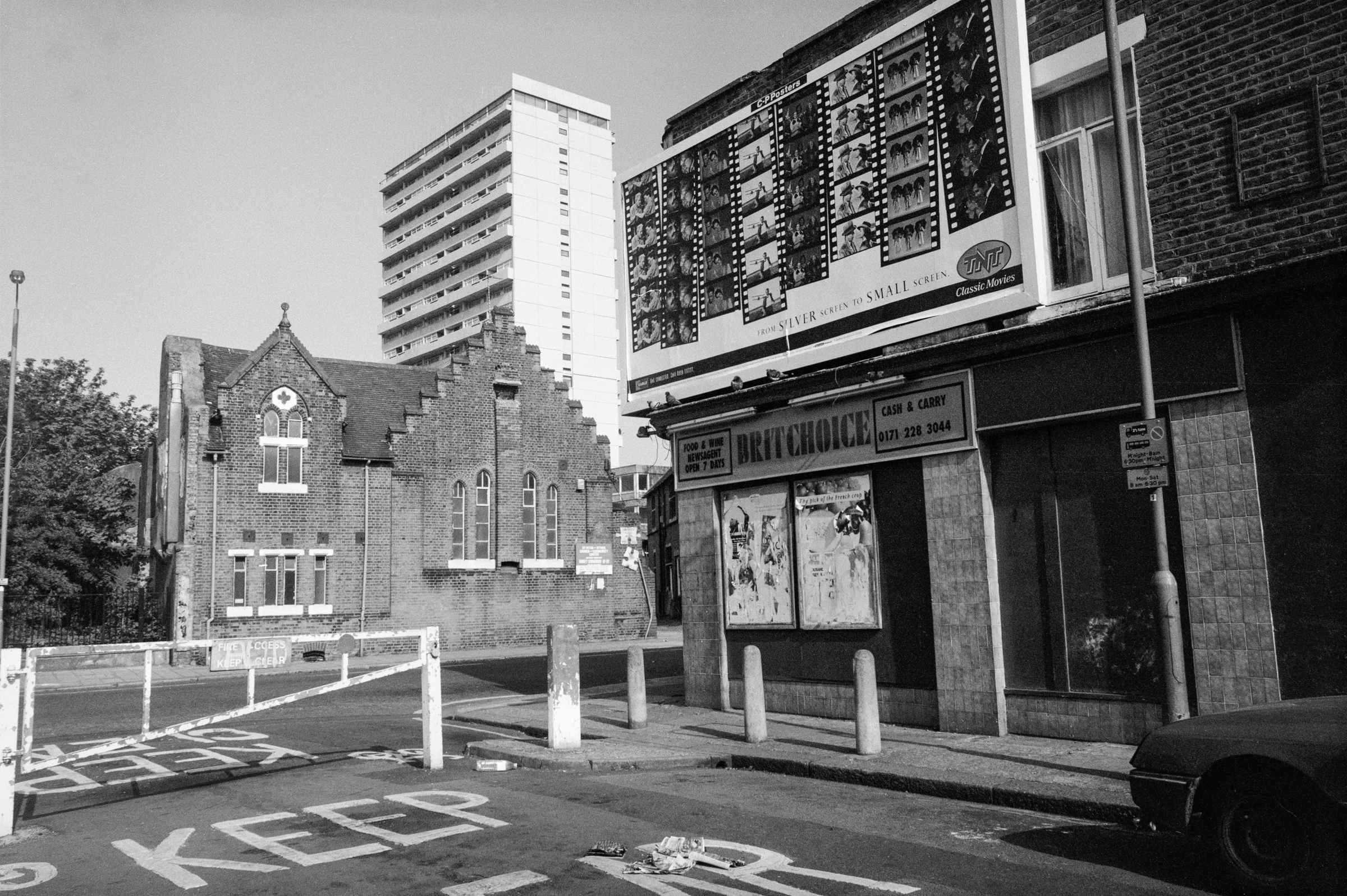
Shop, St Peter & St Paul, Church, Flats, Holgate Ave, Plough Rd, Battersea, Wandsworth, 1989

The view of the church from Holgate Avenue shows clearly the position of the church on the edge of the Winstanley Estate to the north of Clapham Junction station. The view of the tower block Sporle Court is now blocked by the new 10 storey block on the church site. The trees at left are in York Gardens.

There is still a billboard and a shop on the corner of Holgate Avenue, but what was then BRITCHOICE is now SUNRISER EXPRESS POLSKI SKLEP. Holgate Avenue was until 1931 known as Brittania Place or Brittania Street and took its name from the Brittania beer house which was possibly in this shop, part of a group of two buildings at 38-40 Plough Lane which are the only remnants of the original 1860s development of the area.

Apparently the Revd Chad Varah, the founder of The Samaritans, was vicar at Saint Peter’s during the 1950’s. St Peter’s was amalgamated with St Paul’s at some time after 1969 – and St Paul’s had been amalgamated with St John in Usk Road in 1938.

Houses, Holgate Avenue, Battersea, Wandsworth, 1989 89-8c-75

According to the Survey of London, “Holgate Avenue, started in the 1920s, was Battersea’s first
successful slum-clearance scheme
.” Poorly built Victorian houses from the 1860s were replaced by these three-storey tenements built by Battersea’s Labour Council in 1924-37 to high standards with some impressive brickwork and detailing. Probably more importantly for the residents they were provided with electric cooking, heating and lighting facilities, unusual luxury for the time.

There was little land in Battersea for building and while the council would have liked to build single family homes it had to compromise with these. But at least tenants at most had only to walk up three flights of stairs, while most new council building by the LCC in the interwar period was in five-storey tenement walk-up blocks.

Price's Candles, York Rd, Battersea, Wandsworth, 1989 89-8c-62
Price’s Candles, York Rd, Battersea, Wandsworth, 1989 89-8c-62

I walked back up Plough Road to York Road, and continued my walk towards Wandsworth Bridge. There was no access to the River Thames on this stretch before the bridge, as the area was still occupied by industrial premises.

Price’s Candles on York Rd was built on part of the site of York House, the London residence of the Archbishop of York from which York Road got its name. You can read more than you will ever want to know about York House in All about Battersea, by Henry S Simmonds published in 1882 and now on Project Gutenberg, which also has a long section on the Belmont Works or Price’s Patent Candle Factory.

Price’s Candles was begun in 1830 by William Wilson and Benjamin Lancaster who had purchased a patent for the separation of coconut fats. They chose the name Price for the business to remain anonymous as candle-making was not at the time a respectable occupation.

They moved to this site in 1847 setting up a large factory and workforce, making candles, soap and other products with stearine wax for the candles and the by products of glycerine and light oils coming cocunuts grown on a plantation they bought in Ceylon. In 1854 they began to import large quantities of crude petroleum from Burma and developed paraffin wax candles. Later they developed processes to work with other industrial wastes, animal fats and fish oils. By 1900 they were the largest candle manufacturer in the world.

The company was taken over by Unilever in 1919, and became owned by other oil companies including BP, who sold part of the site which opened in 1959 as the Battersea Heliport. A few of Price’s buildings remain, though most with added floors, and the rest of the site is mostly new blocks of flats.

York Tavern, pub, 347, York Rd, Battersea, Wandsworth, 1989 89-8c-63

The York Tavern was on the corner of York Road and Usk Road in the late 1850s but was given a makeover later in the century in the typical 1890s Queen Anne style with fake gable facades. I can’t find a date for the closing of this pub but it was clearly very shut when I made this picture. The building was demolished in 2003.

John Watney & Co Ltd, Wandsworth Distillery, York Rd, Battersea, Wandsworth, 1989 89-8c-64

Wandsworth Distillery on York Rd was founded by Richard Bush at Gargoyle Wharf around 1780. By 1874 it was owned by John and Daniel Watney. Gin was produced here, having become popular after heavy taxes were imposed on French brandy, and later particularly in the colonies to counteract the unpleasantly bitter taste of the anti-malarial quinine.

Acquired by Guinness, the distillery was demolished in 1992, and I photographed its occupation as the ‘Pure Genius Eco Village‘ by The Land is Ours in 1996. It was redeveloped as Battersea Reach housing from 2002 on.

More from this walk in another post.


FlickrFacebookMy London DiaryHull PhotosLea ValleyParis
London’s Industrial HeritageLondon Photos

All photographs on this page are copyright © Peter Marshall.
Contact me to buy prints or licence to reproduce.