Southwark Housing, Bermondsey & Rembrandt – 2014

Southwark Housing, Bermondsey & Rembrandt: On Thursday October 16th 2014 I photographed a march from the Elephant to Southwark Council Offices over the borough’s housing scandals, took some time off in Bermondsey to take some panoramic images and then covered a protest at the National Gallery against sponsorship of art exhibitions by companies such as Shell, G4S, BP and Serco.


Compulsory Purchase Orders for Southwark Councillors
Southwark Housing, Bermondsey & Rembrandt

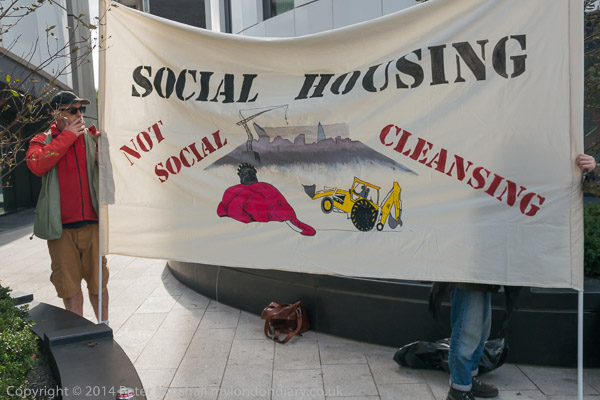
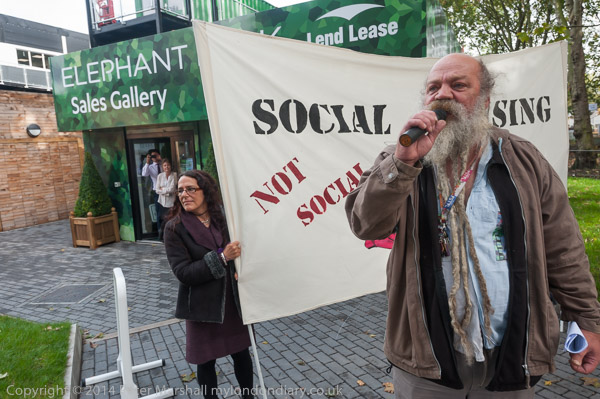
Housing campaigners from Southwark marched from the Elephant and Council to Southwark Council Offices to serve ‘People’s Compulsory Purchase Orders‘ on the homes of the Council leader and other councillors who they say have accepted gifts from developers to sell off council estates at knockdown prices.

Southwark Housing, Bermondsey & Rembrandt

The shameful demolition of over 1200 homes in and close to the well-designed and largely popular Heygate estate has cost the borough dearly, with the costs to the council of ‘decanting’ the residents exceeding the knock-down price it charged the developers.

Southwark Housing, Bermondsey & Rembrandt

Of course the estate residents suffered more, losing their homes and being forced to move further out into the suburbs. Leaseholders were only offered roughly half the true market value of property in the area.
Southwark Housing, Bermondsey & Rembrandt

The demolition and redevelopment has meant the loss of over a thousand social homes, and the new properties on the site had already been advertised to overseas buyers in Singapore and elsewhere as second homes, investment properties, homes for wealthy overseas students studying here, buy-to-let etc. There are just a few so-called affordable units at 80% of market rates, still well above what most Londoners can actually afford.

The protesters met at the base of the Strata Tower, an ugly development of largely luxury flats with three wind turbines built into its roof for show – unable to produce electricity as when running they produce excessive vibration in flats at the top of the building. Facing them ‘One The Elephant‘ was going up, a 44 storey block of luxury flats with no social housing, and is being sold abroad, with ‘studio flats’ starting at around £320,000 or 640,000 Singapore dollars.

Southwark campaigners were joined by members of the Focus E15 ‘Housing for All campaign’ and their first stop for a brief protest was the Elephant Park Sales Office on the Walworth Rd. They then walked through several council estates to the north of the New Kent Road which are also attractive targets for developers who can make huge profits by demolishing them and building high price flats at much higher densities.

They continued through other council estates in the area to London Bridge Station and on to the council offices in Tooley Street, where they were stopped by security from entering the Council offices. Police were called and after much argument two of the campaigners who were Southwark residents were allowed in and waited to present letters containing ‘People’s Compulsory Purchase Orders’ for their homes to council leader Peter John and two other councillors.

They asked at reception to see the councillors and were told to take a seat and wait. They waited and waited. Eventually someone from the council came to tell them that all three named councillors were unavailable but took their letters promising to hand them over personally to them.

More at CPOs for Southwark Councillors.


Bermondsey Thames Panoramas – City Hall to Angel Wharf

I had some time before my next protest and took a short walk by the River Thames,

beginning in Potters Fields where ‘One Tower Bridge’ was going up close to City Hall.

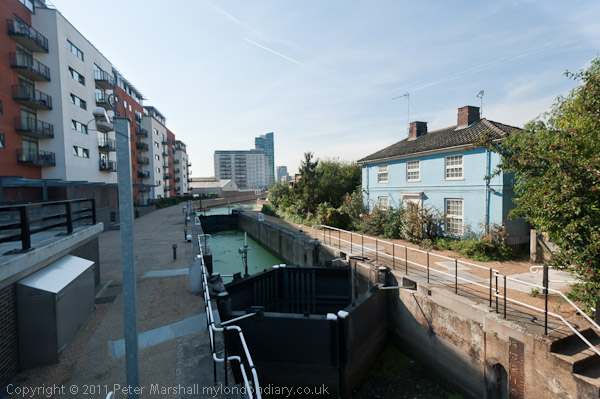
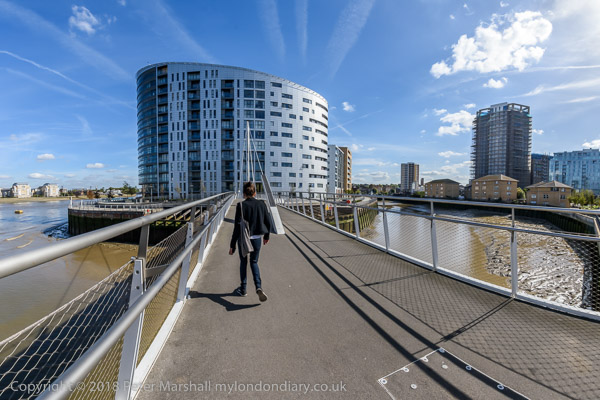
Past Tower Bridge I took a short walk on the foreshore in front of Butler’s Wharf before continuing along Shad Thames and across the footbridge over St Saviour’s Creek.

I continued along the Thames Path past the moorings, and got as far as Angel Wharf before I realised I needed to catch a bus to get me back to Trafalgar Sqaure in time for my next event.

More pictures Bermondsey Thames Panoramas


Art Not Oil Rembrandt Against Shell – National Gallery
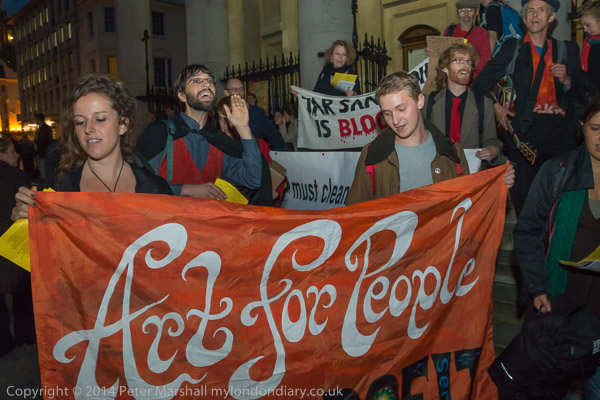
The Art Not Oil coalition had gate-crashed the press launch of the National Gallery’s Rembrandt exhibition to give a brief performance protesting against oil sponsorship of the arts and privatisation of gallery staffing.
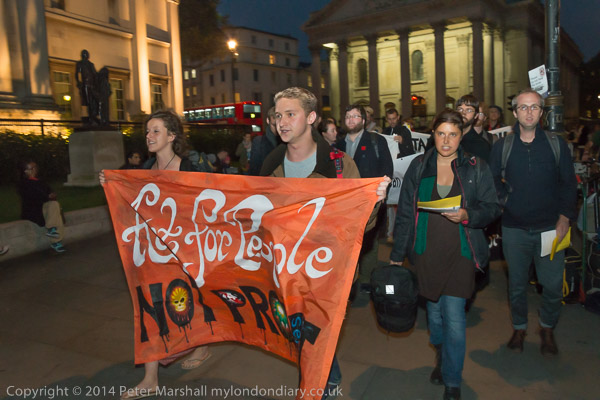
On the evening of 16th October they met on the steps of St Martin-in-the-Fields before marching the few yards to give a repeat performance outside the gallery which was then holding a gala evening for special guests and highly ranked staff.
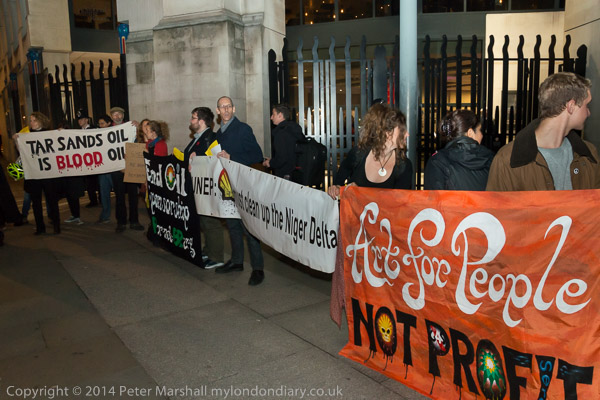
The National Gallery was making plans to privatise up to two thirds of the gallery staff and this exhibition was being guarded by a private security firm rather than the gallery’s own staff.
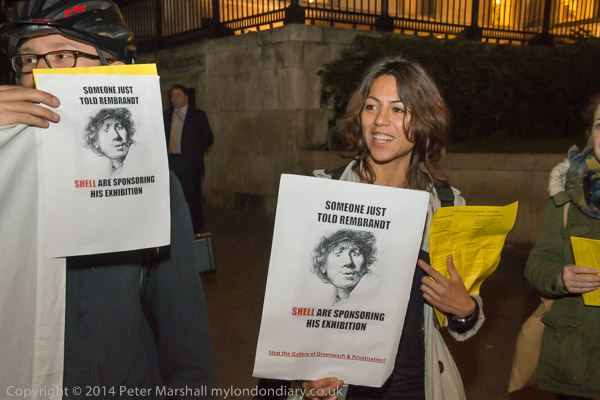
Art Not Oil held banners and placards and handed out flyers agains the sponsorship by Shell stating:

"The presence of unethical sponsors like Shell and the contracting of external security firms shows the growing influence the private sector is having over our arts and culture. With its meagre contribution to the gallery, Shell is buying social legitimacy for its dodgy deeds worldwide, including:

- its failure to clean up its multiple spills in the Niger Delta
- its reckless plans to drill in the Arctic for yet more oil
- its tar sands projects in Canada that are undermining Indigenous people's rights"
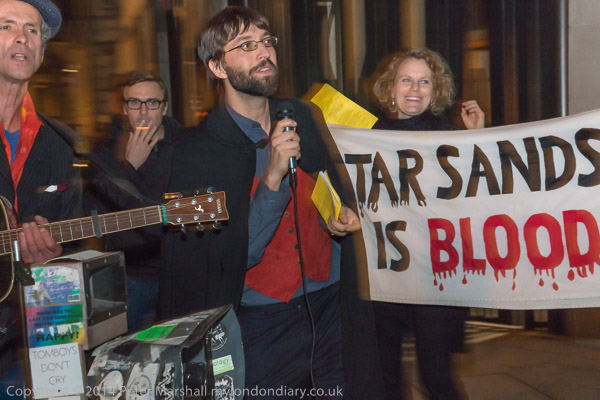
They sang a number of specially written songs and performed the short playlet they had previously given inside the gallery during the press launch.
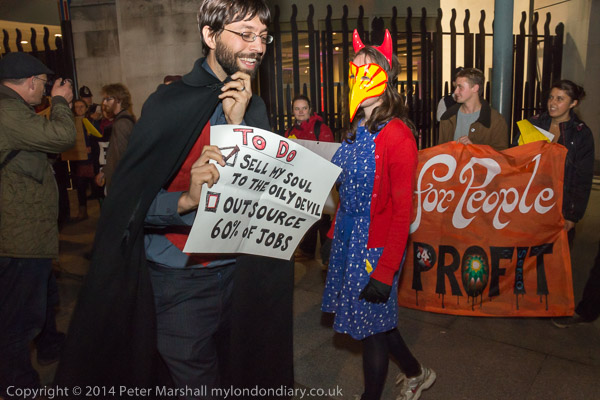
More at Art Not Oil Rembrandt Against Shell.


FlickrFacebookMy London DiaryHull PhotosLea ValleyParis
London’s Industrial HeritageLondon Photos

All photographs on this page are copyright © Peter Marshall.
Contact me to buy prints or licence to reproduce.
Barging on Bow Creek – 2011

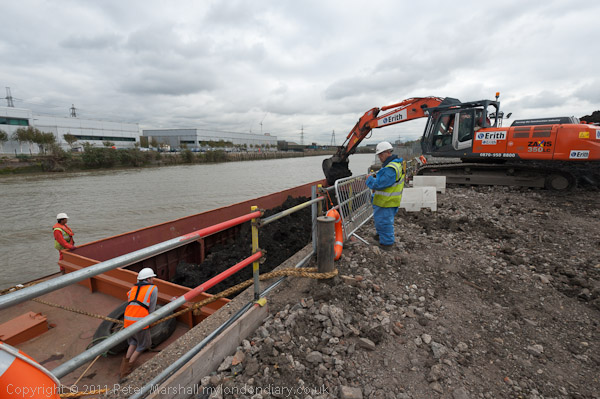
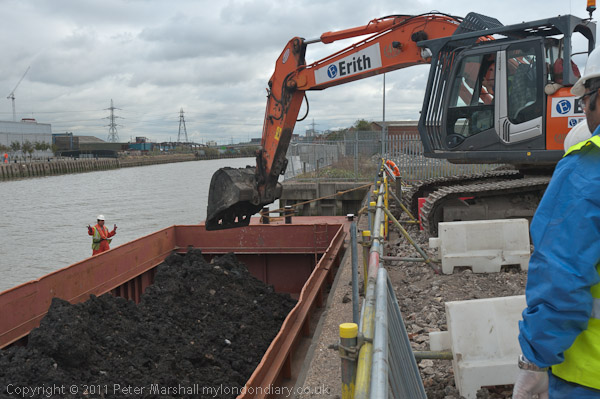
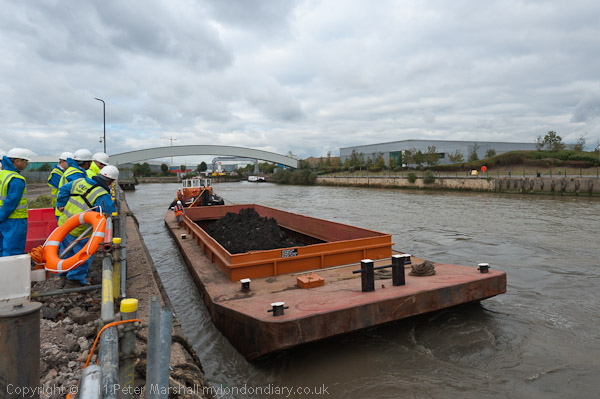
Barging on Bow Creek: On Wednesday 12 October 2011 I was pleased to get paid to go back to Bow Creek and take photographs of a working barge on Bow Creek in Poplar.

Barging on Bow Creek - 2011

Bow Creek is the lower part of the River Lea, between Bow Locks and the River Thames. Bow Locks mark the southern end of the Lea Navigation and since London’s oldest canal, the Limehouse Cut opened in 1770, most canal traffic took advantage of this to take a more direct route to the Thames and avoid the dangerous and meandering tidal Bow Creek.

Barging on Bow Creek - 2011

The River Lea remains tidal some miles above Bow Lock, but this tidal section is separate from the navigation, although there are various channels and locks such as City Mill Lock and Carpenters Lock on the Olympic site which link the two.

Barging on Bow Creek - 2011

Bow Creek continued to be used for navigation, including for bring coal to West Ham Power Station and the huge Imperial Gas Light & Coke Company gas works at Bromley-by-Bow.

Barging on Bow Creek - 2011

But the gas works closed in 1976 although its gasholders remain – they were still in use for gas storage until 2010. (I went inside the site to photograph them in 2022.) Planning permission has now been granted for 2,200 new homes on the site, retaining the seven gasholders. The gas works dock is now Cody Dock, a creative and community hub with moorings and a short walk from the DLR at Star Lane, hosting many intersting events.

West Ham Power Station ended production in 1983 and was then demolished to build a business park. In the lower sections of Bow Creek there were still a number of timber yards and a ship repair business still using the creek at least in the 1980s, but I think all all commercial traffic has now ended.

Much was made during the construction of the Olympic site of the use of barges to carry waste away from the area, and a new lock was built at great expense on the Prescott Channel at Three Mills Green, but I think barges were only used for PR photographs and the huge majority of waste was taken out by lorries.

So I was pleased to hear that “the people cleaning up the gas works site at Poplar … were using barges to carry out the highly toxic soil from the site* and “… “was delighted to be given a commission to go and photograph the barging.”

This is what a rubbish recycling plant looks like

On My London Diary I write more about my relationship with the River Lea which had begun in 1981 when “I heard a story on the radio that commercial barge traffic was about to come to an end on the Lea Navigation, and decided to travel across London to record its last days.” From then I carried out a major project on the river, but was disappointed to have a funding application turned down.

I returned to the River around ten years later and again in the early 2000s, with more frequent visits after the Olympic bid was successful – although access to the main site was soon impossible. In 2010 I published Before the Olympics, ISBN: 978-1-909363-00-7 with over 200 pictures from the source to the Thames.

The My London Diary post also describes my experience on the visit – how I had to dress up to take the pictures – and that although I’d been promised I would have half an hour to take photographs it actually ended up as 11 minutes.

After taking the pictures – both for the project PR and myself – I had the rest of the day to take a walk along Bow Creek again and made my way to the Thames on the Greenwich meridian, where I found “a new marker installed in the Virginia Quay estate next to West India Docks station, built since I carried out my ‘Meridian Project‘ in the 1990s and made an unsuccessful bid to create a’Meridian Walk’ to mark the new millennium.” Now there is a sculpture trail, The Line, which in part follows Bow Creek – and includes work at Cody Dock.

All pictures in this post are from Wednesday 12 October 2011. There are many more pictures from my walk as well as the barging at Barging on Bow Creek


FlickrFacebookMy London DiaryHull PhotosLea ValleyParis
London’s Industrial HeritageLondon Photos

All photographs on this page are copyright © Peter Marshall.
Contact me to buy prints or licence to reproduce.


Liverpool Road, Highbury Corner & Caledonian Rd – 1989

Liverpool Road, Highbury Corner & Caledonian Rd continues my walk in Islington on Sunday 15th October 1989 which began with the post Memorials, Eros and More. The previous post was Shops, a Poly, Electricity, Church & Library.

Samuel Lewis buildings, Samuel Lewis Housing Trust, Liverpool Rd, Islington, 1989 89-10h-63

Samuel Lewis was born in Birmingham in 1837, started work at 13 selling steel pens, then opened a jewellers shop before becoming the most fashionable money-lender of his day. When he died in 1901 he left £2.6 million to his wife, with over £1 million going to charity on her death.

£670,000 of this – equivalent to around £30 million today – went to a charitable trust to provide housing for the poor, and these flats are on the first of eight large estates they built.

This estate was built in 1909-10 for the Samuel Lewis Trust, architects Charles Sampson Joseph, (1872-1948), Charles James Smithem and Ernest Martin Joseph (1877-1960) who worked as Joseph & Smithem until 1916. The two Joseph brothers were sons of Nathan Solomon Joseph (1834-1909) who as well as building many synagogues was the leading designer of social housing as architect for the Guiness Trust and the Four per Cent Industrial Dwellings Company and worked also for the LCC and other London councils and he may also have contributed to the designs for these buildings.

Hampton Court, Upper St, Islington, 1989 89-10h-41

I was amused by the contrast between this street and its namesake palace on the River Thames. This Hampton Court is a short street leading west from Upper Street at Highbury Corner, leading to Swan Yard, which is at the end of the street in my picture.

On the left wall is a sign for J Barrett & Sons, but I can’t make out what their business was at 250 Upper St, now a Starbucks. The posters on the wall at right are for a Socialist Party Public Meeting and I think we have four pictures of Maggie Thatcher; I can’t quite read the text but I’m sure it wasn’t complimentary.

The tall building on the right at the end of the street is now a printers and I think probably was when I made this picture. Those to the right of it have been replaced and I think those on the left considerably refurbished. Those in Swan Yard at the end of the street are still there but have lost their white paint.

Swan Yard, Islington, 1989 89-10h-43

I think Highbury Studios, at 15 Swan Yard and most other workshops on the street have been converted to residential or office use and there is now a new building at the southern end of the street, recently converted into coworking office space with a communal roof terrace overlooking Laycock Green, an urban green open space.

Swan Yard and the southern side of Hampton Court are included in the Upper Street (North) conservation area.

Mallett, Porter & Dowd, North London Engineering Works, 465, Caledonian Rd, Lower Holloway, Islington, 1989 89-10h-33

This warehouse and works was built in 1874. Its conversion to student housing for University College London was awarded the Carbuncle Cup for the ugliest building of 2013 from Building Design magazine. The red brick building was demolished with its frontage retained a short distance in front of a a new multicoloured building. The judges commented “The original frontage has been retained in a cynical gesture towards preservation. But its failings go deeper,” and said “This is a building that the jury struggled to see as remotely fit for human occupation.” The rooms lack adequate daylight, give little privacy and those behind the facade have no view outside. Islington council had refused planning permission for the treatment of this locally listed building but were overruled.

Hubbards for Cupboards, 453, Caledonian Rd, Lower Holloway, Islington, 1989 89-10h-35

Those musical among you can sing “We’re Hub-bords Cup-boards, We’re Hub-bords Cup-boards, We’re go-ing to fight, fight, fight – to get your of-fice right” to the tune shown on this shop, Hubbards for Cupboards Tables & Chairs, at Hubbards Corner on Caledonian Rd. 453 Caledonian Rd on the north corner with Market Road is now a large block of flats with a natural food shop at ground level.

Caledonian Road Methodist Church, Caledonian Rd, Market Rd, Lower Holloway, Islington, 1989 89-10h-36

Built in an Italianate style in 1870 as a Primitive Methodist Chapel, architects T & W Stone, it became Caledonian Road Methodist church in 1932 and is still in use. It was restored in 1953 and the exterior cleaned in 1980. Grade II listed.

Market Rd, Lower Holloway, Islington, 1989 89-10h-24

This building, at 18 Market Road opposite the bus stop at Market Road Gardens and the adventure playground was demolished between 2008 and 2012. Peter Darley in The Journal of the Islington Archaeology & History Society says it was a tripe factory when Czech refugge Otto Fischel bought it in the 1950s and made it Otaco Ltd, plastic injection moulders. His wife, artist Käthe Strenitz was fascinated with industrial London and produced many fine pictures.

You can read more in Jane’s London about J. L. Henson tripe dealer whose name was originally on the panel where E.Zee is in my picture. But the elephants and E. Zee remain unaccounted for, but were perhaps linked in some way with the playground opposite. Though I have a nagging feeling that somewhere in the past I have written more about them.

A private limited company EZEE Ltd, Company number 02564140, was incorporated in 1990, had its registered office for a year in 1992-3 at 14-18 Market Rd. Its business was given as Artistic & literary creation etc. It last filed annual returns in 1991 and was finally dissolved in 2015.

My walk continued and there will be another post shortly.


FlickrFacebookMy London DiaryHull PhotosLea ValleyParis
London’s Industrial HeritageLondon Photos

All photographs on this page are copyright © Peter Marshall.
Contact me to buy prints or licence to reproduce.


Saffron Revolution & Slave Trade Abolition – 2007

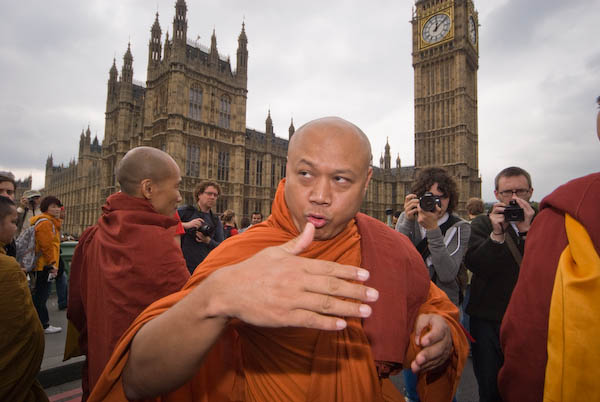
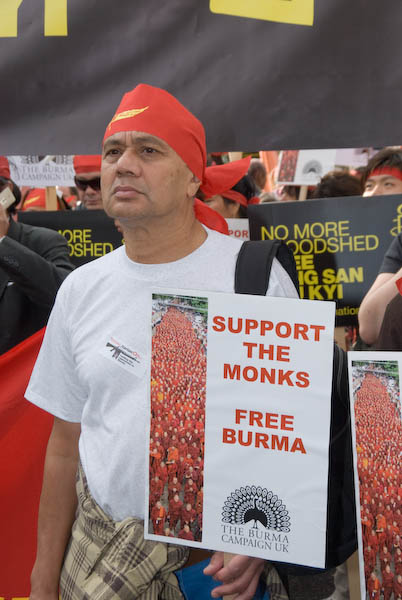
Saffron Revolution & Slave Trade Abolition: On Saturday 6th October 2007 I photographed a protest against the brutal repression of the Saffron Revolution protest in Myanmar (Burma) and a celebration of the 200th anniversary of the abolition of the slave trade,


Global Day of Action for Burma – Westminster

There was considerable support in the UK and UK media for the Burmese people who were taking part in non-violent protests against the military dictatorship there after it decided to remove subsidies on fuel, exacerbating a cost-of-living crisis in the country.

The protests were led by thousands of along with students and political activists and were often referred to as the Saffron Revolution.

The protests had begun in August 2007 and in late September after protests involving many thousands in various cities the government began a huge crackdown using military force to stop the protests and imposing curfews and prohibiting gatherings of more than five people.

Monasteries were raided, thousands of arrests were made and some protesters were killed. Wikipedia gives a great deal of detail, and on 1st October it was reported that around 4,000 monks were being detained at a disused race course, disrobed and shackled.

The official death toll over the period of the protests was 13, but the independent media organisation Democratic Voice of Burma based outside the country produced a list of 138 names of those killed.

The march began at Tate Britain on Millbank, proceeded over Lambeth Bridge and then returned to Westminster over Westminster Bridge. Many of the roughly 10,000 marchers wore red headbands and a small group of monks were allowed to tie strips of cloth onto the gates of Downing Street before the march continued to a rally in Trafalgar Square, where I left them.

More at London Burma March.


Slave Trade Abolition Bicentenary Walk

In 1787, Thomas Clarkson, Granville Sharp and ten other anti-slavery campaigners founded The Society for the Abolition of the Slave Trade. Nine of the twelve founders were Quakers, including the wealthy banker Samuel Hoare Jr which prevented their having much involvement in parliament.

Perhaps because of this the society became the first modern campaigning movement, working to educate the British public about the cruel abuses of the slave trade through publication of books, prints, posters and pamplets, organising lecture tours, including that by former slave and author Olaudah Equiano and by boycotting of goods produced by slaves.

The Quakers had organised petitions against slavery and presented these regularly to Parliament, and in 1787 William Wilberforce, MP for Hull was persuaded to join the movement, presenting the first Bill to abolish the slave trade in 1791 which was heavily defeated.

Further Bills followed on an almost annual basis, and finally in 1807 the Abolition of the Slave Trade Act was passed, with a majority of 283 votes to 16 on its second reading in the House of Commons. A similar act was passed by the USA in the same year taking effect at the start of 1808.

Despite this it took another thirty years for slavery in the British Empire (except those parts ruled by the East India Company) to be abolished in 1838. And when this was done the freed slaves received no compensation but massive amounts were paid to the former slave owners, a total of around £20 million, around 40% of the national budget and allowing for inflation around £2, 800 million today. Fact checking by USA Today confirms that the UK Government only just finished paying its debts to the slave owners in 2015.

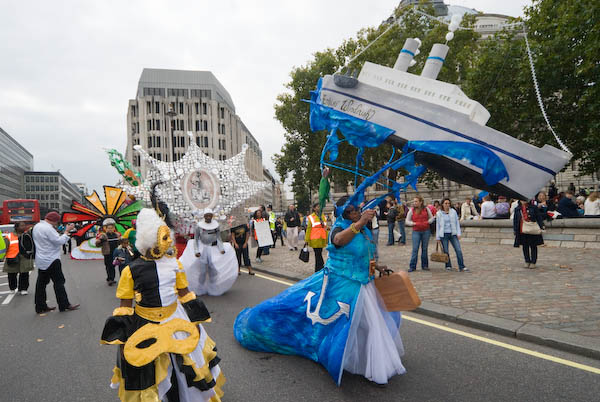
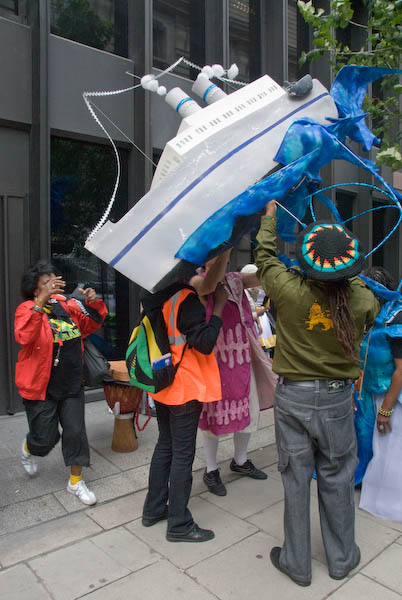
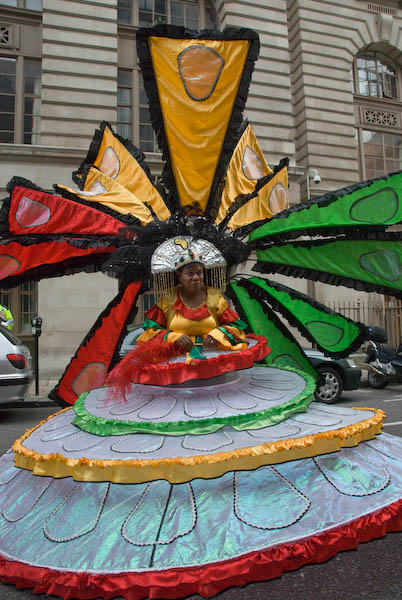
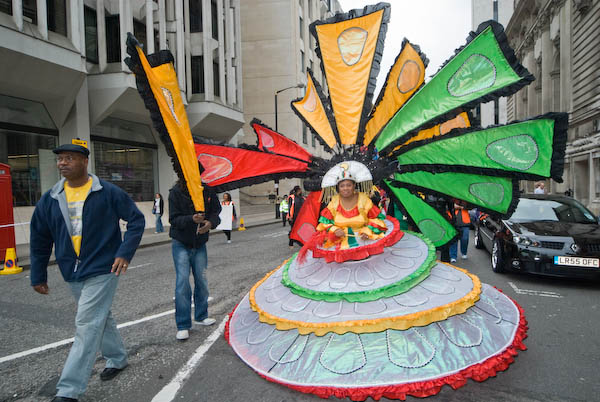
The Slave Trade Abolition Walk organised by Yaa Asantewaa & Carnival Village was only one of a number of events commemorating the abolition of the slave trade taking place in 2007, but was I think the most colourful. Yaa Asantewaa was named after the famous Queen Mother of Ejisu in the Ashanti Empire who led the Ashanti Kings in the War of the Golden Stool against British colonial rule in 1900 and was exiled to the Seychelles where she died in 1921.

Among the costumes was one winner from Notting Hill, and a rather fine ‘Empire Windrush’ depicting the ship which brought the first large contingent of migrant workers from the Caribbean to England in 1948. They had been recruited to fill the gap in UK workers needed to restore the British economy after the war and came to a country where they met much racist discrimination, which more recently became government policy under the Windrush scandal, still continuing.

As of course is slavery. ‘Modern slavery’ is no less slavery than the slavery that was at the core of the British Empire and which provided the wealth that once made Britain ‘Great’.

Slave Trade Abolition Bicentenary Walk


FlickrFacebookMy London DiaryHull PhotosLea ValleyParis
London’s Industrial HeritageLondon Photos

All photographs on this page are copyright © Peter Marshall.
Contact me to buy prints or licence to reproduce.


Shops, a Poly, Electricity, Church & Library – 1989

Shops, a Poly, Electricity, Church & Library: Continuing my walk in Islington on Sunday 15th October 1989 which began with the post Memorials, Eros and More.

Dorset House, 217-9, Holloway Rd, Lower Holloway, Islington, 1989 89-10g-45

I walked back from Hornsey Road to Holloway Road and took this picture of Dorset House on the corner of George’s Road, then the Unique Butchers at 217 and Wai Shang Chinese Take Away at 219. This building had changed little by 2022, though the butchers was then a closed cafe up for sale and the Chinese take-away was now Green Jade.

I’m surprised that this building does not appear to be locally listed, though it is a shame that it has lost the balustrade on its left side. On Drawing The Street where you can see a more recent drawing of the building @ronniecruwys points out that the detailing of the balustrade is identical to that of Southwark Bridge, but that dates from 1921, when Rennie’s earlier bridge was rebuilt. A comment on that post states “My 2 x great grandfather lived here in 1881. His name was Henry Appleby and his father in law who was the head of the house in 1881 (census) was a retired Policeman named Walter Tovey.”

My guess is that this house probably dates from the early 19th century, but like others I have failed to find out more about its history. George’s Road was originally George’s Place, built by George Pocock.

Polytechnic of North London, Holloway Rd, Hornsey Rd, Lower Holloway, Islington, 1989 89-10g-33

Wikipedia tells me the Polytechnic of North London was granted university status to become the University of North London. It existed under that name until 2002, when it merged with London Guildhall University to form London Metropolitan University. It had been formed from Northern Polytechnic, founded in 1896 and North-Western Polytechnic in 1971.

This building mirroring its surroundings is on the corner with Hornsey Road and was rather appropriately I think next to a mirror shop and factory at left of picture, which later in 1994 was redeveloped as the Learning Centre library.

Pyracrest Ltd, 71 Hornsey Rd, Caedmon Rd, Lower Holloway, Islington, 1989 89-10g-22

This shop remained in commercial use until recently, though not for joinery, display and general woodwork but most recently as a glass merchant. It was sold in 2012 and extended. The garage on the opposite corner, shown here only by a Michelin Man poster on the wall closed around 2009 and was replaced by a new residential development with a ground floor café.

Caedmon Road was earlier called Spencer Road, renamed in 1938. Developed in 1866 it was renamed after Caedmon the earliest known English poet, a Northumbrian cowherd working at Whitby Abbey whose only known surviving work is the nine lines of Cædmon’s Hymn. You can read this on Wikipedia and will find only a slight resemblance to modern English – though possibly more to Geordie or the other impenetrable dialects of the north-East.

The Vestry of St Mary Islington, Electric Light Station, Eden Grove,  Lower Holloway, Islington, 1989 89-10g-26
The Vestry of St Mary Islington, Electric Lighting Station, Eden Grove, Lower Holloway, Islington, 1989 89-10g-26

Conveniently the title of this locally listed building at 60 Eden Grove is shown on its exterior along with the date of 1896. As the Islington Society states, Islington was one of the earlier local authorities to distribute electricity. The vestry’s work was taken over by the Metropolitan Borough of Islington in 1900.

At first this power station was only for street lighting, but soon the wealthier inhabitants of the borough could get power for their homes and they say by 1936 it was supplying “40,000 customers through 106 miles of mains.

Former St James, church, Chillingworth Rd, Lower Holloway, Islington, 1989 89-10g-12

This Grade II listed Neoclassical church was built as St James the Apostle Church in Victoria Road (later Chalfont Road, later Chillingworth Road) in 1839, architects Henry William Inwood and E N Clifton. The east end was extended in 1840 by Hambley and he added the tower in 1850. The top section of this was later removed, possibly after bomb damage, in 1944.

The parish was united with St. Mary Magdalen in 1953-4 and a parish hall built in the shell of the church. Converted to offices and recording studio in 1980-82 and renamed St Mark’s Studios. Probably then the concave entrance shown here was constructed and the original pilasters on the facade were replaced by pillars.

Islington Central Library, Fieldway Crescent, Holloway Rd, Lower Holloway, Islington, 1989 89-10g-15
Islington Central Library, Fieldway Crescent, Holloway Rd, Lower Holloway, Islington, 1989

This frontage on Holloway Rd dates from 1906, architect Henry T Hare; the building was enlarged in 1973-6, and has recently undergone considerable refurbishment. It is Grade II listed.

The library was built for the Metropolitan Borough of Islington and received funding of £20,000 from Andrew Carnegie and was opened in October 1907 by Sir Arthur Rucker, principal of the University of London. The bust at the left is of Spenser and that at the right, cruelly cropped, of Bacon. It remains open as a public library.

More to come from this walk later.


FlickrFacebookMy London DiaryHull PhotosLea ValleyParis
London’s Industrial HeritageLondon Photos

All photographs on this page are copyright © Peter Marshall.
Contact me to buy prints or licence to reproduce.


Memorials, Eros and More – Highbury & Lower Holloway 1989

Memorials, Eros and More: On Sunday 15th October 1989 I caught the North London Line from Richmond to Highbury & Islington for the start of another walk in North London.

Boer War Memorial, Higbury Crescent, Highbury Place, Highbury, Islington, 1989 89-10f-24

There had been a series of conflicts between Dutch and British settlers in South Africa for some years as the Boers opposed the British annexation of African countries and resented British attempts to end slavery. The first Boer War in 1880-1 ended badly for the British who signed a peace treaty with Transvaal President Paul Kruger.

But the discovery of huge gold reserves in 1884 created a hug British interest in the area, and Britain again decided to try to take control of Transvaal and the Orange Free State. One of the earliest moves was a failed attempt thought up then by Cape Prime Minister Cecil Rhodes and Johannesburg gold magnate Alfred Beit to provoke an uprising in Johannesburg by an armed raid from Rhodesia, the Jameson Raid over the New Year in 1896. This was followed by an uneasy truce – and an uprising by the Matabele and Mashona peoples against the British South Africa Company whose forces had been greatly weakened by taking part the raid which was suppressed with many Africans killed.

British efforts continued and in 1899 after Britain rejected an ultimatum to withdraw their troops made by Kruger he declared what we generally call the Boer War, though now more widely known as the South African War, which continued until 1902.

The memorial was erected here in 1905 and the inscription reads:

HOW SLEEP THE BRAVE WHO SINK TO REST
BY ALL THEIR COUNTRY’S WISHES BLESS’D.
IN HONOUR OF
NINETY-EIGHT ISLINGTONIANS
WHO DIED FOR THEIR COUNTRY
IN THE SOUTH AFRICAN WAR,
1899 – 1903.
ERECTED BY THEIR FELLOW-TOWNSMEN
JULY 1905.

as well as listing the names of the 98.

The war had repercussions and laid the basis for apartheid in South Africa. It also saw the first ‘concentration camps’ where Boers were imprisoned by the British. And Robert Baden-Powell who had been a scout in the war set up the Scout movement with a uniform and ideas based on his role there.

On the wall behind the cannons is the graffitied message ‘BRITISH STATE HEAR US SAY – IRISH PEOPLE WILL MAKE YOU PAY.

The Court Gardens, Holloway Rd, Highbury, Islington 1989 89-10f-12

This gate to The Court Gardens is, perhaps unsurprisingly, next to Highbury Corner Magistrates’ Court on Holloway Road, which perhaps accounts for the uncompromising concrete wall at right. Underneath the name it states PRIVATE PROPERTY. A private road leads into the housing in Court Gardens from Liverpool Road,

Thomas Judd, Memorials, 123 Holloway Rd, Highbury, Islington, 1989 89-10f-13

Thomas Judd, Memorial & Marble Masons remained in this shop until around 2018. The shop had been open since the 1880s and was thought to have been the oldest business in continuous use on the street.

The Camden New Journal reported in 2018 that its owner, Kenneth Howard, was an 81 year-old who had retired and in 2016 had been suspended from the National Association of Memorial Masons register for a year. This meant the company was unable to work in many cemeteries. He was taken to court by some clients who had paid deposits to him for work he had been unable to deliver, claiming he had been let down by a sub-contractor, and was ordered to pay back the deposits with compensation, court costs and a victim surcharge.

Bookbinders of London, Ronalds Road, Highbury, Islington, 1989 89-10g-61

This company is still in existence but moved its registered office from 11 Ronalds Road in 2014 to Hertford and their name across the adjoining gates was replaced the following year by NET.WORKS.LONDON and later by UNCOMMON as serviced offices.

Although the neighbouring former Salvation Army Citadel is locally listed I was a little surprised to find this building is not mentioned.It is well-proportioned with fine doorways.

Bookbinders of London, Ronalds Road, Highbury, Islington, 1989 89-10g-66

According to the fine ‘Streets With Story’ by Eric A Willats, Ronalds Road was named “after Sir Francis Ronalds (1788-1873) who was, with Wheatstone, one of the pioneers of the electric telegraph. The name was suggested by a Mr. M.C. Sharpe who for years had lived at Highbury Terrace. Sir Francis’s father Francis Ronalds took over no.1 Highbury Terrace in 1796 and died in 1806. The new road had run alongside no.1 and the first electric wires ran from a coach-house of no.1 to a cottage in the immediate neighbourhood.”

Ronalds (1788 – 1873) built the world’s first working telegraph system in his mother’s back garden in Hammersmith when he was 28 in 1816. ‘It was infamously rejected on 5 August 1816 by Sir John Barrow, Secretary at the Admiralty, as being “wholly unnecessary“.’

Drayton Park, Islington, 1989 89-10g-53
Drayton Park Rd, Highbury, Islington, 1989 89-10g-53

I think this fence and yard has long disappeared together with the figure on it, but is was possibly part of Drayton Park School close to the corner of Arvon Road. I think the picture shows a child holding something just above kitchen scales.

Eros Fashions, Hornsey Rd, Lower Holloway, Islington, 1989 89-10g-43

Much of this section of Hornsey Road close to the impressive Victorian School building at 30-36 has been replaced by modern buildings since 1989 and I think that the building that Eros Fashions occupied has gone. Certainly I can find no trace of it now.

Back then Eros Fashions was still in business, with vacancies for almost everyone involved in the manufacture of clothing:

VACANCIES
MACHINISTS
FINISHERS
PRESSER
OVERLOCKERS
FELLING
CUTTER

on the board beside the door, and shadowy mannequins inside.

This is the final picture in my book ‘1989’ still available on Blurb, though at a silly price for the print version, and the full set of pages is on the web site, including this image and this text:

‘Eros, fairest among the deathless gods, who unnerves the limbs and overcomes the mind and wise counsels of all gods and all men within them.’

Created first out of Chaos, also son to Aphrodite, though argument rages as to whether his Dad was Zeus, Ares or even Uranus.

It must be a bit of a come-down to be running a fashion manufacturer (to be rude you could call it a sweat-shop) in North London. Though he was always a bit of a shady character – those different names for a start – Cupid and Amor – what was he trying to hide? And then there’s that business with Hymen, best not to say too much.”‘”

Which seems a suitable place to end this post, though my walk will continue in further episodes.


FlickrFacebookMy London DiaryHull PhotosLea ValleyParis
London’s Industrial HeritageLondon Photos

All photographs on this page are copyright © Peter Marshall.
Contact me to buy prints or licence to reproduce.


Lea Navigation & Olympic Site

Lea Navigation & Olympic Site: Saturday 1 October 2011 was a fine day and I decided to go early to Stratford and take a photographic walk around Bow & Stratford Marsh, before a meeting at the View Tube on the Greenway overlooking the Olympic site.

Lea Navigation & Olympic Site

I took the Jubilee Line to Stratford and then walked over the footbridge leading to the Carpenters Estate and then on to Stratford High Street. A great deal of new building was taking place there, including a new bridge to carry the Olympic crowds across the busy road on a route from West Ham station along the Greenway. The bridge was demolished shortly after the games ended.

Lea Navigation & Olympic Site

This section of the Greenway – the path on top of Bazalgette’s Northern Outfall Sewer rebranded in the 1990s – was closed off by fences and I kept on walking down the High Street. A few yards along was one of the few remaining commercial sites, though by then derelict and for sale. It was demolished and the site flattened for the Games, though it was only five years later than penthouses on the new block here were offered for sale.

Lea Navigation & Olympic Site

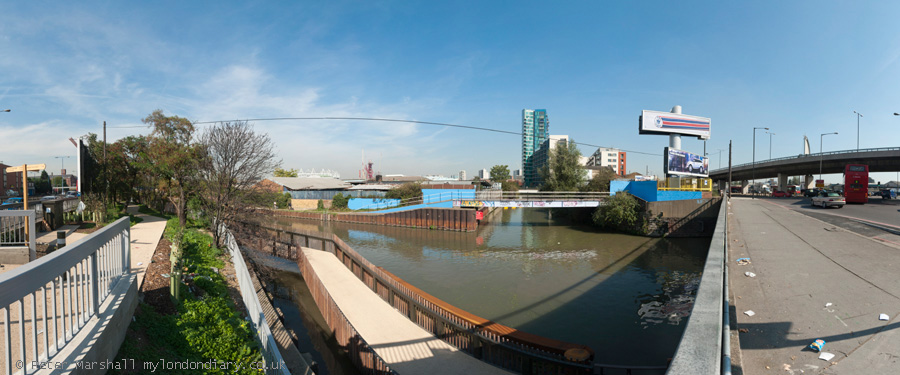
A few yards off the High Street was City Mill Lock, now behind a row of flats. I continued on to the Lea Navigation. The industrial sites on the High Street had now been cleared and there were now huge advertising structures.

Lea Navigation & Olympic Site

I had come mainly with the intention of making panoramic images, but these don’t display well on this blog, but you can see them larger on My London Diary. A footway now carries the towpath under the Bow Flyover and the High Street and then across the canal where the towpath continues on the opposite bank.

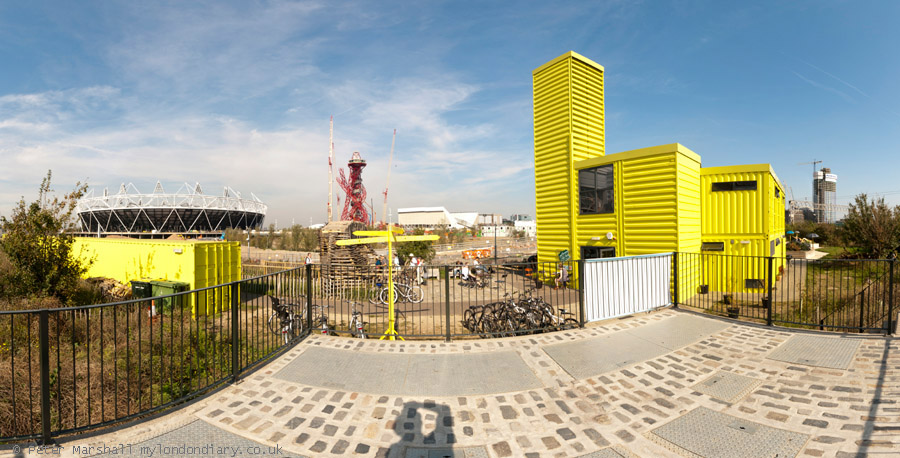
I made far too many pictures around this part of the canal before I could drag myself away, although the sky was not at its best for panoramic images and I would have prefered more distinct clouds rather than the large areas of blue. Only the first section of Cook’s Road was still open, but I could walk along beside St Thomas’s Creek to Marshgate Lane and then make my way to the bright yellow View Tube.

Here I was one of five photographers taking part in what was billed as a ‘Salon de Refuse Olympique‘, showing our artistic responses to the area. It was interesting to see the very different work that the five of us presented. You can read more about this in a post published here two days after the event in 2011, Northern Outfall Sewer 1990, 2005, 2010… which includes the three pictures I contributed for a forthcoming book as well as a lengthy text based on my presentation.

The Olympics have certainly changed this area, and the changes which were showing back in 2011 have continued. Many more pictures – both panoramic and normal aspect ration – in my post on My London Diary at Lea Navigation & Olympic Site.


FlickrFacebookMy London DiaryHull PhotosLea ValleyParis
London’s Industrial HeritageLondon Photos

All photographs on this page are copyright © Peter Marshall.
Contact me to buy prints or licence to reproduce.


Yet More from Stoke Newington

Yet More from Stoke Newington: This is the final post about my walk on 8th October 1989 going down Stoke Newington High St towards Dalston with some minor detours. The previous post on this walk was Cemetery, Synagogue & Snooker.

Shops, 77, Stoke Newington High St, Stoke Newington, Hackney, 1989 89-10f-52

I wondered about the history of these three shops at 75-79 Stoke Newington History with the three-story Golden House Chinese takeaway at its centre. The first-floor brickwork on either side didn’t quite seem to match suggesting to me that the central building may have been a post-war addition to an existing building, or that these first floors may have been a later addition.

This central shop is still a Chinese takeaway but under a different name.

Hovis Bread, Batley Rd, Stoke Newington High St, Stoke Newington, Hackney, 1989, 89-10f-55
Hovis Bread, Victorian Grove, Stoke Newington High St, Stoke Newington, Hackney, 1989 89-10f-55

The Cinema Treasures site states that The Vogue Cinema at 38 Stoke Newington High St opened as The Majestic Electric Palace on 15th December 1910 and was closed on 21st June 1958 as a protest by Classic Cinemas against the landlord’s rent rise.

It remained shuttered and closed for 42 years until in November 2000 the foyer was converted into a Turkish restuarant with housing behind, described to me on Flickr as the “best Turkish restaurant ever.” The restaurant owners restored the Vogue sign.

My picture with the Hovis Bread ghost sign was taken from a few yards down Victorian Grove looking towards the cinema across the High Street. The block at right of the picture has now been replaced by a large building with a Tesco Extra on its ground floor.

House,  Victorian Grove, Stoke Newington, Hackney, 1989 89-10f-56
House, Victorian Grove, Stoke Newington, Hackney, 1989 89-10f-56

This street was originally called Victoria Grove, but its name was changed some time in the middle of the last century. Much of the area was redeveloped in the 1970s but these houses dating from the early years of Victoria’s reign in the 1840s or 1850s remain.

This Grade II listed pair with the unusual curved bays and balconies have the name ‘BRIGHTON VILLAS’ on a plaque between the first floor windows, hidden by the curvature of the nearer bay in my photograph. The nearer balcony roof has been replaced since I took this, matching the one on its neighbour.

Works entrance, Victorian Grove, Stoke Newington, Hackney, 1989 89-10f-41

The wall beside 3 Victorian Grove is still there, but now has only graffiti on it. There are still some industrial units behind the villas of Victorian Grove, though surely they will soon be replaced by expensive flats, but access to these is now thourgh a gated vehicle entrance further down the street.

Posters, Stoke Newington High St, Stoke Newington, Hackney, 1989  89-10f-42
Posters, Stoke Newington High St, Stoke Newington, Hackney, 1989 89-10f-42

Should you Google – as I did – ‘Trevor Moneville‘ – you will find he was a 33-year-old from Hackney, was found dead at HMP Lewes on April 18, 2021 from Sudden Death in Epilepsy (SUDEP) because of insufficient and unacceptable management of his care.

But this was a case of history repeating itself. A copy of the poster at top right is also in the collection of Hackney Museum, where the web site notes:

“Trevor Monerville went missing from Stoke Newington police station after being taken into custody on New Year’s Eve, reappearing after several days on the other side of London in Brixton prison. He had multiple injuries and later underwent emergency surgery in Maudsley Hospital. The case highlighted existing concerns about alleged institutional racism in the Metropolitan Police and led to the formation of the Hackney Community Defence Association in 1988.”

And in the centre of the picture is a poster for another, better known case of police brutality. Blair Peach was a young teacher murdered by the police Special Patrol Group who went beserk when policing an anti-racist protest in Southall on 23 April 1979.

Andy's Fashions, 141, Stoke Newington Rd, Stoke Newington, Hackney, 1989 89-10f-43
Andy’s Fashions, 141, Stoke Newington Rd, Stoke Newington, Hackney, 1989 89-10f-43

Further south Stoke Newington High Street becomes Stoke Newington Road, and back in 1989 I found myself confusing the two. Andy’s Fashions was at 141 Stoke Newington Road. No longer Andy’s, the shop is now Stitch “N” Time offering tailoring, alterations, repairs. and no longer has its wares on the pavement outside or partly blocking the entry to the Stoke Newington Estate of the Industrial Dwellings Society (1885) Ltd.

The IDS was established as the Four Per Cent Dwellings Company in 1885 by “Jewish philanthropists to relieve the overcrowding in homes in the East End of London” and changed its name in 1952. They opened the Stoke Newington Estate in 1903.

Curtains,  Stoke Newington Rd, Stoke Newington, Hackney, 1989 89-10f-32
Curtains, Stoke Newington Rd, Stoke Newington, Hackney, 1989 89-10f-32

Another shop somewhere on Stoke Newington Road, with a fine formation of net curtains for sale, though in my book ‘1989’ I imagined them rather differently, perhaps as the front of a vast army of angels, “Or a phalanx of klansmen or some strange voodoo creatures about to burst out onto the streets of London.

The book is still available on Blurb, though at a silly price for the print version, but you can see over half of it on the preview there or the full set of pages on the web site where this image and its text is on page 19.

The texts in that book were intended to explore the question of why some scenes grabbed my attention enough to make me fix them as photographs, and why they continue to excite my imagination and I hope that of other viewers.

Street Market, Shoreditch High St, Tower Hamlets, Hackney, 1989 89-10f-33

My walk had ended and I got on the bus to take me to Waterloo for the train home. I almost always sit on the upper deck on double-decker buses and enjoy the views from the windows. As the bus went slowly along Shoreditch High Street close to the junction with Commercial Street it passed the informal market on the pavement where I had time to take three frames through the window. The area looks a little different now, but the last time I went past on a Sunday there was still a rather similar market there.

This is the final post about my walk on 8th October 1989. You can find more pictures from London and elsewhere on Flickr, with both black and white and colour images in albums mainly arranged by the year I took them, such as 1989 London Photos and 1989 London Colour.


FlickrFacebookMy London DiaryHull PhotosLea ValleyParis
London’s Industrial HeritageLondon Photos

All photographs on this page are copyright © Peter Marshall.
Contact me to buy prints or licence to reproduce.


A Day Out in Deptford – 2018

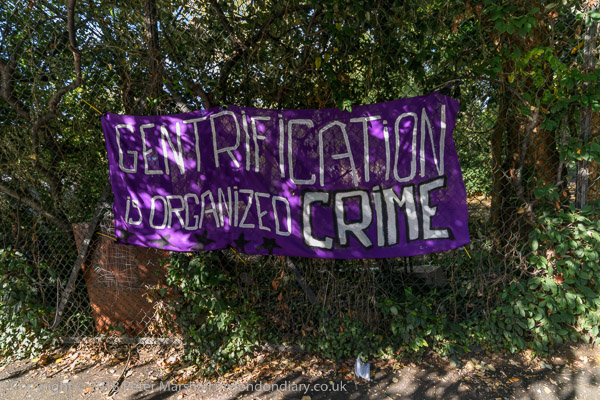
A Day Out in Deptford: On Saturday 29th September I had decided to go on the Deptford Art & Gentrification Walk, part of the Deptford X Festival, and Deptford Aint Avinnit, an art crawl organised by ART&CRITIQUE. This was the second such walk, following on from an earlier event in May 2018.

A Day Out in Deptford

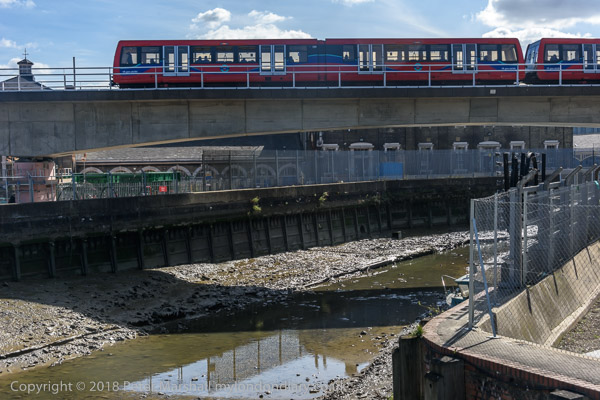
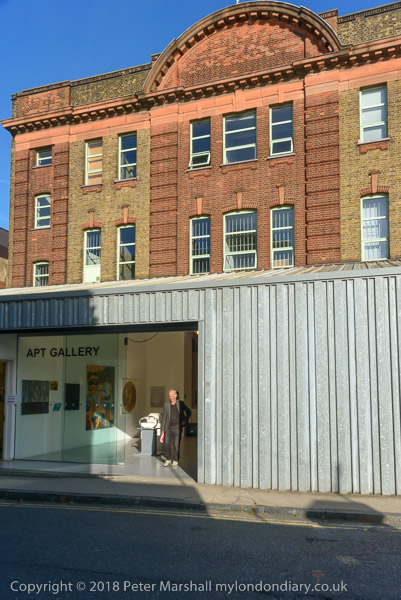
Over the afternoon we visited community spaces, galleries, studios, landmarks, waterways, green spaces and new developments on a guided walk through the street with a series of discussions on the relationship between art and gentrification and the huge changes that are currently sweeping through Deptford.

A Day Out in Deptford

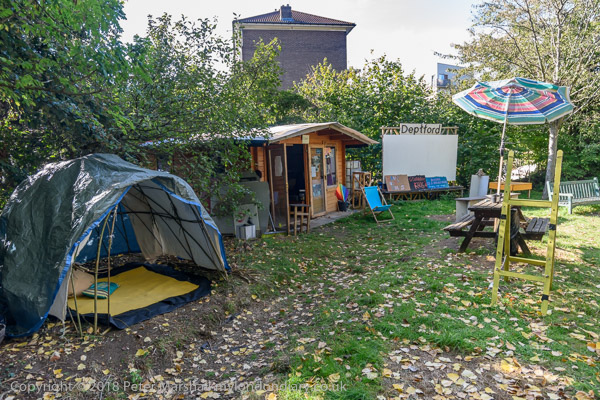
As I wrote in My London Diary in 2018, “The walk took place because of the continuing struggle with Lewisham Council over their plans to build on the 20-year old community run Old Tidemill Garden, the adjoining council flats, Reginald House, and Tidemill Primary School, which closed in 2012.”

A Day Out in Deptford

“Local residents, including those whose homes in Reginald House are threatened with demolition have opposed the plans, and at the end of August a group of them had occupied the Old Tidemill Garden.”

A Day Out in Deptford

The development would mean the loss of environmentally valuable green space but more importantly would be a part of the social cleansing of London which Lewisham, like other London Labour dominated councils are taking part in, demolishing council housing at social rents largely by private housing.

The site was to be developed by Peabody with 209 housing units, 51 for sale at market prices, 41 in shared ownership schemes (which require relatively high incomes) and 109 to be let at London Mayor Sadiq Khan’s London Affordable Rent, something like 65% higher than current Lewisham council rents. As well as paying much higher rents, tenants under this scheme will have for less security of tenure.

The residents group had put forward alternative plans which suggested retaining the Tidemill Garden and council flats and building at higher density on the redundant school site to create a similar number of housing units, but the council refused to consider these and terminated the community lease on the gardens on 29th August – when residents squatted them.

“The garden was established in 1997 with the aid of Groundwork, the London Development Agency, the Foundation for Sport & Arts, Mowlem plc, Lewisham College and Lewisham Council, and much of the work on it was carried out by parents and children from Tideway Primary. It now includes 74 well-established trees and has been shown to improve air quality in the local area.”

The garden was where we had the longest discussion on the tour, but there were plenty of other places where we stopped to discuss what was happening, making it an interesting afternoon.

It was a fine day and I decided to go to Deptford a couple of hours early to take a walk around some of the parts that were not included on the tour. I’d first photographed Deptford in 1979 and took with me a copy of my book Deptford to Woolwich 1979-85.

Back in the early 1980s much of Deptford was a very different place, with industry around the Creek and Deptford Power Station. Almost all of that has now gone, replaced by tall flats including much student housing and the Laban Dance Centre. On the tour we visited some of the former industrial buildings which are now artists studios and galleries. On part of the tour I was able to show pictures of what some parts of Deptford looked like before the changes.

The many pictures on My London Diary are in three posts, links below. Deptford Walk contains pictures from my own unaccompanied walk before the art crawl. Deptford Art & Gentrification Walk has my pictures taken during the walk. A third post, Deptford Panoramas, has extreme wide-angle views taken during both walks. These have the normal aspect ration of 1.5:1, but an extreme angle of both horizontal and vertical view.

The pictures show many aspects of Deptford, still a vibrant area of London, though rapidly changing. The Tidemill Garden is now built on, Deptford Cinema closed in 2020 but has a number of ongoing projects, the High Street market was still busy last time I was there, and the Dog and Bell serves a fine pint.

Deptford Panoramas
Deptford Art & Gentrification Walk
Deptford Walk

Cemetery, Synagogue & Snooker – Stoke Newington 1989

Cemetery, Synagogue & Snooker continues my walk on Sunday 8th October 1989 which had begun at Seven Sisters Station. The previous post Stoke Newington Shops – 1989 had ended with me opposite the gates of Abney Park Cemetery, which I had visited on a walk the week before, Abney Park & South Tottenham, and I wrote more about the cemetery there.

Angel, Abney Park Cemetery, Stoke Newington, Hackney, 1989 89-10e-45

The cemetery has a huge assortment of memorials and I photographed a few of them, including this angel, perhaps a fairly typical depiction, with similar angels in memorials across the country. It also gives an idea of the wilderness which the cemetery had become by 1989.

Angel, Abney Park Cemetery, Stoke Newington, Hackney, 1989 89-10e-23

Another angel erected by a husband in sacred memory of his wife Elizabeth who “departed this life” only 28 years old in 1865. This is a rather more unusual monument and I wondered if it might perhaps resemble this young woman who may well like many of the time have died in childbirth. There are two cherubs on the plinth and below them a rather strange pipe with perhaps shoots emerging at both ends. I suspect someone may know the significance of this. I cannot quite make out the name of her husband, although someone had clearly removed the creeper from the stone in order to reveal it.

John Swan, Engineer, Abney Park Cemetery, Stoke Newington, Hackney, 1989 89-10e-26

The text on the monument at the right of this picture is clear, and this is the Grade II listed memorial to John Swan (1787-1869), the inventor of the screw propellor for use on ships, and also of the self acting chain messenger which apparently saved the nation around £70,000 a year, for which he “never received the slightest remuneration.”

I took around 20 pictures in the cemetery and have only digitised seven of them – you can find four not included in this post on Flickr.

Northwold Rd, Synagogue, Northwold Rd, Stoke Newington, Hackney, 1989 89-10e-13

Built as a Primitive Methodist Chapel in 1875, this building was bought by members of the Beth Hamedrash Ohel Yisrael Synagogue as “more suitable and commodious premises” than their previous synagogue at 46 Brooke Rd in 1953 and consecrated in 1955. It became known as Beit Knesset Ohel Yisrael or Northwold Road Synagogue.

The synagogue closed the month before I made this picture. The building at 16 Northwold Road became the Sunstone Women Only Gym and is now the Tower Theatre.

Northwold Rd, Stoke Newington, Hackney, 1989 89-10e-14

Northwold Road begins opposite Abney Cemetery gates and its first secition still includes a number of interesting buildings as well as the former synagogue, but these on the north side of the road opposite it have been replaced by a large grey six-storey block of housing.

The flats at right re a part of the George Downing Estate on Alkham Road and are on the other side of the railwa line.

House, 187, Stoke Newington High St, Stoke Newington, Hackney, 1989 89-10f-64

Grade II* listed along with its neighbours 189 and 191, this is part of what the listing text describes as “an Early C18 large scale composition of 3 houses, the centre one projecting, touching at corners”. (It actually says proecting, but this building has a large yard in front and 189 has its porch almost on the street,)

This house was built in 1712 for Silk merchant John Wilmer (1696-1773), a wealthy Quaker. It later became ‘The Invalid Asylum for the Recovery of the Health of Respectable Women’. Substantially rebuilt in 1983 it is now the Yum Yum Thai Restaurant.

Snooker, Slindon Court, 149, Stoke Newington High St, Stoke Newington, Hackney, 1989 89-10f-66
Snooker, Slindon Court, 147, Stoke Newington High St, Stoke Newington, Hackney, 1989 89-10f-66

Hard to remember why I cropped this so tightly as to remove the S from Snooker and the SLI of Slindon Court, but probably it was just to make what I felt was a more satisfactory composition. I had previously photographed this in colour with a slightly wider view.

Snooker, Slindon Court, Stoke Newington High St, Stoke Newington, Hackney, 1989, 89e04-62

Slindon Court is now the entrance to a gated mews development behind the shops here.

The final post on this walk is still to come.


FlickrFacebookMy London DiaryHull PhotosLea ValleyParis
London’s Industrial HeritageLondon Photos

All photographs on this page are copyright © Peter Marshall.
Contact me to buy prints or licence to reproduce.