Goodbye to Wandsworth – 1990

Goodbye to Wandsworth – 1990: The final post on my walk on Sunday 4th March 1990 which had begun at Clapham Junction in Battersea with St John’s Road & East Hill, Battersea – 1990. The previous post on this was walk was Point Pleasant and the Thames.

It wasn’t of course the last time I went to Wandsworth – I was even back there a couple of weeks ago, walking through the same areas, though much of it now hardly recognisable.

West Hill Primary, School, Broomhill Rd, Wandsworth, 1990, 90-3c-25

The school building is locally listed and its address is 5 Merton Road, but this is the view from Broomhill Road.

London Theatre School, Chapel Yard, Wandsworth, 1990, 90-3c-26

On a second image I made of this building I can just about make out the inscriptions on the frontage as at left ‘Erected 1573, Enlarged 1685 and on the right ‘Repaired 1809 – 31, Rebuilt 1882’. You can read all four plaques lower on the building on the London Remembers site.

This is Wandsworth Chapel and possibly the site was first used by Huguenots, though perhaps only rather later than this. Another plaque lower down mentions a Dutch congregation but from 1713-87 this was the ‘French Church.’ Later from 1809 it was Congregational and a plaque states they continued to use it for mission work until 1939 after moving to a new church on East Hill in 1860. Its history reflects the many immigrants who settled in Wandsworth and set up industries along the Wandle using its water and the power it could generate.

The current building with a hall which could hold 500 people opened in 1883 and is locally listed. Since housing the London Theatre School it became the National Opera Studio.

Pizza Delivery, Scooters, Wandsworth High St, Wandsworth, 1990, 90-3e-65

Pizza Delivery began in the UK in the mid-1980s, but back in 1990 you had to phone for a pizza, with on-line ordering only becoming widespread in the late 1990s. It was still fairly unusual in 1990 and HIPPO PIZZA with this row of five scooters ready and waiting for a call was something of a pioneer.

Entrance, Car Wash, Wandsworth High St, Wandsworth, 1990, 90-3e-66

‘Welcome, Please Drive In’ for a ‘Guaranteed Complete Clean’. At at right someone sits waiting. There is still a ‘HAND CAR WASH’ here on the High Street.

Gas Holder, Armoury Way, Wandsworth, 1990, 90-3e-51

I walked up Ram Street again to Armoury Way and took a few more pictures of the gas holder – which I’ve written more about in earlier posts about this walk.

Gas Holder, Armoury Way, Wandsworth, 1990, 90-3e-53

I think I then looked at my watch and hurried to Wandsworth Town Station taking no more pictures to catch a train rather than have to wait another half hour for the next one.
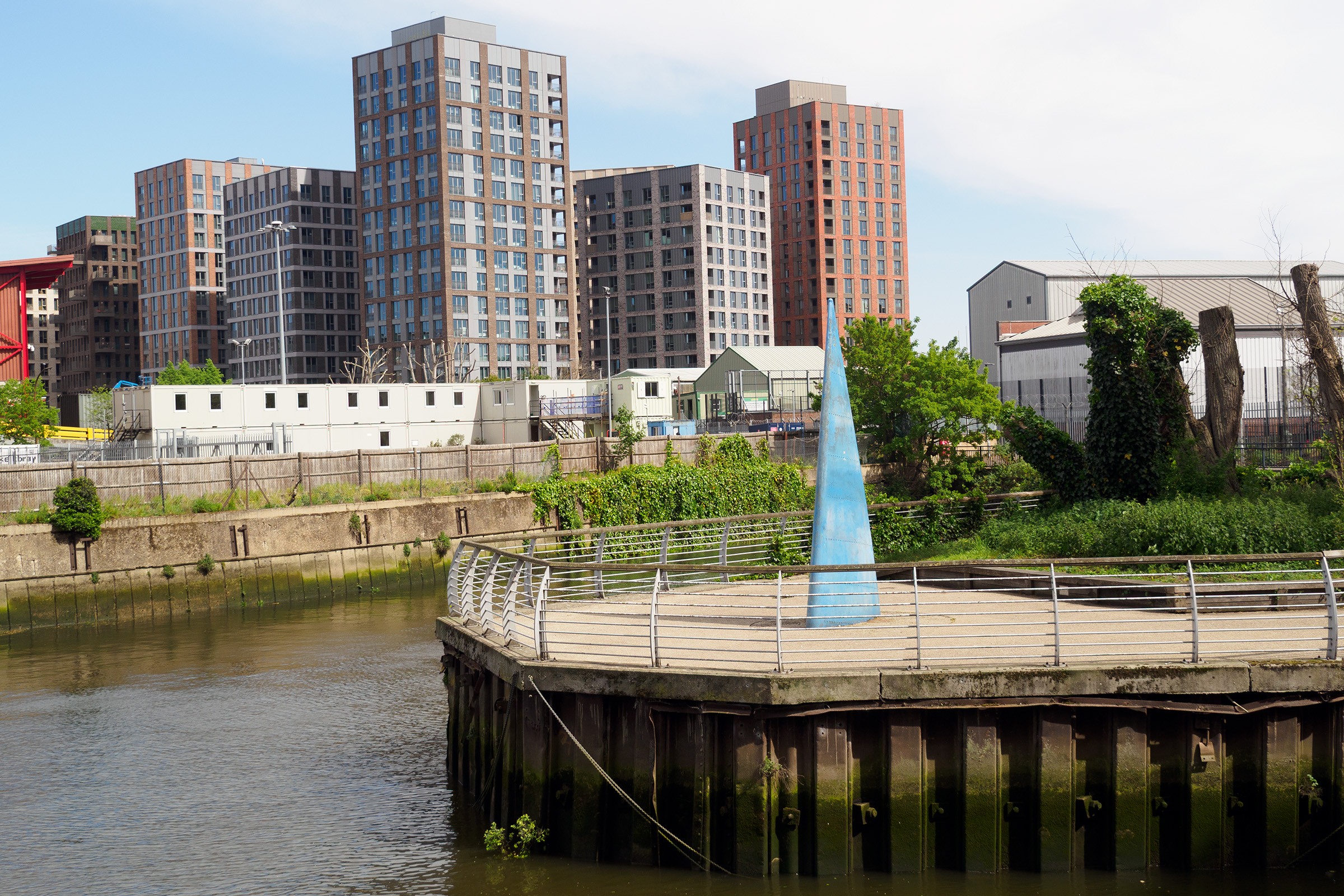
Finally, here is just one picture from the area I made on my last visit in April 2026, looking across where Bell Lane Creek and the River Wandle join. On ‘The Spit’ is a sculpture, ‘Sail’, by Sophie Horton placed there in 2003, financed by the Wandsworth Challenge Partnership. It was inspired by the sail of a dinghy, though I don’t think these have ever sailed up here. But perhaps in the new Wandle Riverside they will.

The flats are part of a new development on the former site of the Wandsworth Gasworks. And where I was standing to take this picture where there is now a riverside path leading to the River Thames was, back in 1990, part of the Shell Oil Terminal.


FlickrFacebookMy London DiaryHull PhotosLea ValleyParis
London’s Industrial HeritageLondon Photos

All photographs on this page are copyright © Peter Marshall.
Contact me to buy prints or licence to reproduce.
Tamil Festival & Brentford Walk – 2010

Tamil Festival & Brentford Walk: On the morning of Sunday 8th August 2010 I photographed the annual Chariot Festival from the Tamil Hindu Temple in West Ealing and in the afternoon went for a walk in Brentford.


Tamil Chariot Festival in West Ealing

Tamil Festival & Brentford Walk - 2010
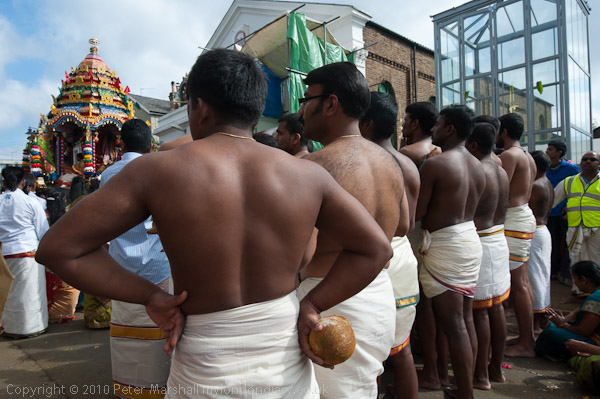
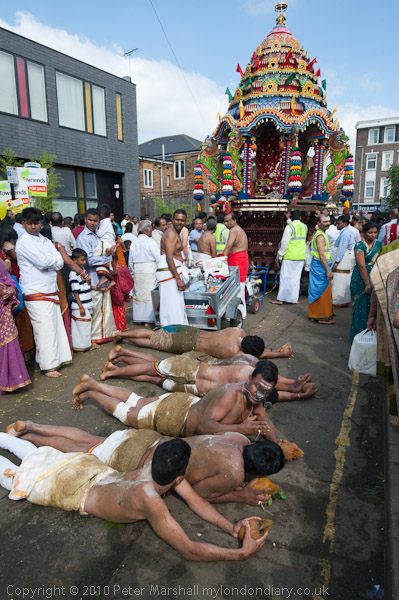
Men wait with coconuts outside the temple, ready to roll along the road

The annual Chariot Festival from the Tamil Shri Kanagathurkkai Amman (Hindu) Temple at a former chapel in West Ealing comes close to the end of their Mahotsavam festival which lasts for around four weeks each year.

Tamil Festival & Brentford Walk - 2010

In it a represtentation of the Temple’s main goddess Amman (Tamil for Mother) and priests are dragged around the streets on a large chariot pulled by men and women on long ropes.

Tamil Festival & Brentford Walk - 2010

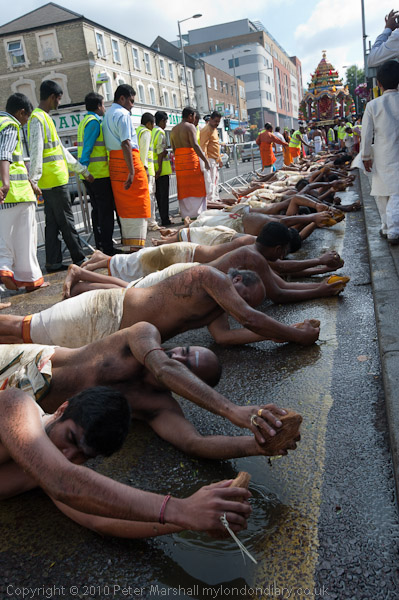
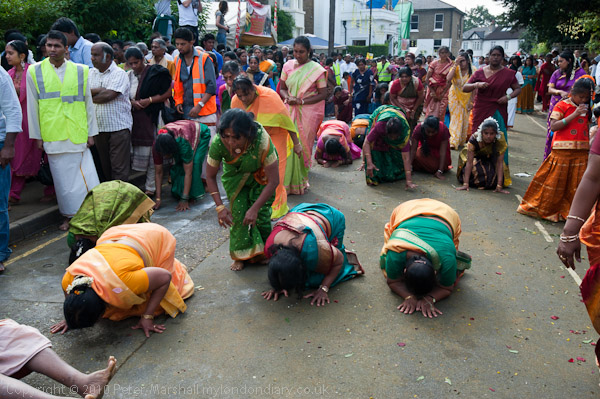
Behind them around 50 men naked from the waist up laid down on the street holding a coconut in front of them and rolled their bodies along the street for the half mile or so of the route. Men and women came and scattered Vibuthi (Holy Ash) on them. Following them were women who prostrated themselves to the ground every few steps.

Tamil Festival & Brentford Walk - 2010

From the Temple in Chapel Street the procession, led by a smaller chariot made its way along Uxbridge Road in the bus lane. People crowded around the chariot holding bowls of coconut and fruits (archanai thattu) as ritual offerings (puja) to be blessed by a temple priest.

Tamil Festival & Brentford Walk - 2010

To photograph the event I had – like those taking part – removed my shoes and my feet were soon soaked in coconut milk from the many cut open or smashed on the ground. Coconuts play an important role in many Hindu rituals and are a major product of the Tamil areas of India and Sri Lanka and many sacks of them were broken in the festival.

Further back in the procession were male dancers, some with elaborate tiered towers above their heads. Others had heavy wooden frames decorated with flowers and peacock feathers, representing the weight of the sins of the world that the gods have to carry; they had ropes attached to their backs by a handful of large hooks through their flesh. They turned and twisted violently as if to escape from the ropes, held by another man.

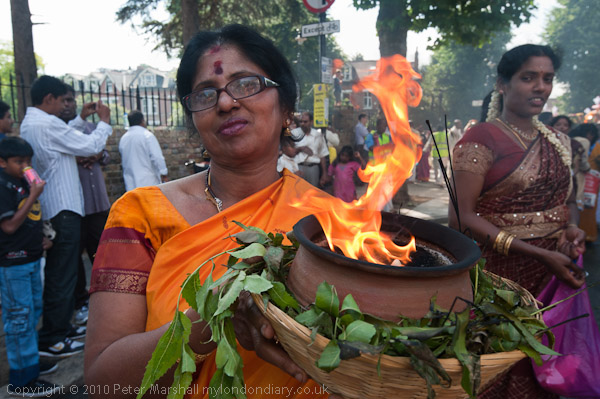
Women walked with flaming bowls of camphor which burns with a fairly cool flame and leaves no residue with others behind them carrying jugs on their heads.

The festival raises funds for various educational projects for children that the temple sponsors in northern Sri Lanka and other charitable projects in Sri Lanka devastated by the civil war and had sent more then £1.3 million in the previous ten years.

I left the festival, dried my feet as best I could, put on my socks and shoes and caught at bus to Brentford.

Many more pictures on My London Diary at Tamil Chariot Festival in Ealing.


Brentford

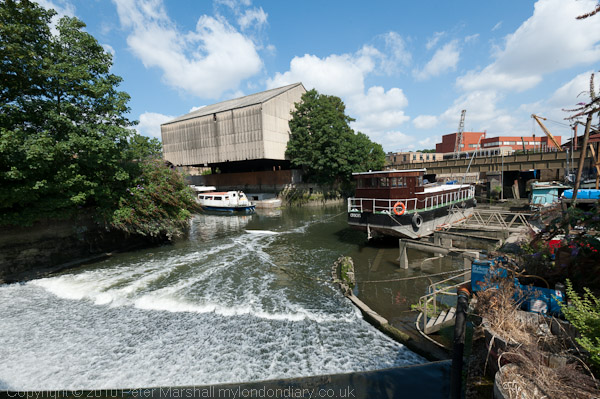
Overflow from the canal takes the River Brent to the Thames

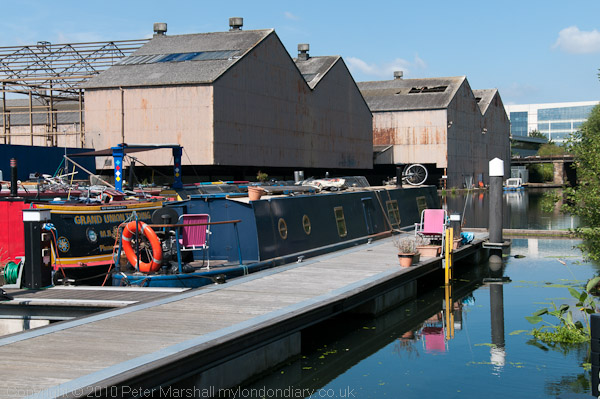
When I was young and lived not far away Brentford was an important canal port, the junction of the Grand Union Canal (also here the River Brent) with the River Thames. The docks by the Thames were now a private housing estate and by 2010 almost all of the British Waterways sheds had gone, replaced by blocks of flats.

Past the recent moorings were the last remaining loading sheds

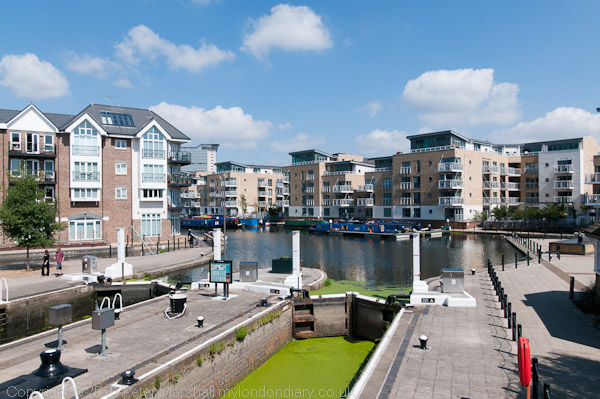
But the canal and the locks are still there, along with the small docks and some of the boat repair businesses. Little is visible from the High Street except where it goes over the canal, but despite extensive redevelopment in the 1990s – and more going on now – it remains an interesting area to walk around.

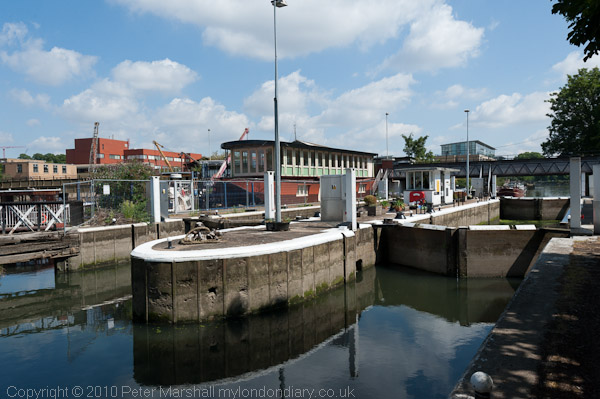
From the footbridge over the Brentford gauging locks

I’d photographed a little in the area back before much redevelopment took place, and more extensively in the 1990s. On line you can see some pictures from 2003 when some of the more recent development was starting. And I’ve returned a few times since this walk in 2010 and you can find more pictures if you search on My London Diary.

Thames Lock, connecting the canal system to the River Thames

As I noted in 2010, “Much of the walk that I took is now a part of the Thames Path, though it isn’t always well signposted, and some of the more interesting parts are a short detour away.”

More pictures from my short walk around Brentford on My London Diary.


FlickrFacebookMy London DiaryHull PhotosLea ValleyParis
London’s Industrial HeritageLondon Photos

All photographs on this page are copyright © Peter Marshall.
Contact me to buy prints or licence to reproduce.

Lea Navigation & Olympic Site

Lea Navigation & Olympic Site: Saturday 1 October 2011 was a fine day and I decided to go early to Stratford and take a photographic walk around Bow & Stratford Marsh, before a meeting at the View Tube on the Greenway overlooking the Olympic site.

Lea Navigation & Olympic Site

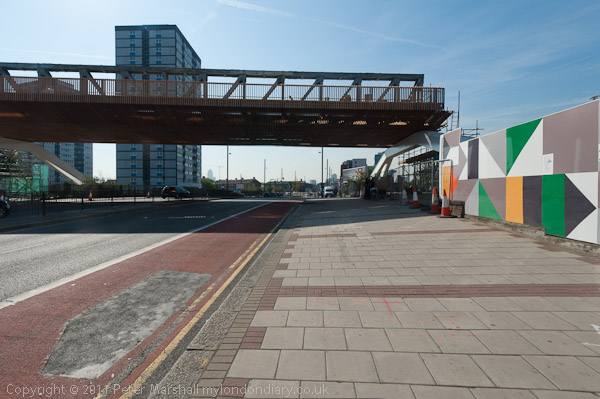
I took the Jubilee Line to Stratford and then walked over the footbridge leading to the Carpenters Estate and then on to Stratford High Street. A great deal of new building was taking place there, including a new bridge to carry the Olympic crowds across the busy road on a route from West Ham station along the Greenway. The bridge was demolished shortly after the games ended.

Lea Navigation & Olympic Site

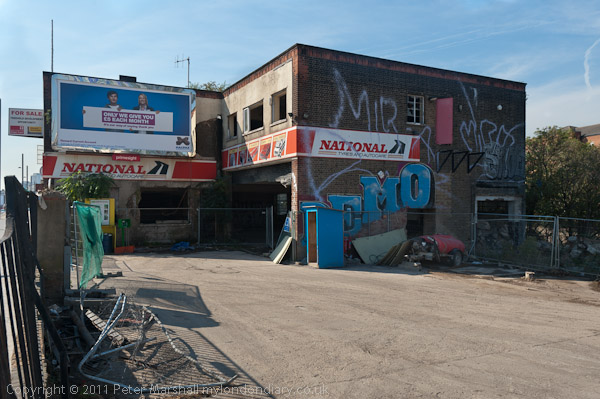
This section of the Greenway – the path on top of Bazalgette’s Northern Outfall Sewer rebranded in the 1990s – was closed off by fences and I kept on walking down the High Street. A few yards along was one of the few remaining commercial sites, though by then derelict and for sale. It was demolished and the site flattened for the Games, though it was only five years later than penthouses on the new block here were offered for sale.

Lea Navigation & Olympic Site

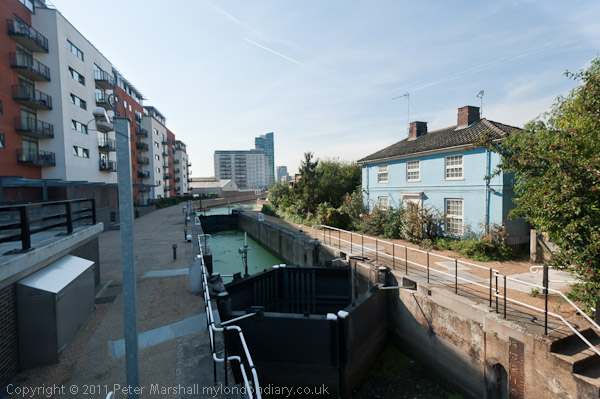
A few yards off the High Street was City Mill Lock, now behind a row of flats. I continued on to the Lea Navigation. The industrial sites on the High Street had now been cleared and there were now huge advertising structures.

Lea Navigation & Olympic Site

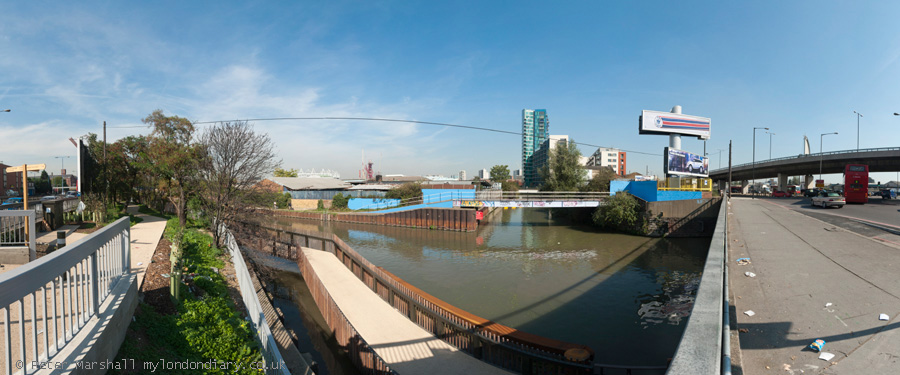
I had come mainly with the intention of making panoramic images, but these don’t display well on this blog, but you can see them larger on My London Diary. A footway now carries the towpath under the Bow Flyover and the High Street and then across the canal where the towpath continues on the opposite bank.

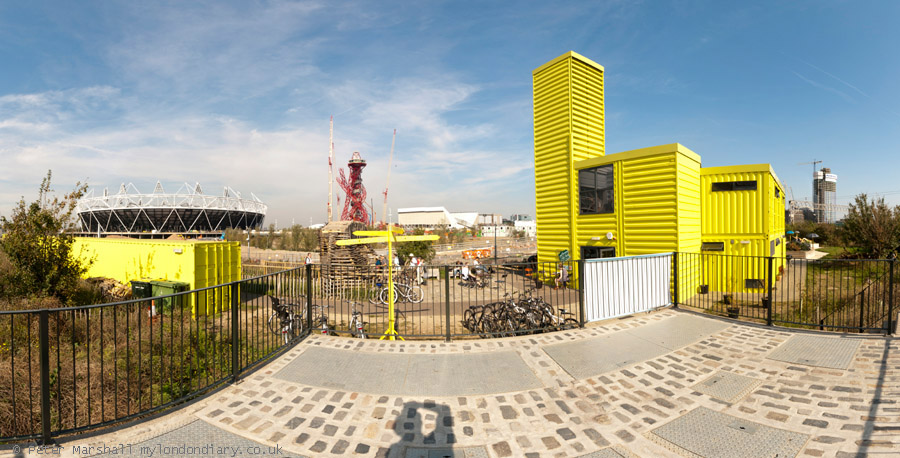
I made far too many pictures around this part of the canal before I could drag myself away, although the sky was not at its best for panoramic images and I would have prefered more distinct clouds rather than the large areas of blue. Only the first section of Cook’s Road was still open, but I could walk along beside St Thomas’s Creek to Marshgate Lane and then make my way to the bright yellow View Tube.

Here I was one of five photographers taking part in what was billed as a ‘Salon de Refuse Olympique‘, showing our artistic responses to the area. It was interesting to see the very different work that the five of us presented. You can read more about this in a post published here two days after the event in 2011, Northern Outfall Sewer 1990, 2005, 2010… which includes the three pictures I contributed for a forthcoming book as well as a lengthy text based on my presentation.

The Olympics have certainly changed this area, and the changes which were showing back in 2011 have continued. Many more pictures – both panoramic and normal aspect ration – in my post on My London Diary at Lea Navigation & Olympic Site.


FlickrFacebookMy London DiaryHull PhotosLea ValleyParis
London’s Industrial HeritageLondon Photos

All photographs on this page are copyright © Peter Marshall.
Contact me to buy prints or licence to reproduce.