A Day In Manchester – 2018

A Day In Manchester: Manchester isn’t everyone’s idea of a holiday destination, but it is a place with many largely happy memories for my wife and myself. We met there and lived there on the upper floor of a small house in a working-class area for the first two years of our marriage. Since then we had passed through it a few times but had hardly been back for almost 50 years when we decided to book a hotel and revisit the city in for a few days in August 2018,

All of these pictures were taken on one day – Thursday 2nd August 2018 – and show a little of what we found – and you can see many more pictures from the day and a couple of others we were there on My London Diary. As you can see it was a very full day.


Manchester: City Centre

New Islington, Whitworth St, Castlefield
A Day In Manchester - 2018

After breakfast we walked into the City Centre aiming to view the memorial to Alan Turing and then go on to the the Manchester Museum of Science and Technology. Our route took us past Piccadilly Village, Manchester’s tallest building Beetham Tower and a number of interesting late Victorian buildings.

A Day In Manchester - 2018
New Islington from the window of our hotel room
A Day In Manchester - 2018

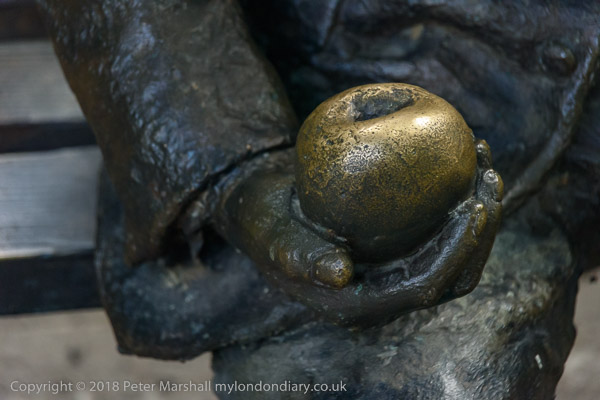
This memorial to Alan Turing is in Sackville park, Fairfield St, close to where I worked for several years. He committed suicide in 1954 with an apple containing cyanide after being hounded for being gay. His work in Cambridge and later from 1948 to his death at Manchester University made him recognised as the father of modern computing and artificial intelligence.

A Day In Manchester - 2018

Manchester is still full of interesting older buildings. Medlock Mill was built in 1801 as a cotton warehouse. From 1982-2011 it housed Percy Brothers – The Hotspur Press

A Day In Manchester - 2018

The Great Northern Warehouse connected the railway, roads and the Manchester and Salford Junction Canal which ran underneath it.

A Day In Manchester - 2018

But there is also a great deal of modern architecture, including Manchester’s tallest building, Beetham Tower.

More examples in the pictures on My London Diary at Manchester: City Centre – Thursday.


Manchester: Science & Industry Museum

Liverpool Rd
A Day In Manchester - 2018
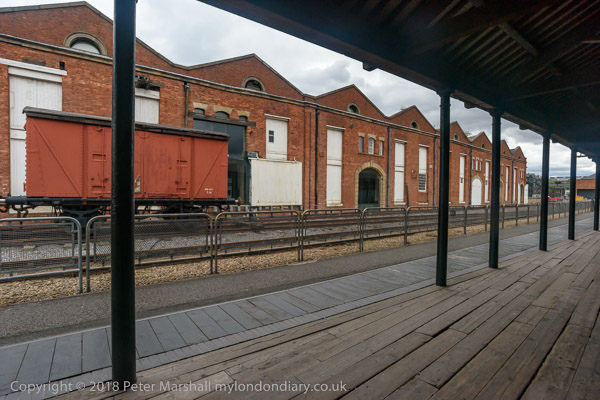
The platform for the first passenger railway station in the world

Manchester Liverpool Road station opened as the terminus of the Liverpool and Manchester Railway in September 1830 and it only finally closed in 1975, although passenger services had ended in 1844 with the opening of Manchester Victoria station. It was still connected to the main line until 2015, and a few heritage services ran into it until then.

The station building and Liverpool Rd

After it was sold by British Rail the station and its goods yard were used for a short time by Granada Television, who filmed some scenes of Coronation Street there, but in 1978 it became a museum. It is now part of the Science Museum, with the space to display some of the exhibits which could not be shown in its old building in South Kensington, and is a model of what a science museum should be.

1830s railway warehouses on the site

We had come to see a special exhibition of the world’s first stored program computer, ‘Baby’, built at Manchester University, which ran its first program on 21 June 1948. We did finally see it, but only after we had walked past the area it was in and explored much of the rest of the museum – which was photographically more interesting. But we had to leave before we had time to really go around the museum – to which we returned later.

More at Science & Industry Museum.


To Stockport & Bramhall Hall

Bramhall Hall

We had only intended a short visit to the museum as we had planned to visit Bramhall Hall, a fine old building now owned by Stockport Council. Somehow we had spent years in Manchester seeing buses going past with the destination Bramhall but had never gone there to visit it.

I’m not a huge fan of visiting stately homes though I’ve been to plenty, but this one turned out to be rather more interesting than most and I recommended a visit if you’ve never been. But we made a bit of a mess of the bus trip – the buses were then sorely in need of a Greater Manchester mayor to lick them into shape.

Many more pictures at  To Stockport & Bramhall Hall.


Manchester: Canal walk

Bridgewater Viaduct at Castlefield

We returned to Manchester and our hotel for a short rest and then went out for another walk by some of the canals, hoping to find a pub where we could have an evening meal.

H A Howard & Sons Ltd – Gileric Gowns – Ducie St

The walk was fine, but we didn’t like the look (or perhaps it was the menu) of the first pub we tried; the second bar looked interesting but then we found it didn’t serve real meals; another pub looked promising, offering ‘home cooking’ but when I went in to ask I was told they only served food at lunchtimes.

Rochdale Canal from Great Ancoats St

Eventually we gave up and made for one of central Manchester’s Wetherspoons on Deansgate. It’s in a splendid former cinema, worth a visit to view its interior, and the food, if not exciting is dependable and certainly cheap.

Ashton Canal

After relaxing with food and drink we enjoyed a leisurely walk – more canals – and made our way back to the hotel.


Flickr – Facebook – My London Diary – Hull Photos – Lea Valley – Paris
London’s Industrial Heritage – London Photos

All photographs on this page are copyright © Peter Marshall.
Contact me to buy prints or licence to reproduce.


Liverpool Road, Highbury Corner & Caledonian Rd – 1989

Liverpool Road, Highbury Corner & Caledonian Rd continues my walk in Islington on Sunday 15th October 1989 which began with the post Memorials, Eros and More. The previous post was Shops, a Poly, Electricity, Church & Library.

Samuel Lewis buildings, Samuel Lewis Housing Trust, Liverpool Rd, Islington, 1989 89-10h-63

Samuel Lewis was born in Birmingham in 1837, started work at 13 selling steel pens, then opened a jewellers shop before becoming the most fashionable money-lender of his day. When he died in 1901 he left £2.6 million to his wife, with over £1 million going to charity on her death.

£670,000 of this – equivalent to around £30 million today – went to a charitable trust to provide housing for the poor, and these flats are on the first of eight large estates they built.

This estate was built in 1909-10 for the Samuel Lewis Trust, architects Charles Sampson Joseph, (1872-1948), Charles James Smithem and Ernest Martin Joseph (1877-1960) who worked as Joseph & Smithem until 1916. The two Joseph brothers were sons of Nathan Solomon Joseph (1834-1909) who as well as building many synagogues was the leading designer of social housing as architect for the Guiness Trust and the Four per Cent Industrial Dwellings Company and worked also for the LCC and other London councils and he may also have contributed to the designs for these buildings.

Hampton Court, Upper St, Islington, 1989 89-10h-41

I was amused by the contrast between this street and its namesake palace on the River Thames. This Hampton Court is a short street leading west from Upper Street at Highbury Corner, leading to Swan Yard, which is at the end of the street in my picture.

On the left wall is a sign for J Barrett & Sons, but I can’t make out what their business was at 250 Upper St, now a Starbucks. The posters on the wall at right are for a Socialist Party Public Meeting and I think we have four pictures of Maggie Thatcher; I can’t quite read the text but I’m sure it wasn’t complimentary.

The tall building on the right at the end of the street is now a printers and I think probably was when I made this picture. Those to the right of it have been replaced and I think those on the left considerably refurbished. Those in Swan Yard at the end of the street are still there but have lost their white paint.

Swan Yard, Islington, 1989 89-10h-43

I think Highbury Studios, at 15 Swan Yard and most other workshops on the street have been converted to residential or office use and there is now a new building at the southern end of the street, recently converted into coworking office space with a communal roof terrace overlooking Laycock Green, an urban green open space.

Swan Yard and the southern side of Hampton Court are included in the Upper Street (North) conservation area.

Mallett, Porter & Dowd, North London Engineering Works, 465, Caledonian Rd, Lower Holloway, Islington, 1989 89-10h-33

This warehouse and works was built in 1874. Its conversion to student housing for University College London was awarded the Carbuncle Cup for the ugliest building of 2013 from Building Design magazine. The red brick building was demolished with its frontage retained a short distance in front of a a new multicoloured building. The judges commented “The original frontage has been retained in a cynical gesture towards preservation. But its failings go deeper,” and said “This is a building that the jury struggled to see as remotely fit for human occupation.” The rooms lack adequate daylight, give little privacy and those behind the facade have no view outside. Islington council had refused planning permission for the treatment of this locally listed building but were overruled.

Hubbards for Cupboards, 453, Caledonian Rd, Lower Holloway, Islington, 1989 89-10h-35

Those musical among you can sing “We’re Hub-bords Cup-boards, We’re Hub-bords Cup-boards, We’re go-ing to fight, fight, fight – to get your of-fice right” to the tune shown on this shop, Hubbards for Cupboards Tables & Chairs, at Hubbards Corner on Caledonian Rd. 453 Caledonian Rd on the north corner with Market Road is now a large block of flats with a natural food shop at ground level.

Caledonian Road Methodist Church, Caledonian Rd, Market Rd, Lower Holloway, Islington, 1989 89-10h-36

Built in an Italianate style in 1870 as a Primitive Methodist Chapel, architects T & W Stone, it became Caledonian Road Methodist church in 1932 and is still in use. It was restored in 1953 and the exterior cleaned in 1980. Grade II listed.

Market Rd, Lower Holloway, Islington, 1989 89-10h-24

This building, at 18 Market Road opposite the bus stop at Market Road Gardens and the adventure playground was demolished between 2008 and 2012. Peter Darley in The Journal of the Islington Archaeology & History Society says it was a tripe factory when Czech refugge Otto Fischel bought it in the 1950s and made it Otaco Ltd, plastic injection moulders. His wife, artist Käthe Strenitz was fascinated with industrial London and produced many fine pictures.

You can read more in Jane’s London about J. L. Henson tripe dealer whose name was originally on the panel where E.Zee is in my picture. But the elephants and E. Zee remain unaccounted for, but were perhaps linked in some way with the playground opposite. Though I have a nagging feeling that somewhere in the past I have written more about them.

A private limited company EZEE Ltd, Company number 02564140, was incorporated in 1990, had its registered office for a year in 1992-3 at 14-18 Market Rd. Its business was given as Artistic & literary creation etc. It last filed annual returns in 1991 and was finally dissolved in 2015.

My walk continued and there will be another post shortly.


Flickr – Facebook – My London Diary – Hull Photos – Lea Valley – Paris
London’s Industrial Heritage – London Photos

All photographs on this page are copyright © Peter Marshall.
Contact me to buy prints or licence to reproduce.