Liquor, Motors, Furniture, Packing & Timber

Liquor, Motors, Furniture, Packing & Timber My previous post on this walk in in Deptford on October 1988, More From Deptford, ended at Tooheys Liquor Barn on Evelyn Road, where this section starts.

Liquor Barn, Evelyn St, Deptford, Lewisham, 1988 88-10h-62

Toohey’s Brewery was founded by two brothers, John Thomas Toohey,born in COunty Tipperary whose family emigrated to Melbourne in 1841, and his younger Australian-born brother Matthew.
They ran pubs in Melbourne and then moved to Sydney where they set up their brewery in 1869, brewing Tooheys Black Old Ale. The company went public in 1902 and began brewing lager in 1930, though normally it comes in rather smaller bottles than this one. After various mergers and takeovers the company is now owned by Japanese brewer Kirin. Evelyn St. Wines of which this was a part was on this site until around 2015.

City Motor Auctions, Evelyn St, Deptford, Lewisham, 1988 88-10h-64-Edit_2400
City Motor Auctions, Evelyn St, Deptford, Lewisham, 1988 88-10h-64

City Motor Auctions Ltd was just to the east of the Liquor Barn on Evelyn St and car auctions, latterly under the name Docklands City Car Auctions continued here until around 2014. Like the Liquor Barn it became a part of the large development site

Bucks,  Furniture Warehouse, Evelyn St, Deptford, Lewisham, 1988 88-10h-52-Edit_2400
Bucks, Furniture Warehouse, Evelyn St, Deptford, Lewisham, 1988 88-10h-52

Bucks were still here at Bridge Wharf immediately to the west of the former Surrey Canal until around 2012 and their site was then briefly taken over by the car auctions, with Bucks returning briefly when those moved to Charlton at the start of 2015. The site was derelict by the end of 2015 and demolition was complete by 2017.

I was unsure if the circular bricked area with a post at its centre was a relic of the former wharf or simply a sculpture recalling the past. I couldn’t see any particular purpose in it, so it was probably art!

Evelyn St, Deptford, Lewisham, 1988 88-10h-53-Edit_2400
Evelyn St, Deptford, Lewisham, 1988 88-10h-53

Ocean wharf was at the south-west corner of the bridge built to take Evelyn Street over the Surrey Canal. Parker Packing Co Ltd were presumably the Parker whose corner was a few yards away on the opposite side of Evelyn St on its corner with Dragoon Road. The sign at an angle points to Neptune Wharf and a sign for a company dealing in polythene sheeting, polythene & paper sacks and other items, while a larger sign behind the branches is completely blank.

Timber Sheds, former Surrey Canal, Evelyn St, Deptford, Lewisham, 1988 88-10h-54

The view from Blackhorse Bridge looking towards the southwest where once the Surrey Canal ran, with timber sheds along its east bank. Timber would have been a major part of the canal traffic, as the Surrey Docks were largely used for timber imports and had large timber ponds. By 2008 the timber sheds had been replaced but otherwise the view was much the same, but in 2016 the empty space was filled by a large Shurgard self-storage shed.

Timber Sheds, Blackhorse Road, Deptford, Lewisham, 1988 88-10h-56
Timber Sheds, Blackhorse Road, Deptford, Lewisham, 1988 10h-56

The view of the timber sheds in the previous picture from Blackhorse Road, replaced some years ago by the Blackhorse Business Park.

Grinstead House, Grinstead Rd, Deptford, Lewisham, 1988 88-10h-34-Edit_2400
Grinstead House, Grinstead Rd, Deptford, Lewisham, 1988 88-10h-34

All the buildings along Grinstead Road have been demolished and replaced by residential properties. This was the only building I found of interest in the long stretch facing Deptford Park. The park was opened to the public in 1897 and probably Grinstead Road dates from then or shortly afterwards. I can find no explanation for the street name.

Grinstead House, Grinstead Rd, Deptford, Lewisham, 1988 88-10h-36-Edit_2400
Grinstead House, Grinstead Rd, Deptford, Lewisham, 1988 88-10h-36

Another view of its distinctive doorway. I can find nothing out about this property and there are few if any clues although it interested me enough to take nine frames concentrating on the doorway. The logo above the door is I think made of the letters J & J and this house was around halfway down the street, a short distance past the former galvanised iron and zinc Ida works, at the back of Neptune Wharf. It probably dates from the early 20th century.

To be continued in a later post.


More from Deptford 1988

More from Deptford 1988 continues my walk around New Cross and Deptford. The previous post was Deptford Broadway And New Cross Road.

Deptford High St, Deptford, Lewisham, 1988 88-10g-51-Edit_2400
Deptford High St, Deptford, Lewisham, 1988 88-10g-51

13 Deptford High Street is distinguished by the impressive pillars of its entrance and a fine rounded frontage. Whoever it was built for was obviously wealthy and perhaps a shipowner or merchant for goods landed locally either on Deptford Creek or on the Thames, perhaps tea from China. Tea was taxed heavily – 119% – until 1784 and this led to considerable smuggling but parliament reduced to tax then to 12.5% making tea available to a wider range of the population and ending the illegality. Though the East India Company retained its monopoly until 1834.

The house, built on what was then Butt Lane is locally listed is thought to have been built in the early 18th century but its rounded front was probably added around a hundred or so years later.

Deptford High St, Deptford, Lewisham, 1988 88-10g-52-Edit_2400
Deptford High St, Deptford, Lewisham, 1988 88-10g-52

The ‘A One CAFE’ at 18 Deptford High St looked as if it was no longer in business, though its door still is decorated with ice-cream cones. The doorway leading to the upper residential floors has the message ‘Gays Rule’ and is I think boarded up. This building is still there, its ground floor now a Vets, its brickwork plastered over and generally looking in rather better repair.

Unfortunately this picture is slightly out of focus (though the grain is sharp) and I cannot make out some of the finer detail of the building.

Deptford High St, Deptford, Lewisham, 1988 88-10g-56-Edit_2400
Deptford High St, Deptford, Lewisham, 1988 88-10g-56

I took only a couple of pictures as I walked up Deptford High Street to its north end and its junction with Evelyn Road/Creek Road, which still looks much the same as in my picture except that all the shops have changed hands at least once.

No 227 was in very poor condition and there was considerable building work there a few years ago but the general appearance is much the same, though it has long lost the shopfront and signage. This Grade II listed house, shop and bakehouse was built in 1791 for Thomas Palmer and improved in the early 19th century, although the ‘RCHME DEPTFORD HOUSES: 1650 to 1800’ survey in 1997-8 suggested it was “perhaps a single late-17th-century house with the front house added c. 1700, extensively rebuilt 1791-2” and says it “has its origins in the period 1654-1692 during which John Evelyn developed a corner of his Sayes Court estate corresponding to Nos 217-227 with a block of nine buildings set back from the road.” It does go on to say the house “was all but wholly rebuilt for Palmer in 1791-2” and remained a bakers until the 1990s.

The Tideway Clothing Stores is now an off-licence and supermart. The Courage Pub at right was torn down illegally without permission in 2019; it had been there at least since the 1820’s and though it looks as if it was still open, closed as a pub around the time I made this picture. The building became offices for a firm of solicitors, and the ground floor was used for art classes. The Deptford Dame published a report of the proposals for its reconstruction in 2021.

Panda, Car Hire, Watergate St, Deptford, Lewisham, 1988 88-10g-41-Edit_2400
Panda, Car Hire, Watergate St, Deptford, Lewisham, 1988 88-10g-41

Watergate Street is essentially the continuation of Deptford High Street to the north, leading to the River Thames. At the extreme left of this picture you can see a pillar of another Deptford pub, the Harp of Erin at 2 – 4 New King Street on the corner between this and Watergate Street. The pub which went under a variety of names over the years as Round the Bend, Nobody’s Inn, Looney Tunes, closed as simply The Harp in 2014.

Panda Car Hire and taxi service to Airports, Theatres, Stations was next to the pub on Watergate St and had this rather odd imitation half-timbering which attracted my attention. Panda Cars seemed a strange business name, usually used to refer to small police cars driven by police officers which were often painted black and white. The building is still there, and in the same business as Water Gate Cars but has now a rather plainer frontage.

Parker's Corner, Evelyn St, Deptford, Lewisham, 1988 88-10g-46-Edit_2400
Parker’s Corner, Evelyn St, Deptford, Lewisham, 1988 88-10g-46

I walked west along Evelyn Street. Parker’s Corner was around half a mile away, just before what is clearly a bridge although the Surrey Canal which used to go under it has long been filled in. I’d photographed this corner three years previously and wrote this about it: “Parkers Corner was next to the former Surrey Canal Blackhorse bridge in Evelyn Street on the corner of Dragoon Road.

Parker’s Timber were based at a wharf on the canal on the northeast of the bridge. The company moved to Belvedere, Kent in the 1960s. Although I was a great fan of Bird, someone else had beaten me to paint Charlie on the wall. ” In this frmae you can still see ‘Charlie’ though a little faded. The sign at top left is for Victoria Wharf, the site behind the wall, and lists some of the businesses there. The modern building behind, Parker House at 144 Evelyn Road, was demolished in 2015

Law Bros, Grove St, Deptford, Lewisham, 1988 88-10g-21-Edit_2400
Law Bros, Grove St, Deptford, Lewisham, 1988 88-10g-21

The Victoria Wharf site stretched along Dragoon St from Evelyn Street to Grove Street where Law Bros had this building. Rather oddly a sign at right told me the Bros were Stewart & Alice and their business appear to be in Calor Gas according the the five signs in the picture. At left were signs for two other businesses on the wharf and above the doorway was another for Andrews.

I wondered what this building had been built as; it was marked as ‘Chapel’ on old large-scale OS maps on Grove St beside the wharf entrance. A very bad photograph in the Deptford Archives enabled me to identify it as Victoria Hall Methodist Church, opened in 1857 and demolished in 2015 as a part of the Timberyard development.

Scrap Dealer, Oxestalls Rd, Deptford, Lewisham, 1988 88-10g-14-Edit_2400
Scrap Dealer, Oxestalls Rd, Deptford, Lewisham, 1988 88-10g-1488-10g-14

Oxestalls Road was created around 1966 when there was considerable redevelopment in the area with the creation of the Pepys estate, and it goes across the former route of the Surrey Canal at an elevated level. This view is looking roughly east and you can see the chimneys and roof of The Victoria pub on Grove Street above the sheds to the left of the picture along with a chimney which I think is at Deptford Power Station.

Holsten Pils, Liquor Barn, Evelyn St, Deptford, Lewisham, 1988 88-10g-15-Edit_2400

Tooheys Liquor Barn on Evelyn Street with the trailer of a lorry carrying a Holsten Pils waggon, probably designed to be horse-drawn. It appears to be part of the Evelyn Cash & Carry shed. In the background is Eddystone Tower on Oxestalls Road, 26 floors and 257ft high, part of the GLC Pepys Estate built in 1962.

My walk around Deptford will continue in a later post.


Nurses, Coal, Art, Biafrans & Sunflowers

Nurses, Coal, Art, Biafrans & Sunflowers – Saturday May 30th 2015 was another varied day of events and protests across London.


Filipino Nurses tell Daily Mail to apologise – Kensington.

Nurses, Coal, Art, Biafrans & Sunflowers

I began the day travelling to High Street Kensington, just a short walk from the offices of the Daily Mail. It has the largest circulation of any UK newspaper but is also the UK’s least reliable source of information. Recently The Factual analysed 1,000 articles from each of 245 major news sources from around the world although mainly from the USA and including international news organisations such as Reuters and AP. The Mail came out with the third lowest score of any with a Factual Grade of 39.7% compared to the average of 61.9%. In a table listing all the results, even The Sun does a little better, as do the Daily Express and RT News, though all of these are way below average while The Guardian was above average along with the BBC, though neither among the top scorers.

Nurses, Coal, Art, Biafrans & Sunflowers

We don’t have a free press in this country, we have a press largely controlled by a small number of billionaires who, as these figures show, use it largely as a source of disinformation and the promotion of their prejudices – including homophobia, racism and misogyny. Articles are more generally written as click-bait rather than with any desire to inform or educate, and it was hardly surprising when in 2016 it was sanctioned by the International Press Standards Organisation for violating professional norms for accuracy and in 2017 Wikipedia editors decided it was a “generally unreliable” source.

Nurses, Coal, Art, Biafrans & Sunflowers

I was there for the start of a long protest by Filipino health workers outside the Daily Mail over its reporting of the Victoriano Chua case which insulted Filipino NHS workers as a whole despite the vital contribution they make to the NHS. The demanded the Daily Mail apologise for its racist comments and to recognise the contribution that they make, keeping our NHS afloat. As someone who a dozen years earlier had been looked after in intensive care by a Filipino nurse I feel very grateful to them, though angry at the UK government for not training enough nurses and doctors – and in particular for removing the training bursary for nurses which has now made the situation much worse. But I did feel they were asking the leopard to change its spots.

Filipino Nurses tell Daily Mail apologise


Walking the Coal Line – Peckham

Rye Lane

I left the Filipinos as their protest was still building up and journeyed across London to Peckham Rye where we were invited to take a tour of the proposed Peckham Coal Line elevated linear urban park between Peckham Rye and Queens Road Peckham stations as a distant part of the Chelsea Fringe Festival events – something vaguely related to the annual flower show.

The Coal Line was frankly hugely over-hyped, particularly in comparing it to New York’s ‘High Line’, and the walk was largely close to but not on the actual proposed line. The former coal sidings on the viaduct which inspired the project are next to a working rail line and could only be seen looking down from neighbouring buildings.

As I commented: “The walk is essentially an urban linear park that would make a useful short cut for some local walkers and cyclists, and could also be a part of a longer leisure walk from Brixton to the Thames. I hope it comes into existence, as the cost would be relatively low and it would be a useful addition to the area.

But I still enjoyed an interesting walk, visiting both the Bussey Building in the former industrial estate Copeland Park south of the line and the multi-storey car park to the north which now houses a cafe, a local radio performance space and another rooftop bar next to the Derek Jarman memorial garden and has good views of Peckham and central London. And having followed the official route to Queens Road Peckham I walked back a different way vaguely along the Coal Line at ground level, finally travelling more closely along it in an Overground train that took me to Canada Water and the Jubilee Line to Waterloo.

Walking the Coal Line


UK Uncut Art Protest – Westminster Bridge

UK Uncut met outside Waterloo station for their mystery protest taking direct action at an undisclosed location. Police liaison officers tried to find out where they were going and what they intended to do, but nobody was talking to them. Finally they set off and marched the short distance to Westminster Bridge where they spread a large piece of cloth on the roadway and painted a banner telling Parliament that collecting dodged taxes would bring in more than cutting public services.

They lifted up the banner and then ‘dropped’ it over the side of the bridge. It was a long run to take a picture of it hanging from the bridge, and I’m not sure worth the effort. It would have been better to have lowered it on the downstream side so as to get the Houses of Parliament in the background.

Another group of protesters in Parliament Square were protesting against the plans to get rid of the Human Rights Act, and some of the UK Uncut people had joined them before the end of the ‘Art’ protest. In May 2022 the government announced it was getting rid of the act and replacing it with a ‘British Bill of Rights’ which will allow the police to “perform freer functions“, Leading charities concerned with human rights have condemned the changes as affecting “the ability of individuals to hold the government and public bodies to account by bringing cases when their human rights have been breached.” They state “The Human Rights Act has greatly benefited a vast number of people from across society, improving their health and wellbeing; ensuring their dignity, autonomy, privacy, and family life; and overall improving their quality of life.” Many see the changes as yet another move towards fascism and a police state.

UK Uncut Art Protest


Biafrans demand independence – Trafalgar Square.

Biafra came from the Kingdom of Nri of the Igbo people, which lasted from the 10th century to 1911 and was one of Africa’s great civilisations before the European colonisation.

Biafra was incorporated into Southern Nigeria by the colonialists in the 1884 Berlin Conference and then became part of the united Nigeria in 1914. Biafrans declared independence from Nigeria in 1967, but lost the long and bloody civil war that followed, with many Biafran civilians dying of starvation.

Biafrans demand independence


Mass rally Supports National Gallery strikers – Trafalgar Square

After a large rally in Trafalgar Square, National Gallery staff striking against privatisation marched towards the Sainsbury Wing, holding a sit down and short rally outside after police blocked the doors to the gallery. The gallery doors were then locked.

Candy Udwin, a PCS rep at the National Gallery had been sacked for her trade union activities in connection with the plans to privatise gallery staff and the opposition to it by staff. Exhibitions in the Sainsbury wing have already been guarded by privatised staff, and the security there is also run by the private company. After 100 days of strike action the dispute was finally resolived in early October 2015 after the appointment of a new gallery director with terms and conditions of service protected and Udwin returning to work.

Mass rally Supports National Gallery strikers


Deptford Broadway And New Cross Road

Deptford Broadway And New Cross Road – this continues my walk in October 1988 from the previous post, More Deptford And A Little Greenwich.

Deptford Broadway, Deptford, Lewisham, 1988 88-10f-25-Edit_2400
Deptford Broadway, Deptford, Lewisham, 1988 88-10f-25

The last image in my previous post was a general view of the north side of Deptford Broadway from close to the corner with Brookmill Road, and I commented on the ‘Antique Warehouse’ built for ‘Montague Burton, The Tailor of Taste’. I walked west along Deptfprd Broadway to take this picture from a closer viewpoint. As well as the antiques, this building was also in use as a Snooker Club, boast 16 full size tables and open 22 hours daily. Over the central door are the names Southampton and Bournemouth.

The name ‘Montague Burton the Tailor of Taste Ltd’ dates from the registration of the limited company in 1917 and was almost certainly originally visible in the large panel on the frontage although I can see no trace of it in my photograph. Burton’s architect Harry Wilson designed a whole range of similar variants of these Art Deco stores for towns and cities across the country in the 1930s, and there is a splendid ‘Spotters Guide‘ online – although it doesn’t mention Deptford. Over the central door are the names Southampton and Bournemouth, and stores often carried a list of a few of the leading branches across the frontage at the top of the ground floor windows. Burtons and Woolworths both built many branches in a Deco style and appear to have copied ideas from each other.

Deptford Broadway, Deptford, Lewisham, 1988 88-10f-26-Edit_2400
Deptford Broadway, Deptford, Lewisham, 1988 88-10f-26

A slightly wonky view of No8 Deptford Broadway taken from the other side of the road. Almost all of these images were made with a 35mm Zuiko shift lens where the optical elements could be pushed both horizontally or vertically to enable me to produce images without converging or diverging verticals and play other small tricks with perspective. I still occasionally find myself trying to push other lenses in the same way and they don’t!

The Zuiko lens was a good example of this type of lens, but not entirely simple to use; it was a “manual lens” and you viewed the subject and made any necessary lens shift with the lens at its widest F2.8 aperture, then pressed a small lever to stop down the lens iris to the smaller aperture needed for the exposure. At full aperture the corners of the image were not sharp, and sometimes I failed to stop down sufficiently (or at all) to bring them into proper focus.

For this image I didn’t quite get the camera back vertical and the verticals in the building diverge, something rather less common in photographs than converging vertical. The shopfront here clearly goes across one building and a part of its neighbour (the rest of which housed the Dover Castle pub) and its missing panel allows us to view the lower part of the first floor window. Both these buildings have now been replace by a rather mediocre modern development

Deptford Seventh Day Adventist Church, New Cross Rd, New Cross,, Lewisham, 1988 88-10f-12-Edit_2400
Deptford Seventh Day Adventist Church, New Cross Rd, New Cross, Lewisham, 1988 88-10f-12

Continuing west, Deptford Broadway turns into New Cross Road where this charming building was built as a private house, but around 1900 the New Cross Equitable Building Society – which was founded elsewhere in New Cross in 1866 – moved in. It remained here until the Registrar of Friendly Societies closed it down in 1984, for unsafe financial practices involving large borrowings which later became rather normal.

The building then became the Deptford Seventh Day Adventist Church as my photograph shows; in 1991 they bought and moved to rather large premises on the corner of Devonshire Drive and Egerton Drive, the former St Paul’s, built as an Anglican Church in 1865-6 by the prolific church architect S S Teulon which closed in 1978, and was then used by other church groups and scouts until becoming Greenwich Seventh Day Adventist Church. Since 1994 470 New Cross Road has been the Iyengar Yoga Institute

Zion Chapel, New Cross Rd Baptist Church, New Cross Rd, New Cross,, Lewisham, 1988 88-10f-13-Edit_2400
Zion Chapel, New Cross Rd Baptist Church, New Cross Rd, New Cross, Lewisham, 1988 88-10f-13

More or less next door at 466 is this short passageway leading to Zion Chapel. Its Grade II listing places it in Brockley (its electoral ward) and dates it 1846. The listing does not mention the gateway and lantern which I think add greatly to its appeal – and which my choice of viewpoint was carefully chosen to include and emphasise.

Seventh Day Adventist, Baptist, Church,New Cross Rd, New Cross,, Lewisham, 1988 88-10f-15-Edit_2400
Seventh Day Adventist, Baptist, Church,New Cross Rd, New Cross, Lewisham, 1988 88-10f-15

Another picture shows the Adventist Church, the house flanking the passage to Zion Chapel and its lantern and gateway, with at the left a part of Addey & Stanhope School. Both schools were ancient foundations in Deptford, Stanhope School being founded by the vicar of Deptford, George Stanhope in 1714. Addey School was only founded in 1821, but the money came from the will of John Addey (1550-1606), the Master Shipwright at Deptford Dockyard who left £200 for the poor of Deptford. The two schools were merged in the late 19th century and moved to this location in 1899. It has since expanded considerably.

Fire Brigade Union, New Cross Rd, New Cross, Lewisham, 1988 88-10f-01-Edit_2400
Fire Brigade Union, 435, New Cross Rd, New Cross, Lewisham, 1988 88-10f-01

This house along with the others in the blocks on both sides of Mornington Road now look considerably smarter than in 1988. It appears to have once been some kind of offices of the Fire Brigade Union, FBU, founded in 1918. But it made me feel rather strange…

Two doors down, at 439 was the site of the 1981 New Cross Fire which killed 13 young black people, with one survivor taking his own life 2 years later. The police investigation of the fire which concluded, according to Wikipedia “that there was no evidence of arson and that the fire was believed to be accidental” enraged the black community and lead to a “Black People’s Day of Action” with 20,000 people marching from New Cross to Hyde Park. The Wikipedia article states ‘The New Cross fire, described by Darcus Howe in 2011 as “the blaze we cannot forget”, is significant as a turning point in the relationship between Black Britons, the police and the media, and marks an “intergenerational alliance to expose racism, injustices and the plight of black Britons“.’

New Cross Rd, New Cross,, Lewisham, 1988 88-10g-63-Edit_2400

New Cross Rd, New Cross,, Lewisham, 1988 88-10g-63

This doorway is still there at 455 New Cross Road, though looking just a little different and now with a metal gate. It seems a particularly elaborate entrance to the flats above the shops, and there was something about the light in the segment window above the door which made me see it as the dome of a head, some great intelligence incorporated into the building. Or perhaps I was hallucinating.

To be continued in a later post…


More Deptford And A Little Greenwich

My walk continued along Stowage where my previous post ended to St Nicholas, Deptord Green, and then south through Deptford.

Church Gate, Skull, St Nicholas, Deptord Green, Deptford, Greenwich, 1988 88-10f-54-Edit_2400
Church Gate, Skull, St Nicholas, Deptord Green, Deptford, Greenwich, 1988 88-10f-54

Playwright and spy Christopher Marlowe (1564-1593) was apparently killed in a house in Deptford on 30th May 1593 and buried in an unmarked grave in this churchyard at St. Nicholas’s Church. A web page, Death In Deptord gives the known facts and also various conspiracy theories. He had been arrested a week earlier on a charge of atheism, then a serious crime for which those found guilty could be burnt at the stake. Surprisingly he was granted bail.

He came to Deptford to escape the plague which was raging through London and was at a meeting in a private house there which is thought to have been a safe house used by government agents, and was dining there with three other spies, all connected with the secret service set up by Marlowe’s patron, Sir Francis Walsingham, to protect Queen Elizabeth from Catholic assassination plots.,

Surprisingly the lengthy Coroners Report by the Queen’s Coroner kept secret at the time was only rediscovered and published in 1925. It describes the killing as a result of a dispute over the bill and names his murderer – who was given a royal pardon 28 days later. Many have thought the inquest was a cover-up and that either the death was a planned assassination by the security services or that Marlowe was not killed but smuggled out of the country to escape his prosecution and possible burning for heresy.

Deptford High St, Douglas Way, Deptford, Lewisham, 1988 88-10f-45-Edit_2400
Deptford High St, Douglas Way, Deptford, Lewisham, 1988 88-10f-45

This shop on the corner of Douglas Way is still a Halal Butcher. There was a barbers until around 2016 in the shop on Douglas Way still with the perhaps unfortunate name of H Nicks, but that and the two further shops have changed hands and are now rather more colourful, with barbers Tuttii Fruitii, Divine Beauty Hair Salon and Good Friends Chinese Restaurant and Takeaway reflecting the vibrant multicultural mix of Deptford.

Deptford High St, Deptford, Lewisham, 1988 88-10f-34-Edit_2400
Deptford High St, Deptford, Lewisham, 1988 88-10f-34

The shop on the left, closed in 1988 is now Omed Uk Ltd, African Textile & Novelty, and Richard Stone Mans Store is now DAGE, Deptford Action Group For The Elderly but that on the right, though with a new sign is still in much the same business as Deptford Cobbler. The buildings appear to have changed little. Most times when I’ve walked along here since the street has been busy with market stalls, but these pictures were made on a Sunday morning when there was then no market.

Deptford High St, Deptford, Lewisham, 1988 88-10f-35-Edit_2400
Deptford High St, Deptford, Lewisham, 1988 88-10f-35

There was a pub here in 1788, though the street was then called Butt Lane. It was part rebuilt in the late 19th century with the frontage rebuilt at some time between 1868 and 1894. Originally called the Red Lion and Wheatsheaf it became The Distillery in the 1890s and at other times in the early twentieth century simply as the Red Lion. It reverted to its original name around 1930 and closed as a pub in 1961-2.

The Wenlock Brewery in Wenlock Road Hoxton owned a large number of pubs across London and was bought up by Worthington – part of Bass – in 1953 and closed in 1962.

Mumford's Mill, Greenwich High Rd, Greenwich, 1988 88-10f-22-Edit_2400
Mumford’s Mill, Greenwich High Rd, Greenwich, 1988 88-10f-22

I walked across Deptford Bridge and a short distance up Greenwich High Road to photograph Mumford’s Mill which is on the east bank of Deptford Creek. The Grade II listed silo with the date 1790 was a later addition to the site, added in 1897 and built in an elaborate Italianate style by one of the leading architects of the day, Sir Aston Webb, along with his partner Edward Ingress Bell who got his unusual second name from being born in Ingress Park a few miles down the river at Greenhithe.

The 1790 mill was possibly a tide-mill – and there is a tidemill site here on the west side of the Creek, for some years a neighbourhood park but now after a fight by local residents failed to save it being redeveloped for housing. The early mill was soon replaced by two early 19th century three storey stone grinding flour mills.

But by 1897 this was a state of the art flour mill, with roller mills powered by steam. In the 1930s it was bought by the Rank Group, founded in Hull by Joseph Rank who had set up the first modern flour milling business in the UK there in 1875 and milling was soon ended. Parts of the premises were used by various companies, but much was apparently empty for several decades until converted to residential use early this century.

Greenwich High Rd, Greenwich, 1988 88-10f-23-Edit_2400
Greenwich High Rd, Greenwich, 1988 88-10f-23

I continued up the Greenwich High Road to these two adjacent contrasting doorways just off the road in Burrgos Grove. Wellington House is 2 Burgos Grove while the property at right, in 1988 shared between Joule Electrical Ltd and the Inner London Probation Service is numbered as 34 Greenwich High Rd. Probably both properties date from the mid-19th century. No 34 was extensively rebuilt in 2012 but the doorway and facade were retained.

Deptford Broadway, Deptford, Lewisham, 1988 88-10f-24-Edit_2400
Deptford Broadway, Deptford, Lewisham, 1988 88-10f-24

I walked back to Deptford Bridge and west to Deptford Broadway. Now this would mean going under the Lewisham extension of the Docklands Light Railway, opened in 1999. Should you be here it is worth going up to the platforms of Deptford Bridge Station which gives some of the better views of Mumford’s Mill and other parts of the area, and taking the train north to Greenwich to see more of Deptford Creek.

The north side of the Broadway has a remarkable variety of architectural styles and includes a group of five houses at the right of this picture Grade II listed as a group at 17-21 consecutive, thought to be all of late C17 origin, though all much altered later. Next is Broadway House, dated 1927, followed at 13-14 by what is probably a late-Victorian property and then a fine piece of 1930 Art-Deco – in my picture ‘Antique Warehouse’ but built for ‘Montague Burton, The Tailor of Taste’. Unfortunately I was just a few months too late to photograph the Deptford Odeon, designed by George Coles in 1938, but demolished earlier in the year – and the billboard at extreme right was in front of its empty site.

To be continued in a later post.


Stowage, Deptford

Stowage, Deptford – Stowage is the place were things were stored and Stowage was from 1600 until 1782 a storage area for the East India Company who also built ships here. The name was not just for the street but for a wider area including the site of Deptford Power Station, the world’s first commercial-scale high voltage power station by Sebastian Ziani de Ferranti in 1889.

The Hoy, Deptford Power Station, Stowage, Deptford, Greenwich, 1988 88-10e-34-Edit_2400
The Hoy, Deptford Power Station, Stowage, Deptford, Greenwich, 1988 88-10e-34

The Hoy pub was open on the corner of Stowage at 193 Creek Road at least by 1840 but closed in 2008, becoming a café. Some reports say it lost its licence because of a large number of reports of drug use. It looked closed and unoccupied when I walked past a few months ago. Until the 1920s there were two pubs actually in Stowage, the Old George and the Fishing Smack, both open in the 1820s.

Stowage, Deptford, Greenwich, 1988 88-10e-35-Edit_2400
Stowage, Deptford, Greenwich, 1988 88-10e-36

The General Steam navigation Co Ltd established its shipyard on Stowage at the mouth of Deptford Creek in 1825, using it to build and maintain its paddle steamers. The site became part of Deptford Power Station for the Deptford East HP station which opened in 1953.

Stowage, Deptford, Greenwich, 1988 88-10e-26-Edit_2400
Stowage, Deptford, Greenwich, 1988 88-10e-26

The area has a long and interesting history. Stowage was the first base of Trinity House, who were close to St Nicholas’s Church at the west end of Stowage from 1511-1660 before moving to the City of London, and this was the location of the first Trinity House Almshouses. According to the entry in Pepys Diary for Friday 8 April 1664 he went with Sir William Batten, then the Master of Trinity House to see the new almshouses which were being built at Deptford. They were demolished around 1877.

Stowage, Deptford, Greenwich, 1988 88-10e-11-Edit_2400
Stowage, Deptford, Greenwich, 1988 88-10e-11

The walk District 45 created by the Royal Geographical Society is a fine introduction to the area and one I recently followed (with a few of my own additions) with a couple of friends. It is based on Charles Booth’s walk around the area with the local police in 1899 and you can read Booth’s notebooks on the LSE’s Charles Booth’s London web site (his handwriting is occasionally a little difficult) which provide some further notes to those in the RGS walk.

Stowage, Deptford, Greenwich, 1988 88-10e-13-Edit_2400
Stowage, Deptford, Greenwich, 1988 88-10e-13

In his notes, Booth described Stowage as “A stinking unpaved lane with wharves on north side until the bend is passed … occupied by a low rough waterside population. ” He went on to say “Most people living here work at one of the factories along the Creek. Besides the chemical works there are numerous business places employing a large number of ‘hands’. The Steam Navigation Company has a large yard in the Stowage.

All these works are busy and work is plentiful so that no man need be unemployed. Women work
in woodyard and laundry, girls in the tin factory or as ‘gut girls’ in the meat market cleaning the entrails of the slaughtered beasts
. “

Stowage, Deptford, Greenwich, 1988 88-10e-12-Edit_2400
Stowage, Deptford, Greenwich, 1988 88-10e-12

I walked along the short street on various occasions in the 1980s and 90s, and it seems to me that relatively little had changed, except there were rather fewer houses and people living on the streets. It was a street were there were often small groups of men who looked shifty and where I didn’t always feel able to stop and take photographs and where much that went on was perhaps on the edge of the law. Often there were fires burning and foul smoke, perhaps getting rid of rubber and plastic from various scrap metal objects.

Stowage, Deptford, Greenwich, 1988 88-10f-64-Edit_2400
Stowage, Deptford, Greenwich, 1988 88-10f-64

I wrote “It was also an area where anyone with a camera aroused suspicion, if not outright hostility. If you were lucky people just asked accusingly “You from the council?”, but there were others who made rather more direct threats. it was an area where there were dodgy deals, stolen cars and other things going on that it wasn’t healthy to poke your nose into. Most of the time I kept my Olympus OM1 under my jacket as I walked along.”

Stowage, Deptford, Greenwich, 1988 88-10f-65-Edit_2400
Stowage, Deptford, Greenwich, 1988 88-10f-65

Other photographers were less timid than me – and had rather different interests in the area. One I knew slightly was Jim Rice, and for his Deptford Creek project he got to know many of those in the area and made some striking portraits.

Stowage, Deptford, Greenwich, 1988 88-10f-51-Edit_2400
Stowage, Deptford, Greenwich, 1988 88-10f-51

Bank, London Bridge, Fish Island, Hackney Wick

Bank, Victoria Park, Fish Island, Hackney Wick: In 1988 I was still teaching a full timetable at the sixth-form and community college where I worked, but because I took an evening class on Tuesdays I was able to finish the week’s teaching at noon on Friday. As a union rep I had persuaded my members against national union advice to some deviations from the national conditions that suited the peculiar circumstances of the college and made such arrangements possible.

Most of the pictures I made back in 1988 were either taken during the college holidays – we kept more or less normal school terms – or at weekends, but at noon on some Fridays I would rush down to the caretakers stores where I kept my bike, pedal home furiously, dump the bike, pick up my camera bag and rush to the station for a train to London. Until the clocks went back at the end of October there was then time for a few hours walking and taking pictures – in late October sunset is around 5.45pm. I think the pictures in this post were probably taken on the last occasion that year that my journey was worthwhile.

Doorway, Bank Station, Bank, City, 1988 88-10d-25-Edit_2400
Doorway, Bank Station, Bank, City, 1988 88-10d-25

I didn’t make many pictures on this Friday afternoon – around 16 black and white frames and perhaps two or three in colour, perhaps partly because I broke my journey to make this picture. Rather than taking the train from Richmond to Homerton or Hackney Wick, I went up to Waterloo and took the Waterloo & City line to Bank. I’d some time earlier photographed this doorway at Bank station and had for reasons now unknown to me decided I needed another and different image. Possibly I’d been reminded of it when the earlier picture, a closeup of the three heads, was used on a bookjacket.

It perhaps took me a few minutes at Bank to find the doorway still there on King William Street on the side of the splendid Hawksmoor church of St Mary Woolnuth. Having make the single exposure shown here, I made my way to a bus stop for a No 8 bus to Bethnal Green and then walked up Grove Road to Victoria Park.

Old London Bridge, stone alcove, Victoria Park, Tower Hamlets, 1988 88-10d-26-Edit_2400
Old London Bridge, stone alcove, Victoria Park, Tower Hamlets, 1988 88-10d-26

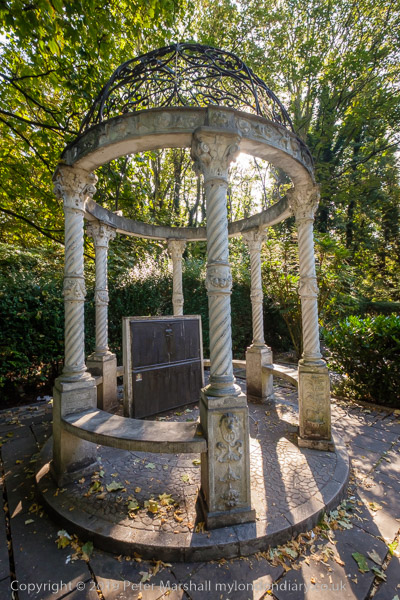
I’d realised when I got home from my previous walk that I had not photographed the shelters which were stone alcoves from the Old London Bridge. That bridge, built in 1176-1209 had until 1760 been cluttered with houses and shops, leaving only a narrow path across the river. These were cleared in 1760-63, more than doubling the width of the bridge, and seven stone alcoves were installed along each side.

The bridge was demolished in 1831, but these alcoves were sold and two found there way to Victoria Park when it was opened in 1845. Another is in a courtyard at Guy’s Hospital and two ended up on an estate in East Sheen along with some of the balustrade, though only one now remains in the grounds of some 1930s flats at Courtlands, close to the 1st Richmond Scouts HQ.

Percy Dalton, Dace Rd, Hackney Wick, Tower Hamlets, 1990, 90-9h-46

From Victoria Park I walked across the footbridge over the East Cross Route to Hackney Wick, then turning south and making my way down Wansbeck Road to the Northern Outfall Sewer on Wick Lane. Steps there took me down to Dace Road and along to Old Ford Locks. Unfortunately although I took a few picture on the walk, none are among those I’ve digitised. So here’s one I took in 1990 on Dace Road of Percy Dalton’s peanut factory.

Loading Bay, Lock, Old Ford, Lea navigation, Tower Hamlets, 1988 88-10e-61-Edit_2400
Loading Bay, Lock, Old Ford, Lea navigation, Tower Hamlets, 1988 88-10e-61

I walked across the gates at Old Ford Lock and took a few pictures there, including this one of the loading bay at Swan Wharf.

Bridge, White Post Lane, Lea Navigation, Hackney Wick, Tower Hamlets, 1988 88-10e-62-Edit_2400
Bridge, White Post Lane, Lea Navigation, Hackney Wick, Tower Hamlets, 1988 88-10e-62

The I walked north on the towpath. Now there are two new bridges on this stretch, from Stour Road and Monier Road, but in 1988 the next crossing was at White Post Lane.

Bridge, White Post Lane, Lea Navigation, Hackney Wick, Tower Hamlets, 1988 88-10e-65-Edit_2400
Bridge, White Post Lane, Lea Navigation, Hackney Wick, Tower Hamlets, 1988 88-10e-65

At left is the splendid 1913-14 Queen’s Yard works, part of the Clarke, Nickolls & Coombs Ltd “Clarnico” sweet and chocolate factory, formerly the largest employer in the area. Much of their five works were damaged or destroyed by wartime bombing and this building needed some restoration. The company was bought by Trebor in 1969 and the works closed. The white building fronting the canal beyond the bridge was the cocoa bean roasting factory built around 1900.

I walked over the bridge and along to Hackney Wick station for a train to Richmond on my way home.


London Crowns 100th May Queen

London Crowns 100th May Queen – Hayes, Kent.

On Saturday 12 May 2012 I went by invitation from the family of the 100th May Queen to photograph her crowning on Hayes Common. Earlier I had photographed and written about the festival and other May Queen Festivals. Below is the text from my report on the event in My London Diary, with just a few minor corrections along with a few of the pictures. You can find more pictures on the web site.

London Crowns 100th May Queen

The Merrie England and London May Queen Festival was started by Joseph Deedy, usually described as a ‘Dulwich schoolmaster’ in 1913, and moved to its current location on Hayes Common soon after. Surprisingly it continued throughout both world wars, although in a somewhat truncated version, with no procession around the village. It was also felt that holding the ceremony in the open air would present too tempting a target for the enemy, and so it was moved from the common to the parish church. But continue it did, and every year since 1913, one girl has been crowned as the London May Queen, making this year’s Festival and Queen the 100th.

London Crowns 100th May Queen

Whitelands College in London started its May Queen festival rather earlier in 1881 at the prompting of John Ruskin, and this still continues at the college (now part of the University of Roehampton) although since the college now admits men, some years they have a May King in place of a queen. Talking to one of the organisers of the event yesterday I learnt that Deedy had worked at Whitelands – contrary to the published information on him, including that I retold in my own book and PDF on the festival. [You can read a little more about this book on >Re:PHOTO which also has has an e-pub link.) Copies of this and my other Blurb books are usually available to UK addresses more cheaply direct from me.

The London May Queen sits in her carriage

The ceremonies take place in a large roped off arena on Hayes Common, with the May Queens and their groups from various places on the fringes of south east London taking their places around it in alphabetical order. Each group has its own colour for the dresses and its own flower, and girls who may join as young as three make their way up through the various roles in the group until, if they remain long enough, they become the May Queen of their local realm. After this they can move on to join the London May Queen group, and again take the various roles by seniority until finally – usually when they are around 16 – they become London May Queen. As well as taking part in May Queen activities, May Queens and their groups also appear at various charity events in their local areas.

London Crowns 100th May Queen
Beckenham May Queen and retinue

I arrived just as the procession around Hayes was starting, with the uncrowned queen in a lightweight carriage pulled by Sea Cadets with the Prince of Merrie England walking beside her and preceded by a bagpiper. Behind her were the members of London May Queen, including the Joy Bells celebrating Music, Company, Life, Beauty, Flowers as well as the Fairy Queen, Bo-Peep, Robin Hood and several others.

London Crowns 100th May Queen
Bromley Common Queen and retinue

Behind them came the May Queen realms in alphabetical order – Beckenham, Beddington, Bletchingly, Bromley Common, Caterham, Chislehurst, Coney Hall, Downe, Eden Park, Elmers End, Green St Green, Hayes, Hayes Common, Hayes Village, Orpington, Petts Wood, Shortlands, Wallington, Warlingham and West Wickham. In the heyday of the event in the 1920s and 30s there were as many as 100 groups, and the event made the national newspapers and the cinema newsreels.

Little Sanctum - London Crowns 100th May Queen
At Hayes Parish Church for Little Sanctum

At the parish church, the London May Queen group made their way into the churchyard for a short service written by Deedy which he called ‘Little Sanctum’, before joining back on the end of the procession around the village and back to the common.

London Crowns 100th May Queen

There the 100th May Queen was crowned and the further pageant witten by Deedy performed, ending with the May Queen being led around the arena by BoPeep and scattering flowers towards the seated May Queen realms.

Many of the younger girls were quite tired by the walk around the village and were busy eating ice cream and sandwiches, which revived them considerably, and after the Chislehurst May Queen group had given a demonstration of ribbon dancing, all of the Merrie England children – including a few young boys who mainly take part as pages – came and took part in a lively circle dance around the large maypole.

All that was left was for the May Queen to draw the tickets for the raffle which helps to cover the expenses.

London Crowns 100th May Queen


You can read more about this and other May Queen ceremonies in London both in reports of the various events on My London Diary and from my book mentioned above. I had hoped that this would be followed by a major exhibition and a more scholarly work illustrated by my pictures but as yet this has not been possible.


Car Spares And Fly Tipping In Hackney Wick

The final few hundred yards of my walk in Hackney on a Sunday in October 1988 took me to Hackney Wick station and I made a few views using the height of the footbridge across the East Cross Route and also from Hackney Wick station where the railway line runs on a viaduct. The previous section of this walk is Homerton to Hackney Wick.
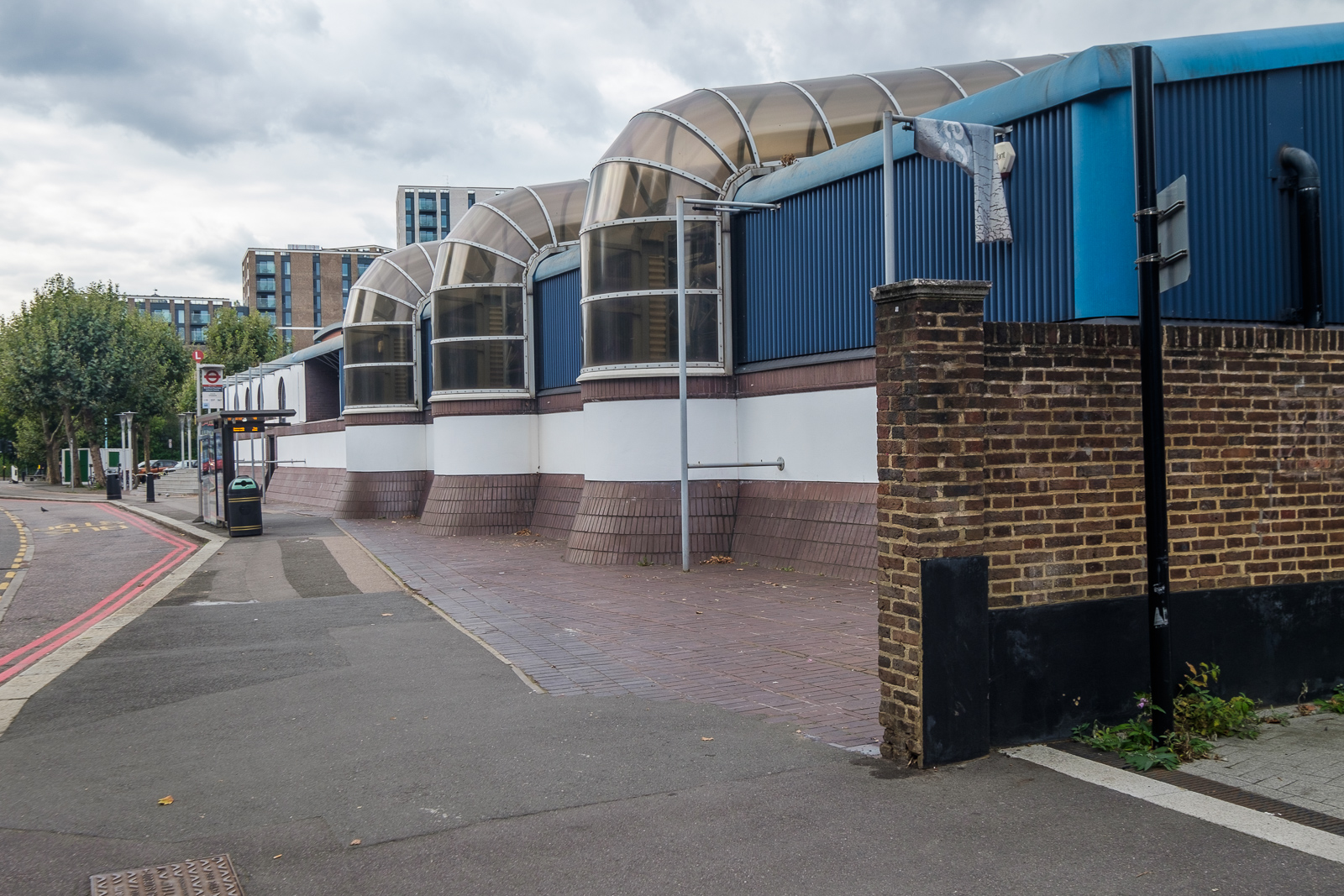
Footbridge, Hackney Wick, Hackney, Tower Hamlets, 1988 88-10d-56-Edit_2400
Footbridge, Hackney Wick, Hackney, Tower Hamlets, 1988 88-10d-56

Looking roughly north you can see the tower blocks of the Trowbridge Estate. Some had already been demolished by 1988 – the programme had been started in 1985 and was completed by 1996.

Car Spares, Hackney Wick, Hackney, 1988 88-10d-42-Edit_2400
Car Spares, Hackney Wick, Hackney, 1988 88-10d-42

Coming down the footbridge I got a better view of the large car spares yard on Rothbury Road, past which you can see the embankment carrying the North London Line. At right is the top of a cafe and towering above the railway the remaining towers of Hackney Wick’s Trowbridge Estate. Perhaps given its history my my confusion with Trowbridge and the accident-prone frigate HMS Troutbridge in BBC radio’s long running series with Lesley Phillips, Jon Pertwee, Ronny Barker and others, The Navy Lark was understandable.

Car Spares, Rothbury Rd, Hackney Wick, Tower Hamlets, 1992, 92-8d-41

I didn’t photograph the front of the car spares site on Rothbury Road on this occasion – it had been a long walk and I was tired and just wanted to get to the station in time for a train towards home. So here are a couple of pictures from around four years later, when little had changed.

Fence, Car spares, Rothbury Rd, Hackney Wick, Tower Hamlets, 1992 TQ3684-009

And one in colour.

Fly tipping, Rothbury Rd, Hackney Wick, Hackney, 1988 88-10d-31-Edit_2400
Fly tipping, Rothbury Rd, Hackney Wick, Hackney, 1988 88-10d-31

The area at the Hackney Wick end of the footbridge was a favourite with fly-tippers, sometimes making it hard to use the bridge.

Wallis Rd, White Posts Lane, Hackney Wick, Tower Hamlets, 1988 88-10d-34-Edit_2400
Wallis Rd, White Posts Lane, Hackney Wick, Tower Hamlets, 1988 88-10d-34

The whole right hand side of White Posts Lane at the right of this picture was redeveloped in 2018-9, but the low section of wall from earlier demolition in my picture was still there after that though now – like much of Hackney Wick, highly decorated with graffiti. A considerable amount of graffiti in the Wick was removed in tidying up the area for the 2012 Olympics but was soon re-stablished. Wallis Road at left led me to the station.

Hackney Wick, Hackney Wick Station, Tower Hamlets, 1988 88-10d-36-Edit_2400
Hackney Wick, Hackney Wick Station, Tower Hamlets, 1988 88-10d-36

From the footbridge at Hackney Wick station there were views over the surrounding area. The station has been rebuilt since I made this picture, and now has an entrance on the south side of the line.

This was the end of my rather long walk in the London Borough of Hackney in October 1988 which had begun at the southern end of Stoke Newington in the post South Stokey & Hornsey Detached.


Homerton to Hackney Wick

Homerton to Hackney Wick – This walk I made in October 1988 continues from where my previous post Morning Lane, Paint, Handbags and Printers ended.

Homerton High St, Homerton, Hackney, 1988 88-10d-01-Edit_2400
Homerton High St, Homerton, Hackney, 1988 88-10d-01

Immediately east of Mackintosh Lane on the south side of Homerton High St at No 178-84 was an unusual arched brick wall, which attracted my attention. Thistle House at 178-82 was a hostel with 33 rooms in multiple occupation. Part of the wall shown in this picture has now been demolished to allow storage of large rubbish bins. The wall goes in front of two distinct houses, both of which have one circular window – but in the joined house it is above the second floor window.

Barnabas Rd, Homerton, Hackney, 1988 88-10d-63-Edit_2400
Barnabas Rd, Homerton, Hackney, 1988 88-10d-63


Barnabas Rd runs south from Homerton High Street past Homerton Station. In 1988 the premises of printers Alan Moor & Co at No 24 was up for auction. It is still there and remains a handsome villa – my photograph doesn’t really do it justice. I suspect it dates from around 1860 when Barnabas Road was called Church Road, (it was renamed in 1936) but can find no details. The rather ugly porch has I think been extended since 1988.

The Immaculate Heart of Mary & St Dominic, RC, Church, Kenworthy Rd, Homerton, Hackney, 1988 88-10d-64-Edit_2400
The Immaculate Heart of Mary & St Dominic, RC, Church, Kenworthy Rd, Homerton, Hackney, 1988 88-10d-64

Originally called the The Church of the Immaculate Heart and St. Dominic it was designed by C A Buckler and built on what was until 1939 Sidney Rd two years after a mission was founded here in 1873. The church, completed in 1883, was badly damaged by bombing and fire in 1941 and was rebuilt in 1955-57. My picture shows it with shops on the corner of Wick Rd, where there is still an Indian takeaway.

Hackney Hospital, Homerton High St, Kenworthy Rd, Homerton, Hackney, 1988 88-10d-65-Edit_2400
Hackney Hospital, Homerton High St, Kenworthy Rd, Homerton, Hackney, 1988 88-10d-65

I went up Kenworthy Road back to Homerton High St, stopping on the corner of Ward Lane to make this picture of the East Wing of Hackney hospital, which I think is Pavilion B, built in 1880-82, designed by William Finch, a typical design for the time with long airy ‘Nightingale Wards’ and towers at the corner containing sanitary facilities. (I stayed on a similar ward in a south London hospital in 2003 just before it was demolished – and collapsed in the disconnected sanitary area after an operation, fortunately in reach of the red emergency cord which I came around sufficiently to pull and bring medical staff running to my aid.) Although Hackney Hospital closed in 1995, parts are still in use for mental health services and a notice calls this the John Howard Centre, which provides low and medium secure mental health services for North East London.

Shops, Homerton High St, Homerton, Hackney, 1988 88-10d-66-Edit_2400
Shops, Homerton High St, Homerton, Hackney, 1988 88-10d-66

These buildings are still there at 201-205 Homerton High Street, though in different hands. Back in 1988 a Bookmakers next to a Turf Accountant (a rather upmarket term for the same thing) seemed excessive, while F A MURRELLS business was completely hidden by shutters. It seemed to be some kind of miniature business, the whold width of the property perhaps around 7 ft with a tiny door only suitable for a slim child in the shutters. Whatever was going on inside – or rather had once gone on inside – obviously involved something of some value, worth protecting with an AFA Burglar Alarm, perhaps a jewellers or pawnbrokers? But this tiny shop had obviously been fairly recently sold – and now appears to be a residential property.

The Adam & Eve, pub, Homerton High St, Homerton, Hackney, 1988 88-10d-51-Edit_2400
The Adam & Eve, pub, Homerton High St, Homerton, Hackney, 1988 88-10d-51

There has been an Adam & Eve tavern in Homerton High Street since at least 1735, but its fine frontage is dated from 1915 and was recently restored. Its cream terracotta front includes a large relief showing very chastely the couple before the fall but underneath an apple tree. In 1988 it was a Taylor Walker pub (though Taylor Walker had been taken over and closed in 1960), now it is described as a gastro-pub, with fresh food from the farm daily and offering “CURING – MICROBREWERY – ALLOTMENT”. The Taylor Walker pub sign was rather better and had above the field gun that came from the Clerkenwell Cannon brewery they took over in 1929.

East Cross Route, Hackney Wick, Hackney, Tower Hamlets, 1988 88-10d-55-Edit_2400
East Cross Route, Hackney Wick, Hackney, Tower Hamlets, 1988 88-10d-55

The East Cross Route was a part of the disastrous Ringways plan for concentric motorway rings around London. This was one of two major parts of the of the innermost Ringway 1 which actually got built between 1967 and 1973. The cost and environmental devastation caused by the building of the Westway in North Kensington led to a huge backlash which led to the cancellation of the remaining parts of the scheme.

The East Cross Route was less controversial, partly because it was in East London and most politicians and others didn’t much care about what happened there, but also because it largely replaced an existing rail line which had long separated the communities on each side. For much of its length there was in any case little between the road and the natural boundary of the River Lea and the Lea Navigation.

There were relatively few roads which ran across the area, and the links across the new road were maintained with both Wick Lane and Wick Road still leading to Hackney Wick. Olf Ford Road no longer led to Old Ford, except by a footbridge, but for vehicles the detour was relatively short. The bridge I was on when I made this picture carries a footpath across Victoria Park from Cadogan Terrace to Rothbury Road in Hackney Wick. The Trowbridge Estate built in 1965-9 had 7 rather striking 21-storey tower blocks. Demolition of these had begun with Northaird Poiont in 1985 and all had gone by 1996.
The final post in this series, appearing shortly, will include my pictures from Hackney Wick where my walk ended.