Stockwell – Chapel, Church, Jazz & Housing

Stockwell – Chapel, Church, Jazz & Housing: I thought I had completed the pictures from my walk on 4th June 1989, but find there is a chunk I had left out. As those who have followed my various walks know I often wandered in circles. I think these pictures were taken following those in the post More Stockwell Green & Mary Seacole.

Khatme Nubuwwat Centre, 35 Stockwell Green, Stockwell, Lambeth, 1989 89-6b-46

The Khatme Nubuwwat Centre was previously known as Aalami Majlise Tahaffuze Khatme Nubuwwat and is also known as Stockwell Green Mosque. It was the subject of an investigation by the Charity Commission in 2016 over its links with Pakistani groups advocating the killing of Ahmadi Muslims. Its name means that Muhammad is the last of the prophets, while Ahmadis are a minority Muslim sect who believe the Prophet Mohammad is not the last and final messenger.

Khatme Nubuwwat Centre, 35 Stockwell Green, Stockwell, Lambeth, 1989 89-6b-31

Another picture of Stockwell Green Mosque with the number 35 and its name in 1989, Aalami Majlise Tahaffuze Khatme Nubuwwat, at the side of the door.

Confusingly this building still appears to be Grade II listed as Stockwell Green United Reformed Church, although it was sold to the mosque in 1988, when that church moved to smaller premises. It also gives the address as Union Mews. The listing text says it is a classical chapel dating from around 1830. It was known as Stockwell New Chapel and was where William Booth and Catherine Mumford the founders of The Salvation Army were married on 17th June 1855.

I’m surprised that when it was listed in 1981 a more exact date could not be given as most chapels have foundation stones with names and dates. It was built in 1798, but was extended and given this facade by architect Hames Wilson in 1850.

St Andrew's, Church, CofE, Landor Rd, Stockwell, Lambeth, 1989 89-6b-33
St Andrew’s, Church, CofE, Landor Rd, Stockwell, Lambeth, 1989 89-6b-33

I went back to Landor Road and made another picture of the Anglican St Andrew’s Church seen from the corner of Stockwell Green, showing the oversize circular window at its east end, doubtless part of H E Roe’s Romanesque rebuilding in 1867.

The house at the left, 22 Stockwell Green is early 19th century and Grade II listed.

Live Music, Stockwell Green, Stockwell, Lambeth, 1989 89-6b-34

I think this may have been an entrance to the Plough pub, on the corner of Stockwell Green and with the address 90 Stockwell Road, though nothing there resembles this now.

The Plough had been on this site since brewery records began in 1666, but was rebuilt in the 1930s as a Truman pub designed by A E Sewell. It was a well-known jazz venue in the 1960s and 70s with performances by some of Britain’s best jazz musicians and some live recordings were made in the bar.

By the 1990s the audience for live jazz had declined and two letters of its name had fallen from the sign and it was relaunched as a garish bar, the Plug. But this was unsuccessful and closed in 2001. The upper floors are now residential but the ground floor seems to still be empty 22 years later.

King George's House, 40 Stockwell Rd, Stockwell, Lambeth, 1989 89-6b-35
King George’s House, 40 Stockwell Rd, Stockwell, Lambeth, 1989 89-6b-35

Built as Ingram House, architect Arthur T Bolton, it opened in 1905 as a residential club for young men and later was taken over the the YWCA for young ladies. In 1937 it became King George’s House, a home for working boys aged 14-18 run by the John Benn Boys’ Hostel Association. It is now run by Evolve Housing as “an 87 bed service for single homeless young people from 16 years of age with a range of support needs.

The rather tall gates were firmly locked when I made this picture from the street.

Cassell House, Stockwell Gardens Estate, Stockwell, Lambeth, 1989 89-6b-21

Cassell House is in Stockwell Gardens West and has flat numbers 1-81. The estate was built by the London County Council from around 1930 on. Cassell House is a large complex with this curved block behind a group of buildings including the Swan pub on the corner of Clapham Road and Stockwell Road more or less opposite the Stockwell Underground Station.

Stockwell’s most famous gardens, the botanical gardens of John Tradescant lay a little to the north.

A few more of the ‘missing’ pictures in a later post.

Cinelli, Poppies and Music at Class War Poor Doors – 2014

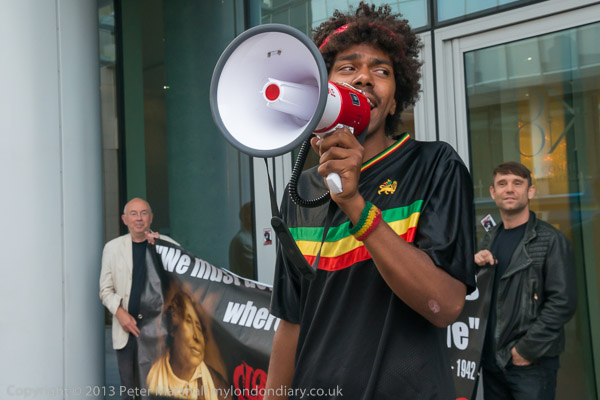
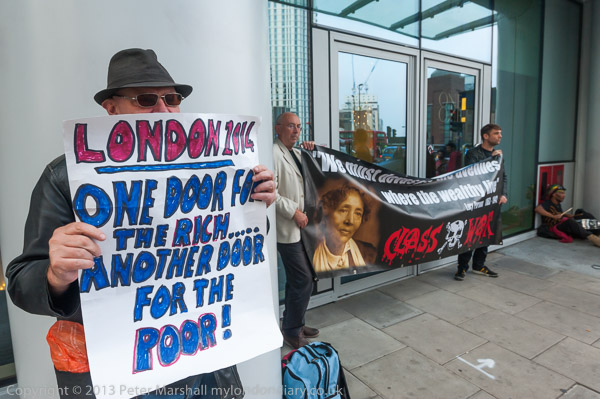
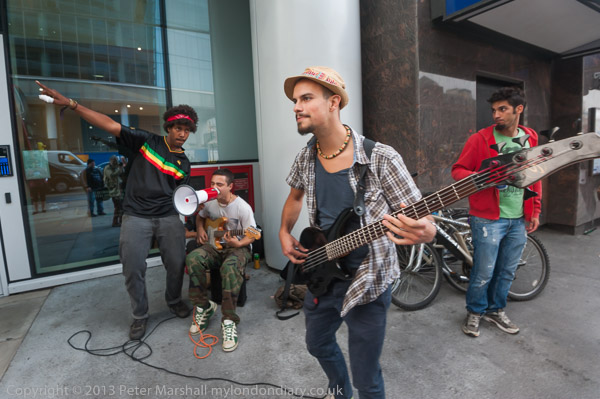
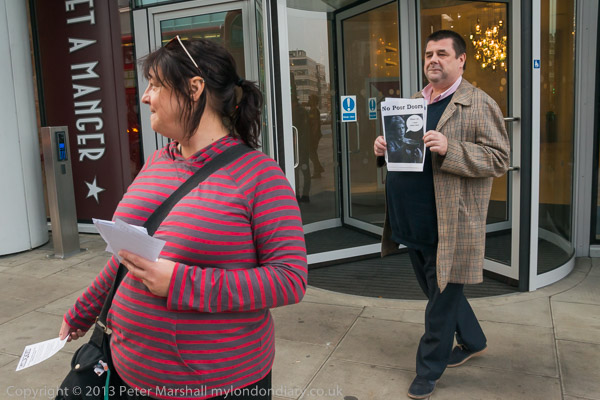
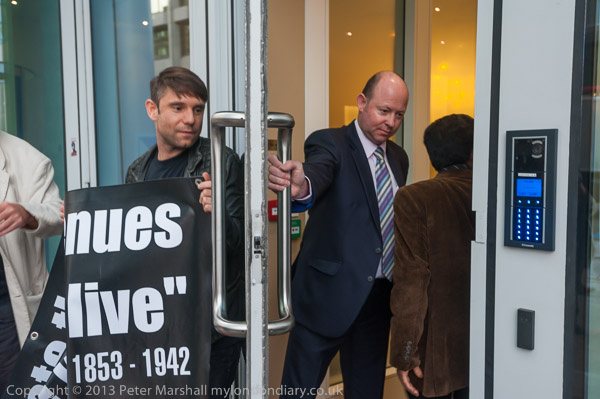
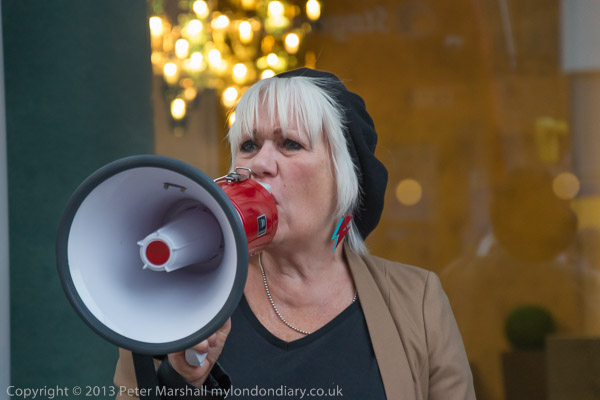
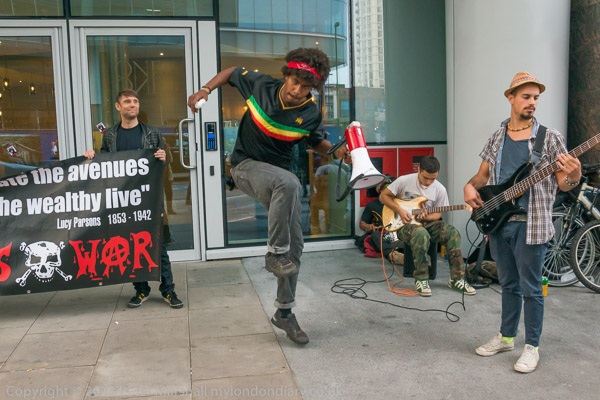
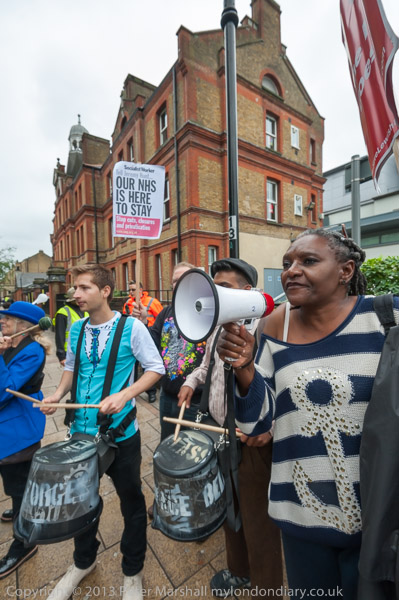
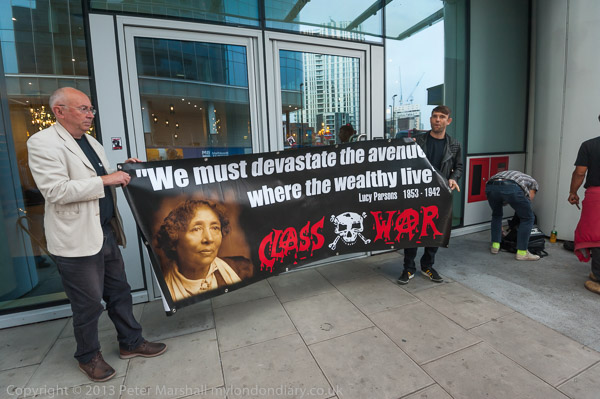
Cinelli, Poppies and Music at Class War Poor Doors. I only photographed one event on Wednesday 17th September 2014, one of the long series of weekly protests by Class War over separate entrances for rich and poor occupants of the large block of flats at One Commercial St on Whitechapel High Street.


Music at Class War Poor Doors – Aldgate

Cinelli, Poppies and Music at Class War Poor Doors

One Commercial St is a 21 storey largely residential block occupying an extensive corner site on Whitechapel High St and Commercial St which includes 207 flats above lower floors of offices, shops and an entrance to Aldgate East Underground Station.

Cinelli, Poppies and Music at Class War Poor Doors

The building, opened in 2014, received strong criticism in architectural circles, and Wikipedia quotes Building Design as commenting on what was developer Redrow’s “first flagship development” with “First flagship development? Please God let it also be their last. No one who can liken this incoherent hulk of ill-fitting glass sheets to a blade of light deserves to build again in such a sensitive location” and it was nominated for the Carbuncle Cup for “the ugliest building in the United Kingdom completed in the last 12 months“.

Cinelli, Poppies and Music at Class War Poor Doors

But it became controversial for other reasons too. To meet planning regulations the block contains some flats at affordable rents. While those in the main part of the building enter through an impressive foyer with a concierge desk and seating from the High Street adjoining Aldgate East Station, tenants of the affordable section had to go down what was then a dirty and dingy alley at the side of building, Tyne Street, to a door with a card-entry reader leading to a long empty corridor. On 17th September the card reader had been broken for 3 weeks, leaving the building insecure and the building management had failed to repair it.

Cinelli, Poppies and Music at Class War Poor Doors

This difference in treatment for rich and poor was highlighted in an article in The Guardian which commented on the growing trend for London’s new housing developments to include separate entrances like this for the less wealthy, known as “poor doors” and which gave One Commercial Street among the examples.

Many people expressed their distaste at this social segregation, and in New York Mayor Bill De Blasio announced he planned to take action to prevent new developments having such separate doors for low-income residents after a single such block was built there. But it was becoming common in London.

Anarchist group Class War decided it was time to take some action, and from July 2014 organised a weekly series of evening protests outside One Commercial Street, continuing (with a few breaks) until the following May. I photographed all but a couple of these, and later published a zine with some of the pictures I made. This is still available, but carriage costs make buying single copies expensive, however there is a good preview online.

Others joined with Class War on various occasions, and on Wednesday 17th September 2014 Reggae band Different Moods from Tottenham came to perform their ‘Poor Doors’ song specially written for the protests.

The protests by Class War did raise the profile of the problem, and resulted in some minor changes – including better lighting and cleaning for the side alley. They probably also embarrassed the owners enough to make them sell the building, though the new owners proved no better and the social segregation remains. And it’s perhaps why the building was later renamed and is now the Relay Building.

Music at Class War Poor Doors


Sea of Poppies – Tower of London

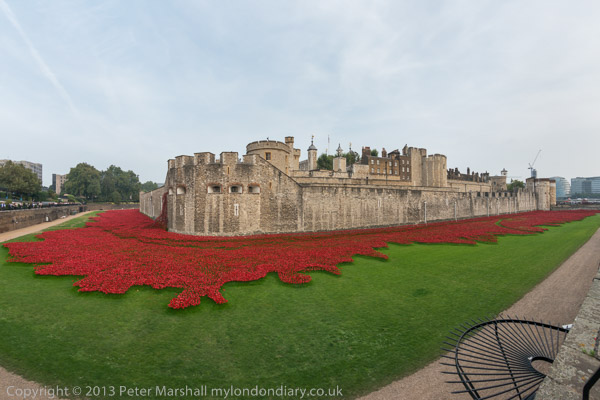
On my way to Aldgate I stopped at the Tower of London and made a photograph of the Sea of Poppies, work of art remembering the ‘Great War’, the ceramic poppies, one for each of the British forces killed in the war. I commented that for me “it seems decorative but shallow” and “lacks any real sense of the numbers involved and is far less graphic than the war cemeteries with their seemingly endless rows of crosses.

A little more at Sea of Poppies.


Vintage Cinelli in poor state

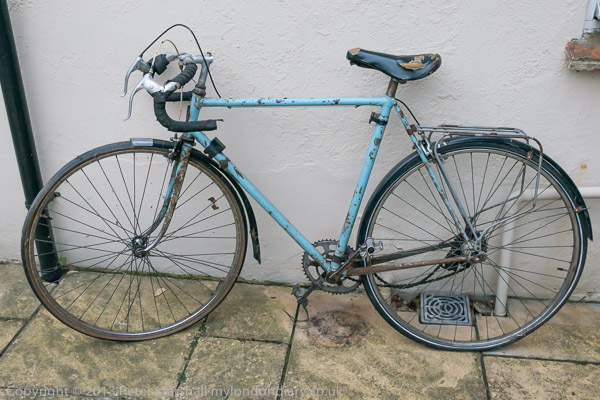
Earlier in the day I’d taken a picture showing the terrible state of my old bicycle, no longer ride able. It’s still in my shed, as several attempts to find a replacement chainwheel have failed. You can read more of the story about it at Vintage Cinelli in poor state. Perhaps I should try searching again.


Serius, MOT, Two Bees & More

My walk which began in Clapham on Sunday 4th June 1989 continues in Stockwell. It began with Light & Life, Pinter and Stockwell Breweries and the previous post was Coldharbour, Atlantic & Brixton Rd – 1989.

Serius Gallery, 44 Bellefields Rd, Brixton, Lambeth, 1989 89-6a-22

All I can tell you about SERIUS GALLERY is written on the door of 44 Bellefields Rd, which continues with ‘QUEEN MARTIN’ and gives its opening hours as Mon-Fri 2-6pm and Sat, Sun 12-3. These houses are still there, looking in rather better condition but no longer as a gallery.

Nor can I tell you anything about Queen Martin, though these was a rather nice looking Victorian pub at 45 Bellefields Road opposite this house named The Queen, which was demolished in 2006 and replaced by an rather ugly block with flats above ground floor commercial spaces also named THE QUEEN.

MOT Centre, Ferndale Rd, Brixton, Lambeth, 1989 89-6a-24

The M.O.T. Centre for Cars & Motor Cycles offering Free Steering & Brake Safety Check would not inspire my confidence with its heap of car scrap at the left of the picture. This site is now a little tidier as Zaks Tyres and the Ferndale Road Car Wash, on the corner of Ferndale Road and Pulross Road.

The fence just visible above its notices is along the railway line.

Tintern St, Brixton, Lambeth, 1989 89-6a-12

I made another picture of the M.O.T centre (not on line) which continues on the other side of the railway bridge and a couple more and continued along Ferndale Road, wandering down some of the side streets. I’ve also not yet digitised a picture of the Brixton Seventh Day Adventist Church on the corner of Ducie St and Santley St, and my next picture on-line is this one from Tintern Street. The building at right of the picture is on the corner with Ferndale Road, with two shops there not visible in my picture.

The shopfronts have changed but the upper floors and general appearance are still much as they were in 1989, and the whole remains a rather nice reminder of the Victorian era. The main loss is in the shopfronts at the left of my picture. Of course it is no longer the ‘TWO BEES LADIES AND GENTS HAIRDRESSERS’ but still in the same trade as a Unisex Hair Salon.

Subverted Billboard, Bedford Rd, Clapham, Lambeth, 1989 89-6a-14

I’m not sure I entirely understood the amendments made to this billboard which advertised Billy Graham’s 1989 Evangelical Mission when I made this picture. It helps too look up Luke 12:19, which in the King James Version reads “And I will say to my soul, Soul, thou hast much goods laid up for many years; take thine ease, eat, drink, and be merry.” And to put the comment into more standard English, “Dollar bill still has to be my bowl of cherries.”

While it’s clear that the L is now a pound sign, and is followed by a dollar symbol. I think the ‘E’ at right is added to make this now read £$ FEE.

I think it was probably a different hand that posted a line of five anti-poll tax posters posters at bottom right.

Chequers Cafe, Bedford Rd, Landor Rd, Clapham, Lambeth, 1989 89-6a-15
Chequers Café, Bedford Rd, Landor Rd, Clapham, Lambeth, 1989 89-6a-15

The Chequers Café, a greengrocers and a pub on the corner of Bedford Road with Landor Road. The pub is still there. In 1989 it was the Bedford Arms, there since around 1874, but I think later was the Hog’s Head and simply the Bedford. In 2003 it became The Clapham North, the first of several pubs in the area opened by the pub group Livelyhood who made it one of Clapham’s most popular pubs. But they were simply tenants and the pub was bought by Young’s in 2013 and ten years later they decided to take over the lease. So now just another Young’s pub.

Houses, Atherfold Rd, Clapham, Lambeth, 1989 89-6a-16

This was the last picture on my walk on 4th June 1989. These unusually ornate early Edwardian houses caught my attention. They are terraced houses, but built to look grander than they are with substantial doorways over paired front doors. The houses at left are part of a short terrace of four, and then a longer terrace goes around a corner in the street.


Lewisham, Secular Europe & Malta Day – 2013

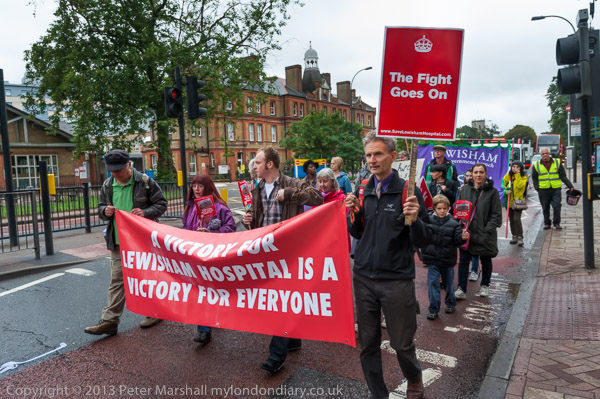
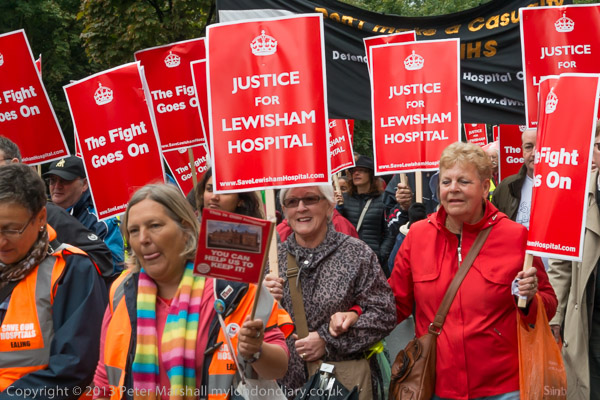
Lewisham, Secular Europe & Malta Day – Saturday 14th September 2013 was a very mixed day for me, beginning with a victory celebration by hospital campaigners in Lewisham, then moving to Westminster for a protest celebrating secularism in Whitehall before finally photographing a highly religious Malta Day celebration at Westminster Cathedral.


Lewisham Hospital Victory Parade

Lewisham, Secular Europe & Malta Day

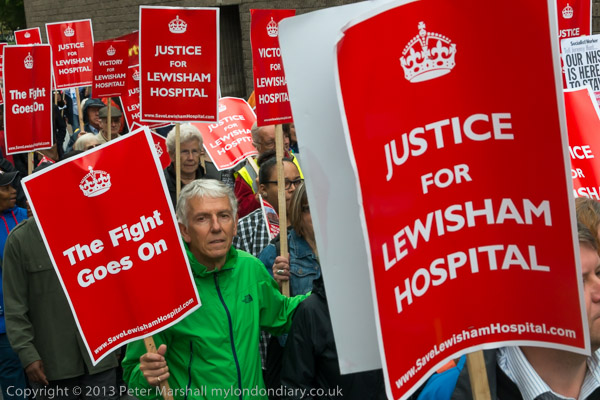
Lewisham Hospital is a highly successful and well run hospital serving a large area of South London, and when the government planned to close large areas of its services there was a huge public outcry, with large marches to keep it open, as closure would have severely damaged the health service in the area.

Lewisham, Secular Europe & Malta Day

The planned closure was not in response to any failure by Lewisham; it’s sole purpose was to allow the NHS to continue to make massive PFI repayments due from the building of other London hospitals through contracts that were badly negotiated when interest rates were high and have already delivered huge profits to the lenders.

Lewisham, Secular Europe & Malta Day

As well as a hugely successful public campaign, both Lewisham Council and the Save Lewisham Hospital campaign went separately to the High Court for Judicial Review of the decision by Health Secretary Jeremy Hunt, and both were successful.

Lewisham, Secular Europe & Malta Day

The immediate response of the Health Secretary was to announce he would appeal the two decisions, and the campaign had launched a petition calling on him to accept the defeat gracefully and not waste any further time or taxpayers money over the appeal. Given the clear judgement of the court any appeal seemed unlikely to succeed.

The government also intend to change the law to make it much more difficult for people to contest their decisions in the courts after being defeated on this and other cases where they have failed to give proper consideration to policies. But having a government which seems to think ‘sod the law, we’re going to do as we like‘ doesn’t seem at all healthy for democracy.

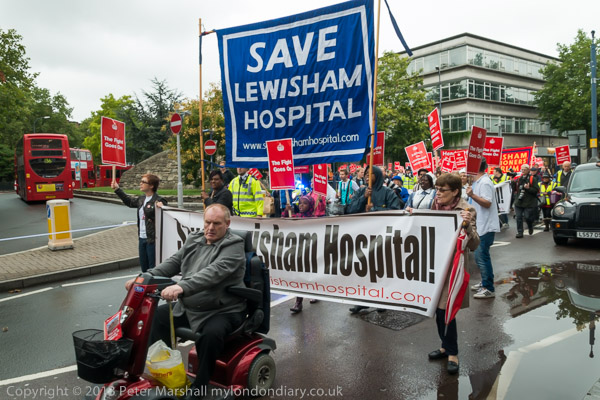
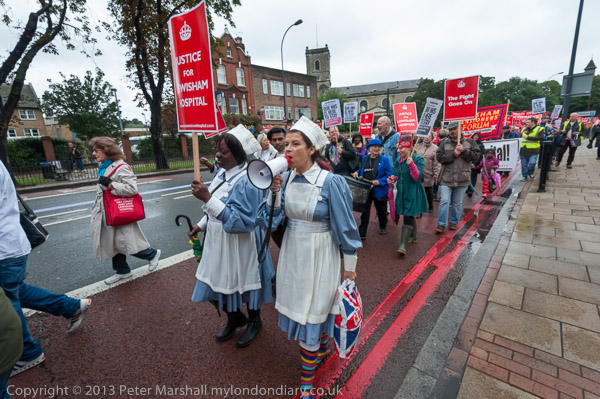
The Victory Parade was rather smaller than the earlier protests which had brought thousands out onto the streets of Lewisham, with perhaps a little fewer than five hundred people, though more turned up to take part in the celebration event at the end of the parade in Ladywell Fields. But perhaps marching now seemed less important, and the poor weather will have put some off.

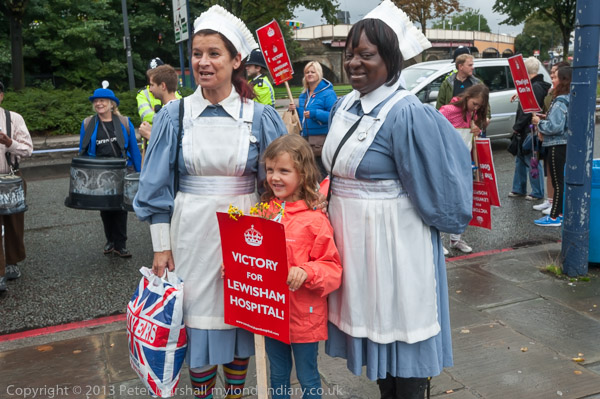
At the front of the parade was a Lewisham Council dustcart with large posters on it and following it were marchers with a small street band. Among those marching were two nurses wearing their uniforms from the Olympic opening ceremony, some ‘Olympic’ drummers and others in medical uniforms.

More pictures on My London Diary at Lewisham Hospital Victory Parade.


Secular Europe Protest – Downing St

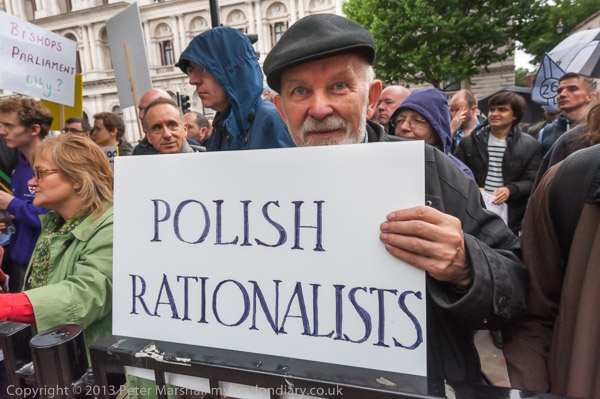
Around a hundred people had marched from Temple to a rally opposite Downing Street for the 6th annual Secular Europe Campaign protest celebrating secularism and demanding an end to religious discrimination and indoctrination.

As well as the protest in London there was also a similar protest taking place in Krakow, Poland, a country where politics are still very much dominated by the Catholic Church.

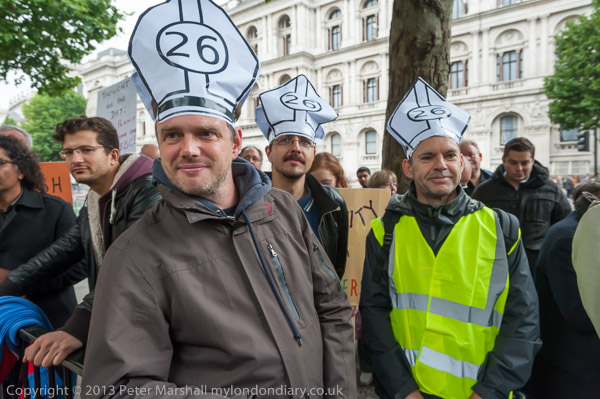
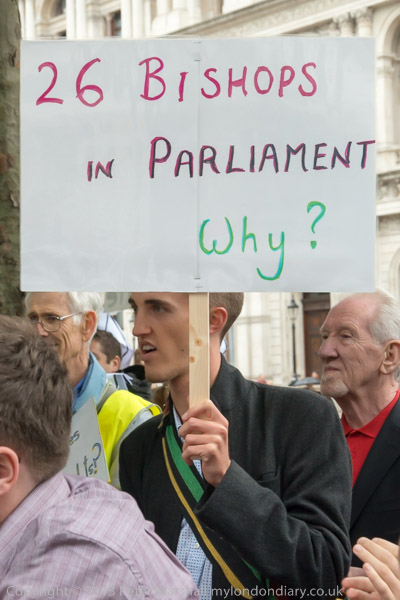
Things are rather different in the UK, but we still have the anomaly of 26 Church of England bishops sitting in the House of Lords, reflected in some of the campaigners wearing paper versions of a Bishop’s mitre with the number 26 on the front.

We obviously need reform of the House of Lords, but the bishops seem to me a minor issue and are among the more sensible and progressive members of the house. There are still 92 hereditary peers, as well as many more wholly undeserved political appointees, particularly those given a seat as thanks for their political and other services to retiring Prime Ministers. The recent list by Boris Johnson included some that clearly bring our politics into disrepute, and if the list by Liz Truss is approved following her disastrous fifty days in office, our politics will clearly have become a farce.

The campaigners also called for an end to religious indoctrination in schools, though I was pleased to hear one speaker make clear that not all church or religious schools were guilty of this, with many providing a good education that encouraged their pupils to think for themselves.

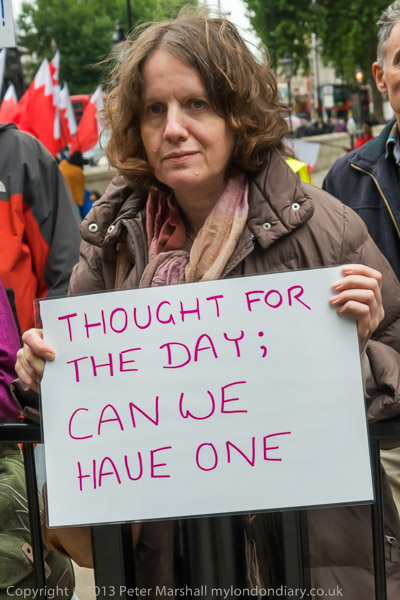
Others complained about the lack of secular speakers on Radio 4’s ‘Thought for the Day’, and though I think the selection has widened a little in recent years there is certainly still room for a wider choice of viewpoints. And they still have some who make me cringe every time they appear.

Some of the other things that concern the secular movement are religious discrimination against women and gays, abuse of children by the clergy, the teaching of creationism in schools, the anti-abortion lobby and misinformation about contraception and AIDs, religious male circumcision and female genital mutilation, false accusations about witchcraft, Sharia law, forced marriages and the right to die with dignity. And of course many of these concerns are shared with many religious people.

More at Secular Europe Protest.


Malta Day Procession – Westminster Cathedral

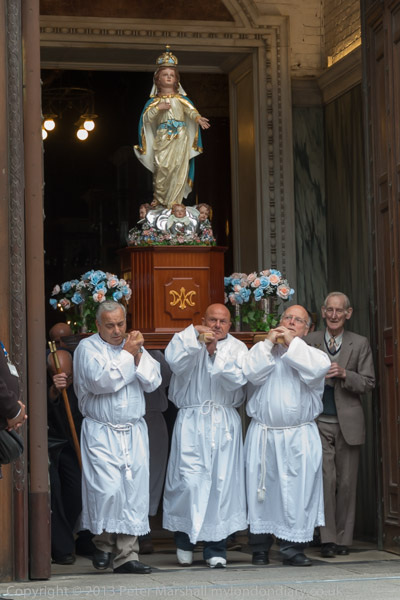
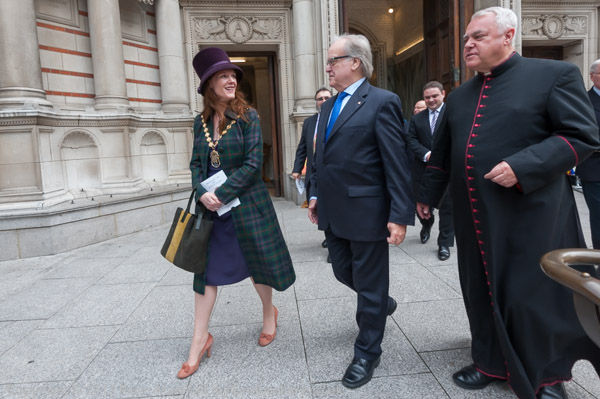
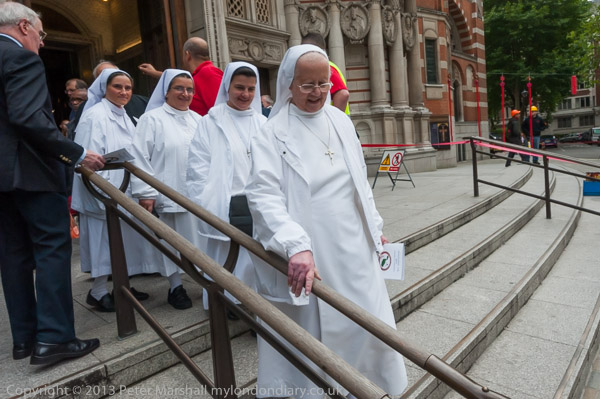
Finally I walked to Westminster Cathedral where a Mass was taking place for Malta Day, attended by the Lord Mayor of Westminster, Councillor Sarah Richardson, taking pictures as people came out from the church for the procession which was to follow.

Malta Day, actually 8th September, is a public holiday in Malta, the Feast of Our Lady Of Victories or Victory Day. Celebrations in villages there mark the Nativity of the Blessed Virgin Mary, commemorated in statues of ‘il-Bambina’, one of which was carried in the procession.

The day also celebrates the Victory of the Knights of St John of Malta against the Turks in 1565, a victory over the French in 1800 and the surrender of Italy, then occupying Malta, in 1943.

Fire-crackers were set off in the plaza and a band played before the procession finally set off down Victoria Street.

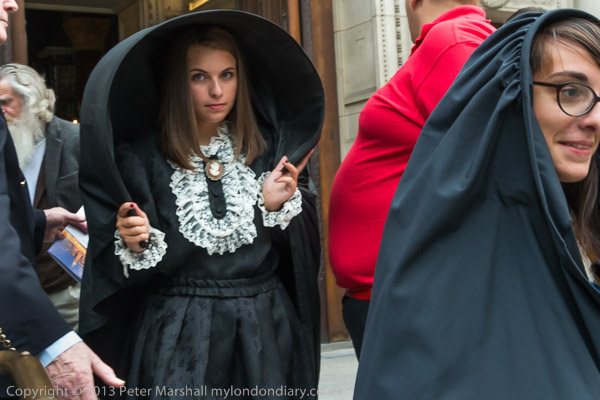
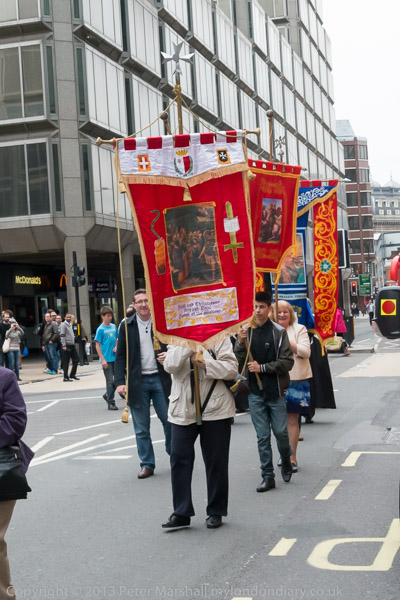
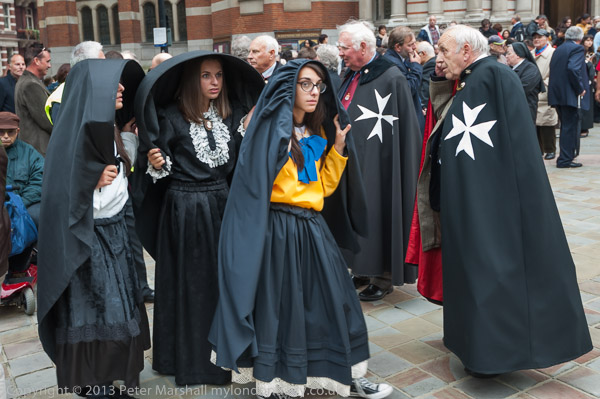
As well as the statue of ‘il-Bambina’, there were also seeral large and colourful banners, men in the robes of the Knights of Malta, and girls in huge black hooded cloaks (Faldetta or Ghonella), which seemed a little sinister to me. For various personal reasons although I’ve never been there I’ve long regarded Malta as an epitome of religious intolerance.

More pictures at Malta Day Procession.


Harmondsworth, Colnbrook & Heathrow 2014

Harmondsworth, Colnbrook & Heathrow: Back in 2014 I could take a bus a short walk from my home which took me to within a few yards of what had recently been renamed the Heathrow Immigration Removal Centre on Bath Road to the north of Heathrow Airport. And since the bus only ran every half hour I arrived a while before the protest there began and had time for a short walk – and almost half an hour to wait on my way home.

Harmondsworth, Colnbrook & Heathrow

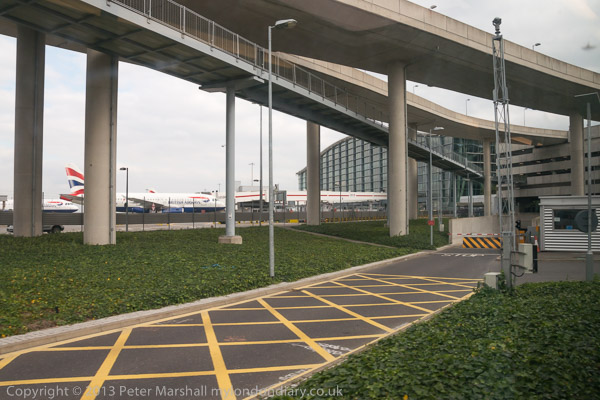
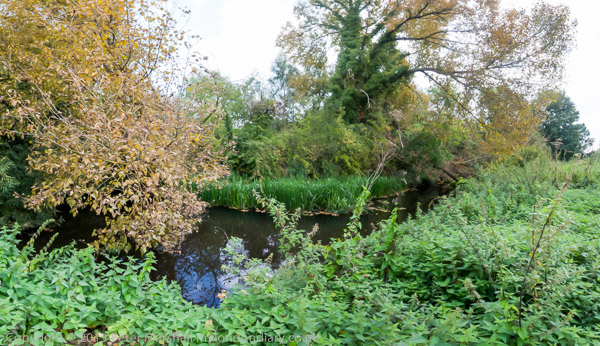
Surprising both buses had fairly clean windows and I also took a few pictures through them on my journey, and you can see a few more at Colnbrook and Heathrow. Before the protest I’d walked beside the Duke of Northumberland’s River which runs through the extensive grounds of the British Airways offices, and on the other bank is a tall fence for the Immigration Centre and BT premises.

Harmondsworth, Colnbrook & Heathrow

The river is a man-made distributary of the River Colne, dug to take water to the Isleworth flour mill and Syon House. Along with another channel, the Longford River, built to take water to Bushy Park and Hampton Court, it has been rerouted around Heathrow airport and some of the pictures from the bus show the two in their new largely concrete channels beside the perimeter road.

Harmondsworth, Colnbrook & Heathrow

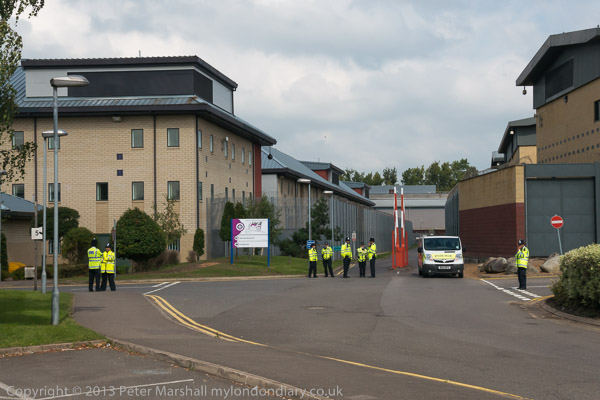
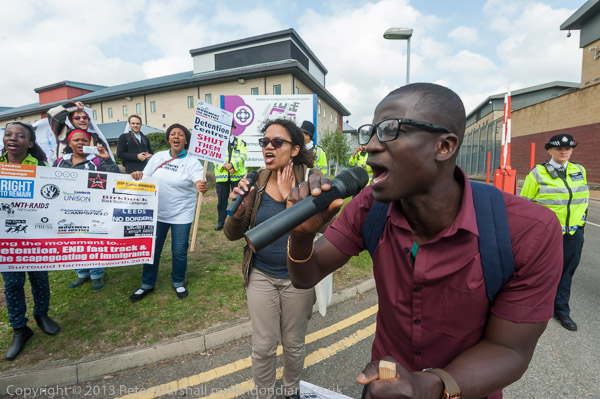
There are two immigration prisons on each side of a private road leading to the BT site behind. On the left of the picture is the Harmondsworth prison block, and on its right the high-security Colnbrook centre. At the start of the month both had been taken over by Mitie, as ‘Heathrow Immigration Removal Centre’, making ‘Care and Custody’, the Mitie subsidiary running the centre the “largest single private sector provider of immigration detention services to the Home Office.”

Mitie’s track record in running such centres should have disqualified them from running and government services. At Campsfield there had been three mass hunger strikes, a suicide and a disastrous major fire – perhaps why they had become one of the government’s favourite contractors.

Harmondsworth, Colnbrook & Heathrow

The name ‘Immigration Removal Centre’ reflects the government’s racist policies towards asylum centres. It wants to remove immigrants, whether or not they have a sound case for asylum. Such centres lock up people making it harder for them to pursue their case to remain in the UK and easier for them to be deported. The great majority of those imprisoned will eventually be given the right to remain in the UK, but may be held in centres like this for many months or even more than two years before being released so they can continue their lives – and make the positive contribution they will to UK society and our economy.

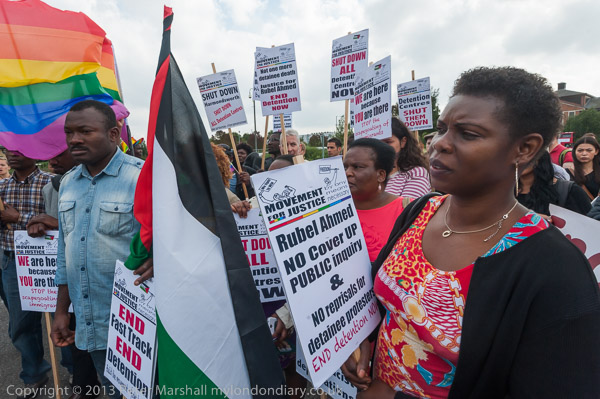
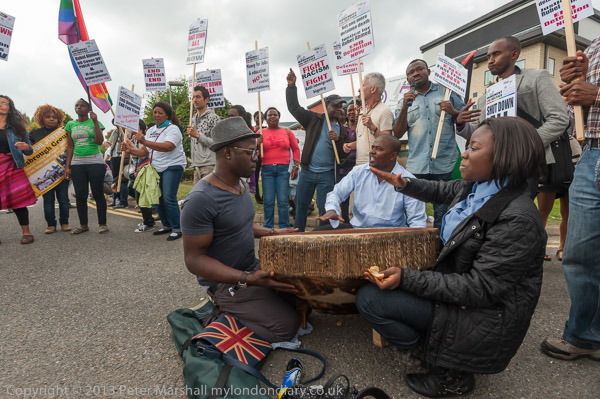
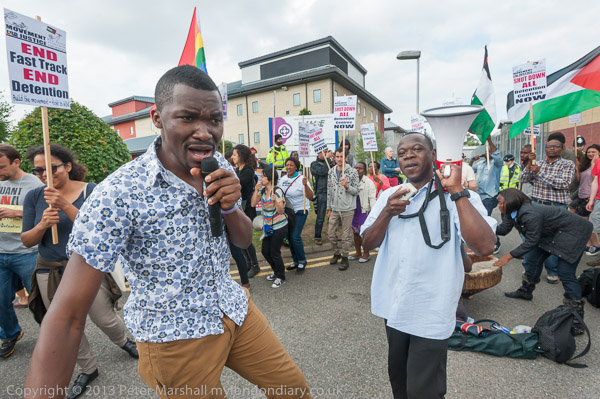
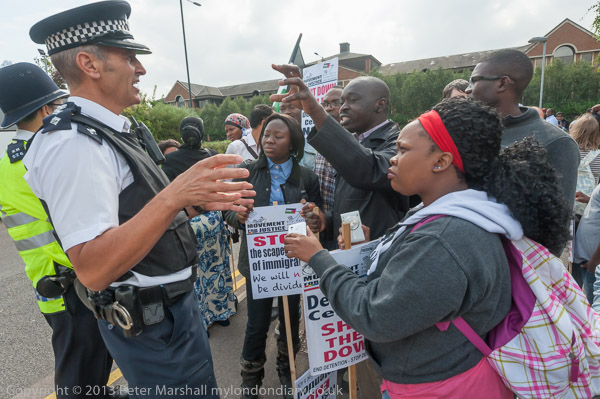
At previous protests here the protesters had been allowed to march down the private road between the two prisons and continue alongside the 20 foot fence around the Harmondsworth site back to the front. But now – perhaps due to the new management – police refused to allow them access, restricting the protest to a pen in front of the centre’s administrative block.

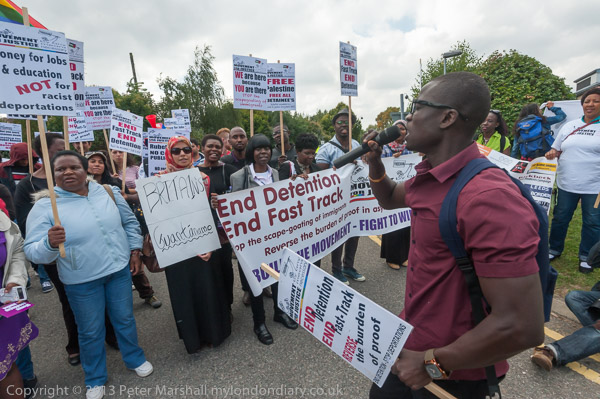
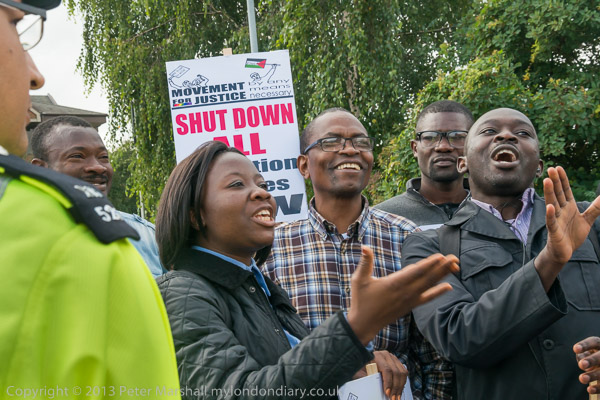
The protest was one of a number here organised by the Movement for Justice, and supported by many other organisation and the protesters argued for some time to be allowed to march down the roadway and around the Harmondsworth centre as usual but without success. Eventually the around a hundred protesters who had travelled out to the western edge of London moved into the pen provided.

The majority of those attending the protest were immigrants, many of whom had been held in this centre or others around the country. Harmondsworth imprisons male detainees, and many of the women at the protest had spent time in Yarl’s Wood near Bedford. Later MfJ would concentrate their protests at that centre.

The protest was a very noisy one, with loud shouting and drumming and a great deal of dancing between the speeches. Phone calls from inside told the protesters that they could be heard inside the cell blocks.

Most of those who spoke were former asylum speakers and told of the suffering they had endured in our immigration detention. As some said, it was worse than prison, as the detention was indefinite. They had no release date to look forward too, and could have been deported at any time back to the countries which they had fled in fear of their lives.

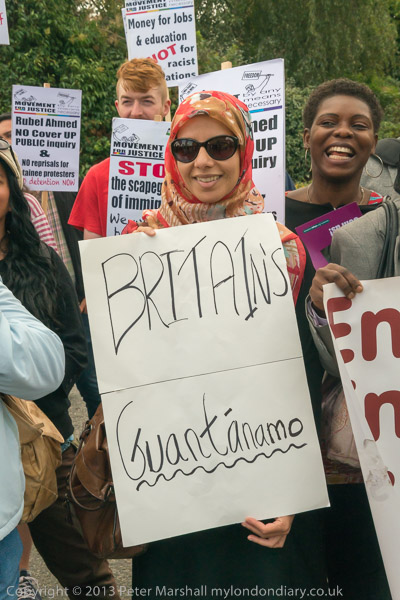
Speakers also called for an end to the ‘Detained Fast Track’ system, deliberately set up when Labour where in power to make it impossible for many asylum claimants to defend themselves against deportation and remove them from the country before they are able to do so. It’s a shameful system that no country that believes in the proper rule of law, fair play and human decency could support.

Various legal challenges to ‘Detained Fast Track’ led to the High Court declaring in January 2017 that DFT had denied justice to asylum seekers for the previous ten years, with thousands being deported without a lawful hearing of their cases.

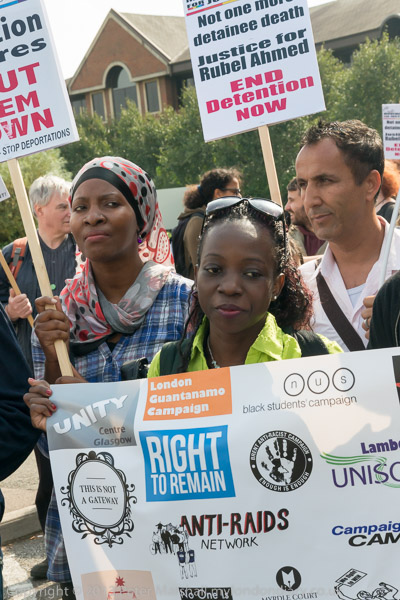
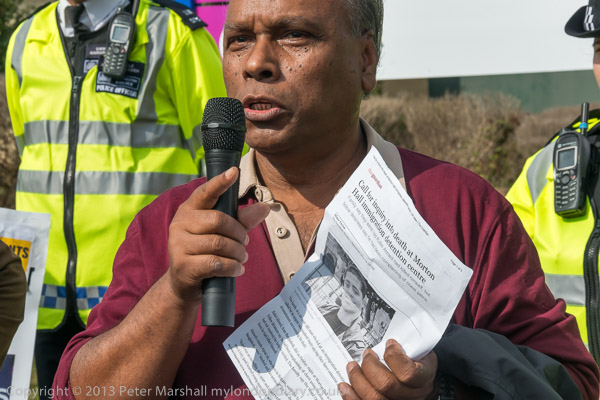
A friend of the family of Rubel Ahmed who described how he died in Morton Hall immigration detention centre in Lincolnshire on September 5th 2014 after having been refused refused medical treatment for his chest pains. Fellow prisoners heard him screaming for help, and had rioted after his death, taking control of the detention centre until brutally suppressed. One who contacted the press was brutally beaten by prison guards.

Many more pictures from the protest on My London Diary at Close UK Immigration Prisons.


Coldharbour, Atlantic & Brixton Rd – 1989

Coldharbour, Atlantic & Brixton Rd: My walk which began in Clapham on Sunday 4th June 1989 continues in Brixton. It began with Light & Life, Pinter and Stockwell Breweries and the previous post was Bon Marche, Police, Acre Lane and Tate.

Shops, Coldharbour Lane, Brixton, Lambeth, 1989 89-6a-45

After taking a near-identical image of Electric Avenue to that I posted earlier I moved on to Coldharbour Lane. Rather to my surprise this row of shops is still there, close to the corner with Electric Lane on the south side of the road.

Clifton Mansions, Coldharbour Lane, Brixton, Lambeth, 1989 89-6a-46

Clifton Mansions, 22 flats at 429 Coldharbour Lane were built set back from the road in 1896 to house workers at the nearby Brixton Theatre, now the Ritzy Cinema and are still reached by a archway between shops at 427 and 431.

They attracted a wide range of squatters in the 1990s, including the Pogues and Jeremy Dellar. The flats were refurbished in 2012. Flats there can now be rented for around £2,500 a month.

Matlock House, Rushcroft Rd, Brixton, Lambeth, 1989 89-6a-32

Matlock House looks in rather better condition now and the blocked doorway covered with fly-posting has now been restored. I think the date on the tile above that doorway is 1892. These properties were refurbished in 2015-6 after some 75 squatters living in Rushcroft Road were forcefully evicted in July 2013. You can read about the eviction and see photographs on Brixton Buzz.

Lambeth Council had owned the flats since around 1975 when they had bought them for the constuction of the Innner London Motorway Box, plans for which fortunately were abandoned, as it would have been disastrous for Brixton. Like Clifton Mansions these flats had been built to house artists and technicians from Brixton’s theatre and music halls. The council abandoned the flats and left them to rot, with squatters moving in.

One resident was able to claim “ownership in the House of Lords under the so-called ‘twelve year rule.’ Five Law Lords threw up their hands in exasperation, took a flat away from Lambeth Council and gave it to him, gratis, after more than a decade of Council mismanagement, incompetence, irresponsibility and neglect.”

The squatters formed a neighbourhood association to defend the flats against sale by the council to property developers in 2002. But slowly, despite great public support for the residents the council pressed ahead, destroying a successful community and hugely accelerating the gentrification of Brixton. Flats here are now for sale at around £750,000.

Continental Foods, Coldharbout Lane, Brixton, Lambeth, 1989 89-6a-33
Continental Foods, Coldharbour Lane, Brixton, Lambeth, 1989 89-6a-33

Home in 1989 by Continental Foods, this Grade II listed building at 411-417 Coldharbour Lane, was built around 1914 to the designs of of T R Somerford as one of the chain of Temperance Billiard Halls. The company targeted south London in particular because many new pubs were built here around the end of the 19th century.

Since I made the photograph, there have been some changes with the ground floor now divided into a number of shops, including a community police station. Lambeth Council granted planning permission for it to be turned into a hotel in the 1990s, and the rest of the building around 2005 became a hostel with the name London Hotel, but has since been refurbished as flats named Billiard Lodge.

Shops, Atlantic Rd, Brixton, Lambeth, 1989 89-6a-34

This row of shops with housing above is between Kellett Road and Saltoun Road on Atlantic Road and includes the Frontline Off Licence. The area around the north end of Railton Road which continues Atlantic Road south of here gained that name after the 1981 clashes with police which became known as the Brixton Uprising or Brixton Riots started here.

Vote Rudy Naryan, Shop Window, Brixton Rd, Brixton, Lambeth, 1989 89-6a-36

Rudra (Rudy) Narayan (1938 – 28 1998) was a barrister and civil rights activist who migrated to Britain in the 1953 from Guyana, spending seven years in the British Army before studying at Lincoln’s Inn to become a barrister.

A blue plaque now marks the building at 413 Brixton Road where he had a law practice from 1987-94. Erected by the Nubian Jak Community Trust and the Society of Black Lawyers it remembers him as ‘BARRISTER, CIVIL RIGHTS ACTION, COMMUNITY CHAMPION AND “VOICE FOR THE VOICELESS’. A heavy drinker who was thrown out of chambers for assaulting his head of chambers, he died of cirrhosis of the liver in Kings College Hospital in 1998 following a lengthy battle with alcoholism.

In 1989 Narayan who had been a Labour councillor and once been selected as Labour candidate for Birmingham Handsworth, but then deselected for allegedly anti-Semitic remarks in his books stood as a candidate in the Vauxhall by-election arguing that a largely black area should have a black MP. His campaign failed to attract much support and Labour’s Kate Hoey was elected.

The plaque is above the San Marino coffee shop on the corner with Brixton Station Road. From there I returned to the area around Ferndale Road where a further post will continue this walk.

Workfare, Methodists & Grow Heathrow – 2012

Workfare, Methodists & Grow Heathrow: Saturday 8th September 2012 was another day of travelling around London, with protests against forced unpaid work for benefit claimants in Camden and Brixton, Ghanaian Methodists celebrating at Victoria and then an open day at Grow Heathrow in Sipson from where a couple of buses took me home.


Day of Action Against Workfare – Camden & Brixton

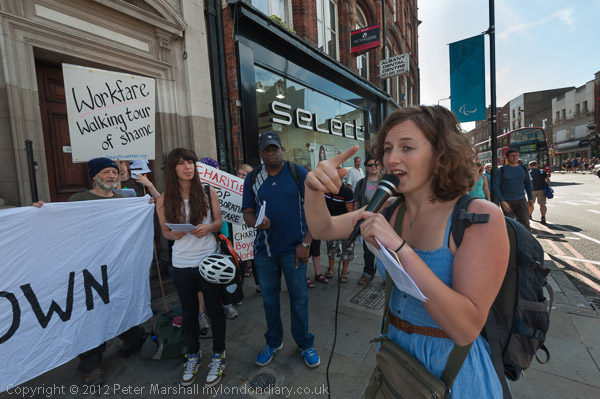
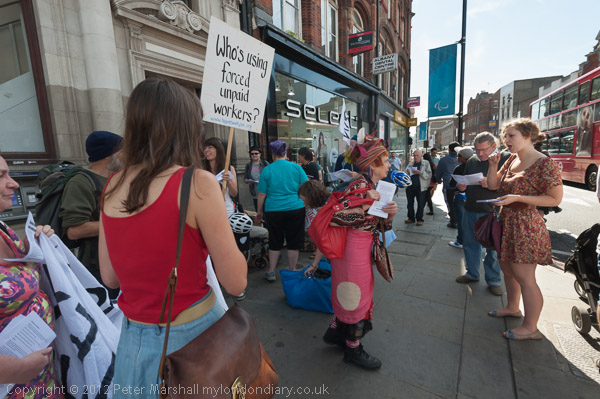
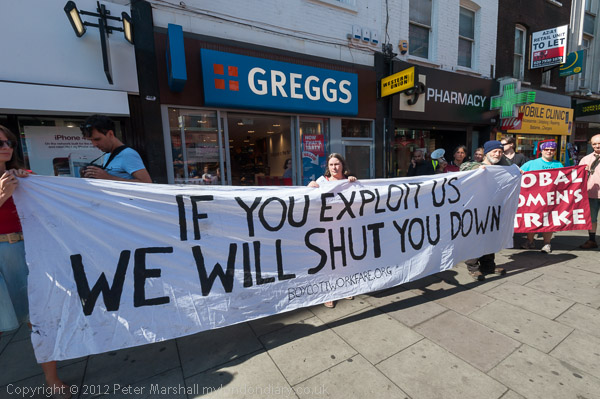
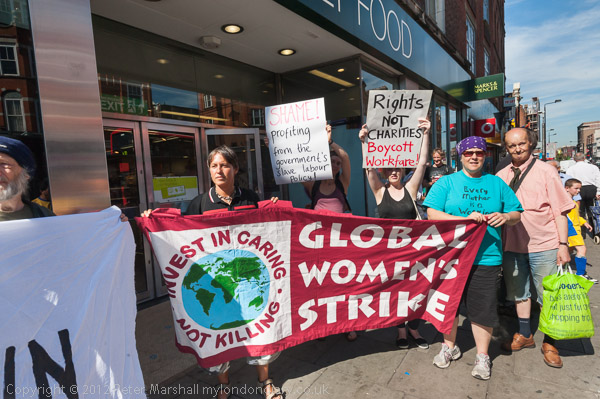
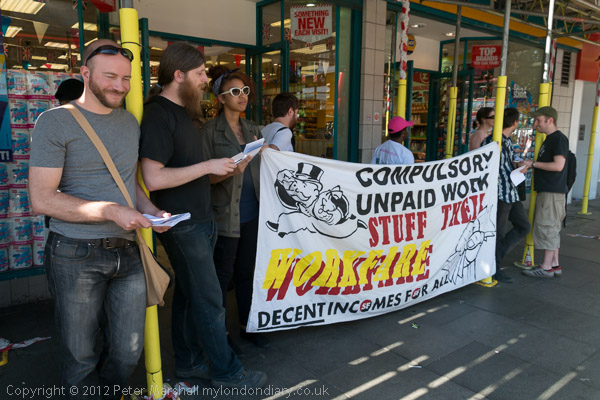
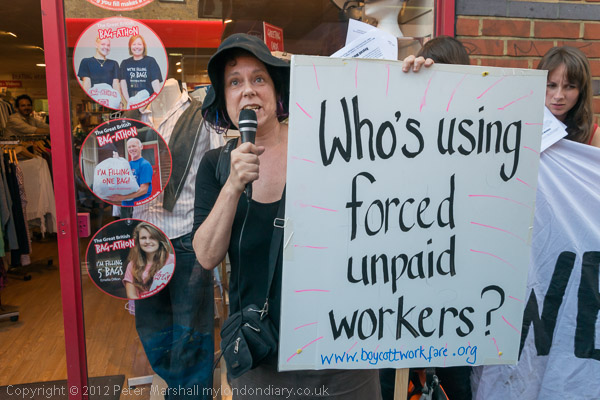
Boycott Workfare held a UK day of action targeted against charities and shops that take part in the government scheme of forced unpaid work which treats the unemployed as criminals. They also celebrated companies and charities that have withdrawn from the scheme.

Although the scheme is described as voluntary those who refuse to take part or or whose participation is judged unsatisfactory face the loss of some or all of their benefits. Under harsh government targets the number of claimants being sanctioned had increased threefold over two years and in 2012 there were over half a million under sanctions. It’s work for nothing or lose your benefits.

As Boycott Workfare pointed out, the four week Mandatory Work Activity scheme is the equivalent of a medium level community service order – such as might be given to someone found guilty of assault or drunken driving. And while the longest community service order a judge can give is for 300 hours, under some workfare schemes claimants are being forced to work without pay for 780 hours.

Many claimants unable to find paid work do find useful unpaid community activities they can volunteer for – and then are forced to give these up by workfare schemes.

These schemes are supposed to provide work experience than can then lead to actual jobs, but many companies in the schemes use them simply as a source of free labour – which then then be replaced by new free workers when they come to and end of their period. Often there is no possibility of people on the schemes moving into paid work.

Among well known shops and charities making use of this unpaid labour in 2012 were Boots, Argos, Scope, Cancer Research UK, Poundland and British Heart Foundation, and the protests took place in front of a number of their shops. In Brixton protesters handed out leaflets inside Poundland.

Protests against workfare had already had some effect with groups including Burger King, Oxfam, Waterstones, Shelter, 99p Stores, Pizza Hut and Sainsbury’s pulling out from the scheme.

More on My London Diary at Day of Action Against Workfare.


Ghanaian Methodists Celebrate 10 Years – Westminster Cathedral

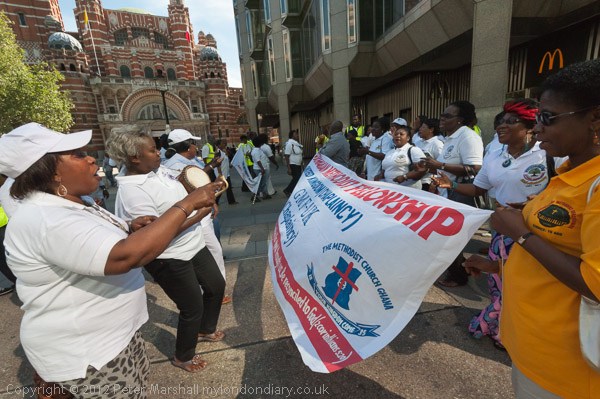
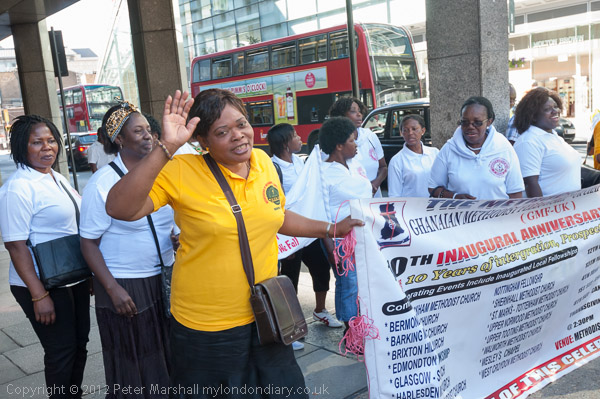
Celebrations of 10 years of the Ghanaian Methodist Fellowship UK and its 16 churches were to end in a thanksgiving service the following day. On Saturday the met at Westminster Catholic Cathedral and then danced away down Victoria Street towards Methodist Central Hall.

Methodism in the UK tends to be worthy and rather rather less exuberant, though with loud singing of hymns and much drinking of tea. There was a very different atmosphere at these dancing celebrations.

More pictures Ghanaian Methodists Celebrate.


Grow Heathrow Open Day – Sipson

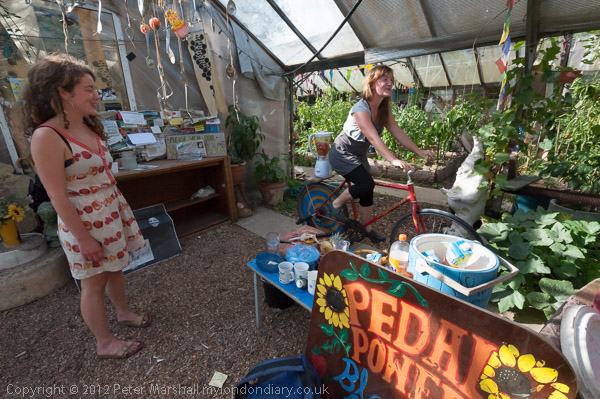
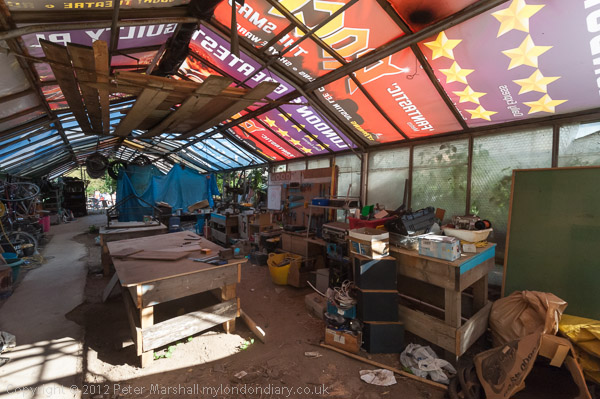
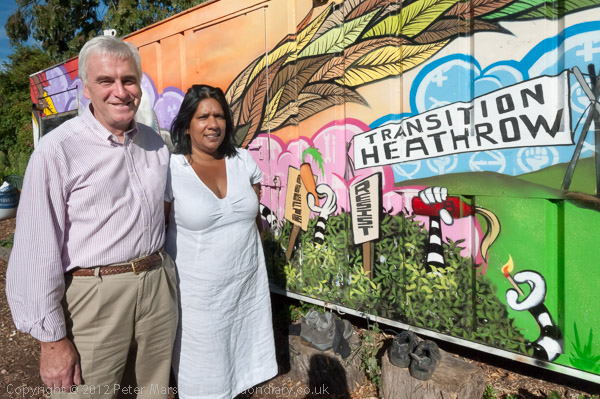
A journey to the end of the Piccadilly line and a short bus ride took me to Sipson where over two years ago Transition Heathrow moved onto the local eyesore and dumping ground of the former Berkeley Nursery site. This was an open day for their Grow Heathrow project.

People had moved onto the site to fight against plans for a third runway at Heathrow, but realised the potential of the site to create a productive alternative off-grid home that would become a creative hub for the area.

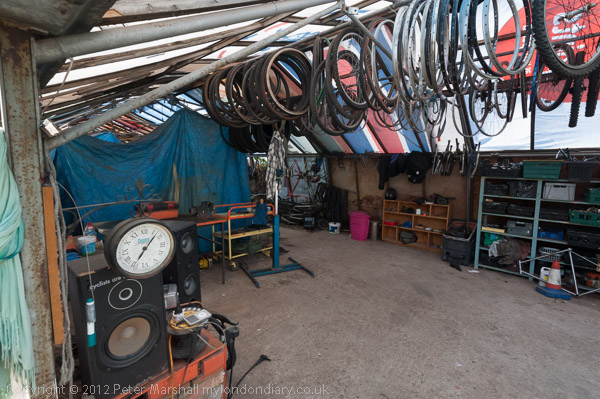
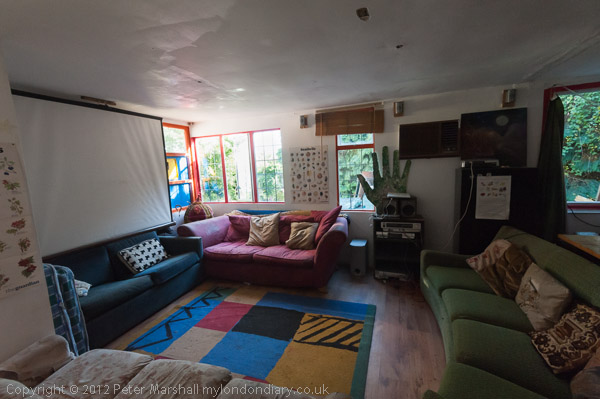
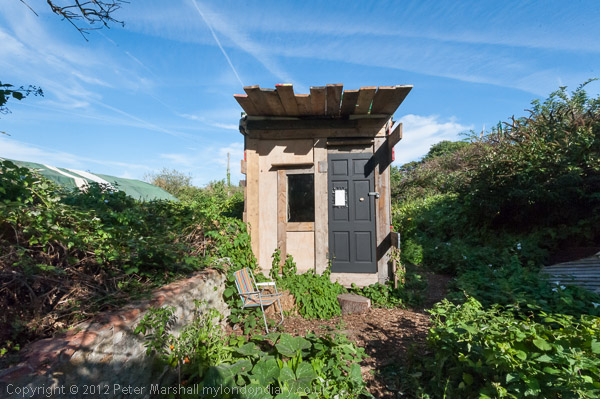
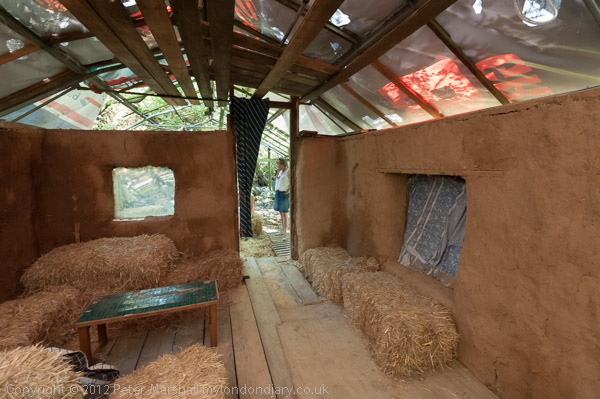
They started by clearing the rubbish and getting the local council to take away around 30 tons of it, but much of the material on site was a valuable resource that with a great deal of ingenuity they recycled for there own uses. Many built there own small temporary houses in the wilder areas of the site, though some were still then living in tents. And patched up part-ruined greenhouses and a couple of cabins on the site became communal spaces including a comfortable sitting area, a library and a vistor’s room.

Their activities gained a great deal of support from the local residents and when the site owners gained permission to evict them they were granted leave to appeal on human rights grounds with the judge describing the site as as “much loved and well used” by the local community. The site was open to them and other visitors weekdays from 10am – 6pm and on Sunday afternoons.

There are regular events every week open to anyone, including bicycle workshops, art workshops and gardening, and some of the results were impressive. Were it just a little closer to my home I’d be tempted to come here more often, but although it might be a pleasant place in Summer I think I would miss the comforts of my own home rather too much in winter. The wood-burning shower did look rather draughty even if the water was very hot.

Among firm supporters of Grow Heathrow was local MP John McDonnell who stated “This inspirational project has not only dramatically improved this derelict site but it has lifted the morale of the whole local community in the campaign against the third runway and in planning a sustainable future for our area. We cannot lose this initiative and I will do all I can to enable it to continue.”

And continue it did for some years, surviving a number of legal challenges. Half of the site was reclaimed by bailiffs in 2019, but the final eviction only came in March 2021.

More at Grow Heathrow Open Day.


EDL Stopped, Musicians at Arms Fair, Silvertown – 2013

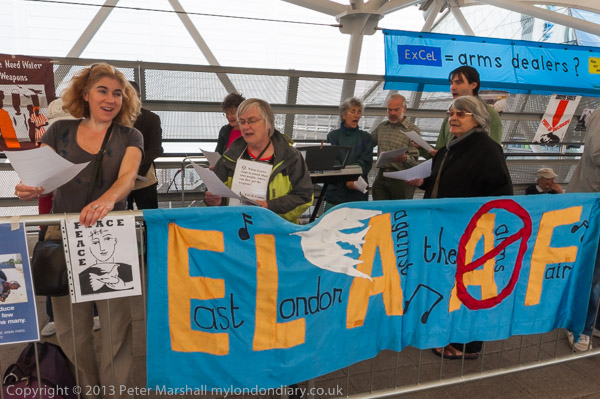
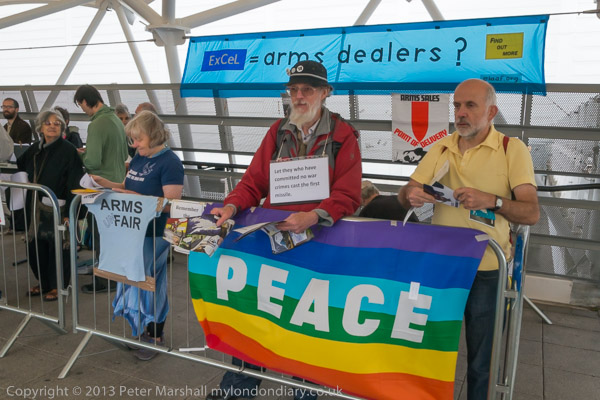
EDL Stopped, Musicians at Arms Fair, Silvertown: On Saturday 7th September 2013 after photographing the EDL attempting to march into Tower Hamlets and the people coming out to stop them I went on to the Excel Centre in Newham where East London Against Arms Fairs were holding a Musical Protest against next weeks DSEi arms fair. And on my way home I took more pictures.


EDL Try To March Into Tower Hamlets

EDL Stopped, Musicians at Arms Fair, Silvertown:
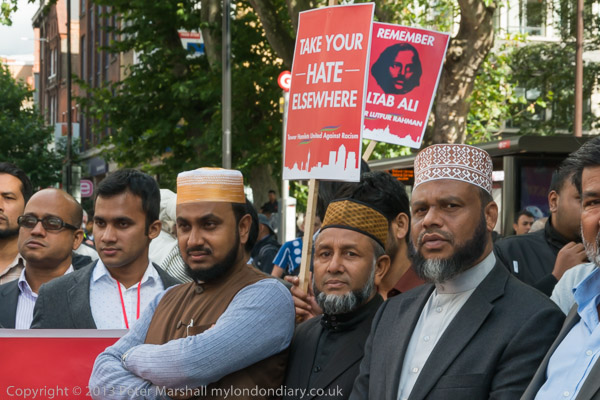
Whitechapel says ‘Take Your HATE Elsewhere’

I started the day in Bermondsey were around a thousand EDL supporters were gathering for a march across Tower Bridge to Aldgate High St.

EDL Stopped, Musicians at Arms Fair, Silvertown:

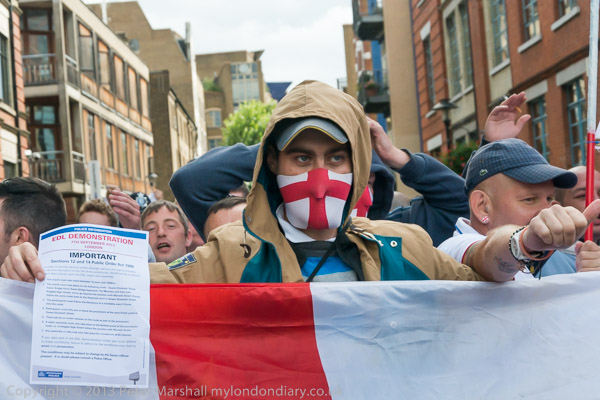
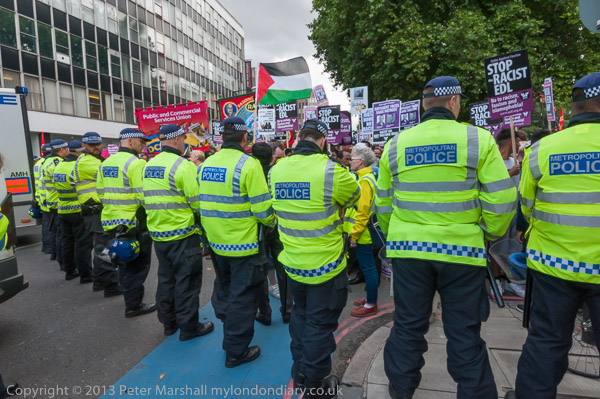
Police had laid down very strict conditions for the march, specifying the exact route and timings and more, which where specified on A4 sheets they handed out to protesters and were also broadcast every few minutes from a loudspeaker van where the marchers were gathering.

EDL Stopped, Musicians at Arms Fair, Silvertown:

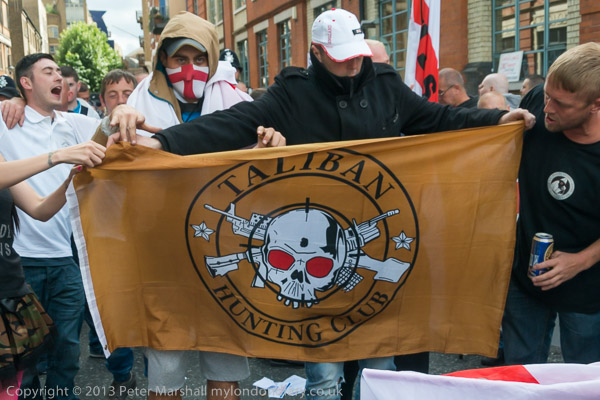
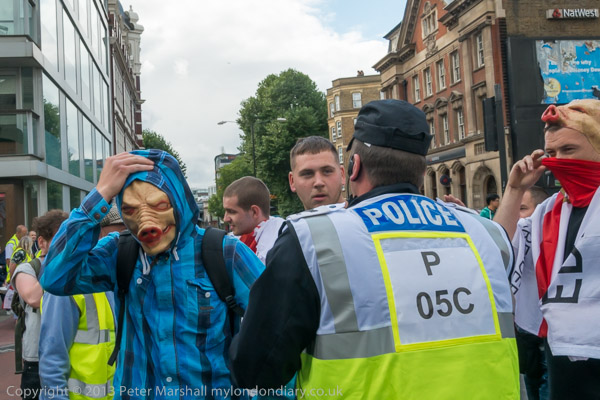
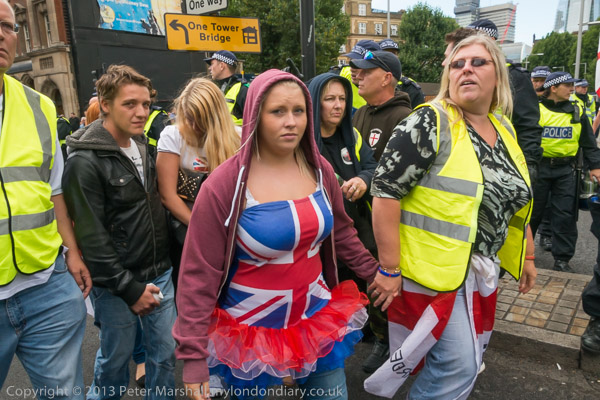
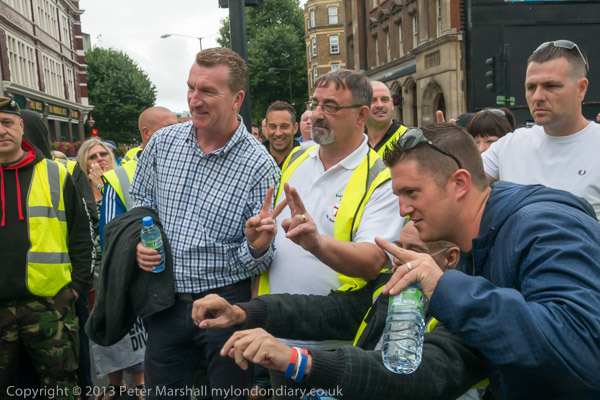
There was a very strong police presence on the streets with police on all sides around the marchers and some mingling with them. The EDL were also on their best behaviour, with many posing for photographs. A couple who arrived in pig’s head masks were forced by police to remove them and hand them over.

EDL Stopped, Musicians at Arms Fair, Silvertown:

There was still a great deal of racism and hate in the comments that were being made and when the march got under way the majority took up the usual Islamophobic chants including “Allah, Allah, who the f**k is Allah“.

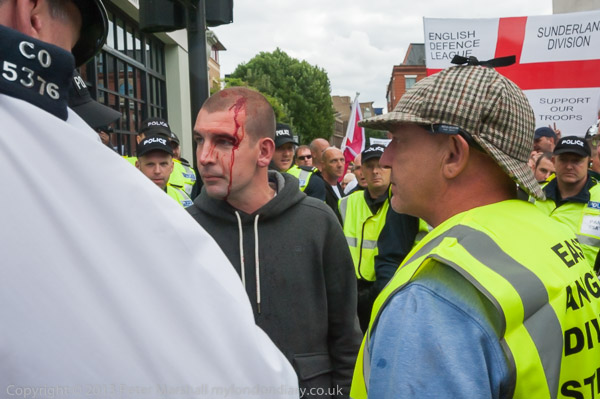
There were a small number of anti-fascist protesters in the area, and police tried to keep them well away from the march, although EDL stewards who led away one man with a bleeding face from the crowd alleged he had been hit by a bottle thrown from across the road.

As the march set off, police moved photographers well away, and police handlers with dogs walked in advance of the marchers. Later I was able to get a little closer.

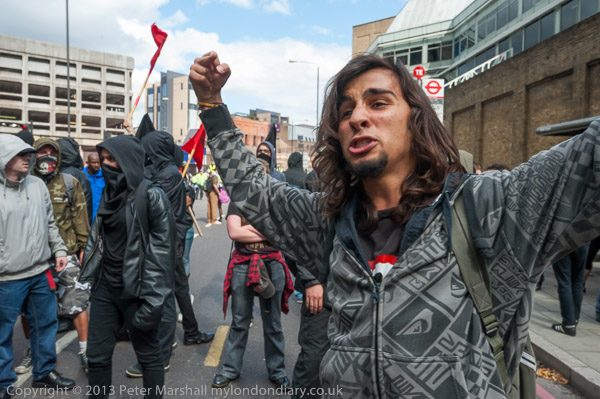
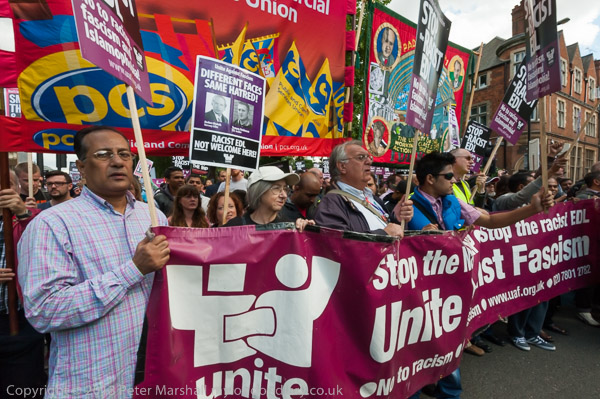
After crossing Tower Bridge I saw red smoke in the distance coming from the ground in front of a row of police vans in Mansell St and rushed there to find a group of around 50 anti-fascist protesters, mainly dressed in black, with red and black flags and a few with Unite Against Fascism placards.

The EDL march stopped for a couple of minutes opposite them and the two sides shouted insults at each other with the police keeping them well apart before the march moved on to Aldgate High Street without further incident. I later heard that the anti-fascists here had been kettled for some hours before many of them were arrested.

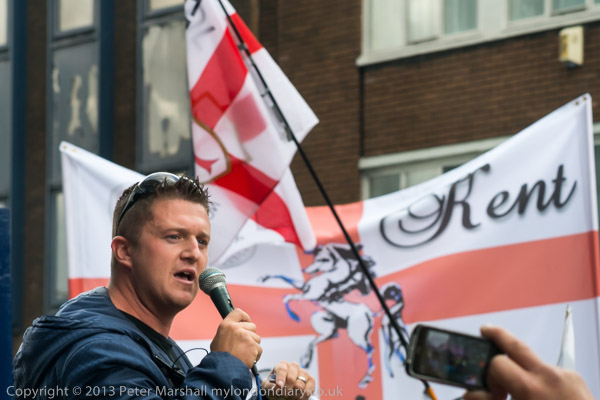
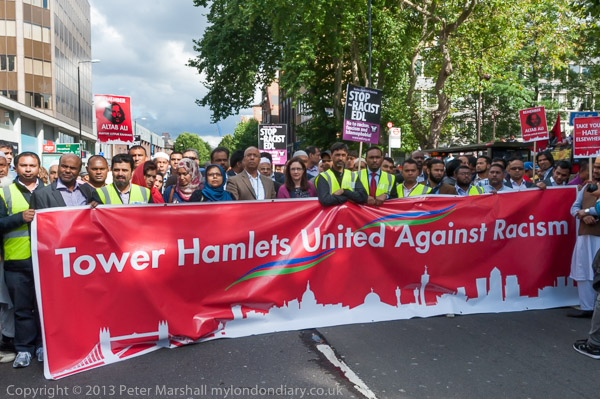
I photographed Tommy Robinson addressing the rally, then made my way to where a counter-protest was being held by the community of Tower Hamlets, united in opposing the EDL. I had to go through several lines of police, showing my Press Card. A few officers refused to let me through, but I was able to walk along the line and make my way through.

As I commented, “It was a remarkable change in atmosphere from the feeling of hate and Islamophobia that filled the air with gestures and chanting from the EDL to the incredible unity and warmth of the several thousands largely from the local community who had come out to oppose them and make a statement based around love and shared experience of living in Tower Hamlets with people of different backgrounds and religion.”

There was clearly a determination in Whitechapel, as there was in the 1930s at the Battle of Cable Street which had taken place not far away of a community that had decided that ‘They shall not pass’. And although most had come to protest peacefully, had the police not kept the two sides well apart, the EDL would have been heavily outnumbered by local youths angry at their presence.

I’d left the EDL rally before Tommy Robinson was arrested for incitement, apparently for suggesting that people break some of the restrictions that police had imposed on the EDL march and rally. The police presence had prevented any large outbreaks of public disorder and although the EDL were up in arms over the arrest of their leader had protected them from a severe beating.

More on My London Diary at:
Tower Hamlets United Against the EDL
Anti-Fascists Oppose EDL
EDL March returns to Tower Hamlets


Musical Protest against Arms Fair – Excel Centre, Custom House

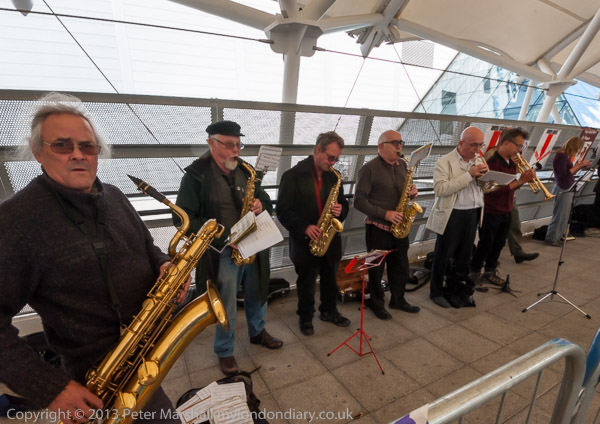
I didn’t stay long in Whitechapel but took the tube and bus to Custom House where on the walkway leading the the ExCel Centre East London Against Arms Fairs (ELAAF) were holding a Musical Protest against next weeks DSEi arms fair with a big band and singers and others handing out leaflets opposing the event.

THe DSEi arms fair, held every other year at the ExCel Centre in London Docklands attracts buyers from all over the world, including those from many countries with oppressive regimes. It’s a showcase for the weapons they need to continue to oppress their populations and to wage war on their neighbouring states and others.

There were more and larger protests in the following week against the arms fair.

More at Musical Protest against Arms Fair.


Silvertown

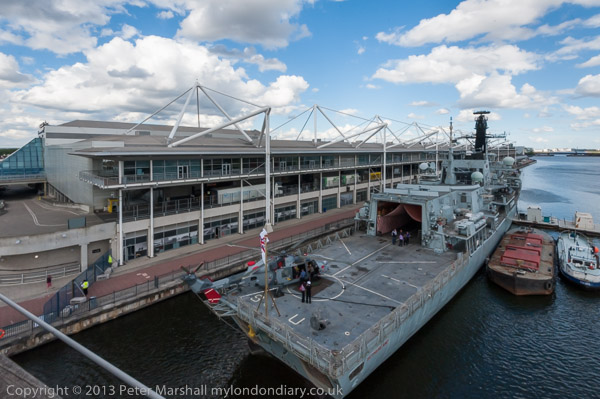
Although the DLR wasn’t running on the branch leading to Custom House, there were trains running on the branch through Silvertown and I walked to there across Victoria Dock on the high-level bridge, taking a few photographs.

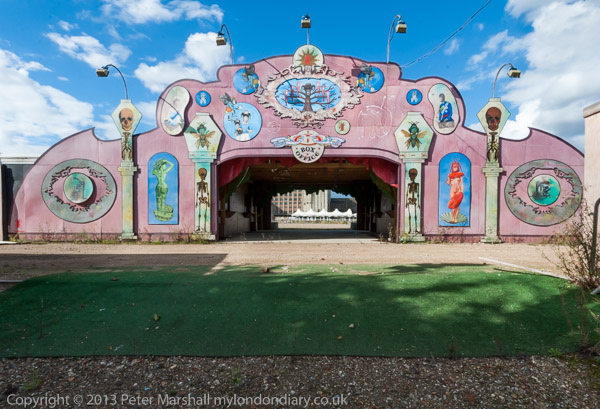
The gates to the London Pleasure Gardens which had closed recently only a few weeks after its opening were locked but I was able to take pictures through the gates. I walked on to the elevated Pontoon Dock DLR station and made some panoramas from there before catching a train.

For once the DLR train had a very clean window and I took advantage of this to take some more pictures on the way to Canning Town where I changed to the Jubilee line.

More pictures: Silvertown


Bon Marche, Police, Acre Lane and Tate

Bon Marche, Police, Acre Lane and Tate: My walk which began in Clapham on Sunday 4th June 1989 continues in Stockwell. It began with Light & Life, Pinter and Stockwell Breweries and the previous post was More Stockwell Green & Mary Seacole.

240-250 Ferndale Rd, Brixton, Lambeth, 1989 89-6a-61

Possibly before going to Stockwell Green, perhaps even at some point on my previous walk I made some more pictures around the centre of Brixton. Unfortunately film doesn’t come with meta-data and my memory is not as reliable as EXIF data, but these pictures were certainly made around the end of May or beginning of June 1989 and so I’ll share them here.

240-250 Ferndale Rd on the corner with Stockwell Ave, just a few yards back from Brixton Road was built in 1905-6 as an annexe of Bon Marche department store, later becoming Post Office with council offices on the upper floor. You can see a post office sign at the left of my picture. A photograph in the Lambeth Archives taken around 1975 show it as offices for Christian Aid and it was later home to the Refugee Council. The ground floor more recently became Canova Hall, a restaurant and the building was revived as The Department Store, “to create a series of collaborative workspaces supported by an evolving hub of creative, retail and community uses“.

Edmundsbury Estate, Ferndale Rd, Brixton, Lambeth, 1989 89-6a-64

This estate was complete in 1929 for the London County Council as Ferndale Court to house police officers in the City of London Police, but converted into council flats managed by Lambeth Council in 1979 when one of the blocks was demolished to leave a public open space. They were designed by Sidney Perks, who was surveyor to the City of London from 1908 before being appointed as its architect in 1928.

Adjoining the site to the east was the City of London Police Sports Club ground, now the Ferndale Community Sports Centre.

Acre Lane Mouldings Ltd, Acre Lane, Brixton, Lambeth, 1989 89-6a-52

A board illustrates the range of skirting architraves and cornices the company could supply, ‘Quality Mouldings for That Finishing Touch!‘.

Acrelane Timber Ltd is still at this site in Brixton and can perhaps still supply some similar items. A previous frame, not yet digitised shows a little of the frontage offering heating and plumbing supplies.

In my father’s workshop, a very large shed with store rooms and work benches at the back of his family house in Hounslow, long sold off and demolished, I was intrigued as a child by many of the old tools used around the start of the 20th century which included a range of moulding planes used to produce shaped mouldings such as this, used in his father’s cart building business. Back when my elderly aunts moved out around 1970 there was little interest in things like this and I imagine they ended up in landfill, though I’ve since viewed far less impressive ranges in museums.

Lambeth Town Hall, Acre Lane, Brixton Hill, Brixton, Lambeth, 1989 89-6a-54

I turned back along Acre Lane to the junction with Brixton Road where I photographed the grandiose Lambeth Town Hall, complete with a banner advertising an event about child benefit taking place on June 2nd, as well as a sign about going to Lambeth Debtline for debt advice.

Grade II listed Lambeth Town Hall was built in 1905-8, designed by Septimus Warwick and H Austen Hall in what is described as a modified Baroque style, and was further raised and extended 1935-8. I think the clock tower looks like some strange parody, an ornament which doesn’t really belong but has somehow thrust itself up through the ceiling of the main building and flowered extravagantly, reminding me of an amaryllis.

Tate Bust, Tate Library, Brixton Oval, Brixton, Lambeth, 1989 89-6a-55

This area was a pleasant garden before being destroyed by Lambeth Council to produce a windswept waste to discourage local people gathering here. It hasn’t really worked, just become less comfortable with oddly placed fixed chairs and the wind certainly rushes through the renamed Windrush Square. I think I might have come here in 1989 to sit and eat my sandwich lunch.

Henry Tate was born in 1819 in Lancashire, the son of a Unitarian minister, and set up a successful grocery business with six shops in the Liverpool area before going into partnership with sugar refiner John Wright there in 1859. When this partnership came to an end he founded Henry Tate & Sons with his sons Alfred and Edwin.

Tate introduced new more efficient refining techniques for the production of white sugar, and his business expanded and in 1878 he opened a large refinery at Silvertown still producing sugar now.

Fountain, Tate Library, Brixton Oval, Brixton, Lambeth, 1989 89-6a-56

Tate was an employer who took care of his workers and supported many educational projects including free libraries in Streatham, Balham, South Lambeth and Brixton as well as hospitals. After he had built and opened a gallery on Millbank and presented his art collection to the nation he was told Queen Victoria would be offended if yet again he refused a title, and he became a baronet in 1898, a year before his death.

The business was merged with that of Abram Lyle & Sons in 1921, probably causing Tate to turn in his grave, as he had despised Lyle, not least for the way he treated his workers.

Reliance Arcade, Electric Avenue, Brixton, Lambeth, 1989 89-6a-41
Reliance Arcade, Electric Lane, Brixton, Lambeth, 1989 89-6a-41

The Art Deco Reliance arcade was built into an exiting Georgian house and other buildings between Brixton Road and Electric Lane in 1923-5, its Egyptian style terracotta inspired by the 1922 discovery of Tutankhamun’s tomb.

Home to around 30 businesses it was since 2014 this Grade II listed arcade was on English Heritage’s at risk list but was renovated in 2019-20. There are some good pictures from this time by Mike Urban on Brixton Buzz from before and close to the end of the renovation.

My account of this walk will continue in a later post.

Epping Forest Centenary Walk

Epping Forest Centenary Walk 2009: London is in some ways a ‘green city’ with over 3,000 parks of varying sizes within the boroughs which make up Greater London. These range from pocket handkerchief areas to large commons and royal parks such as the roughly 2500 acre Richmond Park.

Epping Forest Centenary Walk
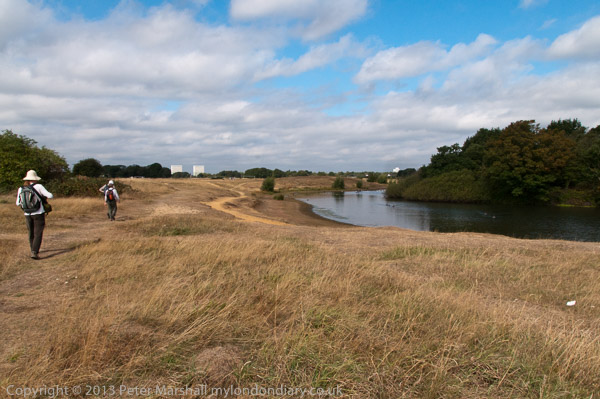
Wanstead Flats

London Mayor Sadiq Khan supported London being designated as the world’s first National Park City in 2019 and announced plans to increase the amount of ‘green space’ to 50%. This isn’t a huge target as according to the capital’s environmental records centreRoughly 47% of Greater London is ‘green’; 33% of London is natural habitats within open space according to surveyed habitat information and an additional 14% is estimated to be vegetated private, domestic garden land.”

Epping Forest Centenary Walk
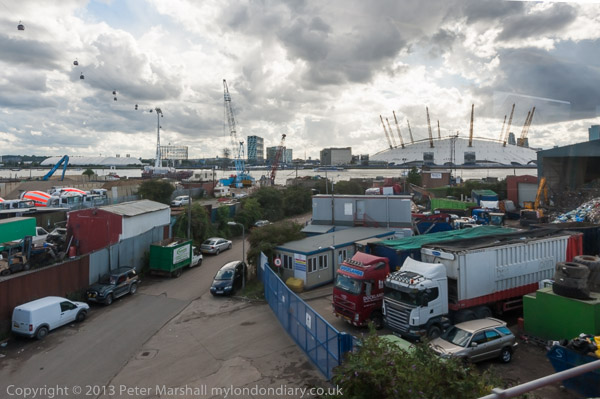
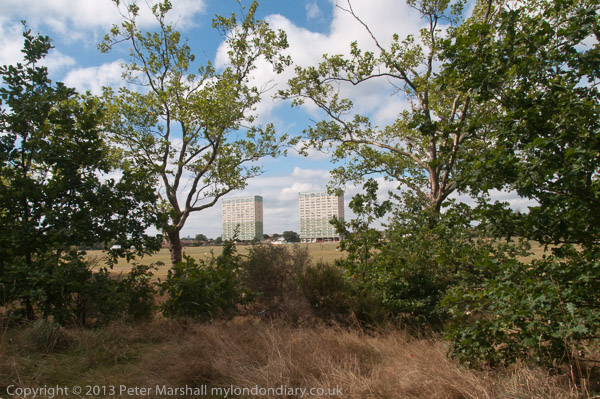
One of the Montague Road Estate flats had misssiles on its roof for the Olympics

In order of size, starting with the largest they categorise this as Other Urban Fringe, Parks And Gardens, Natural And Semi-natural Urban Greenspace, Green Corridors, Outdoor Sports Facilities, Unknown and amenities with other minor contributions. Some 22% is classified as Green Belt which gives some quite strong protection against development, though my borough is currently proposing to build on a little of it.

Epping Forest Centenary Walk
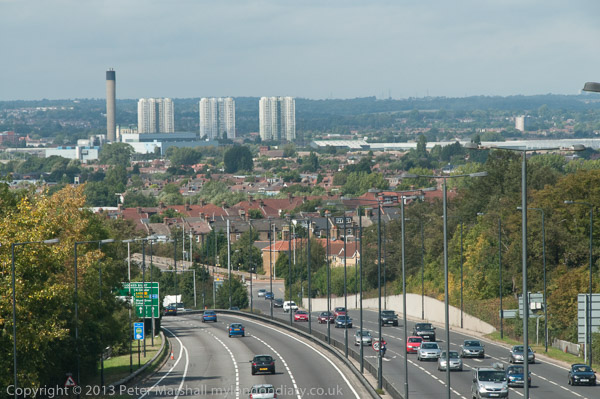
The walk goes on a bridge across the North Circular Road

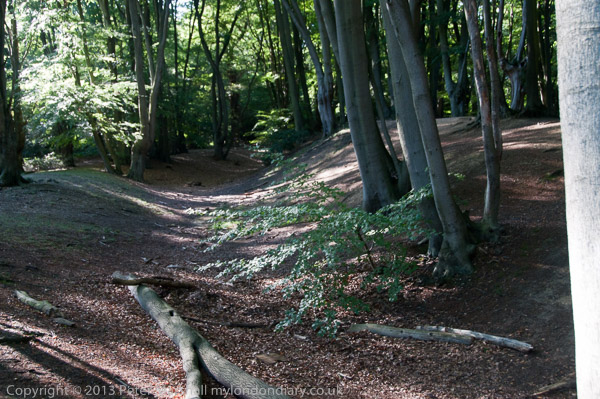
The protection of green spaces in and around London has a long history, back to the Norman conquest when kings set up royal hunting grounds convenient to their palaces in Westminster and further afield. These were called forests, though most were mainly open land rather than full of trees; the name was a legal term meaning only the king had the right to hunt deer in them. One of the larger areas, established by Henry II in the 12th century was Epping Forest, part of an even larger Forest of Essex.

Epping Forest Centenary Walk
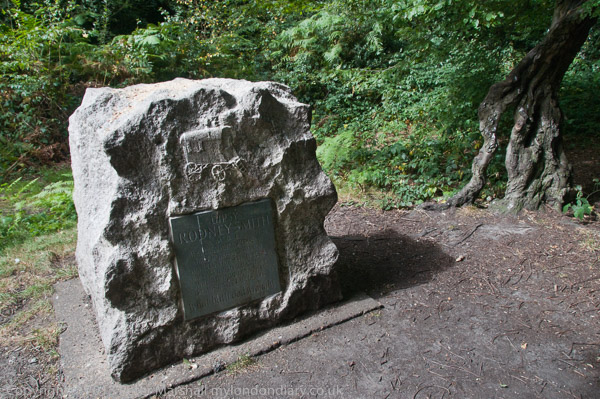
Memorial to a famous evanglalist Gypsy Rodney Smith born in a bender here

Enclosures began to threaten the future of the forest at the start of the 19th century when around a third of the remaining forest was allowed to be privatised for building development and farming by the lords of various manors in the forest. By 1870 around two thirds of the forest had been enclosed.
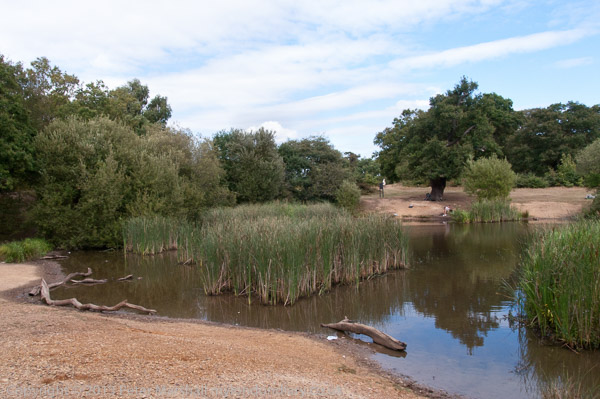
Warren Pond

By this time many people had become worried about the loss of the commons, particular after neighbouring Hainault Forest had been sold off by the Crown, the trees removed and the area turned into poor agricultural land. More and more people were coming out from London during their free times to enjoy the green spaces in the outskirts and preservation societies were set up.

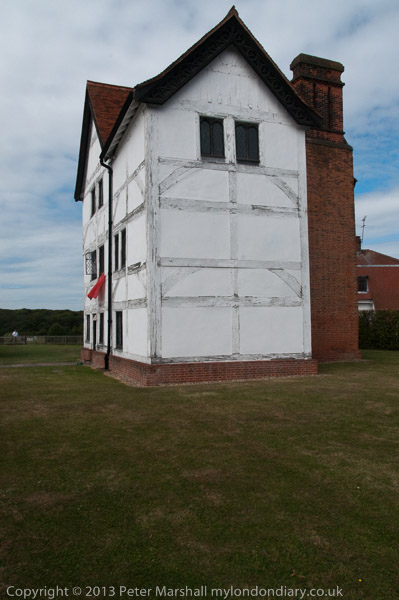
Queen Elizabeth’s Hunting Lodge

The City of London became involved after it bought land at Manor Park for the City of London Cemetery. Traditonally the city had organised Easter Monday stag hunts in the forest, but they now became commoners with the right to graze animals, and began legal actions agaimst lords of the manor who had enclosed forest land. Eventually Acts of Parliament allowed them to purchase the forest manors and an court in 1874 ruled that all enclosures made since 1851 were illegal.

Under the Epping Forest Act 1878 the forest ceased to be a royal forest and became managed by the City – as it still is. The Crown lost its right to venison and commoners lost some of their rights too, but the City Conservators were obliged to “at all times keep Epping Forest unenclosed and unbuilt on as an open space for the recreation and enjoyment of the people.”

The preservation of Epping Forest was the first major victory in Europe for the modern environmental movement. Four years later it was endorsed by Queen Victoria, who although it was no longer royal but in the hands of the City of London, nevertheless stated “It gives me the greatest satisfaction to dedicate this beautiful forest to the use and enjoyment of my people for all time“.
On the 100th anniversary of the Epping Forest Act in 1978, the Friends of Epping Forest began a annual series of anniversary walks from along a route they established from Manor Park Station to Epping. The Friends were originally formed to oppose the routing of London’s orbital M25 through the Forest, leading to it being put in a tunnel. But they have been less successful in opposing some other breaches of the 1878 Act, and in 1989-94 a large section of the south of the forest was lost to build the M11 link road, and during the London 2012 Olympics a temporary police station was allowed to be built on Wanstead Flats.
Epping Station at the end of our walk

I walked the Epping Forest Centenary Walk with some of my family and a friend on Bank Holiday Monday 31 August 2009, and you can download a leaflet including a map (though I’d advise also having the OS Explorer 174) of what has now been renamed the Epping Forest Big Walk. According to this it is 14.1 miles (22.7km) but we managed to walk rather further, possibly partly because we got a little lost at times. Of course you can do the walk in stages rather than all on the same day. If you want to walk with others you can join the free Big Walk this year on Sunday 17th September 2023 to be led by experienced guides!