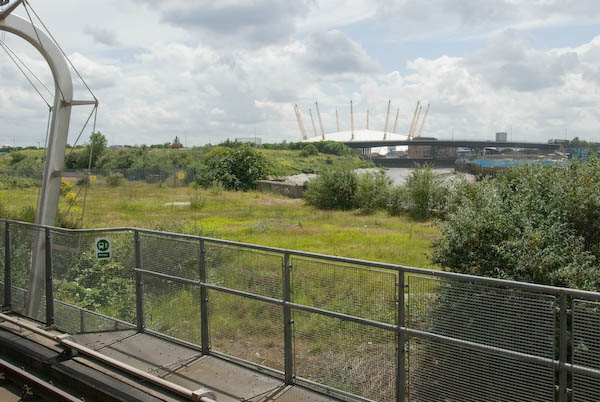
An elevated section of the Docklands Light Railway runs along the south side of North Woolwich Road. Opened in 2006, it currently runs to King George V station in North Woolwich, but tunnelling is in progress to take it under the Thames to Woolwich. [It opened in 2009]
DLR under construction from Silvertown Way – 2004.
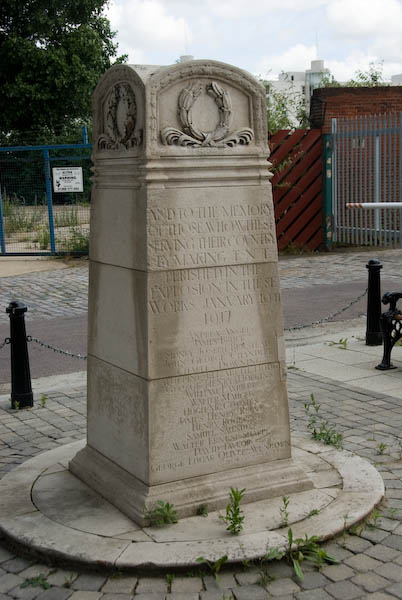
Turn left and walk east along North Woolwich Road; roughly 100 meters on is a site entrance which includes a monument to the Silvertown Explosion.
The Brunner Mond chemical works opened here at Crescent Wharf in West Silvertown in 1893, producing first soda and then caustic soda. But by 1914 the works was idle, and the government needed a factory to purify TNT. This was known to be extremely dangerous and a process that should be carried out in a remote area, and not in this highly populated area such as this. Dr FA Freeth, Brunner Mond’s head chemist later made his views about the process clear:
“It worked but was manifestly dangerous. At the end of every month we used to write to Silvertown to say that their plant would go up sooner or later.” But the Government, at a safe distance in Whitehall, decided that the risk was worth taking. It was the people of Silvertown who were, largely unwittingly, taking it.
“Sooner or later” turned out to be Friday 19 January 1917 when a fire caused 50 tons of TNT to explode. They heard the bang in Cambridge and Guildford. Around 70,000 properties were damaged, costing £2.5 million. Over 70 people were killed (12 of the bodies were never found) and 400 injured. Because of war-time restrictions, it was 3 days before the news was in the papers.
This site is now under application for development as Minoco Wharf. In January 2005 the Mayor removed its safeguarded wharf status, which will allow more freedom in its development. [Renamed ‘Royal Wharf’ and recently completed it includes 3,385 new homes, a primary school, leisure facilities and retail and commercial office space.]
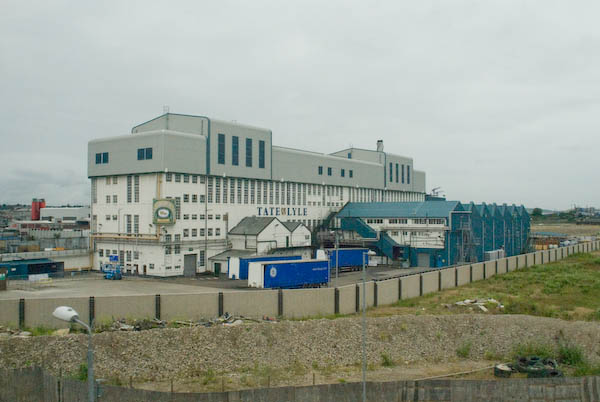
Tate & Lyle’s Plaistow wharf
A little to the west is Peruvian Wharf, which includes the site of the old guano works and Tate & Lyle’s Plaistow wharf. (Tate & Lyle have consolidated their activities at Thames Refinery to the east in Silvertown.)
The application to develop this site, which still has safeguarded wharf status, went to public enquiry and was refused in 2006. There are further applications, mainly for industrial use. The best views of these sites are from the DLR. [The site was bought by the Port of London Authority in 2016 and part leased to for an aggregate wharf and concrete batching plant.]
Continue along North Woolwich Road and walk up the steps immediately behind Barrier Point into Barrier Park.
Barrier Point residential development, architects Goddard Manton Partnership (they took some ideas from their earlier Pierhead Lock at West India Docks) is in two parts, the ‘Seven Steps’ garden apartments occupied in 2000, and the landmark tower completed in 2001. It provides 252 “concierged apartments” and attracted various awards, making it “the most decorated contemporary housing development” in Britain. It forms an impressive wall at right-angles to the Thames, with suitably maritime railings and decks, although these perhaps give it too much of a 1930s international modern feel. The tower, a shining white lighthouse, is a grand effect.
This walk will continue in a later post with Part 9: Barrier Park
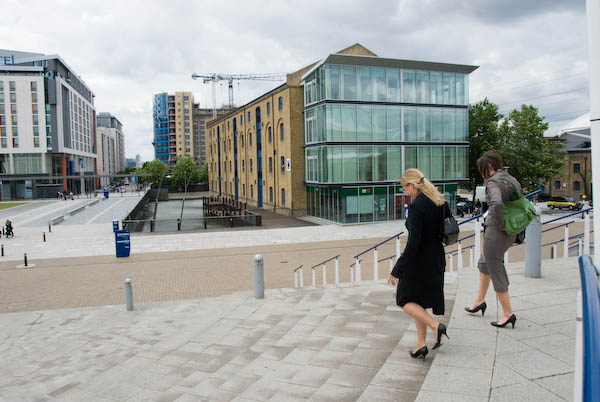
Walk along the covered walkway leading to the ExCeLcentre, passing some Victorian dock buildings on your right. At ExCeL, go to your right and down into the open square.
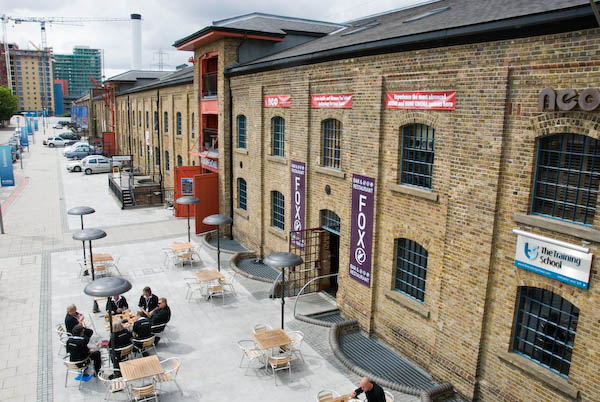
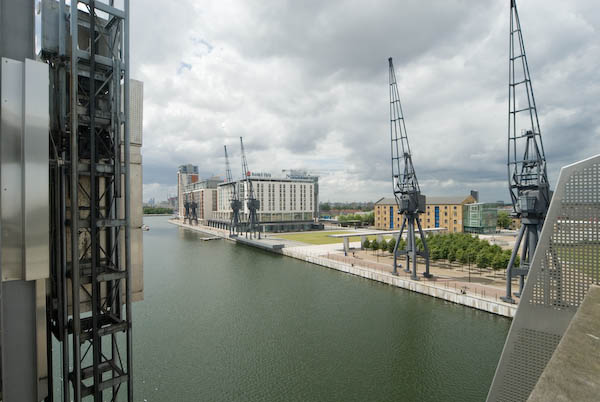
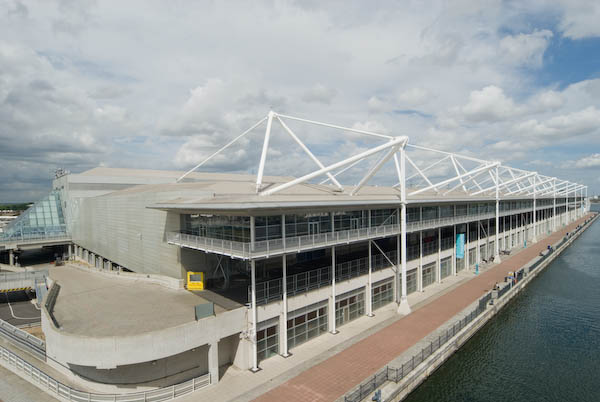
On our right is a range of dock buildings, K Warehouse, built 1859, used for some years as a store for the Museum of London and now housing a restaurant. On our left is the ExCeL centre (Exhibition Centre London) used for various conferences and business events. [Including controversially every two years DSEi, the worlds largest arms fair, which attracts many protests.]
W warehouse from 1883 was originally more or less on the dockside, which had a number of wide jetties coming out from it towards the centre of the main dock, more or less as far as the current waterline. Ships were moored on each side of these for loading and unloading. Probably most of the buildings on these were fairly simple and temporary, and the number of these bays changed over the years. The docks were given an extensive makeover in the 1930s and 40s, and also needed considerable work to repair war damage.
In later years, these jetties were removed and the dock narrowed, with larger warehouses by its edge.
The Royal Docks were at their busiest around 1960, but the decline after this was rapid. Cargo handling methods were rapidly changing, with containerisation and bulk handling techniques, and ships were getting larger.
Considerable investment was needed and the PLA rightly decided to make this at Tilbury. Traffic congestion was a major problem at the Royals (the 1930’s road improvements linked into London’s congested road system) while Tilbury had the prospect of excellent connections to the M25 and the rest of the expanding motorway system. It was also closer to the sea, and avoided a longer journey through relatively narrow channels upriver, with greater tidal limitations.
Weighbridge office, King George V Dock, Royal Albert Dock, Newham, 1984 84-7l-25
The Royal Docks closed in 1981, and a year or two later I photographed them as a ghost town. There were abandoned offices with half-drunk cups of tea, cobwebbed jackets hanging on hooks, paperwork and rubber stamps left on desks. [There are many pictures from that project on Flickr, in the albums 1984 London Photographs and 1984 Docklands Colour. I also published pictures from the project as The Deserted Royals and you can view an extensive preview online.]
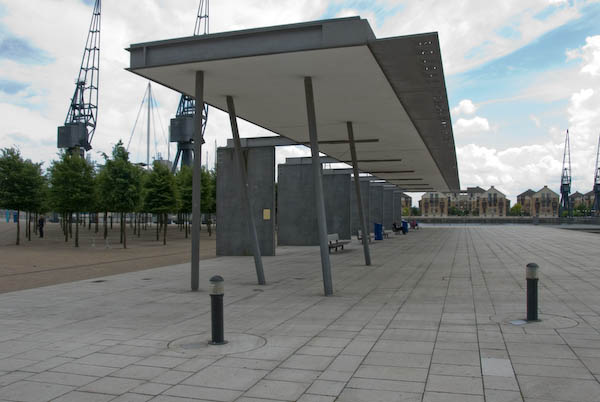
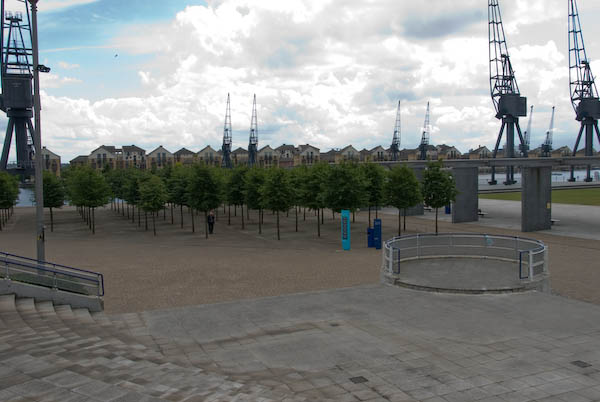
Royal Victoria Square was developed by the GLA’s London Development Agency and opened by Ken Livingstone in 2001. It cost £3.5million. The fountains are apparently quite nice should they ever be working. Computer controlled and coloured by fibre optics to give a wave effect. Apparently.
The square is at its best in bright sun, when the shadows of the closely planted trees create interesting effects, and the dark stone contrasts with the light paving. It is a pleasant place to sit and relax, although the modern hotel buildings hardly add to that pleasure.
The ExCeL centre also looks better in sun, which adds shadows from its external spars, as well as a glow from its white surfaces, and brings out its geometries. The idea came from the LDDC, but it was not completed and opened until 2000. Its presence has attracted many hotels to the area – including the floating Sunborn Yacht hotel.
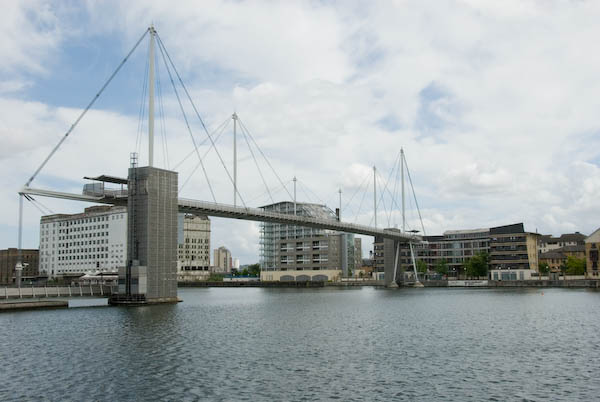
Walk down to the dockside, where deck hangs out over the water for a view of the bridge.
The bridge was designed by Lifschultz Davidson as a very slender structure, representing the sailing heritage of the dock, and cost £3.9 million. Six masts support the bridge varying from almost 30m at one end to 10.6m at the middle. Originally there had been talk of a transporter bridge, but this is I think both more elegant and more practical. While the docks were in use, there was a ferry service across the dock at this location.
Walk to the bridge and go to the high level either by the steps or lift.*
This walk continues in a later post with Part 7: Royal Victoria Dock from the footbridge.
[* You may find the footbridge is closed or the lifts are not working. If you cannot access the bridge you can continue the walk by walking on the dockside path around the west end of the dock.]
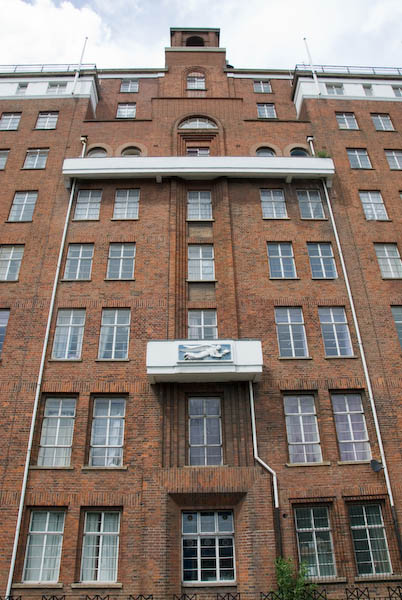
Alight from the train at Custom House and walk out of the exit at the eastern end of the station, turning left (north.) While at the top level, you get a good view of the ‘Flying Angel’ Seamens Hostel.
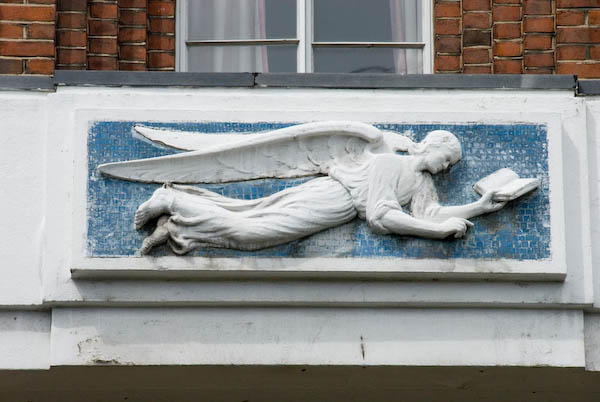
The ‘Flying Angel’ was an Anglican Mission to Seamen, providing hostel accommodation, and was built in 1934-6. As well as the angel there is some good brickwork and a suitable weathervane.
Go down the steps and slope, cross over Victoria Dock Road, and turn right down Freemasons Road, walking down to the sculpture at the junction with Coolfin Rd.
Canning Town
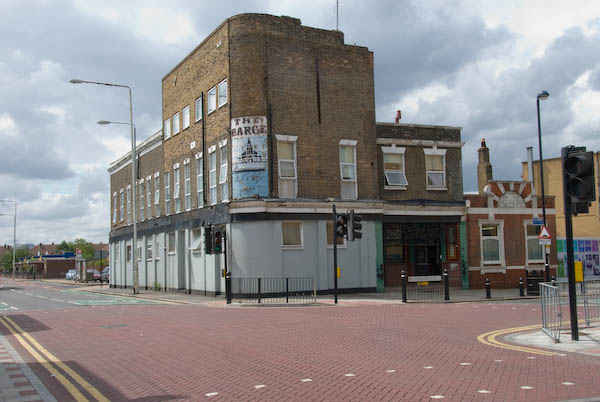
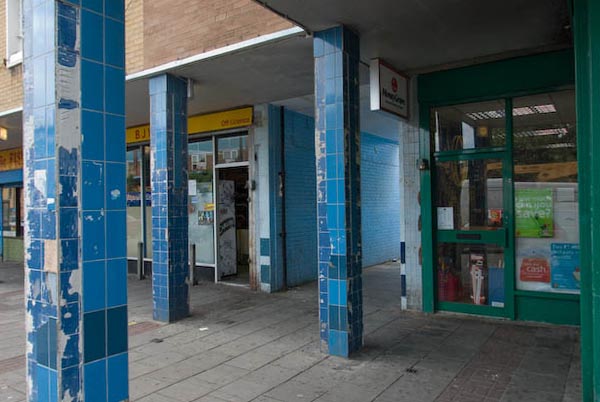
Thanks to bombing in the Second World War, few older buildings in the area survive. On the corner of Freemasons Road, ‘The Barge’ is a good example of a Victorian pub (built 1862, then in Liliput Road, the sign dates from the early 1990s when it was renamed. Formerly ‘The Freemason’s Tavern’, it probably gave its name to the road on which it stands,) used as a hostel for the homeless, while the parade of shops is typically post-war and gives an accurate impression of the area, one of the most deprived. Canning Town South, where we are, was ranked by the Government in 2000 as the most deprived ward in London, and the 35th most deprived in the country.
The Barge, Custom House, became a hostel for the homeless in the 1990s.
The south east line of Crossrail (if ever built) is planned to run through Canning Town from Abbey Wood on the currently disused North London line, with a station here. It will then go into a tunnel to the Isle of Dogs and across London to Paddington, before emerging and carrying on to Heathrow and Maidenhead.
[Crossrail was completed and opened as the Elizabeth Line in May 2022 with a station at Custom House and has made an important contribution to transport in and around London.]
Shops, Freemasons Road
85% of the buildings in Canning Town were destroyed in the war. A little to the west is the Keir Hardie Estate, named after Britain’s first socialist MP, who was elected for this constituency of West Ham (South) in 1892, Hardie was a Scot who had started work in a coal mine, and in 1907 became the leader in the House of Commons of the newly formed Labour Party. The estate was developed along ‘garden city’ lines.
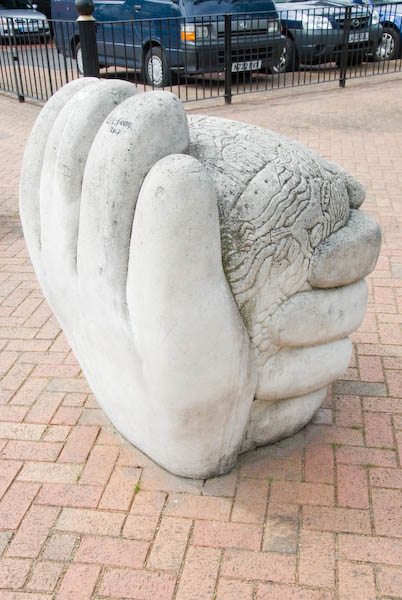
Dockers’ Memory
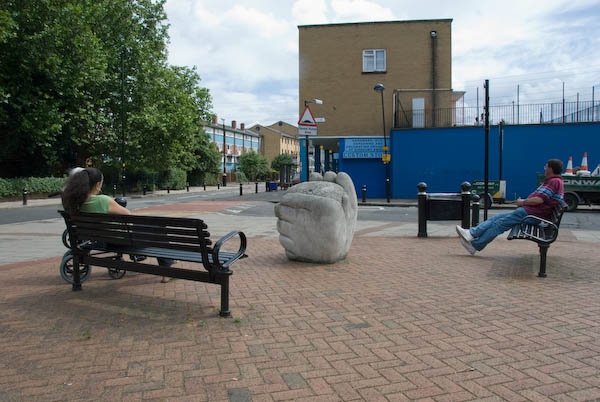
The sculpture on the corner of Coolfins road is by Paula Haughney and dates from 1995. It appears to be cast concrete, and the surface of the ‘brain’ is covered by various symbols related to dockers and the sea.
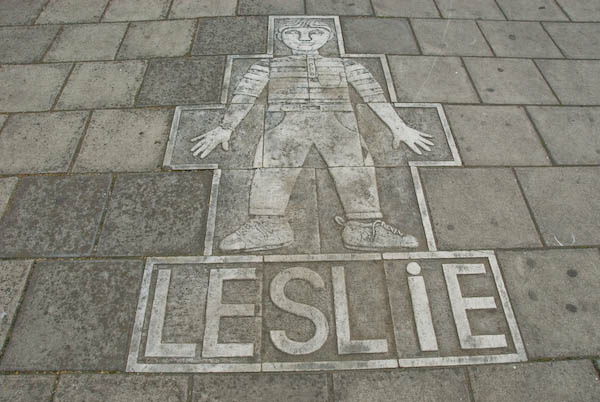
There is a further work by Haughney beside the bus shelter on the east side of Freemasons Road. Situated between Leslie Road and Ethel Road, the pavement contains figures of both Leslie and Ethel as well as a central motif that includes two knots and other devices.
Clever Road
We are close to a site that has had a pivotal role in architecture and town planning, a hundred yards or so to the north in Clever Road, although both the building concerned and the road have been removed.
At 5.45am on 16 May 1968, fifty-two year old Ivy Hodge decided to make an early morning cuppa. She struck a match and set off a gas explosion which resulted in the collapse of one corner of her 20 storey tower block, Ronan Point.
Although Ronan Point was repaired (it was careless building work rather than a design fault that cause the catastrophic collapse) it was the beginning of the end for high-rise system-built blocks. Ronan Point, together with the other 8 or 9 similar blocks in the Freemasons Estate, and many others around the country was demolished in the 1980s and replaced by the current 2 and 3 storey terraced housing.
Peter Woodhams
Canning Town made headlines again in 2006. Peter Woodhams was a local 22 year old whose car was hit by stones as he was driving around the area. He got out and confronted the stone-throwers, and was stabbed.
The police didn’t seem to take a great deal of interest in the incident, nor in further reports from Peter of abuse and other minor incidents from the same bunch of youths that became a regular feature when he visited the shops or walked around the area.
In August 2006, in another confrontation with some of the local youths, one pulled out a gun and shot him dead. An 18 year old was convicted of his murder in March 2007.
Walk back to Custom House Station and up the steps, but instead of descending to the platform follow the signs to the Excel Centre.
This walk continues in a later post with Part 6: ExCeL and Royal Victoria Square.
Pass through the station barrier and go up the two escalators to the DLR platform. Until the Bow Creek Walkway is opened this gives some of the best views of this part of Bow Creek.
Pura Foods
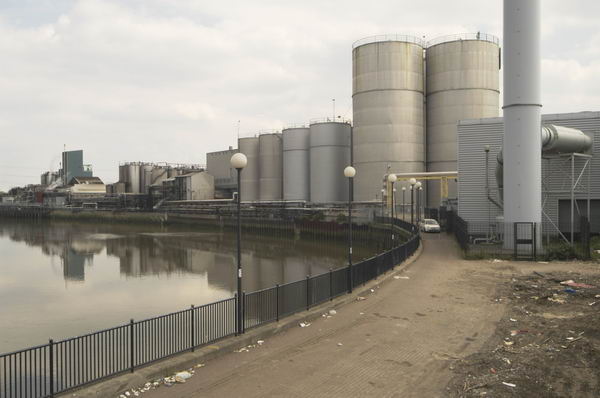
Across the railway track and the Bow Creek is the former site of Pura Foods, a large factory site which filled almost the whole of the area in the bend of the river north of the Lower Lea Crossing, and gave the area both a distinctive appearance and smell.
Pura site in 2004 from the SW.
Pura, a leading supplier of edible oils and fats to the UK and for export, began as the Pure Lard Company, but is now a part of a large American company ADM. It moved out of the area probably because of the development value of the site, although there were some years of pressure from local residents in TELCO to improve its environmental act. It continues to process oils on sites further downstream, including Belvedere. Ships used to bring oils to Brunswick Wharf, close by on the Thames, with a pipeline connection to the site, filling the shining storage tanks.
Demolition of the works started around October 2006 and are now (June 2007) virtually complete. A revised planning application seems likely to be approved, if with some revisions. The proposed development is to be mixed use, including a primary school as well as up to 1800 residential units (mainly flats), offices, shops and restaurants, as well as other commercial, community and leisure space. It will be very different from the old site. [London City Island – which has a new bridge across Bow Creek, close to the riverside exit from Canning Town Station. You can now walk through the development and on down to Trinity Buoy Wharf at the mouth of Bow Creek]
Thames Ironworks
These occupied most of the land on the Essex side of Bow Creek, some of which you can see from the platform, as well as parts of the other side closer to the Thames.
Thames Ironworks occupied most of the land adjoining Bow Creek
Board a train for Beckton, getting off at Custom House
From the Train: Silvertown Way
Look through the windows on the left side of the train. You will see it passes the entrance and ventilation towers for the Jubilee Line tunnel under the Thames to North Greenwich. Beyond this, it runs alongside the largely derelict buildings behind Silvertown Way, before going under this to Victoria Dock Station.
Royal Victoria Square
Silvertown Way was the first flyover to be built in Britain, and was completed in 1934. It was followed in 1935 by the Silvertown Bypass, another similar concrete structure, distinguished by a fine bowstring bridge. Unfortunately this was demolished in the 1990s.
My picture from 1984
The increasing use of road transport was already leading to impressive congestion in the area around the Royal Docks, and these developments were necessary to keep the traffic moving.
[Construction of the London Cable Car began here in 2011 and it opened in 2012. Worth a ride as a tourist attraction it makes no significant contribution to travel in the area. The Crystal, completed in 2012, was commissioned by Siemens and designed by WilkinsonEyre as an exhibition centre and a think tank and since 2022 has been London’s City Hall.]
I’ll post Part 5 Custom House and Canning Town later, again with a few more pictures and comments. You can see the whole walk still on the former London Art Café web site.
The walk starts at the top of the stairs leading up from the Station to the Bus Station. Here there is a memorial to the Thames Ironworks.
C J Mare’s shipbuilding firm did not prosper and was soon bought out by the Thames Ironworks and Shipbuilding Company, whose works soon occupied most of the Essex shore of Bow Creek as well as areas close to the Thames on the Middlesex side. Over the years it built at least 650 ships (some sources say 900) as well as bridges and other iron structures.
Frank Hills
Its greatest fame came under the ownership of Frank Hills who bought the Thames Ironworks and Shipbuilding Company in 1880, when it was struggling to retain employment for its 6,000 men in face of competition from larger yards on the Clyde, Tyne and Mersey.
Thames Ironworks occupied most of the land on the east of Bow Creek and some on the far side.
Hills, educated at Harrow was a Christian, a fine sportsman, English champion in the mile and 3 miles, an Oxford football blue, and played for England when they beat Scotland 5-4 in 1879. He was also the first President of the London Vegetarian Society (1888) and the Vegetarian Cycling and Athletic Club, and also served as President of a London Vegetarian Rambling Club. He also founded The Vegetarian, an independent magazine, and founded the Vegetarian Federal Union (1889), becoming President. He was also a member of the Temperance (total abstinence) union.
As an employer he was described as an “enlightened patriarch” who cared deeply for the welfare of his workers. For some years he lived among them in a small house in the East India Dock Road. Despite this, relations at work were not always good, especially when he engaged non-union workers, and some of the workforce went out on strike at the time of the dock strike of 1889.
Hills was one of the first employers to set up a bonus scheme – in 1892 – and he voluntarily introduced an eight-hour day in 1894 at a time when many employers demanded 10 or 12 hour days. He tried to get his workers to “sign the pledge” and take healthy exercise – and set up clubs of all kinds to keep them out of the pubs. These included a temperance league, cycling club, cricket club, an amateur operatic society and a brass band as well as a football club, the Thames Ironworks Football Team set up in 1895. In 1900, Hills put up the money to fund a merger with another local side, the Old Castle Swifts, and they became West Ham Football Club. The nickname the Hammers comes from the tools they used in building ships.
Leamouth, 1992. Thames Ironworks formerly occupied all the land to the left of Bow Creek at its mouth and some parts in the centre of the picture.
The Albion Disaster
Disaster struck at the Ironworks in 1898 at the launch of HMS Albion. The Duchess of York (later Queen Mary) tried 3 times to break the champagne bottle on the steel hull, but it just bounced off. Despite this bad omen, the launch went ahead. The 12,950 tons batleship, then the largest of the ship ever built on Bow Creek and the wave it created as it slipped into the water smashed a temporary jetty between it and a ship under construction for the Japanese navy.
A huge crowd had turned up to watch the launch, and a large number had managed to get onto this jetty (which hadn’t been intended for such use.) 26 people were awarded Royal Humane Society Broze Medals for their attempts to save those in the water, but despite their bravery, 38 were killed. Hills was devastated. He personally visited the families of the bereaved and paid the funeral expenses, as well as contributing generously to the West Ham Council fund for the survivors.
In 1911, the Ironworks built the Thunderer, at 22,500 tons the Navy’s largest dreadnought and the last great ship (and the largest) to be built on the Thames. It was an order that broke the yard. Hills, his health gravely effected by the Albion disaster in 1891, had a stroke shortly before its launch. The company closed at the end of the year, but Hills lived on until 1927, dying a few days short of his 70th birthday.
Flat-pack Steamers
Should you visit Lake Titicaca in Peru, (The Sacred Lake and legendary birthplace of the Incas), you can see the steamship Yavari, now the only ‘working’ single-screw iron passenger ship in the world.
Ordered from Boulton & Watt in Birmingham by the Peruvian government as one of a pair of cargo-passenger ‘gunboats’, her iron hull (and that of her sister ship) was built in Bow Creek, in numbered pieces, none weighing more than 3.5 cwt, the heaviest that a mule could carry. The two ships were completely fitted out here, then carefully stripped down, numbered and colour-coded and crated for transit.
In 1862, they travelled on a ship around the Horn accompanied by 8 British engineers to Ordered from Boulton & Watt in Birmingham by the Peruvian government as one of a pair of cargo-passenger ‘gunboats’, her iron hull (and that of her sister ship) was built in Bow Creek, in numbered pieces, none weighing more than 3.5 cwt, the heaviest that a mule could carry. The two ships were completely fitted out here, then carefully stripped down, numbered and crated for transit. In 1862, they travelled by sea around the Horn accompanied by 8 British engineers to Arica, Peru, where the railway (the oldest in South America) took them the first 37 miles of the journey. The remaining 190 miles were to be by mule, and over mountain passes higher than anything in Europe up to the lake at 12, 500 ft, across the driest desert in the world. Meanwhile the engineers went ahead to build a jetty and machine shop on the lake. It took over 7 years for all the parts to arrive, and the Peruvian Navy in the meanwhile helped itself to the guns, which never made it.
Eventually the rest was there and the first ship, the Yavari was launched on Christmas day 1870. There was still a problem. There was no coal at Titicaca for the steam engines; the only fuel available was dried llama dung, and a simple journey along the 100 mile lake and back took 1,400 sacks. Its perhaps not surprising that the steam engine was replaced by a diesel in 1914. The ship continued in regular service until the 1950s. It was rediscovered in 1982, and found to be in excellent condition, thanks to the clean fresh water and high altitude of the lake, and is now preserved by a Peruvian charity.
The Memorial
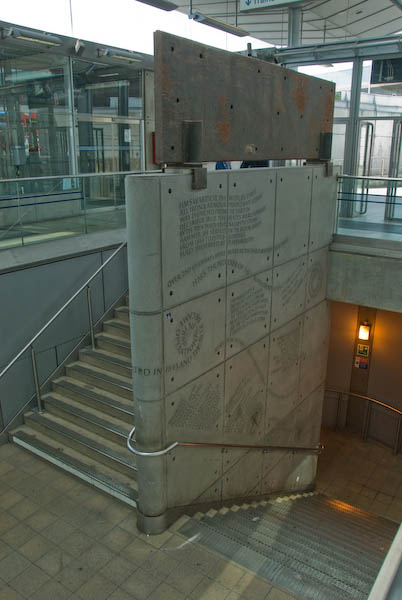
At the top of the stairs leading down to the station barriers at Canning Town is a memorial to the Thames Ironworks by Richard Kindersley, unveiled by the Archbishop of Canterbury in 1998. The large cast iron plate across its top is from the first iron Royal Navy vessel with a full iron hull, HMS Warrior, built around a quarter of a mile south of her by the Thames Ironworks and Shipbuilding Company in 1860.
The Warrior had 3 masts, two funnels and a screw propeller. When under fire, wooden ships splintered terribly and it was flying wood splinters that resulted in most injuries and deaths, and the use of iron cut this down. Other navies soon followed the example. The ship is restored and can be seen at Portsmouth.
The elegant engraving on the stonework in the middle of the stairway tells some of the story of the company. You can see a part of the company site (now empty) from the station platform.
3: Canning Town Transport Interchange
From Thames Ironworks memorial, look through the large glass windows towards the station, with its two level platforms. Walk along to see the bus station (which includes toilets) before taking the escalator down into to the bottom level of the station.
Canning Town DLR and Jubilee Line stations. Bus is in Bus Station
One of the better aspects of the LDDC, responsible for development from 1981-98 was the creation of the DLR and some other aspects of transport infrastructure. Widely derided as a ‘toy train’, the DLR has demonstrated the use of light railway technology.
The new Canning Town station replaced one to the north of the A13 on the North London Line, and opened as a DLR and Silverlink station in 1994, to close after a few months for a couple of years for the building of the Jubilee line. The station reopened – together with the adjoining bus station – in 1999.
North London Line services stopped in December 2006 in preparation for the DLR extension to Stratford International. The station has three levels; at the bottom is the booking hall and barriers, above that are the Jubilee line platforms, with the former NLL platforms at the same level to the east. The DLR lines and platforms are above those of the Jubilee Line.
This is perhaps the best example, indeed one of very few examples of an integrated transport interchange in London.
Bow Creek Walkway
As you walk past the ticket machines and office, in front you will see the exit from the station to the Bow Creek Walkway, completed in the 1990s, but still not open to the public.
Weeds on the walkway – now open but still incomplete
Newham has at least one other example of an expensively constructed foot path in a similar limbo. In this case the reason is said to be that the various parties involved, which include Tower Hamlets and Newham have been unable to reach an agreement about the ownership and liabilities involved.
Budget Day: Tuesday 22nd June 2010 came after the May general election which had resulted in a hung Parliament, with the Tories winning 306 votes, 20 short of the number needed to for a majority. It had been a defeat for New Labour, in power since 1997, who only achieved 258 MPs. The Lib-Dems were the third party with 57 seats. Theoretically an anti-Tory coalition might have achieved a small but workable majority, but instead Nick Clegg decided to join a coalition government with the Tories which would have a clear majority – and lasted until the 2015 General Election.
Their decision resulted in a programme of austerity and cuts along with increases in tax which began with George Osborne’s budget on 22nd June. This included a rise in VAT from 17.5% to 20%, cuts in public services and a 2 year pay freeze for workers in the public sector, freezing of child benefit for 3 years, pegging state benefits and public service pensions to a lower price index, capping of housing benefit , cutting research and development and more.
PCS outside the Treasury
Most of these changes had been widely signposted before the budget speech and opponents had made clear that they were likely to stifle growth and to have a disproportionate effect on the poor, women, disabled people and ethnic minorities. It was the most controversial budget in recent history and so it was unsurprising that so many came out to protest. And later the changes it introduced were probably a major factor in both the disastrous Brexit vote and the succession of hopeless Tory governments that led to the 2024 Labour landslide.
‘Can’t Pay Won’t Pay’s funeral procession with coffin, widow and gravestones
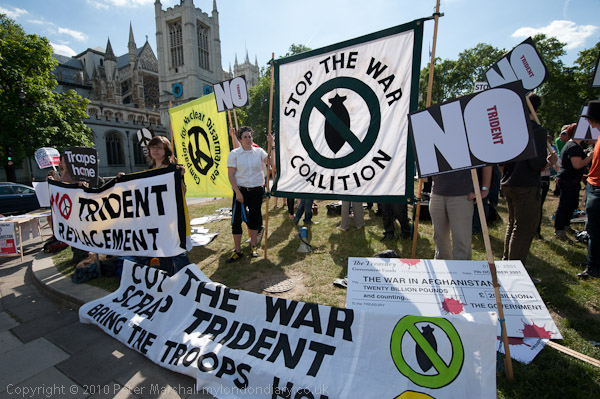
Brian Haw’s Parliament Square Peace Campaign was also still in Parliament Square, although Brian himself was in court on the morning of the budget. But they had been joined there at the start of the previous month by the Democracy Village who were still camping there, and though relations between the two groups were not positive, both were still protesting, and on Budget Day others including the PCS union, ‘Can’t Pay Won’t Pay’, Stop the War and CND also came to protest at Westminster too.
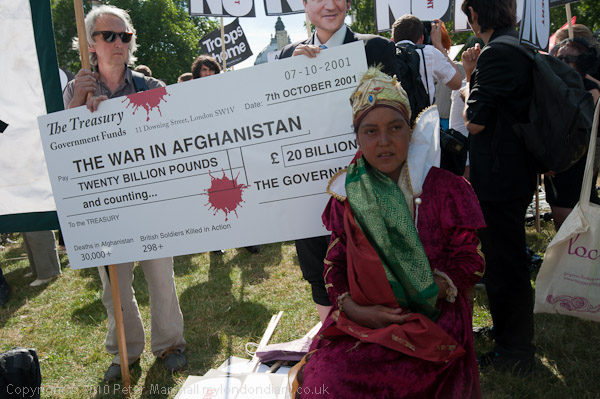
I missed what was probably the largest protest of the day opposite Downing Street, having been held up photographing the Democracy Camp calling for an end to the war in Afghanistan.
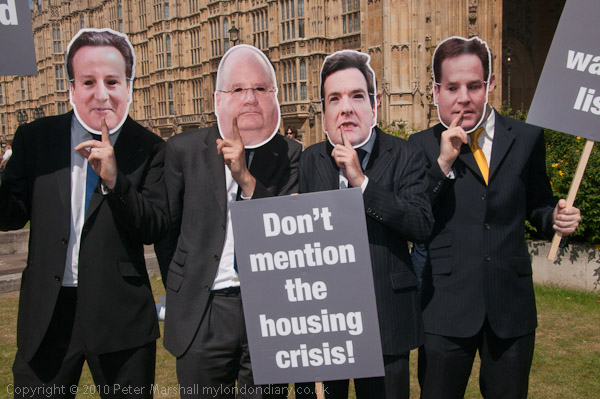
‘Cameron’ and ‘Clegg’
The PCS were protesting outside the Treasury. Democracy campers went with their banner to the media village. ‘Can’t Pay Won’t Pay’ campaigners arrived with a coffin and a little street theatre (it even got them a short mention on the BBC) and I followed them back to Parliament Square, missing two attempts to make citizens arrests on Labour politicians.
You can read more about the events on My London Diary, as well as a police incident involving gun violence campaigner ‘King David’ who was holding a brass ornamental pistol – clearly not a weapon – but was stopped and searched under terrorist legislation.
King David was searched under the Terrorism act for holding this brass ornament
More protesters arrived with placards and masks protesting about the housing crisis and the lack of affordable homes, and there was a man with a megaphone lampooning the whole thing and getting some attention from the police who today seemed clearly did not want to make arrests.
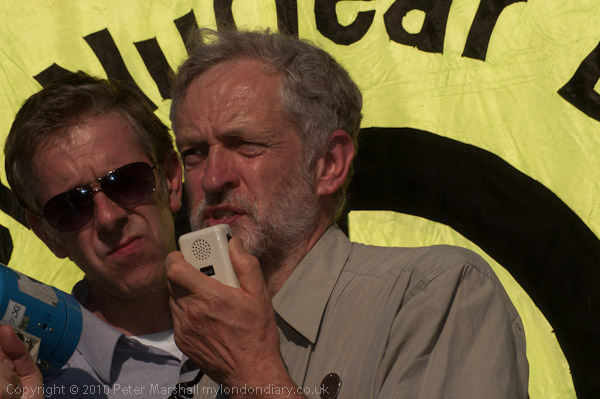
Jeremy Corbyn
The final event I photographed before leaving Parliament Square was by Stop the War and CND, pointing out that the war in Afghanistan had cost more than £20 billion, and that a large saving could be made by deferring or cancelling the replacement of our Trident nuclear deterrent, for which there was no longer any possible military justification.
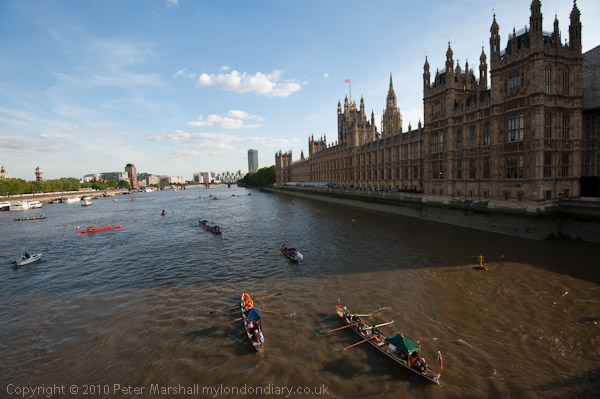
The race starts in several waves from outside the Houses of Parliament
As I walked back across Westminster Bridge towards Waterloo Station I noticed a number of boats being rowed upriver in what appeared to be a race.
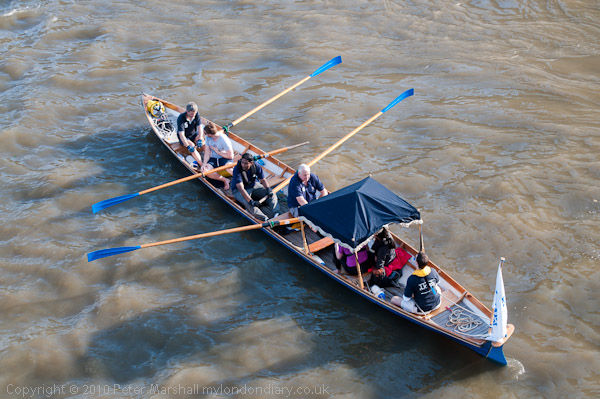
The Admiral of the Port’s Challenge, a “historic tradition”, appears to have started around 2008 by the London livery companies, liverymen rowing “traditional” Thames Waterman’s Cutters, 34 feet long and 4 feet 6 inches wide, with fixed seats for 4 rowers and a canopy over 2 passengers, to the rear of which the cox sits. The boats start in waves from outside the Hoses of Parliament and row around a mile and a third to a boat club in Pimlico.
These boats, though based on those shown in 18th century paintings, are actually a modern design, adapted and built to be fast and stable for modern use for the Thames ‘Great River Race’ which started in the 1980s. Unlike modern racing craft they can cope with choppy waters on the river or even in coastal waters. And at the end of the race there is a champagne reception for those taking part.
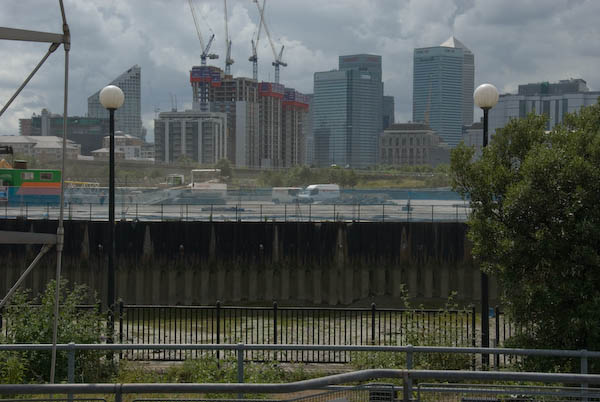
Canary Wharf and the Millenium Dome from Silvertown
Stratford & Silvertown: One of the shorter posts I wrote on My London Diary was about my trip to Silvertown and Stratford in East London on 21st June 2006. Here it is in full, just as I published it then:
on wednesday 21st i took the DLR to stations in silvertown, taking pictures from the train, the platforms and around the stations. then i went to stratford to make more pictures there.
I left home in mid-afternoon and began photographing from the DLR a little after 4pm. It was a fine day and I was going to join a walk around Stratford in the evening by the Greater London Industrial Archaelogy Society and had a couple of hour before I was to meet with them at Stratford Station.
It was almost a year since London had been awarded the 2012 Olympics and I had made a number of visits to the Olympic area to record it before the huge changes that were about to take place.
The DLR extension to King George V station in North Woolwich had opened in December 2005, but had yet made little impact on the surrounding area. Construction had already begun on its extension under the River Thames to Woolwich Arsenal which opened in January 2009.
The line is largely elevated on a concrete viaduct which gives extensive views of the area. As the trains are driver-less I was able to sit at the front of the train and photograph through the front window. Then the DLR was relatively little used and at least on schooldays there was little competition for the front seats – and I think the train windows were usually cleaner.
Trains on the line were then reasonably frequent so I was able to get off at various stations to walk around a little and then return to the station to continue my journey, including a visit to Lyle Park with views across the River Thames.
The station platforms also provide elevated viewpoints to photograph the area. I went as far as Silvertown station and then made my way back to Stratford.
Here I left the train to join the GLIAS walk around the area to the south of the Olympic site, including the Carpenters Estate, a popular council estate close to the station which Newham were then trying to empty and sell off against local opposition, Stratford High Street and the Waterworks River.
By the time this evening walk ended although it was the middle of June the light was fading, though I think this picture exaggerates this a little.
There are quite a few more pictures on My London Diary, beginning here, but I took many more that day, particularly on the evening walk. Perhaps I will post more from this here some time.
Islington, Charlton & Refugees: On Saturday June 19th 2005 I photographed Imagine Islington, a green festival in Islington, then went out to Charlton for the Horn Fair, before finally returning to central London for a Refugee event taking place as a part of the Coin Street Festival in Bernie Spain Gardens on the South Bank of the Thames in Lambeth. Again I’ll give the texts I wrote at the time with links to more pictures from the events on My London Diary.
Imagine Islington
Islington
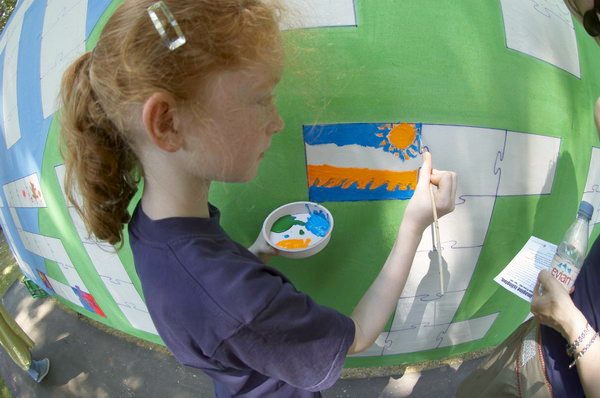
Painting the ‘Hugh Jart’ mural on Islington Green
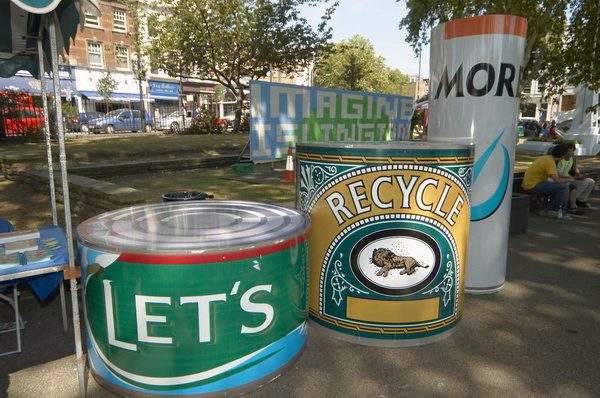
Imagine Islington was another green festival, but with rather more fun than some, taking place at 7 locations around the Angel and Islington Green.
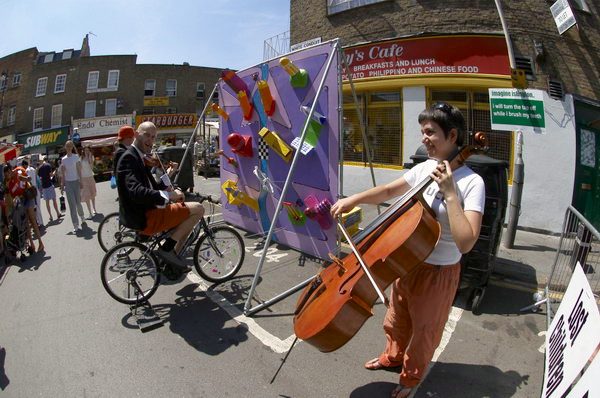
Rhythms Of ResistanceWeapons of Sound, playing a range of containers, trolleys and other objects
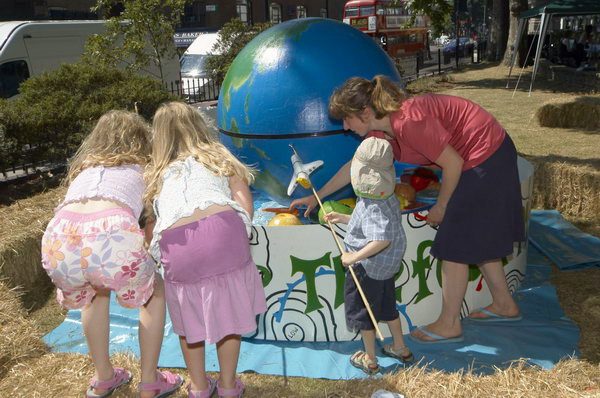
On the Green there was music from Rhythms Of Resistance and Weapons Of Sound, a giant mural to paint by ‘Hugh Jart’, an air-miles game and other attractions.
The food miles interactive game from ‘Arts Desire’ was designed to show the high cost in carbon emissions of importing fruit and veg
Elsewhere there was a wind installation at St Mary’s Church, a Biodiversity Garden in the NI Centre, the Incredible String Trio Pluck (they described themselves as “the world’s most musically challenged string trio“) in Chapel Market and more.
Recycling is fine, but there needs to be more emphasis on reusable containers and on simply consuming less and wasting less.More Pluck in Chapel Market
This was a pleasant event for the family but largely concentrated on the froth rather than the essentials of the challenge the world faces.
I wanted to go to Charlton simply because the annual Horn Fair there was notorious for its “indecencies and frequent riots“, eventually leading to its suppression by an order in council in 1872.
Irish dancing
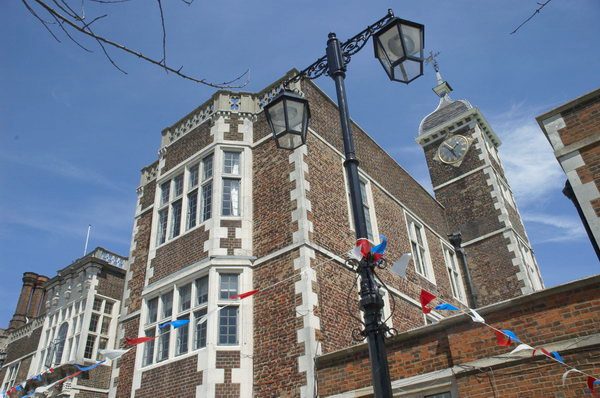
Unfortunately its modern recreation turned out to be a much more tame affair, although Charlton House remains impressive.
[I also took a few pictures on my journey to Charlton and on my way from there to Coin Street, some also included in my 2006 post.]
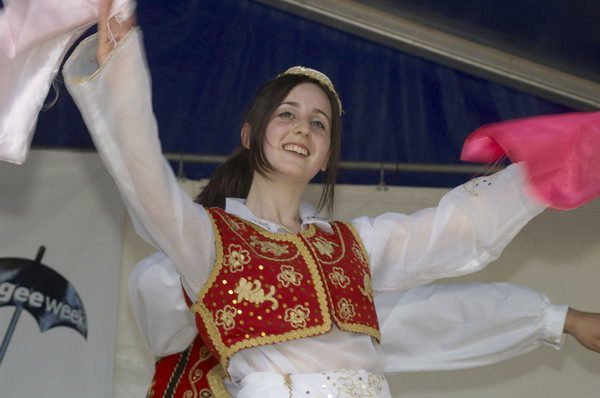
Meanwhile in Coin Street, another Refugee Week event, Celebrating Sanctuary, was taking place.
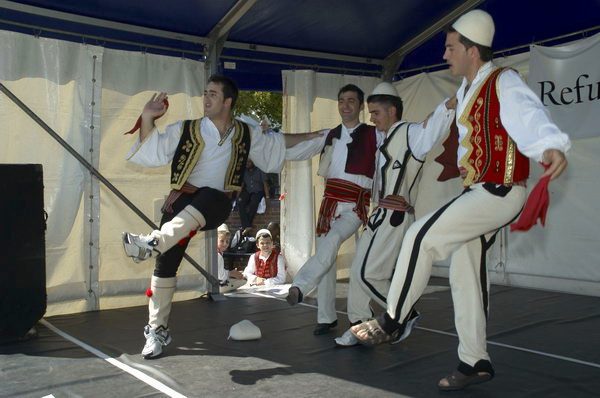
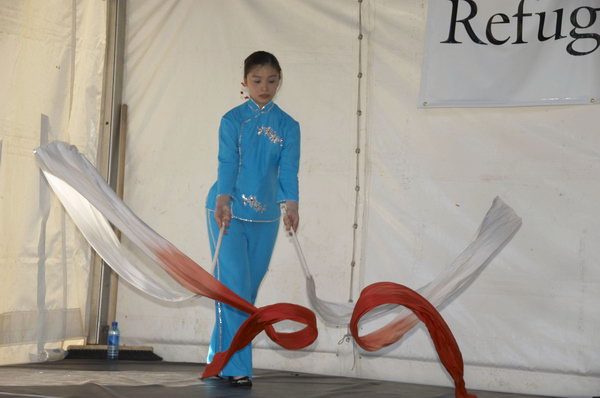
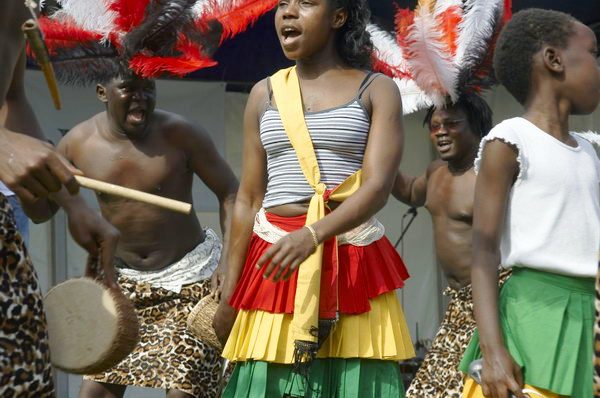
The men’s dance was more energeticThis Chinese dancer made some great patterns with her long streamersThen we had a fantastic performance by a large group of all ages from Uganda, in various tribal dress and a great deal of energy
Among the events I photographed were Albanian dancing, a Chinese dancer with long streamers and African dancing from Uganda.
Rathayatra, Roller Skates & the World Cup: I began Sunday 18 June 2006 by photographing the annual Rathayatra chariot festival in Hyde Park and on its way to Trafalgar Square, before going to Parsons Green where I found the West London Green Fair rather disappointing but did briefly meet a large crowd on roller skates on a ride around London.
Later I went to New Malden to meet a friend and photograph Koreans who had gathered at a local pub to watch South Korea playing France in Leipzig in Group G of the 2006 World Cup. South Korea had earlier beaten Togo, and drew with France but a few days later lost to Switzerland and so failed to progress to the knockout phase of the cup. Below is what I wrote in 2006 (with the usual corrections) and links to more pictures from the day.
Hare Krishna: Rathayatra Festival
Hyde Park to Trafalgar Square
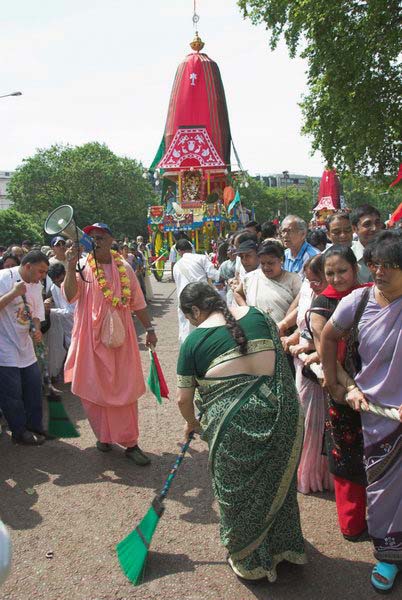
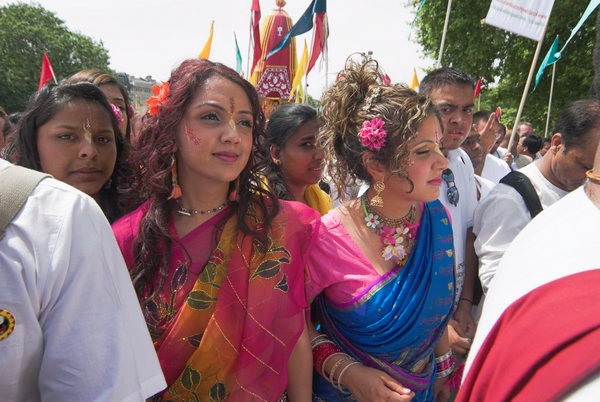
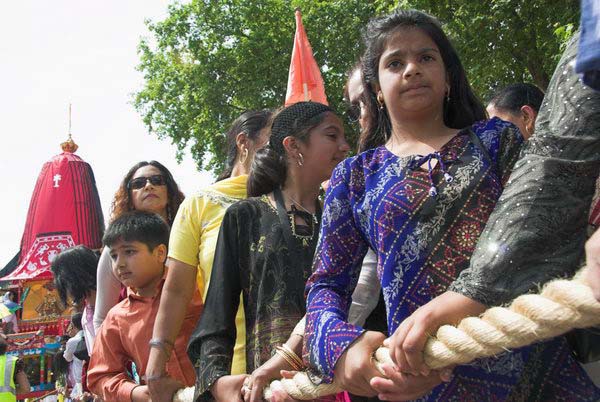
One of London’s more colourful annual events is the Rathayatra or Chariot Festival organised by the Hare Krishna movement. The three chariots carry representations of three deities, Lord Jagannatha (Krishna, the Lord of the Universe), Lady Subhadra and Lord Balarama, and pulling the ropes grants eternal service at the end of life in the spiritual world.
The ceremony dates back around 5000 years in the ancient holy city of Jagannath Puri in Orissa, India, but was only established in London rather more recently in 1969.
The chariots are accompanied by musicians and dancers, and there is free food for all at Trafalgar Square where the procession ends.
This year’s festival also celebrated the 108th anniversary of the birth of A C Bhaktivedanta Swami Prabhupada (1896-1977), who in 1966 founded the Hare Krishna movement.
I called in briefly at the West London Green Festival at Parson’s Green on my way to New Malden, but there didn’t seem to be much happening there.
The Skate Rollerstroll called in briefly, but didn’t stop for long.
Korea v France
The Fountain Pub, New Malden
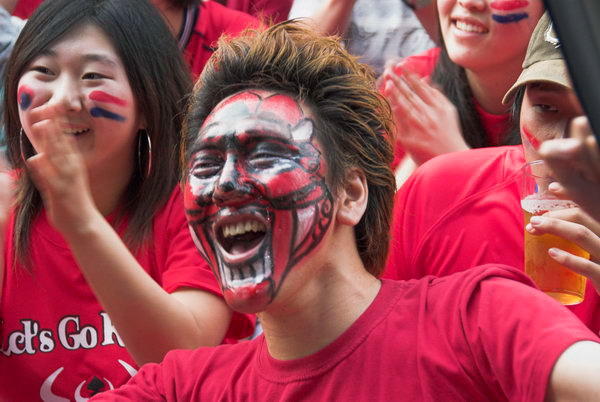
Korean Face painting in New MaldenI’m about to have two stripes painted on my cheeks by this young woman
I was on my way to New Malden, where I met up with Paul Baldesare to go and photograph Korean supporters watching the Korea v France match at one of the local pubs.
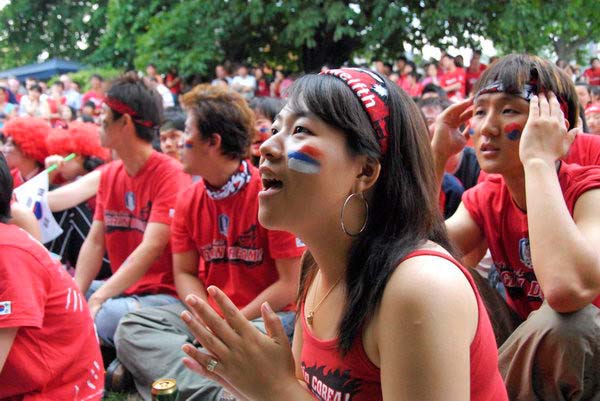
Both inside the pub and in the garden were a whole lot of large screens, with Koreans coming to watch the game.
We got there quite a while before the start when everyone was just starting to get into the mood. Soon we both had red and blue stripes painted on our faces.
It was very much a community event, with everyone enjoying themselves, and emotions obviously ran high once the game had started.
Along with the hundreds of Koreans there were a few non-Korean locals, and one French woman with a France t-shirt. I talked to her briefly before the game began, but couldn’t find her later when I went to take some photographs in the crowd. So everyone in my pictures is a Korea supporter.
When I left, a few minutes into the second half, Korea were trailing 1-0. I missed the equaliser, and the after-match celebrations when the High Street was full of Koreans celebrating the draw.
Diggers at Runnymede: On Saturday 16th June 2012 I cycled to Runnymede in Surrey on the south bank of the Thames, a large area of National Trust land which was possibly the site where King John met the barons and agreed to the Magna Carta in 1215. There is a large area of meadow on both sides of the current course of the River Thames and the actual site of the meeting within this remains uncertain.
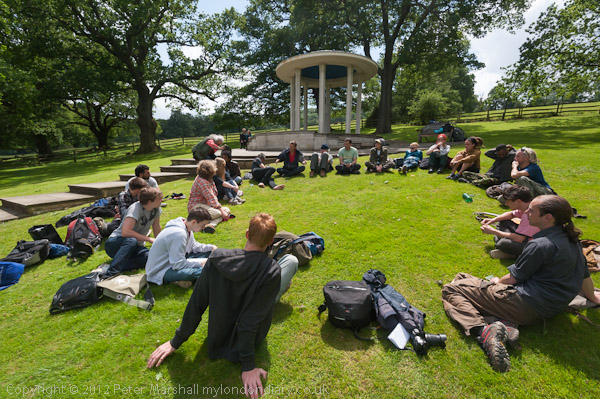
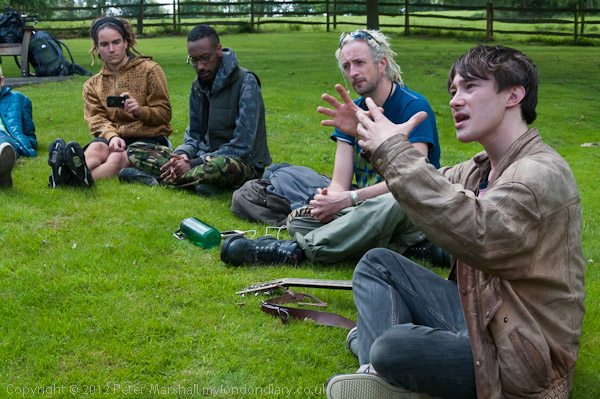
I stepped back a couple of paces from the circle to take this picture
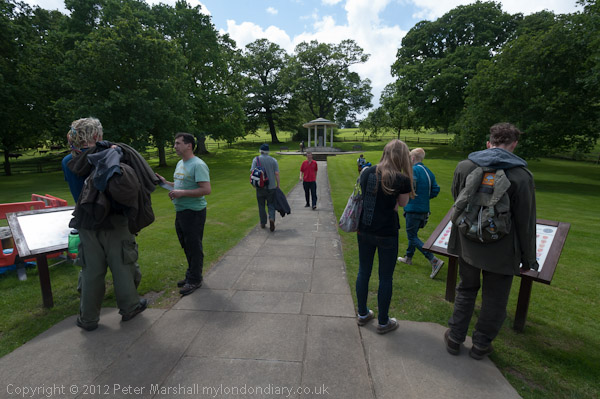
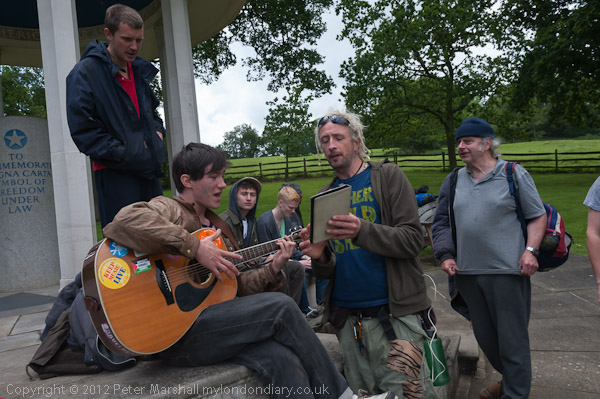
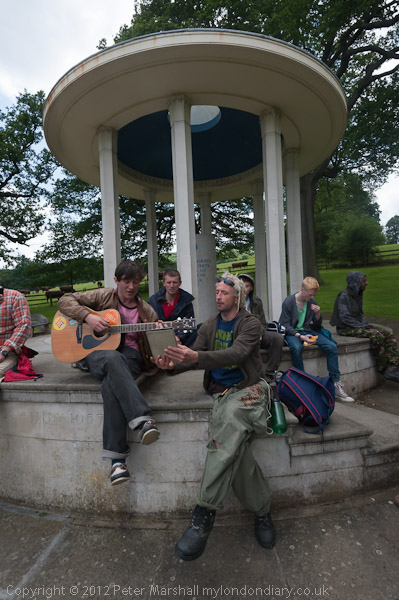
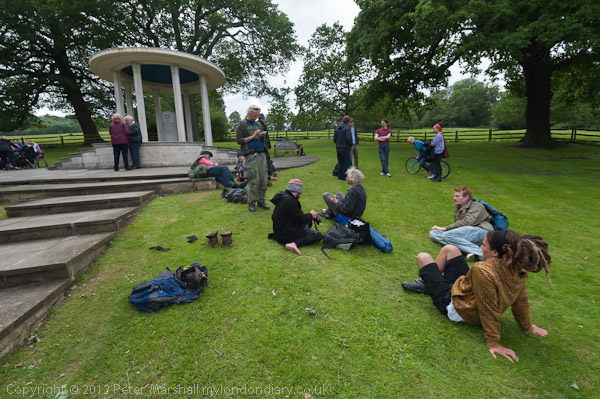
The meeting that I attended was close to the American Bar Association Magna Carta Memorial, unveiled here in 1957 – and almost certainly not where the 1215 meeting took place, but a short distance above the meadows on the slope of Coopers Hill.
There I met a group of ‘Diggers’ who were camping further up the hill, ecologists whose ideas mirror those of the original Diggers or ‘True Levellers’ founded by Gerard Winstanley in 1649 after the first English Civil War. He stated that “true freedom lies where a man receives his nourishment and preservation, and that is in the use of the earth” and that “England is not a free people, till the poor that have no land have a free allowance to dig and labour the commons.”
When food became horrendously expensive in 1649 the Diggers set up a camp on common land at St George’s Hill in Weybridge and began to grow vegetables there. The local landowners called in the army, who came and decided the Diggers were not harming anyone and told the landowners to take their case to court.
Instead the landowners paid a gang of ruffians to attack the Diggers, beating them up and burning down a house. Three years after the 2012 meeting, history repeated itself during the Magna Carta 800th anniversary celebrations, when police illegally invaded the Runnymede Eco-Village community set up by the new Diggers to stop their peoples’ celebration. The site is now occupied by luxury housing.
The original Diggers based their ideas of sharing of property from the New Testament and early Christianity and also looked back to England before the Norman Conquest. After 1066 the Norman Conquerors took hold of the land and divided it between themselves and there has been remarkably little change in land ownership over the almost 950 years since then, with the same families still owning the great majority of English land; 0.65% of the UK population currently own more than two thirds of the UK land area.
It was an interesting discussion with some very historically informed contributions about Magna Carta and the lesser-known but more relevant to the common man ‘Charter of the Forest‘ which was issued shortly afterwards as well as a discussion of current issues and some interesting proposals for the future. As well as hoping to use the Eco-village as a practical example of their philosophy they also decided to hold a people’s celebration of the 800th anniversary in 2015 to take place as well as the official events.
At the end of the meeting people get up to go to the Diggers campsite
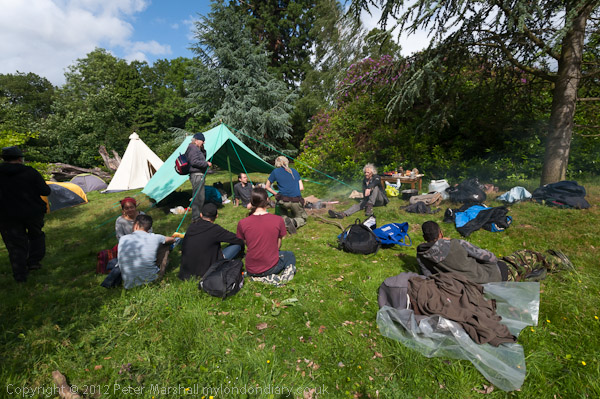
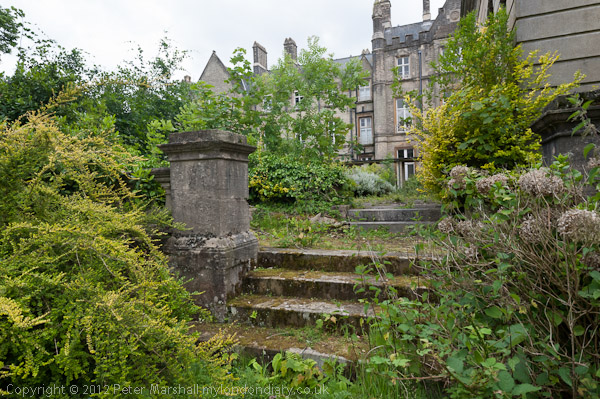
After a long meeting we walked up the hill to the Diggers camp close to the long disused Runnymede campus of Brunel University and I made a few pictures. The Eco-village was finally set up a few yards further down the slope.