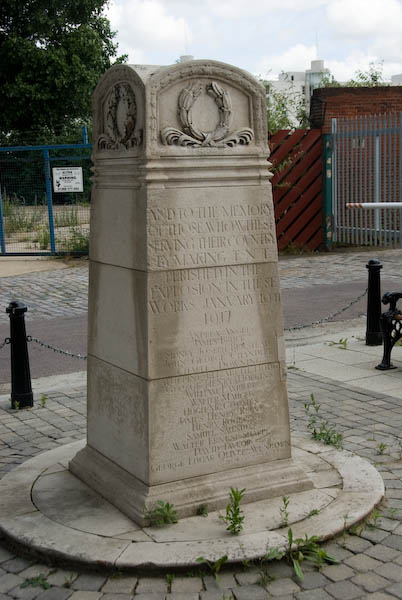
More City of London Panoramas – 1994

More City of London Panoramas: This is the final set of picturesI’ll post from those I made while working on a personal project on the City of London in July 1994. Of course I took many which I’ve not digitised, spending several days walking the City and making over 300 exposures. The camera I used makes negatives on standard 35mm film which are wider than normal and a ’36 exposure’ film only gets around 20 or 21 panoramic frames. Film loading is also trickier as the film has to go around a curve.

Each exposure took a few minutes to select a viewpoint, set up my tripod, level the camera, use a handheld lightmeter to check exposure and finally press the cable release. Most of those not uploaded are similar to those I have posted with just minor changes to the view.

London Bridge Walk, Tooley St, Borough High St, Southwark, 1994, 94-711-52

Not quite in the City, but made as I made my way from London Bridge Station to London Bridge along London Bridge Walk. The road in the background is Borough High Street which leads on to London Bridge and the City boundary is in the middle of the river. You can just see the pinnacles on the top of the tower of Southwark Cathedral.

After the operation of the Waterloo & City underground line from Network South East to London Underground in April 1994 I could no longer use my ‘London Terminals’ ticket on this route, and my cheapest journey became to go to London Bridge on this and walk across to the City.

This is one of a few pictures I had digitised but missed when I was uploading these images to Flickr.

High Walk, Wood St, City, 1994, 94-713-42

Another exposure from the highwalk at Wood Street, leading south along the east side of the street away from London Wall. In the centre of the picture is the City of London Police Headquarters, with two white police vans at bottom right. Steps lead down from the walkway to Wood Street but the highwalk also continued straight on at extreme left – though with more steps.

In the centre of Wood Street at right is the tower of St Alban Wood Street. The medieval church was destroyed in the Great Fire and rebuilt by Sir Christopher Wren. The church was largely destroyed in the Blitz in 1940. The tower remained and was Grade II* listed in 1950 and is now a private house; the remains of the rest of the church were demolished in 1965.

Lower Thames St, King William St, City, 1994, 94-711-12

Again on my way from London Bridge Station to the centre of the City, this is made from where London Bridge joins to King William Street and goes across Lower Thames Street. You can see a highwalk bridge going across Lower Thames street a couple of hundred yards to the east, still there in 2025.

Until around 1970 Thames Street was a fairly narrow street, just wide enough to allow a single lane of traffic in both directions. It was then turned into a major road and divided at London Bridge into Lower and Upper Thames Street. At the left you can clearly see where older buildings were cut through to widen the road.

Bank Junction, City, 1994, 94-712-33

The heart of the City. I made the picture close to the corner of Mansion House Street and Princes Street with the Underground entrance on the corner. At left is a corner of the Bank of England and the main modern building towering above it is the Stock Exchange Tower, home to the Stock Exchange until 2004.

Towards the centre is the Royal Exchange, I think then still home to the International Financial Futures Exchange rather than just an upmarket shopping mall. Two buildings full of banks and insurance companies book-end Hawksmoor’s St Mary Woolnuth and at the extreme right is the edge of the Mansion House with a gilded lamp on its steps.

Milton Court, Silk Street, City, 1994, 94-713-21

Another section of highwalks ran from close to Moorgate Station to the Barbican Estate and these last four pictures show sections of this, which could also be accessed from Ropemaker Street. This northern section has now been lost.

Milton Court was designed by Chamberlin, Powell & Bon and built as a part of the Barbican development in 1959 for various City services – “a fire station, Coroner’s Court, mortuary, office of weights and measures and a civil defence school.”

It was arguably London’s most outstanding single post-war building and English Heritage wanted to list it in 2001, but the government’s Department of Culture, Media and Sport objected and in 2007 Secretary of State James Purnell granted it immunity from listing. In a sad act of cultural vandalism this remarkable building was demolished in 2008.

Milton Court, Silk Street, City, 1994, 94-713-12

The building which replaced Milton Court was also given the same name but is a much more bland modern structure. The bridge which linked to the northern section of highwalk disappeared.

The new 115m tall Milton Court is described on its builders Sir Robert McAlpine web site: “Climbing to 36 storeys, Milton Court redefines luxury living in the Square Mile. In addition to a graceful residential tower, the development is home to a spectacular new annexe to the Guildhall School of Music & Drama.” But to me it looks like just another tall city office block.

Highwalk, Ropemaker St, City, 1994, 94-715-52

This enclosed section of highwalk ran from Ropemaker Street to the bridge across Silk Street to the Speed Highwalk still there along the north side of Speed House.

Ropemaker St, Islington, City, 1994, 94-715-32

Remarkably I think none of the buildings in this picture looking east along Ropemaker Street has ssurvived. Even the building at left, Ropemaker Place, a 60m high block which I photographed while it was being built in 1986 and was completed in 1987 and which I thought was one of the more attractive modern buildings in (or rather a few feet outside) didn’t last long and was demolished only 18 years later in 2005.

More colour from 1994 in later posts.


FlickrFacebookMy London DiaryHull PhotosLea ValleyParis
London’s Industrial HeritageLondon Photos

All photographs on this page are copyright © Peter Marshall.
Contact me to buy prints or licence to reproduce.

The Lord Mayor’s Show – 2005

The Lord Mayor’s Show. One of the largest ceremonial events in London every year is the Lord Mayor’s Show in November – in 2005 it was on Saturday 12th November. It is said to be the oldest civic procession in the world, first held after King John allowed the City of London to appoint its own Mayor in 1215.

The Lord Mayor's Show - 2005
Not a nightmare, but the Dunloy Accordion Band from Ireland. London, 12 Nov, 2005

I’d photographed the event in several earlier years, though in many ways for me it had often been more a social event than a serious part of my photography, meeting up with some of my photographer friends and after taking some pictures and finding a suitable pub. But as I wrote in 2005, that year I had decided to do it on my own and actually photograph it as if I were covering the event for a magazine rather than as a personal photographic project. Though to two things often overlapped considerably in my work.

The Lord Mayor's Show - 2005 Gog and Magog,
Gog and Magog, legendary giants, with the Society of Young Freemen

I have photographed it a few times since, mainly when other groups have decided to add their own input to the day. In 2011 Occupy SLX staged their ‘Not the Lord Mayors Show’ festival of entertainment and in 2021 Extinction Rebellion held a rival protest, Rise and Rebel XR at Lord Mayors Show.

The Lord Mayor's Show - 2005

The City of London is virtually its own country inside Britain, and has a unique position as a city, ceremonial county and local government district in England. And although it shares an MP with the City of Westminster, it also has the rather shadowy figure of the ‘City Remembrancer‘ who sits in the under-gallery of the House of Commons as a permanent lobbyist for the City and has the special privilege to see legislation as it is being drafted. Over the years this has led to the City being able to protect its interests in various ways, notably in the last century to prevent the reforms to the City’s status proposed by the postwar Attlee government.

The Lord Mayor's Show - 2005

Treasure Islands’ by Nicholas Shaxson, which includes a section on the City, often called ‘the money-laundering capital of the world‘ gives some insight as to how the lavish display of this event and much of the City’s activities are possible. The show does raise considerable amounts to support various charities.

The Lord Mayor's Show - 2005

This year, 2025, London had it’s first ‘Lady Mayor’s Show‘ though there have been two previous female Lord Mayors. The City calls it a ‘historic milestone’ but to me it seems not a blow for feminism but an anachronism in an age where we no longer have actresses or Chairladies. I had other things to do this year and didn’t go to see the show.

All the pictures in this post were taken by me in 2005 – there are many more on My London Diary – but below with the usual minor corrections is what I wrote then.

“Saturday I was back opposite Guildhall for the start of the annual Lord Mayor’s Parade. Although I’ve been to it on several occasions, I’ve never tried to photograph the actual event and people taking part in a straightforward way. Usually the things that happen before and after and on the fringes are of more interest to photographers (Cartier-Bresson photographing that guy sleeping it off on a pile of paper as the Coronation Procession moved by has a lot to answer for.)

After the end of the parade had passed the Guildhall, I took a short cut to St Paul’s to watch the Blessing Of The Lord Mayor and his lady, but unfortunately the crowd barriers holding back the public were too far away for a decent view, though I did take a few snaps.

It is a tightly policed event, very different from the Notting Hill Carnival parade, perhaps organised more with television in mind than letting those present actually take part – if you go to watch in the more crowded parts you often get a poor and distant view. Then I found a seat in the sun outside the new Stock Exchange and ate my sandwiches before photographing some of the fairground around the cathedral.

Then it was time to see the parade returning, and a short walk took me to opposite St Andrew-by-the-Wardrobe. I’d meant to stay on for the fireworks later, but I’d been standing up too long for my injured knee and decided to go home.”

Many more pictures begin here on My London Diary


FlickrFacebookMy London DiaryHull PhotosLea ValleyParis
London’s Industrial HeritageLondon Photos

All photographs on this page are copyright © Peter Marshall.
Contact me to buy prints or licence to reproduce.

More from Tollington Park – 1990

More from Tollington Park – 1990 continues my walk which began at Kings Cross on Sunday February 11th 1990 with the post Kings Cross and Pentonville 1990. The previous post was Fonthill & Tollington.

House, Tollington Park, Finsbury Park, Islington, 1990, 90-2c-12

Tollington is a district whose name dates back at lease into Saxon times. According to Eric A Willats’ ‘Streets With A Story‘, from which much of the information in this post comes, “It was spelt ‘Tollandune’ in the Anglo-Saxon Charters meaning the hill or pasture of Tolla. ‘Tolentone’ meant a pannage for hogs, a place of beechwood and mast. This area and Holloway were all then part of the Great Forest of Middlesex. It
had various spellings Tolesdone, Tolyndon, Tallingdon and Tallington
.”

Modern development of the area, then farmland, began early in the 19th century; “About 1818-1820 ‘a pretty range of villa residences were erected in the Italian style by Mr. Duerdin, with stabling and offices attached, from the designs of Messrs. Gough and Roumieu.’” These are now 96, 102, 106 and 110 Tollington Park.

House, Tollington Park, Finsbury Park, Islington, 1990, 90-2c-13

Like many other early and mid-19th century developments the villas were first given their own distinct subsidiary names and only became numbers in ‘Tollington Park’ in 1871, Willats gives the following details:

After 1871 subsidiary names were abolished, e.g., Belmont Terrace became nos2-6, Birnam Villas 8-10,St Marks Villas 16-22, Claremont Villas 24-36, Duerdin Villas 44-56, Fonthill Villas 60-70, Syddall Villas 59, Syddall Terrace 63-73, Regina Villas 89-101, Shimpling Place by 1882 nos15-155 Upper Tollington Park, Harrington Grove 1848/9 became after 1894 47 to 67 and 52 to 70 CHARTERIS ROAD. Nos96 to 108 have been attributed to Gough & Roumieu, built 1839-40

House, 53, Tollington Park, Finsbury Park, Islington, 1990, 90-2c-14

This corner house has been significantly modernised but retains its tall archway and fits in well with the adjoining houses out of picture to the left. It doesn’t get a mention on the fine map of ‘Historic Tollington’ which was “created by the incredibly vibrant Tollington Park Action Group in 1994.” As well as the plan of the streets this contains informative annotation on 26 sites in the area and would have been very useful to me as a guide to the area which I photographed four years before the map was made.

House, 20A, Turle Rd, Finsbury Park, Islington, 1990, 90-2c-15

Willats suggests the road was “Probably named after a John Turle of no.11 Tollington Park who was at that address in 1830 and in 1833.”

George Orwell School, Turle Rd, Finsbury Park, Islington, 1990, 90-2d-65

The former Tollington Park School first opened in 1886. It gained some new buildings to add to its Victorian main block in 1930 but these were demolished by bombing in 1940. I think my picture shows the new extension built in 1955.

It was renamed by the Inner London Education Authority in 1981 after Eric Arthur Blair, better known as George Orwell, in 1981. He had lived not far away at 27b Canonbury Square from 1944-7. The name of this ‘secondary modern’ school was changed when it was merged with Archway Secondary School and it disappeared in 1999 following a damning Ofsted inspection of all Islington’s schools, re-emerging as Islington Arts and Media School.

The school’s most famous former pupil is photographer Don McCullen who was born and grew up in Finsbury Park nearby.

St Marks, church, Church Hall, Moray Rd, Finsbury Park, Islington, 1990, 90-2d-53

Work began on building the church in 1853; its architect was Alexander Dick Gough (1804-71) who lived at 4 Tollington Park. He was a pupil of Benjamin Dean Wyatt and for some years worked in partnership with Robert Lewis Roumieu; their work together in North London included the Islington Literary and Scientific Institution (now the Almeida Theatre), the rebuilding of the Norman St Pancras Old Church and several Italianate villas in Tollington Park mentioned above.

After their partnership was dissolved in 1848, Gough designed or redesigned over a dozen churches in North London and elsewhere, many now demolished, along with other buildings. St Mark’s required some structural alterations in 1884 and was renovated in 1904.

Tollington Court, Tollington Place, Finsbury Park, Islington, 1990, 90-2d-54

These 1938 flats are on the corner of Tollington Place and Tollington Park and I was standing a few yards down Moray Road to make this picture, with the square and fluted round pillars of St Mark’s Mansions, 60 Tollington Park, at the left. This building is locally listed as a semi-detached Italianate villa dating from around 1850.

St Marks Mansions, Tollington Park, Finsbury Park, Islington, 1990, 90-2d-55

This shows the neighbouring semi-detached villa of St Mark’s Mansions and the poor decorative state of many of the buildings like this long converted into flats in Tollington Park. The area has been considerably gentrified since 1990 and it is hard to believe the state of the properties then when you look at them now.

See what Tollington looked like in the 60’s & 70’s has a collection of pictures by Leslie William Blake taken before the area had begun to receive any real investment following extensive bomb damage in the war. The article states “it wasn’t until the late Sixties that any real investment began” to come into the area, and my pictures from 1990 show that there was still much to do.

More pictures from my walk in a later post.


FlickrFacebookMy London DiaryHull PhotosLea ValleyParis
London’s Industrial HeritageLondon Photos

All photographs on this page are copyright © Peter Marshall.
Contact me to buy prints or licence to reproduce.

Around the Highwalks – Wood Street 1994

Around the Highwalks – Wood Street: London’s ambitious series of ‘highwalks’, aimed at separating movement on foot from traffic began after World War 2 when the City began to rebuild after extensive war damage – a process that really sprung into action on a large scale in the 1950s.

Highwalk, Wood St, City, 1994, 94-708-21

As Wikipedia states, “In 1947 architect Charles Holden and planner William Holford” had put forward a blueprint for “a network of first-floor walkways that would connect buildings across the City.”

Wood St, Escalator, London Wall, City, 1994, 94-709-12, 1994, 94-709-31
Wood St, Escalator, London Wall, City, 1994, 94-709-31

The City of London Pedway Scheme was later adopted by the City of London Corporation and to get planning permission by the 1960s all new developments were required to include first floor access to walkways. It worked where there had large areas destroyed by bombing – such as the Barbican, but elsewhere these walkways were often dead ends leading nowhere.

Wood St, Escalator, London Wall, City, 1994, 94-709-12

Although London had suffered greatly from the bombing, much survived – and many damaged buildings had been restored in the immediate aftermath of the war. Although some of the city’s older buildings were demolished there was an increasing recognition of the value of many of them. The 1944 Town and Country Planning Act had given the government power to create a statutory list of buildings of special architectural interest – and those powers were increased in the 1947 Act.

Green Cuisine, Highwalk, Wood St, London Wall Citry, 1994, 94-709-21

Listing of buildings began seriously after this, and many buildings in the City gained some protection from demolition – and a resurvey in 1968 began to add more to the lists. It became increasingly clear that the Pedway scheme would never be able to produce a really coherent scheme over most of the City and by the mid-1980s it was effectively discontinued.

Highwalk, St Alphage Highwalk, London Wall, City, 1994, 94-710-22

Since then some parts of the walkway system have been lost, while some areas still remain. Around London Wall while some parts of it were closed. The part of the St Alphage Highwalk in these pictures had been demolished but it was partly replaced by a new section during redevelopment around 2017.

Highwalk, St Alphage Highwalk, London Wall, City, 1994, 94-710-12

Another problems with the Pedway is that London’s transport systems – buses and Underground largely leave passengers at street level. Getting to the highwalks generally requires going up steps and most people would prefer to simply continue to their destination at street level.

Highwalk, St Alphage Highwalk, London Wall, City, 1994
Highwalk, St Alphage Highwalk, London Wall, City, 1994, 94-710-11

For those with disabilities which make steps difficult or impossible this is a real barrier. There were very few places where escalators were provided to ease the problems as these were expensive.

More panoramic images from the City Highwalks in a later post.


FlickrFacebookMy London DiaryHull PhotosLea ValleyParis
London’s Industrial HeritageLondon Photos

All photographs on this page are copyright © Peter Marshall.
Contact me to buy prints or licence to reproduce.

Martyrdom of Ali, Save Fallujah – 2004

Martyrdom of Ali, Save Fallujah: I had a fairly long and busy day on Sunday 7th November 2004, beginning with the annual London celebration of the martyrdom anniversary of Imam Ali, the first Imam of Shi’ite Islam. From Park Lane I walked to Parliament Square where a protest demanded that the troops were withdrawn from Iraq.

This was the day when US and UK troops began the bloody offensive of the Second Battle of Fallujah, codenamed ‘Operation Phantom Fury’, fighting against Iraqis in militia of all stripes including both Sunni and Shia, united in opposition to the US-imposed Shia-dominated government.

Finally I went to Trafalgar Square and took a few pictures of the Diwali celebrations taking place there, although I didn’t post any of these at the time on My London Diary.

Diwali in Trafalgar Square, Martyrdom of Ali, Save Fallujah - 2004

In this post I’ll reproduce (with minor corrections) what I wrote in 2004, along with some of the pictures I took. These were made with the first digital DSLR camera I owned, the 6Mp Nikon D100, and most were made with a Nikon 24-85mm lens (36-127mm equivalent), though I had recently got a second lens, a Sigma 12-24mm (18-36 equivalent.) The Sigma wideangle was rather slow and working at f5.6 in low light was difficult as the D100 which did not have the high ISO capabilities of more modern cameras.


Muslims mourn in London

Hyde Park and Park Lane

Martyrdom of Ali, Save Fallujah - 2004
Talks and prayers before the procession started in Hyde Park

Sunday saw Muslims on the street for a religious event, a Jaloos & Matam on the Martyrdom anniversary of Imam Ali, organised by Hub-e-Ali, making its way from Hyde Park down Park Lane carrying a taboot or ceremonial coffin.

Martyrdom of Ali, Save Fallujah - 2004
A small boy carries burning incense sticks, while elders shoulder the heavy load of the taboot.

The event started with prayers, addresses and a mourning ceremony.

Martyrdom of Ali, Save Fallujah - 2004
The weight took a strain as bare-footed bearers carried the heavy black taboot with its red roses slowly along Park Lane

The banners carried included texts from the ‘purified five‘ members of the prophet’s family, but particularly Hasan Bin Ali Bin Abu Talib, the cousin and first believer in the prophet.

Martyrdom of Ali, Save Fallujah - 2004

There was some impressive chanting and much beating of breasts (matam or seena-zani) by the men, chanting and sticks of incense being burnt. The women followed quietly behind.

The women followed, their black-clad quiet dignity contrasting with the frenzied chest-beating of the men

More images start here on My London Diary


Withdraw the Troops from Iraq – Save Fallujah From Destruction

Parliament Square and Whitehall

Martyrdom of Ali, Save Fallujah - 2004
Code Pink activists carry a coffin “How many children will cease to play” in front of the Houses of Parliament.

I met Dave at the procession on Park Lane and walked with him to Parliament Square where a demonstration was to be held demanding the withdrawal of troops from the cities of Iraq. From the news that morning it seemed the Americans were about to storm Fallujah. [They did – see below *]

The large anti-war organisations seemed to be keeping strangely quiet, and there were only a hundred or two demonstrators here.

Among them of course was Brian Haw, now almost two and a half years into his permanent protest in the square, which seems likely to lead MPs to pass a bill specially to make such protests illegal.

I admire him for making such a stand, even if I don’t entirely share his views, and feel it will be a very sorry day for civil liberties in this country if such activities are banned.

There were a few placards and banners, and some people who had come with white flowers as requested.

There were few takers for the ‘open mike’ and nothing much was happening until a group of ‘Code Pink’ supporters intervened theatrically parading a black-dressed cortège around the square. The effect was literally dramatic.

There were a few more speeches, including a moving one by Iraqi exile Haifa Zangana.

It was getting dark (or rather darker, as it had been dull and overcast, with the odd spot of rain all day) as we moved off up Whitehall towards the Cenotaph, where the funeral wreath was laid on the monument.


Police tried (although it is impossible to see why) to restrict the number of those putting flowers on the monument to an arbitrary five, but those who had brought flowers were not to be so easily diverted.

People wait for police to allow them to lay their flowers at the Cenotaph

They ignored police orders and walked across the empty roadway to lay their flowers, and around 50 of the protesters staged a sit-down on the road.

Eventually the police warned them they would be removed forcibly if they did not get up, and then started to do so.

Police drag demonstrator away as peace protestor Brian Haw holds a placard “War Kills the Innocent” in front of Cenotaph and Code Pink wreath, “How Many Will Die in Iraq Today?”.

For the most part the police used minimum force, but there were one or two unnecessarily unpleasant incidents.

The protesters were then corralled for a few minutes on the pavement before being allowed to continue the demonstration in the pen opposite Downing Street.

Nothing much seemed to be happening, so I went home [via the Diwali celebrations in Trafalgar Square] when police refused to let me photograph from in front of the barriers.

It seemed an arbitrary and unnecessary decision, but this time I couldn’t be bothered to argue. I think they were just upset because I had taken pictures during the violence a few minutes earlier.

*More about Fallujah

The Second Battle of Fallujah lasted about six weeks and probably resulted in around 2,000 fighters dead and many wounded, mostly Iraqis, with just 107 of the coalition forces killed. Another roughly 1,500 Iraqis were captured.

US forces had stopped all men between 15 and 50 from leaving the city, and treated all those left inside as insurgents. Civilian deaths were later estimated at between 4,000 and 6,000. Civilians who were able to fled the city and around 200,000 became displaced across Iraq. Around a sixth of the city’s buildings were destroyed and roughly two thirds suffered significant damage.

The US forces were heavily criticised for their direct use of white phosphorus in the battle against both combatants and civilians. Highly radioactive epleted uranium shell were also used and a survey in 2009 reported “a high level of cancer, birth defects and infant mortality” in the city.”

More pictures from the protest on My London Diary.


FlickrFacebookMy London DiaryHull PhotosLea ValleyParis
London’s Industrial HeritageLondon Photos

All photographs on this page are copyright © Peter Marshall.
Contact me to buy prints or licence to reproduce.

Beekeepers Protest – and some graffiti – 2008

Beekeepers Protest – and some graffiti: On Tuesday 5 Nov, 2008 I went to a protest by bee-keepers outside Parliament calling for more to be spent into research into the threats that bees were facing across the world – and which threaten our food supply. On my way back for my train I took a slightly longer route through Leake Street, the graffiti tunnel under the lines into Waterloo Station. I wrote a more personal than usual piece related to the bees back in 2008, and here I’ll post a corrected and slightly enlarged version of this with a few of the pictures.


Beekeepers Protest – Spend More on Research

Old Palace Yard, Westminster

Beekeepers Protest - and some graffiti - 2008

Forget the birds, it was the bees that led to my existence. My father, then a young bachelor, signed up for a bee-keeping course at the newly founded Twickenham and Thames Valley Bee-Keepers Association and made friends with his similarly aged instructor. Both had younger sisters, and soon, thanks undoubtedly to the magical properties of honey, there were two engaged pairs – and, in the fullness of time, me. Though that was rather later as I was my parent’s fourth and final child.

Beekeepers Protest - and some graffiti - 2008

Both Dad and Uncle Alf kept bees for money as well as honey, both gained certificates at various local and national honey shows. For Dad it was only one of the many small jobs as carpenter, plasterer, plumber, roofer, bricky, glazier, electrician, painter and decorator, gardener and more by which he scraped a living, but I think for Alf it was his only job.

Beekeepers Protest - and some graffiti - 2008

Dad’s second war service involved getting on his bike to inspect hives across Middlesex for foul brood, and for a time he was paid to look after the T&TVBKA’s own bees at their apiary in Twickenham, as well as those of Mr Miller at Angelfield in Hounslow, and of course he had his own on several sites, while Uncle Alf had hives in west country orchards as well as locally.

So although I’ve never kept bees, I certainly learnt about them helping Dad as a young boy, and learnt to love honey. We used it liberally, as while for most people honey came in small glass jars, ours came in 28lb cans – and I had been the motive power to turn the handle of the extractor to spin it out of the combs.

Beekeepers Protest - and some graffiti - 2008

I’d also help my dad when he went to open the hives, perhaps to add or take off a layer of combs or simply inspect them. I’d puff the smoker into which we had stuffed a roll of smouldering corrugated cardboard to pacify the workers inside and buzzing around, my head in a gauze veil to keep the bees out. But often – if not usually – I’d still get at least one sting. They hurt, but my father seemed immune, simply brushing the bees off his usually bare arms. And he certainly felt bee-stings were good for you.

The police got to know Dad well and any time there was a swarm in the area there would be a knock at our front door. Dad would get on his bike with a box and his bee gear on the rear rack and cycle off to deal with it, bringing the bees back to put in an empty hive.

For Dad honey was the cure for all ills. We gargled with it in warm water when we had colds and he smeared it on his toes when he had chilblains. Though I couldn’t bear having sticky toes.

Vegans criticise us for “stealing the honey from the bees” but of course we gave then candy in return, made from the extra sugar ration – stained with dye – that we got for the purpose, housed them well and ensured that they kept alive over cold winters. They owed their existence to us – and we of course all – not just me – in part owe our existence to them.

Bees aren’t just about honey, they are vital for pollination of crops, with around a third of what we eat depending on their work. The economic benefit from this in the UK is about ten times that from honey production at around £120-200 million a year.

But bees are under threat. Since the early 1990s, the Varroa mite has devastated many wild bee colonies. Bee-keepers have managed to control the mite, but now strains have developed which resist the treatments. A fungus, Nosema ceranae has added to the problems.

An even greater threat is colony collapse, a poorly understood disorder probably caused by a combination of factors including viruses, stress, pesticides, bad weather and various diseases. There have been huge loses of bees in the USA and parts of Europe but as yet is has not reached here.

Bee-keepers start young – as I did

Around 300 bee-keepers, organised by the British Bee-Keepers Association (BBKA) came to lobby parliament for greater research to combat the threats to bees and to deliver a petition with with over 140,000 signatures for increased funding for research into bee health to Downing St.

Most wore bee-keeping suits and hats with veils and some brought the bee-smokers that are used to calm the hives. Labour MP for Norwich North , Dr Ian Gibson, spoke briefly at the start of the protest. One of the few MPs with a scientific background, he was Dean of Biology at the University of East Anglia before being elected as an MP in 1997. The current president of the BBKA, Tim Lovett, who led the protesters, was a former student of his.

Every year the Animal and Plant Health Agency’s (APHA) National Bee Unit launches a Hive Count and the 2025 Hive count began on 1st November. Last year there were 252,647 over-wintering bee colonies in the UK and we seem so far to have avoided the catastrophic loss in bee numbers that seemed likely in 2008, though I think other pollinating insects – which are not protected by keepers – have declined.

More pictures on My London Diary at Beekeepers protest.


Leake St Grafitti

Leake St, Waterloo

The graffiti in my pictures from 2008 seem rather less impressive than those I’ve photographed in this official graffiti space in more recent years.

There are a few more on My London Dairy at Leake St Grafitti


FlickrFacebookMy London DiaryHull PhotosLea ValleyParis
London’s Industrial HeritageLondon Photos

All photographs on this page are copyright © Peter Marshall.
Contact me to buy prints or licence to reproduce.

Police Killing, No Borders, Malaysia & Dance of the Dead – 2010

Police Killing, NoBorders, Malaysia & Dance of the Dead: Saturday 30th October 2010 I went to the annual protest by United Friends and Families against deaths in custody, then a march by No Borders against surveillance and border control. At the Malaysian High Commission I photographed a protest against torture and other human rights abuses before finally going to photograph zombies in a Halloween Dance of the Dead Street Parade in Hoxton.


United Friends & Families March

Trafalgar Square to Downing St

Police Killing, No Borders, Malaysia & Dance of the Dead - 2010
Marcia Rigg-Samuel, sister of Sean Rigg, killed by police in Brixton, tries to deliver a letter at Downing St

The annual march by United Friends and Families of those who have died in suspicious circumstances in police custody, prisons and secure mental institutions went in a slow, silent funeral march down Whitehall to Downing St, where they held a noisy rally.

Police Killing, No Borders, Malaysia & Dance of the Dead - 2010

Police refused to allow them entry to the street to deliver a letter to the Prime Minister, David Cameron and would not take it. Apparently nobody from No 10 was prepared to come and receive it.

Police Killing, No Borders, Malaysia & Dance of the Dead - 2010

This march has taken place every year since 1999 and in most years police have stood back and let it happen, even facilitating it by stopping traffic. This year they had decided to try to stop people marching on the road down Whitehall, but the protesters simply stood in the road blocking it and refusing to move and were eventually allowed to proceed.

Police Killing, No Borders, Malaysia & Dance of the Dead - 2010
Stephanie speaks about her twin brother Leon Patterson and the lack of support for families who seek justice

On My London Diary you can read more about a few of the several thousands of deaths in police custody, often clearly at the hands of officers.

Police Killing, No Borders, Malaysia & Dance of the Dead - 2010
Operation Clean Sweep killed Ricky Bishop – his family protest

Among speakers at the rally were Stephanie, the twin sister of Leon Patterson, Rupert Sylvester, the father of Roger Sylvester, Ricky Bishop’s sister Rhonda and mother Doreen, Samantha, sister of Jason McPherson and his grandmother, Susan Alexander, the mother of Azelle Rodney, and finally the two sisters of Sean Rigg.

There were noisy scenes at the gates to Downing Street as the protesters tried to deliver a letter to the Prime Minister calling for justice, with police at the gate even refusing to accept the letter addressed to him. Eventually a few of the group were allowed to sellotape the flowers, a photo of Sean Rigg and the letter to the gates.

Much more at United Friends & Families March.


Life Is Too Short To Be Controlled

Piccadilly Circus, London

Juliet speaks at Piccadilly Circus before the march

London NoBorders had organised a march from the pavement above the London main CCTV control room at Piccadilly Circus to the UK border at St Pancras International, protesting about the obsession with surveillance and border control.

Westminster Council CCTV HQ, which controls many of London’s 10,000 CCTV cameras, able to follow our movement on almost every street in the capital was an obvious starting point for the second ‘Life is Too Short to Be Controlled’ protest organised by London NoBorders.

They point out that despite CCTV everywhere on our streets it had not been possible to show a link between it and crimes being sold and say the real purpose of spying on our every movement is its potential to control dissent.

The protesters also called out the deliberate racism inherent in the term “illegal imigrants“. No immigrants on reaching this country are illegal; they simply do not have the particular documents that give them the right to live here and only became illegal once their case to stay here has been turned down.

Until recently the free movement of people – like the free movement of money, goods and capital – was seen as normal and beneficial.Our immigration rules are explicitly racist and NoBorders say anyone should be able to move and live where they please.


The march was delayed and I had to leave for another event before it reached St Pancras International, where those taking the Eurostar enter of leave the country. The station has detention facilities run by the UK Border Agency.

I returned later to hear that they had briefly occupied the ‘border’ area there before being escorted out by police. One person had been arrested and apparently charged with aggravated trespass, but I was told he was shortly to be released by the Transport Police.

Life Is Too Short


Stop Torture in Malaysia

Belgrave Square

Opposite the Malaysian High Commission in Belgrave Square

2010 was the 50th anniversary of the Malaysian Internal Security Act, ISA, under which more than 10,000 people have been detained without trial for up to two years – and this can then then renewed making it effectively indefinite.

Detainees can be held incommunicado in detention for up to 60 days, during which they are often tortured, mistreated and placed under severe psychological stress while being denied access to legal process.

In June 2010 the UN Working Group on Arbitrary Detention visited Malaysia and they called for the ISA to be immediately repealed, and the UK chapter of the Malaysian Abolish ISA Movement (AIM) was protesting outside the Malaysian High Commission.

The protest in October marked 23 years since ‘Operation Weed Out’ (Operasi Lalang) when the ISA was used to arrest over 100 Chinese educationalists, civil rights lawyers, opposition politicians and others.

More on My London Diary at Stop Torture in Malaysia.


Halloween In London & Dance of the Dead

West End & Hoxton Square

I’d met a few zombies stumbling around as I walked through the West End – and some of them had come to be photographed with the NoBorders ‘Life is too Short’ banner. But I went photograph the the Halloween Dance of the Dead Street Parade which started from Hoxton Square and was going on to end at a party in Gillett Square, Dalston.

Corpse de Ballet

Hoxton Square had by 2010 become a trendy area with art galleries such as White Cube moving in an area some years after furniture and other local trades had declined and it had been squatted or rented as cheap studios for artists since the 1980s or so. Below is what I wrote in 2010 about the parade.

“By 7pm, there were several hundred people ready for the procession to start, including a group of dancers, the ‘Corpse de Ballet’ and a group from Strangeworks with some very well designed costumes, along with many others dressed up for the occasion.”

A woman in a haunted house

“A samba band, led by a giant skeleton came along from Coronet Street and led the large group of revellers, many carrying bottles, around Hoxton Square and then on to Old Street. By this time I’d been out taking pictures for around 8 hours and was feeling tired and hungry, so I jumped on a bus to begin my journey home, leaving the procession, organised by StrangeWorks Theatre collective and [then} in its fifth year, to head on its way to a dance in Gillett Square.”

More pictures at Halloween In London.


FlickrFacebookMy London DiaryHull PhotosLea ValleyParis
London’s Industrial HeritageLondon Photos

All photographs on this page are copyright © Peter Marshall.
Contact me to buy prints or licence to reproduce.

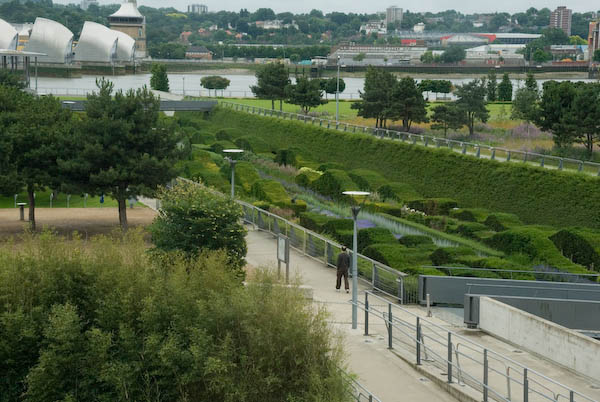
Clock House to Olympic Site – 2005

Clock House to Olympic Site: Thursday October 27 2005 was a fine late autumn day and I decided to go for a bike ride, putting my folding bike on a couple of trains to my start point, Clock House station. This is in south east London, halfway between Penge and Beckenham and just inside the London Borough of Bromley.

Big Party, Clockhouse

The Chaffinch Brook runs close by and joins with the River Beck to form the River Pool (aka Pool River) a mile or so north and a footpath going north from there is now part of a national cycle route. Parts of the Pool River which were once culverted have now been restored to an open stream, which will help prevent flooding downstream. The river’s main claim to fame is that four years after my ride then London Mayor Boris Johnson fell into it on an official visit to encourage volunteers who were cleaning the river up.

Big Pipes, New Beckenham

The Pool River is a tributary of the River Ravensborne and I had planned to continue along this as closely as I could to Deptford Creek where it joins the Thames. But I ran out of time, so took the Docklands Light Railway at Lewisham rather than Greenwich to cross the river to Canning Town.

Lower Sydenham

My ride then continued with a loop around Bow Creek and over the Lower Lea Crossing back through Canning Town and on to Stratford Marsh where work was then just beginning to turn this whole area into the Olympic site.

Bell Green

It wasn’t a long ride – probably around ten miles in all, perhaps a little longer with all the small diversions I took. All the pictures here were taken on this ride and there are more on My London Diary, along with the account below that I wrote back in 2005. As usual I’ve made a few small corrections.


Pool River and Ravensbourne (left) join

The Brompton folding bike is really an ideal form of transport for London, an essential tool for the urban photographer. It’s short wheelbase is great in slow-moving crowded traffic, and it can be folded in 15s to travel by tube, rail, taxi or even bus. [I’ve never put mine in a taxi.] The only problem is that they are highly prized by cycle thieves. [They are fairly expensive and slip easily into a car boot.]

Bridges over Bow Creek, River Lea, Canning Town, London

The weather forecast was for a fine summery day, so I took the opportunity to check up on a few things and fill in some little gaps, where I’d not quite managed to photograph things before. First I wanted to go along the footpath at Bell Green, next to Sainsbury’s, so I decided to make a slightly longer trip of it by starting at Clock House Station. There is a good, almost traffic-free route north from there along the Pool River, then the River Ravensbourne, at times surprisingly rural.

DLR viaduct over Bow Creek

Taking photographs slows you down, as does stopping to sit in the sun and eat sandwiches, so at Lewisham I decided to get on the DLR with the bike to travel to Canning Town.

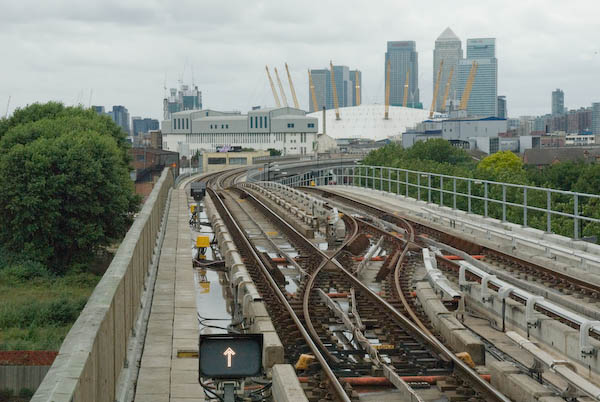
DLR extension, Millenium Dome and Canary Wharf from Silvertown Way.

Perhaps one day the riverside walkway by Bow Creek from the station will open [it did, but only to go across a new bridge to City Island – the route south still comes to a dead end], but it seems unlikely to be in our lifetime. I went round the creek, over the Lower Lea Crossing and on to Silvertown Way to see how the new stretch of DLR was progressing. [It opened north of the river at the end of 2005.]

Car sales, Stratford Marsh

Then I cycled up to Stratford to take a look at Stratford Marsh again before work starts in earnest to demolish the existing businesses and create the Olympic waste. It was getting later and noticeably darker by the time I was there, although the day felt like summer, it gets dark rather earlier at the end of October.

The Greenway goes under the railway line on Stratford Marsh.

What really makes no sense at all is to put our clocks back to make it even darker still, as we were going to do in a couple of days time. If I were in charge, we’d move to the same time as France and the rest of our neighbours across the channel. I don’t like dark mornings, but it would be much better than having it get dark in the middle of the afternoon in winter. Orcadians or even Scots would be welcome to have their own time zone if they really must, but its about time they stopped imposing it on the rest of us. The sun set around 5.30, and next week that means it will be 4.30pm.

Twilight for Stratford Marsh

More pictures start here on My London Diary.


FlickrFacebookMy London DiaryHull PhotosLea ValleyParis
London’s Industrial HeritageLondon Photos

All photographs on this page are copyright © Peter Marshall.
Contact me to buy prints or licence to reproduce.

March Against Cuts & Bloomsbury Festival – 2010

March Against Cuts & Bloomsbury Festival: On Saturday 23rd October 2010 striking London firefighters led a march with other trade unionists against government cuts on spending on public services announced a few days earlier. After photographing the march I walked around Bloomsbury where Bloomsbury Festival was taking place over a week or so.


Trade Union March Against Cuts

Euston Rd to Bedford Square

March Against Cuts & Bloomsbury Festival - 2010

London’s firefighters were taking part in an 8-hour strike from 10am, called after the London Fire Brigade had in August begun firing 5,600 of them to bully them into agreeing a new contract. 79% of firefighters had voted in a ballot over strike action with 79% supporting the strike.

March Against Cuts & Bloomsbury Festival - 2010

The Fire Brigade Union had been negotiating with the LFB over a new contract, but say that the Conservative chair of the London Fire and Emergency Planning Authority had pushed the LFB to adopt a more aggressive stance, firing the workers and then offering re-employment on a less favourable contract imposed without negotiation. Birmingham City Council were also attempting this for their 26,000 workers and Sheffield had also sent similar letters to their employees.

March Against Cuts & Bloomsbury Festival - 2010

Many of us were astonished that any reputable employer could even consider this ‘fire and rehire’ approach, and doubted its legality. Surely every worker treated in this way must have a cast-iron case for unfair dismissal – or certainly should have. Though as usual the main thrust of our laws is to protect the interests of the rich and powerful against the rest of us, so perhaps they could get away with it despite the clear injustice.

March Against Cuts & Bloomsbury Festival - 2010
Bob Crow, RMT

If they could do it for firefighters, councils and other employers could do it for other workers and many other trade unionists had come out in support of the FBU, with the London march being called by the RMT, FBU, NUT, PCS and the National Shop Stewards Network.

March Against Cuts & Bloomsbury Festival - 2010
Matt Wrack, FBU

The cuts announced by Chancellor George Osborne in the previous Wednesday’s Comprehensive Spending Review had been anticipated but still shocked. We – the country’s workers – were being made to pay for the greed of the wealthy bankers who had caused the crisis but were being given handouts. The London march and rally was just one of others across the country including in Cardiff, Manchester, Bristol, Lincoln and Wigan.

At the rally in a corner of Bedford Square there were calls for a much more positive approach from the TUC, and a demand that they bring forword the national demonstration which was planned for Spring 2011 but the TUC kept to its planned date of March 26th.

Some of those taking part in the march and rally went on to a TUC organised rally against the cuts in the nearby TUC HQ Congress House, organised by the South-East Region TUC, but I left to take a walk around the Bloomsbury Festival.

More pictures at Trade Union March Against Cuts.


Bloomsbury Festival

Modern cloth strips at the Foundling Museum, where ‘Threads of Feeling’ was showing.

The annual Bloomsbury Festival began in 2006, but this was the first year I had noticed it, and although there had been some events earlier in the week that sounded interesting I hadn’t had time to attend them.

Paper birds in Russell Square where the main stage and stalls were

On Saturday there were free events taking place across the area, in museums and galleries, parks and gardens, as well as various dance and film performances, exhibitions, walks and tours and workshops. I walked through the area, visiting most of the squares and parks in which there were artworks as well as some of the museums and exhibitions.

Malet St gardens

But much of what interested me on my walk were things I saw or found in the area itself, with some of the ‘found art‘ rather more interesting than the actual festival pieces. I was pleased to be able to go into the the charming private garden in Malet St – and the trees, leaves and the grass roller excited me considerably more than the work of photographic art strapped to a couple of trees.

It was good to go into the Foundling Museum for my first visit there, both to see its permanent exhibition with its incredibly moving special display the pieces of 18th century cloth, textile tokens left by mothers with the babies taken to the Foundling Hospital in the hope they could later be identified and reclaimed, along with a show Threads of Feeling, based on this.

More pictures at Bloomsbury Festival.


FlickrFacebookMy London DiaryHull PhotosLea ValleyParis
London’s Industrial HeritageLondon Photos

All photographs on this page are copyright © Peter Marshall.
Contact me to buy prints or licence to reproduce.


Fonthill & Tollington – 1990

Fonthill & Tollington continues my walk on Sunday February 11th 1990 which began at Kings Cross with the post Kings Cross and Pentonville 1990. The previous post was Caledonian Road, Barnsbury & Lower Holloway – 1990.

Tower House, 149, Fonthill Rd, Finsbury Park, Islington, 1990, 90-2c-32

The Tower House it at the south end of a late Victorian terrace at 141-9 Fonthill Road close to the junction with Seven Sisters Road. This was the factory and showroom for Witton, Witton & Co. In an advertisement in Musical Opinion & Music Trade Review they describe it as ‘BRITAIN’S FINEST FACTORY’ producing ‘”THE IDEAL BRITISH PIANO” Specially made for Variable Climates’. According to the Pianoforte-makers in England web site the company was formed in 1874, although earlier Wittons had made pianos from 1838. They held two patents related to pianos. The name continued in use after production went abroad in the 1930s. Their grand pianos are said to be not well made.

By 1990 the tower had lost its top floor topped by a cupola. Like much of Fonthill Road the building was mainly in use by clothing manufacturers and wholesalers in 1990.

Goodwin St, Finsbury Park, Islington, 1990, 90-2c-35

The 3 storey house in this picture is still present on Goodwin Street, a turning off Fonthill Road which now leads through City North House to Finsbury Park Station. This is 11 Goodwin St, owned by the Trustees of Peace News and the home of CND, the Campaign Against Arms Trade as the hanging sign above the double door indicates, along with various other groups. I think the right hand door was number 13, though the numbering around here seems rather random.

Shops, Fonthill Rd, Finsbury Park, Islington, 1990, 90-2c-36

The rather strangely staggered roofline is still there at 138 Fonthill Road and all the shops are still in the clothing trade, though I think all the names are changed. Photographer Don McCullin grew up in the area in the 1940s and described the area as “a battlefield” and later he was to photograph on many real ones, including in Cyprus.

It was the Cyprus emergency with the UK fighting EOKA in the the late fifties and the later war between Greeks and Turks that led to many Cypriots to come to live in North London – and a number of them set up clothing factories and wholesale businesses here – and others from Turkey, the Caribbean and Africa came too. At first shops here were simply wholesale, but then many began to open on Saturdays for retail sales, and the street was crowded with people – mainly women – buying real bargains.

Fonthill Metal Co, Fonthill Rd, Finsbury Park, Islington, 1990, 90-2c-21

I don’t think any trace remains of the Fonthill Metal Co or the garage next door on Fonthill Road which were almost at the end of Fonthill Road close to Tollington Park. There used to be many similar small scrap metal dealers who would pay cash on the spot for non-ferrous metals – Copper, Brass, Lead, Zinc and Ali – aluminium.

BRAIZERY here means copper pipes and other material which has been soldered and so contains small amounts of other metals, particularly tin and lead. If you have a decent load of this you can probably get around £6 a kilo for it – but no longer on Fonthill Road.

Velvet Touch, Fonthill Rd, Finsbury Park, Islington, 1990, 90-2c-22

Later retail clothes shops elsewhere in the country found they could buy clothing cheaper abroad than garments made in the UK, and manufacturing here started to fall away. Slowly more and more wholesalers welcomed retail customers and many new wholly retail shops opened.

More recently the retail trade has fallen away too as the area becomes increasingly gentrified. Most of the clothes still on sale are now made abroad, particularly in Turkey.

Velvet Touch at 1 Fonthill Road was at the far end to the other clothing manufacturers, wholesalers and importers and although you can still read that line of their shopfront, (rather faded now) their name and the large sign on the side wall are long gone and I think the building is now residential. The very small window on the first floor is still bricked up.

St Mellitus, RC, Church, Tollington Park, Finsbury Park, Islington,, 1990, 90-2c-23

Built as the New Court Chapel in 1871 by Congregationalists from New Court, Carey St, Lincoln’s Inn Field after their chapel had been demolished to build the Royal Courts of Justice.

The Neo-classical church, designed by C G Searle seated 1,340 and in the early years was often full in the early years, but after the war congregations dropped away. It was sold to the Catholic Church in 1959, becoming St Mellitus RC Church. St Mellitus was the first Bishop of London in 604CE and later in 619CE became Archbishop of Canterbury.

House, Tollington Park, Finsbury Park, Islington, 1990, 90-2c-24

Tollington Park was one of the first streets in this northern part of Islington in Finsbury Park (estate agents like to call it Stroud Green, but that seems rather a stretch too far) to be laid out and its grand semi-detached villas date from the 1830’s and 40’s.

Before that cows had grazed its fields to supply milk to London across north Islington which had what was claimed to be the largest dairy farm in the country, run by Welsh dairy farmer Richard Laycock.

By WW2 the area had deteriorated and become a poor working-class area. It was heavily bombed in WW2 and much still remained in a mess twenty years later. By the 1970s it was home to many migrants from across the world, including “Welsh, Irish, Jamaican, and others from all over the world.”

House, Tollington Park, Finsbury Park, Islington, 1990, 90-2c-26

Many of the damaged properties and some others were demolished in 1970 to form a park, Wray Crescent, and gentrification of the area set in. The Friends of Wray Crescent history page contains a number of pictures of Tollington in the 1960s and 1970s, taken by Leslie William Blake when “local campaigners and the Tollington Park Action Group began to fight to preserve some of the buildings, including the creation of the local conservation zone.”

Houses like those in my picture are now all or almost all a number of flats. Only 4 houses in Tollington Park are Grade II listed (along with the two churches) but many are locally listed including these two at 104 and 106, thought to have been built in 1840.

More from this walk to follow.


FlickrFacebookMy London DiaryHull PhotosLea ValleyParis
London’s Industrial HeritageLondon Photos

All photographs on this page are copyright © Peter Marshall.
Contact me to buy prints or licence to reproduce.