Abney Park & South Tottenham

Abney Park & South Tottenham: I ended my walk on Sunday 1st October 1989 (which had begun at Finsbury Park) in Abney Park Cemetery, one of London’s ‘Magnificent Seven’ garden cemeteries laid out after an 1832 Act of Parliament encouraged the establishment of private cemeteries in the outer suburbs of London as graveyards in the inner city were dangerously overflowing.

Abney Park Cemetery was laid out on the grounds of Abney House and its neighbours and named after Sir Thomas Abney, Lord Mayor of London in 1700–1701, who had Abney House built for him in 1676 – it was demolished for the cemetery which opened in 1840.

Those involved with setting up the cemetery were members of the Congregational Church but it was set up on a wholly non-denominational basis. For the next 40 years was the burial place of choice for many leading non-conformists. Among those who had played a part in the landscaping of the area around Abney House long before it became a cemetery was the prolific Congregational hymn writer Isaac Watts, many of whose hymns are still well-known and loved, and there is a statue of him in the cemetery.

Unusually, as well as a cemetery it was also established as an arboretum and retains a magnificent collection of trees and a significant example of landscape design. From 1880 it was run strictly on commercial lines, but when the company went into administration in the 1970s the cemetery became hugely overgrown. In the 1980s it was taken over by Hackney council, but at first they did little to improve its condition other than establishing it as a nature reserve. More recently it has been considerably improved with the help of lottery funding.

Rev Henry Richard, (1812–1888), the Apostle of Peace, Abney Park Cemetery, Stoke Newington, Hackney, 1989 89-10c-42
Rev Henry Richard, (1812–1888), the Apostle of Peace, Abney Park Cemetery, Stoke Newington, Hackney, 1989

According to WikipediaHenry Richard (3 April 1812 – 20 August 1888) was a Congregational minister and Welsh Member of Parliament between 1868–1888. Richard was an advocate of peace and international arbitration, as secretary of the Peace Society for forty years (1848–1884). His other interests included anti-slavery work. “

The memorial over his grave was erected by public subscription in 1891, and his statue in the Square in Tregaron where he was born was unveiled in 1893.

Young Angel, Abney Park Cemetery, Stoke Newington, Hackney, 1989 89-10c-31

I can tell you nothing about George Clayton other than is recorded here, but I was attracted both by the young angel and surrounding flowers in this relatively recent example of a memorial, shortly before the cemetery fell out of use.

I didn’t spend long in the cemetery on this occasion, walking through it to get to Stoke Newington Station as by the I was in a hurry to get home. I took around a dozen pictures in my walk through the park but have so far only put two of these online. But I did return to it on my next walk a week later – and have been back quite a few times since.

My next walk began from Seven Sisters Station a week later, and I walked from the Victoria Line exit south down the High Road.

Motor Auctions, High Rd, South Tottenham, Haringey, 1989 89-10c-22

Sometimes I came across what seemed to me, at least in a photograph, a kind of visual conundrum and this was one of them. Probably standing where I was to take the picture I could have sorted out why what appears to be a view through a rather smeared tranparent sheet in some places shows what is behind it but elsewhere replaces it with a different view. Kind of seeing through a glass darkly. And what is this strange structure which holds this sheet. I can’t now tell you. But the empty can of Ginger Beer spiked on the fence is quite clear.

Posters, High Rd, South Tottenham, Haringey, 1989 89-10c-23

Turkey and Africa meet on the posters here. The Türkiye Devrimci Komünist Partisi – Revolutionary Communist Party of Turkey – is, according to Wikipedia, “a clandestine communist party in Turkey” and “Not to be confused with Revolutionary Communist Party (Turkey).Kahrolsun Fasist Diktatorluk! I think translates as ‘Down With Fascist Dictatorship’ and presumably means that of Turkey rather than Haringey Council.

Underneath is a poster for and event at Dougie’s Nightclub in the Lower Clapton Road, which would appear to feature sounds from Africa and Zimbabwe in particular. Dougie’s was in a function room for the White Hart pub, which later became the Clapton Cinematograph before becoming a night club, Dougie’s in 1983. Later it was the Palace Pavilion nightclub where stabbings and shootings made this road known as ‘Murder Mile’

And underneath these, other posters which little or almost nothing can be seen. It was a well-used post, just south of the railway bridge and then just to the side of a small shop or cafe, the former station ticket office, since demolished to provide a path to South Tottenham Station.

The Dutch House, High Rd, Crowland Rd, South Tottenham, Haringey, 1989 89-10c-24

The Dutch House public house at 148-156 High Road, Tottenham has recently been renamed The Station House and is now an Irish pub. This area was developed around 1880-1900 and this building dates from shortly after 1894. Locally listed it was not built as a pub, but possibly as a music hal. It it has some incredible Venetian and Moorish detailing as this picture shows. It is by far the most interesting architecture in the area and I think should be given proper listing.

The Dutch House, High Rd, Crowland Rd, South Tottenham, Haringey, 1989 89-10c-26
The Dutch House, High Rd, Crowland Rd, South Tottenham, Haringey, 1989

Originally this building was completed with a spire above that incredible corner tower which perhaps seems oddly truncated now. But of course I would have had to stand much further back to take the picture were it still there. As well as a pub, the building also housed clothing factories and fashion shops.

More from this walk in later posts.


FlickrFacebookMy London DiaryHull PhotosLea ValleyParis
London’s Industrial HeritageLondon Photos

All photographs on this page are copyright © Peter Marshall.
Contact me to buy prints or licence to reproduce.


Highbury to Stoke Newington Church Street – 1989

Highbury to Stoke Newington Church Street: Continuing my walk from Sunday 1st October 1989 which had begun at Finsbury Park and continued to the Nags Head before returning to Finsbury Park. The previous post ended on Blackstock Road.

House, Kelross Rd, Northolme Rd, Highbury, Islington, 1989 89-10b-46
House, Kelross Rd, Northolme Rd, Highbury, Islington, 1989

Blackstock Road continues south into Highbury as Highbury Park and I walked some way down this before turning east into Northolme Road. Highbury Park was developed in the 1870s but the houses in Northholme Road date from the 1890s. This and neighbouring roads were built on the Holm Estate and the LCC applied for permission to develop these roads in 1890.

North Holme is near Helmsley, North Riding of Yorkshire and although it has been described as a “township” is a small cluster of buildings, more a farm than even a village close to the River Dove. “The Revd Joseph Parker, DD (1830-1902) … lived in 1866 at a house in Highbury Park he called ‘North Holme‘. The sites of Northolme Road, Sotheby Road and Ardilaun Road were on part of the grounds of his house.” He was the “Minister of the City Temple, 1869-1901, author, preacher and twice
Chairman of the Congregational Union
“.

This house is at the eastern end of Northolme Road, where it meets Kelross Road and is a detached villa rather larger than the terraces along long the rest of the road.

Clissold Park, Stoke Newington, Hackney, 1989 89-10b-35

From here Kelross passage leads to Highbury New Park, a street with villas built from around 1850. But I pressed on across it into Collins Road, making my way towards Clissold Park and Stoke Newington Church St.

Clissold House was built as Paradise House for Quaker City merchant Jonathan Hoare, a noted philanthropist and anti-slavery campaigner and brother of banker Samuel Hoare Jr. The water here was a stretch of the New River which brought clean drinking water from Hertfordshire to London, but I think at some point the river here was culverted, although the bridge taking Stoke Newington Church St across it remained until the 1930s.

The park was first created as grounds for this GradeII listed house. Hoare got into financial difficulties and lost the house and grounds, which passed through several owners before being owned by Augustus Clissold. When he died in 1882 the estate was bought by the Ecclesiastical Commissioners who intended to make money from developing it as housing, but the Metropolitan Board of Works were persuaded in 1887 to buy it to be a public park.

By 1989 the house and park were in a poor condition and Clissold House was put on English Heritages ‘at risk’ register in 1991. Since then both park and house have been restored with the aid of lottery money.

Park Crescent, Spensley Walk, Stoke Newington Church St, Stoke Newington, Hackney, 1989 89-10b-23

Grade II listed Park Crescent at 207-223 Stoke Newington Church Street was built in 1855, but by the 1980s was in a very dilapidated state and became home to around 90 squatters alongside only a handful of legal tenants. The houses were then owned by Hackey council who planned to sell them to housing associations.

Park Crescent, Spensley Walk, Stoke Newington Church St, Stoke Newington, Hackney, 1989  89-10b-11
Park Crescent, Spensley Walk, Stoke Newington Church St, Stoke Newington, Hackney, 1989 89-10b-11

Three motorbikes parked outside one of the houses of Park Crescent. You can clearly see the poor state of the buildings which need Acrow props to support the porches, with the steps at right being roped off to block access to the unsafe building.

Park Crescent now looks very neat and tidy compared to this.

Shops, 185-189, Stoke Newington Church St, Stoke Newington, Hackney, 1989 89-10c-51

The building at 185 Stoke Newington Church St had been sold when I made this picture in October 1989, but The Modern Man, a hairdressers, was still alive in another shop on the street, shown in my next picture.

This row of buildings with ground-floor shops is still there and like the rest of the area has become rather better kept and is now that epitome of gentrification, an estate agents which has also expanded into 187.

Perhaps surprisingly the 5 Star Cleaners at 189 is still a dry cleaners, though under a different name.

The Modern Man, Stoke Newington Church St, Stoke Newington, Hackney, 1989 89-10c-52

I found The Modern Man still in business at 121 Stoke Newington Church St at the corner with Marton Road. It didn’t survive the gentrification of the area and the shop has passed through several hands as ‘frere jacques’, ‘search and rescue, ‘Ooh Lou Lou Cakery’ and ‘The Caffeine Fix’.

I don’t know how long Tanya’s Cafe-Diner Take away lasted but around 2009 it became Lydia Cafe Restaurant and retained the name Lydia until recently becoming ‘The Tiffin Tin.’.

My walk was almost at an end, but I’ll share are few more pictures in a later post.


FlickrFacebookMy London DiaryHull PhotosLea ValleyParis
London’s Industrial HeritageLondon Photos

All photographs on this page are copyright © Peter Marshall.
Contact me to buy prints or licence to reproduce.


Blackstock and Brownswood

Blackstock and Brownswood: Continuing my walk from Sunday 1st October 1989 which began at Finsbury Park and continued to the Nags Head before returning to Finsbury Park. The previous post to this ended on Blackstock Road.

Gillespie Neighbourhood Office, Blackstock Mews, Blackstock Rd, Finsbury Park, Islington, 1989 89-10b-63

The buildings at the right of this picture are those on the left of the final picture in my previous post. Here I wanted to contrast the deco style of the Gillespie Neighbourhood Office at 102 with that of the solid Victorian house next door and its more utilitarian infill at 98.

The border between Hackney and Islington runs here along the centre of Blackstock Road and this is on the Islington side, though I was standing in Hackney to take the picture. I was in Hackney’s Brownswood Conservation Area, but the more interesting side of the road here is not in a conservation area and this Art Deco office does not even appear on the local list.

House, Brownswood Rd, Wilberforce Rd, Finsbury Park, Hackney, 1989 89-10b-52

The development of this area was delayed by the setting up of the park in the area as in the early years of its planning the actual boundaries were not fixed. So much of the area was built up in the 1870s, giving it a unusually homogeneous architecture.

Brownswood Road runs though the area with two peculiar staggered junctions and this picture was made at one of these.

Frinton Metal Ltd, 145a, Brownswood Rd, Finsbury Park, Hackney, 1989 89-10b-53

I think the house number is from Blackstock Road – the scrap metal and Gold and Silver buyer was in the back yard of the house at the left, 145 Blackstock Road. Although there were no ‘TO-DAYS PRICES’ listed for Gold & Silver and the shop was closed on a Sunday, there is a light on inside and I think it was still in business.

Google Maps labels this section of Brownswood Road as Lydon Row and there is no sign that there ever was a business here.

Mountgrove Garage, 115, Finsbury Park Rd, Finsbury Park, Hackney, 1989 89-10b-56

I walked a little further on down Blackstock Road and then turned down Mountgrove Road. The house at right is on Mountgove Road and that on the left – along with the garage – in on Finsbury Park Road. Rather to my surprise Mountgrove Garage is still there, now offering ‘MOT Tyres Servicing Bodywork’ and claiming ‘ALL VEHICLES REPAIRED HERE’, though all of the notices in my picture have been replaced. I think it looks rather less impressive now.

Shops, 162-176, Blackstock Rd,  Finsbury Park, Islington, 1989 89-10b-41
Shops, 162-176, Blackstock Rd, Finsbury Park, Islington, 1989 89-10b-41

Back on Blackstock Road I photographed this nicely detailed row with ground floor shops and facing more of the same on the opposite side of the street. I chose this one for the sign which I think at the top read OFFICIAL BOOKING OFFICE with MOTOR COACHES between the first and second floors and lower down ALL ROAD ROUTES and RAIL SEA AIR.

That sign has I think been restored since 1989 and is clearer now, but the uppermost word, already difficult to read in my picture has disappeared. Rather than a booking office the shop is now a book shop.

Head, 198-200, Blackstock Rd,  Finsbury Park, Islington, 1989 89-10b-42
Head, 198-200, Blackstock Rd, Finsbury Park, Islington, 1989 89-10b-42

A little further down Blackstock road was this head above BESTOCK FURNISHING, a secondhand furnishing shop, the kind of place we bought chairs and tables when we were poor, and on the shop front of RITEMARKS LTD FOOTWEAR MANUFACTURERS a variety of symbols – a sunflower and two leaping fish. I think the window between these is a reflection of the building in my next picture.

217, Blackstock Rd,  Finsbury Park, Islington, 1989 89-10b-43
217, Blackstock Rd, Finsbury Park, Islington, 1989 89-10b-43

Built as Highbury Fire Station by the LCC in 1906 it was one of many closed in 1920 after the replacement of horse-drawn engines by motorised fire engines meant that stations could serve a wider area.

As a young man around 1920 my father worked for a short time at Dennis Brothers Limited in Guildford. He was (among other trades) a carpenter, having grown up working with his father making horse-drawn carts, and they were then still making wooden fire engines, as well as ‘charabancs’ – open motor buses. Cutting the curved doors for these was a tricky three-dimensional job and he did it freehand.

Since I photographed it this Edwardian Arts & Crafts locally listed building has been converted into the Little Angel Day Nursery with flats above.

More from this walk to follow.


FlickrFacebookMy London DiaryHull PhotosLea ValleyParis
London’s Industrial HeritageLondon Photos

All photographs on this page are copyright © Peter Marshall.
Contact me to buy prints or licence to reproduce.


Seven Sisters Road – 1989

Seven Sisters Road: on Sunday 1st October 1989 I took the Victoria Line tube to Finsbury Park (a couple of pictures here) and walked through the park to its most easterly corner, the junction between Green Lanes and Seven Sisters Road at Manor House.

Finsbury Park, The Manor House, Manor House, Haringey, Hackney, 1989 89-10a-53

A view from beside the wall to Finsbury Park by the gate. This area was know as Woodberry Down before the Manor House Tavern was first built here on 1830-4 at the crossroads with Green Lanes, a turnpike or toll road, after a 1829 Act of Parliament had allowed the building of Seven Sisters Road.
Local builder Thomas Widdows had owned and lived in a cottage on the site and saw a business opportunity, though it is unclear why it was given the name Manor House – probably because it sounded posh.

It opened as a ‘public house and tea-gardens’ in 1834 and its first landlord advertised it, writing “The Grounds adjoining are admirably calculated for Cricket, Trap-ball, or any other amusement requiring space. There is likewise a large Garden and Bowling green, good Stabling, lock-up Coach-houses, &c. Dinners for Public and Private Parties.

The original pub was demolished in 1930 when the road was widened and the Piccadilly line Manor House station built here, and replaced by this attractive Flemish style building with just a hint of Art Deco. The pub and tube station led to the area becoming known as Manor House, with the name Woodberry Down being revived for the large post-war housing estate built a little to the east by the LCC from 1948-62.

You can learn more about its interesting history and varying clientele – including its time as a major Blues venue in the 1960s – in the Wikipedia article cited. The pub closed around 2000 and its ground floor became a supermarket in 2004.

Shops, Seven Sisters Rd, Finsbury Park, Islington, 1989 89-10a-42

Finsbury Park was a rather run-down area in 1989 and some friends were worried about my safety as I walked around the area carrying a bag full of expensive camera equipment, but I had no problems. People were friendly though sometimes clearly thought I was mad to be taking photographs of their streets and shops.

At left is KYPRIAKON KAFENEION, shown more clearly in my next picture. Between the shops are decorated pillars and above them rather odd decorated stone balls. I think the shops were probably added a few years later to the mid-Victorian houses behind.

Cypriot Social Club, Seven Sisters Rd, Finsbury Park, Islington, 1989 89-10a-43

You can still see this row of shops on Seven Sisters Road, in the parade between Yonge Park and Medina Road*, and I think this Cypriot cafe is now a dentists. In 1989 there were many Cypriot businesses in the area, but the area is now more diverse and has a large Muslim community. None of the businesses in my previous picture are still present.

* I have now decided that these shops are those at 218-230 Seven Sisters Road which can clearly be seen in a photograph I took later on this walk. They were very similar to those further down the street but have been more altered since 1989, and some demolished.

Sisters Gowns, Coleridge Rd, Seven Sisters Rd, Finsbury Park, Islington, 1989 89-10a-44

Sisters Gowns, a few yards down Coleridge Road was also clearly a Cypriot business, and one of many clothing manufacturers in the area, which has now become one of London’s most vibrant fashion areas, particularly around nearby Fonthill Road.

This doorway could still be seen iin a derelict building n 2008, but the whole corner site was demolished soon after, although the site was still empty in 2022.

Shop Interior, Seven Sisters Rd, Finsbury Park, Islington, 1989 89-10a-31

I think this busts and bodies were for wale along with other pieces of equipment for use in shop displays, but it looked to me like some kind of kinky torture chamber. Though shopping for clothes is often a torture, particularly when accompanying others who are looking for them. I’m not sure what the football is doing here.

Shops, Seven Sisters Rd, Finsbury Park, Islington, 1989 89-10a-32

An extremely motley assortment of buildings from different periods, including BANGS, established in 1907, but I think the frontage at least is from the 1930s.

Rather to my surprise, these buildings are still there, though the shops have changed and below BANGS rather than JANE CAST LTD is now a Tesco. Even the building at the right of the row which appeared in my photograph to have no visible support is still there as well as the pub surrounded by scaffolding have survived. The Eaglet, built in 1869, was apparently badly damaged by a Zeppelin in 1917 but recovered and is still open.

North London Drapery Store, Axminster Rd, Seven Sisters Rd, Holloway, Islington, 1989 89-10a-35
North London Drapery Store, Axminster Rd, Seven Sisters Rd, Holloway, Islington, 1989

Built in 1938 as North London Drapery Store this Art Deco store was damaged in the war. In 1989 it was used by a variety of businesses including London International College. It has recently been converted to provide 118 expensive flats, with shops on the ground floor.

Nags Head Market, Enkel St, Seven Sisters Rd, Holloway, Islington, 1989 89-10a-36

According to ‘Streets With A Story‘, “Robert Enkel from 1830-49 owned property and
occupied the nursery until 1834 when Cornelius Crastin and his family took over and continued as nurserymen until at least 1890. The street name disappears by 1975.
” Enkel’s family came from Holland and his name was given to the street which dated from around 1875-6. As you can see the street name was actually still there in 1989.

There is still an Enkel Arms pub a few yards away on Seven Sisters Roadm but Enkel Street disappeared with the development of the Nags Head Shopping Centre in 1992. And there is a Nags Head Market indoors at 22 Seven Sisters Road, apparently since 1975.

More to come from Seven Sisters Road.


FlickrFacebookMy London DiaryHull PhotosLea ValleyParis
London’s Industrial HeritageLondon Photos

All photographs on this page are copyright © Peter Marshall.
Contact me to buy prints or licence to reproduce.


Garden Bridge, Housing, Domestic Violence, Migrants & Police Killings

Garden Bridge, Housing, Domestic Violence, Migrants & Police Killings; Saturday 9th July 2016 began for me in Waterloo, where right wing Labour party members were attending a conference. Then I travelled to Hackney for a Sisters Uncut protest over domestic violence and housing, back to Downing Street for a rally against the scapegoating of immigrants and went briefly to a Brexit debate in Green Park and then south of the river again to a protest against police murders in the UK and US.


Garden Bridge protest at ‘Progress’ conference – Coin St

Garden Bridge, Housing, Domestic Violence, Migrants & Police Killings

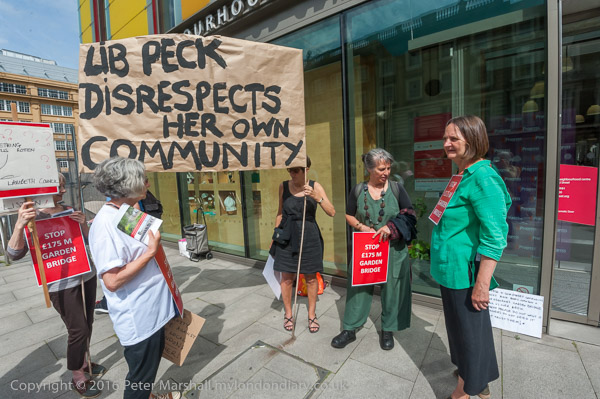
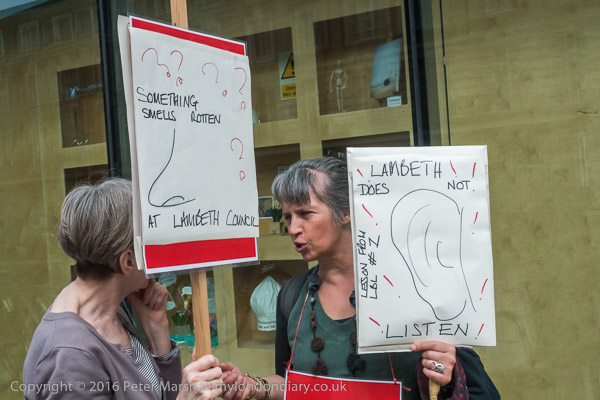
Lambeth Council were supporting the ‘Garden Bridge‘, a private green space to bridge the River Thames close to Waterloo Bridge, an expensive vanity project with a costing over £200 million with little public gain.

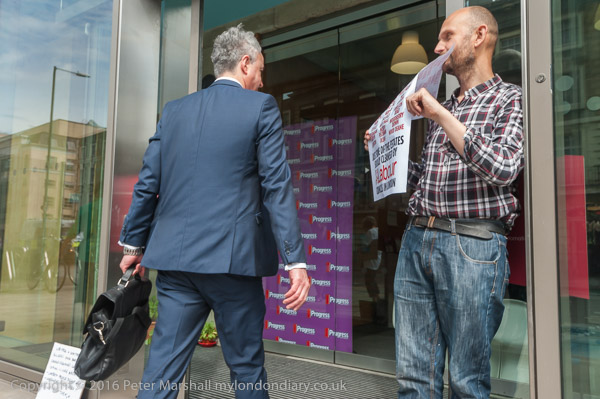
Lambeth residents came to protest as Lambeth councillors and council leader Liz Peck were attending the Labour Party ‘Progress’ movement ‘Governing for Britain’ conference.

Garden Bridge, Housing, Domestic Violence, Migrants & Police Killings

The Garden Bridge project was finally abandoned in August 2017, by which time it had cost £53m, including £43m of public money.

Garden Bridge ‘Progress’ protest


Housing Protest at ‘Progress’ conference – Coin St

Garden Bridge, Housing, Domestic Violence, Migrants & Police Killings

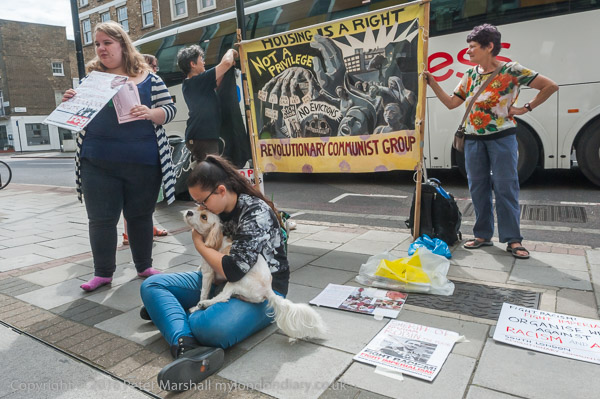
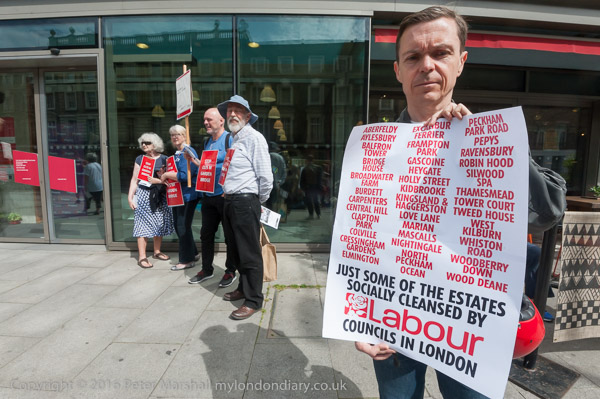
Also protesting outside the Progress conference were housing protesters against the demolition of council estates and their replacement by luxury flats under ‘regeneration’ schemes by London Labour councils including Southwark, Newham and Lambeth.

Garden Bridge, Housing, Domestic Violence, Migrants & Police Killings

The protesters were from the Revolutionary Communist Group, Focus E15 ‘Homes for All’ campaign and Architects for Social Housing who had been involved in various campaigns to stop the demolition of social housing in these boroughs.

They say that New Labour policies, now accelerated by the Tory Housing and Planning Act, makes London too expensive for ordinary workers leading to social cleansing, while making excessive profits for developers, including housing associations and estate agents Savills.

Housing Protest at ‘Progress’ conference


East End Sisters Uncut on Domestic Violence – Hackney Town Hall

Sisters Uncut came to Hackney Town Hall to demand the council abolish all plans to demolish council homes, refuse to implement the Housing Act and invest money into council housing and refuges for victims of domestic violence.

They quoted a Women’s Aid report for 2013-5 which found that over 60% of applications to women’s refuges in Hackney are refused as no room is available.

East End Sisters Uncut-Domestic Violence


Europe, Free Movement and Migrants – Downing St

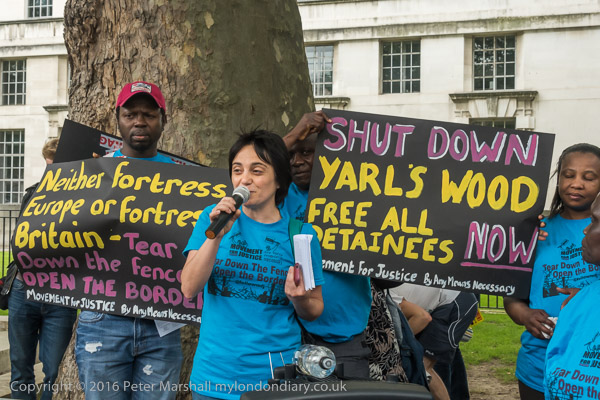
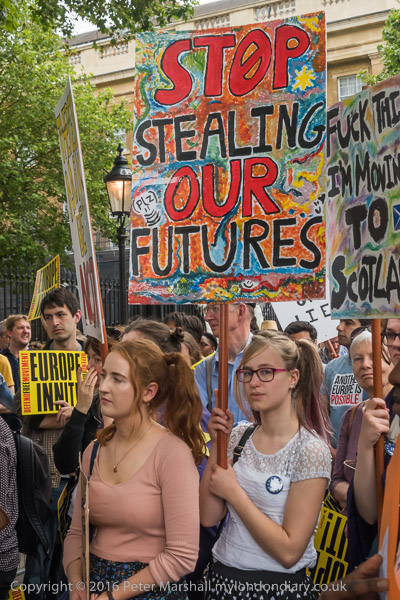
The Brexit vote had been followed by a rise in the scapegoating of immigrants and Islamophobia, and ‘Another Europe Is Possible’ organised a rally at Downing Street to keep Britain open to migrants, and for policies and media which recognise the positive contribution that migration makes to the UK.

Speakers came from a wide range of groups including Movement for Justice, Left Unity, Friends of the Earth, Newham Monitoring Project, Stand Up To Racism and Syrian activists.

Many from the rally were going to the Brexit picnic and discussion in Green Park afterwards, and I did too.

Europe, Free Movement and Migrants


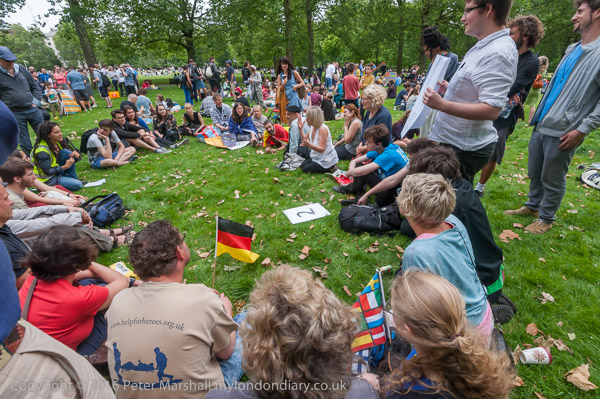
Green Park Brexit Picnic

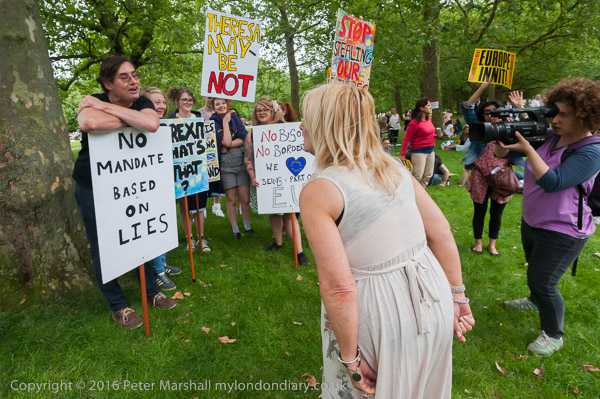
Most of those who came to the picnic felt cheated by a vote that was based on lies and false promises, but they came wanting to find ways to make it into something positive for the country.

There were also some who had come to counter the protest with their own picnic for democracy organised by Spiked magazine, and when the people from the Downing Street rally arrived with their placards some of them came over to pick an argument.

Things got a little heated when a woman from the ‘Spiked’ group accused those holding the placards of being unwashed, and there was some vigorous speaking in response. But people from both sides stepped in to cool things down.

Green Park Brexit Picnic


Brixton stands with Black victims

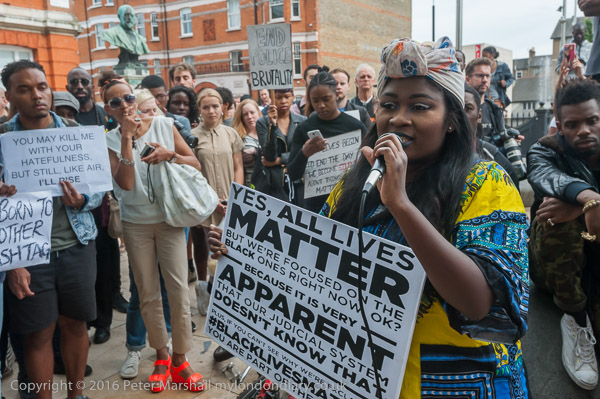
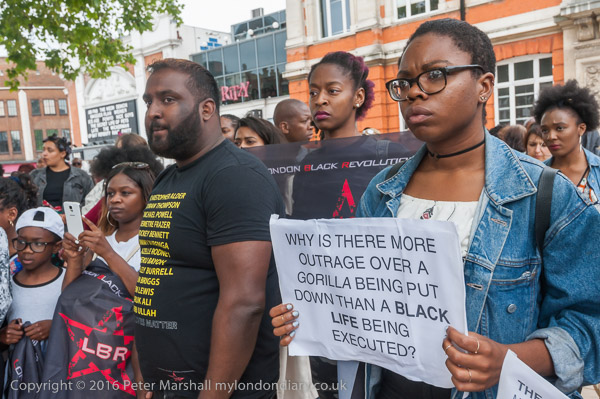
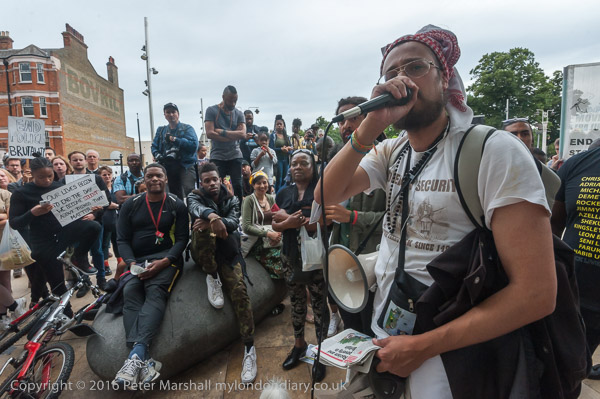
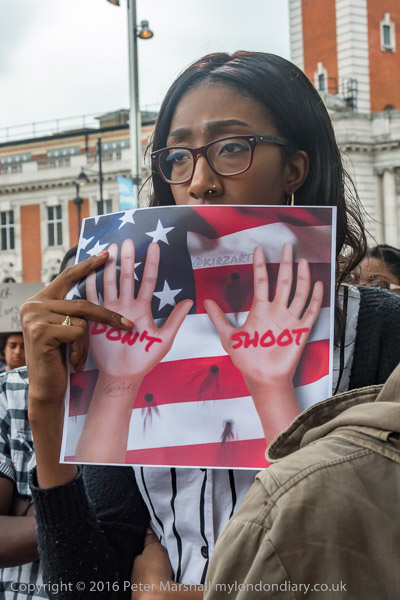
Local black organisers in Brixton called a rally and march in memory of Alton Sterling and Philando Castile and to show solidarity with those murdered by police brutality, both in the US and here in the UK.

Alton Sterling was murdered by police officers on July 5, 2016, in Baton Rouge, Louisiana, shot at close range after police had pinned him to the ground where he was selling CDs outside a grocery store. In May 2017 the US Justice department announced there was insufficient evidence to support federal criminal charges against the officers concerned – despite the many videos of the incident and other sources.

Philando Castile was fatally shot at close range after has car was stopped by police in he Minneapolis–Saint Paul metropolitan area. There was video of the incident and the officer was charged with second-degree manslaughter and two counts of dangerous discharge of a firearm. A jury acquitted him of all charges in June 2017.

There were many speeches both about these and other US cases and those in the UK, where Sean Rigg, Wayne Douglas and Ricky Bishop died after being held in nearby Brixton Police Station. One of the organisers spoke wearing a t-shirt listing just a few of those who have been killed by police in the UK. An annual protest is held every year in Whitehall against the many custody deaths in the UK, and in 2015 while this was taking place police took advantage of this to strip the tree in front of the police station of its deaths in custody memorials

Some time after I left the protesters marched around Brixton, bringing traffic to a halt for several hours.

Brixton stands with Black victims


FlickrFacebookMy London DiaryHull PhotosLea ValleyParis
London’s Industrial HeritageLondon Photos

All photographs on this page are copyright © Peter Marshall.
Contact me to buy prints or licence to reproduce.


Decent Housing & Saving the NHS – 2014

Decent Housing & Saving the NHS: Ten years ago today there were protests over two of the major issues which still face our incoming government today, but which I have no faith in them facing or improving.


Focus E15 March for Decent Housing – East Ham

Decent Housing & Saving the NHS

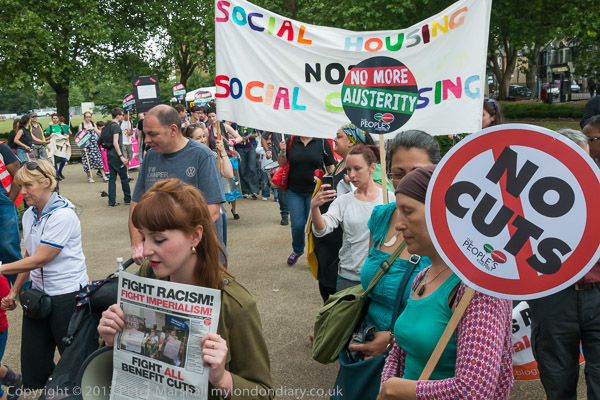
The housing crisis largely stems from successive governments, largely starting with Thatcher prioritising private ownership above all other ways of providing homes for people. Thatcher gave away publicly owned social housing to tenants at knock-down prices and refused to allow councils to try to replace what had been lost.

Decent Housing & Saving the NHS

Government housing policy since have been obsessed with the idea of the “housing ladder“; housing isn’t – or shouldn’t be – about ladders to increase personal wealth but about homes, and the ladder is very definitely that in “Pull up the ladder, Jack! We’re all right” and sod those left at the bottom below.

Decent Housing & Saving the NHS

Private renting has also moved from being a way in which owners of properties derived and income from properties they owned, to a scheme where more and more tenants are paying high rents to buy properties for their landlords. It’s a crazy system and one which should be stopped.

Decent Housing & Saving the NHS

We have also seen a huge growth in properties which are largely built to be bought as investments, particularly by overseas investors, often being left unoccupied for all or most of the time. Clearly this needs to be made economically nonviable, not only because of the effects it has on the shortage of homes, but also because of the way it is seriously distorting the development of our cities.

Second (and multiple) home ownership is also an increasing problem, particularly in the more desirable rural areas of the country and we need to find ways to reduce the impact of this, perhaps through taxation to provide a fund to build social housing in these areas.

But the basic solution to the country’s housing problems is simple. Build more social housing. Any government which comes in without this as the main thurst of their housing policy will fail to improve the housing crisis.

As I wrote ten years ago “We need a government – national and local – determined to act for the benefit of ordinary people, making a real attempt to build much more social housing, removing the huge subsidies currently given to private landlords through housing benefit, legislating to provide fair contracts for private tenants and give them decent security – and criminalising unfair evictions.” We haven’t got one.

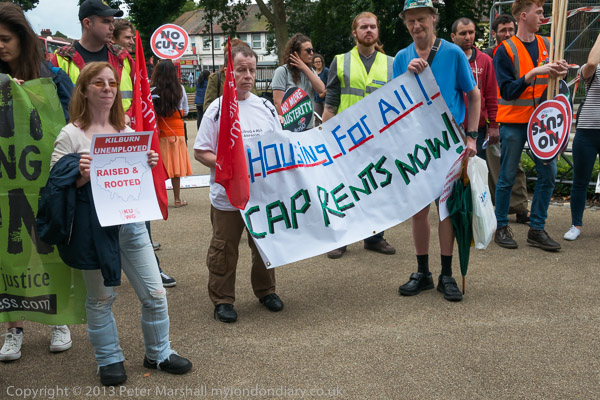
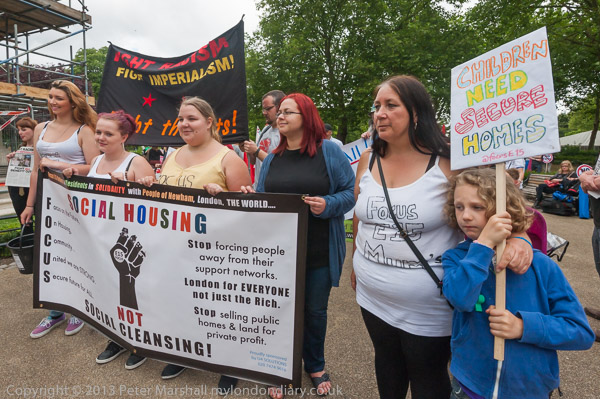
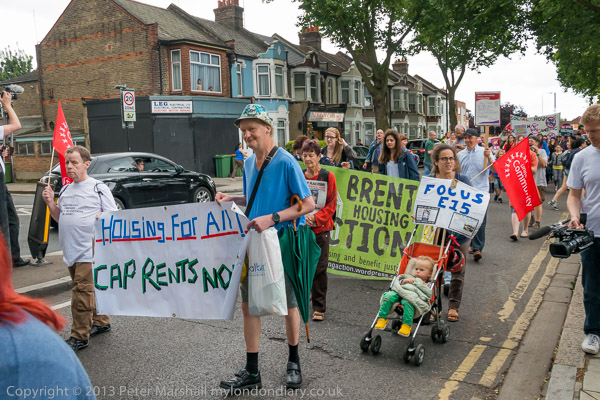
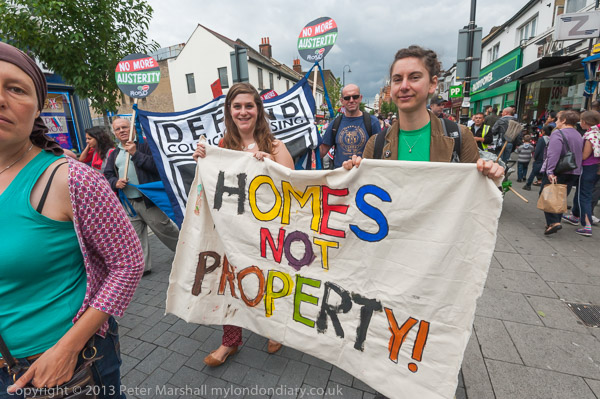
You can read more about the march in East Ham organised by Focus E15 Mums to demand secure housing, free from the threats of eviction, soaring private rents, rogue landlords, letting agents illegally discriminating, insecure tenancies and unfair bedroom tax and benefit cap on My London Diary.

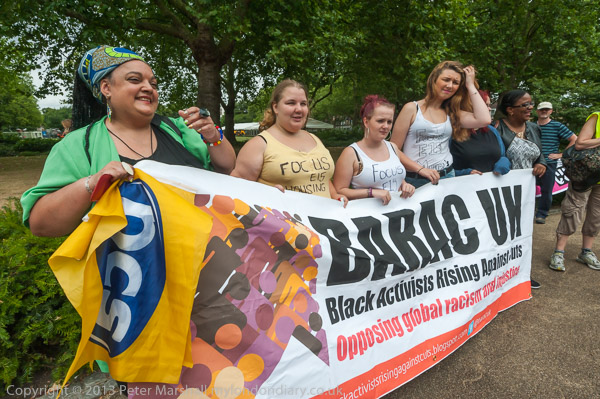
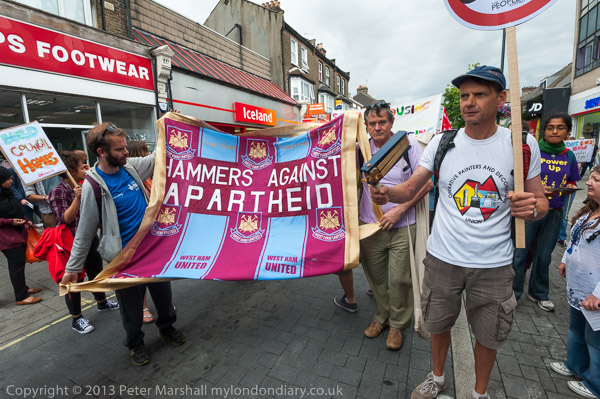
The march was supported by housing protest groups from Hackney, Brent and from South London and organisations including BARAC and TUSC. I was surprised to see the popular support it received on the streets with even some motorists stopping their cars to put money in the collection buckets.

More at Focus E15 March for Decent Housing.


Save our Surgeries on NHS 66th Birthday – Whitechapel

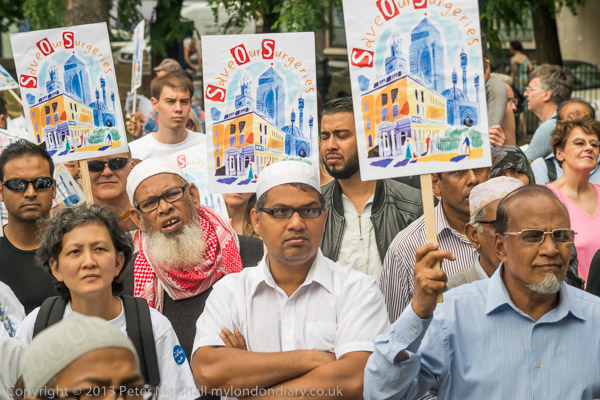
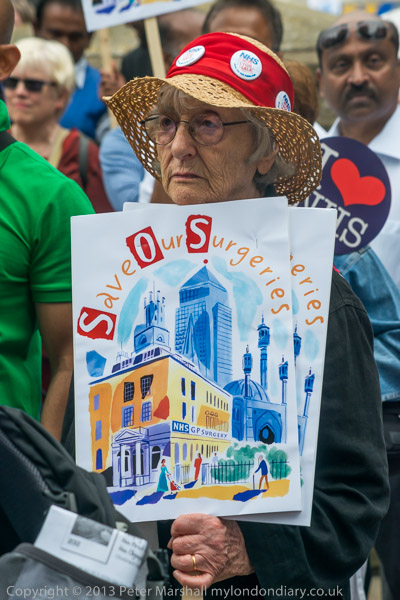
The National Health Service began on 5th July 1948 and on its 66th anniversary the Save our Surgeries campaign against health cuts in Tower Hamlets marched to Hackney in a show of opposition to health cuts, surgery closures and NHS privatisation.

The setting up of the NHS was opposed by the Conservatives and they and the doctors and dentists associations forced many compromises which led to it being a less than comprehensive health service, though still a great national achievement and one which for we are justly proud of.

Many doctors made – and some still make – large incomes from private practice and fought to keep these rather than back a universal system wholeheartedly. But in more recent years a huge private medical system has grown up alongside the NHS and more and more people are covered through work schemes providing private medical cover.

This private system has grown parasitically on the state medical system and all governments over the past thirty or more years have found ways to syphon off money to it, by allowing it to tender for various more straightforward aspects of NHS services.

Successive governments have also created huge administrative burdens on the NHS, setting up new levels of administrators which oversee and to some extent override clinical decisions. But financially the most disastrous impact on the NHS comes from the various PFI agreements, largely made under New Labour, which enabled the building of new hospitals without the costs appearing in the government’s debts, but tied the trusts running the hospitals into huge debt repayments and the kind of service contracts that make replacing a light bulb cost £1200.

General practice was set up in 1948 under doctor-owned surgeries but increasingly these are now owned by healthcare companies after New Labour in 2007 allowed larger companies to buy them up. Operose Health, part of US healthcare giant Centene Corporation in 2022 was running 70 practices and a BBC Panorama report showed they were only employing half as many doctors as average practices, while employing six times as many physician associates (who have only 2 years of medical training rather than the 10 for GPs) who were being inadequately supervised.

Unfortunately Labour policy appears to be to increase the reliance – and transfer of funds to the private sector rather than reduce it. You can read more about their position in the 2023 Tribune article Labour’s Love Affair with Private Healthcare by Tom Blackburn, which aslo sets out clearly the financial links of Wes Streeting to private healthcare. And of course he is not the only Labour MP with a financial interest. Labour might sort out a few of the problems but the creeping privatisation seems sure to accelerate.

The protest in East London was over changes in the funding of NHS surgeries which have failed to take into account the extra needs of deprived innner-city areas and were expected to lead the closure of some surgeries as well as other NHS cuts, particularly those happening because of the huge PFI debt from the new Royal London Hospital.

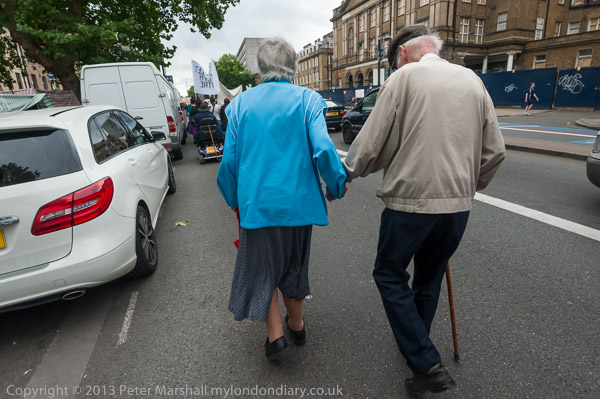
There was a brief rally in Altab Ali Park before the march with speeches by local politicians and health campaigners before the crowd of several hundreds set off down the Whitechapel Road on its way to London Fields in Hackney where it was to meet up with other protesters for a larger rally. But I left the march at Whitechapel Station.

More at

Strikes for a Living Wage & Grenfell – 2017

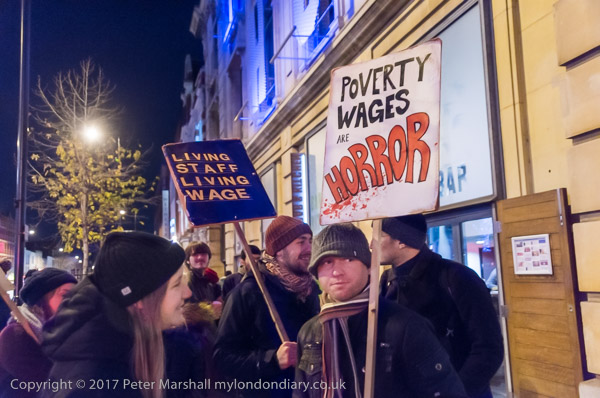
Strikes for a Living Wage & Grenfell – Thursday 14th December 2017 was six months on from the tragic fire at Grenfell Tower in North Kensington, and as on every 14th of the month since there was a silent walk to remember the victims and call for justice. But earlier in the evening I photographed two groups of workers striking for a living wage.

Star Wars Strike Picket Picturehouse – Hackney

Strikes for a Living Wage & Grenfell - 2017

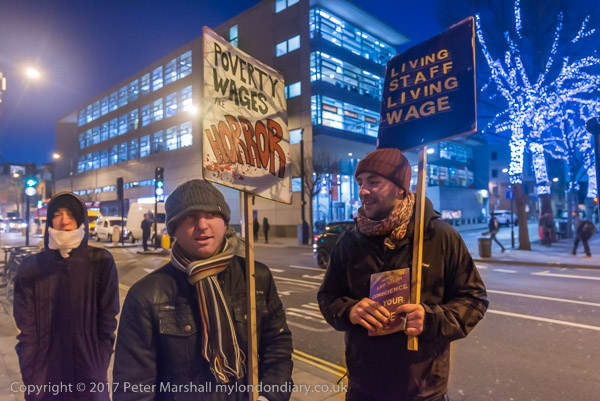
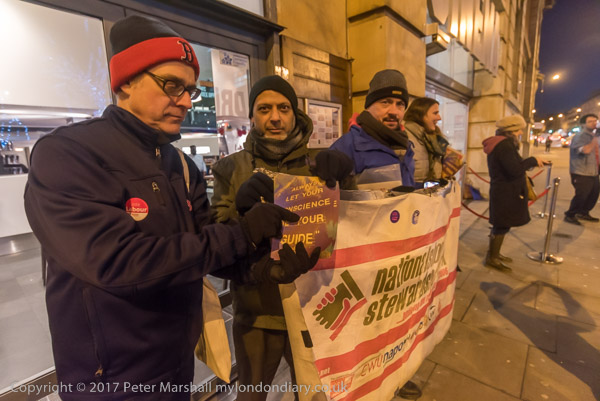
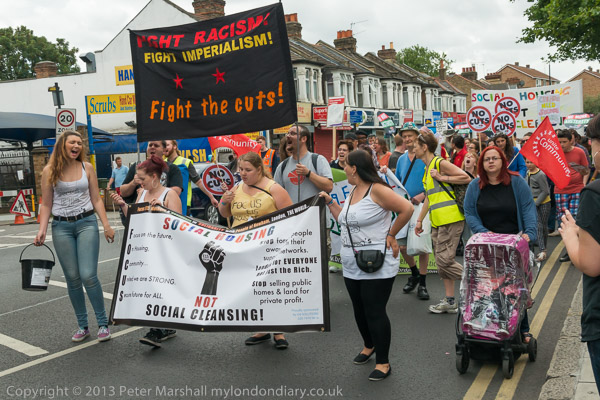
On the day that the ‘Star Wars’ film, ‘Last of the Jedi’ opened at Picturehouse Hackney, workers at the chain held a strike calling for them to be paid the London Living Wage. Workers and supporters demonstrated in solidarity on the pavement outside the cinema as it opened.
Strikes for a Living Wage & Grenfell - 2017

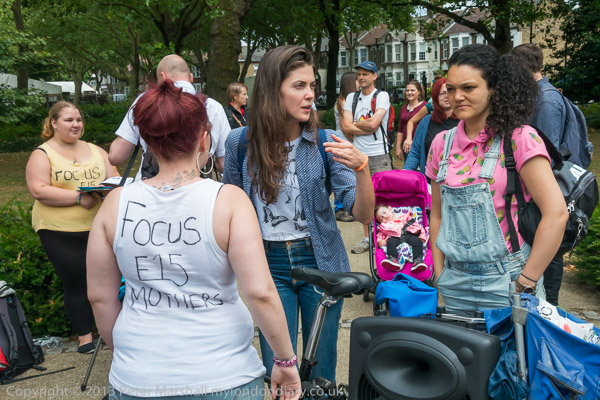
Picturehouse is a part of the multinational company Cineworld and has refused to recognise the trade union which the workers belong to, BECTU, instead claiming they are represented by a company run staff forum. As well as a fight for pay this is also for union recognition.

Strikes for a Living Wage & Grenfell - 2017

Members voted to dissolve the staff forum in 2019 and is no longer a recognised trade union. Although there have been some pay increases some workers around the start of this year were still only paid £9.80 an hour, over £2 short of the London Living Wage.

Star Wars Strike Picket Picturehouse


City cleaners strike at LHH for Living Wage – Gracechurch St, City

Strikes for a Living Wage & Grenfell - 2017

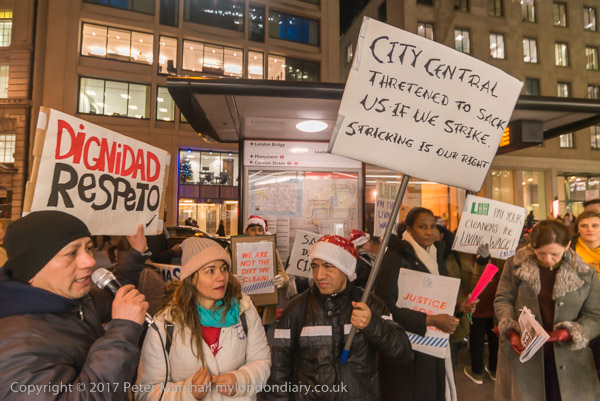
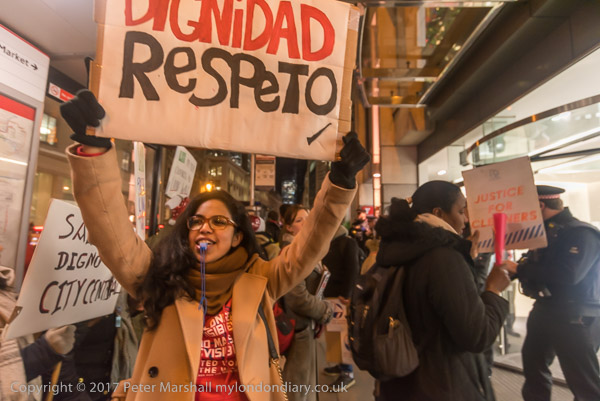
United Voices of the World union and supporters protested noisily outside the offices of Lee Hecht Harrison (LHH), a large company in the heart of London’s financial district with a £2 million profit and a 32% increase in revenue this year.

The cleaners of their offices are not employed by LHH and the cleaning was outsourced to City Central Cleaning & Support Services Limited who had rejected their demand for a living wage and unlawfully threatened them with dismissal if they strike.

The cleaners were being paid the national minimum wage of £7.50 an hour, far less than the London Living wage of £10.20 per hour independently assessed as the minimum needed to live on in London.

After an hour of noisy protest by supporters outside the offices the cleaners were cheered as they went in to start their cleaning shift.

Following this protest, in late January 2018 LHH announced they would be re-tendering their cleaning contract to guarantee that within the month the cleaning staff are paid the London Living Wage of £10.20 per hour. It was the first victory of the year for the UVW.

City cleaners strike at LHH for Living Wage


Grenfell Silent Walk – North Kensington

I was late arriving at Notting Hill Methodist and the silent march was starting early, with people already in line behind the banner on the road at the side of the church. It marked 6 months since the terrible fire, and six months in which nothing had been done to prosecute those who were clearly responsible for the conditions that led to the 72 deaths. Six years on nothing has changed.

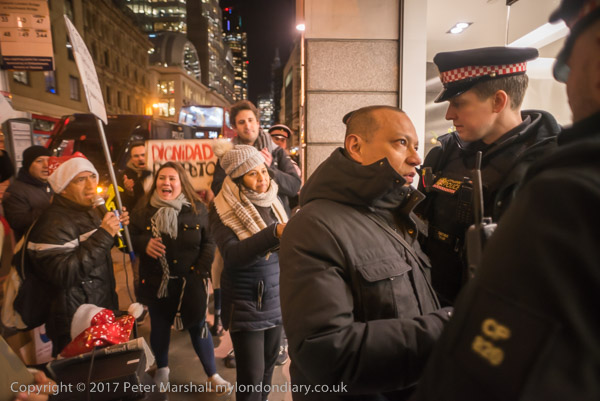
At the front were grieving relatives, some who had escaped from the flames and local clergy, and police and march stewards were ensuring that photographers and others kept a respectful distance.
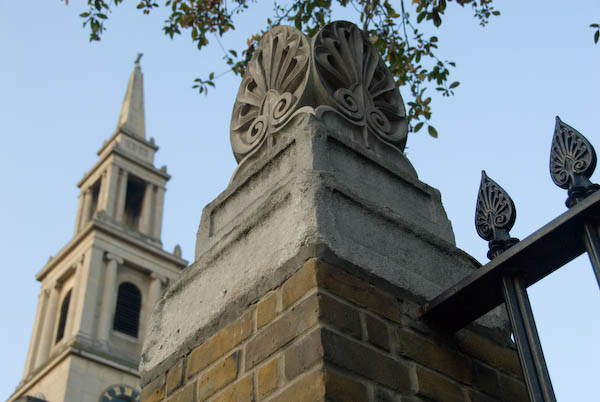
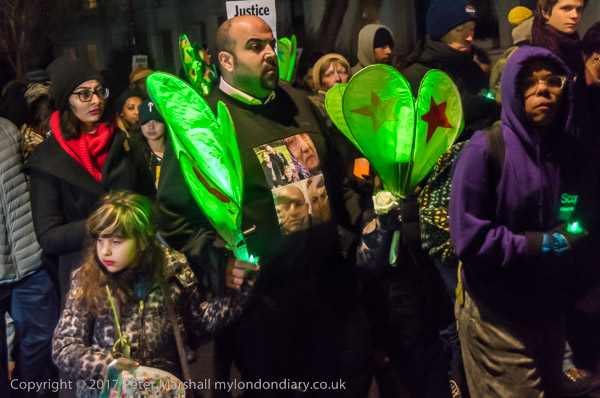
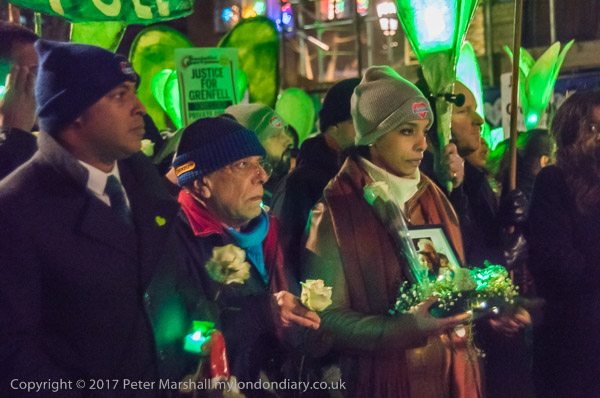
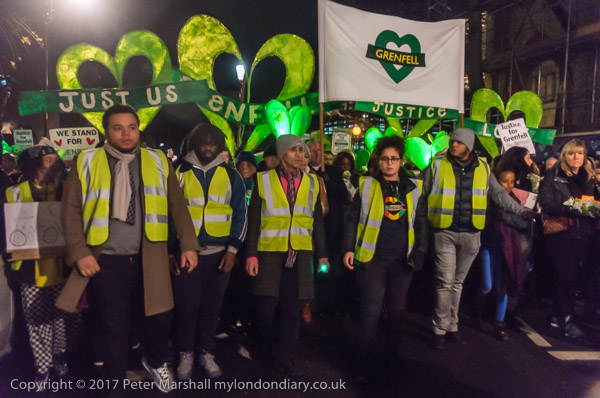
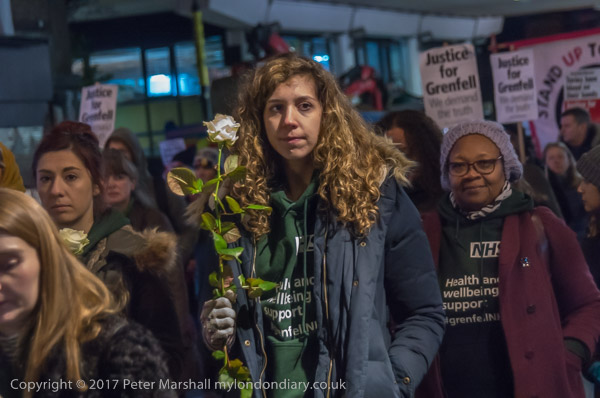
When the march moved off it was led by a line of stewards. Many of the relatives held white roses and photographs of some of those who died and behind them were others carrying large green heart-shapes for Grenfell with single word messages such as ‘JUST US’ , ‘GRENFELL’ and ‘JUSTICE’.

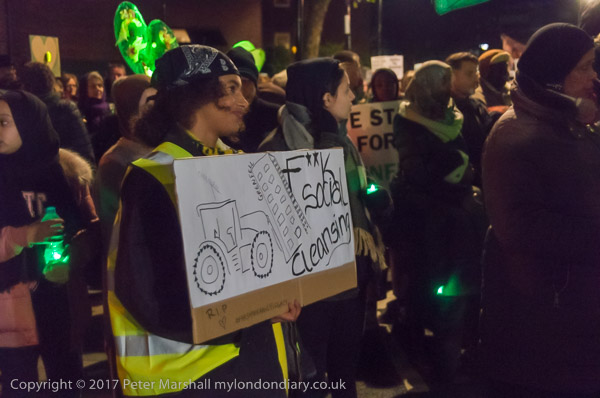
Many taking part walked with green battery-powered candles and further back in the march there were many placards demanding the truth about Grenfell. One banner read ‘Fight For Justice’ and the community will not get it unless they keep on fighting. They have kept on fighting, but it seems less and less likely that the long-running inquiry will deliver any real justice.
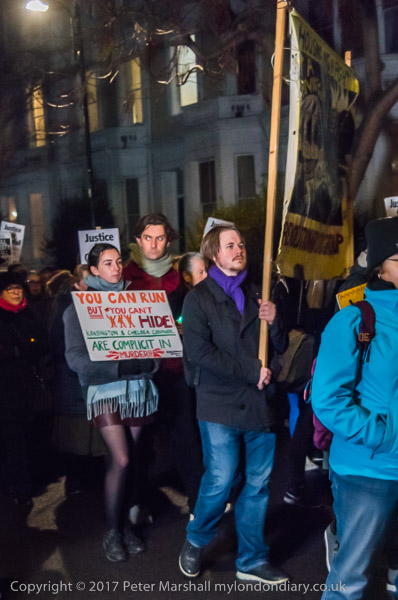
Further back on the march were some more angry posters, including one which read ‘You can run BUT you can’t hide – Kensington & Chelsea Council ARE COMPLICIT IN MURDER’.
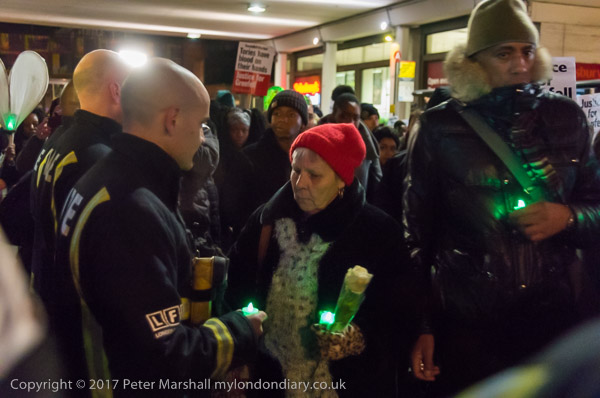
By Ladbroke Grove station firefighters were lined up as a guard of honour for the marchers, many of whom stopped to thank them for their bravery and persistence which saved many lives, some embracing them. I stayed on Ladbroke Grove to photograph as the rest of the march went past.

The march seemed much more moving than the service I’d watched on livestream earlier in the day. I was actually here with the several thousand on the march, and close to where the totally avoidable tragedy took place. There are many more pictures from the march on My London Diary at Grenfell Silent Walk – 6 months on.


Dalston, Shacklewell and Stoke Newington – 1989

This post is the second and final part on my walk in Hackney which began with Dalston Doorcases to Marie Lloyd.

German Hospital, Chapel, Ritson Rd, Dalston, Hackney, 1989 89-7k-32

Founded in 1845 with German staff to provide medical services to German-speaking immigrants who had settled in parts of North London. English staff took over when the German staff were interned in 1940. It became a part of the NHS in 1948, and only closed in 1987. The Grade II listed buildings survive and were converted into affordable flats.

Man on van, Ridley Rd, Dalston, Hackney, 1989 89-7k-33

I wandered up into Ridley Road where business was beginning to slack off in the market for the day. This man having a cigarette sitting on the bonnet of a van saw my camera and asked me why I was taking photographs. We had a short talk and he insisted I take his photograph, so here he is.

Public Washing Baths, Shacklewell Lane, Shacklewell, Hackney, 1989 89-7k-34

I continued north to Shacklewell Lane and took this picture of the Public Washing Baths, built by the Metropolitan Borough of Hackney in 1931 when many houses in the area were without bathrooms. Many poorer families and single people lived in one or two rooms sometimes without any running water or gas supply in their rooms and shared lavatories and kitchens with other tenants of the buildings.

This bath house provided 24 baths for men, 16 for women and they will have been well used in the early years before slum clearance provided better housing for many in the area. They were damaged by bombing in 1940 and reopened in 1942 and only closed some time in the 1960s. It is now occupied by the Bath House Children’s Community Centre who bought it from Hackney Council in 2002. This is now part of the St Mark’s Conservation Area, designated in 2008.

Works, 124-128 Shacklewell Lane, Hackney Downs, Hackney, 1989 89-7k-36

Built in 1932 as the Albert Works for the printers Henry Hildesley by architects Hobden & Porri, it later became the Rona Fashions House of George Gowns Ltd, but by 1989 their name had been removed from the facade leaving the marks you can see on the horizontals of the building. I think it was then still in use for the rag trade but my picture has the end of the names ‘RONA ROON… and Bab… hidden by the trees of Shacklewell Green.

Robert William Hobden who died in 1921 and Arthur George Porri (1877-1962) whose practice was based in Finsbury Square were responsible for many commercial and public buildings across London in first third of the twentieth century but seem suprisingly little known – perhaps a good subject for some academic research.

Henry Hildesley the printers are best known for the many posters they produced, including some for London Transport and HMSO, with many produced to help the war effort in the 1940s. The building, now called Cotton Lofts is in the Shacklewell Green conservation area designated in 2018 and is now flats.

Houses, Perch St, Hackney Downs, Hackney, 1989 89-7k-22

I can no longer remember the route I took to make the three final images in this post, but they were all made on 27th July 1989.

This terrace was built in 1882 and the conservation area statement calls it and other similar buildings in nearby streets “attractive and architecturally interesting”.

Former synagogue, Montague Road Beth Hamedrash, 62a Montague Rd, Dalston, Hackney, 1989 89-7i-16

Founded in 1910, this Strictly Orthodox Ashkenazi synagogue owned by the Federation of Synagogues was closed and the membership merged with the West Hackney Synagogue in 1981. Used for some years by Roots Pool Community Association and Dalston Community Centre it was eventually converted into flats as Montague Court.

Shops, Cazenove Rd, Stoke Newington, Hackney, 1989 89-7k-26

Possibly I may have taken a bus to pay a visit to Abney Park Cemetery, close to where this final image was made though if so I took no pictures on this occasion, or perhaps just to make this picture.

Shops were added in the front gardens of these houses built in 1878, and that now housing the artist’s house Madame Lillie was initially a carpentry workshop owned by the Wright family. In 1917, when Mrs Wright was a widow, her daughter Lillie opened a corsetry shop, which continued in business until she retired in 1970. In 1973 she sold the shop and house to her young artist nephew Paul David Wright. He converted the premises into studios for artists and a gallery space.

You can read the first part of this walk at Dalston Doorcases to Marie Lloyd.


Dalston Doorcases to Marie Lloyd

Dalston Doorcases to Marie Lloyd – On Thursday 27th July 1989 I took the North London Line to Dalston Kingsland and crossed the road into Ridley Market and walked along Colvestone Crescent and on to Montague Rd. I can’t now remember what had brought me to North London for this brief interruption to my series of walks south of the river.

Doorway, Montague Rd, Dalston, Hackney, 1989 89-7k-61

Here there are four houses on both sides of the street with similar doorways to the pair in my photograph with these odd decorative figures supporting the lintel. Those further down the street have simpler largely geometrical designs.

I was unsure what to call these muscular male figures, hand on hips staring down at the ground with what appear to be victory wreaths of laurel leaves around their heads and a pair of rather fishy looking tails. A long and detailed study published by the Hackney Society, The Victorian Villas of Hackney by Michael Hunter tells me they are mermen, and provides other examples of ‘bizarre doorcases’ in the Victorian villas of the 1850s and 1860s in Dalston. These date from 1861-6.

Shopfront, Cecilia Road, Dalston, Hackney, 1989 89-7k-63

There are several houses close to Dalston Lane at the south end of Cecilia Road that have converted shopfronts with consoles matching that at the top right of this shop and this was one of these.

Although the advertising for the News of the World and Silk Cut suggests this was once a newsagent and tobacconist, it looks as if it was by 1989 a junk shop.

Eagle Shipping Services, 168, Dalston Lane, Dalston, Hackney, 1989 89-7k-65

This building on the corner of Stanford Mews is still there and has kept its decorative iron balcony railing though not the Eagle Shipping Services advertising and graphics. Its upper floor is now simply painted white while the ground floor has been converted into a ‘rustic health food cafe & shop‘, Healthy Stuff.

Jas. Elves, marble mason, Carrara House, 164, Dalston Lane, Dalston, Hackney, 1989 89-7k-66

James Elves was a marble mason and called his premises at 164 Dalston Lane Carrara House, after the area in Italy famous for its marble. Born in Shoreditch he lived and worked here with his family from around 1900 at least until 1930.

The house is still there and also its porch, but the tiles – presumably marble – of the front path have been replaced with duller slabs.

Houses, 112-4, Greenwood Rd, Dalston, Hackney, 1989 89-7k-53

A few yards south of Dalston Lane, these houses in Greenwood Road were looking a little the worse for wear in 1989 but are considerably smarter now. With three stories and a basement these houses are now largely converted into four flats.

Doorways, 96-98, Graham Rd, Dalston, Hackney, 1989 89-7k-42

I continued south to Graham Road where I found more of Hackney’s remarkable doorcases. The left hand door is 98B as I think there will he a separate door in the area below to the basement flat.

Michael Hunter has a picture of a similar pair a few doors down where he states that the Roman standards are based on pattern books of classical architecture, “but the extraordinary swags of solidified shells over the doors of… Graham Road defy analysis.

The unfortunate door at right has since been replaced, but with another design that while preferable is still not in keeping with the building.

Doorways, 96-98, Graham Rd, Dalston, Hackney, 1989 89-7k-45

A closer view of one of the swags showing more clearly the shells and at the centre a lion’s head.

Marie Lloyd, plaque, 55, Graham Rd, Dalston, Hackney, 1989 89-7k-46

Finally for today, a rather simpler doorway in Graham Road with the GLC plaque recording that Marie Lloyd, Music Hall Artiste lived here. The dates are those of her life, 1870-1922.

Born in Hoxton in 1870 as Matilda Wood, she made her first appearances on stage when she was 14, taking the stage name Marie Lloyd the following year. So many of the old music hall songs we now know were made famous by here, not least for her remarkable use of nuance and double-entendre as well as displaying her undergarments in a way that respectable Victorians found deplorable but music hall audiences loved.

She moved into this house after her marriage in 1887 – but the marriage was not happy for long. After a disastrous bust-up she moved out from Graham Road in 1894.

As she sang ‘A little of what you fancy, does you good‘ but in her life she certainly became ‘one of the Ruins That Cromwell Knocked About a Bit‘ and at her funeral, thousands took the advice of ‘My Old Man‘ and followed the van to her burial from Woodstock Road in Golders Green to Hampstead Cemetery. Train journeys recently have often left me wondering ‘Oh Mr. Porter, what shall I do?

More from his walk shortly.


Gun & Knife Crime, Equiano & St John’s – 2007

Gun & Knife Crime, Equiano & St John’s: I went to two events in North London on Sunday 14th October 2007, a local march against gun and knife crime and then a Black History Month event in Abney Park Cemetery. And on my way home I stopped to take a few pictures of the church opposite Waterloo Station.


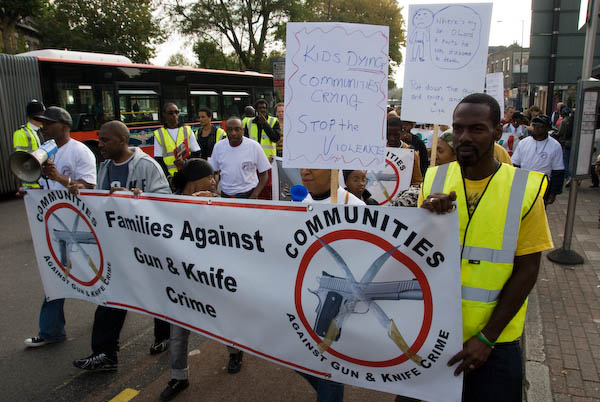
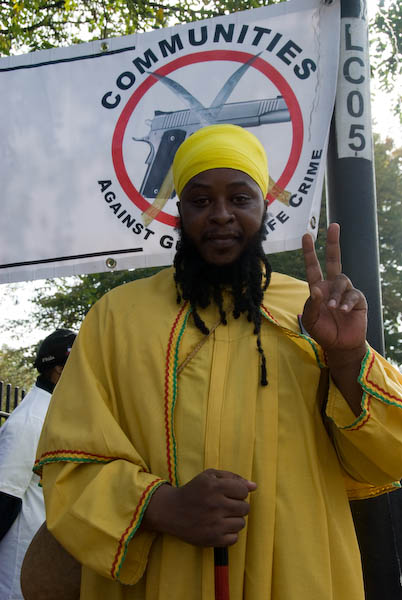
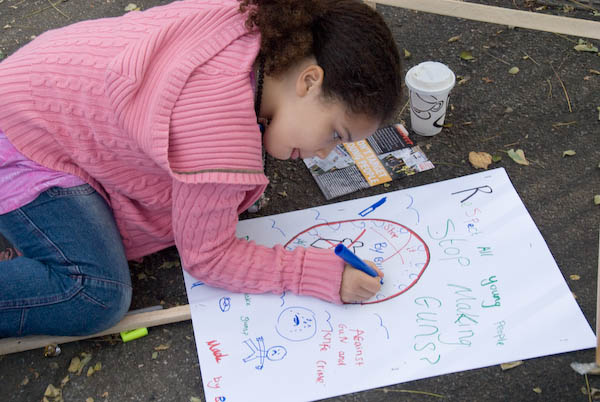
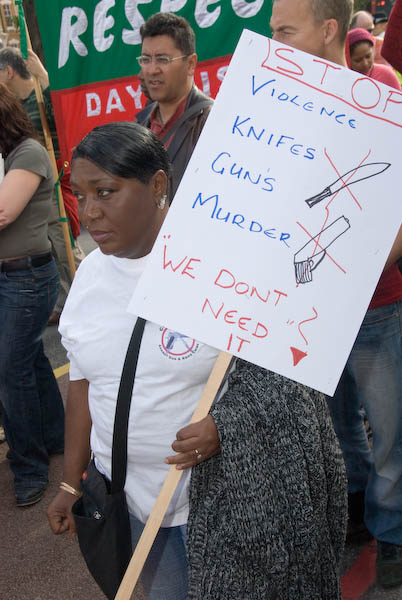
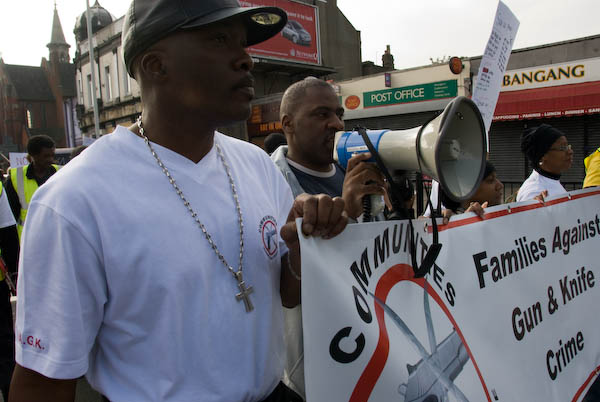
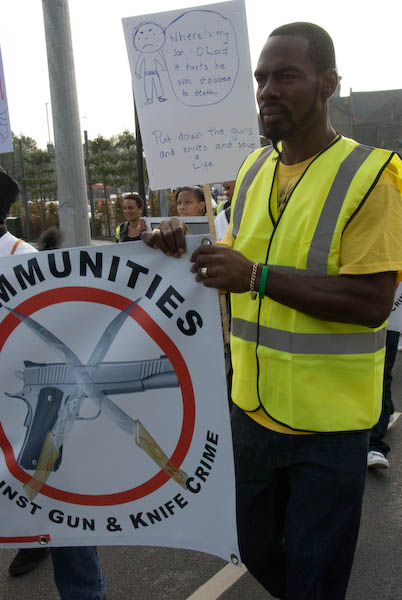
Communities Against Gun and Knife Crime, Hackney

In the 2000’s a stretch of road between Upper Clapton and Lower Clapton attracted the title ‘Murder Mile’ in the press after eight people were shot dead on the street or in the streets just off the main road over a period of two years. Of course there are some other cities around the world – including in the USA – where that number of deaths in a week or even a day would not be unusual. But London is generally a very safe city and Clapton is one of a number of areas which has more than its share of gun and knife crime.

Gun & Knife Crime, Equiano & St John's:

This is an area with a number of night clubs and where drug dealing is common and a large proportion of the shootings and deaths are related to these, often involving people from outside the area.

Gun & Knife Crime, Equiano & St John's:

But young people who live in and around the area are also caught up in gun and knife crime and one death is one too many, particularly when it involves your friends or family. Like many areas of London it houses a wide social mix, and these crimes particularly involve the poorer members of the community, many of whom are black.

Gun & Knife Crime, Equiano & St John's:

The march organised by Communities Against Gun And Knife Crime appeared to have no support from either of the two London Boroughs concerned – Hackney and Haringey – or from the Met police, who did escort it. The only other organisation which I could see was supporting it was Hackney Respect, a local group of the left-wing Respect party.

Gun & Knife Crime, Equiano & St John's:

The march began at Clapton Pond with a prayer by a Black Church Sister, and then moved slowly north up the Lower Clapton Road and across the Lea Bridge Roundabout and up the Upper Clapton Road. I had to leave before the end for my second event.

The march was smaller than I had expected with fewer than a hundred people taking part, and although it atrracted waves and shouts of support from people as it passed, few if any of them came to join it. As I commented, “marches like this are surely useful in raising community awareness, and it is hard to see why there was so little support from either the public, local authorities or other local groups – including the other political parties, churches and other community groups.” Apart from myself there was a photographer from a local paper reporting on the event, but no other media interest. I don’t think any of the pictures or my report which I filed to an agency were ever used.

Here is my final comment from my 2007 article:

The real challenge in cutting youth crime – and gun and knife crime is mainly youth crime – is getting people, and especially young people – real jobs that offer training and possibilities for advancement. At the moment there are too few jobs for young people, and many pay below a living wage, especially a living wage for London. While crime offers the only way to money, prestige and apparent success, many will take that route.

Communities Against Gun and Knife Crime

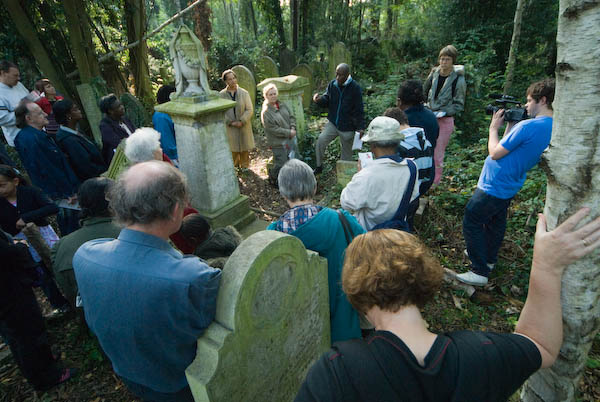
Equiano Society – His Daughter’s Grave – Abney Park Cemetery, Stoke Newington

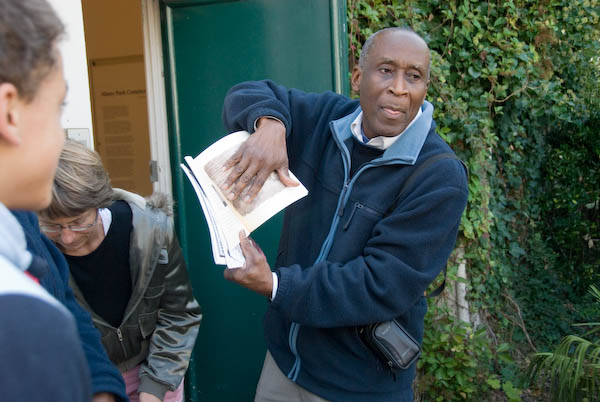
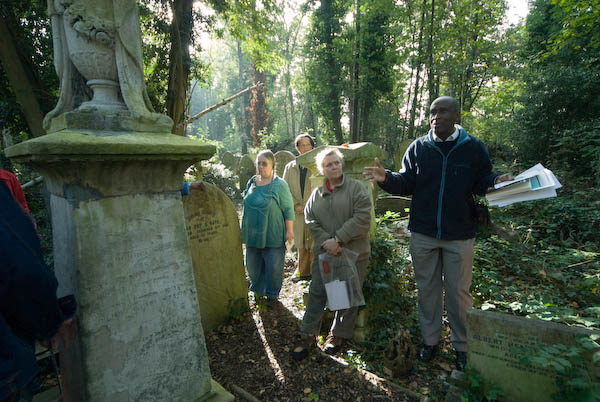
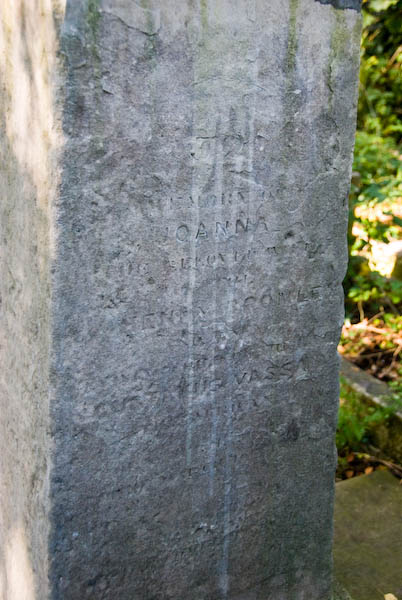
I joined a Black History Month walk led by Arthur Torrington OBE, the secretary of the Equiano Society which ended around the grave of Joanna Vassa, the daughter of Olaudah Equiano.

As the web site Olaudah Equiano, or, Gustavus Vassa, the African shows he was a truly remarkable man. Probably born around 1745 in what is now Nigeria he was kidnapped and sold into slavery as a child and taken to Barbados. In 1745 he became slave to a captain in the Royal Navy who renamed him Gustavus Vassa, and taught him to be a seaman and also sent him to school in London to learn to read and write. Later was bought by a Quaker merchant in Philadelphia who set him to work on one of his trading ships. Equiano was also able to engage in some trading for himself, and in four years made the £40 that his master had paid for him and was able to buy his freedom.

After various adventures in 1743 he came to London and became involved in the fight against slavery, although at first he was engaged in projects to set up black colonies in Central America and Sierra Leone, becoming for the latter the first black civil servant – but after he pointed out corruption among some officials he was quickly sacked.

He then wrote the book which made him famous, ‘The Interesting Narrative of the Life of Olaudah Equiano, or, Gustavus Vassa, the African‘ which was an autobiography, a description of the horrors of slavery and a polemic calling for its abolition. It was a success when published in 1789 and he earned a considerable income from it. In 1792 he married an English woman, Susanna Cullen, at Soham in Cambridgeshire and they had two daughters, one of whom after his death in 1797 inherited his estate of £950 (equivalent to around £100,000 now.)

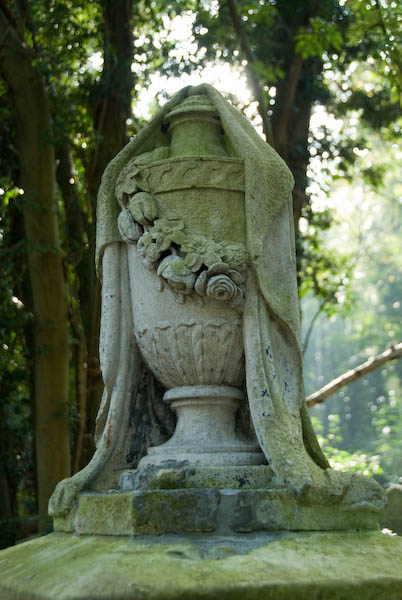
Joanna Vassa later married the Congregational minister, Henry Bromley, and in 2005 their joint grave (also of Henry’s second wife) was discovered in Abney Park Cemetery, fallen down and covered by moss and undergrowth. Much of the inscription was worn away, but the names remained and the stone was restored and re-erected.

Equiano’s daughter


St John’s, Waterloo – A Waterloo Church

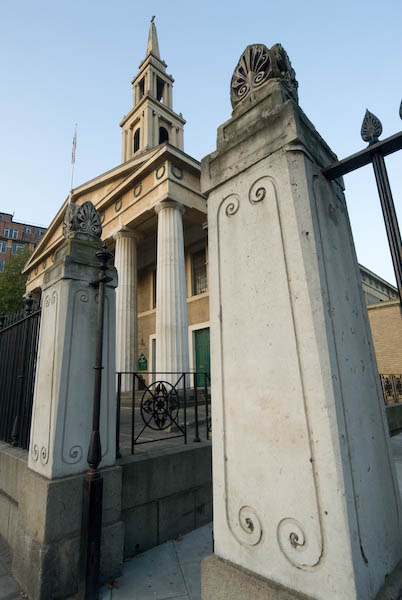
St John’s Church, now opposite Waterloo Station was one of a number of churches built in the years of national triumph following the defeat of Napoleon in 1815 with money granted by acts of Parliament to the Church Building Commission in 1818 and 1824 totalling £1.5 million. A total of 612 new churches were built by the Church Commissioners, mainly in the new and expanding industrial towns and cities, but initially “particularly in the Metropolis and its Vicinity“.

London south of the river was expanding rapidly, with new industries and a great deal of housing. The church was designed by Francis Octavius Bedford and built in 1822-1824 in a Greek Revival style – as were his other churches for the commissioners in Camberwell, West Norwood and Trinity Church Square, Southwark.

The site chosen, close to the foot of Waterloo Bridge was a difficult one, being a pond and a swamp, and John Rennie the Younger was consulted for advice about the foundations. This has proved sound as the building, despite being badly bombed in 1940 and standing in ruins until 1950 and the construction of the Jubilee Line underneath is still sound. It was restored and rededicated in 1951 as a part of the Festival of Britain, and again controversially in recent years which removed some of the later features.

I think I probably had just missed a train home from Waterloo Station opposite, a later development which opened as Waterloo Bridge Station in 1848, and had some time to wait for the next. Soon I was on a train home.

St John’s Waterloo