Leyton and a Puzzle: Pictures from walks around parts of Leyton in August or September 1994 and a puzzle from south of the river.
New Spitalfields Market, Sherin Rd, Leyton, Waltham Forest, 1994, 94-901-53
Traffic congestion, lack of space and outdated buildings led the City of London Corporation to relocate its wholesale fruit and vegetable market out of Spitalfields to a purpose-built 31 acre site in Leyton which opened in 1991.
Stratford Market, which had been founded in 1879 by the Great Eastern Railway as a competitor to Spitalfields also moved to the new site. According to Wikipedia, New Spitalfields Market “is Europe’s leading horticultural market specialising in exotic fruit and vegetables – and the largest revenue earning wholesale market in the UK.”
New Spitalfields Market, Sherin Rd, Leyton, Waltham Forest, 1994, 94-901-43
There were plans for this, Billingsgate Fish Market (in the West India Docks) and Smithfield Market to move to a new consolidated site in Dagenham Dock and planning permission was given in 2021, but in November 2024 the City decided this was no longer economically viable. New Spitalfields will remain in use while there are now plans to relocate the two other markets to Albert Island at the east end of the Royal Docks.
Leyton, Waltham Forest, 1994, 94-901-45
The market is on the east side of Hackney Marshes a short distance from the River Lea and I walked east along Ruckholt Road into Leyton. I think this building was probably in a side turning just off this road and I think has probably been demolished. But I was only interested in the colours an shapes.
A E Cornell, Furniture, 363, High Rd, Leyton, Waltham Forest, 1994, 94-901-46
This shop is now occupied by Woodland Estate Agents who opened here in 2005 and the building looks rather less run-down. Of course I was attracted by the Union Flags in the windows and door as well as the Churchillian poster with its pointing finger, though I’m unclear what we should DESERVE. Perhaps someone will have memories of this shop.
Chinese Takeaway, Fish & Chips, London, 1994, 94-901-32
I think this was also in Leyton as another almost identical image is on the next frame of film to the picture of A E Cornell’s furniture shop. The Chinese Takeaway seems to have been at 17D and had a name ending in GARDEN. But of course my interest was mainly in the peeling mural of two rather strange-looking jockeys and horses on the side of the neighbouring bookies.
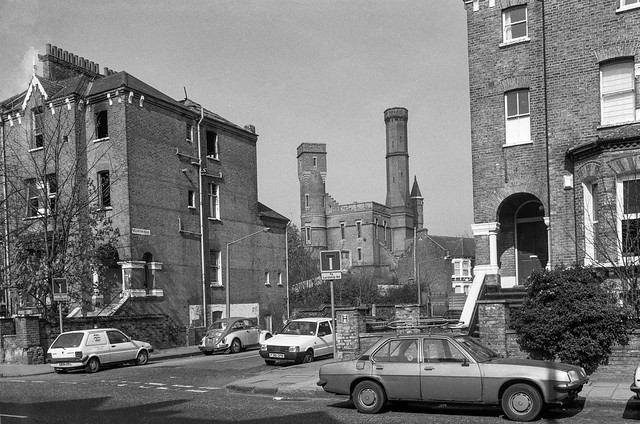
Frederick Place, Bloomfield Rd, Woolwich, Greenwich, 1994, 94-901-24
And finally a little puzzle from the same film but taken south of the river on Bloomfield Road in Plumstead. The L and the S are clear and there are hints of two other letters, perhaps an I and a T. There could have been other letters, out of frame to the left. The building has been demolished and replaced by new housing, though some parts of the unusual paving remain. I can’t remember now if I knew what the site was, but have a vague feeling it may have been a garage and there is still a garage at the back of the new houses.
Please comment if you know more about this or any other of the pictures. More colour from 1994 to come.
Old Comrades, Women for Life & Sikhs: Sunday 4th June 2006 was a day for marching and running on the streets of London. In the City, the London Regiments were remembering their fallen comrades, and several thousand women were raising funds for cancer research. In Hyde Park I joined several thousand Sikhs at a rally before they marched in memory of the martyrdom of the Fifth Guru and the Indian genocide of Sikhs, calling for the release of political prisoners and the formation of an independent Sikh state.
I wrote a rather longer piece than usual, ending with a complaint about the police harassment of photographers during the Sikh march. There do seem to be some officers who really have a very negative attitude towards photographers, and at times in particular towards those with UK Press Cards. Though formally these are recognised by all police forces in the UK, that recognition too often means nothing on the street. Below is what I wrote in 2006 – with the usual minor corrections.
London Old Comrades
Bank of England
Early Sunday the centre of the real City, around the Bank Of England is generally pretty empty, but today things were going on. Immediately north of the bank a small group of ‘old comrades’ from the London Regiments were preparing to march and lay poppy wreaths at the monument to their fallen comrades in front of the Royal Exchange. Some of those I spoke to had fought in the second world war, though there were also some younger people there. It’s a remembrance that has taken place twice a year since 1919.
It was a solemn and ceremonial occasion, impressive and colourful, with a well-disciplined smoothness. The monumental architecture of the Bank made a good setting, although the area on top of Bank Station itself is too fussy and cluttered.
Towards the end of the event, when the numbers had thinned out a bit, London Wall was still fairly full.
As they marched off, I peeled left in search of 750,000 women, or rather that fraction who were taking part in the Central London event. ‘Race For Life’ for Cancer Research UK, is the UK’s largest women-only nationwide fund-raising day. There certainly were a lot of them, [around 10,000], at times packing even the wider streets full from side to side, making it hard to walk along Cornhill.
Women of all ages, shapes, sizes, races and speeds running, walking or limping or wheel-chairing around the 5km course. There were fewer serious runners than I’d expected and less fancy-dress, but the sheer numbers were impressive.
The Sikh Remembrance March and Freedom Rally commemorated the martyrdom of the fifth guru, Sri Guru Arjan Dev Ji 400 years ago, as well as the events of 1984.
Guru Arjan Dev Ji compiled the first version of the Sikh holy book, the Guru Granth Sahib, in 1604, writing many of the hymns within it. He was arrested in Lahore in 1606 on the orders of Mogul Emperor Jehangir, tortured for 5 days and martyred on the banks of the River Riva.
Punjabi speakers at the rally in Hyde Park described the events of 1984. The marchers demanded an acknowledgement of the Indian genocide of Sikhs, the release of Sikh political prisoners held in Indian jails, and for the establishment of an independent secular state of Khalistan in the Punjab.
During the annual celebration of the death of Sri Guru Arjan Dev Ji in 1984, Indira Ghandi sent her troops to attack Sikh militants in the Golden Temple at Amritsar. Many innocent pilgrims – men, women and children – were killed in the brutal assault. Thousands more died around the Punjab, particularly in the riots incited by government TV and radio stations after the October assassination of Indira Ghandi by her Sikh bodyguards.
After the speeches came prayers, and then the march set off for Trafalgar Square and another rally. This was a serious event, with strongly felt grievances, and an impressive display of Sikh tradition and feelings.
The marchers were pleased to find photographers taking an interest in their cause, with many of them encouraging me and thanking me for my presence. Some had heard of this web site [My London Diary] too.
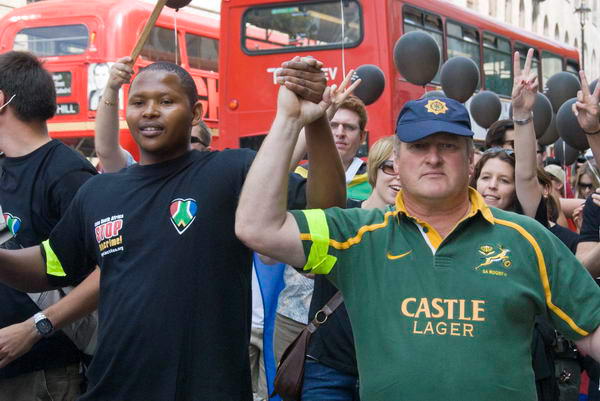
The march sets off in Hyde Park, with five men representing the original Panj Piare (Five Beloved Ones.)
Until we were close to Hyde Park Corner, the police were helpful and in good humour too, but then along came one of the rotten apples, someone who just wanted to push photographers around. He came and told me to get off the road, as I was stopping the demonstration. This was clearly absolute nonsense, and I tried to tell him, but reason held no interest for him.
Police harass a photographer trying to do his job. I and other photographers got the same treatment
Other photographers got harassed too. You can see one of them in my picture. We are accused of holding up the march, generally nonsense as most of us want to capture action in our images, and if people even slow down, will wave them on.
Of course it’s those at the actual front of the march who would have any effect on its progress. Further back where we were working, small gaps develop and are closed up all the time without affecting the overall progress.
I have respect for the police – some at least of their work is essential, but this kind of petty and stupid behaviour simply makes their job harder for no reason.
It also makes the work of photographers impossible. I can’t work unless I can stand in the right place to take pictures, and that is seldom on the sidelines. At the highest level, the police realise this; it’s about time they got some of the little dictators in the middle to put it into practice.
The message of love & peace SILENCED BY TANKS
Of course the policing of many marches is over the top. There were probably ten times the number needed for this event, which was predictably well ordered, good natured and essentially self-policing. Traffic control was really all that was required. Perhaps harassing photographers makes these surplus guys on overtime think they have a purpose.
Twenty minutes later, along with several of the other photographers, I was on my third warning from this guy and he was getting redder and more and more tense. I was interested in how the situation might develop, but I was also tired and it was time for me to go elsewhere.
More Golden Jubilee Celebrations: Monday June 3 2002 was the official Golden Jubilee Bank Holiday, and a number of events were taking place across the nation. And although I wasn’t myself celebrating I felt I should in some way document the events and picked a couple I felt might be of interest.
Here I’ll reproduce what I wrote in My London Diary in 2002 with the usual minor corrections, along with some of the pictures I posted back then, though the scans I made are sometimes rather primitive. I’ll also link to more pictures on-line, though there are still many from the day I’ve yet to digitise.
“June 3 I went to see how ordinary people were celebrating – first of all to a council organised even in Ilford, and then to a street party in the heart of the East End. “
Redbridge Jubilee Celebrations
Ilford High Rd, Ilford.#
Redbridge is in some ways one of the bleaker London boroughs, and the event seemed to lack any real centre or real conviction.
Perhaps the brightest point was the rain, which brought out a little of the true british spirit.
Mile End is also bleak when you emerge from the Underground, with too many lanes of road cutting through its centre.
To the north, and running up to the Roman and Vicky Park is one of the remnants of London’s East End, still with many of its Victorian terraces.
The street party was in full swing when I arrived and everyone was out to have a good time.
It was a great event for kids and for grandmas and everyone else, and the bar and the pub were doing good business too.
These were the real East-Enders – with a cast including a real Black Bishop in purple robes, two fancy dress Beefeaters, police who could almost have been from Dock Green (except for the hats), a fire engine and its crew and plenty of characters.
Not a single juggler, mime or performance artist in sight (sometimes I ask myself what did I do to father a unicyclist.) These were people who – like we all used to – could make their own entertainment.
Food, drink, chat, music, a bit of a dance, games for the kids. It was a street rather like the area I grew up in fifty years ago, where everybody knew each other, although now with a rather more multi-ethnic population.
People – apart from the odd shy kid – were happy to have their pictures taken and to talk. One man saw I was photographing the decorations on his house and came over to tell me how his father had decorated it for the Silver Jubilee twenty five years earlier and that he had been determined to do it better.
They hadn’t quite got to a real full-blown knees-up, but it seemed definitely on the cards but it was time for me to go. As I walked away three young women were walking towards the party on the other side of the street, “D’you wanna take our picture“, one shouted, seeing my cameras. “No film left” I replied.
The following day I meant to go out and take more pictures of other Jubilee events, but in the end I couldn’t make it, just feeling it would be too much of an anti-climax.
There are six pages with pictures from the celebrations in Bow. Back in 2002 we were still on dial-up connections and so images were spread out only a few on each page to give sensible loading times. Images were then shared on the web at much lower quality than we would use now. The links to the next page are usually above the final picture and the final page from the event is of black and white images.
Jubilee Celebrations and Kurdish Protest: Celebrations were taking place on Sunday 2nd June 2002 for the Queen’s Golden Jubilee (and they continued the following day which was the Golden Jubilee Bank Holiday, with the Tuesday also being the Spring Bank Holiday – moved into Summer for more celebrations.) My main reason for going into London was to photograph a protest by Kurds but I also tried to photograph some of the celebrations. Quotes below are from what I wrote on My London Diary back in 2002 with some of the pictures and I took.
Sloane Square
Chelsea
“As a convinced republican I wasn’t too excited, but thought I’d go along and have a little look at how others were celebrating. Sloane Square seemed a good place to see how Chelsea was taking it as they were having a fair on Sunday 2nd June.”
At least while I was there the celebrations in Sloane Square were an extremely formal event and rather boring.
Kurds Call For Human Rights in Turkey
Westminster
I am the Kadek – Kurds protest
“I was glad to leave and join the Kurds in their demonstration for human rights. Britain has a lot to answer for, having betrayed them at the Lausanne Treaty in 1923 which divided their country, giving most to Turkey which has since behaved with complete disregard for their human rights.”
The Devil TurkeyKurds protest against banning of their organisations Free Ocalan, Free Kurdistan
“More recently – again to keep the Turks onside – the US put the Kurdistan Workers’ Party (PKK) on their terrorist list, despite it having abandoned terrorism to try and obtain justice. ” KADEK was the name the PKK changed to in 2002 when it said it was committed to non-violent activities and it was added to the PKK proscription in 2006.
“Turkey has continued a policy of brutal repression – as the European Court of Human Rights has confirmed.”
“Cynical support of US policy by Britain and other countries resulted in the PKK also being listed [in the UK] as a banned terrorist organisation last month. It’s the kind of politics that makes me ashamed to be British and loses our Labour government any respect.”
“After the demo I went on to see how Southwark were celebrating. “
“The answer turned out to be very low key, though as usual there were some interesting food and drink stalls at Borough Market, and a steady stream of people walking along by the river.”
The Beer and Wine Trade Society decided in 1851 to provide an asylum for its elderly poor members and purchased land on the north side of Nunhead Green, launching an appeal to its members to build these almshouses. They were built at at a cost of around £3,000 as a terrace of seven dwellings to house 13 people. The Metropolitan Beer and Wine Trade Society almshouses, architect William Webbe, opened in 1853.
The accommodation was on a generous scale, with each having four rooms and a kitchen and a part of the garden behind to grow vegetables. As well as the accommodation the residents also received a weekly allowance.
The almshouses are Grade II listed and are now private homes.
Nunhead Library, Gordon Rd, Nunhead, Southwark, 1990, 90-3e-26
Nunhead Library was designed by Robert Whellock of Camberwell in an Arts and Crafts style and built in 1896. Since 1965 in the London Borough of Southwark where it is one of four libraries which were founded by philanthropist John Passmore Edwards and is still in use as a library. Edwards founded another 11 libraries in London, most no longer in use.
Nunhead had been a part of the ancient parish of Camberwell but became a separate parish in 1878 and became part of the Metropolitan Borough of Camberwell in 1900, which became part of the London Borough of Southwark in 1965.
Nunhead Railway station is in Gibbon Road and this Gents Hairdresser at 52 and Launderette at 54 (and the Fish & Chip shop at 50 whose frying times are in the corner of their window) are just past the bridge north of the station entrance. Rather to my surprise there is still Gents Hairdresser and a Fish and Chip shop here, though the Launderette closed around 2010 and is now two homes at 54 and 54a.
The two people sitting reading outside – before the age of mobile phones – are doubtless waiting for their washing to finish inside the launderette.
I went down Gibbon Road and turned left into Hathway Terrace, which turns into Kitto Road and leads on to Drakefell Rd. Somewhere here was this path with a broken-down fence leading to an area of prefabs.
In 201 Elisabeth Blanchet and Jame Hearn from the Prefab Museum photographed the interior of a prefab in Drakefell Road and posted a video of the resident, John De’Ath, who had moved in when these prefabs were new in 1948 and stayed there until his death in 2017, a very satisfied resident. You can read more about London’s prefabs and see a photograph of one of them in a GLIAS Journal, when in 2024 the two last prefabs there were awaiting demolition.
Telegraph Hill Park, Brockley, Lewisham, 1990, 90-3f-55
The 10 acres site the hill top on Kitto Road was created in 1894 thanks to George Livesey, chairman of the South Metropolitan Gas Company and a local philanthropist. It has good views to central London and south and east towards Croydon and Shooters Hill, which made it a great side for a semaphore station which was built around 1795 – as one of a series which formed an optical communication system from London to Dover and Southampton with large arms which could be moved to different positions to convey letters or codes.
The French had invented the system for their military and we copied it – and it was able to speedily deliver the new of Wellington’s victory at Waterloo (among many other messages over the years) back to London. The signal station was out of use by 1823, but the name it gave to what had previously been ‘Plowed Garlic Hill’ stuck.
Rather than take the views, I decided to make a picture that showed a hill. I don’t think it shows the part of the park which once had the telegraph station.
Mantle Road and Endwell Road meet at Brockley Cross, just to the north of Brockley Station, which is just down the hill which goes under the railway bridge at the left of Endwell Court. This rather isolated block appears to have been built as a mansion block with perhaps four flats and looks very similar now.
A small group of three semi-detached houses on the north side of Drakefell Road close to Brockley Cross have some rather unusually detailed ornamentation. This end of Drakefell Road was Penmartin Road until 1902, and I think these houses probably date from a few years before then. The houses are now flats.
As always, comments and corrections are welcome. More from Brockley in a later post.
Hall Place & River Darent: More from my walks by the River Cray and Darent in September 1994. Firstly a couple of pictures from Hall Place, Bexley where the River Cray runs through the grounds of a magnificent Tudor Hall.
Park, River Cray, Bexley Hall Place, Bexley, 1994, 94-906-62
The gardens are open free of charge all year round, and are well worth a visit – and dogs, footballs, BBQs or fishing are not allowed, making it very peaceful. I can’t remember exactly where in the grounds this was, perhaps at the north close to the A2 where there is a flood channel marked on the map.
Hall Place, Bourne Road Bexley, 1994, 94-901-61
Although you can see the exterior of the Grade I listed country house for free, you can only go inside on pre-booked guided tours. I once went on one of these and possibly these pictures were taken on the same day, but I took no pictures inside the house.
The main house was built in two stages, the first in 1537 for Sir John Champneys, a wealthy merchant and former Lord Mayor of London with the fine flint and rubble walls in my picture. Some of the stone used in its construction was recycled from the ruins of the former Lesnes Abbey not far away in Abbey Wood.
When the house was sold to a second wealth London merchant, Sir Robert Austen in 1649, he decided to double its size, extending it in red brick. Later buildings including a lodge were added in the Victorian era. In the 1920s the last tenant of the hall, then owned by her wealthy American son-in-law Stephen Cox Brady, was the eccentric Lady Limerick who added some mock-Tudor interior features.
Brady died in 1928 and the house and gardens were sold to Bexley Council, but the eccentric Lady Limerick lived there as a tenant until her death in 1945. During the war the house was also in use by US soldiers who were involved in the decoding of German messages, part of the operation centred at Bletchley Park and had the code name Santa Fe.
I think the next pictures were made a few days later.
Darent Industrial Park, Erith, Bexley, 1994, 94-912-23
I’ve walked around beside the River Darent and on to the Thames and to Erith a number of times, and more recently on my folding bike. Usually I’ve begun my walk either at Slade Green or Barnes Cray stations, though I think I may once have done it in the opposite direction.
Darent Industrial Park, Erith, Bexley, 1994, 94-912-42
The land here is on the edge of the marshes and was marsh and grass land until the 1879s when the Thames Ammunition Works, later part of VickersArmstrong, was established here. During World War I it employed thousands, many of them women, working long hours in hazardous conditions. The site officially closed in 1962, having been run down for some years and became home to a number of smaller companies.
Darent Industrial Park, Erith, Bexley, 1994, 94-913-32
River Thames, Crayford Ness, Erith, Bexley, 1994, 94-913-42
Taken from the low-lying ground immediately upstream of the confluence of the River Darent with the River Thames. At left is the QE2 bridge, with the chimney of Littlebrook Power station on the south bank – only finally demolished in 2019 though the plant had closed in 2015, and at right the Darent Flood barrier built in 1982. The riverside path runs along the top of the grassy bank at right.
Beltane Bash – Pagan Pride 2005: Spiral dance around the fountain in Russell Square
Beltane was an ancient Gaelic Festival to mark the beginning of Summer and was celebrated in Ireland and Scotland on May 1st, but the whole month of May was the month of Beltane, and this London celebration on Sunday 29 May 2005 took place on the last Sunday of Beltane.
It was when cattle were taken to higher Summer pastures and various fires and rituals were performed “to protect cattle, people and crops, and to encourage growth.” There was also a great deal of feasting and merry-making.
Beltane was still celebrated in many places in the Victorian era and attracted the attention of folklorists recording its dying practices. But the mid twentieth century saw its revival in cultural festivals in some towns including in the Gaelic diaspora.
The Green Lady
Celebrations have also been revived in Neopaganist events such as this annual event in London which I photographed most years from 2004 to 2010, but there are other celebrations in various venues across the country and wider, mainly around the start of May.
I’m unsure if the Pagan Pride Parade still takes place in London. The first was in 1998 and there was a parade in London in 2019, but I don’t know if there have been more since Covid.
Here’s the text I wrote in 2005 – and a link to more pictures from the day:
Beltane Bash – Pagan Pride
Bloomsbury
The Beltane Bash takes place annually in London during late May, and is a gathering of “pagans of all traditions, whether they be witches, wiccans, druids, odinists, asatru, shamans and Egyptian traditions” to celebrate the changing seasons of the year.
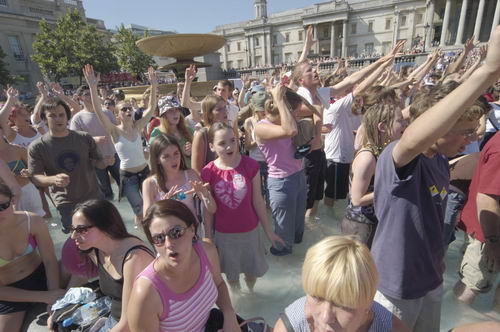
The event starts with a Pagan Pride Parade around Bloomsbury, with a dance and a certain amount of splashing around the fountain in the middle of Russell Square. The fountains have a number of jets which rise and fall, and some play is made of this in the proceedings.
The procession, led by the Green Lady, includes the Jack In The Green – a dancing bush – along with a whole band of Green Men, the Bogie drummers, Giants including Herne, Lord of the Forests, the Ravens and much more.
Beltane Bash is also a fund-raising event, helping to ensure the future of an area of 25 acres of ancient woodland, Raven’s Wood, near Tring in Buckinghamshire.
There are more pictures on My London Diary on most May pages from 2004 to 2010. Those from 2005 start here.
Chelsea Flower Show: Saturday 28 May 2005. I’ve never had a serious interest in photographing flowers, though I have occasionally pictured some of those growing in my garden, roses, apple blossom etc and turned my phone on plants and bouquets given to Linda so she can thank the donors. And although I’ve gone with students and family to Kew Gardens and elsewhere and taken the odd snap, I have never actually visited the annual Chelsea Flower Show.
But in 2005 I was persuaded by a photographer friend to go with him to Chelsea on the final day of the show, where t the end of the last day on Saturday a bell starts a frenzied sale of many of the plants on display.
It’s long been one of the events of the London season for photographers as men and mainly women stagger out onto the streets and onto buses and tube carrying huge pots of impressive specimens.
I did wonder how many of these fine and formerly cosseted plants made it back to their carrier’s homes, and if so how long they survived. Some marriages are rumoured to have been ended as husbands dropped pots, broke off stems getting on to buses or crowded tube carriages, and otherwise destroyed the prized and expensive loot on the way home to Putney and Wimbledon.
I suspect I mainly went along for a social pre- and post-event pint with my mates, and I don’t think I ever went again in later years – there are so many other things to photograph. I only wrote a short and hard to find paragraph for My London Diary to go with the over 50 photographs I put on-line – here in full with the usual corrections.
“Chelsea Flower Show is the biggest event of the gardening season, and the crowds are huge. This year an extra day was added to cut down on the jams, though I don’t know how effective it is.
Unless you are a gardening photographer, the most interesting part of the whole event is the end, when many of the plants on show are sold off and proudly carried home by their purchasers.
As you can see from the pictures, they carry them along the streets to the bus stop or car park or coach, providing a rather unusual spectacle”
The previous year, 2004, I had met the same friend close to Victoria Station where many of those getting onto buses with flowers from the show alight “to photograph them as they poured of the buses carrying their prizes. After a minor navigation error involving a Wetherspoons pub we made it, and managed to take a few pictures.“
On 18th March 1990 I took an early train to Vauxhall and then travelled east on the top deck of a 36 bus to Camberwell Green. I saw the buildings at the crossroads there and rang the bell to get off the bus to make a photograph.
Camberwell New Road, Denmark Hill, Camberwell Green, Camberwell, Southwark, 1990, 90-3e-55
Here I crossed the road and walked a few yards to take this picture looking across the start of Denmark Hill to Camberwell Green and the start of Camberwell Road Most of the buildings in my picture can still be identified although their uses have changed. That ornate National Westminster Bank is now Camberwell Green Surgery, and Kennedy’s Sausages are long gone, their site now occupied by Technozone.
The Grade II listed Baroque Revival bank was built in 1899 for the London and County Bank, which after a series of mergers with other banks including the London and Westminster Bank shortened its name the the Westminster Bank in 1923 and merged with the National Provincial Bank to form the National Westminster Bank in 1970.
But I was on my way to Peckham and after taking a single frame crossed back to the bus stop and took the next bus along Camberwell New Road to Peckham High Street and walked down Rye Lane.
Here the lighting was right for was an impressive array of architectural styles and eras on the west side of the street, from plain late Victorian to more ornate turn of the century, 1930s and probably 1950s or 60s.
The range of buildings represents the establishment of Rye Lane as one of South London’s shopping streets in the late 1870s, but outstanding for me was Peckham Indoor Market. As I wrote in an earlier post here:
“Peckham Indoor Market was built around 1938 or shortly after as Rye Lane Bargain Centre with an imposing frontage for a narrow arcade leading back to a large covered market. It’s a style that rather makes it look like a cinema. Across the top is the message ‘Come Rain Or Shine It’s Always Fine at Peckham Indoor Market’.
In the early 2000s the market at the back was reduced in size with part now redeveloped as flats but the front section remains and is now Rye Lane Market, housing over 50 small shop units.”
The Morning Star, Rye Lane, Peckham, Southwark, 1990, 90-3e-44
The Morning Star at 231 Rye Lane was built in 1871 and is now the Nag’s Head, having changed its name to cash in on the BBC TV comedy ‘Only Fools And Horses’, though I think the BBC made them paint over a reference to this high on the frontage. The pub was South London’s most famous Darts Pub in the 1970s and 80s.
But I was really photographing ‘The Triangle’ which had been a favourite meeting place for Mods and their scooters.
Former Camberwell Workhouse, Gordon Rd, Peckham, Southwark, 1990, 90-3e-33
20 Gordon Road was built as the Camberwell Workhouse in 1878 when a competition for their design was won by architects Berriman and Sons Ltd. It housed 743 able-bodied inmates. Women were employed in laundries and men broke stones and chopped wood. Taken over by the London County Council in 1930 it became the Camberwell Reception Centre, closing around the end of the 1970s. Minor buildings on the site were demolished and the main buildings converted into flats.
This was later simply a casual ward, and took in many normally sleeping rough and only seeking accommodation in bad weather or desperate for a meal. Many tramping the roads preferred to sleep rough as to get a meal and a bed for the night men were expected to then to join the permanent residents working most of a day breaking up stones to mend roads or chopping wood – or in the laundry for women.
Former Camberwell Workhouse, Gordon Rd, Peckham, Southwark, 1990, 90-3e-34
There were still ‘tramps’ in the 1950s who would knock at our back door in oouter London and my mother would talk to them, give them a mug of tea and fill their water bottle if they had one, but few people would make them welcome – and some set the dogs on them. We only had a cat, and my mother was a charitable woman. Tramps would often make chalk marks on pavements to tell others which houses to visit and which to avoid.
Former Camberwell Workhouse, Gordon Rd, Peckham, Southwark, 1990, 90-3e-36
Tramps would often run away before finishing their work – and this was a criminal offence which could put them in prison for up to a month were they caught until the 1970s.
Former Camberwell Workhouse, Gordon Rd, Peckham, Southwark, 1990, 90-3e-22
A bench from Gordon Road is now in the London Museum together with a good account of how ‘casuals’ would be treated, at least after the National Assistance Board built a waiting room at ‘the Spike’ in 1952 – though they think the bench was only provided after 1964 when a report noted that chairs were ‘brandished as weapons in altercations between waiting applicants’.
It quotes two of the casuals: ‘Upon arrival at Gordon Road, you had to wait with dozens of other dossers in a dingy, unheated outhouse containing nothing but a few benches. You might have to wait here for several hours, even all night‘ The waiting room was often overcrowded and violent: ‘Last night sat for three hours before the porters called us in. Quite a few drunks, same old faces, singing, swearing, bottles breaking, glass all over the place. One goes flying through the window and I duck as it flies over my head. Five or six porters come rushing in, they grab the drunk and push him out the gate.’
Those admitted were then given a hot bath – many were very dirty and infected by lice – before being fed. The Camberwell Reception Centre only finally closed in 1985 and was still derelict five years later when I made these pictures.
The Star of India, Gordon Rd, Peckham, Southwark, 1990, 90-3e-24
The Star of India was a Victorian pub on the corner of Gordon Road and Brayards Rd, dating from before the 1871 census. It was closed and demolished around 2000. A block of 12 flats on the site was completed by Habitat for Humanity using 1500 volunteer days in 2009. The flats were sold on completion to Hexagon Housing Association and New World Housing Association.
Waiters Day, Monsanto, White Pride & The Line: Saturday 23rd May 2015 was a busy day, beginning with Unite Hotel Worker, moving on to the global March Against Monsanto, then an extreme right White Pride protest and finally going to the opening of the world-class sculpture walk roughly along the Greenwich Meridian, The Line.
Waiters Day call for fair contracts and union rights
Grosvenor House Hotel, Park Lane
Bakers Food and Allied Workers Union President Ian Hodson
The Hotel Workers branch of Unite protested outside the Grosvenor House Hotel in Park Lane, the birthplace of Zero Hours Contracts, on National Waiters Day, calling for an end to poor conditions, poverty wages, zero hours contracts and management stealing of tips.
Some of the protesters wore masks and placards with names of leading company bosses using zero hours contracts and exploiting workers and took part in a short ‘waiters race’ along the pavement in front of the hotel. The race was of course fixed
Back in 1979 waiters at the Grosvenor House Hotel in Park Lane were sacked when they tried to organise a trade union branch there. The case eventually went to court where it was decided their sacking was legal. It was this case, O’Kelly v Trusthouse Forte plc, that opened to door to Zero Hours Contracts in the UK. Previously employment law had been based on “mutuality of obligation” with employers obliged to offer hours of work, and employees to work those hours.
Until 2012 less than 1% of employees were on zero hours contracts, but their use then rocketed, and by 2015 had increased to 2.5%. By 2021, roughly half of the organisations in hospitality and entertainment were using them.
National Waiters Day seems to have been invented in the USA in the early years of this century and is generally observed on May 21st. A UK Waiters Day was begun by restaurant manager Fred Sirieix in 2013 and is on October 20th.
In London the annual Global March Against Monsanto by over 3.5 million people across 600 cities was marked by a small static protest opposite Downing St.
Monsanto and other companies which profit from GMOs claim they are playing an important part in feeding the world, but are actually attempting to monopolise food production for their own profit, patenting existing species, trying to prevent farmers from saving and using their own seed, encouraging the use of highly toxic chemicals and practices that degrade the soil.
As the protesters say, we need to plant our own seed, to grow local and to eat sustainable food, and to do so in our own ways in countries across the world.
The end of the banner reading Töten für Wotan (Kill for Wotan) was rolled up as I moved to photograph it
A group of around 30 ultra-right neo-Nazi protesters at the US Embassy remembered David Eden Lane, a convicted criminal and author of the ‘14 words’ statement used by extreme right groups about securing a future for white children. A small group of anti-fascists had come to oppose them.
One of the right-wing protesters makes a Nazi salute for my camera
Lane was a co-foounder of ‘The Order‘ a rabidly antisemitic group which bombed theatres and synagogues and he was convicted as the getaway driver after they murdered liberal Jewish Denver radio talk show host Alan Berg in 1984 when he was the second on their long death list. The group also carried out violent robberies to finance their activities. He died in prison in 2007.
His 14 words, a close quotation from Mein Kampf, is often referred to in extreme right circles as ’14/88′, where 88 stands for the repeated 8th letter of the alphabet, HH, shorthand for ‘Heil Hitler’.
Peter Rushton of the England First Party waits to speak
Inside jail, Lane, a former Ku Klux Klan and the ‘White Christian Separatist’ group ‘Aryan Nation’ member, was one of the founders of a new pagan religion, ‘Wotanism‘, named after the Germanic god Odin, also know as Wotan, which serves as an acronym for ‘Will Of The Aryan Nation’.
It was good to get away to something much more pleasant, the official opening of the world-class sculpture walk, ‘The Line‘ with works by distinguished sculptors going north from Greenwich across the Thames and on to the Olympic Park.
I’d visited the festivities at Cody Dock in the morning when few people were around to photograph the site and walk a short stretch of the trail.
One piece I found particularly interesting was DNA SL90 (2003) made by Abigail Fallis from 22 shopping trolleys for a supermarket chain to mark the 50th anniversary of Crick & Watson’s discovery of the double-helix structure of DNA. It’s location on the edge of Bow Creek next to a major distribution centre, seemed particularly appropriate, and it is an impressive piece.
A Cody Dock volunteer snips the ribbon and ‘The Line’ is open
I returned from central London just in time for the opening ceremony when a fair sized crowd had gathered.
Since 2015 new stairs down from the bridge at have removed the awkward detour alongside the busy Blackwall Tunnel Approach, but I think we are still waiting for the opening of the riverside path along Bow Creek south of Cody Dock.