Church Path, Town Hall & West Reservoir – 1990

Church Path, Town Hall & West Reservoir: The third and final post from my walk on April 1st 1990. The previous post was Reservoir, Castle & Lordship Lane

Church path, The Old Church, St Mary's, Church, Stoke Newington, Hackney, 1990, 90-4b-61
Church path, The Old Church, St Mary’s, Church, Stoke Newington, Hackney, 1990, 90-4b-61

The Old Church is the only remaining Elizabethan church in London, built in 1563 when the then Lord of the Manor decided to rebuild the near-derelict parish church, including a private chapel for him and his family. The Church was extensively restored in 1827-9 by Charles Barry who almost doubled its seating and replaced its wooden spire – not visible in my picture. But although much has changed it has retained its Tudor character.

The Old Church was heavily damaged in wartime bombing in October 1940, but repairs were made quickly and it was back in use only a couple of months later. Later there were more repairs and most of the box pews were removed. In 2013 the interior was remodelled to make it a flexible arts and community space.

The Old Church is on the right of my picture, rather overshadowed by its successor; there was a call by the end of the eighteenth century for a larger building to cope with the growing population of the area, but the new and much larger church was only opened in 1858. The new St Mary’s Stoke Newington was designed by George Gilbert Scott but its spire was completed by his son, J O Scott, in 1890. The building is in the Decorated style of the late C13/early C14 made popular by Pugin and the Ecclesiologist Movement. The Old Church became a ‘chapel of ease’ and has never been deconsecrated. Both churches are Grade II* listed.

Monument, Church path, The Old Church, Stoke Newington, Hackney, 1990, 90-4b-63

One of the several impressive monuments in the churchyard around the Old Church, but I cannot make out the names of those buried here – though one of them died in 1789.

Several people prominent in the abolition of the slave trade have their graves here including James Stephen (William Wilberforce’s brother-in-law, a lawyer and chief adviser on the anti-slavery bill) and Wilberforce’s sister and daughter. He also asked to be buried here but when he died it was decided he should be in Westminster Abbey.

Two tombs in the cemetery are Grade II listed, that of James Stephen and of the Romantic woman poet and abolitionist Anna Laetitia Barbauld (1743-1825) and her ‘beloved brother’, John Aikin (1747-1822)

Stoke Newington Town Hall, Stoke Newington Church St, Stoke Newington, Hackney, 1990, 90-4b-65

Stoke Newington Town Hall is an impressive municipal building, designed by J Reginald Truelove as the Town Hall for the Metropolitan Borough of Stoke Newington and built in 1935-7 and still in use as council offices.

On its noticeboards are fly-posters from the TKiH, the Türkiye Komünist isci Hareketi, Communist Workers’ Movement of Turkey, illegal in Turkey. Founded in 1984 it merged with other Turkish groups in 1994 to form the Marxist-Leninist Communist Party, MLKP who still appear in force in London’s May Day March.

West Reservoir, Lordship Rd, Stoke Newington, Hackney, 1990, 90-4b-55

I returned to the West Reservoir and took a walk around it – I think this picture shows the New River at right and was taken from a bridge over it. There appears to be a channel with a sluice gate joining the reservoir and the river just beyond the skip in the centre of the picture.

West Reservoir, Lordship Rd, Stoke Newington, Hackney, 1990, 90-4b-31

And I think this view was from more or less the same place but looking in the opposite direction, with the New River now in the foreground and council estates and solid blocks of council flats at Woodberry Down, a huge LCC estate built immediately after the war and now redeveloped.

This wasn’t quite the end of my walk, as I made my way back to Manor House station from here, and I took my final picture of the day going down the escalator there – but it was not worth digitising. For my next walk I returned to south London.


FlickrFacebookMy London DiaryHull PhotosLea ValleyParis
London’s Industrial HeritageLondon Photos

All photographs on this page are copyright © Peter Marshall.
Contact me to buy prints or licence to reproduce.

Highgate to Stoke Newington

On the early May Bank Holiday – the one that should have been on May Day but isn’t – Linda and I walked another short section of the Capital Ring, from Highgate to Stoke Newington.

After a short walk along footpaths and roads, the route joins the former railway line which is now the Parkland Walk. Quite a lot of this is in a cutting, though there are some embankment sections, but except where the line has bridges over roads the view is often very limited by trees and bushes which have grown beside the former line.

A long bridge takes you across the East Coast main line and its suburban outliers and into Finsbury Park, where both cafe and toilets were very welcome.

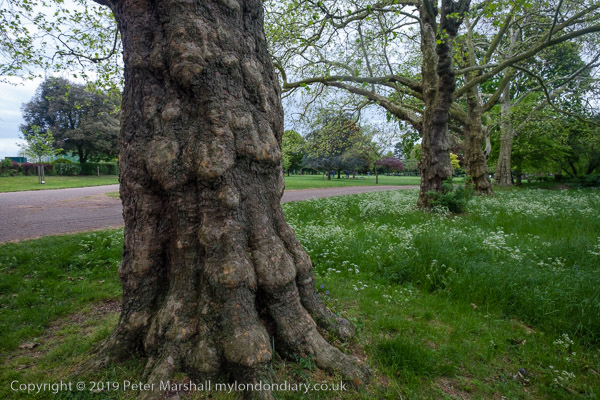
Across the park you join the New River, supplying water to London since 1613, thanks in particular to the efforts of Sir Hugh Myddelton, though I expect he had quite a few others to dig it for him (and it wasn’t his idea in the first place.)

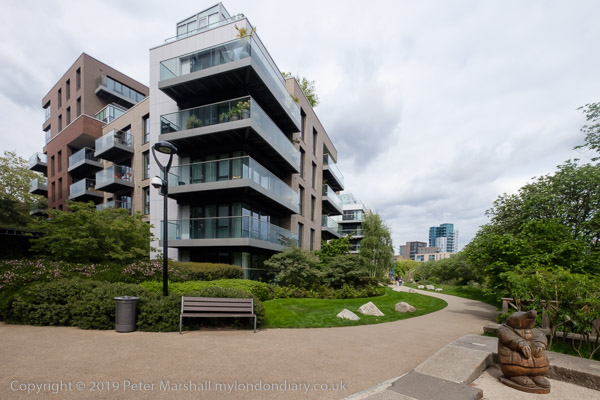
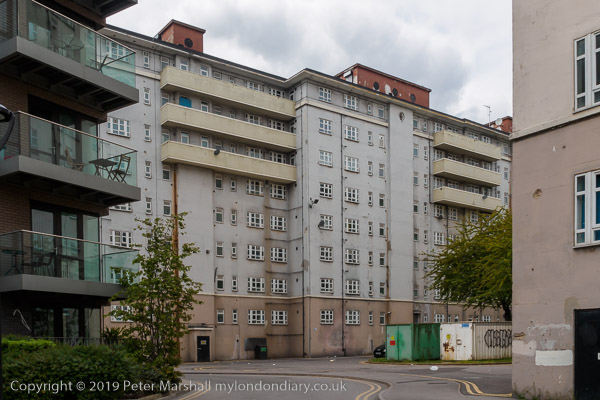
This goes along the edge of the Woodberry Down Estate, a large area bought by the LCC for housing in 1934, but only developed after the war as a ‘utopian estate of the future‘. Building began in 1949 and the 57 large blocks of flats were only completed in 1962. The estate included the country’s first purpose built comprehensive school and a medical estate opened by Nye Bevan, but unfortunately was allowed to deteriorate over the years, and beggining in 2009 became one of Europe’s biggest single-site estate regeneration projects.

The controversial scheme by Berkeley Homes, Notting Hill Genesis and Hackney Council will involve a loss of around a fifth of social housing in the area estimated by the council at around 320 homes and has been described as ‘state-sponsored gentrification‘ with 3 bed flats selling for around £800,000 and many being bought up as investments by foreign investors rather than used as homes.

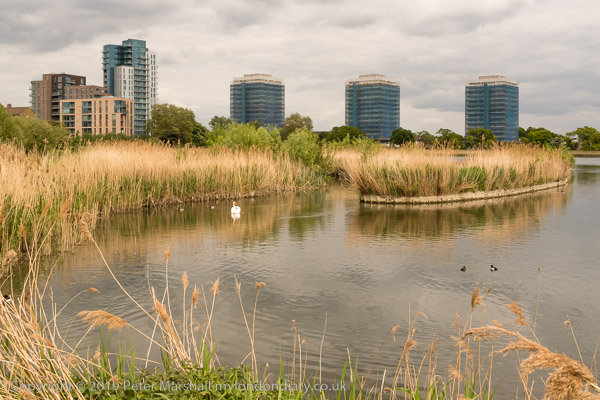
On the opposite side of the path, across the New River are large reservoirs of open water, part now a nature reserve with public access (and another tea room with toilets) and another used for sailing and other water sports. The remarkable Scottish Baronial castle built as offices for the water board is now a climbing centre.

From there it’s a short walk to Clissold Park (another cafe and toilets – this must be the best provided section of the Capital Ring) and Stoke Newington Church Street, often described as a ‘hipster hub‘. Next to the park are the two churches of St Mary, the older locked but with an atmospheric and overgrown churchyard and the Victorian built in 1858 to the design of Sir George Gilbert Scott,  open and well worth a visit.

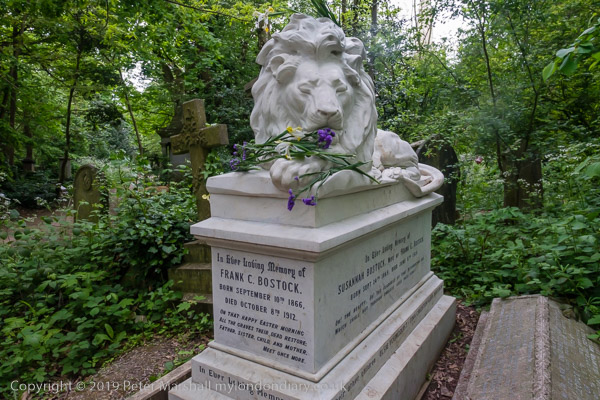
As a final climax we came to Abney Park Cemetery, one of London’s finest, set up in 1840 as a burial ground for non-conformists and the final resting place of around 200,000 Londoners, now a nature reserve. We looked up the train times from nearby Stoke Newington station and rather than rushing through to the station spent some time wandering around and finding a few of the better-known graves and some other interesting monuments.

In our rush from there the few hundred yards to the station I lost a little concentration and we went down to the wrong platform and caught a train going into London rather than out and had to re-plan our journey home. It turned out to be almost as fast.

More pictures from the walk at Highgate to Stoke Newington.


All photographs on this and my other sites, unless otherwise stated, are taken by and copyright of Peter Marshall, and are available for reproduction or can be bought as prints.

There are no adverts on this site and it receives no sponsorship, and I like to keep it that way. But it does take a considerable amount of my time and thought, and if you enjoy reading it, please share on social media.
And small donations via Paypal – perhaps the cost of a beer – would be appreciated.