Wimbledon, Pensions & Hammersmith: On Saturday 19th June 2004 I paid a short visit to Wimbledon Village Fair before photographing a TUC protest calling for changes in pension law and better pensions in Westminster and then going for a short riverside walk in Hammersmith. There are more pictures from the protest on My London Diary, I’ll include the short text I wrote at the time about the day as well as some from the captions I wrote in 2004.
Wimbledon Village Fair
Home of tennis and the Wombles, Wimbledon always strikes me as an alien implant in London by some civilisation with a time machine, a sense of humour and a very fat wallet. I dropped in to the Village Fair just to see it still existed.
Pay Up For Pensions – Trade Union Congress March and Rally
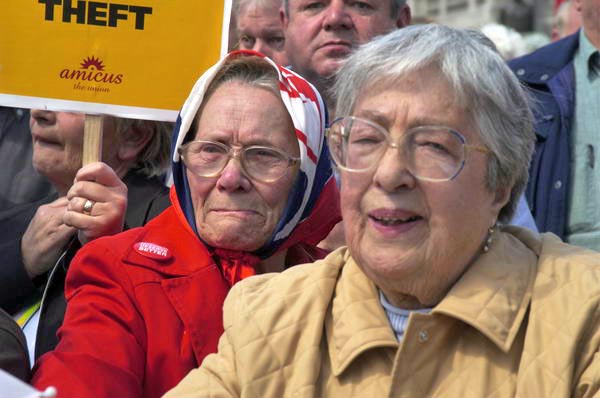
Half an hour later I was back in the real world. Where companies make off with the pension funds leaving people who have paid in to schemes for years with no pensions. where other creditors come before pension holders when companies go bust.
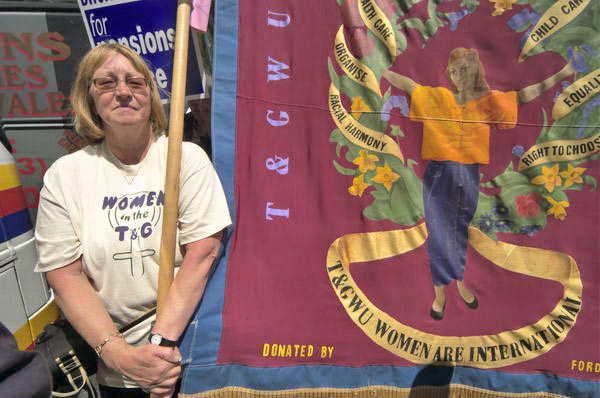
Where millions of lower paid workers now have no employment pension rights at all. Where women have always been treated unfairly in many respects. Where government has worsened conditions for civil servants, teachers and others. As TUC General Secretary Brendan Barber says “Those who used to have good pensions now have poor pensions. Those who used to have poor pensions, now have no pension.”
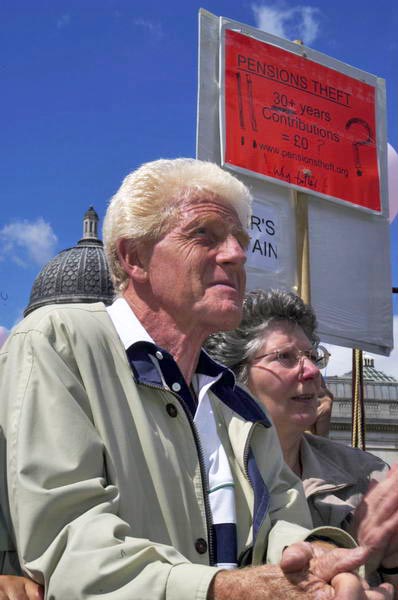
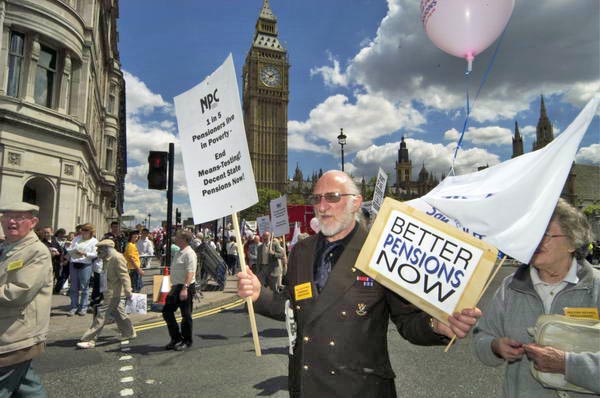
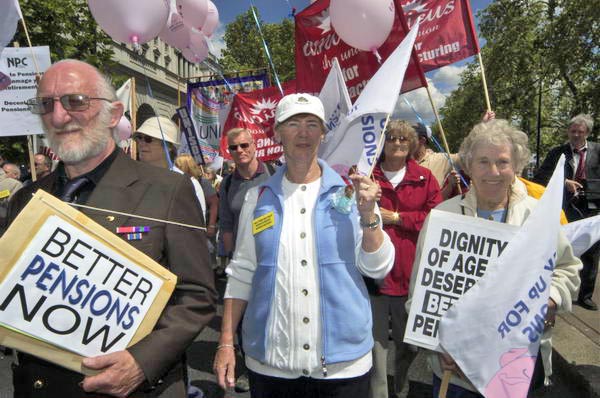
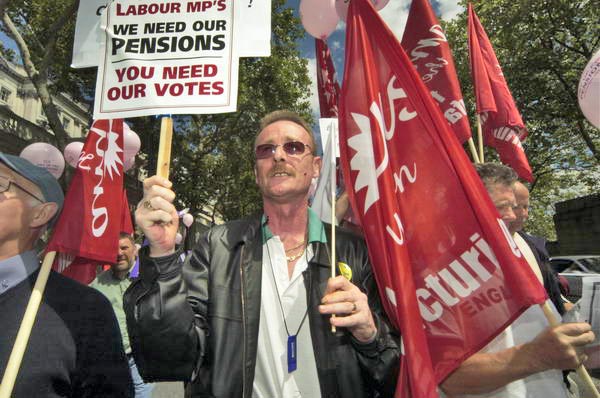
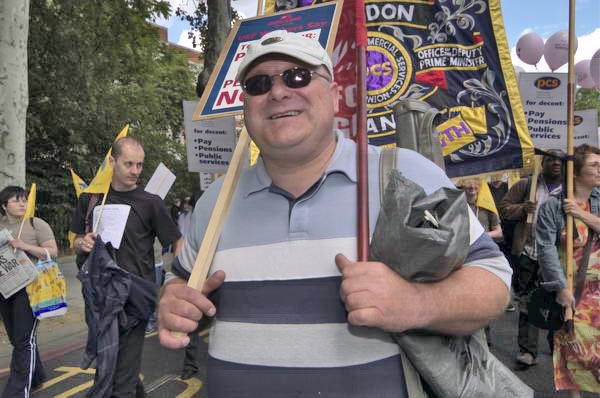
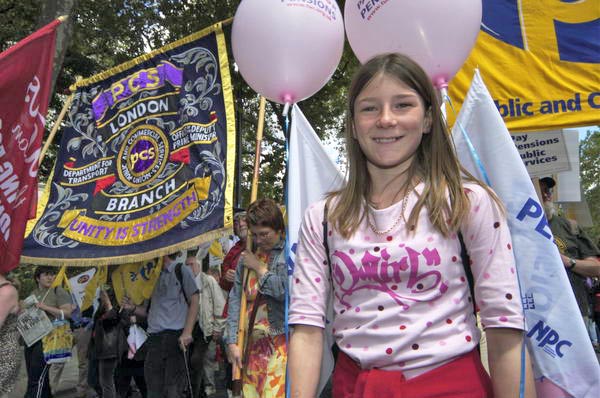
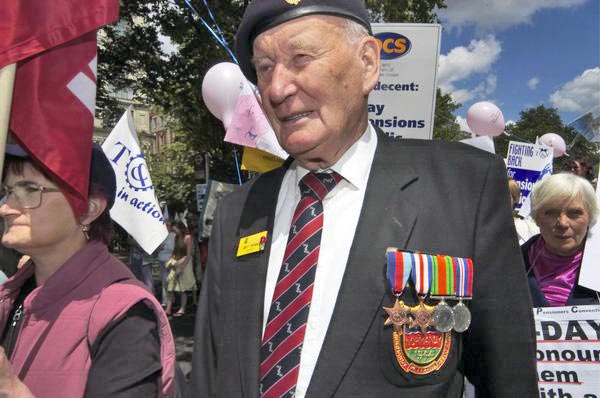
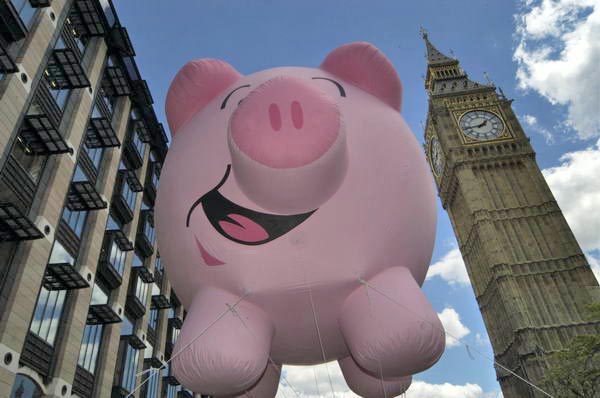
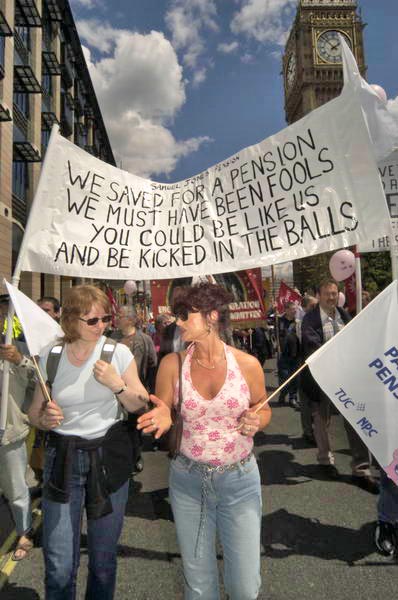
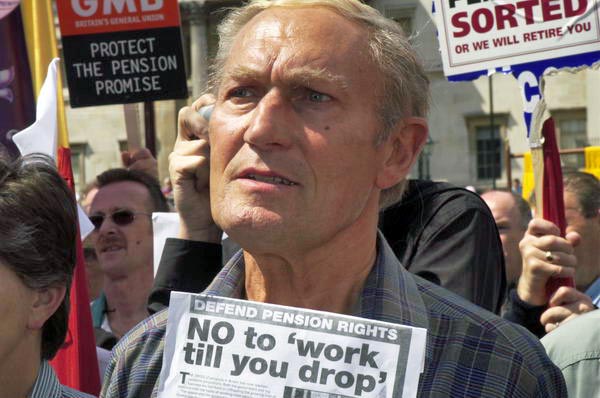
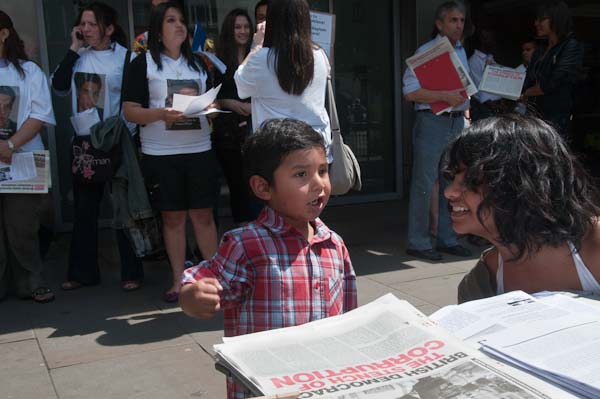
Around 5-10,000 people marched down from Temple towards the Houses of ParliamentMarchers included many workers who have already lost their pensions when their companies foldedBanners on the march included many union branches including those for civil servantsPeople of all ages took part; not only the old are affected by pensions.Marchers included pensioners who had served in WW2Women have never been treated fairly over pensions by employers or stateThe pink pensions pig caught between Big Ben and Parliamentary OfficesWorkers from Samuel Jones lost their pensions when the company was taken over‘Protect the Pension Promise’, ‘NO to work ’till you drop”. The labour movement looks to the government to act on pensionsPensioners want a better deal, and the unfairness of pension theft is widely recognised
Unfortunately the New Labour Government wasn’t listening and the “the great British pension theft” begun by Margaret Thatcher and taken over by Gordon Brown continued, while ineffectual legislation introduced after the scandal when Robert Maxwell stole £460 million from the Mirror pensioners continued to allow companies to steal pensions from their workers. Despite pension protection schemes, workers can still lose when companies are taken over or fail.
River Thames at Hammersmith – Furnival Sculling Club
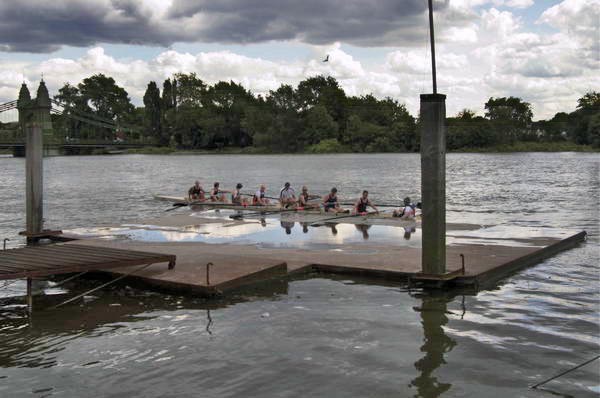
On the way home I went for a walk by the river in Hammersmith, another area of London strongly associated with William Morris. The Funivall Sculling Club here was established in 1896 as the Hammersmith Sculling Club For Girls – the world’s first women’s rowing club – by Dr Frederick Furnivall; it went unisex in 1901. Furnival had earlier championed rowing for working men. He served as the model for Ratty, the water rat in ‘Wind In The Willows’, as well as being involved with the preparation of the Oxford English Dictionary.
Hammersmith Mall – The second building is the Furnival Sculling ClubWeeds and pollution in the ThamesPlastic bottles and other rubbish collected up by this landing stage near Hammersmith Bridge
The former BBC Riverside Studios – part converted to offices which were advertised by the banner at roof level. It was imaginatively redeveloped in 2014-6 to provide better public facilities, a riverside walkway and 165 flats.
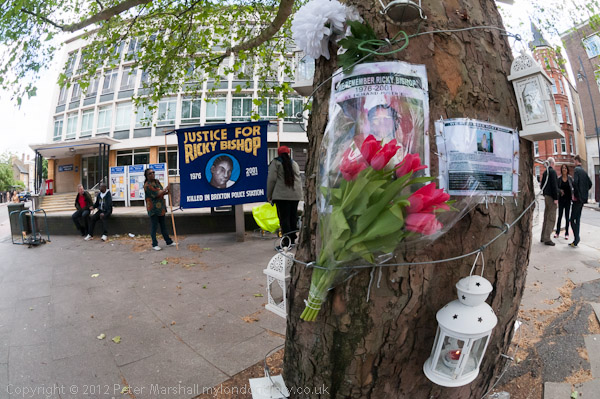
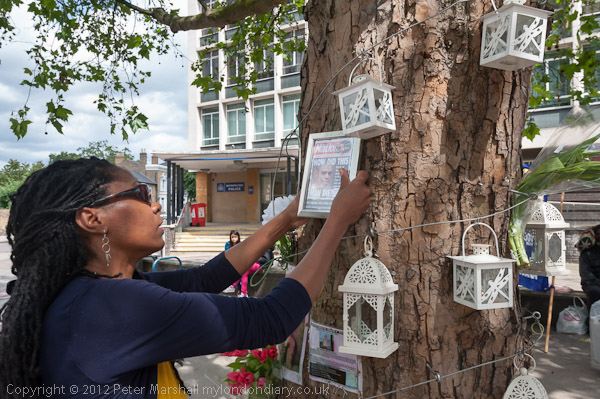
Chariot Festival & Vigil for Custody Deaths: On Sunday 17th June 2012 I photographed the Rathayatra Chariots Festival in Hyde Park, leaving as it set off to go to Brixton. Families of men killed in police custody were holding Fathers Day vigils outside police stations and at Brixton, the family of Ricky Bishop was joined by the sisters of Sean Rigg, whose inquest 4 years after his death there had just started and was in the news.
Hare Krishna Chariot Festival – Hyde Park
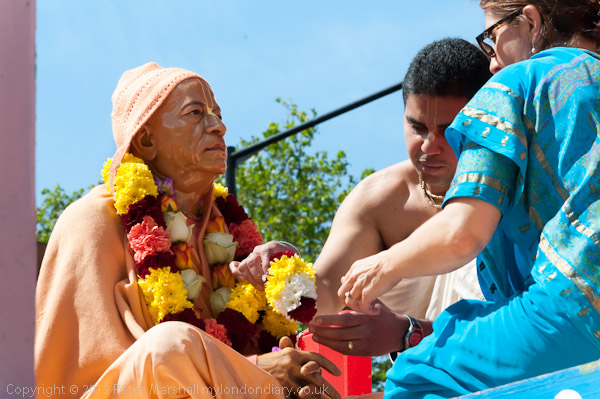
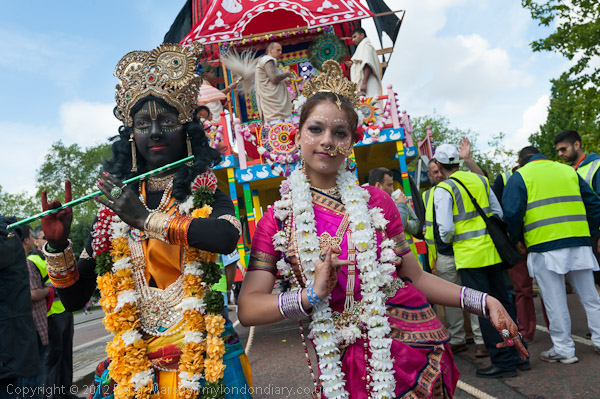
Effigy of A.C. Bhaktivedanta Swami Prabhupada (1896-1977) the founder of ISKCON (Hare Krishna)
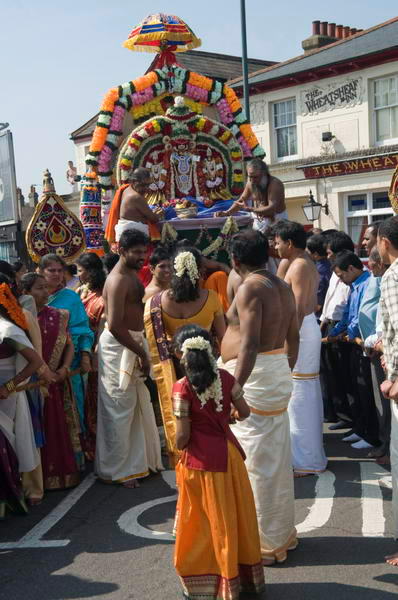
The annual Rathayatra Chariots Festival is now one of the largest and most colourful religious processions in London with more than a thousand devotees pulling the three giant chariots through the streets from Hyde Park to Trafalgar Square, chanting ‘Hare Krishna’ and dancing.
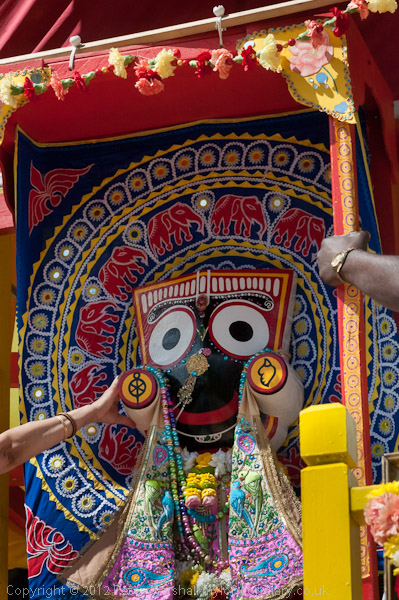
The ceremony which began at the Jagannatha temple in Puri, Orissa on the Indian east coast at least a thousand years ago celebrates the time when Krishna grew up on earth; when he became a great lord he moved away from his childhood friends who were cowherds and they came with a cart and tried to kidnap him and take him back to their village.
Jagannath means ‘Master of the Universe’ and his name and the chariots in the festival give us the word “juggernaut”.
The first Rathayatra festival in the west was in San Francisco in 1967 and two years later it was begun in London by disciples from the International Society for Krishna Consciousness (better known as the Hare Krishna.)
Krishna, his sister Subhadra and elder brother Balarama each have a chariot and an effigy of the founder of ISKCON, C Bhaktivedanta Swami Prabhupada (1896-1977) is also carried on one of the chariots in the festival.
Fathers Day Vigil for Custody Deaths – Brixton Police Station
At the vigil outside Brixton Police Station the family of Ricky Bishop was joined by the sisters of Sean Rigg; both were young men in their twenties died after being taken into the police station, Bishop in 2001 and Rigg in 2008.
On My London Diary you can read more about the two deaths and the steps police have taken to stop the truth about their deaths emerging with lies and failures to investigate. The inquiry by the IPCC wailed to question the officers concerned until 8 month after Sean Rigg’s death and the inquest was delayed for four years, beginning a few days before this protest. It was only because of the huge battles by his family that many of the facts emerged. A report into the IPCC investigation in 2013 had concluded they had committed a series of major blunders.
Two months after this vigil, Wikipedia states ‘the inquest jury returned a narrative verdict which concluded that the police had used “unsuitable and unnecessary force” on Rigg, that officers failed to uphold his basic rights and that the failings of the police “more than minimally” contributed to his death.’
Other vigils were taking place on the same day at Birmingham West Midlands Police HQ and in High Wycombe for Habib ‘Paps’ Ullah, in Manchester for Anthony Grainger, Slough for Philmore Mills and at New Scotland Yard for Azelle Rodney.
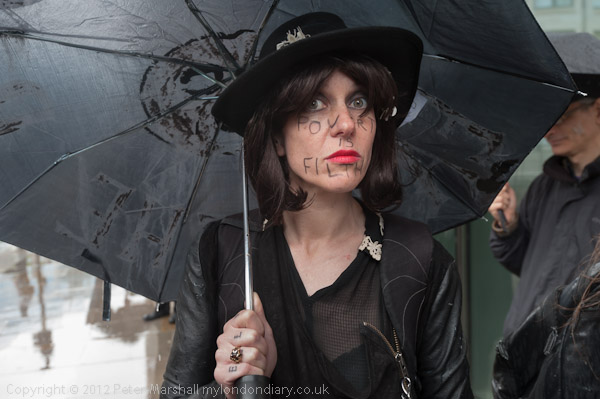
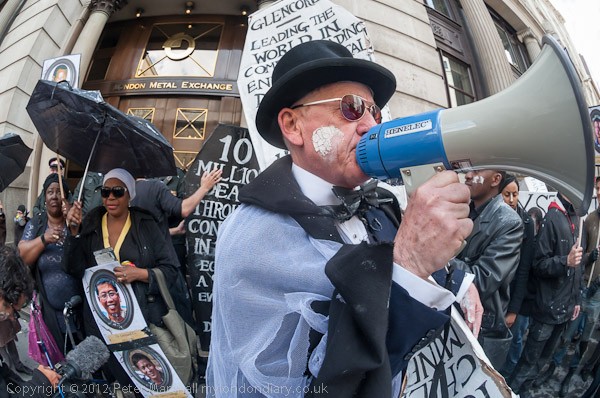
The ‘Carnival of Dirt‘ united activist groups from the UK and around the world in a funeral procession for the many killed by mining and extraction companies, powerful financial organisations whose crimes are legitimized by the City of London.
Mining companies have exploited mineral resources in countries around the world, mainly in the majority countries to feed the industrial development of countries such as ours, and have done so with little or no regard for the environment or the people who work in their mines or live in the areas around, creating large amounts of pollution and destroying vital habitats and traditional ways of life, driven by producing minerals at the lowest possible cost.
Many of those companies are based in London, in part because of our imperial past and are listed on the London Stock Exchange and trade on the London Metal Exchange. They are propped up by our pension funds and protected by our government and even allowed to get away with evading millions (if not billions) of UK taxes – as well as often evading taxes in the countries where they mine. Among the major criminals named were Xstrata, Glencore International, Rio Tinto, Vedanta, Anglo American, BHP Billiton, BP and Shell.
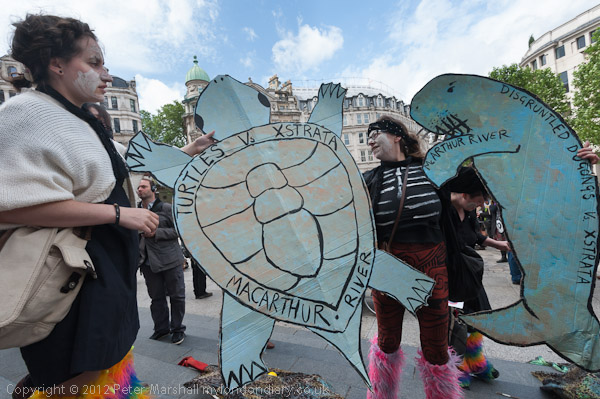
Turtle & Dugong – Xstrata has destroyed their homeland in the Macarthur River
The carnival procession began at St Pauls and stopped at the Stock Exchange, the Bank of England and the London Metal Exchange for speeches about the various crimes, before going to stop for lunch at Altab Ali Park.
There had been several heavy showers and by lunchtime my zoom lenses were all steamed up internally – zooming draws in damp air which condenses on the glass – and I only had a 16mm fisheye giving totally clear images. I needed to dry the others out and decided I had taken enough pictures and it was time for me to go home – although the carnival was going to continue to the West End and end with a ‘Reclaim the Streets’ style party starting on the Embankment at 6pm.
I described the event at length in 2012 and here I’ll quote some of it, but you can still read it all at Carnival of Dirt on My London Diary.
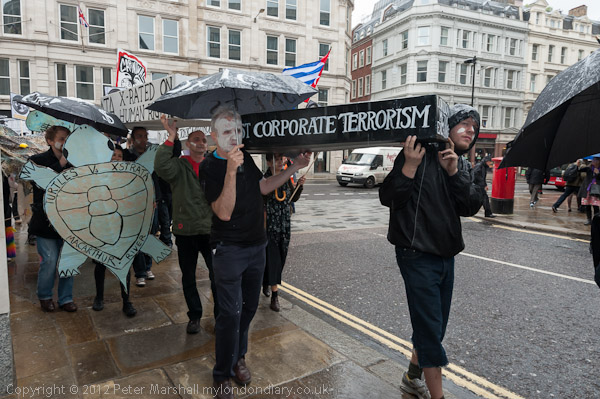
The funeral cortege that gathered at St Pauls included a large snake, a turtle and a tortoise, a reminder of XStrata’s criminal diversion of the McArthur River, destroying the ecosystem and despoiling the sacred sites of Australian aborigines.
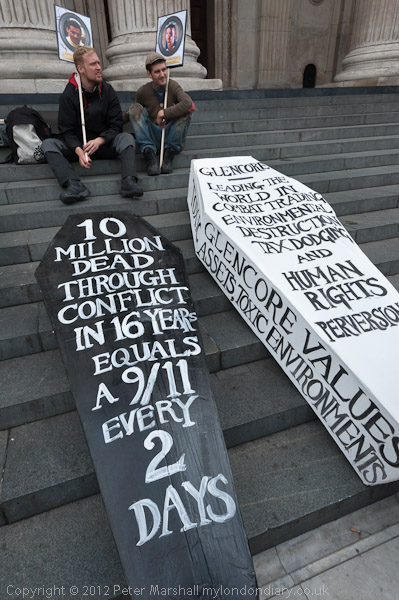
There were coffins representing the dead and naming many of the companies involved one said ‘Glencore Values – Toxic Assets, Toxic Environments‘, another ‘XStrata – X-Rated on Human Rights‘ and pointed out the CEO Mick Davis “Gets £30 million to stay in job while 2 Dead 80 Injured protesting at Tintaya mine in Chile.’
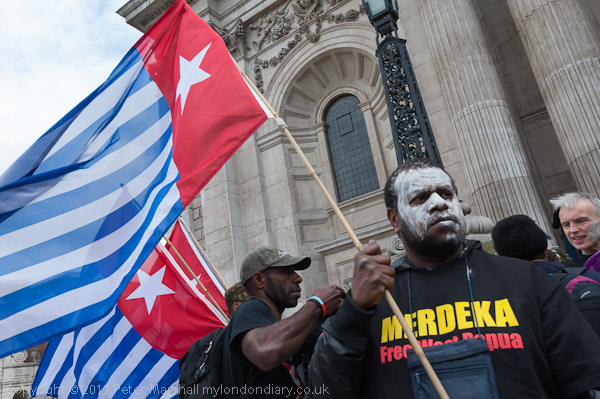
A small coffin represent the over 18,000 child miners in the Phillipines, while another read ‘10 Million Dead Through Conflict in 16 years equals a 9/11 every 2 days‘. A black coffin carried on the side the message ‘Resist Corporate Terrorism‘ and on the top the message ‘London Metal Exchange – Setting the Global Standard in Bloodshed‘ with red drops bleeding from it. Another testified to the genocide in West Papua where Indonesian troops have torched villages.
Many carried placards with photographs of a few of the better-known activists who have been murdered for standing up to corporate terrorism, and marchers distributed a leaflet naming 15 of them – Valmore Locarno, Fr Fausto Tentorio, Victor Orcasita, Alexandro Chacon, Fr Reinel Restropo, Dr Gerry Ortega, Armin Marin, Dr Leonard Co, Elizer Billanes, Jorge Eliecer, Floribert Chebeya, Raghunath Jhodia, Abhilash Jhodia, Damodar Jhodia, Petrus Ayamiseba. Others carried photographs of unnamed and horribly mutilated victims.
Grenfell 8 Years On – 14th June 2025: Usually I write about events in the past, but today I’m thinking about something that will take place this evening in Notting Hill on the eight anniversary of the terrible Grenfell Tower fire on 14 June 2017. I’ll put the invitation to join this evening’s silent walk by Grenfell United at the end of this post.
2018
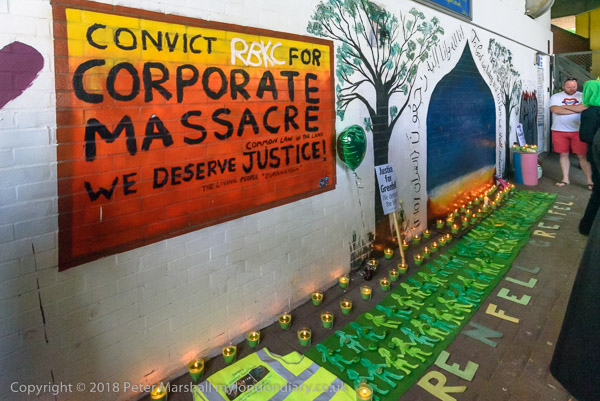
Eight years have passed, a long and detailed inquiry has taken place, but still we have seen no justice. Before long the tower will be taken down and the government will be hoping that we will all forget the terrible crimes that led to the fire.
2018
The essential details were largely known well before the inquiry began, within a month or two of the fire. More would have come out in court had prosecutions begun then. Instead we have had 8 years with little or no action, and certainly no justice.
2018
Eight days after the fire, Architects for Social Housing held an open meeting with residents, housing campaigners, journalists, lawyers, academics, engineers and architects about it, and the following month produced a report, THE TRUTH ABOUT GRENFELL TOWER.
2018
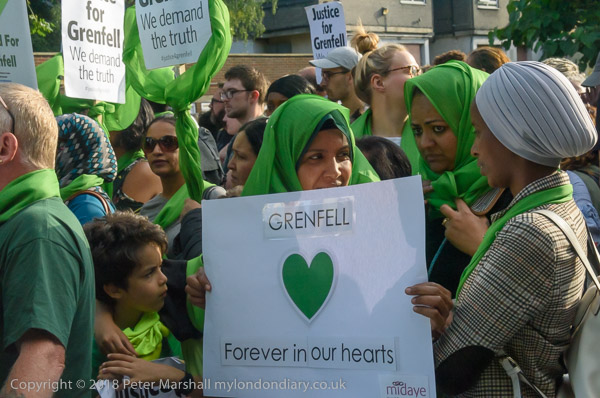
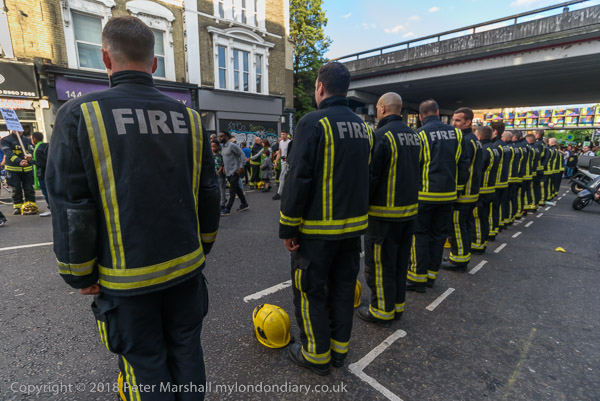
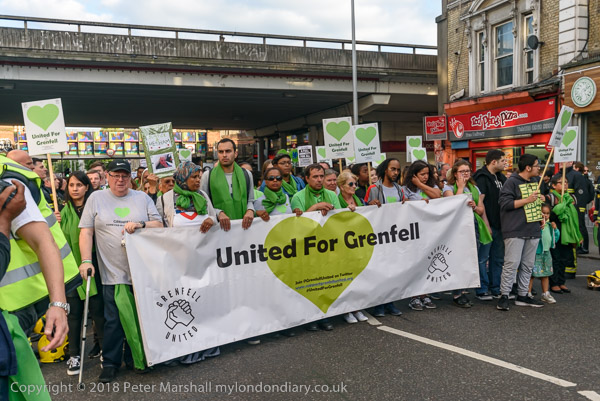
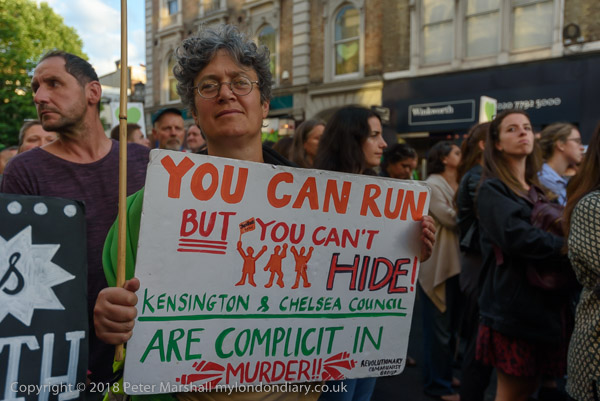
I went to many of the silent walks that have taken place to remember Grenfell – the images here are from the first anniversary on 14th June 2018, when around 10,000 people took part. I’l post the link to this event and to that in 2019 at the bottom of the post. As well as many more pictures these also contain more of my comments on the fire and its aftermath. And you can find more events I covered related to the fire by a search for ‘Grenfell’ on My London Diary.
2018
Grenfell United
Please join us at the Silent Walk for the 8th Anniversary of the Grenfell Tower fire on 14 June.
8 years on. No arrests. No justice. The tower is a stark reminder of what happened that night but the government has decided it’s time to bring it down.
Walk with us to show them you still stand united with the Grenfell Community. They want the tower out of sight. But we won’t stop until the criminals are brought to justice.
The Grenfell Silent Walk to remember the 72 people who died at Grenfell, to honour their memory and demand justice starts at 6pm at Notting Hill Methodist Church. Please wear green in solidarity.
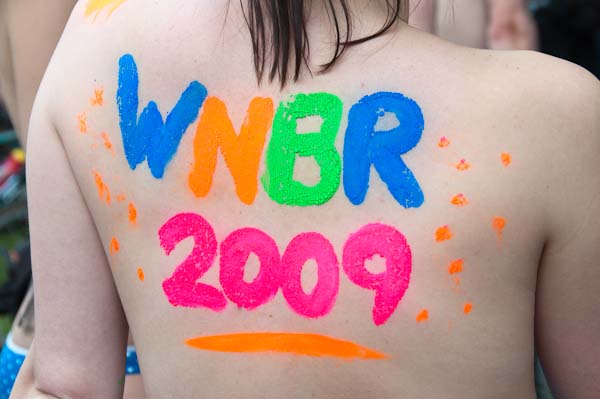
Carnival, Racist Deportations & more Naked Cyclists: I began work on Saturday 13 June 2009 photographing a carnival procession in Carshalton in the south of London, travelled to Islington in north London for a protest against Britain’s racist and inhuman immigration policies and finally covered the uncovered cyclists taking part in the 2009 London World Naked Bike Ride, photographing the preparations in Hyde Park ad the start of the ride there and then on the ride at Waterloo and in the West End.
Carshalton Carnival Procession – St Helier – Carshalton
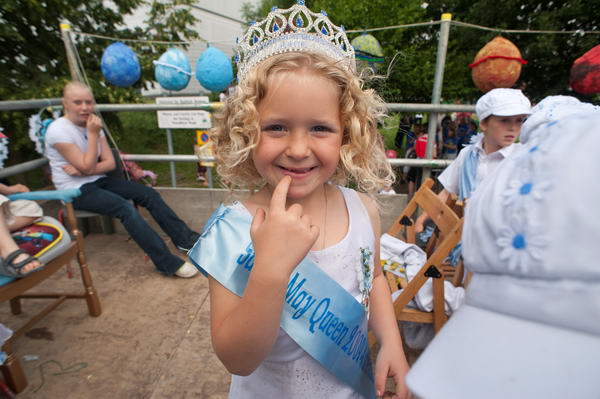
Sutton’s May Queen 2009 came to look at my cameras
My account of this event on My London Diary begins with a slightly unkind description “of the St Helier estate, a huge sprawling area built by the LCC 1930 to a kind of debased Garden City plan almost entirely without the charm of those earlier developments on what had previously mainly been the lavender fields of Mitcham.”
The procession began next to the “St Helier Hospital [built] in the modern style of the 30s, facing the imaginatively named St Helier Open Space” outside the Sutton Arena leisure centre and as usual I found the more interesting pictures were those I took there rather than on long procession to Carshalton where it was to end at a fair in Carshalton Park.
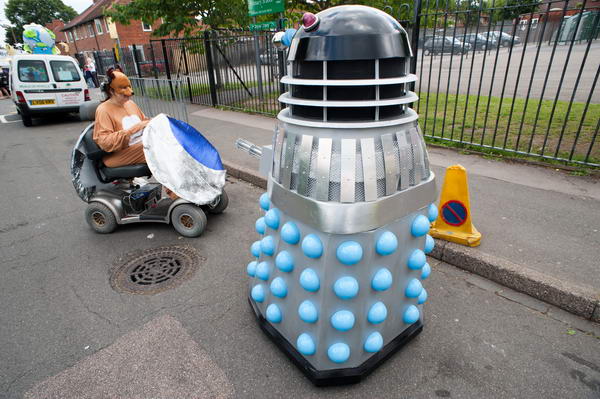
I’d come to the carnival largely because I was then working on a project on London’s May Queens, with several groups of them from across south London taking part in the procession, along with various other local organisations. And a Dalek and others in fancy dress.
The Rotary had brought their Father Christmas coming out unseasonably from the chimney of a small four-wheeled house towed behind a car at the rear of the procession. He’d been there too when I photographed the carnival previously in 2004.
It was a long an hot trek to Carshalton from St Helier, and the procession paused at Carshalton College for a break. I’d walked enough and made my way to the station missing the rest of the event and the funfair in Carshalton Park.
Speak out against Racism and Deportations – Angel, Islington
Britain’s major political parties at the prompting of our mainstream press have long promoted myths about migrants and asylum seekers, the more rabid of our tabloids in particular promoting the views of clearly racist columnists who publish stories about them getting homes and huge benefits, depriving the working class of housing, pushing down wages, taking “our jobs“, making it impossible to see doctors and more.
Nothing could of course be further from the truth. It’s the greed of the wealthy and government policies that have led to these problems – and without the migrants we would be in a considerably worse position. It’s something that is glaringly obvious when we need to make use of the NHS which would have collapsed entirely without them, but also in other areas. Demonising migrants is a deliberate policy divert public attention and anger away from the real problem of our class-based society. Divide and rule by our rulers,
Most of those who settle here from abroad want nothing more than to work and contribute to our society, though we make it hard for many of them to do so. They want a better life, particularly for their children and often work long hours for it. Migrant workers who clean offices are often more qualified than those who work in them – but their qualifications are not recognised here, and asylum seekers are unable to work except in the illegal economy.
Some facts:
Over a quarter of NHS doctors were born abroad (and others are the sons and daughters of migrants);
Immigrants are 60% less likely to claim benefits than people born in Britain;
Studies sho immigration has no significant effect on overall employment, or on unemployment of those born in Britain.
This campaigning protest in a busy shopping area outside one of London’s busier Underground Stations was organised by the Revolutionary Communist Group and was also part of a campaign by the Suarez family to prevent the deportation of John Freddy Suarez Santander, a 21 year-old father with a 3 year-old son. He came here from Colombia when he was six and grew up here. As a teenager he committed an offence and served 7 months in a young offenders institution.
Two years after he had served his sentence, the New Labour government passed a law to deport all immigrants with a criminal record, and an order was made for him to be sent back to Colombia, where he has no remaining relatives. His case in 2009 was still being considered at the European Court of Human Rights. The ECHR generally asserts that juvenile offences should not be seen as a part of a criminal record, but the Home Office decided the month before this protest to deport him anyway, and this was only stopped by his family going to the airport.
I’ve written rather often about this event, intended as a protest against the domination of our lives by ‘car culture’ which has resulted in our towns and cities and transport networks being designed around the priorities of motorists and road transport rather than us as pedestrians and cyclists – and to serve the interests of the companies that make cars and lorries. And it has resulted in illegal levels of pollution causing massive health problems.
Although it’s certainly an eye-catching event, it isn’t always very clear why it is taking place to those standing on the pavements, gazint at it in amazement, laughing and recording it on their phones. It’s probably good for our tourist industry, though I rather think London has too many tourists anyway, particularly as I struggle to walk over Westminster Bridge.
Heres one paragraph of what I wrote in 2009 – you can read the rest on My London Diary.
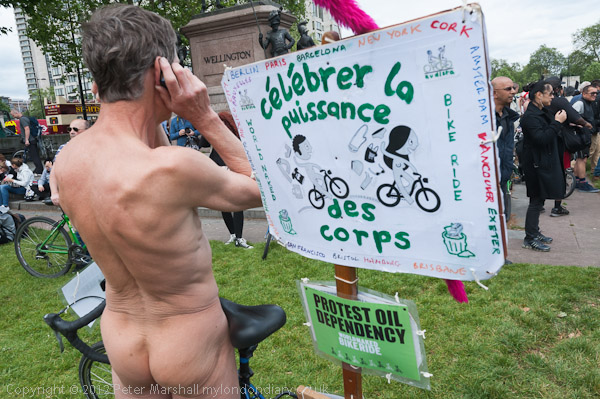
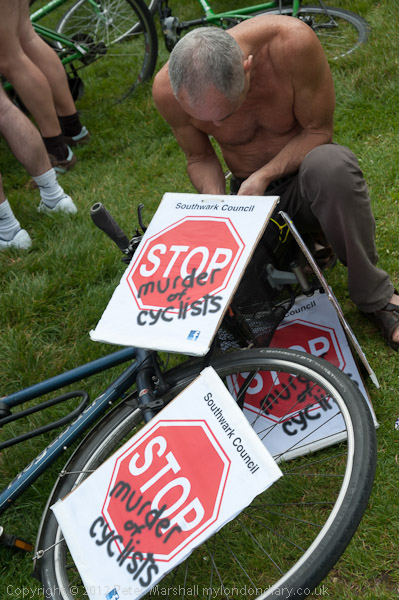
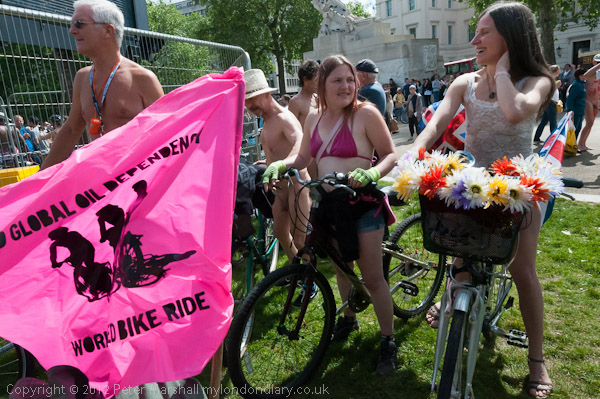
Some riders did have slogans on their bodies, mainly about oil and traffic, and some bikes carried A4 posters reading REAL RIGHTS FOR BIKE and CELEBRATE BODY FREEDOM or had flags stating ‘CURB CAR CULTURE’ which made clear the purpose of the event to the careful onlooker, but for most people it seemed simply a spectacle of naked or near-naked bodies. Though of course also a rare treat for any bicycle spotters among them.
I didn’t censor the pictures I put on line from the event though I’ve carefully selected those in this post. I think that there is nothing offensive about the naked human body but I included the following statement with the link to more pictures I posted then and which you can still see online.
Warning: these pictures show men and women with no clothes on. Do not click this link to more pictures if pictures of the naked human body may offend you.
People’s Assembly against Austerity 2.0: Last Saturday, 7th June 2025 the People’s Assembly had organised what they hoped would be a huge anti-austerity demonstration against Labour’s Austerity 2.0 which seems a return to the policies of the Cameron and other Tory governments, cutting spending on public services while ensuring the rich continue to get richer.
They say:
Austerity is not an inevitability; it is a political choice. By sticking to her arbitrary ‘fiscal rules,’ Rachel Reeves is plunging the country into more crisis. By choosing to spend money on arms rather than public services, social security and our NHS, this government is actively impoverishing us. We say no – and we mean it.
Recent government announcements of a huge increase in defence spending are based on a return to the worst excesses of the Cold War and a false narrative of Russian invasion of all of Europe – something that the criminal and disastrous invasion of Ukraine when what Putin thought would be over in three days has turned into years of attrition, ruining the Russian economy, actually makes less likely.
Arms manufacturers have always played on our fears to boost their profits – and they are the only people who come out of wars as winners – both the Ukrainian people and the Russian people will end up as losers whatever the final outcome in Ukraine. And it was them and the NATO military hawks who kept up the isolation of Russia and the manipulation of politics in Ukraine and elsewhere after the fall of the USSR rather than welcoming Russia into our fold.
Already our government has drastically cut the aid budget, probably the most important expenditure to promote peace across the world, and is also planning huge cuts in benefits in an attack on the most vulnerable in our society.
It has also continued its attacks on migrants with a new Immigration White Paper which will attack our migrant communities and affect millions of migrants, continuing the racist policies of previous governments. We need migrants, particularly as our population is ageing. Those already here are making a positive contribution to our country – and would do more if we introduced safe ways for them to come here, particularly to join relatives already living here, allowed asylum seekers who can to work, recognised their qualification and made it easier for them to become British citizens. We need a positive approach to migrants rather than the increasingly hostile one.
Many on the protest came to protest about the increasing privatisation of the NHS and the failures to adequately resource it, about the cuts in education and about misguided and inadequate housing policies which have led to huge increases in rents – while making landlords wealthy. About the increases in energy prices and in prices generally which are making many poor. About the failure to abolish to two child cap on benefits which has put so many children into poverty.
Kid Starver Out – and a cut up Labour Party card.
We live in a country with massive inequalities and with governments that are inatroducing policies to increase these. The protest called for ‘Welfare not Warfare’, to ‘Tax the Rich’ and ‘Stop the Cuts’.
NEU protesters
We would not need to bring in tax increases to greatly increase the amount of tax the country receives but could bring in billions by simply clamping down on tax evasion and tax avoidance. We should outlaw all those schemes that enable companies and individuals who earn money in the UK from not paying taxes. We need to change the law so HMRC would work to a simple rule – if you earn it here, you pay tax on it here – and enforce it. It would probably bring in at least another £20 billion a year.
Saturday’s protest was not the huge demonstration that the People’s Assembly had hoped for, though it was a respectable size, perhaps 3-5,000 people. The drastic and inaccurate weather forecast may have put some people off, but the many groups who backed the event only came in small numbers. Sometimes only just enough to carry their banner.
Revolutionary Communist Party
By far the largest and loudest bloc on the march was that of the Revolutionary Communist Party. Until 2024 called ‘Socialist Appeal’ it was relaunched under this new name. Back around the 1970s it was the Trotskyist Labour group ‘Militant tendency’, set up around the newspaper ‘Militant’ in 1964 and finally proscribed by the Labour Party in 1982.
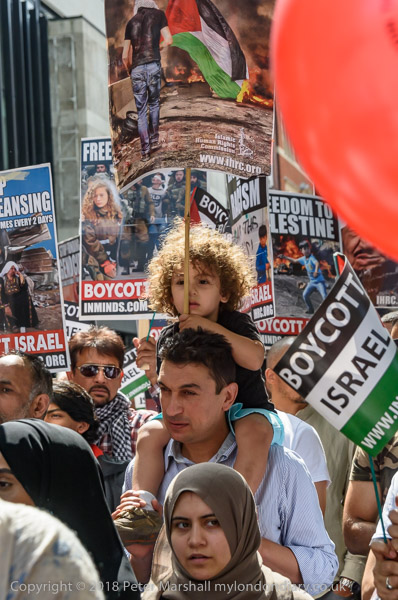
Nicaragua, Votes For Women, Al Quds Day: Sunday 10th June 2018 my work began in Trafalgar Square where Nicaraguans called for an end to the current government violence in their country. I then photographed a march commemorating the extension of the UK vote to include many but not all adult women a hundred years earlier. Then I went to the Saudi Embassy where there were two groups facing each other, kept well separate by police. It was Al Quds (Jerusalem) Day and supporters of the oppressed people of Palestine had come to protest there, with a counter-protest by Zionists.
End government killings in Nicaragua – Trafalgar Square
Nicaraguans came to call for an end to the violent attacks by police on protests in Nicaragua where they have killed over 100 protesters, injured over 600, and others have been unjustly detained, tortured and some raped.
The government atrocities have been condemned by he CIDH (Inter-American Commission on Human Rights) and Amnesty International and this was one of protests across Europe in solidarity, demanding the resignation of president Daniel Ortega and his wife and and vice-president Rosario Murillo and free and fair elections.
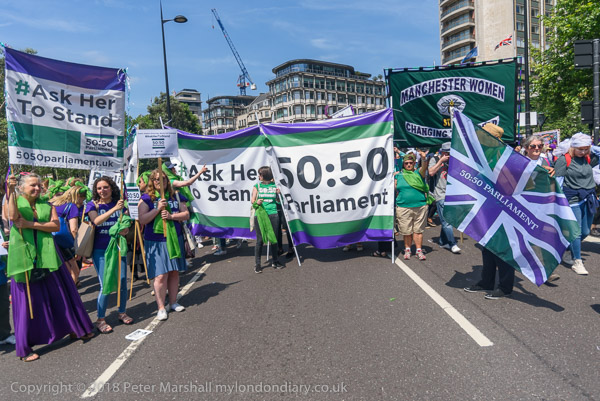
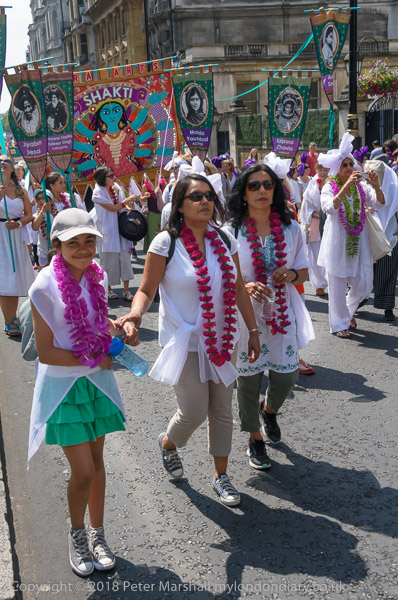
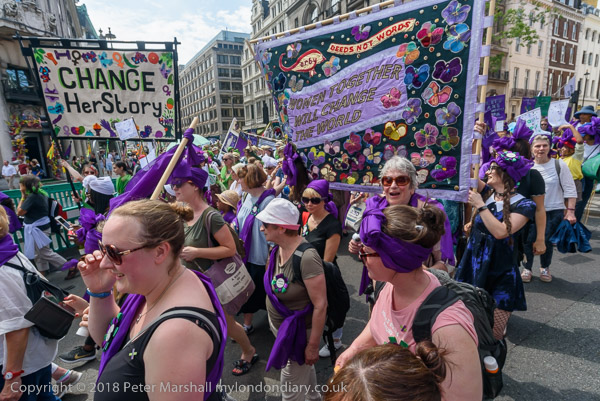
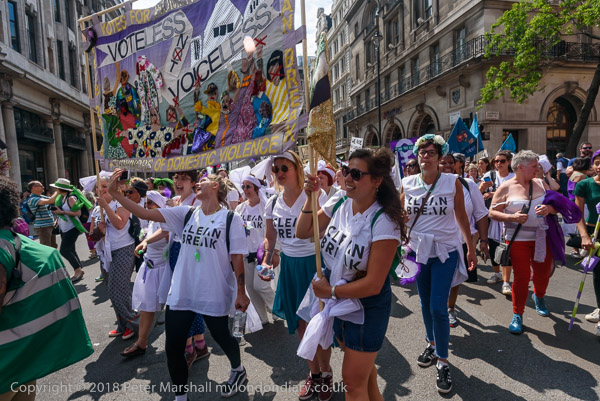
Women wore purple, white and green head scarves to make up three strands of a huge procession in the suffragette colours through London marking 100 years since many British women gained the right to vote.
The 1918 act gave the vote to the first time to all men over 21 and to men like my father over 18 serving in the armed forces, but did not bring in universal suffrage for women. Women had to be over 30 and meet a property requirement. It was another ten years before all women over 21 – including my mother who was by then 23 – could vote.
My mother made no secret of her support for the Conservative party, displaying their poster in our front window at every election. My father, who kept quiet about his politics to avoid conflict at home, went into the polling station every time to cancel out her vote with one for Labour.
I left the march as the end of it passed Piccadilly Circus on its way to Westminster.
Zionists protest against Al Quds Day – Saudi embassy, Mayfair
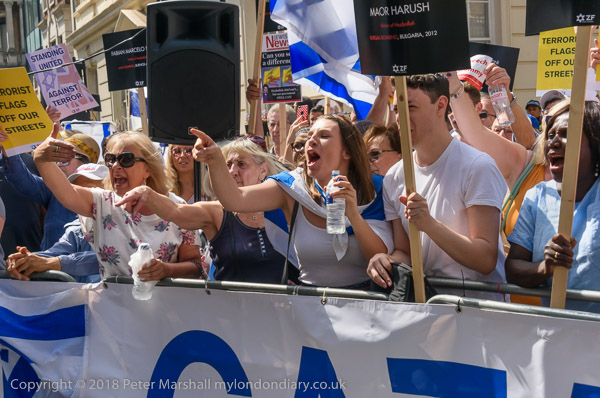
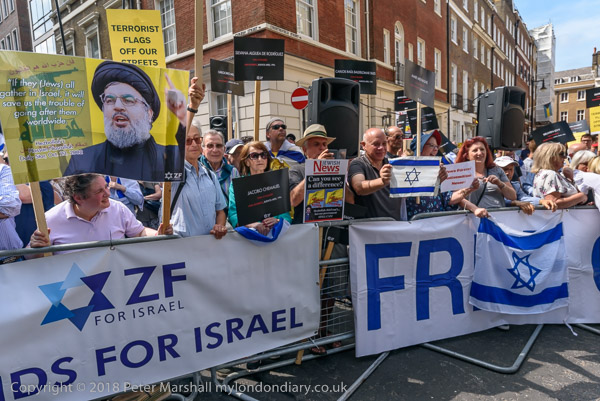
As well as the official Zionist protest kept behind barriers by police around a hundred yards away from the pro-Palestine Al Quds day event there were also a number of extreme right football thugs roaming the area, together with some well-known Zionists. Some of these managed to come close to the Al Quds day event and shout at it and at times there was some forceful policing as the thugs were moved away.
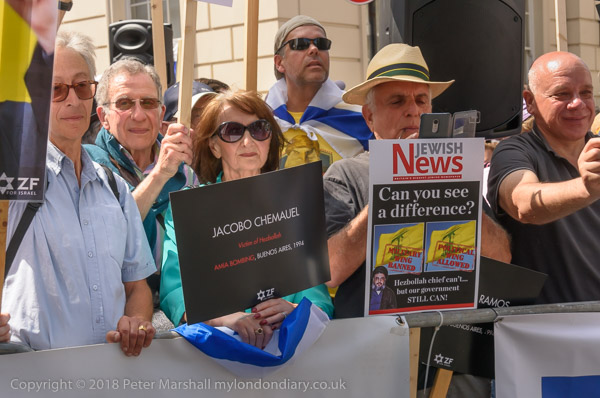
The official Zionist Federation protest kept behind the barriers, shouting at the Palestinian supporters, most of whom simply ignored them though a handful faced them at a distance and shouted back. There seemed to be rather fewer of the Zionists than in earlier years and there were almost certainly more Jewish protesters in the Al Quds day event which was supported by several groups and numerous individuals from the Jewish left as well as the ultra-orthodox Neturei Karta, who always attract a great deal of venomous anti-Semitic shouting from the Zionists.
There had been considerable pressure on the UK government to ban the display of the Hezbollah flag, which was then still legal here, as the same flag was used by both the military wing, banned in 2008 and the political wing of the party which at the time had two ministers in the Lebanese government. Despite this the UK government banned the group as a whole in 2019, making the display of this flag from then on a criminal offence.
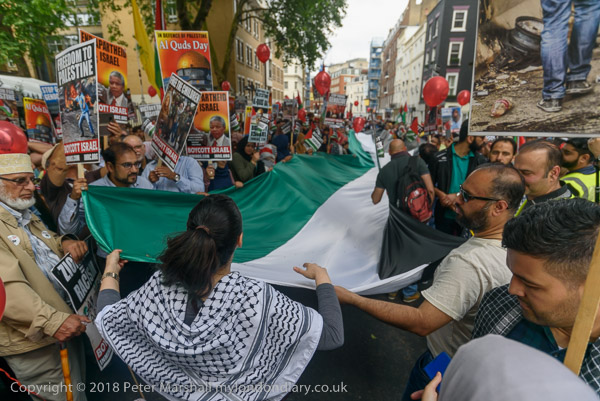
Protesters hold the largest Palestinian flag ever made, 70m long to symbolise the 70 years since the Nakba
The much larger crowd who had come to the protest organised by the Justice for Palestine Committee and supported by the Islamic Human Rights Commission and a wide range of pro-Palestinian organisations was squashed into a small area in front of the Saudi Embassy.
There was a large police presence in the area that kept them well apart from the counter-protest by the Zionist Federation and stopped the football hooligans from attacking this peaceful protest.
Al Quds Day was established by the Islamic Republic of Iran in 1979 and is celebrated in many countries particularly across the Arab world. There have been events like this one in London for over 30 years.
The protest this year was a gesture of defiance to the demonisation campaign and the ongoing murders by Israeli troops of innocent Palestinian protesters in the Gaza Strip commemorating 70 years since Israel was formed on expropriated Palestinian land.
Intellectual Property, Naked Cyclists: On Saturday 9th June 2012 after a rally against the Anti-Counterfeiting Trade Agreement outside Europe House in Smith Square I went to Hyde Park Corner where cyclists were preparing for the London World Naked Bike Ride, an environmental protest against a society based on oil and the domination by cars.
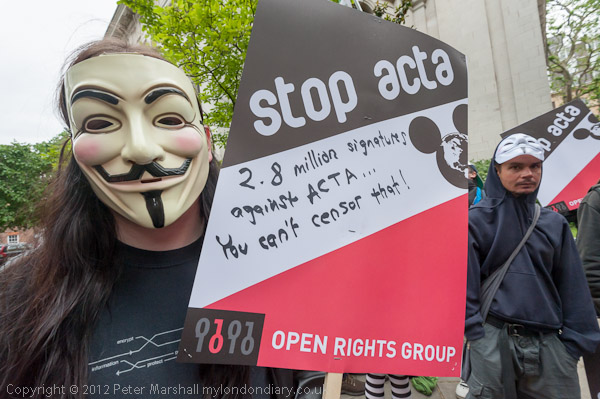
Rally Against ACTA
Current debates on intellectual property in 2025 are mainly concerned with protecting the rights of individual creators from being used without permission or compensation by companies developing AI which could then use the data taken to create new works which would mimic their work, essentially producing counterfeit works.
Back in 2012 the protests were against ACTA, the Anti-Counterfeiting Trade Agreement put together in secret talks between the USA, Europe, Japan and some other major governments to protect the copyrights, trademarks and patents held by major multinational companies.
Wikileaks had released the secrets of these talks, deliberately set up in private to exclude the views of civil society and developing countries. They proposed putting draconian powers in the hands of major corporations without the need for allegations of abuse to be properly tested.
Now in 2025 the government is attempting to put into law an act which would legitimise the production of ‘fakes’ by the major AI companies, though the fight against this is being carried on largely in the House of Lords rather than on the streets or on the web. As usual laws are largely about protecting and advancing the interests of the rich and powerful – whose donations and lobbying keep our legislators on side.
As well as preventing much sharing of material on the web – some legitimately – ACTA would also disrupt much-needed generic medicines to majority world countries, where indiscriminate raids had already disrupted some legitimate supplies. And many musicians and other content creators feared it would be used by the major corporations to prevent or inhibit their ability to profit through distributing their own work via the Internet.
On 4th July 2012, 478 MEPs in the European Parliament voted against ACTA, 39 in favour, and 165 abstained, meaning the agreement did not enter into force in the EU.
More about the protest and about ACTA, along with more pictures on My London Diary at Rally Against ACTA.
Naked Cyclists Ride Against Oil
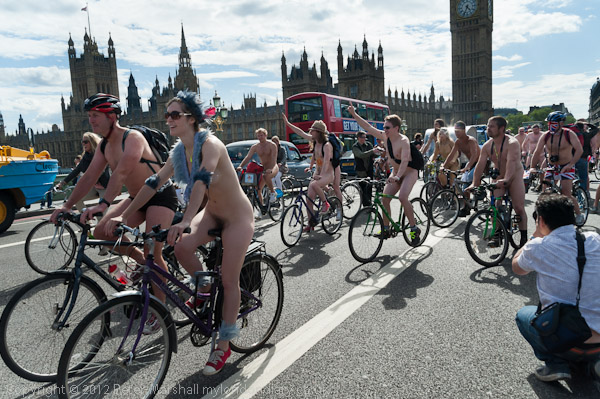
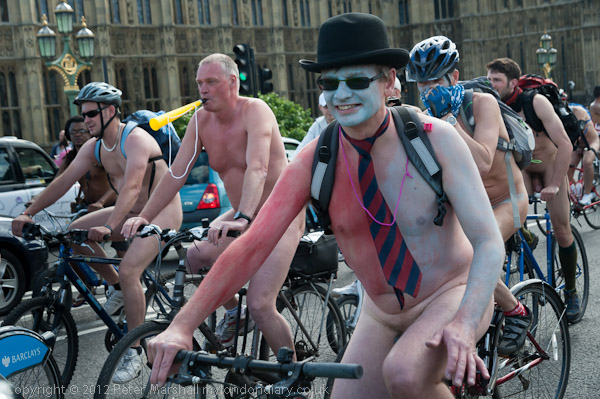
Around a thousand cyclists in various states of undress, some wearing nothing but shoes, took part in the World Naked Bike Ride, an annual environmental protest touring central London, much to the astonishment of many tourists. Shoes are required, but otherwise the dress code is “as bare as you dare.”
People gathered at Hyde Park Corner for the start of the ride
Public nudity is not illegal in Britain and the ride seems to cause a great deal of hilarity from some onlookers but little or no offence. Most of those on the pavements were tourists and eagerly taking photographs of the event.
Although there had been many earlier naked bike rides organised as naturist or political demonstrations, the first World Naked Bike Rides were organised in 2004 and now take place in many cities around the world. The rides are a protest against dependence on oil and other forms of non-renewable energy and “expose the unique dangers faced by cyclists and pedestrians” in modern cities.
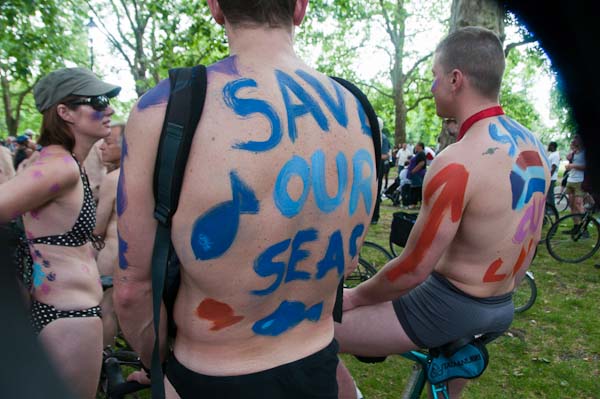
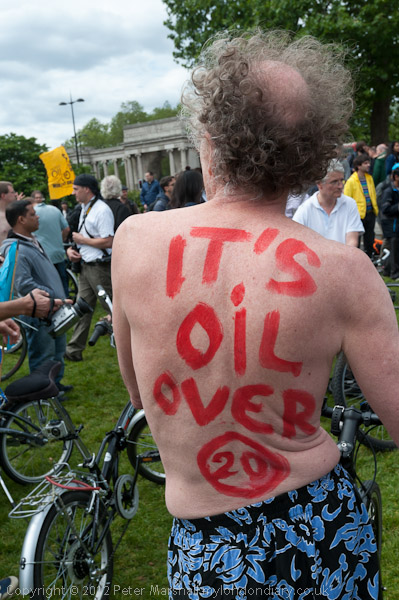
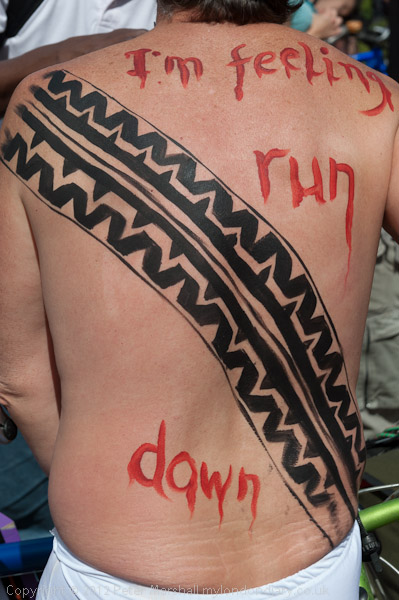
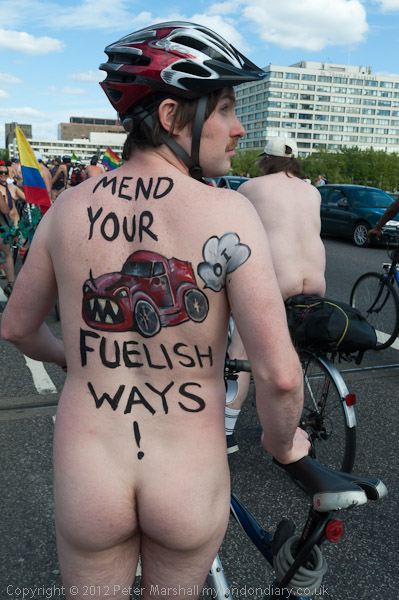
In 2012 there did seem to be a rather clearer environmental message than in some other years, and my pictures here – and in the many more on My London Diary concentrate on this rather than the nudity, and on the many with body paint, sometimes solely for decoration but often expressing an environmental message, contributing to the purpose of the ride to “deliver a vision of a cleaner, safer, body-positive world.”
Back in 2012 there were similar rides in 20 countries around the world ands well as others in Brighton, Bristol, Cardiff, Exeter, Glasgow, Manchester, Portsmouth, Southampton and York.
After photographing the riders on the grass at Hyde Park corner I set off with them on foot, rather dangerously as other traffic was still driving around the busy roundabout and along Piccadilly. But I soon got out of breath and had to rest.
Later I took the tube to Westminster and met the cyclists again coming down Whitehall, going with them across Westminster Bridge. I left them to go to Waterloo Station on their way to the City and then back trough Holborn to Buckingham Palace and Hyde Park Corner.
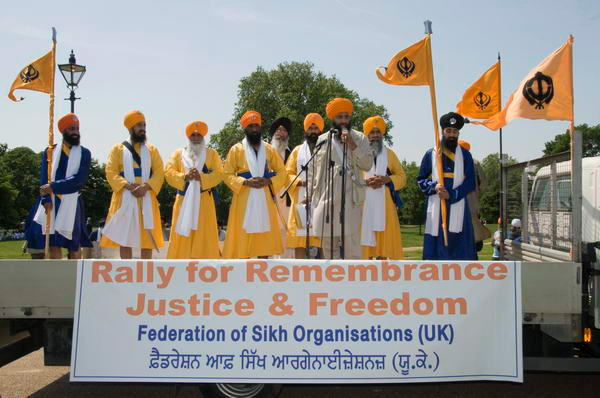
Lord Maruga, Portugal Day & Khalistan: My day on Sunday 8th June 2008 very much reflected the multicultural nature of London, beginning with a Hindu Festival in Thornton Heath, moving on to a Catholic Mass celebrating Portugal Day in Kennington and finally a march by Sikhs remembering the 1984 massacre and calling for an independent Sikh state, Khalistan.
Lord Muruga in Thornton Heath
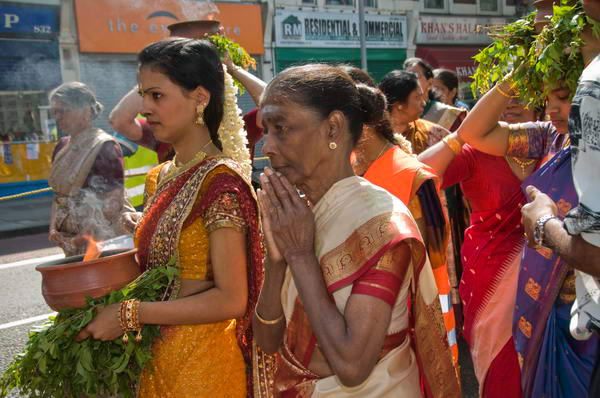
Hindu God Lord Muruga is particularly popular with the Tamils of southeast India (Tamil Nadu), Sri Lanka and Malaysia, and several hundred from the Sivaskanthagiri Murugan Temple in Thornton Heath celebrated him by pulling a chariot carrying his representation through the local streets.
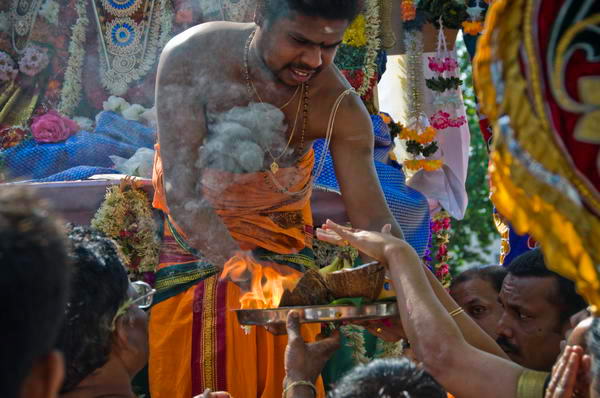
The procession was led by musicians, and by women carrying pots of burning embers on their heads and in their arms. As the chariot made its way along the street, people brought offerings of good to be blessed, and these were returned to them flaming.
Lord Muruga is the son of Agni, the fire god. He also carries a spear and a staff with a picture of a cockerel, and rides on a peacock. He is noted for the help that he gives for devotees who are in distress and the procession in particular visits those who cannot come to the temple because of their poor health or other disabilities
The flames are from camphor, widely used in Indian rituals and thought to eliminate negative energies. This waxy white solid burns with a relatively cool flame and emit little smoke.
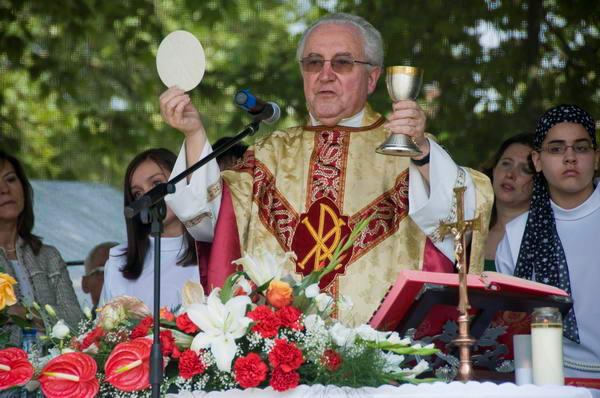
Also known as Camões Day, Portugal’s National Day marks the anniversary of the death of its greatest poet and writer, Luís de Camões, on 10 June, 1580. He died in the year that Portugal became part of Spain, and the date of his death (the day of his birth around 1624 is not recorded) was celebrated as a national day after Portugal regained independence in 1640.
His great epic poem ‘The Lusaids’ centres on Vasco da Gama’s voyage to discover a sea route to India which was the foundation of the colonial explorations that brought the country great wealth and it made him a symbol of the nation.
Fascist dictator Salazar who ruled Portugal from 1932 to 1968 made the day a celebration of a fictional Portuguese ‘race’, but it is now simply a day for celebration by Portuguese communities around the world – and London has the largest Portuguese community outside Portugal, centred in Stockwell close to Kennington Park. The celebrations in the park includes entertainments and considerable eating and drinking after the initial open-air Catholic Mass I photographed.
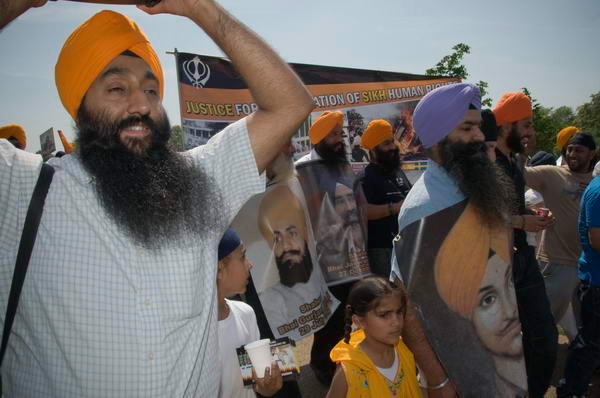
Sikhs remember the massacres at Amritsar by the Indian Army and the mob killings encouraged by the Indian government following the assassination of Indira Ghandi by her Sikh bodyguards in 1984.
Sikh interests were ignored by an ignorant and incompetent British administration led by the Viceroy and Governor-General of India Lord Mountbatten who were responsible for the partition of India in 1947.
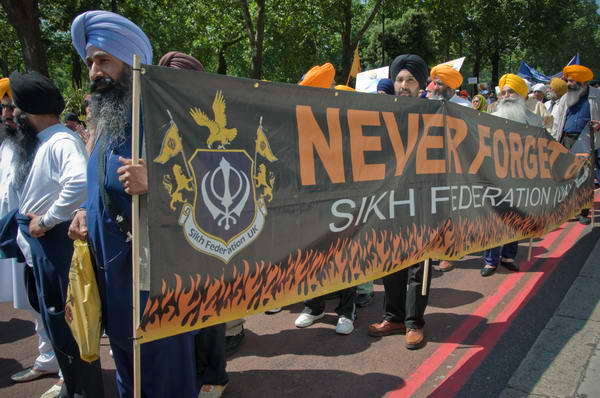
This annual rally and march in London calls for the establishment of an independent Sikh homeland, Khalistan in the Punjab and possibly incorporating some nearby areas of India and Pakistan.
Some Sikhs had been calling for an independent state since the 1930s and the movement continued to grow after partition with various militant Sikh groups including Babbar Khalsa, proscribed in the UK. Violent repression by Indian police led to a decline in the 1990s, but repression continues against Sikhs and in particular against those campaigning for separation and has increased in recent years. This makes it very difficult to determine how much popular support there is for the Khalistan movement in the area.
Data in the UK suggests that only a small fraction of British Sikhs support the establishment of Khalistan. In 2018, India asked UK to ban Sikh Federation (UK) who organise these events for its anti-India, pro-Khalistan activities, including proscribing the organisation but this has not happened.
Peckham Fight the Developers: Last Saturday, 31st May 2025 I went to a protest in Peckham against the proposals for the redevelopment of the Aylesham Centre in the heart of Peckham by developers Berkeley Homes.
Peckham, London, UK. 31 May 2025
Their proposals shocked local residents in various ways. They include a 20 storey tower over 250 ft tall, and while the site would included 877 new homes, only 77 of those would be ‘affordable‘. Only a quarter of the number required in the new London Plan which calls for 50% – and for these to be ‘genuinely affordable‘, something that there is no clarity that any of those meagre 77 would be. The plans also include a supermarket and car park, some space that could be used to provide various services or offices as well as shops and a “Drinking Establishment”.
Peckham, London, UK. 31 May 2025
Because of the widespread opposition, apparently including all three local councillors as well as various local community groups which have come together in the umbrella group of housing campaigns and activists from across Southwark – SHAPE – Southwark Housing And Planning Emergency – it seems likely that Southwark Council will reject the application. In which case Berkeley are almost certain to appeal.
Peckham, London, UK. 31 May 2025
Given the Labour Party’s new policies on planning it seems unfortunately likely that in the case of an appeal Levelling Up Secretary and Deputy Prime Minister, Angela Rayner is likely to wave their proposals through despite their obvious failings and disatrous effect on Peckham.
Peckham, London, UK. 31 May 2025. Journalist and author Anna Minton
One of the speakers at the event was authour and Guardian journalist Anna Minton, invited to speak after her article last week, A new kind of gentrification is spreading through London – and emptying out schools which had the subhead “Thanks to ‘placemaking’, thriving communities are hollowing out, to be replaced by luxury apartments and expensive restaurants.”
Peckham, London, UK. 31 May 2025
Much of her article looked at the consequences of the demolition and replacement of another area of Southwark, the Heygate Estate at Elephant and Castle. This large council estate was replaced by developers Landlease with ‘Elephant Park’ with many flats being sold off-plan to international investors. Lendlease made big profits but Southwark council actually lost both a hugely valueable asset in land as well as actual money in the process.
Peckham, London, UK. 31 May 2025
The new site had more homes than the old, with around 2,000 largely still council-owned flats and houses being replaced by 2,704 of which only 82 are social housing. There 25% were ‘affordable’ but at up to 80% of market rent unaffordable to most locals including the previous residents of the area – and only a small fraction of the site being ‘affordable’. Replacing family homes by luxury flats has led to a large drop in births in the area, forcing the closure of the local primary school at the end of the current term. It was an exercise in ‘ethnic cleansing’ with most forced out of the Heygate having to move long distances further from the centre of London to find properties they could afford.
Peckham, London, UK. 31 May 2025
Minton comments “The positive rhetoric and branding of placemaking is that it transforms run-down areas into vibrant and economically successful parts of the city. The reality is that it creates sterile places, emptied of so many of the essential aspects of urban life, except the expensive activities.”
Peckham, London, UK. 31 May 2025. Outside the Aylesham Centre
Rye Lane on which the Aylesham Centre stands was described in 1934 as “the Oxford Street of South London” with no rival outside of Central London. At the north end of this “Golden Mile of shops” was a whole block containing the department store Jones & Higgins of which only a small part containing its clock tower remain – and under risk.
Peckham, London, UK. 31 May 2025. Outside the Aylesham Centre
Jones & Higgins closed in 1980 and in 1985 most of it was demolished to build the Aylesham Centre. Most of the other fine shops of the past have left, but their buildings mainly survive in new uses, and the street is now remarkably vibrant largely with small shops serving the area’s multicultural community. Rye Lane remains one of London’s busiest shopping streets and I always enjoy walking along it. Off to the side are several small street markets and the amazing Copeland Park and its former cricket bat factory the Bussey Building, now a cultural centre, along with Peckham Levels, a transformed multi-storey car park, though its Derek Jarman memorial garden was in a poor state when I last visited a few years back.
Peckham, London, UK. 31 May 2025. Outside the Aylesham Centre
The Aylesham centre is perhaps now the low point on the street and its demolition would certainly be no loss, but it would be terrible for it to be replaced by yet another sterile ‘white Elephant‘. It is a site that could offer much to the local community, including making a significant inroad into the roughly 12,000 families on the local council’s housing waiting list.