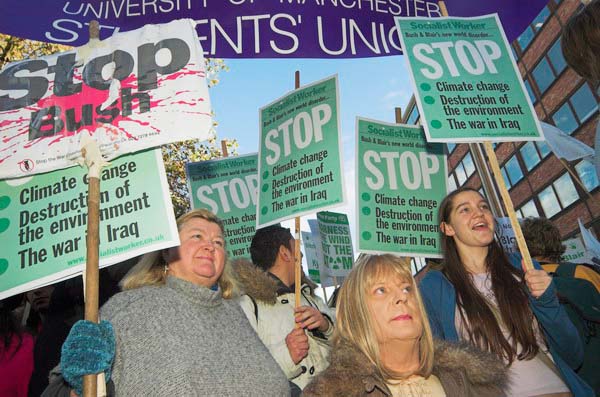
Climate March 2005

Climate March 2005
Climate March 2005 – people meet at the start in Lincolns Inn Fields

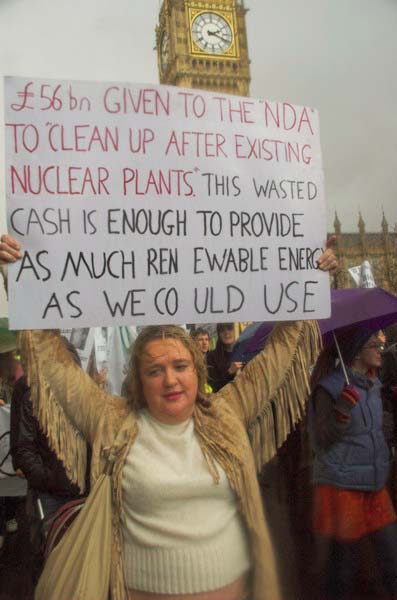
Twenty years ago on Saturday 3 December 2005 the Campaign Against Climate Change organised a march calling for urgent action over climate change. Among groups supporting the march were the Green Party, Friends of the Earth and socialist organisations.
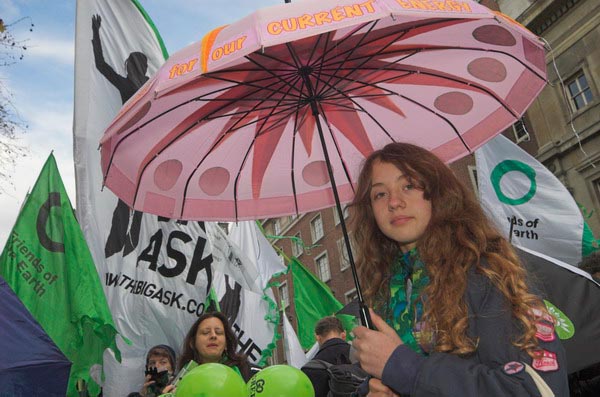
Climate March 2005
Umbrellas came in very useful later when it poured with rain

But in 2005 there was no interest from the major charities and mainstream organisations that have since supported some major London marches pointing out the dangers of climate change and global extinction, like most governments they had yet to wake up to the very real dangers facing the future of human life on our planet.
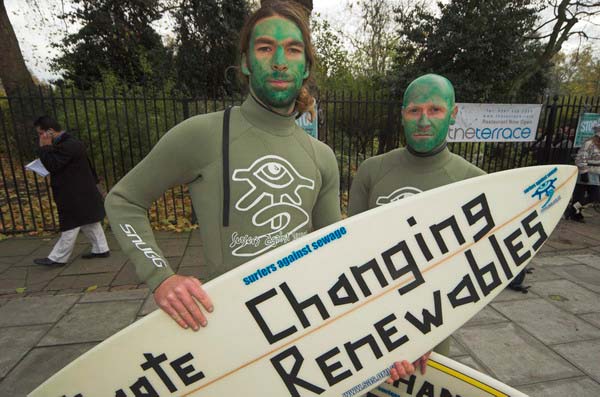
Climate March 2005
Surfers Against Sewage were supporting the march

The Campaign Against Climate Change was one of the first organisations in the UK to serilsly begin organising against global warming – and I remember photographing them back in 2002 pushing an attractive ‘Tiger’ on a bed from the Esso headquarters in Leatherhead to the US Embassy in Grosvenor Square, Westminster. US President George W Bush had put the interests of climate-denying US Oil and fossil fuel companies, notably Esso, above the survival of our species with with his rejection of the Kyoto protocol, agreed in 1997 but only due to come into force in 2005.
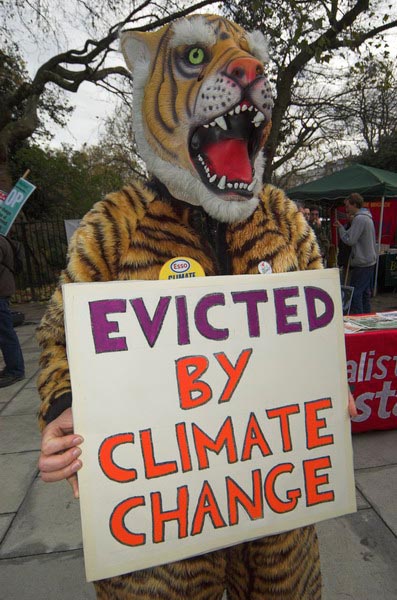
Climate March 2005
The Tiger’s message: ‘Esso presents’ ‘Evicted by Climate Change’

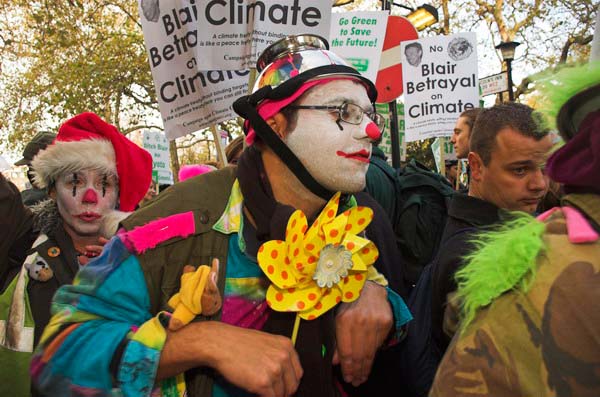
Back in 2005, we needed governments to act with urgency, but they failed us and the world. One of those failing then was Tony Blair, whose New Labour government had also betrayed us over the invasion of Iraq as well as over climate change. And now in 2025 we have another Labour government, now under Keir Starmer, pressing ahead with new climate-destroying road schemes, oil exploration and extra runways rather than facing up to the need to change our assumptions and way of life in ways that would reduce CO2 emissions and slow global warming.
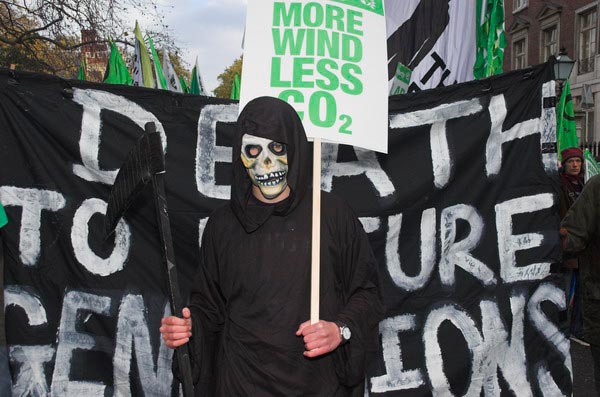
Climate March 2005
Death to Future Generations is the bleak prospect we face

Saturday 3rd December 2005 was an international day of climate protest but the march to the US Embassy in London achieved little media coverage – the billionaires who own and control most of our media have little interest in the subject (and probably large financial interests in fossil fuels and other drivers of climate change.) Even the BBC had been a hive of complacency, and have given a totally unwarranted level of coverage to those who continue to refuse the overwhelming scientific evidence. Though now they are perhaps beginning to realise that you cannot have ‘balance’ over scientific fact.
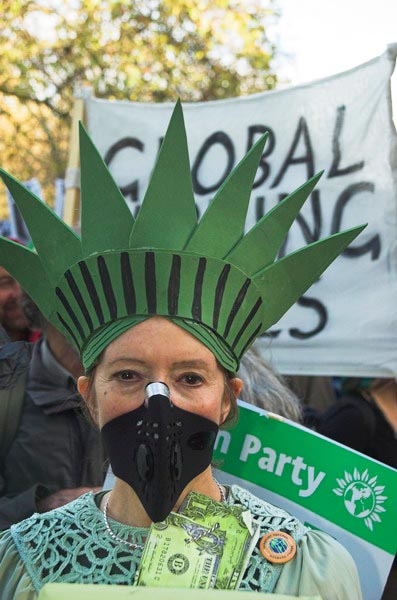
The ‘Statue of Taking Liberties’ was at the Front of the march to the US Embassy

Here – with minor corrections – is what I wrote about the march back in 2005 – and a few of the pictures I took at the event – you can see more on My London Diary at the link at the bottom of this page.


Kyoto was the first attempt to at least recognise the problem was global and take some concerted action, even if less than half-hearted. Thanks to George Bush and the oil companies he represents, the ineffectual has been made even more so.
Problems related to growth and pollution are inextricably linked with industry and trade. It is hard to see any possibility of their solution without the imposition of tariffs on the exports of countries that continue to pollute – such as the USA. It’s equally hard to envisage this happening while the USA is so dominant in the world bodies and conferences that set the rules on trade.

Rising Tide

There were around 10,000 of us on the streets of London on Saturday, and many more around the world in demonstrations elsewhere, all part of the International Day of Climate Protest, the march in London organised, as previous climate marches and protests, by the UK Campaign Against Climate Change.
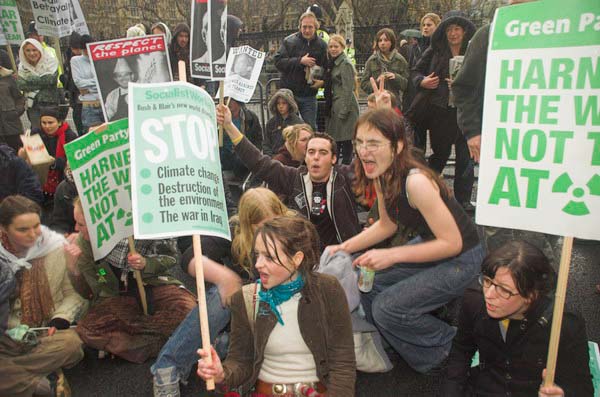
A sit down in pouring rain in Parliament Square is not a good idea

Here in London the climate smiled on us for an hour or so, then the rain came as the march entered Parliament Square. It was pouring rain rather than the police that persuaded the students who sat down in front of the Houses of Parliament that it was a good idea to get up and move on.
My camera also began to suffer, and I needed to move inside to dry it out. My injured knee was beginning to hurt too, so I decided it was time to take a rest and go home.

More pictures begin here on My London Diary.


FlickrFacebookMy London DiaryHull PhotosLea ValleyParis
London’s Industrial HeritageLondon Photos

All photographs on this page are copyright © Peter Marshall.
Contact me to buy prints or licence to reproduce.


March for Clean Water, London, 3 Nov 2024

March for Clean Water: On Sunday 3rd November 2024 I joined thousands of marchers gathering at Vauxhall overlooking the River Thames for a march demanding urgent action to end the pollution of our rivers and sea.

March for Clean Water,

Much of this pollution is by illegal discharges of sewage by the privatised water companies who have failed to make the investments needed since the regional water authories were sold off to private companies in 1989.

March for Clean Water,

Opinion polls then showed that just under 80% of the UK population were against water privatisation back then, and now over 80% are in favour of bringing them back into public ownership.

Back in 1884, Joseph Chamberlain got it right when he argued “It is difficult, if not impossible to combine the citizens’ rights and interests and the private enterprise’s interests, because the private enterprise aims at its natural and justified objective, the biggest possible profit.”

March for Clean Water,

Private water companies were largely taken over by local authorities by the start of the 20th century and under the 1973 Water Act passed by a Tory government under Edward Heath these were amalgamated into the 10 Water Boards each based on the basin of one of our major rivers, “responsible for water extraction, water supply, sewage treatment and environmental pollution prevention,

March for Clean Water,

Unfortunately government failed to provide them with the money to properly carry out their functions, and the situation was made much worse after Margaret Thatcher came to power in 1979 when she made it very much harder for the water boards to borrow money for capital projects.

This left the water authorites unable to meet the new EU standards for “river, bathing, coastal, and drinking water quality” which would have required according to Wikipedia “from £24 to £30 billion.”

In light of this, the Conservatives went ahead with privatisation despite the huge public opinion against it. It was hardly a sale, more a getting rid of their liabilities at a token price of £7.6 billion, at the same time taking over the existing debts of £5 billion and gifting the companies a present of £1.5 billion. So the sale only raised £1.1 billion.

Privatisation made England & Wales the only countries in the world to have “a fully privatised water and sewage disposal system.” Something we have been both paying for and suffering from, SInce privatisation water prices have risen by 40% above inflation and in 2017 “research by the University of Greenwich suggested that consumers in England were paying £2.3 billion more every year for their water and sewerage bills than they would if the water companies had remained under state ownership.

And while we have paid more, the shareholders of at least some of those water companies have done very well out of it – as have many of the top managers who have got huge bonuses despite the many failings of the companies they have run.

Since privatisation investment in the water industry has decreased by around 15% and the companies have built up debts of over £60 billion – rather less than their payouts to shareholders of £78 billion. Huge amounts of treated water is now lost through leaks as our water systems have not been properly maintained and expanded to meet new demand.

And sewage. More and more untreated raw sewage has been dumped in our rivers. What was supposed only to happen when unusual rainfall overwhelmed the sewers now appears to have become a normal occurence in some areas. We should have been investing in increasing separation between drainage and sewage, particularly in new developments but nothing has been done.

We are still largely working with a Victorian system of drainage with a hugely increased population, installed when few homes had baths, washing machines and showers were unheard of and far fewer homes had even one flushing toilet. Demand for water has increased greatly per person.

The march in London on 3rd November was organised by River Action, “an environmental charity on a mission to rescue Britain’s rivers from the deluge of pollution that has left the majority of our waterways in a severely degraded ecological condition” and it reflected this, backed by a long list of other organisations.

Although sewage outflows are the major source of this, agricultural wastes particularly from intensive animal farming are a huge source of pollution in our rural areas and there are still some other industries which pollute our rivers.

We need to bring the water companies under public control and also reform or replace Ofwat and the Environment Agency which have clearly failed in their roles.

You can see more pictures from the march in my album March for Clean Water.


FlickrFacebookMy London DiaryHull PhotosLea ValleyParis
London’s Industrial HeritageLondon Photos

All photographs on this page are copyright © Peter Marshall.
Contact me to buy prints or licence to reproduce.