Vantage London, Great West Rd, M4, Brentford, Hounslow, 1990, 90-1f-45
Built around 1970 as the 12 storey headquarters of Beecham Pharmaceuticals it was no longer needed after they became part of Glaxo Smith Kline and was refurbished as as Vantage London with offices let to a number of companies. The building was again refurbished in 2016 and in 2019 was sold to a Luxembourg based company for £30 million.
In 2024 a planning application was made by Resolution Property for its conversion into 178 flats. It was approved following some modifications in April 2025.
The elevated section of the M4 runs on top of the Great West Road in front of the building. The strucvture in the foreground is I think a gritting bin.
Great West Rd, M4, Brentford, Hounslow, 1990, 90-1f-35
Taken under the elevated M4 where slip roads link the A4 Great West Road with the motorway. One project I was working on at the time was inspired by J G Ballard’s 1973 novel ‘Crash’, key scenes of which were set in this area – although the 1996 film of the book by Cronenberg was made in Canada. Ballard who lived not far away in Shepperton obviously knew the area well.
Crash centres around a car crash victim who finds himself aroused by car accidents but my project was more simply about the domination of our culture by the car and I felt threatened by the powerfully enclosed architecture here which is perhaps a modern equivalent of the Roman coliseums, and was rather choked by the fumes.
On previous occasions I had photographed the iconic moderne 1930s buildings along the Great West Road, and this at right shows Beechams, which had this side entrance a few yards down Clayponds Lane. The factory building continues in a more utilitarian fashion but with a tall window, probably lighting a staircase which reflects the style.
Flats, Carville Hall, Carville Hall Park, Brentford, Hounslow, 1990,90-1f-22
The Carville Hall Estate was bought by Middlesex County Council in 1919 for the construction of the Great West Rd, and they sold the parts on both sides of the new road to Brentford UDC as a park, which opened in 1923. The house, orginally known as Clayponds, is now called Simmonds House. Originally built in the late 18th century, the front was re-modelled in the 19th century. It is locally listed.
The park is off Clayponds Lane and parts of it were once dug for clay, leaving ponds, marked as ‘Fishponds’ on the 1871 OS Map.
Lion, flats, Carville Hall Park, Brentford, Hounslow, 1990, 90-1f-23
Beyond the lion and the park are the tall blocks of the Brentford Towers Estate built for Hounslow Council in 1968-72.
The house here had extensive grounds and there is now a park on both sides of the A4/M4. The park to the north of the roads is larger than this but of little interest.
The house is thought to have been built for the “wealthy distiller and brewer David Roberts (c1733-97)” and was later home to “coal and horse racing magnate William Lancalot Redhead (c1853-1909) and his daughter“. It was later converted into flats.
Lion, Carville Hall, Carville Hall Park, Brentford, Hounslow, 1990, 90-1f-24
The fate of the lion appears to be a mystery. I was surprised on a later visit to find it no longer there and I’ve not been able to find what happened to it. The most I’ve come across is a suggestion that it was stolen.
I thought that it was probably a Victorian garden ornament made from artificial stone – Coade or Portland Stone etc – and would have been fairly heavy, so the thief would have needed a lorry with appropriate lifting gear.
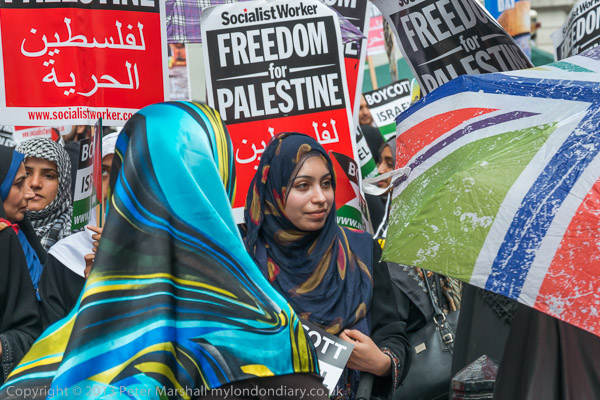
Al Quds Day March in London: International Quds Day is an annual event at the end of the Islamic holy month of Ramadan which expresses support for Palestinians and oppose Israel and Zionism. In particular it is a protest against the Israeli occupation of East Jerusalem – al-Quds in Arabic.
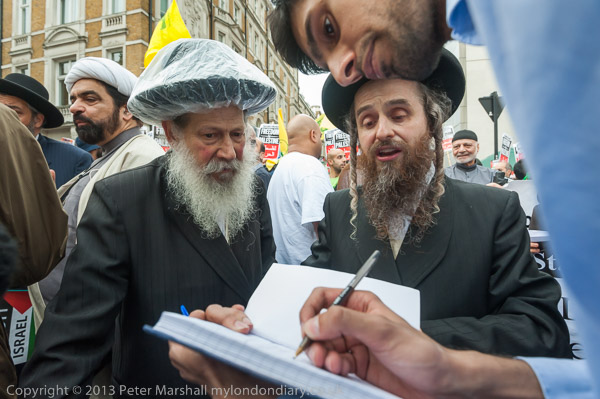
Neturei Karta ultra-orthodox Jews oppose Zionism
A peaceful Al Quds march has taken place every year in London for over 40 years and the organisers describe it as having a “family atmosphere with demonstrators coming from all walks of life. Christians, Jews, Muslims, people of other faiths and none all march in common cause side by side.”
This is largely true, but the march in London attracts counter-protests from Zionists and others (including Iranian freedom, communist and royalist movements and UK right wing fringe groups), which have sometimes led to confrontations and delays and increased security with some marchers becoming mistrustful of photographers.
It has at times been a difficult event for me to cover in the close way I like work. Many of my pictures are made with wide angle or extreme wide angle lenses, 28mm or less focal length down to fisheye, working inside or on the edge of crowds. I want to be close to people, if not within touching distance, seldom more than a couple of metres away to give greater interaction and immediacy.
The Quds Day march and rally in 2025 was on Sunday 23rd March, but chaotic rail services that day prevented me from covering it, though I had photographed a pro-Palestine rally close to the Israeli Embassy the previous day. The organisers pointed out that it was taking place “amid an ongoing genocide in Gaza where Israeli forces have slaughtered 50,000 civilians in Gaza, most of them women and children. At the same time armed colonial settlers and troops are running rampage in the occupied West Bank, invading, looting and attacking Palestinian towns and villages with the international community turning a blind eye or actively complicit in the slaughter.”
Back in 2014, the situation in Gaza was dire. As UNRWA states, “During the 50 days of hostilities lasting from 8 July until 26 August 2014, 2,251 Palestinians were killed; 1,462 of them are believed to be civilians, including 551 children and 299 women. 66 Israeli soldiers and five civilians, including one child, were also killed. Overall, 11,231 Palestinians were injured during the conflict, including 3,540 women and 3,436 children.”
83 schools and 10 health centres were damaged, over 12,600 homes were totally destroyed and there was “a massive displacement crisis in Gaza, with almost 500,000 persons internally displaced at its peak.” The “scale of human loss, destruction, devastation and displacement caused by the 2014 conflict in Gaza – the third within seven years – was catastrophic, unprecedented and unparalleled in Gaza.”
But of course Gaza is now experiencing something far worse – and humanitarian agencies including UNWRA are being prevented by Israel from supporting the people and supplies of food and other necessities are largely being blocked. Inadequate amounts are brought in by the so-called “Gaza Humanitarian Foundation” and people desperate to get it are being shot by the Israeli Defence Forces.
Of course we all know this npw – even though the Israeli government has tried to hide it by preventing international journalists from entering Gaza – and also systematically targeting the Palestinians who are able to report. An article in Modern Times Review on July 15, 2025 quoted the Cost of War project as stating “more journalists have been killed in Gaza in the past 18 months than were killed in the U.S. Civil War, World War I, World War II, the Korean War, Vietnam, and Afghanistan combined.” Early in July the number killed in Gaza had risen to 226.
On 24th July 2014, the march began close to the BBC and went to a rally outside the US Embassy, then still in Grosvenor Square. It was covered by several foreign media organisations but – as with most UK demonstrations – willfully ignored by the BBC.
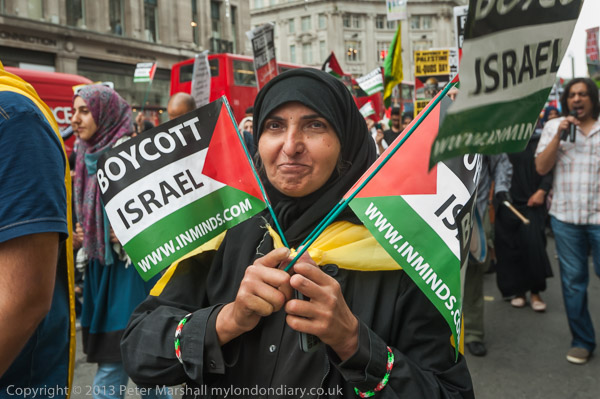
Protesters called for a boycott of Israel and an end to the occupation of Palestine as well as an end to the attacks on Gaza.
On My London Diary I give a list of the organisations supporting the march – and there is a rather longer list of those supporting the 2025 march. One of the major organisations in both is the Innovative Minds Human Rights Group (InMinds). Founded in 1997 and alleged to have links to the Iranian Islamic Republic it has held regular protests in London against companies supporting the Israeli military, against the arbitrary detention of Palestinians, the torture and imprisonment of Palestinian children and calling for an end to apartheid in Israel.
In the pictures you will see many flags and posters from Inminds – and also a few images of Ayatollah Khomeini who started the celebration of Al Quds Day in Iran in 1979 as well as the current Supreme Leader of Iran, Ali Khamenei.
Also standing out in my pictures are the ultra-orthodox anti-Zionist Neturei Karta Jews who state clearly their belief that Judaism is a religion and not a state, and “Judaism rejects the Zionist state And condemns its ATROCITIES”
One contentious issue in 2014 was over the carrying of flags of the Lebanese Shia Islamist political party and paramilitary group Hezbollah. In 2014 the political party, which was part of the government of Lebanon had not been proscribed and it was only illegal to carry it if there was other evidence to show support of the proscribed terrorist group. I was looking for these flags but only found a very few to photograph.
As the march made its way down Regent Street there were shouts against it from an upper floor window and vegetables were thrown down at the marchers who shouted back angrily. The march organisers asked police to investigate and urged to people to march on.
I left the march well before it reached the US Embassy and saw no other protests against the march. You can see more pictures from the march on My London Diary at Al Quds Day march for Jerusalem.
End the Genocide, Stop Arming Israel: Last Saturday, 19th July 2025, the weather forecast for London was dire. Thunderstorms and heavy rain until clearing a little later in the afternoon, with up to several inches of rain leading to some localised flooding. In the event it was a bit under two inches, with small rivers running along the side of some streets.
London, UK. 19 July 2025. Many thousands march in pouring rain in London
In this account I intend to write about my personal experiences and working as a photographer on the day rather than my views on the terrible situation in Palestine and the reprehensible actions of the Israeli government and army – and Hamas. I’ve often written about the need for peace and justice, for an end to occupation and destruction and for the release of hostages and prisoners.
London, UK. 19 July 2025.
Linda and I were determined to go out and join the national demonstration, to show our support for the people of Gaza, to demand our government stop selling arms to Israel and to call on the Israeli government to end its terrible destruction and genocidal attacks and to allow humanitarian aid for the people of Gaza, many now starving. A little rain was not going to stop us.
As usual I checked online for our trains, only to find that our services into London were subject to delay and cancellation due to signalling problems. We dropped everything and hurried to get an earlier train than we had intended – and which actually was more punctual than usual – only two or three minutes late into Waterloo.
It was raining fairly heavily as we walked out of the station and by the time we’d crossed the Jubilee bridge to the Embankment where the march was gathering we were already quite wet.
As the forecast was for afternoon temperatures in the low to mid twenties I’d grabbed a lightweight waterproof jacket on my way out, which was a mistake. It did keep the water off to start with but was soon getting soaked through in places. I realised too late that I should have worn my poncho – or a heavier jacket that although too warm would have kept me dry. At least I’d had the sense to put on my truly waterproof walking boots rather than my usual trainers.
We joined the large crowd that was sheltering under the bridge carrying the rail lines into Charing Cross and I started to take photographs. It was dry – so long as you avoided the areas where water was leaking down from above – but rather dark.
I was working with my Olympus OM-D E-M5 Mark III (what a crazy mouthful of a name) a camera that came out over 5 years ago. It’s a Micro 43 camera with a sensor only around half the size of full-frame, but that does mean it can be significantly smaller and lighter – something increasingly important to me as I get less able to carry heavy camera bags. And, vitally important today, it is a camera that has good weather protection.
I also had my Fuji X-T30 in my camera bag, with a 10-24 zoom fitted. Had I not rushed out I might have chosen a more suitable body and wide angle for use in wet weather. Neither that camera or lens are weather sealed (the more recent 10-24mm is) and for most of the day they stayed in my bag. I did take them out a couple of times when the rain had eased off, but hardly any of the pictures I took with them were usable.
Under the bridge light was low, but the Olympus has good image stablisation and the main problem was subject movement, as people shouted slogans, jumped up and down, banged drums and more. Being very crowded also meant people were often banging into me as I was working.
I also use small and light lenses – in the case the Olympus 14-150mm F4-5.6 – equivalent to 28-300mm on full frame, going from a decent but not extreme wide-angle to a long telephoto. Its a small, light and incredibly versatile lens, but not one at its best in low light with its rather small aperture.
I started off working with the lens on the P setting, the programme choosing suitable shutter speed and aperture – with the lens wide open and shutter speeds of around 1/15 to 1/25 second. But I soon realised to stop action I would need a faster speed and switched to manual, deliberating underexposing at 1/100th second, f5.0 and at ISO 3200. The RAW images were dark but I knew that I could get Lightroom to make them look fine – if sometimes lacking in shadow detail.
Eventually people began to move out into the rain and march and I went with them, holding my camera under my jacket and only taking it out quickly to take pictures. I looked in my bag for the chamois leather I usually hold to dry and hold in front of the lens filter and it wasn’t there – I’d left it back home in the pocket of the jacket I was wearing when it last rained while I was taking pictures. I had to make do with a handkerchief instead, giving the protective filter a quick wipe before each exposure.
Outside it was a little brighter and I was able to increase the shutter speed to something more sensible, and was using manual settings of 1/160 f5.6 with auto-ISO giving me correct exposure. I was mainly working at the wider focal lengths of the lens and f5.6 gave me enough depth of field.
I hadn’t got out my umbrella, but of course many others were carrying them to keep dry. I find it hard to work with one hand while holding an umbrella in the other. But other people’s umbrellas were a little of a nuisance, with water often pouring from them onto me as I took pictures, adding to the effect of the rain.
So I was getting increasing wet – and soon retreated to the sheltered area under the bridge where different groups were now coming through. Keeping close to the end of the sheltered area I was able to keep working at the same settings, with the ISO now 3200.
London, UK. 19 July 2025. Stephen Kapos and another holocaust survivor on the march.
After a while I went out into the wet again – the rain had eased off slightly, and took more pictures. Then I noticed the banner for the Jewish holocaust survivors and their descendants and went over to greet Stephen Kapos, photograph him and another survivor as they set off on the march.
Shortly after I decided I would move to Westminster Bridge to take pictures of the marchers with the Houses of Parliament in the background, and walked as quickly as I could to there. Crowds of marchers and tourists watching the march slowed my progress somewhat.
The bridge is open to light and I was now using 1/250 second, but still with the Olympus lens at its wide-angle lens there was no need to stop down and I was working at around ISO 640.
I think around half of the march had gone over the bridge before I got there and I stayed taking pictures around halfway across the bridge for around half an hour, only leaving when I could see the end of the march coming on to the bridge. Fortunately the rain had eased off, but I was still getting wet.
I then hurried taking a short cut to get to Waterloo Bridge, taking just a few pictures where hurried past the march again on York Road. I took more photographs as people came onto Waterloo Bridge and then saw that a large group had stopped in the shelter underneath the railyway bridge and were having a spirited protest there – so I went to photograph them. When they marched off I went with them to Waterloo Bridge.
I looked at my watch. I had thought about taking the tube to Westminster and then going to photograph the rally in Whitehall, but decided it was perhaps too late to bother. I’d taken a lot of photographs and was rather wet and also hungry and decided it was time to go home.
I went to Waterloo and got on a train. Eventually, 15 minutes late, it decided to leave, and with a few stoppages at signals got me home around 25 minutes later than it should. Fortunately I’d packed some sandwiches and was able to eat them sitting at Waterloo, though the view wasn’t interesting. I’d edited and filed my pictures by the time Linda arrived home.
In March 1994 I spent some time photographing in the London Borough of Enfield, and going a little beyond its borders into Waltham Cross. Mostly I was taking black and white pictures – some of which you can see on Flickr in the album 1994 London Photos – but I did also take some in colour, including a few colour panormas.
Mollison Avenue in Brimsdown is a busy road running roughly parallel to and between a railway line and the Lea Navigation with the area between these crammed with industrial and commercial sites. Now much of it is occupied by delivery centres and I think there are rather more fences than in 1994.
This was a picture largely about shapes and as with many olds getting the colours to look natural is a problem – as you can see particulary in the foliage here.
The colour is rather better in this image of a large pipe bridge, possibly carrying gas, over the navigation. The view here looks rather rural, but as usual there is a line of tall pilons.
Here I made use of the curvature from the swing-lens camera – as well as the obvious pipe there is a second interlocking curve with the bridge, the grass bank and the towpath.
Columbia Wharf, Ponders End, Enfield, 1994, 94-03-3-23
Columbia Wharf was now a wharf in name only, with lorries now delivering carpets. This is now a part of ‘Ponders End Waterfront’. I think this picture was taken from Wharf Road.
Enfield Wash is close to Enfield Lock station which I used several times to walk around the area. I have a small suspicion that this launderette may really have been in an area that locals would call Enfield Lock, but I decided given the subject that Enfield Wash was more appropriate.
I still can’t decide whether I preferred the landscape or portrait version of this launderette interior – taken through the window when it was closed.
Shops and Cross, Waltham Cross, Broxbourne, 1994, 94-03-1-61
From Enfield Lock Station a short walk took me to the Lee Navigation towpath which is also the Lea Valley Walk and a couple of kilometres north uder the M25 I was out of Greater London and in Waltham Cross. At right is the Eleanor Cross, one of twelve built to the orders of King Edward I to mark the overnight resting places of his wife Eleanor of Castile who died near Lincoln in 1290 as her body was en route to Westminster Abbey.
Much restored it now sits in the pedestrianised shopping centre, one of only 3 surviving Eleanor Crosses. The one in front of Charing Cross Station is a Victorian 1865 recreation.
St Alban’s Cottage, 164, Duke Rd, Chiswick, Hounslow, 1990, 90-1e-43
I can’t now remember how I got to Duke Road from Hammersmith – either by walking through some of the back streets or by taking a bus to Hogarth Lane where a footpath, Devonshire Passage, leads to Duke Road by the side of St Alban’s Cottage, a detached house dating from 1871.
This is on the Glebe Estate, formerly an open filed providing an income to the vicar of St Nicholas Church, Chiswick and owned by the Ecclesiastical Commissioners and St Paul’s Cathedral who let it for building in 1869. As Gillian Clegg remarks, “That charming little enclave of Victorian cottages between Duke Road and Devonshire Road, Glebe Street and Fraser Street has become one of the most desirable, not to say expensive, places in which to live, which is somewhat ironic since the houses were built as homes for Chiswick’s less affluent.” And this is probably the most charming of the cottages in the area.
I went up Duke Road to the Chiswick High Road in Turnham Green and I think probably jumped on another bus to Kew Bridge.
Lionel Road South runs from beside Kew Bridge Station to the Great West Road and is now dominated by Brentford Football Club’s Gtech Community Stadium. RSR Fasterners in Station House was close to the corner with Kew Bridge Road. All of the land in this area had been railway land and was important for bringing passengers and coal from the north of England in the 1850s. In 1990 this building was still on the edge of the station’s freight yard as the sign directing deliveries indicates. The company RSR Fasteners was founded in 1948 and moved here the following year. The business is now based in Hayes.
At the back of the signs here for Tunnel Cement, Brentford Commercials and others is a sign for the British Rail Freight Yard, although some sources say the goods yard closed in 1967. In the background you can see Kearney’s large shed and beyond it the Agfa building on the Great West Road.
The Agfa building was extensively refurbished and became 27 West but the rest was swept away with the development of the new Brentford stadium. There are now further plans for the development of the area.
I’m not sure that the rather rusted vehicle here was a good advert for the servicing provided by the Tony Western Garage.
Another view of Rydal Engineering and to the right of the Volvo lorry is Kearneys, with the Agfa building again in the background.
Agfa were one of the pioneers of colour negative film, introducing Agfacolor in 1932 and I’d occasionally used Agfa film, but they had failed to keep up with others and almost all of the colour I have put online was taken on Fujicolor – and when I made prints in the darkroom they were all on Fuji paper – except for the project ‘German Indications’ which I printed from transparencies on outdated Agfa reversal paper.
Flats, Green Dragon Lane from Lionel Rd, Kew Bridge, Brentford, Hounslow, 1990, 90-1f-55
Looking across Lionel Road was a parking yard protected by a tall fence, The railway line is lower down and out of sight beyond this, and the four tall blocks of flats are on Green Dragon Lane. Here is what I wrote about when they appeared in a picture from an earlier walk:
Six 23 storey blocks were built here as the Brentford Towers Estate in 1968 to 1972 by the London Borough of Hounslow.
Green Dragon Lane apparently got its name from a 17th century pub but there appears to be no record of where this was, though there are or were around 40 other pubs of that name elsewhere in the country. The name is usually thought either to have come from the Livery Badge worn by servants of the Herbert family, the Earl of Pembroke, which showed a bloody arm being eaten by a dragon or a reference to King Charles II’s Portuguese Catholic queen, Catherine of Braganza whose family badge was the Green Wyvern.
Shut Down Yarl’s Wood 14 – Yarl’s Wood immigration prison, near Bedford
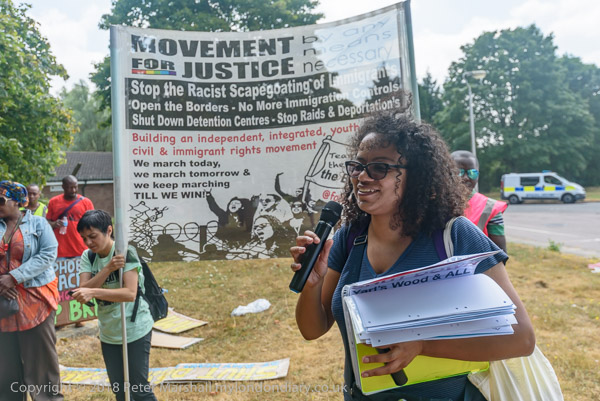
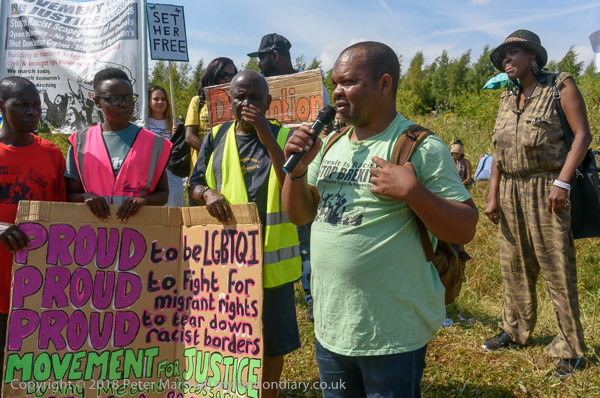
The protest outside Yarl’s Wood Immigration Detention Centre on Saturday 14th July 2018 was the fourteenth on the remote site built on a wartime air base organised by Movement for Justice, although I had been covering protests in and around London calling for the closure of this and the other immigrant prisons for over 10 years.
Antonia of Movement for Justice tells people what is happening. We are waiting for a final coach
I’d been at most of the previous thirteen at the site, although I had missed the first, largely because of transport problems – living outside London it wasn’t practical for me to travel on one of the coaches organised from London. In July 2018 I came with my bike on the train to Bedford and then cycled the 5 hilly miles to the event.
The march starts along the road
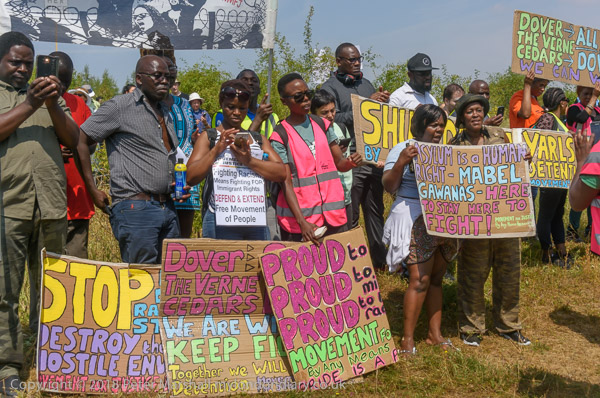
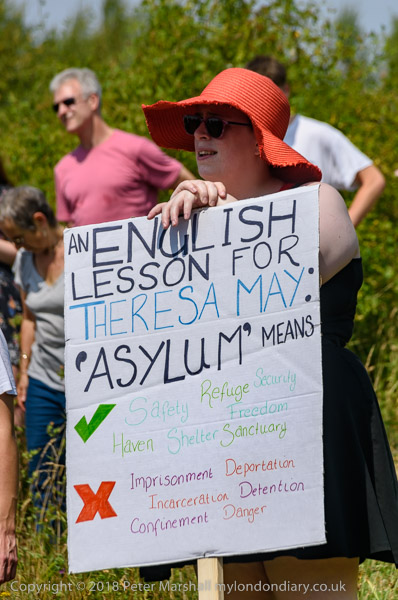
This protest was the smallest of them all I had attended there, with only a little over a hundred protesters. Many of those present had themselves been held for some time in this or other detention centres.
And then along a public footpath
Yarl’s Wood was being used to hold women and a few families, and previous protests had been widely supported by other groups including many feminist groups, who on this occasion stayed away. Later some other groups organised protests but on a smaller scale than the previous protests.
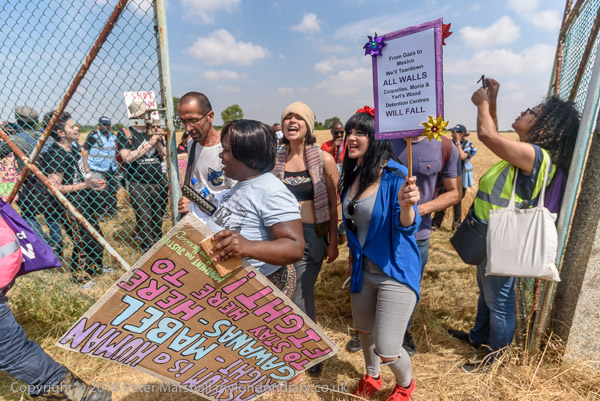
and through a gate into the field next to the detention centre
A woman who had been part of Movement for Justice and active in earlier protests here had left the group, complaining bitterly about the way the group had treated her. She had received widespread support including from some other former members leading to many boycotting this protest. I knew both her and others in MfJ and commented: “However justified her personal complaint, it revealed little if anything about the group that was not already public knowledge, and MfJ has played a major role in protests against our racist immigration detention system, and still seems to be supported by the former detainees.”
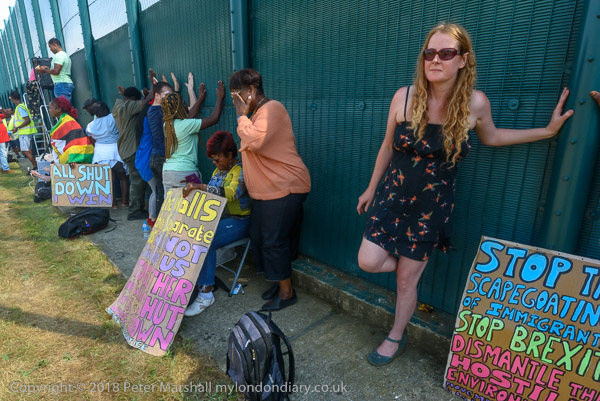
Where they stand and greet the women held inside over the fence
You can read about that public knowlege of MfJ on Wikipedia and on the complaints on the “Speak The Plain Truth” blog. I was saddened by the dispute but more so at the effect it had in weakening this and related campaigns – and I had never had any illusions about the nature of the organisation which I had first met in the 1990s.
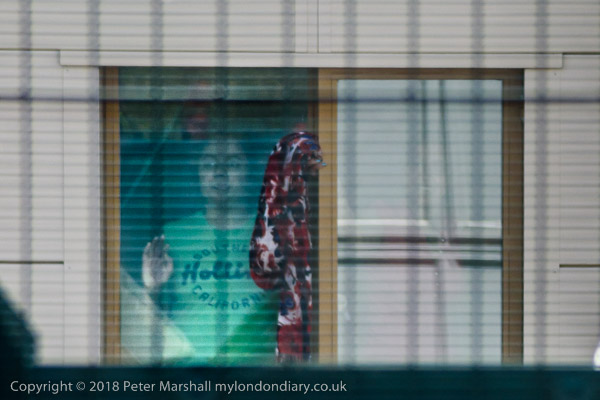
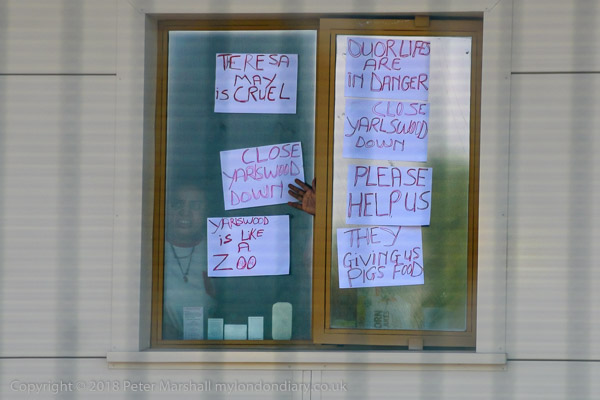
A woman looks out at the protesters who were obviously welcomed
The protest followed the usual pattern, meeting on the public highway and, after a rally there marching a mile or so along a public footpath to a field next to the prison and overlooking a part of the site across a 20 foot high metal fence.
Others hold messages in the windows which only open a narrow slit
The lower 10ft of the fence is solid metal sheeting but the upper 10ft is a thick metal gauze (out of focus in the picture above.) Standing back on a slope I could see women held inside greeting the protesters. Guards inside had apparently tried to keep them away from the windows – even enticing them to another part of the building with offers of free ice-cream!
They could hear the protest and know that there were people outside who supported them, and some inside were able to speak to us over a mobile phone link. Some of those who spoke outside were able to greet friends still inside – some are held for long periods, with one released a day under three years.
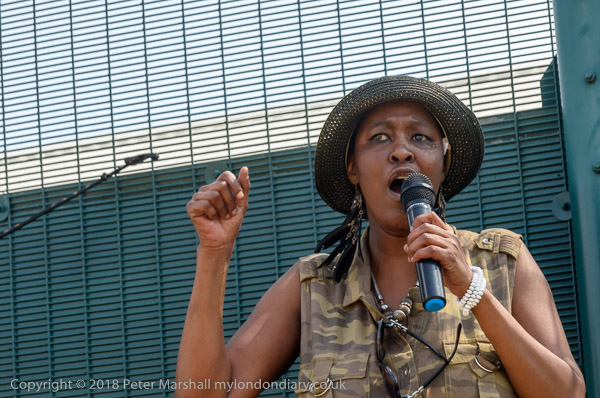
Mabel had spent 3 years inside and knew many of those still held there
Most asylum seekers are genuine and are eventually released, but the Home Office has long appeared to have a policy of putting as many hurdles as possible in their way, often demanding records that are impossible for the detainees to provide – a similar tactic to that used in the Windrush scandal. Many were deported under illegal “fast-track” procedures – and MfJ has also managed to take legal action along with others to stop some individuals being deported.
Between speeches many banged on the fence to make a great deal of noise
Most of our legal system is based on the principle that people are innocent until they are tried and proven guilty. But our asylum system works in the opposite way, assuming claims are fraudulent and demanding that asylum seekers prove they are genuine.
It was hot in the sun and I got tired. The protest was still continuing as I got on my bike to ride back to Bedford station.
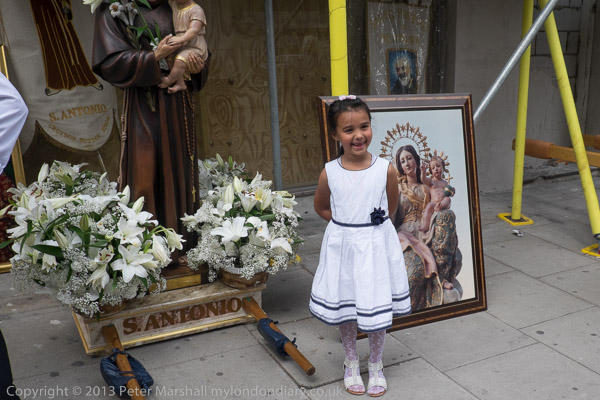
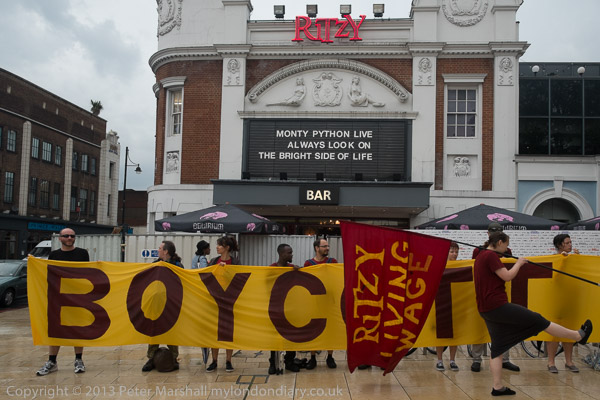
Italian Festival & Ritzy Strike: On Sunday 20th July 2014 I spent several hours at the Italian festival in Clerkenwell and photographed the procession around the local streets before rushing off to Brixton where striking cinema workers were holding a protest in front of the Ritzy cinema.
Festival of Our Lady of Mount Carmel – St Peter’s Church, Clerkenwell
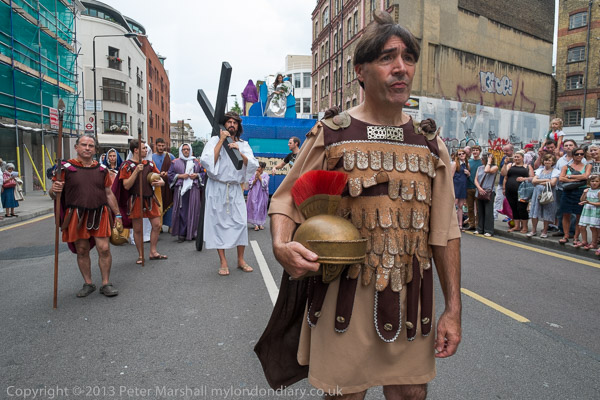
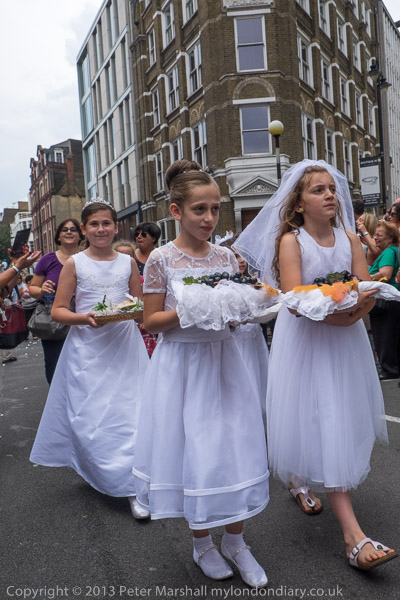
I think I first photographed the procession of Our Lady of Mount Carmel in 1992 – you can see pictures from then and the following year in one of my Flickr albums, Procession in Honour of Our Lady of Mount Carmel.
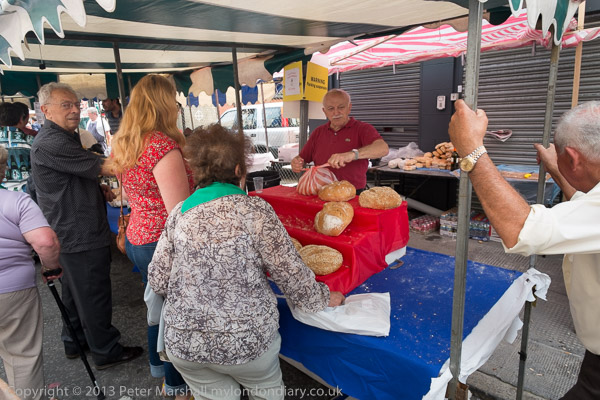
There were many stalls selling Italian food and drinks in the Sagra
In 1883 when the event began it was the first Roman Catholic event on English streets for 349 years and required special permission from Queen Victoria, but since then – with a few interruptions for war etc – has taken place every year on the third Sunday in July.
Since then I’ve frequently gone back to the event and taken more photographs, though in more resent years it has become more of a social event for me, meeting up with photographer friends – including one with Italian heritage – and sharing plastic cups of cheap Italian wine.
As well as the procession I’ve always photographed the people at these events and Sunday 20th Jul 2014 was no exception. As well as watching the procession many from the Italian community come from across this country to meet with old friends at the event and enjoy the food, wine, music and dancing in the Sagra in Warner Street.
This year (2025) it is also on 20th July and if you are in London and reading this on the day I post it, if you can get to St Peter;s Church in Clerkenwell (a short walk from Farringdon Station) by 3.30pm you can see what is I think London’s largest annual and certainly most colourful Christian processions.
It is still in my diary, but probably I won’t make it this year, partly because of being tired from photographing another protest calling for an end to the genocide taking place yesterday. But also because last time I went the wine had gone up in price and down in quality. More seriously because I’ve photographed it so many times it is hard to find anything new and not just repeat myself.
The event in 2014 was, as I noted, the first I’ve attended when there were no white doves released. So, although the other pictures are all from 2014, here is one from the last time I went to the festival in 2019. Pigeons are unpredictable and often look rather strange in flight and I was pleased to get one frame with them all visible.
London, UK. 20th July 2019. Three white doves are released from a basket in the historic procession in London’s Clerkenwell from St Peter’s Italian Church.
I usually stayed for an hour or two photographing the people celebrating, but in 2014 I rushed off after the procession to photograph another event.
Ritzy workers strike for Living Wage – Windrush Square, Brixton,
Despite some torrential rain “the Ritzy workers, some soaked to the skin, kept standing behind their long banner across the whole wide frontage of the cinema. Some had umbrellas, others did not, but it was the kind of rain that made umbrellas next to useless.”
I sheltered under the tree and my umbrella but still got wet.
For once I had my own umbrella up, holding it while taking pictures but still “enough came through to soak my clothes and my feet were squelching in my shoes.“
The Ritzy is the busiest and most successful art-house cinema in the the UK but was still paying its workers at only 82% of the London Living Wage – not enough to live on in London. Backed by their union, BECTU, they went on strike after negotiations with employers Cineworld failed. The workers say ‘Living Staff – Living Wage.
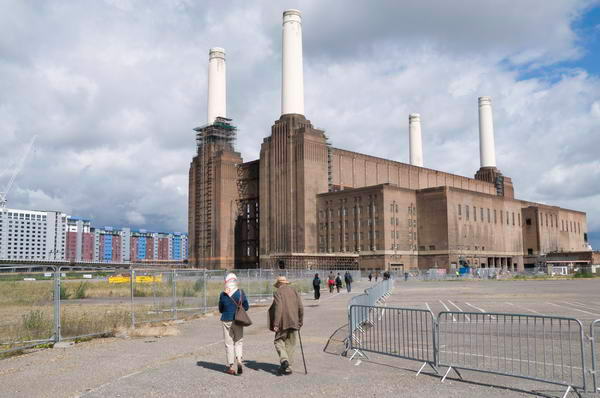
Battersea, Jesus, Bonkers & Peckham: On Saturday 19 July 2008 I began my day at an open day at Battersea Power Station by developers proposing a comprehensive redevelopment before photographing the Jesus Army marching along Piccadilly and, going on to Camberwell Green for Bonkersfest and a brief visit to I Love Peckham.
Battersea Power Station
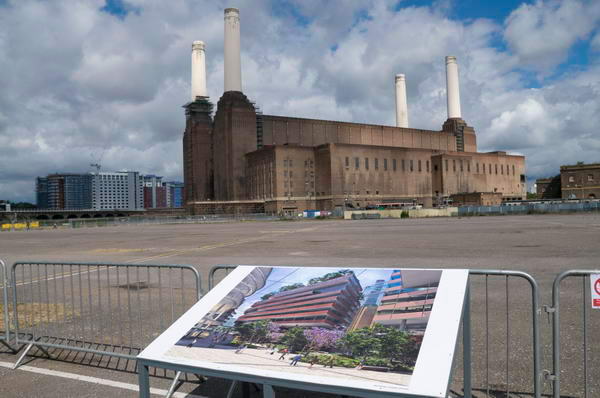
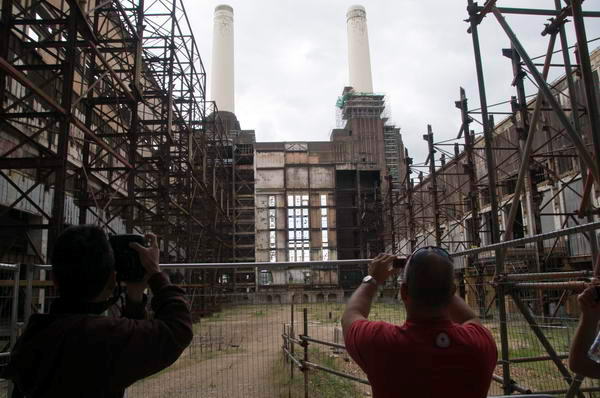
Developers Real Estate Opportunities had bought the site for around £400 million and were showing the latest development of their plans for it to the public. These then involved re-building the chimneys and filling the space around with various buildings including an eco-dome and a 980ft eco-tower which dwarfed the power station – and which London Mayor Boris Johnson described as an “inverted toilet-roll holder”. You can see it in my photograph of their model on My London Diary, and to be fair I think it perhaps looks more like some high-tech lavatory brush.
The pictures suggested the power station would hardly be visible from ground level
This tower was soon dropped from the scheme which was approved in 2010 but building never started. The only aspect of the scheme which did eventually get built was the Northern Line extension from Kennington, partly because of a £100 million contribution from the sale of the site to a Malaysian consortium in 2012 – who ten years later opened the power station building to the public.
The central turbine hall had been open to the elements since the late 1980s when the roof was removed to lift out the machinery.
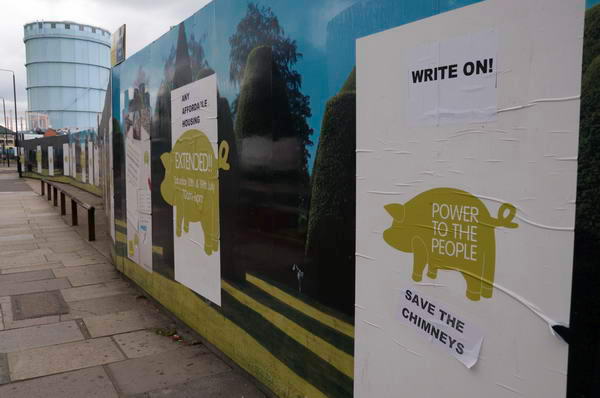
Local organisations had been formed in the 1980s to oppose unsuitable development and were then still active and asking questions about the proposals. They were concerned both about the loss of the power station as an iconic landmark and also the lack of affordable housing and facilities of any use to local people in the plans. The web site I linked to in 2008 is no longer active and the domain is for sale.
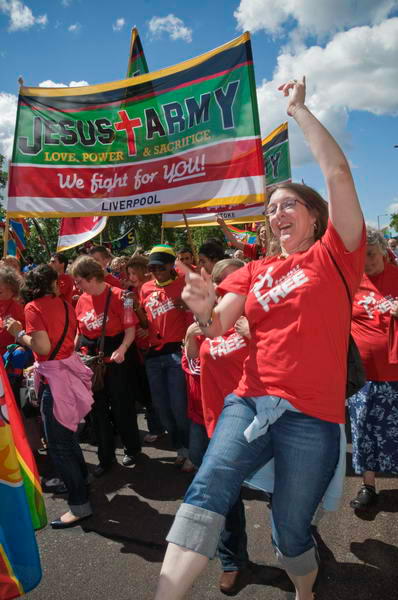
The Jesus Army describes itself as “an evangelical Christian Church with a charismatic emphasis” while others have labelled it as a sect or a cult. There are certainly ex-members who talk openly about it, and particularly about leaving it as a traumatic experience, while others simply feel that they could not personally give the level of commitment it requires of them.
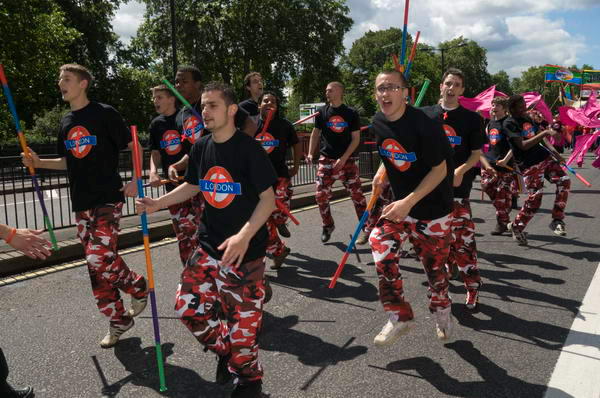
I found their march through London a dispiriting event, too uniform in many ways and I soon found it depressing to photograph. But as I told the woman who came out of the crowd passing by to hug me, “Jesus loves you too, sister” although I’m sure the guy I’ve read about in the gospels would have had no truck with this organisation. London Transport might have a problem with their logo [on some t-shirts] too!
Creative Routes, an interdisciplinary arts organisation run by and for those who have survived the mental health system and mental distress, organise the annual Bonkersfest as “a showcase of mad creativity.”
I wasn’t greatly impressed by what I saw happening this year, and left after taking a few pictures, including those of “some enterprising women were making the most of the occasion by organising a yard sale” in front of Brighton House on the edge of the green and a small memorial which had been unveiled in 2007 to the Wright family and four others killed by a direct bomb hit on the shelter here on the afternoon of 17th September 1940.
They had taken shelter while celebrating the wedding of Sidney and Patricia Wright. Bride and groom, Sidney’s parents and five sisters were among the 13 who were killed.
There is an energy about Peckham that I really do like, and some of it was on display here, watched by a small crowd including the Mayor of Southwark, Councillor Eliza Mann – in pink.
There were a few things going on for me to photograph, and clearly there had been various other mainly art-related activities by local people, particularly children in the week of the festival, but it seemed to have attracted rather less interest than the previous year when I had photographer the march of the human rights jukebox.
Big Lunch Street Party: The Eden project is a visitor attraction built in a disused clay pit near St Austell in Cornwall, its name coming from the Biblical garden and with a mission to celebrate plants and the natural world, reconnect people with them and to regenerate damaged landscapes and give the world a better future.
The Eden project launched The Big Lunch in 2009 as “a little experiment: to see what the transformative effect of getting to know our neighbours might be.”
I was invited by a friend to be with him on Sunday 18 July 2010 as the official photographers at the Big Lunch Street Party in Wrayfield Road in North Cheam, part of a typical 1930s surburban development in what was then Surrey and is now a part of the London Borough of Sutton.
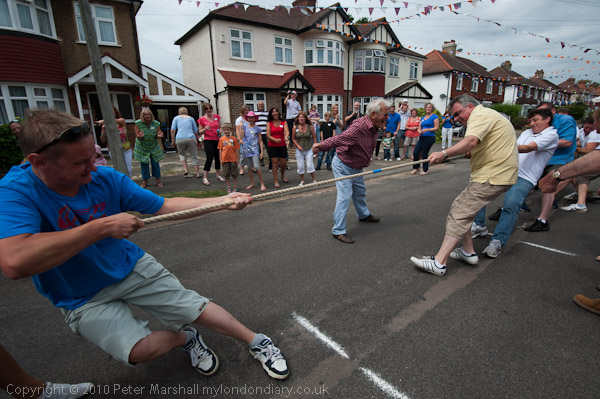
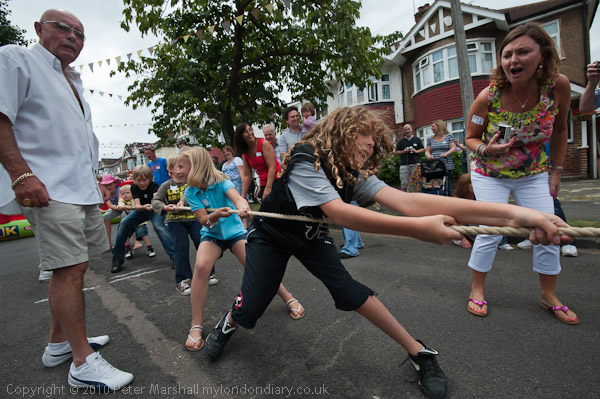
The party started with several tugs of war between teams from the odd and even sides of the street
You can find out more about Wrayfield Rd on Streetscan which reports that though in some respects it is close to an average UK postcode, though having rather more married couples than average in these family homes.
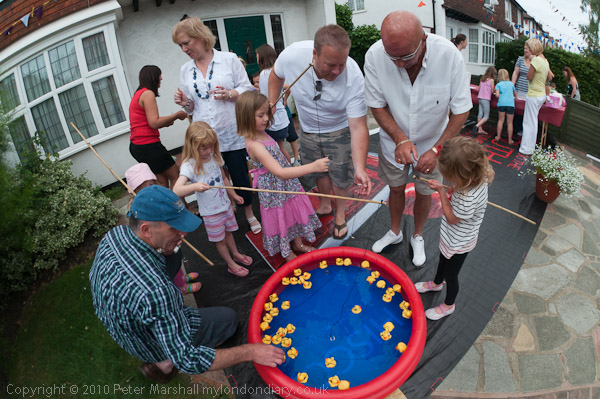
Fishing for ducks was popular with children
People here are healthier than the average and with higher household wealth than 89% of England and Wales with low unemployment and significantly higher levels of self-employment and entrepreneurship. There are low levels of deprivation and it is what I would describe as an affluent outer-London suburb.
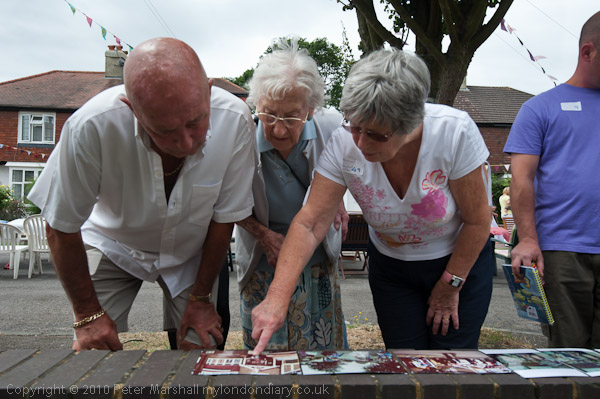
Some of those present could remember last street party for the 1977 Silver Jubilee street shown in the pictures on one garden wall
And like many such streets, it is visually rather boring. It’s around a thousand feet long, lined mainly by solidly built semidetached houses, with a few detached properties – a little under 60 homes in all, developed by Warner and Watson Ltd, and completed in 1933/4. More details on the estate and the cost of homes back then on my post in My London Diary – now these houses cost around a thousand times as much. Had they just gone up by inflation they would be around £50,000 but in 2025 you are looking at around £750,000. At least one person who had moved in in 1933 was at the party 77 years later.
Several couples had lived on the street for a very long time
But the event was an interesting one and I’ve written more about it on My London Diary. Getting to know the people who live around you is a good idea and I’m sure things like this help.
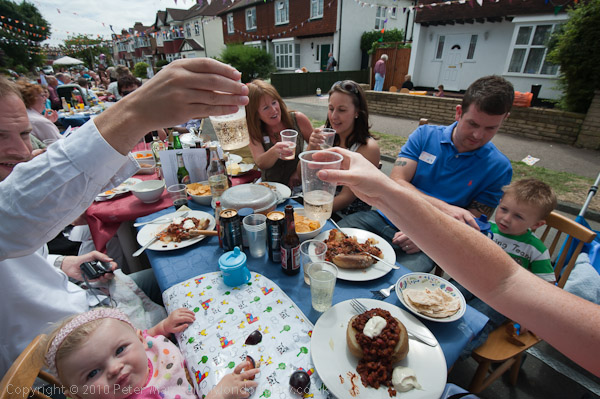
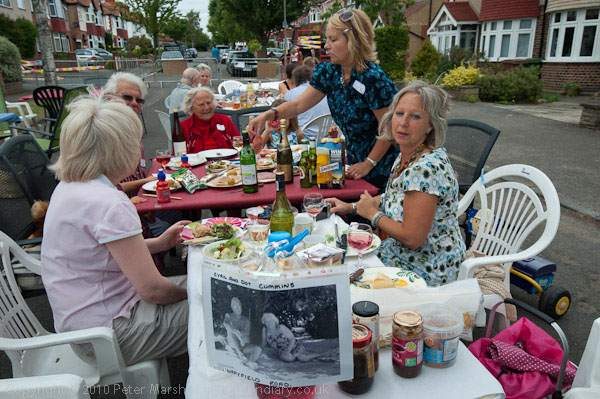
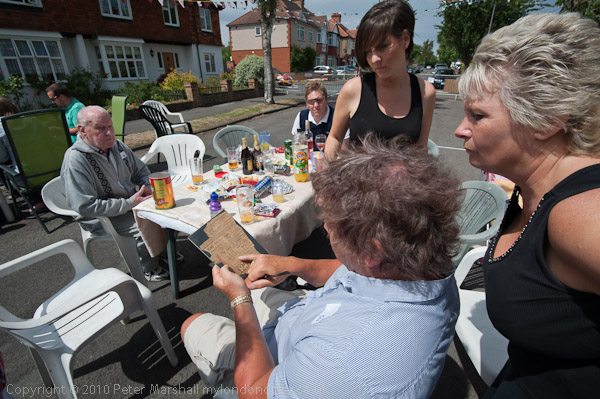
People look at he original newspaper advert for the houses in the streetThere was plenty of eating and drinking taking place along the middle of the streetA toastSome buntingAnd sun hats were a good idea
The event received sponsorship from some local businesses and organisations – and the fire brigade brought a fire engine for kids to take the driving seat. Th local MP came and spoke, there was a fine singer and as I was leaving a local band came to play. The party was expected to keep going into the night.
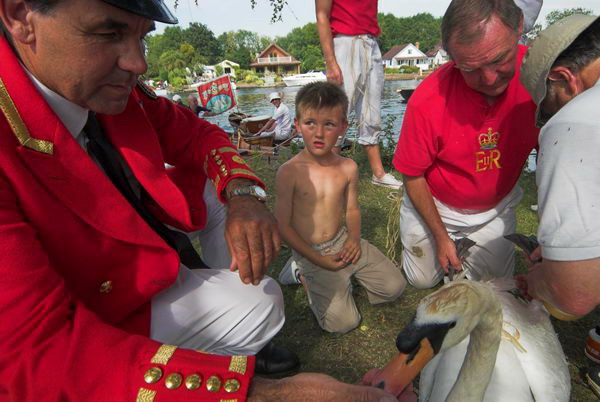
Swan Upping on the Thames: On Monday July 17 2006 I again photographed the annual Swan Upping which takes place on the River Thames over five days, in the third week of July starting on Monday at Sunbury Dock and ending on the Friday of that week at Abingdon Bridge. Like many who live close to the river – a five minute walk for me – I’d heard about this for many years but is was only in 2001 that I first saw and photographed the event – before then I had always been teaching during that week.
It is a ceremony that began in the twelfth century where a part of their huge grab of the country the Norman invaders claimed ownership of mute swans on open water as well as all the land. Later they granted some rights over the swans to others including London Livery Companies the Worshipful Company of Vintners and the Worshipful Company of Dyers, who now share the rights to swans on the Thames equally with King Charles III.
You can find pictures and text from a number of years on My London Diary, up to 2013, when I had photographed it ten times and I then decided I was simply repeating myself. I might go again, perhaps just to watch the spectacle but not to try and cover it in any depth.
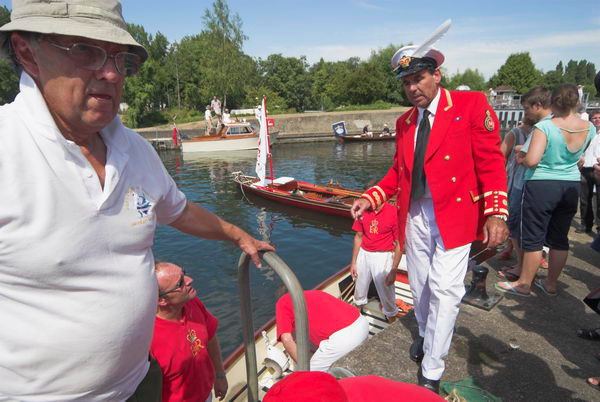
The Queen’s Swan Warden Christopher Perrins, Professor of Ornithology at the University of Oxford’s Department of Zoology and the Queen’s Swan Marker, David Barber
Some years I wrote at some length about the history and what actually takes place, but here I’ll post my first post about the event in 2001 and the post I made in 2006, the year in which all pictures here were taken.
2001
Swan upping is an annual event, counting swans along the Thames from Sunbury to Abingdon takes a week. The Crown decided it was a good thing to claim the swans around the 12th century, so they could gorge themselves on them at banquets, [later] they let some of their rich mates in the city have a share, but protected them from the people by severe penalties.
Swans are seldom eaten now, but upping continues to divide the Thames birds between the Crown, the Dyers and the Vintners.
2006
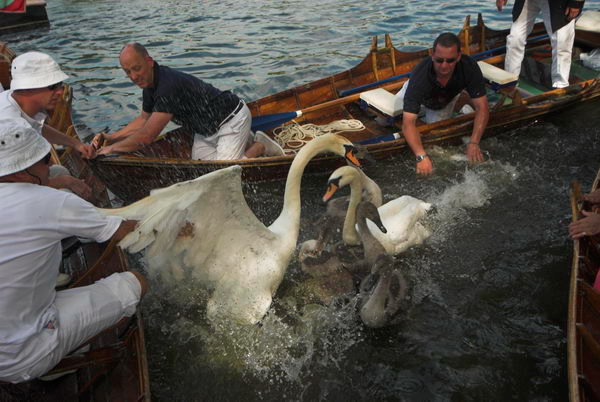
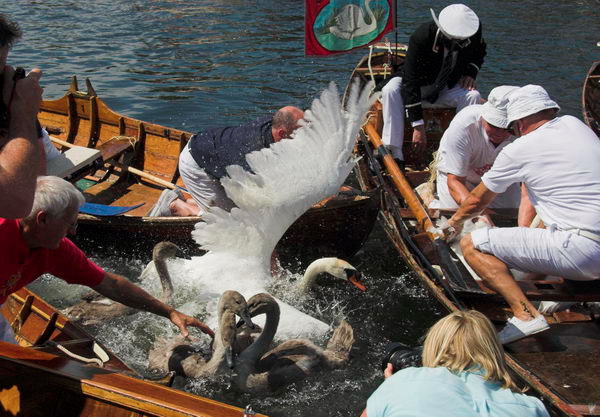
I’ve said rather a lot about swan upping in some previous years. It’s a fascinating and colourful event, which keeps a record of swans on the River Thames, as well as giving them a useful health check. The swans are handled very carefully and care is taken to avoid undue distress (though some of the press present this year could have been rather more careful.)
Swans are no longer normally eaten, but are admired for their decorative effect and looked after. Although anglers are now rather more responsible than in the past, the birds examined still often have signs of damage from discarded hooks and line. Many cygnets die in the first few months before the uppers come around, either from predators or other hazards.
I still feel an excitement watching the skill of the uppers as they surround a family of swans, gradually closing in on them, avoiding gaps and then grabbing them out of the water.
Great care is also taken when releasing the family back into the river, and usually only a few seconds later they are swimming serenely as ever.
Eric who cycled along the towpath to try to lure the swans into suitable places for upping using crushed digestive biscuits
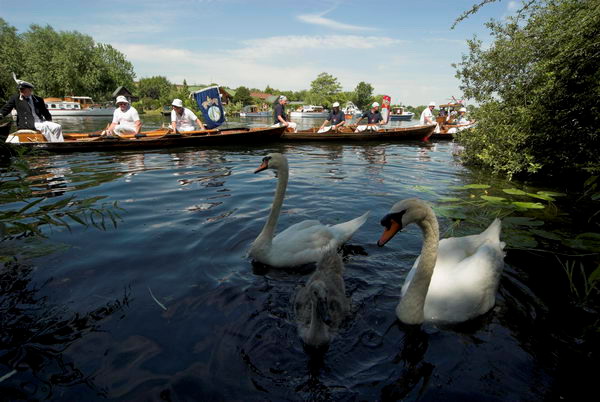
One of the smaller mysteries to me is how there are so many swans on the river, but so few mating pairs – and many of these with very small broods. Of course there are many other lakes and rivers around, and swans can and do move around, although many of the adults in these pictures were ringed as cygnets in more or less the same locations.
The swans get recorded – here the leg ring is being checked while the Swan Master looks at the bird’s beak.
In 2006 I left the uppers at Runnemede, but in some years I went with them to Windsor where they stand to drink a Royal Toast in Romney Lock and then, on the way to the Eton Boathouses at Windsor, the Dyers and Vintners salute the Royal Uppers by standing in their boats with oars upraised.