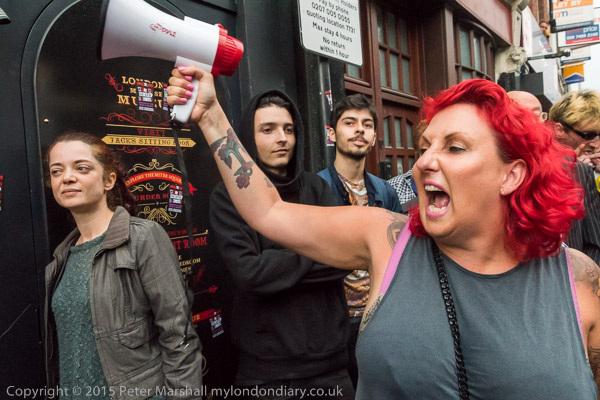
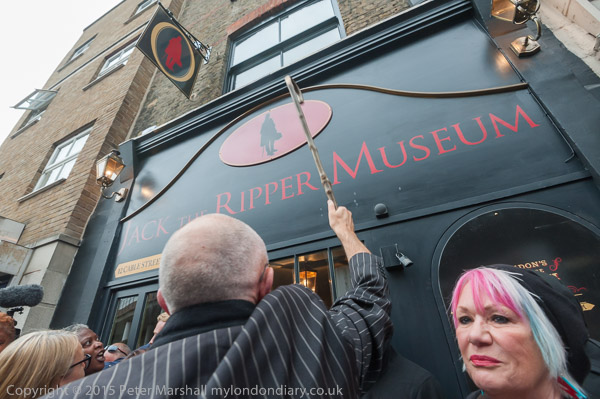
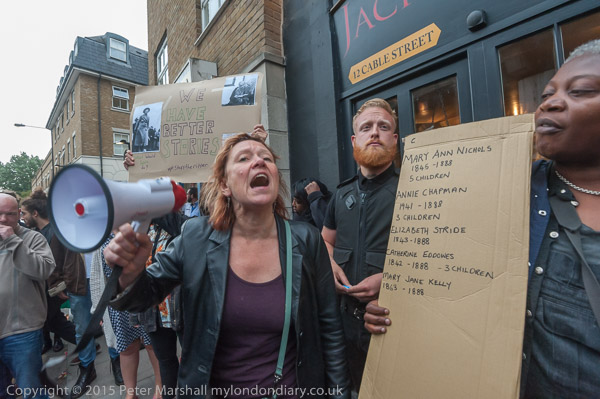
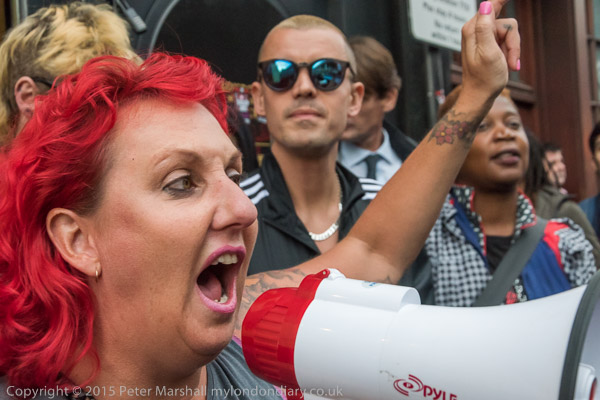
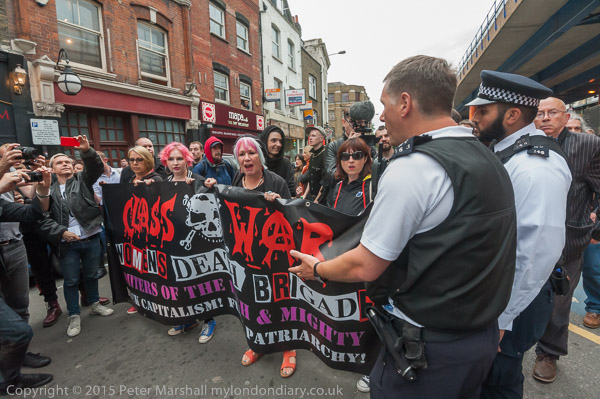
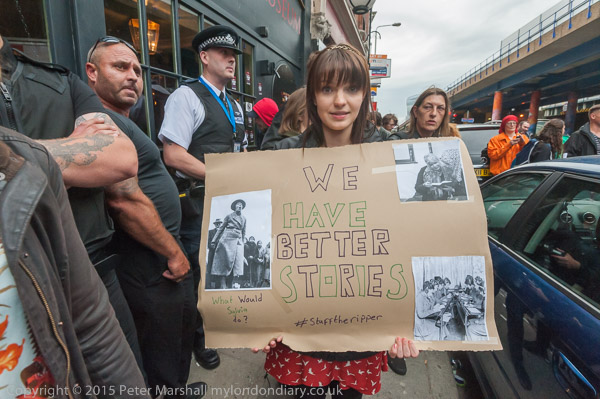
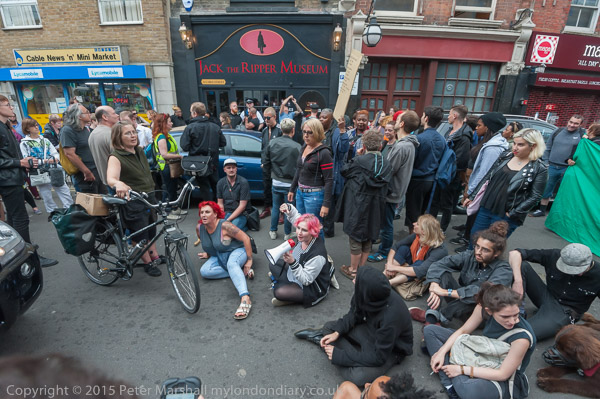
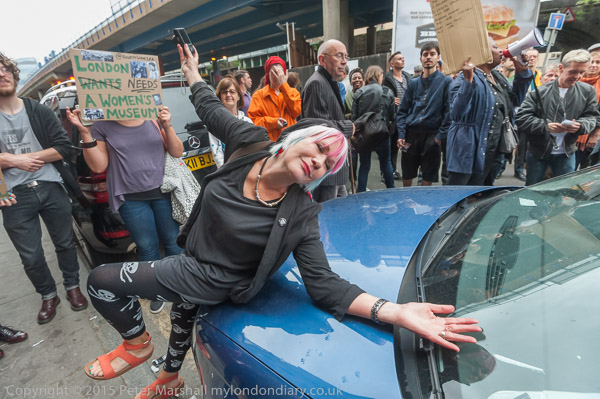
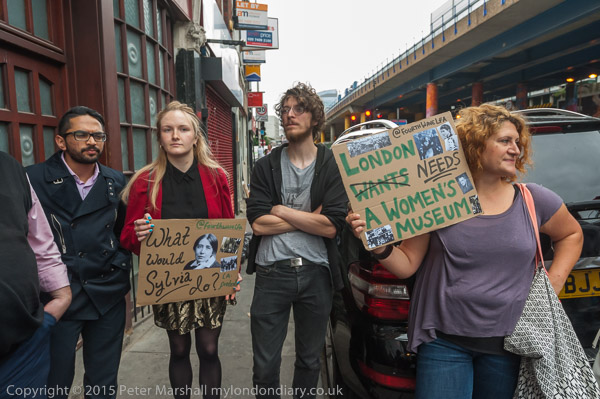
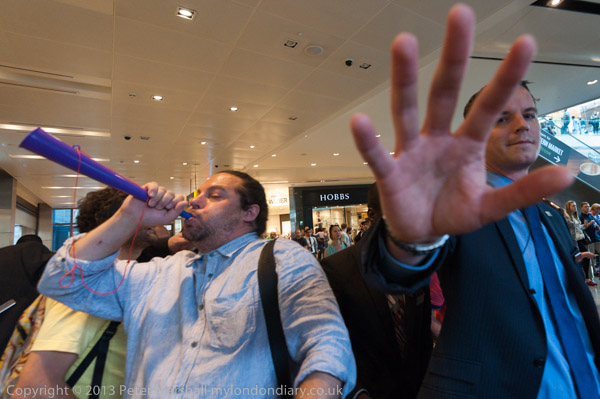
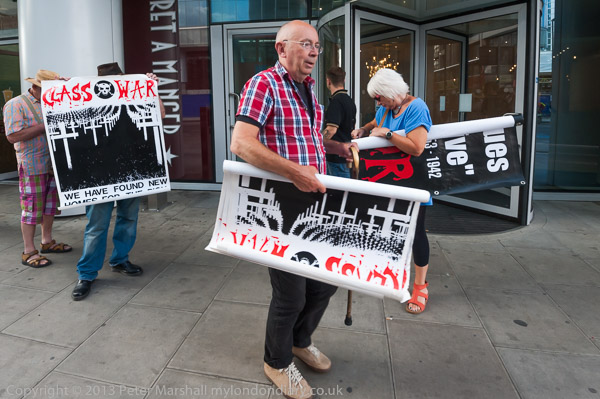
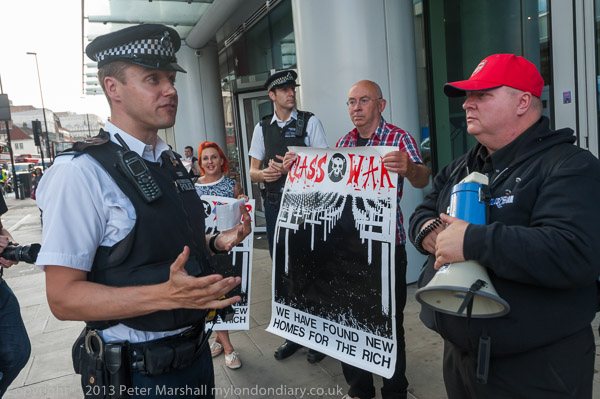
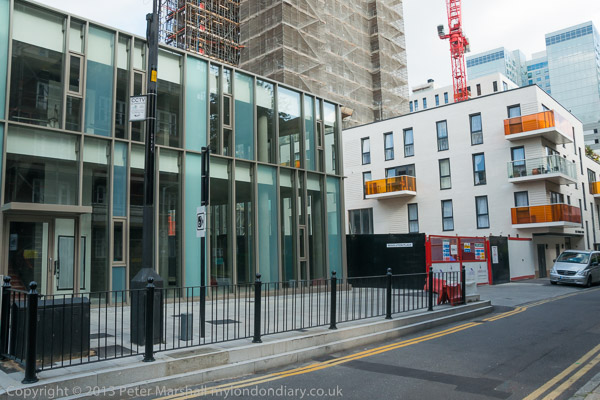
Class War and others protested on Wednesday 5th August 2015 outside the newly opened Jack The Ripper “museum” in Cable St days after it first opened. Class War had called this protest as soon as the news became public, and others had organised another protest the previous evening which I had been unable to attend. Class War later organised further protests outside the museum which I also photographed.
Unfortunately the Jack the Ripper tourist attraction in Cable Street is still open, pandering to a popular taste, particularly among tourists to the city, for the sensational and to wallow in the grisly details of this brutal and horrific series of murders in London of five working-class women on the streets of Victorian London.
The museum was set up according to its planning application as the “first women’s museum in the UK” which “will recognise and celebrate the women of the East End who have shaped history, telling the story of how they have been instrumental in changing society.” A number of people gave advice or worked for free or at cost because they supported the project on this basis, and felt disgusted at how they were duped.
As I commented in 2015, ‘People who have seen the museum have been revolted at its sensational presentation of violent crimes against women. One of the politer comments was to call it “salacious, misogynist rubbish.“‘
I’ve only seen the shop through the doors and windows, and there does seem to be a lot of merchandise for sale. The on-line reviews of the place are extremely polarised. There are many positive, even fawning examples, though some do seem to follow a very similar pattern.
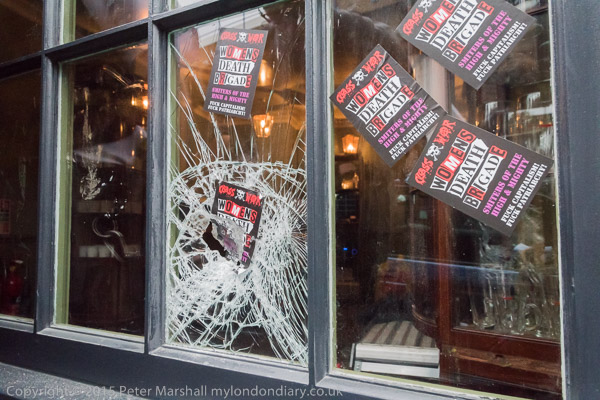
I think the window had been smashed earlier in the day
Others are damning. One comments “The museum is pretty small. It’s effectively 5 small rooms. You could whizz round it in 10 minutes easily. In no way does it represent good value for money. One of the rooms was pure conjecture too (What Jack the Ripper’s living room might have looked like…!?). It’s rather light on any kind of detail. For people with anything more than a superficial interest in the history etc, this is a waste of your time and money.”
Another states “I have no idea how it got so many positive reviews… It’s £12 per person and we’ve basically seen everything after 10 minutes. There’s nothing in this museum that isn’t already in the Google images.” Others are far more negative about the exploitation of the sadistic murders of women for profit.
So if you are someone who thinks we should celebrate the work of a serial killer who eviscerated five defenceless women – three of them mothers – on the streets of London and feel your holiday would not be complete without wallowing in more of the bloody details you may well enjoy this “museum”, even though it is in the wrong location and has little authentic content.
If you are not sure about the details of the killings and have a strong stomach you can read more, rather too much more, on Wikipedia; it isn’t pleasant reading. For once I’d advise you not to click on the link, or if you do to skip some parts of the entry.
Of course the whole Ripper industry is a tacky area, with many more imaginative and profitable books speculating on the identity of the deranged killer. Although the evidence is only circumstantial the most likely suspect remains Montague Druitt who committed suicide shortly after the last of the five murders, and was one of three named in a letter written five or six years later by a senior police officer who though not involved in the investigation will have had access to the officers and the – now largely destroyed – police records of the case.
Olympic Shame, Holocaust Hero And Iraq Festival – 2012 On Saturday 4th August 2012 much of the nation and all of the media were in the grip of another sporting obsession the 2012 London Olympics and two of the events I covered had at least some link to this. The third was something rather more serious, celebrating the work of one of the great heroes of the Second World War, not a military hero but a man who saved the lives of many.
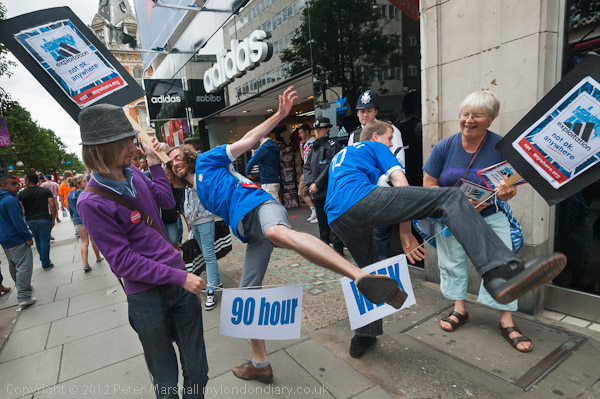
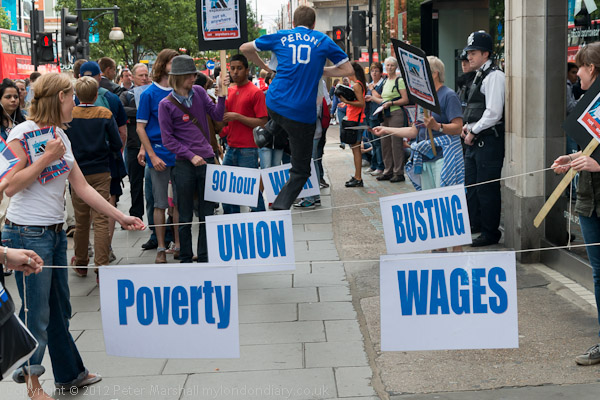
Adidas Stop Your Olympic Exploitation – Adidas, Oxford St
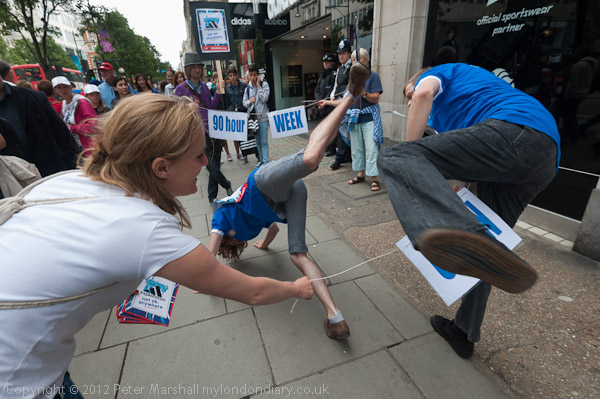
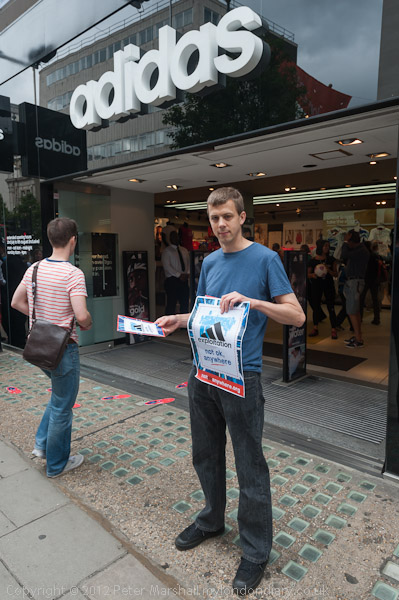
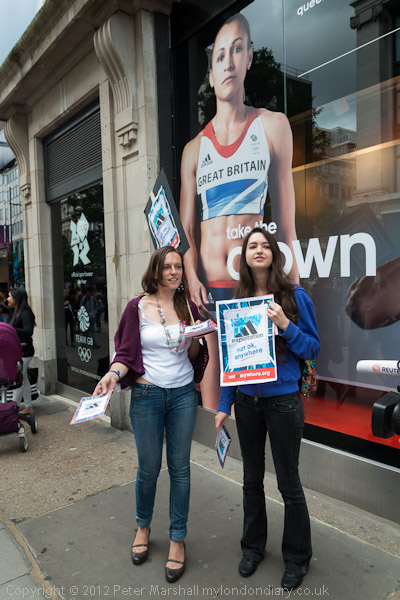
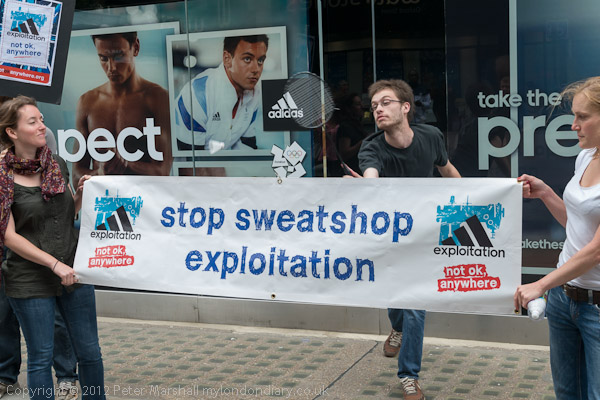
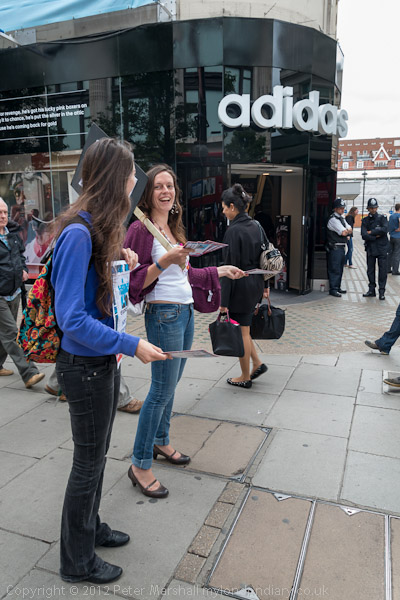
War on Want held a protest outside Adidas on Oxford Street, playing games and handing out leaflets because workers making clothes for the official sportswear partner of London 2012 in Indonesia, Sri Lanka and China get poverty wages are not allowed to form unions and have little or no job security.
War on Want stated: Around the world thousands of workers, mainly women, producing clothes for Adidas are not paid enough to live. There wages do not cover basic essentials like housing, food, education and healthcare. With such low wages, workers have to work excessive hours just to scrape together enough to get by, sometimes beyond legal limits – up to 15 hours a day. In many cases workers are told that if they try to organise trade unions to defend their rights, they face harassment or they will be fired.
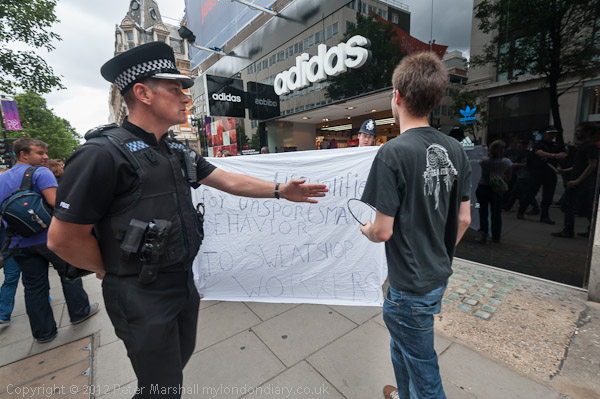
Around 20 police stood around watching as War On Want began their games in protest, and they stopped play as the protesters began their badminton game using a banner as a net, claiming it might endanger people walking past. The street was even more crowded than usual with people who had come to London to attend the events, some of whom stopped to talk with the protesters and express their disgust at the exploitation of foreign workers, but the action by Scottish police drafted down to London perhaps reflected a lack of experience in dealing with protests.
The badminton continued for a few minutes in a side street, and then they turned to a rather short hurdles event. Again when they ‘ran’ this on the pavement in front of the Adidas shop police fairly soon stopped it, perhaps because Adidas complained that half the area of pavement was its property.
As well as leaflets, War On Want was handing out Freepost postcards to people to send to Herbert Hainer, the CEO of Adidas, care of War on Want, calling for Adidas to end the exploitation of workers.
Unusually Adidas sent out a person from their PR agency to talk to me as I began to take pictures of the event, and she later sent me an e-mail stating Adidas was “fully committed to protecting workers rights and to ensuring fair and safe working conditions in factories throughout our global supply chain.” Unfortunately it was clearly an attempt to mislead as it was irrelevant to the claims that were made by War on Want about wages and conditions in factories in Indonesia, Sri Lanka and China producing goods for Adidas. She also said that they had tried to contact War on Want to discuss their claims but had been unable to do so.
A War on Want press release gave full links to the cases on which their claims were made and stressed that they had taken part in discussions with Adidas, “but the multinational continues to deny the widespread nature of the problems and has failed to respond to the organisation’s demands that the firm commits to paying a living wage.”
Of course Adidas is not the only major sponsor of London 2012 and other major sporting events – and London 2012 showed itself also to be blind to the activities of Dow, Atos, BP and all the others.
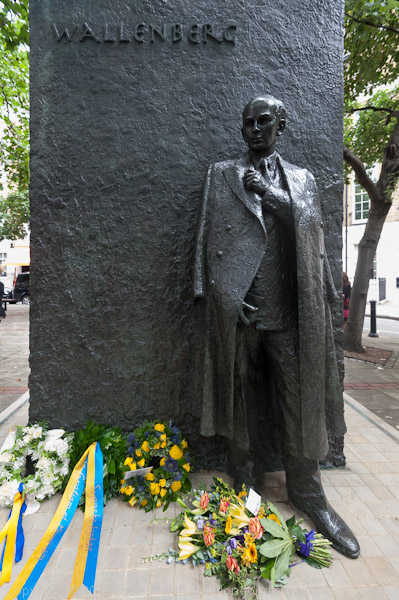
Raoul Wallenberg 100th Anniversary – Great Cumberland Place
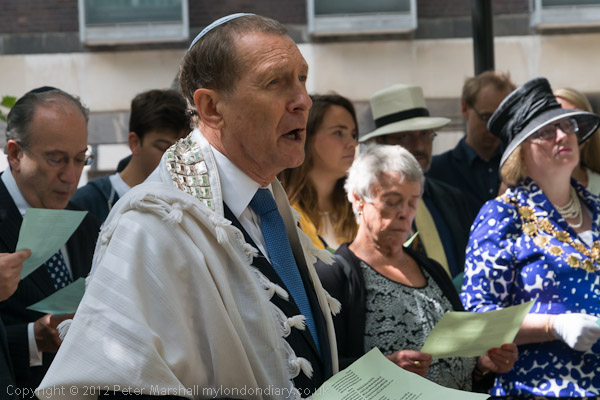
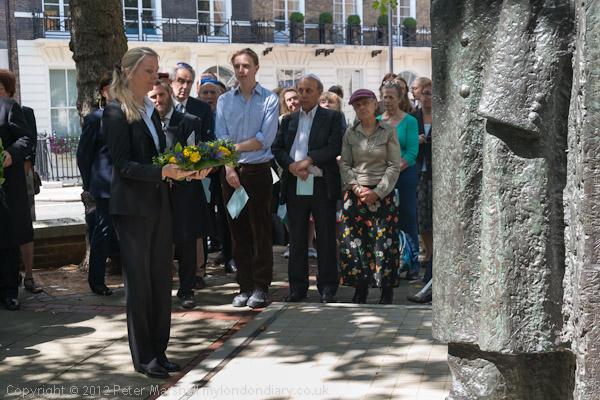
A ceremony took place around the monument erected to Raoul Wallenberg in 1997 in Great Cumberland Place, outside the Western Marble Arch Synagogue to mark the 100th anniversary of his birth. Led by Rabbi Lionel Rosenfeld it was attended by the Lord Mayor of Westminster and the Swedish Ambassador as well as many from the synagogue and the Swedish Church in London.
Rabbi Lionel Rosenfeld of the Western Marble Arch Synagogue leading the chanting of a Psalm in Hebrew
Rector Michael Persson from the Swedish Church talked about Wallenberg, who he called ‘an average man’ who grew up in a banking family but was too sensible, too friendly and too nice to be a banker and so became a businessman. Faced with the situation of thousands of Jews being sent to their death in Hungary he did everything he could to help, following the Lutheran ideal of living, a calling to be yourself and to do good for other people, an ordinary man who was brave when the time came and became one of Sweden’s greatest heroes.
The Swedish Ambassador lays one of several wreaths
The memorial shows Wallenberg standing in front a a large wall made of stacks of the roughly 100,000 very official looking ‘protective passports’ he issued identifying the bearer as Swedish subjects awaiting repatriation. Although these had no legal status, they looked impressive and, sometimes with the aid of a little bribery, saved the bearers from deportation.
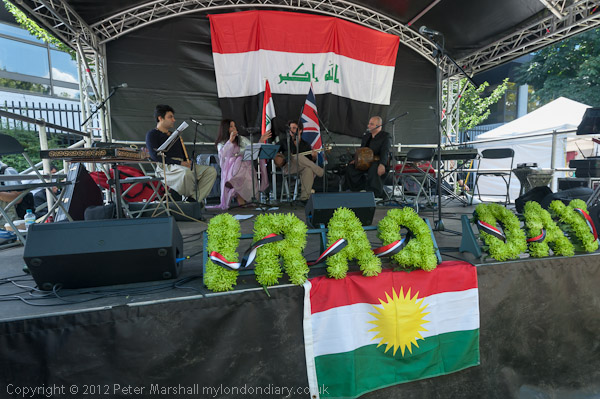
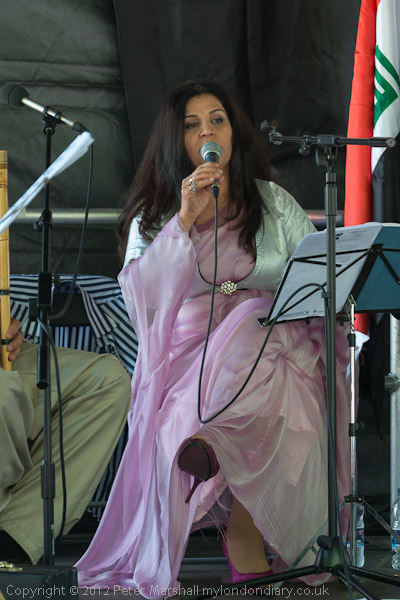
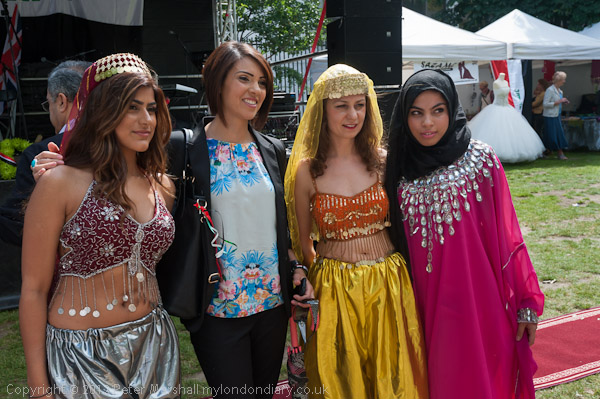
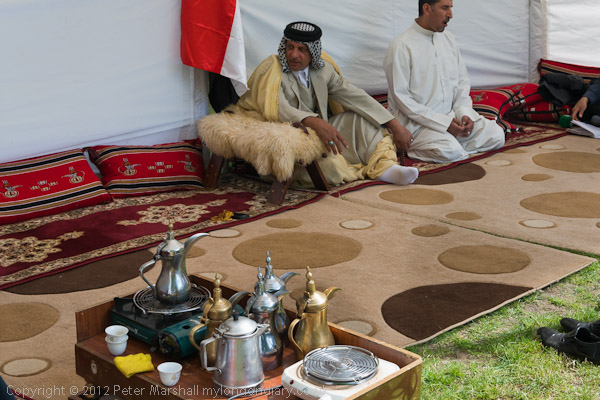
The Iraq Day 2012 festival also had an Olympic link, being “organized to celebrate the games with a hint of Iraq flavor” by the Iraqi Culture Centre in London and sponsored by Bayt Al Hekima-Baghdad in conjunction with the Local Leader London 2012 program.
Although it aimed to build stronger relationships among British-Iraqi communities and promote the the rich cultural heritage of Iraq including its music, food and art in several ways it actually demonstrated the differences between different Iraqi communities.
Given the continuing political divisions and unrest in Iraq after the US-led invasion the stated aim to promote tourism to the country seems entirely wishful thinking. Current UK advice on travel to Iraq begins “Iraq remains subject to regional tensions. Militia groups opposed to western presence in Iraq continue to pose a threat to UK and other interests in Iraq – including through attacks on Global Coalition military bases, diplomatic premises, and foreign nationals…” and ends with the paragraph “If you’re travelling or moving to Iraq, you should take appropriate security precautions before travelling. Outside of the Kurdistan Region you are strongly advised to employ a private security company, make arrangements for secure accommodation and transport and consider pre-deployment training.“
US travel advice is even blunter: “Do not travel to Iraq due to terrorism, kidnapping, armed conflict, civil unrest, and Mission Iraq’s limited capacity to provide support to U.S. citizens.”
I saw one performer storm off the platform, furious at what she felt was cultural discrimination against the Kurds and overheard a loud and bitter argument between the director of a fashion show and the event organisers. I’d been told the show would start in two minutes and when I went home an hour later it still had not happened.
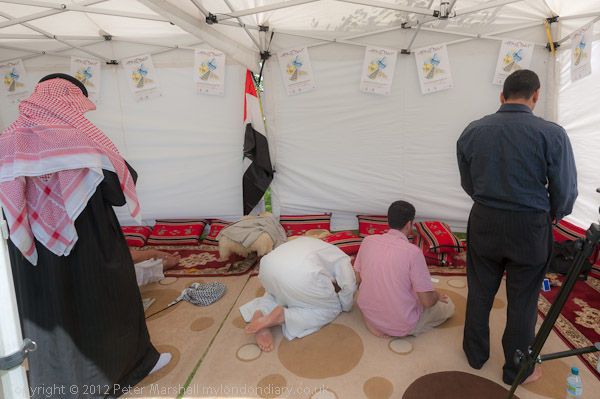
Afternoon prayers
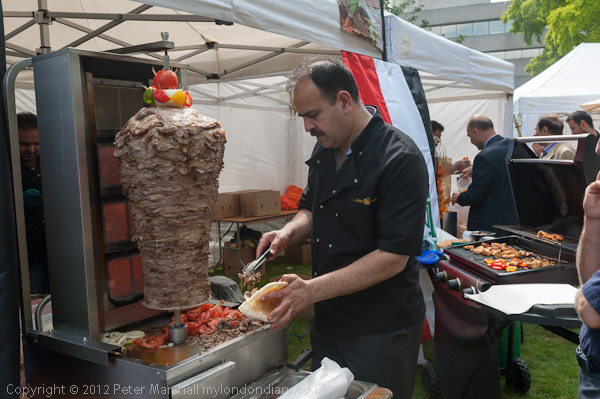
There was a great deal of Iraqi food on offer, and while many of those going past along the riverside walk stopped to taste and buy some this was perhaps rather insensitive so far as many of the Iraqis present were concerned. The event was taking place during Ramadan and although they could see and smell the Iraqi food on offer they were fasting until after sunset at 2041.
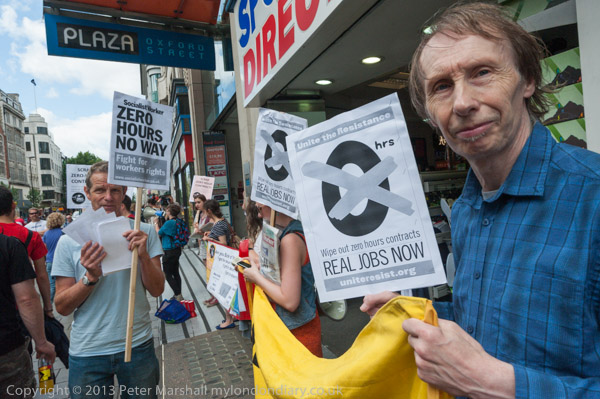
Zero Hours at Sports Direct, Cleaners at John Lewis Westfield – On Saturday 3rd August 2013 I photographed one of many protests calling for an end to zero hours contracts at Sports Direct branches then hurried to Stratford, where a surprise protest inside the store demanding demanded that their cleaners get a living wage and be treated in the same way as other workers in the store.
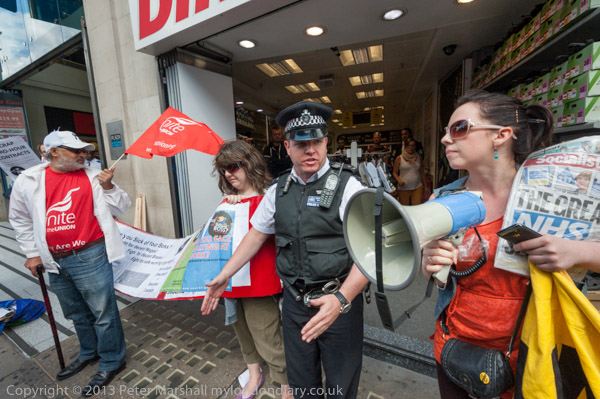
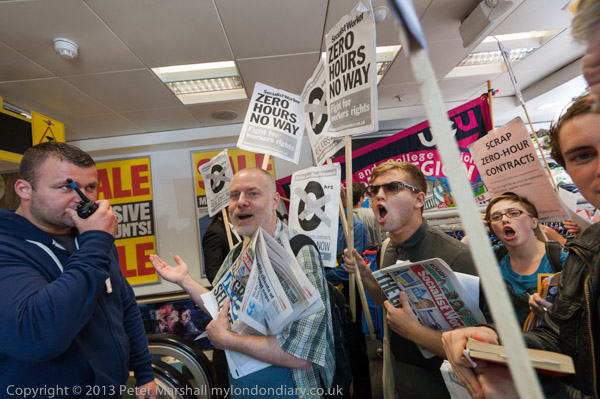
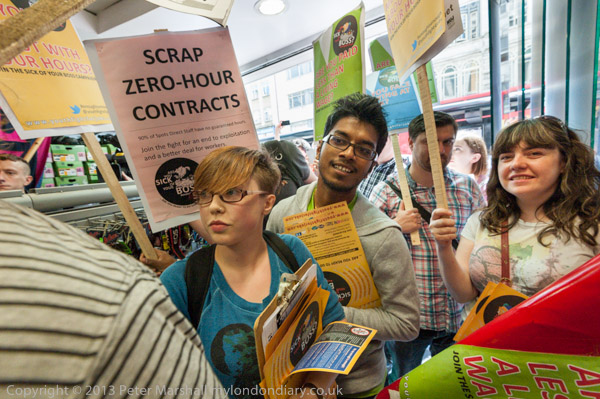
End Zero Hours Contracts – Sports Direct, Oxford St
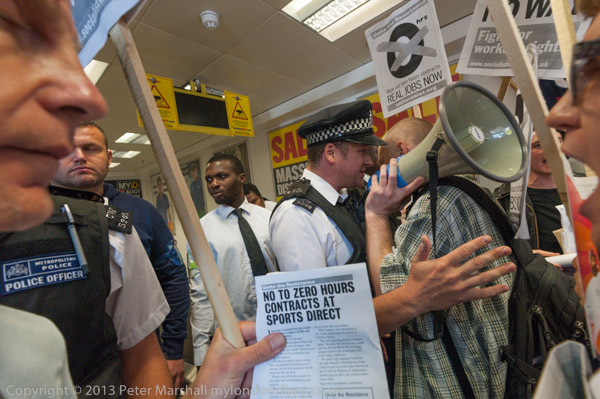
Over 85% of the 20,000 part-time staff at Sports Direct branches across the country were on Zero-hour contracts which deprived them of sick pay, holiday pay and other employment rights. These contracts have no guaranteed weekly hours or income and have now become widely used – including by Buckingham Palace and 13 out of 32 London Boroughs.
Essentially they deny the whole concept of a contract as normally understood, agreements without substance which gravely disadvantage workers. They provide no guaranteed weekly hours or income and are used to cut wages and avoid holiday pay and pensions. Despite no guarantee of any income, they oblige the workers to be available for work at the employer’s whim, making it impossible for them to take on other work.
Zero hours contracts are also illegal if they do not give workers the statutory minimum requirements for paid holidays, wages, sick pay, maternity pay etc, but these again are difficult to enforce. There are various types of zero hours contracts but all are essentially designed to exploit workers.
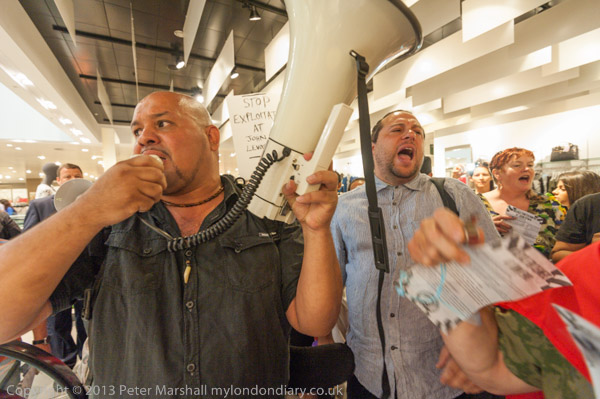
The protest started with around 50 people making a lot of noise on the pavement outside the shop and handing out leaflets to the many shoppers passing by. Many of those who took the leaflets expressed surprise that such contracts were legal – and a change in law in 2015 made it illegal for contracts to deny employees the possibility of working for another employer – though there is no effective mechanism to stop employers penalising workers who turn down shifts offered because they have another job at that time.
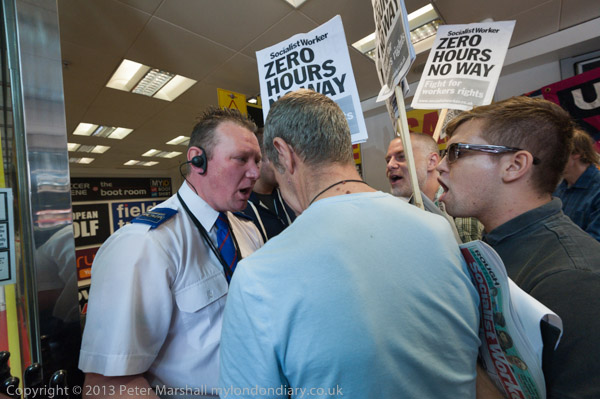
After around 50 minutes the protesters surged into the small street-level area of the store, intending to go down the escalator leading to the main store area. Security staff blocked their path and told them to stop, and they did. One security man tried to push a protester who complained he was being assualted but otherwise the situation remained calm, with people blocking the way to the escalators in protest being watched by police and security.
A police officer came to talk with one of the leading protesters, who made it clear they were taking care to cause no damage and would shortly leave after making their point. The officer retired and after a few minutes people left the store to continue the protest on the pavement for a few minutes before calling an end.
Cleaners in John Lewis Westfield – Westfield Centre, Stratford
I walked from Oxford Street to take the Central Line to Stratford where I met a group of members of the IWGB outside Stratford Station on their way to protest inside John Lewis. They have been conducting a long term campaign to get the cleaners in John Lewis stores to be treated like others who work on the shop floor.
John Lewis is very proud of the fact that its workers are ‘partners’, with higher pay and better benefits than other shop workers, getting a share in the company’s profits – in 2013 this was a bonus equivalent to nine weeks pay. But the staff who keep the store clean get low pay, lousy conditions of service and are generally treated like dirt by the contract company that employs them.
The cleaners want to be directly employed by John Lewis and so get a share in the profits and the better conditions. They were then getting £6.72 per hour, considerably less than the London Living Wage of £8.55 an hour set by the GLA and backed by the London Mayor, and only statutory sick pay, holidays and pensions from the contracting company which employed them.
Their claims are supported by many of the ‘partners’ they work alongside, and by many John Lewis customers. But the ‘partners’ are afraid to speak out; one of them, Ralph Ashley who worked at Stratford did so and urged his fellow workers to join the IWGB, and was targeted and sacked after he gave an interview to the Guardian. As well as their own demands, the protesters also demanded he get justice and be re-employed.
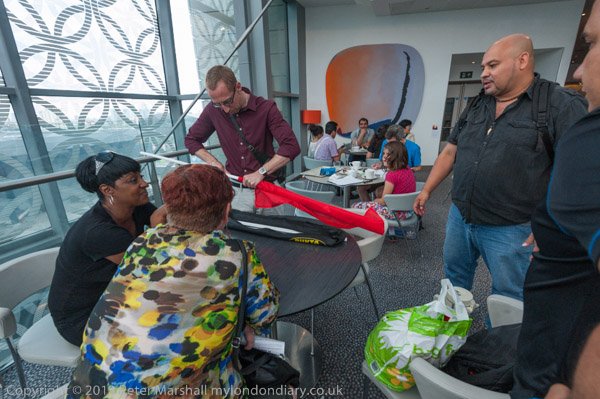
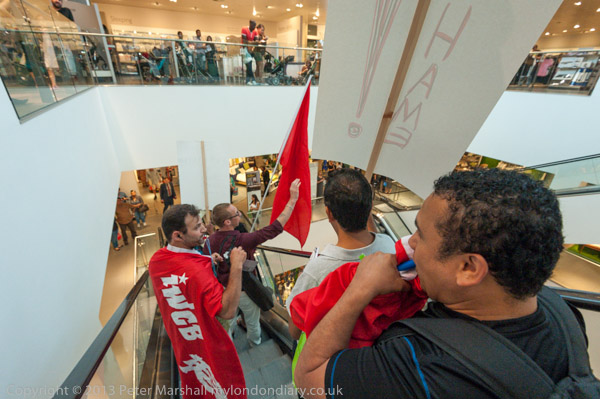
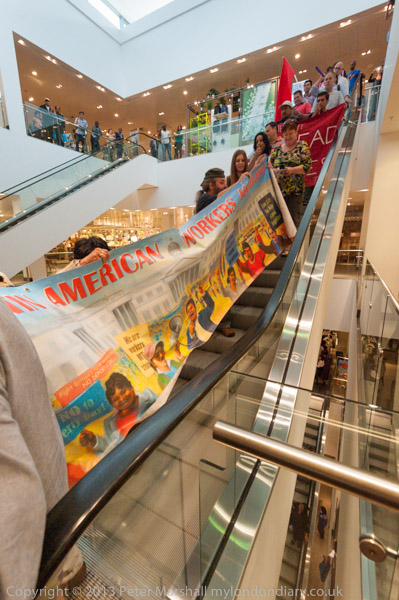
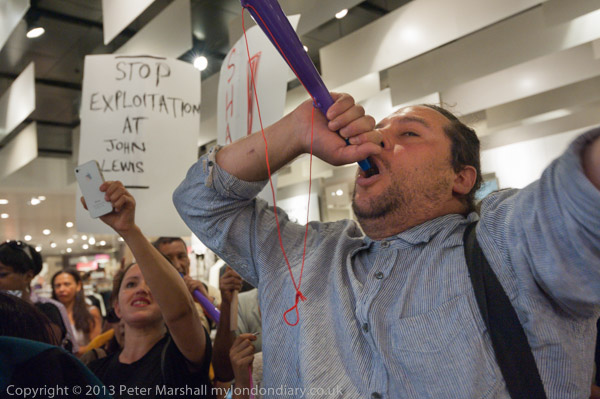
The IWGB members and supporters kept quiet as they moved through Stratford Westfield and made their way to to the third floor restaurant in the large John Lewis store where they got out banners, whistles, plastic trumpets and megaphones before moving out into the centre of the shop for a noisy protest.
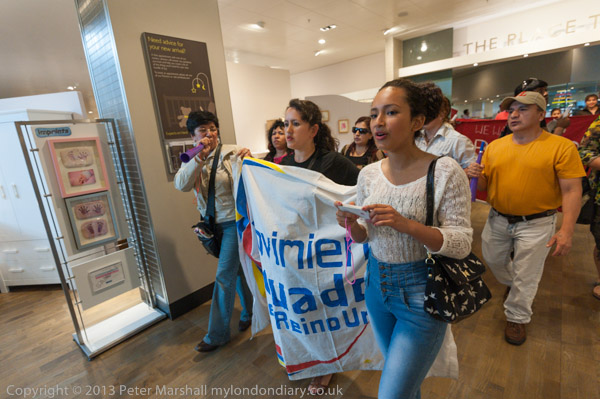
Their noisy protest as they marched around the different levels of the store to make their way to the escalators handing out leaflets attracted a great deal of attention and they stopped occasionally to explain the protest and many stopped to watch and listen.
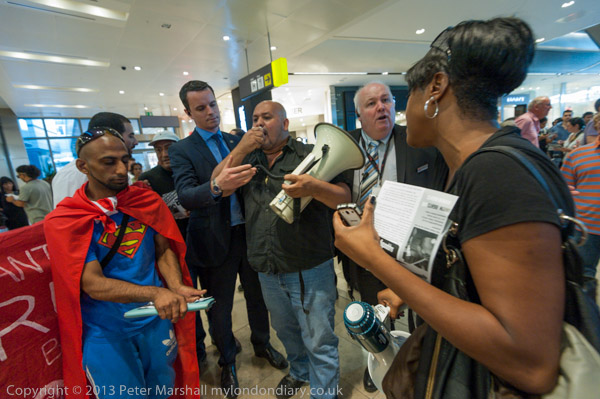
Eventually they reached the first floor ‘street’ level, holding a slightly longer protest there before moving outside. Here a small group of Westfield Security tried to stop the protest and to prevent me taking pictures both with little success. Eventually we left the enclosed street and went outside and around the side of the store.
As the protesters were packing up the police arrived and having been assured that this was a peaceful protest and that the protesters were about to leave took no further action.
Around the Abbey in Bermondsey 1988 Railway arches have played an important role in the economy of London and other cities, but particularly in London south of the river, where from the start around 1840 lengthy viaducts were built, beginning with this long one east from London Bridge which cut a gap through Bermondsey. The arches provided relatively low cost premises for small businesses, giving something back to the area in compensation for the damage the railways caused.
This particular business had closed and despite the fence had become a hand area for fly-tipping, with many houses in the area being cleared as gentrification was setting in. Furniture and other items that once would have gone to secondhand shops was simply being disposed of as cheaply as possible.
Unfortunately railway arches are now being refurbished as Network Rail sees them as a real opportunity to profit from its large estates, with often long-term tenants being forced out and the refurbished arches being let at three or more times the previous rents. A long battle was fought against this recently in central Brixton, where most of the previous businesses were forced to close.
Abbey St, Bermondsey, Southwark, 1988 88-10r-23
Former warehouses are boarded up and awaiting demolition on Abbey Street close to the junction with Maltby Street.
Maltby St, Bermondsey, Southwark, 1988 88-10r-24
All these buildings in Maltby Street have been demolished and it is hard to locate the exact location which I think was on the part of the road leading from Abbey St to Grange Walk. The sign on one of this range of commercial buildings was for ‘DIAMOND GLASS-FIBRE’.
Bermondsey United Charity School for Girls, Grange Walk, Grigg’s Place, Bermondsey, Southwark, 1988 88-10r-11
The BERMONDSEY UNITED CHARITY SCHOOL FOR GIRLS was, according the the text on its side, ERECTED A.D.1830 and was more recently used as St Mary’s youth centre. It and the terrace along Grange Walk to the east remain and the school has been converted into flats.
This row of late seventeenth century houses on the right hand side of the street are all Grade II listed and Nos 5-7 at right of picture apparently include in their structure part of one side of a late medieval stone gatehouse to Bermondsey Abbey. However I don’t think any of this is visible, and despite various accounts elsewhere they are not the abbey gatehouse, though they show its position.
The more modern structure at the extreme right was recently demolished. On Tower Bridge Road it used to advertise itself as ‘The Bermondsey Indoor Antique Market’ on the Tower Bridge Road frontage withe the message ‘Open Every Friday’ on a board above its Grange Walk side.
Walter Coles, Tanner St, Bermondsey, Southwark, 1988 88-11d-65
Although these last two pictures are filed in my contact sheets under November, my note on the sheet says they were taken earlier than the first November sheet and I think they were taken on this walk.
Walter Coles & Co Ltd sold polythene bags from this warehouse at 47-9 Tanner St, just a few yards east of Tower Bridge Road. Since 2012 it has been an arts venue, Ugly Duck.
The buildings to the right of the warehouse were all on Tanner Street, which turns round towards the north, and have all been demolished and replaced.
Abbey St, Bermondsey, Southwark, 1988 88-11d-51
Two notices had once been here but both had gone. One was replaced in 2019 letting us know this was St Saviours Estate and Purbrook Estate. This is Attilburgh House on the corner of Abbey St and Riley Road, a seven storey council block built on the site of five large houses on the street as a part of the St. Saviours Estate and I think dates from the 1960s. Its name probably comes from the old name for Attleborough, a market town in Norfolk not far from Thetford which gave its name to a neighbouring block.
Like most council housing, many of the flats here have been bought by tenants under Thatcher’s popular but disastrous ‘right to buy’. Many who did buy were unable to keep up with mortgage repayments and repair costs, and so many were fairly quickly sold, often to ‘buy to let’ investors who let them out at several times the council rents, enough to more than pay the costs of the mortage or bank loan, the new tenants buying the flats for those investors. A few years ago this estate featured in a court case after Southwark Council found that fire doors required replacement and tenants too them to court over the charges they imposed.
I think this was probably the end of my walk on 30th October 1988. Two weeks later I was back in Bermondsey taking more pictures, the subject of my next series of posts.
Reparations for Slavery, Vedanta & Blood Diamonds – the three protests I photographed in London on Friday 1st August 2014 were all related to world trade – the Atlantic Slave Trade and current devastation caused by mining industry and the diamond trade that funds Israeli war crimes against Palestinians.
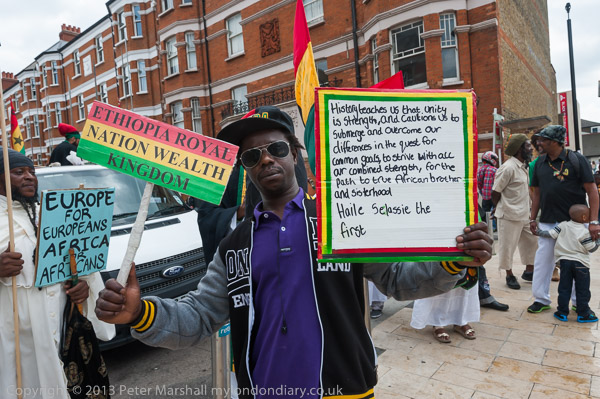
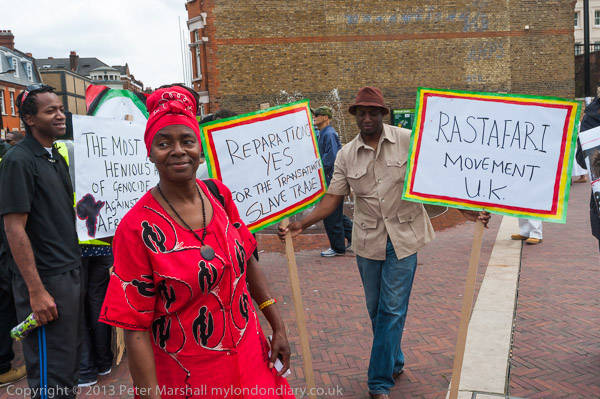
Rastafari demand reparations for slave trade – Windrush Square, Brixton
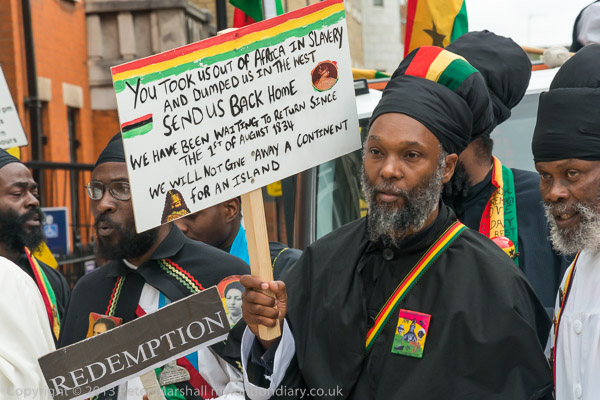
On August 1st 1834 the 1833 Abolition of Slavery Act came into force, ending slavery across the British Empire. But although the slave owners received compensation of £20 millions the freed slaves got none. They were not even freed, but converted to ‘apprentices’ who were expected to continue to work without wages for up to six years until 1838 and were unable to own land.
The payment to the former slave owners was huge – around 40% of the National Budget of the UK, and the Treasury who took out a loan to enable them to pay it. British tax payers – including many descendants of former slaves – were still paying off the debt until 2015, as a rapidly deleted tweet from the UK Treasury confirmed in February 2018.
The Act abolishing slavery was designed largely to ensure that Britain’s hugely profitable sugar industry based on slavery continued after emancipation, and Britain also continued to import cotton grown by slavery in the southern states of the USA as well as sugar from slave plantations in Brazil and Cuba.
August 1st became widely celebrated as ‘Emancipation Day’ and it was the date chosen by Marcus Garvey to found the Universal Negro Improvement Association (UNIA) in Jamaica in 1914, and for a meeting six years later in Madison Square Gardens in New York attended by 25,000 of UNIA’s claimed membership of 4 million.
Demands for reparations to be made to the descendants of slaves have so far been met by only token measures, such as the renaming of streets and buildings and official apologies, with some legislation requiring companies to provide information about their involvement in the trade and insurance of slaves.
But since the 1990s there has been a growing movement demanding financial reparations both for slavery, particularly following the First Pan-African Conference on Reparations convened by the Organisation of African Unity and the Nigerian government and held in Abuja, Nigeria in 1993.
In the UK the movement was led by Bernie Grant, MP for Tottenham until his death in 2000. Prime Minister Tony Blair in 2006 expressed “deep sorrow” for Britain’s role in the slave trade, saying it been “profoundly shameful”, though as Wikipedia notes this was criticised as lacking any measures of reparation. A further public apology for London’s role in the slave trade came from then London Mayor Ken Livingstone during the commemorations of the 200th anniversary of the passage of the 1807 Slave Trade Act.
A case was for compensation was brought against Lloyds of London in 2004, but failed. The same year a Jamaican Rastafari call for European countries, particularly the UK to support the resettlement of 500,000 Jamaican Rastafarians in Africa in a scheme costed at £72.5 billion was rejected. Other claims have been lodged by in 2007 by Guyana, in 2011 by Antigua and Barbuda and Barbados.
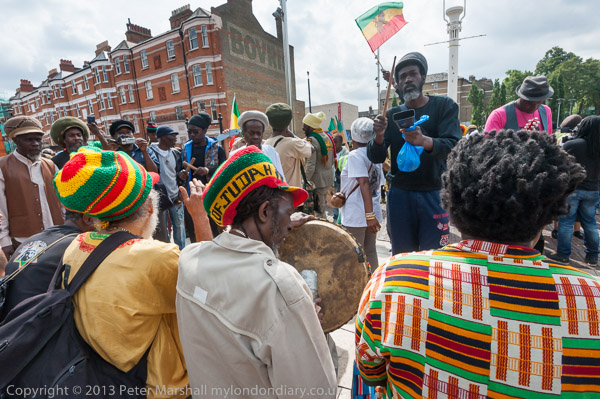
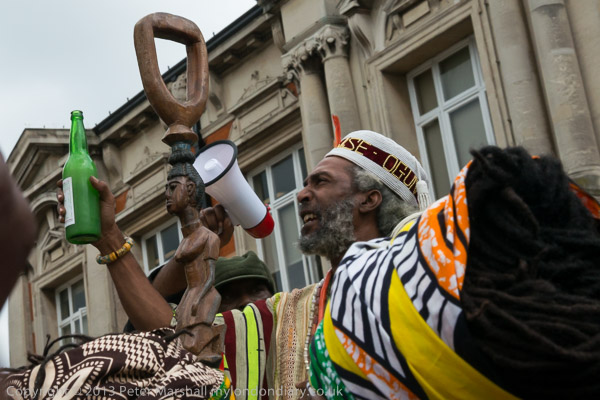
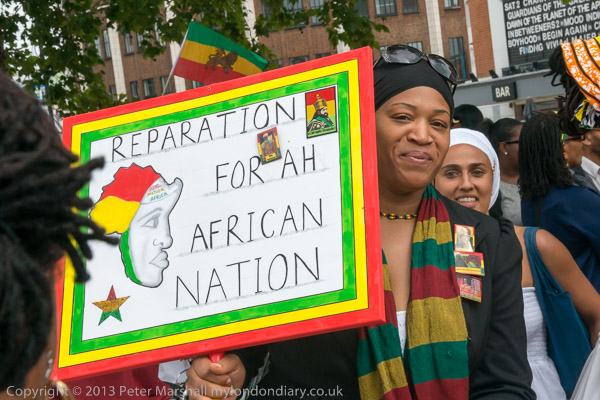
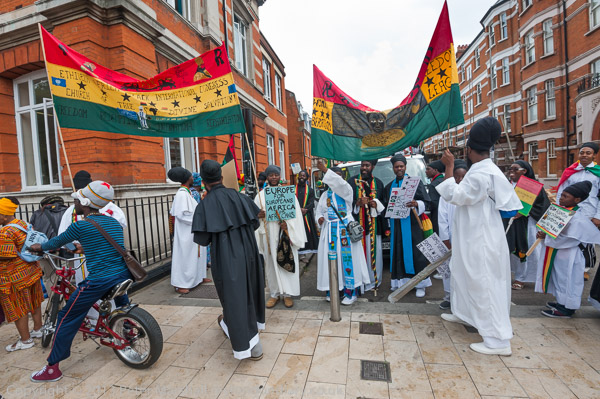
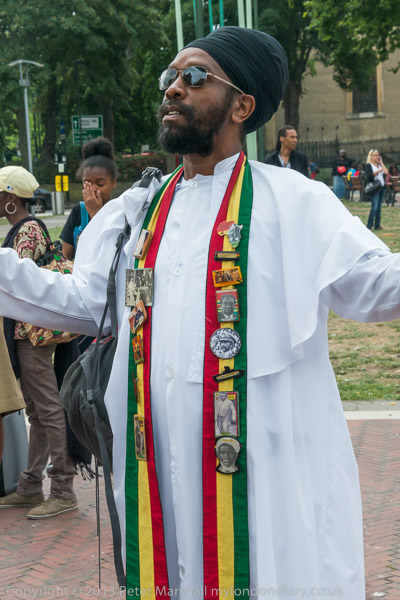
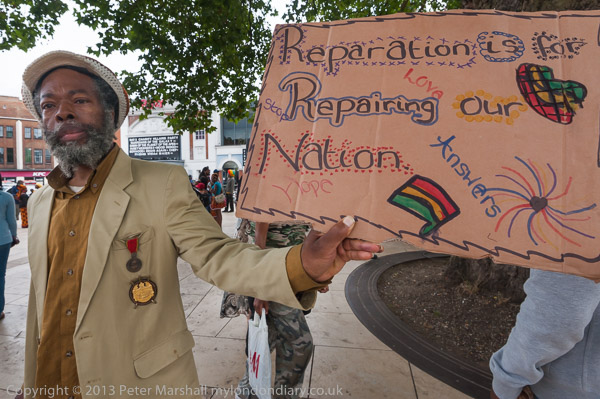
On 1st August 2014, the 100th anniversary of Garvey’s setting up of the UNIA. a large group of mainly people of African and Afro-Caribbean descent gathered in Windrush Square in Brixton for several hours of speeches, celebration, drumming and dancing before they were to march to Parliament to make their demand for reparations. The march has become an annual event in London, but I had to leave shortly before it began.
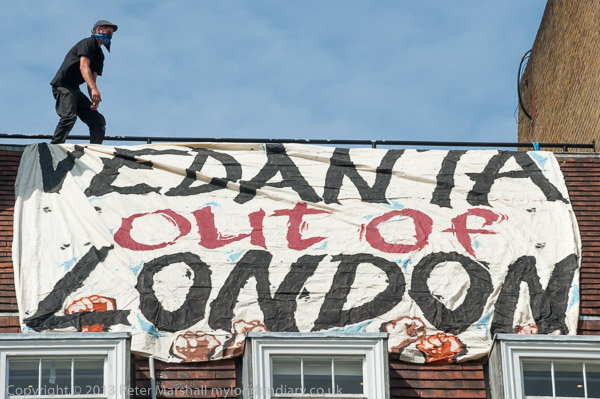
Vedanta told ‘end your killing’ – Lincoln Inn’s Fields
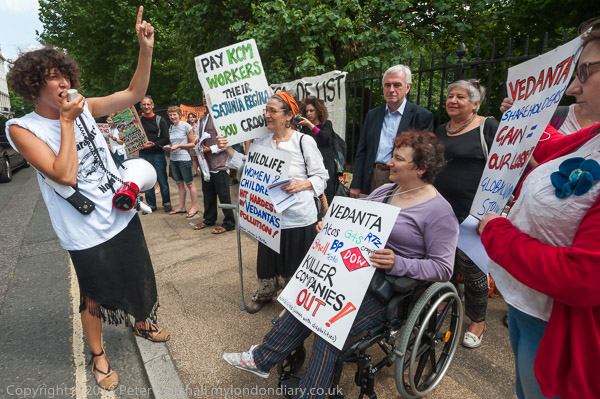
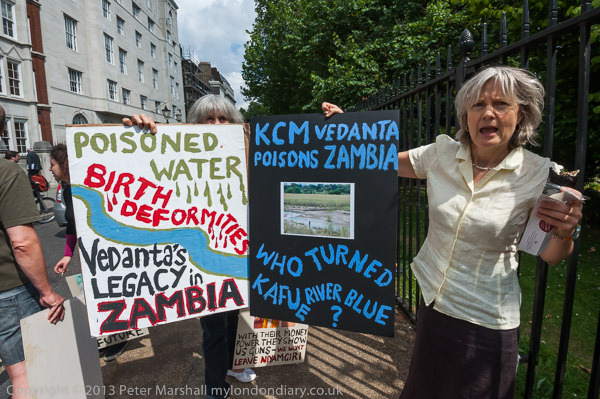
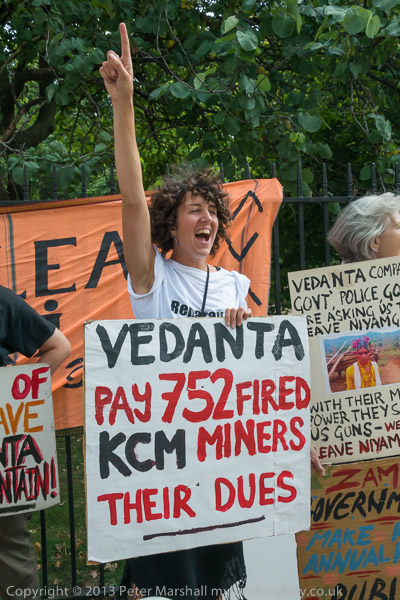
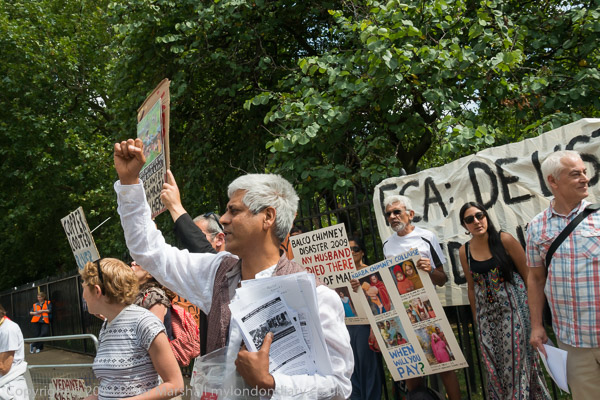
I joined the protest outside the building in Lincoln’s Inn Fields where the FTSE 250 British-Indian mining company Vedanta Resources was holding its AGM. Here and at other protests in Zambia and Odisha and Delhi in India.
Vedanta is a huge company which protesters say is “guilty of thousands of deaths, environmental devastation, anti union action, corruption and disdain for life on earth. They have become one of the most hated and contentious companies in the world.“
Their activities, particularly their attempt to destroy the sacred Nyamgiri mountain in India for its aluminium ore, have led to protests around the world, and an Indian Supreme Court decision that, at least for the moment have halted the mining there.
Another setback for Vedanta was the research by activist group Foil Vedanta into their subsidiary Konkola Copper Mines in Zambia, accused of poisoning thousands and causing ongoing birth deformities by major pollution spills in 2006 and 2010. The research showed the company which was claiming it was making a loss and so unable to pay its fines and tax bill was actually making around $500 million a year.
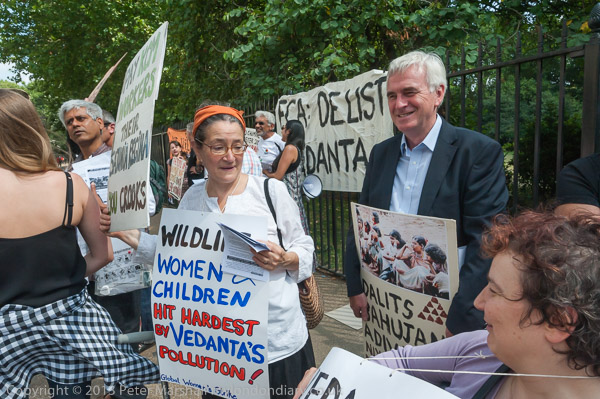
Labour MP John McDonnell was among those who had become a shareholder to attend the AGM
Vedanta’s problems being made public resulted in a dramatic crash in its share price and the previous December it dropped out of the FTSE100. Billionaire owner Anil Agarwal responded by buying large numbers of the shares and was now said to own over two thirds of the company. But there were other shareholders going into the AGM, including a few activists who had bought a share to entitle them to attend and ask questions.
The activities of these activists, both inside and outside the AGM every year, were eventually were an important part in the decision four years later by Agarwal to make Vedanta a private company.
Boycott Israeli Blood Diamonds – De Beers, Piccadilly
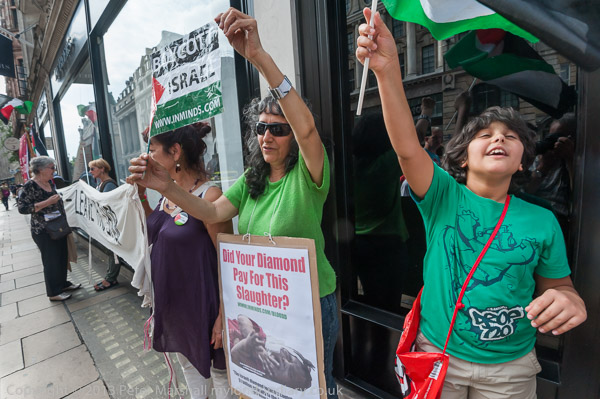
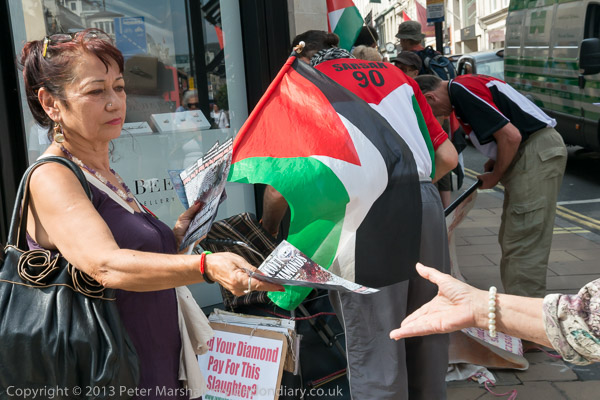
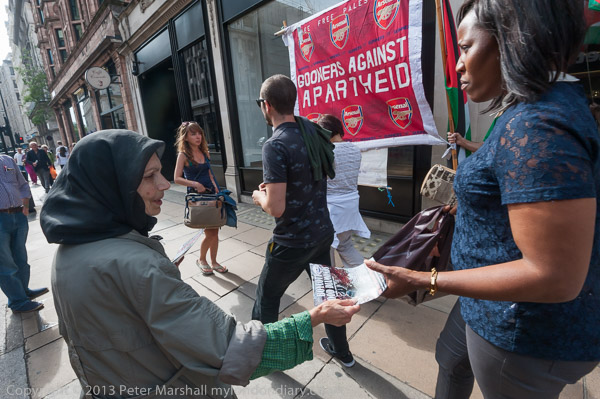
Finally I made my way to Piccadilly where pro-Palestinian campaigners were protesting in front of De Beers jewellery shop, calling on people to boycott diamonds cut and polished in Israel.
Although there are no diamonds mined in Israel, according to Wikipedia, almost a quarter of Israel’s total exports come from the sales of diamonds cut and polished in the country and they account for almost one eighth of the total world production.
Israel claims that all these diamonds are covered by the ‘Kimberley Process’ which aims to prevent diamonds mined in conflict areas and sold to finance war and insurgency coming to the market. But campaigners say that this defines blood diamonds too narrowly, enabling Israel’s diamond-cutting industry to avoid attention, and the “Boycott, Divestment and Sanctions (BDS) campaign, among others, has called for diamonds processed in Israel to be considered conflict diamonds.”
I walked back up Bermondsey Street. There was slanting light across many of the frontages on the east side of the street and I stopped to take pictures of several of the more interesting buildings. Turner Whitehead were in these tall warehouses at 65-71, now renamed Bramah House. As I noted in an earlier, Turner Whitehead described themselves as ‘polythene converters’ meaning they made and sold a wide range of polythene products including bags etc.and these fine late Victorian buildings were said to have been tea warehouses.
I’d photographed 65-71 Bermondsey St before together with this building next door at No63 and was pleased to have better lighting to take another picture. This site was occupied by the Green Dragon pub from at least 1822, probably much earlier. The building probably dates from around the end of the nineteenth century and the pub appears to have closed and been converted to commercial use in the 1920s. Now the ground floor is an estate agents.
The Green Dragon was an emblem of the Earls of Pembroke, one of whom, Japer Tudor, born around 1431 was the son of Catherine of Valois, the widow of King Henry V (and mother of Henry VI) and her Welsh clerk of the Wardrobe Owen Tudor. The couple were said to have married secretly in 1429 and managed to have at least five children before their marriage was discovered; then Owen Tudor was imprisoned and Catherine de Valois sent to live in Bermondsey Abbey. She died in disgrace in 1437 but was still buried in Westminster Abbey.
Next going up Bermondsey street on the other side of what is now Vintage Yard is this fine Grade II listed 3 storey building at No 59, built as a new police station for the Metropolitan Police in 1851. When a new Tower Bridge Police Station opened in 1904 it briefly became a police section house and in 1906 was converted to commercial use. At least until the 1960s it was occupied by Read & Partners Ltd. Since I took this picture in 1988 it has been internally refurbished as offices.
I walked back up Bermondsey Street, pausing to photograph this image in the window of a barber’s shop. That long-haired figure seemed strangely familiar.
The light now made for a much better picture of Thomson Bros Ltd Knightrider Mills, the gateway shared by Tempo Leather Co Ltd, not to mention Rilling Hills Ltd and Marchant Hills Ltd.
As the notice states, these had been ‘ACQUIRED BY THE ELEPHANT HOUSE CO PLC AND DUNLOW HOUSE PLC – PROPOSED DEVELOPMENT – ALL ENQUIRIES’. Fortunately the development has retained the frontage more or less intact, almost certainly because it is Grade II listed, with gates now leading to ‘Shiva Building – Studio/Offices and ‘The Tanneries – www.lordshiva.net’, which address tells you a little about what goes on inside. It was built in 1873 to the designs of George Legg.
This street apparently gets its name from a pub which had the sign of St Christopher who was the bearer of the cross on which Christ was crucified. The pub, named ‘The Cross of Bermondsey’ was apparently demolished in 1559.
More demolition came with the railway, which runs in a wide swathe across Bermondsey, built for the London and Greenwich Railway Company with construction beginning in 1834.
Guys Hospital was founded in 1721 by Thomas Guy who had made a fortune printing Bibles and a killing by speculating on the South Sea Bubble. An early private-public partnership it had been granted a monopoly by the to supply African slaves to South America and the South Sea Islands. Because Spain and Portugal controlled most of South America it did very little business with slaves, but in 1720 pushed up its share price by rumours of support from King and Parliament, rising from £128 to £550 in five months, before rapidly collapsing back. Guy apparently sold his shares before the collapse.
Guy’s Tower was built in 1974 and was then the tallest hospital building in the world, with 34 floors and almost 150 metres tall. According to Wikipedia it is now the world’s fifth-tallest hospital building.
Enid St, Bermondsey, Southwark, 1988 88-10r-35
You can see the railway viaduct in the background of this picture on Enid St, which appears to be both the name of the street beside the viaduct and some side-streets on the Neckinger Estate. I can no longer find either the buildings and chimney but I think this may have been taken from around Enid St Playground.
Aldgate, Class War Rich Door, Poor Door – On 30th July 2014 I went to London to cover another in the long series of protests by Class War over the ‘social apartheid’ of separate entrances to large blocks of flats for the wealthy and poor people who live in them. I went up early and walked around the area beforehand.
Class War – Rich Door, Poor Door – 1 Commercial St, Aldgate
Class War, including three of their candidates for the 2015 General Election the following year, protested at 1 Commercial St in Aldgate which has a separate ‘poor doors’ for the social housing flats they had to include to gain planning permission for the development.
The front entrance on Whitechapel High St (One Commercial St is the name of the block) has a hotel-like reception desk, and is staffed 24 hours. It leads to the lifts for the expensive flats, many owned by overseas investors. Like most such buildings, some of them are empty and seldom used, while others are short term holiday lets.
Flats like these are advertised to overseas investors particularly in the far East as providing a high return on capital. Buy a flat now and you will be able to sell it for much more in a few years as London housing prices continue to soar – some publicity suggested that people could get the equivalent of a 13% interest rate. It’s easier to sell if you keep the flats empty, though you can use them for the occasional visit to London, or even let them over the web for a few days or weeks as holiday lets to generate a little actual income.
As I commented:
The web site for One Commercial St (studios, apartments and penthouses specified to exceptional levels, with exclusive services for residents – or rather those residents allowed to use the rich door) suggests that the average rent in the area is £1,935 pcm and investors can expect a 32% increase in property value by the time Crossrail opens. It’s all a part of the madness that means London is being developed not for the people of London but for investors in China, the oil states and elsewhere.
The building owners claimed there was no internal connection between the part of the building with expensive privately owned flats and that occupied by social housing tenants, although that was simply a lie – and on a later occasion I was taken through by one of the private owners from her flat to the ‘poor door’ which she used when walking her dog.
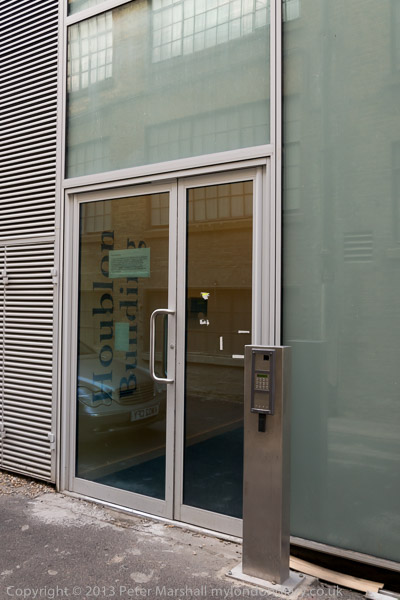
The owners give the social housing in the block a different name and only allow the tenants to access their flats through a side door in what was when Class War began their protests a dark alley often full of dumped rubbish, smelling of urine. A card entry system let them into a long bare corridor with some mail boxes on one side, quite a contrast to the large foyer with a reception desk, concierge, comfortable seating and art works enjoyed by the rich.
The protests had by then resulted in some small improvements, the alley now having been cleaned and new lighting installed, though the card entry system was apparently often out of order. And the alley still had that nasty smell.
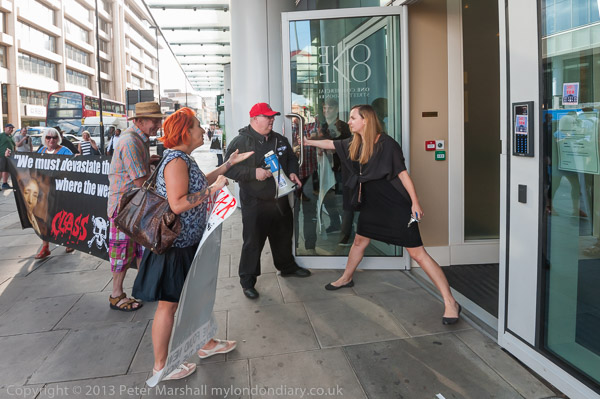
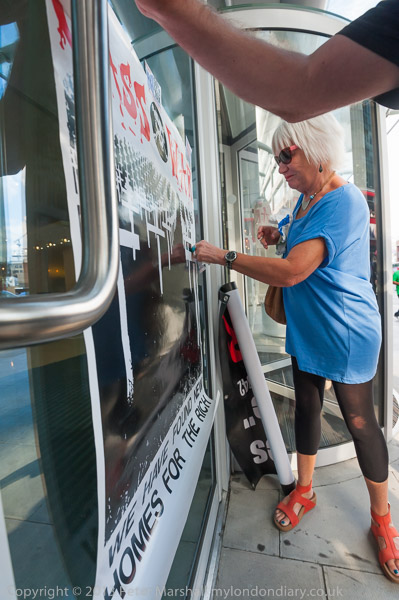
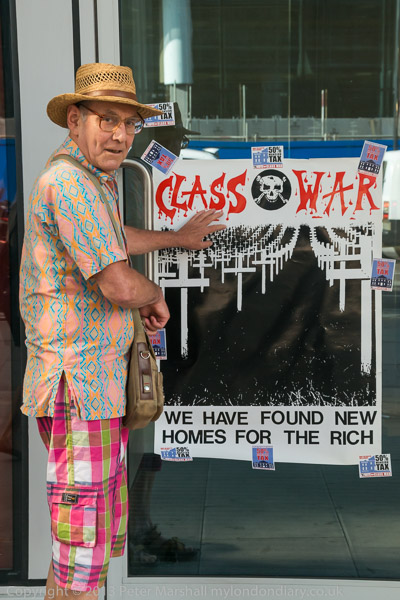
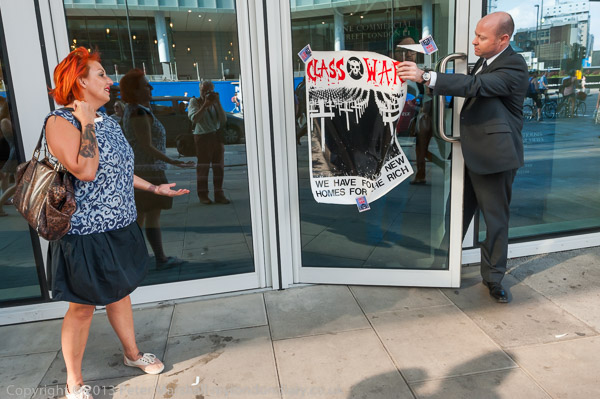
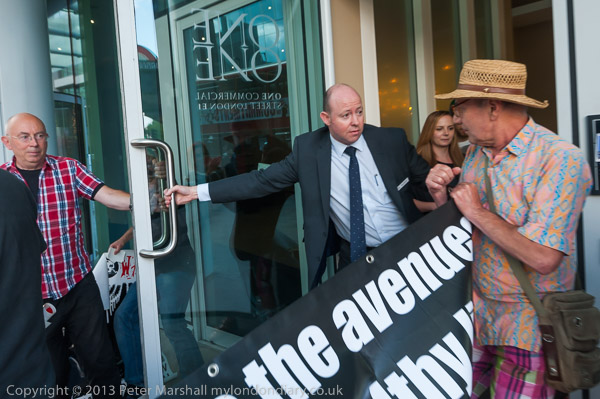
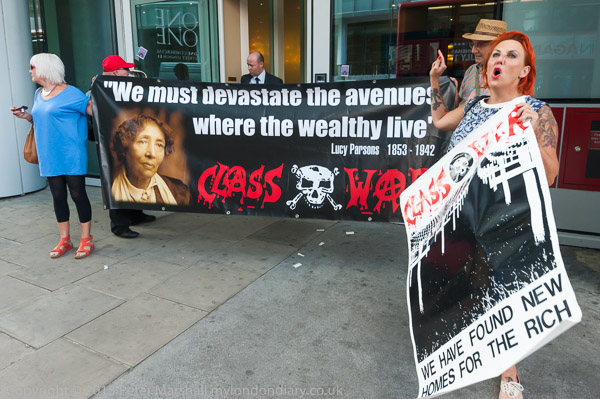
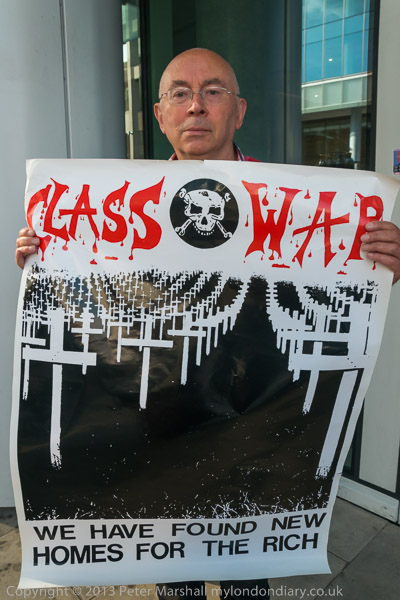
The protesters came with a banner featuring the radical US labour activist Lucy Parsons (1853-1942) with her quotation “We must devastate the avenues where the wealthy live” and posters – with their skull and crossbones – and the message “We have found new homes for the rich” with long rows of grave crosses stretching into the distance – which at one time police tried to arrest them for. They stuck posters on the windows on and around the ‘Rich Door’ using Class War election stickers with their promise of a 50% mansion tax. The building manager came out and pulled the posters off and screwed them up, but they held up others beside the door.
Most of the protest took place in front of the ‘Rich Door’, where they chanted calling for an end to the social apartheid and attempted to talk with the few people who left and entered the building. They held the door open to make their protest more easily heard inside, and there was a brief brief tug of war as security and a resident tried to close it. Eventually they let the door be closed, probably when they saw police arriving.
Police only arrived around 15 minutes after the protesters and they went directly inside the building to talk to the building manager and concierge. Then the police came out and argued with the protesters, trying to get them to move further from the doorway, but they insisted on their right to protest where they wanted on the pavement. Class War kept up the protest for around an hour before they decided it was time to leave – and come back for another protest there the following week. This was just one of a series of around 30 ‘Poor Doors’ protests, most of which I photographed – and published a ‘zine’ of the pictures, still available from Blurb.
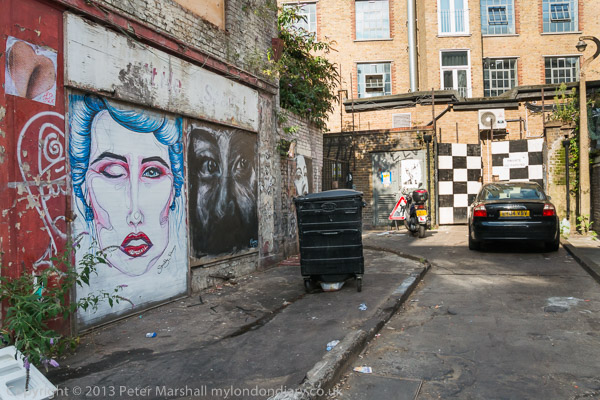
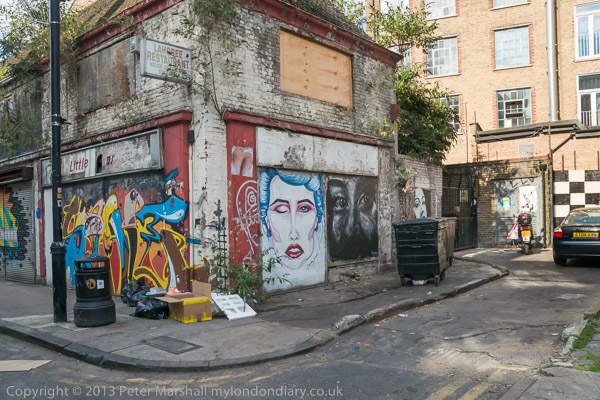
I was early for the protest at One Commercial St, and took a short walk around the area while I was waiting, going up Commercial St and then back down Toynbee St. I was astonished at the amount of new buildings since I was last here a few years back, and with a great deal of work currently going on. At night all the red lights on the tops of the cranes make London look like a Christmas tree.
It is of course a prime site just on the edge of the City of London, an easy walk to the city, and with plenty of buses, underground stations and both Liverpool St and London Bridge stations not far away. London City Airport is a short taxi ride too, or under half an hour by public transport, and Brick Lane’s curry houses just around the corner. Crossrail will cut journey times to Canary Wharf to 4 minutes when Whitechapel station opens in 2018.
In fact Crossrail only opened in 2022, four years behind schedule, but investors still did pretty well, and much more of the area has been demolished and replaced by investment flats. Our government still counts these as a part of our meagre housing programme although they make no contribution towards easing the housing crisis. We need strong laws to limit overseas ownership of property and financial encouragement to build homes for people, particularly homes at social rents.
I walked past Dockhead and along Tooley Street, turning down Tower Bridge Road and on to Tanner St making a few photographs, but have only digitised the two shown here. Dockhead is of course at the head of St Saviour’s Dock and until a bridge was built across the mouth of the dock walkers by the river had to take the route past Dockhead – and I often took a picture looking down the dock towards the Thames and this was no exception, but I haven’t yet digitised it.
The building with the circular window on its top floor was Jacob’s Biscuit Factory – another of whose buildings on Wolseley street featured in the previous post.
And although I made half a dozen exposures on Tooley St, one on Fair Street and several on Tower Bridge Road, this is the only one on-line. I do sometimes find it hard to know why I’ve not scanned some images and perhaps one day I’ll come back and fill in the gaps. But for the moment this is the only picture here from this section of the route.
It shows the two buildings on the corner with Lafone St, which runs north from Tooley Street to Shad Thames. Tower Coachworks has been demolished and replaced by new flats, but the large warehouse blocks at left, which run across the whole block to Boss St and up Lafone St to Queen Elizabeth St was refurbished by the London Docklands Development Corporation into a large residential development, Boss House. Q’s Ltd Snooker & Pool Club with its line of arrows to guide even the most shortsighted or inebriated to its entrance at rear has long gone. The three warehouses dates from somewhere around 1900 and there was a short street across the middle, Goat St, whose name can just be seen above the van parked on Lafone St, at least on a larger version of this frame.
Sarson’s vinegar works were on a large site on Tower Bridge Road with these vats viewed from Tanner St. Their presence was very apparent by the smell which pervaded the area – I couldn’t walk past without thinking of fish and chips – although according to Wikipedia production had moved to Manchester in 1968, it actually continued through the 1980s and the works only closed in 1992.
Thomas Sarson is said to have first brewed his malt vinegar in 1794 in Shoreditch, though apparently this date is unlikely and probably Sarson’s only made cheaper ‘wood’ vinegar until 1894. Sarson’s vinegar was briefly sold as ‘”Sarson’s Virgin Vinegar’ but that name was soon dropped. There is a very detailed article Just Say Sarsons by Tim Smith in a GLIAS Journal about the company with descriptions and photographs from a finely detailed recording visit. The vinegar works were begun by Noah Slee and a Mr Vickers around 1814, but later greatly expanded. The works were run by the Slee family until a merger with Champions in 1908 and their family connection continued until the formation of British Vinegars Ltd in 1932. Later they became a part of Nestlé and the Sarson’s brand is now owned by a Japanese vinegar company, who also own my favourite Hayward’s Pickled Onions.
The site was redeveloped from 2000 on, with its Grade II listed buildings being converted into flats and other buildings such as these vats being demolished and replaced by modern flats.
Tanner St, Bermondsey, Southwark, 1988 88-10q-32
Further west along Tanner St are these three adjoining buildings at 1-3 Tanner St. The Bermondsey Wire Works name has faded a little more but otherwise that building looks much the same, while Neon Manufacturers at No 2 is rather more tidier, has lost its original windows and all signage and has a new door and porch. No 3 has also had something of a face-lift but retains most of its former character, but the hoist no longer has a bucket attached.
Tanner St, Bermondsey, Southwark, 1988 88-10q-33
These buildings were still very obviously in commercial use back in 1988, but I think now most are studios, offices and residential, and I think I went to an exhibition in one of them a few years ago. Tanner Street was originally known as Five Foot Lane and most of it was on a map by 1544. The second part of the story by Richard Miller deals with it after it was renamed Russell Street in the late 18th century when it contained the Bermondsey Workhouse, and part 3 looks at it after Bermondsey Parish Council renamed it Tanner Street in 1881, reflecting the main trade then carried on there. The workhouse closed in 1922, and the site was bought with funds from selling St Olave’s Church in Tooley Street to Hay’s Wharf – and a part of that church’s tower, now Grade II listed, was installed as a drinking fountain in Tanner Street Recreation Ground which opened on the site in 1929. The park got a little larger in the 1990s.
Cockle & Co, Bermondsey Mesh and Wireworks were at 109 Bermondsey St from 1903-1919 and their works stretched around the corner here into Tanner St. According to the Bermondsey Boy web site, No 3 -7 were built in 1838 for three separate businesses but were bought by the Simmons Company, makers of perambulators, mail carts and stretchers in 1888 and later they also owned No 1 – you can see some of their advertisements on thesite. Simmons sold No 1 in 1952 and closed the business in 1959.
Bermondsey Square looks very different now to when I took this picture in 1988 and I think the actual position where I was standing may now be inside the ground floor of the Bermondsey Square Hotel. My shadow in the foreground shows me looking across the grass area towards the corner of Long Lane and Bermondsey St. The building then the Bermondsey Antique Market is still there – as is St Mary’s Church, but rather than antiques it is now ‘Flour & Grape’ which Google now tells me is an Italian restaurant and “A 3-min walk from the White Cube“. What is left of Bermondsey Square is now paved and although there is a small green area with seating at the front of the hotel it looks very plastic.
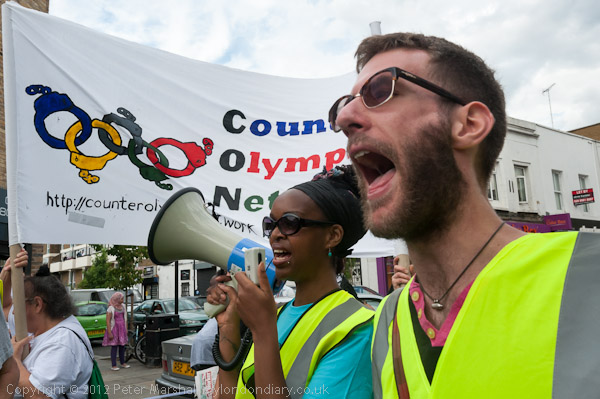
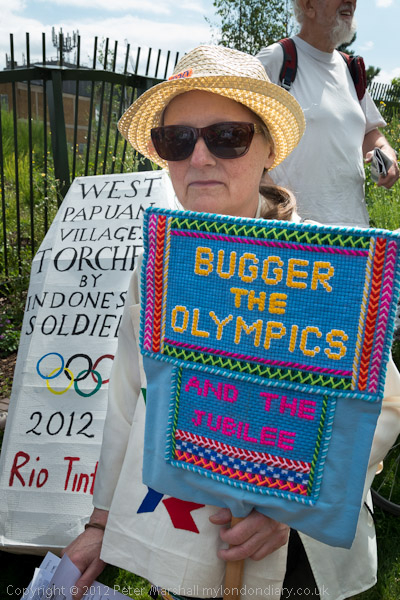
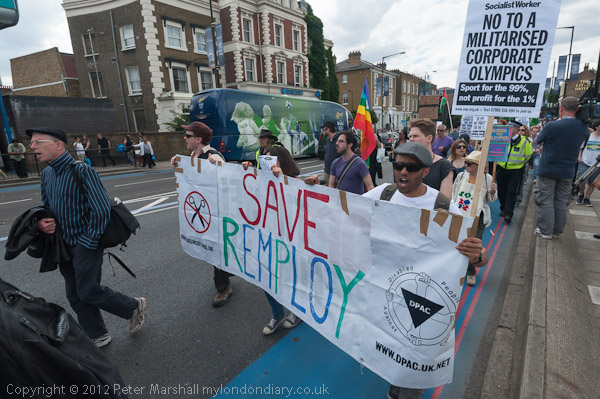
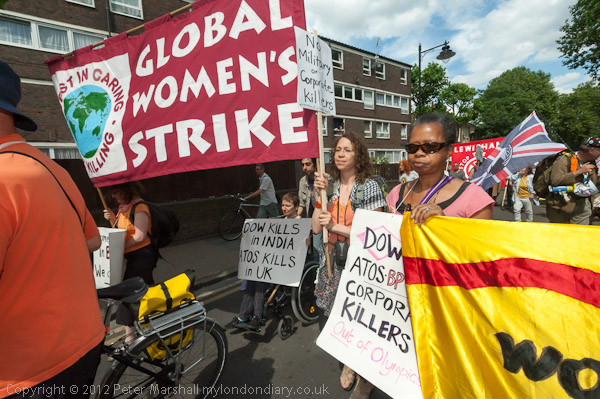
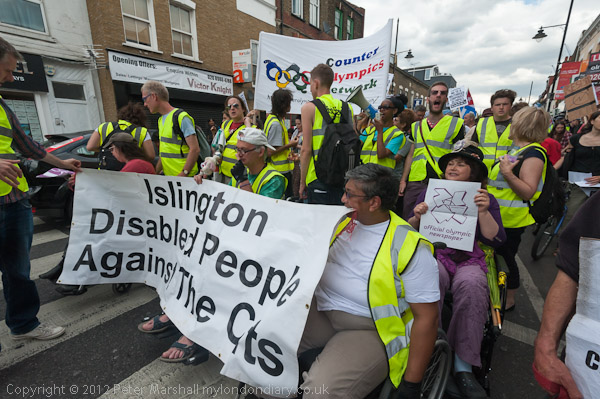
Ten years ago on July 27th 2012, as the London 2012 Olympics were getting underway in Stratford, people, mainly from the local area, marched to call for an end to the corporate takeover of the Olympics and the draconian policing and military presence largely aimed at the protection of brands and for the games to meet its legacy promises.
The authorities had done their damnedest to stop the protest taking place – first they had tried to ban it altogether, then Transport for London had refused permission for them to march along any roads which were emergency backup Games routes. But protesters agreed with police that they would leave the road if there was any emergency. Tower Hamlets council tried to ban any speeches or other events on Wennington Green where the march ended, and protesters were threatened they would be arrested if they carried banners, placards or t-shirts with political messages – though it was hard to see any legal basis for doing so.
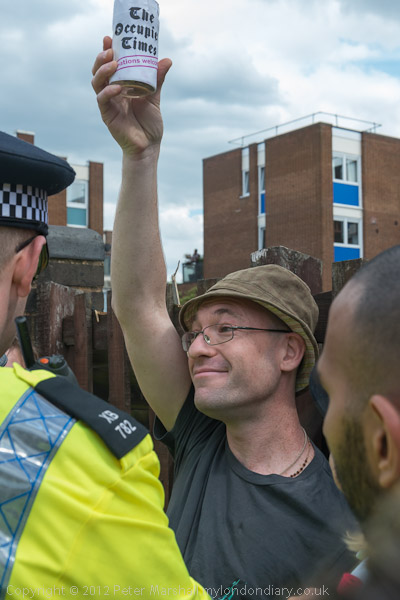
The ‘Whose Games? Whose City?’ protest went ahead despite the threats, with only one small incident when police seized and searched a man who had cut a piece of police tape. A crowd of marchers supported them and shouted for his release and after a few minutes he was set free without charge and the march continued.
The threats and public controversy had doubtless persuaded many not to come to the event, where around 500 marchers mingled with press and TV from around the world at the starting point in Mile End Park at midday. The organisers, the Counter Olympics Network (CON) had made clear that they were not against the Olympics as a sporting event but against the way it had been taken over by corporate interests. In my long account of the event on My London Diary I quoted from several of their statements, including:
"the close ties between the Olympic brand and its corporate sponsors who, despite IOC claims of vetting on ethical grounds, include serial polluters, companies which seriously damage the environment and which wreck or take lives, Coca Cola, Rio Tinto, BP, Dow Chemical. G4S, Cisco, and Atos deny people their human rights in a variety of situations while Macdonalds helps to fuel the obesity epidemic. London2012 provides benefits at taxpayers’ expense while receiving little in return."
CON also pointed out the many broken promises made about the games and the very doubtful legacy the games will leave, particularly in East London.
"the lack of benefits for local people and businesses, the fantastic expansion of security into our daily lives, the deployment of missiles and large numbers of troops, the unwarranted seizure of public land at Wanstead Flats, Leyton Marsh and Greenwich Park."
A man celebrates after the crowd made police release him
Later in his speech on Wennington Green, Chris Nineham of the Stop The Olympic Missiles Campaign declared that the London Olympics had already set a number of records, including the largest ever number of arrests on the first day, the highest ticket prices, the most intensive application of branding rules and the highest level of militarisation of any Olympic games, with far more being spent on security that even in China. There were now more troops in London than at any time since World War 2, and more than at any time in Afghanistan, where our military activities were now making us a terrorist target in London. Among the other speakers was Melanie Strickland, one of the 182 ‘Critical Mass’ cyclists arrested the previous night for riding near the Olympic stadium.
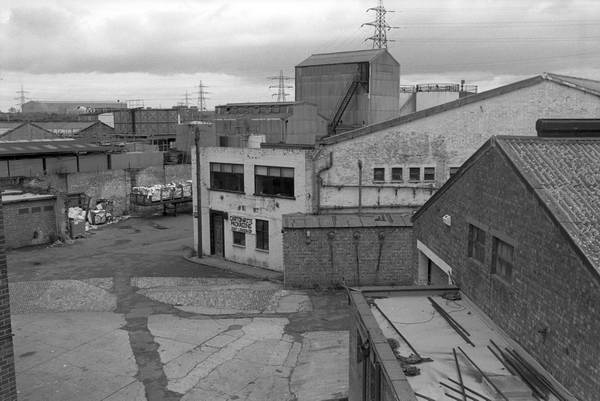
Industry on the Olympic site, Marshagate Lane, 1990
I had known and photographed the Olympic area since the early 1980s until the public were all excluded from the vast site in 2007 and after when we were only able to peer over the blue fence. In 2010 I brought out a book ‘Before The Olympics’ which included many pictures of the area in the thirty years or so before they took place, as well as looking more widely along the length of the River Lea and the Navigation. Most people miss that parts of the area were formerly thriving industrial and commercial sites, others a verdant wilderness – and of course some thriving allotments. Of course there have been some benefits following 2012 – more housing is something London desperately needs, but much was already being planned before the bid succeeded. But the park remains to me deeply disappointing.
Allotments on the Olympic site, April 2007
The book is still available and you should be able to view a preview at ‘Before the Olympics‘ though Blurb appears to be having some problems at the moment; it is a ridiculously highly priced softback, but there is a more reasonable PDF version. The book includes many of my pictures of the area which are also on my The Lea Valley web site including mainly black and white images from the 1980s and 90s and colour from the 2000s. Later images from before and after 2012 are on various pages of My London Diary. There is a large collection of the black and white images in my Flickr album River Lea – Lea Navigation 1981-1992 including many from what became the Olympic site.
Fossil Fuels, Bradley Manning & Global Racism – my Saturday 27th July 2013 began with a “radicalized midsummer cloud forest dream” against the support given to fossil fuels and climate chaos by the banks and the City of London, continued with a vigil for Bradley Manning who exposed US war crimes and ended with a march and rally against and Injustice.
Rev Billy at HSBC – Victoria
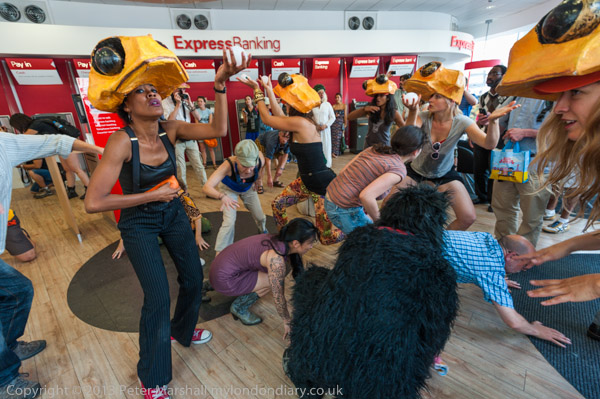
Golden Toads to the rescue with ice
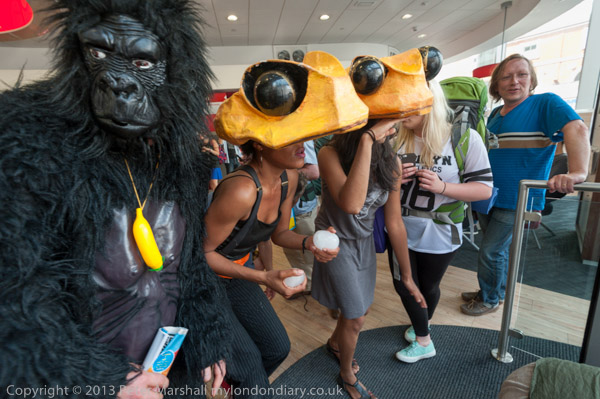
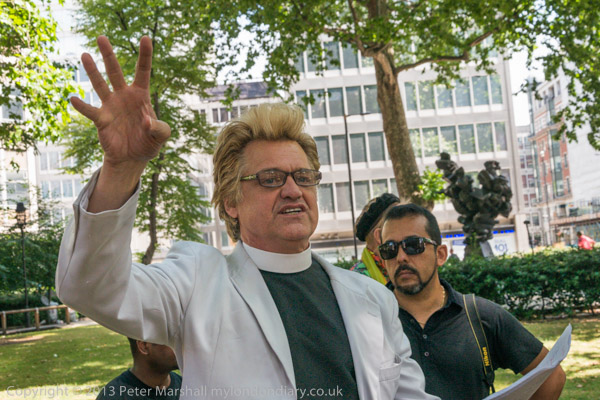
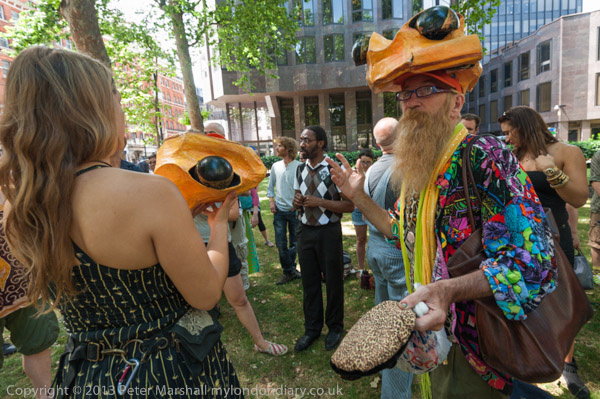
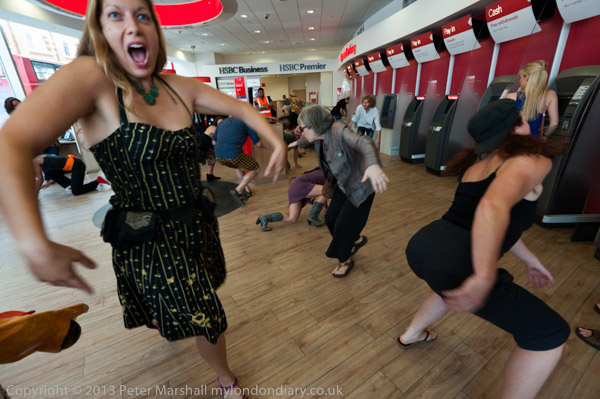
I met the Rev Billy and his choir on the Stop Shopping Church Tour England in a green open space on Victoria Street, opposite New Scotland Yard (which has since moved to the Embankment.) There they practised their performance as species – monkeys, jaguars and eagles – among those threatened by climate change.
Some had heads of Golden Toads, a Costa Rican species already made extinct by climate change. These were hidden away as the group walked towards the HSBC bank at Victoria, and we all walked in trying our best to look like normal customers and going up to the long line of ‘Express Banking’ cash machines.
Then the group erupted into dance action, with the Rev Billy using a megaphone to tell bank staff and customers what is happening and why we are in HSBC. Fossil Fuels are killing life on this planet and London banks and the London Stock Exchange play a key role in this – a quarter of all fossil fuel shares are traded on the LSE and in 2010-12 the top five UK banks raised £170 billion for fossil fuel companies, with the HSBC in the lead. He promised that they would leave the bank after the short performance.
Then the Golden Toads arrived to save the species, bringing with them some large eggs of ice to help cool the planet down, and then as promised people left the bank to continue to the end of the performance on the wide pavement outside. Police arrived and went into the bank as the players were leaving to celebrate their action in a nearby cafe and bar.
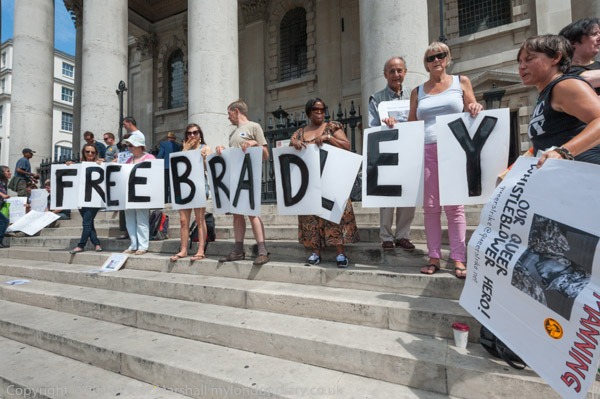
Free Bradley Manning Vigil – St Martin’s, Trafalgar Square
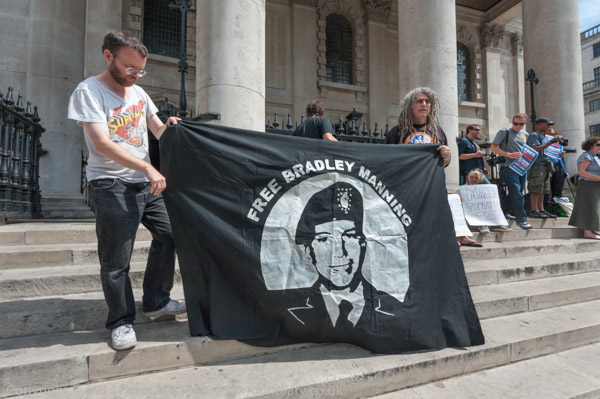
Saturday 27th July 2013 was an international day of action by the Bradley Manning Support Network, and in London they held a vigil on the steps of St Martin-in-the-Fields.
Bradley Manning’s trial had started on 3rd June in Fort Meade, US, and protests have continued both inside and outside the court, with the ‘gay whistleblower’ being celebrated in countries across the world and awarded the Sean MacBride Peace Prize. Many see Bradley – later Chelsea Manning as a hero who should be honoured rather than imprisoned. Her trial ended on 30th July with a sentence of 35 years, but in 2017 this was commuted by President Obama to seven years, dating from her arrest in 2010.
Against Global Racism and Injustice – US Embassy to Whitehall
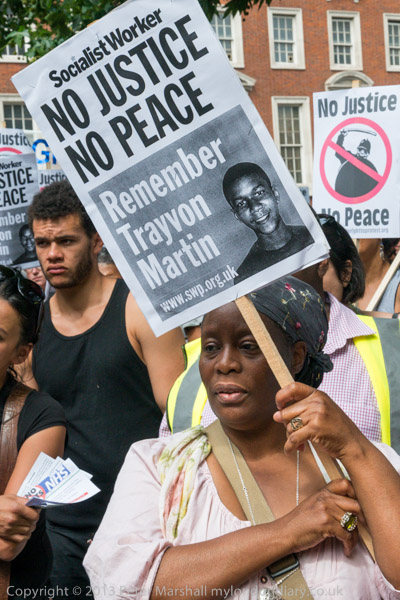
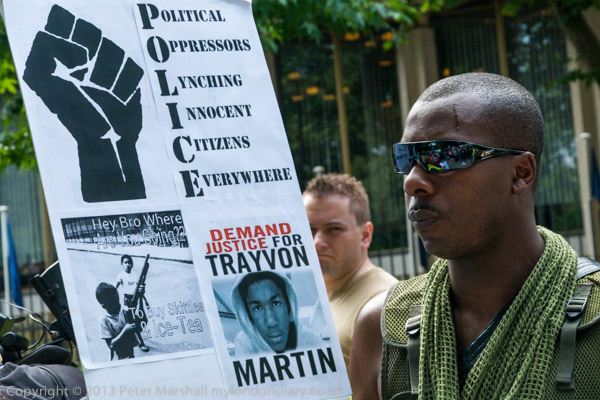
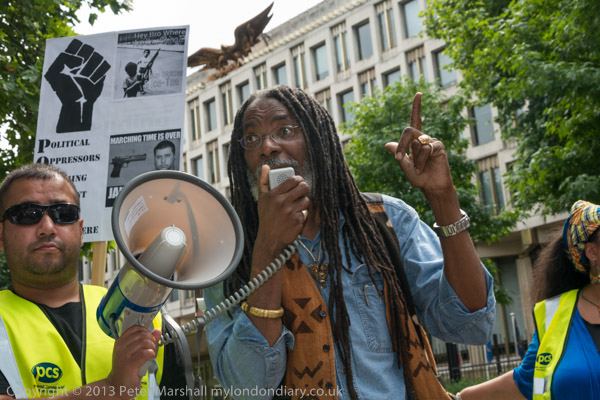
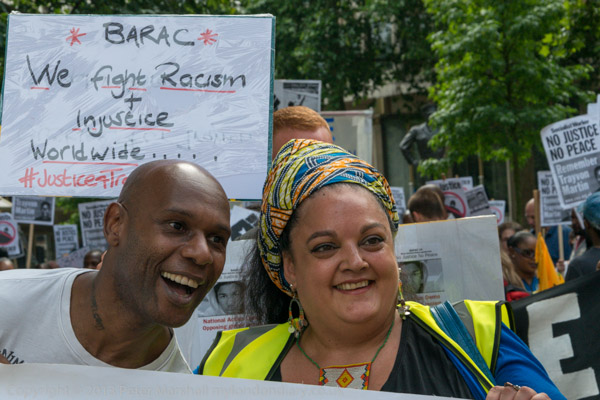
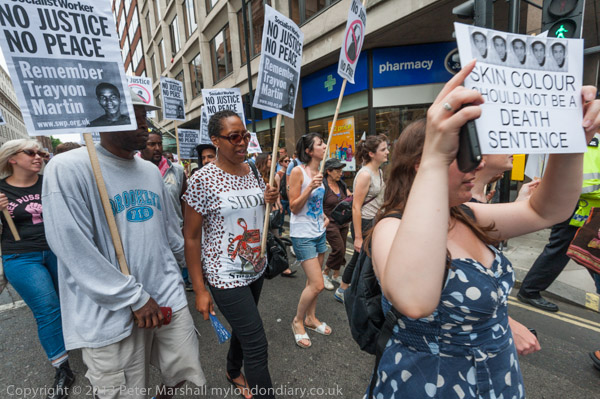
Black Activists Rising Against Cuts (BARAC) UK held a rally outside the US Embassy in Grosvenor Square before marching to Whitehall in solidarity with families of Trayvon Martin, Stephen Lawrence, Azelle Rodney, Jimmy Mubenga and many others to highlight the reality of racism and seek justice, both in the UK and US.
The protest was supported by many anti-racist organisations including Operation Black Vote, the National Black Students Campaign, Global Afrikan Congress, PCS, RMT Black Members, Counterfire, UAF, Love Music Hate Racism, Lambeth TUC and Lambeth People’s Assembly and a number of well-known faces from the British left were among the marchers, some were scheduled to speak at the Downing Street rally.
The US Embassy was chosen as the starting point because of the killing in Florida of Trayvon Martin and the global outcry against the acquittal of his murderer under the Florida ‘Stand Your Ground’ law.
But although this was a protest against global racism and injustice, and it had a particular focus on this country, and as Lee Jasper stated “We march for Jimmy Mubenga, Mark Duggan, Kingsley Burrell, Smiley Culture and Azelle Rodney.” And others also made clear in speeches they were appalled by UK cases, including We march for Jimmy Mubenga, Mark Duggan, Kingsley Burrell, Smiley Culture and Azelle Rodney and many, many other cases.
I followed the march as it went through Mayfair, but then had to leave rather than attend the final rally.