Thousands March for Animal Rights – London.

Thousands March for Animal Rights

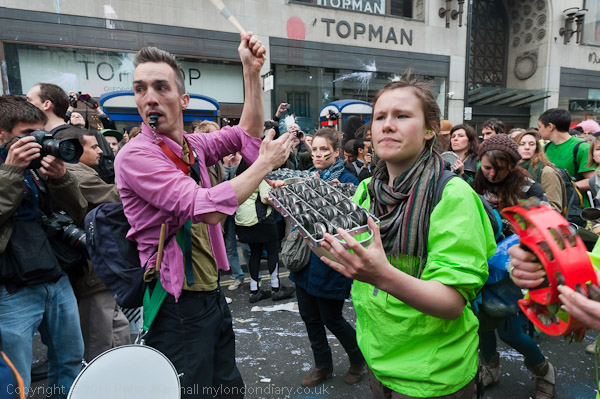
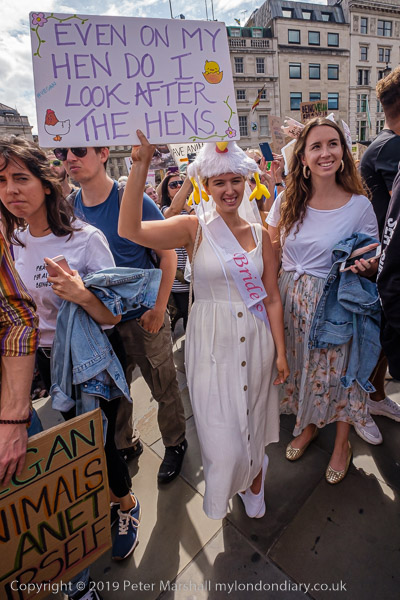
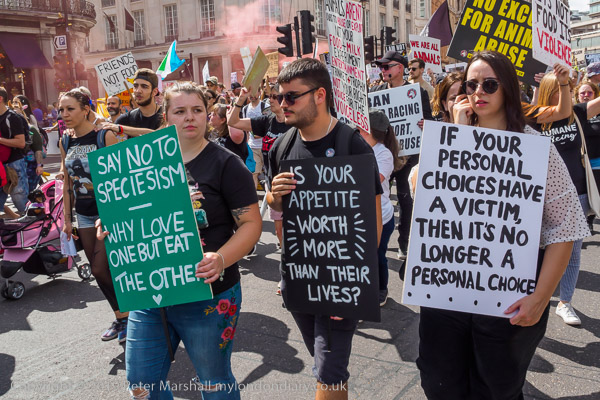
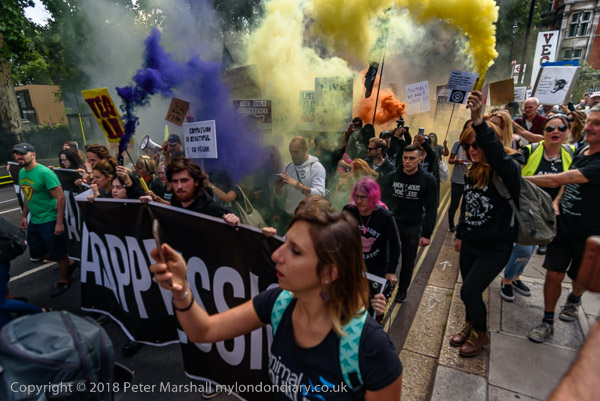
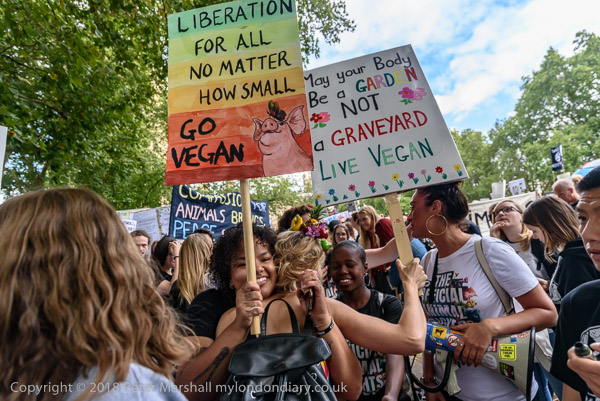
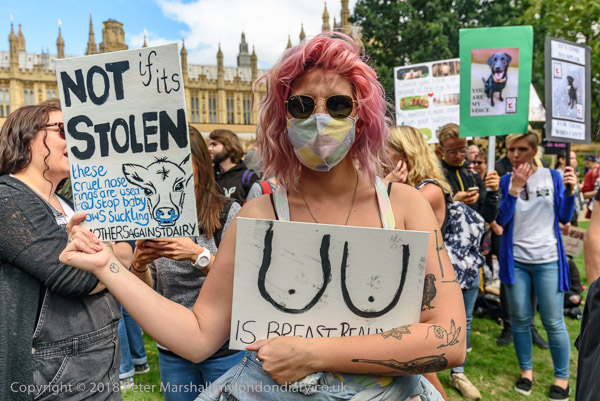
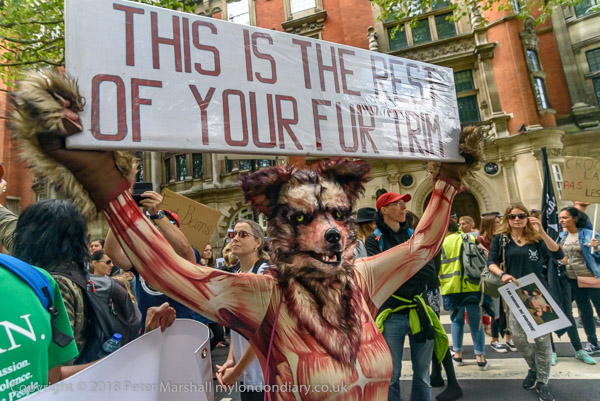
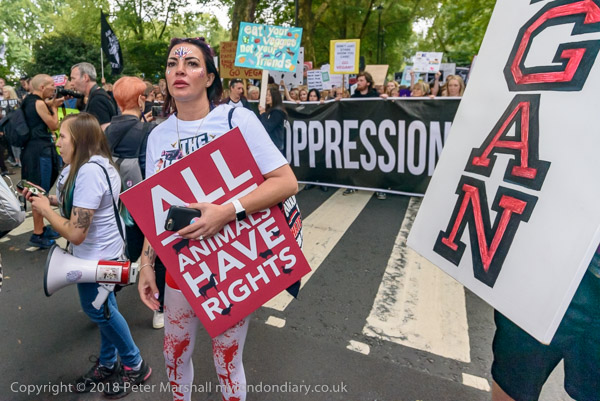
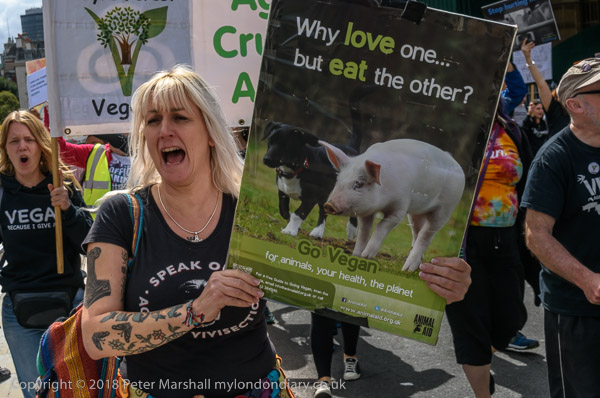
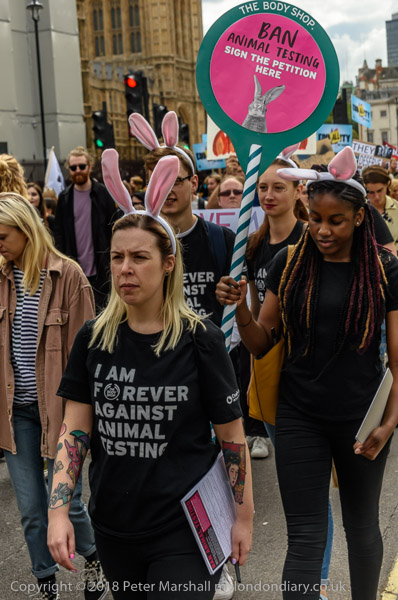
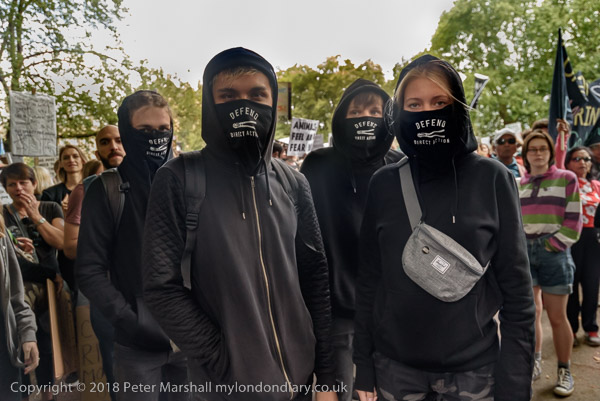
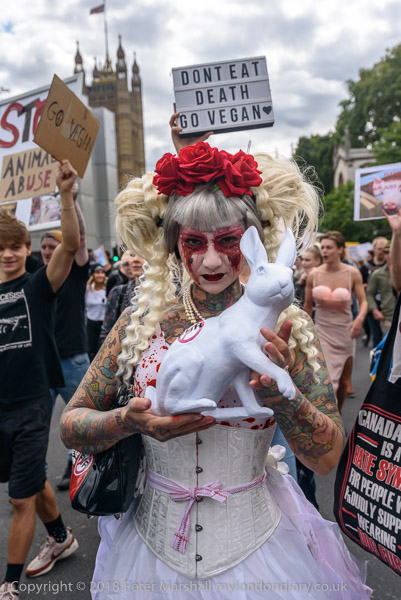
Thousands March for Animal Rights – thousands of vegans marched through London from Westminster to Hyde Park on Saturday 25th August 2018 in the Official Animal Rights March founded by animal rights organisation Surge, calling for an end to animal oppression and urging everyone to stop eating animals and using dairy products.
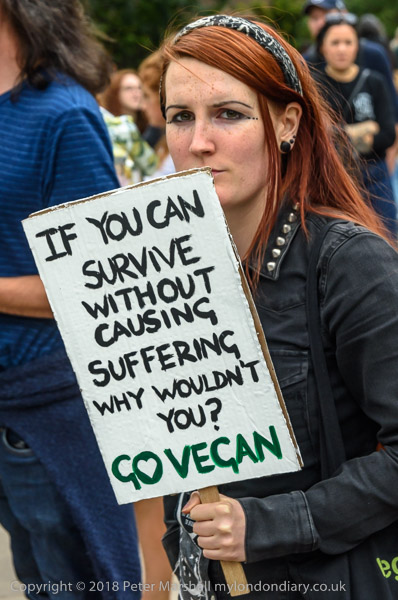
Vegans say that animal lives matter as much as ours and call for an end to speciesism, and the misuse of animals for food, clothing and sport. There does however seem to be rather less concern about aspects such as the breeding of dogs and other animals as pets. And while horse racing attracts some attention, the last protest that I photographed against that most cruel of all races, the Grand National, attracted only a handful of protesters compared to the thousands on this march.

Specieism – the idea that animal lives matter as much as human lives – isn’t something I can agree with. I firmly believe there is something special about the human species which has come about through evolution and in particular the development of language. While other species can communicate with each other and some develop very intricate systems of cooperation and civilisation, humanity has developed these to a very different level.
It’s that level indeed that makes veganism possible. The lion needs to hunt and eat, killing other species cruelly in order to survive. Nature truly is famously ‘red in tooth and claw’ at virtually every level, and predation is a vital aspect of all ecosystems.
Of course I’m against cruel treatment of animals, whether it is in farming practices, the transport of live animals, fur farming etc. I’ve never eaten foie gras and will never do so, but I still happily consume cows milk knowing that cows have been bred that now produce many times the amount their young offspring need and would experience considerable pain if not milked. And I’ll happily pay the extra for free range eggs while opposing the terrible treatment of chickens kept in horrifically overcrowded chicken houses. Modern farming practises have generally prioritised cutting costs over being kind to animals and while injections and vetinary treatment may have cut disease it has been in the interests of productivity rather than a more overall view of animal welfare.
There are good environmental reasons for eating less meat, though less so for grass-fed livestock and also for reducing the scale of consumption of diary products. It’s welcome that some people decide not to eat these things, but a wholesale adoption of veganism would be highly damaging to ecosystems around the world and change the nature of our countryside. Just imagine a farmyard without animals – and think seriously about the future of soil without farmyard manure.
Those fluffy animals on the posters at many vegan protests are not wild animals but domesticated animals, which only exist as they do because they have been bred to live with humans and to provide us with food. I would be sad to see them disappear, but there would be no reason for there to be any cows, sheep, geese, pigs, chickens etc in our farms and fields if we ceased to eat them (though I wouldn’t miss turkeys at all.) And certainly I’d not want to see more petting zoos. But I would like to see more truly wild animals in our countryside – including wild ponies rather than horses being kept and ridden for pleasure. And keeping animals as pets does seem to me to be abuse of a kind too – and sometimes by kindness.
There are animals that I happily kill, such as the slugs that eat my vegetable crops and the ticks that hop a ride to suck my blood. Others that I’d support the culling of – including deer and the grey squirrels that are destroying young oak trees and other young vegetation (and we are slowly finding that plants have feelings too) though I can see no justification for the killing of badgers. Then there are smaller animals that I kill accidentally by walking along paths or through forests.
I’m an insulin user, and it has kept me alive and reasonably healthy for around the last 20 years. Reasearch on insulin began in the 1880s, though it was only in the 1920s that the first human patients were injected with it. That research was only possible through experiments using animals, mainly dogs. Until 1982 when the first biosynthetic human insulin became available all commercial production of insulin depended the use of cattle and pigs. Much more recently a plant source has been found. Using animals in medical research in this and many other cases has saved millions of lives but of course it should be subject to proper controls and certainly not used for trivial and routine tests.
In the past I have marched with animal rights activists, supporting many of their protests against animal cruelty. And my diet now contains far less meat than it once did. But it would be good to see more of those who come out to march for animal rights also coming out to march for human rights. still suffering much abuse here and elsewhere around the world. We are a species too and even though we now don’t eat each other, people are being killed, tortured, sexually assaulted, imprisoned without trial, sentenced for their political views variously abused and denied their human rights and the necessities of life.
More at Thousands March for Animal Rights.

Twickenham Riverside – December 1988

River Thames, Eel Pie Lisand, bridge, The Embankment, Twickenham, Richmond, 1988 88-12a-51-Edit_2400
River Thames and bridge to Eel Pie Island, The Embankment, Twickenham 1988 8812a-51

Twickenham Riverside – December 1988
I was teaching on Tuesday 13th December 1988, and together with a colleague took a group of photography students from the college to Twickenham, possibly to view an exhibition at the Orleans House Gallery, or perhaps just as a photographic outing.

My first thought when I looked at the contact sheet today was that it could be for the show I helped to organise there in 1988, city news urban blues…. It had been an interesting show, with images from ten of us who were part of a group called Framework, each showing their own group of pictures – those exhibiting were Carol Hudson, Peter Jennings, Terry King, myself, Tony Mayne, Derek Ridgers, John RJ Taylor, Laurence Ward, Randall Webb and Anton Williams. Terry was the main organiser and I worked with him to keep the group running.

But on checking I find that show was rather earlier in the year and I think we were just taking college students to a reasonably safe and interesting area a short train journey away where they could first be taken for a walk to suitable locations around the riverside and parks and then be left to work unsupervised taking pictures while their tutors probably took a lunch hour rest in a riverside pub.

It was surprisingly difficult to get some students to actually take photographs, so we arranged outings such as this where we would provide a suitable location and brief to make sure even they had some material to work with in the darkroom. They were all required to make at least 36 exposures so they had a film (black and white of course) to develop and make prints. Some students made sure they had time to get to a pub too, though there were enough in Twickenham for them to avoid the same as their two tutors.
River Thames, The Embankment, Twickenham, Richmond, 1988 88-11f-55-Edit_2400
River Thames, The Embankment, Twickenham, Richmond, 1988 88-11f-55

But I did take some pictures myself during the outing, and here are a few of them. I took two versions of this image, looking upriver from the west end of the Embankment, one with the new Minox GTE and the second I think with a Leica M5 using the 35mm Summilux f1.4 lens. The image above is with the Minox, which had a MC Minoxar 35mm/2.8 lens and is just a little sharper, though the difference might well be in the exact focus distance chosen. But though the Minox was incredibly small and light – the smallest 35mm full-frame camera ever made, it could deliver exceptional results.
River Thames, Twickenham, Richmond, 1988 88-12a-32-Edit_2400
River Thames, Twickenham, Richmond, 1988 88-12a-32

You can still launch boats at Twickenham, where at the junction of Church Land and Riverside a roadway leads down into the river. When the tide is low you can walk down this and get a view downriver. On the right boats are moored by Eel Pie Island and in the centre of the image you can just see Richmond Hill between the trees.
And although there is a footbridge across to Eel Pie Island as shown in the top image of this post, residents still need to keep tide tables handy, as the Twickenham Embankment end of the bridge still floods on those days when the moon aligns with the sun at full and new moon to give Spring Tides.
River Thames, The Embankment, Twickenham, Richmond, 1988 88-12a-36-Edit_2400
River Thames, The Embankment, Twickenham, Richmond, 1988 88-12a-36

The balustrade is around what is now Champion’s Wharf Play Beach, and the wall is around the end of the riverside section of York House Gardens and a part of the archway leading through to this is just visible. The previous picture showed the narrow sloping pebbles above the waterline which I walked out on to take this picture.

Surprisingly I don’t appear on this occasion to have walked through York House Gardens and didn’t photograph the ‘Naked Ladies’ or Italian Fountain just through that gateway and on the left, but continued along Riverside, taking a few pictures of the houses beside it before reaching the splendid building of the White Swan pub.

You can now drink The Naked Ladies, the bestselling beer produced by Twickenham Brewery, a 4.4% golden ale made with Herkules, Celeia and Chinook hops and CAMRA’s 2019 Champion Golden Ale of London. But the brewery only opened in 2004, and Naked Ladies was first launched in 2013, so I can’t recall if or what I drank there in 1988. But I have enjoyed it at the White Swan and elsewhere more recently.

River Thames, Twickenham, Richmond, 1988 88-12a-15-Edit_2400
River Thames, Twickenham, Richmond, 1988 88-12a-15

Before going in a pub we did go down to the riverside a little along from the White Swan, and I made several pictures of this boat covered in vegetation. Apart from this it seemed in quite usable condition and was still firmly moored. The Thames here is still tidal, though the Richmond half-lock downstream stops the water entirely flowing out.

River Thames, Twickenham, Richmond, 1988 88-12b-64-Edit_2400
River Thames, Twickenham, Richmond, 1988 88-12b-64

A second picture in much the same area shows a smaller boat in rather cleaner condition, firmly moored and roped down on the mud. In the background at right is the white house on the corner of Lebanon Park and Riverside. This is where Twickenham Ferry used to run across the Thames to Ham House, passing just downstream of Eel Pie Island.

The ferry was licensed by the owners of Ham House, the Dysart family (and sometimes known as Dysart’s Ferry) and the first written mention of it was in 1652. I last went across with my father to see Ham House in the mid-1970s, not long before it ceased operation. There had for some years been a dispute about its right of way on this slipway. I took the photograph below in 1979 when the river was flooded and there were boats moored there which were those used for the ferry in better weather to row people across and there were still notices for waiting passengers still on the fence.

Twickenham Ferry, River Thames flooding at Twickenham, Richmond, 1979
Twickenham Ferry, River Thames flooding at Twickenham, Richmond, January 1979

My contact sheet from December 1988 shows we walked further on, with pictures of moored boats close to where the still operational Hammerton’s Ferry, a Johnny-come-lately from 1908, still runs when weather and water conditions allow. An on one of these frames (not digitised) a small figure by the water’s edge stands taking a photograph, with the balding head of my teaching colleague, another Peter. This was where I made my final image of the day, after which I strongly suspect we made our way back towards a riverside pub before meeting our students for the train back to college.


Families Separated, Gaza, Ghouta and Sri Lanka

Families Separated, Gaza, Ghouta and Sri Lanka – On Saturday 23rd August 2014 I photographed four protests in Westminster, one against an aspect of our racist immigration policies, the second against the UK selling arms to Israel which have been used in attacks on Gaza (along with a counter demonstration), the anniversary of chemical attacks by the Syrian regime and a protest calling for UK support against the continuing genocide of the Tamil nation.


Divided Families protest over cruelty – Downing St

Families Separated, Gaza, Ghouta and Sri Lanka

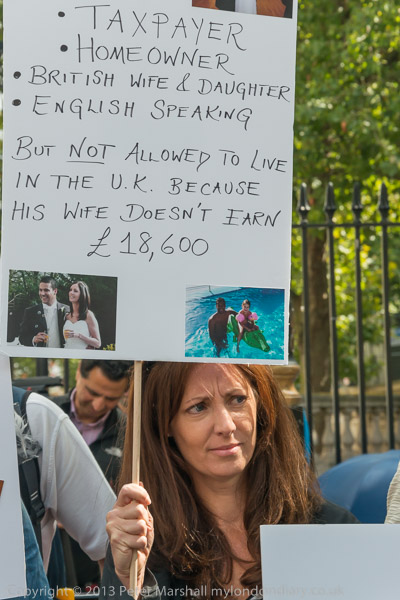
The cruel and unfair immigration rules set up by the Home Office under Theresa May mean that anyone earning less than £18,600 was unable to bring a non-EU spouse into the country (Brexit means that similar rules now apply to most EU countries.)

Families Separated, Gaza, Ghouta and Sri Lanka

This income requirement discriminates against women, the retired and disabled young and many minority ethnic people who have on average lower incomes than the general population. For couples with children, the income limit is even higher, and to secure visas for a spouse and two children you would need an income of £24,800.

Families Separated, Gaza, Ghouta and Sri Lanka

Fees for applications are also expensive – from £1048 to £1538 per person and applicants may also need to pay a healthcare premium of from £1560 to £3120 for adults and around three-quarters of this for each child. For applications made in the UK there is an extra £800 if you want a faster decision. And applicants also need to supply a great deal of documentation.

The policy, which also includes tougher English Language tests, a proof of greater attachment to the UK than of any other country and extending the probationary period from two to five years, is in direct contradiction of the Universal Declaration on Human Rights which states:

‘No one shall be subjected to arbitrary interference with his privacy, family, home or correspondence, nor to attacks upon his honour and reputation. Everyone has the right to the protection of the law against such interference or attacks.’

Universal Declaration on Human Rights

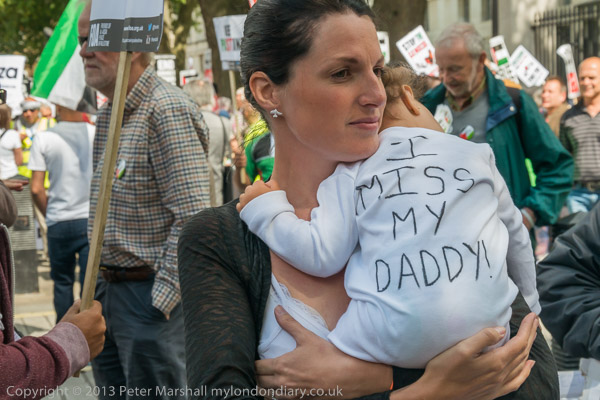
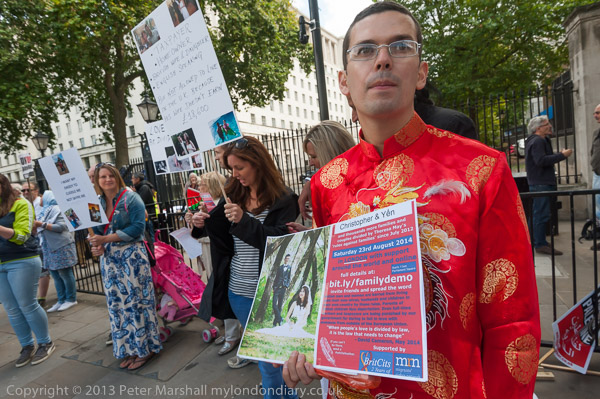
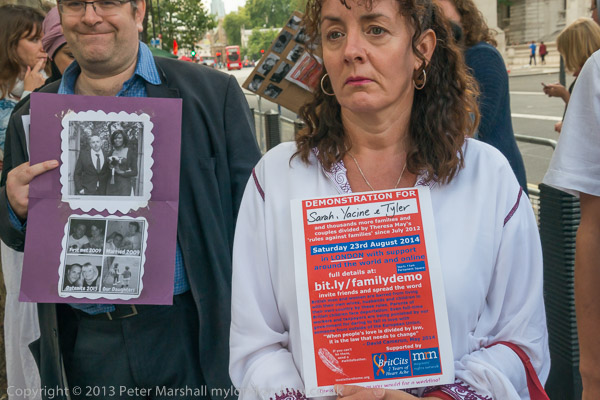
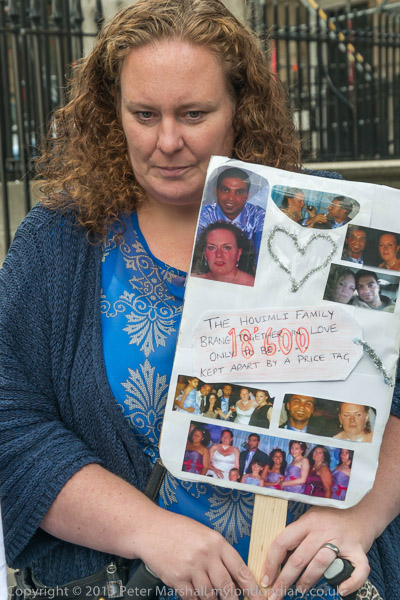
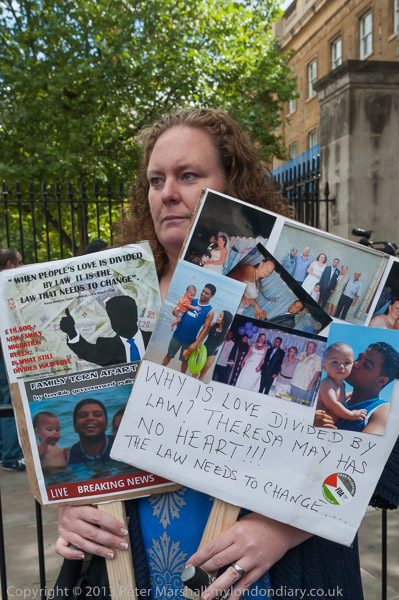
People at the protests included many whose families were divided as they were unable to meet the income levels, as well as a number of parents and friends of divided families.

Many carried placards with images of the divided families, along with captions such as ‘I WANT MY DADDY TO CUDDLE ME NOT SKYPE ME’. I felt deeply for those caught by what seem to be vindictive, unnecessary and totally insupportable polices. It was impossible not to agree with the placards with messages such as ‘WHY IS LOVE DIVIDED BY LAW? THERESA MAY HAS NO HEART!!! THE LAW NEEDS TO CHANGE….’

Divided Families protest over cruelty


Gaza Protest – Stop Arming Israel – Downing St

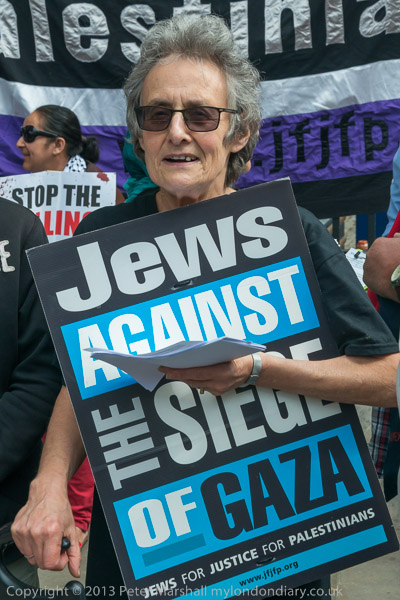
A large rally at Downing St called on the UK to stop selling arms to Israel, and for an end to Israeli war crimes. Among the protesters were many Jews from various Jewish groups, including the ultra-orthodox Neturei Karta who had walked down from north London to support the protest.

Israel had carried out air strikes on Gaza in July 2014 following a number of incidents including the shooting by the IDF of two Palestinian teenagers and the kidnapping and killing of three Israeli teenagers in the West Bank. There were other incidents including house demolitions and the kidnapping and killing of a Palestinian youth. Hamas replied to air strikes with rocket fire on Israel.

The Israeli invasion of Gaza began in earnest on 20th July and the ground war was still continuing though on a lesser scale when this protest took place, with a ceasefire being agreed and coming into effect on 26th August.

There are more details about the invasion in the Wikipedia Timeline, which states “2,256 Palestinians and 85 Israelis died, while 17,125 Palestinians, and 2,639 Israelis suffered injuries.”

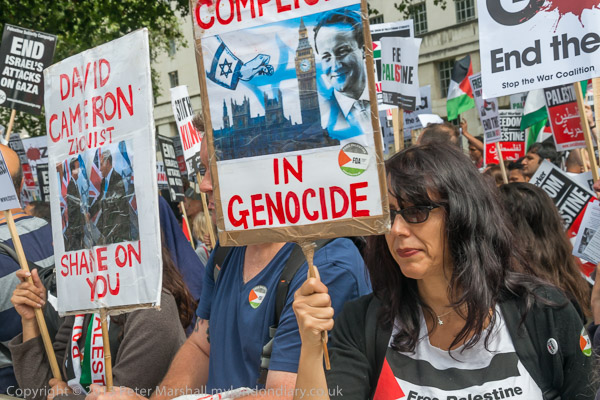
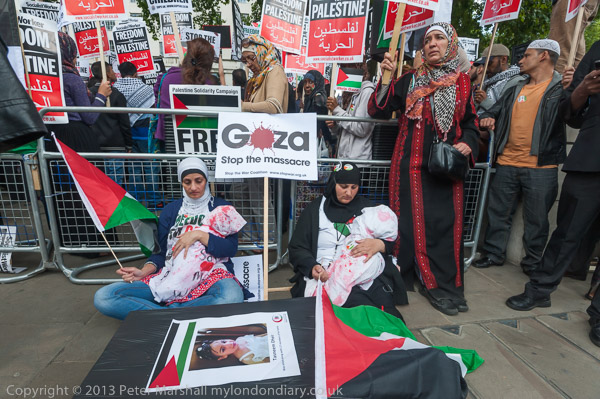
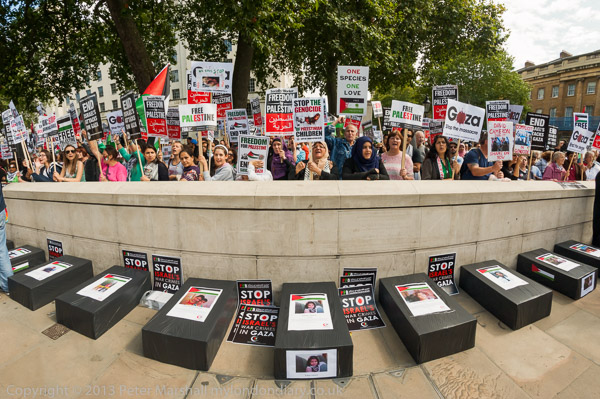
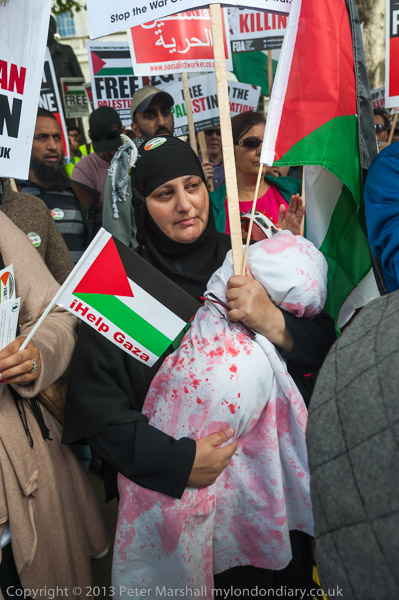
At the protest there was a row of black boxes representing coffins and the names of children killed, and some people carried ‘bloodstained’ bundles representing dead children

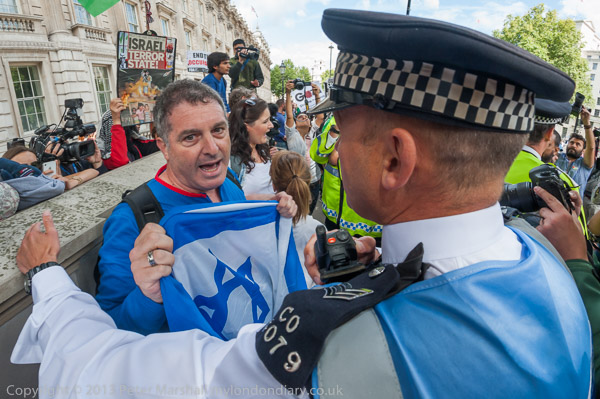
Three people came to wave Israeli flags across the road and were led away for safety by police.

Earlier one of the Palestinian protesters had tried to seize one of the flags and was dragged away by police. At the end of the rally opposite Downing St some of the protesters marched around London and I went with them as far as Trafalgar Square where I had another event to cover.

More pictures: Gaza Protest – Stop Arming Israel


Syria Chemical Massacre Anniversary – Trafalgar Square

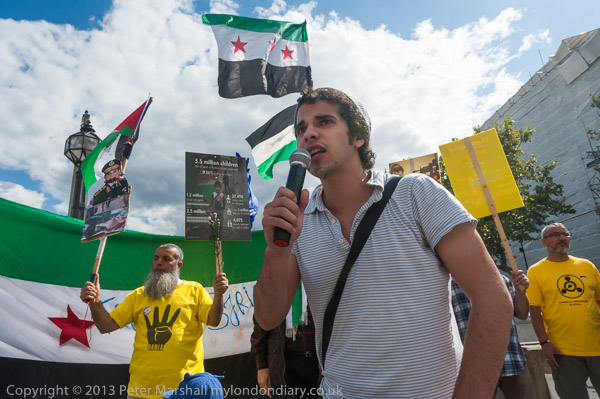
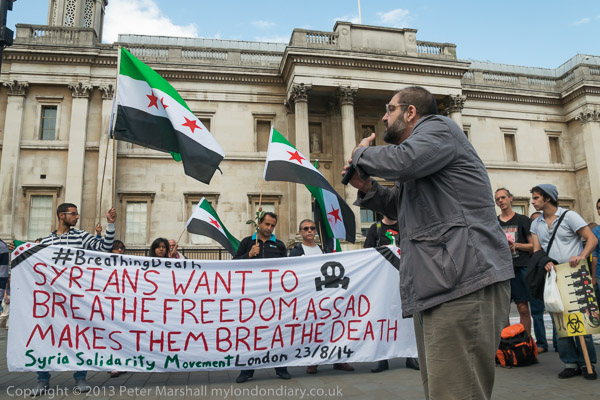
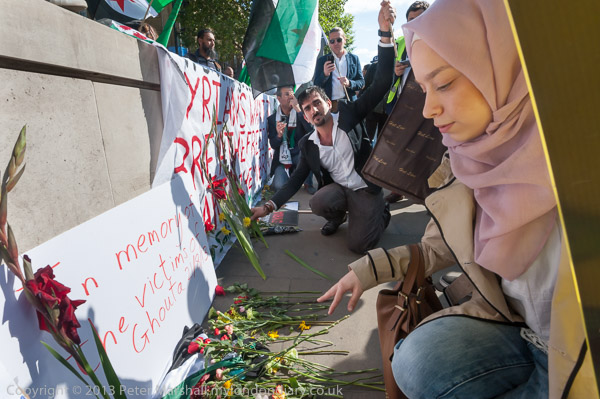
A rally marked a year after the Ghouta massacre of 21/08/2013 when Assad regime forces outraged the world by using Sarin gas, killing 1,477 residents including over 400 children in this Damascus suburb. The world failed to act against Assad.

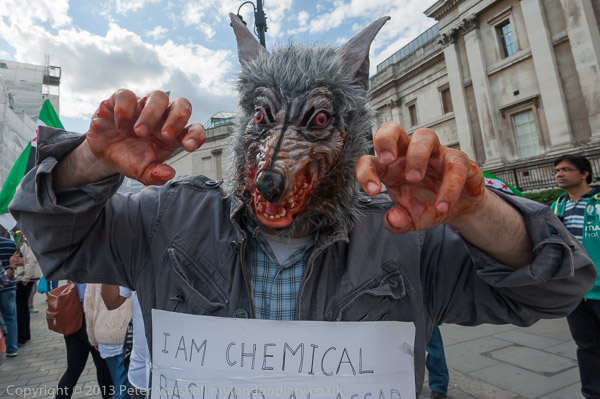
One man was wearing wolf head with bloody hands and placard ‘I AM CHEMICAL BASHAR AL ASSAD AND ONE YEAR ON I AM STILL GASSING SYRIAN CHILDREN. THANK YOU FOR UN VETO’

After an hour-long rally in Trafalgar Square the protesters, who were mainly Syrians, marched along the pavements to Richmond Terrace, opposite Downing St, where they laid flowers in memory of the dead.

More pictures: Syria Chemical Massacre Anniversary


Tamils protest Sri Lankan rapes & killing – Downing St

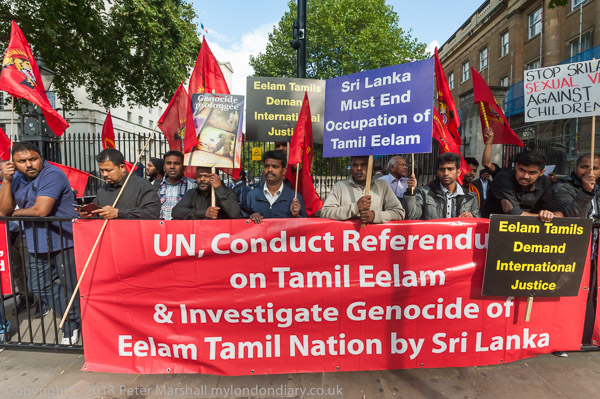
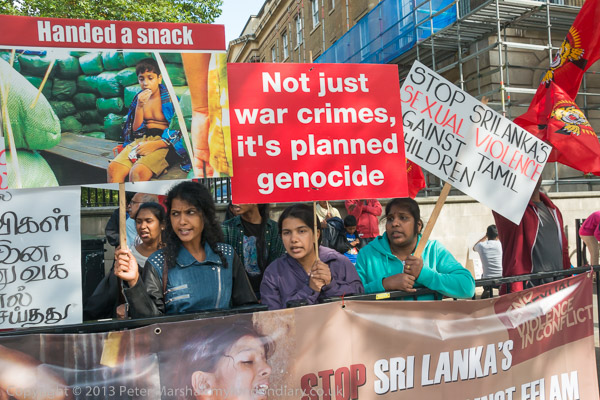
Also present when I returned to Downing St were Tamils protesting over the continuing genocide of the Tamil nation, calling for a UN investigation and referendum on Tamil Eelam.

Placards called for an end to the use of rape to destroy their nation and sexual violence against children.

More pictures: Tamils protest Sri Lankan rapes & killing


Aylesbury, Newington & City Nights

This post looks at the end of my walk south of the river on Sunday 13th November 1988 – the previous post was Flats, A Square, Bread & Funerals – Walworth – and finishes with a few pictures taken at night in the City of London.

Wendover, Aylesbury Estate, Thurlow St,  Walworth, Southwark, 1988 88-11c-12-Edit_2400
Wendover, Aylesbury Estate, Thurlow St, Walworth, Southwark, 1988 88-11c-12

Southwark Council built the Aylesbury Estate between 1963 and 1977. It was one of the larger if not the largest public housing developments in Europe, with around 2,700 homes. Wendover, designed by the boroughs architects, was completed in 1970. I think it’s two blocks contains around 471 flats as well as a learning centre and tenants hall.

Like many council estates it was poorly maintained over the years and parts of the estate were deliberately used by the council to house people and families with various social problems, something exacerbated by the Conservatives plans, particularly under Thatcher, to get rid of social housing, resulting in it increasingly becoming housing for the most deprived members of society.

The estate has a central boiler for heating and hot water, which has increasingly suffered from failures which residents say the council is very slow to take action over. The flats also have fallen behind more modern standards of insulation etc, and are in need of some refurbishment, though the council drastically overstated the costs of this when making their case for demolition.

Wendover, Aylesbury Estate, Thurlow St,  Walworth, Southwark, 1988 88-11c-14-Edit_2400
Wendover, Aylesbury Estate, Thurlow St, Walworth, Southwark, 1988 88-11c-14

I’ve in recent years been inside quite a few flats on the estate, often lovingly maintained and decorated by their residents who have been fighting a long battle against council plans to redevelop the area.

Although the council carried out a long PR campaign against this and the neighbouring Heygate Estate – including Tony Blair making his first speech as Prime Minister here and launching the party’s programme of regeneration of housing estates.

Its relatively open and fairly traffic-free nature along with convenient location made the estate a favourite for “grim backdrops to murder scenes, gun and drug storylines and gang-related crimes in soaps and gritty dramas” until pressure from local residents forced Southwark Council to ban filming in the area.

Channel4 took footage from the estate to use in their channel ident, adding to it, according to Ben Campkin of UCL quoted in Wikipedia, “washing lines, shopping trolley, rubbish bags and satellite dishes” to show it as “a desolate concrete dystopia [which] provides visual confirmation of tabloid journalists’ descriptions of a ‘ghost town’ estate.

Residents wanted refurbishment rather than demolition – which will lead to many of them moving much further away from the centre of London. But councillors salivated at the thought of profits and handouts from the developers and never seriously considered anything other than demolition and replacement. Their decision lead to a series of occupations by housing activists of properties due for demolition. The complete destruction of the estate seems likely to take around another ten years with the final phase beginning next year. You can read much more about what has happened – and the duplicity of Southwark Council on the Southwark Notes site.

Trade Counter, Lambeth Rd, Newington, Southwark, 1988 88-11e-62-Edit_2400
Trade Counter, Lambeth Rd, Newington, Southwark, 1988 88-11e-62

I walked on through both the Aylesbury and Heygate estates, both estates with a bad reputation for crime, but where I never suffered an uneasy moment despite having around £10,000 of equipment in my camera bag. I didn’t stop to take many pictures after those of Wendover, probably because I was getting tired. I did took a few frames on the New Kent Road and then walked on past the Elephant.

This entrance on Lambeth Road was one I’d photographed previously and probably I made a slight detour to do so again. I’d made an earlier picture using the tiny Minox that lived in my jacket pocket and it was severely underexposed. I had to send the camera for servicing. It was distributed by Leica, who told me it couldn’t be repaired, but offered me a replacement at considerably below the shop price. I had it in my pocket on 13th November taking my first test film, and took it out and made another exposure with it which was fine – and very similar to this, made on an Olympus SLR. Both are online on Flickr.

Frank Love, Lambeth Rd, Newington, Southwark, 1988 88-11e-63-Edit_2400
Frank Love, Lambeth Rd, Newington, Southwark, 1988 88-11e-63

The previous image was the trade entrance at No 47 for Frank Love at New XL House, No 45 Lambeth Rd. Its signs read PLUMBERS BRASSFOUNDRY COPPER TUBES AND FITTINGS but I think the works had closed when I made this image. You can view an earlier image of the whole frontage by Bedford Lemere & Co in the Lambeth borough archive, and see some of their advents on Grace’s Guide. I think these were the last pictures taken on my walk which ended at Waterloo Station.

Dagwoods, St Alphage Highwalk, City, 198888-11e-41-Edit_2400
Dagwoods, St Alphage Highwalk, City, 198888-11e-41

Dagwoods offered Quality Sandwiches to city workers in their lunch hour but the area was pretty empty at night, although there are still a few lights in the offices. The large area of pavement emphasises that emptiness.

I think I was probably coming back from an event at the Museum of London and had decided to take a little walk with my camera, though from some of the other pictures it seems clear I had come without a tripod.

Night, Bassishaw Highwalk, City, 1988 88-11e-42-Edit_2400
Night, Bassishaw Highwalk, City, 1988 88-11e-42

Another deserted area of highwalk, and the sharpness and depth of field suggests I was able to steady myself well to produce this handheld – it will have been taken at a pretty slow shutter speed. This section of highwalk and the office building at right is still there though looking rather different.

Too much of the older London remained for the planners’ dreams of the separation of pedestrians from traffic to ever really be feasible except in a few small areas of the city – and there are very few escalators or lifts where the elderly and disabled can access them.

Night, Bassishaw Highwalk, City, 1988 88-11e-45-Edit_2400
Night, Bassishaw Highwalk, City, 1988 88-11e-45

One of my favourite modern buildings in London, and one I’ve photographed several times in daylight. I suspect it was this building that really prompted me to make this short walk at night. After the four frames (only one digitised) I made here I did wander around an make a dozen or so more exposures, but nothing which really caught my interest when I was deciding which to put on-line.

65 Basinghall St is Grade II listed as “Former exhibition hall, magistrates court and offices, now converted to offices, 1966-69, by Richard Gilbert Scott of Sir Giles Gilbert Scott, Son and Partner” and was built in 1966-9. There is a long essay in the listing text. But perhaps sufficient to say its roof is one of the finest uses of concrete at least in the UK.


Sean Rigg Memorial 2012 – Brixton

Sean Rigg Memorial 2012 - Brixton
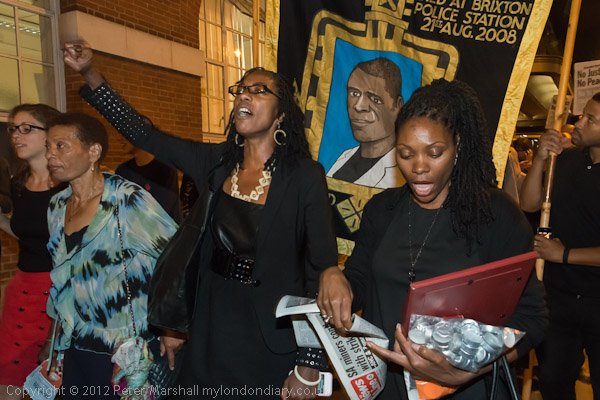
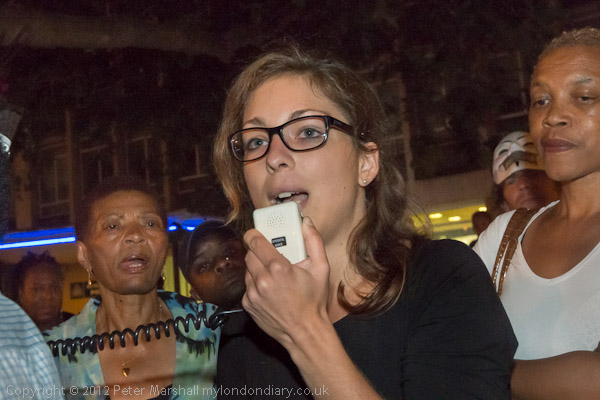
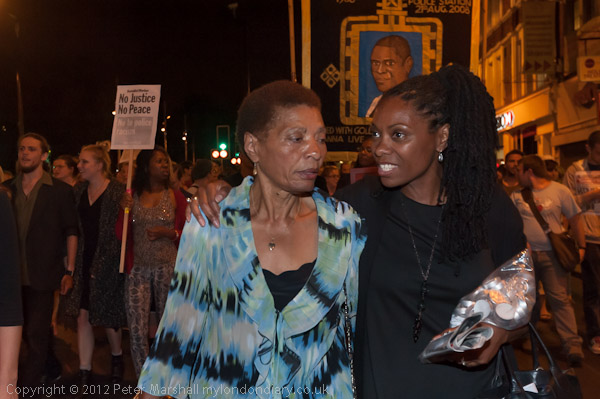
Mona Donle and Sean Rigg’s mother and sisters lead the march to Brixton Police Station

Sean Rigg Memorial 2012 – Brixton

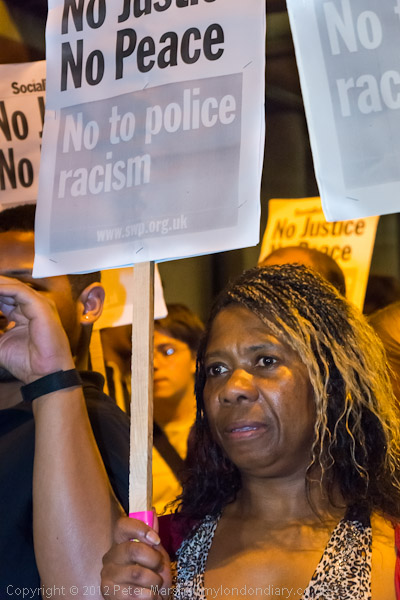
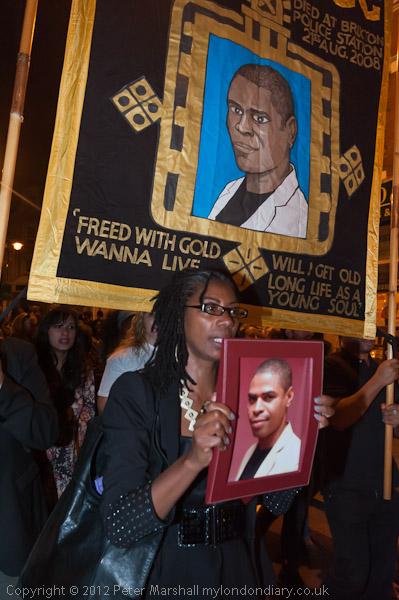
Sean Rigg, a 40-year-old black musician and music producer was assaulted and arrested by police on August 21st 2008 and taken to Brixton Police Station where he died as a result of police violence.

Sean Rigg Memorial 2012 - Brixton

Wikipedia fills in some details about what happened. Police had been called to Rigg, who suffered from paranoid schizophrenia and had become “uncooperative and aggressive” in his hostel earlier in the day but they turned down five 999 phone requests from hostel staff asking for urgent assistance. They only eventually turned up after a number of calls from members of the public about his “strange behaviour” on the street outside.

Sean Rigg Memorial 2012 - Brixton

Four officers arrived, chased and handcuffed him, then restrained him face down, leaning on him for 8 minutes, before placing him “face-down with his legs bent behind him in the caged rear section of a police van” and driving to Brixton Police Station, where he was kept locked in the van unmonitored for a further 10 minutes before, by then “extremely unwell and not fully conscious” he was taken into the police station.

It took 25 minutes for police to call their medical examiner to examine him, and the custody sergeant told the doctor he was “feigning unconsciousness.” Ten minutes later the doctor found his heart had stopped and he was not breathing. CPR failed to revive him but he was only officially pronounced dead after being taken to a nearby hospital.

This was the start of an immediate and sustained effort of lies and obfuscation by the police officers involved, the Metropolitan Police, the Independent Police Complaints Commission, the Crown Prosecution Service and even courts to cover up what had actually happened and protect the police officers who killed Sean Rigg.

And the story would have ended there, but for the incredibly determined efforts of his family to uncover the truth. The Sean Rigg Justice & Change Campaign was set up, led by his sisters Marcia Rigg-Samuel and Samantha Rigg-David and supported by the rest of the family. One of many family-led campaigns which togther make up the United Families and Friends Campaign, it also got support from other organisations including Inquest and Black Mental Health UK and has slowly managed to bring the many of the facts out into the open.

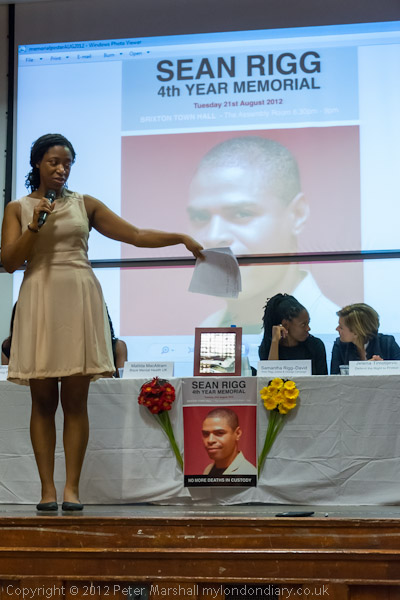
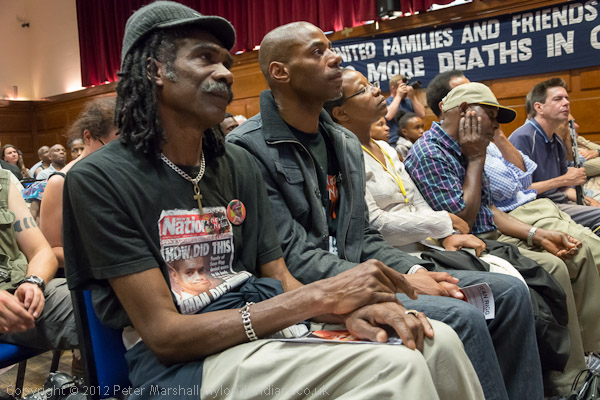
Four years later, on August 21st 2012 I was in a full Assembly Hall inside Lambeth Town Hall for the Sean Rigg Memorial where a number of speakers including Sean Rigg’s sisters gave details they had managed to uncover of his death, the misleading press releases from the police and their attempts to cover up and the total failure of the IPCC to carry out a proper investigation. At the end of the meeting the 50 minute film ‘Who Polices the Police’ directed by Ken Fero of Migrant Media was shown.

Speakers also talked about other cases of suspicious deaths in police custody where again there has been no proper investigation – and no police officer has ever been found responsible.

Mona Donle

Mona Donle spoke about an incident she had witnessed two days earlier across the road in Windrush Square, where police arrested another man who was clearly disturbed and acting unpredictably. One officer choked the man by holding his forearm across his throat, then another officer stamped on him. The foot was on his face when he passed out and people kept telling the police to call an ambulance. Another witness to the event told me it was around twenty minutes before the man came round – and he still had the clear impression of the boot across his face. The police record of the incident made no mention of any violence and suggested the ambulance came ‘approximately’ five minutes after the arrest.

Brixton Police Station

The inquest into Sean Rigg’s death had brought out some more of the details, and its verdict 3 weeks earlier had ‘concluded that the police had used “unsuitable and unnecessary force” on Rigg, that officers failed to uphold his basic rights and that the failings of the police “more than minimally” contributed to his death‘.

Three police officers had clearly committed perjury in their evidence to the inquest and were arrested in 2013. One was cleared by the IPCC and in 2014 the Crown Prosecution Service announced it would not bring criminal charges despite what appeared to most people compelling evidence. Later the Rigg family campaign forced the CPS to review that decision and one officer was charged, and the case was brought. Inexplicably the jury decided to acquit him.

The inquest verdict also led to the setting up of an external review of the IPCC investigation, which gave an extremely damning verdict on there total failure to properly investigate the events. It and other investigations into the IPCC led to this being replaced in 2018 by the Independent Office for Police Conduct. It will surprise no-one if that is also replaced in a few years time.

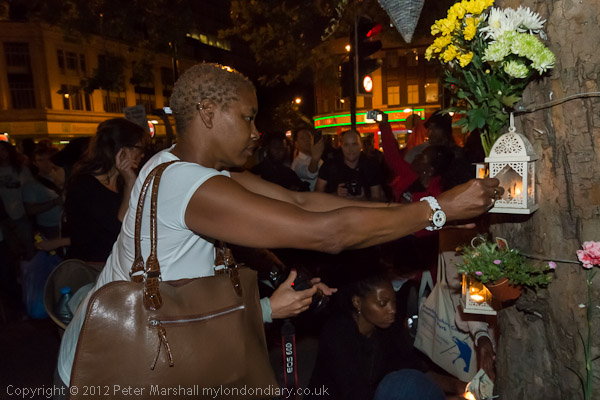
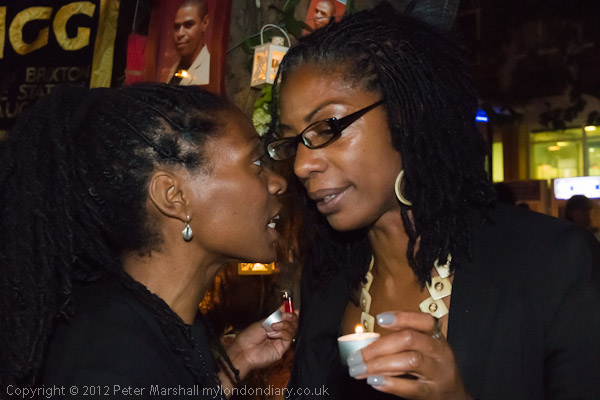
After the memorial meeting around 200 of those present marched behind the Sean Rigg Campaign banner from the town hall to Brixton Police Station, where flowers were laid at the memorial tree outside, candles lit and a minute’s silence held for Sean Rigg and other victims of police violence.

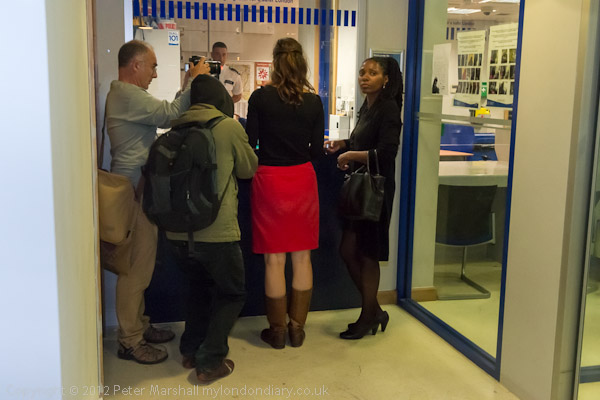
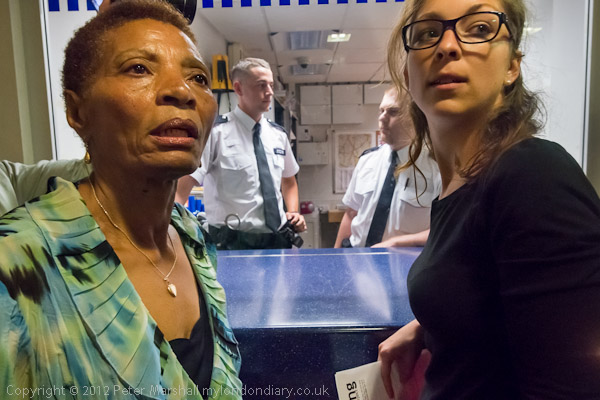
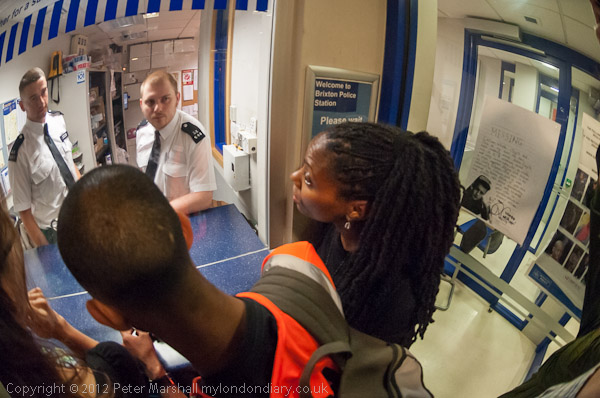
Samantha Rigg and Mona Donle then took a formal complaint into the police station about the police assault two days earlier and were followed in by a crowd, packing out the small lobby. Police made a copy of the complaint and gave them a signed and dated copy. They asked to see the officer in charge, and after a few minutes he came to a side door and answered what questions he could about the arrest.

There still, 14 years on from his death, despite the huge fight by his family, has been no justice over the death of Sean RIgg. Nor for the families of others who have died in police custody, prisons etc.

No Justice, No Peace.

Sean Rigg Memorial – 4 Years


Music, Spoken Word and Protest

Music, Spoken Word and Protest
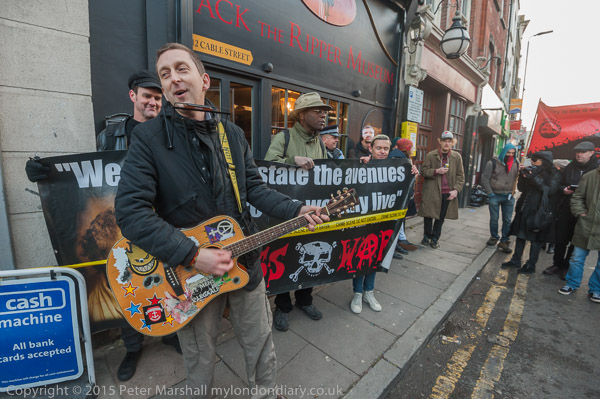
Cosmo sings at the Jack The Ripper protest, 2015

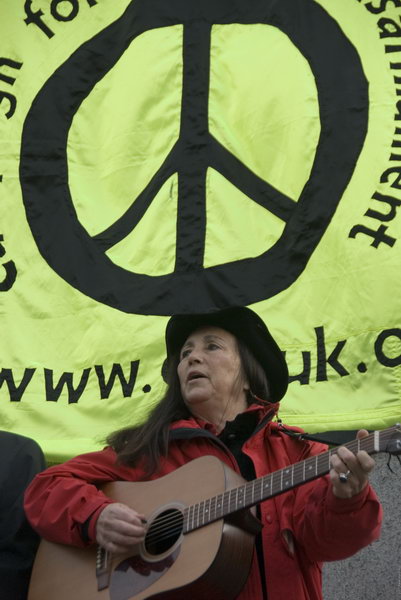
Music, Spoken Word and Protest. A week or two ago I received a Facebook invitation suggesting I listen to a monthly radio show on Riverside Radio, the Colin Crilly Takeover, a monthly show with hosts Andy Bungay and Colin Crilly. In this edition they were to “be playing SONGS with a political/social angle, and discussing the issues raised.”

Music, Spoken Word and Protest
Adam Clifford performs at Class War newspaper launch, White Cub, Bermondsey, 2017

Colin Crilly is someone I’ve often met and photographed on protests in London and who has on occasion asked me to be interviewed for the show, but I’ve never done so. Radio isn’t really an ideal medium for photography.

Music, Spoken Word and Protest
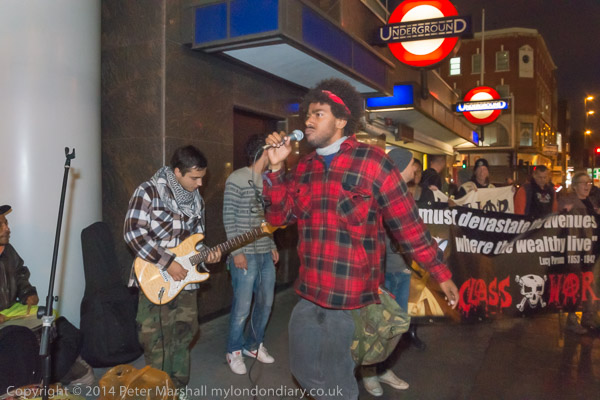
Different Moods play at Poor Doors protest, 2014

Riverside Radio is a local station covering a wide area of southwast London, mainly the boroughs of Wandsworth, Richmond and Merton but available to everyone on the web. I didn’t log on to the live show live as it airs for two hours from 11pm on a Saturday night, a time when I’m usually exhausted and only ready to fall asleep. Or if I’ve had a particularly busy day covering events I might still be editing the work.

Julie Felix at CND protest, 2007

But a few days later, Colin sent me a link to a recording of the show on MixCloud and I began to listen to it. I’ve not managed to hear the whole two hours and I found MixCloud a frustrating experience as, perhaps because I haven’t subscribed, I couldn’t skip forward and when I took a rest it reverted to the start of the track. Since radio doesn’t come with pictures (except in the mind) I’ve added some of my own to this post.

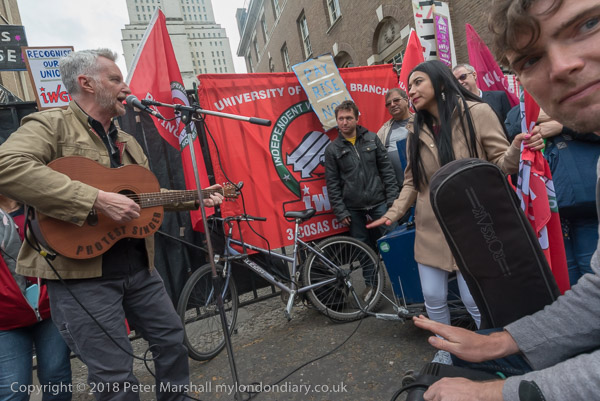
Billy Bragg supports IWGB strikers 2018

It was good to hear a track by Anne Feeney, the late great US folk musician, singer-activist and lawyer who died in 2021. Her ‘Have You Been To Jail For Justice?’ and her lines “A rotten law stays on the books til folks like us defy it, The law’s supposed to serve us, and so are the police, And when the system fails, it’s up to us to speak our piece …” are very relevant now. It led to some interesting discussion by Colin and Andy, but perhaps it could have been related rather more to the approaches of groups such as Extinction Rebellion and Insulate Britain in the UK.

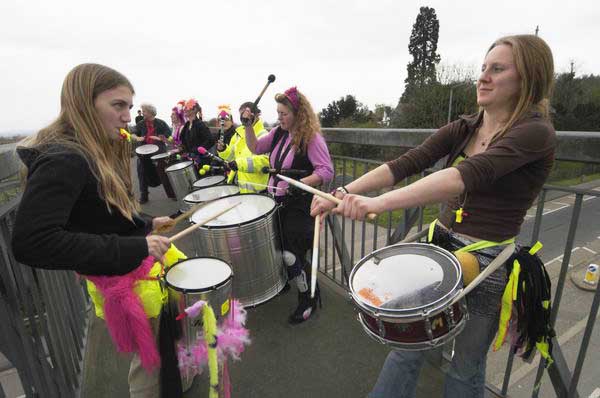
Sheffield Samba Band on march to Aldermaston, 2004

Next up was Paul Hardcastle’s ’19’, about the Vietnam War, but released in 1985, which apparently made a huge impression on a then-young Colin. It really was a ground-breaking release in several ways, but like the interview with John Lennon which followed – and preceded his ‘The Fool On the Hill’, did give the show seem rather an academic and historical approach to the subject.

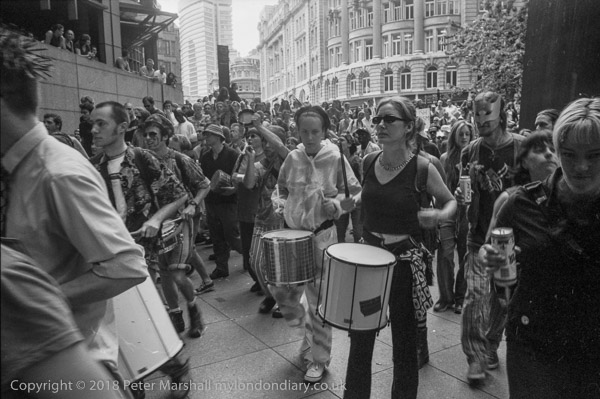
Samba band, Carnival Against Capitalism, 1999

I didn’t get much further in listening – and I think these were the only songs in the first hour of the show, though I might have fallen asleep a bit – there was a lot of long discussion. George Michael on BBC Hard Talk in 2002 came into it. It’s perhaps a shame that there wasn’t a playlist on the MixCloud page.

Samba – UK Uncut, 2011

Among the hashtags there was #london and I didn’t think I’d heard much about London or protests there in the part of the show I heard. Nor did I get to hear the promised Wood Guthrie, whose songs I used to play and sing badly from a much dog-eared paperbook in my youth, though fortunately seldom in public.

But many of the protests I’ve attended over the years have included performances by singers as well as spoken word performers, and of course the sound of almost all marches in recent years has been the samba band. How or if the recent act designed to prevent effective protest alters this remains to be seen.

Cosmo at Poor Doors protest, 2014

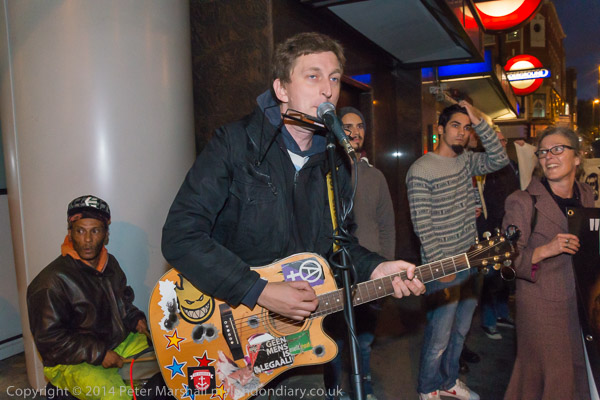
I’ll just mention a few of those I’ve been impressed by – and have photographed in London. On his web site is this description of Cosmo, based in Wales as well as a number of music videos featuring him and his friends.

Cosmo is “a one-man folk-punk phenomenon.” (Miniature Music Press). Over the course of 14 albums and 30 years of touring, he has established himself as a formidable voice on the UK and international underground.

He has appeared at Glastonbury, the Edinburgh Fringe and other major UK festivals, as well as touring across the UK, Europe, North and South America and the Middle East. In that time, he has shared stages with Billy Bragg, Frank Turner, Grace Petrie, John Cooper Clarke, Mark Thomas and more. Cosmo has won awards at the Edinburgh fringe and Hay fringe festivals.

An activist as well as a musician, Cosmo has also performed at countless picket lines, protest camps, rallies and demos, as well as being involved with community organising.

https://www.cosmoguitar.com/about/

I’ve photographed Cosmo several times, particularly at protests with Class War and always been impressed by the lift he gives to protesters.

Grim Chip (left) outside the TUC, 2017

Quite a few rappers and poets have also performed at events I’ve photographed. Poetry on the Picket Line does exactly what the name suggest. Poets in the group, including hip Hamer, Janine Booth, Nadia Drews, Joe Solo, Tim Watts, Tim Kiely, Owen Collins, Repeat Beat Poet, Mark Coverdale, Lantern Carrier and Michael Breen, reading their work in the spirit of solidarity
on picket lines and at rallies.

Potent Whisper performs ‘Estate Of War’ at Class War’s Newspaper Launch at the White Cube 2017

Georgie, a London based rapper and spoken word artist performs as Potent Whisper. Dog Section Press published his ‘The Rhyming Guide to Grenfell Britain‘ including the text of nine full-length pieces, I think all of which I’d heard him deliver at various demonstrations as well as in videos, including The Rhyming Guide to NHS Privatisation, Estate of War and Grenfell Britain. The book is worth getting if you can find a copy. An article by him in the New Internationalist includes a link to his ‘You’ll Never Edit Grenfell‘ and you can view more on his YouTube channel.


Hindu Festival and Heathrow Protest 2007

Back in 2007, My London Diary’s text was still firmly stuck in lower case – an affectation perhaps reflecting my admiration for the work of ee cummings, whose works, though not completely free of capitals used rather less than the normal quota, but I did it more to speed up my use of the keyboard. I’ve corrected at least most of the capitalisation in the following account I wrote back then about the events I photographed on Sunday 19th August 2007. When I set out I hadn’t intended to go to Heathrow – their restrictive media policy had put me off, but a police search changed my mind.


Janam Ashtami Shobha Yaatra – Shri Krishna’s Birthday, Shree Ram Mandir, Southall

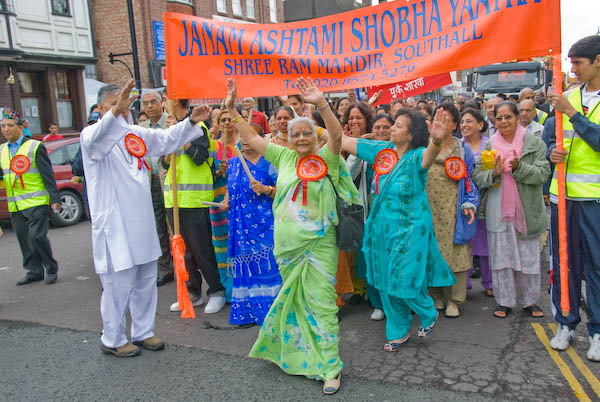
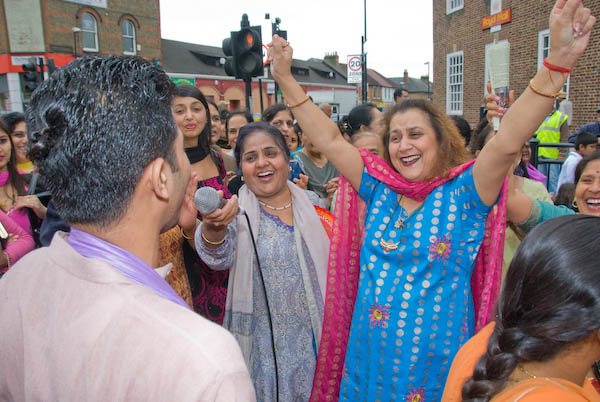
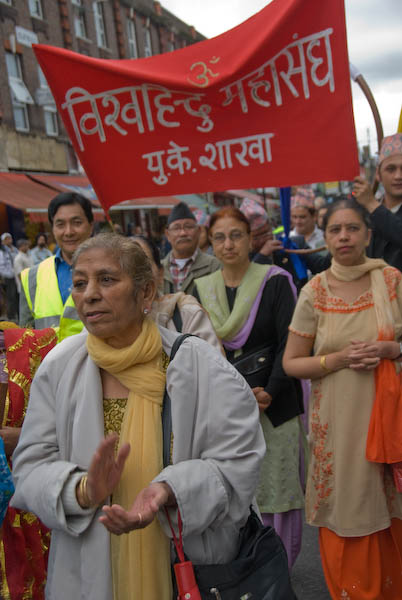
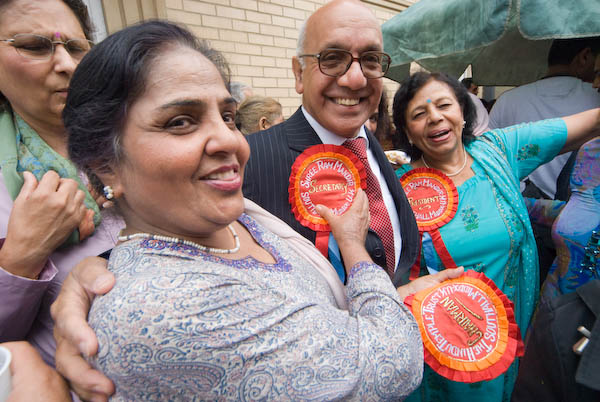
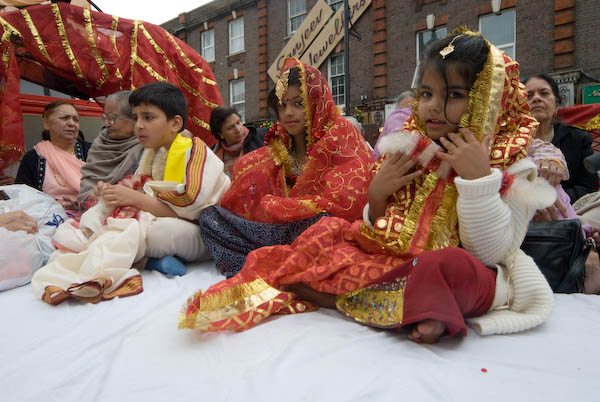
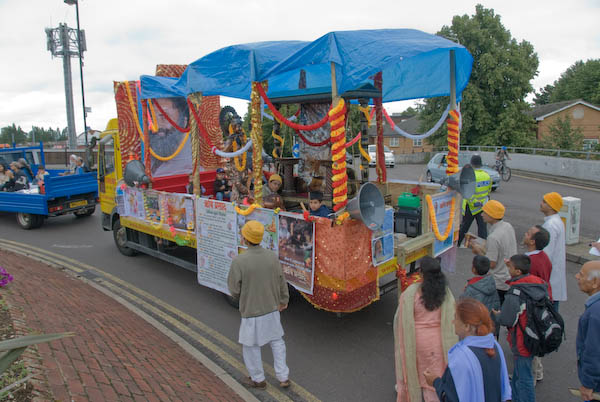
On Sunday 19th August 2007 I cycled through the light rain to the Shree Ram Mandir (Temple Of Lord Rama) in King Street, Southall, which was apparently the first Hindu temple established in Britain, although recently rebuilt. They were holding their Janam Ashtami Shobha Yaatra, a procession in honour of the birth anniversary of Krishna which in 2007 was on September 4th.

I have to admit to finding the Hindu religion confusing, but processions such as this are lively and colourful events even if their full appreciation may require a rather different mindset to mine.

it is easy to share the feelings of celebration and of community, and to feel the welcome given by so many. I also met for the first time the newly elected MP for Ealing Southall who held the seat for labour in last month’s by-election, Virendra Sharma, taking part in the procession; many were eager to pose for their picture with him.

Many more pictures on My London Diary


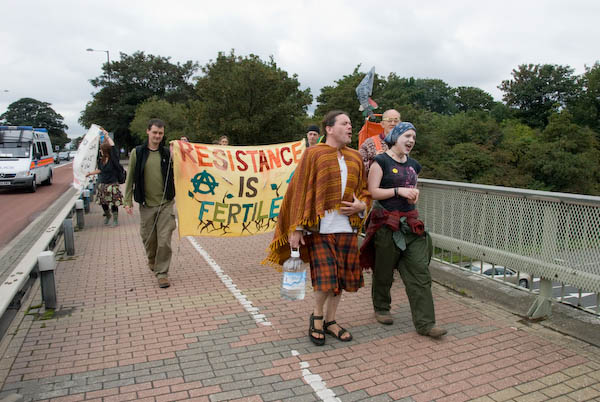
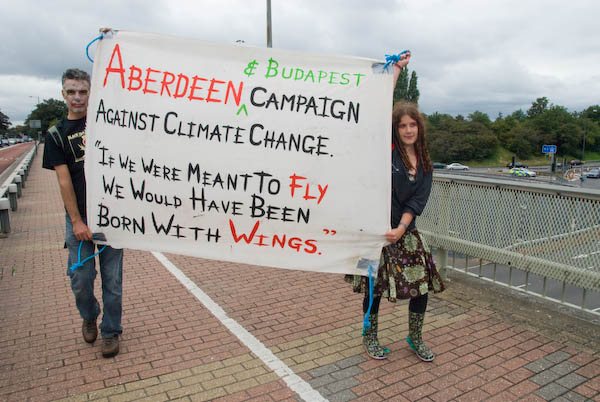
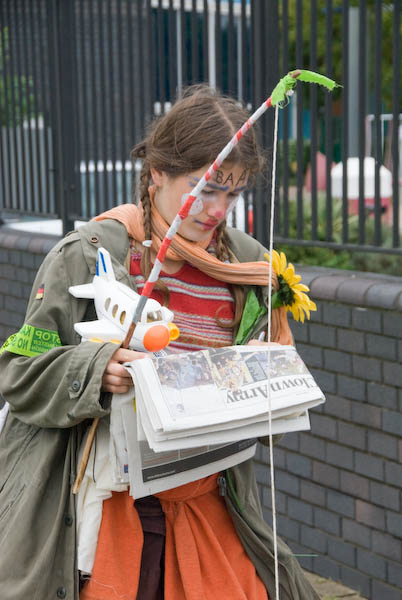
Heathrow Climate Camp Protestors – Bath Road, Sipson Sun 19 Aug 2007

I took a route back from Southall along the north side of Heathrow, close to the climate camp. On my way to Southall, along the Great South West Road which runs along the south-east of the airport, I’d been stopped and searched by police at Hatton Cross. Its a power that police are using more and more – on average around 11,000 a month in London now, and one that makes me feel uneasy. We now seem to be in a kind of police state I’ve certainly never voted for and don’t wish to live in.

I won’t appear in the Met’s figures, despite being searched in London, as the two officers concerned had been drafted in from Surrey for the day. They were polite and we had a pleasant enough conversation, but to me it still seems an unreasonable intrusion – and I think they only did it because they were bored. Under section 44 of the Terrorism Act 2000, the police can search anyone in an area designated as likely to be the subject of a terrorist attack – such as airports. They don’t need to have any grounds to suspect you, being there is enough.

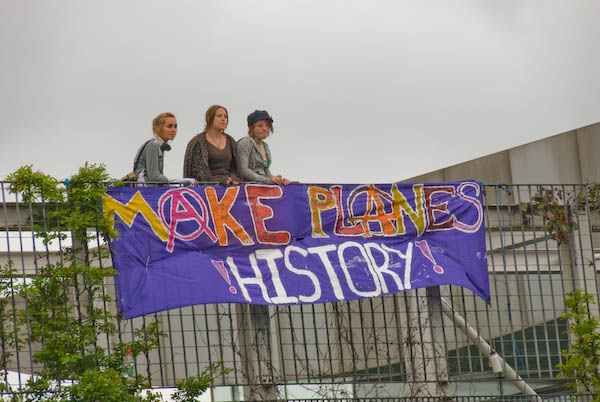
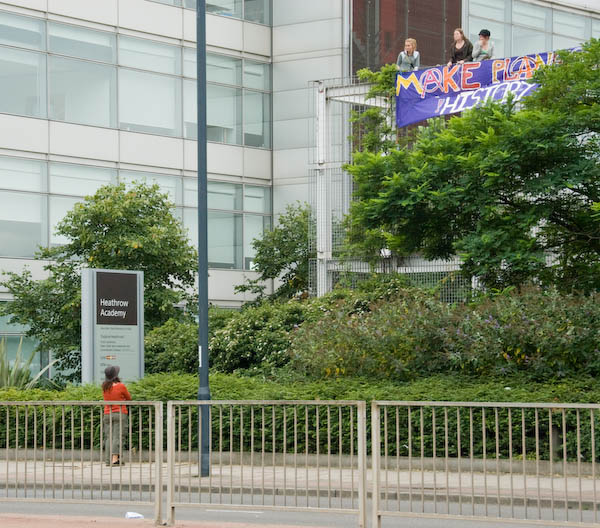
Cycling back along the pavement by the bath road (a shared path) there were rather more police around, but they were too busy with more likely targets to stop me. As I came along the road I found myself riding along with a woman who was obviously hurrying to get somewhere. We both stopped at the same point, opposite where three activists had scaled the side of a small building with a banner reading “MAKE PLANES HISTORY”.

She jumped over the fence between the two carriageways to approach the protesters, while I stayed on the opposite side from where I had a better view. Later she came back to talk to the TV crew beside me and was talking to one of the protesters – obviously she was proud of her daughter’s action.

And she had every right to be proud. we need action over Heathrow, action to prevent the takeover of even more land for the third runway. I’ve long opposed the expansion of Heathrow – and was on the local march against the third runway. Now there shouldn’t even be a possibility of further expansion, but the government must look at ways of running down the activities at Heathrow, or it will be failing not just west London but the world.

Further along the road I found protesters gathering around the British airports authority offices, which were ringed by police. Nothing much seemed to be happening and the media were there in force, so I left the guys to it. I’d previously been upset by the restrictive media policy adopted by the climate camp, which had the effect of preventing sensible photographic coverage of the event. So I was rather less interested than I might otherwise have been in putting myself out to take pictures.

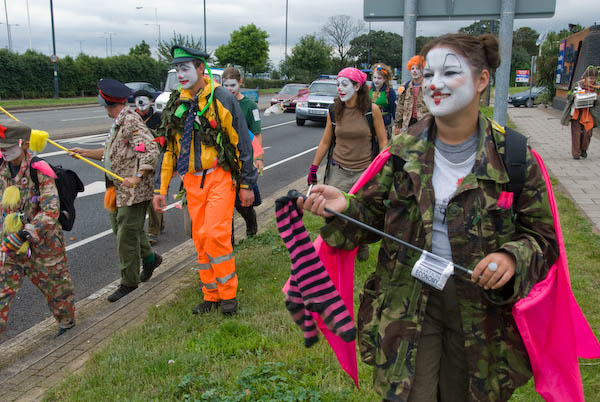
Along the road I met a few groups of demonstrators and did take a few pictures of them, including some on the bridge over the road into the airport, and a couple of the clown army being harassed by a police photo team, but my heart still wasn’t really in it.

The British airways offices had seemed to me a likely place for a confrontation – and obviously the police had thought so too, as teams of black clad figures paced up and down spoiling for a fight, watched over by the guys in uniform and a group of suits. At the top of the mound in front of the offices were a couple of officers on horses.

It was like some painting of the field lining up before a medieval battle, and I wish I’d stopped to take a picture, but they were so obviously looking for trouble I decided I didn’t want the aggravation that this would most likely have caused. For once you will just have to imagine it!

more pictures

Flats, A Square, Bread & Funerals – Walworth

This post about my walk on Sunday 13th November continues from Gardens, Neckinger, Silver Sea, Special Girls & Deaf Boys.

Congreve St area, Walworth, Southwark, 1988 88-11c-42-Edit_2400
Congreve St area, Walworth, Southwark, 1988 88-11c-42

Flats, A Square, Bread & Funerals – Walworth 1988
My walk continued on the other side of the Old Kent Road, in Walworth, where late Victorian housing was partly replaced by modern council estates in the 1930s and 1960s. I wandered through the Congreve/Barlow estate getting rather lost, as I often did in such places, where street maps like the miniature A-Z I always carried in a pocket were seldom of much use. The older houses here are in Tatum St, with those at the right further back in Halpin Place.

The passageway in which I was standing is between Ellery House on my right and the longer block of Povey House on my left, both dating from around 1964 and part of Southwark Council’s Barlow Estate.

Congreve St, Walworth, Southwark, 1988 88-11c-43-Edit_2400
Congreve St, Walworth, Southwark, 1988 88-11c-43

Thelow wall at the left in front of Comus House was obviously designed for children to walk on top, and I found a small group doing so. The building on the right at 5 Congreve St is also still there, and has been in use by the Redeemed Christian Church Of God (RCCG) since 1997. I am not sure whether it was still in use as a factory when I made this picture, or what was made there.

I think this was the rear of a site entered from a yard on the Old Kent Road, possibly Preston Close, the front part of which was redeveloped in around 2005. Excavations on that part of the site by the The Museum of London Archaeology Service after it was cleared suggested it might have been the site of a Roman mausoleum.

At the end of the street you can see Townsend Primary School, still very much in use.

Comus House, Congreve St, Walworth, Southwark, 1988 88-11c-44-Edit_2400
Comus House, Congreve St, Walworth, Southwark, 1988 88-11c-44

The block is a part of the Barlow/Congreve Estate and was built in 1957 for Southwark Council. The picture is from the corner of Congreve St and Comus Place.

Surrey Square, Walworth, Southwark, 1988 88-11c-35-Edit_2400
Surrey Square, Walworth, Southwark, 1988 88-11c-35

The blue plaque on 42 Surrey Squareclose to the centre of the picture records that artist Samuel Palmer (1805 – 1881) was born here, just a few years after this street was developed in 1793-4 by architect Michael Searles. His plan included houses around the other three sides of a square but these were never built.

My Surrey Square Park describes this as “the only remaining group of 18th century domestic buildings in Walworth with any pretension to architectural quality“.

A church, All Saints was built in 1864-65 to the designs of R. Parris and S. Field, but damaged by bombing in WW2 and replaced by a rather plain church designed by N F Cachemaille-Day in 1959. This became redundant when parished were merged in 1977 and is now in use as The Church of the Lord (Aladura) and is their Europe Diocese HQ.

I was standing in front of the church with it out of picture to my right as I made this picture which shows the church hall, an Arts and Crafts style building dating from around 1900. It was used for a variety of purposes after the church closed and is since 2019 the Walworth Living Room, a community space.

Dalwoods, Bakers, Bagshot St, Smyrk's Way, Walworth, Southwark, 1988 88-11c-22-Edit_2400
Dalwoods, Bakers, Bagshot St, Smyrk’s Way, Walworth, Southwark, 1988 88-11c-22

Dalwoods Quality Bakers and Quality Confectioners on the corner of Bagshot St and Smyrk’s Way was closed when I made this picture on a Sunday morning but still in business.

Dalwoods, Bakers, Bagshot St, Smyrk's Way, Walworth, Southwark, 1988 88-11c-25-Edit_2400
Dalwoods, Bakers, Bagshot St, Smyrk’s Way, Walworth, Southwark, 1988 88-11c-25

I was rather attracted to the display font used for DALWOODS and BAKERS although I couldn’t put a name to it, perhaps a 1930s Deco touch? Something very similar came free with the first Desk Top Publishing package I taught, and it was one of several of which students would make highly inappropriate use. It rather contrasted to the sold block serifs of ‘HOME MADE BREAD’ above the window, best seen in the previous image.

The shop has changed hands since then and now offers the rather less tasty selection of ‘Hair, Nails, Cosmetics & Fashion Wears’ (sic) as a unisex hair salon and boutique. The shopfront has also been redesigned with smaller windows and canopies over the windows.

Funeral Services, Albany Rd, Walworth, Southwark, 1988 88-11c-26-Edit_2400
Funeral Services, 96 Albany Rd, Walworth, Southwark, 1988 88-11c-26

Another business shopfront, for J W Simpson’s Funeral Service, with the word CREMATIONS over the coach entrance at left, suggesting to me an on-site service for anyone misguided enough to drive into it. The clock had suffered some damaged, with a blank black area above the face where one of the two texts partly visible below had once fitted.

I disliked the fussy little bricks that had been imposed on the front extension of the shop, but they perhaps look less annoying now as the concrete walls around the front garden have gone to make room for a parking space in front of what is still a funeral director. It’s one business that never runs out of clients.

My walk will continue ….


XR, Hong Kong, Animal Rights & London – 2019

XR, Hong Kong, Animal Rights & London

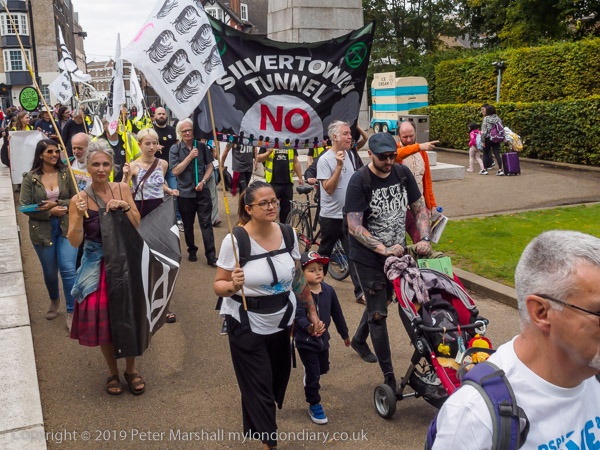
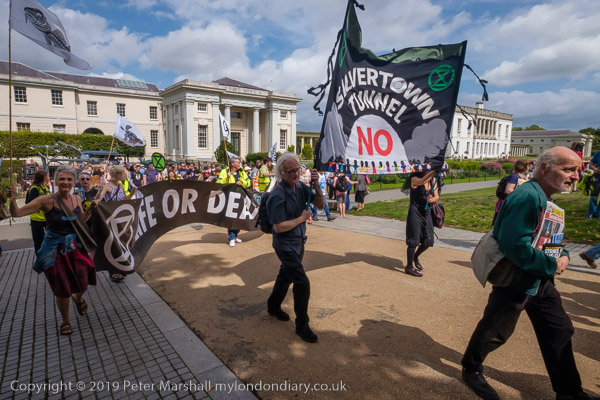
XR, Hong Kong, Animal Rights & London – 2019 Three years ago today, on Saturday 17th August I made a few journeys around London to photograph protests in Greenwich by Extinction Rebellion and Animal Rights marchers in central London as well as protests supporting Hong Kong’s Freedom marches and Chinese students opposed to them in Westminster.

Royal College and Thames with sailing barge from Greenwich Park, Greenwich. 1982 31p-44: barge, college, palace, river, Thames

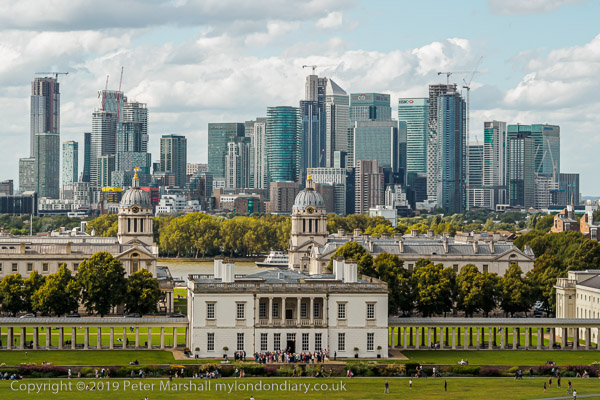
My day taking pictures ended in Greenwich Park, where I made the picture at the top of this post, a view looking down the Queen’s House and the Old Royal Naval College and on towards Canary Wharf. I’d made a photograph from a very similar position in 1992 and the pair make an interesting comparison.


XR Rebel Rising March to the Common – Greenwich

XR, Hong Kong, Animal Rights & London

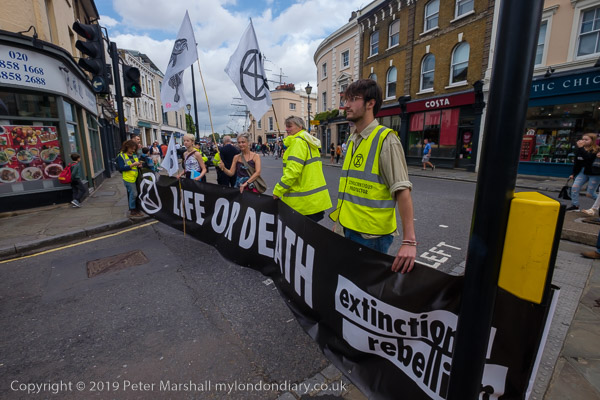
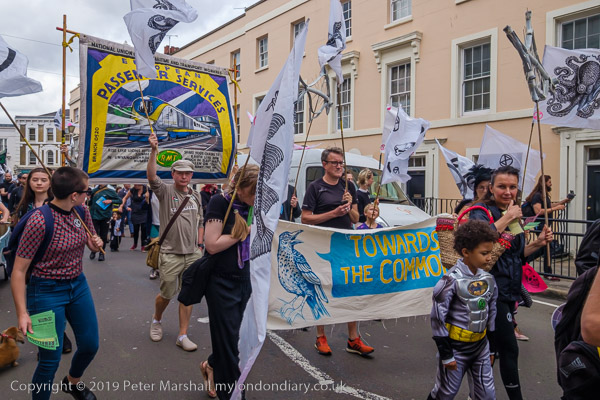
Supporters of South East London Extinction Rebellion met beside the Cutty Sark in Greenwich to march to a two-day festival on Blackheath Common, calling for urgent action on Global climate change.

XR, Hong Kong, Animal Rights & London

Blackheath Common has a long history of involvement in protest. It was here that around 100,000 anti-poll tax rebels gathered under Wat Tyler in 1381, and in 1450 that Jack Cade’s 20,000 Kent and Essex yeomen camped in their revolt against Henry VI’s tax hikes. Neither of these events ended well, nor did the several thousand Cornishmen killed and buried on the common after they rose up against taxes levied to fight the Scots 1497. The Chartists who met here also largely failed, but the Suffragettes did better.

XR, Hong Kong, Animal Rights & London

Ten years earlier, I’d come with Climate Camp to swoop to a secret destination which turned out to be Blackheath Common, and photographed the camp being setup and spent another day there as a part of the Climate Camp documentation team. But that too had failed to spur the UK into any really effective action, though perhaps more lip-service.

The situation by 2019 was clearly critical and Extinction Rebellion were calling on our and other governments to take the urgent actions needed to avoid the extinction of species including our own, and also for local councils to do everything within their powers.

Unfortunately I wasn’t able to stay with the marchers all the way to the festival ground as the march started late, waiting for the samba band to arrive. I had to leave them halfway up the hill and rush back down to the station for a train to central London.

XR Rebel Rising March to the Common


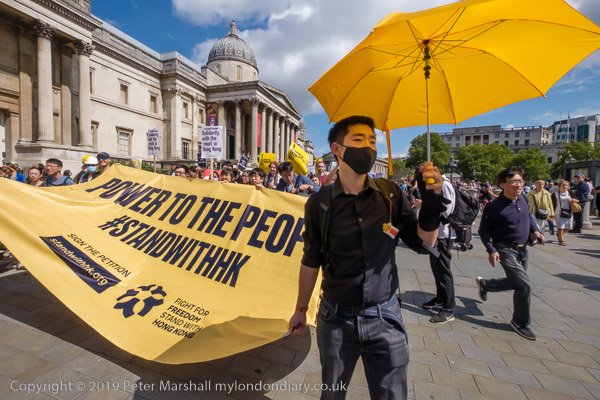
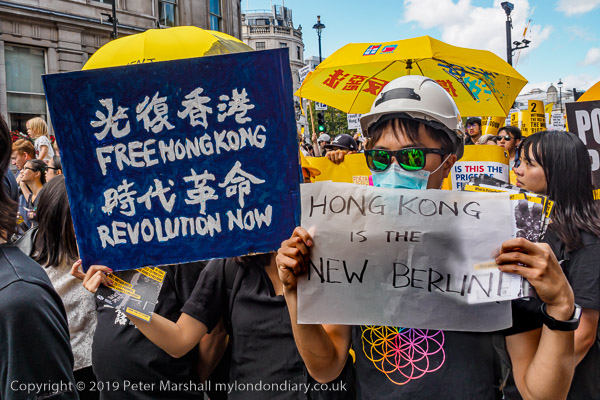
Stand with Hong Kong & opposition – Trafalgar Square

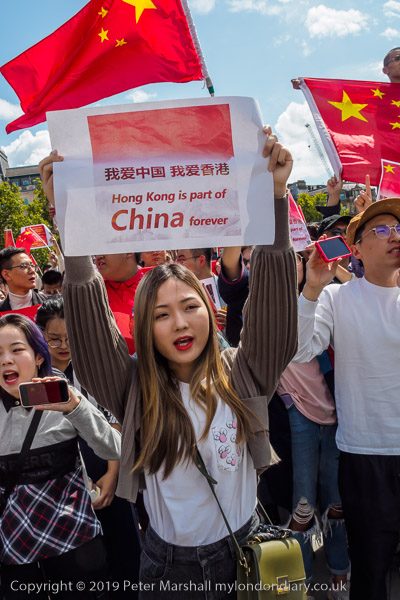
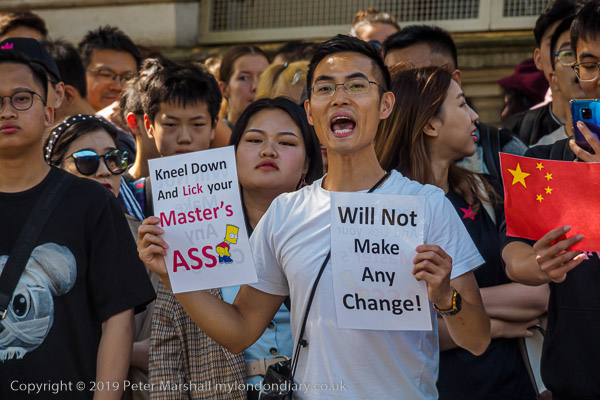
My train took me into Charing Cross and I rushed the short distance to Trafalgar Square where I found a rather confusing situation. It took me a few moments to realise that the first group of Chinese protesters I met were supporters of the Chinese government, but the number of Chinese flags they were waving was an undeniable clue.

There are many Chinese students studying at UK universities, providing a very useful source of finance to these institutions. Most of that money comes from the Chinese government or from families that are very wealthy from their Chinese businesses which depend on that government, and as they intend to return to China have no choice but to come and be seen showing their support for China.

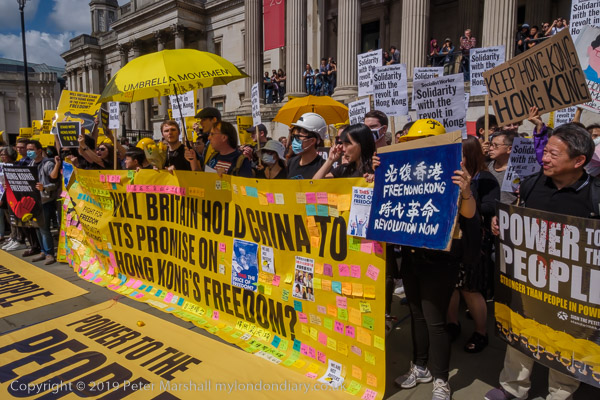
I spent a few minutes photographing their protests, then moved on a few yards to a protest with a very different colour, dominated by yellow posters, banners and umbrellas of the Hong Kong Freedom Movement.

Eventually they set off to march down Whitehall, stopping to protest opposite Downing
St. The Chinese students followed them, but police largely kept the two groups on opposite sides of the road, with the Chinese supporters shouting to try and drown out the speakers opposite.

After a rally at Downing St the Hong Kong freedom protesters moved off towards a final rally in Parliament Square – followed too by some of the Chinese who continued to shout and mock them. But I left to go elsewhere.

Stand with Hong Kong & opposition


Official Animal Rights March 2019

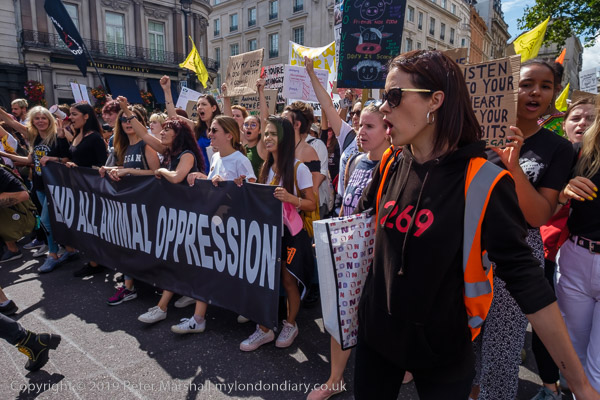
I’d missed the start of the vegan Animal Rights march in Hyde Park, but met them and took some pictures as they came to Trafalgar Square, where they halted, blocking all the roads leading in and out of the square.

This march was organised by the vegan activist collective Surge and non-violent civil disobedience movement Animal Rebellion, who say animal lives matter as much as ours and call for an end to speciesism, and the misuse of animals for food, clothing and sport.

Some of the marchers wore t-shirts with the number 269, the number of a calf on an Israeli diary farm whose number Israeli animal rights activists branded themselves with in a 2012 protest after which 269life became a worldwide movement.

Official Animal Rights March 2019


Charing Cross to Greenwich & Back

Deptford Creek

For once my trains to Blackheath and back from Greenwich after photographing the central London protests both had reasonably clean windows, and I took a number of photographs on the outward and return journeys. Also in this section I included the picture from Greenwich Park at the top of this post, along with a couple of others from much the same position.


Charing Cross to Greenwich

XR Rebel Rising Royal Observatory Die-In – Greenwich

From Blackheath Station I rushed to the Rebel Rising festival on Blackheath Common, arriving just in time for the start of a march from the festival to protest at the Royal Observatory in Greenwich Park.

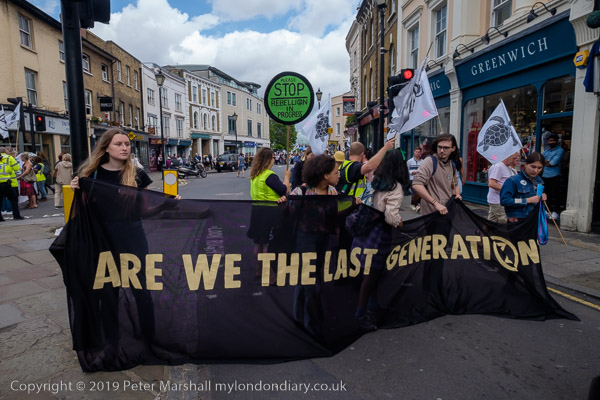
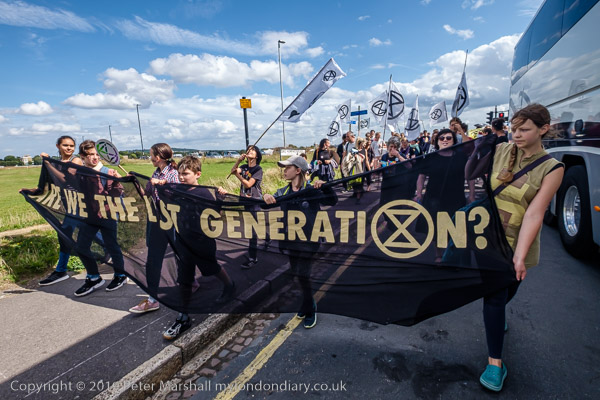
The march proceeded behind a black banner with the text asking the question ARE WE THE LAST GENERATION? Unfortunately at least for the younger members of the marchers, some of whom were in push-chairs the answer could well be YES.

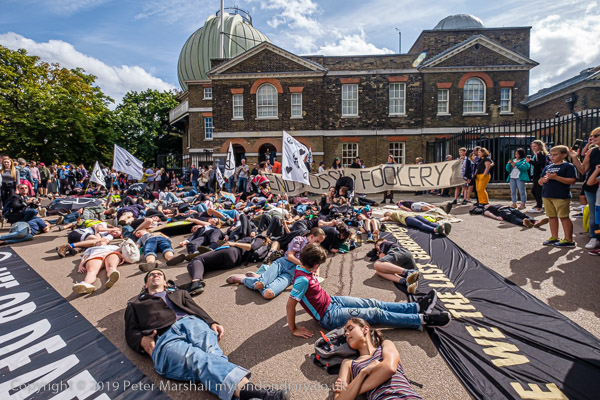
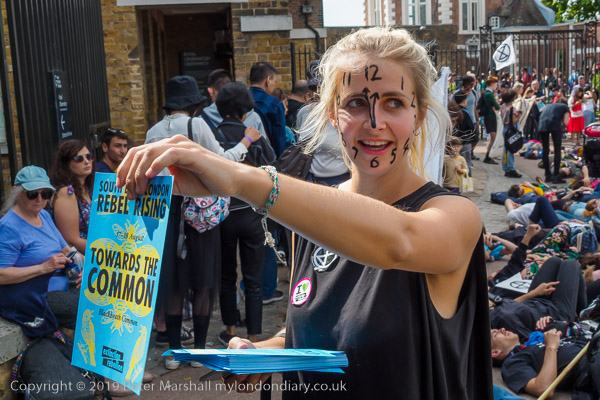
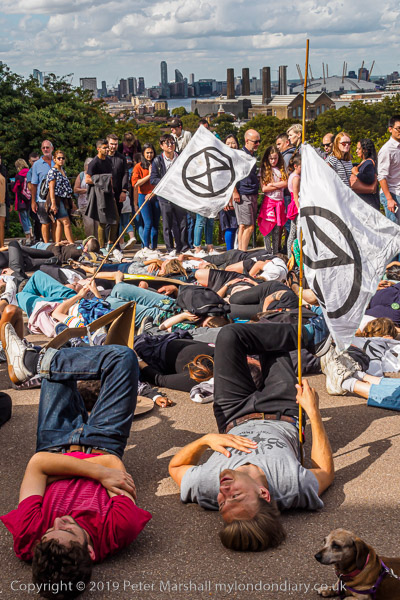
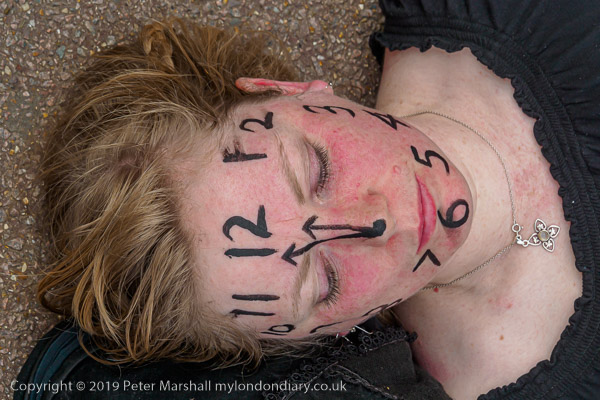
At the Royal Observatory there was a die-in on the area in front of the gates, the site chosen to symbolise we have zero time left and that we need to act now on climate change. Some taking part had clock faces drawn on their faces and the protest was just a few yards to the east of the markers for the Greenwich meridian, zero longitude.

Many of the tourists passing the protest including those going in and out of the Royal Observatory stopped at least for a few moments on the crowded paths to watch and listen, and many expressed their support for the need to take urgent actions to avoid global climate catastrophe.

Rebel Rising Royal Observatory Die-In


London Solidarity with Marikana Miners

London Solidarity with Marikana Miners
South Africa House, 16th August 2014

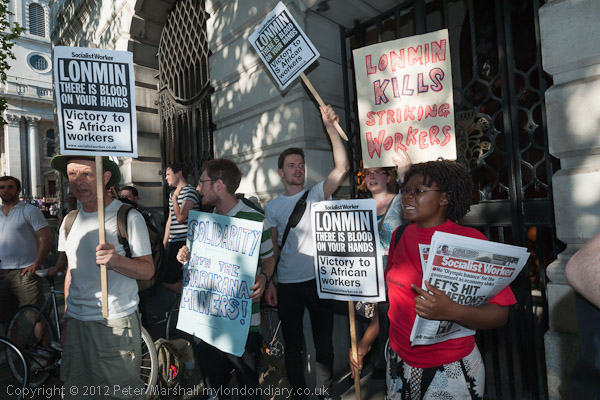
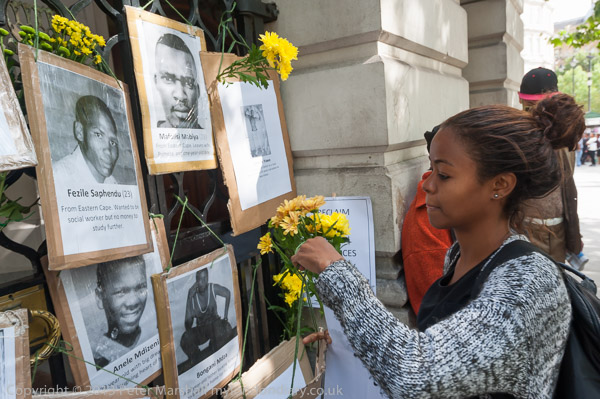
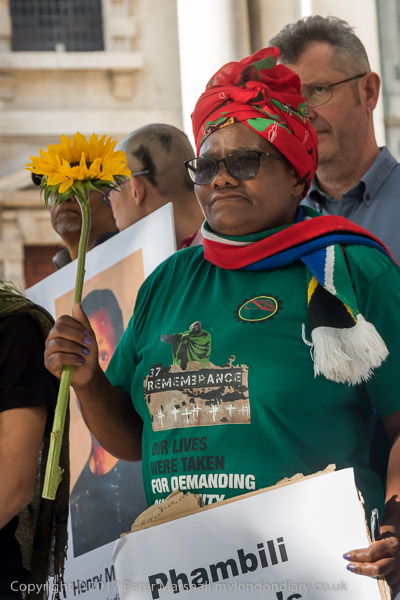
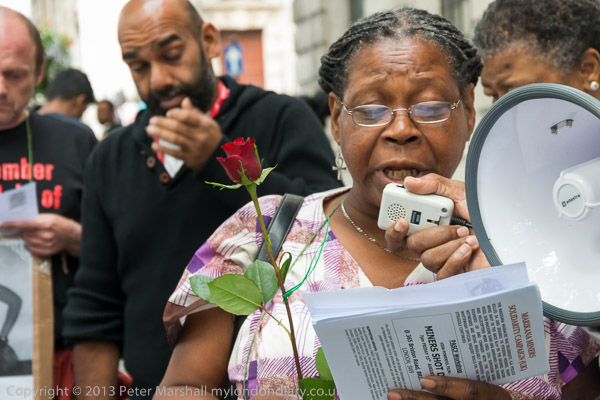
London Solidarity with Marikana Miners Today, 16th August 2022, from 5pm people will be outside South Africa House to remember the massacre ten years ago of 34 striking miners at Lonmin’s Marikana platinum mine, a massacre deliberately planned by South African police working for London mining company Lonmin, whose directors at the time included Cyril Ramaphosa, now President of South Africa.

London Solidarity with Marikana Miners
Outside Lonmin offices, London, 18th August 2012

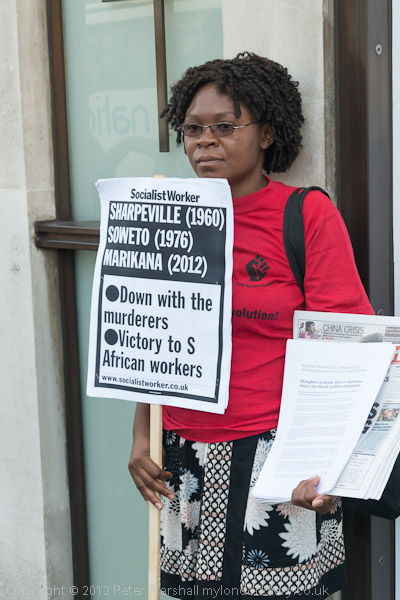
It was an attack that brought back memories of the Sharpeville massacre of 1960 and the 1976 Soweto Uprising, things we had perhaps thought no longer possible after the overthrow of the white apartheid regime. South Africa may have got rid of its crude system of racial injustice but it was a demonstration that there are still huge differences and exploitation based on wealth and privilege – and of the lengths that those who benefit most from these are willing to go to maintain their position. A naked expression of class war.

London Solidarity with Marikana Miners
South Africa House, 18th August 2012

As usual, Wikipedia gives a detailed account of what took place, although some details are unknown or contested, and my account here largely relies on it. The massacre “was the culmination of a series of violent encounters between the SAPS, Lonmin security, and members of the National Union of Mineworkers (NUM) on one side; and strikers on the other.” Various clashes in the five days before it had led to a number of strikers being injured and ten deaths, of “six mine workers, two Lonmin security guards, and two SAPS members.

South Africa House, 16th August 2017

It was not a single massacre on 16th August; police opened fire with their assault rifles on two groups of miners around 500 metres apart, killing seventeen at each of these places. Police say they first tried to control the strikers with water cannons, rubber bullets, stun grenades and tear gas. The miners were largely armed with spears, knives and sticks, but six guns were later found at the site, including one taken from a police officer killed earlier in the week.

South Africa House, 16th August 2018

Police accounts as in this country are seldom reliable, usually decorated or invented to justify and defend their actions. But there were more independent observers. A Reuters photographer present does confirm that he saw one of the strikers firing a pistol before the police opened fire. The noted South African journalist Greg Marinovich who investigated the scene closely found that some of the miners killed were shot at close range or crushed by police vehicles, but most were targeted and killed from around 300 metres, concluding “It is becoming clear to this reporter that heavily armed police hunted down and killed the miners in cold blood.” Other reports say police shot and killed miners who had their hands up in surrender.

South Africa House, 16th August 2019

270 miners were arrested and charged with ‘public violence’ which was later changed to murder, using the doctrine of “common purpose”. Most of those arrested complained that they were beaten in custody. Eventually after great public outcry the charges were dropped and most of those arrested released.

South Africa House, 16th August 2014

A commission was set up into the massacre, though many feel it made its inquiries after the authorities had time to cover up and falsify evidence. And although it made recommendations none has been implemented and no prosecutions have followed. You can watch a recent long interview with Rehad Desai, derector of the documentary film ‘Miners Shot Down‘ (Trailer here) from a few days ago on YouTube, Marikana Massacre | A decade later, still no justice.

South Africa House, 16th August 2014

The first protest in London took place two days later on 18th August 2012, when a small group of people marched from the Lonmin offices at Hyde Park Corner to South Africa House in Trafalgar Square.

Lonmin HQ, London, 16th August 2017

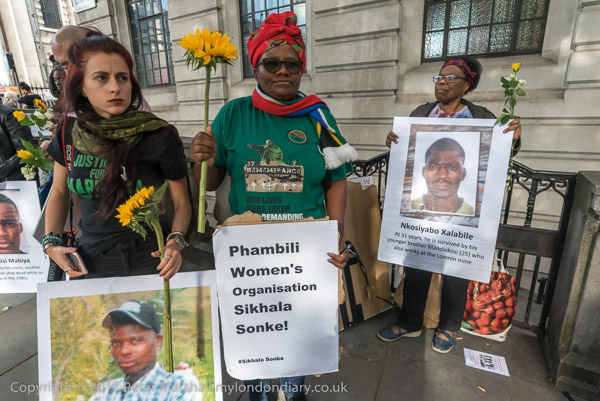
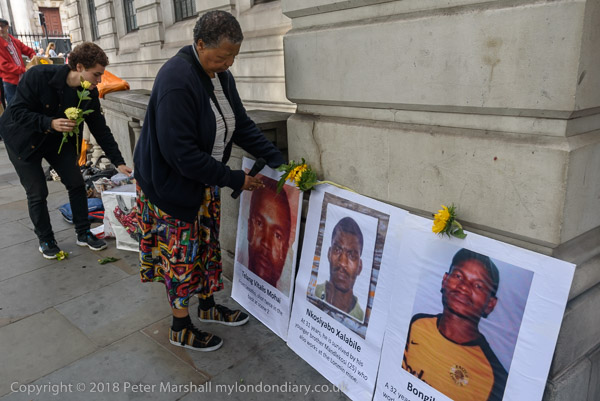
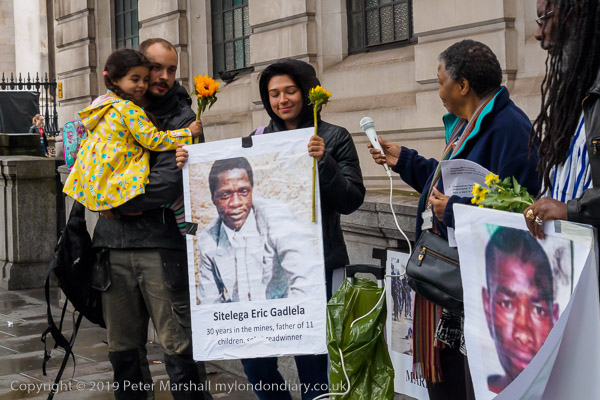
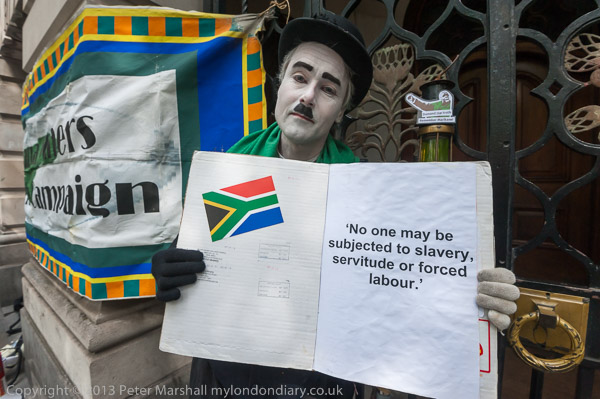
There have been protests each year on or close to the anniversary, with vigils outside South Africa House, where security have often come to harass those holding the events. But after the offices there have closed for the day and the security are off-duty people put flowers and pictures of the murdered miners on the gates and walls.

South Africa House, 16th August 2017

And there are speeches and songs and a silence. Some years those taking part have included guests from the Marikana women’s organisation Sikhala Sonke (We Cry Together), including Primrose Nokulunga Sonti who have joined those from various African and UK organisation members at the vigil.