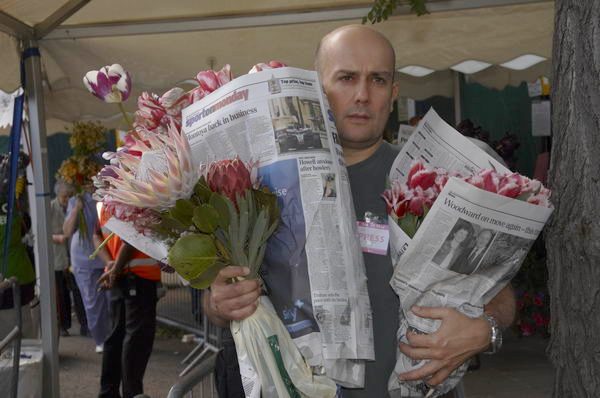
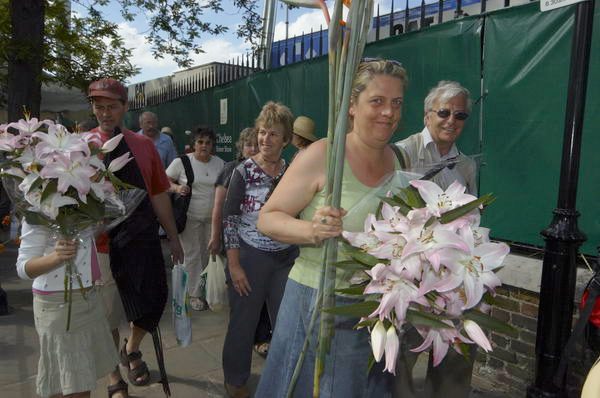
Chelsea Flower Show: Saturday 28 May 2005. I’ve never had a serious interest in photographing flowers, though I have occasionally pictured some of those growing in my garden, roses, apple blossom etc and turned my phone on plants and bouquets given to Linda so she can thank the donors. And although I’ve gone with students and family to Kew Gardens and elsewhere and taken the odd snap, I have never actually visited the annual Chelsea Flower Show.
But in 2005 I was persuaded by a photographer friend to go with him to Chelsea on the final day of the show, where t the end of the last day on Saturday a bell starts a frenzied sale of many of the plants on display.
It’s long been one of the events of the London season for photographers as men and mainly women stagger out onto the streets and onto buses and tube carrying huge pots of impressive specimens.
I did wonder how many of these fine and formerly cosseted plants made it back to their carrier’s homes, and if so how long they survived. Some marriages are rumoured to have been ended as husbands dropped pots, broke off stems getting on to buses or crowded tube carriages, and otherwise destroyed the prized and expensive loot on the way home to Putney and Wimbledon.
I suspect I mainly went along for a social pre- and post-event pint with my mates, and I don’t think I ever went again in later years – there are so many other things to photograph. I only wrote a short and hard to find paragraph for My London Diary to go with the over 50 photographs I put on-line – here in full with the usual corrections.
“Chelsea Flower Show is the biggest event of the gardening season, and the crowds are huge. This year an extra day was added to cut down on the jams, though I don’t know how effective it is.
Unless you are a gardening photographer, the most interesting part of the whole event is the end, when many of the plants on show are sold off and proudly carried home by their purchasers.
As you can see from the pictures, they carry them along the streets to the bus stop or car park or coach, providing a rather unusual spectacle”
The previous year, 2004, I had met the same friend close to Victoria Station where many of those getting onto buses with flowers from the show alight “to photograph them as they poured of the buses carrying their prizes. After a minor navigation error involving a Wetherspoons pub we made it, and managed to take a few pictures.“
On 18th March 1990 I took an early train to Vauxhall and then travelled east on the top deck of a 36 bus to Camberwell Green. I saw the buildings at the crossroads there and rang the bell to get off the bus to make a photograph.
Camberwell New Road, Denmark Hill, Camberwell Green, Camberwell, Southwark, 1990, 90-3e-55
Here I crossed the road and walked a few yards to take this picture looking across the start of Denmark Hill to Camberwell Green and the start of Camberwell Road Most of the buildings in my picture can still be identified although their uses have changed. That ornate National Westminster Bank is now Camberwell Green Surgery, and Kennedy’s Sausages are long gone, their site now occupied by Technozone.
The Grade II listed Baroque Revival bank was built in 1899 for the London and County Bank, which after a series of mergers with other banks including the London and Westminster Bank shortened its name the the Westminster Bank in 1923 and merged with the National Provincial Bank to form the National Westminster Bank in 1970.
But I was on my way to Peckham and after taking a single frame crossed back to the bus stop and took the next bus along Camberwell New Road to Peckham High Street and walked down Rye Lane.
Here the lighting was right for was an impressive array of architectural styles and eras on the west side of the street, from plain late Victorian to more ornate turn of the century, 1930s and probably 1950s or 60s.
The range of buildings represents the establishment of Rye Lane as one of South London’s shopping streets in the late 1870s, but outstanding for me was Peckham Indoor Market. As I wrote in an earlier post here:
“Peckham Indoor Market was built around 1938 or shortly after as Rye Lane Bargain Centre with an imposing frontage for a narrow arcade leading back to a large covered market. It’s a style that rather makes it look like a cinema. Across the top is the message ‘Come Rain Or Shine It’s Always Fine at Peckham Indoor Market’.
In the early 2000s the market at the back was reduced in size with part now redeveloped as flats but the front section remains and is now Rye Lane Market, housing over 50 small shop units.”
The Morning Star, Rye Lane, Peckham, Southwark, 1990, 90-3e-44
The Morning Star at 231 Rye Lane was built in 1871 and is now the Nag’s Head, having changed its name to cash in on the BBC TV comedy ‘Only Fools And Horses’, though I think the BBC made them paint over a reference to this high on the frontage. The pub was South London’s most famous Darts Pub in the 1970s and 80s.
But I was really photographing ‘The Triangle’ which had been a favourite meeting place for Mods and their scooters.
Former Camberwell Workhouse, Gordon Rd, Peckham, Southwark, 1990, 90-3e-33
20 Gordon Road was built as the Camberwell Workhouse in 1878 when a competition for their design was won by architects Berriman and Sons Ltd. It housed 743 able-bodied inmates. Women were employed in laundries and men broke stones and chopped wood. Taken over by the London County Council in 1930 it became the Camberwell Reception Centre, closing around the end of the 1970s. Minor buildings on the site were demolished and the main buildings converted into flats.
This was later simply a casual ward, and took in many normally sleeping rough and only seeking accommodation in bad weather or desperate for a meal. Many tramping the roads preferred to sleep rough as to get a meal and a bed for the night men were expected to then to join the permanent residents working most of a day breaking up stones to mend roads or chopping wood – or in the laundry for women.
Former Camberwell Workhouse, Gordon Rd, Peckham, Southwark, 1990, 90-3e-34
There were still ‘tramps’ in the 1950s who would knock at our back door in oouter London and my mother would talk to them, give them a mug of tea and fill their water bottle if they had one, but few people would make them welcome – and some set the dogs on them. We only had a cat, and my mother was a charitable woman. Tramps would often make chalk marks on pavements to tell others which houses to visit and which to avoid.
Former Camberwell Workhouse, Gordon Rd, Peckham, Southwark, 1990, 90-3e-36
Tramps would often run away before finishing their work – and this was a criminal offence which could put them in prison for up to a month were they caught until the 1970s.
Former Camberwell Workhouse, Gordon Rd, Peckham, Southwark, 1990, 90-3e-22
A bench from Gordon Road is now in the London Museum together with a good account of how ‘casuals’ would be treated, at least after the National Assistance Board built a waiting room at ‘the Spike’ in 1952 – though they think the bench was only provided after 1964 when a report noted that chairs were ‘brandished as weapons in altercations between waiting applicants’.
It quotes two of the casuals: ‘Upon arrival at Gordon Road, you had to wait with dozens of other dossers in a dingy, unheated outhouse containing nothing but a few benches. You might have to wait here for several hours, even all night‘ The waiting room was often overcrowded and violent: ‘Last night sat for three hours before the porters called us in. Quite a few drunks, same old faces, singing, swearing, bottles breaking, glass all over the place. One goes flying through the window and I duck as it flies over my head. Five or six porters come rushing in, they grab the drunk and push him out the gate.’
Those admitted were then given a hot bath – many were very dirty and infected by lice – before being fed. The Camberwell Reception Centre only finally closed in 1985 and was still derelict five years later when I made these pictures.
The Star of India, Gordon Rd, Peckham, Southwark, 1990, 90-3e-24
The Star of India was a Victorian pub on the corner of Gordon Road and Brayards Rd, dating from before the 1871 census. It was closed and demolished around 2000. A block of 12 flats on the site was completed by Habitat for Humanity using 1500 volunteer days in 2009. The flats were sold on completion to Hexagon Housing Association and New World Housing Association.
Waiters Day, Monsanto, White Pride & The Line: Saturday 23rd May 2015 was a busy day, beginning with Unite Hotel Worker, moving on to the global March Against Monsanto, then an extreme right White Pride protest and finally going to the opening of the world-class sculpture walk roughly along the Greenwich Meridian, The Line.
Waiters Day call for fair contracts and union rights
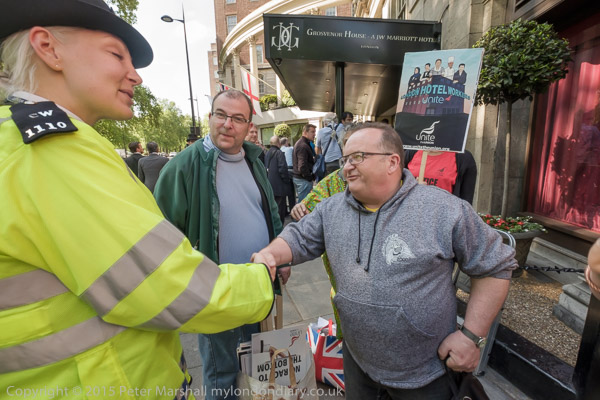
Grosvenor House Hotel, Park Lane
Bakers Food and Allied Workers Union President Ian Hodson
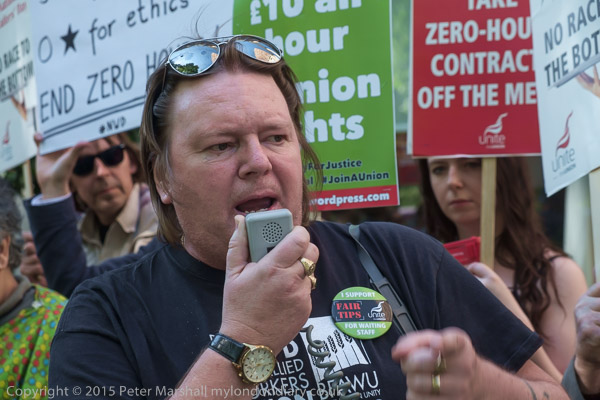
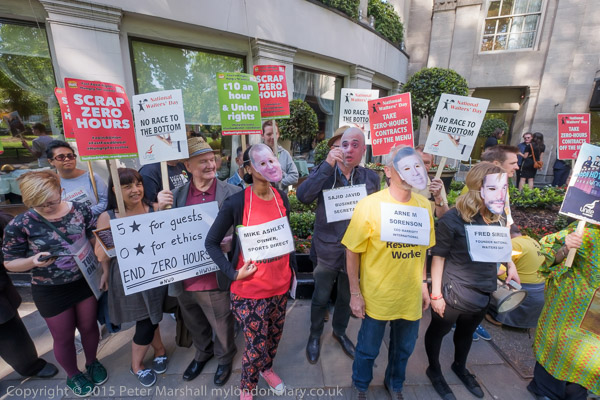
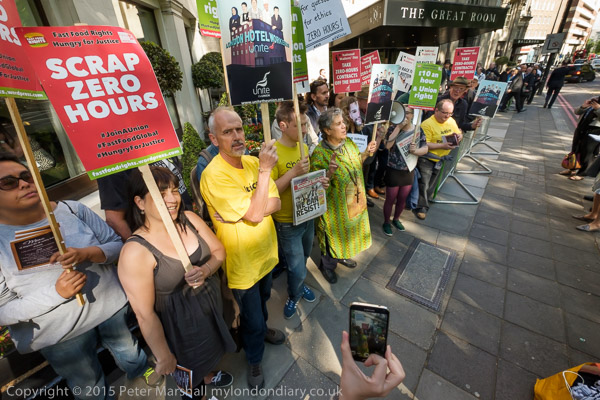
The Hotel Workers branch of Unite protested outside the Grosvenor House Hotel in Park Lane, the birthplace of Zero Hours Contracts, on National Waiters Day, calling for an end to poor conditions, poverty wages, zero hours contracts and management stealing of tips.
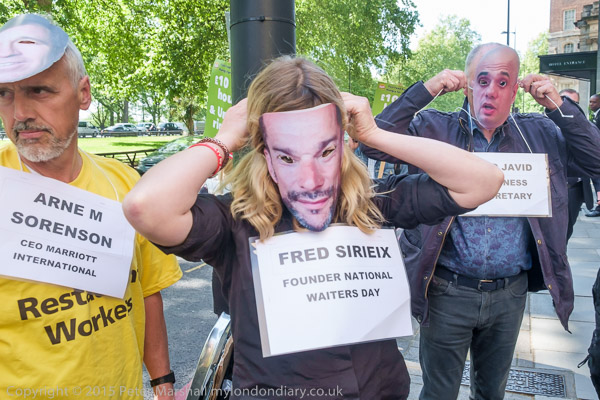
Some of the protesters wore masks and placards with names of leading company bosses using zero hours contracts and exploiting workers and took part in a short ‘waiters race’ along the pavement in front of the hotel. The race was of course fixed
Back in 1979 waiters at the Grosvenor House Hotel in Park Lane were sacked when they tried to organise a trade union branch there. The case eventually went to court where it was decided their sacking was legal. It was this case, O’Kelly v Trusthouse Forte plc, that opened to door to Zero Hours Contracts in the UK. Previously employment law had been based on “mutuality of obligation” with employers obliged to offer hours of work, and employees to work those hours.
Until 2012 less than 1% of employees were on zero hours contracts, but their use then rocketed, and by 2015 had increased to 2.5%. By 2021, roughly half of the organisations in hospitality and entertainment were using them.
National Waiters Day seems to have been invented in the USA in the early years of this century and is generally observed on May 21st. A UK Waiters Day was begun by restaurant manager Fred Sirieix in 2013 and is on October 20th.
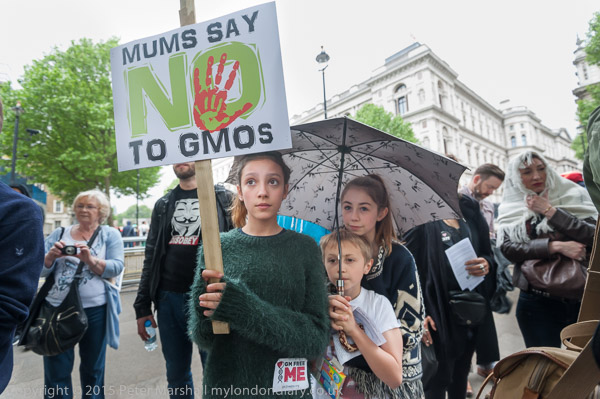
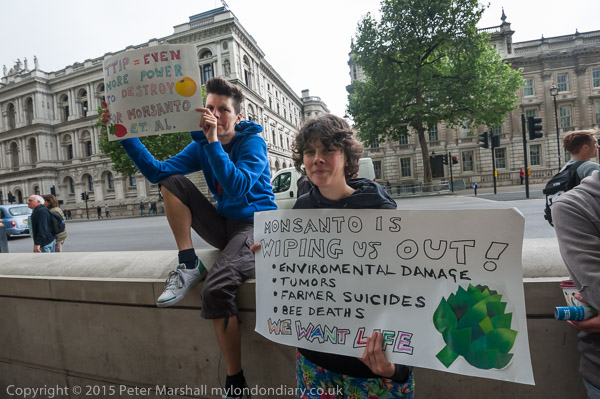
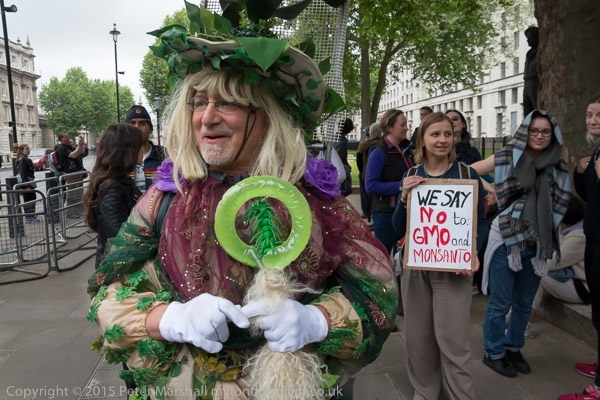
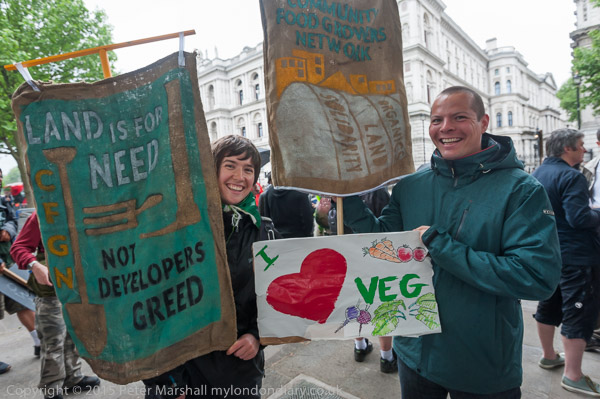
In London the annual Global March Against Monsanto by over 3.5 million people across 600 cities was marked by a small static protest opposite Downing St.
Monsanto and other companies which profit from GMOs claim they are playing an important part in feeding the world, but are actually attempting to monopolise food production for their own profit, patenting existing species, trying to prevent farmers from saving and using their own seed, encouraging the use of highly toxic chemicals and practices that degrade the soil.
As the protesters say, we need to plant our own seed, to grow local and to eat sustainable food, and to do so in our own ways in countries across the world.
The end of the banner reading Töten für Wotan (Kill for Wotan) was rolled up as I moved to photograph it
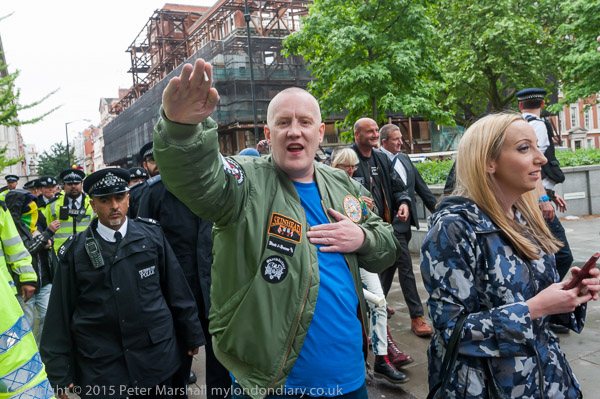
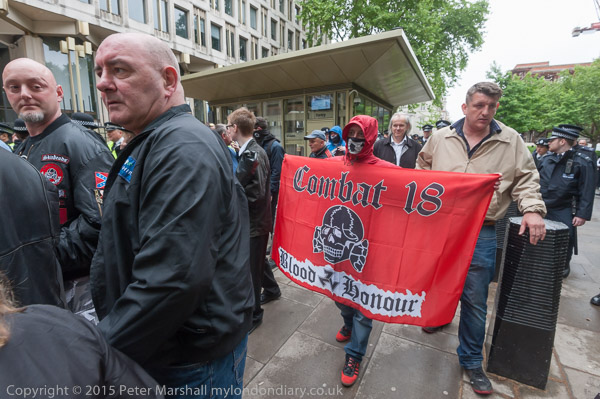
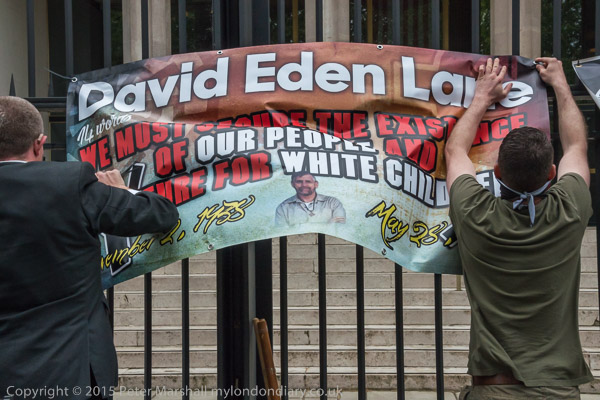
A group of around 30 ultra-right neo-Nazi protesters at the US Embassy remembered David Eden Lane, a convicted criminal and author of the ‘14 words’ statement used by extreme right groups about securing a future for white children. A small group of anti-fascists had come to oppose them.
One of the right-wing protesters makes a Nazi salute for my camera
Lane was a co-foounder of ‘The Order‘ a rabidly antisemitic group which bombed theatres and synagogues and he was convicted as the getaway driver after they murdered liberal Jewish Denver radio talk show host Alan Berg in 1984 when he was the second on their long death list. The group also carried out violent robberies to finance their activities. He died in prison in 2007.
His 14 words, a close quotation from Mein Kampf, is often referred to in extreme right circles as ’14/88′, where 88 stands for the repeated 8th letter of the alphabet, HH, shorthand for ‘Heil Hitler’.
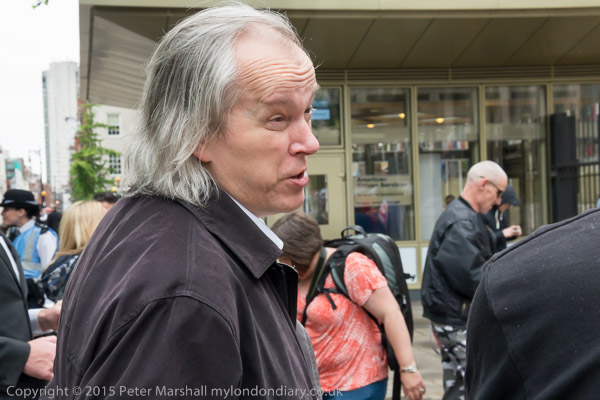
Peter Rushton of the England First Party waits to speak
Inside jail, Lane, a former Ku Klux Klan and the ‘White Christian Separatist’ group ‘Aryan Nation’ member, was one of the founders of a new pagan religion, ‘Wotanism‘, named after the Germanic god Odin, also know as Wotan, which serves as an acronym for ‘Will Of The Aryan Nation’.
It was good to get away to something much more pleasant, the official opening of the world-class sculpture walk, ‘The Line‘ with works by distinguished sculptors going north from Greenwich across the Thames and on to the Olympic Park.
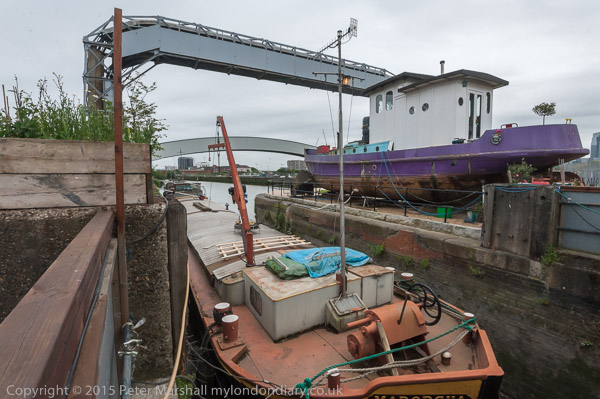
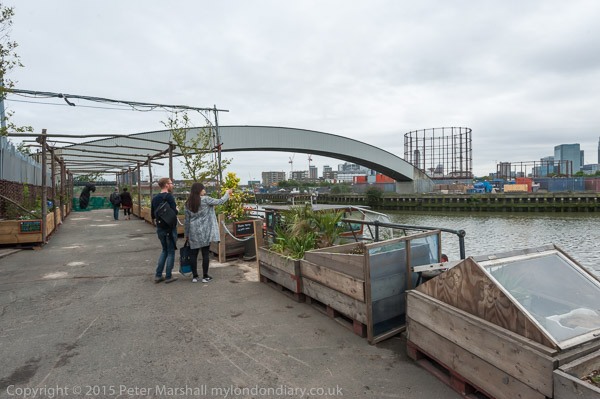
I’d visited the festivities at Cody Dock in the morning when few people were around to photograph the site and walk a short stretch of the trail.
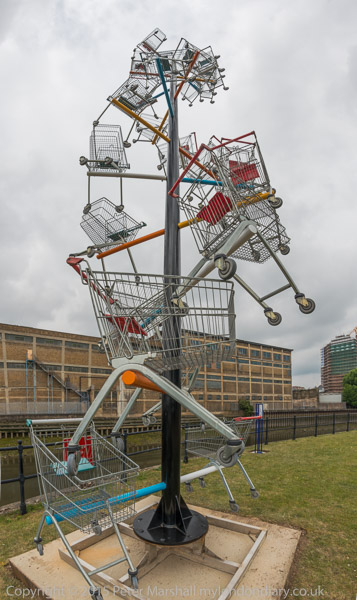
One piece I found particularly interesting was DNA SL90 (2003) made by Abigail Fallis from 22 shopping trolleys for a supermarket chain to mark the 50th anniversary of Crick & Watson’s discovery of the double-helix structure of DNA. It’s location on the edge of Bow Creek next to a major distribution centre, seemed particularly appropriate, and it is an impressive piece.
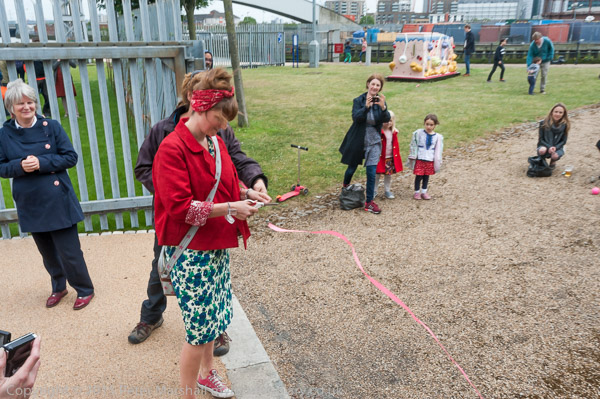
A Cody Dock volunteer snips the ribbon and ‘The Line’ is open
I returned from central London just in time for the opening ceremony when a fair sized crowd had gathered.
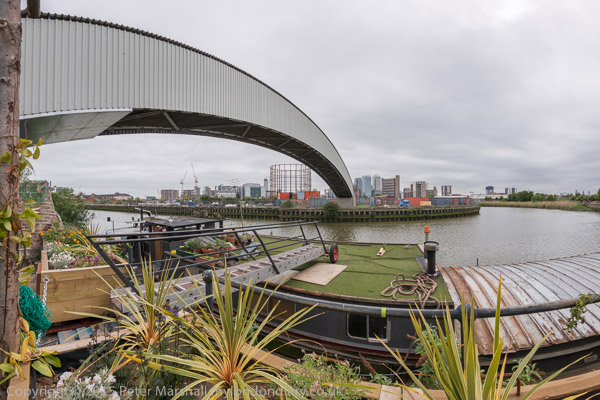
Since 2015 new stairs down from the bridge at have removed the awkward detour alongside the busy Blackwall Tunnel Approach, but I think we are still waiting for the opening of the riverside path along Bow Creek south of Cody Dock.
Christian Aid Sponsored Walk – London Churches: Soon after we moved to our present address in 1974, Linda took over as Christian Aid organiser for the area, only retiring from this in recent months. Over the years she has gone on a number of sponsored walks for them and some related organisations as well as organising some in our area.
I’ve often walked with her on these, as well as sometimes sponsoring her, largely to keep her company, but sometimes to make sure she didn’t get lost despite the clear maps given to walkers and the large numbers of people following the walks. But also because the routes took you to and past some interesting places and sometimes into churches or areas of them seldom open to the public.
Although I have had a great interest in architecture I’ve never had a great interest in photographing church interiors, partly because they have been so much photographed by others, and the photographs I made on these walks were very much pictures on my days off. Often I carried very little equipment, though Sunday 20 May, 2007 was something of an exception as together with my Nikon D200 I had Nikon wide and telephoto zooms and a fisheye.
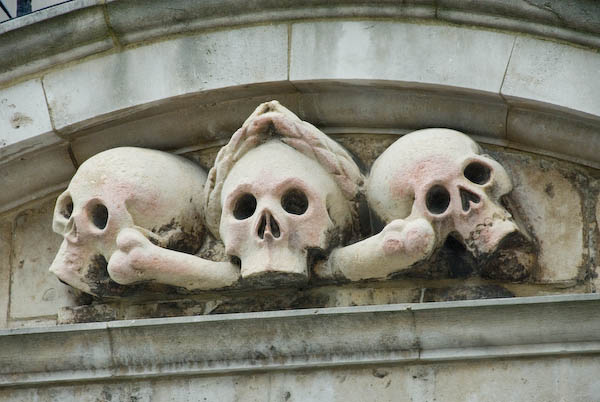
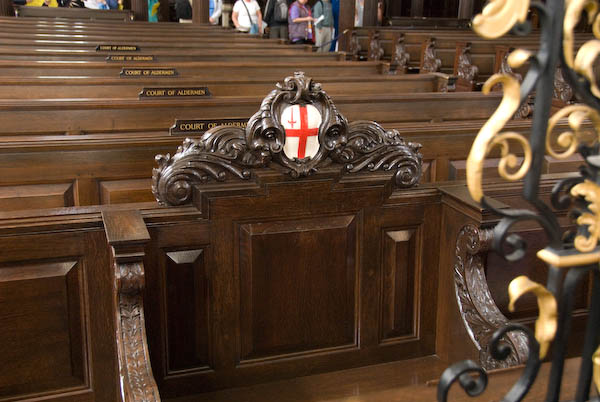
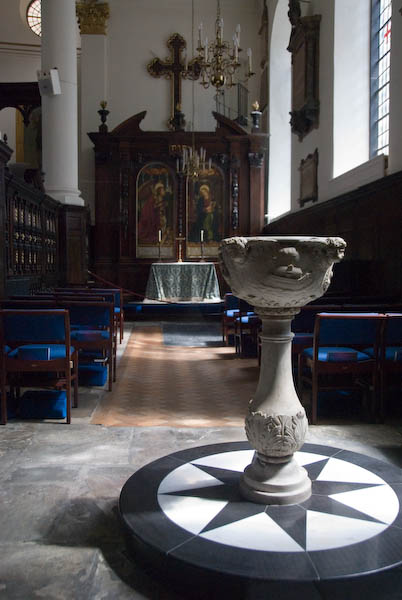
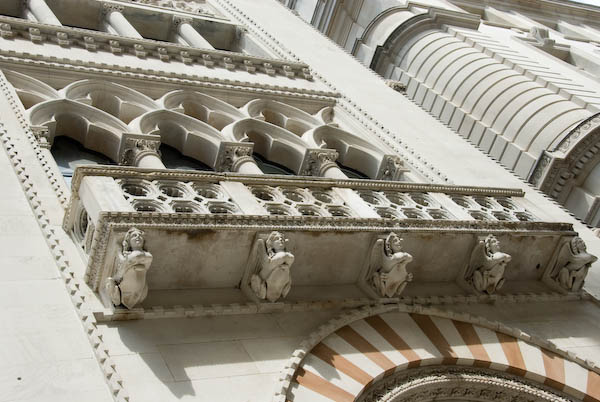
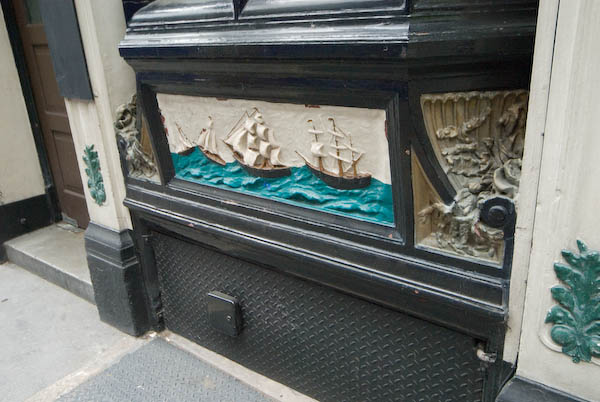
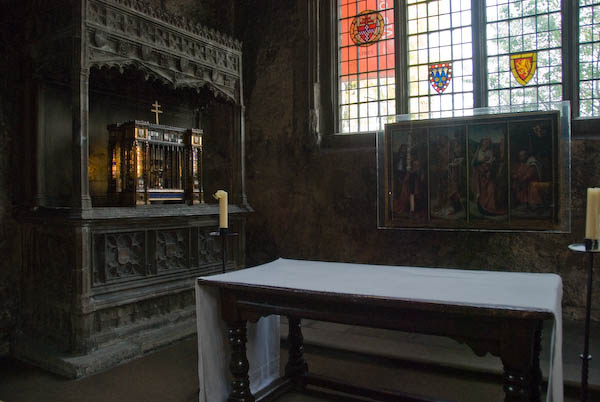
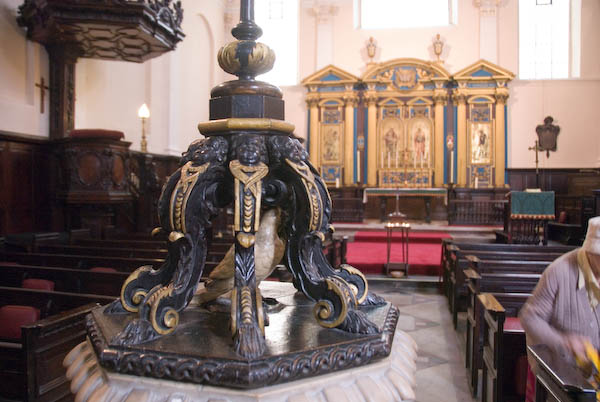
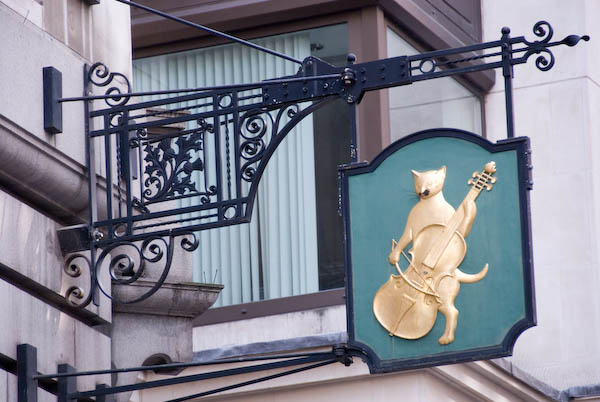
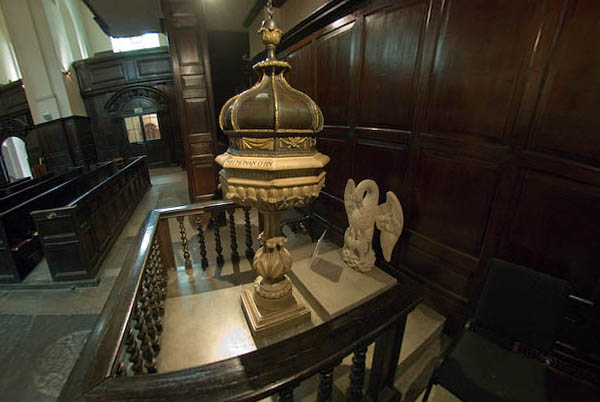
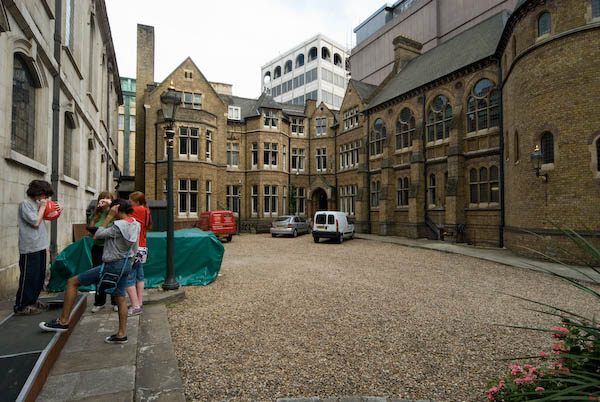
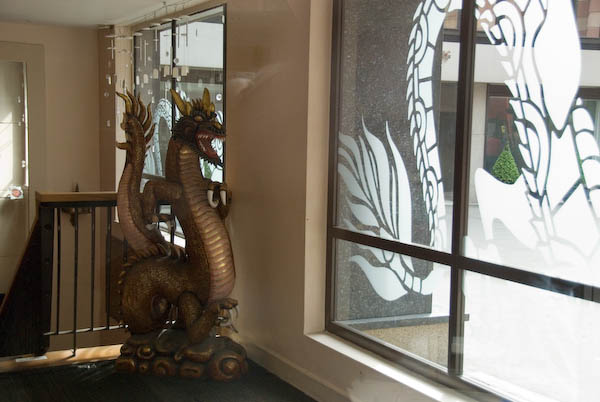
On My London Diary you can see over a hundred pictures I made on the walk, some of very well known and much photographed parts of the City of London, others less so. There are captions identifying most on those pages, but here I’ll post them without them – and just a couple of clues to the more difficult.
The plaque marks where Dositey Obradovich, first Serbian Minister of Education lived in London in 1784The bird a pelican, though to me it looked like a swan.
If you can name all these I’ve posted above, you must surely be a certified London Green Badge Guide – and I think anything over half shows a fairly intimate knowledge of the City. I think all the answers are in my post on My London Diary at Christian Aid walk – London churches.
And finally, one I can’t remember where I found it – perhaps someone can tell me in a comment.
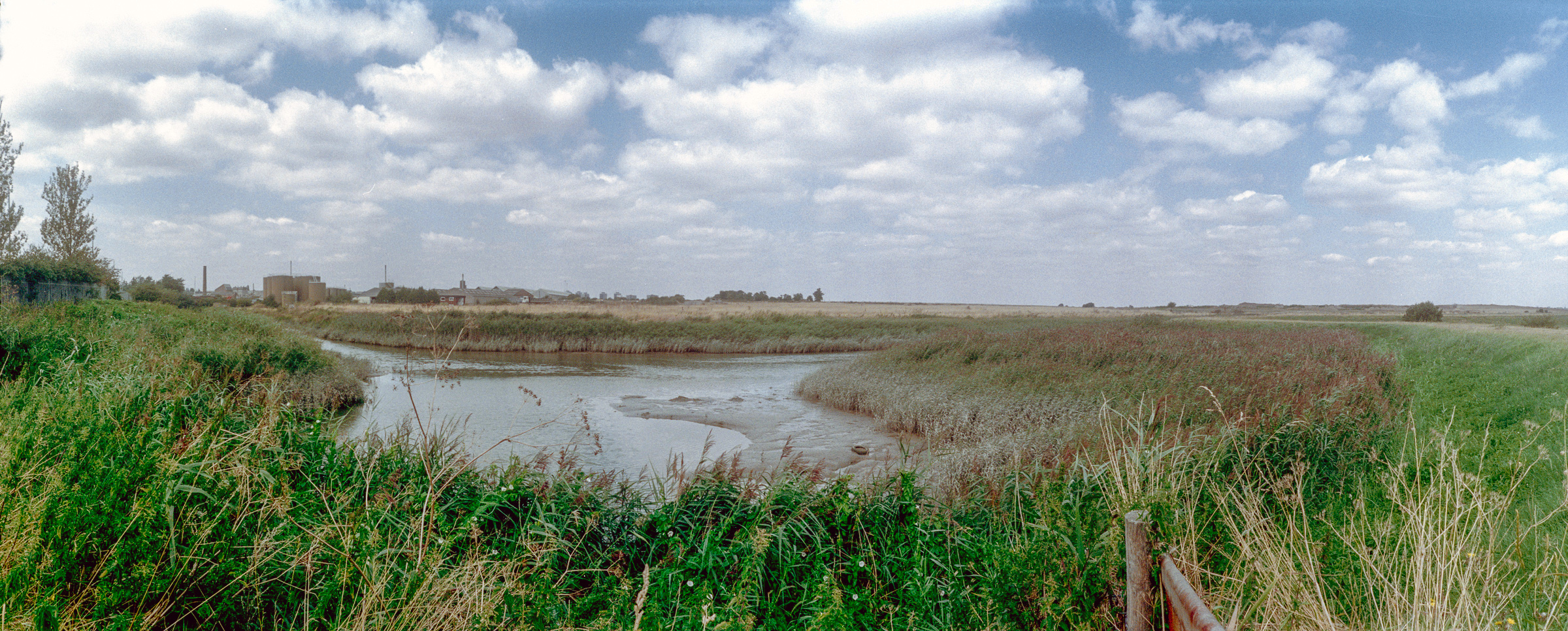
The Cray Riverway is a 10 mile long path which follow the River Cray from Foots Cray Meadows to the junction with the the River Darent and along side this to the River Thames and then into Erith. Back in 1994 I walked along most or all of it, paying several visits to the area as I was a photographer rather than a walker and liked to wander rather than stride out.
River Cray, Barnes Cray, Bexley, 1994, 94-904-53
I think I took two different swing-lens cameras on these walks, both a Japanese and a Russian model which produces very similar results in terms of angle of view (just a little over a third of the entire view around me) and quality. I used both on a sturdy Manfrotto tripod, mainly working from my eye level, and using a nine-inch carpenters’ spirit level to try to level the camera both from side to side and front to back as I found the built-in levelling insufficiently accurate (and I didn’t always get it quite right even with the larger level.)
River Cray, Barnes Cray, Bexley, 1994, 94-904-41
In 1994 I was processing my own colour negative film and I think at times the negatives suffered a little either from my inaccuracies or from chemical issues, and I find it hard to get the colour of some images exactly as I would like them. The rest of these pictures are from Flickr, but one I’ve worked on the one above again since I uploaded it there.
Footpath, River Cray, Barnes Cray, Bexley, 1994, 94-904-42
I’ve already featured some of these images on earlier posts, but here I’ll include a few different images.
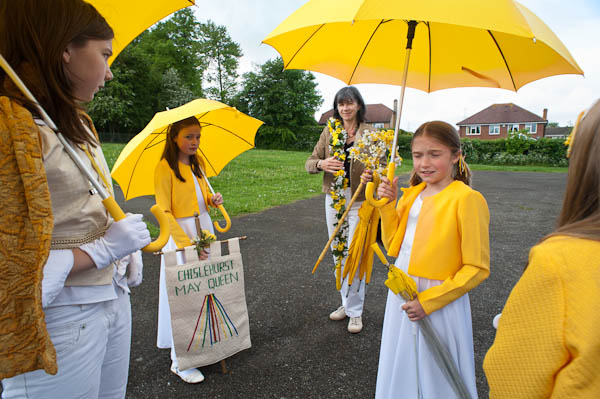
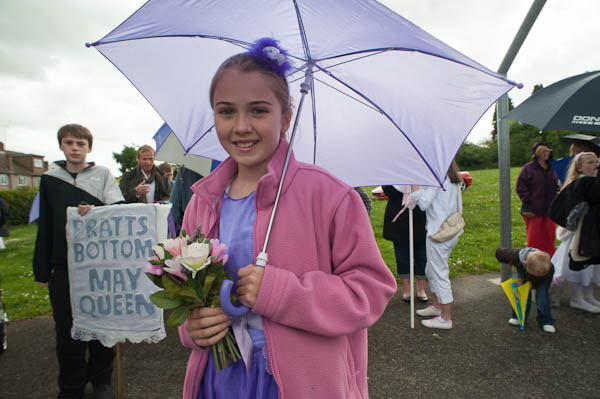
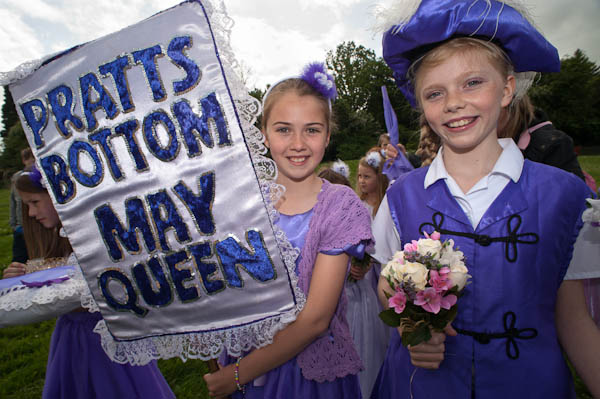
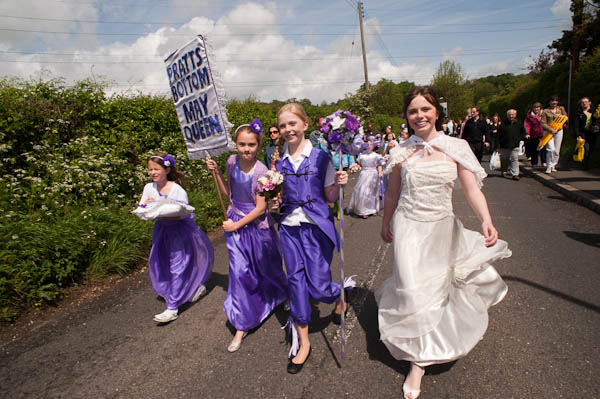
Pratt’s Bottom & Walton on the Hill: On Saturday 16th May 2009 I photographed two May Queen events on the outskirts of London, at Pratt’s Bottom in Kent and Walton on the Hill in Surrey. The two places are around 10 miles apart as the crow flies, and I had gone with a couple of friends, one driving a car, and we managed to make the journey between the two rather more quickly than the roughly two and a half hours it would have taken by public transport.
Pratts Bottom May Queen
Pratts Bottom, Bromley
Chislehurst May Queen group wait for the start of procession at Pratt’s Bottom
Pratts Bottom is just inside the boundary of the London Borough of Bromley, though it seems very much out in the country, and Kent begins just a few yards away. On my first visit there, walking from the station at Knockholt I had wandered along a short stretch of the main road actually in that county. You can see my account and pictures from that 2008 event at Pratts Bottom Village Fete.
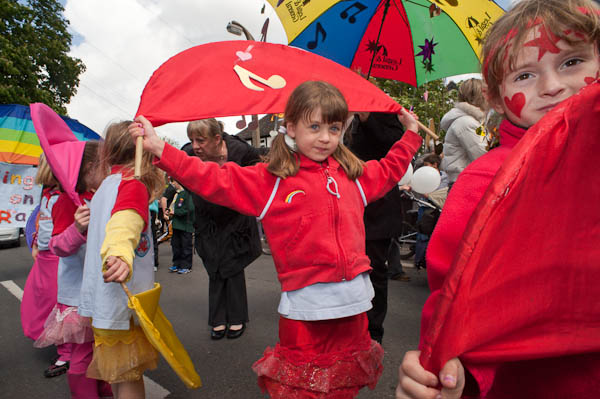
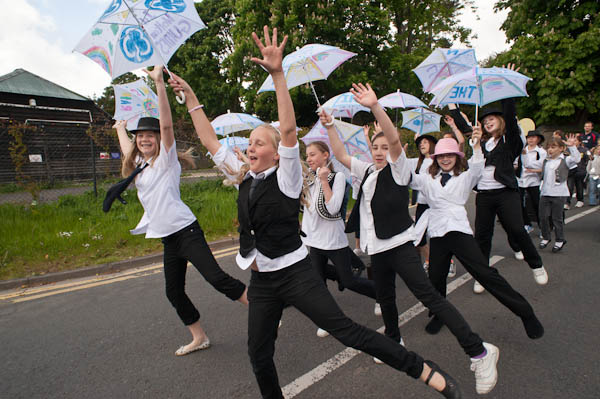
Both in 2008 and in 2009 the weather for the Village Fête was pretty dismal, and you can see umbrellas in many of the pictures – with May Queen groups having them in their realm colours.
Pratts Bottom (most locals seemed to spell it without the apostrophe on my map) has its own May Queen group, and the event included other May Queen groups from Green Street Green, Orpington and Pett’s Wood.
Fortunately the rain stopped and the sun came out for the procession up Rushmore Hill to the village green where the fête was taking place. The procession was led by a cadet marching band and Miss Bromley. The band at the front set off at a cracking pace that left some of the younger members of the May Queen realms struggling to keep up – and making life a little difficult for photographers.
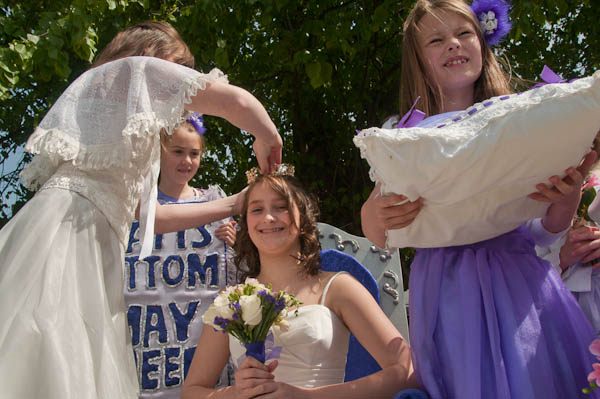
Thr Pratts Bottom May Queen is crowned
On the village green there was a brief ceremony in which the 2009 Pratt’s Bottom May Queen was crowned by the last year’s queen, and Miss Bromley officially opened the fete. Then we walked down to the car to drive to another May Fayre.
This was another event with a May Queen that I had photographed previously – this time in 2007, but not part of the London May Queen events.
The May Pageant here was started (or ‘revived’) forty years ago in 1969 and while many such local carnival events had faded away by the end of the twentieth century this one was still enjoying wide popular support, with crowds on the street.
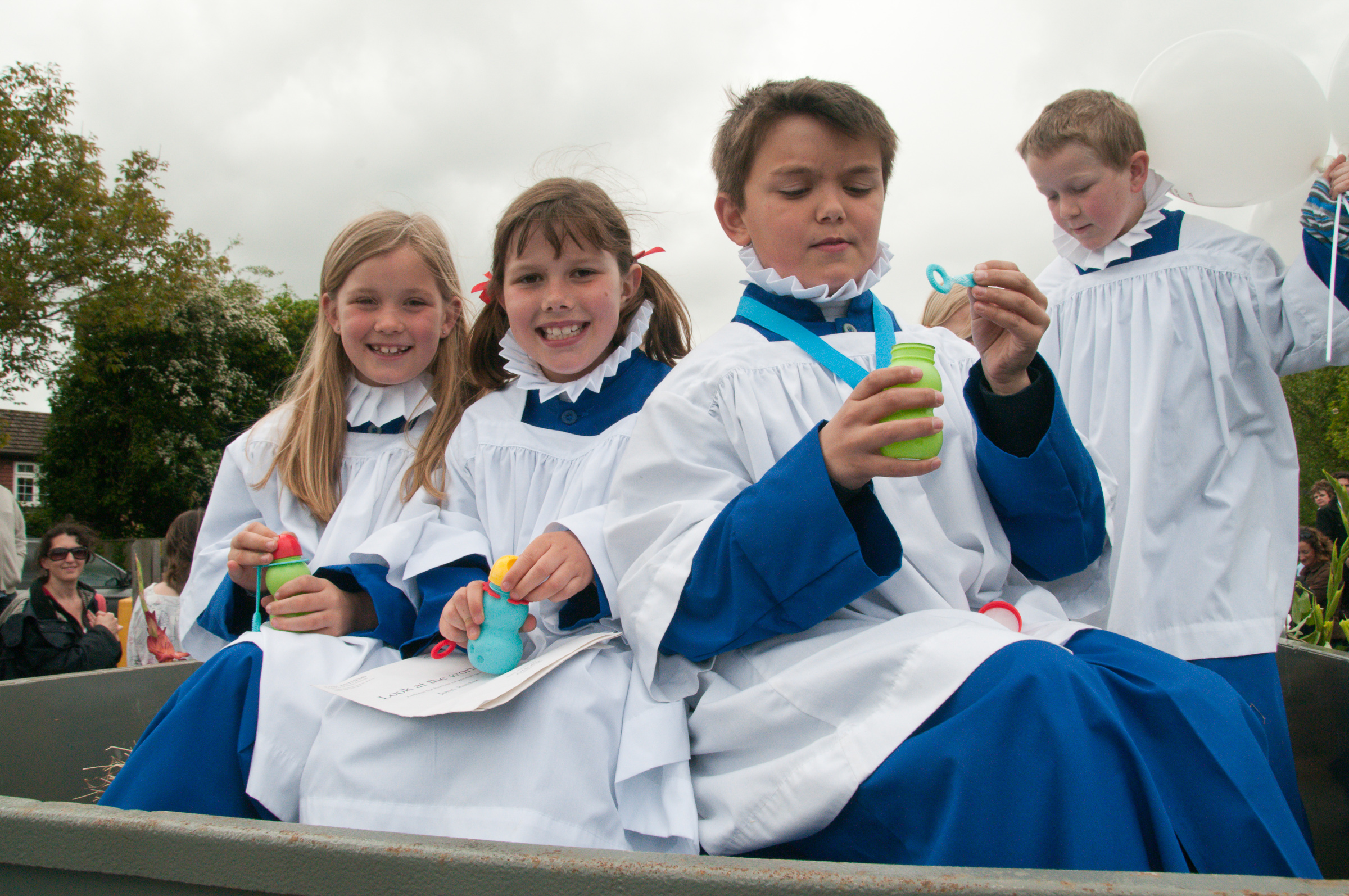
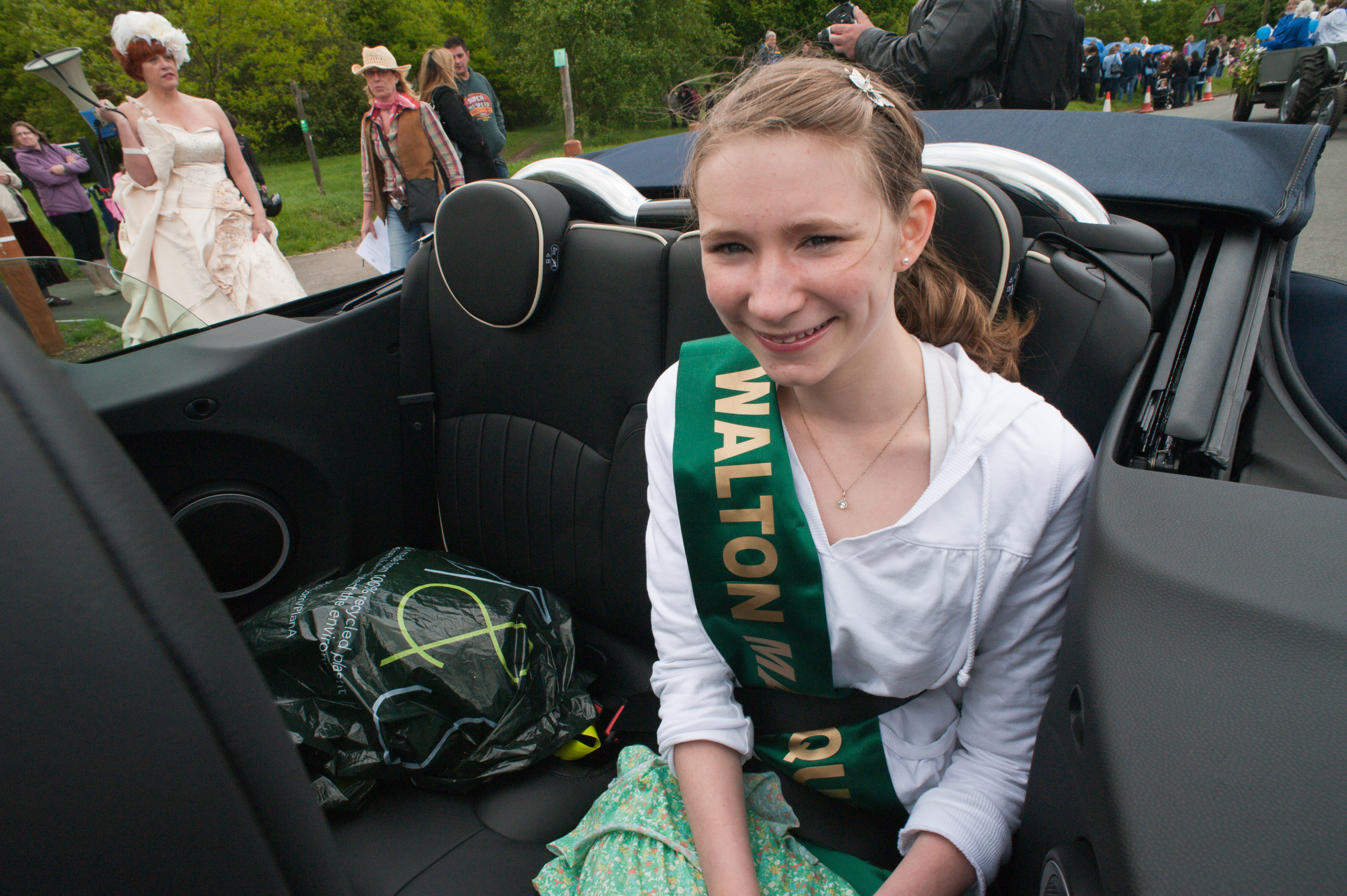
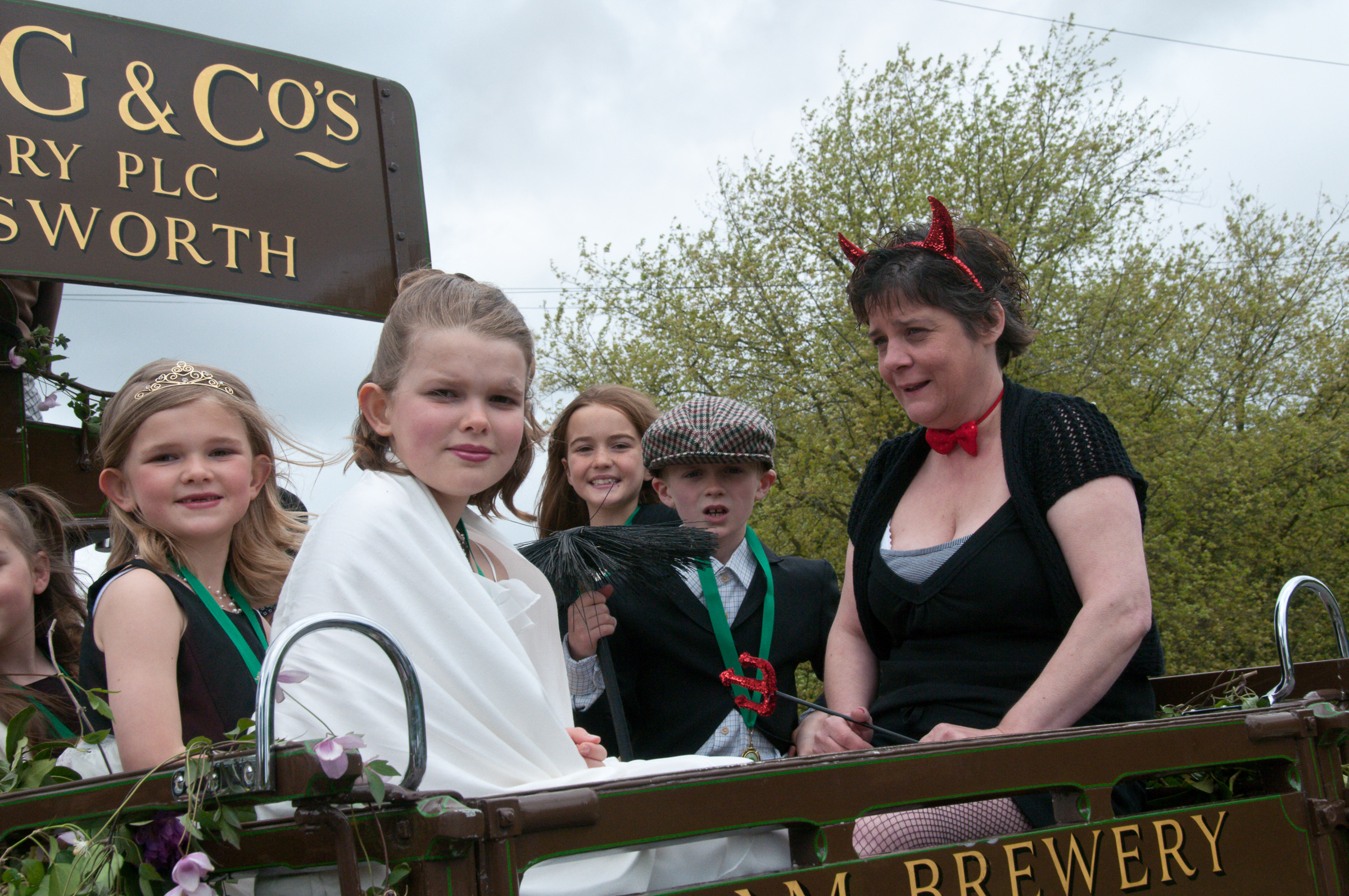
It’s a community event with the Vicar and her church choir sitting on hay bales in a cart pulled by a tractor, various school and nursery groups, youth groups and more, including a May Queen in a car and her rather mixed entourage in a Young’s brewery dray.
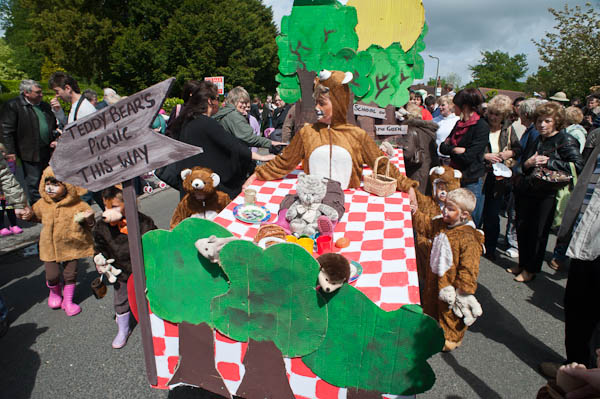
The May Queen in an open carAndher retinue in a brewery drayTeddy Bears Picnic
And as the procession reached the fairground I stopped taking pictures and sat down to have a drink before going home. For some reason I didn’t include the pictures here of the May Queen and her friends in the post on My London Diary but there are many more pictures from the event at Walton on the Hill May Pageant.
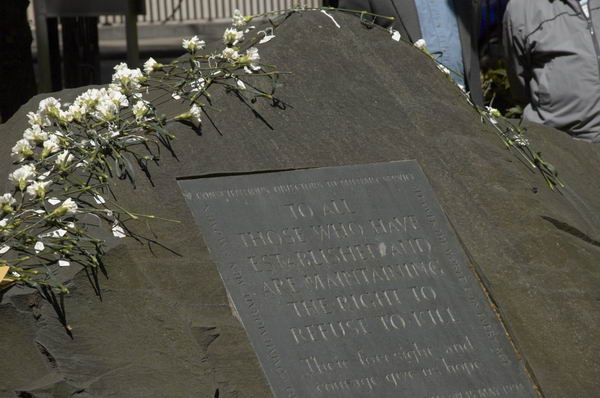
Conscientious Objectors, Cannabis Education & Bengali New Year: Three unrelated events on 15th May 2005 in London. May 15th has been observed in Europe as Conscientious Objectors’ Day since 1982 and became International in 1985 when it was adopted by War Resisters’ International. A ceremony is held every year on the day in Tavistock Square at the site of the massive slate Conscientious Objectors’ Commemorative Stone which has the inscriptions:
TO COMMEMORATE MEN & WOMEN
CONSCIENTIOUS OBJECTORS TO MILITARY SERVICE
ALL OVER THE WORLD & IN EVERY AGE

TO ALL THOSE WHO HAVE
ESTABLISHED AND
ARE MAINTAINING
THE RIGHT TO
REFUSE TO KILL

Their foresight and
courage give us hope

THIS STONE WAS DEDICATED ON 15 MAY 1994
INTERNATIONAL CONSCIENTIOUS OBJECTORS' DAY
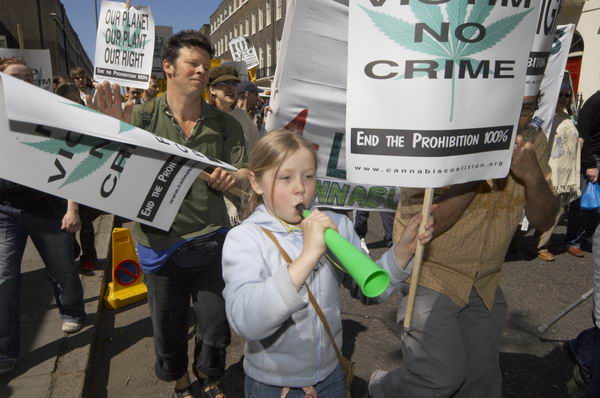
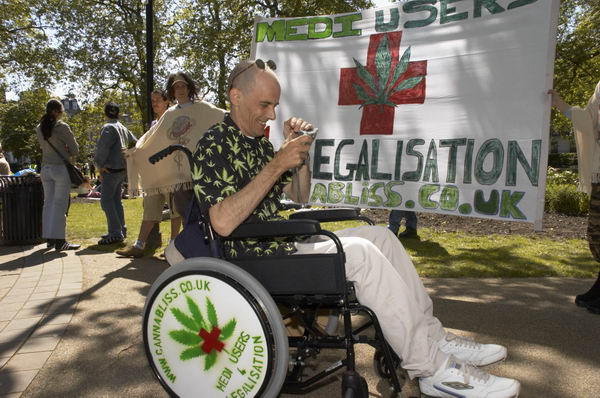
I left before the end of the ceremony and hurried to Russell Square for the start of the annual march calling for the legalisation of cannabis, walking with this to Trafalgar Square and then taking the tube to go to Brick Lane for the Bengali New Year Festival. Below is what I wrote in 2005.
The Right to Refuse to Kill – International Conscientious Objectors Day
Tavistock Square
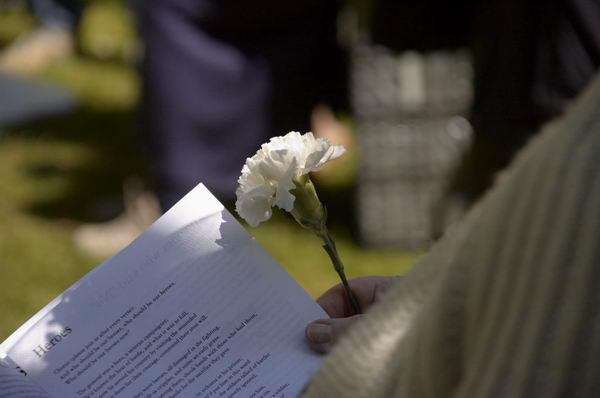
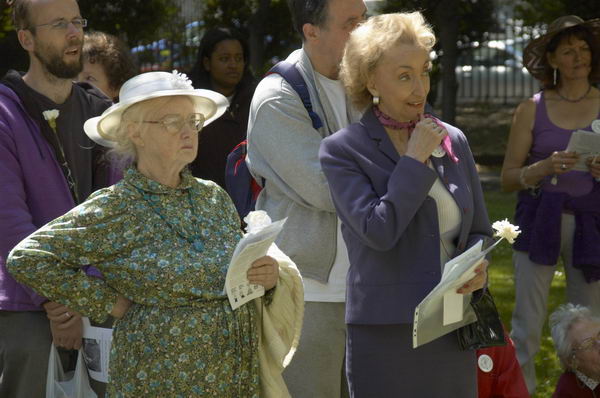
May 15th was International Conscientious Objectors’ Day, and the ‘right to refuse to kill’ group of people from the Peace Pledge Union, Conscience, The Unitarian Peace Fellowship, Christian CND, The Anglican Pacifist Fellowship, Pax Christi, The Women’s International League For Peace And Freedom And Dances Of Universal Peace had organised a ceremony at the Commemorative stone in Tavistock Square. After a brief introduction by Tony Kempster of the Anglican Pacifist Fellowship, Sue Gilmurray sang her song ‘Heroes’ and then Angela Sinclair who was a conscientious objector in the Second World War told her story and spoke about the right not to take part in war.
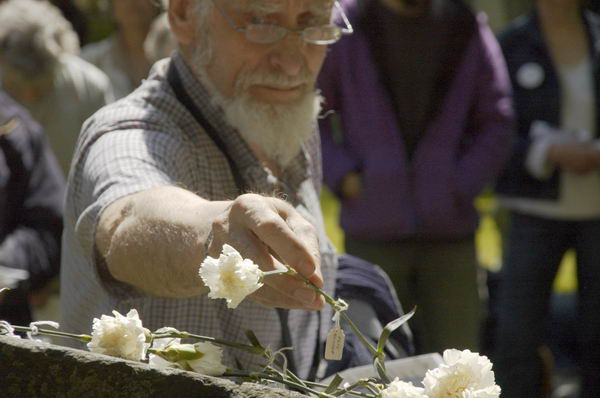
After a speaker from Amnesty and another from Conscience, the names of almost seventy conscientious objectors, many of who had died for their beliefs, were read out. The organisers had given out white flowers labelled with their names, and as each name was read, the person holding their flower came and placed it on the stone. After a one minute silence the commemoration continued with another song and then dancing, but I had to leave at this point.
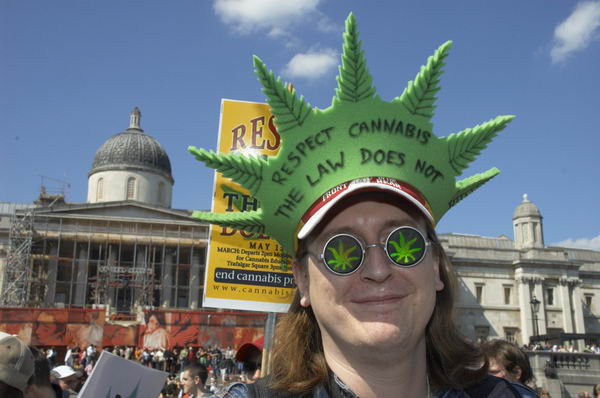
The annual march to demand the legalisation of cannabis had to be postponed and moved to a central London location after Lambeth council had refused to allow it to use Brockwell Park. Probably for this reason, the numbers seemed well down on previous years.
The last year had seen both an increasing recognition of the value of cannabis in relieving pain for some conditions, and also in revealing the mental health problems it causes some users. Despite these, the existing anti-drugs policies are more and more discredited, leading to increasing crime and addiction, and also greatly increasing the probability of cannabis users moving on to more dangerous and addictive drugs.
Cannabis needs to be taken out of the hands of drug dealers, and into some form of legalised supply chain which would cut out the drug dealers, allow better supervision of the product and create a total separation between cannabis and other more dangerous substances.
It would also allow the creation of a tax revenue, some of which could be spent on the rehabilitation of drug users.
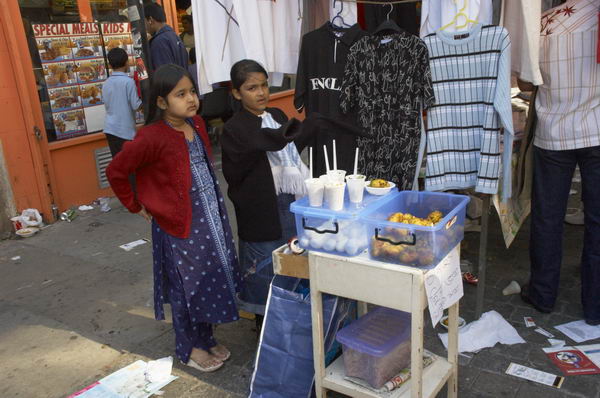
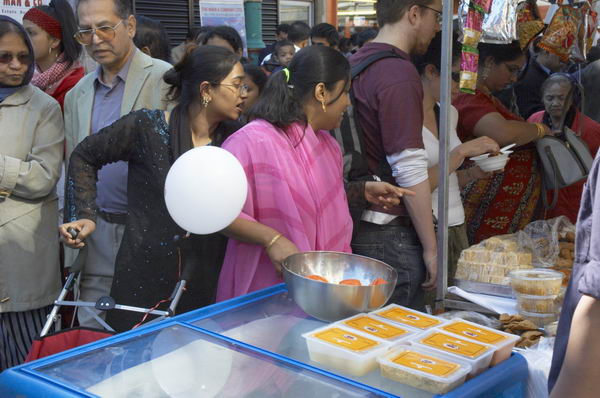
I went with the march to Trafalgar Square and stayed to listen to a couple of the speakers, but soon lost interest and got on the District Line to go up to Brick Lane for the Bengali New Year Festival.
When I got there it was just too crowded; after walking around for a few minutes I gave up and came home.
Brian, Bears, Morris and May Queens: On Saturday 13th May 2006 I went to Parliament Square where I photographed resident peace protester Brian Haw and Morris Dancers, going on to more dancers performing in Trafalgar Square as a part of a Westminster Day of Dance. From there the Underground took me out to Hanger Lane from where I walked to Brentham to photograph the 100th anniversary of the first Brentham May Queen crowning.
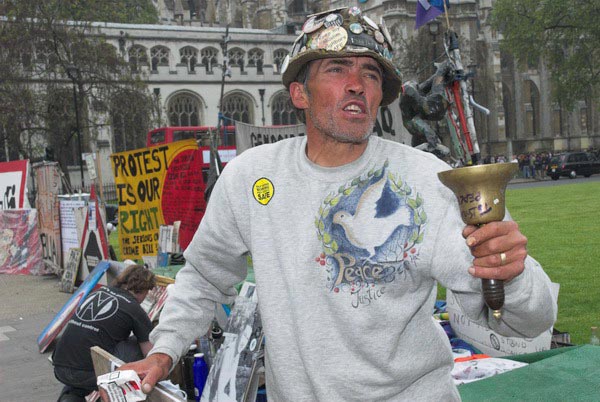
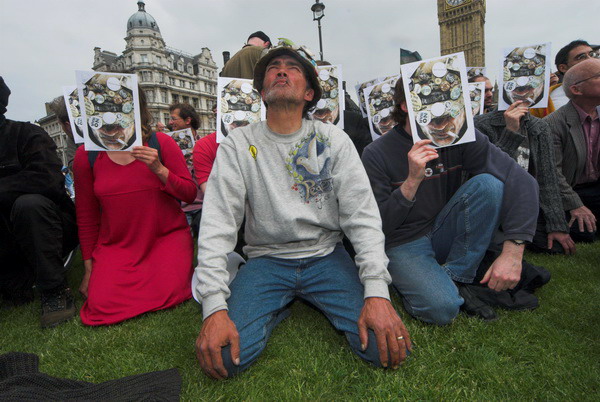
Brian Haw at Parliament Square
Brian and the Bears
Brian Haw lost the appeal by the government over his protest in Parliament Square, the court deciding that the Serious Organised Crimes And Police Act did apply to his protest after all, despite it having started around 4 years before the act came into force. It seems to be a decision that reflects more on the ability of the government to apply pressure rather than one that suggests an independent judiciary.
At the moment, Brian is still there, his protest now regulated by the police, but it seems rather likely that at some moment the feel convenient they will decide to terminate it. On Saturday morning I went to have a short word with him and take some more pictures, particularly of some of the bears who are with him.
His protest from the start has been about the killing of children, at first by the effects of sanctions, then by the war, and the teddy bear symbolises this (I think of one of the most poignant images from the Second World War, by Cecil Beaton, of a child in a hospital bed with a teddy bear.) I hope to be back to see Brian tomorrow, with a few friends, if he is still there. [He was, and depite constant harassment remained there until ill-health forced him to leave in 2011, dying in a German hospital six mohnths later.]
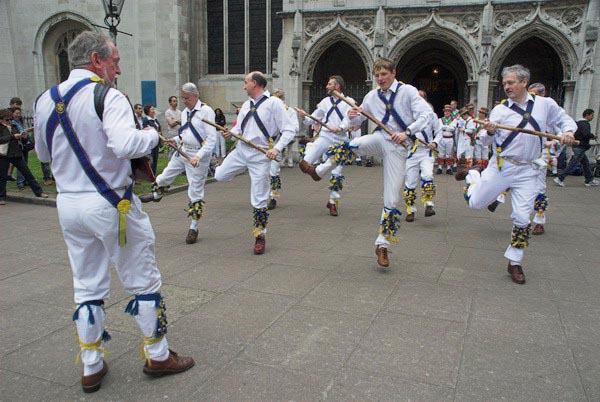
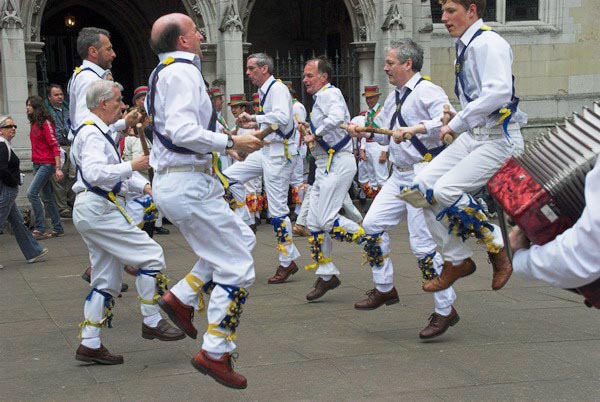
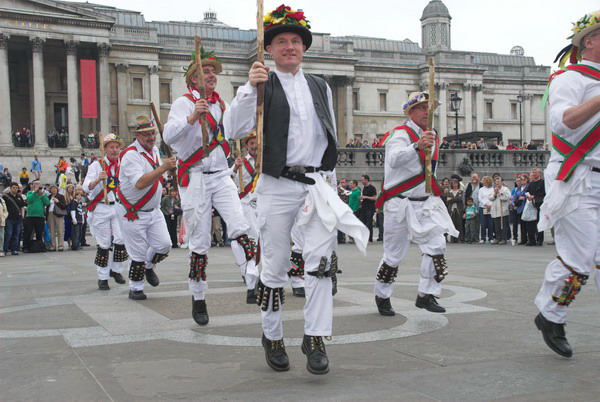
For several years there has been a dance festival in Westminster in May, with teams of Morris Dancers from around the country. I caught up with them briefly dancing in front of St Margaret’s Church next to Westminster Abbey, then a little later in Trafalgar Square.
Although i’ve never had a great desire to take up Morris myself, it certainly is one of our English traditions, going back at least 500 years – the first written record of it is in 1448.
It was still alive in many villages in the nineteenth century and a revival started in the early twentieth century particularly through the work of Cecil Sharp, who collected over 170 different dances around the country and started the English Folk Dance Society in 1911. Sharp and Mary Neal published books of dances, and in the 1920s and 30s, country dancing became a part of most young school children’s week. How I hated it in the 1950s!
It is perhaps that enforced participation that led to Morris Dancing being thought of as something false and lacking in credibility. In a curious anomaly, our Arts Councils refuse to support English ethnic dances while (quite rightly) giving aid to foster dance and related activities among minority ethnic groups. Despite this, Morris Dancing has continued to grow both in the UK and now increasingly abroad, particularly in Canada and the USA.
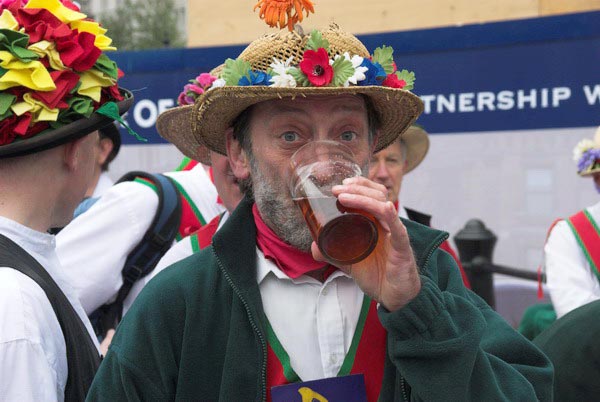
All the teams in Trafalgar Square were men, although there are also many women dancers. One of the things that comes out in my pictures is that the dance is at times a very athletic event. Many of the traditional dances use swords or staves and have a link to martial arts. Morris also has a strong link to another English tradition, the ale house.
May continued for me with another May Queen. Last year (2005) I had photographed the oldest continuing May Queen event at least in the London area, the Merrie England and London May Queen Fayre at Hayes, Kent, held continuously since 1913. This year I went instead to Brentham, where a May Fayre with maypole dancing was held in 1906, and its centenary was held this year.
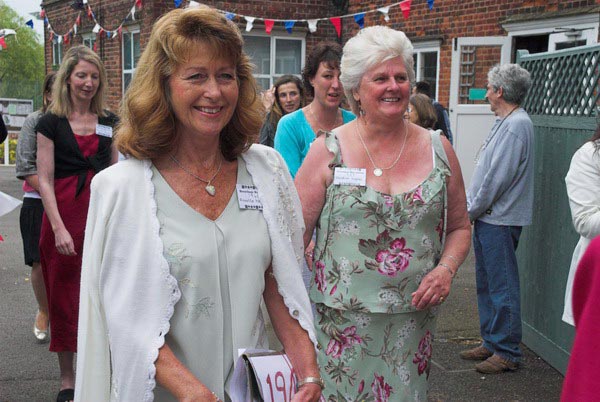
For this event, the organisers had managed to find and invite along many former May Queens, including some from the 1950s. Some had come long distances to be there, including one now living in America.
Brentham was one of the earliest “garden village” estates, built by ‘Ealing Tenants’ a co-partnership housing scheme started in 1901 and largely completed by 1915. The road layout was designed by Raymond Unwin and Barry Parker, and it was in many ways a model for other and better known garden villages.
The Brentham May Queen is less formalised that the south London events, with little or no long speeches and ceremonies (unlike Hayes it was not set up by a Dulwich schoolmaster.)
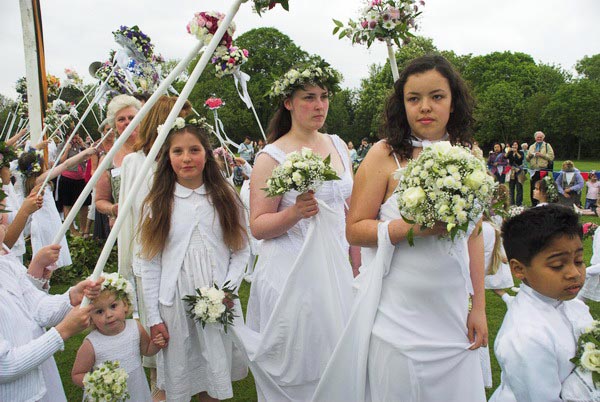
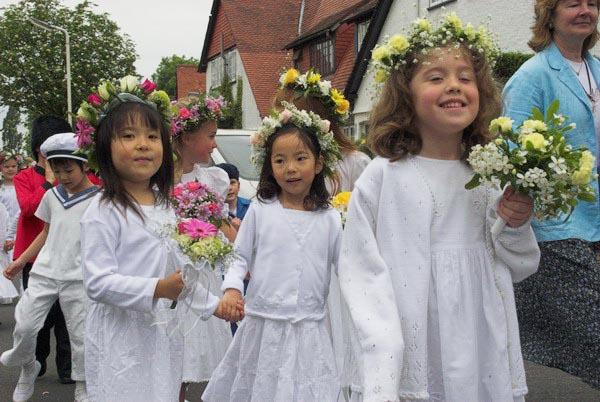
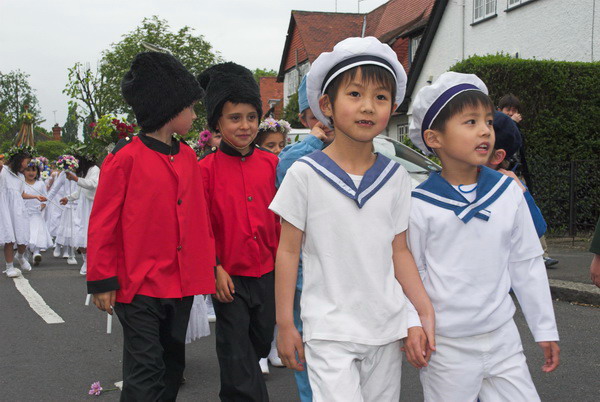
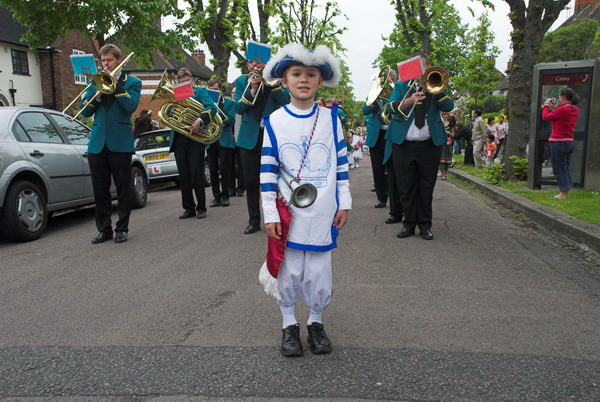
As well as the May Queen Elect and previous May Queens, each with a small group of attendants, there is also a herald who leads the parade (aided today by a brass band) Brittania, Sailor and Soldier, and, leading the large group of around 150 young girls dressed in white with flowers, a Jack In The Green, covered with leaves, with just bare legs and sandals visible.
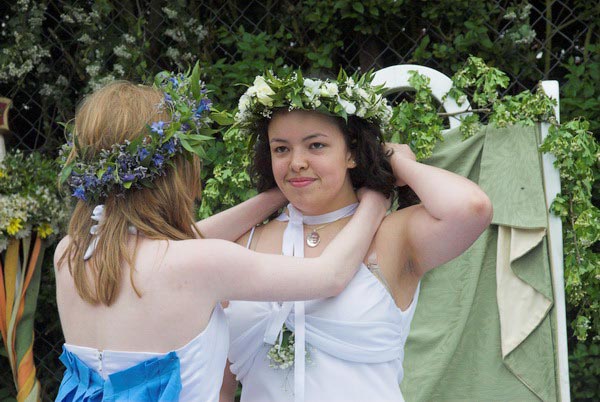
The crowning of the 2006 Brentham May Queen
After the parade around the area, there was a short ceremony in one of the fields by the River Brent in which last year’s May Queen crowned the new queen, and a very short speech. Following this were country dances and dancing round the maypole, but I left before this began.
Baisakhi Mela, Bengali New Year: Back in May 1998 I went to the celebrations of the New Year taking place in a crowded Brick Lane and photographed the people on the streets, mainly in black and white and a few in colour.
I’ve recently digitised the more interesting of these pictures and have posted 35 black and white and a few colour pictures on Flickr.
Of course I was then working with film. I can’t remember exactly which two cameras I was using that day, but I think most likely one would have been my favourite Minolta CLE with a 28mm lens. Minolta had previously worked with Leica to produce the Leica CL, a more compact Leica using Leica M lenses, but for some reason two companies had parted company for the improved version of this, which came out under Minolta’s name. Perhaps its improved metering made it seem too modern for Leica.
The Minolta 28mm M-fit lens was a fine performer, actually out-performing its Leica equivalent. Sadly I had to bin it years later as fungus growth within it had damaged some of the internal glass beyond repair when I had hoped to use it with an appropriate adaptor on a Fuji digital camera.
Konica were another company that produced a modernised rangefinder Leica, the Hexar RF using their version of the Leica M-mount which accepted all Leica lenses. The viewfinder was perhaps not quite as bright as a Leica, but was better for 28mm lenses, and it not only had a good autoexposure system but also motorised wind-on of film and rewind. But that only came out a in 1999 after these pictures were made, when it became my ‘Leica’ of choice.
Probably the black and white images were made with an earlier Konica camera, the Hexar F, a 35mm fixed-lens, fixed focal length autofocus camera. Film loading, advance and rewind was motorised and automatic. It wasn’t promoted much in the UK, and I had to order mine from the USA, I think in 1993. The 35mm lens was superb, but I did have some self-made probelms with this camera, mainly due to my fingers. It was all too easy for them to wander over the exposure senor on the front of the body, causing extreme over-exposure, and I often managed to get greasy fingerprints on the front of the lens which had no lens hood.
Brick Lane was full of sound for the Baisakhi Mela, but both the Minolta CLE and the Hexar F were quiet in operation and the Hexar even had a ‘silent’ mode that made it hard for even me to know if I had taken a picture – so I seldom used it. Many of those in these pictures would have been immersed in the event and so unaware that I was taking their photographs, though others were and were clearly happy to be photographed.
The picture above is the first black and white picture from the Mela in the album, and clicking on it will take you to Flickr where you can then go through all 35 black and white pictures.
It wasn’t of course the last time I went to Wandsworth – I was even back there a couple of weeks ago, walking through the same areas, though much of it now hardly recognisable.
West Hill Primary, School, Broomhill Rd, Wandsworth, 1990, 90-3c-25
The school building is locally listed and its address is 5 Merton Road, but this is the view from Broomhill Road.
London Theatre School, Chapel Yard, Wandsworth, 1990, 90-3c-26
On a second image I made of this building I can just about make out the inscriptions on the frontage as at left ‘Erected 1573, Enlarged 1685 and on the right ‘Repaired 1809 – 31, Rebuilt 1882’. You can read all four plaques lower on the building on the London Remembers site.
This is Wandsworth Chapel and possibly the site was first used by Huguenots, though perhaps only rather later than this. Another plaque lower down mentions a Dutch congregation but from 1713-87 this was the ‘French Church.’ Later from 1809 it was Congregational and a plaque states they continued to use it for mission work until 1939 after moving to a new church on East Hill in 1860. Its history reflects the many immigrants who settled in Wandsworth and set up industries along the Wandle using its water and the power it could generate.
The current building with a hall which could hold 500 people opened in 1883 and is locally listed. Since housing the London Theatre School it became the National Opera Studio.
Pizza Delivery, Scooters, Wandsworth High St, Wandsworth, 1990, 90-3e-65
Pizza Delivery began in the UK in the mid-1980s, but back in 1990 you had to phone for a pizza, with on-line ordering only becoming widespread in the late 1990s. It was still fairly unusual in 1990 and HIPPO PIZZA with this row of five scooters ready and waiting for a call was something of a pioneer.
Entrance, Car Wash, Wandsworth High St, Wandsworth, 1990, 90-3e-66
‘Welcome, Please Drive In’ for a ‘Guaranteed Complete Clean’. At at right someone sits waiting. There is still a ‘HAND CAR WASH’ here on the High Street.
Gas Holder, Armoury Way, Wandsworth, 1990, 90-3e-51
I walked up Ram Street again to Armoury Way and took a few more pictures of the gas holder – which I’ve written more about in earlier posts about this walk.
Gas Holder, Armoury Way, Wandsworth, 1990, 90-3e-53
I think I then looked at my watch and hurried to Wandsworth Town Station taking no more pictures to catch a train rather than have to wait another half hour for the next one.
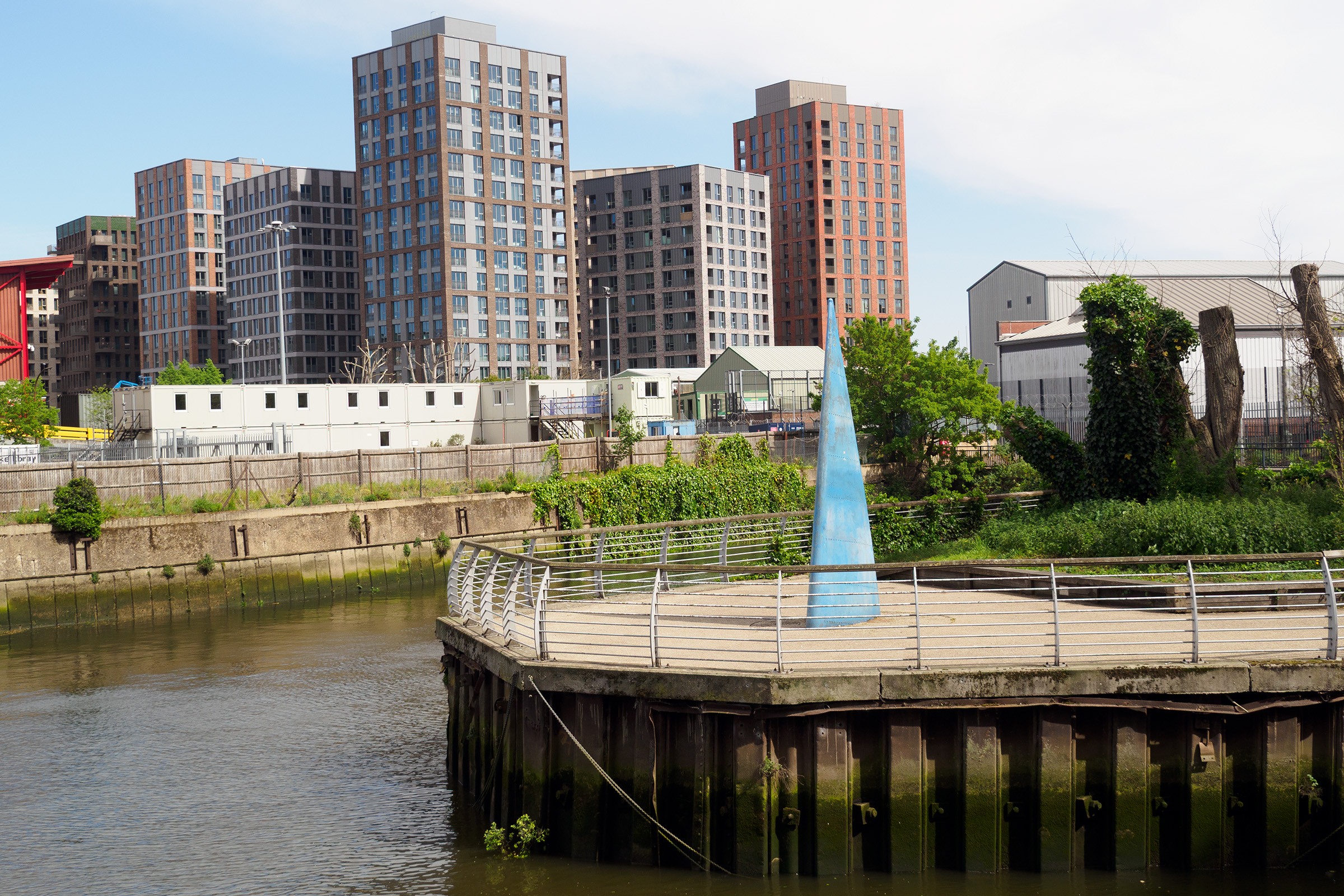
Finally, here is just one picture from the area I made on my last visit in April 2026, looking across where Bell Lane Creek and the River Wandle join. On ‘The Spit’ is a sculpture, ‘Sail’, by Sophie Horton placed there in 2003, financed by the Wandsworth Challenge Partnership. It was inspired by the sail of a dinghy, though I don’t think these have ever sailed up here. But perhaps in the new Wandle Riverside they will.
The flats are part of a new development on the former site of the Wandsworth Gasworks. And where I was standing to take this picture where there is now a riverside path leading to the River Thames was, back in 1990, part of the Shell Oil Terminal.