Baisakhi Mela, Bengali New Year – 1998

Baisakhi Mela, Bengali New Year: Back in May 1998 I went to the celebrations of the New Year taking place in a crowded Brick Lane and photographed the people on the streets, mainly in black and white and a few in colour.

Baisakhi Mela, Bengali New Year, Brick Lane, Spitalfields, Tower Hamlets, 10 May, 1998, 98-513-66

I’ve recently digitised the more interesting of these pictures and have posted 35 black and white and a few colour pictures on Flickr.

Baisakhi Mela, Bengali New Year, Brick Lane, Spitalfields, Tower Hamlets, 10 May, 1998, 98-512-46
Baisakhi Mela, Bengali New Year, Brick Lane, Spitalfields, Tower Hamlets, 10 May, 1998, 98-515-62

Of course I was then working with film. I can’t remember exactly which two cameras I was using that day, but I think most likely one would have been my favourite Minolta CLE with a 28mm lens. Minolta had previously worked with Leica to produce the Leica CL, a more compact Leica using Leica M lenses, but for some reason two companies had parted company for the improved version of this, which came out under Minolta’s name. Perhaps its improved metering made it seem too modern for Leica.

Baisakhi Mela, Bengali New Year, Brick Lane, Spitalfields, Tower Hamlets, 10 May, 1998, 98-512-14

The Minolta 28mm M-fit lens was a fine performer, actually out-performing its Leica equivalent. Sadly I had to bin it years later as fungus growth within it had damaged some of the internal glass beyond repair when I had hoped to use it with an appropriate adaptor on a Fuji digital camera.

Baisakhi Mela, Bengali New Year, Brick Lane, Spitalfields, Tower Hamlets, 10 May, 1998, 98-513-41

Konica were another company that produced a modernised rangefinder Leica, the Hexar RF using their version of the Leica M-mount which accepted all Leica lenses. The viewfinder was perhaps not quite as bright as a Leica, but was better for 28mm lenses, and it not only had a good autoexposure system but also motorised wind-on of film and rewind. But that only came out a in 1999 after these pictures were made, when it became my ‘Leica’ of choice.

Baisakhi Mela, Bengali New Year, Brick Lane, Spitalfields, Tower Hamlets, 10 May, 1998, 98-514-51

Probably the black and white images were made with an earlier Konica camera, the Hexar F, a 35mm fixed-lens, fixed focal length autofocus camera. Film loading, advance and rewind was motorised and automatic. It wasn’t promoted much in the UK, and I had to order mine from the USA, I think in 1993. The 35mm lens was superb, but I did have some self-made probelms with this camera, mainly due to my fingers. It was all too easy for them to wander over the exposure senor on the front of the body, causing extreme over-exposure, and I often managed to get greasy fingerprints on the front of the lens which had no lens hood.

Baisakhi Mela, Bengali New Year, Brick Lane, Spitalfields, Tower Hamlets, 10 May, 1998, 98-514-31
Baisakhi Mela, Bengali New Year, Brick Lane, Spitalfields, Tower Hamlets, 10 May, 1998, 98-515-12
Baisakhi Mela, Bengali New Year, Brick Lane, Spitalfields, Tower Hamlets, 10 May, 1998, 98-516-46

Brick Lane was full of sound for the Baisakhi Mela, but both the Minolta CLE and the Hexar F were quiet in operation and the Hexar even had a ‘silent’ mode that made it hard for even me to know if I had taken a picture – so I seldom used it. Many of those in these pictures would have been immersed in the event and so unaware that I was taking their photographs, though others were and were clearly happy to be photographed.

Baisakhi Mela, Bengali New Year, Brick Lane, Spitalfields, Tower Hamlets, 10 May, 1998, 98-512-52

The picture above is the first black and white picture from the Mela in the album, and clicking on it will take you to Flickr where you can then go through all 35 black and white pictures.


FlickrFacebookMy London DiaryHull PhotosLea ValleyParis
London’s Industrial HeritageLondon Photos

All photographs on this page are copyright © Peter Marshall.
Contact me to buy prints or licence to reproduce.
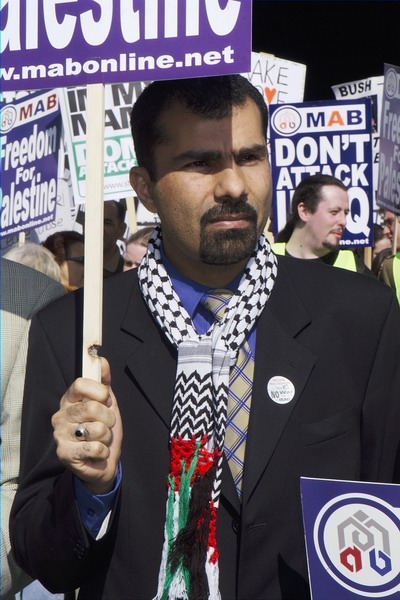
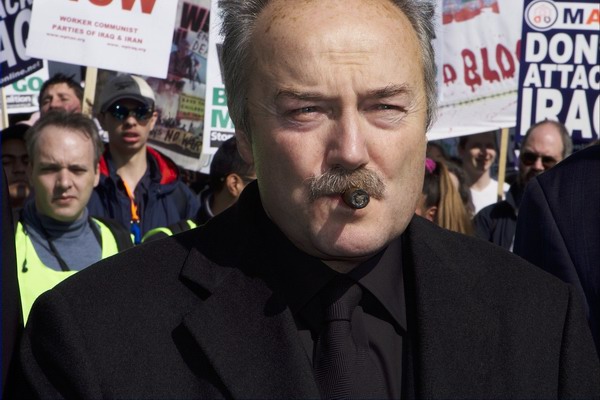
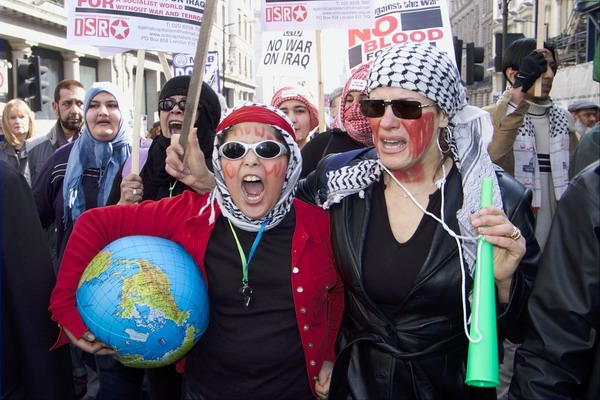
Invasion of Iraq Protest 2003

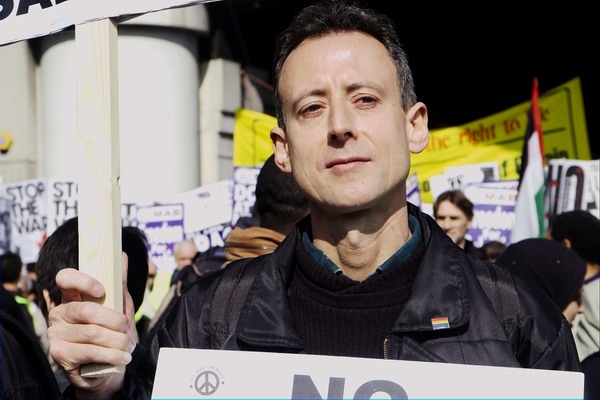
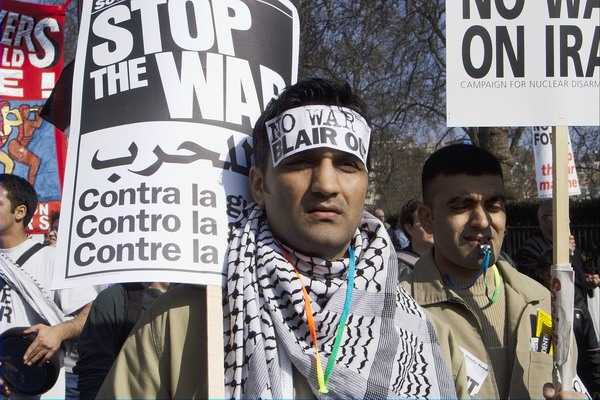
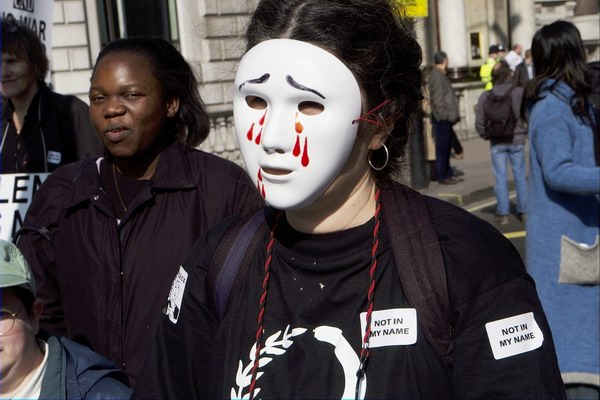
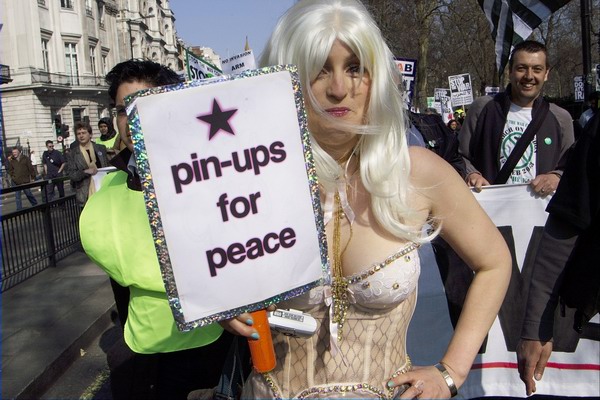
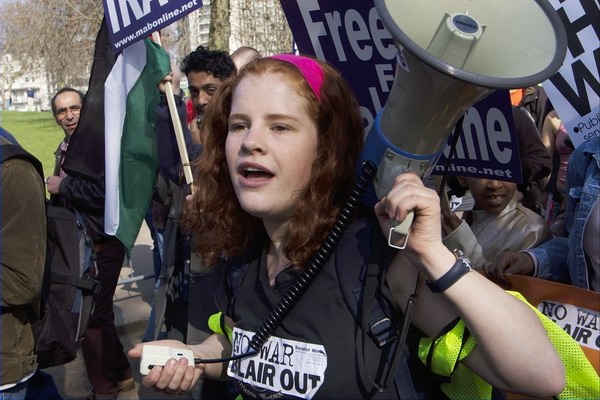
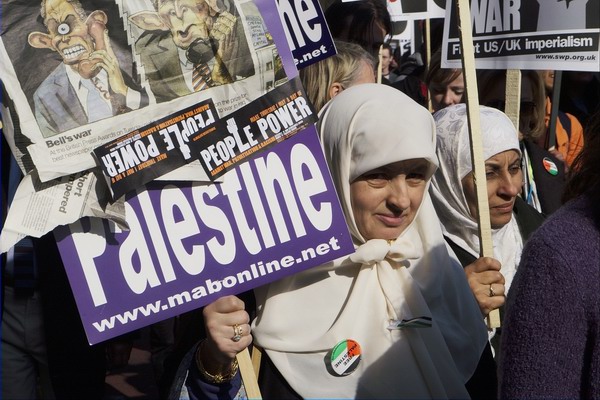
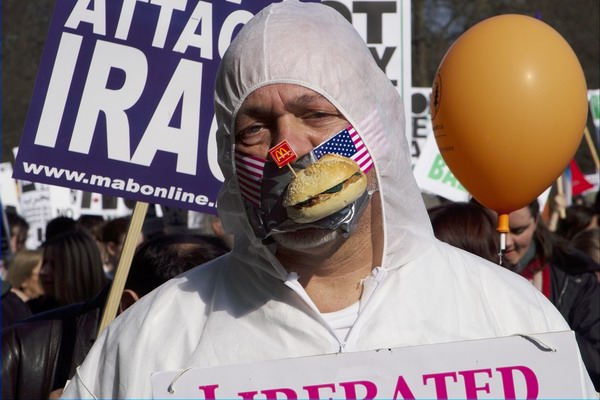
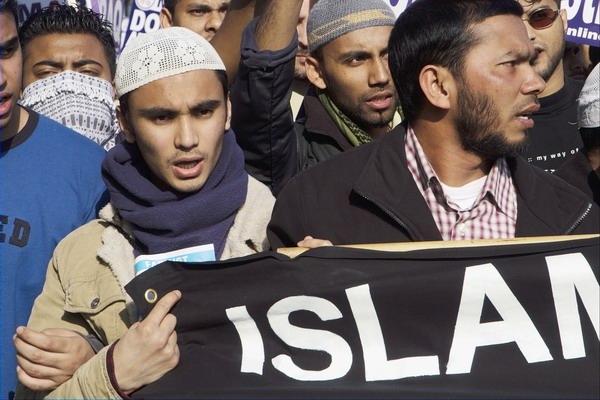
Invasion of Iraq Protest 2003 – On 22nd March 2003 several hundred thousand people marched through London against the invasion of Iraq which had begun four days earlier on on 19th March 2003.

Invasion of Iraq Protest 2003

I’d missed the huge worldwide protests the previous month, when on the weekend of 15-16th February according to the BBC, always conservative (I think a euphemism for deliberately lying) on protest numbers reported that a million people had marched in London on the Saturday among between six and ten million in 60 countries around the world.

Invasion of Iraq Protest 2003
George Galloway

I’d come out of hospital the previous day, February 14th, and was still very weak following a minor heart operation that had gone slightly wrong. So I could only wave to my wife and elder son as they set off to the station to join the other 1.5 or 2 million marchers.

Invasion of Iraq Protest 2003

I think it was March 6th that my doctor signed me off as fit to work, though I was still not back to normal, but I covered my first protest after the op two days later, cutting down the weight of my camera bag as much as I could to two cameras and five lenses – all primes.

Invasion of Iraq Protest 2003
Peter Tatchell

I’d spent some of my time recovering getting used to the Nikon D100 I had bought just a few weeks before going into hospital. It was the first digital camera I’d owned capable of professional results, and the first with interchangeable lenses, though I only then owned one in a Nikon fitting I’d bought with the camera, a 24-85mm.

As well as taking colour pictures on the D100, I was also taking black and white film using a rangefinder camera, probably a Konica Hexar RF, the kind of camera Leica should have produced but never did. It featured automatic film advance and rewind and had accurate auto-exposure and has been described as “the most powerful M mount camera there is.” And very much cheaper than a Leica. The nine pictures from the day I sent to the library I was then using were all black and white 8×10″ prints from the pictures made with the Hexar RF, as in 2003 they were still not taking digital files.

Here you can see some of the digital images I took on 22nd March 2003 with that single zoom lens. It was the first zoom lens I had used for over 25 years, having been rather disappointed with a telephoto zoom I bought soon after I got my Olympus OM1. The image quality on the Nikon zoom – about the cheapest lens in their range and light and relatively small – was fine if not quite up to the Leica lenses on the Hexar, but it gave some distortion – barrel at 24mm and pincushion at 85mm.

But the Nikon D100 was a DX format camera, and on this the widest angle of view marked as 24mm actually was equivalent to 35mm on my film camera. Hardly wide-angle at all, and on film I was often working with 15mm or 21mm lenses.

The digital images are shown here as I put them on-line in 2003, and I think I would get the colour rather better now. And of course digital cameras have improved tremendously since then, with much better dynamic range, and the software for processing digital images is also far better. Also with download speeds generally much lower in 2003 they were put on line at a much poorer jpeg quality so they would download faster – and also spread over a number of pages with perhaps just half a dozen images on each page.

The marchers met on the Embankment and marched to a rally in Hyde Park. I think I only used the D100 before and on the march and photographed the rally entirely in black and white. Probably this was a decision I made, but it could have been because the battery ran out. But I think I had decided just to use it to photograph people on the march.

We now know that Blair lied to take us to war and made use of the fake “dodgy dossier” to swing the vote in Parliament. There were no “Weapons of Mass Destruction” in Iraq – and the UN had found none because there was nothing to find. But the US had been gearing up to attack over the past year and were not going to let the facts put them off, and Blair was their lap dog.

You can read more about the Invasion of Iraq on Wikipedia. While the US had prepared for war, they had made little or no preparation for what was to follow after President George W Bush declared the “end of major combat operations” on May 1st. Iraq was still in a mess when the US troops finally withdrew in 2011 and remains so today. It was as I wrote in 2003, the wrong war at the wrong time – and by 2023 over 60% of US citizens were prepared to state that the U.S did not make the right decision by invading Iraq.

More on the March 2003 page of My London Diary where you can also find pictures of another protest against the war on Saturday 29th March calling for more balanced coverage by the BBC.


FlickrFacebookMy London DiaryHull PhotosLea ValleyParis
London’s Industrial HeritageLondon Photos

All photographs on this page are copyright © Peter Marshall.
Contact me to buy prints or licence to reproduce.