Camberwell Green, Peckham Workhouse & the Star of India – 1990

On 18th March 1990 I took an early train to Vauxhall and then travelled east on the top deck of a 36 bus to Camberwell Green. I saw the buildings at the crossroads there and rang the bell to get off the bus to make a photograph.

Camberwell New Road, Denmark Hill, Camberwell Green, Camberwell, Southwark, 1990, 90-3e-55

Here I crossed the road and walked a few yards to take this picture looking across the start of Denmark Hill to Camberwell Green and the start of Camberwell Road Most of the buildings in my picture can still be identified although their uses have changed. That ornate National Westminster Bank is now Camberwell Green Surgery, and Kennedy’s Sausages are long gone, their site now occupied by Technozone.

The Grade II listed Baroque Revival bank was built in 1899 for the London and County Bank, which after a series of mergers with other banks including the London and Westminster Bank shortened its name the the Westminster Bank in 1923 and merged with the National Provincial Bank to form the National Westminster Bank in 1970.

But I was on my way to Peckham and after taking a single frame crossed back to the bus stop and took the next bus along Camberwell New Road to Peckham High Street and walked down Rye Lane.

Shops, Market, Rye Lane, Peckham, Southwark, 1990, 90-3e-56

Here the lighting was right for was an impressive array of architectural styles and eras on the west side of the street, from plain late Victorian to more ornate turn of the century, 1930s and probably 1950s or 60s.

The range of buildings represents the establishment of Rye Lane as one of South London’s shopping streets in the late 1870s, but outstanding for me was Peckham Indoor Market. As I wrote in an earlier post here:

“Peckham Indoor Market was built around 1938 or shortly after as Rye Lane Bargain Centre with an imposing frontage for a narrow arcade leading back to a large covered market. It’s a style that rather makes it look like a cinema. Across the top is the message ‘Come Rain Or Shine It’s Always Fine at Peckham Indoor Market’.

In the early 2000s the market at the back was reduced in size with part now redeveloped as flats but the front section remains and is now Rye Lane Market, housing over 50 small shop units.”

The Morning Star, Rye Lane, Peckham, Southwark, 1990, 90-3e-44

The Morning Star at 231 Rye Lane was built in 1871 and is now the Nag’s Head, having changed its name to cash in on the BBC TV comedy ‘Only Fools And Horses’, though I think the BBC made them paint over a reference to this high on the frontage. The pub was South London’s most famous Darts Pub in the 1970s and 80s.

But I was really photographing ‘The Triangle’ which had been a favourite meeting place for Mods and their scooters.

Former Camberwell Workhouse, Gordon Rd, Peckham, Southwark, 1990, 90-3e-33

20 Gordon Road was built as the Camberwell Workhouse in 1878 when a competition for their design was won by architects Berriman and Sons Ltd. It housed 743 able-bodied inmates. Women were employed in laundries and men broke stones and chopped wood. Taken over by the London County Council in 1930 it became the Camberwell Reception Centre, closing around the end of the 1970s. Minor buildings on the site were demolished and the main buildings converted into flats.

This was later simply a casual ward, and took in many normally sleeping rough and only seeking accommodation in bad weather or desperate for a meal. Many tramping the roads preferred to sleep rough as to get a meal and a bed for the night men were expected to then to join the permanent residents working most of a day breaking up stones to mend roads or chopping wood – or in the laundry for women.

Former Camberwell Workhouse, Gordon Rd, Peckham, Southwark, 1990, 90-3e-34

There were still ‘tramps’ in the 1950s who would knock at our back door in oouter London and my mother would talk to them, give them a mug of tea and fill their water bottle if they had one, but few people would make them welcome – and some set the dogs on them. We only had a cat, and my mother was a charitable woman. Tramps would often make chalk marks on pavements to tell others which houses to visit and which to avoid.

Former Camberwell Workhouse, Gordon Rd, Peckham, Southwark, 1990, 90-3e-36

Tramps would often run away before finishing their work – and this was a criminal offence which could put them in prison for up to a month were they caught until the 1970s.

Former Camberwell Workhouse, Gordon Rd, Peckham, Southwark, 1990, 90-3e-22

A bench from Gordon Road is now in the London Museum together with a good account of how ‘casuals’ would be treated, at least after the National Assistance Board built a waiting room at ‘the Spike’ in 1952 – though they think the bench was only provided after 1964 when a report noted that chairs were ‘brandished as weapons in altercations between waiting applicants’.

It quotes two of the casuals:
Upon arrival at Gordon Road, you had to wait with dozens of other dossers in a dingy, unheated outhouse containing nothing but a few benches. You might have to wait here for several hours, even all night‘ The waiting room was often overcrowded and violent: ‘Last night sat for three hours before the porters called us in. Quite a few drunks, same old faces, singing, swearing, bottles breaking, glass all over the place. One goes flying through the window and I duck as it flies over my head. Five or six porters come rushing in, they grab the drunk and push him out the gate.’

Those admitted were then given a hot bath – many were very dirty and infected by lice – before being fed. The Camberwell Reception Centre only finally closed in 1985 and was still derelict five years later when I made these pictures.

The Star of India,  Gordon Rd, Peckham, Southwark, 1990, 90-3e-24
The Star of India, Gordon Rd, Peckham, Southwark, 1990, 90-3e-24

The Star of India was a Victorian pub on the corner of Gordon Road and Brayards Rd, dating from before the 1871 census. It was closed and demolished around 2000. A block of 12 flats on the site was completed by Habitat for Humanity using 1500 volunteer days in 2009. The flats were sold on completion to Hexagon Housing Association and New World Housing Association.

More from this walk in a later post.


FlickrFacebookMy London DiaryHull PhotosLea ValleyParis
London’s Industrial HeritageLondon Photos

All photographs on this page are copyright © Peter Marshall.
Contact me to buy prints or licence to reproduce.


More South Hackney 1988

More South Hackney 1988

Bucknell House, Victoria Park Rd, Hackney, 1988 88-9c-13-Edit_2400
Bucknell House, Victoria Park Rd, Hackney, 1988 88-9c-13

After eating my lunch in Victoria Park where I finished my previous post on this walk I went back to Victoria Park Rd and photographed No 78, Bucknell House, which seemed to be the site of a great deal of building activity, though I suspect not by Barry Bucknell who had been the great DIY expert on TV in the 50s and 60s with “Do it Yourself” and then “Bucknell’s House”.

Back then TV was broadcast live, and the programmes often ended in disaster, much to the viewers amusement. The street was built after Victoria Park, bought by the Crown, opened in 1845, stimulating development in the area which had before been slow.

Warneford St, Hackney, 1988 88-9d-64-Edit_2400
Warneford St, Hackney, 1988 88-9d-64

Much of the land in the area belonged to St. Thomas’s hospital and the trustees of the Sir John Cass Foundation (hence the name Cassland Rd.) I think these houses in Warneforde Street probably date from around the 1880s.

Victoria Park Rd, Hackney, 1988 88-9d-52-Edit_2400
Victoria Park Rd, Hackney, 1988 88-9d-52

These are some of a row of six very similar detached houses on the north side of Victoria Park Road just to the west of Clermont Road, numbers 69-81, I think these are probably 73 to 69. No house numbers are visible in the picture as is often the case, with properties either not having a number or these being too small to be visible. There were seldom bins visible back in 1988 with large house numbers on them, though now we all have wheelie-bins these are often the easiest way to find house numbers.

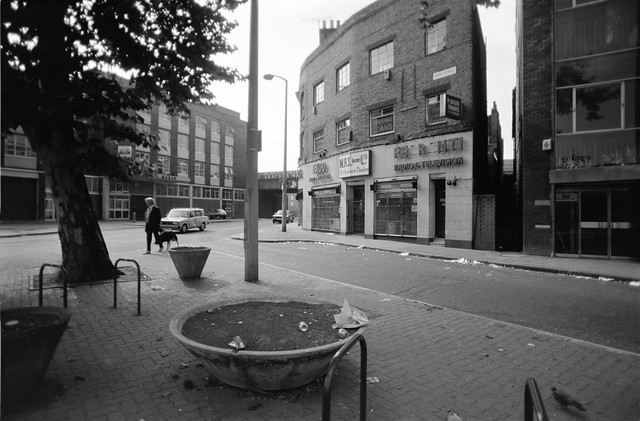
The Triangle, Mare St, Hackney, 1988 88-9d-53-Edit_2400
The Triangle, Mare St, Hackney, 1988 88-9d-53

I’d walked past The Triangle where Mare St and Westgate Street meet earlier and had taken one picture (not online), but coming back later I made three more, another similar to this one and a third from a few yards further back including a large three-legged notice board telling me the is as the London borough of Hackney and a couple of modern telephone booths. But my main interest was in the building housing M.R.S.[Hackney]Ltd., T.V.s & Appliance Dealers and above them Baker Finance offering Personal Loans.

Just a few yards away I found more large graffiti, urging ‘Don’t mug me. MUG A YUPPIE!!!MUG A YUPPIE!!!’ but so far I’ve not scanned that frame.

Fashions, Mare St, Hackney, 1988 88-9d-43-Edit_2400
Fashions, Mare St, Hackney, 1988 88-9d-43

I walked further up Mare St, past the Cordwainer’s College, now part of the London College of Fashion but originally built in 1877 as Lady Hollis’s School for Girls, which moved to Hampton as Lady Eleanor Hollis in 1936 and it later turned down my sister for having working class parents (picture not online.) I then photographed this entrance, I think on the west side of Mare St, to Le Duman – Fashions of London – Ladies Fashions Factory Shop. It claimed to be ‘Now Open To The Public’ but that was only Monday-Friday, and it was Sunday.

Darnley Rd, Hackney, 1988 88-9d-46-Edit_2400
Darnley Rd, Hackney, 1988 88-9d-46

Further on up Mare St I photographed another block with an interesting corner on Darnley Rd and then this rather narrow alley leading to some industrial premises which I think was between two more interesting buildings on Darnley Road I failed to photograph!

Darnley Rd, Hackney, 1988 88-9d-31-Edit_2400
Darnley Rd, Hackney, 1988 88-9d-31

In Darnley Road I came across these houses which although they seemed to be in poor condition were still lived in. I wondered at their wide double doors. They are still there, though I think most have now been extensively refurbished into expensive flats. Darnley Road dates from 1853 and was one of the areas in which the well-to-do late Victorians lived.

Darnley House, Darnley Rd, Hackney, 1988 88-9d-33-Edit_2400
Darnley House, Darnley Rd, Hackney, 1988 88-9d-33

And also in Darnley Rd, No 57, the last house before the corner with Brenthouse Road was certainly very much in the middle of its complete refurbishment, and I was unsure if it was to be demolished. It looks very smart now, except that its gateposts do not quite match. That on the left has a low pyramidal cap with the word DARNLEY on its front edge, while at the right of the entrance is much flatter and wordless – and the brickwork below is not quite the same. The wall and posts are separately Grade II listed to house, and the listing of the posts mentions the inscribed word HOUSE – which isn’t there. My picture only shows a side of the left post. In 1927 this was the home of Dinshaw Phiroze, physician & surgeon, about whom I can tell you nothing more.

More pictures from this walk in South Hackney to follow in a later post, Paragon, Fashion, Morning Lane & Nautilus 1988.