Ministry of Justice cleaners protest – 2018

Ministry of Justice cleaners protest - 2018

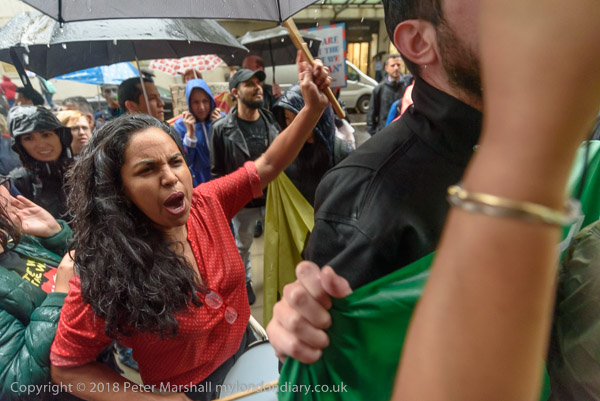
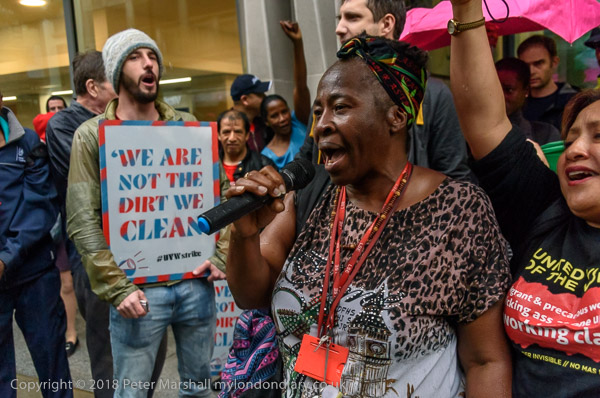
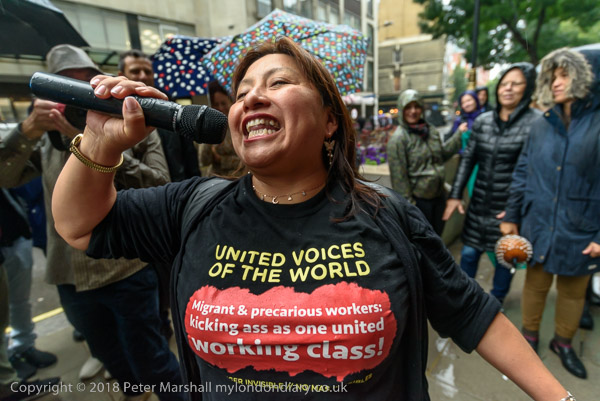
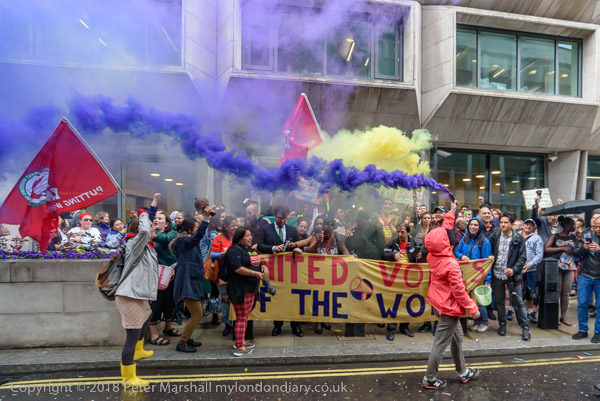
Ministry of Justice cleaners protest – 2018 Four years ago today we were in some ways in a very different place. For one thing it was pouring with rain on Thursday 9th of August and for another Labour’s Shadow Justice Minister had no doubts about coming to join a picket line as United Voices of the World cleaners and supporters celebrated the end of their 3-day strike with a rally outside the Ministry of Justice in Petty France with a lively protest despite pouring rain.
Ministry of Justice cleaners protest - 2018

But in other ways it was depressingly similar. We still have a Tory government that was determined to ignore the needs of the poor and low paid – and Boris Johnson is still prime minister, if not for long. But whichever of the two candidates wins to succeed him, the country is bound to lose, with the wealthy getting wealthier and the rest of us suffering.
Ministry of Justice cleaners protest - 2018
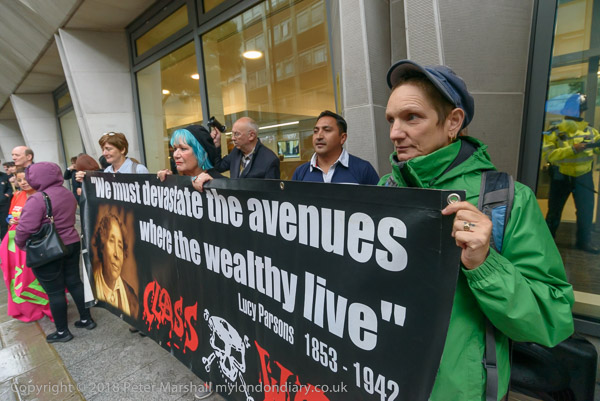
Class War and others had come to support the strikers

And of course in some ways things have got worse. We have now left the EU and are slowing finding out what a terrible deal was negotiated, largely thanks to a combative approach rather than trying to work with Europe to reach sensible solutions – and in part because of the overriding political need to “get things done” rather than read the small print.
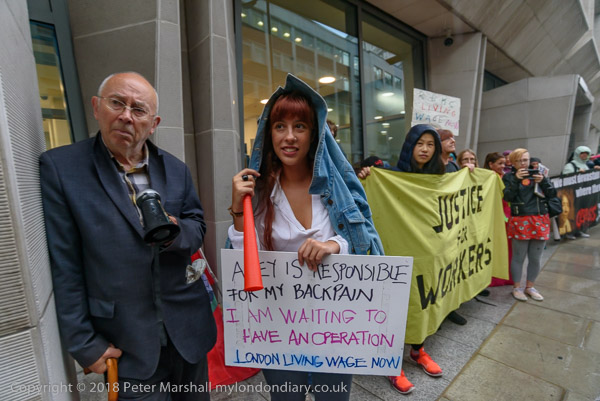
A cleaner is waiting for a back operation for a work injury – NHS underfunding and privatision mean long waits

And we’ve had Covid, most of us several times, with a failure to take sensible actions in time that led to thousands of extra deaths, saved from being far worse by a successful vaccination programme with at last some competent planning and hard work beyond their duties particularly by NHS workers and many volunteers. But Covid also led to huge waste of public money in contracts awarded to mates of the Tory party who too often failed to deliver – or even didn’t really exist.
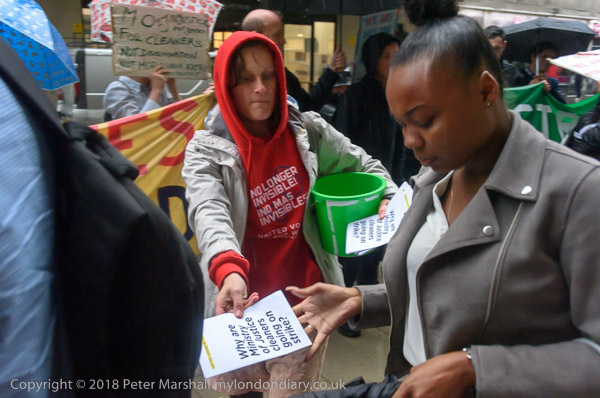
Leaflets tell workers leaving the Ministry of Justice why the cleaners are striking

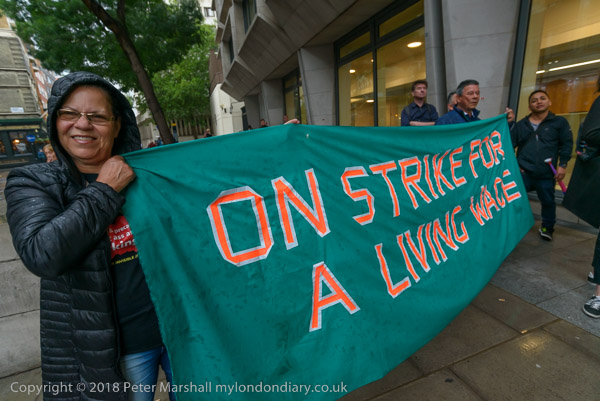
The protest in August 2018 marked the end of a three day strike by United Voices of the World cleaners at the Ministry of Justice, but also at Kensington & Chelsea council and hospitals and outpatient clinics in London run by Health Care America. At all three workplaces they were demanding the London Living Wage and better conditions of employment.
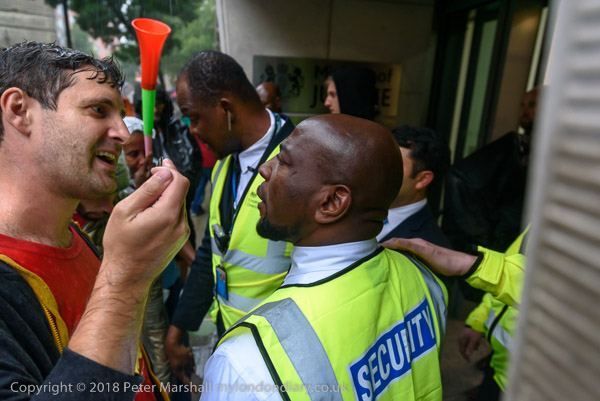
UVW’s Petros Elia tried to take protesters in out of the pouring raid but is stopped by security

It seemed impossible to believe that workers at the Ministry of Justice should not be paid the London Living Wage. The LLW was introduced in 2002 following an initiative by the London Citizens coalition and was taken up by the Mayor of London and was calculated by the Greater London Authority until 2016. A UK Living Wage was also established in 2011. The levels are now calculated based on the real cost of living by the Living Wage Foundation, with the 2022 London Living Wage being £11.05 per hour, and the UK Living wage £9.90.
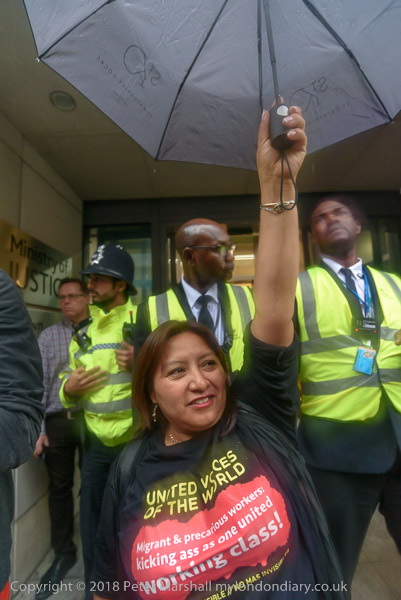
I’m getting soaked taking pictures – and Susanna from the UVW holds up an umbrella over me

In the 2015 budget, Tory Chancellor George Osborne announced a ‘National Living Wage’, replacing the earlier National Minimum Wage and almost certainly intended to counter the success of the living wage campaigns, setting the amount at a lower level. Currently this is £9.50 – even in London where it is £1.55 less than the real living wage.
Speeches continue in the pouring rain under umbrellas

While a considerable number of employers do now pay a real living wage, others still fail to do so. Too many hide from meeting the obligation to give their staff a living wage and decent conditions of service by outsourcing low paid workers to contracting companies, who usually stick to the basic minimum of legal conditions and pay, while all decent employers give significantly greater benefits and the living wage.
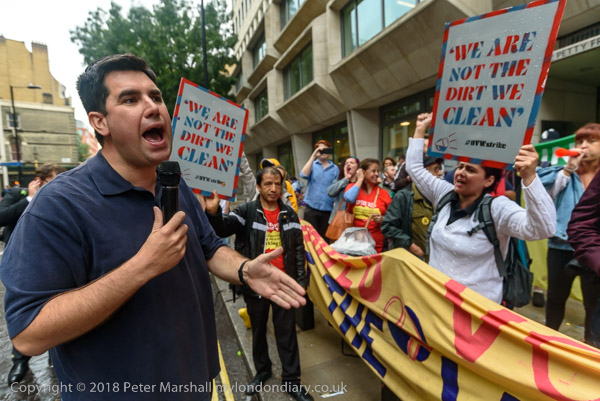
The rain slackens off for Richard Burgon to speak

Shadow Justice minister Richard Burgon came to support the workers and brought a message from then Labour leader Jeremy Corbyn, who promised that a Labour government would end the outsourcing of low paid jobs. Since Keir Starmer became leader, Labour’s policies have changed, and ministers who stand with workers are liable to be sacked. It now seems to be the Labour party only in name.
American healthcare companies have now taken over even more of our health facilities, and earlier this year the High Court dismissed a legal challenge against the takeover by Operose Health, a subsidiary of American health insurance giant Centene, of GP practices in London. This is a significant stealth privatisation of part of the NHS, with Centene now running 58 GP services.
Privatised GP practices generally have failed to employ permanent doctors and rely instead on locum provided care, which greatly reduces the quality of service. Takeovers like this have also meant many doctors leaving the profession early – and we are currently short of 9,000 GPs.
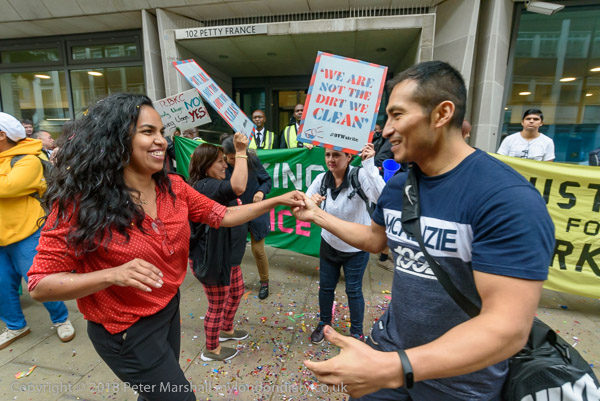
And the protest ends with dancing in the street

You can read more about the protest which was supported by other groups including Class War in My London Diary Ministry of Justice cleaners protest.
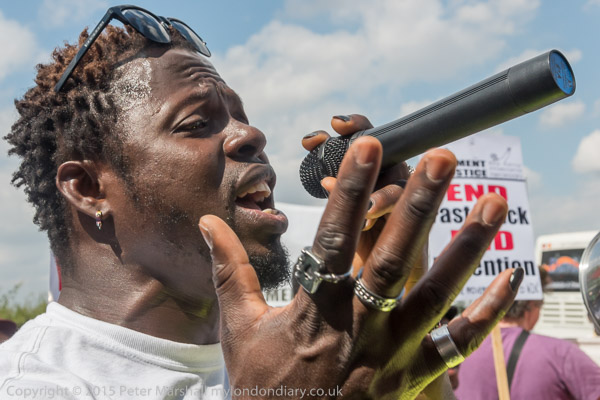
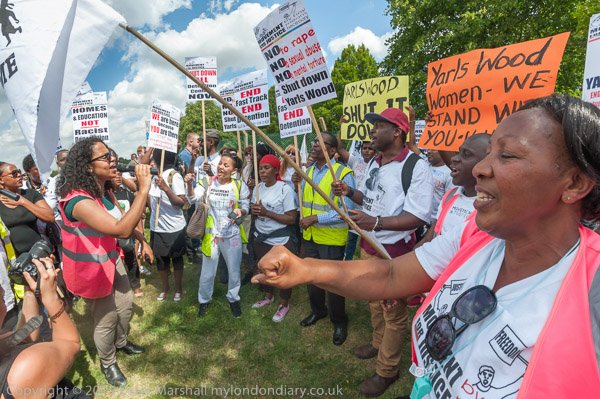
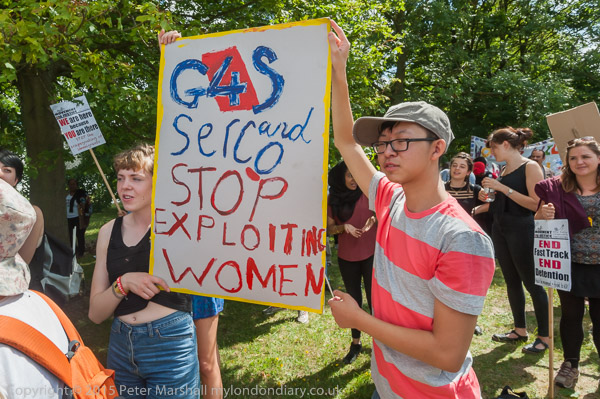
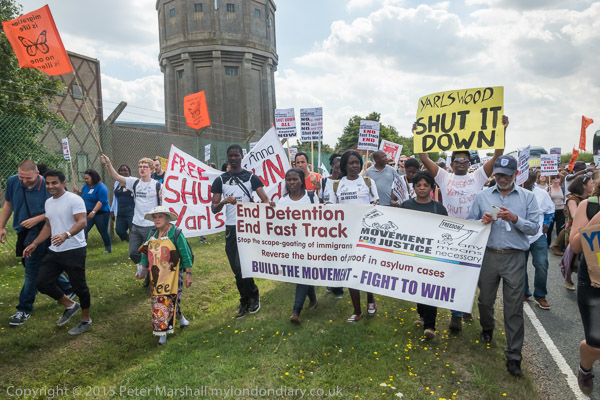
Close Down Yarl’s Wood – August 2015

Close Down Yarl’s Wood – Yarl’s Wood Immigration prison, near Bedford

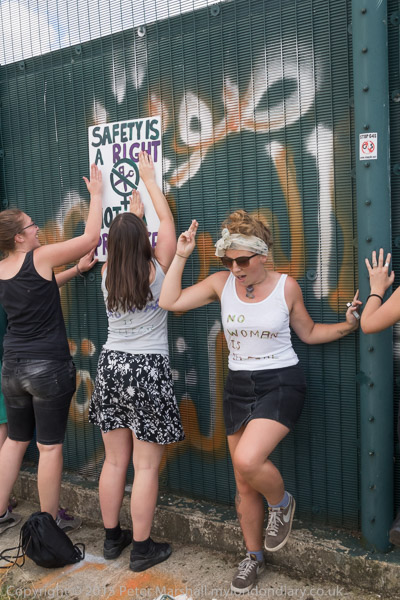
Saturday 8th August 2015 saw a large protest outside the immigration jail at Yarl’s Wood where asylum seekers are locked up indefinitely by our racist immigration system without trial, a prison run for profit by a private company where detainees are subjected to abuse and sexual harassment.

Yarl’s Wood was used to detain women, many of whom had fled abuse and violence in their own countries only to arrive in this country and be locked up and further abused here. The detention centre is in a remote location in a business park on a former wartime airfield around five miles from Bedford.

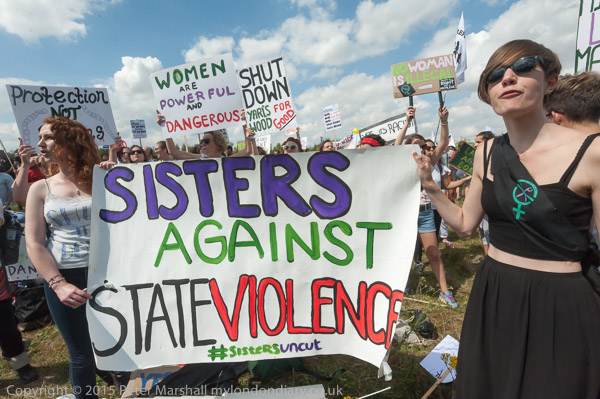
The protest was one of a long series organised by Movement for Justice, but was supported by a large number of other groups, particularly many women’s groups including Sisters Uncut. In my post on My London Diary I listed 25 of them, but there were others too. This was only the second protest they had organised at Yarls Wood, but it came after a series I’d photographed at the Harmondsworth and Colnbrook detention centres.

MfJ is a small Trotskyist group which has been one of the most active UK groups organising against racism and for civil rights in the UK since it was formed by students in North London in 1995. This protest came a couple of years before a bitter dispute led many other groups to end cooperation with them, but MfJ continue their active role, in particular in opposition to deportation charter flights and the shameful Rwanda plan.

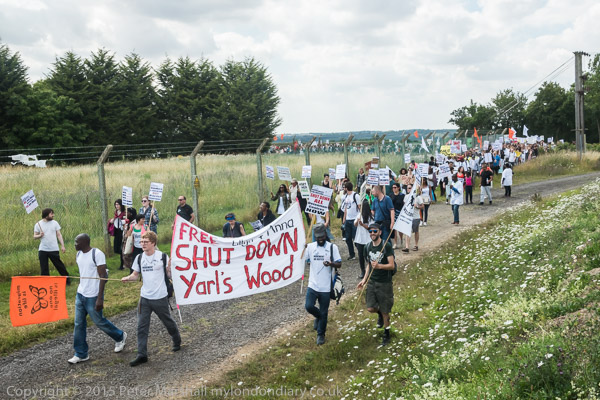
The main entrance to the detention centre is on a private road which is gated some distance from the centre. The coaches bringing people from across the country, and me and others from Bedford Station were parked in a long line at the side of a public road around a mile to the north, close to the locked entrance to the business park. The protest began on an area of grass here as we waited for everyone to arrive, and there were speeches and much chanting and dancing.

Finally the protest began its march, setting off around 300 metres along the road to a bridleway which eventually after around a mile of walking led to a hilly field beside the 20ft high fence around the prison. The lower 10ft of this is solid metal sheeting, but the upper 10ft a sturdy metal gauze, and from the hill we could see women at many of the windows waving to greet the protesters. Those held inside feel isolated and forgotten, though there are a few prison visitors and they are allowed some phone contact with solicitors and others to pursue their asylum cases.

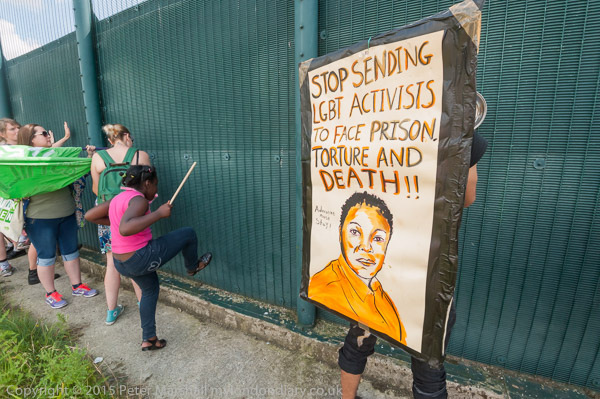
Protesters made a great noise, kicking and banging on the metal sheeting of the fence as well as shouting, and had brought a sound system so that they could speak to the women outside. They were also able to make phone contact with some of them and amplify their voices too.

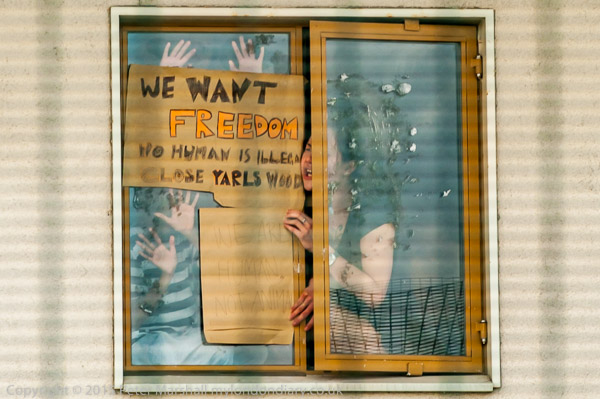
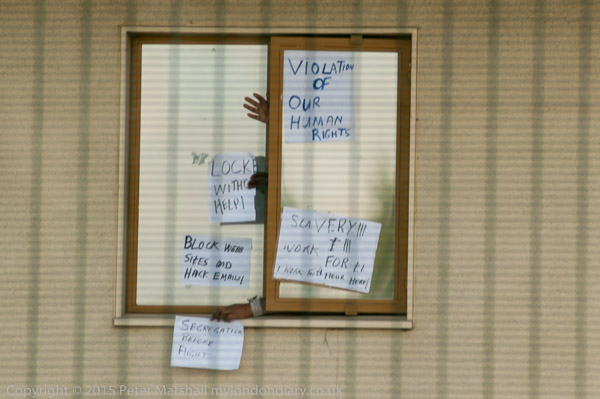
The windows of the centre only open a couple of inches, but some were able to squeeze their arms through the gap and wave cloths or articles of clothing, while others held up messages to the glass. One carefully drawn one read ‘We Want Freedom – No Human Is Illegal – Close Yarls Wood’ while another simply read ‘Help’. Others wrote their mobile numbers large enough to be read by the protesters to contact them.

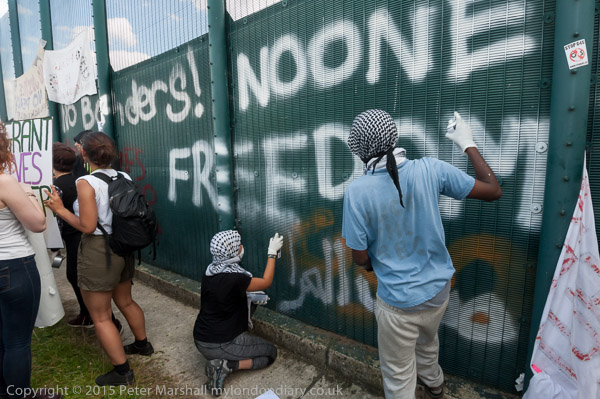
A group of people wearing face masks began to write slogans on the fence, and soon a long length of it was covered with them ‘No Borders’, ‘No One is Illegal’ ‘#SetHerFree’, ‘Shut it Down’, ‘Gaza 2 Yarls Wood Destroy Apartheid Walls’, ‘Racist Walls’ and more.

The speakers on the hill facing the prison included several who had been held inside Yarls Wood and could see women inside they knew, and others who had been in other detention centres. Most people who are held in this way are finally released and allowed to stay in the UK – sometimes after several years of imprisonment – and their seems no justification for locking them up in this way.

Here’s the final paragraph I wrote back in 2015:

Too soon we had to leave. And they had to stay. As I walked away to catch the coach back to Bedford station I felt ashamed at the way that my country treats asylum seekers. They deserve support and humanity and get treated worse than criminals.

More on My London Diary: Close Down Yarl’s Wood


Class War Protest Jack The Ripper Opening

Class War Protest Jack The Ripper Opening

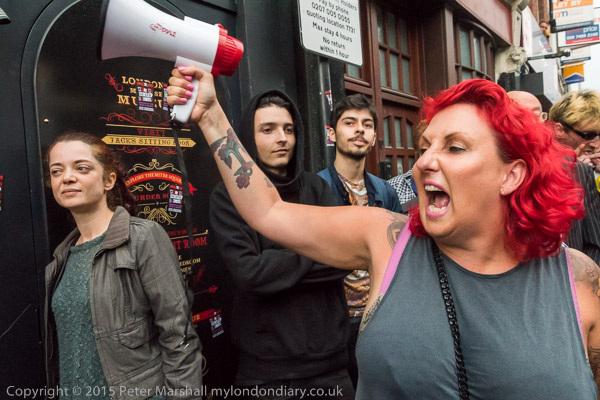
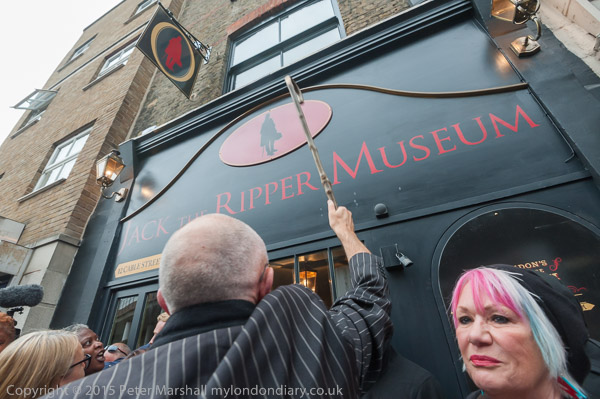
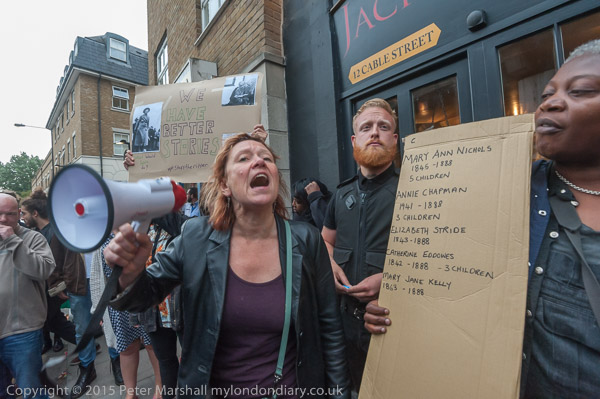
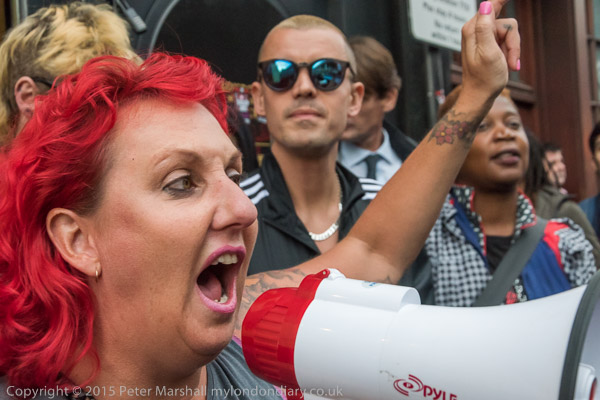
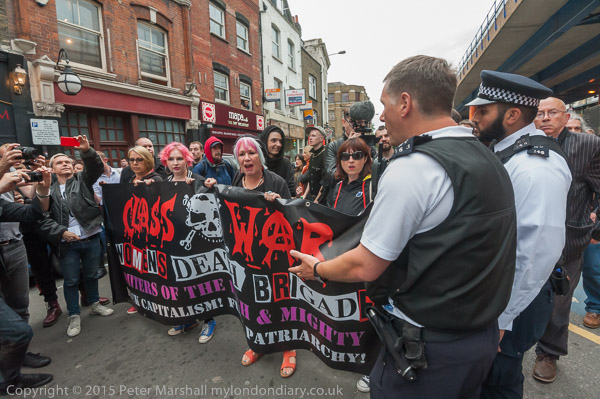
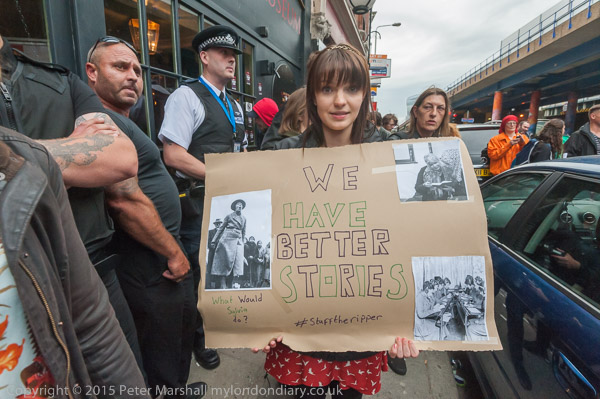
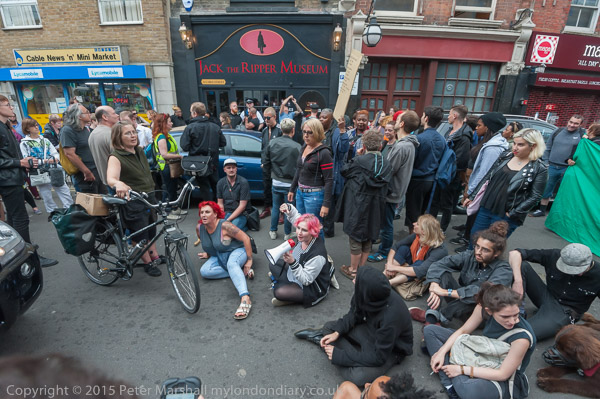
Class War and others protested on Wednesday 5th August 2015 outside the newly opened Jack The Ripper “museum” in Cable St days after it first opened. Class War had called this protest as soon as the news became public, and others had organised another protest the previous evening which I had been unable to attend. Class War later organised further protests outside the museum which I also photographed.

Class War Protest Jack The Ripper Opening

Unfortunately the Jack the Ripper tourist attraction in Cable Street is still open, pandering to a popular taste, particularly among tourists to the city, for the sensational and to wallow in the grisly details of this brutal and horrific series of murders in London of five working-class women on the streets of Victorian London.

Class War Protest Jack The Ripper Opening

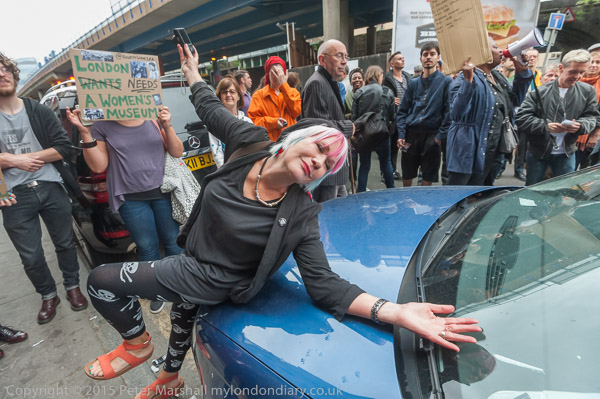
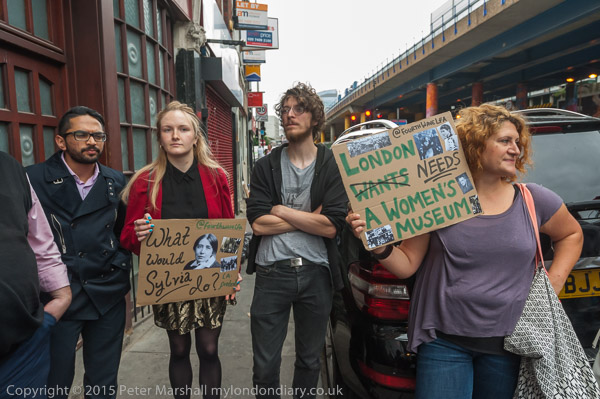
The museum was set up according to its planning application as the “first women’s museum in the UK” which “will recognise and celebrate the women of the East End who have shaped history, telling the story of how they have been instrumental in changing society.” A number of people gave advice or worked for free or at cost because they supported the project on this basis, and felt disgusted at how they were duped.

Class War Protest Jack The Ripper Opening

As I commented in 2015, ‘People who have seen the museum have been revolted at its sensational presentation of violent crimes against women. One of the politer comments was to call it “salacious, misogynist rubbish.“‘

I’ve only seen the shop through the doors and windows, and there does seem to be a lot of merchandise for sale. The on-line reviews of the place are extremely polarised. There are many positive, even fawning examples, though some do seem to follow a very similar pattern.

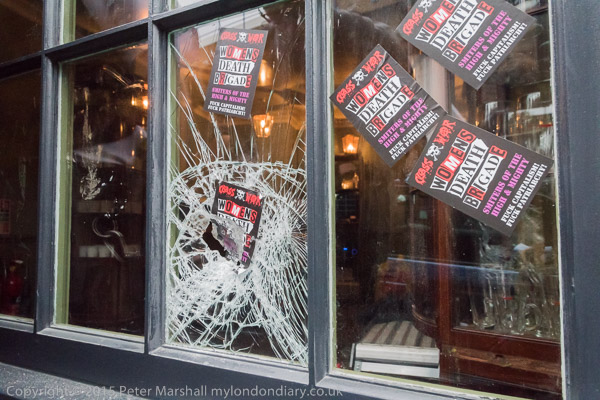
I think the window had been smashed earlier in the day

Others are damning. One comments “The museum is pretty small. It’s effectively 5 small rooms. You could whizz round it in 10 minutes easily. In no way does it represent good value for money. One of the rooms was pure conjecture too (What Jack the Ripper’s living room might have looked like…!?). It’s rather light on any kind of detail. For people with anything more than a superficial interest in the history etc, this is a waste of your time and money.”

Another states “I have no idea how it got so many positive reviews… It’s £12 per person and we’ve basically seen everything after 10 minutes. There’s nothing in this museum that isn’t already in the Google images.” Others are far more negative about the exploitation of the sadistic murders of women for profit.

So if you are someone who thinks we should celebrate the work of a serial killer who eviscerated five defenceless women – three of them mothers – on the streets of London and feel your holiday would not be complete without wallowing in more of the bloody details you may well enjoy this “museum”, even though it is in the wrong location and has little authentic content.

If you are not sure about the details of the killings and have a strong stomach you can read more, rather too much more, on Wikipedia; it isn’t pleasant reading. For once I’d advise you not to click on the link, or if you do to skip some parts of the entry.

Of course the whole Ripper industry is a tacky area, with many more imaginative and profitable books speculating on the identity of the deranged killer. Although the evidence is only circumstantial the most likely suspect remains Montague Druitt who committed suicide shortly after the last of the five murders, and was one of three named in a letter written five or six years later by a senior police officer who though not involved in the investigation will have had access to the officers and the – now largely destroyed – police records of the case.

More about the protest at Class War at Jack the Ripper ‘Museum’.


Olympic Shame, Holocaust Hero And Iraq Festival

Olympic Shame, Holocaust Hero And Iraq Festival – 2012 On Saturday 4th August 2012 much of the nation and all of the media were in the grip of another sporting obsession the 2012 London Olympics and two of the events I covered had at least some link to this. The third was something rather more serious, celebrating the work of one of the great heroes of the Second World War, not a military hero but a man who saved the lives of many.


Adidas Stop Your Olympic Exploitation – Adidas, Oxford St

Olympic Shame, Holocaust Hero And Iraq Festival

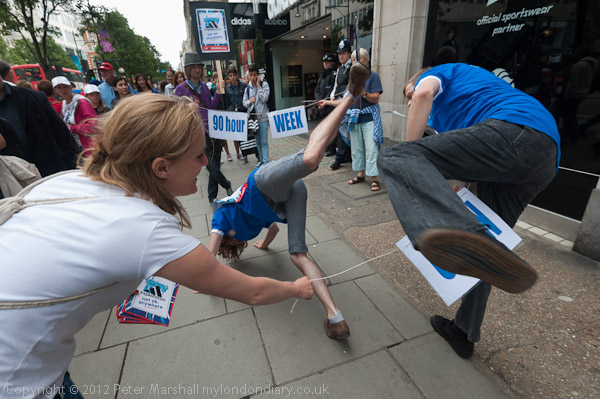
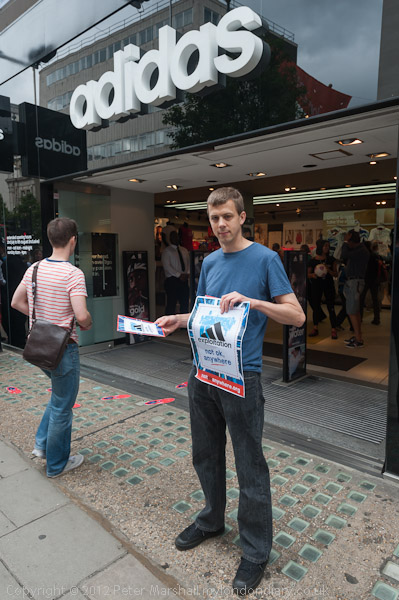
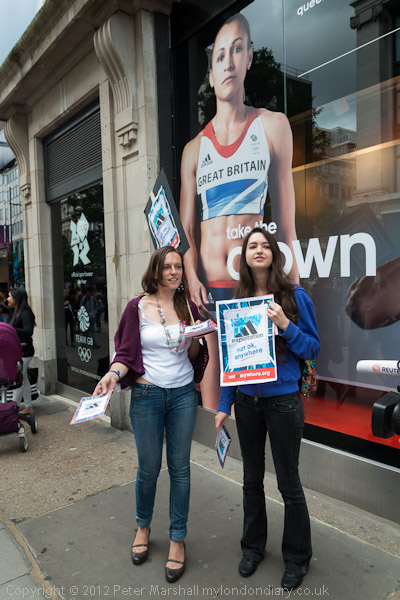
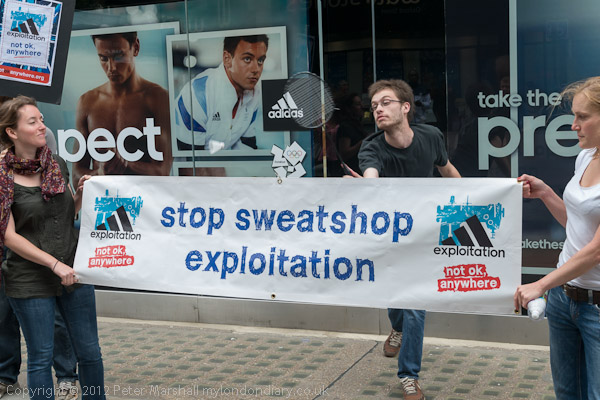
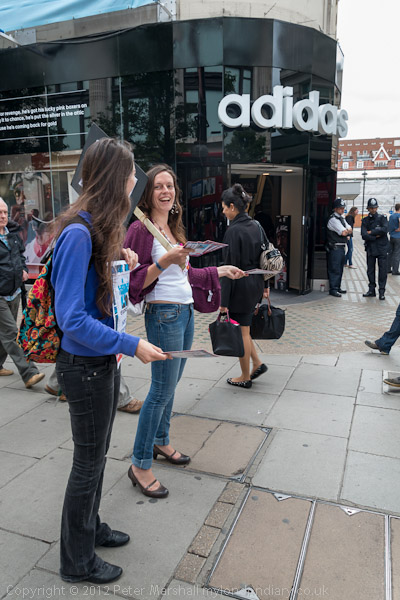
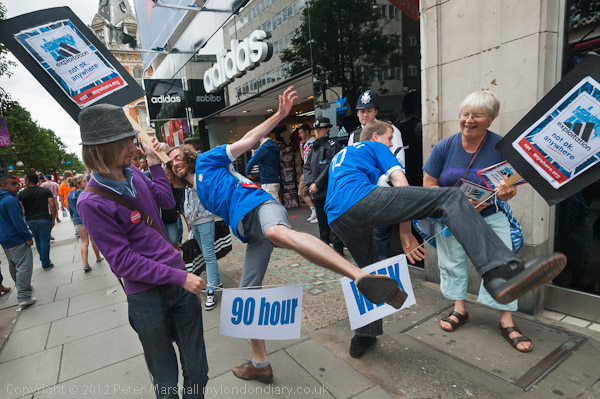
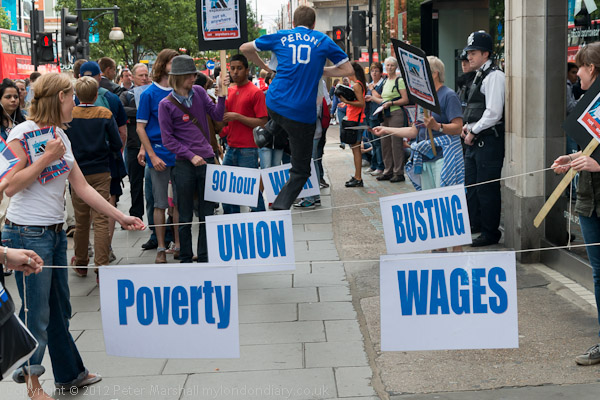
War on Want held a protest outside Adidas on Oxford Street, playing games and handing out leaflets because workers making clothes for the official sportswear partner of London 2012 in Indonesia, Sri Lanka and China get poverty wages are not allowed to form unions and have little or no job security.

Olympic Shame, Holocaust Hero And Iraq Festival

War on Want stated:
Around the world thousands of workers, mainly women, producing clothes for Adidas are not paid enough to live. There wages do not cover basic essentials like housing, food, education and healthcare.
With such low wages, workers have to work excessive hours just to scrape together enough to get by, sometimes beyond legal limits – up to 15 hours a day.
In many cases workers are told that if they try to organise trade unions to defend their rights, they face harassment or they will be fired.

Olympic Shame, Holocaust Hero And Iraq Festival

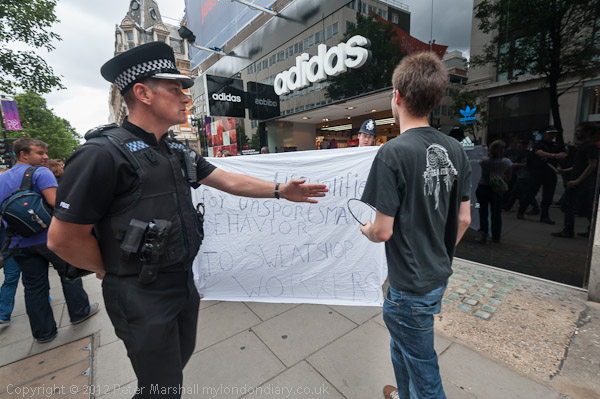
Around 20 police stood around watching as War On Want began their games in protest, and they stopped play as the protesters began their badminton game using a banner as a net, claiming it might endanger people walking past. The street was even more crowded than usual with people who had come to London to attend the events, some of whom stopped to talk with the protesters and express their disgust at the exploitation of foreign workers, but the action by Scottish police drafted down to London perhaps reflected a lack of experience in dealing with protests.

The badminton continued for a few minutes in a side street, and then they turned to a rather short hurdles event. Again when they ‘ran’ this on the pavement in front of the Adidas shop police fairly soon stopped it, perhaps because Adidas complained that half the area of pavement was its property.

As well as leaflets, War On Want was handing out Freepost postcards to people to send to Herbert Hainer, the CEO of Adidas, care of War on Want, calling for Adidas to end the exploitation of workers.

Unusually Adidas sent out a person from their PR agency to talk to me as I began to take pictures of the event, and she later sent me an e-mail stating Adidas was “fully committed to protecting workers rights and to ensuring fair and safe working conditions in factories throughout our global supply chain.” Unfortunately it was clearly an attempt to mislead as it was irrelevant to the claims that were made by War on Want about wages and conditions in factories in Indonesia, Sri Lanka and China producing goods for Adidas. She also said that they had tried to contact War on Want to discuss their claims but had been unable to do so.

A War on Want press release gave full links to the cases on which their claims were made and stressed that they had taken part in discussions with Adidas, “but the multinational continues to deny the widespread nature of the problems and has failed to respond to the organisation’s demands that the firm commits to paying a living wage.”

Of course Adidas is not the only major sponsor of London 2012 and other major sporting events – and London 2012 showed itself also to be blind to the activities of Dow, Atos, BP and all the others.

More at Adidas Stop Your Olympic Exploitation.


Raoul Wallenberg 100th Anniversary – Great Cumberland Place

Olympic Shame, Holocaust Hero And Iraq Festival

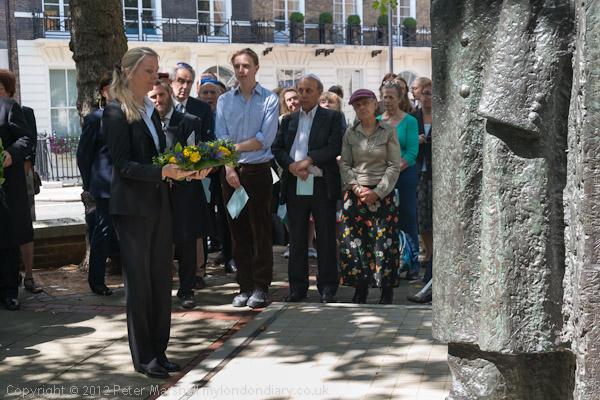
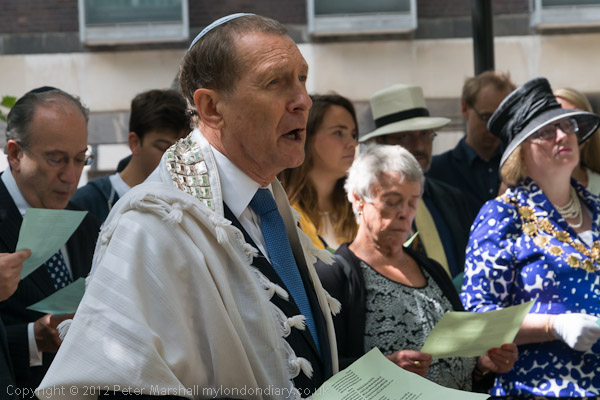
A ceremony took place around the monument erected to Raoul Wallenberg in 1997 in Great Cumberland Place, outside the Western Marble Arch Synagogue to mark the 100th anniversary of his birth. Led by Rabbi Lionel Rosenfeld it was attended by the Lord Mayor of Westminster and the Swedish Ambassador as well as many from the synagogue and the Swedish Church in London.

Rabbi Lionel Rosenfeld of the Western Marble Arch Synagogue leading the chanting of a Psalm in Hebrew

Rector Michael Persson from the Swedish Church talked about Wallenberg, who he called ‘an average man’ who grew up in a banking family but was too sensible, too friendly and too nice to be a banker and so became a businessman. Faced with the situation of thousands of Jews being sent to their death in Hungary he did everything he could to help, following the Lutheran ideal of living, a calling to be yourself and to do good for other people, an ordinary man who was brave when the time came and became one of Sweden’s greatest heroes.

The Swedish Ambassador lays one of several wreaths

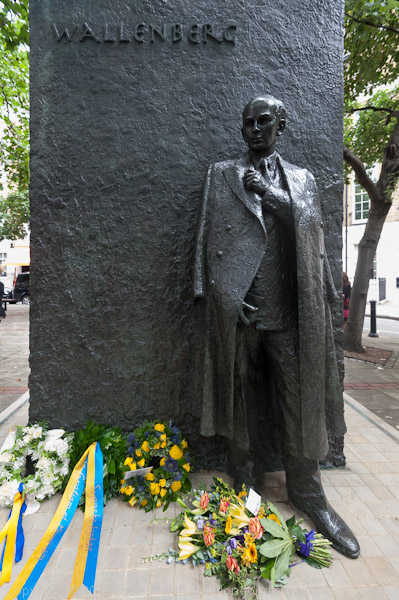
The memorial shows Wallenberg standing in front a a large wall made of stacks of the roughly 100,000 very official looking ‘protective passports’ he issued identifying the bearer as Swedish subjects awaiting repatriation. Although these had no legal status, they looked impressive and, sometimes with the aid of a little bribery, saved the bearers from deportation.

Raoul Wallenberg 100th Anniversary


Iraq Day Festival – Queen’s Walk, South Bank

Olympic Shame, Holocaust Hero And Iraq Festival

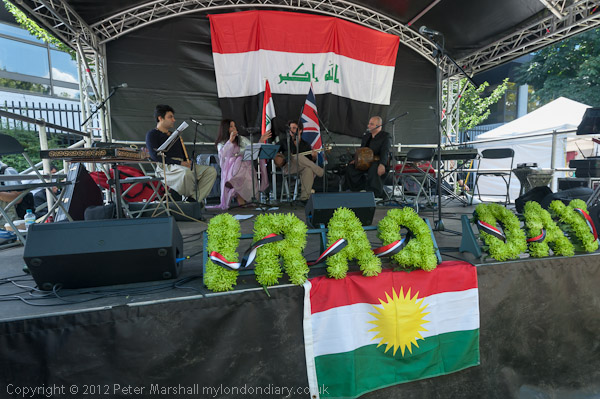
The Iraq Day 2012 festival also had an Olympic link, being “organized to celebrate the games with a hint of Iraq flavor” by the Iraqi Culture Centre in London and sponsored by Bayt Al Hekima-Baghdad in conjunction with the Local Leader London 2012 program.

Although it aimed to build stronger relationships among British-Iraqi communities and promote the the rich cultural heritage of Iraq including its music, food and art in several ways it actually demonstrated the differences between different Iraqi communities.

Given the continuing political divisions and unrest in Iraq after the US-led invasion the stated aim to promote tourism to the country seems entirely wishful thinking. Current UK advice on travel to Iraq begins “Iraq remains subject to regional tensions. Militia groups opposed to western presence in Iraq continue to pose a threat to UK and other interests in Iraq – including through attacks on Global Coalition military bases, diplomatic premises, and foreign nationals…” and ends with the paragraph “If you’re travelling or moving to Iraq, you should take appropriate security precautions before travelling. Outside of the Kurdistan Region you are strongly advised to employ a private security company, make arrangements for secure accommodation and transport and consider pre-deployment training.

US travel advice is even blunter: “Do not travel to Iraq due to terrorism, kidnapping, armed conflict, civil unrest, and Mission Iraq’s limited capacity to provide support to U.S. citizens.”

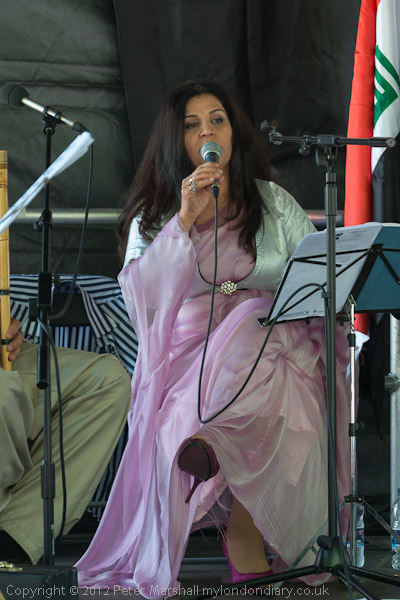
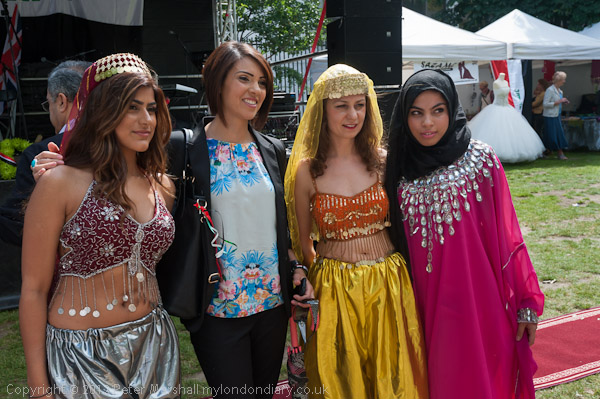
I saw one performer storm off the platform, furious at what she felt was cultural discrimination against the Kurds and overheard a loud and bitter argument between the director of a fashion show and the event organisers. I’d been told the show would start in two minutes and when I went home an hour later it still had not happened.

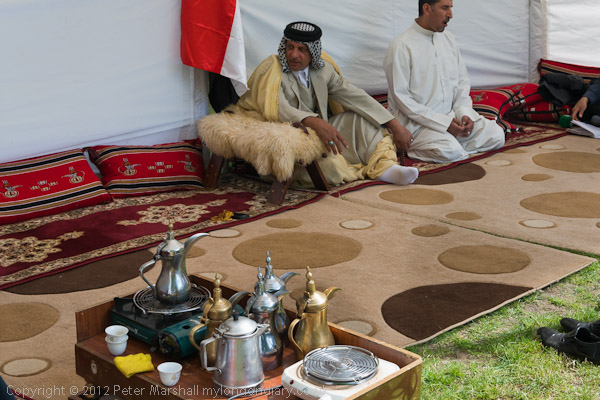
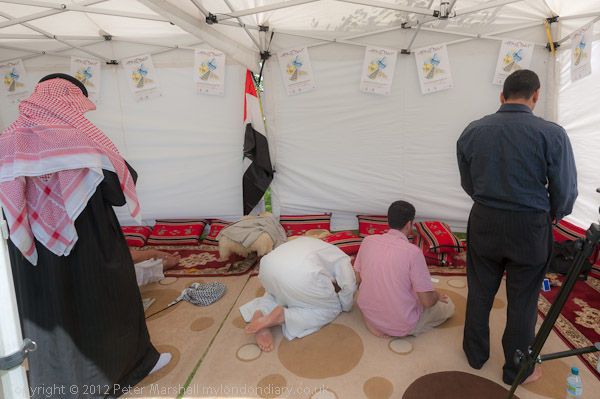
Afternoon prayers

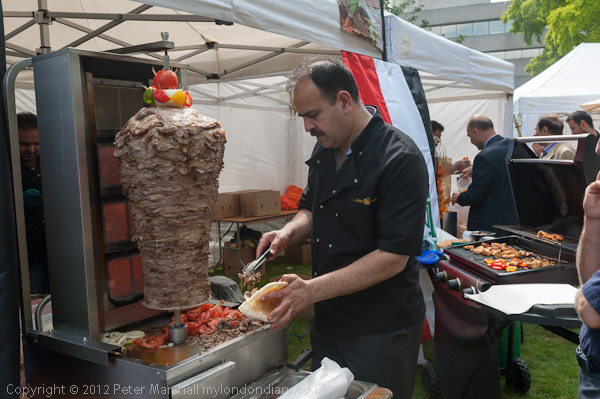
There was a great deal of Iraqi food on offer, and while many of those going past along the riverside walk stopped to taste and buy some this was perhaps rather insensitive so far as many of the Iraqis present were concerned. The event was taking place during Ramadan and although they could see and smell the Iraqi food on offer they were fasting until after sunset at 2041.

Zero Hours at Sports Direct, Cleaners at John Lewis Westfield

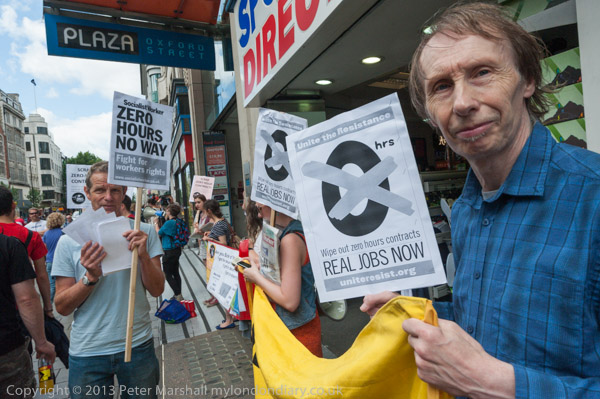
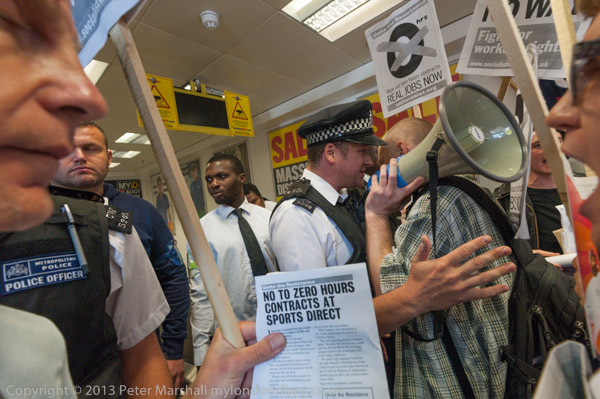
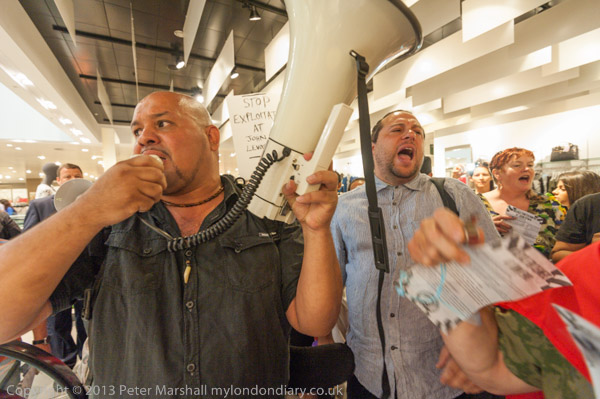
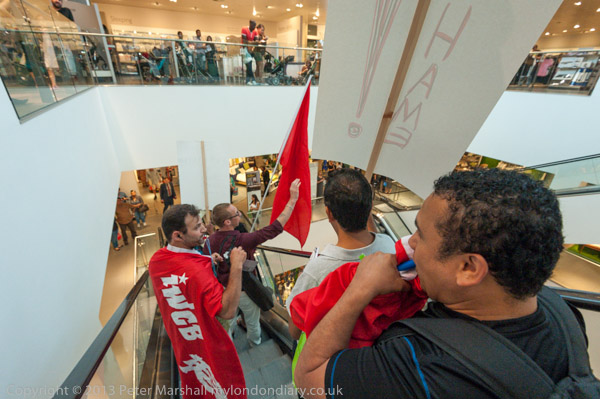
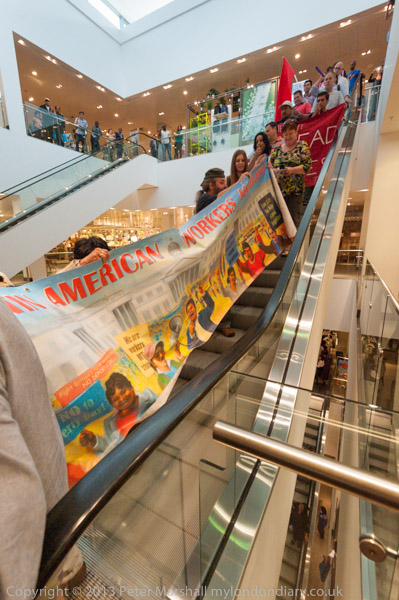
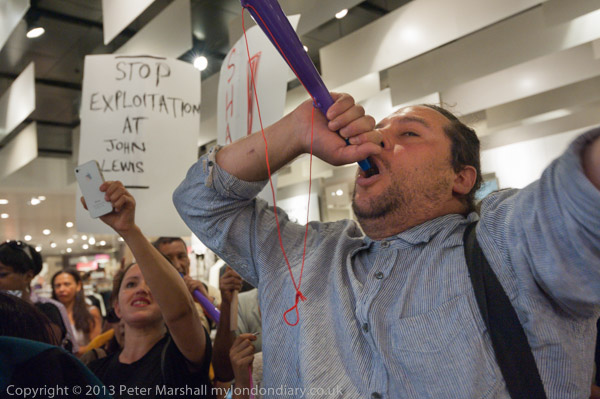
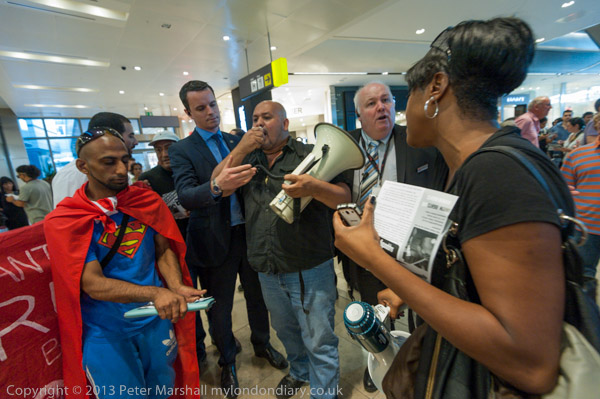
Zero Hours at Sports Direct, Cleaners at John Lewis Westfield – On Saturday 3rd August 2013 I photographed one of many protests calling for an end to zero hours contracts at Sports Direct branches then hurried to Stratford, where a surprise protest inside the store demanding demanded that their cleaners get a living wage and be treated in the same way as other workers in the store.

End Zero Hours Contracts – Sports Direct, Oxford St

Over 85% of the 20,000 part-time staff at Sports Direct branches across the country were on Zero-hour contracts which deprived them of sick pay, holiday pay and other employment rights. These contracts have no guaranteed weekly hours or income and have now become widely used – including by Buckingham Palace and 13 out of 32 London Boroughs.

Essentially they deny the whole concept of a contract as normally understood, agreements without substance which gravely disadvantage workers. They provide no guaranteed weekly hours or income and are used to cut wages and avoid holiday pay and pensions. Despite no guarantee of any income, they oblige the workers to be available for work at the employer’s whim, making it impossible for them to take on other work.

Zero hours contracts are also illegal if they do not give workers the statutory minimum requirements for paid holidays, wages, sick pay, maternity pay etc, but these again are difficult to enforce. There are various types of zero hours contracts but all are essentially designed to exploit workers.

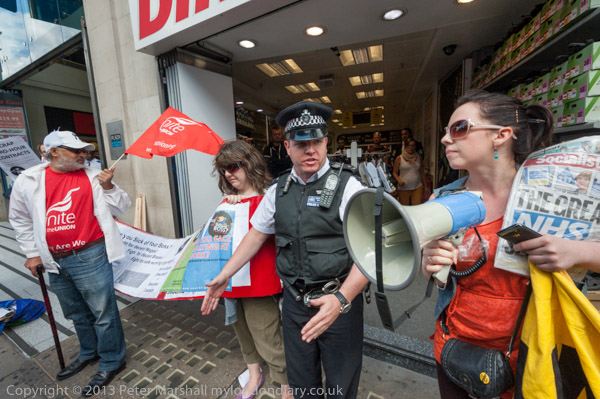
The protest started with around 50 people making a lot of noise on the pavement outside the shop and handing out leaflets to the many shoppers passing by. Many of those who took the leaflets expressed surprise that such contracts were legal – and a change in law in 2015 made it illegal for contracts to deny employees the possibility of working for another employer – though there is no effective mechanism to stop employers penalising workers who turn down shifts offered because they have another job at that time.

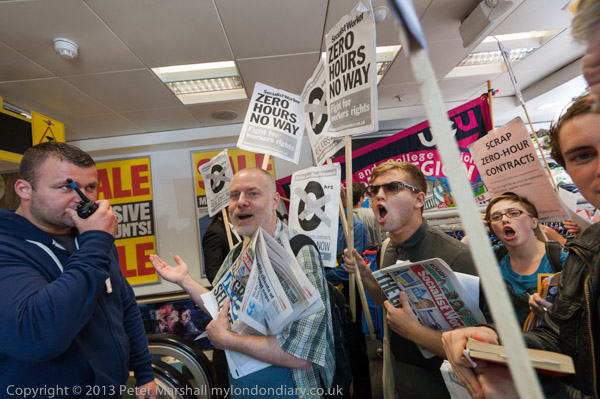
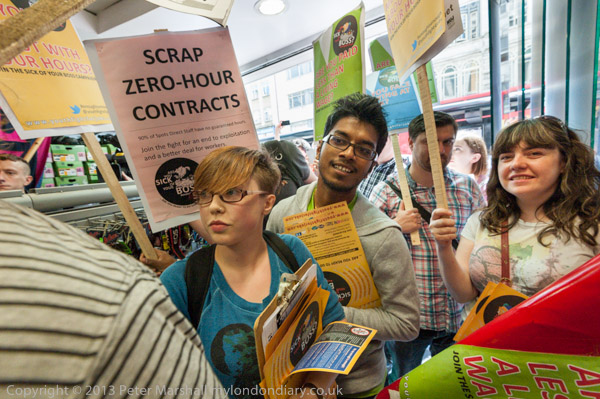
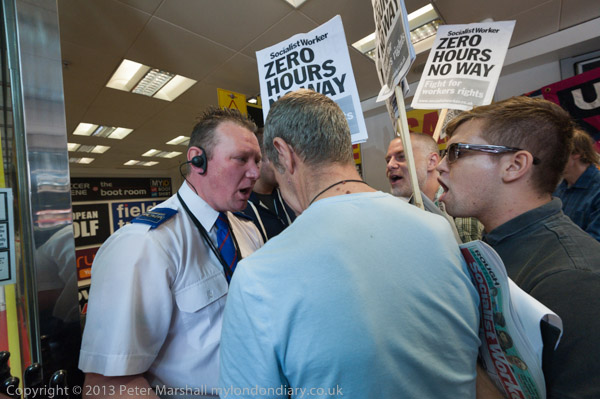
After around 50 minutes the protesters surged into the small street-level area of the store, intending to go down the escalator leading to the main store area. Security staff blocked their path and told them to stop, and they did. One security man tried to push a protester who complained he was being assualted but otherwise the situation remained calm, with people blocking the way to the escalators in protest being watched by police and security.

A police officer came to talk with one of the leading protesters, who made it clear they were taking care to cause no damage and would shortly leave after making their point. The officer retired and after a few minutes people left the store to continue the protest on the pavement for a few minutes before calling an end.

More at End Zero Hours Contracts – Sports Direct.


Cleaners in John Lewis Westfield – Westfield Centre, Stratford

I walked from Oxford Street to take the Central Line to Stratford where I met a group of members of the IWGB outside Stratford Station on their way to protest inside John Lewis. They have been conducting a long term campaign to get the cleaners in John Lewis stores to be treated like others who work on the shop floor.

John Lewis is very proud of the fact that its workers are ‘partners’, with higher pay and better benefits than other shop workers, getting a share in the company’s profits – in 2013 this was a bonus equivalent to nine weeks pay. But the staff who keep the store clean get low pay, lousy conditions of service and are generally treated like dirt by the contract company that employs them.

The cleaners want to be directly employed by John Lewis and so get a share in the profits and the better conditions. They were then getting £6.72 per hour, considerably less than the London Living Wage of £8.55 an hour set by the GLA and backed by the London Mayor, and only statutory sick pay, holidays and pensions from the contracting company which employed them.

Their claims are supported by many of the ‘partners’ they work alongside, and by many John Lewis customers. But the ‘partners’ are afraid to speak out; one of them, Ralph Ashley who worked at Stratford did so and urged his fellow workers to join the IWGB, and was targeted and sacked after he gave an interview to the Guardian. As well as their own demands, the protesters also demanded he get justice and be re-employed.

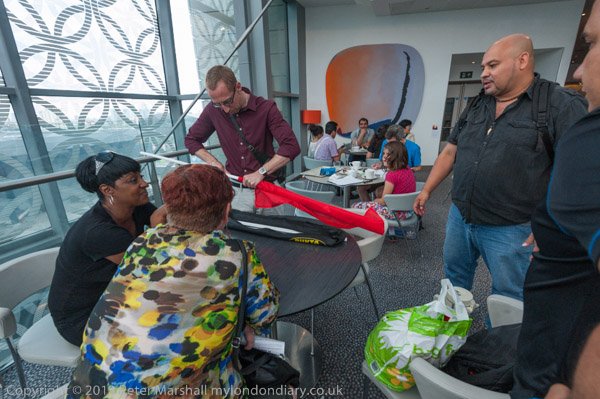
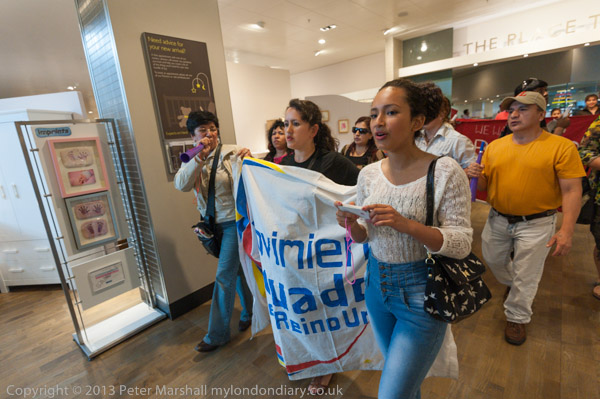
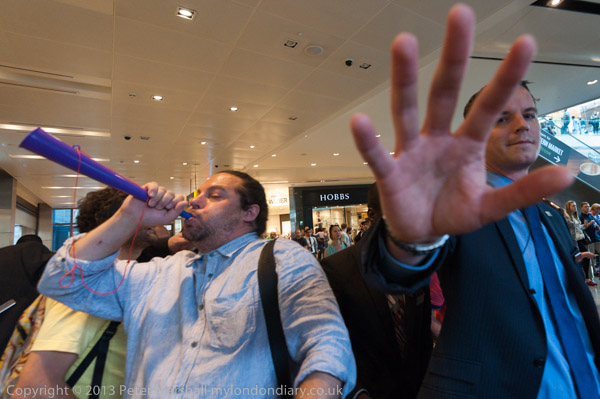
The IWGB members and supporters kept quiet as they moved through Stratford Westfield and made their way to to the third floor restaurant in the large John Lewis store where they got out banners, whistles, plastic trumpets and megaphones before moving out into the centre of the shop for a noisy protest.
Their noisy protest as they marched around the different levels of the store to make their way to the escalators handing out leaflets attracted a great deal of attention and they stopped occasionally to explain the protest and many stopped to watch and listen.

Eventually they reached the first floor ‘street’ level, holding a slightly longer protest there before moving outside. Here a small group of Westfield Security tried to stop the protest and to prevent me taking pictures both with little success. Eventually we left the enclosed street and went outside and around the side of the store.

As the protesters were packing up the police arrived and having been assured that this was a peaceful protest and that the protesters were about to leave took no further action.

Much more at Cleaners in John Lewis Westfield.


Reparations for Slavery, Vedanta & Blood Diamonds

Reparations for Slavery, Vedanta & Blood Diamonds – the three protests I photographed in London on Friday 1st August 2014 were all related to world trade – the Atlantic Slave Trade and current devastation caused by mining industry and the diamond trade that funds Israeli war crimes against Palestinians.


Rastafari demand reparations for slave trade – Windrush Square, Brixton

Reparations for Slave Trade, Vedanta & Blood Diamonds

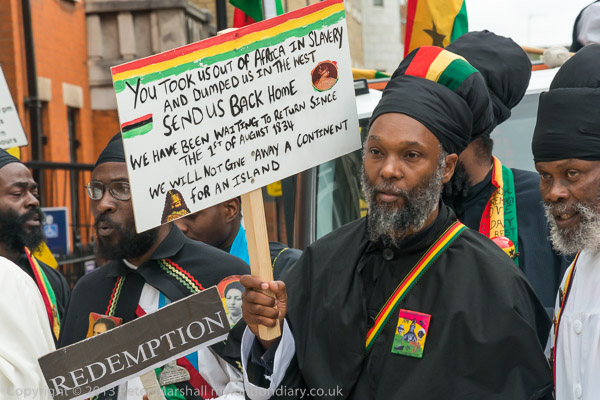
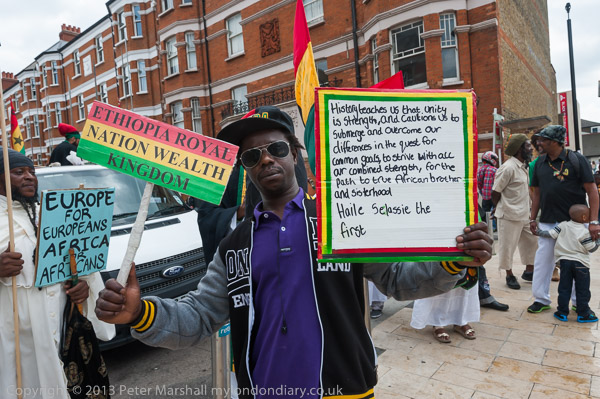
On August 1st 1834 the 1833 Abolition of Slavery Act came into force, ending slavery across the British Empire. But although the slave owners received compensation of £20 millions the freed slaves got none. They were not even freed, but converted to ‘apprentices’ who were expected to continue to work without wages for up to six years until 1838 and were unable to own land.

Reparations for Slave Trade, Vedanta & Blood Diamonds

The payment to the former slave owners was huge – around 40% of the National Budget of the UK, and the Treasury who took out a loan to enable them to pay it. British tax payers – including many descendants of former slaves – were still paying off the debt until 2015, as a rapidly deleted tweet from the UK Treasury confirmed in February 2018.

Reparations for Slave Trade, Vedanta & Blood Diamonds

The Act abolishing slavery was designed largely to ensure that Britain’s hugely profitable sugar industry based on slavery continued after emancipation, and Britain also continued to import cotton grown by slavery in the southern states of the USA as well as sugar from slave plantations in Brazil and Cuba.

August 1st became widely celebrated as ‘Emancipation Day’ and it was the date chosen by Marcus Garvey to found the Universal Negro Improvement Association (UNIA) in Jamaica in 1914, and for a meeting six years later in Madison Square Gardens in New York attended by 25,000 of UNIA’s claimed membership of 4 million.

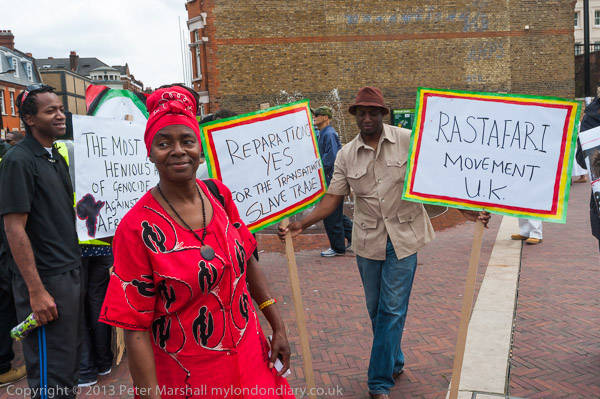
Demands for reparations to be made to the descendants of slaves have so far been met by only token measures, such as the renaming of streets and buildings and official apologies, with some legislation requiring companies to provide information about their involvement in the trade and insurance of slaves.

But since the 1990s there has been a growing movement demanding financial reparations both for slavery, particularly following the First Pan-African Conference on Reparations convened by the Organisation of African Unity and the Nigerian government and held in Abuja, Nigeria in 1993.

In the UK the movement was led by Bernie Grant, MP for Tottenham until his death in 2000. Prime Minister Tony Blair in 2006 expressed “deep sorrow” for Britain’s role in the slave trade, saying it been “profoundly shameful”, though as Wikipedia notes this was criticised as lacking any measures of reparation. A further public apology for London’s role in the slave trade came from then London Mayor Ken Livingstone during the commemorations of the 200th anniversary of the passage of the 1807 Slave Trade Act.

A case was for compensation was brought against Lloyds of London in 2004, but failed. The same year a Jamaican Rastafari call for European countries, particularly the UK to support the resettlement of 500,000 Jamaican Rastafarians in Africa in a scheme costed at £72.5 billion was rejected. Other claims have been lodged by in 2007 by Guyana, in 2011 by Antigua and Barbuda and Barbados.

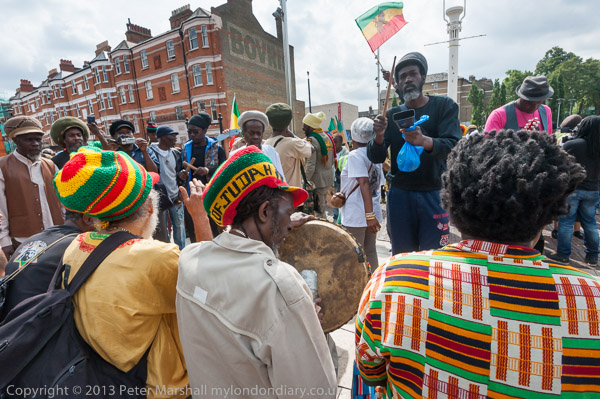
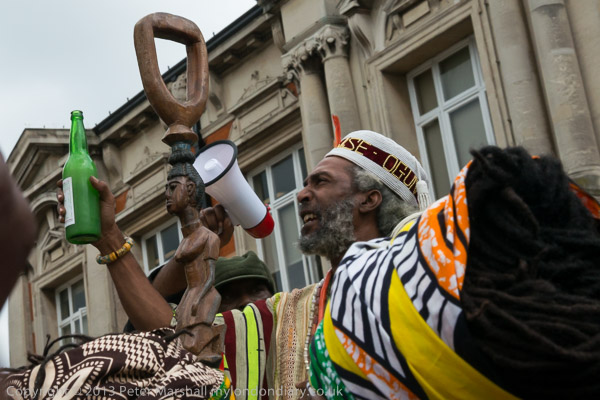
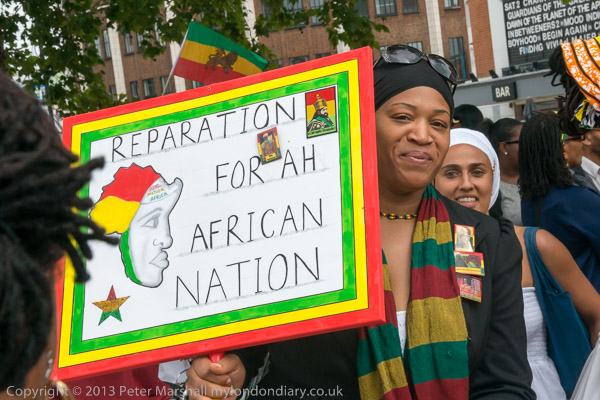
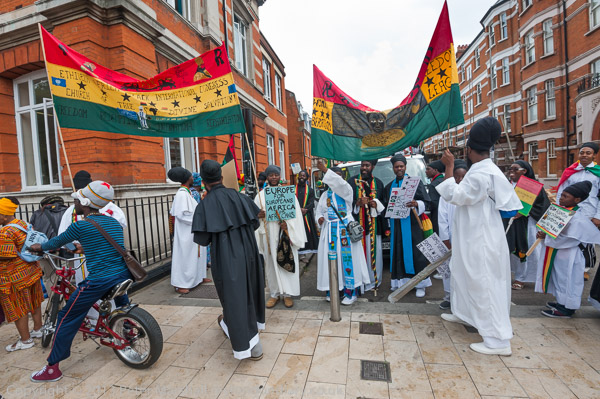
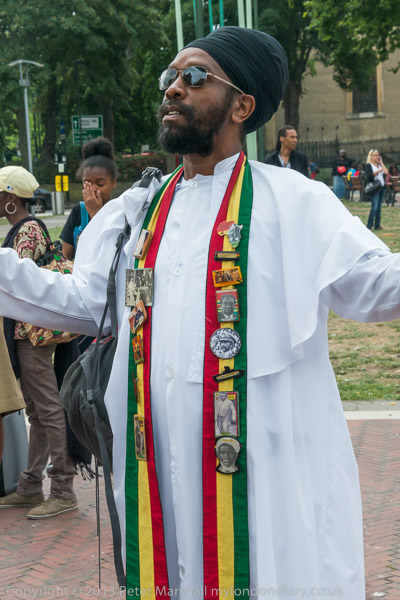
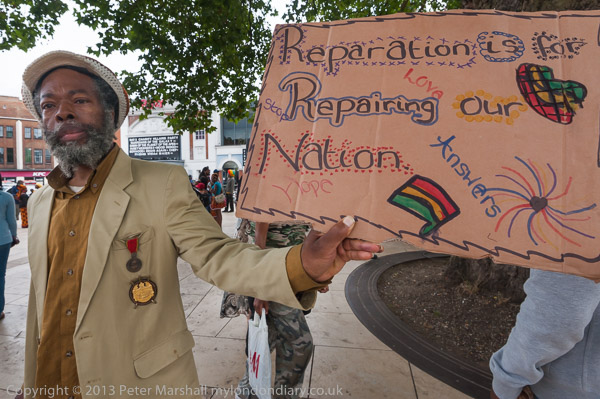
On 1st August 2014, the 100th anniversary of Garvey’s setting up of the UNIA. a large group of mainly people of African and Afro-Caribbean descent gathered in Windrush Square in Brixton for several hours of speeches, celebration, drumming and dancing before they were to march to Parliament to make their demand for reparations. The march has become an annual event in London, but I had to leave shortly before it began.

Rastafari demand reparations for slave trade


Vedanta told ‘end your killing’ – Lincoln Inn’s Fields

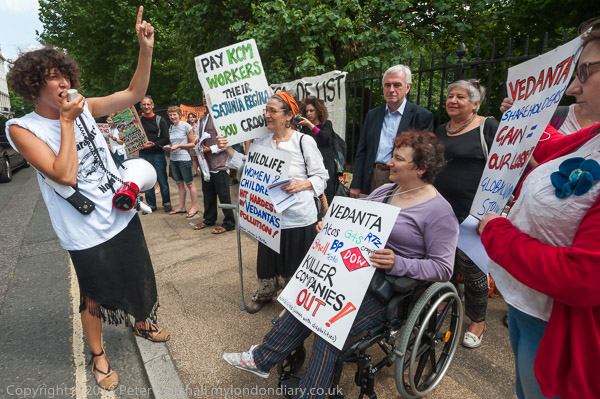
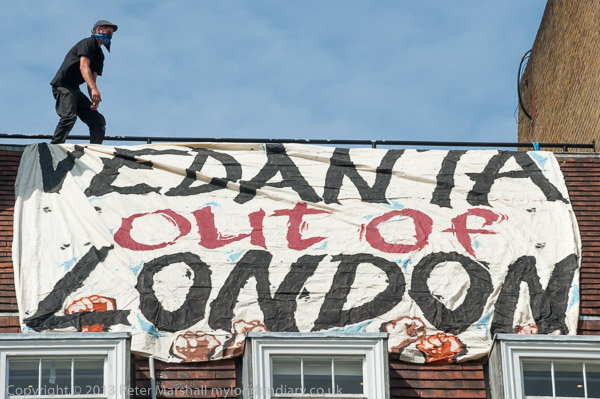
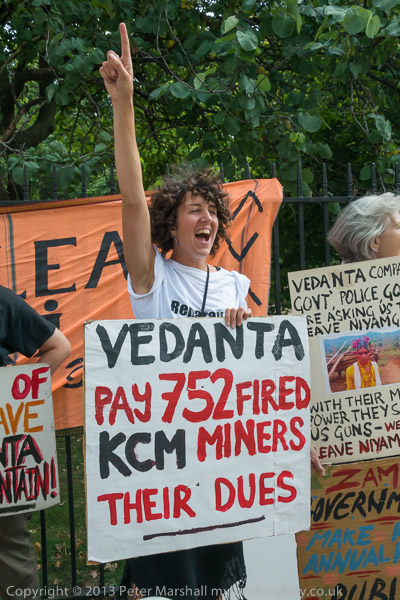
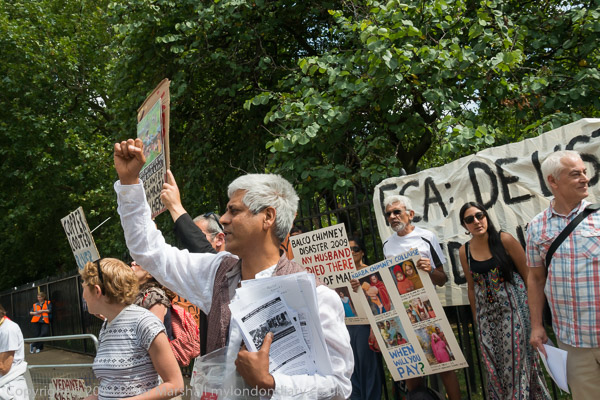
I joined the protest outside the building in Lincoln’s Inn Fields where the FTSE 250 British-Indian mining company Vedanta Resources was holding its AGM. Here and at other protests in Zambia and Odisha and Delhi in India.

Vedanta is a huge company which protesters say is “guilty of thousands of deaths, environmental devastation, anti union action, corruption and disdain for life on earth. They have become one of the most hated and contentious companies in the world.

Their activities, particularly their attempt to destroy the sacred Nyamgiri mountain in India for its aluminium ore, have led to protests around the world, and an Indian Supreme Court decision that, at least for the moment have halted the mining there.

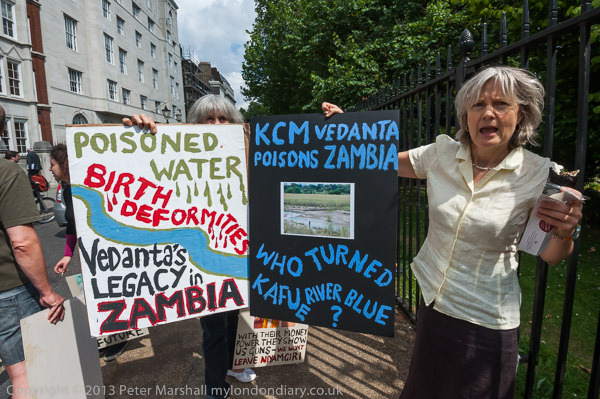
Another setback for Vedanta was the research by activist group Foil Vedanta into their subsidiary Konkola Copper Mines in Zambia, accused of poisoning thousands and causing ongoing birth deformities by major pollution spills in 2006 and 2010. The research showed the company which was claiming it was making a loss and so unable to pay its fines and tax bill was actually making around $500 million a year.

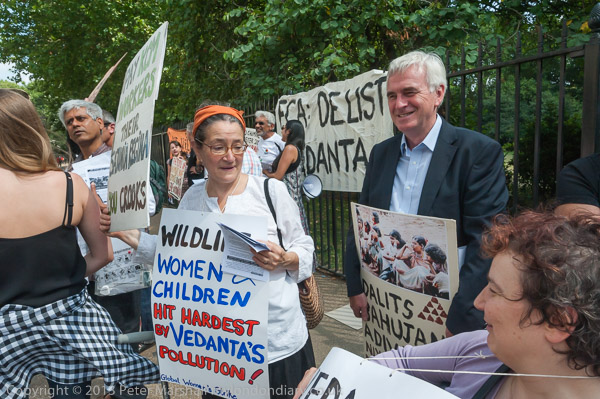
Labour MP John McDonnell was among those who had become a shareholder to attend the AGM

Vedanta’s problems being made public resulted in a dramatic crash in its share price and the previous December it dropped out of the FTSE100. Billionaire owner Anil Agarwal responded by buying large numbers of the shares and was now said to own over two thirds of the company. But there were other shareholders going into the AGM, including a few activists who had bought a share to entitle them to attend and ask questions.

The activities of these activists, both inside and outside the AGM every year, were eventually were an important part in the decision four years later by Agarwal to make Vedanta a private company.

Vedanta told ‘end your killing’


Boycott Israeli Blood Diamonds – De Beers, Piccadilly

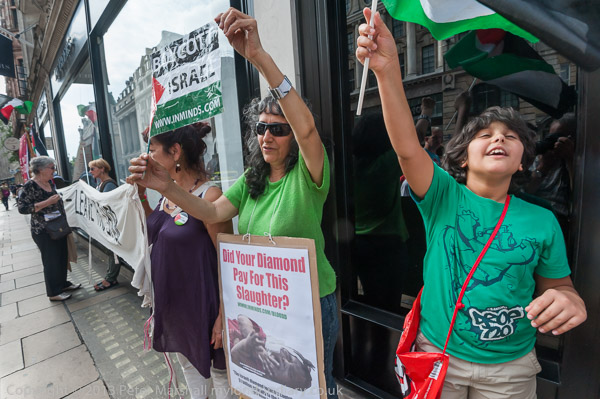
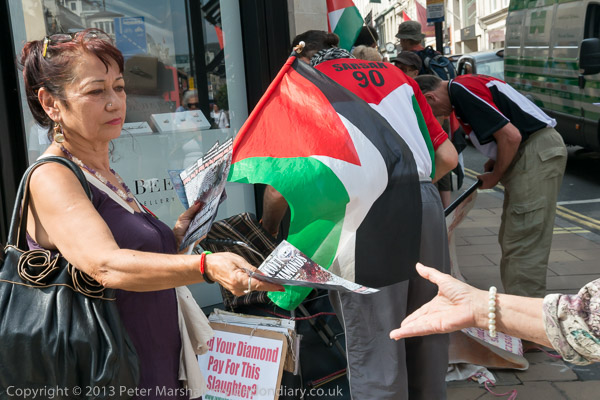
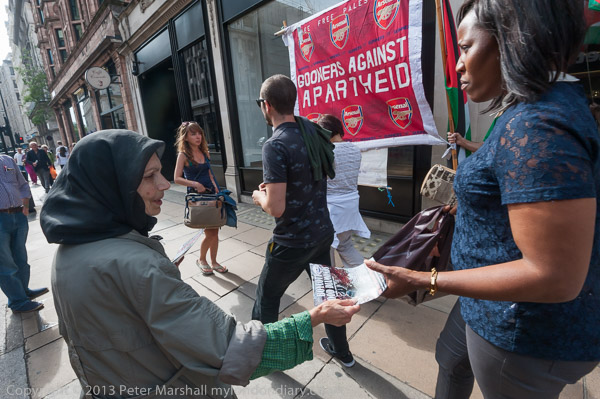
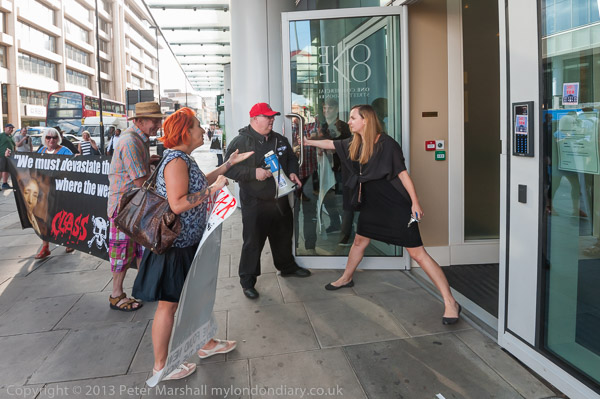
Finally I made my way to Piccadilly where pro-Palestinian campaigners were protesting in front of De Beers jewellery shop, calling on people to boycott diamonds cut and polished in Israel.

Although there are no diamonds mined in Israel, according to Wikipedia, almost a quarter of Israel’s total exports come from the sales of diamonds cut and polished in the country and they account for almost one eighth of the total world production.

Israel claims that all these diamonds are covered by the ‘Kimberley Process’ which aims to prevent diamonds mined in conflict areas and sold to finance war and insurgency coming to the market. But campaigners say that this defines blood diamonds too narrowly, enabling Israel’s diamond-cutting industry to avoid attention, and the “Boycott, Divestment and Sanctions (BDS) campaign, among others, has called for diamonds processed in Israel to be considered conflict diamonds.”

Boycott Israeli Blood Diamonds


Aldgate, Class War Rich Door, Poor Door

Aldgate, Class War Rich Door, Poor Door – On 30th July 2014 I went to London to cover another in the long series of protests by Class War over the ‘social apartheid’ of separate entrances to large blocks of flats for the wealthy and poor people who live in them. I went up early and walked around the area beforehand.

Class War – Rich Door, Poor Door – 1 Commercial St, Aldgate

Class War, including three of their candidates for the 2015 General Election the following year, protested at 1 Commercial St in Aldgate which has a separate ‘poor doors’ for the social housing flats they had to include to gain planning permission for the development.

The front entrance on Whitechapel High St (One Commercial St is the name of the block) has a hotel-like reception desk, and is staffed 24 hours. It leads to the lifts for the expensive flats, many owned by overseas investors. Like most such buildings, some of them are empty and seldom used, while others are short term holiday lets.

Flats like these are advertised to overseas investors particularly in the far East as providing a high return on capital. Buy a flat now and you will be able to sell it for much more in a few years as London housing prices continue to soar – some publicity suggested that people could get the equivalent of a 13% interest rate. It’s easier to sell if you keep the flats empty, though you can use them for the occasional visit to London, or even let them over the web for a few days or weeks as holiday lets to generate a little actual income.

As I commented:

The web site for One Commercial St (studios, apartments and penthouses specified to exceptional levels, with exclusive services for residents – or rather those residents allowed to use the rich door) suggests that the average rent in the area is £1,935 pcm and investors can expect a 32% increase in property value by the time Crossrail opens. It’s all a part of the madness that means London is being developed not for the people of London but for investors in China, the oil states and elsewhere.

The building owners claimed there was no internal connection between the part of the building with expensive privately owned flats and that occupied by social housing tenants, although that was simply a lie – and on a later occasion I was taken through by one of the private owners from her flat to the ‘poor door’ which she used when walking her dog.

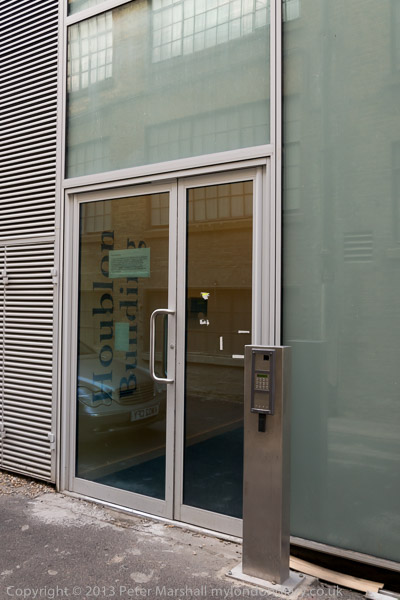
The owners give the social housing in the block a different name and only allow the tenants to access their flats through a side door in what was when Class War began their protests a dark alley often full of dumped rubbish, smelling of urine. A card entry system let them into a long bare corridor with some mail boxes on one side, quite a contrast to the large foyer with a reception desk, concierge, comfortable seating and art works enjoyed by the rich.

The protests had by then resulted in some small improvements, the alley now having been cleaned and new lighting installed, though the card entry system was apparently often out of order. And the alley still had that nasty smell.

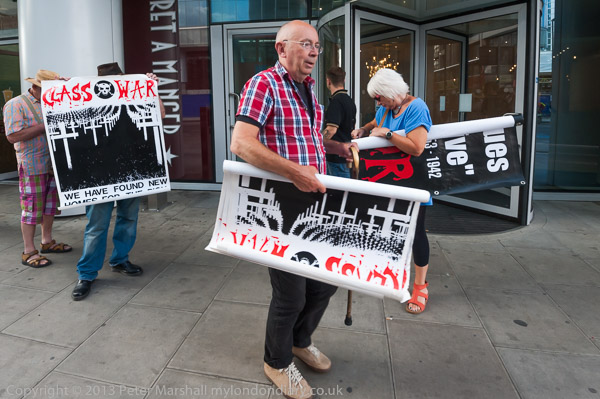
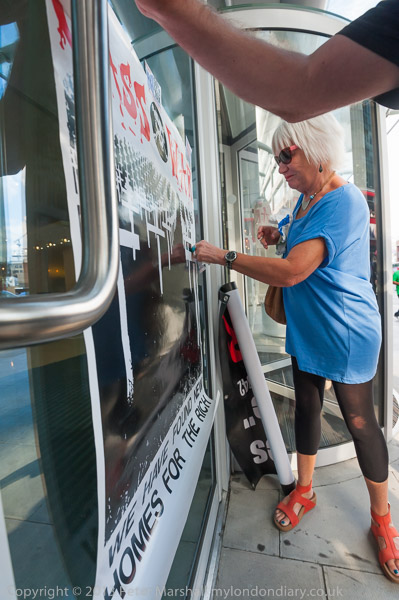
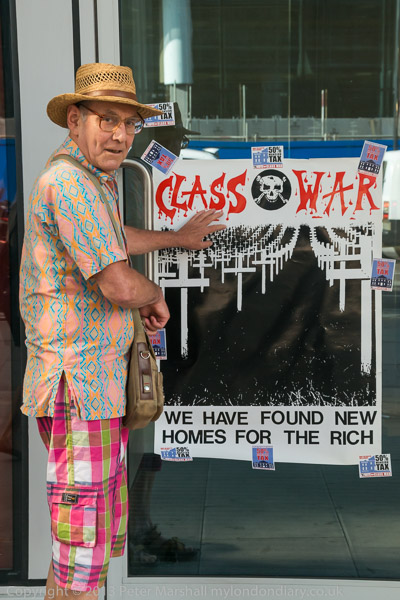
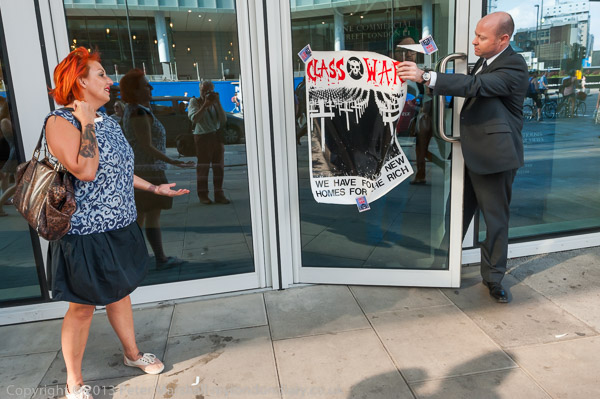
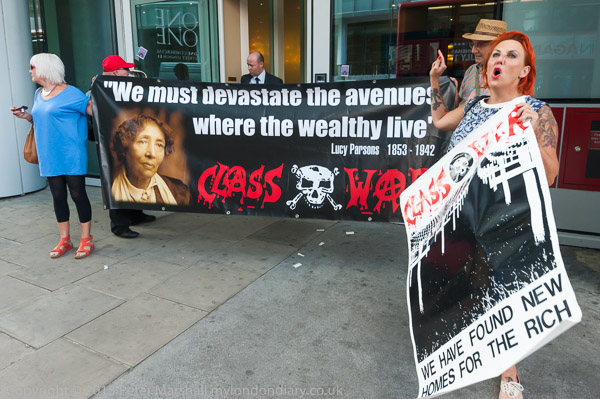
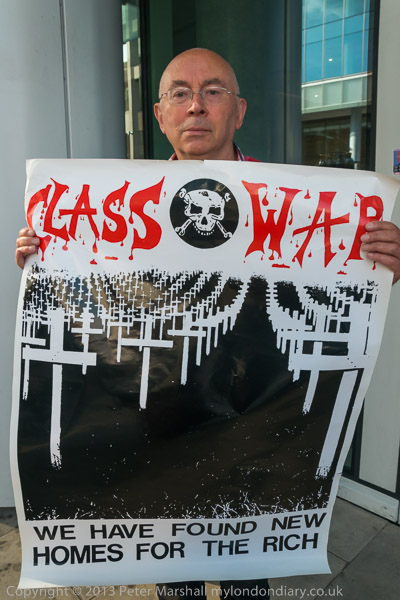
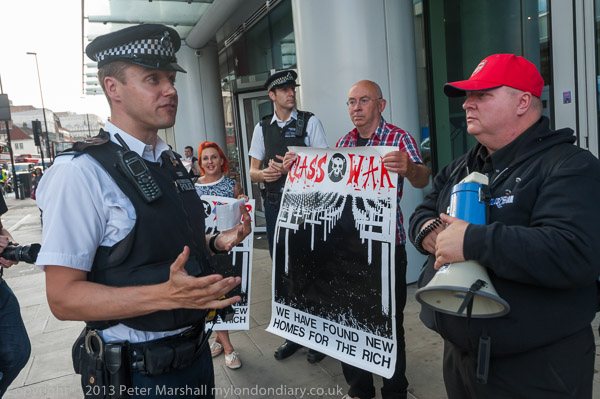
The protesters came with a banner featuring the radical US labour activist Lucy Parsons (1853-1942) with her quotation “We must devastate the avenues where the wealthy live” and posters – with their skull and crossbones – and the message “We have found new homes for the rich” with long rows of grave crosses stretching into the distance – which at one time police tried to arrest them for. They stuck posters on the windows on and around the ‘Rich Door’ using Class War election stickers with their promise of a 50% mansion tax. The building manager came out and pulled the posters off and screwed them up, but they held up others beside the door.

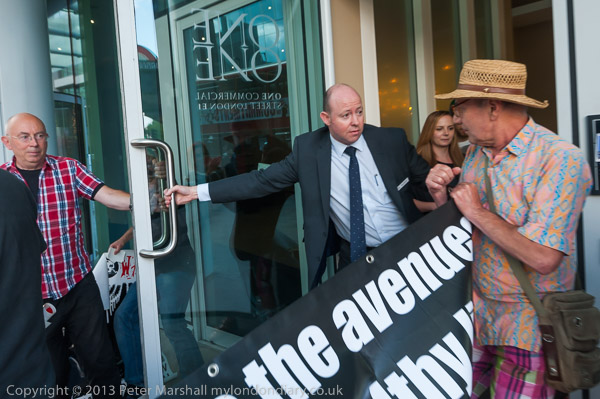
Most of the protest took place in front of the ‘Rich Door’, where they chanted calling for an end to the social apartheid and attempted to talk with the few people who left and entered the building. They held the door open to make their protest more easily heard inside, and there was a brief brief tug of war as security and a resident tried to close it. Eventually they let the door be closed, probably when they saw police arriving.

Police only arrived around 15 minutes after the protesters and they went directly inside the building to talk to the building manager and concierge. Then the police came out and argued with the protesters, trying to get them to move further from the doorway, but they insisted on their right to protest where they wanted on the pavement. Class War kept up the protest for around an hour before they decided it was time to leave – and come back for another protest there the following week. This was just one of a series of around 30 ‘Poor Doors’ protests, most of which I photographed – and published a ‘zine’ of the pictures, still available from Blurb.

Class War – Rich Door, Poor Door


Aldgate & Spitalfields

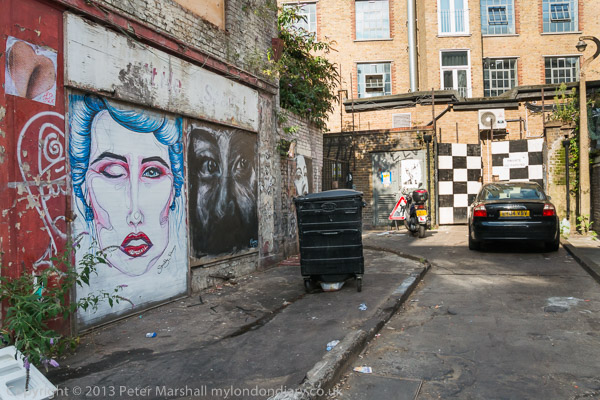
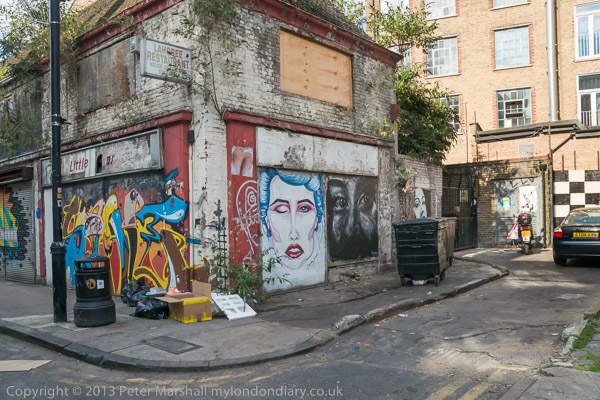
I was early for the protest at One Commercial St, and took a short walk around the area while I was waiting, going up Commercial St and then back down Toynbee St. I was astonished at the amount of new buildings since I was last here a few years back, and with a great deal of work currently going on. At night all the red lights on the tops of the cranes make London look like a Christmas tree.

It is of course a prime site just on the edge of the City of London, an easy walk to the city, and with plenty of buses, underground stations and both Liverpool St and London Bridge stations not far away. London City Airport is a short taxi ride too, or under half an hour by public transport, and Brick Lane’s curry houses just around the corner. Crossrail will cut journey times to Canary Wharf to 4 minutes when Whitechapel station opens in 2018.

In fact Crossrail only opened in 2022, four years behind schedule, but investors still did pretty well, and much more of the area has been demolished and replaced by investment flats. Our government still counts these as a part of our meagre housing programme although they make no contribution towards easing the housing crisis. We need strong laws to limit overseas ownership of property and financial encouragement to build homes for people, particularly homes at social rents.

Aldgate & Spitalfields


March for a People’s Olympics

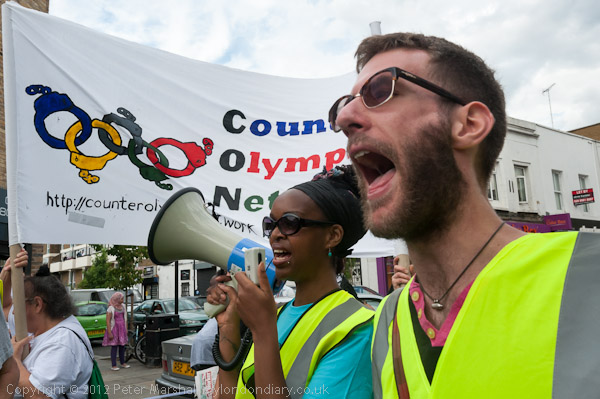
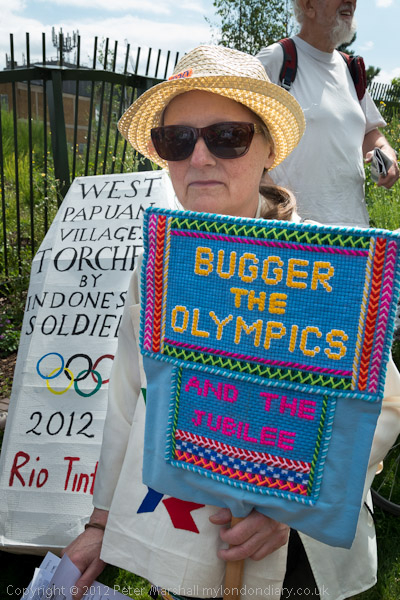
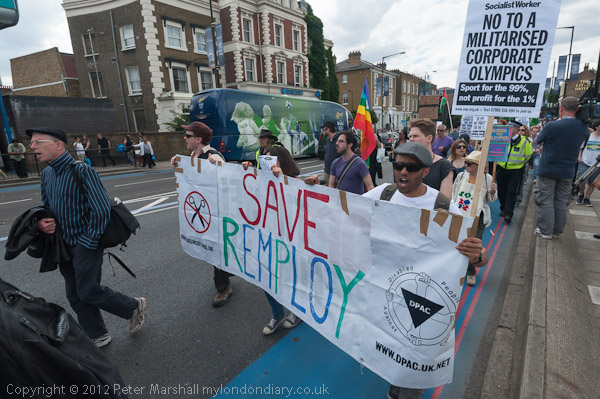
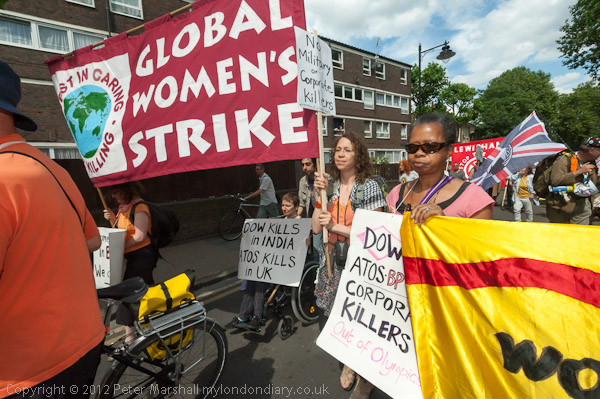
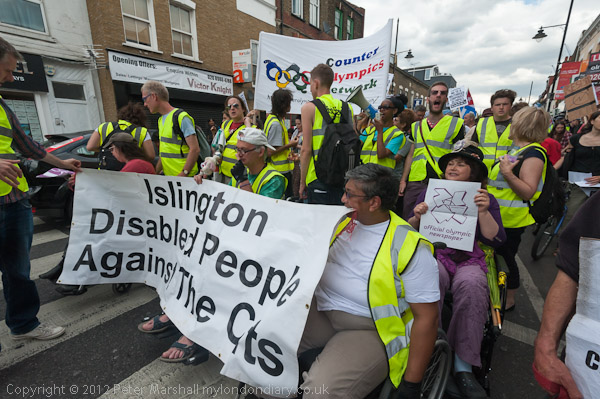
Ten years ago on July 27th 2012, as the London 2012 Olympics were getting underway in Stratford, people, mainly from the local area, marched to call for an end to the corporate takeover of the Olympics and the draconian policing and military presence largely aimed at the protection of brands and for the games to meet its legacy promises.

The authorities had done their damnedest to stop the protest taking place – first they had tried to ban it altogether, then Transport for London had refused permission for them to march along any roads which were emergency backup Games routes. But protesters agreed with police that they would leave the road if there was any emergency. Tower Hamlets council tried to ban any speeches or other events on Wennington Green where the march ended, and protesters were threatened they would be arrested if they carried banners, placards or t-shirts with political messages – though it was hard to see any legal basis for doing so.

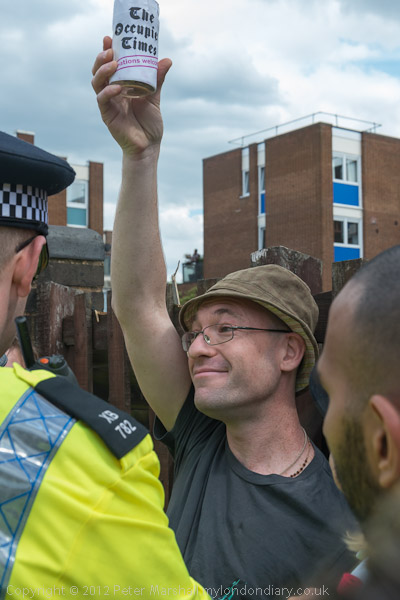
The ‘Whose Games? Whose City?’ protest went ahead despite the threats, with only one small incident when police seized and searched a man who had cut a piece of police tape. A crowd of marchers supported them and shouted for his release and after a few minutes he was set free without charge and the march continued.

The threats and public controversy had doubtless persuaded many not to come to the event, where around 500 marchers mingled with press and TV from around the world at the starting point in Mile End Park at midday. The organisers, the Counter Olympics Network (CON) had made clear that they were not against the Olympics as a sporting event but against the way it had been taken over by corporate interests. In my long account of the event on My London Diary I quoted from several of their statements, including:

"the close ties between the Olympic brand and its corporate sponsors who, despite IOC claims of vetting on ethical grounds, include serial polluters, companies which seriously damage the environment and which wreck or take lives, Coca Cola, Rio Tinto, BP, Dow Chemical. G4S, Cisco, and Atos deny people their human rights in a variety of situations while Macdonalds helps to fuel the obesity epidemic. London2012 provides benefits at taxpayers’ expense while receiving little in return."

CON also pointed out the many broken promises made about the games and the very doubtful legacy the games will leave, particularly in East London.

"the lack of benefits for local people and businesses, the fantastic expansion of security into our daily lives, the deployment of missiles and large numbers of troops, the unwarranted seizure of public land at Wanstead Flats, Leyton Marsh and Greenwich Park."
A man celebrates after the crowd made police release him

Later in his speech on Wennington Green, Chris Nineham of the Stop The Olympic Missiles Campaign declared that the London Olympics had already set a number of records, including the largest ever number of arrests on the first day, the highest ticket prices, the most intensive application of branding rules and the highest level of militarisation of any Olympic games, with far more being spent on security that even in China. There were now more troops in London than at any time since World War 2, and more than at any time in Afghanistan, where our military activities were now making us a terrorist target in London. Among the other speakers was Melanie Strickland, one of the 182 ‘Critical Mass’ cyclists arrested the previous night for riding near the Olympic stadium.

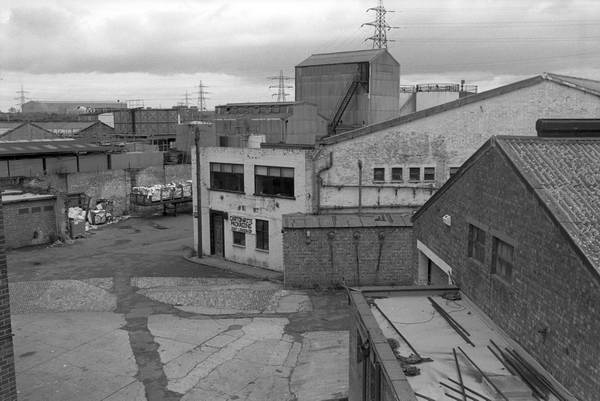
Industry on the Olympic site, Marshagate Lane, 1990

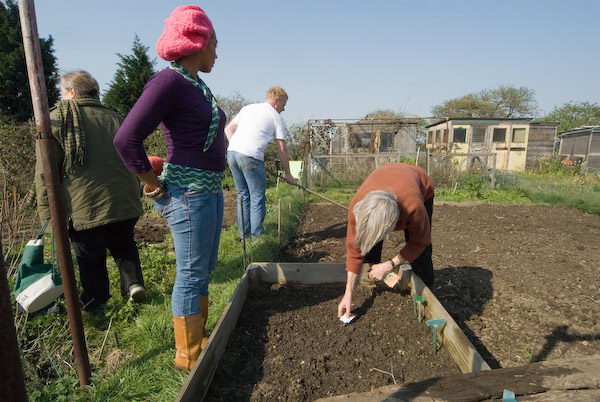
I had known and photographed the Olympic area since the early 1980s until the public were all excluded from the vast site in 2007 and after when we were only able to peer over the blue fence. In 2010 I brought out a book ‘Before The Olympics’ which included many pictures of the area in the thirty years or so before they took place, as well as looking more widely along the length of the River Lea and the Navigation. Most people miss that parts of the area were formerly thriving industrial and commercial sites, others a verdant wilderness – and of course some thriving allotments. Of course there have been some benefits following 2012 – more housing is something London desperately needs, but much was already being planned before the bid succeeded. But the park remains to me deeply disappointing.

Allotments on the Olympic site, April 2007

The book is still available and you should be able to view a preview at ‘Before the Olympics‘ though Blurb appears to be having some problems at the moment; it is a ridiculously highly priced softback, but there is a more reasonable PDF version. The book includes many of my pictures of the area which are also on my The Lea Valley web site including mainly black and white images from the 1980s and 90s and colour from the 2000s. Later images from before and after 2012 are on various pages of My London Diary. There is a large collection of the black and white images in my Flickr album River Lea – Lea Navigation 1981-1992 including many from what became the Olympic site.


Fossil Fuels, Bradley Manning & Global Racism

Fossil Fuels, Bradley Manning & Global Racism – my Saturday 27th July 2013 began with a “radicalized midsummer cloud forest dream” against the support given to fossil fuels and climate chaos by the banks and the City of London, continued with a vigil for Bradley Manning who exposed US war crimes and ended with a march and rally against and Injustice.


Rev Billy at HSBC – Victoria

Fossil Fuels, Bradley Manning & Global Racism
Golden Toads to the rescue with ice

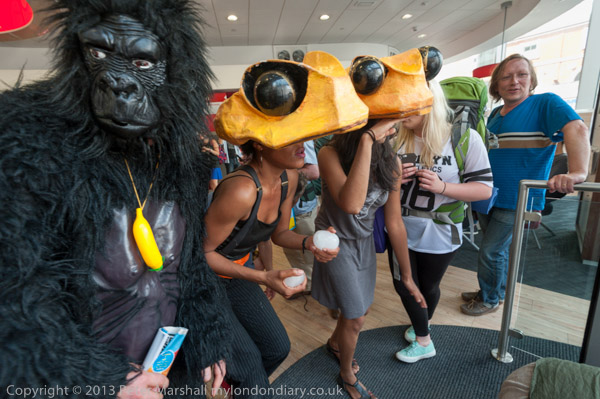
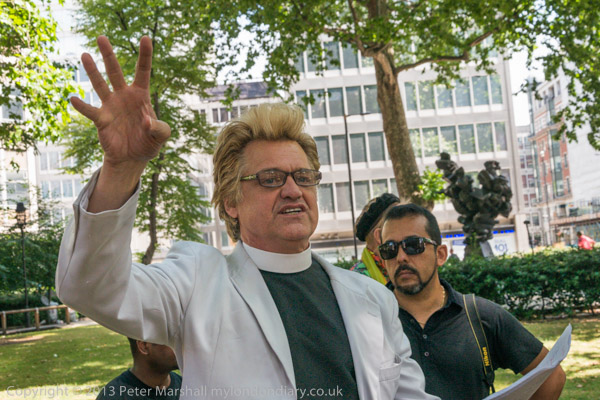
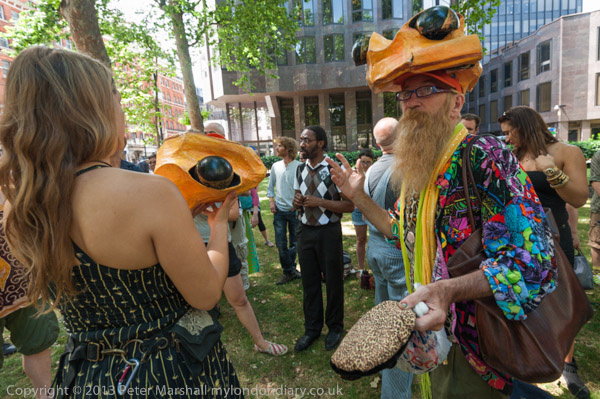
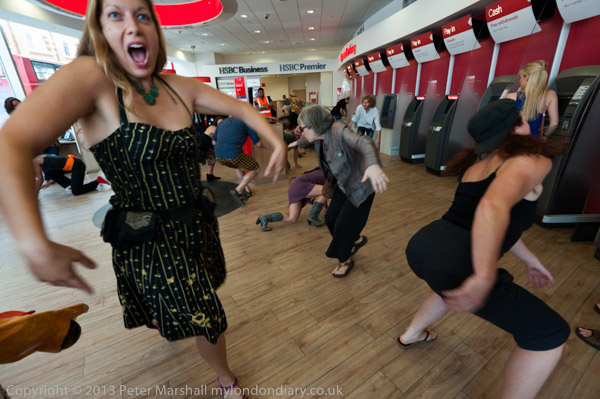
I met the Rev Billy and his choir on the Stop Shopping Church Tour England in a green open space on Victoria Street, opposite New Scotland Yard (which has since moved to the Embankment.) There they practised their performance as species – monkeys, jaguars and eagles – among those threatened by climate change.

Fossil Fuels, Bradley Manning & Global Racism

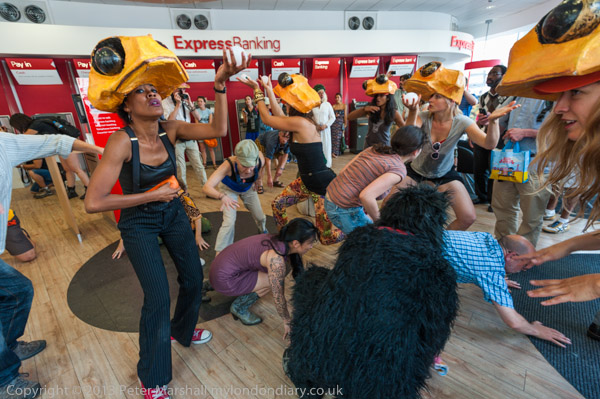
Some had heads of Golden Toads, a Costa Rican species already made extinct by climate change. These were hidden away as the group walked towards the HSBC bank at Victoria, and we all walked in trying our best to look like normal customers and going up to the long line of ‘Express Banking’ cash machines.

Fossil Fuels, Bradley Manning & Global Racism

Then the group erupted into dance action, with the Rev Billy using a megaphone to tell bank staff and customers what is happening and why we are in HSBC. Fossil Fuels are killing life on this planet and London banks and the London Stock Exchange play a key role in this – a quarter of all fossil fuel shares are traded on the LSE and in 2010-12 the top five UK banks raised £170 billion for fossil fuel companies, with the HSBC in the lead. He promised that they would leave the bank after the short performance.

Then the Golden Toads arrived to save the species, bringing with them some large eggs of ice to help cool the planet down, and then as promised people left the bank to continue to the end of the performance on the wide pavement outside. Police arrived and went into the bank as the players were leaving to celebrate their action in a nearby cafe and bar.

More at Rev Billy at HSBC


Free Bradley Manning Vigil – St Martin’s, Trafalgar Square

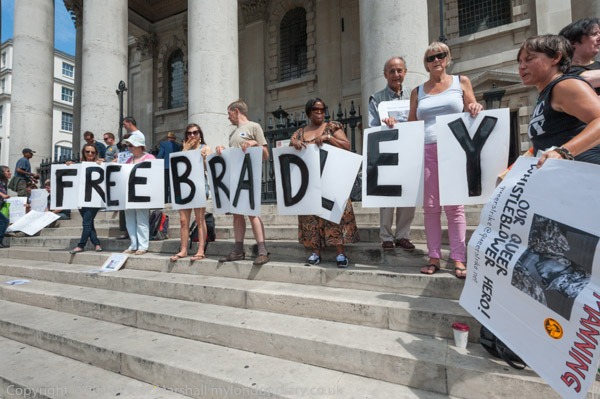
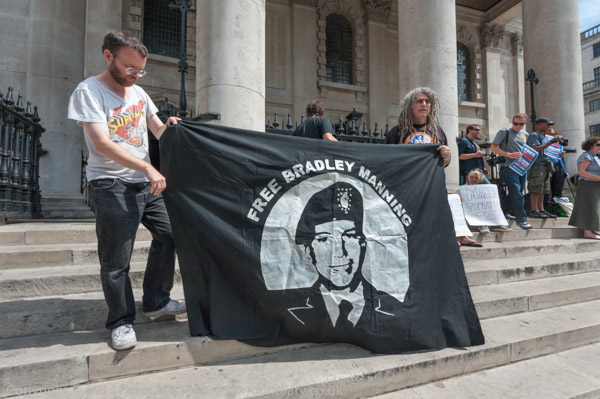
Saturday 27th July 2013 was an international day of action by the Bradley Manning Support Network, and in London they held a vigil on the steps of St Martin-in-the-Fields.

Bradley Manning’s trial had started on 3rd June in Fort Meade, US, and protests have continued both inside and outside the court, with the ‘gay whistleblower’ being celebrated in countries across the world and awarded the Sean MacBride Peace Prize. Many see Bradley – later Chelsea Manning as a hero who should be honoured rather than imprisoned. Her trial ended on 30th July with a sentence of 35 years, but in 2017 this was commuted by President Obama to seven years, dating from her arrest in 2010.

Free Bradley Manning Vigil


Against Global Racism and Injustice – US Embassy to Whitehall

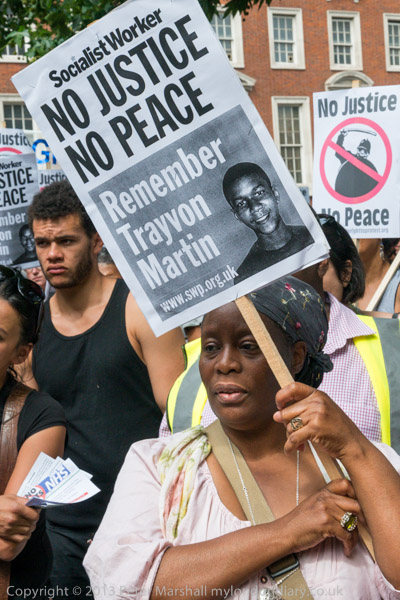
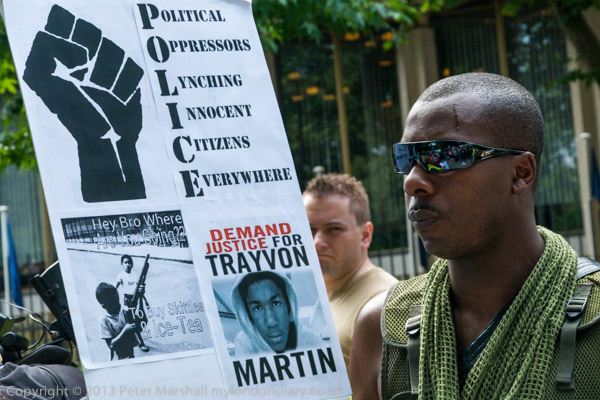
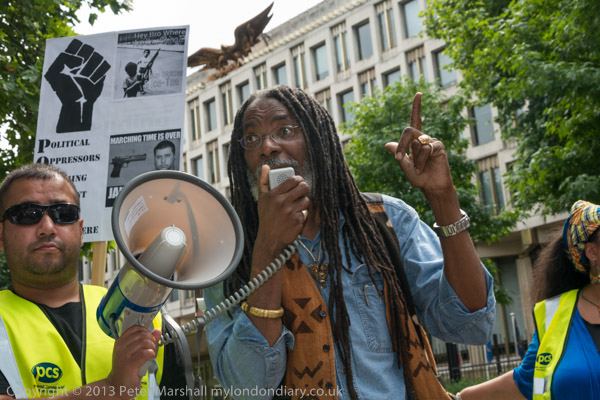
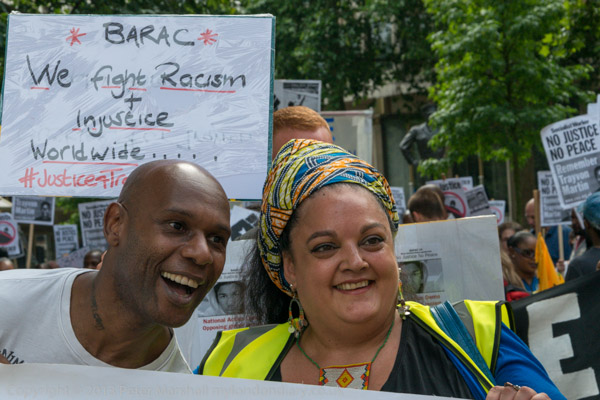
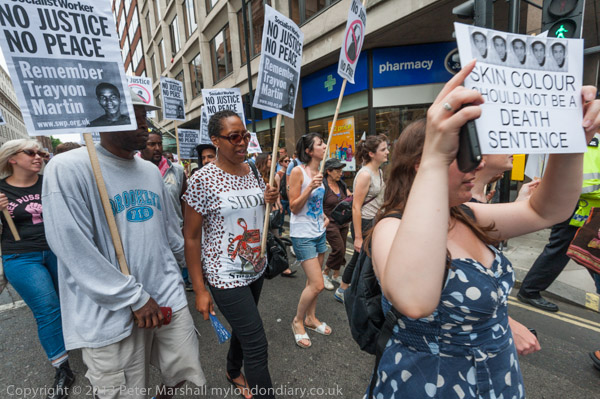
Black Activists Rising Against Cuts (BARAC) UK held a rally outside the US Embassy in Grosvenor Square before marching to Whitehall in solidarity with families of Trayvon Martin, Stephen Lawrence, Azelle Rodney, Jimmy Mubenga and many others to highlight the reality of racism and seek justice, both in the UK and US.

The protest was supported by many anti-racist organisations including Operation Black Vote, the National Black Students Campaign, Global Afrikan Congress, PCS, RMT Black Members, Counterfire, UAF, Love Music Hate Racism, Lambeth TUC and Lambeth People’s Assembly and a number of well-known faces from the British left were among the marchers, some were scheduled to speak at the Downing Street rally.

The US Embassy was chosen as the starting point because of the killing in Florida of Trayvon Martin and the global outcry against the acquittal of his murderer under the Florida ‘Stand Your Ground’ law.

But although this was a protest against global racism and injustice, and it had a particular focus on this country, and as Lee Jasper stated “We march for Jimmy Mubenga, Mark Duggan, Kingsley Burrell, Smiley Culture and Azelle Rodney.” And others also made clear in speeches they were appalled by UK cases, including We march for Jimmy Mubenga, Mark Duggan, Kingsley Burrell, Smiley Culture and Azelle Rodney and many, many other cases.

I followed the march as it went through Mayfair, but then had to leave rather than attend the final rally.

More at Against Global Racism and Injustice.


End The Israeli Invasion Of Gaza – 2014

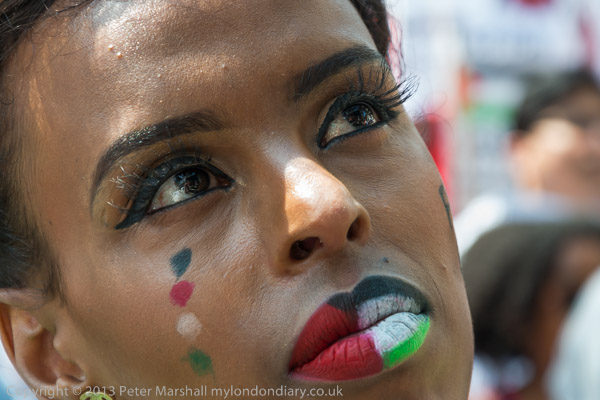
End The Israeli Invasion Of Gaza – 2014 On 8th July 2014, Israel had begun Operation Protective Edge with air strikes and artillery bombardment on the narrow Gaza strip of Palestinian territory.

The previous month 3 Israel teenagers had been kidnapped close to an Israeli settlement on the West Bank; several weeks later their bodies were found – they appeared to have been shot shortly after capture and Israeli Prime Minister Benjamin Netanyahu vowed that Israel would have a tough response.

After the kidnapping the Israel Defence Forces had immediately arrested 350 Hamas members in the West Bank, and in response Hamas fired rockets into Israel from the Gaza strip. Israel’s bombardment failed to stop the rocket attacks and after 10 days on 17th July they began a full-scale ground invasion, attempting to destroy the military tunnels which Hamas had created in Gaza.

Israel ended the ground invasion on 5th of August and a cease-fire was announced on 26th August. During the war between 2,125 and 2,310 Gazans were killed and over 10,000 badly injured, many of them permanently disabled. The homes of over 10,000 families were destroyed and more severely damaged. The huge military imbalance meant that deaths on the Israeli side were 72, five of them civilians.
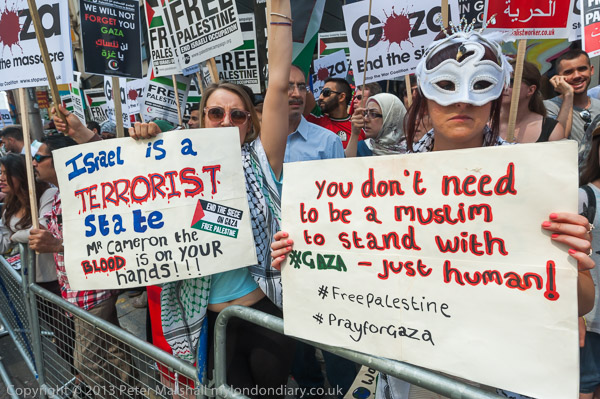
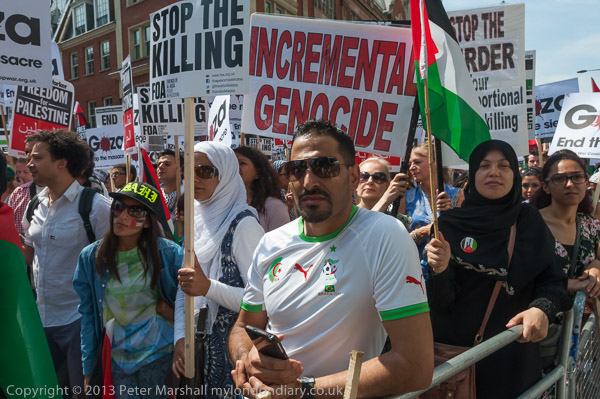
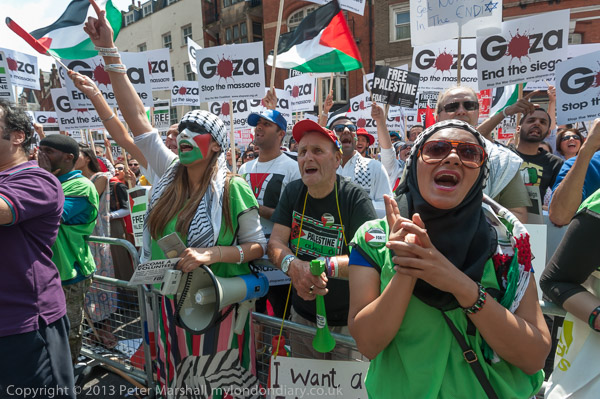
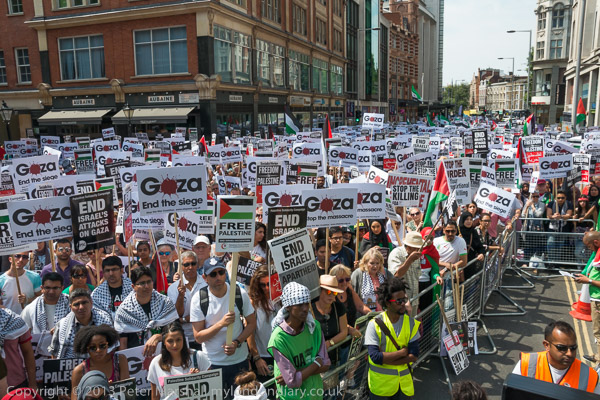
The protest in London on Saturday 26th July called for an end to Israeli attacks on Gaza which had already killed over a thousand Palestinians, mainly civilians.

It began with a rally on the main road close to the Israeli embassy a short distance down a private road which was heavily defended by barriers and police. The police tried to keep the protesters on the pavements and traffic flowing, but there were soon far too many protesters for this to be possible and it spilt out to block the road.

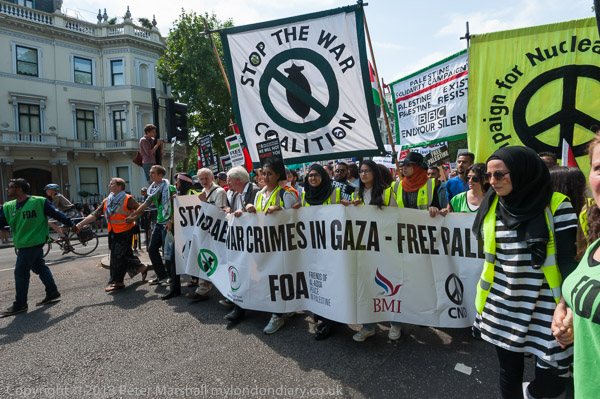
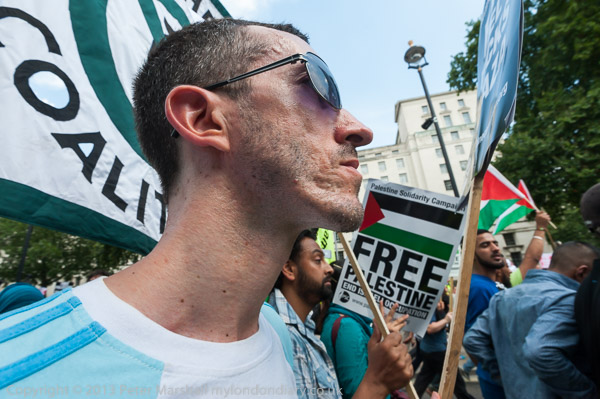
The rally here was fairly short, with speakers including Owen Jones and Labour veteran Walter Wolfgang. It was hard to estimate the number of protesters, but the wide street was packed with people for around 300 yards, many too far away to hear the speeched. I photographed the front of the march as it moved off and stayed with it for around half a mile before walking slowly back against the flow of the march taking more pictures of the protesters. There were still people coming out of the tube station for the march as I took a train to photograph another protest at Westminster.

After covering another event briefly I met up with the front of the march at Trafalgar Square as it turned into the top of Whitehall and was able to photograph it going down. It stopped briefly opposite Downing St, then continued to Parliament Square for the main rally.

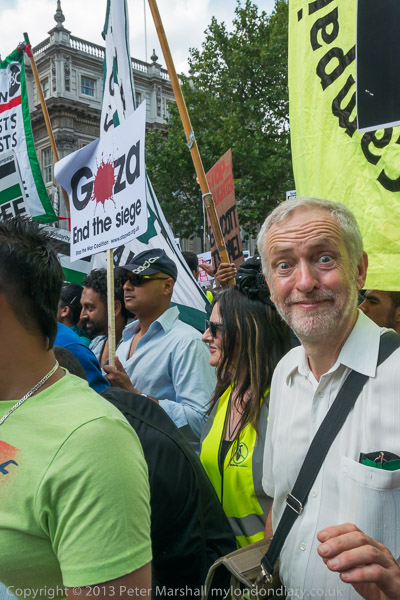
Jeremy Corbyn sees me taking his picture

Parliament Square is almost square with its large central area, mainly grassed about 205×230 feet, and for this protest was mainly fairly crowded, with people spilling out onto the roadways around its edge in places. Though quite a few protesters had felt they had done their bit by marching on a hot day and were making their way to the station or elsewhere.

I stayed for some time, photographing the marchers and speakers but after listening to around 17 of them (you can see my pictures of them on My London Diary) I began to feel rather faint. It was a hot day, and although there is some shade, to take photographs I had needed to stand in the sun. The rally was still continuing as I left for home.
Stop the Massacre in Gaza Rally
End Gaza Invasion March to Parliament
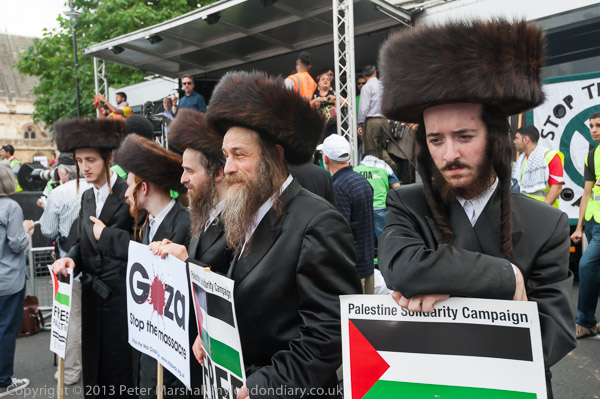
Israeli Embassy rally – End Gaza Invasion