LSE Resist – Working Class, Kidbrooke & Cleaners

LSE Resist – Working Class, Kidbrooke & Cleaners: in September 2016 then LSE research fellow Lisa McKenzie and a couple of students organised a series of discussions, films, lectures and exhibitions in the 3 day campus-wide 3-day free ‘Resist: Festival of Ideas and Actions’. The festival explored how political resistance is understood within academic research, the arts, grassroots activism campaigns, student debate and mainstream politics.

LSE Resist - Working Class, Kidbrooke & Cleaners

As a part of this festival LSE cleaners began a campaign for parity of treatment with other workers at the LSE. I had contributed some protest pictures to be used in publicity for the festival and attended some of the events on 28-29th September 2016.

LSE Resist - Working Class, Kidbrooke & Cleaners

The success of this festival was perhaps one of the reasons why Dr McKenzie was not given a further contract at the LSE. She has since worked at Middlesex University, Durham University and the University of Bedfordshire and is Board Chair of the Working Class Collective.


Working Class debate at LSE Resist – Wednesday 28th September 2016

LSE Resist - Working Class, Kidbrooke & Cleaners

There was a lively open debate around ideas of the working class at lunchtime on the steps in front of the LSE building in Lincoln’s Inn Fields led by LSE Professor of Anthropology David Graeber and Martin Wright of Class War with contributions from others including LSE research fellow Lisa McKenzie and Class War’s Ian Bone.

LSE Resist - Working Class, Kidbrooke & Cleaners

I arrived late, partly because the LSE then was a huge building site and the Facebook invitation to the event had included a map incorrectly suggesting it was taking place in Houghton Street, so unfortunately missed the some of the opening remarks by Graeber.

He was followed by Whitechapel anarchist Martin Wright, a working-class activist from East London who told us he was proud of his record of not working. He now regularly broadcasts his pithy comments on current affairs on the ‘Red and Black’ channel on You Tube.

Ian Bone, the founder of Class War, once described by the gutter press as the ‘The Most Dangerous Man in Britain‘ gave a typically witty and thought-provoking contribution.

And of course Lisa McKenzie spoke at some length and depth, and there was a great deal of discussion among the main speakers, with contributions from many of those sitting around on the steps, mainly LSE students. I took a great many pictures some of which you can see on My London Diary, but think I managed to keep my mouth shut and listen rather than speak.

More pictures at Working Class debate at LSE Resist.


Simon Elmer of ASH indicts LSE

The following day I was back on the same steps to hear Simon Elmer of Architects for Social Housing (ASH) give a lengthy and detailed indictment, ‘The Intellectual Bloodstain’ on a report by a group of LSE academics on Kidbrooke Village, a development by Berkeley Homes and Southern Housing, on the site of a council estate which was demolished between 2009 and 2012.

The Ferrier Estate had been built for the Greater London Council in 1968-72 on the site of a former RAF base. The first section had five 12 storey towers and three years later a second section six more were added. The estate had around 1,900 flats.

When the GLC was abolished in 1986 for having opposed the Thatcher government it was a sad day for London in general, with the capital being left without its essential city-wide authority, something it has not yet recovered from despite the setting up of the GLA in 2000. But for the Ferrier estate in was even worse news as the estate was transferred to the Royal Borough of Greenwich.

Greenwich made Ferrier a sink estate and failed to maintain the estate properly; its population were markedly multi-ethnic, including many refugees while most of the rest of the borough’s estates were predominantly white.

You can read Elmer’s talk in full on the ASH web site and it makes interesting reading. Perhaps the key fact is that the estate still had 1732 flats which were housing council tenants at social rents, but in the replacement Kidbrooke Village although there will be 4,763 new apartments, only 159 will be at social rent. Some of the others will be ‘affordable’, meaning at up to 80% of market rent, but that means completely unaffordable to those who previously lived there – or to almost all of the 15,000 on the council’s housing waiting list.

As a former member of Greenwich Council was quoted by Elmer as stating, ‘Ten years ago residents on the Ferrier Estate were told that they would have the right to come back. What Greenwich Council didn’t mention is that they would need to win the Lottery to do so.

Elmer uses the case of Ferrier to ague about a key tropes behind the LSE produced report, the idea of ‘urban villages’ and also points out some of the omissions and inaccuracies of the report as well as attacking their use of inadequate and often misleading concepts such as ‘human scale‘, ‘unique identity‘, ‘social interaction‘ (which means going to shop at Sainsbury’s), ‘locally driven‘, ‘mixed communities‘ and more as well as pointing out some simple lies lifted directly from the developers’s marketing book.

His report points out “the white elephant standing in the middle of the living room of every one of these luxury apartments – that is, their complete failure to meet the housing needs of the local community” and went on to look more widely at housing issues in the UK before concluding his talk by convening a People’s Court for the indictment of the LSE Four, listing four charges and calling for their suitable punishment “in the name of Architects for Social Housing and on behalf of the former residents of the Ferrier Estate.” I think they were unanimously found guilty.

At the end of the meeting Petros Elia, General Secretary of the United Voices of the World trade union spoke briefly about the failure of LSE management to protect the interests of the LSE cleaners in outsourcing them to a cleaning contractor with no insistence on decent working conditions and conditions of service and inviting all present to a meeting later that do to discuss further action.

More pictures at Simon Elmer of ASH indicts LSE.


LSE Cleaners Campaign Launch

Later on Thursday I went to the meeting where cleaners at the LSE began their campaign for parity of treatment with other workers at the university.

The cleaners, employed by Noonan on a LSE contract, are paid the London Living Wage, but have only the statutory minimum holidays, sick pay and pension contributions, while workers directly employed by the LSE have more generous terms. They also complain they have lost rest facilities, are not allowed in the canteen with other workers, exposed to dangerous chemicals, not allowed to use lifts to move heavy equipment between floors and are generally treated like dirt.

We were all shocked when one of the cleaners stood up and told how she had been sacked by Noonan after 12 years of service at the LSE. The UVW will fight her unfair dismissal as well as pursuing their other claims.

Others attending the meeting included most of the students from a new graduate course at the LSE on issues of equality, something the LSE has a long history of campaigning for outside of the institution but seemed rather blind to on its own campus. Support for the cleaners was expressed by the LSE Students Union General Secretary and by several LSE staff members, and Sandy Nicoll from SOAS Unison told the meeting about their 10 year fight to bring cleaners there in-house.

Several of the cleaners spoke in Spanish, and their comments were translated for the benefit of the non-Spanish speaking in the audience,

There were suggestions for further actions to improve conditions and fight the unfair redundancy, and I was to photograph some of these in the months that followed, eventually leading the them being taken back in-house as LSE employees in 2017.

More pictures at LSE Cleaners campaign launch.


Atos Deaths & Regime Change in Sudan

Atos Deaths & Regime Change in Sudan: Ten years ago on 28th September 2013 I photographed a protest in Parliament Square against the degrading and wholly unreliable tests administered by Atos to determine whether disabled peole qualify for benefits. The I continued to the Sudanese Embassy where a large crowd of Sudanese were calling for an end to the repressive regime in Sudan.


10,000 Cuts – Deaths After Atos Tests – Parliament Square

Atos Deaths & Regime Change in Sudan

10,000 White chrysanthemums were spread on the mud and grass of Parliament Square in an act of remembrance and solidarity for over 10,000 disabled peole who have died in the three months after being made to take the degrading Work Capability Assessments run for the government by Atos.

Atos Deaths & Regime Change in Sudan

The 10,000 are largely made up of those who already have a terminal diagnosis but still have to come and submit to the tests for ther benefits to continue for their remaining few months of life. And despite compelling medical evidence many are refused benefits and said by Atos to be ‘Fit for work’.

Atos Deaths & Regime Change in Sudan

The ceremony took place in the square bounded by the Houses of Parliament, Westminster Abbey, the Supreme Court and the Treasury and was organised by the 10,000 Cuts & Counting Campaign which included disability activists, Occupy activists, the Dean of St Paul’s Cathedral and others who recognise that lives are being devastated by the government’s austerity programme.

Atos Deaths & Regime Change in Sudan

The campaigners do not claiming that the test itself kills the 10,000, although some have been driven to commit suicide after being failed by Atos, but that such tests adminstered in the final days of life are unfeeling, unnecessary and persecute the sick and dying.

Sophie Partridge reads the words of Karen Sherlock who died in 2012 after endess pressure and loss of benefits.

A number of disabled people and a mother of three disabled children gave moving testimonies with many damning indictments of the failures of Atos and the Department of Work and Pensions and their lack of understading of the needs of the disabled. They had not been treated with dignity or humanity, with deliberately discriminatory policies, targets to be met, arbitrary decisions and bureaucratic incompetence. And there was a period of silence and prayers to the four corners of the square.

The Tories had obviously seen the disabled as an easy touch for cuts, thinking they would be unable to defend themselves, but organisations such as DPAC, Disabled People Against Cuts, have signally proved them wrong. Many of the disabled have become desperate and have been some of the most prominent and most effective protesters, not least because the police have great difficulties (and some sympathy) in dealing with them. Arresting people in wheelchairs isn’t easy.

More at 10,000 Cuts – Deaths After Atos Tests.


Sudanese Call for Regime Change – Sudanese Embassy

I left Parliament Square where the protest was still continuing with a number of people including MPs John McDonnell and Jeremy Corbyn as well as several disabled activists still waiting to speak to rush to the Sudanese Embassy in Cleveland Row at the end of Pall Mall.

There a noisy crowd of around a hundred were in a protest pen calling for Omar al-Bashir and the National Congress Party to resign. The London protest was in solidarity with those that have been taking place in Khartoum over rises in fuel prices and corruption over the past six days. The protests there have been brutally attacked by the regime.

The protesters in London from ‘Sudan Change Now’ and the ‘National Sudanese Women Alliance’ see the government as a total failure in managing the country for over 23 years, presiding over a political, economic and social collapse.

They say the government disrespects the Sudanese people and ignores their education and health, with all the money going into ‘security’ spending, which does not make the people secure but is used to repress the people and fight wars, with many of the best Sudanese men and women being killed in South Kordofan, Blue Nile and Darfur.

Under the regime of Omar al-Bashir, the judicial system was base on Sharia Law, with stoning, flogging, whipping, hanging and even crucifixtion. Some saw the protests in Khartoum as the start of an ‘Arab Spring’ movement which would lead to regime change but it was not until 2019 that al-Bashir was deposed in a coup d’état, then arrested, tried and convicted on multiple corruption charges.

More pictures at Sudanese Call for Regime Change.


Whitechapel & Illegal Dates

Whitechapel & Illegal Dates; On Saturday 27th September 2014 I went to Whitechapel early to photograph campaigners who were to protest against Sainsbury’s who were selling dates and other goods from illegal Israeli settlements, in defiance of international law. Around two years earlier I had made a panoramic image of part of the new Royal London Hospital which interested me but I felt was not quite what I wanted.

Whitechapel & Illegal Dates

Going back to re-take photographs is often disappointing, with key features having changed, but I think this time I did at least come up with an improvement. This was a more complex panorama than most of those I now make, and needed me to stitch together three separate exposures. It would perhaps be a little better with some slight cropping on the botton edge.

Whitechapel & Illegal Dates

The Royal London Hospital has much great problems, all arising from the poor PFI deal that was used to finance its construction. All PFI schemes have turned out to be a mistake, but this was worse than most and I think has left the hospital group in financial trouble while providing excessive profits to the investors, with payments continuing for many, many years. The contract means they can charge silly prices for necessary services,

Whitechapel & Illegal Dates

After several attempts at producing the picture I wanted I went for a short stroll around the area making a few more panoramic images before it was time to join th protest.

More pictures at By the Royal London.


Sainsbury’s told Stop Selling Illegal Goods – Whitechapel High St

Whitechapel & Illegal Dates

Campaigners from the Tower Hamlets & Jenin Friendship Association held a protest on the high Street close to Sainsbury’s, calling on the store to end selling dates and other goods from illegal Israeli settlements, in defiance of international law.

The protes was part of the international BDS campaign calling for a Boycott of Israeli goods, divestment from Israeli firms and sanctions against Israel until it ends the persecution of Palestinians and comes into line with international law and UN resolutions.

Similar protests earlier outside Co-op stores had led to the company in 2013 stating they would ‘no longer engage with any supplier of produce known to be sourcing from the Israeli settlements’.

The BDS campaign was given added impetus early in 2014 by the disproportionate use of force against the people of Gaza. During the recent Israeli attacks on Gaza over 2,100 Palestinians were killed, roughly 1500 of them civilians, among them over 500 children. 66 Israeli soldiers died, along with 5 Israeli civilians (including one child.) Over 500,000 people – roughly 30% of the population of the Gaza strip were displaced from their homes, and over 17,000 homes made uninhabitable, with over twice that number suffering less severe damage.

The raids also destoryed much of Gaza’s industry, including factories making biscuits, ice cream factory, plastics, sponges, cardboard boxes and plastic bags as well as the main electricity plant. Two sewage pumping stations were damaged, as were the main offices of the largest diary product importer and distributor.

The protesters had several tables on the pavement outside the library on Whitechapel High St ,one selling Palestinian olive oil, almonds and a range of decorated purses etc. Some handed out leaflets and a postcard ‘Sainsbury’s: Taste the Indifference’, while others held banners or collecting signatures for petitions. At intervals people made short speeches about the Palestinian situation and the campaign to get Sainsbury’s to stop selling illegal Israeli goods.

After an hour or so on the busy street, some of the protesters decided it was time to visit Sainsbury’s, just a couple of hundred yards away down a side-street. They folded up their banners and walked down to the store, where Sainsbury’s were ready and waiting for them with extra security on duty, and they were stopped in the very spacious lobby area in front to the store.

Here they opened up their banners and protested for a little over 10 minutes. There were a few moments of some tension, when store employees or security tried to grab one of the banners, but the whole protest and Sainsbury’s response was pretty civilised.

After 12 minutes, a man in casual dress arrived, and after asking the store manager to request the protesters to leave came across and talked with the the protesters, showing them his poolice warrant card and apologising that the police station didn’t have anyone in uniform available to send at the moment.

Having made their point by their protest, they decided to go quietly and a little exultantly back to the High Street, where others had been continuing the protest. Shortly after I decided it was time for me to leave.

Sainsbury’s appears still to refuse to follow its own ethical guidelines and still apparently sells some products from the occupied West Bank and to deal with suppliers who source goods from there, although probably rather less than in 2014. They have claimed not to source goods from the occupied territories but do still deal with wholesalers who deliberately mislable such produce.
Sainsbury’s told Stop Selling Illegal Goods

Access to Work & Harvest Festival – 2015

Access to Work & Harvest Festival: On Saturday 26th September 2015 I was pulled in two directions, wanting to attend both a protest for disabled people in Westminster and the harvest festival at Grow Heathrow in Sipson on the western edge of London. In the end I managed to get to both, leaving the first early and arriving a little late at the second, going more or less to the end of the Piccadilly line at Heathrow Central and then catching a bus.


Deaf & Disabled Access to Work protest – Westminster

Access to Work & Harvest Festival

The Access to Work scheme was set up in 1994 to provide disabled people with funding to pay for extra disability-related expenses which enable them to work, including travel, support workers and specialised equipment. It was a significant milestone in equality for the deaf and disabled in the UK, and at the end of the Labour government in 2010 was supporting almost 28,000 people. Under Tory cuts this number had been reduced by 15% to around 22,000 with many applications being refused by the DWP.

Access to Work & Harvest Festival

In 2015 the government put a cap on the amount which could be claimed annually by those on the scheme of around £42,000, applying immediately to new claimants and in a couple of years to those already part of the scheme.

Access to Work & Harvest Festival

According to the protesters the cuts would not only prevent many currently supported by the AtW scheme to be able to continue their jobs but would also would lose the government revenue as the current scheme brings in £1.48 for every pound invested.

Access to Work & Harvest Festival

Many of those taking part in the protest were disabled people on the AtW scheme who fear they will be unable to continue in their careers if the cuts are implemented, including many deaf people. Many signed with their hands as I photographed them, and the hand, a symbol for British Sign Language was prominent on some of the banners and on at least one face.
The campaigners met in Old Palace Yard and then assembled to march through Parliament Square and a short distance up Victoria Street and then past the Department of Work and Pensions in Caxton House and on to a rally opposite Downing Street.

I left as the rally there was about to start to take the District line and then the Piccadilly to Heathrow Central from where I could catch a 111 bus to Sipson.

More at Deaf & Disabled Access to Work protest.


Grow Heathrow celebrates Harvest Festival – Sipson

Grow Heathrow which had occupied an abandoned and overgrown nursery in Sipson in 2010 were holding a harvest festival to celebrate another year’s harvest there with ‘music, pumpkins and pizza’ as well as holding an open ‘No Third Runway!’ discussion. which I was keen to attend and take part in.

The discussion was already underway when I arrived a little out of breath after running the short distance from the bus stop, but I was able to ask several questions and make some comments as well as taking pictures. With John Stewart and other campaigners including Christine Taylor of Stop Heathrow Expansion and Sheila Menon of Plane Stupid taking part it was an interesting discussion, and if fairly small the group taking part was certainly a select one.
As I commented then, “Whatever decision the current government take over the curiously defective considerations of the Davies committee (and I think we may well see some very long grass coming into play) it seems to me unlikely that Heathrow expansion will be deliverable.”

The commision had been set up in order to approve Heathrow expansion and it became official government policy in October 2016. It was supported by a parliamentary vote in 2018, but an application for judicial review by environmental groups, the Mayor of London and local councils ruled the decision unlawful as it had failed to to the government’s commitments to combat climate change into account. The government accepted the court’s decision, but Heathrow appealed to the Supreme Court who overruled this decision.
Although this theoretically allowed the expansion to go ahead, it currently seems unlikely to do so, with increasing environmental concerns, changes in forecasts of future air traffic, increasing costs and also increasing capacity at other UK airports almost certainly make it no longer viable.

After the discussion I took the opportunity to walk around the site to see what had changed since my last visit, and take more pictures. The case for eviction of Grow Heathrow had been recently adjourned until Summer 2016. Half the site was lost by an eviction in early 2019 but the site was only finally evicted in March 2021.

More at Grow Heathrow celebrates Harvest Festival.


March for Peace and Liberty – 2005

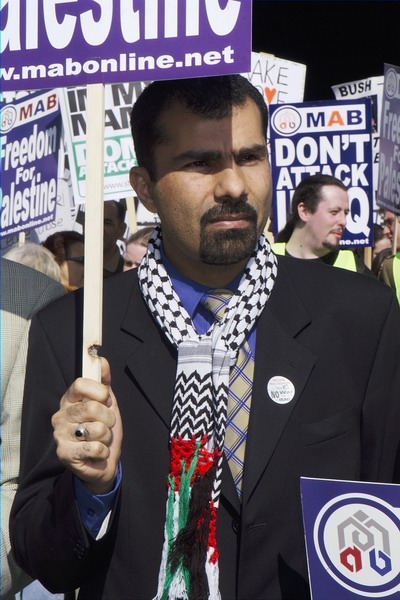
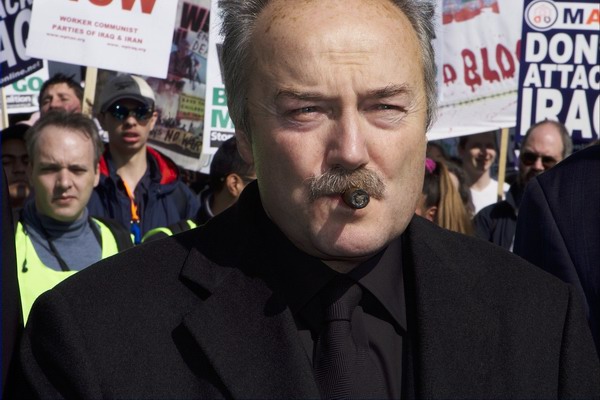
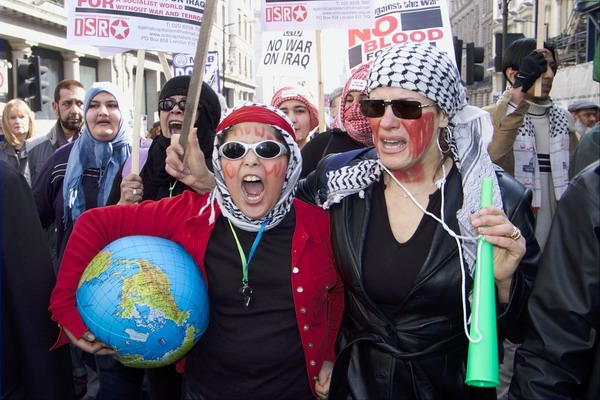
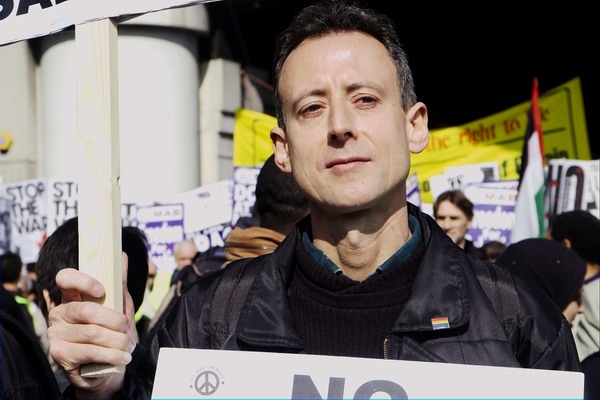
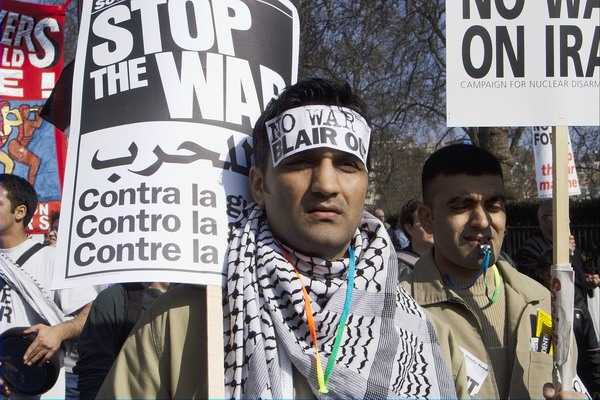
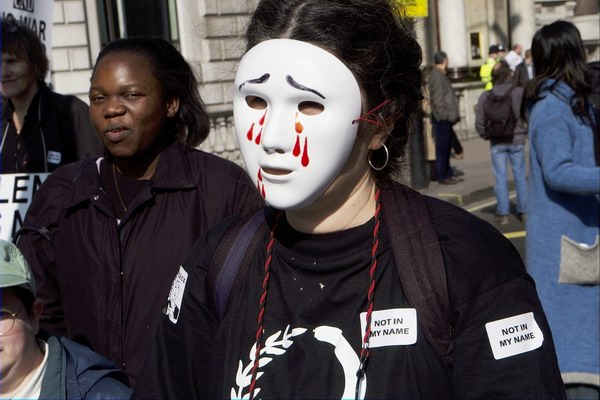
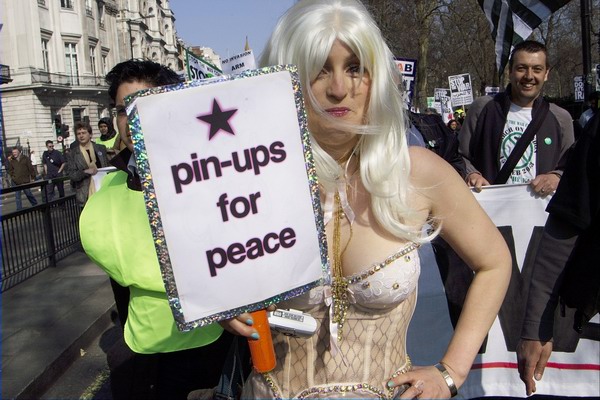
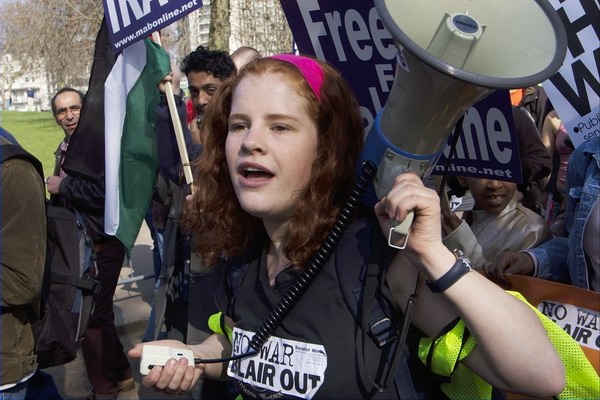
March for Peace and Liberty – 2005 Eighteen years ago on Saturday 24th September around 50,000 of us were marching through London for peace and calling for the withdrawal of forces from Iraq.

March for Peace and Liberty

The protest, called by Stop the War Coalition, the Campaign for Nuclear Disarmament (CND) and the Muslim Association of Britain (MAB) coincided with an even larger protest in Washington close to the White House.

March for Peace and Liberty

Organisers of the Washington protest claimed that around 300,000 took part, while US police said the half that number was “as good a guess as any.” Police estimates of the London march were, as usual more political than based on any reality, and their figure of 10,000 was laughably low.

March for Peace and Liberty

I had developed my own simple methods to assess numbers. For smaller protests I’d simply stop at a suitable point and count those passing. When numbers got a little larger I’d count in groups of roughly ten, larger still groups of hundreds. Though sometimes that hundred might only have been 80 or sometimes 125 the overall figure was probably within around ten percent of the actual total.

March for Peace and Liberty

But with really large protests such as this, well over the police figure of 10,000, any form of counting is too time-consuming and tedious. I’d often still try to get a rough figure by counting for a minute where I was taking photographs a few times as the protest went part, and then make a rough estimate using the time the whole protest took to pass me. Typically the answer this gave me was around half the number claimed by the march organisers and anything around four to ten times the figure release by the police and often quoted by news media.

It’s a little difficult to find the text I wrote about the protest on My London Diary in 2005 as there are no headings in the text column on the September page, with headings and images in a separate unlinked column to the right – later I improved the site design to unite text and pictures and provided a list of links to stories which remains at the top of the monthly pages. Back in 2005 you simply had to scroll down a long page, and while the headings and text were simple to find, many viewers never managed to find the of text, which ends with a little art criticism. So here it is, with a few minor corrections:

What a fine mess you’ve got us into” is probably the conclusion of most of the British people about Blair’s decision to join in with Bush’s Iraq invasion in 2003. Quite how many of them turned up on the 24th to march for a British pull-out is a matter of contention. Both police and organisers estimates – ten and a hundred thousand respectively – seem to me extremely unlikely.

So I was there with probably between twenty-five and fifty thousand people, walking across Parliament Square in front of the Houses of Parliament, despite it being a Saturday afternoon, with no business taking place inside, the ban on the use of amplification within a kilometre of parliament was still in force, so the event was a little quieter than usual. Some did choose to defy the ban and the police appeared not to notice.
Gate Gourmet supply in-flight meals for British Airways. It used to be a part of the company, but was separated out, then sold to American management. Rather like what is starting to happen in our National Health Service, and of course British Airways was also originally owned by the nation.

The company takes advantage of a largely Asian labour force living around the edge of the airport, paying them relatively low wages. The new management decided to cut labour costs even more by bringing in casual labour to do much of the work (while apparently employing more managers!) and when the employees held a meeting to protest, they were sacked.

Pressure from both BA and the union (TGWU) led to the company offering to take back some of the sacked workers, but not all, and the strike continues. Some of the strikers came to take part in the rally, to publicise their case as well as call for a withdrawal from Iraq.

Most of the usual people were there at the march, and I took their pictures again – and some are on the site. When the march started I hung around in Parliament Square to watch it go past before walking rather faster than the marchers up Whitehall.
By the time I’d reached Trafalgar Square and waited again for the end of the march to pass, my knee [I’d injured it earlier in the month] was beginning to ache and I didn’t feel up to walking to Hyde Park. I sat down and ate my sandwiches contemplating the new sculpture on the ‘fourth plinth’, ‘Alison Lapper Pregnant’ by Marc Quinn. This 15ft white marble shows Lapper, an artist born without arms, sitting naked and eight months pregnant, and will stay on the plinth until April 2007.

It is a striking piece of work and was obviously attracting a great deal of attention from the tourists in the square. I took my time sitting and looking at it while I was eating, and then walking round it from all sides (slightly impeded by the preparations for a juvenile TV show to be broadcast from the square the following day.) Lapper herself works with photographs of her body, and this statue is perhaps too like her black and white photographs, with a rather unpleasant surface, sometimes more soap than marble. I found myself thinking thank goodness for the pigeons who were perching on it and doubtless adding their contributions to it.

Its position up there on a plinth is not ideal. This is work that would be best seen from roughly the same level as its base. The other plinths in the square are occupied by men on horses, which raise their figures more suitably above the plinths. Perhaps when it leaves the square a more suitable display place can be found, but its present placing is a great for catalysing debate about disability. Of course another disabled figure dominates the square; Nelson has his back to her and does not need to call upon his blind eye not to see her.

Many more pictures on My London Diary


Climate March & Open House 2014

Climate March & Open House: On Sunday 21st September 2014 I photographed the so-called ‘Peoples Climate March’ in central London before going to party with Focus E15 Mothers on the Carpenters Estate where they celebrated a year of their fight to be rehoused in the area.


Peoples Climate March – Embankment

Climate March & Open House

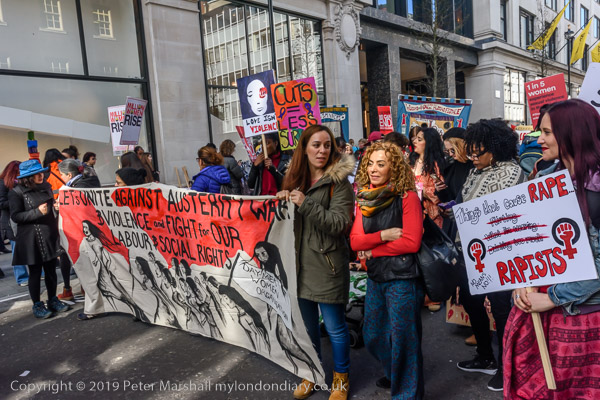
As in this week in 2023, a Climate Summit was taking place in New York in September 2014 and marches were taking place in London and elsewhere to demand divestment in fossil fuels and an end to the domination of politics by the fossil fuel industry which has blocked action against climate change.

Climate March & Open House

Little has actually changed in the 9 years since then. More empty words and promises but too many governments including our own in the UK continuing to encourage exploration for more gas and oil and even approving new coal mines. And carbon levels continue to rise, with at least a 2 degree rise in global temperature now seeming inevitable.

Climate March & Open House

What has changed is that we are all much more aware that climate change is real and are feeling its effects. While many in the Global South have been suffering for years, we in Europe and North America have now felt the new record high temperatures and seen the increasing wild fires and unstable weather caused by global temperature rise.

Last Saturday I photographed another Climate March in London, and it had a rather more serious and committed air than the 2014 event, not just because it was organised by Extinction Rebellion, but because the global situation has worsened, with new an disturbing reports coming out almost weekly.

Climate March & Open House

Back in 2014 I wrote about some length about the march and how it “seemed to have been rather taken over by various slick and rather corporate organisations rather than being a ‘people’s march’ and seemed to lack any real focus.”

Climate March & Open House

Then I commented that “There was one block – the ‘‘Fossil Free Block’ that I felt was worth supporting, and what the whole march should have been about. We have to stop burning oil, coal, gas. We are certainly on our way to disastrous climate change if we fail to severely cut carbon emissions, and probably need to actually reverse some of the rise that has already occurred. Drastic action really is needed.”

The 2023 march was behind a banner ‘NO NEW FOSSIL FUELS’ and another read ‘BIG OIL HAS FRIED US ALL’. But it didn’t get the kind of corporate support of the 2014 event and I don’t think there were any celebrities on the march, though I think some spoke at the rally afterwards, but I had left before this.

Worryingly in 2023 it was much smaller than the 2014 March. Back in 2014 I still felt there was time to avert catastrophe, but now I’m rather less optimistic. It may be too late. I have a feeling that in another nine years time we will be marching again, world leaders will still be talking and doing little and the world will be descending into chaos. Given my age it may still see me out but I worry about those younger.

More on My London Diary at Peoples Climate March.


Focus E15 Open House Day

I left well before the end of the march in 2014 too, catching the Underground to Stratford to get to the Carpenters Estate in Stratford where Focus E15 Mothers were celebrating the first anniversary of their fight against LB Newham’s failure to provide local housing for local people.

It was a year since Newham Council had cut funding for their hostel in Stratford run by East Thames Housing and they had been given eviction notices. Newham, which had a statutory duty to rehouse them told them it would be in private rental property miles away in Birmingham or Hastings or Wales but they wanted to stay within reach of families, jobs support services and friends in London.

Unlike many others they decided to fight the council, and launched an active and successful campaign, later widening their personal fight into “a wider campaign for housing for all, for social housing in London and an end to the displacement of low income households from the capital, with the slogan ‘Social Housing not Social Cleansing’.”

Despite the desperate shortage of social housing in Newham, the council led by Mayor Robin Wales had been trying to sell off its Carpenters Estate for ten years, moving people out and leaving good homes empty. The estate is next door to Stratford Station and Bus Station and so has excellent transport links making it very desirable for development. It is a post-war estate with large numbers of good quality low-rise housing along with three tower blocks. By 2014, most of the properties had “been boarded up for years, empty while thousands wait on the council’s housing list.

Carpenters Estate June 2014

In June 2014 I’d come with Focus E15 to the estate and had photographed them pasting up large photographs of themselves on some boarded up flats with slogans such as ‘This home needs a family‘ and ‘This family needs a home‘ and ‘These homes need people‘. I’d been told something intersting might happen at the party and wasn’t surprised when after a noisy session by a samba band to mask the sounds of removing some of the metal shutters at the rear of the flats we saw some of the E15 mums and supporters waving at us from a first floor window.

“It was Open House Day in London and courtesy of the Focus E15 Mums, 80-86 Dorian Walk was now one of the houses open to the public, even if not on the official lists, and we formed an orderly queue in best Open House tradition to go in and look at the four flats.

I was surprised to see what good conditions the flats were in, “fitted kitchens and bathrooms still in good working order – with running water, wallpaper and carpets almost pristine, and the odd piece of abandoned furniture. In one of kitchens, the calendar from 2004 was still on the wall, a reminder that while Londoners are desperate for housing, Newham council has kept this and other perfectly habitable properties empty for ten years.”

Focus E15 occupied the flats for a couple of weeks, leaving after the the Council issued legal eviction notices but their fight continued. Most of them have been rehoused in London and they have supported many others in Newham and neighbouring boroughs to get proper treatment from the council and prevent evictions. Their actions saved the Carpenters Estate and it is now being regenerated, although the plans don’t satisfy many of the groups demands. Their campaigns for housing for people in Newham continue.

More on My London Diary at Focus E15 Open House Day.


Cinelli, Poppies and Music at Class War Poor Doors – 2014

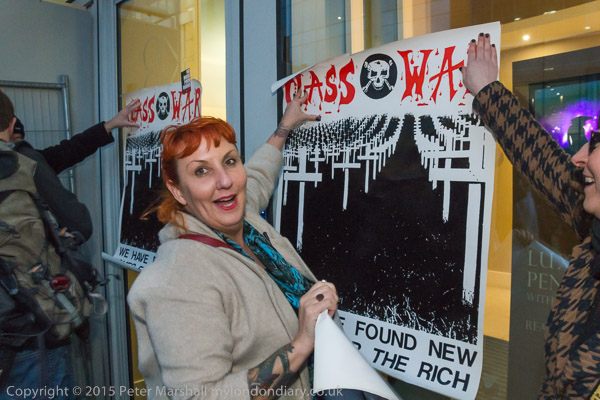
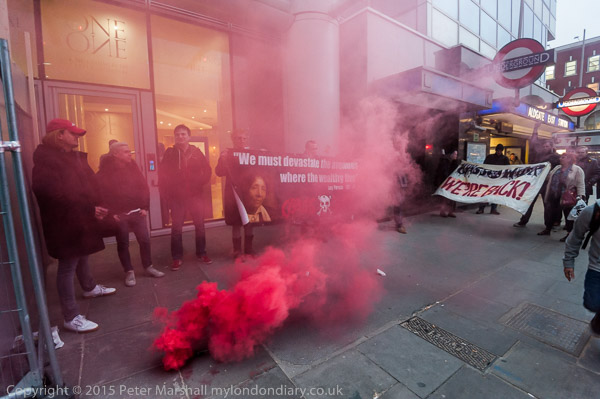
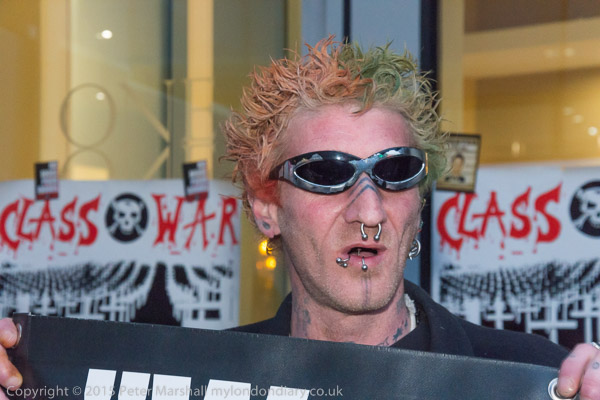
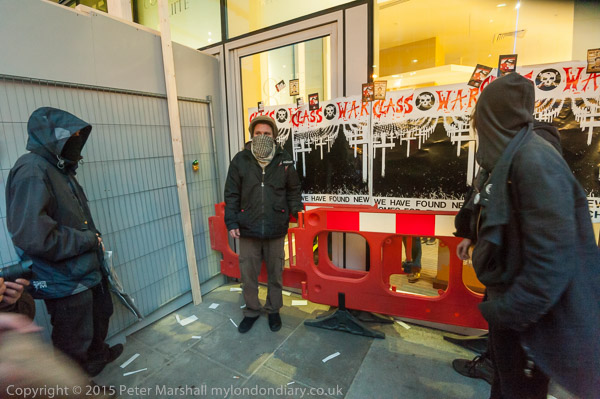
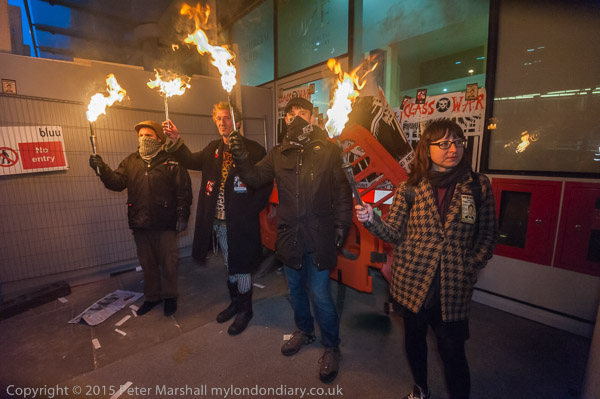
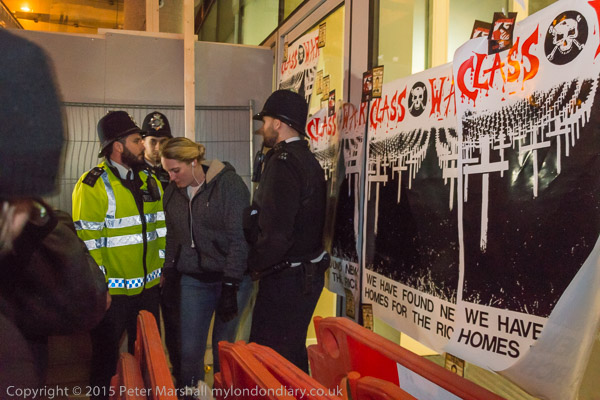
Cinelli, Poppies and Music at Class War Poor Doors. I only photographed one event on Wednesday 17th September 2014, one of the long series of weekly protests by Class War over separate entrances for rich and poor occupants of the large block of flats at One Commercial St on Whitechapel High Street.


Music at Class War Poor Doors – Aldgate

Cinelli, Poppies and Music at Class War Poor Doors

One Commercial St is a 21 storey largely residential block occupying an extensive corner site on Whitechapel High St and Commercial St which includes 207 flats above lower floors of offices, shops and an entrance to Aldgate East Underground Station.

Cinelli, Poppies and Music at Class War Poor Doors

The building, opened in 2014, received strong criticism in architectural circles, and Wikipedia quotes Building Design as commenting on what was developer Redrow’s “first flagship development” with “First flagship development? Please God let it also be their last. No one who can liken this incoherent hulk of ill-fitting glass sheets to a blade of light deserves to build again in such a sensitive location” and it was nominated for the Carbuncle Cup for “the ugliest building in the United Kingdom completed in the last 12 months“.

Cinelli, Poppies and Music at Class War Poor Doors

But it became controversial for other reasons too. To meet planning regulations the block contains some flats at affordable rents. While those in the main part of the building enter through an impressive foyer with a concierge desk and seating from the High Street adjoining Aldgate East Station, tenants of the affordable section had to go down what was then a dirty and dingy alley at the side of building, Tyne Street, to a door with a card-entry reader leading to a long empty corridor. On 17th September the card reader had been broken for 3 weeks, leaving the building insecure and the building management had failed to repair it.

Cinelli, Poppies and Music at Class War Poor Doors

This difference in treatment for rich and poor was highlighted in an article in The Guardian which commented on the growing trend for London’s new housing developments to include separate entrances like this for the less wealthy, known as “poor doors” and which gave One Commercial Street among the examples.

Many people expressed their distaste at this social segregation, and in New York Mayor Bill De Blasio announced he planned to take action to prevent new developments having such separate doors for low-income residents after a single such block was built there. But it was becoming common in London.

Anarchist group Class War decided it was time to take some action, and from July 2014 organised a weekly series of evening protests outside One Commercial Street, continuing (with a few breaks) until the following May. I photographed all but a couple of these, and later published a zine with some of the pictures I made. This is still available, but carriage costs make buying single copies expensive, however there is a good preview online.

Others joined with Class War on various occasions, and on Wednesday 17th September 2014 Reggae band Different Moods from Tottenham came to perform their ‘Poor Doors’ song specially written for the protests.

The protests by Class War did raise the profile of the problem, and resulted in some minor changes – including better lighting and cleaning for the side alley. They probably also embarrassed the owners enough to make them sell the building, though the new owners proved no better and the social segregation remains. And it’s perhaps why the building was later renamed and is now the Relay Building.

Music at Class War Poor Doors


Sea of Poppies – Tower of London

On my way to Aldgate I stopped at the Tower of London and made a photograph of the Sea of Poppies, work of art remembering the ‘Great War’, the ceramic poppies, one for each of the British forces killed in the war. I commented that for me “it seems decorative but shallow” and “lacks any real sense of the numbers involved and is far less graphic than the war cemeteries with their seemingly endless rows of crosses.

A little more at Sea of Poppies.


Vintage Cinelli in poor state

Earlier in the day I’d taken a picture showing the terrible state of my old bicycle, no longer ride able. It’s still in my shed, as several attempts to find a replacement chainwheel have failed. You can read more of the story about it at Vintage Cinelli in poor state. Perhaps I should try searching again.


Open House, Sewol, Iran, Sabah, Sarawak & Orange Order 2017

Open House, Sewol, Iran, Sabah, Sarawak & Orange Order: Saturday 16th September 2017 was another busy and varied day for me in London, beginning with two visits on Open House Day and continuing with four protests.


Open House – Banqueting House – Whitehall

Open House, Sewol, Iran, Sabah, Sarawak & Orange Order

Though I’d often walked past the Banqueting House in Whithall, usually on my way to protests at Downing Street or Parliament Square, I’d never before been inside the building. But when I came past on Open House Day there was only a short queue and entrance was free. I had time to spare as a protest I’d hoped to photograph had failed to materialise, so in I went.

Inigo Jones designed (or copied from Andrea Palladio) the Banqueting House for the Palace of Whitehall, built 1619-22, and it is the only remaining building from the palace. It was the first neo-Classical building in England.

More about it and more pictures on My London Diary at Open House – Banqueting House.


Open House & more – Peckham

Open House, Sewol, Iran, Sabah, Sarawak & Orange Order

I went to Peckham to see a few things in the Peckham Festival including the Open House showing of the Old Waiting Room at Peckham Rye station which was housing a photographic exhibition of old pictures of Peckham.

Open House, Sewol, Iran, Sabah, Sarawak & Orange Order

The building itself turned out to be more interesting than the exhibition which lacked any real examination of the more recent past of Peckham. But there were other things to see in Peckham, and a short walk around Rye Lane and the Bussey Building is always interesting.

More at Open House & more – Peckham.


41st monthly Sewol ‘Stay Put!’ vigil – Trafalgar Square

Open House, Sewol, Iran, Sabah, Sarawak & Orange Order

Back in Central London, my first protest was in Trafalgar Square where a small group mainly of SOuth Koreans was continuing their series of monthly vigils in memory of he Sewol victims, mainly school children who obeyed the order to ‘Stay Put’ on the lower decks as the ship went down.

They continue to demand the Korean government conduct a thorough inquiry into the disaster, recover all missing victims, punish those responsible and enact special anti-disaster regulations.

41st monthly Sewol ‘Stay Put!’ vigil


Overthrow the Islamic Regime of Iran – Trafalgar Square

Also in Trafalgar Square the 8 March Women’s Organisation (Iran-Afghanistan) were protesting on the 29th anniversary of the massacre of political prisoners in Iraq following a fatwa by Ayatollah Khomeini calling for the death of all Mojahedins and leftists as ‘fighters against God’ and ‘apostates from Islam.’

The fatwa led to over 30,000 political prisoners, mostly members of the main opposition People’s Mojahedin Organization of Iran (PMOI/MEK) being executed, largely hanged in groups of six and buried in mass graves.

The protesters call for the overthrow of the Islamic regime as necessary for the ‘litigation movement’ can achieve justice and build a society where such executions cannot occur and no one is suppressed, imprisoned or tortured for their ideas.

More pictures: Overthrow the Islamic Regime of Iran.


Black Day for Sabah & Sarawak – Downing St

A short distance down the road at Downing St, Sabahans and Sarawkians were protesting on Malaysia Day, which they say is a ‘Black Day for Sabah and Sarawak’, calling for a restoration of human rights and the repeal of the Sedition Act and and freedom for Sarawak and Sabah.

Among them was Doris Jones, the leader of the Sabah Sarawak Keluar Malaysia secessionist movement in London.

When Malaysia was founded on 16th September 1963 the two independent countries in North Borneo joined with the Federation of Malaya and Singapore and were given promises, assurances and undertakings for their future in the federation. These included ’20 points’ of an Inter-Governmental Committee (IGC) Report, which the prrotesters say have been cast aside, and anyone raising them is being detained under a draconian Internal Security Act.

More at Black Day for Sabah & Sarawak.


Lord Carson Memorial Parade – Cenotaph, Whitehall

The annual Lord Carson Memorial Parade, one of several annual parades by lodges of the Orange Order came to the Cenotaph for wreaths to be laid. As well as various lodges dedicated to the Apprentice Boys of Derry there were others remembering the Ulster regiments that fought on the Somme. As well as members of lodges in the Home Counties and London, these parades also include some who come from Ulster and Scotland.

Lord Carson (1854-1935) was a leading judge and politician in the UK becoming Solicitor General and First Lord of the Admiralty. He had joined the Orange Order at the age of 19, and in 1911 became the leader of the Ulster Unionists, determined to fight against home rule for Ireland by “all means which may be found necessary“, becoming one of the founders of a unionist militia that became the Ulster Volunteer Force.

But in later years he warned Unionists not to alienate the Catholics in the north, something which parades such as this clearly do in some areas of Northern Ireland. In London they are much less controversial, although I have at times been threatened by those taking part for photographing them. But on this occasion I received just a few hard stares and even some faintly welcoming grins from some who recognised me.

More pictures on My London Diary at Lord Carson Memorial Parade.


Lewisham, Secular Europe & Malta Day – 2013

Lewisham, Secular Europe & Malta Day – Saturday 14th September 2013 was a very mixed day for me, beginning with a victory celebration by hospital campaigners in Lewisham, then moving to Westminster for a protest celebrating secularism in Whitehall before finally photographing a highly religious Malta Day celebration at Westminster Cathedral.


Lewisham Hospital Victory Parade

Lewisham, Secular Europe & Malta Day

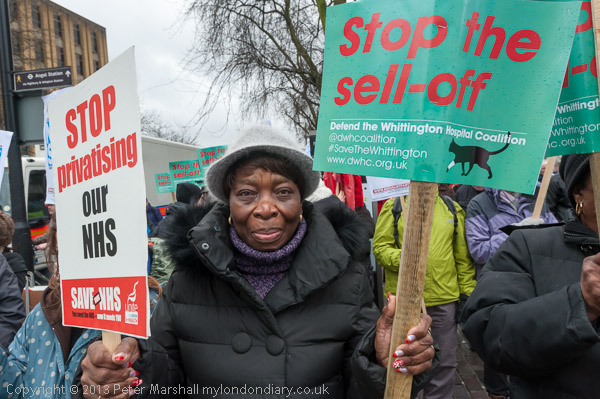
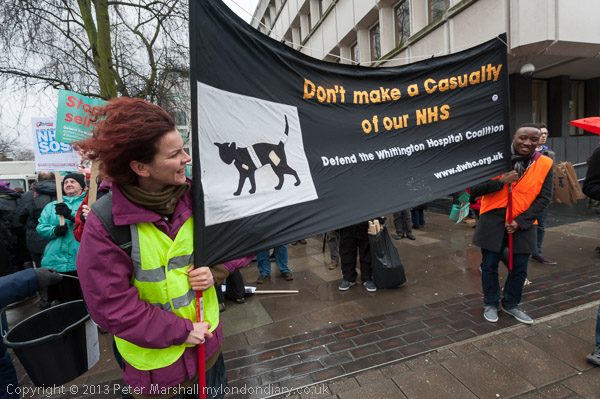
Lewisham Hospital is a highly successful and well run hospital serving a large area of South London, and when the government planned to close large areas of its services there was a huge public outcry, with large marches to keep it open, as closure would have severely damaged the health service in the area.

Lewisham, Secular Europe & Malta Day

The planned closure was not in response to any failure by Lewisham; it’s sole purpose was to allow the NHS to continue to make massive PFI repayments due from the building of other London hospitals through contracts that were badly negotiated when interest rates were high and have already delivered huge profits to the lenders.

Lewisham, Secular Europe & Malta Day

As well as a hugely successful public campaign, both Lewisham Council and the Save Lewisham Hospital campaign went separately to the High Court for Judicial Review of the decision by Health Secretary Jeremy Hunt, and both were successful.

Lewisham, Secular Europe & Malta Day

The immediate response of the Health Secretary was to announce he would appeal the two decisions, and the campaign had launched a petition calling on him to accept the defeat gracefully and not waste any further time or taxpayers money over the appeal. Given the clear judgement of the court any appeal seemed unlikely to succeed.

The government also intend to change the law to make it much more difficult for people to contest their decisions in the courts after being defeated on this and other cases where they have failed to give proper consideration to policies. But having a government which seems to think ‘sod the law, we’re going to do as we like‘ doesn’t seem at all healthy for democracy.

The Victory Parade was rather smaller than the earlier protests which had brought thousands out onto the streets of Lewisham, with perhaps a little fewer than five hundred people, though more turned up to take part in the celebration event at the end of the parade in Ladywell Fields. But perhaps marching now seemed less important, and the poor weather will have put some off.

At the front of the parade was a Lewisham Council dustcart with large posters on it and following it were marchers with a small street band. Among those marching were two nurses wearing their uniforms from the Olympic opening ceremony, some ‘Olympic’ drummers and others in medical uniforms.

More pictures on My London Diary at Lewisham Hospital Victory Parade.


Secular Europe Protest – Downing St

Around a hundred people had marched from Temple to a rally opposite Downing Street for the 6th annual Secular Europe Campaign protest celebrating secularism and demanding an end to religious discrimination and indoctrination.

As well as the protest in London there was also a similar protest taking place in Krakow, Poland, a country where politics are still very much dominated by the Catholic Church.

Things are rather different in the UK, but we still have the anomaly of 26 Church of England bishops sitting in the House of Lords, reflected in some of the campaigners wearing paper versions of a Bishop’s mitre with the number 26 on the front.

We obviously need reform of the House of Lords, but the bishops seem to me a minor issue and are among the more sensible and progressive members of the house. There are still 92 hereditary peers, as well as many more wholly undeserved political appointees, particularly those given a seat as thanks for their political and other services to retiring Prime Ministers. The recent list by Boris Johnson included some that clearly bring our politics into disrepute, and if the list by Liz Truss is approved following her disastrous fifty days in office, our politics will clearly have become a farce.

The campaigners also called for an end to religious indoctrination in schools, though I was pleased to hear one speaker make clear that not all church or religious schools were guilty of this, with many providing a good education that encouraged their pupils to think for themselves.

Others complained about the lack of secular speakers on Radio 4’s ‘Thought for the Day’, and though I think the selection has widened a little in recent years there is certainly still room for a wider choice of viewpoints. And they still have some who make me cringe every time they appear.

Some of the other things that concern the secular movement are religious discrimination against women and gays, abuse of children by the clergy, the teaching of creationism in schools, the anti-abortion lobby and misinformation about contraception and AIDs, religious male circumcision and female genital mutilation, false accusations about witchcraft, Sharia law, forced marriages and the right to die with dignity. And of course many of these concerns are shared with many religious people.

More at Secular Europe Protest.


Malta Day Procession – Westminster Cathedral

Finally I walked to Westminster Cathedral where a Mass was taking place for Malta Day, attended by the Lord Mayor of Westminster, Councillor Sarah Richardson, taking pictures as people came out from the church for the procession which was to follow.

Malta Day, actually 8th September, is a public holiday in Malta, the Feast of Our Lady Of Victories or Victory Day. Celebrations in villages there mark the Nativity of the Blessed Virgin Mary, commemorated in statues of ‘il-Bambina’, one of which was carried in the procession.

The day also celebrates the Victory of the Knights of St John of Malta against the Turks in 1565, a victory over the French in 1800 and the surrender of Italy, then occupying Malta, in 1943.

Fire-crackers were set off in the plaza and a band played before the procession finally set off down Victoria Street.

As well as the statue of ‘il-Bambina’, there were also seeral large and colourful banners, men in the robes of the Knights of Malta, and girls in huge black hooded cloaks (Faldetta or Ghonella), which seemed a little sinister to me. For various personal reasons although I’ve never been there I’ve long regarded Malta as an epitome of religious intolerance.

More pictures at Malta Day Procession.


Harmondsworth, Colnbrook & Heathrow 2014

Harmondsworth, Colnbrook & Heathrow: Back in 2014 I could take a bus a short walk from my home which took me to within a few yards of what had recently been renamed the Heathrow Immigration Removal Centre on Bath Road to the north of Heathrow Airport. And since the bus only ran every half hour I arrived a while before the protest there began and had time for a short walk – and almost half an hour to wait on my way home.

Harmondsworth, Colnbrook & Heathrow

Surprising both buses had fairly clean windows and I also took a few pictures through them on my journey, and you can see a few more at Colnbrook and Heathrow. Before the protest I’d walked beside the Duke of Northumberland’s River which runs through the extensive grounds of the British Airways offices, and on the other bank is a tall fence for the Immigration Centre and BT premises.

Harmondsworth, Colnbrook & Heathrow

The river is a man-made distributary of the River Colne, dug to take water to the Isleworth flour mill and Syon House. Along with another channel, the Longford River, built to take water to Bushy Park and Hampton Court, it has been rerouted around Heathrow airport and some of the pictures from the bus show the two in their new largely concrete channels beside the perimeter road.

Harmondsworth, Colnbrook & Heathrow

There are two immigration prisons on each side of a private road leading to the BT site behind. On the left of the picture is the Harmondsworth prison block, and on its right the high-security Colnbrook centre. At the start of the month both had been taken over by Mitie, as ‘Heathrow Immigration Removal Centre’, making ‘Care and Custody’, the Mitie subsidiary running the centre the “largest single private sector provider of immigration detention services to the Home Office.”

Mitie’s track record in running such centres should have disqualified them from running and government services. At Campsfield there had been three mass hunger strikes, a suicide and a disastrous major fire – perhaps why they had become one of the government’s favourite contractors.

Harmondsworth, Colnbrook & Heathrow

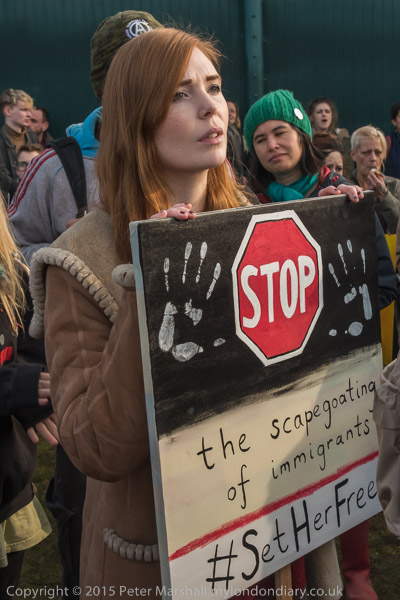
The name ‘Immigration Removal Centre’ reflects the government’s racist policies towards asylum centres. It wants to remove immigrants, whether or not they have a sound case for asylum. Such centres lock up people making it harder for them to pursue their case to remain in the UK and easier for them to be deported. The great majority of those imprisoned will eventually be given the right to remain in the UK, but may be held in centres like this for many months or even more than two years before being released so they can continue their lives – and make the positive contribution they will to UK society and our economy.

At previous protests here the protesters had been allowed to march down the private road between the two prisons and continue alongside the 20 foot fence around the Harmondsworth site back to the front. But now – perhaps due to the new management – police refused to allow them access, restricting the protest to a pen in front of the centre’s administrative block.

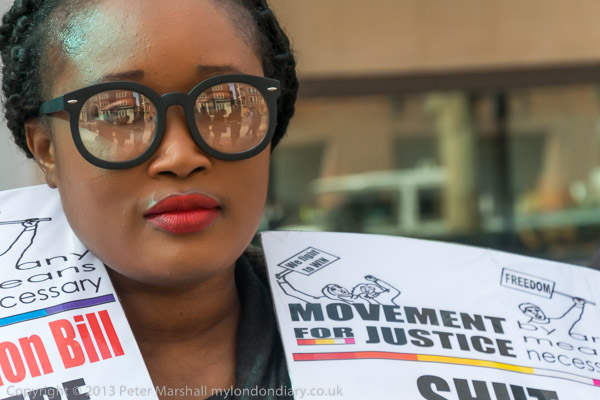
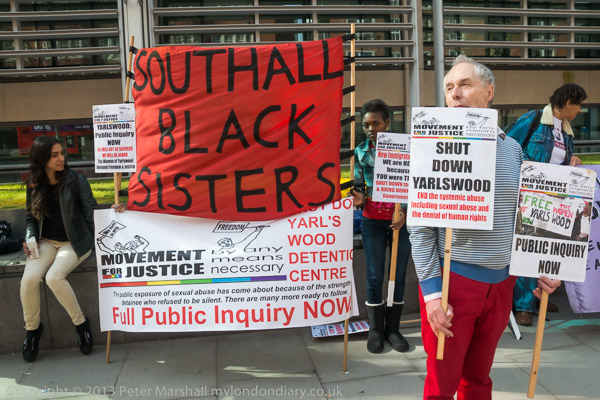
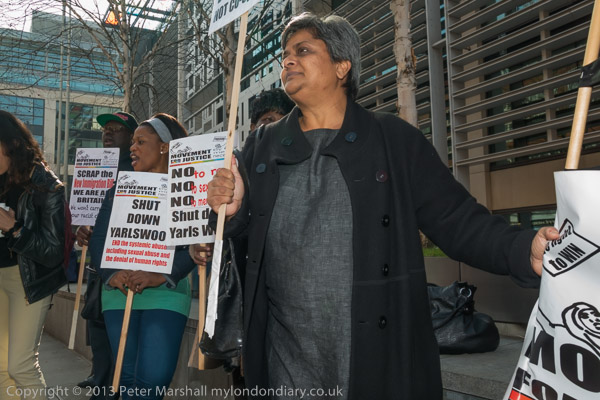
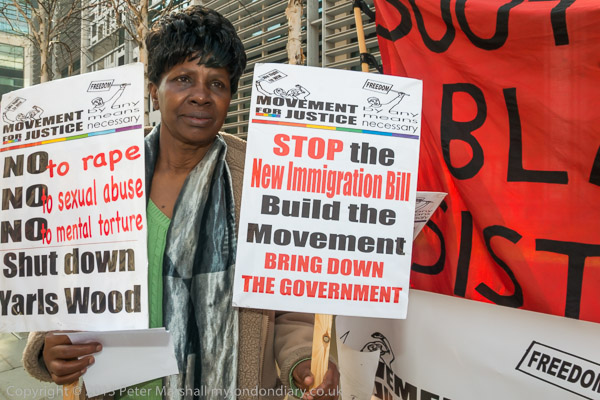
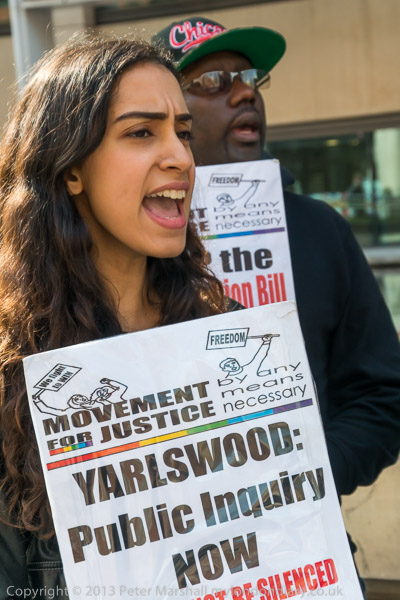
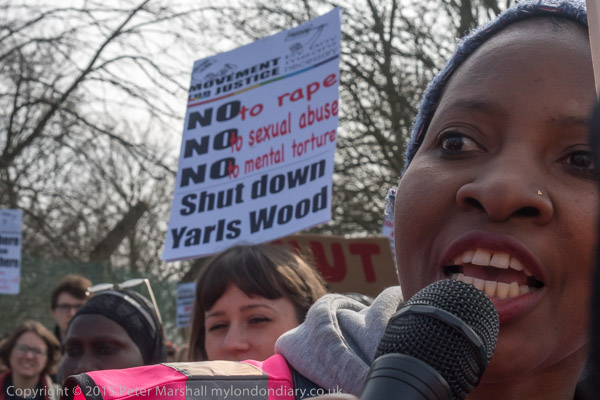
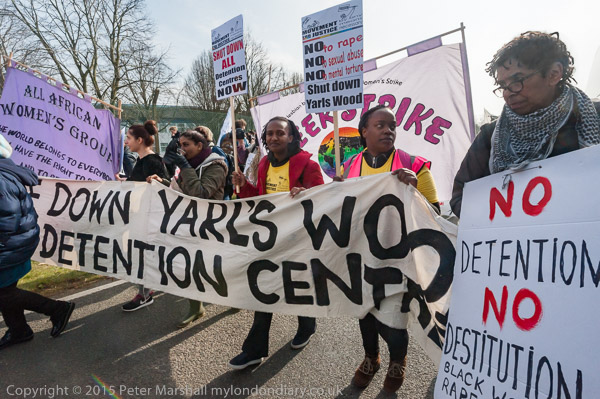
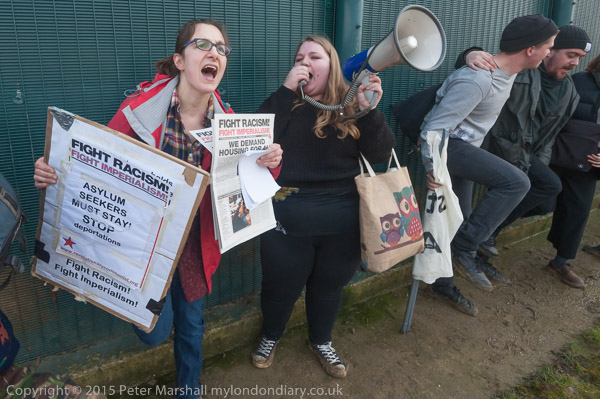
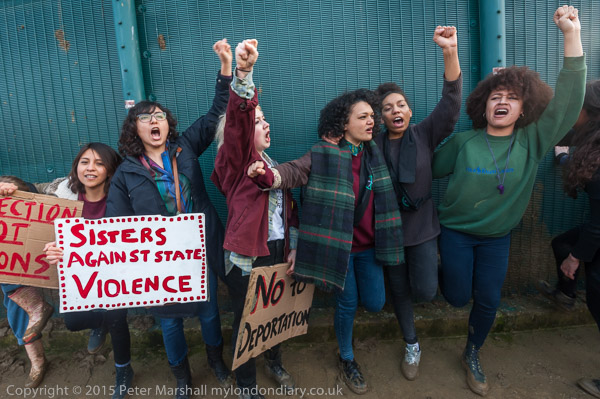
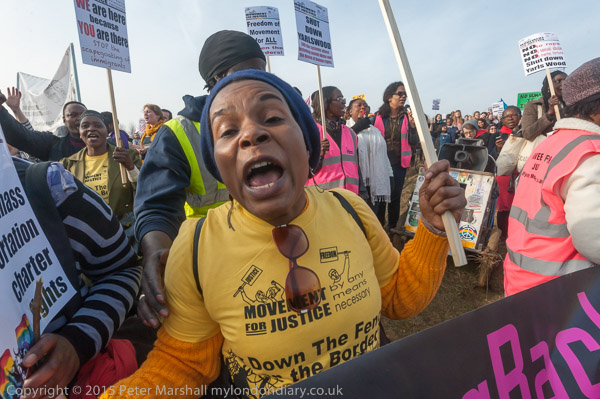
The protest was one of a number here organised by the Movement for Justice, and supported by many other organisation and the protesters argued for some time to be allowed to march down the roadway and around the Harmondsworth centre as usual but without success. Eventually the around a hundred protesters who had travelled out to the western edge of London moved into the pen provided.

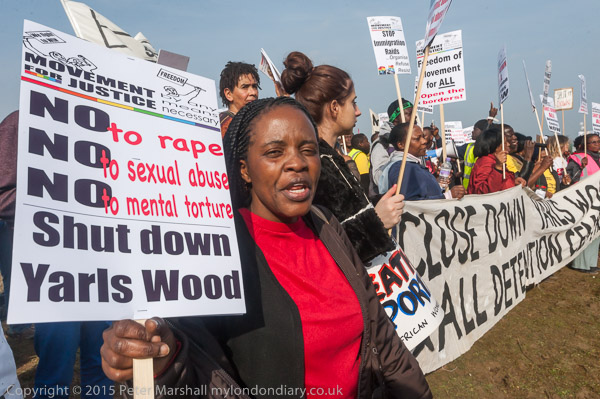
The majority of those attending the protest were immigrants, many of whom had been held in this centre or others around the country. Harmondsworth imprisons male detainees, and many of the women at the protest had spent time in Yarl’s Wood near Bedford. Later MfJ would concentrate their protests at that centre.

The protest was a very noisy one, with loud shouting and drumming and a great deal of dancing between the speeches. Phone calls from inside told the protesters that they could be heard inside the cell blocks.

Most of those who spoke were former asylum speakers and told of the suffering they had endured in our immigration detention. As some said, it was worse than prison, as the detention was indefinite. They had no release date to look forward too, and could have been deported at any time back to the countries which they had fled in fear of their lives.

Speakers also called for an end to the ‘Detained Fast Track’ system, deliberately set up when Labour where in power to make it impossible for many asylum claimants to defend themselves against deportation and remove them from the country before they are able to do so. It’s a shameful system that no country that believes in the proper rule of law, fair play and human decency could support.

Various legal challenges to ‘Detained Fast Track’ led to the High Court declaring in January 2017 that DFT had denied justice to asylum seekers for the previous ten years, with thousands being deported without a lawful hearing of their cases.

A friend of the family of Rubel Ahmed who described how he died in Morton Hall immigration detention centre in Lincolnshire on September 5th 2014 after having been refused refused medical treatment for his chest pains. Fellow prisoners heard him screaming for help, and had rioted after his death, taking control of the detention centre until brutally suppressed. One who contacted the press was brutally beaten by prison guards.

Many more pictures from the protest on My London Diary at Close UK Immigration Prisons.