Gate Gourmet & My Bike Ride – 2005

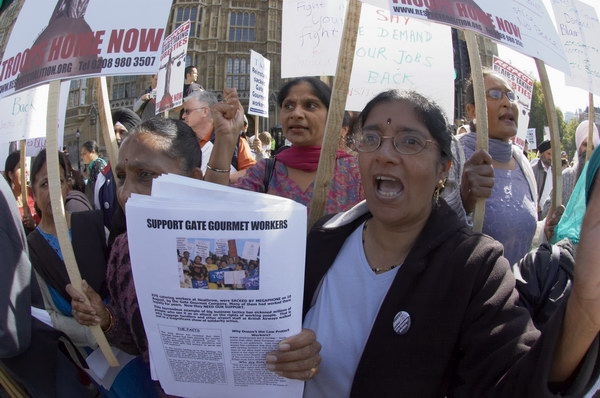
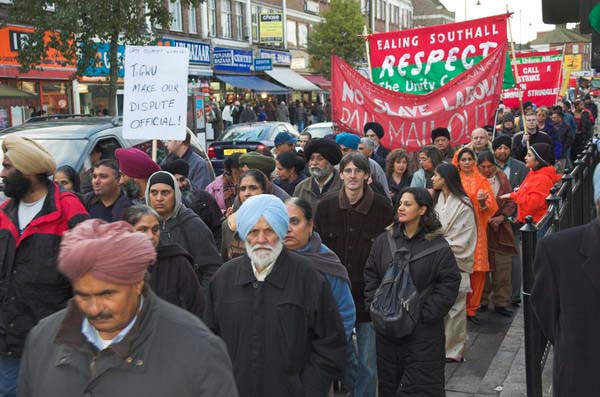
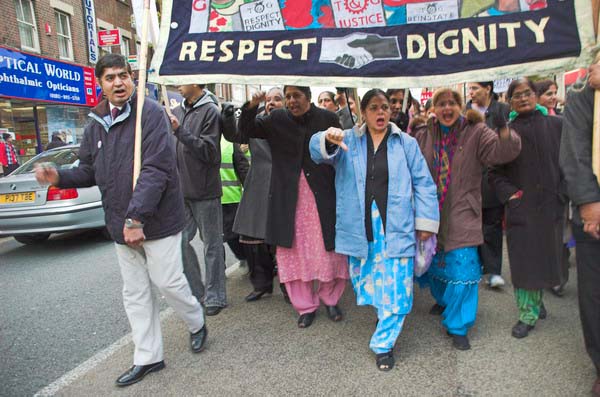
Gate Gourmet & a Bike Ride: On Sunday December 4th 2005 I got on my bike and rode the roughly 1l miles to Southall, where I locked up my bike (not the Brompton, but an old CinellI racer I’d got many years ago for my 13th birthday) and photographed a protest by workers sacked from their jobs at Heathrow airport catering firm Gate Gourmet.

There is an excellent article on the Striking Women website which gives the background to the dispute and explains why 56 women workers of South Asian origin felt betrayed by the agreement reached by the TGWU over the dispute and refused the compensation offered of between £5000 and £8000 – and refused to leave quietly – though most of the workers took the money rather than fight for justice.

Gate Gourmet & My Bike Ride - 2005

The workers and their shop stewards received little support from the official trade union movement in their fight for justice and the TGWU hardship fund ended its support in January 2006, and the TGWU (by then part of UNITE) cease all support in 2009. Around a dozen of the workers – mainly those who were for various reasons not at work when Gate Gourmet locked the workers out – eventually won claims for unfair dismissal.

Gate Gourmet & My Bike Ride - 2005

The dispute made very clear the extent to which union powers had been emasculated by a succession of Acts passed under Thatcher – the Employment Act 1980, Employment Act 1982, Trade Union Act 1984, Trade Union Art 1990, Employment Act 1988, Employment Act 1990. John Major continued with the Trade Union Reform and Employment Rights Act 1993 and then Blair and New Labour took over the job.
Gate Gourmet & My Bike Ride - 2005

But even given all this, the TGWU ended up caving in to the employers and giving them everything they wanted in the settlement it made.

Below (with minor corrections) is the post I wrote back in 2005.


Gate Gourmet – the Struggle Continues

Southall, December 4, 2005
Gate Gourmet & My Bike Ride - 2005

Gate Gourmet was split off from British Airways in 1997 to cut costs by out-sourcing their catering. It was sold to US company Texas Pacific in 2002, and they also decided to cut costs. This seems to have meant increasing workload, bringing in more managers (why?) and replacing skilled and experienced staff by unskilled workers. They went into a dispute with the TGWU (Heathrow’s major union) over layoffs and worsening conditions, then on 10 August 2005, took on 120 temporary workers.
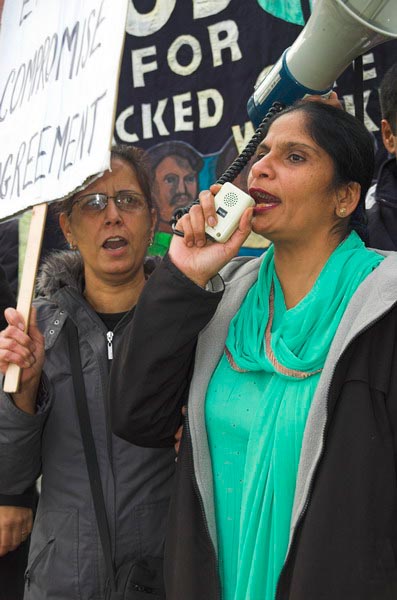
Their aim was to provoke an unofficial walkout, which would allow them to sack the workers. The workers held a union meeting in the canteen and were told by management that if they were not back at work in 3 minutes they were all sacked. It is claimed that management had locked the doors just to make sure they didn’t return. The workers were then forcibly evicted from the premises by the private security guards the management just happened to have standing around waiting.
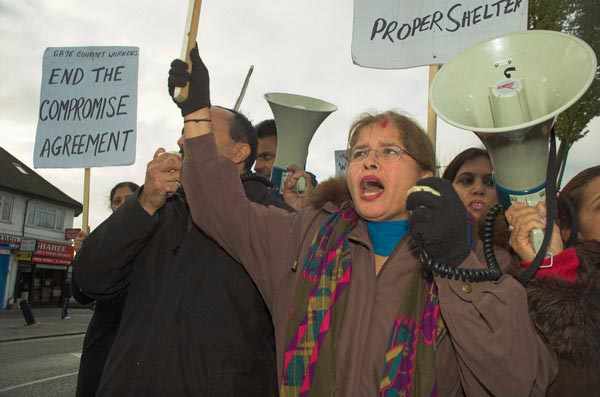
Britain’s anti-union laws (thanks to Mrs Thatcher) stack the odds against workers, allowing unscrupulous management to get away with most things short of murder if they put their minds to it.

The TGWU were hamstrung by a High Court injunction, which prevented them from doing much to help the workers. The only thing that helped them was illegal action by their former colleagues at BA, said to have cost that company £40 million. So eventually BA forced Gate Gourmet to come to some kind of compromise with the TGWU, but this has failed to satisfy most of the workers, who wanted their jobs back and decent working conditions. So, although all the papers reported it as over, the action still continues. When my wife flew BA from Heathrow a few days ago, she got a voucher to get sandwiches in the departure lounge rather than in-flight catering.

This is a dispute that highlights the need for proper trade union laws that give workers and unions a fair deal. It shows how union weakness has allowed the Labour Party to renege on the promises it made in opposition and to turn its back on its traditions of fair play. BA has also emerged as pretty short-sighted in its decision to out-source its catering, much as we have found out-sourcing to be a mistake over key services in hospitals and schools.

More pictures on My London Diary


Around Heathrow

December 4, 2005

Farm at Bedfont, immediately south of Heathrow

After the protest I was relieved to find my bike still in one piece where I had locked it and rode home. On my way to Southall I had time to spare and stopped to take a few pictures -and just a few more on my way home. Here is what I wrote in 2005.


I took my usual route to Southall on a push-bike – it takes me around 45 minutes if I don’t stop. but I nearly always do stop at least once to take some pictures. So here are a few pictures from around Heathrow, including a farm. Heathrow swallowed up some of the most productive arable land in the country including a number of fine orchards, but there are still a few farmed areas around its edges – cutting down the dangers of a crash, although some of the most used approaches come in low over many homes.

It was never a suitable site for a major airport, but the chances of any government biting the bullet and closing it down seem low. We should have been running it down for years, but instead have built 2 new terminals (both of which the airport authority said they would never need) and further disastrous development looks likely.

A few more pictures on My London Diary.


FlickrFacebookMy London DiaryHull PhotosLea ValleyParis
London’s Industrial HeritageLondon Photos

All photographs on this page are copyright © Peter Marshall.
Contact me to buy prints or licence to reproduce.
March for Peace and Liberty – 2005

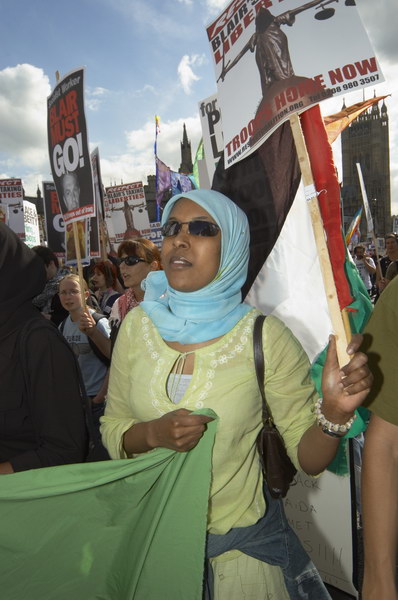
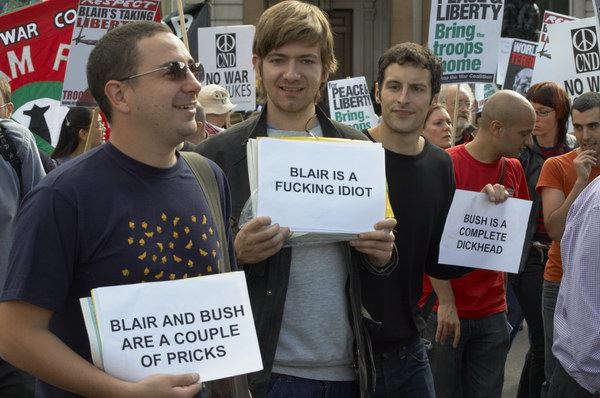
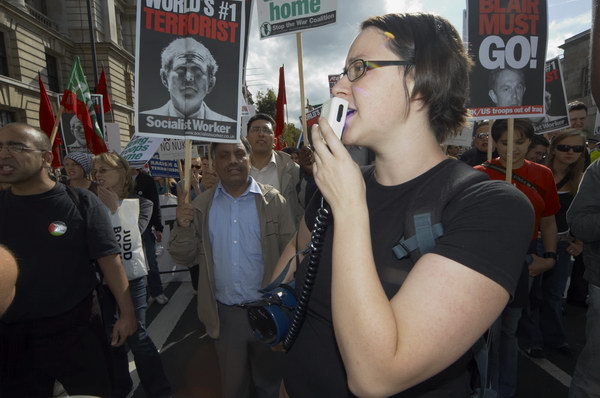
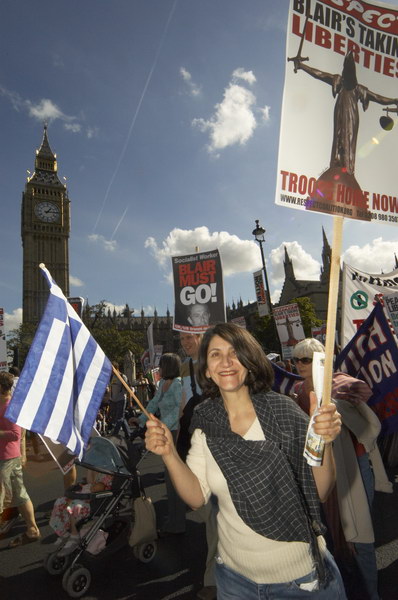
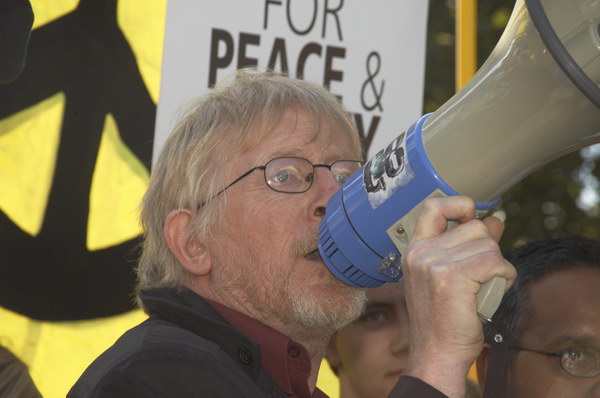
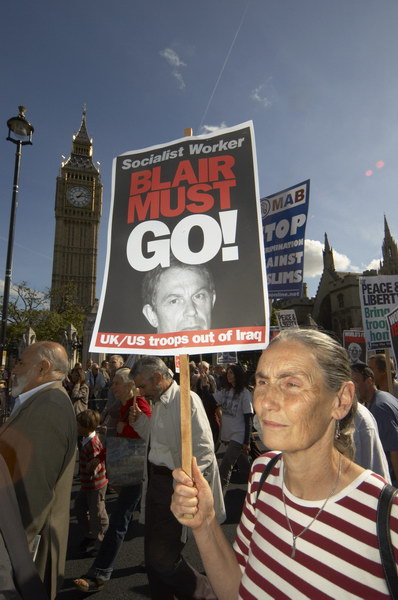
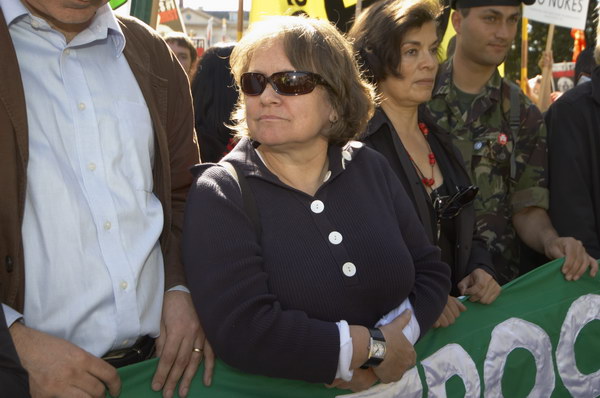
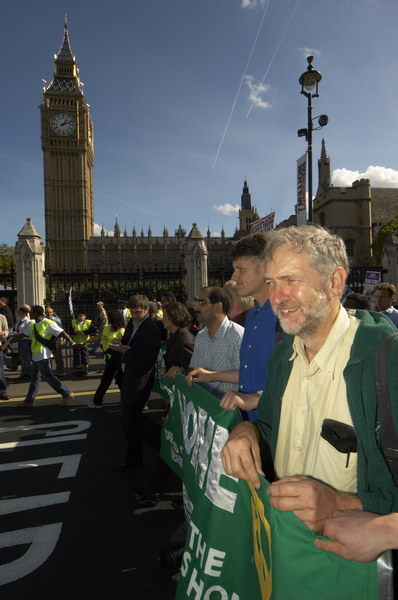
March for Peace and Liberty – 2005 Eighteen years ago on Saturday 24th September around 50,000 of us were marching through London for peace and calling for the withdrawal of forces from Iraq.

March for Peace and Liberty

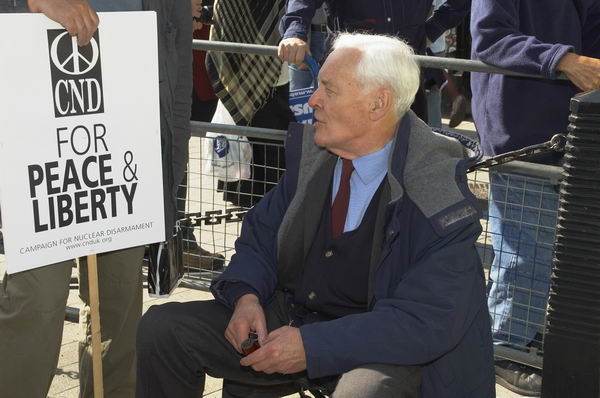
The protest, called by Stop the War Coalition, the Campaign for Nuclear Disarmament (CND) and the Muslim Association of Britain (MAB) coincided with an even larger protest in Washington close to the White House.

March for Peace and Liberty

Organisers of the Washington protest claimed that around 300,000 took part, while US police said the half that number was “as good a guess as any.” Police estimates of the London march were, as usual more political than based on any reality, and their figure of 10,000 was laughably low.

March for Peace and Liberty

I had developed my own simple methods to assess numbers. For smaller protests I’d simply stop at a suitable point and count those passing. When numbers got a little larger I’d count in groups of roughly ten, larger still groups of hundreds. Though sometimes that hundred might only have been 80 or sometimes 125 the overall figure was probably within around ten percent of the actual total.

March for Peace and Liberty

But with really large protests such as this, well over the police figure of 10,000, any form of counting is too time-consuming and tedious. I’d often still try to get a rough figure by counting for a minute where I was taking photographs a few times as the protest went part, and then make a rough estimate using the time the whole protest took to pass me. Typically the answer this gave me was around half the number claimed by the march organisers and anything around four to ten times the figure release by the police and often quoted by news media.

It’s a little difficult to find the text I wrote about the protest on My London Diary in 2005 as there are no headings in the text column on the September page, with headings and images in a separate unlinked column to the right – later I improved the site design to unite text and pictures and provided a list of links to stories which remains at the top of the monthly pages. Back in 2005 you simply had to scroll down a long page, and while the headings and text were simple to find, many viewers never managed to find the of text, which ends with a little art criticism. So here it is, with a few minor corrections:

What a fine mess you’ve got us into” is probably the conclusion of most of the British people about Blair’s decision to join in with Bush’s Iraq invasion in 2003. Quite how many of them turned up on the 24th to march for a British pull-out is a matter of contention. Both police and organisers estimates – ten and a hundred thousand respectively – seem to me extremely unlikely.

So I was there with probably between twenty-five and fifty thousand people, walking across Parliament Square in front of the Houses of Parliament, despite it being a Saturday afternoon, with no business taking place inside, the ban on the use of amplification within a kilometre of parliament was still in force, so the event was a little quieter than usual. Some did choose to defy the ban and the police appeared not to notice.

Gate Gourmet supply in-flight meals for British Airways. It used to be a part of the company, but was separated out, then sold to American management. Rather like what is starting to happen in our National Health Service, and of course British Airways was also originally owned by the nation.

The company takes advantage of a largely Asian labour force living around the edge of the airport, paying them relatively low wages. The new management decided to cut labour costs even more by bringing in casual labour to do much of the work (while apparently employing more managers!) and when the employees held a meeting to protest, they were sacked.

Pressure from both BA and the union (TGWU) led to the company offering to take back some of the sacked workers, but not all, and the strike continues. Some of the strikers came to take part in the rally, to publicise their case as well as call for a withdrawal from Iraq.

Most of the usual people were there at the march, and I took their pictures again – and some are on the site. When the march started I hung around in Parliament Square to watch it go past before walking rather faster than the marchers up Whitehall.

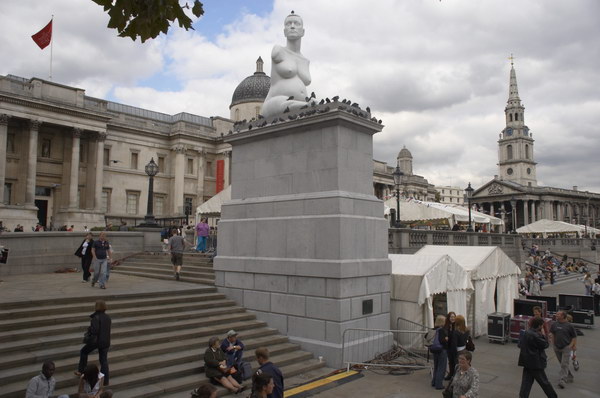
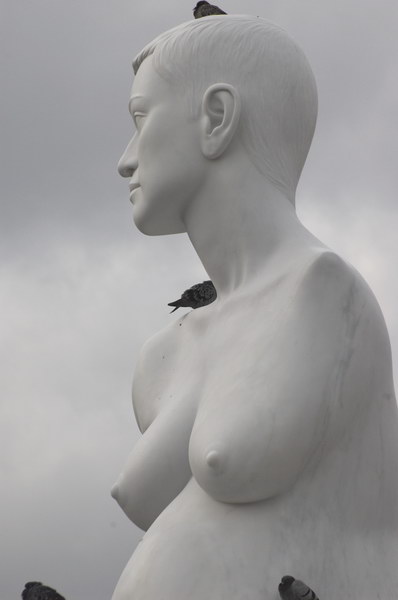
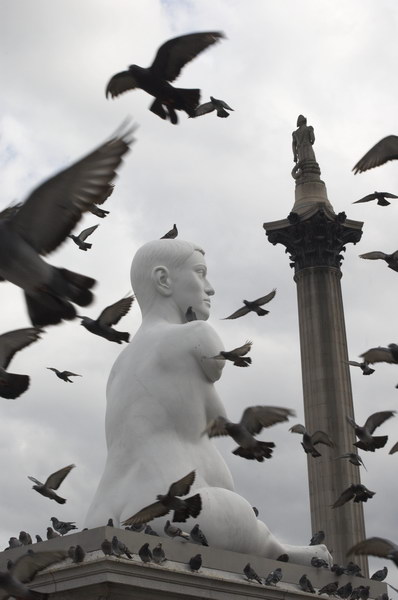
By the time I’d reached Trafalgar Square and waited again for the end of the march to pass, my knee [I’d injured it earlier in the month] was beginning to ache and I didn’t feel up to walking to Hyde Park. I sat down and ate my sandwiches contemplating the new sculpture on the ‘fourth plinth’, ‘Alison Lapper Pregnant’ by Marc Quinn. This 15ft white marble shows Lapper, an artist born without arms, sitting naked and eight months pregnant, and will stay on the plinth until April 2007.

It is a striking piece of work and was obviously attracting a great deal of attention from the tourists in the square. I took my time sitting and looking at it while I was eating, and then walking round it from all sides (slightly impeded by the preparations for a juvenile TV show to be broadcast from the square the following day.) Lapper herself works with photographs of her body, and this statue is perhaps too like her black and white photographs, with a rather unpleasant surface, sometimes more soap than marble. I found myself thinking thank goodness for the pigeons who were perching on it and doubtless adding their contributions to it.

Its position up there on a plinth is not ideal. This is work that would be best seen from roughly the same level as its base. The other plinths in the square are occupied by men on horses, which raise their figures more suitably above the plinths. Perhaps when it leaves the square a more suitable display place can be found, but its present placing is a great for catalysing debate about disability. Of course another disabled figure dominates the square; Nelson has his back to her and does not need to call upon his blind eye not to see her.

Many more pictures on My London Diary