London Loop – Enfield Lock to Chigwell

London Loop – Enfield Lock to Chigwell – If you want a good walk on the outskirts of London to walk off a little of the excesses of Christmas I can recommend this section of the London Loop. In the book guide we – myself my wife and my elder son – used on 28th December 2006 it was section 13, but now appears to be split into two parts as Sections 18 and 19. You can download excellent walk guides from Inner London Ramblers. Bits can be muddy so you need walking boots.

London Loop - Enfield Lock to Chigwell

It’s not a particularly long walk and starts and ends at stations. Photographers always add a little by wandering around a bit and running up slopes to get a better view. But back in 2006 a little under 9 miles was fine for me, though now I might prefer to split it into the two sections.

London Loop - Enfield Lock to Chigwell

The rail journey to Enfield Lock takes around an hour and a half for us, changing from the Victoria Line to Greater Anglia at Tottenham Hale, and coming home from Chigwell which is on the Central Line just a little longer. The walk itself at a moderate pace with a stop to eat our sandwiches a little over 4 hours, and in December to finish in daylight means starting walking around noon, though we made it a little earlier and arrived at Enfield Lock just after 11am.

London Loop - Enfield Lock to Chigwell

My first picture online came not long after, although the rather decorative length of piping in the top picture may not appeal to all. I think it was over the Turkey Brook, though I can’t exactly remember the location. But soon we were walking past the 1907 Lee Conservancy Offices at Enfield Lock and then a short distance beside the Lea Navigation.

London Loop - Enfield Lock to Chigwell

Then we crossed the navigation taking the footpath to Sewardstone walking to the north of King George’s Reservoir and following one of the branches of the River Lea and then crossing another wide flood relief channel and then coming to something that looks rather more like a proper river.

The route from here is uphill for some way. Somewhere we passed two horses heads and and on the Sewardstone Road a nursing home.

A few yards along the busy road (its the A12) we left and continued uphill, pausing at times to admire the view across the Lea Valley.

Here we got another view of the rather mysterious structure that had loomed above the Lea Navigation which is Enfield Power Station, built in 1997-9, a gas-fired power station built partly on the site of the decommissioned Brimsdown Power Station.

A little further on there were more views, across the reservoirs to Ponders End. But soon we came to more rural scenes including the pond and houses of Carrolls Farm.

The next section of the walk involved a lot of woods and is part of Epping Forest and also includes the Scout camp at Gilwell. The IL Ramblers notes recommend an alternative route which gives better views, but we only had the book and I made few pictures on this section – none of which are on the web.

We stopped to eat our sandwiches beside Queen Elizabeth’s Hunting Lodge on Chingford Plain where we also bought crisps and soft drinks to go with them, and sat around rather too long before taking a look at the building and then continuing.

Here we got a little lost in Epping Forest as the directions in the book were perhaps rather less clear than those online, so I think our route was just a little different to that intended. We found the Butler’s Lodge, but despite the promise in the book it was not serving tea.

There were some views on our way, but the suburbs here are not really picturesque. I think the river in the picture below is the Roding rather than the Ching which was more of a small ditch where we crossed it.

Parts of the route led along roads and perhaps the best that can be said for them are that they were downhill – and by this time I was getting tired. Eventually we came to the station and sat down and waited for a train.

There are a few more pictures as well as those above on My London Diary.


FlickrFacebookMy London DiaryHull PhotosLea ValleyParis
London’s Industrial HeritageLondon Photos

All photographs on this page are copyright © Peter Marshall.
Contact me to buy prints or licence to reproduce.


Remember Gaza & Ashura 2009

Remember Gaza & Ashura – Two events in London on December 27th 2009 was the first anniversary of ‘Operation Cast Lead’, Israel’s earlier war against Gaza which began on 27 Dec 2008. By the time this illegal attack came to an end on 18 Jan 2009, it had killed more than 1,400 Palestinians and devastated the Gaza strip, destroying homes and infrastructure.


Remember Gaza – Israeli Embassy, Kensington

Remember Gaza & Ashura 2009

That attack in 2008 had come after a number of earlier attacks by Israel on Gaza over the years – which had resulted in a growing active resistance from Palestinians, including the firing of rockets from Gaza into Israel and the free election of Hamas with a majority in Gaza in 2006.

Remember Gaza & Ashura 2009

After Hamas took over the running of the Gaza strip in 2007, Israel imposed an indefinite blockade of Gaza that has continued until now. Intended to stop Hamas importing weapons it “also led to significant humanitarian challenges, as it restricts the flow of essential goods, contributes to economic hardship, and limits the freedom of movement for Gaza’s residents.”

Remember Gaza & Ashura 2009

The current destruction of Gaza is of course on a much greater scale than in 2008, with over 20,000 Gazan deaths including 10,000 children. More journalists have now been killed in Gaza than were killed in the whole six years of the Second World War; many aid workers have also been killed. Over 90% of those living in Gaza have been forced to flee their homes with many families living in squalid conditions in makeshift tents without water supplies or sanitation and short of food. UN officials on the ground describe it as “hell on earth”.

Remember Gaza & Ashura 2009

It is now clear to almost everyone around the world outside Israel that the current Israeli attacks go far beyond anything that can possibly be justified as a response to the horrific attack by Hamas on 7th September. Now impossible not to see the current attacks as an attempt at genocide, the complete elimination of the Palestinian population of the area, and this has been the clearly stated aim of some Israeli right-wing politicians including some of those in the Israeli government.

It is hard at the moment to see any end to the current destruction of Gaza and its people by Israeli armed forces. The US seems unable to exert any real influence on Israel but has been able to effectively stymie any international action through the United Nations, watering down the United Nations Security Council resolution to almost meaningless platitudes – and even then abstaining.

As Russia’s UN Ambassador stated to the council, this resolution “would essentially be giving the Israeli armed forces complete freedom of movement for further clearing of the Gaza Strip“.

More than a thousand came to protest as close a police would allow them to the Israeli Embassy in Kensington on December 27th 2009. They called for an end to the siege of Gaza, justice for the Palestinian people and the trial of Israelis responsible for war crimes, and for Egypt to allow the peace convoy taking humanitarian aid to Gaza to proceed.

It was a peaceful but noisy rally, with a number of speakers including Jeremy Corbyn as well as Palestinians from Gaza. Police stopped people from crossing the road towards the private road leading to the Israeli embassy and led them back, with one man who sat down and refused to move being carried back with reasonable care by smiling officers.

Also present at the protest were a group of ultra-orthodox Neturei Karta Jews who oppose Zionism, believing it to be a political movement that is against their view of the Jewish religion. They were taking part in other similar demonstrations in major cities around the world and a group of their Rabbis was on its way to Gaza to show solidarity with the people.

More on My London Diary at Remember Gaza.


Ashura Day Procession – Marble Arch to Kensington

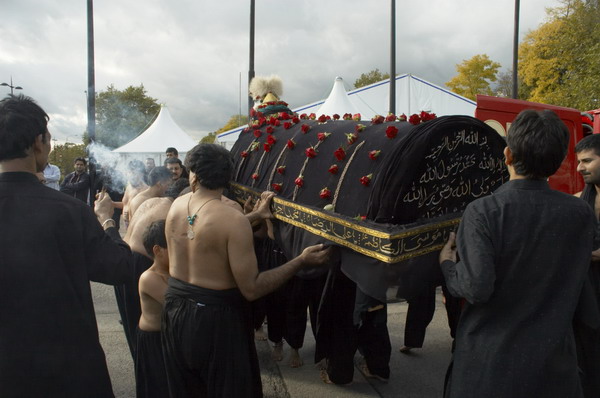
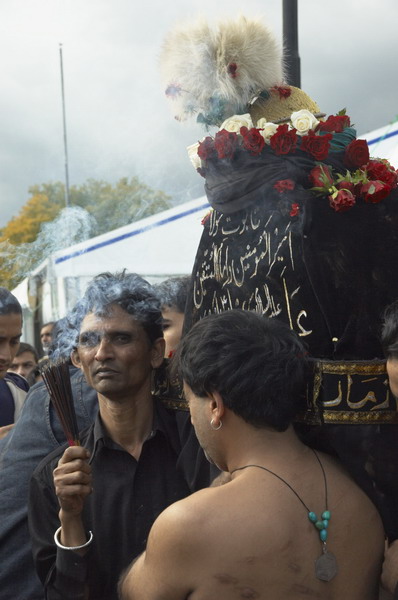
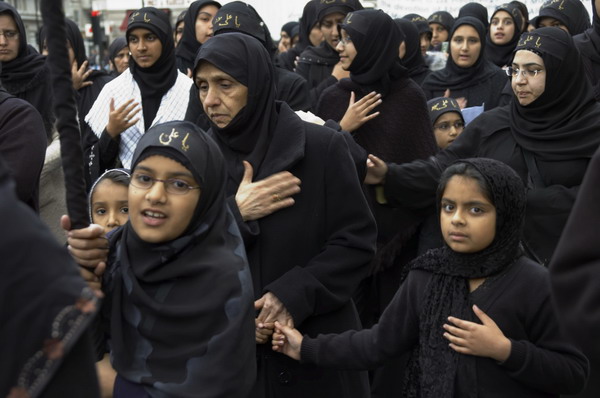
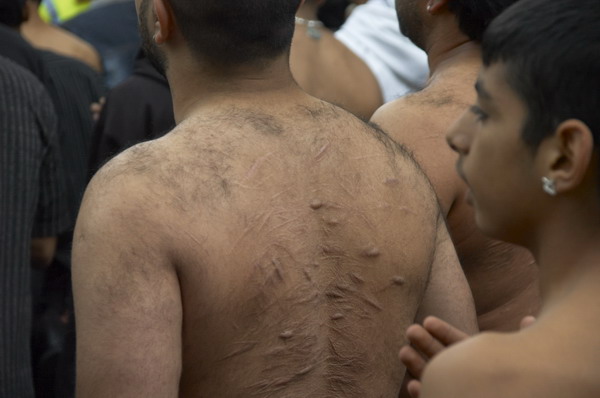
Also taking place earlier in the day in London on 27th December 2009 was the annual Ashura Day procession, which takes place on the 10th of the Muslim month of Muharram to mourn the assassination of the Imam Hussain and his followers at Karbala in AH 61 (680 AD.) Because the Islamic Calendar is based on a year of 12 lunar months this observance occurs at different dates each year according to the civil Gregorian calendar – and in 2023 was in July.

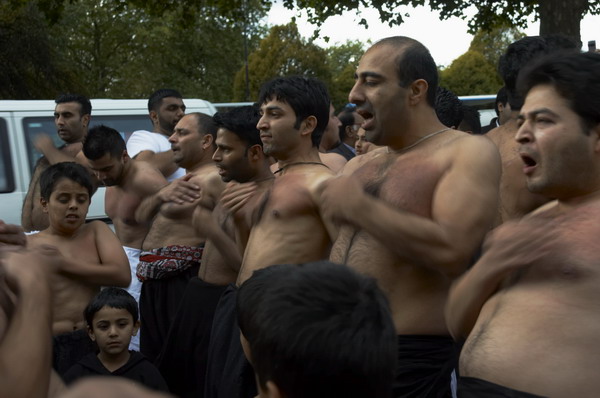
The march began at Marble Arch and two large groups of Shia Muslims – men followed by women -marched from there to the Islamic Centre in Holland Park. Most were dressed in black and many beat their chests with their hands in mourning as they marched to the beat of drums and the sounding of trumpets. Some wept as the marched. Many had been fasting for the previous nine days of Muharram, saying prayers and giving charitable gifts.

Imam Hussain was the grandson of the Prophet Mohammad and he and his followers had refused to accept the authority of Caliph Yazid as they believed this would have meant abandoning the “true” Islam of his grandfather. He and his small group of followers were surrounded at Karbala, left for three days in the desert without water and then Imam Hussain and his 72 male companions including male children were slaughtered and the women made to march as captives to Damascus.

More on My London Diary at Ashura Day Procession,


FlickrFacebookMy London DiaryHull PhotosLea ValleyParis
London’s Industrial HeritageLondon Photos

All photographs on this page are copyright © Peter Marshall.
Contact me to buy prints or licence to reproduce.


Christmas Displays – 2003

Christmas Displays – Back in December 2003 I walked and cycled over much of the outer areas of London to photograph the Christmas displays that people had put on the outside of their houses, sometimes collecting large amounts for charities. Twenty years ago I was of course 20 years younger and considerably fitter – and had been told by my doctor to get a lot of exercise after a rather minor heart op at the start of the year.

Christmas Displays

Christmas Displays

My heart attack had coincided with a couple of other important events in my life at the end of 2002, the start of my change to digital photography with the purchase of a Nikon D100, one of the first affordable digital SLR cameras capable of professional quality, and of a folding bicycle. This camera and the Brompton were both essential to this project, as was the Internet, where I appealed for details of where the more interesting displays could be found.

Christmas Displays

Cameras have improved considerably over that 20 years and photographically it would be much easier to take pictures like this now, with cameras having a greater dynamic range and also many incorporating easy to use HDR modes. This was one of the few projects I’ve carried out where the use of a tripod – a sturdy Manfrotto – was essential, and for some images I was able to combine two different exposures.

Christmas Displays

Here with minor corrections is what I wrote about these pictures 20 years ago:

Christmas is on its way, and houses all over Britain are beginning to display the signs, some more tastefully than others. Some I’ve found are rather impressive, others I find amusing, but your opinions may well differ.

Christmas has almost completely lost the connection it had to the nativity, and the ‘Christmas Story’ is now one of cash registers and a Santa Claus who owes as much to advertising as to Saint Nicholas. Originally of course this was a pagan festival, from over 4000 years ago, the feast of the goddess of nature, an occasion for drinking, gluttony and gifts, so perhaps we really are getting down to our roots for once.

Many celebrations, especially those for Yule (the ‘wheel’ or sun) were on the winter solstice – the shortest daylight, usually on Dec 21 or 22, when the rebirth of the sun was celebrated. Pope julius I decided it would be a good idea for Christians to celebrate the birth of Jesus on Dec 25th back in 350AD, so that Christians could go on celebrating Yule and not feel bad about it, celebrating the birth of the son while others were celebrating the birth of the sun.

Christmas as we know it only came in around the 1500s in Germany, many of its customs only arriving here when Victoria married Albert. Our modern picture of Santa developed in the USA in the mid nineteenth century, particularly in the drawings of Thomas Nast for ‘Harpers’, and the jovial fat bearded man in red and white was well-established before Haddon Sundbloom annexed him for his fantastically successful coke adverts. Although Coca-Cola didn’t invent Santa, it was largely the power of their advertising that sold him around the world.

These decorated houses, often an attempt to go one better than the Joneses, have become an urban folk art; one of the glories of folk art is that it is seldom polite or tasteful, sometimes incredibly kitsch and over the top. Despite my misgivings on grounds of religion, ecology, upbringing and reserve I love them. At the very least they add a little colour to our lives.

My London Diary

Some of the better pictures are on the page linked above, which also has some more about my travels around London in search of them, but others are rather scattered around on other pages from the month.

Now I’m out to get a little exercise, with a five mile walk to a meal with relatives which has become a tradition with us on Boxing Days. Last year I wrote a little about this on >Re:Photo in the post Boxing Day Walks (and Rides) with pictures from 2005.


FlickrFacebookMy London DiaryHull PhotosLea ValleyParis
London’s Industrial HeritageLondon Photos

All photographs on this page are copyright © Peter Marshall.
Contact me to buy prints or licence to reproduce.


Christmas Greetings From My Flickr Albums

Christmas Greetings From My Flickr Albums – There are only 17 pictures out of the roughly 30,000 on my Flickr account which have the tag ‘Christmas‘, and some of those are only because I’ve mentioned the festival in my description rather than for anything in the picture. Although I’ve taken many pictures of Santas on the streets of London, almost all of these have been in the last 25 years, and so far I’ve mainly put pictures from earlier times onto Flickr – mostly from 1970-1994 and mainly of London. Wishing you all a happy Christmas. But if you get too fed up with the nonsense on TV or even with family and friends there are plenty of pictures on-line to look at!


Former Cobblers, Hackney Road, Cambridge Heath, Tower Hamlets. 1983 36u-62
Former Cobblers, Hackney Road, Cambridge Heath, Tower Hamlets, 1983 36u-62

I took this in 1983, looking through the window of a cobblers shop which had recently closed but still had posters with the message ‘It wouldn’t be Christmas without Pirelli’. Santa Claus wasn’t entirely the invention of Coca-Cola though his popularity and appearance owes much to their Christmas advertising from the 1930s. The article on the link to Wikipedia above has more about Santa than you will ever want to know. This year I produced a short run of poorly printed versions of this picture as Christmas cards for selected personal friends, mainly photographers. This picture is in my album London 1983 and also appears in Tower Hamlets – Black and White.

Auto-Sparks Ltd, Electric Harness Manufacturers, Wincolmlee, Hull, 1982 33g21

In my Hull Black and White album you can find this picture and the long description below:

An unprepossessing 20th century industrial building on or close to Wincolmlee where electrical harnesses – bundles of cables and connectors – for various makes of cars and other vehicles were made. Apparently Auto-Sparks Ltd Hull dates back to an electrical business founded by Mr Henry Colomb on Beverley Rd in the 1920s. Auto-Sparks Ltd was incorporated in April 1942 and a history page on the web site of its successor company, Autosparks reproduces the original company logo from 1954 when it was registered as a trade mark.

After the original owner and manager retired in the 1980s Auto-Sparks got into difficulties and collapsed in 1991. It was bought and moved to Sandiacre Nottingham by R D Components who were specialists in classic motorbike and car harnesses and they took over the name as Autosparks, and in 2005 became Autosparks Ltd.

This picture was taken in December, and my attention was drawn to the building by the Christmas decorations drawn on its first-floor windows. And by wondering whatever an electric harness was.

Hull Black and White

The SI unit of electric charge is of course the Coulomb, named after Charles-Augustin de Coulomb, so this electical business founded by Mr Henry Colomb would appear to be a remarkable example of nominative determinism.

Father Christmas, High Rd, Willesden, Brent, 1990, 90-12c-55

In 1990 in Brent I took two Christmas pictures in 1990, one in black and white in the album 1990 London Photos of a Santa holding a number of figures and with a Harrods tag ‘£22’ standing on a box containing a caravan TV aerial kit.

Café, Christmas, Harlesden, Brent, 1990, 90c12-01b-41

The second picture from 1990 Brent was a café window in colour with Christmas decorations and an advert posted in it for flats to let in Station Road. Also in the window is a poster for Sickle Cell Awareness Day, 15th December 1990, to the left of which you can see part of me reflected as I made the image, along with reflections of a parked van and the shops and flats on the opposite side of the road. This is one of many pictures in my album 1990 London Colour.

Christmas, Car Sales, High St, Norwood, Croydon, 1991, 91-1b-22

From a South London used car showroom in the album 1991 London Photos is a 1987 car with its features and price described in notices on the windscreen complete with Christmas decorations. Usually when photographing interiors through windows I tried to work close to the glass and eliminate reflections so far as possible, but here I deliberately moved the black glove I was wearing to include the church across the road.

Christmas Lights, West End, Westminster, London, 1986, 86c123-32

In 1986 I took a few colour photographs at night around Piccadilly Circus just before Christmas which are in both 1986 Colour – London & the Thames and in Westminster – Colour 1985-92.

Pictures at night are so much easier now with digital cameras as you can work with much shorter exposures – this was probably taken on ISO400 film, while now at night I often work and get better results at 4 stops faster – the ISO6400 setting on my camera. Also being able to see what you have taken immediately makes it much easier than having to wait until the film was processed and printed.

Eros, Christmas, Piccadilly Circus, Westminster, 1986, 86c123-43

In the same albums and taken within a minute or two of the previous picture was this picture of Eros and the advertising display. The clock tells us that I made this at 16.06, around 15 minutes after sunset. Of course Eros isn’t really Eros, but Anteros, designed by Sir Alfred Gilbert to commemorate the philanthropic work of Lord Shaftesbury and called by him ‘The God of Selfless Love‘ – “as opposed to Eros or Cupid, the frivolous tyrant.”

But Piccadilly is a place at Christmas where some like to come and celebrate drunkenly and Anteros needs boarding up for protection and instead of seeing the fountain we see the hoardings with vintage Christmas images and greetings from The London Standard which featured Eros on its masthead.

Christmas, Shop window, Shepherds Bush, Hammersmith & Fulham, 1988, 88c1-01-61

Finally in 1988 in Shepherds Bush and now the first image in my album 1988 London Colour. This shop was a pet shop and the window is full of Christmas Stockings for cats and dogs and boxes of ‘Good Boy’ treats. Even the scratching post has some green ribbon attached. Along with some rather horrible artificial tree-like objects complete with blue and silver hanging balls. It seemed a particularly bleak image of the capitalist commercialisation of a religious festival.


FlickrFacebookMy London DiaryHull PhotosLea ValleyParis
London’s Industrial HeritageLondon Photos

All photographs on this page are copyright © Peter Marshall.
Contact me to buy prints or licence to reproduce.


Marco Polo, Chelsea Bridge, MAN holder & Convent – 1989

Marco Polo, Chelsea Bridge, MAN holder & Convent – More pictures from my walk which began at Vauxhall on Friday 28th July 1989 with Nine Elms Riverside. The previous post was Kirtling Street to Battersea Power Station & the Dogs – 1989

Marco Polo House, The Observer, Queenstown Rd, Battersea, Wandsworth, 1989 89-7l-13

One of few interesting postmodern buildings in London, Marco Polo House, designed by architect Ian Pollard for The Observer and British Satellite Broadcasting this was completed in 1989. It was demolished in 2014, probably to prevent it being listed and replaced by the rather anodyne flats now on the site.

Marco Polo House, The Observer, Queenstown Rd, Battersea, Wandsworth, 1989 89-7l-12

Another picture of Marco Polo House with cars parked giving a good impression of the impressive scale. At right is the railway viaduct with a train passing on the line from Victoria Station. This is the southern end of the building with a fairy mature tree newly planted in the foreground; it only briefly survived the demolition of the building.

Marco Polo House, The Observer, Queenstown Rd, Battersea, Wandsworth, 1989 89-7l-14

This giant stone carried the name of the building and I think was at the north end of the building on the corner of Sopwith Way or perhaps a little down that minor side-street. At right you can see a little of Marco Polo House and above it the unmistakable chimneys of Battersea Power Station, with the cranes with which McAlpine had removed the roof in the then recently abandoned scheme to convert it into a theme park.

Chelsea Bridge, River Thames, Battersea, Wandsworth, 1989  89-7m-64
Chelsea Bridge, River Thames, Battersea, Wandsworth, 1989 89-7m-64

I walked up Queenstown Road to the foot of Chelsea Bridge and went a few yards down the path into Battersea Park to take this picture looking across the Thames to Pimlico.

Although this was the side of an ancient river crossing fordable when the tide was low, the first bridge here was only opened in 1858 to provide access from north of the river to the new Battersea Park opened in the same year. This was a rather narrow and flimsy looking structure was named Victoria Bridge – and at the other end of the park Albert Bridge was built a few years later. Both were originally toll bridges but failed to be a commercial success and were taken over by the Metropolitan Board of Works in 1877 with the tolls being abolished in 1879.

It was renamed Chelsea Bridge when it was found to be structurally unsound to avoid any embarrassment to the Queen should it collapse but it was not until 1926 that a replacement was proposed. In the meantime the old bridge had appeared in many paintings, drawings and photographs, although the bridge that inspired Billy Strayhorn – probably from the painting by Whistler or Turner to name his impressionist composition Chelsea Bridge, was almost certainly of Battersea Bridge. The jazz standard was first recorded by the Ellington orchestra in 1941, after both had been replaced by more modern structures. Somehow I think the tune would have been less successful had it been named Battersea Bridge.

The current bridge opened in 1937 and “was the first self-anchored suspension bridge in Britain, and was built entirely with materials sourced from within the British Empire.” The main cables attach to the end of the bridge deck rather than onto the bank.

Marco Polo House, The Observer, Queenstown Rd, Battersea, Wandsworth, 1989 89-7m-66

I turned around and walked back down Queenstown Road, and could not resist taking more pictures of Marco Polo House from the opposite side of the road.

Towering above it was the giant gasholder and I carefully chose my position to make this into an unlikely addition to the post-modern building. This was the largest and seventh gasholder to be built on the site for the Nine Elms gas works which was further down Nine Elms Lane and was built in 1932 to the innovative designs of the German company Maschinenfabrik Augsburg-Nürnberg and so was the MAN holder. It and the other remaining holders were finally demolished in 2015.

Marco Polo House, The Observer, Queenstown Rd, Battersea, Wandsworth, 1989 89-7m-51

And this was the final picture I took of Marco Polo House on the walk, showing the south end of the building and attaching to it at right two of the Battersea Power Station chimneys.

Convent of Notre Dame, School, Battersea Park Rd, Battersea, Wandsworth, 1989  89-7m-53
Convent of Notre Dame, School, Battersea Park Rd, Battersea, Wandsworth, 1989 89-7m-53

I turned back onto Battersea Park Road to make this photograph of the former convent school, with the MAN gasholder appearing on the right edge of the picture. The Sisters of Notre Dame came to Battersea in 1870 to provide Catholic education for the poor children of the area with a public elementary school and also a private day school. In 1901 it reopened as Notre Dame High school for Young Ladies and in 1906 increased in size as it began to admit girls on LCC County Scholarships and a new wing was opened in 1907. Until 1919 there were some dormitories for boarders which were then converted to more classrooms and a library.

The grammar school expanded further after the Second World War and became a comprehensive in 1972, closing in 1982 when the building was sold. It was later converted into flats as The Cloisters.

More from my walk into Battersea in later posts.


FlickrFacebookMy London DiaryHull PhotosLea ValleyParis
London’s Industrial HeritageLondon Photos

All photographs on this page are copyright © Peter Marshall.
Contact me to buy prints or licence to reproduce.


Kirtling Street to Battersea Power Station & the Dogs – 1989

Kirtling Street to Battersea Power Station & the Dogs continues my walk which began at Vauxhall on Friday 28th July 1989 with Nine Elms Riverside. The previous post was More from Nine Elms Riverside.

Works, Kirtling St, Nine Elms, Wandsworth, 1989 89-7l-36

The riverside path still ends at Kirtling Street but Greenham’s aggregate wharf has now been replaced by the central site of the Tideway 25km London super sewer project underneath the River Thames due for completion in 2025, when it should prevent 95% of sewage spills in London entering the river. It was here that the two tunnel boring machines were lowered 50 metres below ground to make their way east and west to produce the central section of the tunnel between Fulham and Bermondsey.

T & W Farmiloe, paint factory, Cringle St, Nine Elms, Wandsworth, 1989 89-7l-21

This bricked up entry in a tall brick wall on the corner of Cringle Street was for many years all that remained of the 50-year-old glass, lead, paint and sanitary ware manufacturing company which had opened a large 4-storey factory here in 1884 with a frontage on Nine Elms Lane. The Farmiloe brothers had set up in business in Westminster in the 1840s as glass cutters and taken over the Island Lead Mills in Limehouse in 1885, and expanded with a brass foundry on Horseferry Road, a varnish works in Mitcham and this large warehouse in Nine Elms, producing everything a plumber could need. In the twentieth century their main business moved to sanitary ware and paint, including ‘Nine Elms’ white lead paint which was made at this white-lead factory built around 1910. I think the company which had trademarked ‘Nine Elms’ had long vacated the site before it was dissolved in 1988. The trademark passed to Akzo Nobel and expired in 2005.

Works, Sleaford St, Nine Elms, Wandsworth, 1989 89-7l-23

Sleaford Street was on the eastern side of one of the earliest developments in the area, Battersea New Town, begun in the 1790s and was first developed on its west side the by Southwark butcher William Sleford. Apparently later “One side of Sleaford Street was formerly derided as Ginbottle Row, while the other was called Soapsuds Bay, presumably because it accommodated laundresses.”

I can find no signs of the building in this picture and most of the west side of Sleaford Street is now occupied by a large block of flats extending back from the corner with Nine Elms Lane completed around 2008. John Oswald and Sons had a foundry in the street from 1871 and this may be their building.

At the left of the picture you can see the Battersea gasholder, demolished 2014-7 and at right Battersea Power Station.

Battersea Power Station, Battersea Park Rd, Nine Elms, Wandsworth, 1989 89-7l-24

A slightly unusual view of the power station six years after its final closure. Planning permission was obtained for it conversion to a theme park, but the scheme was halted when money ran out in March 1989. By this time the roof had been removed, presumably by McAlpine whose name adorns the building, which led to considerable subsequent deterioration of the steelwork and foundations.

After various failed redevelopment plans the power station was eventually refurbished as an expensive tourist destination surrounded by new homes, a hotel, shops and restaurants and a new London Underground station. McAlpine was the construction manager for the final phase three of the development.

Battersea Power Station, Battersea Park Rd, Nine Elms, Wandsworth, 1989 89-7l-25

Another view of the wrecked power station, along with a rather unconvincing double at the right with a view of the abandoned scheme.

Battersea Dogs Home, Battersea Park Rd, Battersea, Wandsworth, 1989 89-7l-11

Then there was no way back to the riverside before reaching Chelsea Bridge at the north end of Queenstown Road. A long detour away from the river around the power station and gas works site took me past Battersea Dogs Home where I took this picture with one dog begging on the top of the wall and another emerging from the Exit to the building. There is now a rather larger building on the site and it has added ‘and Cats’ to its remit.

The description of my walk will continue in a later post.


FlickrFacebookMy London DiaryHull PhotosLea ValleyParis
London’s Industrial HeritageLondon Photos

All photographs on this page are copyright © Peter Marshall.
Contact me to buy prints or licence to reproduce.


A Murky Solstice in Bethnal Green – 2006

A Murky Solstice in Bethnal Green – Quite a few years earlier I’d photographed some of the panels on the south side of the Museum of Childhood next to Museum Gardens on Cambridge Heath Road.

A Murky Solstice in Bethnal Green - 2006

The Grade II listed iron-framed building was originally part of the extensive museum complex in South Kensington built in South Kensington in 1856-7, but was taken down in 1865-7 when the V&A building there was extended and reassembled in Bethnal Green where it opened as Bethnal Green Museum in 1872.

A Murky Solstice in Bethnal Green - 2006

Since then it has gone through a number of identities as a museum, housing agricultural products and works of art, then an art museum with a growing children’s collection, and in 1974 it became the Museum of Childhood. Renovated and extended in 2005-6 it work on this was just finishing though it had reopend when I took these pictures. It closed again in 2019 to be transformed into ‘Young V&A’.

A Murky Solstice in Bethnal Green - 2006

My interest was in the mosaic panel in each bay facing the park illustrating agriculture and the arts and sciences which had been designed by F.W. Moody, the Instructor in Decorative Art at the National Art Training School and responsible for much decoration at the V&A and elsewhere in South Kensington and assembled by his female students in the South Kensington Museum mosaic class.

A Murky Solstice in Bethnal Green - 2006

I’d been asked to supply a picture of these mosaics to be used in the book ‘The Romance of Bethnal Green’ by Cathy Ross, ISBN 978-1-901992-74-8 along with some of my other pictures I’d taken on film in the 1980s and 90s, but I wasn’t happy with the quality of the film image.

So after lunch on Thursday 21st December 2006 I set out for Bethnal Green to make a replacement digital image using my Nikon D200. But I hadn’t really worked out how long it would take me to get there across London and that the sunset was at 15.53. Nor that it was a rather dull day with some slight fog in the city. By the time I was on site it was decidedly gloomy.

But there was enough light for me to made a decent job of it with the digital camera, taking the colour images in this post (and more) which I later converted to black and white for publication. And after taking these pictures I took a walk up Cambridge Heath Road to the Regents Canal and made a few more pictures around there before

Here’s the paragraph I wrote at the time:

Thursday was a cold dark day, the mercury hanging on zero and grey in the air, a fog which never quite cleared. I needed just one more picture for the project on Bethnal Green and emerged from the Underground half an bour before the shortest day of the year officially turned to night. Having done what I had to do, I kept walking as it got darker still, and more lights came on.

Bethnal Green Solstice

There are a few more pictures on My London Diary beginning here.


FlickrFacebookMy London DiaryHull PhotosLea ValleyParis
London’s Industrial HeritageLondon Photos

All photographs on this page are copyright © Peter Marshall.
Contact me to buy prints or licence to reproduce.


More from Nine Elms Riverside

More from Nine Elms Riverside: My walk on Saturday 29th July continued from yesterday’s post.

Libation, River Thames, Riverside Walk, Nine Elms, Wandsworth, 1989 89-7l-66

At the end of the William Henry Walk I photographed a small coastal vessel, the Libation, moored at a short pier.

Libation, River Thames, Riverside Walk, Nine Elms, Wandsworth, 1989 89-7l-51

As a took a few photographs the skipper of the vessel came up to talk with me. He told me that he and his mate brought the ship up on the tide every day with a load of gravel dredged from the estuary, where it was unloaded by the crane with a grab into the hopper at left of the picture. As soon as I ended the conversation and moved on I regretted I had not asked him if I could take his picture, but it was too late to go back.

The Battersea Barge, Bistro, River Thames, Nine Elms Lane, Nine Elms, Wandsworth, 1989 89-7l-41

The Battersea Barge is at the west end of this section of walk, immediately west of the Heathwall pumping station. And although the area around has changed completely the Battersea Barge is still there, a 1930s Dutch barge converted to a floating bar and restaurant, much in demand for private parties, though it now seems only to offer a bar to which people are welcome to bring their own food – and there are many local outlets which have now opened. And it now has a sister ship nearby, another converted Dutch barge, the Tamesis, a “walk-on neighbourhood bar, live music & events space” moored nearby.

Until around 2008 the path here was reached by an fairly narrow alley beside a warehouse, but the commercial properties along this side of Nine Elms Lane were replace from 2012 on by tall residential blocks, part of the immense development that has taken place in the Nine Elms area.

River Thames, Riverside Walk, Nine Elms Lane, Nine Elms, Wandsworth, 1989 89-7l-44

The dock here was originally Manor House Wharf and a dock ran into the gas works on the other side of Nine Elms Lane. The jetty at Imperial Wharf allowed larger ships to unload coal here.

Jetty, River Thames, Imperial Wharf, Nine Elms Lane, Nine Elms, Wandsworth, 1989 89-7l-31

The jetty for the Nine Elms Gas Works was rebuilt in 1952 to handle the flatiron coastal colliers which brought coal to the works. The gas works had begun here in 1858 and were taken over by the Gas Light and Coke Company in 1883 who ran them until nationalisation in 1949. The gas works closed in 1970 when the UK changed to natural gas.

There are now more houseboats moored here in what is now called Nine Elms Pier.

Pier, Riverside Walk, River Thames, Kirtling St, Nine Elms, Wandsworth, 1989 89-7l-34

At the west end of the Tideway Walk I used the steps up to the jetty to take this and a landscape format image from the same position – below. Both are looking upstream towards Battersea Power Station at left and its jetties and cranes, and on the other side of the river the 1875 chimney for the Western Pumping Station on Grosvenor Road.

Pier, Riverside Walk, River Thames, Kirtling St, Nine Elms, Wandsworth, 1989 89-7l-35

The Tideway Walk ends here, turning south to Kirtling Street, which leads back to the main road. The riverside here is still in industrial use as the Cringle Dock Solid Waste Transfer Station. Back in 1989 there was a long walk before you could access the river at Chelsea Bridge and Battersea Park, but now you can go down Cringle Street to the Battersea Power Station development.

My description of this walk continues in a later post towards Battersea.


FlickrFacebookMy London DiaryHull PhotosLea ValleyParis
London’s Industrial HeritageLondon Photos

All photographs on this page are copyright © Peter Marshall. Contact me to buy prints or licence to reproduce.


Nine Elms Riverside – July 1989

Nine Elms Riverside – July 1989: One of the benefits of working as a teacher as I still was in 1989 was certainly the long Summer holiday and I spent quite a lot of these taking photographs as well as going away for several weeks with my family – though some years this was also a photographic opportunity. And most years we also spent a week or so in Hull where I was able to add a few pictures to the work that had resulted in my exhibition Still Occupied in the Ferens Art Gallery there in 1983.

But our travels around the country in the Summer of 1989 – which as well as Hull included a week with a group of friends in a large holiday cottage in Scotland – only began in August, and the day after my visit to Hackney on Friday 28th July 1989 I returned to take up my work where I had left off earlier in Nine Elms.

Brunswick House, Market Towers, Wandsworth Rd, Vauxhall, Lambeth, 1989 89-7k-13

Tuuning west out of Vauxhall Station took me to the junction of Wandsworth Road and Nine Elms Lane. Brunswick House at right appeared in an earlier post on my walks in 1989. This mid 17th century house, extended in 1758, bought by in 1869 by “the London and South West Railway Company who used it as offices and a Scientific and Literary Institute. In 1994 it was sold to the railway staff association who again sold it in 2002. It is now a restaurant and the yard around it is used by an architectural salvage and supply company.

Market Towers was clearly a very much later building, or rather pair of buildings, the taller 290ft high with 23 floors, completed in 1975, with offices a pub, the Market Tavern, on the first floor. The pub was built to serve workers at the adjoining New Covent Garden Market completed in 1974 and its licence allowed it to open in the early hours. By the 1980s this had made it into “South London’s first gay pub with a 2am licence“.

According to Wikipedia, the buildings were bought by the misleadingly named property developer Green Property in 2008 and four years later they were given planning permission to redevelop. Instead they sold it to Chinese developer Dalian Wanda. It was demolished in 2014-5 who gained revised planning permission for two buildings containing 436 flats and a hotel, City Tower with 58 floors and 654ft tall and River Tower 42 floors and 525ft. The project was sold on to another Chinese company, and there were various problems over building contracts which delayed completion. The Park Hyatt London River Thames hotel is now predicted to open in mid-2024.

Nine Elms Cold Store, Nine Elms Lane, Nine Elms, Lambeth, 1989  89-7k-14
Nine Elms Cold Store, Nine Elms Lane, Nine Elms, Lambeth, 1989 89-7k-14

This tall, windowless monolith states across its top ‘NINE ELMS COLD STORE‘ and was built in 1964 on a former gas works site to store meat and other frozen goods brought by ship into the London Docks and transferred here by lighters. At its side was a large railway goods yard, from which these goods could be taken by rail as well as lorries from the site. But only a few years after its completion, London’s docks began to close and by 1979 it was redundant.

This gas works had closed in 1956 and the site was in use as a coach park when the cold store was built, and also included a small creek, Vauxhall Creek, which once had been the mouth of the River Effra, long culverted and diverted which was then filled in. After it ceased to be used as a cold store it stood for 20 years with various schemes for redevelopment coming to nothing. Part of the delay was caused by the huge cost of demolition, part by Lambeth Council not then wanting the kind of luxury riverside flats than now occupy the site, the 50 storey 594 ft St George Wharf Tower completed in 2014, as well as by some dodgy business dealings.

The cold store was used for various films as a dystopian urban location, was a dangerous gay cruising handily placed for the Market Tavern, as well as allegedly for “black magic, devil worship, sacrifices, and orgies” but was finally demolished in 1999.

River Thames, Riverside Walk, Nine Elms, Wandsworth, 1989 89-7k-15

I had crossed the border from Lambeth to Wandsworth and beyond the cold store the Riverside Walk had been opened up by the council as far as the Thames Water pumping station at Heathwall and after a short diversion past that to Kirtling Street, some years later in 1996 becoming a part of the new Thames Path.

This view from the path across the river past a moored lighter is from its start and there are now new buildings on the riverbank at the left, but the rest remain. These buildings are on Grosvenor Road, Pimlico. You can see the tower of Westminster Cathedral in the distance and I think to its left is the rather ugly block which contains Pimlico station.

A large brick arch on the riverbank is the ancient mouth of the River Tyburn, long since culverted. Plans for the resurfacing of the river by the Tyburn Angling Society seem limited to Mayfair and not to extend to the Thames, though the chances of it happening are as close to zero as can be imagined.

Battersea Power Station, River Thames, Riverside Walk, Nine Elms, Wandsworth, 1989 89-7l-02

The bend of the river here makes it look as if I was walking on water to take this picture, but my feet were firmly on dry land. Battersea Power Station has since then been given something of a facelift, with the removal of some of the more interesting features of the riverfront, as well as now being surrounded on several sides by large blocks of flats and being turned into a wasteful luxury shopping centre.

The pair of distant chimneys just to its right are Lots Road Power Station. The nearer bridge is Grosvenor Railway Bridge taking trains into Victoria Station, but Chelsea Bridge just upriver can also be seen clearly.

Battersea Power Station, River Thames, Riverside Walk, Nine Elms, Wandsworth, 1989  89-7l-64
Battersea Power Station, River Thames, Riverside Walk, Nine Elms, Wandsworth, 1989 89-7l-64

Another view upstream from the riverside path, which shows all four chimneys of Battersea Power Station as well as the riverside path and some of the earlier flats built beside the river here, Elm Quay Court. This luxury flat development built in 1976-8 includes secure underground parking and a 47ft swimming pool, gym and sauna.

Elm Quay Court, 30 Nine Elms Lane, Wandsworth, 1989 89-7l-54

A view of the Elm Quay Court flats from the road. The new US Embassy was built opposite them. Neither building seems attractive to me. The best feature of the US Embassy is the moat which runs along only its north side, and the best feature of Elm Quay Court is the riverside walk, which enables the public to walk past it almost without seeing the building.

My account of my walk will continue in a later post.


FlickrFacebookMy London DiaryHull PhotosLea ValleyParis
London’s Industrial HeritageLondon Photos

All photographs on this page are copyright © Peter Marshall. Contact me to buy prints or licence to reproduce.


Our Pre-Chistmas City Walk – 2017

Our Pre-Chistmas City Walk – On Thursday 7th November 2017 I met up old friends, all photographers, for the early Christmas social event we’ve organised most years. It had proved difficult to find a date everyone could make and several of the group were missing and we were down to five of us.

Our Pre-Chistmas City Walk
Four – and I was holding the camera

It’s a sobering thought that six years on only three of the five are still in the land of the living, with first Alex and more recently John having died. I’ve several times written about John Benton-Harris on this site over the years and he also years ago contributed two guest posts, as well as featuring his surprise 70th birthday party in 2009.

Our Pre-Chistmas City Walk

I’d worked with John in recent years on producing a number of books, including a few for the Café Royal Books series, including his Saint Patrick’s People, though his major work, ‘Mad Hatters’ on the English sadly remains unpublished. And I’d gone with him taking pictures to St Patrick’s Day events in London and elsewhere. Although he had some health problems and was in his 80s, his death still came as a great shock to us all.

Our Pre-Chistmas City Walk

We met at St Paul’s Underground Station and our first visit was to the Guildhall Art Gallery, where we went “down into its depths where a few years ago the remains of the Roman Coliseum were discovered and are now rather well displayed, before looking at the City of London’s art collection on display. It’s a rather mixed bunch with some fine works ancient and modern along with some rather tedious municipal records of great occasions that would have looked fine in the Illustrated London News but don’t really cut it as vast canvasses on the gallery wall.” (Quotes her are from my article written here in December 2017)

Our Pre-Chistmas City Walk

Some years earlier in 2005 I had been to the opening of a show at the gallery featuring works by some of London’s best-known living painters curated by Mireille Gailinou for a now defunct organisation I was then the treasurer of, London Arts Café, ‘London Now – CITY OF HEAVEN CITY OF HELL’ and had given my opinion on the gallery’s collection to the then curator who was very shocked when I’d said I would quite happily burn one of the largest canvases. Fortunately that had not resulted in me being banned from the gallery!

That show is now long gone, as too is the London Arts Café, but its web site with more about this and other shows and events we organised remains currently on-line. And despite my opinions the Guildhall Art Gallery is still worth visiting both for the artworks and certainly for its Roman remains and entry is free.

From there we walked “on past the Bank of England we walked into Adams Court and walked around in a circle before driven by thirst to the Crosse Keys, where I failed to resist the temptation of a pint of Smokestack Lightnin’, a beer from the Dorking Brewery, named after my favourite Howling Wolf track – I still somewhere have the 45rpm record. It was the first time I’ve come across the idea of a ‘smoked’ beer, and while interesting I think it would be best drunk around a bonfire.”

John had left us when we went into the pub, saying there was still light to take photographs and he wanted to make the most of it, but he seemed seldom to enjoy coming with us into pubs. The Crosse Keys is one of many interesting buildings – old pubs, theatres, cinemas, banks etc – around the country that Wetherspoons have taken over and preserved and though their owner has terrible politics and the chain poor conditions of service they offer cheap and generally well-kept beer and plain good-value food. Obviously their staff should unionise and fight for better terms.

We didn’t stay long in the pub, just a quick pint on the balcony and a short visit to the toilets in the depths, before leaving. Alex said goodbye here, seeing a bus that would take him back home to Hackney rather than go west with us, and I led the remaining two “down to the river, where we turned upstream along the Thames path. The light was fading a little, but perhaps becoming more interesting, but when we left the river at Queenhithe it was time to make our way back to St Paul’s to catch a bus and get a table for our meal together before the city workers crowded in.”

All the pictures accompanying this post were made with a Fuji X-E1 and 18mm Fuji lens, an almost pocketable combination. The 18mm f2 is probably my favourite Fuji lens, though often I prefer the added flexibility of the slightly slower but still fairly compact 18-55mm zoom. Later I moved up to the X-E3, which has better auto-focus and a significantly larger sensor and is slightly smaller, but both are still very usable cameras, and the X-E1 is now available secondhand pretty cheaply. It’s still a great camera for street photography and as an introduction to the Fuji range.

A few more pictures at Photographers Walk.