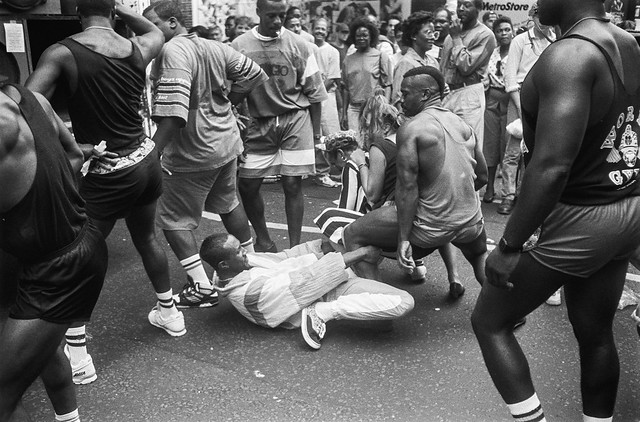
City Heights, 1987

Throgmorton St, City, 1987 87-11a-66-positive_2400
Throgmorton St, City, 1987

The view from the west end of Throgmorton St has changed a little since 1987 but is still recognisable. Largely Victorian or Edwardian at ground level, but dominated vertically by the two towers, both technically on Old Broad Street, though the right hand one, then the Stock Exchange, had an entrance and a long frontage on Throgmorton St.

Stock Exchange, Throgmorton St, City, 1987 87-11a-62-positive_2400
Stock Exchange, Throgmorton St, City, 1987

The London Stock Exchange has a long history from its origins at Jonathan’s Coffee House in Change Alley (though presumably it only got that name later) in 1698. Even older was Stock’s Market, which the City of London plaque at Mansion House dates from 1282-1737, but despite that plaque being featured on the Stock Exchange web site, that was a food market which got its name from the wooden stocks where miscreants would have their legs locked and be subjected to insults and pelted with rotten food, stones and anything else that came to hand. Unfortunately despite being a hotbed of criminal activity there are no stocks at the modern stock exchange.

In 1972 the Stock Exchange moved from Capel Court where it had been since 1802 to a new building, the Stock Exchange Tower, at 125 Old Broad Street. This building with a squashed hexagonal floor plan had a long frontage on Throgmorton St and was 100m high with 26 floors. The Stock Exchange moved out to Paternoster Square in 2004, but the building is still standing, though in disguise, its concrete now hidden behind a glass wall, and with some added office space in new building at the side.

Nat West Tower, Old Broad St, City, 1987 87-11b-55-positive_2400
Nat West Tower, Old Broad St, City, 1987

Also still in place, though a little altered is the Nat West Tower, between Old Broad St and Bishopsgate, and in 1987 there was a highwalk underneath it that led to a pedestrian bridge crossing Bishopsgate.

The Natwest Tower, completed in 1980, was 183 metres tall, and was the talllest building in the UK until the Canary Wharf Tower was completed in 1990. It remained the tallest building in the City until 2009. It required extensive refurbishment over several years after being damaged by the IRA Bishopsgate bomb in 1993. Natwest moved elsewhere and in 1995 it was renamed Tower 42, referencing the 42 floors cantilevered out above its base. The highwalk was not replaced after the bombing.

Nat West Tower, Old Broad St, City, 1987 87-11b-64-positive_2400
Nat West Tower, Old Broad St, City, 1987

Although these walkways were open to the public, they were private property and although I photographed from them on several occasions, apparently photography was not allowed. On one occasion after taking some pictures I was approached by a very apologetic security manager in a suit and tie, who told me that photography was not allowed, before walking with me to the line on the pavement marking the the boundary to the property and inviting me to continue taking pictures from there.

Bishopsgate, City, 1987 87-11b-16-positive_2400
Bishopsgate, City, 1987

I think this was the door to a bank, and I’m sure it was on Bishopsgate or possibly its southern continuation, Gracechurch St. I’ve walked along there a few times in recent years and I think both the door and the building it was on have been replaced.

St Helen's Bishopsgate, Great St Helens, City, 1987 87-11b-32-positive_2400
St Helen’s Bishopsgate, Great St Helens, City, 1987

The bridge across Bishopsgate had steps down in front of an office building on the corner of Bishopsgate and Great St Helen’s, a short street leading to the church of St Helen’s Bishopsgate. This is really two churches and is one of the few churches in the City to have escaped destruction both in the 1666 Great Fire and the Blitz. The church (at left) was there before 1210 when permission was given to build a Benedictine nunnery at its right, the two parts almost but not quite indentical.

Interesting stories are told about some of the things the nuns and priests at times got up to, but it was more the marital activities of Henry VIII that led to him declaring himself head of the Church of England in 1536, following which this and other nunneries were dissolved with the wall dividing the two parts being removed in 1538. There have of course been various alterations since then, particularly in the Victorian era, and it required restoration after being damaged by IRA bombing nearby in 1992-3 providing an opportunity to reverse some of those Victorian changes.

Lloyd's, Leadenhall St, City, London, 1987 87-11b-21-positive_2400
Lloyd’s, Leadenhall St, City, London, 1987

Walking past the St Helen’s Bishopsgate leads to Undershaft, St Mary Axe and Leadenhall St, though much of the area that was back then open is now occupied by giant towers which hide the Lloyds Building until you are rather closer. Even back in 1987 it was a building I felt I’d photographed too much – though even now it’s difficult to resist yet another picture. But perhaps this one was just a little different.

More on page 7 of my album 1987 London Photos.


All photographs on this and my other sites, unless otherwise stated, are taken by and copyright of Peter Marshall, and are available for reproduction or can be bought as prints.


1987 – In the City

St Botolph's Church Hall, Bishopsgate Churchyard, City, 1987 87-11a-15-positive_2400
St Botolph’s Church Hall, Bishopsgate Churchyard, City, 1987

St Botolph’s Church Hall in Bishopsgate Churchyard has changed little since I took this picture over 30 years ago and the churchyard is still a place you can stroll though away from the noise and fumes of Bishopsgate a few yards away.

Old Broad St, City, 1987 87-11a-21-positive_2400
Old Broad St, City, 1987

Back in 1987 you could walk through a considerable part of the City on the High Walks, pedestrian walkways above the streets, one of which could be accessed at the western end of Bishopsgate Churchyard and gave elevated views of the buildings on Old Broad St opposite. Boston House appears to be the name of the the block on Old Broad Street between London Wall and New Broad St, and to be made up of two similar buildings; this one, on the corner of London Wall appeared to me the more satisfactory.

Highwalk, view, St Botolph's Churchyard, City, 1987 87-11a-22-positive_2400
Highwalk, view, St Botolph’s Churchyard, City, 1987

This was the view from the highwalk looking back down Bishopsgate Churchyard. Much of the the highwalk has since been closed to the public.

Highwalk, View, Old Broad St, City, 1987 87-11a-24-positive_2400
Highwalk, View, Old Broad St, City, 1987

Perhaps surprisingly this view from the north end of the highwalk looked little different until recently, though I don’t think there is any public access to enable you to see it from my 1987 viewpoint. At far left is the corner of Broad Street Avenue and the building, 76-80 Old Broad Street, dates from around 1860 and is Grade II listed. The UBS building at 100 Liverpool St was completed in 1988, but UBS moved out a few years ago (to an even more hideous building in Broadgate, nominated for the Carbuncle Cup) and others moved in, but the building has been treated to a facelift, with a new skin over the old structure.

Highwalk, View, London Wall, Old Broad St, City, 1987 87-11a-34-positive_2400
Highwalk, View, London Wall, Old Broad St, City, 1987

Although the bridge across Wormwood Street from which I took this picture is still in place (or was last time I walked by before lockdown) the stairs leading to it were firmly blocked. It shows the junction between Old Broad St and the east end of London Wall, with Boston House, shwon in a picture above, on the corner at right.

Angel Court, City, 1987 87-11a-41-positive_2400
Angel Court, City, 1987

Angel Court is an alley in the centre of London’s finanacial district between Throgmorton St and Copthall Avenue, now leading between tall buldings.

Throgmorton Gardens, City, 1987 87-11a-43-positive_2400
Throgmorton Gardens, City, 1987

A little to the east of Angel Court, this garden is at the corner of Austin Friars and Copthall Avenue and was I think closed to the public, and my photograph was taken through the fence looking south from Austin Friars.

More from the CIty of London in a later post. All these pictures are in my Flickr album 1987 London Photos.


All photographs on this and my other sites, unless otherwise stated, are taken by and copyright of Peter Marshall, and are available for reproduction or can be bought as prints.


Kensington 1987

Kensington Square,  Kensington & Chelsea, 1987 87-10f-65-positive_2400
Kensington Square, Kensington & Chelsea, 1987

Kensington often seemed to me to be more a film set than a real place.

HyperHyper, Kensington High St,  Kensington & Chelsea, 1987 87-10f-55-positive_2400
HyperHyper, Kensington High St, Kensington & Chelsea, 1987

And it was certainly in places ‘HyperHyper’; this designer collective was launched in 1982 at 26-40 Kensington High St with stalls selling the latest and often looniest fashions from young designers. The caryatids were a hangover from the store’s previous incarnation as the Antiques Hypermarket. They are now long gone, and the site is now a rather down-market clothing store.

Viscount Hotel, Victoria Rd, Kensington,  Kensington & Chelsea, 1987 87-10f-02-positive_2400
Viscount Hotel, Victoria Rd, Kensington, Kensington & Chelsea, 1987

This building is still there, though under a different name and has lost its urns. Victoria Road is one of a number of streets that have at least once been named as the most expensive streets in the United Kingdom, though the hotel seems rather reasonably priced for the area.

Kensington Gardens,  Kensington & Chelsea, 1987 87-10e-56-positive_2400
Kensington Gardens, Kensington & Chelsea, 1987

Mainly I went to Kensington Gardens to sit and eat my sandwich lunch when I was in the area, but I did take the odd picture.

Kensington Palace Gardens, Kensington, Kensington & Chelsea, 1987 87-10e-01-positive_2400
Kensington Palace Gardens, Kensington, Kensington & Chelsea, 1987

And another, of the sunken garden, set out in 1908. In 2017 it was named the Princess Diana Memorial Garden, but this picture was taken around ten years before she was killed.

Man with model yacht, Round Pond, Kensington Gardens,  Kensington & Chelsea, 1987 87-10e-42-positive_2400
Man with model yacht, Round Pond, Kensington Gardens, Westminster, 1987

Parts of the gardens, including the Round Pond, are in the London Borough of Westminster. The Round Pond is not remotely round, closer to an oval, but more a rectangle with very rounded corners.

Kensington Rd, Kensington, Kensington & Chelsea, 1987 87-10e-23-positive_2400
Kensington Rd, Kensington, Kensington & Chelsea, 1987

This building with its magnificent winged lions is still there, and still a hotel, but with a different name, and a different entrance and railings.

De Vere Mews, Canning Place, Kensington, Kensington & Chelsea, 1987 87-10e-14-positive_2400
De Vere Cottages, Canning Place, Kensington, Kensington & Chelsea, 1987

As the out of focus area at right indicates, I took this picture of a private courtyard through a gate from the street. It was originally built as Laconia Mews in 1877-8, with rooms for coaches at ground level, a steeply curved ramp leading to stables on the first floor with living accomodation for the carriage drivers and grooms on the second floor. It was converted into cottages shortly after the First World War and most has been considerably rebuilt since then, and a ‘cottage’ here now sells for £2-3 million.

Kensington Church St, Kensington, Kensington & Chelsea, 1987 87-10d-62-positive_2400
Kensington Church St, Kensington, Kensington & Chelsea, 1987

This row of shops remains, although all the names are different. Then they were mainly antique dealers and galleries, now slightly more varied.


All photographs on this and my other sites, unless otherwise stated, are taken by and copyright of Peter Marshall, and are available for reproduction or can be bought as prints.


Staines 1987

My photographic projects in London relied on being able to get a train from Staines, and although the service was generally rather better back in the 1980s than now, there were still times when I turned up at the station only to find there were no trains running. It was probably on one of these days when I’d arrived at the station with my camera bag on my shoulder that I decided instead of going back home to take a walk around the town instead. There is nothing spectacular about these images, but I think they are an interesting record of a time and place and one that in many respects has changed since I took them in October 1987.

Clarence St, Church St, Staines, Middx, 1987, Spelthorne 87-10i-51-positive_2400
Clarence St, Church St, Staines, Middx, 1987, Spelthorne

This corner has changed relatively little, but Johnson and Clark, the Staines department store said to have been the inspiration for a sitcom closed long ago, and its main building on the other side of the road not in this picture long demolished. It was a business which always seemed stuck in a 1950s time warp. The shop with a closing down sale at right had been Staines first supermarket, a small Tesco , but possibly it was a successor selling up; it is now a Wetherspoons, and the last pub I visited before the lockdown in December.

Market Square, Staines, Middx, 1987, Spelthorne 87-10i-41-positive_2400
Market Square, Staines, Middx, 1987, Spelthorne

The Blue Anchor was in business here, possibly from the 15th century, and the brick facade dates from 1721. Some of its windows are real but others only painted, presumably because of the window tax which first came into force in 1696 and was only repealed in 1851, and its hard to see the difference in this picture. One of the major inns in the old town, it closed as a pub around 2006, and has since been a series of restaurants, currently Turkish and of course only able to serve takeaway meals.

Staines Town Hall was built in 1880, financed by public subscription and the building became redundant when Spelthorne Council built new offices around a mile away – and at roughly the same time was Grade II listed. For some years it was used only for occasional concerts (and is the courtroom in the 1982 film Gandhi) but the council spent £1 million to convert it into a much-needed arts centre in Staines which opened in 1994. But this lost money and was closed in 1999 being at the wrong end of the borough to get support from the Tory council. It reopened as a wine bar from 2004-12, then was left empty (apart from a brief squat) before being sold off to a developer for £1.6 million with planning permission granted in 2018 for conversion to flats despite there being no parking space and inadequate disabled access. Many Staines residents regard it as a scandalous loss of what should have been seen as a major public asset for the town desperately short of cultural facilities.

Cock Tavern, Church St, Bridge St, Staines, Middx, 1987, Spelthorne 87-10i-31-positive_2400
Cock Inn, Church St, Bridge St, Staines, Middx, 1987

The Cock Inn, built in 1832 on a site that had been a pub for several hundred years, closed in 2009 and is now offices. Behind it was Ashby’s Brewery, where a modern building for Courage can be seen peeping over and to the left, but it served Brandon’s Fine Ales, brewed in Putney. Some of the older Ashby buildings still stand, converted to residential and office uses and the Quaker Ashby family was one of the most important in the growth of Staines.

A second Staines brewery, on Kingston Rd, set up by the Harris family was taken over by Ashby’s in 1903 and closed in 1914. Later it briefly became Staines Library and then an adult education centre for Surrey County Council but was closed 15 years ago and has been empty and unused since. Squatters occupied it in 2015 attempting to open up the buildings for community use but were evicted after a couple of months.

Clarence St, Staines, Middx, 1987, Spelthorne 87-10i-26-positive_2400
Clarence St, Staines, Middx, 1987

Clarence Street was built as the approach road to the new Staines Bridge designed by John and George Rennie and opened by King William IV and Queen Adelaide in 1832, a short distance upstream of previous bridges thought to have crossed the river since Roman times close to the Market Square. It was the fourth bridge to be built since the Civil War and is still in use, widened considerably in 1958, but still a bottleneck. The building on the corner of Bridge St was in the 1970s Staines Library.

High St, Staines, Middx, 1987, Spelthorne 87-10i-03-positive_2400
High St, Staines, Middx, 1987

Staines High St is still lined by a few buildings of some architectural interest from the Victorian era, along with some rather less exciting 20th century additions, but the big difference is that it is now pedestrianised.

High St, Staines, Middx, 1987, Spelthorne 87-10h-11-positive_2400
High St, Staines, Middx, 1987

Another view of the north side of the High St, this time looking east towards the ‘Iron Bridge’ which carries the Windsor Line across the road. Almost all of the buildings here have now been demolished, with a large hotel replacing most of them.

London Rd, Staines, Middx, 1987, Spelthorne 87-10h-36-positive_2400
London Rd, Staines, Middx, 1987

The main road through Staines, on the line of the Roman Road to the Southwest which became the A30, becomes London Road to the east of the Iron Bridge seen at the left of this picture. Fortunately the opening of the second section of the Staines bypass in the 1960s takes much of the traffic away from the town which had been a notorious bottleneck. Only the shop and pub barely visible here at the side of the bridge remain (though probably not for long), with both the 1950s shops, the 1930s Post Office and the rest all long demolished and now part of a new partly high-rise largely residential development currently nearing completion – and including a new Co-op store.

London Rd, Staines, Middx, 1987, Spelthorne 87-10h-35-positive_2400
London Rd, Staines, Middx, 1987

A little further along on London Road and some pleasant 1920s style parades of shops on the north side (with some of a similar age on the south side, which would have been in shadow – so I will have decided to photograph them another day in different lighting.)

London Rd, Staines, Middx, 1987, Spelthorne 87-10f-33-positive_2400
London Rd, Staines, Middx, 1987

Surprisingly the Three Tuns and the two shops to the left are still there today, though sadly closed at the moment. As with all pubs we wonder if it will one day reopen, though we hope so, though it isn’t one I frequent. It was listed on this site in 1798 and possibly dates from rather earlier. The large office block is long gone, and development is promised on the site, though when I last looked it was still just earth and rubble.

There are a few more pictures of Staines on page 7 of my album 1987 London Photos, including just a few of the common land and other open spaces around the area on the edge of London – but just inside the M25 which is perhaps its real boundary.


All photographs on this and my other sites, unless otherwise stated, are taken by and copyright of Peter Marshall, and are available for reproduction or can be bought as prints.


South of the River – 1987

Scrap Metal, Deptford Creek, Deptford, Greenwich, 1987 87-10l-45-positive_2400
Scrap Metal, Deptford Creek, Deptford, Greenwich, 1987

Many of my favourite London walks were by the River Thames, back in 1987 still lined with industry, most now replaced by luxury flats, and rather less interesting. Walking along Creek Road from Deptford to Greenwich took me past a power station, scrap metal yards, sand and gravel works and a former gas works with the creek flowing past them.

Scrap Metal, Power Station, Deptford Creek, Deptford, Greenwich, 1987 87-10l-44-positive_2400
Scrap Metal, Power Station, Deptford Creek, Deptford, Greenwich, 1987

The final section of Deptford power station had been decommissioned in 1983, but most of of it was still standing, though I think some demolition was taking place around it. And a smaller chimney, I think on the opposite bank of the creek, was still belching out smoke, and there were piles of sand and gravel on the opposite bank as well as the scrap metal at left where the creek went under Creek Road.

Scrap Metal, Deptford Creek, Deptford, Greenwich, 1987 87-10l-32-positive_2400
Scrap Metal, Deptford Creek, Deptford, Greenwich, 1987

Both banks of Deptford Creek here are in the London Borough of Greenwich, something I often forgot when captioning images, expecting the creek to be the boundary. The creek is of course still there, and more conveniently for walkers there is now a footbridge across it a few yards from where it enters the Thames. A path now runs beside the Thames too, where both the power station and gas works once stood, in some ways a gain, but there is now so much less of interest to see.

Art Gallery, Wood Wharf, Greenwich, 1987 87-10l-43-positive_2400
Art Gallery, Wood Wharf, Greenwich, 1987

I don’t remember going inside the Art Gallery at Wood Wharf, and I think it was probably now open when I took this picture. Wood Wharf is now tall residential blocks – with a riverside walkway, restaurants and a pub.

The Lone Sailor, pub, Francis Chichester, Old Loyal Briton, Thames St, Greenwich, 1987 87-10l-35-positive_2400
The Lone Sailor, pub, Francis Chichester, Old Loyal Briton, Thames St, Greenwich, 1987

The Loyal Briton at 62 Thames Street went through a variety of names over the many years since it was built, probably around the middle of the 19th Century, possibly as a fire station, though it was selling beer by the 1850s.Its renaming as The Lone Sailor was probably after Francis Chichester’s single-handed voyage around the world in 1966-7 when his yacht Gypsy Moth was put on display not far from the Cutty Sark in 1968, remaining there until 2004, when she was restored and put back into sail. The pub closed in the 1990s, later becoming the SE10 restuarant. It had a brief time as a Chinese takeaway and gambling den, and in October 2013 reopened as a pub, The Old Loyal Britons. But the lease was only for a year, and it closed permanently in October 2014 to be replaced in 2018 by a large block of 1,2 & 3 bedroom appartments.

Lambeth Hospital, Renfrew Rd, Kennington, Lambeth, 1987 87-10l-65-positive_2400
Lambeth Hospital, Renfrew Rd, Kennington, Lambeth, 1987

A workhouse was built in 1871 in Renfrew Rd to house 820 inmates and five years later the Lambeth Infirmary was built on an adjoining site, with the two being combined as Lambeth Hospital in 1922. It was taken over by the LCC in 1930 and by 1939 was one of London’s larger municipal hospitals. It continued in use under the NHS until 1976 when a new wing was opened at At Thomas’ Hospital. Parts still remain – including this building which since 1998 has housed the Cinema Museum.

87-10k-62-positive_2400
Trade Counter, Westminster Bridge Rd, Newington, Southwark, 1987

This is now a part of the Peabody Head Office building, Minster Court.

Royal Eye Hospital, St George's Circus, Newington, Southwark, 1987 87-10k-51-positive_2400
Royal Eye Hospital, St George’s Circus, Newington, Southwark, 1987

The South London Opthalmic Hospital opened with two beds in a house near here in 1857, but after some growth and several name changes it moved to this larger block on the NW corner of St George’s Circus as the Royal Eye Hospital in 1892. Badly damaged in the war it reopened in 1944, becoming part of the NHS in 1948. In 1976 patients were transferred to St Thomas’s Hospital with out-patient clinics ending in 1980. It was demolished in the 1990s and a student hall of residence, McLaren House, built on the site.

Temporary Housing, London Park Hotel, Dante Rd, Newington, Southwark, 1987 87-10k-33-positive_2400
Temporary Housing & London Park Hotel, Dante Rd, Newington, Southwark, 1987

The London Park Hotel was built in 1897 as the Newington Butts Rowton House, the third of its kind under Lord Rowton’s recently introduced scheme of hostels for down-and-out or low-paid working men in London. They had communal facilities including a dining hall, lounge, reading room, washrooms, barbers, cobblers and tailors shops, shoe cleaning rooms and parcel rooms for storage on the lower floors and on the upper floors were private cubicles each with a bed, chair, shelf and chamber pot, all for 6d a day. Lodgers were not allowed into the cubicles during the day. They could either eat in the dining room or cook there own food (more at http://www.workhouses.org.uk/RowtonNewington/).Originally having 805 beds, a new wing added in 1903 increased that to 1017. It was renamed Parkview House and in 1972 re-opened as the London Park Hotel. It closed in the 1990s but was for a while used to house refugees and asylum seekers. It was demolished in December 2007.

More pictures on page 7 of my 1987 London Photos on Flickr.


All photographs on this and my other sites, unless otherwise stated, are taken by and copyright of Peter Marshall, and are available for reproduction or can be bought as prints.


1987 – Around Fleet St

Dorset Rise, City, 1987 87-10m-66-positive_2400
Dorset Rise, City, 1987

Dorset Rise runs up from Tudor St towards Fleet Street, changing its name further up to Salisbury Court and lies at what was the heart of the newspaper industry in ‘Fleet St’. This building at 1-2 Dorset Rise dates from the 1930s and was reclad around 1985. In 2012-3 it was converted into a Premier Inn hotel.

Dorset Rise, City, 1987 87-10m-56-positive_2400
Dorset Rise, City, 1987

3 Dorset Rise is a high quality 10 storey office building, sometimes said to have been built in 1985 but probably dating from the 1930s and like the hotel at 1-2 given a new shiny pink brown granite facing in that year. I am unsure if the deco touches at the top of these blocks date from the 1930s or were added in 1985.

Kingscote St, City, 1987 87-10m-44-positive_2400
Kingscote St, City, 1987

I had forgotten where Kingscote St is and had to look for it on Google Maps. Its a short street, around 50 metres long, between Watergate and Tudor St, a short distance west of New Bridge St. One side is occupied by a hotel and the other by a large shared office building. I think this doorway, now slightly altered was at the rear of 100 Victoria Embankment, better known as Unilever House, where Watergate meets Kingscote but if so the sculpture I photographed has gone.

Blackfriars House, New Bridge St,  City, 1987 87-10m-33-positive_2400
Blackfriars House, New Bridge St, City, 1987

Blackfriars House on New Bridge St is a rather dull building with some fine detail and perhaps surprisingly is Grade II listed, the text beginning “1913-16 by F. W. Troup. Steel-framed commercial building with white majolica facing. 7 storeys, the rectilinear structural grid expressed in the facade which is, however, divided in a classically-derived manner.” My picture I think makes it look a far more interesting building than it really is. It is now a hotel.

The Blackfriar, New Bridge St, Queen Victoria St, City, 1987 87-10m-31-positive_2400
The Blackfriar, New Bridge St, Queen Victoria St, City, 1987

The Blackfriar is a fine pub built around 1875 on the corner of Queen Victoria St, part of the site of a former friary. But it only got the decoration which gave rise to its Grade II* listing in the early years of the twentieth century, beginning in 1905, with work by architect Herbert Fuller-Clark and sculptors Frederick T. Callcott & Henry Poole. Sir John Betjeman led a campaign to save it from demolition in the 1960s and CAMRA has published a couple of books about historic pub interiors which feature it.

I think the huge and extremely boring block of the Bank of New York Mellon at 160 Queen Victoria St now blocks this view of St Paul’s Cathedral. It might be possible, but difficult to design a building of less architectural merit.

City Golf Club, Bride Lane, City, 1987 87-10m-25-positive_2400
City Golf Club, Bride Lane, City, 1987

I don’t think any golf was ever played at the City Golf Club and there were never any balls on the fairway in its left-hand window. The two people standing talking in its doorway are I think clearly employees rather than golfers. The Golf Club in Bride Lane a few yards from Fleet St was a members only drinking club much frequented by journalists at a time when pubs closed in the afternoons.

Daily Telegraph, Fleet St, City, 1987 87-10m-13-positive_2400
Daily Telegraph, Fleet St, City, 1987

Perhaps surprisingly the Daily Telegraph building dates from only 4 years before its near neighbour at the Daily Express. The Telegraph building has some Art Deco touches with Egyptian decorations which accord with its date of 1928, designed by Elcock C Sutcliffe with Thomas Tait, but seems rather old-fashioned and staid, with a monumental colonnade perhaps in keeping with its assumed gravitas, but seems to me despite its decorations a decidedly Edwardian building. Pevsner gave it a one of his more scathing reviews, “neo-Greco-Egyptian imitation has turned modernist, with much fluting, fancy iron-work and little to recommend it”. It was Grade II listed in 1983.

Probably my reason for photographing this building was that the Daily Telegraph had just moved out to offices in Victoria – and you can see the boards up in front of its ground floor as it was being made ready for occupation by investment bankers Goldman Sachs on lease until 2021. They moved to Plumtree Court in nearby Shoe Lane and the property, now owned by Qatar, is being again revamped.

Daily Express, Fleet St, City, 1987 87-10m-11-positive_2400
Daily Express, Fleet St, City, 1987

The Daily Express had moved to their new building designed by Ellis and Clarke with Sir Owen Williams, very much in the modern movement of the age in 1931. It was the first London building where the outer wall was a non-structural ‘curtain wall’ and was Grade II* listed in 1972. Like its similar offices in Manchester it was known as the Black Lubyanka. When I made this picture in 1987 the newspaper was still produced here, moving out two years later in 1989 across the Thames to Blackfriars Rd. It came back to the City in Lower Thames St in 2004.

These pictures are from Page 7 of my album 1987 London Photos.

Two years ago – 26 Feb 2019

Class War protest Rees-Mogg freak show

Two years ago today Class War protested outside the London Palladium against Jacob Rees-Mogg, who they accused of spouting “homophobic, transphobic, racist, pro-hunting, misogynist, classist, privileged” nonsense. Rees-Mogg had booked London’s best known venue to preach more of this to his fans, who had paid £38 for a ticket to this freak show.

I met up with Class War at a pub a short walk from the Palladium and found a small group there with Jane Nicholl dressed as a nun, Mother Hysteria, and Adam Clifford as Jacob Rees Mogg and there was time for them to take a selfie and everyone to finish their drinks before the small group moved off to the entrance to the Palladium where a few more of there supporters were waiting and long queues were waiting to enter for the performance inside.

As well as the fans there were of course a large group of security men and police in attendance (all probably thanking Class War for the overtime.) And when Class War held up posters and banners the waiting crowd had their hopes for what they had paid to come and see confirmed. One or two did come across to insult the protesters, and a few others passing by came to share their similar views of Mogg with Class War.

Police did their best to render the protest less effective and moved the group to the opposite side of the pedestrianised street and issued various warnings to harass them. Eventually they stopped and searched Jane Nicholl, threatening her with arrest as they found stink bombs in her handbag which they claimed were offensive weapons. I stood for almost 20 minutes watching the officer writing out “her notice of stop and search, perhaps because he is at a loss trying to find some way that doesn’t make the police action sound stupid” before deciding I had to go home and file my pictures.


Rally for an end to Outsourcing

This protest had come at the end of a long and varied day for me, which had begun with a coordinated action by the UVW, IWGB, and the BEIS PCS branch demanding an end to outsourcing and the insecurity, discrimination and low pay it causes. A legal challenge was demanding better rights for the 3.3 million outsourced workers in the UK, and protesters had met at the University of London at 8am to march to a protest outside the High Court before moving on to a rally in Parliament Square where I joined them a couple of hours later.


Outsourced Workers protest at BEIS

From Parliament Square it was a short walk to the Dept for Business, Energy & Industrial Strategy in Victoria St where outsourced workers including catering and security staff in the PCS were striking in support of their demand for the London Living Wage as well as end to outsourcing and the insecurity, discrimination and low pay it causes.


Outsourced Workers at Justice ministry

After a rally and speeches at the BEIS, the protest by outsourced workers moved on to the Ministry of Justice (though they call in the Ministry of Injustice) where low paid workers belonging the the United Voices of the World union who had been on strike for 24 hours were going back to work. They also want the London Living Wage and fair conditions of service rather than the poverty and insecurity of outsourcing.


North Woolwich

When the protest at the Justice Ministry came to an end I went to have a quick lunch and, as I had several hours to spare before the Class War action, went to take some photographs at North Woolwich. Unfortunately I arrived at Bank station for the DLR only to find there were no trains running – and no information as to when they might resume service.

It took me rather longer than anticipated to get there, taking the Northern Line to London Bridge and a train to Woolwich Arsenal. Fortunately by then services were running from there to North Woolwich, saving me a walk across the river but I still had rather less time than I needed and had to rush away before finishing my planned route, mainly beside the River Thames. It was a pleasant day for a walk, but a clear blue sky is not good for panoramic views.

As usual, more about all these on My London Diary:
Class War protest Rees-Mogg freak show
North Woolwich
Outsourced Workers at Justice ministry
Outsourced Workers protest at BEIS
Rally for an end to Outsourcing


All photographs on this and my other sites, unless otherwise stated, are taken by and copyright of Peter Marshall, and are available for reproduction or can be bought as prints.


Limehouse, Pimlico & the City

DLR, Limehouse Dock, Limehouse, 1992 92-3d-36-7a_2400
Panorama, DLR & Limehouse Dock, Limehouse, 1992

My walk down the Lea Valley from the source to the Thames took a long time on my posts here, and there are still many pictures in the Flickr album that have not featured here, including those around the other outlet from the Lea Navigation to the River Thames via the Limehouse Cut and Limehouse Basin by which barges could avoid the winding and rather treacherous Bow Creek. There are over 500 pictures in the album, including a number of colour images and they come from various visits over around ten years when I probably made several thousands of exposures. And I continued to make occasional visits there after 1992, the latest I think in 2018 or 2019. So here are just a couple of final images before I return to my wider explorations of London, back in 1987.

Heavy Rain, LimehouseBasin, entrance, River Thames, Limehouse, Tower Hamlets, 1983 33f-45_2400
Heavy Rain, Limehouse Basin entrance, River Thames, Limehouse, Tower Hamlets, 1983

1987 continued

St George's Drive, Pimlico, Westminster, 1987 87-10a-15-positive_2400
St George’s Drive, Pimlico, Westminster, 1987 87-10a-15-positive_2400

My last post about my pictures around London several months ago ended with two pictures from Pimlico taken in early October, and that’s where I will take up the story. The long streets of the area lined with Cubitt’s impressive stucco were developed from 1825, St George’s Drive, along with Belgrave Road were the two principla streets, with these opulent five storey town houses, were built (as Wikipedia quotes) for “professional men… not rich enough to luxuriate in Belgravia proper, but rich enough to live in private houses”.

By the 1980s many houses in the area were beginning to show their age; some had been converted to hotels and others offices, while others were in multiple occupation, often rather crudely converted. Developers were busy buying up properties to convert them into flats, as this picture with its estate agent’s boards and scaffolding illustrates.

Churton Place, Pimlico, Westminster, 1987 87-10a-02-positive_2400
Churton Place, Pimlico, Westminster, 1987

The side streets were also a part of Cubitt’s development, but here the houses were less grand and typically of three storeys.

River Thames, foreshore, Blackfriars, downstream, City, 1987 87-10o-63-positive_2400
River Thames, view downstream from Blackfriars, City of London, 1987

My next visit to London, later in the month took me further east, walking from Waterloo Station to the City meant I had to cross the River Thames and this picture shows a rather misty view downstream, with Southwark Bridge, Cannon St Rail Bridge, London Bridge and Tower Bridge. At the left is a tall warehouse on the upstream side of Queenhithe, London’s earliest dock. Now there would be another bridge, the Millennium footbridge, in the foreground.

White Lion Hill, City, 1987 87-10o-52-positive_2400
White Lion Hill, City of London, 1987

White Lion Hill leads up from the river to Queen Victoria St, where a rather dull office building, the Faraday Building, seems to have the dome of St Paul’s Cathedral on its roof. This part of the building was built in 1890 as a post office sorting office, which in 1905 became the GPO’s first London telephone exchange. A taller extension to the west (to the left of this view) was added in 1933, with the whole complex becoming known as Faraday House. This held the international telephone exchange and in its first years virtually all the world’s international telephone conversations were routed through here.

As this picture shows, Faraday House partly blocked the view of St Paul’s Cathedral from the Thames riverside and this led to the introduction of regulations restricting the height of new buildings in various locations giving a number of protected views from around London – including a well known one from Richmond Park. But the regulations only came in after Faraday House was built and were not retrospective. The photograph also shows another of Wren’s churches, St. Benet Paul’s Wharf, rebuilt after the Great Fire and reopened in 1683. Queen Victoria granted the church to Welsh Anglicans in 1879 and services are still conducted there in Welsh.

Knightrider St, City, 1987 87-10o-43-positive_2400
Knightrider St, City of London, 1987

Redevelopment was in full swing in the Knightrider St area as you can see from these pictures. I think the building at right is is the back of the building on Queen Victoria St now home to the Church of Scientology, and to the left is probably Faraday House. So many of what see like older buildings in the city are now just facades to more recent developments.

Knightrider St, City, 198787-10o-42-positive_2400

The web has many references to Knightrider St, but none that give useful information about its post-war past. Most are about its name, suggesting that Stow’s suggestion it came from being a handy route for knights riding to St Paul’s and Smithfield is unlikely (though there are no positive suggestions), or list buildings along the street which were demolished in the nineteenth century or earlier, and exactly the same information is in those reference books I’ve consulted which mention the street.

Knightrider St, City, 1987 87-10o-41-positive_2400

Addle Hill which runs down to the western end of Knightrider St, which continues west as Wardrobe Terrace. In between taking these pictures I photographed The Bell pub, on the corner of Addle Hill and Wardrobe Terrace which closed in 1989 and was demolished in 1998, one of many pictures not on-line. Further east on Knightrider St is The Horn Tavern, which was renamed The Centre Page in 2002 and is newspaper-themed.

These pictures are from Page 7 of my album 1987 London Photos.


All photographs on this and my other sites, unless otherwise stated, are taken by and copyright of Peter Marshall, and are available for reproduction or can be bought as prints.


Bow Creek Panoramas – 1992

DLR Viaduct, Bow Creek, Leamouth Rd, Leamouth, Tower Hamlets, Newham, 1992 92-1j61pr_2400

At the end of 1991 I finally bought my first panoramic camera, a Japanese Widelux F8 which I couldn’t really afford. It was a camera that took around 21 pictures on a 36 exposure film, with the film curved around a part of a cylindrical path with the lens pivoting around the centre of the cylinder.

Bow Creek, Bridges, Leamouth Rd, Tower Hamlets, 1992 92-3a42a_2400

The lens is a 26mm f2.8, though it needs to be stopped down to around f8 for most pictures as the camera is fixed focus at around 6 ft and only gets sharp at infinity when stopped down. Winding on the film winds up a clockwork motor and returns the lens to its starting position. On pressing the shutter the lens swings around through about 140 degrees, exposing the film through a slit at its back which swings across close to the film. It has 3 shutter speeds, 1/15, 1/125, and 1/250th, but even at the fastest speed it still takes rather longer to actually complete the exposure.

92-3b38_2400

The design keeps lens to film distant constant – at around 26mm – right to the edge of the film across a negative 24mm x 56mm. If this was flat, the distance to the corner would be more like 40mm and so objects at the edges get stretched to around 1.5 times actual size. This camera eliminates this distortion, but at the expense of introducing its own which you can see in these pictures. This becomes particularly noticeable in the curvature of most straight non-vertical lines.

Pura Foods, Bow Creek, M & J Reuben, London Sawmills, Wharfside Rd, Newham, 1992 92-3b52_2400

In particular, horizons become curved unless the camera is kept absolutely level. The pictures of Bow Creek were made with the camera on a sturdy tripod and with the help of a spirit level. There is one on the top plate of the camera, but I found a larger separate one more useful.

Bow Creek, Orchard Place, River Thames, Lower Lea Crossing, Tower Hamlets, Newham, 1992 92-1n12_leamouth_2400

Although the angle of view is often stated as 140 degrees this is perhaps misleading and I think probably is the angle across the diagonal. Rather more useful is the horizontal angle of view, which I think is just slightly over 120 degrees. Theoretically it would be possible to create a full 360 degree view in three exposures, but practically it needed four, though I don’t think I ever succeeded on the few occasions I tried to make one.

Later I made many more panoramas here and around London, particularly with a similar Russian camera, the Horizon or Horizont which was rather more convenient to use, as well as a few with a much larger medium format version. I also used a Hassleblad X-Pan, a nice camera which was panoramic only in format, with a similar negative size, 58x24mm, but using rectilinear lenses which can’t acheive a really wide angle of view.


To the Thames – 1983

Canning Town, Newham, 1983 35t-36 (2)_2400

The whole area has changed so much since 1983 that I find it very confusing to locate the exact locations of many of the pictures that I took, and I’ve occasionally got some of the captions wrong. Often the only way I can be sure is by carefully studying other pictures that I took where I am sure of the location.

The building at the centre of the above image can be seen in one of the pictures posted yesterday, and is clearly on Victoria Dock Road, this section of the road completely obliterated in the construction of the Docklands Light Railway and the Canning Town transport interchange. Victoria Dock Road now begins on the other side of Silvertown Way. The picture above was taken from somewhere near the flood barrier.

Bow Creek, East India Dock Rd, Canning Town, Newham, 1983 35t-24_2400

The warning light for the flood barrier was some way to the north, where the river bends around close to the East India Dock Road. At the left of the notice is a pub the East India Dock Road, long demolished, but both pylons are still there, along with the Newham Way flyover.

Bow Creek, Orchard Place, Tower Hamlets,  Newham,  1983 36a-26_2400

I think this picture was taken roughly where the Lower Lea Crossing now goes across Bow Creek and the river bends around to the east.

Leamouth Wharf, Orchard Place, Blackwall Point Power Station, Bow Creek, Tower Hamlets, Newham, 1983 36a-15_2400

It is difficult to pinpoint the locations of these views taken on the same day as I walked down beside Bow Creek towards the Thames. The pylon visible here was on the north-east corner of the East India Dock Basin next to Orchard Place and has since been removed. The chimney is a small mystery as I think this is Brunswick Wharf power station which had two chimneys – but I may have carefully lined them up so one is hidden behind the other. In 1983 the station was still in use and only decommissioned in 1984.

Bow Creek, River Thames, Blackwall Point, Power Station, Trinity Buoy Wharf, Newham, Tower Hamlets, 1983 35t-34 (2)_2400

Things are much clearer as the River Thames comes into view, and the creek swings around yet again towards the south. The power station across the river is the Blackwall Point Power Station on a site close to where the Millennium Dome was later built.

Bow Creek, Thames Wharf, Newham, 1983 35t-65_2400

There was then still a railway line leading down to Thames Wharf, and this was still an industrial area. Things are rather busier not with these sheds still in use and the whole area here is now covered by piles of steel stocks as you can see from satellite images on Google.

River Thames, Bow Creek, Lighthouse, Trinity Buoy Wharf, Tower Hamlets, 1983 35t-31_2400

Across Bow Creek I got a good view of London’s only lighthouse, at Trinity Buoy Wharf. Some years later I was to visit this site on various occasions for several art projects, including a show in which a few of my pictures of Bow Creek were part of the display. And with the late lamented London Arts Cafe I came to a picnic on the riverside and sat in the lighthouse to listen for a few minutes to Jem Finer’s Longplayer which began its thousand year performance here at midnight on the 31st of December 1999. But until 1988 it was still owned by Trinity House and busy maintaining buoys.

Heavy Rain, LimehouseBasin, entrance, River Thames, Limehouse, Tower Hamlets, 1983

Thames Wharf on the River Thames was a busy industrial site which back then seemed mainly to be dealing in scrap metal, and I had to walk around a few heaps to make my way along the river. Although I rather felt I was trespassing, no one approached me. Security was far less strict back then.

Thames Wharf, Victoria Dock Entrance, River Thames, Silvertown, Newham 36a-51_2400

This was around the limit of my walk and having taken my pictures – you can see a few more on Flickr – I walked back up Dock Road to Silvertown Way. I doubt if you can follow much of my walk today, but you do get a good overhead view of the area from the dangleway, London’s cable car across the Thames from North Greenwich to Victoria Dock. But don’t wait too long, as the sponsorship deal with the Emirates Air Line ends in 2022 and the future of this hugely loss-making service must be in doubt.


All photographs on this and my other sites, unless otherwise stated, are taken by and copyright of Peter Marshall, and are available for reproduction or can be bought as prints.