Finsbury 1988 (Part 2)

Helmet Row, St Lukes, Islington, 1988 88-5n-41-positive_2400
Helmet Row, St Lukes, Islington, 1988 88-5n-41

From Whitecross St I wandered across Old St into Helmet Row to make this picture, before going back across the road.

Old St, St Lukes, Islington, 1988 88-5n-42-positive_2400
Old St, St Lukes, Islington, 1988 88-5n-42

Helmet Row is the street beside this building, at at right is the tall spire of St Luke Old St, a Grade I listed chruch designed by John James and Nicholas Hawksmoor, the latter thought to be responisble for the unusual obelisk spire. In 1988 the church was derelict and roofless. Opened in 1733 it became redundant and closed in 1959, remaining empty until taken over as a music centre operated by the London Symphony Orchestra in 2003.

Golden Lane, Baltic St, Finsbury, Islington, 1988 88-5n-43-positive_2400
Golden Lane, Baltic St, Finsbury, Islington, 1988 88-5n-43

I don’t think I went out of my way to photograph buildings with street signs on them, but it was very useful when they did have one – or even two like this on the corner of Golden Lane and Baltic St. Both buildings are still there, although only that at the right of my picture is still Mencap. That at left has gained the name LONDON HOUSE written rather large on both sides.

Stables, Whitbread, Garrett St, Finsbury, Islington, 1988 88-5n-44-positive_2400
Stables, Whitbread, Garrett St, Finsbury, Islington, 1988 88-5n-44

Whitbread’s huge stables, built in 1897 are a reminder of a past age, one that was soon to come to an end, when traffic in London was all horse-drawn, and large numbers of horses were needed to convey barrels of beer to thirsty Londoners. This stables was built to replace a smaller stables on Chiswell street and ramps at the rear enabled horses to be kept on its three floors. The top floor originally had windows like those below, but these were bricked up when it was later used by a gun club as a firing range. Some have now been unbricked.

These stables could house around a hundred horses to pull the brewery drays, a small fraction of the many thousands of horses on London’s streets every day – with a transport system of hansom cabs and horse buses needing around 50,000 to keep running and many more in harness behind various carts and wagons, along with a few saddle horses. And with Shire horses weighing around a ton a piece the stables had to be very sturdy and the pollution problem with each producing between 15 and 35 pounds of manure per day was huge, leading to the Great Horse Manure Crisis of 1894. No solution could then be found to the problem, and it was only the internal combustion engine that eventually came to the rescue – its pollution, though toxic was largely gaseous.

School Caretakers, house, Baltic St, Finsbury, Islington, 1988 88-5n-46-positive_2400
School Caretakers, house, Baltic St, Finsbury, Islington, 1988 88-5n-46

The School Caretakers House and entrance to the Cookery School are still there in Baltic Street, though the school, built for boys, girls and infants by the London School Board in th 1880s, is now the Golden Lane Annexe of the London College of Fashion, part of UAL, the University of the Arts London.

Crescent Row, Finsbury, Islington, 1988 88-5n-31-positive_2400
Crescent Row, Finsbury, Islington, 1988 88-5n-31

The corner of Crescent Row and Sycamore St still looks much the same. Plans to demolish the building on the left edge of the picture were approved in 2017, but it appeared to have been renovated a year or so later.

Dress forms, Old St, Finsbury, Islington,  88-5n-34-positive_2400
Dress forms, Old St, Finsbury, Islington, 88-5n-34

The view through a window in Old Street. I think this later became a café bar.

More from around Old St in a later post. Click on any of the images to view a larger version in my album 1988 London Photos from where you can browse the album.


To Kilburn High Rd 1988

West Kilburn Baptist Church, Carlton Vale, West Kilburn, Brent, 1988 88-5l-33-positive_2400
West Kilburn Baptist Church, Carlton Vale, West Kilburn, Brent, 1988 88-5l-33

My wanderings around Kilburn Park had taken me back through the South Kilburn Estate to Carlton Vale and this fine example of a Baptist Church, built for the Rev Thomas Hall in 1865. Money was tight, but his brother who was an architect worked on the plans without payment. According to the Commemoration Booklet issued for its centenary the foundation stone was laid on ‘Several coins of the Realm bearing the portrait of her most Gracious Majesty Queen Victoria – one shilling, one sixpence, one halfpenny‘ and ‘the text, “Other foundation can no man lay than that is laid, which is Jesus Christ” (1 Corinthians 3:11).’ Six years later, the church still owed £380 of the £1250 it cost to build.

Willesden Lane, Brondesbury, Brent, 1988 88-5l-21-positive_2400
Willesden Lane, Brondesbury, Brent, 1988 88-5l-21

From Carlton Vale I continued northwest up Salusbury Road then turned right along The Avenue in Brondesbury to reach Willesden Lane opposite this house which is numbered as 66 Cavendish Rd, although this frontage is on Willesden Lane. This house struck me as having a intriguing individuality, although certainly not great architecture, incorporating several distinct variations of style and a rather oddly situated small window. Currently divided into around 13 small flats a planning application has been submitted to demolish it and use the site with its long garden along Willesden Lane to build a new 5 to 6 storey building with 21 flats.

Lawrence & Aitken, Albion Works, Kimberely Rd, Brondesbury, Brent, 1988 88-5l-23-positive_2400
Lawrence & Aitken, Albion Works, Kimberely Rd, Brondesbury, Brent, 1988 88-5l-23

Lawrence & Aitken , incorporated in 1927 but founded earlier and now dissolved, filed its last accounts in 1990. It gave the nature of its business as “Manufacture of other articles of paper and paperboard n.e.c. -” and was said to employ five people. The works date from 1904 and were built for cardboard makers Lawrence & Aitken under an agreement with the Simms Manufacturing Company Limited which is reproduced (but very hard to read) on the RAC website. The works is still there, though the building on the right has been replaced by housing called Kimberley Court.

Willesden Lane, Brondesbury, Brent, 1988 88-5l-24-positive_2400
Willesden Lane, Brondesbury, Brent, 1988 88-5l-24

In one of those mysteries that I’ve sometimes come across, the extension at left to J Green’s shop at 136 Willesden Lane has grown to the same height as the rest and the building is now wider, having four windows at first and second floor levels and a new floor on top while retaining the Graeco-Egyptian style of the original.

Both 134 and 136 were built for John Cramb, monumental mason supplying many monuments in the cemetery opposite, 134 in 1896 designed by George Neal and 136 by F C Dare in 1883-1884 . Both are locally listed.

Willesden Lane, Brondesbury, Brent, 1988 88-5l-26-positive_2400
Willesden Lane, Brondesbury, Brent, 1988 88-5l-26

These shops are still there but I think all now different businesses. So many flats and shops were for sale in 1988.

Willesden Lane, Brondesbury, Brent, 1988 88-5l-12-positive_2400
Willesden Lane, Brondesbury, Brent, 1988 88-5l-12

Missing ‘O’, ‘M’, ‘B’ and ‘G’ perhaps made this frontage more interesting.

The National Club, Kilburn High Rd, Kilburn, Camden, 1988 88-5l-13-positive_2400
The National Club, Kilburn High Rd, Kilburn, Camden, 1988 88-5l-13

In 1910 after the death of its owner, The Grange, a large house with extensive grounds on Kilburn High Road was sold to Oswald Stoll, the owner of the London Coliseum, who began building a theatre here. By the time it opened in 1914 his plans had changed and it became the Grange Cinema, with over 2,000 seats.

The cinema closed in 1975 and was opened as Butty’s Club and Dance Hall by Kilburn Irish publican Michael ‘Butty’ Sugrue, and later in 1976 also became the Kilburn National Club, owned by three local brothers who were builders, originally from Tipperary. The club was a major music venue, where stars including Johnny Cash and David Bowie played (there is a longer list here, along with more detailed information about the site.)

Applications to demolish the building were turned down in 1991 as English Heritage had listed it earlier in the year, as was another application in 1993. After the National Club closed in 1999 the building remained empty until it became the Victory Christian Centre in 2001 – but the church was closed in 2002 by the Charity Commission who didn’t approve of Pastor Goodman’s extravagances on expensive holidays and cars and a house in Northants. In 2003 it became a site of the worldwide Universal Church of the Kingdom of God.

The Secondhand Furniture Shop, Kilburn High Rd, Kilburn, Brent, 1988 88-5l-15-positive_2400
The Secondhand Furniture Shop, Kilburn High Rd, Kilburn, Brent, 1988 88-5l-15

An interesting example of a window display.

Loveridge Rd, Kilburn, Camden, 198888-5l-16-positive_2400
Loveridge Rd, Kilburn, Camden, 1988 88-5l-16

A few yards east of Kilburn High Rd the Underground – here decidely overground – goes across Loveridge Rd. I liked the washing hanging over Loveridge Mews, not something often found across a London street.

Confusingly, the boundary between the London Boroughs of Camden and Brent runs down the Kilburn High Road, splitting Kilburn in two. I’m sure there are still some pictures in the album where I’ve indicated the wrong borough.


London 22nd October 2014

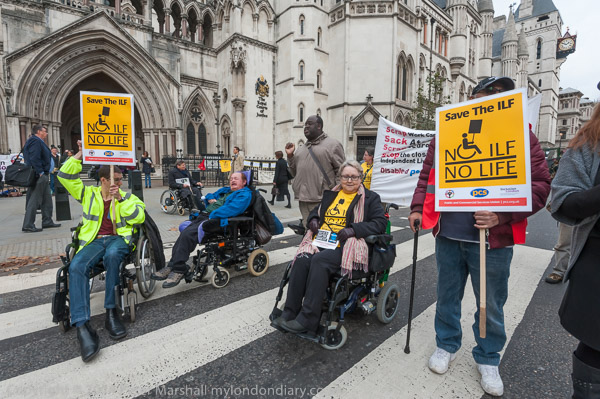
ILF

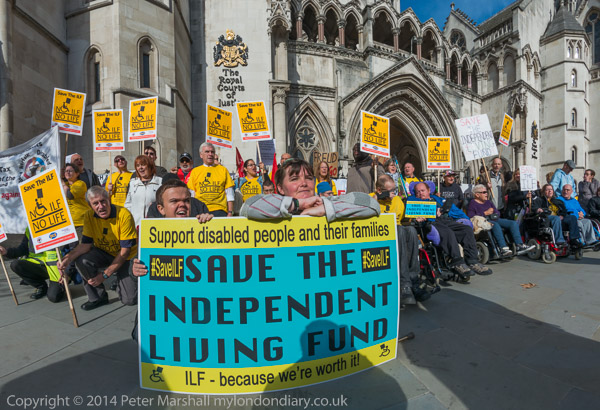
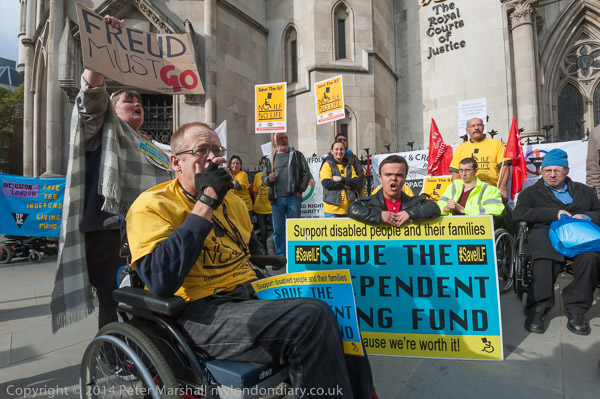
The Independent Living Fund enabled many disabled people to continue to live with dignity and to work making a positive contribution to society and the government decision to close it led to many protests and to legal actions to try and stop it under the Equality Act.

Although a court ruled that the minister concerned had acted illegally, all it required was that the new minister reconsidered the plans. He did so, and decided to go ahead, though with a three month delay. And a judge ruled in December 2014 that although in axing the ILF he knew that the closure would mean many disabled people would lose their ability to live independently in the community his decision was legal.

The decision to end ILF was clearly wrong, clearly immoral, but so long as the legal niceties were observed the government was able to go ahead with it, and our law gave no protection.

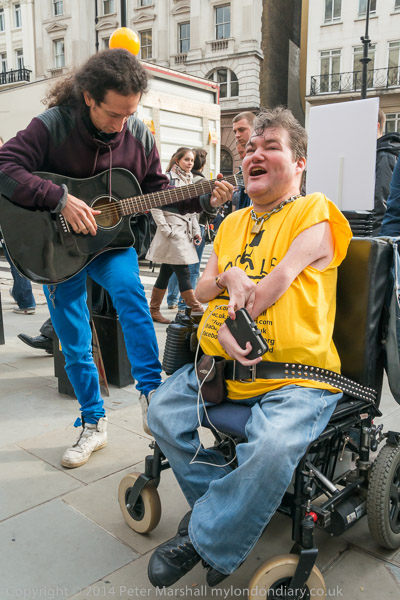
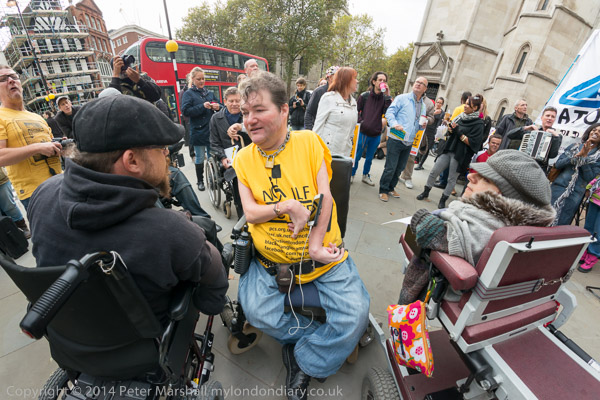
The vigil outside the court while the case was being heard attracted wide support, including from Inclusion London, Norfolk and Suffolk DPAC local DPACs, the Greater Manchester Coalition of Disabled People, Transport for All, Winvisable, PCS Union, the TUC, and other organisations,and there was even a simultaneous vigil in Toronto, Canada. Three MPs, John McDonnell, Andy Slaughter and Jeremy Corbyn, came to give their support, and there were speeches by campaigners including Paula Peters and Andy Greene, with John Kelly singing.

As expected the vigil ended with a short direct action by DPAC and others, briefly blocking the Strand outside the law courts.

Free Shaker Aamer

This was one of a long series of regular vigils opposite Parliament for Shaker Aamer, an innocent charity worker arrested by bandits and handed over to US forces who have imprisoned and tortured him for over 12 years. He was cleared for release in 2007 but remained in Guantanamo with our government failing to press for his release because his testimony could embarrass MI6 as well as the US.

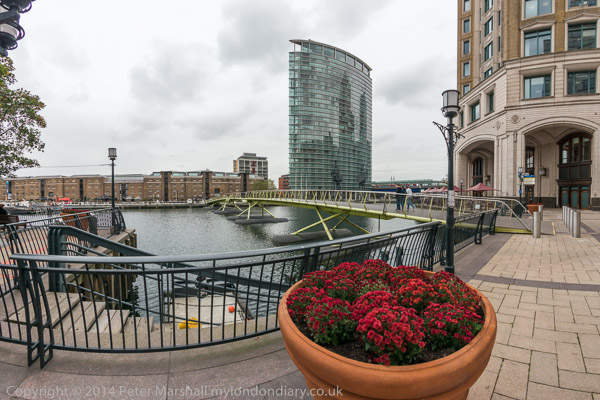
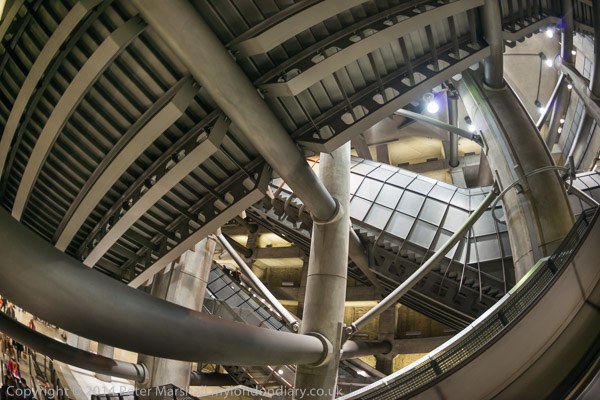
London Panoramas

I had time before another protest to visit an exhibition at the Museum of London Docklands and on the journey to pause and make some panoramic images.

Probably the most interesting were inside Westminster station, where “the beams and buttresses, designed by Hopkins Architects and completed in 1999 for the opening of the Jubilee Line are also the foundations of the block of parliamentary offices above the station, Portcullis House, and were deliberately Piranesian, though sometimes I get more of the feeling of Escher as you seem to walk endlessly up escalators and around the interior.”

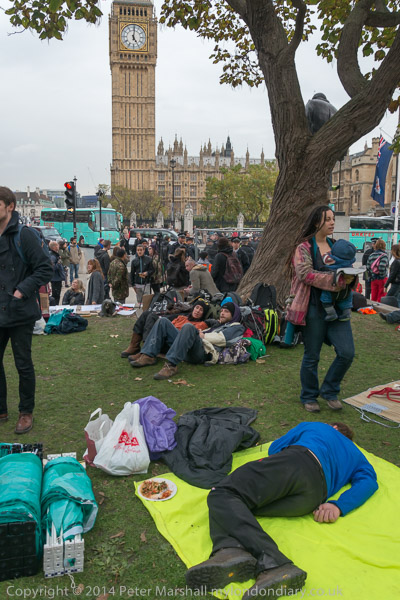
Democracy Camp – Poet Arrested

I returned to Parliament Square where the Democracy Camp was still holding workshops, though police and the GLA ‘heritage wardens’ had fenced off the main grass area.

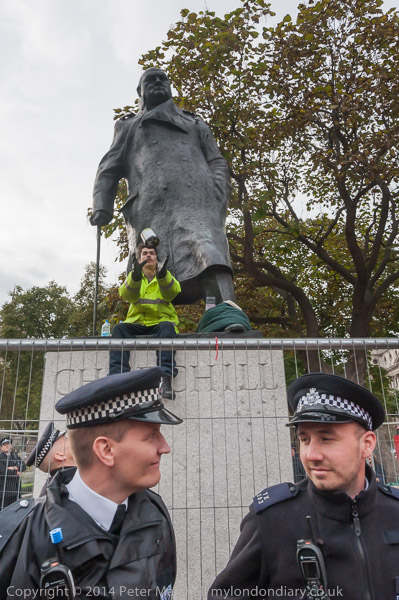
Danny, one of the protesters had been sitting on the plinth next to the statue of Churchill since the previous afternoon and poet Martin Powell arrived with a pot of food for him, which he tossed up to him, going straight into his hands, despite police warning him he could be arrested.

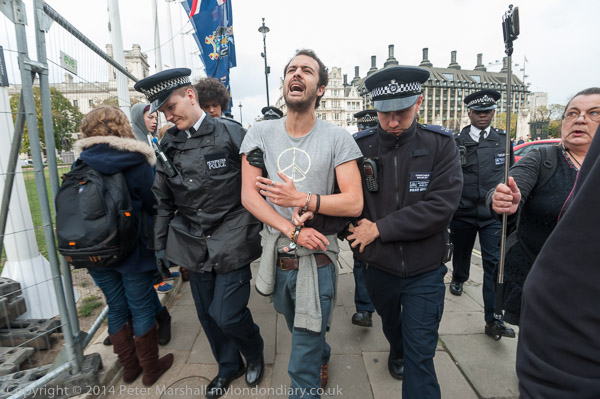
How can feeding the hungry be a crime?” he asked and he was arrested and led away in handcuffs around two sides of Parliament Squareperforming his poem ‘The Missing Peace’. I left while Danny was still on the plinth, though later that evening police finally found a ladder and brought him down after over 26 hours.

Musical Poor Doors

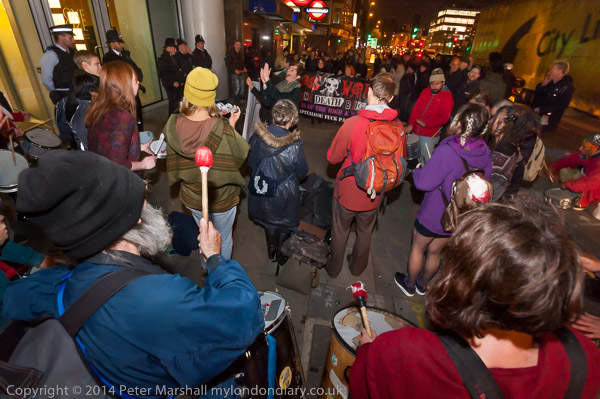
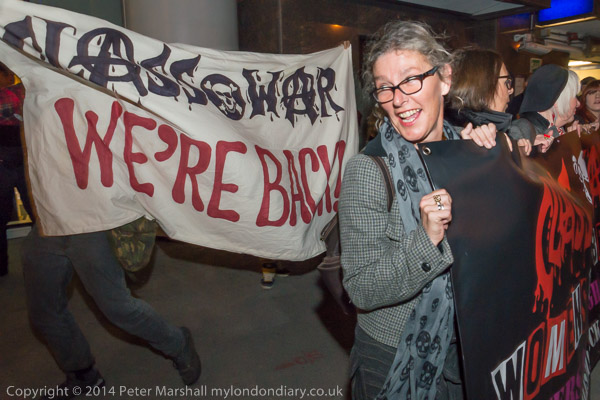
It was Class War’s 14th weekly protest at the ‘rich door’ of Redrow’s One Commercial St flats and it was a lively affair, with the banners dancing to the music of Rhythms of Resistance, a poetic performance and some rousing speeches against social apartheid.

There were a lot of police present and some stood in front of the door and ushered a few people in and out but made no attempt to stop the hour long protest, which though noisy remained entirely peaceful. Some of the police clearly enjoyed the music and watching the dancing.


More at:
Musical Poor Doors
Democracy Camp – Poet Arrested
Canary Wharf & Westminster Tube
End UK shame over Shaker Aamer
DPAC High Court Vigil for ILF


Kilburn Park 1988

Carlton Vale, Kilburn, Brent 1988 88-5k-26-positive_2400
Carlton Vale, Kilburn, Brent 1988 88-5k-26

My next walk at the end of May 1988 took me to Kilburn Park and Kilburn, and again in this post I have put the pictures in the order of my walk rather than the somewhat random order they have in the Flickr album 1988 London Photos. The church in the picture of Carlton Vale is St Augustine, Kilburn, and the large block of flats on the corner of Carlton Vale and Kilburn Park Rd was demolished in 2018-9, though I think the overhead walkway went many years earlier.

Kilburn, Brent 1988 88-5k-15-positive_2400
Kilburn, Brent 1988 88-5k-15

These lower blocks of flats were a part of the same South Kilburn estate and I think close to the corner of Carlton Vale and Cambridge Rd. The estate of high-density housing in low-rise flats and 11 tower blocks was begun in 1959 and further developed in the 1960s and 70s. Brent embarked on a comprehensive redevelopment in 2014, which is resulting in a considerable loss of social housing.

Oxford Rd, Kilburn, Brent, 1988 88-5l-61-positive_2400
Oxford Rd, Kilburn, Brent, 1988 88-5l-61

Unsurprisingly Oxford Road runs parallel with Cambridge Ave up to the Kilburn High Rd. These streets were two of those developed by local builder James Bailey in the 1860s, developing the area he called Kilburn Park. The name was given to the first underground station in Kilburn which opened in 1915 in Cambridge Ave.

Oxford Rd, Kilburn, Brent, 1988 88-5l-64-positive_2400
Oxford Rd, Kilburn, Brent, 1988 88-5l-64

These are typical houses of the era and were probably built from published designs in architectural pattern books. My grandather, who built a few houses on a much less grand scale had owned at least one of these and as children we were sometimes allowed to look at this beautifully illustrated volume.

Cambridge Avenue, Kilburn, Brent, 1988 88-5l-66-positive_2400
Cambridge Avenue, Kilburn, Brent, 1988 88-5l-66

At its southern end Cambridge Avenue leads to both Cambridge Road and the rather posher Cambridge Gardens.

Central Motors, Canterbury House, Canterbury Rd, Kilburn, Brent 1988 88-5l-52-positive_2400

Central Motors, Canterbury House, Canterbury Rd, Kilburn, Brent 1988 88-5l-52-positive_2400

Central Motors in Canterbury Rd still looks much the same, but Canterbury House, although retaining the facade had two extra storeys added in 2015-6 with luxury flats and penthouses. It as built in 1862 when this was still a part of Kilburn Lane as a railway signal factory for Saxby & Farmer who became one of the largest employers in the area but moved out around 1906.

South Kilburn Estate, Crone Court, Rupert Road, Brent, 1988 88-5l-53-positive_2400
Crone Court, South Kilburn Estate, Rupert Road, Brent, 1988 88-5l-53

Crone Court is on the corner of Rupert Rd and Denmark Rd on the South Kilburn Estate and is due for redevelopment in the next few years. The 12 storey block, 32m tall, was completed in 1964.

Joe's Used Ballbearing Emporium, Malvern Rd, West Kilburn, Westminster, 198888-5l-55-positive_2400
Joe’s Used Ballbearing Emporium, Malvern Rd, West Kilburn, Westminster, 1988 88-5l-55

Joe’s Used Ballbearing Emporium & Cycleworks was definitely in Malvern Rd, West Kilburn as it had a street sign higher up on the building. It had a remarkable window display and I took far too many pictures – a few of them here.

Joe's Used Ballbearing Emporium, Malvern Rd, West Kilburn, Westminster, 1988 88-5l-56-positive_2400
Joe’s Used Ballbearing Emporium, Malvern Rd, West Kilburn, Westminster, 1988 88-5l-56

Joe's Used Ballbearing Emporium, Malvern Rd, West Kilburn, Westminster, 1988 88-5l-41-positive_2400
Joe’s Used Ballbearing Emporium, Malvern Rd, West Kilburn, Westminster, 1988 88-5l-41

Joe's Used Ballbearing Emporium, Malvern Rd, West Kilburn, Westminster, 1988 88-5l-45-positive_2400
Joe’s Used Ballbearing Emporium, Malvern Rd, West Kilburn, Westminster, 1988 88-5l-45

Joe's Used Ballbearing Emporium, Malvern Rd, West Kilburn, Westminster, 198888-5l-31-positive_2400
Joe’s Used Ballbearing Emporium, Malvern Rd, West Kilburn, Westminster, 1988 88-5l-31

Click on any of the images to go to a larger version in my album 1988 London Photos from where you can browse the rest of the album.


Around Lots Road

For various reasons the pictures in my albums online are not always in the order that they are taken, but it often makes more sense to write about them in the same order as I walked around taking them – which I can normally see from the contact sheets I made at the time. Usually too these contact sheets identify at least the rough locations of the images, though I often have to resort to maps and sometimes Google Streetview to find the precise spot. Chelsea hasn’t changed radically since I took these pictures but in some other areas this can be impossible. How I wish we had GPS on cameras back in 1986 – and I’m surprised so few cameras incorporate it now.

Westfield Park, Tetcott Rd, Lots Rd Power Station, Chelsea, Kensington & Chelsea, 1988 88-5j-16-positive_2400
Westfield Park, Tetcott Rd, Lots Rd Power Station, Chelsea, Kensington & Chelsea, 1988 88-5j-16

Most people know Lots Road because of the power station of the same name which was built to power the District Railway (now the District Line.) Completed in 1905, it enabled the line, most of which in central London is underground, to convert from steam to electric traction, which must have made it very much more pleasant to use.

Lots Rd, Chelsea,  Kensington & Chelsea, 1988  88-5k-62-positive_2400
Lots Rd, Chelsea, Kensington & Chelsea, 1988 88-5k-62

The power station, which has Chelsea Creek on one side and Lots Road on the other finally closed in 2002 and the area on both sides of the creek was developed as Chelsea Waterfront. The development only began in 2013, delayed both by having to get planning permission from both Kensington & Chelsea and Hammersmith and Fulham and then by the financial crash and was finally due to be completed in 2021. The power station should by now be “193 highest quality luxury loft-style apartments together with high-class restaurants, bar, cafes, boutique shops and a health & fitness club.”

Lots Rd, Chelsea,  Kensington & Chelsea, 1988 88-5k-63-positive_2400
Lots Rd, Chelsea, Kensington & Chelsea, 1988 88-5k-63

As the pictures show, I wandered a little around the area before returning east along Cremorne Road and Cheyne Walk to Battersea Bridge where I took a bus back to Clapham Junction.

Tadema Rd, Chelsea,  Kensington & Chelsea, 1988  88-5k-64-positive_2400
Tadema Rd, Chelsea, Kensington & Chelsea, 1988 88-5k-64

Tadema Road runs north from Lots Road and I doubt if I walked far up it. It’s hard now to see where this Cafe could have been.

Cremorne Rd, Chelsea,  Kensington & Chelsea, 1988 88-5k-66-positive_2400
Cremorne Rd, Chelsea, Kensington & Chelsea, 1988 88-5k-66

I had wandered perhaps up Tadema Road to Cremorne Road some way west from its junction with Lots Road to get to Cornwall Mansions at left of this picture, which is looking east past the junction with Edith Grove with a small part of the World’s End Estate towering in the right half of the picture.

Ornamental gate, Cremorne Gardens, Chelsea,  Kensington & Chelsea, 1988 88-5k-52-positive_2400
Ornamental gate, Cremorne Gardens, Chelsea, Kensington & Chelsea, 1988 88-5k-52

I walked back east on Cremorne Road to the junction with Lots Road and back down on to the riverside Cremorne Gardens. A house was built here around 1750 and later became home to the 1st Viscount Cremorne, an Irish peer from County Monaghan who gave it his name – which came from the Irish for ‘Mountains of Morne’. Charles Random De Berenger, Baron De Beaufain, (actually a fraud called Charles Random) bought the house and grounds here in 1831, turning into a sports club and adding some popular attractions including balloon ascents. The business failed in 1843 and was reopened in 1845 by James Ellis as the Cremorne Pleasure Gardens, with entertainment including concerts, fireworks, balloon ascents and galas. It closed in 1875, losing its licence with accusations that it was a “nursery of every kind of vice”. Much of the gardens were then built over then and later in the 20th century by the 1960s Cremorne Estate. A small riverside garden was re-established and opened in 1981, and the gate which had originally been at the King’s Road end of the Cremorne gardens was re-erected here, having spent the interim at Watney’s Brewery.

Chelsea Wharf, River Thames, Chelsea,  Kensington & Chelsea, 1988 88-5k-53-positive_2400
Chelsea Wharf, River Thames, Chelsea, Kensington & Chelsea, 1988 88-5k-53

I think this view was taken looking upriver from one of the two landing stages at Cremorne Gardens.

Houseboats, River Thames, Chelsea Embankment, Chelsea, Kensington & Chelsea, 1988  88-5k-55-positive_2400
Houseboats, River Thames, Chelsea Embankment, Chelsea, Kensington & Chelsea, 1988 88-5k-55

I think this view is from Old Ferry Wharf, which is actually on Cheyne Walk. The bridge is Battersea Bridge.

Houseboats, River Thames, Chelsea Embankment, Chelsea, Kensington & Chelsea, 1988  88-5k-42-positive_2400
Houseboats, River Thames, Chelsea Embankment, Chelsea, Kensington & Chelsea, 1988 88-5k-42-positive_2400

Another view from a little further east.

Cheyne Walk, Chelsea,  Kensington & Chelsea, 1988 88-5k-56-positive_2400
Cheyne Walk, Chelsea, Kensington & Chelsea, 1988 88-5k-56-positive_2400

These houses at left are on the corner with Blantyre St. The blue plaque at No 120 marks where Sylvia Pankhurst (1882-160) lived as an impoverished art student from 1906-09.

Whistler's House, Cheyne Walk, Chelsea, Kensington & Chelsea, 1988 88-5k-31-positive_2400
Whistler’s House, Cheyne Walk, Chelsea, Kensington & Chelsea, 1988 88-5k-31

James Abbott McNeill Whistler’s house at 98 Cheyne Walk. Some of his best-known pictures show the Thames at Cremorne Gardens. The house next door to the right, hardly visible from the road, was the home of both Sir Marc Isambard Brunel and his son  Isambard Kingdom Brunel.

Click on any image to see a larger version in the album 1988 London Photos, from where you can browse the whole album.


A Busy 10th October – 2014

Solidarity for Care UK Strikers

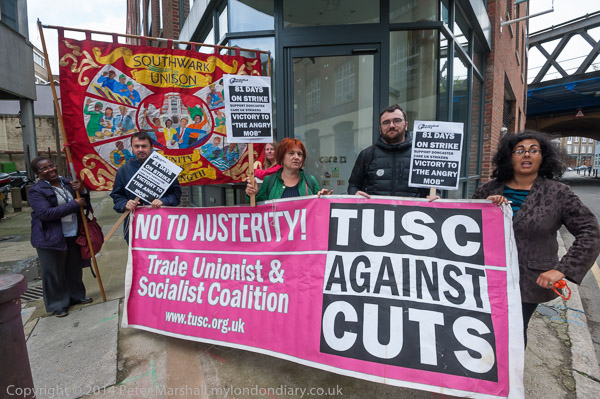
NSSN, TUSC and Southwark Unison protested at the Care UK offices in Southwark during the nation-wide day of solidarity with Doncaster Care UK workers who had been on strike for 81 days after huge cuts in pay and services by a private equity company taking over a part of the NHS, part of the continuing largely hidden privatisation of our NHS.

This protest was one of many around the country outside offices of Care UK and Bridgepoint, the private equity firm that owns Care UK, as well as at shops including branches of Fat Face and Pret a Manger also owned by Bridgepoint. As I wrote:

Their strike is not just about their own cuts in wages, but a stand against the principles involved and the whole idea of a values-based health service. The workers at Care UK are no longer able to proudly address the needs of those with learning disorders in their own community, but are simply required to meet minimum needs at the lowest possible cost – and the greatest profit to Bridgepoint and the company to which they will be sold on once the private equity company has slimmed services and pay to the bone.

Solidarity for Care UK Strikers

Free Ghoncheh Ghavami – SOAS action

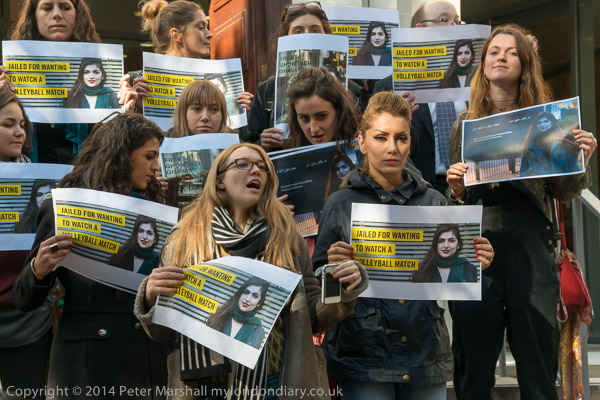
Protesters at outside SOAS called for the release of former SOAS Law student Ghoncheh Ghavami, held in prison for 104 days and on hunger strike for 10 days after being detained in Iran with other women after she went to watch a volleyball match. Among those who spoke at the protest was Ghavami’s brother.

According to Wikipedia, “Ghavami was released on bail on 23 November 2014. She was sentenced to a one-year jail term and a two-year travel ban.”

Free Ghoncheh Ghavami – SOAS action

City Panoramas

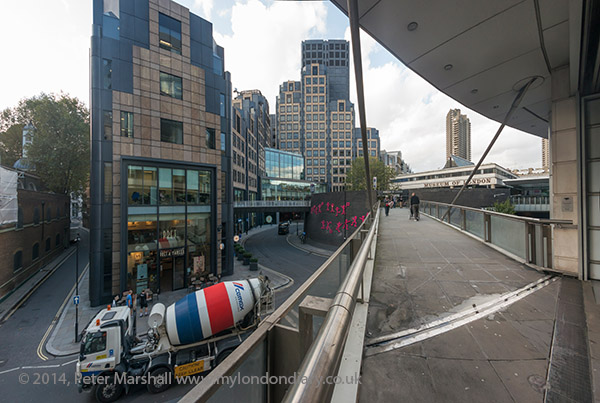
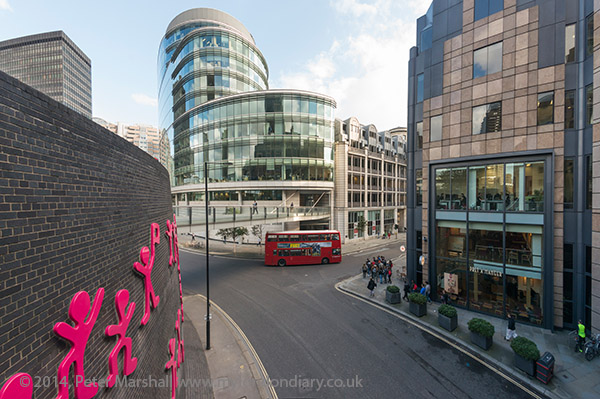
I had a little time to spare between events and took a short walk in the City, including along one of the remaining areas of ‘highwalk’ at the southwest of the Barbican site, part of the post-war plan to segregate pedestrians from traffic.

The Museum of London had decorated the wall at left with characters related to an exhibition about Sherlock Holmes.

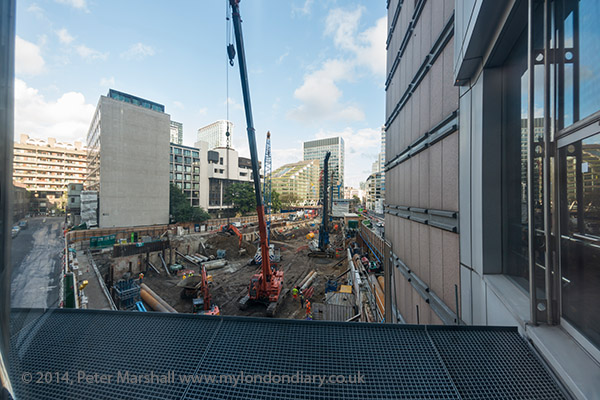
This large building site was on what used to be St Alphage Highwalk. The ambitious post-war plans to separate pedestrians from traffic in the City were never really practical on a large scale and large sections such as this have been demolished, although there are still some highwalks including throughout the large Barbican estate.

City Panoramas

Palestine protest at Hewlett Packard

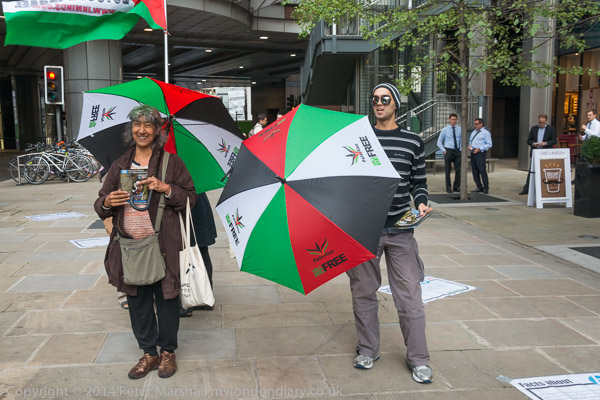
The Palestinian Prisoners Campaign continued their campaign against Hewlett-Packard, which boasts of ‘a massive presence’ in Israel and are the IT backbone for the Israeli war machine with a picket outside their London offices in Wood St in the City.

Palestine protest at Hewlett Packard

Solidarity with the Umbrella Revolution

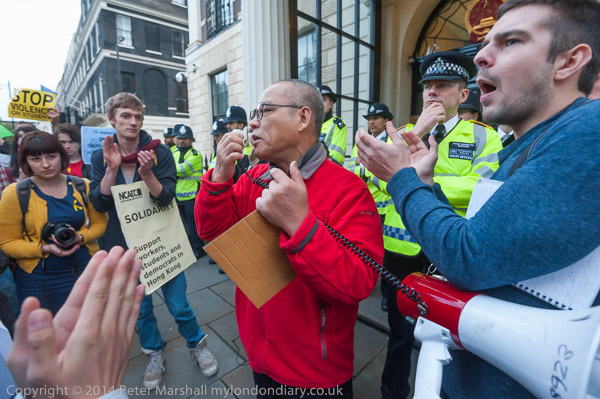
The National Campaign Against Fees and Cuts organised a protest at the Chinese Embassy in solidarity with the ‘umbrella revolution’ of the students and workers of Hong Kong in their fight for democracy. Many of the protesters carried umbrellas and others had small yellow paper umbrellas as well as their posters and placards.

Solidarity with the Umbrella Revolution


Another Chelsea Walk – 1988

Church Of The Ñazarene, Grant Rd, Battersea, Wandsworth, 1988 88-5j-54-positive_2400
Church Of The Ñazarene, Grant Rd, Battersea, Wandsworth, 1988 88-5j-54

I returned for another walk in Chelsea, taking the train to Clapham Junction and taking a few pictures on my short walk to the bus stop of the Church Of The Ñazarene close to the north entrance to the station on Grant Road. The church, a twelve-sided building by Green Lloyd Adams was built in 1970 on the edge of the Winstanley Estate, developed by Battersea Council in the 1960s. The lettering on the ramp ‘JESUS SAID I AM THE WAY’ is designed for maximum size rather than typographical nicety.

Currently extensive building work is being carried out to considerably extend the church, though its future may be threatened if Crossrail 2 goes ahead. Of the two pictures I made I preferred a view across the small area with seats to a cleaner architectural view also included in the album.

Falcon Rd, Battersea, Wandsworth, 1988 88-5j-55-positive_2400
Falcon Rd, Battersea, Wandsworth, 1988 88-5j-55

On the bus I took advantage of an unusually clean front window on the upper deck to take a photograph of Falcon Road with the Queen Victoria pub. Also apparently known as ‘Spikey Hedghog’ the pub which had been there since the 1860s closed permanently in 1999 and was demolished to build the 8 flats of St Luke’s Court.

The picture also includes a falcon – both image and text on the side of a lorry. Elsewhere you can read a short post Falcon Road – a Memory of Battersea by someone who grew up living in the pub which gives an idea what the area was like, probably in the 1950s.

Beaufort St, Chelsea, Kensington & Chelsea, 1988 88-5j-45-positive_2400
Beaufort St, Chelsea, Kensington & Chelsea, 1988 88-5j-45

I got off the bus in Beaufort St in Chelsea and photographed this doorway there before walking along Cheyne Walk. Although the door is on Beaufort St, this is Belle Vue Lodge with the address 91 Cheyne Walk. It gets a lengthy mention in the Survey of London, first published in 1913 which suggests it dates from before 1771. It states that in 1829 it was occupied by “Luke Thomas Flood, who was a great benefactor to the parish. He was evidently a friend of the historian, for he addressed some lines to him, which conclude with the halting line ‘Sweet Chelsea shall ever live in thee.’ Flood Street was named after him, and his benefactions are celebrated at the parish church by a service on January 13th,—’Flood’s Day.'”

Houseboats, River Thames, Chelsea Embankment, Chelsea, Kensington & Chelsea, 1988 88-5j-32-positive_2400
Houseboats, River Thames, Chelsea Embankment, Chelsea, Kensington & Chelsea, 1988 88-5j-32

I walked across Cheyne Walk to make a photograph over the roofs of houseboats at the moorings, looking towards Chelsea Harbour and at left the Rank Hovis flour mills at Battersea and the Battersea Rail bridge. Then I think only used by goods trains this now carries frequent services of the London Overground as well as Thameslink trains.

Cheyne Walk, Chelsea, Kensington & Chelsea, 1988 88-5j-33-positive_2400
Cheyne Walk, Chelsea, Kensington & Chelsea, 1988 88-5j-33

I took a picture of houses in Cheyne Row. That at left is No 104 with two blue plaques, for the artist Walter Greaves (1846-1930) and Anglo-French ‘Poet, essayist and historian’ Hilaire Belloc (1870-1953) whose poem Jim (who ran away from his Nurse and was eaten by a Lion) ends with the famous lines:
‘And always keep ahold of nurse
For fear of finding something worse.’

No 104 doesn’t get a mention in the Survey of London, but No 100 at right of the picture is part of Lindsey House which it suggests was “rebuilt much in its present external form by the third Earl of Lindsey in 1674” but then divided into separate houses as 95-100 around 1775. It gets a very long entry.

Beaufort St, Chelsea, Kensington & Chelsea, 1988 88-5j-22-positive_2400
Beaufort St, Chelsea, Kensington & Chelsea, 1988 88-5j-22

I walked back up Beaufort St, passing a long row of frontages with identical garden ornaments which I think is Beaufort Mansions, though the gardens now have hedges. I think these mansion flats probably date from around 1890.

Shop window, Kings Rd, Chelsea, Kensington & Chelsea, 1988 88-5j-23-positive_2400
Shop window, Kings Rd, Chelsea, Kensington & Chelsea, 1988 88-5j-23

I was on my way to take a few more photographs on the King’s Road, including a several shop interiors. I think the name of the shop is on the wall at left, part hidden, Pineapple.

More pictures from this walk in a later post.


Click on any of the images above to go to a larger version in my album 1988 London Photos from where you can browse other images in the album.


Dovehouse Green, Chelsea Square & Upper Cheyne Row 1988

Millars Obelisk, Dovehouse Green, Chelsea, Kensington & Chelsea, 1988  88-5i-54-positive_2400
Millars Obelisk, Dovehouse Green, Chelsea, Kensington & Chelsea, 1988 88-5i-54

Dovehouse Green was the name given to the King’s Road Burial Ground on the corner of Dovehouse St and King’s Road when it was improved by the Chelsea Society and Kensington & Chelsea council to celebrate the the Queen’s Silver Jubilee and the Golden Jubilee of the society in 1977. The area was given to the parish by Sir Hans Sloane in 1727 and opened as a burial ground in 1736. Chelsea soon outgrew this small area and a new burial ground was opened on the east side of Sydney St in 1812 and there were no more interments here other than in existing family tombs.

The Millar Obelisk which became the centrepiece of this small public park was erected in the old burial ground in 1751, by the wealthy leading bookseller and publisher Andrew Millar to mark the family burial place. Buried close to it were three of his children who died before it was erected and Millar himself who died in 1768 and his wife who outlived him by 20 years. You can read more at Millar’s obelisk, a post by Baldwin Hamey on London Details.

The park has been refurbished a couple of times since I made this picture, but its basic layout remains. On the other side of Dovehouse St is Chelsea Fire Station with its tower. If Crossrail 2 is ever built this may be the site of a station on it. Dovehouse street got its name around 1880, having previously been called Arthur St; I think the name was probably ‘borrowed’ from an early Dovehouse Close some distance away on the other side of King’s Rd. Just to the north of the burial ground was the workhouse for St Luke’s Parish, Chelsea, demolished in the 1970s.

Chelsea Square, Chelsea, Kensington & Chelsea, 1988  88-5i-42-positive_2400
Chelsea Square, Chelsea, Kensington & Chelsea, 1988 88-5i-42

Chelsea Square is a couple of hundred metres to the northwest of Dovehouse Green, though a little further to walk. It was developed as Trafalgar Square in 1810, five years after the battle, with houses around a garden designed to encourage wealthier people to move to Chelsea, then something of a slum. The area came to the Cadogan estate when the lease ran out in 1928 and they redeveloped the area replacing the existing houses from 1931 and building on around a quarter of the garden. New houses were according to the Victoria County History, “designed in early Georgian style by Darcy Braddell and Humphrey Deane, and built of pinkish stock brick, with bright red brick dressings and green-glazed tiles.” and “neo-Regency villas in white stucco… designed by Oliver Hill and built in 1930 and 1934.”

Chelsea Square, Chelsea, Kensington & Chelsea, 1988  88-5i-55-positive_2400
Chelsea Square, Chelsea, Kensington & Chelsea, 1988 88-5i-55

Presumably to avoid confusion with the rather better known Trafalgar Square in Westminster it was renamed Chelsea Square in 1938. Many other duplicated London street names were also replace at the time.

Church of Our Most Holy Redeemer and St Thomas More, Cheyne Row, Chelsea, Kensington & Chelsea, 1988  88-5i-61-positive_2400
Church of Our Most Holy Redeemer and St Thomas More, Cheyne Row, Chelsea, Kensington & Chelsea, 1988 88-5i-61

Designed by Edward Goodie, this Grade II listed Roman Catholic church opened in 1895. It gained the dedication to St Thomas More after he was made a saint in 1935. Damaged by bombing in 1940, it was repaired after the war. Much internal work was carried out in the 1970s.

The Studio,  Upper Cheyne Row, Lawrence St, Chelsea, Kensington & Chelsea, 1988  88-5i-62-positive_2400
The Studios, Upper Cheyne Row, Lawrence St, Chelsea, Kensington & Chelsea, 1988 88-5i-62

Upper Cheyne Row is sometimes referred to as Millionaires’ Row, though that would now apply to most London streets. One house here was recently on the market for £22m. The sign ‘The Studios’ on No 27 has now gone.

Chelsea Pottery, plaque, Lawrence St, Chelsea, Kensington & Chelsea, 1988 88-5i-63-positive_2400
Chelsea Pottery, plaque, Lawrence St, Chelsea, Kensington & Chelsea, 1988 88-5i-63

The LCC square blue plaque which can just be seen on 16 Lawrence St has the message ‘CHELSEA CHINA WAS MANUFACTURED IN A HOUSE AT THE NORTH END OF LAWRENCE STREET 1745-1784
TOBIAS SMOLLETT NOVELIST ALSO LIVE IN PART OF THE HOUSE 1750 TO 1762′. You can read more about Lawrence St from the article on ‘A London inheritance’ Lawrence Street And Chelsea China.


Click on any of the images above to go to a larger version in my album 1988 London Photos from where you can browse other images in the album.


Glebe Place and Carlyle Square 1988

Glebe Place, Chelsea, Kensington & Chelsea, 1988 88-5i-52-positive_2400
Glebe Place, Chelsea, Kensington & Chelsea, 1988 88-5i-52

Glebe Place on the southern side of the King’s Road is a curious street with two right-angle bends and includes a series of artists studios, some grander than others, and its residents over the years have included a huge list of artists and writers – Wikipedia lists around 30 – as well as Paul Robeson, Shirley Williams and Constant Lambert.

I don’t remember outside which house I found this rather fierce sculpture which I think is no longer present.

Glebe Place, Chelsea, Kensington & Chelsea, 1988 88-5i-51-positive_2400
Glebe Place, Chelsea, Kensington & Chelsea, 1988 88-5i-51

25 and 25a Glebe Place. The heraldic lions have since left and the roof has been replaced. No 25 was the home of artist George Washington Lambert (1873-1930) who was born in Russia, educated in Somerset and emigrated with his mother and sisters to Australia in 1887. There he began exhibiting paintings and working as a cartoonist and illustrator. In the 1900s he spent a year in Paris, then moved to London; in the First World War he was an official Australian war artist, and he returned to Australia in 1921. His second son, Constant Lambert (1905-51), a notable British composer, was born in London in 1905 and also lived here; he was the Founder Music Director of the Royal Ballet.

Carlyle Square, Chelsea, Kensington & Chelsea, 1988 88-5i-34-positive_2400
Carlyle Square, Chelsea, Kensington & Chelsea, 1988 88-5i-34

The houses at left of the picture are the pair at the north end of the east side, No 27 and 28 and to the right of them are the doors of No 25 and 24 on the north side.

Carlyle Square, Chelsea, Kensington & Chelsea, 1988 88-5i-35-positive_2400
Carlyle Square, Chelsea, Kensington & Chelsea, 1988 88-5i-35

This rather agonised looking sculpture on the balcony was at No 28 but is no longer present.

Carlyle Square was laid out by the Cadogan Estate in the 1830s after Lord Cadogan bought the land on the north side of King’s Road in 1835, quickly clearing it of the existing small houses and cottages and laying out Oakley Square around an ornamental garden. But development of the square was slow. As originally set out, there were entrances for vehicles from both the east and west sides to King’s Road; more recently an area of garden separates the square from King’s Road, allowing only pedestrian entrance, with vehicle entrance being only from Old Church St.

Development began with short terraces of 3 houses on both the east and west sides next to King’s Rd, all now Grade II listed. They were followed in 1855 by a couple of semi-detached villas on the west side and around 1860 the north side of the square was largely completed with some varied houses. The remaining gaps – including most of its east side – were completed not long after, mainly with large identical semi-detached houses with a few feet gap between them.

Among notable residents over the years were Osbert and Sacheverell Sitwell, William Walton, Sybil Thorndike, Edna O’Brien and David Frost (who held an annual summer party for some years in the garden.) No 21 was built for the Duke of Portland around 1860, and a later Duke of Portland who was Chair of the Joint Intelligence Committee during WW2 was still in residence.

Carlyle Square, Chelsea, Kensington & Chelsea, 1988 88-5i-22-positive_2400
Carlyle Square, Chelsea, Kensington & Chelsea, 1988 88-5i-22

Bushes carefully trimmed in pots under the windows of No 22.

Carlyle Square, Chelsea, Kensington & Chelsea, 1988 88-5i-24-positive_2400
Carlyle Square, Chelsea, Kensington & Chelsea, 1988 88-5i-24

This rather splendid tree is I think a fig tree and is still present – along with the pots at No 22 on the south-facing north of the square.

Carlyle Square, Chelsea, Kensington & Chelsea, 1988 88-5i-33-positive_2400
Carlyle Square, Chelsea, Kensington & Chelsea, 1988

No 37-40 have walls and gate posts like this, and this is the entrance of 38. Most of the rest of the houses on the east and west side have plain iron railings.


Click on any of the images above to go to a larger version in my album 1988 London Photos from where you can browse other images in the album.


Sri Guru Singh Sabha Gurdwara 2005

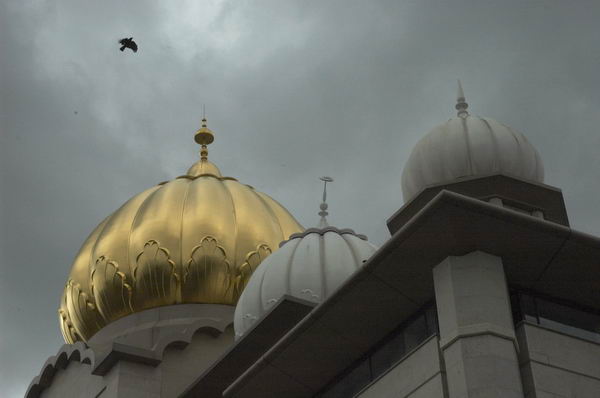
Sixteen years ago on Saturday 1st October 2005 I was fortunate to be able to go with friends from the now long defunct London Arts Café on a visit to the Sri Guru Singh Sabha Gurdwara completed in Southall in 2003 with the building’s architect Richard Adams of Architect Co-Partnership and one of the Sikh volunteer guides. The temple, built with over £17m of local donations was said to be the largest in the western hemisphere, intended to be “a temple second only to the Golden Temple in Amritsar, with a life expectancy of a minimum of 100 years“.

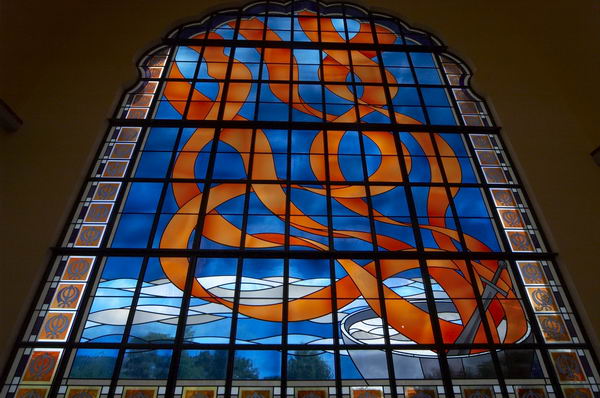
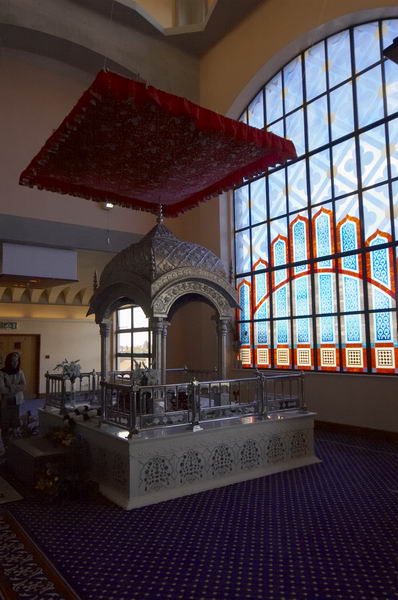
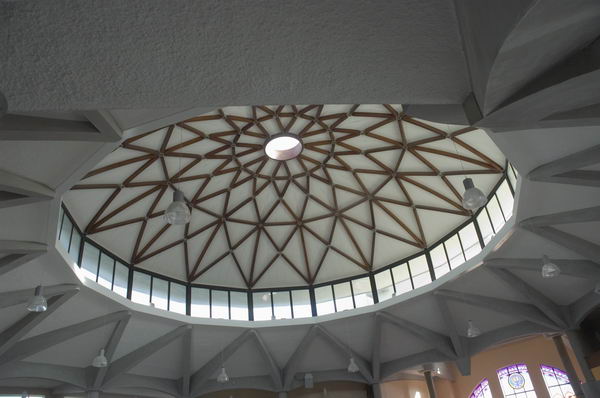
The architects had won the commission in open competition and working with the Sikh community and had produced what I described as “a building suited to their needs, and it does so impressively:clean simple surfaces, powerful colour in the windows and light streaming into the central stairway and lobby from the large window and glass roof areas.” I hope my pictures convey something of this.

Here’s some of the text I wrote about the visit at the time, when I was posting entirely in lower case:

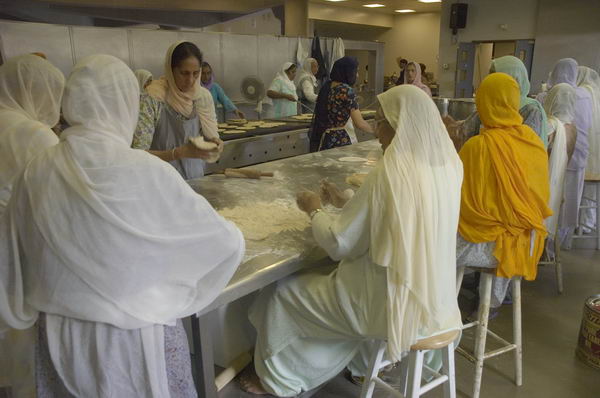
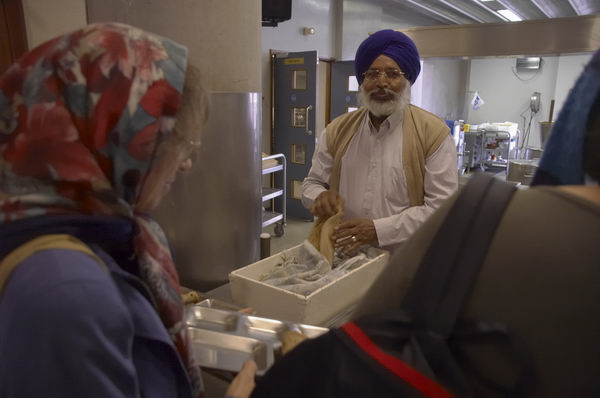
the sri guru singh sabha gurdwara serves the community, both for workship and for other needs. as well as a vast prayer hall officially capable of seating up to 3,000 people (and actually holding rather more at major festivals) there is a fine marriage room, and various other facilities including a langar (dining hall); this free community kitchen can serve over 20,000 vegetarian meals over a festival weekend.

the gurdwara had a powerfully religious atmosphere. on entering we followed the customary practice of removing our shoes, covering our heads with the scarves provided and washing our hands before commencing our visit. at various points both our guide and the architect explained how the building served the basic sikh tenets of service, humility and equality, and also the spiritual guidance from the sri guru granth sahib, the religious writings which are were appointed as spiritual head of the sikh religion, the eternal guru, by guru gobind singh around three hundred years ago.

although the architecture and the prayer hall in particular were impressive, what made the strongest impression on me was the kitchen, especially the team of women working together. the food was excellent, a real pleasure to eat, although my still rather painful knee made it easier for me to stand and eat at one of the tables rather than in the traditional manner seated on the floor. although food is free, those eating may perform some service to the temple in thanks for their food, or give an donation of some kind, which we gladly did.

southall is now britain’s holy city, apparently with places of worship for over 50 religions or denominations. brother daniel faivre’s ‘glimpses of a holy city’ published in 2001 after more than 20 years of living in southall gives a good insight into some of this diversity.

More pictures on My London Diary.


All photographs on this and my other sites, unless otherwise stated, are taken by and copyright of Peter Marshall, and are available for reproduction or can be bought as prints.