12 Days of Christmas -some of my favourite pictures from those I made in August 2025.
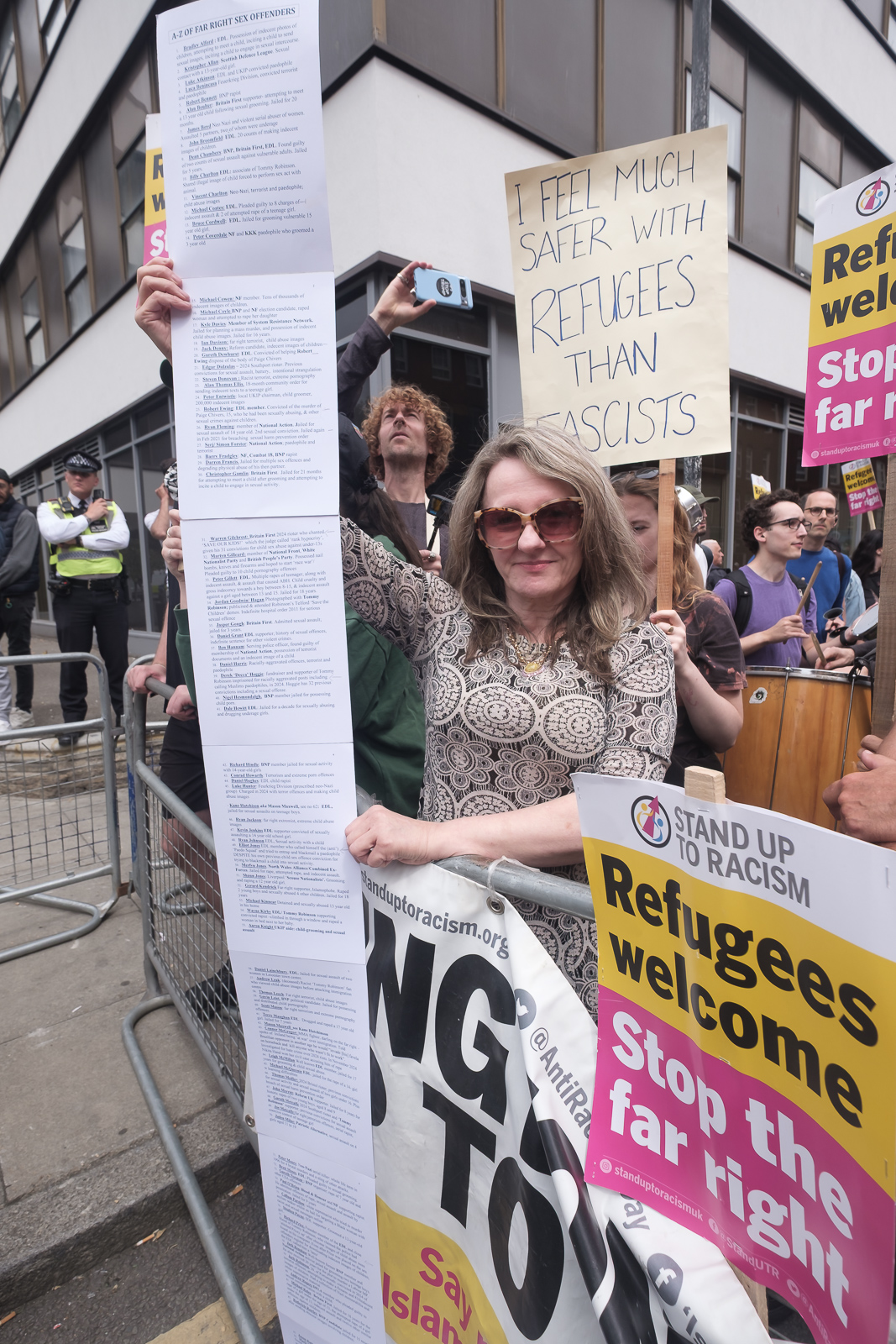
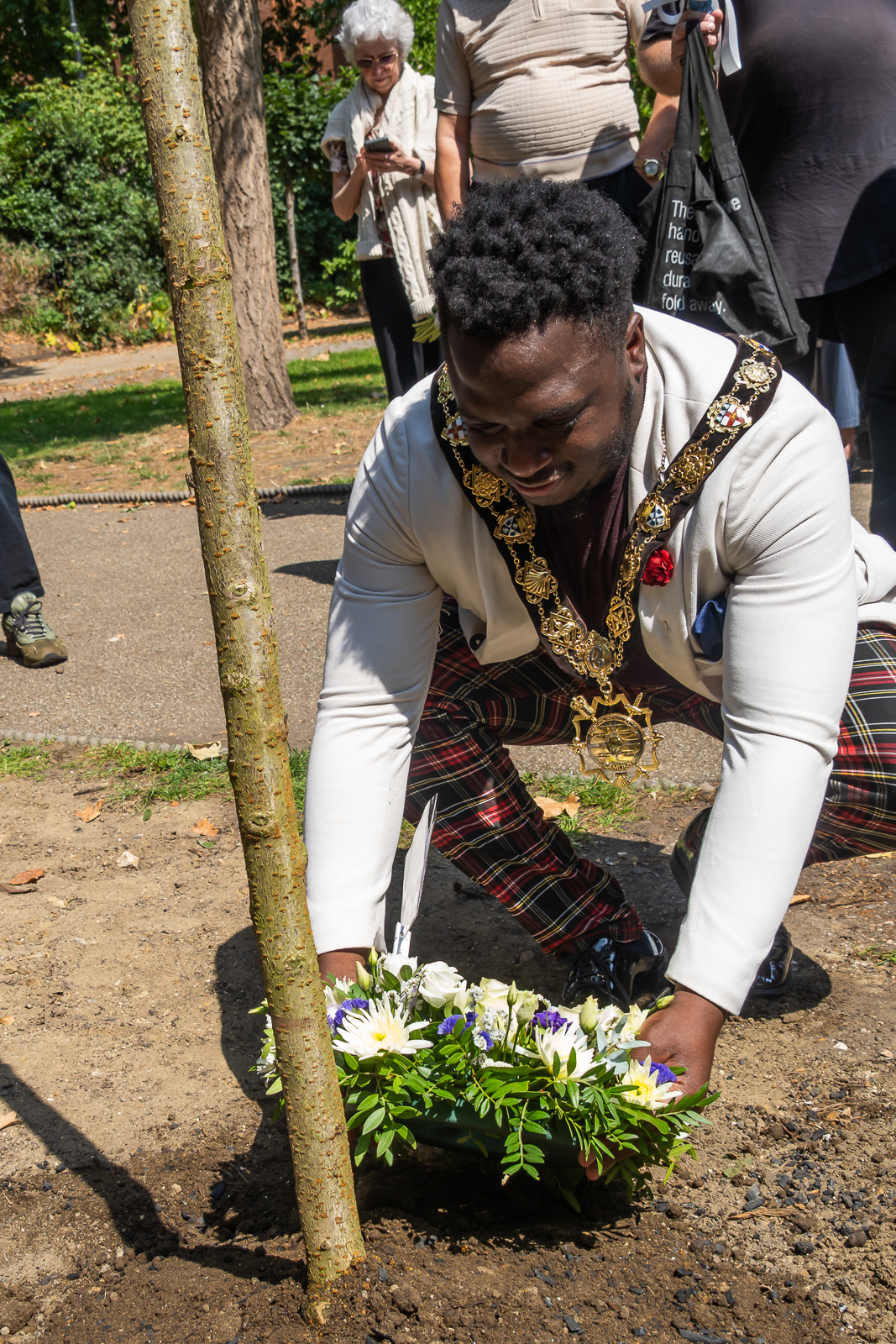
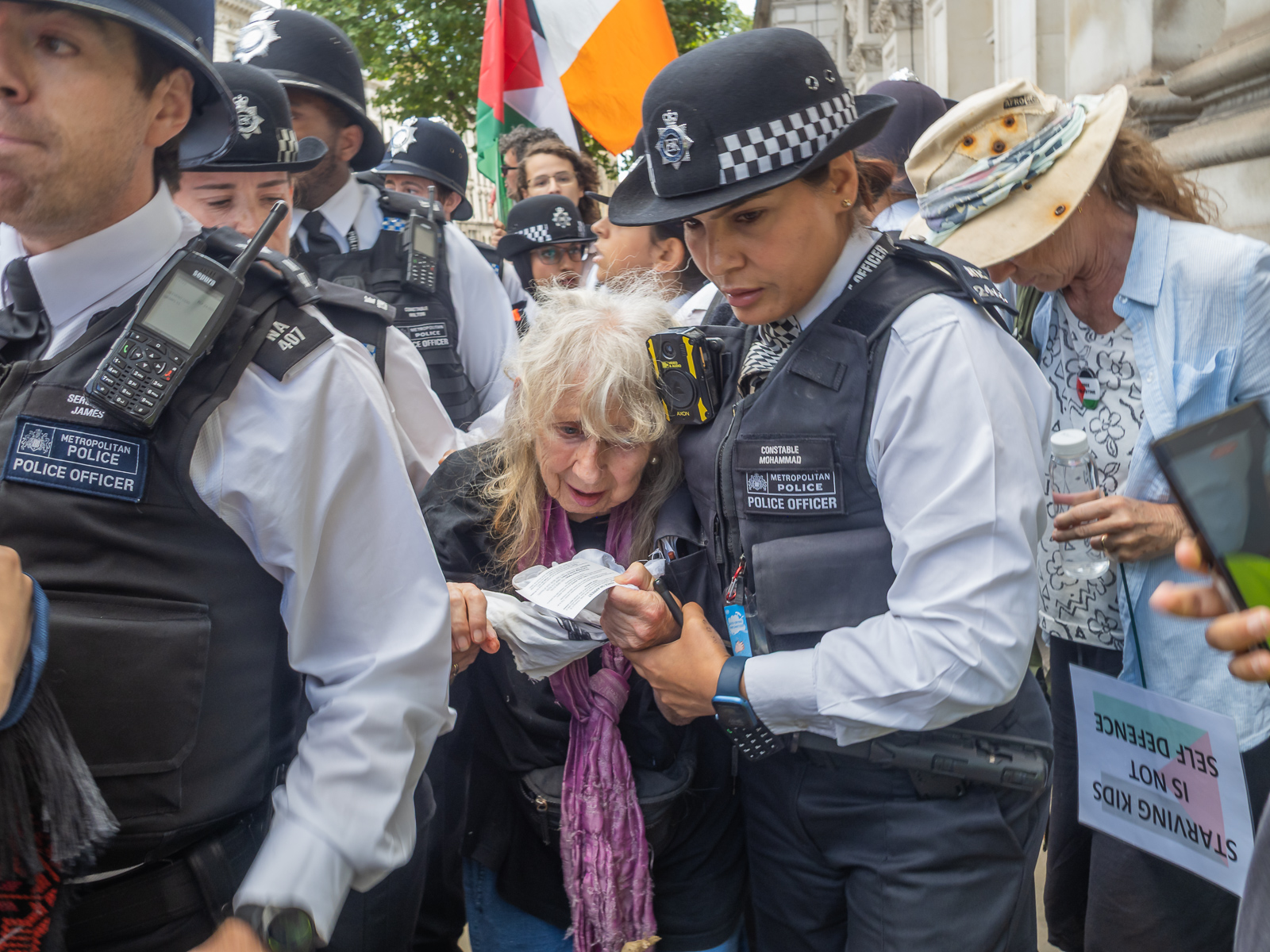
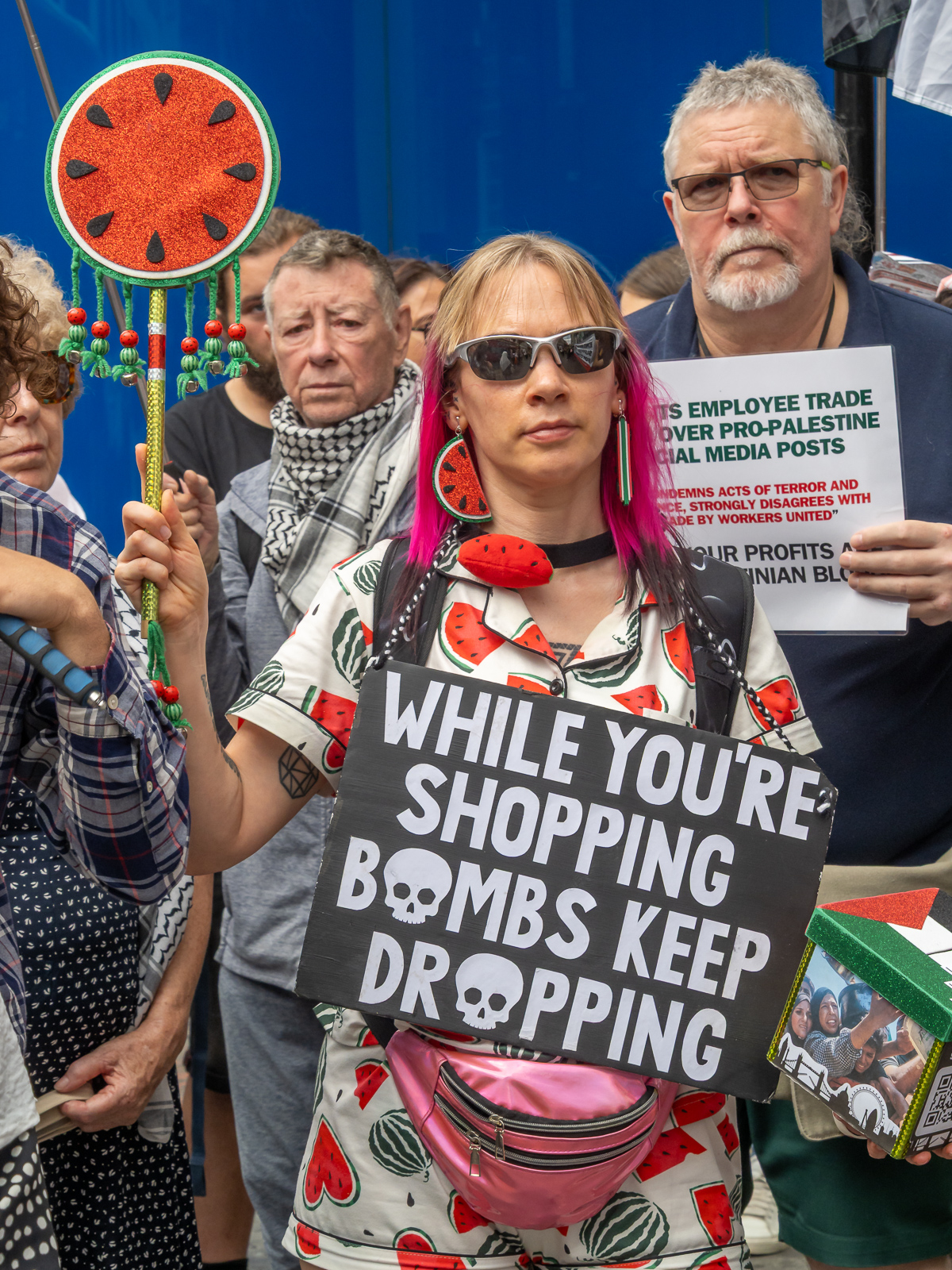
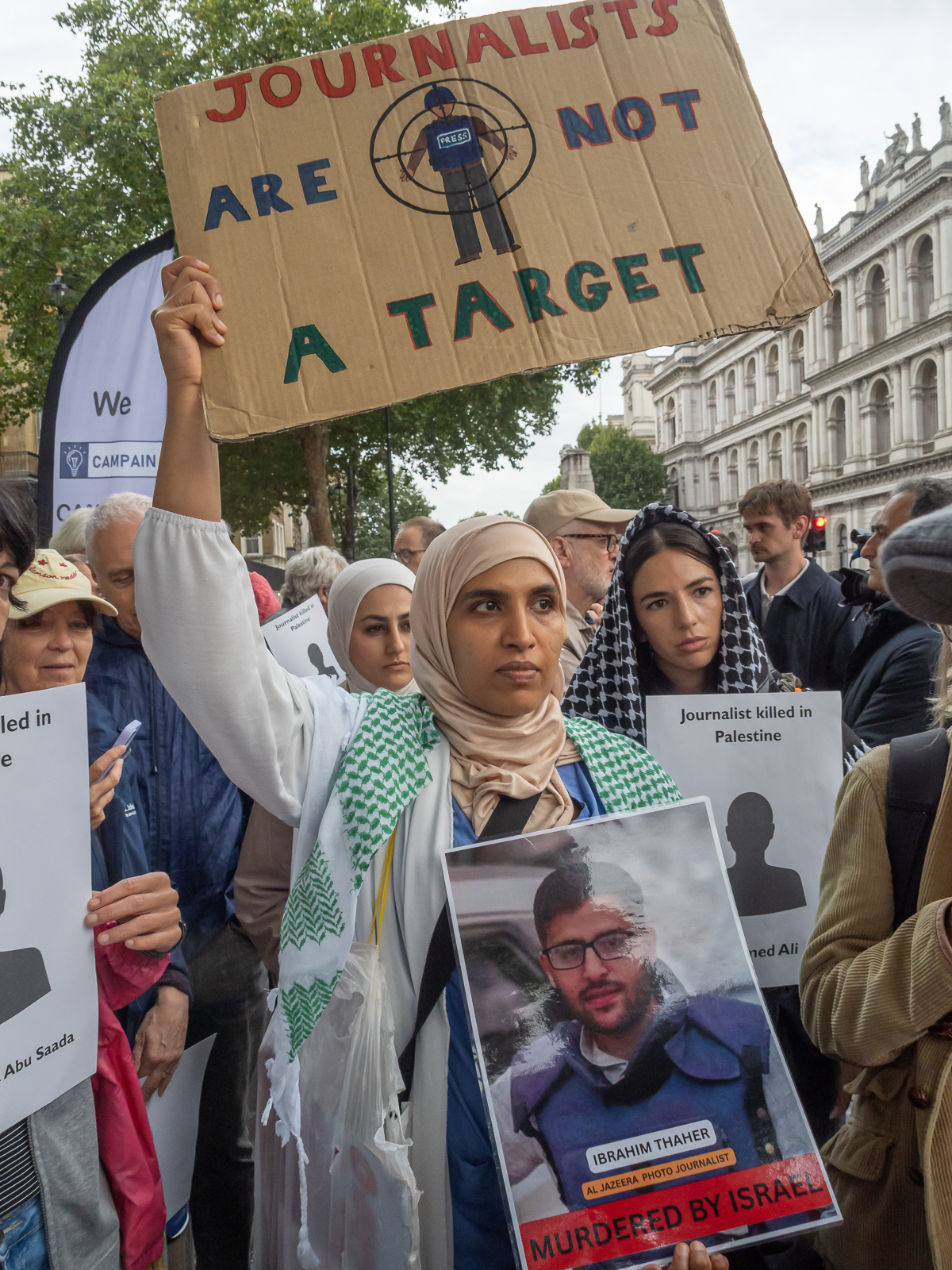
London, UK. 2 Aug 2025. We Are Alll Migrants. Rival groups of protesters kept apart by police at the Thistle City Barbican Hotel, Finsbury. Some locals say asylum seekers there had caused a plague of crime and antisocial behaviour and right wing groups held a protest there, opposed by Stand Up To Racism and groups who say racism and Islamophobia are being used to scapegoat refugees and migrants and fascists are not welcome here. A large block of anarchists arrived, ignored police and stood between the two other groups. Peter MarshallLondon, UK. 2 Aug 2025. Louise Raw holds a long list of far right convicted sex offenders. Rival groups of protesters kept apart by police at the Thistle City Barbican Hotel, Finsbury. Some locals say asylum seekers there had caused a plague of crime and antisocial behaviour and right wing groups held a protest there, opposed by Stand Up To Racism and groups who say racism and Islamophobia are being used to scapegoat refugees and migrants and fascists are not welcome here.. Peter MarshallLondon, UK. 6 Aug 2025. Councillor Eddie Hanson, Mayor of Camden lays a wreath at the new Cherry Tree which had just been planted. Ceremonies around the world mark the 80th anniversary of the devastating US exploding the world’s first nuclear bomb at Hiroshima, instantly killing thousands of innocent civilians with many more dying in the days, months and years from radiation. A new cherry tree was planted in Tavistock Square where speakers, artists and singers led reflections calling for no more nuclear war. Peter MarshallLondon, UK. 9 Aug 2025. Police arrest an old woman at the protest supporting Palestine after the march through London protesting against Israel starving the people of Gaza to death. They seemed to object to a leaflet she was handing out. They called on the UK government to stop arming Israel and to end their complicity with genocide and join the international community in opposing Israel’s actions. Peter Marshall/Alamy Live NewsLondon, UK. 9 Aug 2025. Police arrest and carry a protester away. Hundreds, perhaps a thousand or morecampaigners defied the law and sat to Parliament Square with the message “I oppose genocide, I support Palestine Action” despite warnings they might be arrested under the Terrorism Act. The protest came after Amnesty and international scholars and others had joined many others in calling for the ban to be lifted and permission had been give for a legal action against the ban to go ahead. Police carried away many of them to waiting police vans. Peter Marshall.London, UK. 9 Aug 2025. Members of the United Voices of the World at the Canary Wharf Radisson Blu hotel and the Draughts board game bar both on strike held joint protests at Canary Wharf and here outside the bar in the Leake St graffiti tunnel. The housekeepers are fighting brutal cuts to hours and demanding 40-hour contracts, fair workloads, and the London Living Wage and bar staff are protesting against zero-hour contracts, unpaid training and unsafe working conditions. Peter Marshall.London, UK. 23 Aug 2025. At Starbucks. The Revolutionary Communist Group protest at UK businesses on and around Oxford St which support and profit from the ethnic cleansing, starvation, and genocide of the Palestinian people. Israel’s colonial regime provides high profits, and speeches at each stop detailed evidence against the company. The protest demanded severing all ties with Israel and comprehensive sanctions and claimed the UK government is committed to crushing the Palestine solidarity through state repression and media lies. Peter Marshall.London, UK. Journalists and media workers at Downing Street honour the courageous reporting of the journalists of Gaza who are being deliberately targeted and killed by Israeli attacks on Gaza for telling the world the truth of the genocide. The names of over 240 who are confirmed killed since 7 October 2023 were read out after speeches from Al Jazeera journalist Wael Dadouh, Ahmed Anaouq of We Are Not Numbers and Sangita Myska. Peter Marshall.
Crackers & Paper Hats: A Happy Christmas to you all.
Perhaps this is not the most obvious of Christmas pictures, but if you’ve pulled a cracker and put on a paper hat you have enjoyed the legacy of Tom Smith, whose wife and company are remembered in this memorial.
Martha Smith Memorial Water Fountain, Finsbury Square, Finsbury, Islington, 1992, 92-10e-33
This water fountain states it was ‘Erected and presented to the Parish of St Luke by Thomas and Walter Smith (Tom Smith and Co) to commemorate the life of their mother, Martha Smith, 1826 – 1898.’
Thomas J Smith (1823-1869) invented the Christmas Cracker in 1847 and the company made enough from their sales and the paper crowns introduced into them by his son Walter to move to premises in Finsbury Square where they remained until 1953. The fountain dedicated to their mother was erected by Thomas’s sons Tom and Walter in 1898.
You can still buy Tom Smith crackers both in the UK and the USA and the company has “been the proud holder of a Royal Warrant to The Monarch since 1906” – including our current king, and you can view their catalogue online which also includes gift wrap, display units and tags, gift bags and cards. You can get some of them from various charities in boxes of six at around a pound a cracker as well as in various shops. However I suspect those they produce to be pulled around the royal Christmas dinner table are considerably more expensive.
On another site you can read a fairly detailed story of how the cracker came about – and my short summary based on this and Wikipedia.
Tom Smith began work as a small boy in a “a bakers and ornamental confectioners shop in London, selling sweets such as fondants, pralines and gum pastilles” and enjoyed making new “new, more exciting and less crude designs in his spare time.“
In his teens he set up his own shop in Goswell Road, Clerkenwell selling wedding cake ornaments and confectionery and on a trip to Paris in search of novel ideas in 1840 found the ‘bonbon‘, a sugared almond wrapper in a twist of tissue paper, and he began making and selling these in London. He had the idea of increasing sales by adding love messages in the wrappers.
Chemist Edward Charles Howard had discovered silver fulminate in 1800 and in 1802 Luigi Valentino Brugnatelli found a “a safe way of using it in amusements and for practical jokes.” I think schoolboys made use of it ever since (as I did) to put a trace on schoolmasters chalks to make a small explosion when they write on the board. I imagine whiteboard markers have made this obsolete.
Again according to Wikipedia, Smith bought the design and formula for the “snap” in his crackers from a chemist called Tom Brown who had worked for the Brocks Fireworks company. Smith added these to the now rather larger bonbons and sold them first as ‘Bangs of Expectation‘, later as “Cosaque (French for Cossack)”, but they became known popularly as ‘crackers’.
It was his son Walter, who took over the business after his father’s death in 1869 who first produced the cracker as we know it now, adding trinkets and paper hats, and these enjoyed a huge success, enabling him to move the business to much larger premises near this monument in Finsbury Square. In the 1890s it had 2000 employees and it remained there until 1953 when the company merged with Caley Crackers, then owned by toffee manufacturer John Mackintosh & Sons Ltd. The new joint company operated under the name of Tom Smith’s.
The picture to the memorial which celebrates both Walter’s mother and father is one of over 35,000 pictures, mainly of London, though also some of Paris, Hull and elsewhere. You can search the collection to find pictures of particular interest or browse the albums. As always, comments there are welcome on any of my pictures.
For once this year May Day falls on a Bank Holiday – as it should every year, but in 1978 James Callaghan’s Labour government bottled it when establishing the Early May Bank Holiday. So it only falls on May 1st once every six or seven years – as it last did in 2017.
So in other years many of us have to work on May Day, although since I gave up regular full-time work as a teacher I’ve been able to attend the London May Day March every year except when prevented by illness or lockdown.
Most years here on >Re:PHOTO I’ve written something about the early origins of May Day and how in 1889 it was adopted as the date for International Workers’ Day by the Second International socialists and communists, and then adopted by anarchists, labour activists, and leftists in general around the world to commemorate the 1886 Chicago Haymarket affair and the struggle for an eight-hour working day.
London has a May Day Organising Committee which arranges the event, which is supported by “GLATUC, LESE, UNite London & Eastern Region, CWU London Region, PCS London & South East Region, ASLEF, RMT, MU London, BECTU, FBU London & Southern Regions, GMB London & Southern Regions, Unison Greater London Region, POA, NEU London, NPC, GLPA & other Pensioners bodies and organisations representing Turkish, Kurdish, Chilean, Colombian, Peruvian, Bolivian, Portuguese, West Indian, Indian, Sri Lankan, Cypriot, Tamil, Iraqi, Iranian, Irish and Nigerian migrant workers & communities plus many other trade unions & Community organisations.”
As the list shows, it has a very international nature – as too does London, and visually tends to be dominated by large and organised groups from some of London’s minority communities, particularly Turkish and Kurdish groups. But it’s an event supported by most of the left if a few anarchists sometimes come to the start at Clerkenwell Green to hand out leaflets but head for the pub as soon as the march itself starts.
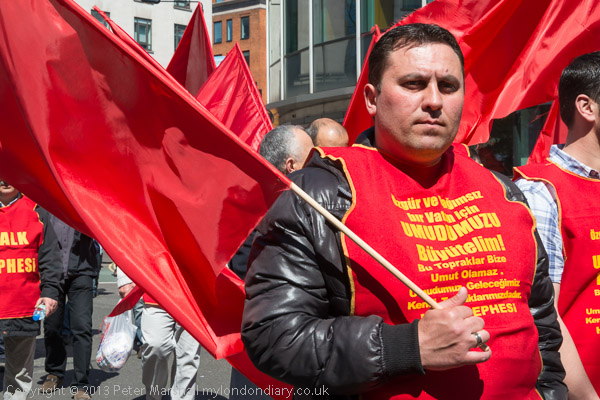
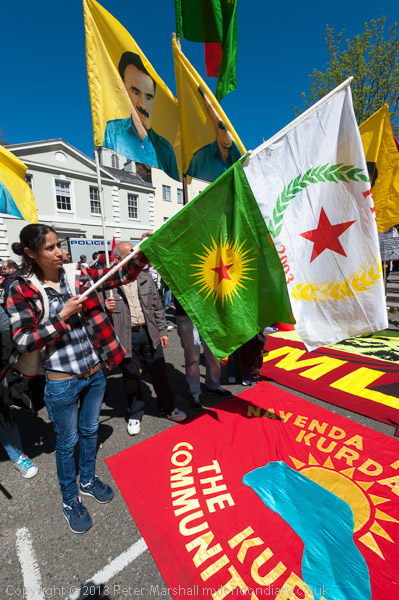
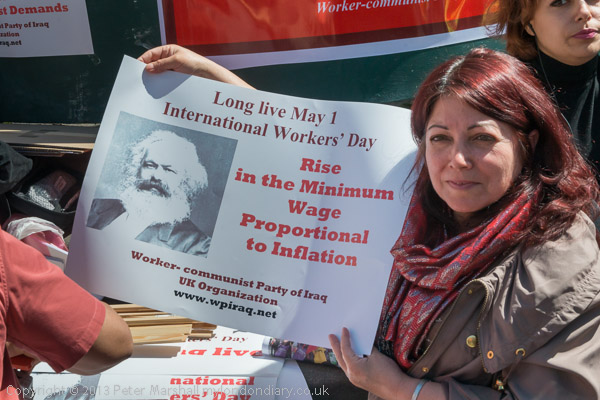
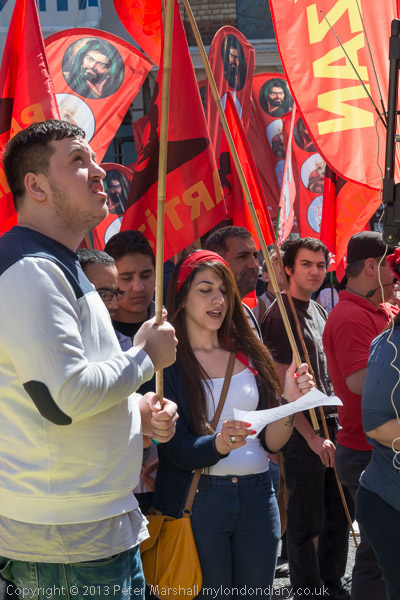
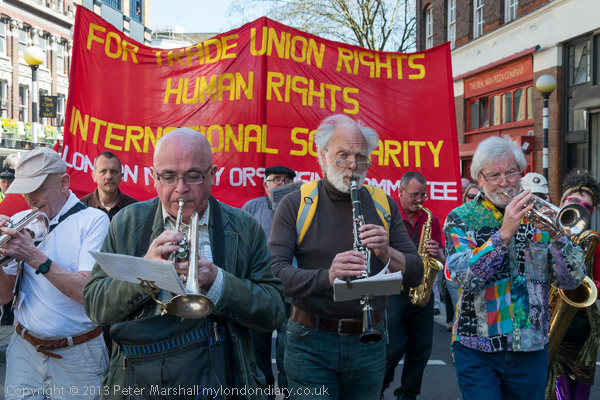
Here are some pictures from ten years ago, Wednesday 1st May 2013. There are more on My London Diary, which also has some of the history of the event at London May Day March. I also posted a few pictures of the area to the north before the march as I arrived early, at Finsbury (though some are in Clerkenwell) as well as a piece about the TUC May Day Rally at the end of the march.
These pictures continue the walk around Finsbury and going back east along Old St to South Shoreditch. They are all in my album 1988 London Photos, but here I’ve put them in the order in which I took them. I also made some other exposures not on line, and the album only contains those images I now find more interesting and worth preserving.
H J Brooks & Co were at a number 136 on the south side of Old St, close to Tilney Court and the building is still there, now offering IT services and support. Henry Brooks was one of many companies in this area in the furniture trade, supplying the various fittings which can be seen in the window.
Kapital Kwickprint, Old St area, Islington, 1988 88-5n-24
I think Kapital Kwickprint was quite close to the Old Street roundabout at the junction with City Road which I’ve since photographed on various occasions. The premises appear to be shared with Sheet Metal and Wire Workers Malbot Ltd, and it was their notices including a hanging sign that attracted my attention as well as a rather curious doorway, firmly shuttered and with the message ‘LETTERS FOR MALBOT LTD’ and an arrow pointing to a postbox beside it.
It is hard to identify this location now, but I think it was in Mallow St, where the next frame on the film was clearly taken. At top left is the address 3TO4.
Warehouses, Leonard St, Shoreditch, Hackney, 1988 88-5n-12
This very sturdy-looking building is still present on the corner with Paul St and is now offices with the name ‘Victoria House’ and address 1 Leonard Circus. Like the warehouses further along the street it probably dates from the 1870s.
Warehouses, Leonard St, Shoreditch, Hackney, 1988 88-5n-13
Part of an impressive row of warehouses on Leonard St dating from 1874-7 which have now been converted to office and residential use. C W Burrows at 69 describe themselves as House Furnishers – and this area was a great centre for furniture manufacture.
The business of J.Davis & Company (Machines) limited, now dissolved, was described at Companies House as “Wholesale of machinery for the textile industry and of sewing and knitting machines – Importing and distribution sewing machines.”
Great Eastern St, Shoreditch, Hackney, 198888-5n-14
Great Eastern St was constructed in 1876 and these buildings date from shortly afterwards. You can see a small part of No 42 at right of picture, which is Grade II listed and built with No 40 in 1877.
Great Eastern St, Shoreditch, Hackney, 1988 88-5n-15
And this picture shows the Grade II listed building at 40-42 built in 1877 by J. W. Brooker for the cabinet ironmongers Edward Wells & Co. As the listing states it is “in an eclectic style with Gothic, Italianate and Venetian influences.” This building was only listed in 2006, and is currently occupied by a cafe and an estate agent. I’ve photographed the entrance on the corner at right on other occasions.
Christina St, Shoreditch, Hackney, 1988 88-5n-16
Christina Street looking east from close to Phipp St. The site at right now has a building on it, and the street looks considerably tidier.
City Road area, Shoreditch, Islington, Hackney, 1988 88-6a-02
Today’s mystery picture. A quite distinctive building but I can’t remember what it was or exactly where it was, though probably somewhere quite close to Wesley’s Chapel on the City Road where I was photographing on the same walk a couple of frames later. It has a vaguely religious feel and may well have been sold and demolished since 1988. I hope someone will recognise it and tell me in a comment.
Click on any of the pictures to go to a larger version in my album 1988 London Photos, from where you can browse the album.
From Whitecross St I wandered across Old St into Helmet Row to make this picture, before going back across the road.
Old St, St Lukes, Islington, 1988 88-5n-42
Helmet Row is the street beside this building, at at right is the tall spire of St Luke Old St, a Grade I listed chruch designed by John James and Nicholas Hawksmoor, the latter thought to be responisble for the unusual obelisk spire. In 1988 the church was derelict and roofless. Opened in 1733 it became redundant and closed in 1959, remaining empty until taken over as a music centre operated by the London Symphony Orchestra in 2003.
Golden Lane, Baltic St, Finsbury, Islington, 1988 88-5n-43
I don’t think I went out of my way to photograph buildings with street signs on them, but it was very useful when they did have one – or even two like this on the corner of Golden Lane and Baltic St. Both buildings are still there, although only that at the right of my picture is still Mencap. That at left has gained the name LONDON HOUSE written rather large on both sides.
Whitbread’s huge stables, built in 1897 are a reminder of a past age, one that was soon to come to an end, when traffic in London was all horse-drawn, and large numbers of horses were needed to convey barrels of beer to thirsty Londoners. This stables was built to replace a smaller stables on Chiswell street and ramps at the rear enabled horses to be kept on its three floors. The top floor originally had windows like those below, but these were bricked up when it was later used by a gun club as a firing range. Some have now been unbricked.
These stables could house around a hundred horses to pull the brewery drays, a small fraction of the many thousands of horses on London’s streets every day – with a transport system of hansom cabs and horse buses needing around 50,000 to keep running and many more in harness behind various carts and wagons, along with a few saddle horses. And with Shire horses weighing around a ton a piece the stables had to be very sturdy and the pollution problem with each producing between 15 and 35 pounds of manure per day was huge, leading to the Great Horse Manure Crisis of 1894. No solution could then be found to the problem, and it was only the internal combustion engine that eventually came to the rescue – its pollution, though toxic was largely gaseous.
School Caretakers, house, Baltic St, Finsbury, Islington, 1988 88-5n-46
The School Caretakers House and entrance to the Cookery School are still there in Baltic Street, though the school, built for boys, girls and infants by the London School Board in th 1880s, is now the Golden Lane Annexe of the London College of Fashion, part of UAL, the University of the Arts London.
Crescent Row, Finsbury, Islington, 1988 88-5n-31
The corner of Crescent Row and Sycamore St still looks much the same. Plans to demolish the building on the left edge of the picture were approved in 2017, but it appeared to have been renovated a year or so later.
Dress forms, Old St, Finsbury, Islington, 88-5n-34
The view through a window in Old Street. I think this later became a café bar.
More from around Old St in a later post. Click on any of the images to view a larger version in my album 1988 London Photos from where you can browse the album.
At the end of May 1988 I went to Finsbury on the northern edge of the City of London – not to be confused with Finsbury Park a couple of miles further north. I think I might have been visiting an exhibition at the Barbican Gallery which has its main street entrance in Silk Street, just a few yards from the border with Finsbury, part of the London Borough of Islington.
Ropemaker St, Islington, 1988 88-5n-61
Ropemaker St, Islington, 1988 88-5n-62
Finsbury St, Islington,1988 88-5n-64
Or it could be that I was simply visiting some of my favourite new buildings in London, in Ropemaker St, some now demolished and replaced. Those balconies – perhaps from the 1950s – are still there but the more recent building on the other side of Chiswell Street has been replaced by something bigger and blander.
I simply had to turn around to find my next subject, the gates of the Honourable Artillery Company, established by Royal Charter on 25th August 1537 and said to be the second-oldest military corps in the world. It actually traces its history back rather further to 21 years after the Norman invasion. The ‘Artillery’ for much of its history was the long bow and it originally had a field in Spitalfields where it could practice shooting arrows, and it only moved permanently here to the Artillery Garden in in 1658. As well as military practice the ground has also often been used for sporting and other events; cricket is said to have been played here as early as 1725 and the first balloon flight in England began was here by Vincenzo Lunardi in September 1784. THe HAC is still a part of the Army Reserve, the oldest regiment in the British Army.
In front of one of the buildings on Chiswell St was a narrow garden with a few bushes and a sculpture of Diana the Huntress with two dogs. I don’t know what has happened to this.
Whitecross St, Finsbury, Islington,198888-5n-55
A tall warehouse on the corner of Errol St and Whitecross St has a sign for A J Brown Brough & Co Ltd, Paper and Packaging. The building is still there, now I think converted largely to residential use, with its main entrances in Dufferin St. But of more interest to many – and perhaps to me when I made the image – is the vintage Citroen in the foreground.
I’ll continue my walk around Finsbury in later posts. You can click on any of the pictures here to go to larger versions in my album 1988 London Photos.
I don’t know why TQ32 didn’t take me very much into north London during the years 1986-92 as certainly in later years I spent more time in Canonbury, Stoke Newington and Enfield etc, but this particular 1km wide strip perhaps just avoids the areas of them that interested me most.
Dummies, Old St, 1988, Islington
It’s just an accident of geography that while Green Lanes begins just on its west edge, as it goes north it moves just a little to the west, taking it out of the area. Another accident that much of what I photographed in Tottenham lies just a short way to its east. Of course the pictures I took of these areas still exist and are either already on line in other albums or will I hope soon be there as I get around to uploading other strips of the project.
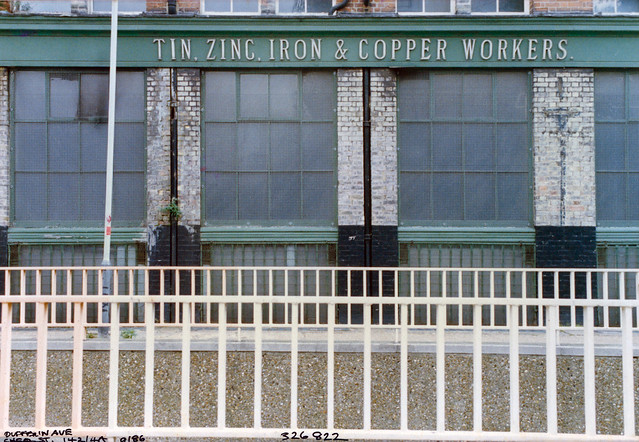
Tin, Zinc, Iron & Copper Workers, Dufferin Ave, Old St, 1986
TQ3282 begins on the edge of the city where both Islington and Hackney and meet it around Old St in Finsbury, Shoreditch and Hoxton. I don’t think there are now any Tin, Zinc, Iron & Copper Workers in Dufferin Ave, which seems largely now to be home to various financial organisations and I think this building close to Bunhill Fields may have been replaced by something more modern, or at least refronted.
SEFCO Ltd, Honduras St, Old St 1986, Islington
Honduras Street is one of several short streets between Old St and Baltic St, just west of Golden Lane, and at one time was where Olympus Cameras had their service centre, which is probably why I walked down it and took this picture of SEFCO Ltd which will probably have been taken on an Olympus OM camera.
There was a company called SEFCO Ltd offering to supply specially shaped rubber pieces from an address in Rosebery Avenue in a small ad in the magazine Electrical Engineering in September 1955 who may possibly be the same company moved to a different but nearby address, but otherwise I can find no other information on the internet.
In later years I visited Honduras Street to go to exhibitions and events when it became the home of Foto8 magazine and the Host gallery from 2002 to 2012.
Among the other pictures that I made in TQ32 were a few from Hoxton and Stoke Newington and the start of Green Lanes, including a fine travel agent’s window and several of a photographer’s shop.
Photographer’s window, Newington Green, Green Lanes, 1988
And further north there are some of interest you can find for yourself, including one with some particular resonance at the moment which I probably photographed at the time in part for its street name, Black Boy Lane.
Page 11 of my album London 1986 has some of my favourite black and white pictures I took that year, at least in London, and is centred around the City of London, with pictures from its northen extremities in Moorgate, Smithfield and the Barbican and close to the City in the surrounding London Boroughs, particularly Islington, where my walks took me around Farringdon, Clerkenwell, Old St and Finsbury.
Atlas Paper Works, Newington Causeway, Newington, Southwark
I drifted into Camden around Kings Cross, Lambeth close to Waterloo, Southwark at Newington and The Borough, Covent Garden, Temple and Strand in Westminster and Whitechapel and Aldgate in Tower Hamlets.
Wig & Pen Club, Strand, Westminster
Those who have been following the colour work I’ve posted in the series of slices through London will recognise a number of the places in these pictures, particularly in the album TQ31- London Cross-section which I’ve written about recently. One of them is the Wigt & Pen club on the Strand, still very much in business back in 1986, but which closed in 2003.
Lloyd’s Diary, Amwell St, Kings Cross, Islington
Occasionally the black and white and colour versions show a similar viewpoint, but usually in black and white I was more concerned with documenting a building or place as a part of the city while the colour work was often more concerned with detail and particularly colour. The black and white is generally more of a document, more objective and the colour more personal, more of a response to the subject.
LowerMarsh, Waterloo, Lambeth
The routes that I researched and plotted were determined by my desire to try to document the whole of London, and to photograph its significant and typical buildings, streets, squares etc. I think it was largely for practical reasons that I did this in black and white, partly because of cost, but more that black and white was able to handle a much higher dynamic range than colour film.
King James St, The Borough, Southwark
But black and white back then was still the primary medium of photography, both in camera and in publication and exhibition. I’d worked for over 15 years primarily as a black and white photographer and almost all of my published work had been in black and white. Looking at the pictures now it is usually the black and white that still interests me most. Things have very much changed, particularly with the move to digital. I only work in colour and can’t ever see myself going back to black and white. And I seldom see black and white by other photographers – particularly not by younger photographers who have never really served their time with black and white – without thinking it would have been better in colour.
I found this head in a barber’s window on New Bridge St fascinating if rather revolting and made several pictures of it and a similar head in another of the shop’s windows. At £11.95 for Mens Shampoo Cut and Finish back then (£25 at today’s prices) this was an establishment catering for the relatively wealthy, though women may think it still a bargain compared with what they pay. The company which had a number of shops is still in business but not at this address.
Curiously this little area of central London remained largely as it had been left after the war when I photographed here in 1992. The Queen’s Head was left alone after bombing in 1940 destroyed its neighbours, the Blue Last pub, the Ventura Restaurant and a stamp dealer in Ludgate Broadway. Fifty two years later their empty spaces only in use for car parks. Although I’ve labelled it on the enprint as Ludgate Broadway, a sign on the boarding around the bomb site reads Blackfriars Lane, but the view continues down f Ludgate Broadway to Pilgrim St. The size of the tree in the bomb site gives some indication of how long this site has been empty, though I think the ground level was some way down on the other side of the fence. The red building in Pilgrim St is still there, the 1891 City Bank with a frontage on Ludgate Hill, and had recently been restored at the time of the picture. A year later Ludgate Court on its west side was renamed Pageantmaster Court. The ugly block to the left of the City Bank has since been replaced by an even uglier one, but both this and the Old Bailey are no longer visible from where I was standing after the bomb site was redeveloped, I think around 2000.
Apart from the colour which seemed appropriate for the trade, I was certainly attracted by the painted brickwork around the door and the signs, both for ‘B. W. Bellgrove (Meat) Limited – Wholesale. Retail & Catering Butcher’ which seemed unusually explicit, and also for the street name, Eagle Court, which made the location clear. Eagle Court is a short distance to the north of Smithfield Market, and runs between Britton St and St John’s Lane.
Designed by Berthold Lubetkin in 1938, the foundation stone was laid in 1946 and the scheme completed in 1949, the Spa Green Estate between Rosebery Avenue and St John St in Clerkenwell is perhaps the most complete realisation of the modernist approach to social housing and a power expression of the new welfare state. It’s special status, confirmed by Grade II* listing in 1998 has enabled the estate, which had begun to deteriorate as government policies turned against council housing and made it difficult for local authorities to properly maintain it, has enable the TMO now responsible to carry out internal refurbishments to modern standards (and in many ways the original was well ahead of its times) and to restore the exterior to reflect Lubetkin’s original vision.
Wigton House on Agdon St in Finsbury. The street used to be called Wood’s Close, but at the start of the 20th century was renamed Northampton St, and then in 1939 the Marquess of Northampton (whose Compton family were the local landowners) was asked to suggest a new name for it and suggested Agdon St after property his family owned in Warwickshire. Back in the middle of the eighteenth century people apparently used to gather here to travel with an armed escort into London because of the danger of being robbed.
This was the rear entrance to Wigton House, whose frontage was on St John St. It was built by John Laing & Son Ltd in 1936-8 as a speculative development and named after Wigton in Cumbria, the area where the company came from. The building was converted into flats shortly after I took this picture in 1992 and renamed Paramount House. The frontage on St John St was altered but this side remains clearly identifiable.
The album TQ31 London Cross-section contains many more pictures from the City and Finsbury as well as areas both to the south and north, all made in the 1km wide strip with Grid reference beginning TQ31, all made between 1986 and 1992.
Page 9 of my album London 1986, black and white pictures taken of the city that year, begins briefly on familiar ground in Southwark, close to the OXO tower, before going on to Clerkenwell and Finsbury. Because of my rather odd filing system the two areas interweave before I return to Southwark and Bermondsey.
A plaque above a hairdresser’s shop commemorates Guiseppe Mazzini, founder of Young Italy, a secret society formed to promote Italian unification. He lived in London at various times between 1840 and his death in 1872 to escape arrest on the continent.
I crossed Tower Bridge briefly and returned south of the river. The riverfront between Tower Bridge and Southwark Crown Court , opened in 1983, has changed completely since I took these pictures, though many of the pictures away from the river have altered relatively little – the George Inn was last rebuilt in after a fire in 1677.
Later I went to the City, wandering the area around Bank and towards the Tower with page 9 ending with a second picture of Pepys on Seething Lane.
The City is also an area where many older buildings have been preserved, despite some notable losses, though most date from the nineteenth or early twentieth centuries, and most that I photographed are still recognisable. But the environment has been altered and many are now somewhat overwhelmed by gigantic towers.
All photographs on this and my other sites, unless otherwise stated, are taken by and copyright of Peter Marshall, and are available for reproduction or can be bought as prints.