An Olympic Bike Ride

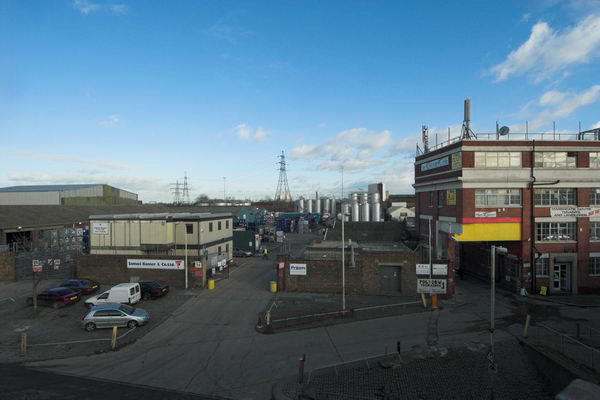
Businesses later demolished at the heart of the site for London’s 2012 Olympics

An Olympic Bike Ride: At the end of 2002 I finally bought a Brompton, a rather expensive folding bicycle which then cost me around £600. Perhaps not a lot for a new bike then and certainly not now, but rather more than the £13-7s6d or so the other bike I was still riding had cost in 1958.
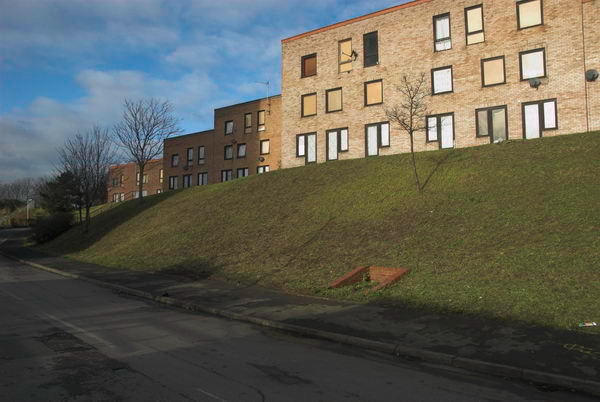
Clays Lane Housing Co-operative – demolished for the Olympics

I’d been thinking about it for years, and it would certainly have been very useful for the work that I’d been doing around outer London in the previous decade, but I’ve only used it infrequently for my photography.
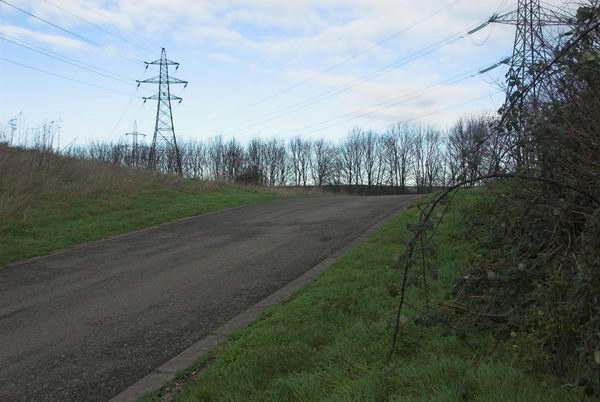
Eastway Cycle Circuit – lost to the Olympics

Though it’s a great way to get to places, taking it by train or underground and riding from a convenient station, Bromptons are a powerful magnet for bike thieves, so easy to put in a car boot or van, and selling at a relatively high price. It isn’t safe to lock them anywhere in public view when even the best cycle lock can only detain the well-equipped thief for around 30 seconds.
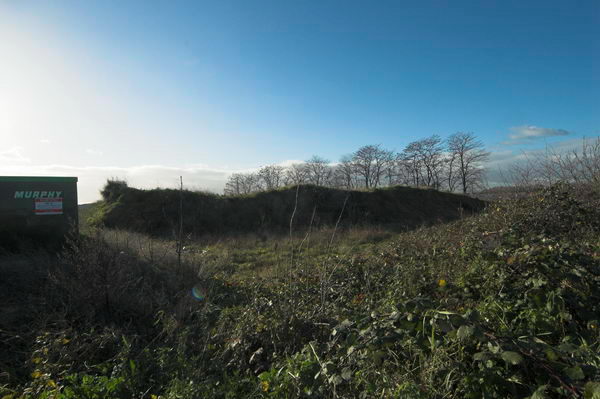
Bully Fen Wood – Community Woodland lost to the Olympics

So rather than using it for my general photography – mainly of protests and other events – I’ve used it for cycle rides on which I’ve taken photographs, both around where I live – it’s easier to jump on and off than my full-size bike – and in and around London.
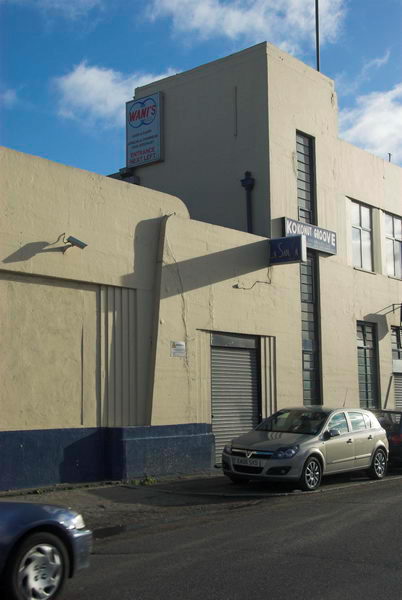
Factory on Waterden Road – demolished for the Olympics

Thursday 4th January 2007 was a nice winter’s day, not too cold and blue skies with just a few clouds, and I went with the Brompton to Waterloo and then on the Jubilee Line to Stratford. Preparations had begun for the 2012 London Olympics and I wanted to see and photograph what I could of the changes that were taking place.
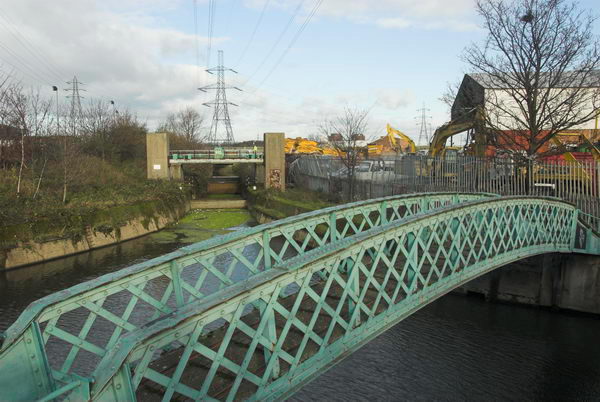
The footbridge has been kept in the new Olympic Park

My account of the day on My London Diary begins with my tongue-in-cheek suggestion that it would have been much preferable on environmental ground to shut down Heathrow and use that as the Olympic site, but goes on to describe a conversation I had with one of the residents at Clays Lane, then about to be demolished (spelling etc corrected.)

‘he talked of living in a fascist state, with lack of consultation and individual powerlessness, and of the games as having always had a militaristic overtone. hardly surprising there is little support for the games here, as initial promises that people from the Clays Lane Housing Co-operative would be rehoused in conditions “as good as, if not better than” their present estate were soon changed to “at least as good as in so far as is reasonably practicable.”‘

My London Diary
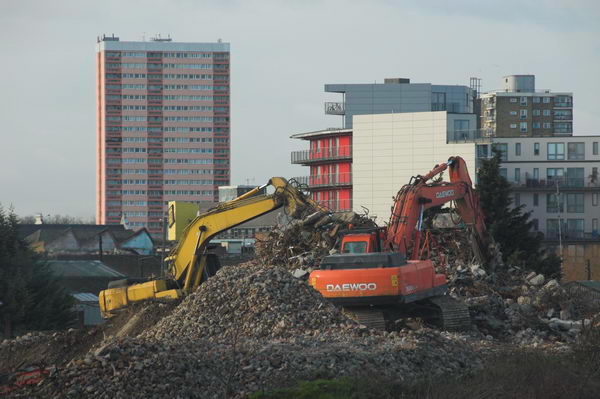
Work on the site seen from the Greenway

From Clays Lane I moved to the Eastway Cycle Track, already closed and fenced off – I decided against going through a gap in the fence to ride around it. The Community Woodland at Bully Fen Wood was also already closed. and I cycled on around the roads at the north of the site to Hackney Wick.
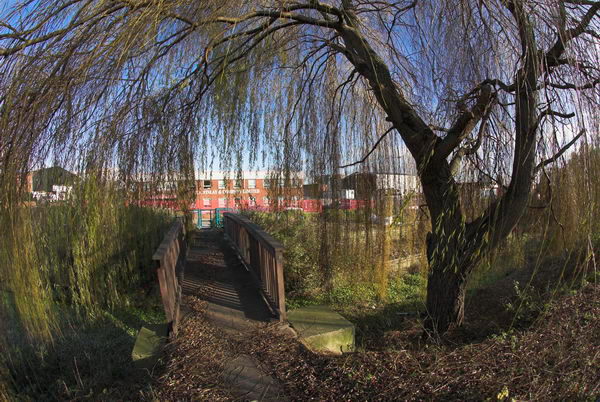
Pudding Mill River and Marshgate Lane – all now gone

Along Waterden Road I photographed some of the other industrial sites that were to be lost to the games, then turned along Carpenters Road and into Marshgate Lane, all soon to be fenced off and everthing on them destroyed. After taking pictures around Marshgate Lane I went back and into Hackney Wick, photographing the Kings Yard workshops on Carpenters Road soon to be demolished on my way.
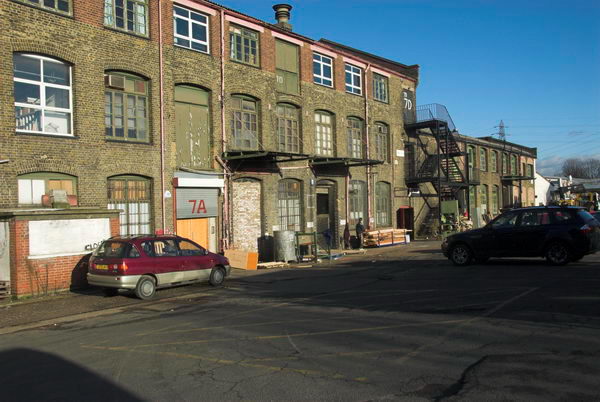
Kings Yard – demolished for the Olympics

Hackney Wick to the west of the Lea Navigation is largely outside the Olympic compulsory purchase area, but some large areas of industry were scheduled for demolition and I took more pictures. I found the towpath here beside the navigation still open and rode down it to Stratford High Street, where more industry to the north of the road is also going.
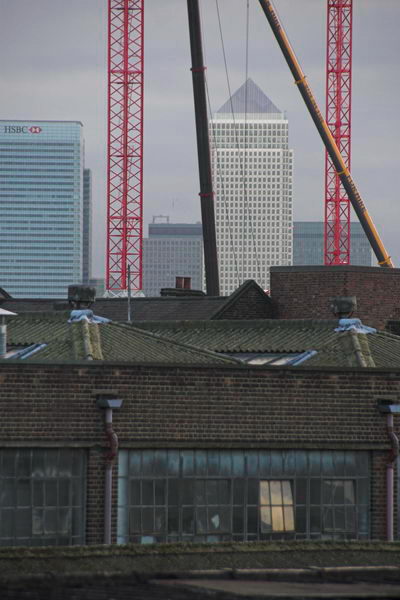
Canary Wharf from Stratford Marsh

I spent some time going up the roads and paths here going from the High Street into Stratford Marsh which were still open, then went east along the top of the outfall sewer past areas also covered by the Olympic CPO.
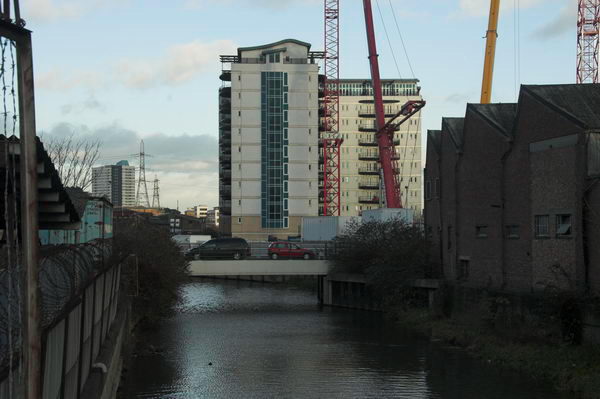
St Thomas Creek, Bow Back Rivers – factories at left and right to be demolished

There was still a little light and I came down from the ‘Greenway’ and cycled down to Bow Creek from West Ham, going down the path on the west side of the creek to the Lower Lea Crossing. I wanted a picture showing the Pura Foods site then being demolished, but also made a number of other twilight pictures from this elevated viewpoint, and also some from the Silvertown Way viaduct as I made my way to Canning Town Station for the train home.
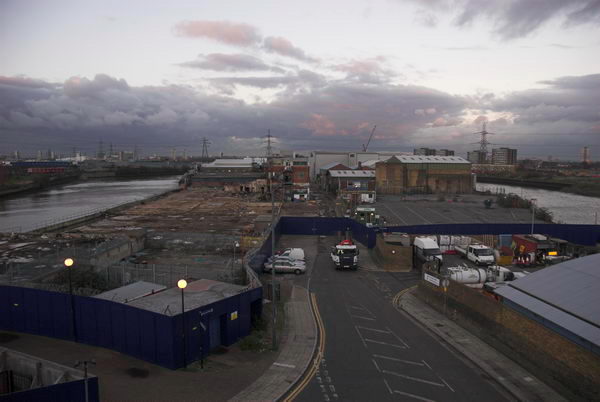
Pura Foods being demolished for London City Island development

Many more pictures from this ride on My London Diary, starting a little way down the January 2007 page.


Around Swiss Cottage 1988

Sigmund Freud, sculpture, Oscar Nemon, Swiss Cottage Library, South Hampstead, Camden, 1988 88-7h-61-positive_2400
Sigmund Freud, sculpture, Oscar Nemon, Fitzjohn’s Avenue, Belsize Lane, South Hampstead, Camden, 1988 88-7h-61

Around Swiss Cottage 1988: Sigmund Freud (1856–1939) escaped from Austria after it was annexed by Nazi Germany and came to London, spending his final year until his death in the house in Maresfield Gardens which now houses the Freud Museum. Croatian sculptor Oscar Nemon made three busts of Freud for his 75th birthday in 1931 and visited him in London in 1938 to make a final bust on which the head of this sculpture was based. Funds were later raised for him to create this bronze sculpture which was unveiled in 1970 next to Swiss Cottage Library where I photographed it.

In 1998 it was moved to a more prominent position at the junction of Fitzjohn’s Avenue and Belsize Lane and it was Grade II listed in 2016.

Taplow, Winchester Rd, Swiss Cottage, Camden, 1988 88-7h-63-positive_2400
Taplow, Winchester Rd, Swiss Cottage, Camden, 1988 88-7h-63

The five tower blocks of the Chalcots Estate where built for the London Borough of Camden in 1967-8. Taplow, Burnham, Bray, and Dorney are 23 storeys while Blashford has 19. The land was owned by Eton College and the names come for the area around Eton.

Cladding was added to the towers in 2006 by the same companies that clad Grenfell Tower but using fire-resistant rock-wool. When a fire broke out in a flat in Taplow in 2012 the fire was contained and did not spread and there were no deaths.

Embassy Theatre, Eton Avenue, Swiss Cottage, Camden, London, 1988 88-7k-61-positive_2400
Embassy Theatre, Eton Avenue, Swiss Cottage, Camden, London, 1988 88-7k-61

Originally a stucco double-fronted Italianate Victorian villa, it was converted in 1890 into the Eton Avenue Hall for the Hampstead Conservatoire, a prestigious private music college; Cecil Sharp the great collector of English folk song was its principal from 1896-1905 and composer Arnold Bax one of his pupils.

The building was converted again after the college had closed and opened as the Embassy Theatre in 1928, with a school of acting from 1932. Damaged in the war it reopened in 1945, continuing as a theatre until 1956 when it was sold to the Royal Central School of Speech and Drama, now a college of London University.

College Crescent, South Hamnpstead,  Camden, 1988 88-7k-63-positive_2400
College Crescent, South Hampstead, Camden, 1988 88-7k-63

College Crescent was built by the Eyre family who were (and are) major landowners in Swiss Cottage and parts of Hampstead, with the first houses built in the late 1840s. Initially it was named as three streets, College Villas Road, College Terrace and College Crescent.

40 College Crescent was not one of the original houses, but was built around 1880 on the site of Abbey Farm Lodge as the family home for Samuel Palmer or Huntley and Palmer’s biscuit firm in Reading. Following his death this area of open space with a drinking fountain and shelter – as its inscription states – “presented to the Borough of Hampstead for the public benefit in memory of the late Samuel Palmer of Northcourt, Hampstead by his widow and family. 1904”. It was Grade II listed in 1993.

St. Thomas More, Roman Catholic, Church, Maresfield Gardens, Hampstead, Camden, 1988 88-7k-64-positive_2400
St. Thomas More, Roman Catholic, Church, Maresfield Gardens, Hampstead, Camden, 1988 88-7k-64

In 1938 the Archbishop of Westminster bought Hyme House at 3 Fitzjohn’s Avenue, for some years the studio of successful society portrait painter Philip de László (1869-1937) as the first English home for the Swiss-based Sisters of Mercy of the Holy Cross. The Sisters converted the studio into a church and bought the next two houses on the street to set up a girls school which they ran until 1985, after which it became a hotel.

In 1950 the studio had become too small and a second church was built on the site, but further expansion made this inadequate. The current church, built a restricted site on tennis courts at the back of the house and fronting onto Maresfield Gardens was designed by Gerard Goalen following the Second Vatican Council to maximise participation of the laity in the Mass. It was Grade II listed in 2016.

Netherhall Gardnes, Hampstead, Camden, 1988 88-7k-42-positive_2400
Netherhall Gardens, Hampstead, Camden, 1988 88-7k-42

A very rectangular house with a gate made largely of circles, but with the ironwork on the top of the gate reflecting the only non-rectangular feature of the frontage, and carefully positioned on top of it.

The Tower, Fitzjohn's Ave, Hampstead, Camden, 1988 88-7k-46-positive_2400
The Tower, Fitzjohn’s Ave, Hampstead, Camden, 1988 88-7k-46

An irresistable Gothic fantasy. Development in this area had been prevented for years after the death of the estate owner Sir Thomas Maryon Wilson in 1821, whose will prevented his sons building on the land, and efforts by his son (confusingly of exactly the same name) to get the will amended came to nothing. When he died, his brother Sir John inherited and was able to make a deal making part of the estate a part of Hampstead Heath and making development possible in other areas.

The Tower, Fitzjohn's Ave, Hampstead, Camden, 1988 88-7k-32-positive_2400
The Tower, Fitzjohn’s Ave, Hampstead, Camden, 1988 88-7k-32

Sir John divided the estate in 1873 with his son Sir Spencer Maryon Wilson who developed Priory Road and Fitzjohn’s Avenue from 1875 on, as a wide road with wide pavements linking Swiss Cottage and Hampstead which was described by Harpers Magazine a few years later as “one of the noblest streets in the world”.

The Tower, Fitzjohn's Ave, Hampstead, Camden, 1988 88-7k-33-positive_2400
The Tower, Fitzjohn’s Ave, Hampstead, Camden, 1988 88-7k-33

A much quoted Camden History Society article describes the Tower at No 25 as an ornate mansion which is now “a fine example of ‘Disneyland Gothic'”. The building with 25 rooms dates from 1880-1, its architect JT Wimperis, a very prolific Victorian architect for Herbert Fleming Baxter (1839-1905), an extremely wealthy American merchant who was a part of a family with extensive estates in Shropshire. The house has been restored and is now divided into flats. Rather surprisingly it was not Grade II listed until 1999.

My walk will continue in a later post.


Click on any of the pictures to go to a larger version in the album 1988 London Photos, from where you can browse through the album.


More from St John’s Wood

Marlborough Place, St John's Wood, Westminster, 1988  88-7e-14-positive_2400
Marlborough Place, St John’s Wood, Westminster, 1988 88-7e-14

More from St John’s Wood – and this next photograph is of the entrance to a large detached house at 38 Marlborough Place, St John’s Wood, where a blue plaque informs us that ‘THOMAS HENRY HUXLEY 1825-1895 Biologist Lived Here’.

Huxley was born into a middle-class family in Ealing, but when the school at which his father taught mathematics closed the family were plunged into poverty, and he had to leave school aged 10, only two years after his education had begun. But he determined to teach himself, and did so with great effect, becoming one of the most knowledgeable men in Britain over a very wide range of subjects, and probably the leading specialist in comparative anatomy of his era.

But he is now best-known for his defence of Charles Darwin whose theory of evolution published in On the Origin of Species aroused considerable controversy, particular from religious figures, and Huxley’s defence of Darwin in an 1860 Oxford public debate with Bishop “Soapy Sam” Samuel Wilberforce (one of William’s sons) led to him being nicknamed after his death as ‘Darwin’s Bulldog’.

The door to the street from the covered path to the front door was open, allowing me to stand outside and take this picture showing the path and canopy as well as the mosaic on the flooring.

Marlborough Place, St John's Wood, Westminster, 1988  88-7e-15-positive_2400
Marlborough Place, St John’s Wood, Westminster, 1988 88-7e-15

I moved back a few feet and a smidgeon to my left to take another picture of the house, which gives a better idea of the covered path to the street and also shows the plaque for Huxley.

In 1988 this was the Marlborough Family Service of the Bloomsbury Health Authority, a pioneering institution for child-protection cases, school-based interventions and family therapy, founded here by Dr Joshua Bierer in 1946 as the Marlborough Day Hospital, the first social psychotherapy centre in the world. It seems to have been closed and sold off around 2018.

Marlborough Place, St John's Wood, Westminster, 1988 88-7f-63-positive_2400
Marlborough Place, St John’s Wood, Westminster, 1988 88-7f-63

The door to the front garden at 59 Marlborough Place was shut, so I couldn’t see inside, but the gateposts has two rather grand eagles still present. This property, built in around 1840 was extensively refurbished in 2013 and you can see a large set of pictures on the web. It sold in 2016 for £14,900,000.

The Grade II listing has a very lengthy text and describes it as “good example of the early mid-C19 semi-detached villas erected on the Eyre Estate, are of special architectural interest on account of their early semi-detached format and their architectural form and detailing expressed on their front elevations.”

The listing text also mentions that between around 1950 and 1990 it was divided into four flats, one of which was for some time the home of composer Benjamin Britten.

Abbey Rd, St John's Wood, Westminster, 1988 88-7f-23-positive_2400
Abbey Rd, St John’s Wood, Westminster, 1988 88-7f-23

This Grade II listed Tudor Gothic detached house at 48 Abbey Road dates from around 1840.

Carlton Hill area , St John's Wood, Westminster, 1988 88-7f-31-positive_2400
Carlton Hill area , St John’s Wood, Westminster, 1988 88-7f-31

The doorway of another house in a similar stye in the area, possibly in Carlton Hill.

New London Synagogue, Abbey Rd, St John's Wood, Westminster, 1988 88-7f-22-positive_2400
New London Synagogue, Abbey Rd, St John’s Wood, Westminster, 1988 88-7f-22

Just around the corner in Abbey Road is the New London Synagogue.

This was the site of the first Jewish community to be established in 1876 by the new United Synagogue which had been formed in 1870; the permanent building for St. John’s Wood (United) Synagogue, now Grade II listed, was opened in 1882. Its architect Hyman Henry Collins, the City of London District Surveyor, designed eight synagogues in London, but all but this have been demolished.

St John’s Wood gained large Jewish population when people moved out of the East End in the 1930s and 1950s, but in 1964 the congregation had closed and the building was being sold off for demolition. It was saved when followers of Rabbi Dr Louis Jacobs who had been refused employment in the United Synagogue’s New West End Synagogue due to allegations of heresy secretly formed a shell company to buy it. They set up a new congregation with him as rabbi, the first in what became known as the Masorti movement in the UK.


St John’s Wood

Abercorn Place, St John's Wood, Westminster, 1988 88-7e-41-positive_2400
Abercorn Place, St John’s Wood, Westminster, 1988 88-7e-41

Long ago St John’s Wood was a real wood, part of the Forest of Middlesex, and was the property of the Knights Hospitaller of St John of Jerusalem who were based in Clerkenwell. Pregiously it had belonged to the Catholic Poor Fellow-Soldiers of Christ and of the Temple of Solomon (better know as the Templars) who were suppressed in 1312. Henry VIII grabbed the land in 1539 when he dissolved the monasteries during the Reformation, but Charles II gave it to one of his mates in settlement of a debt of £1300, and eventually most of it was sold to a city wine merchant, Henry Samuel Eyre in 1733, and much of the area remains the Eyre Estate. Other parts belong to Harrow School.

Development on the Eyre estate began in 1809 The area was developed as an area for the growing upper middle class, with many detached and semi-detached villas with large gardens, the first garden suburb anywhere in the world. Some later were replaced by blocks of flats and terraces of housing, but the area remains one of the most expensive around London. It’s not an area where I often felt at home.

In 2011 I was able to go behind some of the high walls and photograph the ‘Secret Gardens of St John’s Wood‘ in a project initiated by Mireille Galinou of the Queens Terrace Café and shown there in November 2011, but there were still many impenetrable behind high walls, some protected by security guards with suspicious bulges in their clothing. But in 1988 I kept to the streets.

These flats are at the west end of Abercorn Place at its corner with Maida Vale at the rear of Wellesley Court, architect Frank Scarlett, built in 1938. Perhaps surprisingly the St John’s Wood Conservation Area is carefully drawn to exclude this set of expensive private flats.

Nugent Terrace, St John's Wood, Westminster, 1988 88-7e-43-positive_2400
Nugent Terrace, St John’s Wood, Westminster, 1988 88-7e-43

There are still shops in Nugent Terrace, but I think this rather high-class cobblers is long gone. I was amused at how the figurines chosen matched the area.

Hill Rd, St John's Wood, Westminster, 1988 88-7e-46-positive_2400
Hill Rd, St John’s Wood, Westminster, 1988 88-7e-46

This remarkable mansion block, Mortimer Court, on the corner of Hill Road and Abbey Road is certainly not typical of the area, and I have to apologise that my picture fails to record the full horror of its architecture, best appreciated from the opposite side of Abbey Road. It can be seen on the web sites of many of London’s estate agents.

Onslow Ford, memorial, sculpture, Andrea Carlo Lucchesi, Abbey Rd, Grove End Rd, St John's Wood, Westminster, 1988 88-7e-35-positive_2400
Onslow Ford, memorial, sculpture, Andrea Carlo Lucchesi, Abbey Rd, Grove End Rd, St John’s Wood, Westminster, 1988 88-7e-35

English sculptor Edward Onslow Ford RA (1852—1901) was one of the leaders of the British New Sculpture movement of the 1880s, becoming famous for portrait busts and roundels of many leading figures including Ruskin, Millais, Thomas Huxley and Herbert Spencer. A number of his statues including that of Rowland Hill remain on public display.

He produced a long series of “bronze statuettes of adolescent girls in poses loosely derived from mythology or allegorical themes” some of which were also sold widely in smaller scale copies for Victorian homes, though they might not be appreciated now. The monument in St John’s Wood, close to his home was sculpted by his former studio assistant Andrea Carlo Lucchesi and based on one of Ford’s sculptures.

Abbey Rd Studios, Abbey Rd,  St John's Wood, Westminster, 1988 88-7e-21-positive_2400
Abbey Rd Studios, Abbey Rd, St John’s Wood, Westminster, 1988 88-7e-21

It is probably a punishable offence to go to Abbey Road and not take a photo of the now famous studios, though I resisted any urge to photograph the famous pedestrian crossing nearby.

Abbey Road Baptist Church,Abbey Rd,  St John's Wood, Westminster, 1988  88-7e-24-positive_2400
Abbey Road Baptist Church,Abbey Rd, St John’s Wood, Westminster, 1988 88-7e-24

The Baptist Church on Abbey Road was founded in 1863 by a Mr Stott, a preacher from Hyde Park, who engaged leading church architects Habershon & Pite to build this Grade II listed structure in a ‘Free Byzantine’ style.

In 1874 the Abbey Road and St John’s Wood Mutual Benefit Building Society was formed in what was then the Free Church. This later became Abbey Road and St John’s Wood Permanent Building Society and in 1944 joined with The National Building Society to beceome the Abbey National Building Society, which sadly demutualised in 1989 and in 2004 become wholly owned by the Spanish Santander Group.

Abbey Rd,  St John's Wood, Westminster, 1988  88-7e-25-positive_2400
Abbey Rd, St John’s Wood, Westminster, 1988 88-7e-25

This adjoining pair of gate-posts is no longer on Abbey Road, and the block of flats at No 20 have had something of a face lift since 1988. But to me they looked so much like an adult and child – and were perhaps a deliberate attempt to outdo the Joneses.

Abercorn Place, St John's Wood, Westminster, 1988  88-7e-11-positive_2400
Abercorn Place, St John’s Wood, Westminster, 1988 88-7e-11

This small group of three houses on Abercorn Place at the corner of Violet Hill stood out among the fairly varied architecture of the street for the flower motifs above their first floor windows – a reminder, like the name Violet Hill, that this was the first garden suburb.

The gateposts, one of which is at right of the picture I think used to have a more obvious pattern on them, unfortunately out of focus in my image, which made them appear less crude.

My wanderings around St John’s Wood on a Saturday in July 1988 will continue in a later post. You can click on any of the pictures here to go to a larger version in my album 1988 London Photos, from where you can browse the album.


Around Randolph Avenue 1988

Randolph Ave, Maida Vale, Westminster, 1988 88-7d-11-positive_2400
Randolph Ave, Maida Vale, Westminster, 1988 88-7d-11

If you take the Bakerloo Line to Maida Vale, the station exit is on the corner of Elgin Avenue and Randolph Avenue, and within a few yards of the corner I found a number of scenes that interested me enough to take a picture, including several I’ve not put online, including one of the station itself. It’s a nice Underground station, with the typical maroon tiles of the period and Grade II listed, opened in 2015, designed by Stanley Heap for the London Electric Railway but I think I felt it it would look better in colour, though I don’t think I made a colour image of its exterior.

Instead I crossed the road and walked a few yards north up Randolph Ave for this picture of Burke Electrical Services and the White Rose Laundry, both seemingly in an outhouse on the rear of the rather grandiose buildings of Elgin Avenue. All three shops in this picture are now a Starbucks, and those single-storey blocks now have two additional floors above, rather nicely blending in with the surroundings.

Elgin Mews North, Randolph Ave, Maida Vale, Westminster, 1988 88-7d-12-positive_2400
Elgin Mews North, Randolph Ave, Maida Vale, Westminster, 1988 88-7d-12

The left hand building of the above picture was a part of the archway leading east from Randolph Road into Elgin Mews North.

Most of the houses in Elgin Mews North seem modern, said to date from around 1984, but the gateway and those on Randolph Avenue are Grade II listed. The mews arch in an Italian Gothic style was built around 1864 but according to the listing text heavily restored and possibly reconstructed behind the facade around 1980.

Randolph Ave, Maida Vale, Westminster, 1988 88-7d-14-positive_2400
Randolph Ave, Maida Vale, Westminster, 1988 88-7d-14

A very similar pair of houses and archway are on Randolph Avenue just to the south of the Underground station, and are again Grade II listed.

Randolph Ave, Maida Vale, Westminster, 1988 88-7d-16-positive_2400
Randolph Ave, Maida Vale, Westminster, 1988 88-7d-16

According to the Victoria County History, Maida Vale gets its name from a victory in the Napoleonic Wars in 1807 when Sir John Stuart defeated the French at Maida in Calabria, and in 1810 a new pub on Edgware Road was named The Hero of Maida in his honour.

George Gutch (1790-1894) architect to the Bishops of London who owned the area made plans on a grand scale including a long avenue Portsdown Road parallel to Edgware Rd crossed by Elgin Road, but these were slow to be put into action, and it was only in the 1860s that the area began to be built up.

By this time the white stucco of earlier developments was being replaced by buildings in brick, often multicoloured which give the area its distinct look. Elgin Road was renamed Elgin Avenue in 1886, but it was only in 1939 that Portsdown Road was renamed to its current Randolph Avenue.

Randolph Ave, Maida Vale, Westminster, 1988 88-7e-02-positive_2400
Randolph Ave, Maida Vale, Westminster, 1988 88-7e-02

These long terraces are just beyond the mews in the image above.

Randolph Ave, Maida Vale, Westminster, 198888-7e-51-positive_2400
Randolph Ave, Maida Vale, Westminster, 198888-7e-51

The terrace continues for some length down Randolph Avenue.

Elgin Ave, Maida Vale, Westminster, 198888-7e-52-positive_2400
Elgin Ave, Maida Vale, Westminster, 198888-7e-52

I walked back to the tube station and Elgin Avenue, where a couple of shopfronts took may attention. The pillar dividing 294 and 296 is spiral, like those Italianate examples in Randolph Avenue.

Elgin Ave, Maida Vale, Westminster, 1988 88-7e-54-positive_2400
Elgin Ave, Maida Vale, Westminster, 1988 88-7e-54

And a little further east there was a blind stating ‘312 MEN’ above quite a few images of women which probably amused me slightly.

I walked out of Maida Vale across the Edgware Road and into St John’s Wood – where my next post from 1988 will continue. You can click on any of the images here to see a larger version in my album 1988 London Photos and browse the album from there.


More from Maida Vale, 1988

Warwick Farm Dairies, Elgin Ave, Shirland Rd, Maida Vale8, Westminster, 1988 88-7d-51-positive_2400
Warwick Farm Dairies, Elgin Ave, Shirland Rd, Maida Vale8, Westminster, 1988 88-7d-51

J Welford & Son’s Warwick Farm Dairies is still there on the corner of Elgin Avenue and Shirland Road, still looking much as it did when I took this photograph in July 1988, with I think the only noticeable change being in the name of the shop. Now it is over a hundred years since Welford’s became part of United Dairies and cows were kept in the large yard and its buildings behind, but there is still a cow’s head on the second storey of this corner building.

Shirland Rd, Maida Vale, Westminster, 1988 88-7d-53-positive_2400
Shirland Rd, Maida Vale, Westminster, 1988 88-7d-53

When walking around the streets with a camera around my neck I often was accosted by children clamouring for me to take their picture, and I never refused, though occasionally when I was running out of film I might only pretend to do so. Here the interest was perhaps as much in the BMX bikes and the sweater this young man was wearing as in him or the background.

Beachcroft House, Shirland Rd, Maida Vale, Westminster, 1988 88-7d-54-positive_2400
Beachcroft House, Shirland Rd, Maida Vale, Westminster, 1988 88-7d-54

Westminster Council demolished this care home on Shirland Road in January 2018, replacing the low building and garden with two large 5 storey blocks, one a replacement Beachcroft House care home opened in 2019 and run by Gold Care Homes and the other a block of 31 luxury flats, The Masefield, sold to finance the project.

Shirland Rd, Maida Vale, Westminster, 1988 88-7d-55-positive_2400
Shirland Rd, Maida Vale, Westminster, 1988 88-7d-55

Not one door but seven on the front of a former shop somewhere in the short row of five shops at 113-121 Shirland Rd. It rather amused me. Perhaps 30 years ago when I first needed a computer desk I spent some time looking at those available before deciding they looked small and rather flimsy and I could do a better job myself by cutting up an old door I’d replaced in the house, cutting off part horizontally to use as the desktop (its top surface covered by hardboard a previous resident had added) and the top section sawn vertically to give two side supports. A couple of lengths of 2×4″ hardwood provided some bracing close to floor level – and the footrest on which my feet are now resting as I write. It took me 10 minutes to measure and sketch the design and a morning to make and seems likely to last longer than me.

Delaware Mansions, Delaware Rd, Maida Vale, Westminster, 1988 88-7d-41-positive_2400
Delaware Mansions, Delaware Rd, Maida Vale, Westminster, 1988 88-7d-41

Delaware Mansions calls itself on its web site “The best mansion block in Maida Vale!2. Although Delaware Road was planned in 1875 by the developers of the Paddington Estate, the Paddington Trustees and the Church Commissioners as one of an alphabetical series of streets along with Ashworth, Biddulph and Castellain but the site was allotments until this block was built in 1903-1904 designed like many Maida Vale mansions by Boehmer and Gibbs. The road was only then properly made up.

The Church commisioners sold the entire Maida Vale Estate in 1981 with tenants being given a 20% discount on the market value and long leases. They sold the freehold to Fleksun in 1990.

BBC Maida Vale Studios, Delaware Rd, Maida Vale, Westminster, 1988 88-7d-44-positive_2400
BBC Maida Vale Studios, Delaware Rd, Maida Vale, Westminster, 1988 88-7d-44

Although I’d often heard that a radio programme had been made in the BBC Maida Vale Studios I had no real idea where they were until I walked down Delaware Rd. They are opposite Delaware Mansions, whose web site tells me they were originally “the Maida Vale Skating Palace and Club, which opened in 1909 and had one of the largest and most elegant roller-skating risks in the world. It could accommodate hundreds of skaters and seated 2,620 people at any one time.” It was one of the first studios for the BBC and home to many famous programmes; in 2018 the BBC announced plans to close it.

Lauderdale Rd, Castellain Rd,Maida Vale, Westminster, 1988 88-7d-34-positive_2400
Lauderdale Rd, Castellain Rd,Maida Vale, Westminster, 1988 88-7d-34

This was obviously once a rather sporting area, as on the next street to the east, at the corner of Castellain Road and Lauderdale Road was the Tennis and Squash shop, though this was in 1988 the Maida Vale Driving School and has boards showing a varied selection of vehicles for sale in the window. Now it is a flower shop.

This is on the end of a row of shops, Lauderdale Parade. I’ve found no explanation for the rather curious motif on the end wall which has a lion’s head at its centre. Lauderdale Mansions in several blocks were the first mansion blocks to be built in Maida Vale in 1897. Actor Alec Guinness was born there in 1914.

Elgin Ave, Maida Vale, Westminster, 1988 88-7d-36-positive_2400
Elgin Ave, Maida Vale, Westminster, 1988 88-7d-36

I can find little information about 203 Elgin Avenue, a large detached house on the corner of Biddulph Road. On the side of the house is the date AD 1890.

I took the short walk up Biddulph Road and into Paddington Recreation Ground, where I photographed a few people cycling around the paved track (not online) and probably visited the public toilets before returning to Elgin Ave, photographing the side of this house again.

This seems a good place to finish this post – more from Maida Vale in a later post.


Around Elgin Avenue, Maida Vale – 1988

Elgin Avenue, Maida Vale, Westminster, 1988 88-7c-43-positive_2400
Elgin Avenue, Maida Vale, Westminster, 1988 88-7c-43

It was the middle of July 1992 before I returned to photograph London, starting again in Carlton Vale, where I think there must have then been some convenient bus route for me, perhaps from Putney or Clapham Junction – many London routes were longer back then. I walked from there through Paddington Recreation Ground to Elgin Avenue. This was the eighth picture on my walk but the first which I’ve put online, chosen for the ornate porch and balcony above. 101 is the start of a short terrace of similar properties to the east of Shirland Road and reaching to Widley Road ending at 113, the last four of which are named Westside Court. This is part of the Maida Vale Conservation Area and these houses here probably date from the late 1880s or 90s.

Elgin Avenue area, Maida Vale, Westminster, 1988 88-7c-32-positive_2400
Elgin Avenue area, Maida Vale, Westminster, 1988 88-7c-32

The Walterton and Elgin Action Group began in 1985 when estates here owned by the GLC were transferred to Westminster Council who decided to sell them off to private developers without even informing residents.

Many 99 year leases in the area expired in the 1960 and had been bought up my private landlords, some unscrupulous including Perec “Peter” Rachman a few years earlier at low prices. Many homes became empty and derelict and in the 70s many were squatted and there was a high profile Elgin Avenue squatting campaign involving housing activist Piers Corbyn and punk legend Joe Strummer of the Clash.

The council then tried to set up barter deals with developers but an active series of protests inside the officers of the developers by WEAG stopped the deals. When I took these pictures Westminster City Council had emptied one third of Walterton Estate homes, blocking them with steel doors and others were heavily squatted. The 1988 Housing Act intended to encourage the sale of council housing to private landlords included a Tenant’s Choice provision and three quarters of the residents signed up as members of Walterton & Elgin Community Homes (WECH). A 72% vote was then obtained to transfer the properties to WECH, and Westminster Council had to pay over £22 million between 1992 and 1997 to WECH to make up for their years of neglect and pay for the refurbishment of properties. As an outsider I was only very vaguely aware of what was going in the the area when I took these photographs. The video on the WECH site tells the story well.

Shirland Rd, Maida Vale, Westminster, 1988 88-7c-33-positive_2400
Shirland Rd, Maida Vale, Westminster, 1988 88-7c-33

These shops on Shirland Road are close to the junction with Walterton Road. They are still there though as different businesses.

Lanhill Rd, Maida Vale, Westminster, 1988 88-7c-34-positive_2400
Lanhill Rd, Maida Vale, Westminster, 1988 88-7c-34

I was standing in Lanhill Road to make this photograph but the house with the bricked up windows is 79 Chippenham Rd. It still has bricked up windows but the outbuilding at right has been demolished to provide an off-road parking space for a single car. It is the end of a terrace on Chippenham Road and the other end on Grittleton Rd and the other end also has similarly bricked up windows, which I think were built like this simply to avoid a large expanse of brick wall and were never actually windows.

Chippenham Rd, Maida Vale, Westminster, 1988 88-7c-35-positive_2400
Chippenham Rd, Maida Vale, Westminster, 1988 88-7c-35

This shop selling plants, trees and greengrocer at 97 Chippenham Road seemed to be in the middle of rebuilding and is now a carpet store while the area behind the rather rickety boarding is enclosed restaurant seating. The pineapples almost appear to be growing on a tree and it seems to be doing a trade in 25kg bags of potatoes, several months supply for the average household. It seems also to have been a café, taking luncheon vouchers.

J Welford & Sons, Shirland Rd, Maida Vale, Westminster, 1988 88-7c-22-positive_2400
J Welford & Sons, Shirland Rd, Maida Vale, Westminster, 1988 88-7c-22

J Welford & Sons had their dairy in the old Warwick Farm Dairies building, on the corner of Elgin Avenue and Shirland Road from 1845. They merged with United Dairies in 1915 but there is now a Facebook Page devoted to the Largest Diary In London which occupied nearly two acres here, still with long frontages of their buildings along Elgin Ave and Shirland Road, though the cows are long gone.

Elgin Avenue, Lanhill Road, Maida Vale, Westminster, 1988 88-7c-25-positive_2400
Elgin Avenue, Lanhill Road, Maida Vale, Westminster, 1988 88-7c-25

This is the corner of J Welford & Sons Dairy Farm. The Dairy wall you can see down Lanhill Road is now demolished.

Elgin Avenue, Maida Vale, Westminster, 1988 88-7c-14-positive_2400
65-7 Elgin Avenue, Maida Vale, Westminster, 1988 88-7c-14

I took several pictures of this large property up for sale by auction on the corner of Elgin Avenue and Grittleton Rd. It was obviously in poor condition and I wondered if it might be demolished, but it was renovated and is now known as Greenvale House.

Elgin Avenue, Maida Vale, Westminster, 1988 88-7c-16-positive_2400
Elgin Avenue, Maida Vale, Westminster, 1988 88-7c-16

Apparently it has been restored recently and Savills describe it as “a beautiful white Edwardian building that has undergone an extensive refurbishment program to provide 6 luxury apartments in the heart of Maida Vale comprising 3 duplex and 3 lateral apartments.” Whatever those are.

Elgin Avenue, Maida Vale, Westminster, 1988 88-7d-62-positive_2400
Elgin Avenue, Maida Vale, Westminster, 1988 88-7d-62

What was the most distinctive feature of this property, the gate to the street that features in all three of my pictures here was removed some years ago, replaced by a rather ordinary entrance. One section of the original wall survived until a few years ago, but all is now plain flat white.

My walk in Maida Vale will continue in a later post.

Clicking on any of the images will take you to a larger version from where you can browse my album 1988 London Photos.


Ten Years Ago – 3 Dec 2021

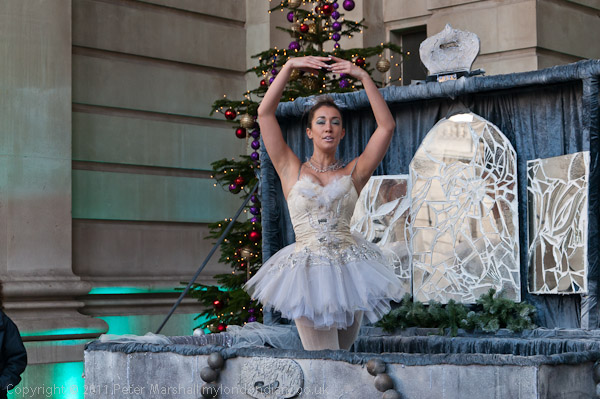
City Xmas Celebrations

I thought I’d see how the City of London was celebrating Christmas and took a few pictures of a real life Music Box in front of the Royal Exchange before going inside and being told I couldn’t take photographs. And although I’d been told there were free drinks I think they were only available for the kind of people who looked as if they would spend vast amounts on the luxury items being sold inside. I went out and walked towards St Paul’s Cathedral, pausing briefly to photograph a band and Santa who had come with a couple of reindeer who seemed rather small to me for his lengthy journey.

City Xmas Celebrations


Occupy LSX Climate Justice Workshops

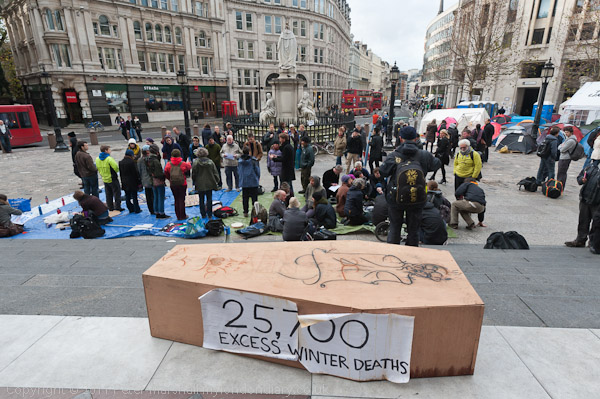
On the steps of St Paul’s Cathedral was a plain coffin with the message ‘25,700 EXCESS WINTER DEATHS’, a rather lower figure than that I photographed at last week’s Fuel Poverty Action protest – last winter the number was 63,000. Of course this can’t all be put down to 10 years of Tory austerity, and Covid will have played a part, though of course flu deaths were down.

Workshops are not generally the most exciting things to photograph, and I only took a few pictures. I left Occupy LSX shortly after they began a ‘Climate Walk of Shame’ around the offices of various climate change villians (‘unsavoury sites of climate criminality’) which began rather later than advertised to make my way to the Climate March (where they were also heading.)

Occupy LSX Climate Justice Workshops


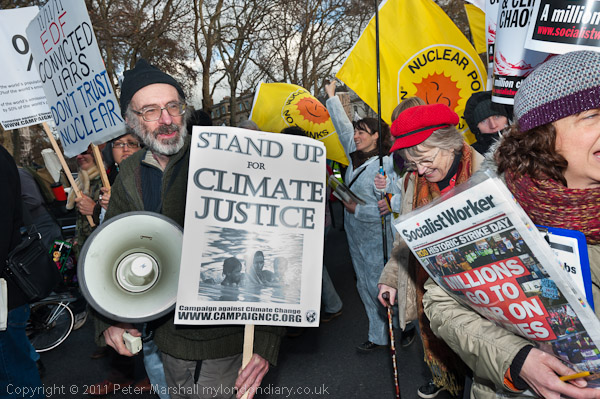
Stand Up For Climate Justice

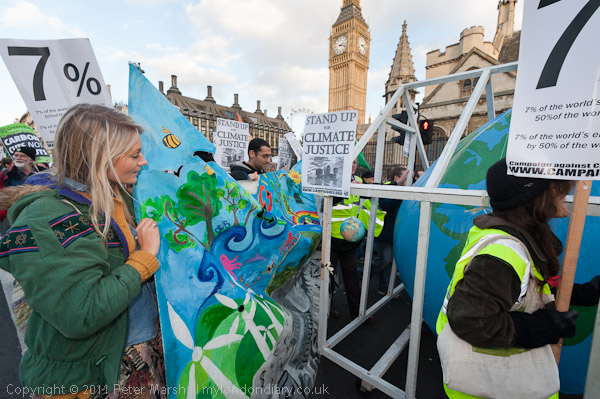
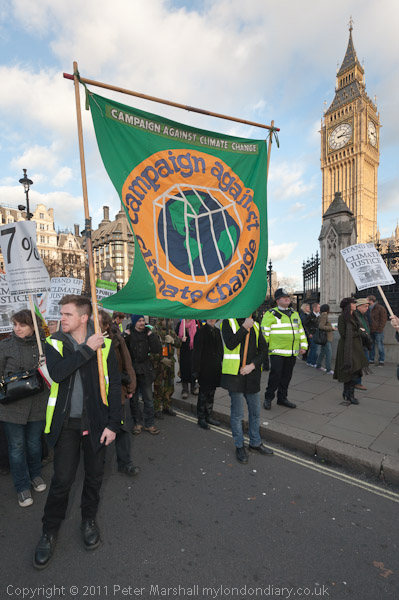
Ten years ago we had a chance to begin to disastrous climate change, but world leaders failed to lead. The protest was organised by the Campaign Against Climate Change and around a thousand people marched through London calling for Climate Justice, highlighting the fact the 7% of the world’s population cause 50% of the worlds emissions as the Durban climate talks take place. This was COP17 but by the time of COP26 in Glasgow little had changed.

Here’s a few paragraphs from the post I wrote then on My London Dairy:

The 17th UN climate change conference taking place in Durban is widely expected to lead to a breakdown in efforts to combat global climate change, as the US continues to block serious attempts to combat climate change. The continued refusal of the US to accept mandatory limits on carbon emissions seems likely to prevent any progress on global reductions in emissions, and seems certain to lead to catastrophic increases in global temperature. To put it bluntly, our planet is going to fry.

Currently predicted global temperature rises by the end of the century would lead to an environmental crisis that would be expected to lead to huge areas of the world becoming uninhabitable, and billions dying through flood, famine and and other catastrophes. Those who will die will largely be the poor who currently are responsible for only a small proportion of the emissions, while the rich and highly polluting are those who will survive.

There is no longer any serious scientific debate about the reality of climate change, just about the the exact magnitude of the effects and the timescales involved. But all informed opinion agrees that urgent action is needed. We need to make drastic cuts in carbon emissions. The most industrialised countries who have contributed most to the increase in CO2 levels over the past centuries have a particular moral obligation to make drastic cuts.

Deja-vu all over again! Though perhaps now I might have added something about Australia, China and India also heads firmly in the sand, and also about species extinction – including possibly ours.

Stand Up For Climate Justice


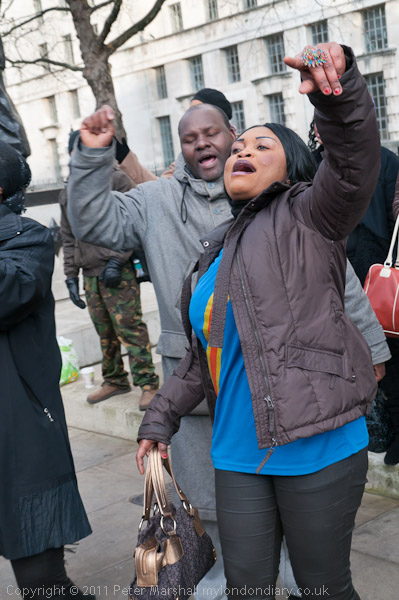
Congolese Election Protests Continue

Congolese continued their protests in London against the election fraud, rapes and massacres and called on the British government to withdraw its support from the immoral regime of President Kabila responsible for the atrocities and voted out by the people.

Congolese Protest Against Kabila Vote-Rigging


London Wandering

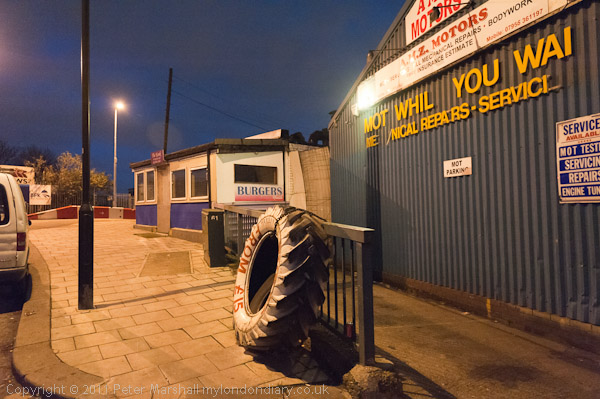
As often while walking about London between the various events I photographed I took a few pictures, including some in the city centre, and others as I made my way to and from an evening event in North Acton where a photographer friend was appearing. I’ve always meant to take more photographs of London at night, but have never got around to more than the occasional picture like the one above.

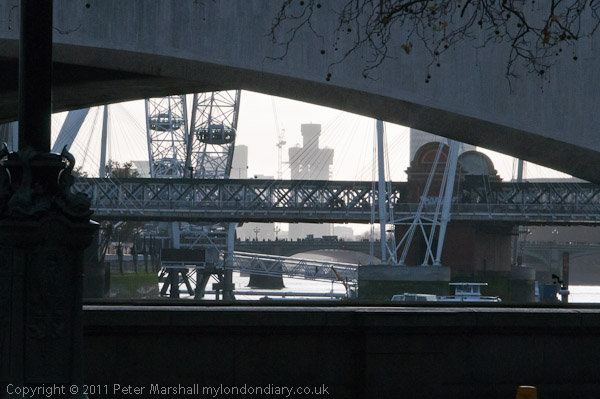
And while I’ve taken many thousands of pictures along the River Thames from its source to the estuary, it’s always good to find something just a little different as in this study of bridges.

London Wandering


Kilburn Again – 1988

St Lawrence Mansions, Priory Park Rd, Kilburn, Brent, 1998 88-6d-03-positive_2400
St Lawrence Mansions, Priory Park Rd, Kilburn, Brent, 1998 88-6d-03

I continued my walk along Kilburn High Road, photographing again some of the buildings I had photographed on my previous walk in Kilburn, and going down Priory Park Road to take a couple of pictures of St Lawrence Mansions, Victorian flats. These were used for some years by Brent Council to house homeless families, and applications by the owners to demolish them were turned down in 2012. In 2017 they were in used to house over 200 asylum seekers in desperately poor and overcrowded conditions in a hostel run by run by Clearsprings Ready Homes, a company that has been criticised in media reports about this and other asylum hostels.

Locksmiths, Willesden Lane, Kilburn, Brent, 1998 88-6d-61-positive_2400
Locksmiths, Willesden Lane, Kilburn, Brent, 1998 88-6d-61

I’ve always been interested in trade signs and liked the large keyhole of this locksmith’s,on Willesden Lane, close to its junction with Kilburn High Rd.

Willesden Lane, Kilburn High Rd, Kilburn, Brent, 1998 88-6d-62-positive_2400

Taken just a few yards closer to Kilburn High Rd, with Kilburn State Cinema tower visible. The large sign for Brondesbury Garage above Brondesbury Mews entrance has now gone, the Gentlemen’s convenience has disappeared, the billboards have gone and Biddy Mulligans is now a betting shop, but the view is still much the same.

Kilburn State, cinema, Kilburn High Rd, Brent, 1998 88-6d-63-positive_2400
Kilburn State, cinema, Kilburn High Rd, Kilburn, Brent, 1998 88-6d-63

Grade II* listing has protected the Gaumont State Theatre, a splendid art deco building withh opened in 1937, seating over 4,000. Since 2007 it has been a church and still contains one of the largest fully functioning Wurlitzer organs in Britain.

The National Club, Kilburn High Rd, Camden, 1998 88-6d-65-positive_2400
The National Club, Kilburn High Rd, Camden, 1998 88-6d-65

The National Club is another building I’ve previously photographed and written about in my post To Kilburn High Rd 1988 – and like the Kilburn State is now also a church. The boundary between Brent and Camden runs down the Kilburn High Road, with properties on the east side being in the LB Camden.

Wallace, chemists, Infected, graffiti, Netherwood St, Kilburn, Camden, 1998 88-6d-66-positive_2400
Wallace, chemists, Infected, graffiti, Netherwood St, Kilburn, Camden, 1998 88-6d-66

Wallace Manufacturing Chemists Ltd is still active according to Companies House, but no longer in Netherwood St. Its business is described as ‘Manufacture of basic pharmaceutical products’ with a registered office in Brentwood and I think is now a part of the Alinter Group based in Abingdon. Perhaps the graffitied ‘INFECTION’ was a mildly humourous comment on the closure of the premises making medicines – Histergan cream and tablets, Ironorm drops and Malarivon and Vigranon-B syrups.

Quex Rd, Kilburn, Camden, 1988 88-6d-45-positive_2400
Quex Rd, Kilburn, Camden, 1988 88-6d-45

These pictures show the doorway at 15 Quex Rd, on the corner with Mazenod Avenue, part of a set of mansions at 9-15 Quex Rd, just a few yards from Kilburn High Rd. I’ve called it Kilburn, but certainly for estate agents this is West Hampstead.

The road was built on a large estate on both sides of West End Lane which had been inherited in 1813 by John Powell Roberts following the death of his brother who fell from a horse. His brother had previously inherited this and a large house a Quex Park in Birchington, Kent under a trust following the death of his uncle, and the terms of that trust meant changing his surname to Powell, and John Powell Roberts became John Powell Powell. When he died in 1849 the various estates held by the trust passed to his nephew, Col Henry Perry Cotton.

Quex Road, named after the Powell-Cotton family seat, was at the heart of plans for the development of the estate made in 1866, which included a Roman Catholic church and Wesleyan Methodist and Unitarian chapels on Quex Rd built in 1868-9 and the street was more or less fully developed by 1885.

Eugene de Mazenod was a leading French Catholic bishop in the nineteenth century and founder of the Oblates of Mary Immaculate who became missionaries across the world and founded the Church of the Sacred Heart of Jesus in Kilburn in 1866, though their temporary building was replaced by one designed by E W Pugin and built after his death from 1875-1899.

Quex Rd, Kilburn, Camden, 1988 88-6d-46-positive_2400
Quex Rd, Kilburn, Camden, 1988 88-6d-45

Click on any image to go to a larger version in my album 1988 London Photos from where you can browse the other images in the album.


West India – North Dock 1988

The Ledger Building,  Hertsmere Rd, West India Docks, Poplar, Tower Hamlets, 1988 88-6c-52-positive_2400
The Ledger Building, Hertsmere Rd, West India Docks, Poplar, Tower Hamlets, 1988 88-6c-52

The Offices of the West India Docks an Hertsmere Rd at the west corner of what was the Import Dock of the West India Docks and were Grade I listed in 1950 together with the adjoining warehouses. They were built in 1803 , architect George Gwilt and converted to hold the dock ledgers by John Rennie, who added the portico in 1827.

In 2000 it was converted into a Wetherspoon pub, the Ledger Office and can be visited during normal opening hours and displays some information about the history of the docks which can be read while drinking a cheap pint.

Warehouses, Hertsmere Rd, West India Docks, Poplar, Tower Hamlets, 1988 88-6c-53-positive_2400
Warehouses, Hertsmere Rd, West India Docks, Poplar, Tower Hamlets, 1988 88-6c-53

These listed warehouses are now converted for various uses including the Museum of London Docklands which has both permanent and temporary displays on the history of the River Thames, the growth of Port of London and the docks historical link to the Atlantic slave trade, in which this building, a sugar warehouse, played an important role. Temporary exhibitions there have included some of my pictures including in the show ‘Estuary‘ celebrating the museum’s 10th anniversary in 2013

Warehouses, Hertsmere Rd, West India Docks, Poplar, Tower Hamlets, 1988 88-6c-55-positive_2400
Warehouses, Hertsmere Rd, West India Docks, Poplar, Tower Hamlets, 1988 88-6c-55

The area has been opened up by the removal of the dockside sheds and is now a popular tourist venue, though it has lost most of its previous allure. But it’s still an interesting area, both for the old and the new buildings.

Crane, West India Quay, Poplar, Tower Hamlets, 1988 88-6c-44-positive_2400
Crane, West India Quay, Poplar, Tower Hamlets, 1988 88-6c-44

Two dockside cranes remain on the side of the dock, close to West India Quay DLR station, perhaps left there to divert attention from a rather hideous hotel building to their north.

Bridge, West India Quay, Poplar, Tower Hamlets, 1988 88-6c-45-positive_2400

This picture taken I think from more or less underneath the DLR which goes across the North (Import) Dock gives some impression of the scale of the West India Docks , which I think when constructed in 1800-1806 were I think the largest enclosed high-security docks in the world – and a model for later docks elsewhere.

This dock now looks considerably smaller, with around half of its width taken up by a strange building on top of a new Crossrail station, looking to me rather like a woodlouse. Nothing in this picture remains except the listed dock wall at bottom left (and possibly the bollard on it.)

Bridge, West India Quay, Poplar, Tower Hamlets, 1988 88-6c-46-positive_2400

I think this bridge, built from what looks suspiciously like Meccano, was the Great Wharf Road Bridge, later replaced by what was intended as a more permanent structure as the Upper Bank Street Bridge. I can find no information about it on-line, but it appears to have a central lifting section with heavy counterweights in those four towers. That more permanent bridge was removed for the construction of the Crossrail station in 2012 and a new, much shorter bridge was built in five sections in Belgium by Hollandia and welded together in situ in, opening in 2020.

Docklands Light Railway, Poplar, Tower Hamlets, 1988 88-6c-32-positive_2400
Docklands Light Railway, Poplar, Tower Hamlets, 1988 88-6c-32

It was time to leave Docklands for home, and together with my two young assistants we got on the DLR, sitting right at the front of the train. This view from the front window as the train had just left Poplar Station and about to cross Aspen Way shows dockland cranes at left and St Anne’s Limehouse at right. Then DLR trains were single two-carriage units like the Stratford service in this picture.

This is the final part of posts here about my pictures from my walk around the docks on the Isle of Dogs in June 1988.

Click on any of the pictures to see a larger version in my album 1988 London Photos, from where you can browse the album. The pictures there are largely ordered by my negative reference numbers, which do not in detail reflect the order in which the pictures were taken used in the posts here.