NHS Privatisation, Iran & the Bologna 12: On Wednesday 8th February 2012 I photographed a mock trial of Health Minister Andrew Lansley against his disastrous Health and Social Care Bill, visited the two peace camps then in Parliament Square and finally went to the Italian Embassy for a protest calling for the release of the Bologna 12, accused of terrorism through their membership of communist organisations, much like those who support Palestine Action in the UK now.
Stop NHS Privatisation – Kill Lansley’s Bill
Old Palace Yard, Westminster
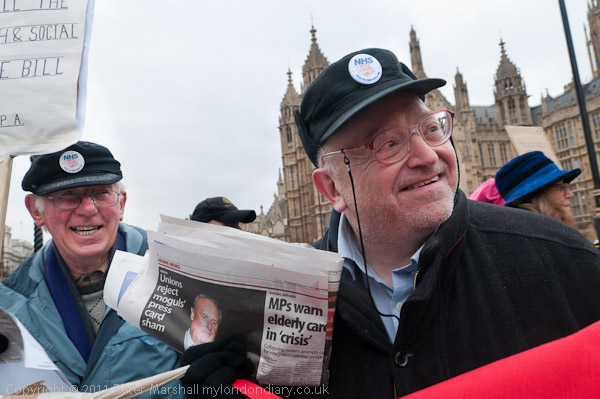
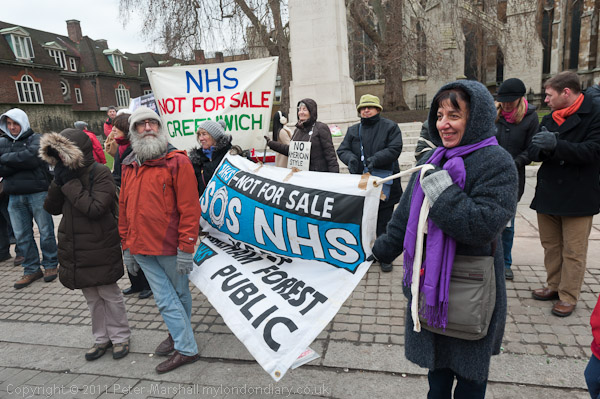
The protest, organised by Hackney Keep Our NHS Public, drew campaigners from across the country for speeches and a mock trial of Health Minister Andrew Lansley as his bill was entering into its report stage. Among those taking part – if briefly – was shadow health minister Diane Abbott MP.
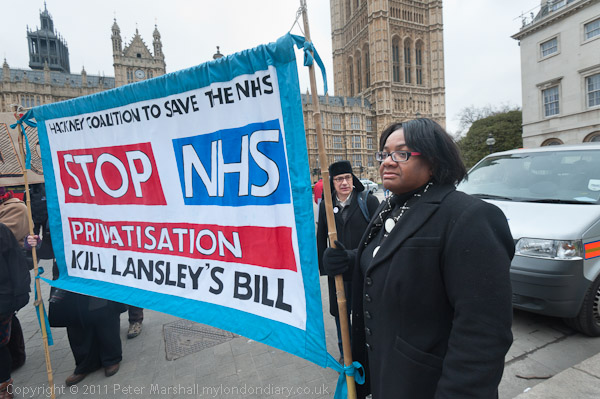
Lansley’s proposals were a clear step towards the privatisation of the NHS, still a continuing process under Labour’s Wes Streeting, despite many of the changes brought in by Lansley having been later abandoned after, according to the Darzi report commissioned by Streeting it “imprisoned more than a million NHS staff in a broken system for the best part of a decade.”
Lord Darzi’s report concluded that “The Health and Social Care Act of 2012 was a calamity without international precedent – it proved disastrous. The result of the disruption was a permanent loss of capability from the NHS“. As Streeting commented it ” led to the longest waiting times, lowest patient satisfaction, and most expensive NHS in history”, but that hasn’t stopped Streeting pursuing his own policies to further prepare the NHS and the country for its privatisation. Of course Lansley was awarded a life peerage in 2015 for his services to capitalism.
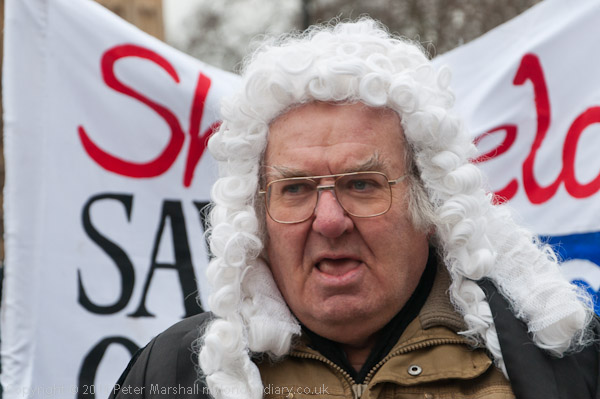
At the centre of the protest was the mock trial of Lansley with a judge with an impressive white wig and witnesses for the prosecution who spoke about their own experiences as patients and workers in the NHS.
Most still see the NHS, along with the other welfare state reforms of the period, as the greatest British achievements of the last century and for all its problems it still provides quality healthcare at a fraction of the cost of the US system which Lansley and his colleagues appeared to take as a model
Most importantly, provides services to the whole population including those who would be unable to pay expensive medical insurance. Over 60% of the two million personal bankruptcies filed each year in the US are a result of medical debt.

I don’t think there was much if any defence for Lansley, and the guilty verdict was inevitable. After the trial and a few stops a small group took the protest around Parliament Square, walking onto the various pedestrian crossings and facing the traffic holding up placards and the letters ‘S’, ‘T’, ‘O’ and ‘P’, usually but not quite always in that order and with a bed pan in the middle.
More at Stop NHS Privatisation – Kill Lansley’s Bill.
Parliament Square Peace Protests – No War in Iran
Parliament Square
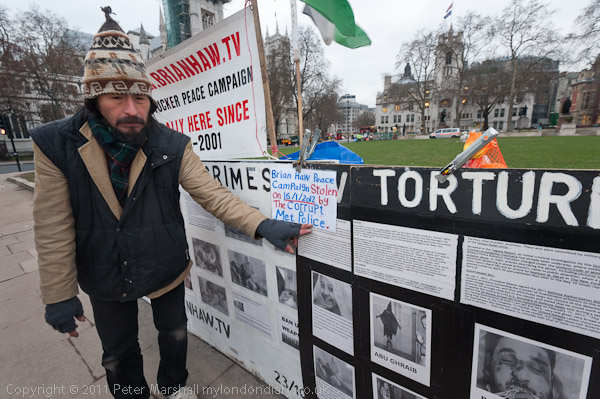
It was a cold day and I had to keep moving, walking around Parliament Square and stopping to talk with peace protesters still then protesting 24/7 in the square. Police and new laws against protest had resulted in the removal of all tents and in restricting the protests to the pavement facing Parliament, but the protests were continuing.

Brian Haw who began his Peace Campaign on 2 June 2001 had left the square on 1 January 2011 for treatment in Berlin for lung cancer, dying there on 18 June 2011. Since he left his campaign had been continued by his supporters, led by Babs Tucker, who had protested for some years with Haw. They on Day 3903 of the protest, continuing in the brutal winter weather despite police having taken away all tents, chairs and other items three weeks earlier.

Maria Gallastegui, for some years a regular supporter of Brian Haw, had broken with him and begun her separate Peace Strike in the square several years earlier. She had cooperated with the police in various ways – such as covering her displays for the 2011 royal wedding – and had been granted a temporary injunction restraining police actions agaist her; police had left her tent and her large ‘peace’ box – modelled on the old police boxes – on the square until her case was heard.

Haw’s Peace Camp had been subject to lying and of devious and underhand actions throughout the ten and a half years of their presence in the square, and they told me the police had intentionally delayed their legal action so they could take away their property before the claim came to court.

I went with the three people from the Peace Strike to the weekly protest with others opposite the Foreign and Commonwealth Office in King Charles Street to remind Foreign Secretary William Hague of their opposition to war in Iran. Their protest was continuing when I needed to leave to go to the Italian Embassy.
Parliament Square & No War in Iran
Release The Bologna 12
Italian Embassy, Grosvenor Square
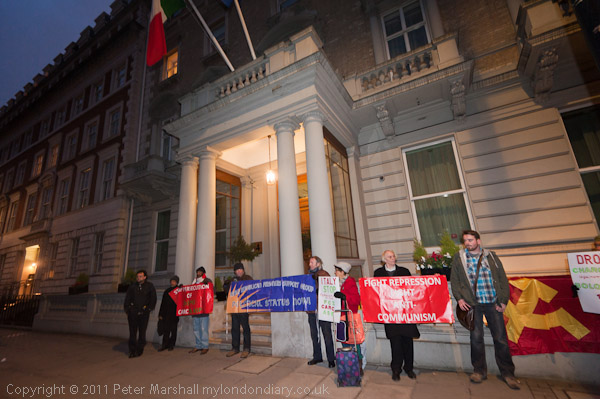
The trial which was starting in Bologna that day of the twelve was being made under section 270bis of the Penal code introduced by the Fascist regime under Mussolini. They were brought as a part of a long campaign by Public Prosecutor Paolo Giovagnoli for the Authorities of the Papal Republic, aimed against freedom of expression and organisation of the left in Italy.

The twelve were accused of “subversive association for purposes of terrorism” for their membership of communist organisations and if they were convicted, similar prosecutions would be brought against those belonging to other groups outside the official left, including anarchists, Maoists and the Occupy movement.

It was a small token protest, with representative from groups including ‘Democracy and Class War’, ‘Socialist Fight’ and ‘Irish Republican Prisoners Support Group’ and began outside the impressive door in my picture in Grosvenor Square.

But after 20 minutes police came and very helpfully told them that they were in the wrong place. This was the back door of the embassy and they should be in Kings Yard at the front door. A man came out from the embassy and confirmed this and we all walked round to the gates outside the yard, while I went inside with two people who handed in a letter.

I went home as the protest continued. More at Release The Bologna 12.
Flickr – Facebook – My London Diary – Hull Photos – Lea Valley – Paris
London’s Industrial Heritage – London Photos
All photographs on this page are copyright © Peter Marshall.
Contact me to buy prints or licence to reproduce.