The Heart of Brixton

The Heart of Brixton continues the account of my walk on Sunday 28th May 1989. The previous post was Sunlight, Trinity, Town Hall & Granada and the walk began with Lavender Hill & Wandsworth Rd – 1989.

D Bess, Bakery, Brighton Terrace, Brixton, Lambeth, 1989 89-5l-21

Was this a Caribbean bakers? D Bess, The Best Bakery. The building is still there at 12-14 Brighton Terrace, trimmed off rather more neatly at the right, modernised and used as an NHS clinic for Lambeth Drug & Alcohol Service, with an extra floor added on top.

Brighton Terrace is one of the older streets in Brixton and was present by the time of the first Skeleton Town plans surveyed by the Ordnance survey in 1848-1851 and by 1870 was lined with smallish houses on both sides, none of which have survived.

At a guess this building dates from around the start of the 20th century but I can find no information about when it was built or its occupiers before it became D Bess Bakery.

A Robson & Sons, 20-22 Brighton Terrace, Brixton, Lambeth, 1989 89-5l-22

A Robson & Sons at 20-22 Brighton Terrace tell us that they are ‘Manufacturers and Rewinders of Replacement xxxxxures Stators and Rotors’ – I think the illegible word must be Armatures, but the state of the sign suggests they were no longer in business at this address. There is still a company in the same business, Robson & Francis Rewinds Ltd, in the Vale Industrial Park in Streatham who call themselves UK Specialists in Rewind & Reconditioning Armatures, Field Coils & Motors and I wonder if this is its successor.

20-22 Brighton Terrace still bears some resemblance to this rather charming small factory building, perhaps dating from the 1930s, but is now the same height as the flats at right of the picture to which it is joined, having four floors rather than the two in my picture. But it still has the same wavy roof line.

Tunstall Hall, Carlton Hall, BrixtonLodge, Bernay's Grove, Lambeth, 1989 89-5l-23
Tunstall Hall, Carlton Hall, Brixton Lodge, Bernay’s Grove, Lambeth, 1989 89-5l-23

Tunstall Hall at the left of the picture was built around 1860 and at one time was storage for Morleys Department Store on Brixton Road, whose rear entrance is just across the street. The central building is Carlton Hall – Bernay’s Grove was originally called Carlton Grove but renamed before 1912. All these buildings apparently became an engineering works in the mid-20th century.

The house at right, 1 Bernays Grove dates from the 1820s and is Grade II listed. It was one of the villas which then lined Brixton Road, set back from it with long front gardens, later built over.

Carlton Hall and No 1 was in 1889 the Carlton Club, the hall used for religious services only, and from 1905 to 1909 Brixton Synagogue. In 1989 it was a Carlton Hall Community Centre. Tunstall Hall is now an architects studio.

The Railway Hotel, Brixton Station, Atlantic Rd, Brixton, Lambeth, 1989 89-5l-25

The London, Chatham and Dover Railway opened Brixton and South Stockwell Station in 1862 taking commuters from what was then a fairly affluent suburb to Victoria, with a further line to Blackfriars opening in 1864. The population of Brixton rapidly expanded. Atlantic Road was laid out in the late 1860s following the railway viaduct and many smaller properties soon appeared. But wealthier residents in the villas along Brixton Road moved out and shops and commercial premises were rapidly built in their place covering their long front gardens.

The Railway Hotel, Electric Avenue, Atlantic Rd, Brixton, Lambeth, 1989 89-5l-26
The Railway Hotel, Brixton Station, Atlantic Rd, Brixton, Lambeth, 1989 89-5l-25

The Railway Hotel has a conveniently located plaque bearing the date 1880 it was built in a finely ornamented neo-Gothic style surmounted by an octagonal clocktower. What can’t be read on my picture is the text underneath the date, LAID BY ANNIE ALLEN, who was its first licensee.

Still the Railway Hotel when I took these pictures, it was renamed Brady’s Bar in the 1990s and became an important music venue, played by Jimi Hendrix, The Clash as well as more local bands such as Alabama 3.

The pub closed in 1999 and was squatted and vandalised. Lambeth Council compulsorily purchased the building, but resisted various local campaigns to turn it into a community asset, selling it off to the highest bidder in 2013. The top floors were converted to flats and the ground floor became a Mexican restuarant, which closed in 2020. It reopened later as DF Tacos. The whole area is under threat from a comprehensive development scheme.

Stairway, Brixton Station, Atlantic Rd, Brixton, Lambeth, 1989 89-5l-13-Edit

I think these old wooden stairs have now been replaced by metal, but I can’t work out exactly where I was standing. They go up to platform level and going above the platforms is the line leading towards Denmark Hill which now carries the Overground but has no stop at Brixton. There used to be an East Brixton station on that line but about a quarter of a mile further on, at Barrington Road, but this closed in 1976.

Brixton’s British Rail stations became less important after the opening of the Victoria Line to Brixton in 1971.

89-5l-14-Edit
Shops, Electric Avenue, Brixton, Lambeth, 1989 89-5l-14

Back in 1989 there was virtually no Sunday trading before the Sunday Trading Act 1994 and I took the opportunity to photograph the normally bustling market street of Electric Avenue when it was almost empty.

This was one of London’s most elegant shopping streets when it was first built in 1885-8 and it was one of the first market streets to be lit by electricity. And around 1890 canopies were erected along both sides of the street so that shoppers could keep dry if it rained.

In 1989 I was surprised to see that these canopies had been removed, perhaps to give more space for the street market. The council I think blamed wartime damage, but it seemed a very thin excuse when they had continued to stand for over 40 years. The street has since been further damaged by partial redevelopment, and more is likely.

Brixton Station, Atlantic Rd, Brixton, Lambeth, 1989 89-5l-15

These huge pillars carry the railway line over the top of Brixton Station. Behind is one of the railway arches which for years were home to many small businesses that served the area well. In 2015 Network Rail decided to close and refurbish the arches over a year – and any traders that wanted to return would be faced with a 350% increase in rents.

The Save Brixton Arches Campaign was set up to oppose the changes, organising a number of public protests which had very wide popular support in the area. Despite this Lambeth Council decided to go ahead with Network Rail and most of the traders went out of business.

Many of the arches have now re-opened, but not with the useful and down-to-earth shops that people in Brixton had used for years, providing useful goods cheaply. When I last walked along Atlantic Road and Brixton Station Road many were still empty. Brixton has lost a large chunk of its heart.

And it was here at the centre of Brixton that the photographs from my walk on 28th June 1989 ended, though I think I will have walked back to Acre Lane to catch my bus back to Clapham Junction.


Sunlight, Trinity, Town Hall & Granada

Sunlight, Trinity, Town Hall & Granada continues the account of my walk on Sunday 28th May 1989. The previous post was The Alexandra, Sanitary Ware & Ace and the walk began with Lavender Hill & Wandsworth Rd – 1989.

Sunlight Laundry, 125 Acre Lane, Brixton, Lambeth, 1989 89-5l-43
Sunlight Laundry, 125, Acre Lane, Brixton, Lambeth, 1989 89-5l-43

Built 1937, architect F E Simpkins Sunlight Laundry is a fine example of Art Deco ‘moderne’ style which unfortunately some architectural historians have turned up their noses at – perhaps why this building and some others are unlisted. Clearly this should be.

The Sunlight company was founded in 1900 and expanded with branches across London and after a merger in 1928 became a national business. Until the 1960s much of its work was for middle class domestic homes, but the wider ownership of washing machines shrunk the market and it concentrated on hotels, factories and other commercial clients. Later it also became a major contractor to hospitals.

Sunlight Laundry, 125 Acre Lane, Brixton, Lambeth, 1989 89-5l-46

There are another three pictures of this building online (click on one of these images to go to the album to see them), and I’ve also photographed it on other occasions when passing, though usually I’ve gone past on a 37 bus and not stopped.

Sunlight became part of the Danish Berendsen group and in 2013 changed its name to reflect this. It continues in business internationally and in the UK is the leading company in textile and laundry services to the hospitality and healthcare sectors. The company was acquired in 2017 by the French laundry services group Elis, whose name and logo now label its frontage.

Trinity Homes, Almshouses,  28, Acre Lane, Brixton, Lambeth, 1989 89-5l-33
Trinity Homes, Almshouses, 28, Acre Lane, Brixton, Lambeth, 1989 89-5l-33

Trinity Homes is a Christian Charity which provides accommodation to both single and married couples over the age of 57 who are members of a Christian denomination. As it states on its frontage it was erected in 1822-4 and was built and Endowed by Thomas Bailey. Additional homes were added in 1860. Initially it was The Trinity Asylum for Aged Persons. The building is Grade II listed.

Bailey was a cut-glass manufacture in the City of London and lived in Bethal House on Trent Road in Brixton Hill behind Corpus Christi Catholic church, built on land given by Bailey. His house, built in 1768, became part of the RC primary school built on the site in 1902 but has since been demolished.

Lambeth Assembly Hall, Buckner Rd, Acre Lane, Brixton, Lambeth, 1989 89-5l-34

The Assembly Hall is at the west end of the Town Hall complex and this striking sculpture relieves a huge plain brick wall area. This rather plain building is covered by the Grade II listing of Lambeth Town Hall and I think dates from 1935-8 when the Town Hall was raised and extended. The striking sculpture on what the listing text calls a particularly handsome rear elevation is ‘Youth rising from the Past‘, by Denis Dunlop (1892–1959).

Lambeth Town Hall, Acre Lane, Brixton 89-5l-35-Edit

Lambeth Town Hall seen from Acre Lane, though my more usual views of it have been either from Windrush Square or in close-up from the bus stop on the opposite side of the road during those long waits for a No 37 bus.

I’m not a great fan of the rather pompous clock tower of this Grade II listed town hall designed by Septimus Warwick and H Austen Hall and built in 1905-8. Edwardian Baroque always seems to me a period where architecture lost its way and was given excessive funding thanks to our plundering the wealth of the Empire.

Granada Brixton, Brighton Terrace, Bernay's Grove, Brixton, Lambeth, 1989 89-5l-36
Granada Brixton, Brighton Terrace, Bernay’s Grove, Brixton, Lambeth, 1989

Opened in 1898 as the Empress Theatre, designed by Wylson & Long, it was reconstructed in Art Deco style by Andrew Mather, reopening in 1931 as the New Empress Theatre. It showed films on Sundays when live performances were not allowed. It closed as a theatre in 1957 and after alterations opened a month later as a cinema. Granada Brixton became a Bingo Club in 1967 and when this closed was used as a furniture store. It was demolished in 1992 and the rather ugly Pavilion Mansions built on the site.

This walk continues along Brighton Terrace in a later post.


The Alexandra, Sanitary Ware & Ace

The Alexandra, Sanitary Ware & Ace continues the account of my walk on Sunday 28th May 1989. The previous post was http://re-photo.co.uk/?p=15138 Shops, Flats, Trade Unions, Monks… and the walk began with http://re-photo.co.uk/?p=15080 Lavender Hill & Wandsworth Rd – 1989

Shops, The Alexandra, pub, Clapham Common Southside, Clapham, Lambeth, 1989 89-5k-25

The Alex is one of the best known pubs in the area and upstairs is the Clapham Darts Club, open to non-members where you can book an oche, though at £20 an hour you might think it a bit steep. I’ve never played darts in a pub where you had to pay, but then its probably 50 years since I’ve played pub darts. Then you paid by buying beer.

Its a pub too that is best avoided on match nights and at weekends unless you want to watch sport. The pub dates from 1866, though has sadly lost a much of its Victorian interior features.

6 Haselrigge Rd, Clapham, Lambeth, 1989 89-5k-15

I can’t remember what route I took from Clapham Park Road to Bedford Rd, probably cutting through some of the estates but not stopping to take photographs. But this house is visible from Bedford Road and drew me down to make this pictures. It was certainly the slender spire which attracted my attention. Built in 1871 it also has an observatory and apparently a matching coach house behind. Long converted into flats, this locally listed house I feel must have more of a story to tell than I’ve been able to unearth.

Haselrigge Road gets its name from one of the oldest well-connected families in England, which dates back before the Norman invasion and are said to have been the lords of the manor on the now lost West Yorkshire village of Hesselgreave. Bartholomew Clerke lord of the manor of Clapham who died in 1589 and his wife, Eleanor Haselrigge, and their son are commemorated in figures on a monument in St Paul’s Church Clapham.

63, Bedford Rd, Brixton, Lambeth, 1989 89-5k-16

53-63 Bedford Road were Grade II listed in 1981, the listing reads in part “Circa 1870, in stock brick with creamy terra-cotta dressings, built by J G Jennings as part of a larger scheme of houses of varying size and quality, to the designs of T Collcutt.” Josiah George Jennings was a noted sanitary engineer.”

Thomas Edward Collcutt (1840-1924) was an important English architect, better known for designing the Wigmore Hall, Savoy Hotel, Palace Theatre and more. This house at 63 is on the corner with Ferndale Road which now has its very own Conservation Area which provided me with much of the information below.

Rathcoole House, Ferndale Rd, Bedford Rd, Brixton, Lambeth, 1989 89-5l-63

Rathcoole house, Grade II listed in 1981, was the main and final house of a scheme designed by T E Colcutt and built by Josiah George Jennings. Remarkably this house was derelict and had been scheduled for demolition in 1966 but was rented from the GLC as a hostel for vagrant alcoholics and decorated and fully furnished mainly by the efforts of voluntary organisations. A decorated sign on the side has the initials JG, the street name and date 1882.

Rathcoole House, Ferndale Rd, Bedford Rd, Brixton, Lambeth, 1989 89-5l-64

The house is on the corner with Ferndale Road which has its on Conservation Area. Lambeth Council’s document on this gives more detail of George Jenning (1810-1882) who set up a company in Paris Street Lambeth making sanitary ware, “patenting revolutionary improvements to
toilets
.”

His ‘Monkey Closets’ installed at the Crystal Palace in Hyde Park in 1851 were the world’s first public toilets – and for a penny clients “received a clean seat, a towel, a comb and shoe shine“. Ever since we have been going to spend a penny even if that now costs 50p and comes without most of the original accompaniments.

Jennings set up the South Western Pottery in Parkstone, near Poole in Dorset to produce sanitary products from the local clays, later expanding to “bricks, chimney post and architectural terracotta” all in a pale creamy colour. He developed other areas of south London including around Nightingale Lane in Clapham.

Jennings began building Ferndale Road in 1870 and only completed the scheme the year he died in a traffic accident. The completion is commemorated on the side of Rathcoole House which had been one of the earlier houses to be built.

House, Bedford Rd area, Clapham, Lambeth, 1989 89-5l-51

Not all houses in the area were built to the same standards as those by Jennings. I think this small building was probably at the front of some works behind whose corrugated iron roof is visible at left. I’m no longer sure exactly where on Bedford Road it was, but somewhere on the west side quite close to the railway bridge.

Ace, Shop, Bedford Rd, Clapham, Lambeth, 1989 89-5l-52

Another rather basic building a little to the north of the railway bridge at 16 Bedford Road and surprisingly still there, now a minicab office. Ace had a rather wider scope, offering driving lessons and also selling and exchanging books – some of which you can see on the shelves through the window.

I took a second picture without the woman walking past who is reflected in the window, but I think this is better.

I turned around and walked back down Bedford Road to Acre Lane where my account of this walk will continue in a later post.


Reparations, North Woolwich & LouLou’s

Reparations, North Woolwich & LouLou’s: Thursday 1st August 2019 was a long and busy day for me with an Afrikan Emancipation Day protest, finishing a walk in North Woolwich I’d begun six months earlier and photographing an evening protest outside the exclusive Mayfair club LouLou’s.


Afrikans demand reparations – Brixton, London.

Afrikans demand Reparations, North Woolwich & LouLou's

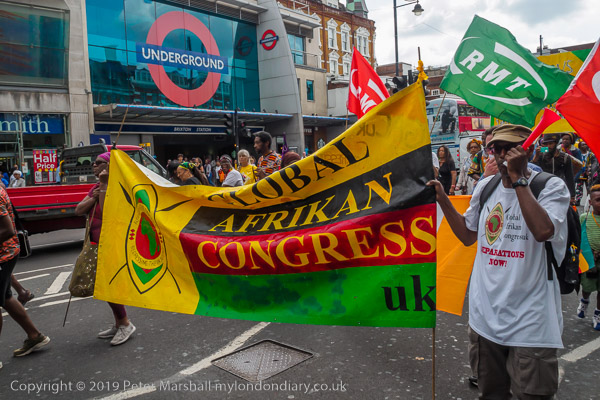
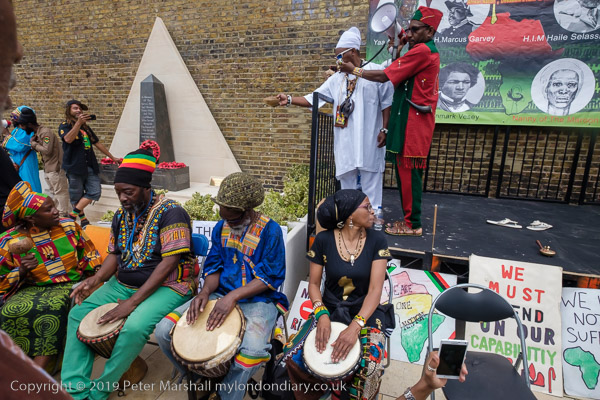
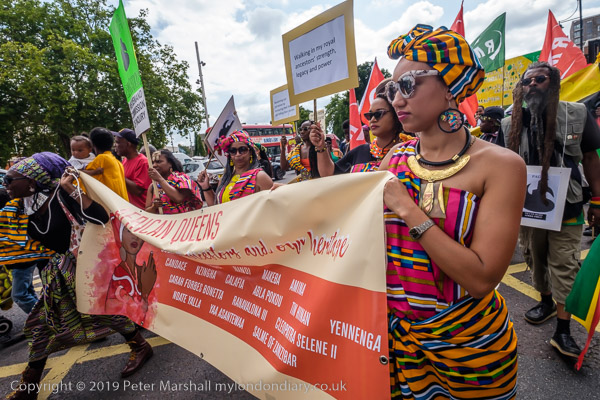
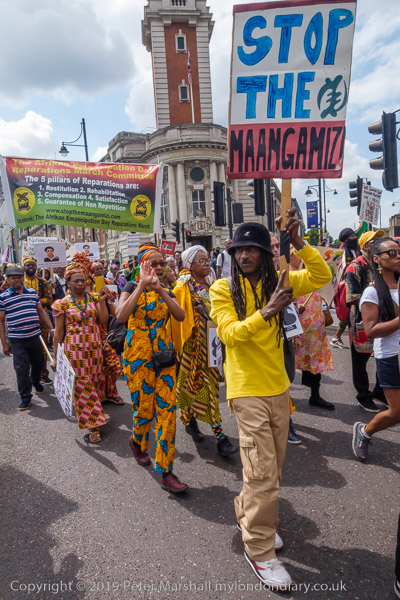
People of African origin met in Windrush Square in the morning to demand an end of the Maangamizi, the continuing genocide and ecocide of African peoples and Africa on Afrikan Emancipation Day.

Afrikans demand Reparations, North Woolwich & LouLou's

After speeches & libations they marched from Brixton to Westminster with a petition calling for an end to acts of violence by Britain, the misuse of taxes and the stolen legacy plundered from Afrika under the British Empire and European Imperialism and demanding reparations.

Afrikans demand Reparations, North Woolwich & LouLou's

The protest was supported by Extinction Rebellion XR Connecting Communities who marched in an Ubuntu Non-Afrikan Allies bloc.

Afrikans demand Reparations, North Woolwich & LouLou's

I left the march as it went past Brixton Police Station on its way to protest outside the Houses of Parliament so I could have some lunch before going to take pictures elsewhere.

Many more pictures on My London Diary at Afrikans demand reparations.


DLR – Bank to North Woolwich

DLR HQ at Poplar

I’d taken the tube back into central London to have a quick lunch before taking the DLR from Bank to London City to King George V Dock station for the final section of the walk I had begun in February but had run out of time to finish because I’d had to take a roundabout route to get there as the direct DLR services were suspended following an accident.

Bow Creek

This time the trains were running properly. They start from Bank and so come into the station empty and I was able to chose my seat and for once I found myself sitting next to a clean window on my way to North Woolwich and took a number of pictures.

Tate & Lyle

Later on my way back to Canary Wharf from King George V I was less lucky and the windows were rather grimy, but I still made a few images.

More at DLR – Bank to London City Airport.


North Woolwich, Royal Docks & the Thames

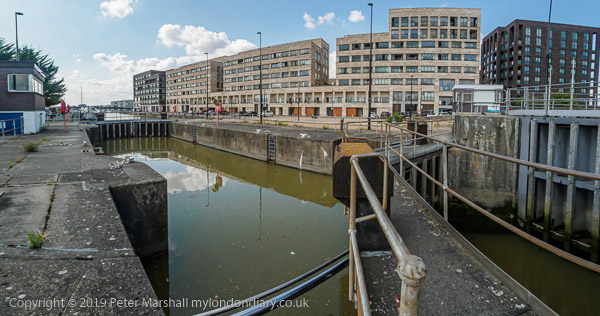
The footpath goes across these gates of the entrance lock to Albert Dock Basin

I took a few pictures as I walked from the elevated King George V station at North Woolwich to the King George V Dock entrance and joined the path by the river.

The lock here is huge, 243.8m long and 30.48m wide. I’d first photographed the area back in the 1980s as a part of a wider project on the Docklands following their closure, both in colour but mainly in black and white – in the album 1984 London Photographs. Although the docks themselves remain, much around them has changed, although there are still some derelict areas.

The riverside path here is part of the Capital Ring, and continues north and over lock at the Albert Dock entrance to the curiously desolate Armada Green Recreation Area.

Here the path ends, with beyond it the former site of the Beckton Gas Works, used as a location for at least 17 films and TV series since its closure, though best known as a stand-in for Vietnam in the 1987 Full Metal Jacket. Past that is the Beckton Sewage Treatment Works, set up in 1864 as part of Joseph Bazalgette’s scheme to treat London’s sewage and still receiving it from all of London north of the Thames.

I had to turn inland, through more recent development and the refurbished Gallions Hotel around Alber Dock Basin. I went briefly under the new bridge to see again the East London University student residences, then went back and across it, taking more pictures from the bridge and the road on my way back to King George V station.

Many more pictures at North Woolwich Royal Docks & Thames.


LouLou’s stop exploiting your workers – Mayfair

Finally I joined the IWGB Cleaners and Facilities Branch outside the exclusive Mayfair private club LouLou’s where they were picketing and protesting for kitchen porters to be paid a living wage, be treated with dignity, respect and given decent terms and conditions including proper sick pay, holidays and pension contributions. Recently outsourced to ACT, porters want to be returned to direct employment.

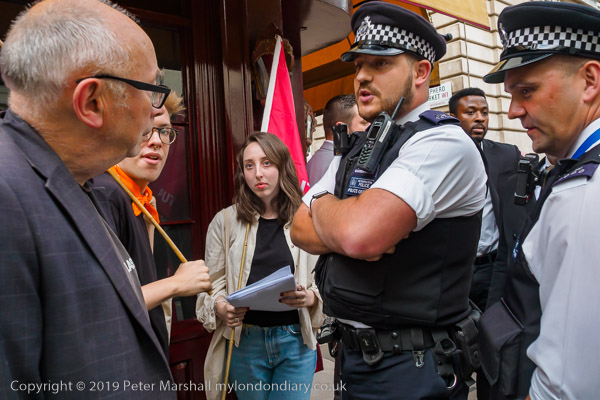
Among those supporting them were Class War, and in the picture above Ian Bone confronts a police office asking why they protect and support the rich. Needless to say the officer had no answer to the question. In general the protesters were reasonably behaved and acting within the law, but police and security hired by the club worked together to try and prevent their protest being effective.

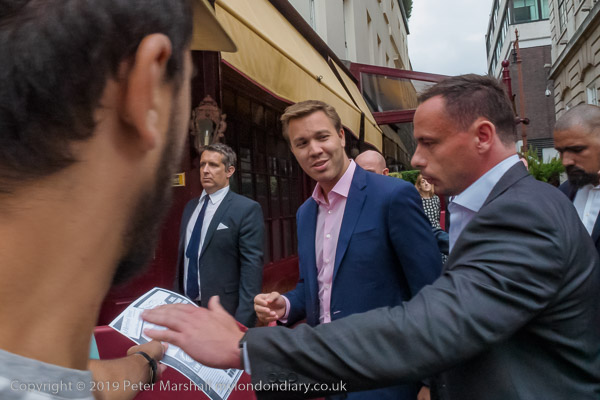
There were angry scenes as staff escorted wealthy clients of the £1800 a year club past the picket, particularly when some roughly pushed the protesters. Police repeatedly warned the protesters but not the security men or customers who had assaulted them. The security also tried to prevent the picket from handing their flier to the customers.

As at previous protests outside of the club, none of the security staff were wearing the visible SIA door supervisor licences required under the Private Security Industry Act 2001, but the police refused to take any action over this.

More pictures at LouLou’s stop exploiting your workers.


Ghost Sign, Cooltan and a Cinema

The final episode in in the series of posts on my walk in south London on Sunday 6th May 1989. The walk began with Hanover, Belgrave, Chapel, Shops, Taxis. The previous post was Railton Road, Herne Hill.

Ghost Sign, S.Errington, Dulwich Road, Brixton, Lambeth, 1989 89-5f-41
Ghost Sign, S.Errington, Dulwich Road, Herne Hill, Lambeth, 1989 89-5f-41

I turned into Dulwich Road and walked up it towards Brixton, stopping to make very few pictures, perhaps keen to get to the end of the walk. Just before reaching Water Lane on the side of what was then Ellis Newsagents at 1a Dulwich Road I couldn’t resist the finely painted sign ‘
S Cooltan
ERRINGTON
DEALER IN
ANTIQUE
&
MODERN

FURNITURE

FURNITURE
BOUGHT
SOLD OR

in drop capitals, decorated with some fine curly bits. Clearly something at the bottom following the ‘OR’ had been painted over, but I couldn’t decide what it might have been. Perhaps ‘EXCHANGED’ or ‘HIRED’?

The property now looks to be residential, but on Google Maps it still appears as:
S Errington Dealer In Antique & Modern Furniture
Home Furniture Shop
Temporarily closed

and that sign is still there, rather more faded and with the lettering now looking very much plainer. Unfortunately although I will have had a camera body with colour film in my bag I did’t photograph this in colour. Some days I only thought in black and white.

CoolTan Suntan Lotion factory, Effra Rd, Brixton, Lambeth, 1989  89-5f-44
CoolTan, Suntan Lotion factory, Effra Rd, Brixton, Lambeth, 1989 89-5f-44

I walked along Brixton Water Lane, taking a couple of pictures (not digitised) on my way to Effra Road. The the names suggest I was following the route of the River Effra, underground since the early nineteenth century, but in fact I had been doing so all the way down from Herne Hill and was now walking away from it. Effra Road got its name from Effra Farm which was on the bank of the river.

CoolTan Suntan Lotion factory, Effra Rd, Brixton, Lambeth, 1989  89-5f-33
CoolTan Suntan Lotion factory, Effra Rd, Brixton, Lambeth, 1989 89-5f-33

The former Suntan lotion factory was squatted and in June 1991 became the CoolTan Arts Centre. They were evicted in February 1992, and the centre moved first to offices above Brixton Cycles before squatting the former Unemployment Benefit Offices in Coldharbour Lane. There it became a thriving art space, with a cafe, live music and offices for various campaign groups including Reclaim the Streets, Earth First! and the Green Party until 1995, when the building was taken over by The Voice newspaper – who boarded it up and left it empty and rotting. The Effra Road factory was demolished shortly after their eviction and remained as empty unused ground for over ten years.

CoolTan Suntan Lotion factory, Effra Rd, Brixton, Lambeth, 1989  89-5f-34
CoolTan Suntan Lotion factory, Effra Rd, Brixton, Lambeth, 1989 89-5f-34

But Cooltan Arts continued. From 1993-2016 Michelle Baharier was, as she writes in her statement on the South London Women Artists site, “Founder, Artistic Director and CEO of CoolTan Arts, London. In twenty-five years, I grew CoolTan Arts from an old suntan lotion factory squatted social centre in Brixton to a user-led disabled people’s arts and mental health charity. CoolTan Arts worked with over three thousand people face-to-face per year with its participatory art programme. The charity improved the lives of individuals with mental distress through creativity, self-advocacy, and volunteer opportunities within the arts. During my tenure at CoolTan I developed psycho-geography walks and other collaborative events with different communities.”

CoolTan Suntan Lotion factory, Effra Rd, Brixton, Lambeth, 1989  89-5f-35
CoolTan Suntan Lotion factory, Effra Rd, Brixton, Lambeth, 1989 89-5f-35

Clearly I was intrigued by this empty 1930s moderne factory and by its gates and their shadows. Unfortunately the gates were locked and although the fence was fairly low the location seemed a little public for me to climb over and explore the site further though it was more decorative than a real barrier. Eventually I managed to tear myself away and continue my walk, taking a few pictures not online as I walked past St Matthews Church and on to Brixton Hill.

Former Cinema, 101-3 Brixton Hill, Brixton, Lambeth, 1989 89-5f-24

The Tarpaulin & Ten Mfg Co, T&T was for many years in the former cinema, which was converted from shops and opened on 10th March 1911 as Brixton Hill Cinematograph Theatre, and was 13th of Montagu A. Pyke’s chain of Cinematograph Theatres. Pyke went out of business when he was jailed after his projectionist in his cinema died in a fire in 1914, and the cinema was taken over by others. It changed its name then and several other times over the years, operating under names including ‘New Royalty’, ‘New Royalty Kinema’ and finally the Clifton.

It showed its last film in 1957 and deteriorated badly before becoming the T&T shop. I think this kept going into this century and the building was up for sale in 2004 and became the Dalxiis Somalian restaurant. By 2008 the auditorium had been demolished and the front of the cinema had become the South Beach Bar, which lost its licence in 2012. In 2015-6 it was ‘Believers Home Chapel’ , in 2018 the S.G.H Events Hall and in 2019 the TAMI Gospel Centre of The Anointed Ministry International, though still with the South Beach Bar sign on that metal structure, empty in my picture at roof level that had once carried the The New Royalty Kinema and Camping Centre signs.

Post Office Building, Blenheim  Gardens, Brixton, Lambeth, 1989 89-5f-11
Post Office Building, Blenheim Gardens, Brixton, Lambeth, 1989 89-5f-11

I went down Blenheim Gardens, photographing this building, dating from 1891 and still in use by the Royal Mail as Brixton Delivery Office, and the windmill, before walking through the back streets between Brixton Hill and Tulse Hill on a roundabout way to Brixton Water Lane to catch a bus on my way home at the end of my long walk.


Loughborough Estate, Angell Town & a Garage – 1989

The fourth post on my walk in Kennington and Brixton on Sunday 6th May 1989. The posts began with Hanover, Belgrave, Chapel, Shops, Taxis. The previous post was Brixton Road and Angell Town -1989

Loughborough Estate, Flats, Loughborough Rd, Brixton, Lambeth, 1989 89-5d-44

I’m not sure which of the nine eleven-story slab blocks on the estate is shown in my picture; the estate was and remains a rather confusing area. Possibly this is Leicester House on Loughborough Road, or more likely Harpur House on Angell Road where I think I walked to next, but the lower buildings in front of the block appear to have gone.

The sign ‘NO HATS’ is not a reference to any headgear but to Housing Action Trusts, an important part of Margaret Thatcher’s marginalisation of local authorities. Having ochestrated the run-down of council estates by earlier restrictions on council spending and the right to buy schemes, the Housing Act 1988 aimed to transfer these estates to non-departmental public bodies which were to redevelop or renovate them so they could be transferred into private ownership.

Opposition to HATs was intense, with the Labour Part, local authorities and estate residents all fighting their imposition, and the first six areas intended to becom HATs managed to avoid implementation, though later six were formed, but none in south London.

Lunch Club, Loughborough Estate, Angell Rd, Brixton, Lambeth, 1989 89-5d-45

I think this rather temporary-looking building as on Angell Road close to Harpur House, but no sign of it remains. I photographed it largely for the posters showing opposition to Housing Action Trusts in Broxton.

As well as a Luncheon Club for pensioners it also has a sign for the Loughborough Sports & Social Club.

Fence, St John the Evangelist, Angell Park Gardens Angell Town, Lambeth, 1989 89-5d-32
Fence, St John the Evangelist, Angell Park Gardens, Angell Town, Lambeth, 1989 89-5d-32

Further along Angell Road – named like the area after the Angell family who had owned large parts of the Lambeth and developed this area in the 1850s. In 1852 Benedict John Angell gave a site here for the building of St John the Evangelist Church which was consecrated in 1853. Unfortunately trees along the edge of the site along Angell Road and Angell Park Gardens had too many leaves in May to clearly see the church.

These paintings on the fence around the church are still visible but rather faded. I took a few pictures of them both in black and white and in colour before walking on past the church and across Wiltshire Road into Villa Road and back onto Brixton Road, where I photographed the rather austere Our Lady of the Rosary Catholic Church (not yet digitised.)

Abeng Youth Community Centre, Gresham Rd, Brixton, Lambeth, 1989 89-5d-22

I walked on down Brixton Road to the Police Station where I turned back east along Gresham Road, stopping to photograph what looked to me to be a former chapel. In 1877 this was the Angell Town Institution and later became Brixtons first telephone exchange.

In the 1970s the Rev Tony Ottey founded the Abeng Centre here to provide supplementary education and youth services to the local children. In 2003 it was relaunched with new management as the Karibu Centre, its Swahili name Karibu meaning welcome, with similar aims. It is also hired for weddings, funerals, birthdays and business meetings.

Wyck Gardens, Loughborough Estate, Millbrook Rd, Brixton, Lambeth, 1989 89-5d-24

Soon I was walking through the Loughborough Estate again, going along Millbrook Road and through Wyck Gardens, a public open space which is thought to be the remnant of a larger wood knwon as Wickwood in the Manor of Lambeth Wick which had been cleared by the end of the 17th century.

The land had belonged to the Archbishops of Canterbury and was bought by the London County Council from the Church Commissioners for a new public open space, opened in 1959 and since extended and improved. You can see more pictures from the park on Brixton Buzz.

I think the large block here is Barrington Court, the first of three I walked past on my way through the park towards Loughborough Junction.

Garage, Railway Arch, Ridgway Rd, Loughborough Jct, Lambeth, 1989 89-5d-25

I left the park and walked along Ridgeway Rd, beside the railway line from Brixton which curves around to a junction just north of Loughborough Junction Station. The next station on this line is at Elephant & Castle.

Some extensive work seems to be in progress on what I am reliably informed (thanks to comments on Flickr) is a Ford Escort, while inside the garage a Renault 4 and a Rover P5 await their turn.

Arch 500 was empty for some years but later became home to the very Brixton Buzwakk Records Recording Studio a few years ago. The arches on both sides are still garages.

More about this walk in May 1989 in a later post.


Brixton Road and Angell Town -1989

The third post on my walk in Kennington and Brixton on Sunday 6th May 1989. The posts began with Hanover, Belgrave, Chapel, Shops, Taxis. The previous post was On the Road to Brixton.

House, Brixton Rd, Brixton, Lambeth, 1989 89-5d-62

No 326, with two doors above each other with steps to the upper door with a balustrade. Many of the houses along here date from the first development along the road and are good examples of early-mid 19th century houses and most have some intresting features but are perhaps not distinctive enough to deserve listing.

The house now looks much the same as when I photographed it. I suspect this unusual arrangement with steps up to the front door was how this house was built. While many houses from the period have basement flats, this appears to have been built with its ground floor rather higher, perhaps becuase of the risk of flooding from the River Effra. But if so, why was a similar approach not used for neighbouring houses?

J & P Motors, Thornton St, Stockwell, Lambeth, 1989 89-5d-63

I walked a little back up Brixton Road to Thornton Street, though too much has changed for me to positively identify the exact location of J & P Motors on this fairly short L-shaped street. I think it was probably on the north side of the bottom of the L behind what is now the worker’s co-operative, Brixton Cycles.

There was a splendid utilitarian simplicity of this building which appealed to me, and which I enhanced with its symmetrical gates and No parking signs.

Evereds, Brixton Rd, Brixton, Lambeth, 1989 89-5d-66

Back on Brixton Road, Evereds Bathrooms had its showroom in two shops at 308-10 Brixton Rd. The buildings here are still standing but no longer in use as a shop. For some years since 2011 the Victorian shopfront built as a house agents in 1879 has been in use as an art gallery, SHARP Gallery (Social, Hope and Recovery Project) which has shown the work of over 120 artists, many of whom use mental health services and is supported by the South London and Maudsley NHS Trust. Both the early nineteent century house and these shops are Grade II listed, along with 312.

Eagle Printing Works, Brixton Rd, Brixton, Lambeth, 1989 89-5d-51

Both buildings at 304 and 306 Brixton Road have survived, but in 2013 planning permission was granted for changes to the Eagle Printing Works, and the fine semi-circular panel including the building date of 1864 and its wrought-iron decoration was removed – a piece of vandalism that should never have been approved.

Apparently the printing works a few years later became a sub district Post, Money Order and Telegraph Office, and it was from here that Sherlock Holmes sent his first telegram.

Loughborough Hotel, Evandale Rd, Brixton, Lambeth, 1989 89-5d-52

I turned off the Brixton Road where I had spent some time wandering back and forth and struck off to the east along Loughborough Road. The first picture I took was of the Loughborough Hotel, described in more detail on a previous walk, a well known music venue, closed in 2008 and has been converted into flats, with a café gallery on the ground floor.

Lilford Rd, Minet Rd, Camberwell, Lambeth, 1989 89-5d-54

From Fiveways I continued along Lilford Road, again stopping to re-take the impressive porch on its corner with Minett Road, also featured in a previous post. I chose a very similar viewpoint but the lighting was quite different as it had been overcast for the earlier image.

I can’t remember why I made the detour, though possibly it was just the sheer pleasure of seeing an area with so many fine buildings again. Or it could have been to find a pleasant place to sit and eat my lunch, as I walked as far as Myatts Fields before returning to Loughborough Rd.

Elmore House, Loughborough Estate, Flats, Loughborough Rd, Brixton, Lambeth, 1989 89-5d-43

On Loughborough Road I was in a very different London, the Loughborough Estate, redeveloped after much of the area was devastated by wartime bombing. The first stages of the rebuild were in five-storey red brick blocks typical of 1930s LCC estates of that era, solid and with decent sized rooms but uninspiring visually. There height was kept to five floors as they had no lifts.

From 1954-7 more of the estate was developed with a mix of high and low-rise modern buildings designed by the LCC Architects Department which included nine eleven-storey slab blocks which became a model for later LCC estates. They even gained approval from John Betjeman who Layers of London quotes as writing “When one compares their open-ness, lightness, grass and trees, and carefully related changes of scale from tall blocks to small blocks, with the prison-like courts of artisans’ dwellings of earlier ages, one realises some things are better than they were… Maybe it has no place for someone like me, but it gives one hope for modern architecture.”

Not everyone shared Betjeman’s enthusiasm, and by the time I made these pictures the area had gained a reputation for crime, one of a number of estates in London about which some people expressed shock that I was walking around taking pictures. More about my walk in a later post.


On the Road to Brixton

On the Road to Brixton is the second post on my walk in Kennington and Brixton on Sunday 6th May 1889. The posts began with Hanover, Belgrave, Chapel, Shops, Taxis.

Christ Church, Brixton Rd,  Kennington, Lambeth, 1989 89-5c-31
Christ Church, Brixton Rd, Kennington, Lambeth, 1989 89-5c-31

This remarkable Grade II* listed building in a composite of Art Nouveau and Byzantine Revival style was designed by Arthur Beresford Pite who was the brother-in-law of the then vicar, Rev William Mowll, whose name is on the adjoining street. It was completed in 1907, though the design dates from the 1890s and the foundation stone was laid in 1898 and the building consecrated in 1902.

It remains in use as an Anglican Church. Some describe it as an architectural monstrosity, but although I think it has a rather split personality it has an overwhelming impact.

Christ Church, Brixton Rd,  Kennington, Lambeth, 1989 89-5c-33
Christ Church, Brixton Rd, Kennington, Lambeth, 1989 89-5c-33

The church was built on the site of an earlier chapel, Holland Chapel, built as an Independent Chapel around 1823 and sold to the Church of England around 1835 and renamed Christ Church. This was a simpler building with a central bell turret but of some size, seating around a thousand and was demolished in 1899, with worship continuing in a hall behind while the new church was being built.

The Holland Chapel had no graveyard and Christ Church was at first only a chapel in the parish of St Mark’s Kennington where burials took place. Before 1825 all this area was in the parish of St Mary Lambeth, now the Garden Museum next to Lambeth Palace. Christ Church became a parish church in 1856.

Christ Church, Brixton Rd,  Kennington, Lambeth, 1989 89-5c-21
Christ Church, Brixton Rd, Kennington, Lambeth, 1989 89-5c-21

The building is often open to the public over the centre of the day and the stained glass is said to be spectacular. The interior (which I’ve not photographed) has more of an Art Nouveau feel than the exterior. The building has been considerably altered since 1907. It was built to seat 1,200.

You can just about see one of the many unusual features of the church at the extreme left of the picture, where there is a bell-shaped roof over an external pulpit, added to the building in 1907 at the insistence of the vicar.

Terrace, Brixton Rd,  Kennington, Lambeth, 1989 89-5c-24
Terrace, Brixton Rd, Kennington, Lambeth, 1989 89-5c-24

This terrace is opposite Christ Church and runs from 91 to 115 and was built at Bowhill Terrace. Some of the houses are stuccoed like these with others left as plain brick. I chose this pair partly for the bark of the tree at left, but also because of the different treatment of the two doors at the top of the steps leading up to both. I think the steps and their railings are probably a modern replacement.

Many of the houses along Brixton Road were in poor condition in the 1970s and were refurbished by the Greater London Council, mostly becoming social housing

Brixton Road was a Roman Road leading down to the south coast and was at one time known as ‘The way to Brighthelmstone’. Among other former names was Brixton Causeway, an embanked roadway running along the west bank of the ,. That it was also known as ‘The Washway’ perhaps suggests that it was sometime flooded by the river. The river was lowered and built over in 1880, becoming a sewer below the street and the earth extracted used to provide banking at the nearby cricket ground, The Oval.

Modern development beside the road only gathered pace after the building of Vauxhall Bridge in 1816 and acts of parliament for roads south from that meeting with Brixton Road at the Oval.

Between 1820 and 1824 the whole of the Manor was let to Henry Richard Vassall, third Baron Holland” and developed piecemeal by “builders and speculators” under building leases as brick houses “of at least the third rate“. According to the Survey of London, “This policy of piecemeal letting, especially in the Brixton Road, resulted in unrelated groups of villas and terrace houses which, in spite of the charm of individual members, gave to the whole an untidy and haphazard appearance.” For me it perhaps enhances the street with many of these varied Regency and early Victorian buildings remaining.

Brixton Rd, Brixton, Lambeth, 1989 89-5c-12

No 188 is a Grade II listed early mid C19 house. The listing text fails to indicate why this building, listed in 1981, has any particular architectural or historic interest. Originally this was one half of a pair of houses, the other half having been replaced by a dull 4 storey block of flats, Willow Court. Perhaps it was listed to save it from a similar fate.

Sheet Metal Works, Robsart St, Stockwell, Lambeth, 1989, 89-5c-13

I made a short detour from Brixton Road down Robsart St which leads west attracted by this three-story works just a few yards down on the north side.

The Brixton Sheet Metal Works building is still there at No 2, but considerably tidied and now Raw Material Music & Media Education who describe the building as a “purpose-built 3-storey building hosts 2 recording studios, computer suite, DJ, music and video production equipment and a live room for performance, workshops and ensemble work.”

It now has a red plaque with the message ‘This project is proudly funded by Comic Relief – All the silly nonsense of Red Nose Day is about the serious business of helping people change their lives – BILLY CONNOLLY 2003‘.

In 1919 No 2 Robsart St was occupied bys W Mason & Co. I think the building was possibly no longer in use in 1989, though there appears to still be a small shop at the left, firmly shut behind wire grilles in my picture.

This walk will continue in a later post.


A Submarine, Flats, Pub, Dog, Ducks & Milkmaid

A Submarine, Flats, Pub, Dog, Ducks & Milkmaid is the final post on my walk on Friday afternoon, May 5th 1989. The previous post was Around Camberwell New Road – 1989

Camberwell Submarine, boiler room, Akerman Rd, Lambeth, 1989 89-5b-35

I crossed over Camberwell New Road to the southern side, turned own Vassall Road and then left into Langton Road. I’ve not digitised the one picture I took of a house here, nor the single image I made in Lothian Road, but I continued further south along here, lured by the sight of an unusual object in the centre of Akerman Road.

Two vertical concrete towers rose up from a more organic looking low concrete body. Later I was to learn that this was known as the Camberwell Submarine.

Camberwell Submarine, boiler room, Akerman Rd, Lambeth, 1989 89-5b-21

I had no idea what this structure was, though clearly it was providing ventilation for some below ground installation. Was it Lambeth’s nuclear bunker, perhaps an underground city? Was there some secret tunnel underneath – though the nearest Underground line was well over a mile away. Later I looked it up to find others had made similar speculations to mine, but of course the real purpose is rather more prosaic.

This is the visible structure of the below ground Myatt’s Fields North Boiler House designed by Michael Luffingham in the mid-seventies for Lambeth Council, and described at the time as Hollamby’s submarine after his boss, borough architect Ted Hollamby. An attempt was made to get it listed ten years ago but failed.

Camberwell Submarine, boiler room, Akerman Rd, Lambeth, 1989 89-5b-23

I could only walk around the outside of the submarine and although it had doors at each end, both were locked. In 2007, Mike Urban of Urban75 was photographing it and was invited inside by a maintenance worker and his post reveals some of the hidden secrets of the interior.

Flats, Akerman Rd, Lambeth, 1989 89-5b-26

These are some of the flats on the Myatt’s Fields North which were heated by the submarine. The estate later got a very poor reputation and much was demolished and replaced in controversial redevelopment in 2014, mentioned in a previous post.
Loughborough Hotel, Evandale Rd, Brixton, Lambeth, 1989 89-5b-14

I turned down Evandale Road and walked down to the Loughborough Hotel on the corner with Loughborough Road. The earliest record of a pub here – on the corner with what was then Cromwell Rd – was in 1864, and it was built on the site of Loughborough House which was demolished in 1854. This had been the Manor House of Lambeth Wick, home to the 1st Baron Loughborough, Henry Hastings. He had been given his title in 1643 for fighting for the Royalists in the English Civil War and returned to live here after a period of exile in 1661.

In 1900 the hotel was replaced by this splendid new building, designed as an entertainment palace with a large ballroom on the first floor. The name ‘Hotel’ simply meant it was a posher establishment than an inn, and it never had rooms where people could stay.

The nature of entertainment at the hotel changed from the late 1960s as did the local population. The Island Disco, a South Pacific Island themed disco opened in 1967 and various other night clubs followed including the legendary Latin and African music club, the Mambo Inn. There were drag nights too from !969.

All this finished in 2005, when the upstairs room s were turned into flats. The ground floor pub finally closed in 2007 and the former bar is now a café and possibly at times an art gallery.

Fiveways, Loughborough Rd, Akerman Rd, Brixton, Lambeth, 1989 89-5b-15

I turned east along Loughborough Road and made my way to Fiveways, the junction with Akerman Road, Lilford Road and Fiveways Road. This shows the house on the corner with Akerman Raod, which has since been considerably refurbished. This was once the end of a long terrace from the Loughborough Hotel with ground floor shops, but those at this end and some others have been converted to residential.

Dog, Ducks & Milkmaid, Lilford Rd, Camberwell, Lambeth, 1989 89-5c-62

I continued along Lilford Road, where at number 15 I photographed this small menagerie. I’m pleased to see that the ducks are still there on the short pillars at the front door, though now looking a little worn, but the milkmaid and dog have gone.

Auto Stores, Camberwell Rd, Camberwell, Southwark, 1989 89-5c-63
Auto Stores, Camberwell, Southwark, 1989 89-5c-63

By now it was getting a little late and I was getting hungry and I made my way quickly along Knatchbull Road towards Camberwell Green to catch a bus back to Waterloo for my train home. I only took this one last picture, though I’m not sure exactly where it was taken around Camberwell Green, though my contact sheet says Camberwell Road.

This is the third and final post on the walk which began with Naked Ladies, 3 Doors & A New Walk. But two days later I was back again on a new walk in South London which I’ll write about shortly


Stand Up To Lambeth, Brixton Arches, Trafalgar Square & Iran

Saturday 8th October 2016 in London


Stand Up to Lambeth Council – Windrush Square, Brixton

Stand Up To Lambeth, Brixton Arches, Trafalgar Square & Iran
Rapper Potent Whisper with the Andrew Cooper’s four Lambeth villains

Lambeth is on some measures one of the most unequal boroughs in the whole of England, with some areas of high deprivation and others with well above average incomes. It is ethnically diverse, with almost two thirds not describing themselves as White British and schoolchildren coming from homes in which 150 languages other than English are the first language. There are large Portuguese, Spanish and Somali speaking communities and almost a quarter of the population identify as Black.

Lambeth Council is run by Labour who have almost 60 councillors, with just three Lib-Dems and two Green Party councillors (there were 3 Conservatives and no Lib-Dems in 2016.) It is dominated by right-wing Labour councillors and has many links with property developers, estate agents and others, and seems determined to follow policies which are not in the interests of the people of Lambeth, closing libraries, ending many vital services and getting rid of council estates and the people who live there.

Lambeth works with Savills, are a leading agency in social cleansing

Activists in the borough accuse the Labour council of financial waste and “destroying our communities, racial and social inequality” and “stealing the people of Lambeth’s future.” The borough’s motto is ‘Spectemur Agendo’, Let us be judged by our acts, and many in Lambeth have judged the council and found it guilty of selling out its people.

Police come to protect a Lambeth Labour stall supporting the council

The protest was planned to be ‘family friendly’, a ‘big, pink, determined’ event to ‘Stand Up To Lambeth Council’ and oppose its “destruction of services, homes, jobs and the rights of residents.” As well as speeches there was a small brass band. But the protesters were clearly angry and a Lambeth Labour stall in the square needed police protection after it refused to take part in the protest or move. There were Labour members taking part in the protest, but Lambeth Momentum later appeared to deny supporting it, hoping to avoid the kind of purges that have been highlighted in the recent truly shocking Al Jazeera ‘Labour Files’ documentaries.

Council business is largely decided by a small inner cabinet, and the four major villains were represented at the event by a large four-headed monster made by Andrew Cooper with the faces of Lambeth Labour leader Lib Peck, Cabinet Member for Housing Cllr Matthew Bennett, Cabinet Member for Regeneration, Business and Culture Jack Hopkins and Sue Foster, Strategic Director, Neighbourhoods and Growth.

Eventually the march set off for Clapham Common, though it came to a partial halt almost immediately for a protest outside Lambeth Town Hall opposite Windrush Square, before setting off slowly towards Clapham.

I walked with the march roughly halfway to Clapham Common before turning around and going back to Brixton to catch the Victoria Line to central London.

More on My London Diary:
Stand Up to Lambeth March
Stand Up to Lambeth Council


Brixton Arches & More – Windrush Square, Brixton

Save Brixton Arches

Both on my way to the protest and during the march along Acre Lane I took a few pictures of Brixton. One of the actions of Lambeth Council has been to cooperate with Network Rail to force out traders from the railway arches in the centre of Brixton.

Network Rail intend to refurbish the arches and will then re-let them at three or more times the current rents, which will mean the distinctive local businesses being replaced by chains which can be found on every high street across the country. The campaign to keep the businesses there received huge support in the area, but the council wasn’t listening.

I rushed a few yards away from the march to photograph the mural Big Splash, painted in 1985 by Christine Thomas and still looking well (details here), though I doubt if anything like this ever existed on Brixton’s river, the Effra.


Trafalgar Square

I’d left the Lambeth protest to come back to photograph a protest that was supposed to be happening in Trafalgar Square which quite a few people had said on Facebook they would be attending. But nobody had turned up, and I had time to wander around the square.

One of the four 18ft square square bas-reliefs on the base of the column was of particular interest as the picture showing Nelson’s death includes one clearly black face. These panels were supposed to be made with brass from captured French cannon, but one led to a court case with the makers being jailed for having added some much cheaper iron and it had to be completed by others. The builders of the column also got away with fraud, as when it was restored in 2006 it was found to be 16 ft shorter than it should have been.

Red Devils MC, Holland

There were problems with the lions too, as they were first commissioned to be sculpted in granite, but the sculptor had a disagreement with the architect and abandoned the job. took years for them to be re-commissioned in bronze from Sir Edwin Landseer and Baron Marochetti and they were only added in 1867. And like most large projects while the costs were intended to be covered by private finance (or rather public subscription) the government had to step in and cover much of the cost.
Trafalgar Square


Iranian vigil on Anniversary of 1988 Massacre – Trafalgar Square

I’d stayed in Trafalgar Square to photograph a vigil by the Iranian People’s Fadaee Guerrillas in London and the Democratic Anti-imperialist Organisations of Iranians in Britain on the 27th anniversary of the massacre of an estimated 18,000 political prisoners held in Iranian jails by the Iranian regime following its defeat in the Iraq/Iran war in the Summer of 1988.
The 3 months of killing by the Iranian regime of communists, progressives, patriotic activists and intellectuals of all ages ended at the beginning of October 1988 but details only began to emerge years later. The protest also called for the release of the many political prisoners still held in Iran and called for a society there were all would be free and equal.

Iranian vigil on Anniversary of Massacre