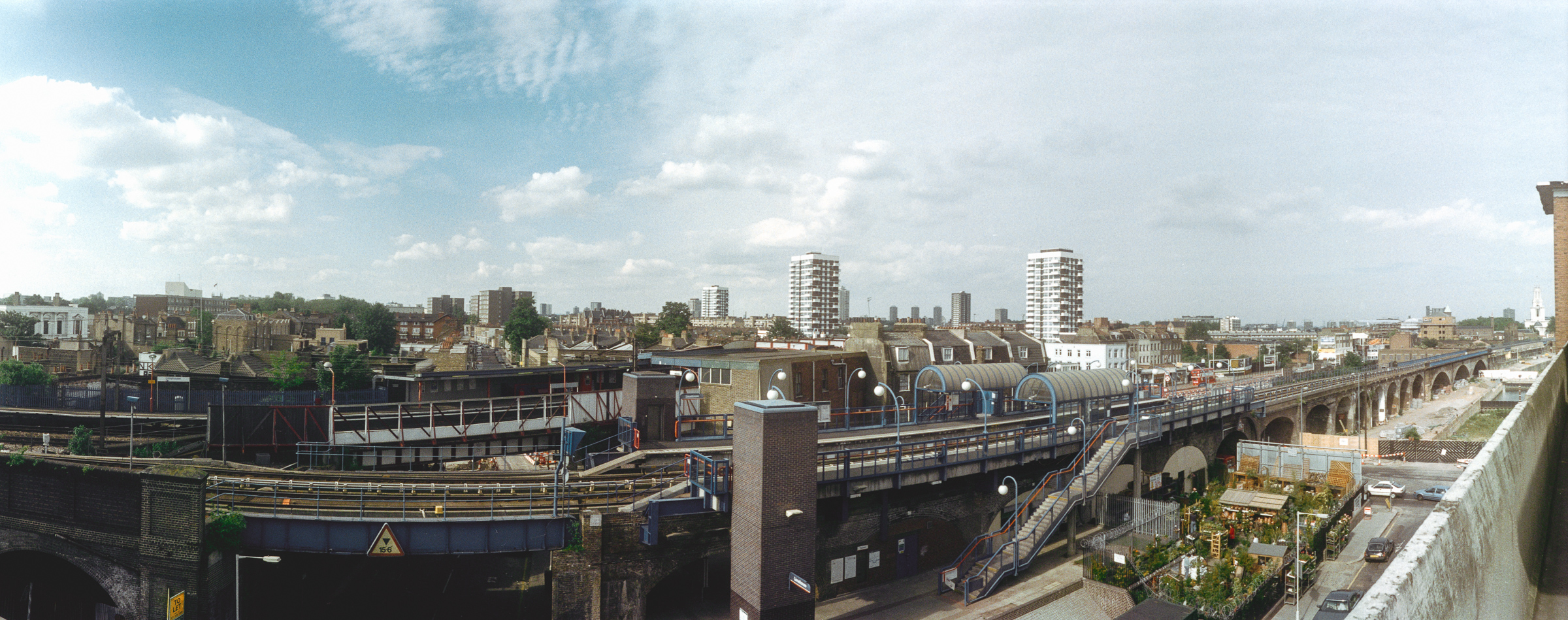
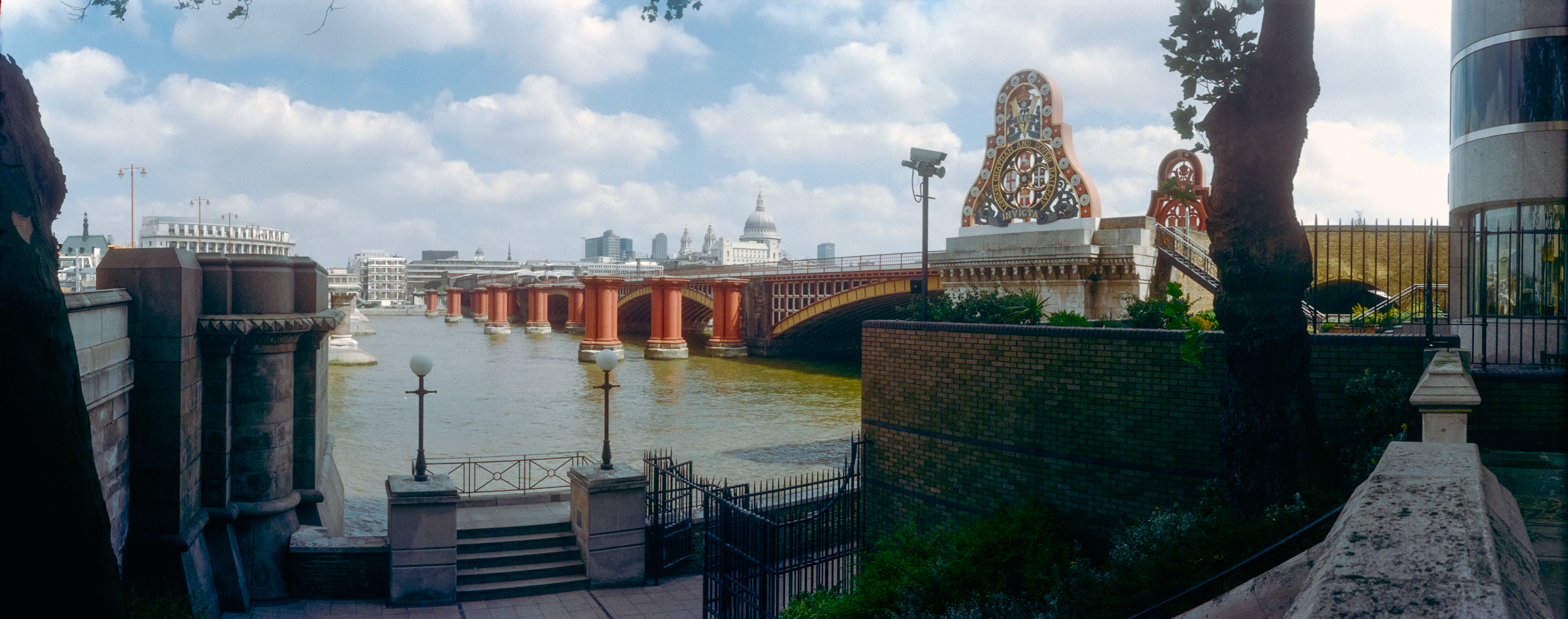
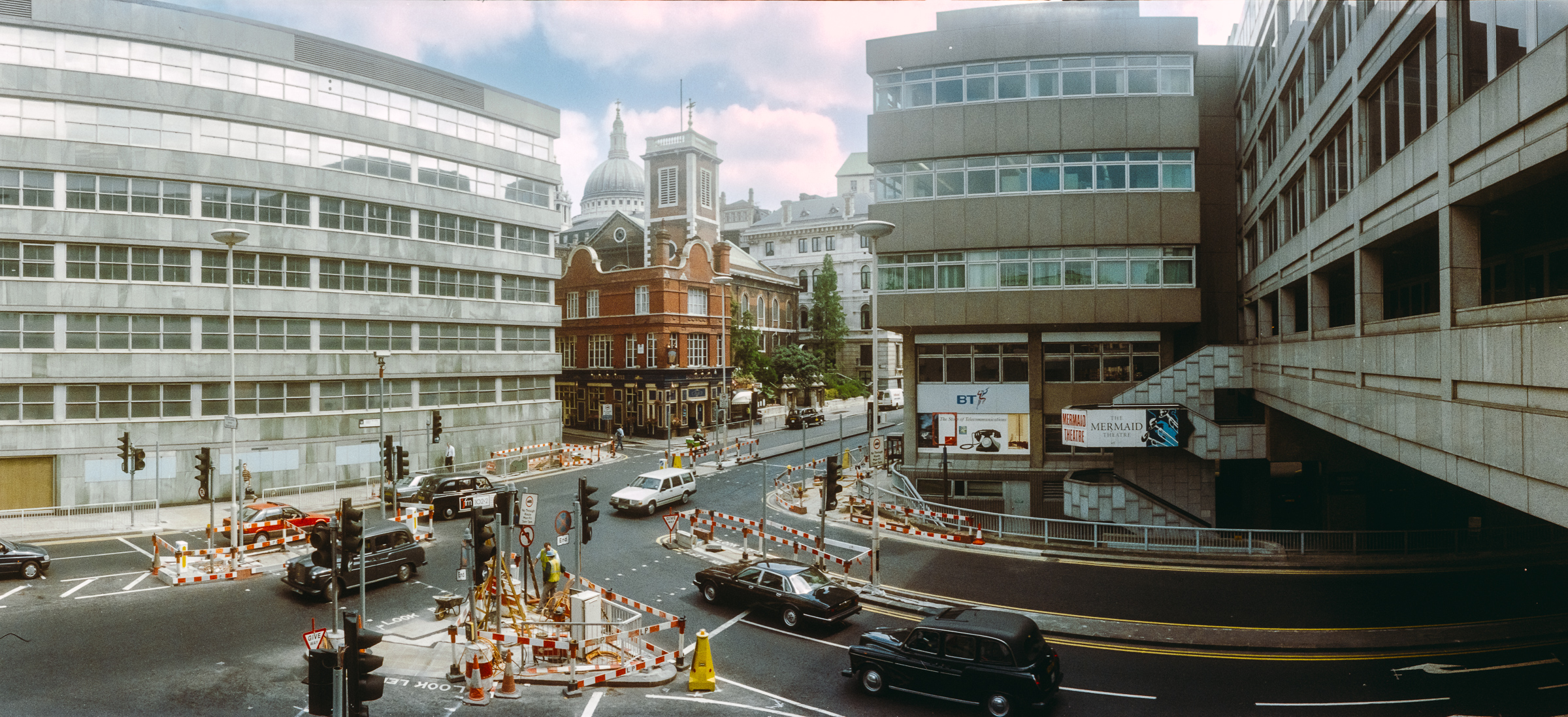
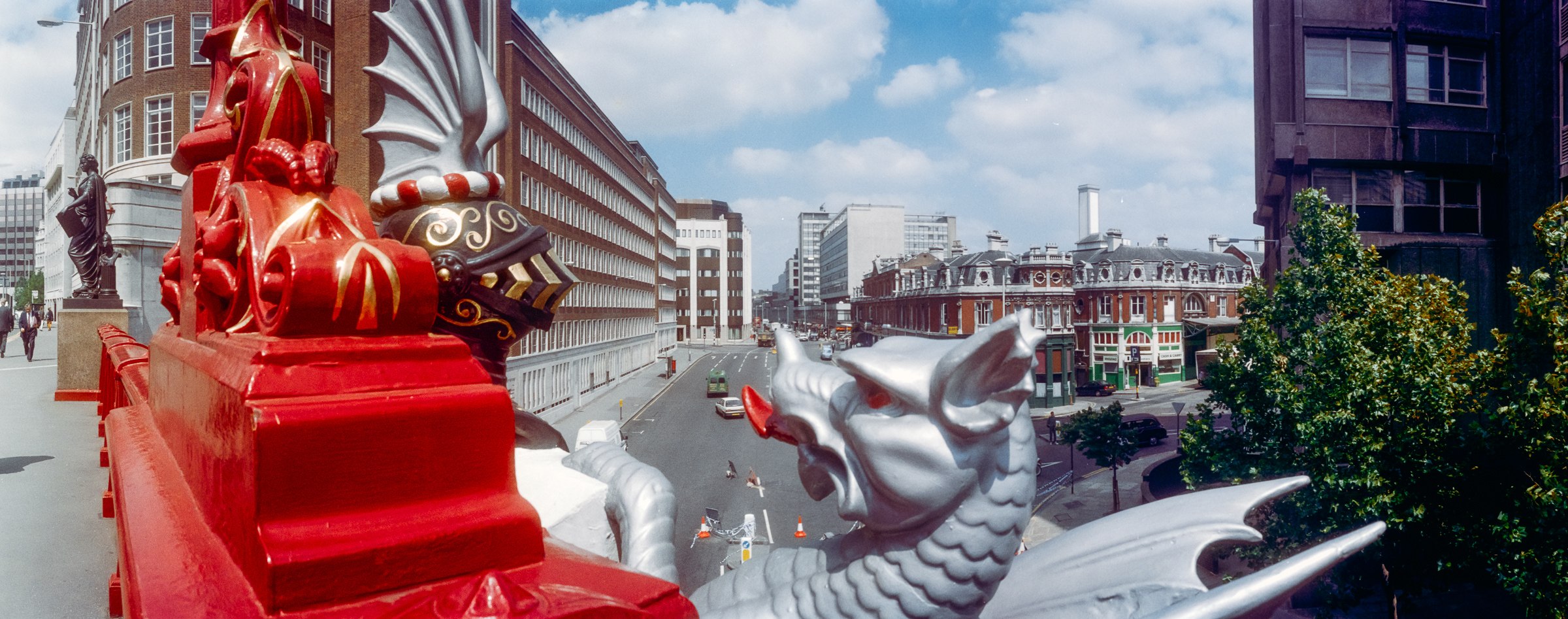
1995 Colour Part 5 – Waltham Forest: My Greenwich Meridian project had taken me into North London as far as Pole Hill in Chingford, but I also wandered more widely in the London Borough of Waltham Forest and even strayed into its neighbouring borough of Redbridge, photographing both with a panoramic camera and my ”normal’ pair of Olympus OM4s on black and white and colour.
Most of the pictures taken with these OM4s were made with the Olympus 35mm shift lens which could slide vertically and horizontally in its mount, particularly useful for photographing tall buildings when it by shifting it up I could keep holding the camera level and place the horizon close to the bottom of the image, so avoiding converging verticals or including large foreground areas.
Leisure Centre, New Road, Chingford, Waltham Forest, 1995, 95p03-441
Leisure Centre, New Road, Chingford, Waltham Forest, 1995, 95-3o-23, 1995, 95c03-335
But often I had the shift on a camera loaded with black and white film, with the 28mm on the OM4 with colour in it. I also carried an ultra-wide 21mm, a 50mm and a short telephoto lens for use when needed.
And just occasionally I photographed the same subject both with the swing lens panoramic and with one or other of the Olympus cameras – and I’ll include a couple of examples in this post. All of these pictures were made in February or March 1995.
Lee Valley Viaduct, North Circular Rd, South Chingford, Waltham Forest, 1995, 95p02-251
Southend Rd, North Circular Rd, South Chingford, Waltham Forest, 1995, 95p01-233
Recreation Ground, Higham Hill, Waltham Forest, 1995, 95p01-263
Sandpiper Close, Higham Hill, Waltham Forest, 1995, 95p02-122
Sandpiper Close, Higham Hill, Waltham Forest, 1995, 95c02-352
For these Sandpiper Close pictures I think the added angle of view of the panoramic greatly improves the image and gives for me a much more powerful impression of what I saw and felt standing there and looking down into the Lea Valley.
Riverhead Close, Higham Hill, Waltham Forest, 1995, 95p02-113
Although the two pictures of the Leisure Centre where only taken a few feet apart, they are very different images. Standing further back for the panoramic gives a better overall view of the site, but moving closer concentrates on the foreground. The slight colour difference between the two images – neither of them quite right – also complicates the issue. Colour balancing many of these old negatives is often very tricky.
Clicking on any of the images above will take you to a larger version on Flickr. You can also find some of the black and white pictures I took on the same walks in my album 1995 London Photosbeginning at this picture. My next post in this series will look at more of the non-panoramic images from Waltham Forest.
Conveniently a large plaque on the house tells me this is Prioy Gardens and gives the date of its construction, 1880. The London Borough of Hounslow street sign confirms the street name and tells me it is in Chiswick, true, but more specifically it is in Bedford Park. Yet a third street name can be seen on the wall of the house in case anyone was still in doubt.
This Grade II listed house at 1 Priory Gardens is a part of the Bedford Park Estate, “a pioneering commercial development of some 350 houses and a few public buildings built between 1875 and 1886 by inexperienced developer Jonathan Carr.”
The estate was planned “to create a community of like-minded middle class aesthetes who were defined by modest financial resources and significant artistic aspirations” and was generally regarded soon after as ‘The First Garden Suburb’ and had a great influence on later suburban housing.
The whole estate reflects the Queen Anne Revival style of the period which the listing calls ‘Picturesque‘ and is also known as Domestic Revival. Most of the houses and public buildings on the estate built before 1880 were designed by Richard Norman Shaw, the leading architect of this style, but this was one of the earliest by his protégé E J May who had taken over as Estate Architect. A planning application to demolish the house and develop the site was turned down in 1973 and it is now the headquarters of the Victorian Society.
The Tabard Inn at the right of this row also dates from 1880 and is Grade II* listed, one of the public buildings in the area designed by Richard Norman Shaw. This building was was “a pioneering ‘improved’ pub and represented a rejection of the Gin Palace in favour of a more traditionally inspired and respectable inn” and retains much of its original interior features. The exterior of this group of properties was inspired by the well-known Staples Inn on High Holborn – which some may remember featured on tins of Old Holborn hand rolling tobacco.
To the left of the pub is the managers house, and closer to my camera at left are the Bedford Park Stores. Wikipedia has a long and interesting entry on this group of buildings. The stores later became a showroom for coachbuilder H. J. Mulliner & Co.
The buildings of Bedford Park which had become run-down and many in multi-occupation by the middle of last century were saved from ruin by an influential campaign by the Bedford Park Society and all of Carr’s buildings were listed in 1967. Ealing and Hounslow Councils created conservation areas covering the estate in 1970.
This is I think 15 Priory Avenue, one of 4 houses at the crossroads with Rupert Road, where I could have faced in any direction and photographed a listed house, or walked down either of the roads lined with them. I think this was the most distinctive corner, but it was a rather overwhelming ensemble.
Back on the Bath Road the Wendy Wisbey theatrical agency, address 2 Rupert Road, occupied what had previously been The Phildene Stage School. In 2010 it became part of Orchard House School, now part of Dukes Education.
This was another building designed by Richard Norman Shaw. Unfortunately because of the mass nature of the listing of buildings in this area the listing text is almost devoid of any information.
Another picture of this agency which was also a dance school which shows the fine window at the east of the Bath Road frontage.
Houses, Bedford Park, Turnham Green, 1989, 89-12b-51
Another picture from Bedford Park showing some rather less grand houses. I can no longer recall the exact location – perhaps someone wlll be able to recognise it.
St Michael & All Angels’ Parish Hall, Woodstock Rd, Bedford Park, Turnham Green, ,1989, 89-12b-44
The Parish Hall adjoins the church and is listed together with it. The church by Richard Norman Shaw was built in 1880 as a central element in the new Bedford Park Estate, but the parish hall was a later addition in 1887. The front of the church and the hall face The Avenue but there is a small grassed area in front and the street sign in the photograph is for Woodstock Rd.
The central pillar seems remarkably stout and the decorative ironwork includes two angels above each door.
I left the church and walked down past Turnham Green Station to Chiswick High Road to continue my walk. More later.
Guantanamo, National Gallery, Elephant, Aylesbury & Lisa; Ten years ago Thursday 5th February 2015 was a long and interesting day for me, with a couple of protests, a short walk around London, an estate occupation and a memorable book launch.
Close Guantanamo – 8 Years of protest – US Embassy
A small group from the London Guantánamo Campaign was celebrating 8 years of holding monthly protests at the US Embassy in Grosvenor Square.
Among those protesting were four people who had been taking part in the protests there for 8 years.
No Privatisation At National Gallery – Trafalgar Square and DCMS, Whitehall
The National Gallery had told 400 of its 600 staff who are responsible for the security of the paintings and the public, provide information about the collection, organise school bookings and look after the millions of visitors each year that they are no longer to be employed by the gallery and will instead become employes of a private company.
They knocked at the door but management did not answer
A private company had already taken over “temporarily” to run services in a third of the gallery.
Workers at the gallery had staged a 5 day strike against the privatisation and were incensed when Candy Udwin, one of the senior PCS union reps and a member of the team taking part in negotiations with management at ACAS, was suspended, accused of breaching commercial confidentiality, and they demanded her re-instatement.
Candy Udwin
The National Gallery was then the only major museum or gallery in London still not paying the London Living Wage. Staff were already living on poverty pay and the privatisation would threaten pay and worsen the conditions – sick pay, holiday pay, pensions, hours of work etc – of these loyal and knowledgeable staff.
When nobody came to the door as they tried to deliver their 40,000 signature petition against privatisation a group went into the Sainsbury Wing to tray and deliver it. Security tried to get them to leave. Nobody from the gallery would come down to recieve the petition and eventually the strikers handed it over to the Head of Security who promised to deliver it to management personally.
Jeremy Corbyn joins the marchers
The strikers and their supporters then marched through Trafalgar Square and Whitehall to the Dept of Culture, Media and Sport, then in Parliament Street, where the minister concerned had agreed to receive a copy of the petition and three of them were allowed to take it in. Here there was a short rally with speakers including Jeremy Corbyn MP.
I made a few pictures as I walked from the Bakerloo Line station at Elephant & Castle to the Aylesbury Estate and afterwards on my way back to the station. The shopping centre has now been demolished and new buildings have sprung up on its site,
This strange building is an electricity substation which is still there, although there is no longer a roundabout around it. It was built as a memorial to Michael Faraday, ‘The Father of Electricity’ who was born a few hundred yards away in 1791.
Chartridge occupied since the previous Saturday in a protest for housing in London
Southwark Council’s Aylesbury Estate was one of the UK’s largest council estates, built between 1963 and 1977 with over 2,700 homes. Lack of proper maintenance by the council and its use by them as a sink estate had led to it getting a reputation for crime, exaggerated by its use in filming TV crime series and films there not least because of its convenient location.
Access to the occupied block – I didn’t attempt it
It was on the Aylesbury Estate that Tony Blair got in on the act making his first speech as Prime Minister promising to fix estates like this and improve conditions for the urban poor through regeneration of council estates.
‘Respect Aylesbury Ballot – Stop the Demolition Now!’ Residents voted overwhelming for refurbishment not redevelopment
The buildings were actually well-designed and structurally sound on a well-planned estate with plenty of green space, but having been built in the sixties and 70s needed bringing up to date particularly in terms of insulation and double glazing. Southwark Council had also repeatedly failed to carry out necessary maintenance, particularly on the district heating system which they had allowed to become unreliable. But many residents liked living on the estate and when given the choice voted by a large majority for refurbishment rather than redevelopment. I visited several homes on other occasions and was quite envious, and the residents clearly loved living there.
Southwark Council responded by claiming the refurbishment would cost several times more than independent estimates suggested and went ahead with plans to eventually demolish the lot. Given the large number of homes involved the process was expected to last 20 years (later increased to 25 and likely to take even longer.) The first fairly small phase was completed in 2013, and the homes that were occupied in 2015 were in Phase 2.
I wasn’t able to access the flats that were occupied as it would have meant a rather dangerous climb to the first floor which I decided was beyond me, but I did meet some of the occupiers and went with them and some local residents to distribute leaflets about a public meeting to other flats in the estate.
Many residents support the occupiers and knew that they would lose their comfortable homes in a good location when they are finally forced to move. Some will be rehoused by Southwark, though mainly in less convienient locations and smaller properties, but many are on short term tenancies which do not qualify them for rehousing and will have to find private rented accommodation elsewhere. Those who have acquired their flats will only be offered compensation at far less than the cost of any similar accommodation in the area and will have to move much further from the centre of London.
While the volunteers were posting leaflets on one of the upper floors of the largest block on the estate, Wendover, I took some pictures to show the extensive views residents enjoyed. This was hindered by the fact that the windows on the walkways were thick with dust, possibly not cleaned since the block was built and not opening enough to put a camera through. Then fortunately I found a broken window that give me a clear view.
Getting By – Lisa’s Book Launch – Young Foundation, Bethnal Green
Ken Loach, Jasmine Stone and Lisa McKenzie, author of ‘Getting By’ talk at the book launch
Lisa McKenzie’s book ‘Getting By‘ is the result of her years of study from the inside of the working class district of Nottingham where she lived and worked for 22 years, enabling her to view the area from the inside and to gather, appreciate and understand the feelings and motivations of those who live there in a way impossible for others who have researched this and similar areas.
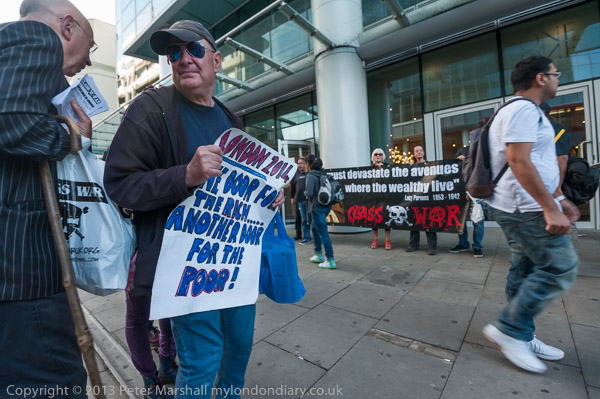
Jasmine Stone speaks about Focus E15 and Lisa and others hold a Class War banner
On the post in My London Diary I write much more about the opening – and of course there are many more pictures as well as a little of my personal history.
Make Poverty History: Twenty years ago on February 3rd 2005 I was one of the 20,000 or so people who packed Trafalgar Square on a Thursday lunchtime to see and hear Nelson Mandela speak in the first major real event in the UK’s ‘Make Poverty History’ campaign.
Make Poverty History was a coalition of charities, religious groups, trade unions, campaigning groups and celebrities which had come together here and in a dozen other countries around the world to promote trade justice, to cancel the debts that were crippling poorer countries and to press for more aid and for this to be better targeted at improving the lives of people in the recipient countries.
The campaign in the UK had officially been launched on TV on New Year’s Day on the same day that Britain took over the Presidency of the G8 – and in July was to host a G8 summit that was supposed to be largely about poverty in Africa, but this rally was the first major national event.
I’d severely misjudged the numbers that would turn up for the rally, arriving only minutes before it was due to start and was unable to make my way through a densely packed crowd to anywhere near where the the speakers – including Mandela would be speaking.
This was an occasion when a long and heavy fast telephoto lens would have come in handy, but I’ve never owned one of these, preferring whenever possible to work at close range. But the relatively small zoom lens I had with a focal length of 200mm and a maximum aperture of only f5.6 did just about allow me to take some recognisable images of what was happening on the stage in the distance.
It helped that Nikon was still sticking to its conviction that its DX format, a sensor half the size of a 35mm frame was all that was needed for digital photography, giving the lens on my D70 the equivalent view of a 300mm on full-frame.
he ‘pills’ are a petition calling for urgent action on aids, to get 3 miilion people on treatment by 2005.
But I was please to have been able to capture some of the event – such as the handshake between Mandela and Bob Geldoff and children coming to meet Mandela, even if someone’s head got in my way a little of the time and those 6Mp images could perhaps have been just a little sharper.
Mosquito nets can help stamp out malaria in Africa
Later I was able to return to focal lengths more in my comfort zone, with a fisheye to show the crowds and more normal wide-angle views of people in the crowds.
The only way to be photographed with Nelson Mandela at the Rally
The ‘Make Poverty History’ movement lasted in the UK until 31st Januarly 2006, though relations between some of the 540 groups involved were very difficult. Oxfam in particular was seen as far to keep to follow a ‘New Labour’ line and some other major NGOs were also often felt to be insufficiently radical. Even though these groups dominated the campaign the TV adverts which had been aired at the start were soon banned by Ofcom as they were deemed to be “‘wholly or mainly political’ in nature, since they aimed to ‘achieve important changes'” – surely the whole point of the campaign.
Clearly the campaign had begun to disturb the rich and powerful who were feeling their privilege and profits from impoverishing the poor might be at risk. But although the campaign raised awareness of the problems its actual achievements were rather limited.
Bust of Nelson Mandela, sculpted by Ian Walters, commisioned by the GLC to mark the 70th anniversary of the African National Congress in 1982, and unveiled by Oliver Tambo in 1985. It records Mandela’s imprisonment in 1962, with added inscriptions marking his release in 1990, the Nobel Peace prize in 1993 and his inauguration as the first president of a free South Afrrica in 1994.
You can read more about the event and seem many more pictures on My London Diary
Central Hill Estate: Tuesday 2nd February 2016 was a bright winter day in London and i decided to go and take a look – and of course to photograph – the Central Hill Estate on the edge of Lambeth, which I had heard and read much about as Lambeth Coucil weree planning to demolish it.
You can read an excellent account of the building of the estate by architect Kate Macintosh on the Twentieth Century Society website, which records the care taken by lead architect Rosemary Stjernstedt (1912-1998) and her team, who had previuosly been head-hunted by Lambeth’s Chief Architect and Planner Ted Hollamby.
As well as planning to make the most of the steeply descending site with its extensive views across London the plans presevered as many as possible of the existing mature trees and included a Doctor’s group practice, a youth club, an old persons’ day centre and shops, open space, play areas, community buildings and a district heating system.
The Twentieth Century Society also supported the two applications for the listing of this site, turned down in 2016 and again in 2021, although the reasons for the refusal seem increasingly spurious and I think based on political pressure rather than architectural evidence.
I wrote about it at some length after my visit in February 2016 on My London Dairy and have visited it again on several occasions since, not lease to see the exhibition of alternative plans to meet Lambeth Council’s stated objectives for the demolition and rebuildling by careful and much lower cost development on the existing estate which would retain its essential excellent design.
Here I’ll quote a part of what I wrote then, beginning with my introduction.
“There is only one real problem with the Central Hill Estate in Upper Norwood. Which is that the estate, owned by Lambeth Council, was built in an age when architects and planners were proud to design the best they could and councils keen to house their tenants to the highest standards, but it has lasted into an age where government policy aims to get rid of all social housing and councils are out to join developers in profiting from redeveloping with lower standards and higher densities for private sale.”
“The whole is on a much more human scale than other large developments of the era, with a design that has proved successful in encouraging community. People like living on the estate and all I talked to when walking around taking pictures were very positive – except for the one council employee who came out from the upper Norwood Community Resource Centre to ask me what I was doing. “
“A survey answered by 150 residents recently found only two in favour of it being demolished. It has been a safe place to live, with below average crime levels – perhaps having the police station at its south-east corner has helped.”
“Like all social housing, the estate has suffered from neglect and poor maintenance, and the properties need refurbishment and bringing up to modern energy standards. Considering the age of the estate the cost per dwelling assessed by Lambeth Council is relatively moderate and only a fraction of that of new building.”
You can read the alternative proposals by Architects for Social Housing – Simon Elmer and Geraldine Dening – prepared for the residents of Central Hill estate between May 2015 and March 2017 in response to the threat of demolition of 456 homes on the estate by Lambeth Labour Council.
In the introduction to the ASH report they write “However, there is nothing, either in current government legislation or in the housing policies of the Conservative, Labour or Liberal Democrat parties, that will stop councils from following the same practices Lambeth council employed to push through their plans to demolish Central Hill estate against both the wishes of residents and the demonstrable social, financial and environmental benefits of the design alternatives.” Lambeth Council refused to seriously consider their alternative suggestions.
Little has changed since then although we are now much more aware of the environmental impacts of demolition and rebuilding, and some greater lip-service was been paid the the “wishes of residents“, but the changes in planning recently announced by Labour had they been in place back in 2016 would almost certainly have meant that Central Hill would not now still be standing.
Turnham Green – 1989: The second post on my walk which began at Kew Bridge Station on 10th of December 1989. The previous post was Kew Bridge & Gunnersbury 1989.
Empire House, Chiswick High Rd, Turnham Green, Hounslow, 1989 89-12a-64
It might be thought odd that this tall office building which was built starting in 1959 should have been called Empire House, when the British Empire was almost completely gone, but the Empire from which this tower got its name was the Chiswick Empire, built for theatre owner and manager Oswald Stoll at 414 Chiswick High Road, replacing some shops and a smithy which opened in 2012.
The architect was the leading theatre architect Frank Matcham and it was a grand example of the Edwardian ‘Jacobean’ style. Built to seat 4,000 it featured mainly variety shows, but also more serious theatre and perhaps was in its heyday in the 1940s and early 50s. Wikipedia has a great list of some of those who appeared in its final years “Tommy Cooper, Max Miller, Max Bygraves, Julie Andrews, Morecambe and Wise, Ken Dodd, Max Wall, Dickie Valentine, the Ray Ellington Quartet, Peter Sellers and Dorothy Squires (1952), Laurel and Hardy on a return visit (1954), Al Martino, Alma Cogan, Terry-Thomas (1955) and Cliff Richard (1959).” Cliff wasn’t quite the man who brought the house down, with the final shows being by Liberace with the theatre being demolished within a month of his stepping away from the piano.
I don’t know who was the architect responsible for Empire House. It has recently been bought and redeveloped into flats and town houses.
This elegant wallpaper factory was designed by C F Voysey and built in 1902. It was the only commercial building designed by the celebrated Arts & Crafts architect and designer and is Grade II* listed.
Arthur Sanderson & Sons Ltd, now just Sanderson, was founded in Islington in 1860 and made fabrics and wallpaper. The company came to Chiswick in 1879 and this building was an extension on the other side of the road to their earlier factory, built in 1893. After a fire in 1928, the company moved to Perivale selling off the Voysey building. They had also built a factory in Uxbridge in 1919 to produce fabrics. Sandersons moved back to into the Voysey building in 2024.
Sandersons had bought the business of Jeffrey & Co who had printed William Morris’s wallpapers and in 1940 when Morris & Co dissolved they also bought the rights to use the Morris name.
Dukes Avenue runs south from Turnham Green towards Chiswick House. Lord Burlington’s grandson was able after the Chiswick enclosures act of 1814 to build the road from his estate to Chiswick High Road. The road is lined with lime trees.
Houses along here seem seldom to be sold, but one went recently for over £3 million. Most appear to be large, solid and Edwardian but of no great interest.
This former Sandersons factory, the “Devonshire works”, was used for light engineering in the 1960s by Evershed & Vignoles of Acton Lane. From 1971 it stood empty until restored by the Cornhill Insurance Co. as the Barley Mow Workspace, for individuals or small firms of designers or craftsmen, the first of whom arrived in 1976.”
After Lord Burlington who built Chiswick House died the property was inherited by the Dukes of Devonshire. I think this works probably dates from 1893.
Afton House, built around 1800 is the only remaining example of the grand houses which were bilt in around 1800 along Chiswick High Road, and it Grade II listed. In the 1850s it was called Falkland House and was a school, but was renamed Afteon House in 1861. From then until 1887 it remained a school but then became a laundry until 1913. Empty and bcoming derelict it was bought in 1919 by Dan Mason of the Chiswick Polish Company (best remembered for their Cherry Blossom Shoe Polish) and given as a club for ex-servicemen.
Linden Gardens, Chiswick High Rd, Turnham Green, Hounslow, 1989, 89-12a-34
Dr Ralph Griffiths who founded the Monthly Review and edited it for 50 years was one of the many “noble, artistic and scholarly residents” of the area in the 18th century and he lived in Linden House where Linden Gardens now is. He was a London bookseller and publisher Ralph Griffiths, with “bookshops at St. Paul’s Churchyard from 1747 until 1753, then at 20 Pater Noster Row until 1759, and finally on the Strand near Catherine Street until 1772 – all under the sign of the Dunciad.”
Griffiths was notably involved in the 1746 publication of Acanius or the Young Adventurer, a fictionalized account of the Young Pretender, and may have been its author. The government attempted unsuccessfully to suppress the book and it remained in print for over 150 years.
Chiswick Fire Station, Chiswick High Rd, Turnham Green, Hounslow, 1989, 89-12a-36
Chiswick Fire Station at 197 Chiswick High Road is an elegant building with a tower and is now a bar and restaurant. It was for sale when I made this picture. Built in 1891 the tower at right was used to hang up fire hoses to dry and also to store the long fire escape ladder. A new fire station was built in 1963 and this became redundant.
War Memorial, Turnham Green, Hounslow, 1989, 89-12a-26
Erected in 1921 ‘In grateful and affectionate memory of the men of Chiswick who fell in the Great War, 1914 – 1918’ this simple obelisk is a rather plain reminder of their sacrifice designed by Edward Willis FSI, Engineer and Architect to the Chiswick Urban District Council. More names were added after the Second World War. There seems to be little reason to justify its Grade II listing
I walked on to Bedford Park. More from there in a later post .
Kew Bridge & Gunnersbury 1989: I didn’t get our for a walk again in 1989 until the 10th of December, probably partly because of the weather with drizzle, mist, fog and some very cold days. But it was just a little warmer and I decided to go out. But at this time in London sunset is before 4pm and so I decided to take pictures fairly close to home so I could make an earlier start. Kew Bridge station is only around a half hour journey from my home.
I made my first picture from the footbridge in the station taking me to the station exit. As you can see the station buildings were in pretty poor condition. The view includes the local landmark water pumping tower and the top of the engine house of Kew Bridge Engines, opened as a remarkable museum in 1975 (now renamed as London Museum of Water & Steam) and the tower blocks further down Green Dragon Lane. Six 23 storey blocks were built here as the Brentford Towers Estate in 1968 to 1972 by the London Borough of Hounslow.
Green Dragon Lane apparently got its name from a 17th century pub but there appears to be no record of where this was, though there are or were around 40 other pubs of that name elsewhere in the country. The name is usually thought either to have come from the Livery Badge worn by servants of the Herbert family, the Earl of Pembroke, which showed a bloody arm being eaten by a dragon or a reference to King Charles II’s Portuguese Catholic queen, Catherine of Braganza whose family badge was the Green Wyvern.
Kew Bridge station gets rather crowded at times now, as Brentford’s new football stadium is next door.
I walked up to Gunnersbury Avenue where on the north-east corner of the Chiswick roundabout was this magnificently derelict former works of Spenklin Ltd. They appear to have made Power-operated work clamping devices and other engineering tools including boosters, clamps, cylinders and hydraulic ram heads. The company name was a contraction of Spencer Franklin. I think the next factory along – demolished by the time I took this – had been Permutit water softeners.
I think this building probably dates from around 1925 when the Brentford Bypass – soon better known as the Great West Road – was opened. The roundabout here came later along with its flyover in 1959.
A closer view of the entrance with its boards showing it had been acquired by Markheath Securities PLC a London property developer, though 49 per cent owned by The Adelaide Steamship Co Ltd. They appear to have been responsible for several developments in the area and to have made Section 106 contributions to Hounslow Council for improvements to nearby Gunnersbury Park.
National Tyres, Gunnersbury Avenue, Gunnersbury, Hounslow, 1989 89-11i-33
My memory – often false – tells me that this was on the west side of Gunnersbury Avenue (the North Circular Road) to Spenklin House and I think is probably from the same era. At least it is clear what the business of the National Tyre Service was and the building has a rather fine squad of Michelin men.
Chiswick Rd, Acton Lane, Chiswick Park Station, Chiswick Park, Houslow, Ealing, 1989 89-11i-36
Quite a long walk along Chiswick High Road took me to Acton Lane where I took this picture on the corner of Chiswick Road. A station was built here in 1879 when the District Railway was extended from Turnham Green to Ealing Broadway, but clearly that in the distance here is from the 1930s.
On the corner we have a rather unremarkable post-war building but with some rather remarkable Christmas decorations. The long shop front is now divided into separate shops.
Chiswick Park Station, Chiswick Park, Ealing, 1989 89-11i-23
A closer view of Chiswick Park Station, one of many characteristic stations by architect Charles Holden for London Underground and built in 1931-2. Holden’s first complete Underground stations were built on the Northern Line southern extension from 1926, but he later designed many more. This station remains almost as it was built and shares its features with many of his others. It was Grade II listed in 1987.
Chiswick Park Station, Chiswick Park, Ealing, 1989 89-11i-1
The interior of the tall drum-shaped ticket hall with a shop, Midas Gold Exchange at right. Useful signs above the exit tell the way to buses and to Acton Green, while the lower advertising panels are all for Underground posters. The Underground were pioneers in various ways in advertising – not least in the tall tower at this and other stations whose main if not only purpose was to carry their branding with the trade-mark roundel and station name.
I think the brick building at left which I think housed the ticket office was perhaps a later addition to the building which otherwise has been altered little.
Peace, Congo, Iran, Egypt, Bikers, Trafalgar Square: On Wednesday 25th January 2012 I went up to London in the middle of the afternoon and continued to take photographs at various places and events for several hours.
Parliament Square Peace Camp
I began with a brief visit to the Peace Camp – as I often had over the years – but found that Barbara Tucker was busy tidying up in anticipation of yet another police raid in their long campaign of harassment of her and here supporters and on this occasion didn’t have time to talk. So I just took a couple of pictures and then walked up to Trafalgar Square. On May 10th 2012 the protest had been 4000 Days in Parliament Square but was evicted shortly after.
Congolese Keep Up Protests – Trafalgar Square
In Trafalgar Square I found a small group of Congolese protesters in a pen on the pavement outside South Africa House, calling on South Africa to put pressure on the Congo regime. They called on South Africa to free political prisoners and recognise opposition leader Étienne Tshisekedi wa Mulumba as the duly elected President of the Democratic Republic of Congo. The 2011 elections were widely regarded as having been fixed and it is unclear whether he or the incumbent Joseph Kabila whose election was confirmed by the Supreme Court of the Democratic Republic of Congo actually got more votes.
The protesters told me that more people were expected to arrive for the protest soon and I promised to return. But I got a little held up elsewhere and by the time I returned everyone had left.
Peace For Iran – No To War – Foreign & Commonwealth Office, Whitehall
I walked back along Whitehall to the Foreign & Commonwealth Office in King Charles St where a small group were protesting against going to war with Iran, calling for peace.
I waited with the protesters who told me they expected more to arrive, but had to leave after around 20 minutes. I think few were coming as a large protest was to happen a few days later (you can see my report and pictures on this at No War Against Iran & Syria)
Egyptians Protest Against SCAF – Egyptian Embassy
I had to leave to go to the main event I had come into London to report, the protest by Egyptians on the first anniversary of the Egyptian revolution. Egypt was then suffering under the Supreme Council of the Armed Forces (SCAF) and they called for the revolution to continue and an end to military rule.
This was an energetic and protest by over a hundred Egyptians in solidarity with the estimated 300,000 who had marched to Tahrir Square earlier in the day.
A few from the British left had come to give their support, including Chris Nuneham of Stop the War who was one of those who spoke.
The speakers urged solidarity with the Egyptian people and also with the other revolutions of the Arab Spring, and called for an end to the Western attempts to enforce an agenda on the Arab nations.
They voiced their opposition to the increasingly likely military action against Iran, and called on those present to join the No War Against Iran & Syria protest at the US Embassy on the following Saturday.
Westminster Bikers First Olympic Jubilee Demo Ride – Trafalgar Square
I returned to Trafalgar Square for a protest by motorbike riders, incensed by the so-called experimental parking charges for powered two wheelers.
‘No To the Bike Parking Tax’ see the parking charges introduced by Westminster Council as a simple money-making racket and have been making regular Wednesday protests against it as well as lobbying and making a legal challenge.
The daily fee for parking in a solo motorcycle bay is now only £1, and bikers can move from bay to bay.
After the bikers rode away I took a few pictures in Trafalgar Square under its dramatic red lighting then walked away. There had been a traffic accident on Northumberland Avenue which seemed to have involved two bikers and a cyclist and the police were now in attendance. I took a single frame as I approached but I didn’t investigate this further, walking down Whitehall.
Opposite Downing St a small protest was taking place calling for Freedom for Syria from the Assad regime, but nothing much was happening there and after making a couple of pictures I moved on, now in a hurry to get home and have something to eat.
Atos Protest & Camden Town: – Monday 24 January 2011
Disability benefits are now under attack by our Labour government, who have insisted they will implement the Tory plans to cut the amount paid in incapacity benefits by £3 billion by 2028. And the House of Lords economic affairs committee a few days ago published a report calling for a fundamental review of the benefits system to tackle the rising social and fiscal costs of disability benefits.
Picket at the Archway Job Centre Plus Atos test centre
Also last week the High Court ruled that the previous government’s consultation on changing incapacity benefits was unlawful as “it presented the changes as a way of supporting disabled people into work but failed to make clear that 424,000 vulnerable claimants would see their benefits cut by £416 a month.”
When the Tory coalition government came into power in 2010 it picked on the disabled who it thought would be an easy target for the cuts it was making to support the bankers. Protests such as this on Monday January 24th 2001 showed how wrong they were, with determined opposition to the unfairness of their cost-cutting reforms from disabled groups including Disabled People Against Cuts (DPAC) and the Black Triangle Campaign.
Protesters meet up in Triton Square
One part of the campaign by successive governments has been to give huge publicity and priority to benefit fraud, which according to the national Audit Office only amounts to 0.6% of the DWP budget and is a “drop in the ocean compared to the losses by tax evasion by the super-rich and the amounts lost by them and major corporations exploiting tax loopholes.“
Police try rather ineffectually to stop protesters heading for the Atos offices
In 2011 a major source of unfairness in the system was the attempts to cut costs by the use of computer-based ability to work assessments carried out for the DWP by European IT company Atos. The interviews were administered by ‘healthcare professionals’, often poorly trained and lacking the qualifications and experience to assess many types of disability, particularly mental illness. Almost 70% of those assessed were moved onto the lower benefit rates of the Job Seekers Allowance with some being refused any benefits at all.
An independent review for the DWP made fundamental criticisms of the assessments, and around 40% of those who appealed the decisions eventually had their benefits restored to previous levels – but only after months of hardship, and often just in time for their next review when their benefits would again be axed. Part of the problem was the pressure applied on the assessors to meet targets in cutting benefits by the company so they could justify their costs to the DWP.
And there were plenty of true horror stories. People assessed fit for work who died within days of the assessments, those who committed suicide and some who starved to death. Benefit cuts really do kill.
Atos went on to gain other contracts from the DWP until September 2024 when the contract for Personal Independence Payment (PIP) and work capability assessment (WCA) were given to Serco. The DWP had acknowledged there were flaw in the Atos assessments but few believe that Serco will be any fairer.
Monday January 24th was a a National Day of Protest Against Benefit Cuts, with actions around the country, including protests in Leeds, Birmingham, Burnley, Hastings, Crawley, Chesterfield, Livingston, near Edinburgh (Atos’s Scotland HQ) and Glasgow. I began by photographing a local protest at Archway in North London before going on to a protest outside the London HQ of Atos Origin in Triton Square close to the Euston Road.
On My London Diary back in 2011 I wrote much more about the Atos tests and also about the details of the two protests. The protest in Triton Square was heavily policed but the organisers and those taking part, including Disabled People Against Cuts, WinVisible (Women with Visible and Invisible Disabilities) and London Coalition Against Poverty were intent on this being a peaceful protest.
Police have problems in dealing with disabled protesters. Many want to treat them carefully and their officers certainly realise that images of them being roughly handled would be terrible PR. But they were annoyed that the protesters decided to protest close to the actual Atos offices rather than in a pen they had set up a short distance away. And when one elderly man walked through the spread out police line he was roughly pushed to the ground and dragged away, though later he was allowed to rejoin the other hundred or so protesters.
The police then brought more barriers and erected them around the protesters, telling them they could only exit the fenced area when they were dispersing at the end of the protest. There seemed to be no real justification for this and they seemed simply to be a simply a matter of pique that the protesters had not followed their instructions.
I had plenty of time to get from Archway to Triton Square and got off the bus in Camden Town for a walk and to make use of one of London’s rapidly disappearing public toilets in the middle of the busy road junction there (but I think closed a few years ago.)
I’d photographed around Camden High Street and Chalk Farm Road quite often in the 1990s, often on my way home from taking pictures elsewhere in North London, and walking from Camden Town station to Chalk Farm. Then the lemon sorbets from Marine Ices were the best in London if not the world. But that’s gone too now, and in January 2011 it wasn’t the weather for it.
Back in the 1990s the streets would have been pretty empty except at weekends, but by 2011 there were plenty of tourists wandering around even on a cold Monday in January, though business was fairly slack. But mainly I pointed my camera up to the decorations above the shops
More around the Meridian – It’s seldom possible to actually walk for more than a few yards actually on the Greenwich Meridian in London and while planning my Meridian Walk I often wandered around considerably, having to make detours and also looking for the more interesting routes. So not all these images are exactly on the Meridian, but most were taken within a short distance from it.
When I began this project the Meridian was not marked on the Ordnance Survey or Street maps, and one of may first tasks was to get a ruler and pencil it on to them. In 1999 it was added to the OS maps of the area, but does not seem to be on the latest versions. In 1995 there were no smart phones with online maps and GPS which would have made things so much easier.
The Greenway was the recently rebranded path above the Northern Outfall Sewer which rans across East London from Hackney Wick to the sewage treatment plant at Beckton, going under the road here close the the bridge over Abbey Creek on the Channelsea River, where Abbey Lane becomes Abbey Road. You can see the bridge at the left of the picture.
Greenway, Channelsea River, Stratford, Newham, 1995, 95p4-1153
The Greenway is a great traffic-free cycle route for pedestrians and cyclists, running straight and level and this picture gives some evidence of that.
Channelsea River, Long Wall, Stratford, Newham, 1995, 95p4-1111
I’m not sure what this pipe was for, perhaps for taking gas across the river. Not far away on the other side of this tidal creek was one of the largest gas works in London – and you can still see its listed gasholders, though the view is likely to change soon with the site being redeveloped.
But behind me when I made this picture was the Abbey Mills sewage pumping station and on the edge of the creek below were the storm outfalls where sewage would be released after heavy rains. With the changing tides it would flow downstream a little and then could be taken miles upriver along the Prescott channel and the River Lea.
Flats, East India Dock Rd, South Bromley, Tower Hamlets, 1995, 95p4-1321
I think the Meridian went through the centre of the taller gas holder at Poplar Gas works.
Flats, East India Dock Rd, South Bromley, Tower Hamlets, 1995, 95p4-1321
Another view with the gasholders in the background.
Clove Crescent, East India, DLR, South Bromley, Tower Hamlets, 1995, 95p4-1273
My pencilled line for the Meridian shows it going through both the water in the dock and the brick building at left which was the former Blackwall Power Station in both of these pictures.
Clove Crescent, East India DLR, South Bromley, Tower Hamlets, 1995, 95p4-1263
South of the East India Docks the line crosses the River Thames above and between the two bores of the Blackwall Tunnel, closer to the original western tunnel now used by northbound traffic. I couldn’t take photographs in the tunnel – though it was possible for those on foot to take a bus across, but these would have been rather boring in any case.
This picture shows the southern entrance to the tunnel with its 1897 Grade II listed gatehouse by the London County Council’s Superintending Architect Thomas Blashill. In front of it a less ornate red and white striped arch with heigh and weight restriction signs and hangers to hit any overtall vehicles and hopefully prevent damage to the gatehouse.
One picture not I think actually on the Meridian but not far from it, taken from the long footbridge over the Blackwall Tunnel Southern Approach.
Riverside Path, Greenwich, 1995, 95p4-1762
My path continued south along the riverside path, with the Meridian going into the River Thames on the extreme left of this picture.
Riverside Path, Greenwich, 1995, 95p4-1742
I kept to the land continuing along a path I’ve walked many times and making a few more pictures.
Riverside Path, Greenwich, 1995, 95p4-1743
Like much of London’s riverside almost all of the industry has now gone, but some relics remain, though most of this part of my route is now lined by rather boring flats.