Global Climate Change March – 2007

Global Climate Change March: On Saturday 8th December 2007 around 6,000 people came to march through London in an attempt to shake the government out of its complacency and get the real change in direction needed to avoid catastrophe. It was by then totally clear that our world was heading to disaster.

Global Climate Change March - 2007
A mermaid at the front of the march points out the danger of rising sea levels

Eighteen years later we are still on course for human extinction, and for taking many other species with us. Although most governments have by now taken some measures to curb emissions together these have only resulted in a slight reduction of our rate of self-destruction. Tinkering at the margins is not going to save us and there will be no magic scientific solution, we need a dramatic system change.

Global Climate Change March - 2007
Cyclists arrive to support picket at a Tesco Metro

The main driver of our impending disaster can be stated in one word: GROWTH. The incessant demand for more, more, more – when what we really should be valuing is better.

Global Climate Change March - 2007
The cyclists rode around central London in the rain

We have a government that is committed to growth – and introducing climate killing policies such as Heathrow expansion. Protests such this in 2007 and many others managed to stop the third runway then but now it and other disastrous projects are back.

Global Climate Change March - 2007
People come to Parliament Square to start the march to the US Embassy in Grosvenor Square

Of course it isn’t just our current government, but the whole political and economic system which calls for growth – and is dominated by the rich and powerful people and corporations who control the laws, the media and more. They aren’t our laws and our media but their laws and their media – and they lead to the obscenity of billionaires and to poverty in rich countries and across the world.

Global Climate Change March - 2007
Polar bears support Friends of the Earth’s ‘The Big Ask’.

Below is my fairly lengthy account of the march in 2007 from My London Diary, where there are many more pictures of the event than the few here.

‘Can’t you stop climate change’

Global Climate Change March – Parliament – Grosvenor Square

The global climate change march on Saturday 8 December was intended to send a message to government that they need to produce an effective Climate Change bill and put themselves wholeheartedly behind saving the planet rather than backing projects such as the Heathrow expansion that will further increase the chaos.

The march went to the US Embassy in Grosvenor Square, because America is still refusing to ratify the Kyoto treaty and still sabotaging any progress on getting effective measures to cut carbon and energy use.

Cyclists were also out in force on a tour of central London before the march, visiting a picket at Tesco Metro in Lower Regent Street, where leaflets were handed to customers asking them to shop elsewhere so long as Tesco continues to promote bio-fuels.

It was a lousy day, with strong winds and intermittent heavy showers, but that didn’t stop more than 6000 marchers turning out for the event, many in fancy dress as santas, polar bears, reindeer, elves, penguins and more to highlight the problem of melting polar icecaps. At the front of the march was the ‘Statue of Taking Liberties’ with the Kyoto treaty, followed by the Earth in its greenhouse as in the Campaign against Climate Change logo. And Lucy, our favourite mermaid was there to remind us of the perils of rising sea levels.

It was hardly surprising to see such a great number of protesters and placards opposed to the expansion of Heathrow and the building of a third runway across the villages of Sipson and Harmondsworth. There also appeared to be an increasing realisation that to combat climate chaos we need to put into place changes in lifestyle and politics, with some protesters calling for an end to livestock farming – one of the main contributors to carbon emissions – and others for a revolution.

I tried hard to represent all the different groups on the march, but doubtless I will have missed some. One of the santas carried two placards, the more appropriate of which said “Santa says stop Global Warming. Its getting too wet and windy for Rudolph“; it was certainly too wet and windy for marchers and photographers, but we stuck it out

Many more pictures at Global Climate Change March.


FlickrFacebookMy London DiaryHull PhotosLea ValleyParis
London’s Industrial HeritageLondon Photos

All photographs on this page are copyright © Peter Marshall.
Contact me to buy prints or licence to reproduce.

Grenfell – 2017 & Hong Kong

Grenfell – 2017 & Hong Kong: On Wednesday 6th December 2017 I photographed two protests outside Kensington Town Hall in both of which people demanded answers from Kensington & Chelsea council about the terrible fire at Grenfell Tower almost six months earlier.

Grenfell - 2017 & Hong Kong
A woman in the crowd listens to speeches at the Justice4Grenfell protest

The protest had been approved earlier at a public meeting and was supported by the Justice4Grenfell campaign and the Revolutionary Communist Group who both came with PA systems.

Grenfell - 2017 & Hong Kong

J4G refused to let the RCG speak at their protest and tried to persuade them to move away, but they refused.

Grenfell - 2017 & Hong Kong
Emma Dent-Coad MP

But they did pause their protest and turn off their sound system for the J4G’s main speakers, MPs Kate Osamor and Emma Dent-Coad.

Grenfell - 2017 & Hong Kong

After that the RCG resumed their protes as J4G appeared to have stopped – but soon they also began again and there were two protests taking place a few yards apart. A small group from J4G came to shout angrily at the RCG, and there were threats of physical violence with one man having to be held back by his friends after he tried to start a fist fight.

Grenfell - 2017 & Hong Kong

Also protesting with the RCG were some from Class War, who stood with posters of disgraced Councillor Rock Feilding-Mellen, who as deputy council leader and cabinet member responsible for housing and for the flammable cladding and other cuts which had created a disaster waiting to happen. Since the fire he had fled the area and hidden away – and under the large image of his face was the single word ‘WHERE?’

I tried hard to photograph both protests, moving between the two groups.

Both shared the same aims, both condemning the failures by the council which had led to a small fire turning rapidly into a major disaster and, after the fire its failure to respond adequately and in a timely way to the needs of the survivors, both calling for criminal charges against those responsible in Kensington and Chelsea council, the TMO and the cladding company and others.

Both calling for a real role for the local community in the official inquiry into the fire which they feel has already disrespected local residents and fear will be a cover up.

Now eight years later the inquiry has told us very little that was not already covered in the report by Architects for Social Housing published 5 weeks after the fire and there have still not been any criminal charges made against those responsible.

Moyra Samuels

There have been some related cases, with people being prosecuted who have fraudulently tried to profit from the disaster – which were discussed in a blog post by Steve Tombs of the OU, The Poor Get Prison… Grenfell as a Site of Crime?, but none for those directly responsible for the tragedy.

Kate Osamor MP

Many will have noticed the enormous contrast between this and the recent fire at the Wang Fuk Court complex in Hong Kong where Reuters report at least 156 people died in a fire rapidly spread by substandard plastic mesh and insulation foam.

The first reports in the UK media over the fire also included that police had already arrested a number of people in connection with the fire. Reuters reported 15 on suspicion of manslaughter as well as another 12 arrests in a corruption investigation.

Grenfell protests outside council meeting.


FlickrFacebookMy London DiaryHull PhotosLea ValleyParis
London’s Industrial HeritageLondon Photos

All photographs on this page are copyright © Peter Marshall.
Contact me to buy prints or licence to reproduce.


Bloody Murder at Ripper ‘Museum’ 2015

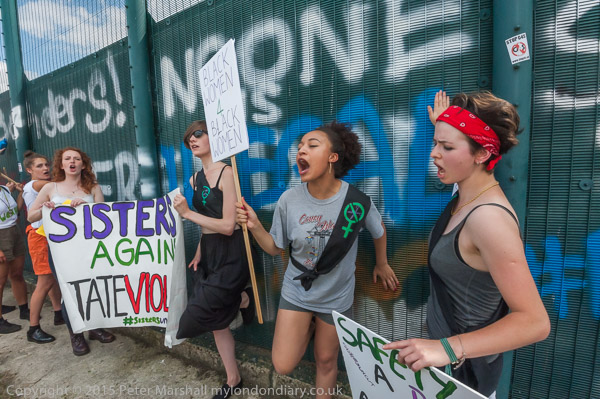
Bloody Murder at Ripper ‘Museum‘: Another of the series of protests by Class War at the so-called museum glorifying the gory murders of working-class women took place on Saturday 5th December 2015.

Bloody Murder at Ripper 'Museum' 2015
A police officer smiles while another looks fixedly away as Jane Nichol displays the bloody head

I photographed most if not all of the protests they organised in a campaign they kept up for some years, showing their disgust at this fake museum, which the owner, Mark Palmer-Edgecumbe got planning consent to open claiming it was to celebrate the powerful history of the women of London’s East end, not their bloody dismemberment by a homicidal maniac.

Bloody Murder at Ripper 'Museum' 2015
Jane Nicholl waves her grandson’s plastic cutlass (or scimitar?) at the Ripper ‘museum’

Class War were always interesting to photograph – and always fun to be with, as well as supporting important campaigns, particularly those around housing problems, bringing both a clear and informed anarchist perspective and a great deal of street theatre.

Bloody Murder at Ripper 'Museum' 2015
The Lucy Parsons banner. The Ripper attacks were by an upper class man on working working-class women

And their publications including the Class War magazine were always a good read, with often penetrating analysis as well as some distinctly black humour, truly black and red and read. You can see many earlier editions online at The Sparrow’s Nest.

Ian Bone’s autobiography, Bash the Rich: True Life Confessions of an Anarchist in the UK is certainly an interesting read and the 1991 Class War: A Decade of Disorder he edited comes with the ‘Publishers’ Warning! This book contains explicit language and illustration which may offend yuppies, police officers, members of the royal family and people who think the world can be changed by holding hands and singing “We shall overcome.” ‘

Bloody Murder at Ripper 'Museum' 2015

As I wrote back in 2015, “Class War re-enacted a murder outside the Jack the Ripper tourist attraction, women hacking and decapitating a dummy wearing the mask of owner Mark Palmer-Edgecumbe with a plastic scimitar and liberally spattering fake blood as others played kazoos

Bloody Murder at Ripper 'Museum' 2015
More fake blood is scattered on the Palmer-Edgecumbe ‘guy’ –
and on my trousers as I took the picture – it washed out easily

Class War is more of a loose association of like-minded people than an organisation and its actions often gain support from many others, including on this occasion and others fourth-wave feminists.

After Jane others took their turn in attacking the dummy which proved remarkably resistant to the plastic scimitar, but finally Jane could triumphantly display the bloody severed head of Palmer-Edgecumbe,

and others came to kick its body.

Women showed their bloody hands,

and Ian Bone came carrying the rolled-up banner and his walking stick to inspect the corpse.

Police wanted Class Wat to remove the Palmer-Edgecumbe ‘guy’ but they declined, saying they were donating it to the museum as one of the few genuine exhibits for their display. Police followed Class War as they walked away to the pub, and it seemed for a moment they might make and arrest – perhaps for littering – but they thought better of it and walked back to guard the shop. They were still there when I left the pub around an hour later.

Ten years later the tacky tourist attraction remains open, though my conclusion to this protest had hoped for a different conclusion:

Thanks at least in part to Class War’s publicity and vigorous protests over around five months others have taken up the fight against the so-called museum, and the fight to get a real museum celebrating the powerful history of the women of London’s East End. It’s a rich heritage with powerful and colourful figures in which the bloody murders by the Ripper are only an insignificant and entirely negative episode. Perhaps it’s now time for others to take up a long-term if probably lower-key campaign here and continue it until this bloody blot on our heritage is closed down.

More of my thoughts about the ‘museum’ and about the protest – with many more pictures – on My London Diary at Bloody Murder at Ripper ‘museum’.


FlickrFacebookMy London DiaryHull PhotosLea ValleyParis
London’s Industrial HeritageLondon Photos

All photographs on this page are copyright © Peter Marshall.
Contact me to buy prints or licence to reproduce.

Gate Gourmet & My Bike Ride – 2005

Gate Gourmet & a Bike Ride: On Sunday December 4th 2005 I got on my bike and rode the roughly 1l miles to Southall, where I locked up my bike (not the Brompton, but an old CinellI racer I’d got many years ago for my 13th birthday) and photographed a protest by workers sacked from their jobs at Heathrow airport catering firm Gate Gourmet.

There is an excellent article on the Striking Women website which gives the background to the dispute and explains why 56 women workers of South Asian origin felt betrayed by the agreement reached by the TGWU over the dispute and refused the compensation offered of between £5000 and £8000 – and refused to leave quietly – though most of the workers took the money rather than fight for justice.

Gate Gourmet & My Bike Ride - 2005

The workers and their shop stewards received little support from the official trade union movement in their fight for justice and the TGWU hardship fund ended its support in January 2006, and the TGWU (by then part of UNITE) cease all support in 2009. Around a dozen of the workers – mainly those who were for various reasons not at work when Gate Gourmet locked the workers out – eventually won claims for unfair dismissal.

Gate Gourmet & My Bike Ride - 2005

The dispute made very clear the extent to which union powers had been emasculated by a succession of Acts passed under Thatcher – the Employment Act 1980, Employment Act 1982, Trade Union Act 1984, Trade Union Art 1990, Employment Act 1988, Employment Act 1990. John Major continued with the Trade Union Reform and Employment Rights Act 1993 and then Blair and New Labour took over the job.

Gate Gourmet & My Bike Ride - 2005

But even given all this, the TGWU ended up caving in to the employers and giving them everything they wanted in the settlement it made.

Below (with minor corrections) is the post I wrote back in 2005.


Gate Gourmet – the Struggle Continues

Southall, December 4, 2005

Gate Gourmet & My Bike Ride - 2005

Gate Gourmet was split off from British Airways in 1997 to cut costs by out-sourcing their catering. It was sold to US company Texas Pacific in 2002, and they also decided to cut costs. This seems to have meant increasing workload, bringing in more managers (why?) and replacing skilled and experienced staff by unskilled workers. They went into a dispute with the TGWU (Heathrow’s major union) over layoffs and worsening conditions, then on 10 August 2005, took on 120 temporary workers.

Their aim was to provoke an unofficial walkout, which would allow them to sack the workers. The workers held a union meeting in the canteen and were told by management that if they were not back at work in 3 minutes they were all sacked. It is claimed that management had locked the doors just to make sure they didn’t return. The workers were then forcibly evicted from the premises by the private security guards the management just happened to have standing around waiting.

Britain’s anti-union laws (thanks to Mrs Thatcher) stack the odds against workers, allowing unscrupulous management to get away with most things short of murder if they put their minds to it.

The TGWU were hamstrung by a High Court injunction, which prevented them from doing much to help the workers. The only thing that helped them was illegal action by their former colleagues at BA, said to have cost that company £40 million. So eventually BA forced Gate Gourmet to come to some kind of compromise with the TGWU, but this has failed to satisfy most of the workers, who wanted their jobs back and decent working conditions. So, although all the papers reported it as over, the action still continues. When my wife flew BA from Heathrow a few days ago, she got a voucher to get sandwiches in the departure lounge rather than in-flight catering.

This is a dispute that highlights the need for proper trade union laws that give workers and unions a fair deal. It shows how union weakness has allowed the Labour Party to renege on the promises it made in opposition and to turn its back on its traditions of fair play. BA has also emerged as pretty short-sighted in its decision to out-source its catering, much as we have found out-sourcing to be a mistake over key services in hospitals and schools.

More pictures on My London Diary


Around Heathrow

December 4, 2005

Farm at Bedfont, immediately south of Heathrow

After the protest I was relieved to find my bike still in one piece where I had locked it and rode home. On my way to Southall I had time to spare and stopped to take a few pictures -and just a few more on my way home. Here is what I wrote in 2005.


I took my usual route to Southall on a push-bike – it takes me around 45 minutes if I don’t stop. but I nearly always do stop at least once to take some pictures. So here are a few pictures from around Heathrow, including a farm. Heathrow swallowed up some of the most productive arable land in the country including a number of fine orchards, but there are still a few farmed areas around its edges – cutting down the dangers of a crash, although some of the most used approaches come in low over many homes.

It was never a suitable site for a major airport, but the chances of any government biting the bullet and closing it down seem low. We should have been running it down for years, but instead have built 2 new terminals (both of which the airport authority said they would never need) and further disastrous development looks likely.

A few more pictures on My London Diary.


FlickrFacebookMy London DiaryHull PhotosLea ValleyParis
London’s Industrial HeritageLondon Photos

All photographs on this page are copyright © Peter Marshall.
Contact me to buy prints or licence to reproduce.

Climate March 2005

Climate March 2005
Climate March 2005 – people meet at the start in Lincolns Inn Fields

Twenty years ago on Saturday 3 December 2005 the Campaign Against Climate Change organised a march calling for urgent action over climate change. Among groups supporting the march were the Green Party, Friends of the Earth and socialist organisations.

Climate March 2005
Umbrellas came in very useful later when it poured with rain

But in 2005 there was no interest from the major charities and mainstream organisations that have since supported some major London marches pointing out the dangers of climate change and global extinction, like most governments they had yet to wake up to the very real dangers facing the future of human life on our planet.

Climate March 2005
Surfers Against Sewage were supporting the march

The Campaign Against Climate Change was one of the first organisations in the UK to serilsly begin organising against global warming – and I remember photographing them back in 2002 pushing an attractive ‘Tiger’ on a bed from the Esso headquarters in Leatherhead to the US Embassy in Grosvenor Square, Westminster. US President George W Bush had put the interests of climate-denying US Oil and fossil fuel companies, notably Esso, above the survival of our species with with his rejection of the Kyoto protocol, agreed in 1997 but only due to come into force in 2005.

Climate March 2005
The Tiger’s message: ‘Esso presents’ ‘Evicted by Climate Change’

Back in 2005, we needed governments to act with urgency, but they failed us and the world. One of those failing then was Tony Blair, whose New Labour government had also betrayed us over the invasion of Iraq as well as over climate change. And now in 2025 we have another Labour government, now under Keir Starmer, pressing ahead with new climate-destroying road schemes, oil exploration and extra runways rather than facing up to the need to change our assumptions and way of life in ways that would reduce CO2 emissions and slow global warming.

Climate March 2005
Death to Future Generations is the bleak prospect we face

Saturday 3rd December 2005 was an international day of climate protest but the march to the US Embassy in London achieved little media coverage – the billionaires who own and control most of our media have little interest in the subject (and probably large financial interests in fossil fuels and other drivers of climate change.) Even the BBC had been a hive of complacency, and have given a totally unwarranted level of coverage to those who continue to refuse the overwhelming scientific evidence. Though now they are perhaps beginning to realise that you cannot have ‘balance’ over scientific fact.

The ‘Statue of Taking Liberties’ was at the Front of the march to the US Embassy

Here – with minor corrections – is what I wrote about the march back in 2005 – and a few of the pictures I took at the event – you can see more on My London Diary at the link at the bottom of this page.


Kyoto was the first attempt to at least recognise the problem was global and take some concerted action, even if less than half-hearted. Thanks to George Bush and the oil companies he represents, the ineffectual has been made even more so.

Problems related to growth and pollution are inextricably linked with industry and trade. It is hard to see any possibility of their solution without the imposition of tariffs on the exports of countries that continue to pollute – such as the USA. It’s equally hard to envisage this happening while the USA is so dominant in the world bodies and conferences that set the rules on trade.

Rising Tide

There were around 10,000 of us on the streets of London on Saturday, and many more around the world in demonstrations elsewhere, all part of the International Day of Climate Protest, the march in London organised, as previous climate marches and protests, by the UK Campaign Against Climate Change.

A sit down in pouring rain in Parliament Square is not a good idea

Here in London the climate smiled on us for an hour or so, then the rain came as the march entered Parliament Square. It was pouring rain rather than the police that persuaded the students who sat down in front of the Houses of Parliament that it was a good idea to get up and move on.

My camera also began to suffer, and I needed to move inside to dry it out. My injured knee was beginning to hurt too, so I decided it was time to take a rest and go home.

More pictures begin here on My London Diary.


FlickrFacebookMy London DiaryHull PhotosLea ValleyParis
London’s Industrial HeritageLondon Photos

All photographs on this page are copyright © Peter Marshall.
Contact me to buy prints or licence to reproduce.

Another Don’t Bomb Syria Protest – 2015

Another Don’t Bomb Syria Protest: On the evening of Tuesday 1st December 2015 a protest by Stop The War again called on MPs not to back David Cameron’s motion to bomb Syria.

Another Don't Bomb Syria Protest - 2015

There was a large crowd in Parliament Square who listened to speeches by a wide range from the British left including Andrew Murray, Lindsay German, Salma Yaqoob of Stop the War, Kate Hudson of CND, SNP MPs Philippa Whitford and Tommy Sheppard, Former Green Party leader Caroline Lucas, Labour’s Richard Burgon and Imran Hussain, Weyman Bennett of Unite Against Fascism, Momentum organiser Adam Klug, George Galloway.

Another Don't Bomb Syria Protest - 2015

I photographed all of these speakers and you can see several pictures of most of them on My London Diary.

Another Don't Bomb Syria Protest - 2015

But as in the previous Stop The War protest, there were “no speeches by Syrians or Kurds, and no real attempt to take their views into account. And while the speakers all condemned the UK plans to bomb in Syria, there was no condemnation of the Russian bombing of the Syrian opposition, perhaps a greater threat to the Syrian people than Daesh, and certainly than the handful of UK planes.

Another Don't Bomb Syria Protest - 2015

Present in the crowd were a number of supporters of President Assad, with flags of his regime, though most of those present were opposed to the Assad regime and Daesh as well as to bombing by the UK.

John Rees of Stop the War

As I commented, “It’s rather unfortunate that the only organisation promoting large-scale protests against the bombing is Stop the War rather than one clearly supporting the aspirations of the Syrian people for freedom.”

Hours after this protest, Stop the War issued an article ‘For the avoidance of doubt‘ by John Rees which began by stating “The STWC has never supported the Assad regime.” I commented: “Well, it’s good to make that clear, because there have been many protests by Stop the War which Assad supporters have attended and appeared to be welcome, and by refusing to let Syrians opposed to the regime speak at this and other protests STW have certainly given that impression.”

It had become clear by 2015 “that while our government has fulminated against ISIS/Daesh it has also been complicit in support for them through its support of Saudi Arabia which provides support for their Wahabi ideology and more materially, for Turkey which is deeply involved in their oil exports, refining much of their output as well as providing pipelines and ports, and Israel which is the major customer for the smuggled oil.”

The bombing which later took place was largely ineffectual, hypocritical and immoral. While inflicting “little damage on Assad’s military inflicting real damage on the economic and military capability of Daesh” it was as predicted “catastrophic in effect on the civilians” that were bombed either deliberately or by accident.

After the speeches, the protesters marched first to the Tory HQ and then to Labour to deliver letters before returning to Parliament Square where the official protest ended.

A police officer tells Jasmin Stone that megaphones are not allowed to be used in Parliament Square

Many stayed on in the square and there were minor incidents with police making a few who had climbed onto the plinth of Churchill’s statue come down and stopping some from using a megaphone. But after a few minutes I decided it was time to go home.

More about the protest and many more pictures at Don’t Bomb Syria.


FlickrFacebookMy London DiaryHull PhotosLea ValleyParis
London’s Industrial HeritageLondon Photos

All photographs on this page are copyright © Peter Marshall.
Contact me to buy prints or licence to reproduce.

Second Day of Student Fees Protests – 2010

Second Day of Student Fees Protests: London Tuesday 30th November 2010 - A student holds a lighter to set fire to a placard
Second Day of Student Fees Protests: London Tuesday 30th November 2010 – A student holds a lighter to set fire to a placard

Six days earlier a march against the Browne Review of Higher Education Funding, which had advocated an increase in tuition fees, allowing them to rise to £9000 a year, as well as the scrapping of the Educational Maintenance Allowances (EMA) for 16-18 year old and other changes including closing many arts and humanities courses had led to an angry confrontation between students and police when police decided to halt and kettle the march in Whitehall.

Second Day of Student Fees Protests - 2010

I had been there and reported at some length on the events, including the smashing of a worn-out police van which seemed to have been deliberately left by the police “as a plaything for the protesters” and charges in which some “police made pretty liberal use of their batons and a couple clearly went a little berserk“, and protesters were in danger of being crushed, screaming that they couldn’t breathe.

Second Day of Student Fees Protests - 2010

It hadn’t been like those protests I had taken part in during the late 60’s and most of those taking part “were probably well-behaved students on their first demonstration” who when more militant students breached the police lines “just stood around wondering what to do rather than following them.”

Second Day of Student Fees Protests - 2010

I concluded:

“It had been a pretty confused situation, and it seemed to me that neither police nor students came out of it with much credit. The police tactics seemed designed to create public disorder by kettling and a small minority of the students rose to the bait. Although most of the students were out for a peaceful march and rally and to exercise their democratic right to protest, the police seemed to have little interest in upholding that right.”

Protesters run down Whitehall – but turn around when get close to a police line

The following Tuesday around 5000 students came back to Trafalgar Square for what was meant to be a peaceful march at 1pm along the same route down Whitehall to a rally in Parliament Square – which had been agreed in advance with police. I think both sides wanted to avoid a replay of the previous week.

They go back and through Admiralty Arch – with not a policeman in sight

But shortly after noon, more radical students, including a group of younger students who would lose the EMA took to the plinth under Nelson’s column and called for the crowd to go down Whitehall and demonstrate at Downing Street; several hundreds followed them.

When they see the police in Parliament Square they turn around again

There were only a few police at the top of Whitehall and clearly they stood no change of stopping them, but their attempts to do so heightened the tension and when police formed a tighter line further down Whitehall the protesters began shouting that they were being kettled.

They turned around and went under Admiralty Arch and on to the Mall before continuing down Horse Guards Road. Police followed them, walking beside them as they crossed into Storey’s Gate, then turned into Parliament Square.

Near Hyde Park Corner

By now this group of protesters – perhaps by then a thousand or two were obsessed with the idea that they were being kettled – and certainly there were a large number of police in Parliament Square, particularly behind barriers set up in front of Parliament and at some of the exits from the square.

A police medic attacks a protester in one of the only violent incidents I witnessed

The protesters turned around and walked and ran, beginning a “long rather rapid walk around London“, rather painful for me as I was still suffering from a foot injury, “taking in Hyde Park Corner, Piccadilly Circus, Oxford Circus and Oxford Street and turning down Kingsway at Holborn and then walking into the City of London along Fleet St” with a couple of hundred police walking along the side of the march.

The march passes the Stock Exchange

Most of the Met police stopped at the City of London boundary as the march continued “past St Pauls, the Stock Exchange, on up some of the narrow winding streets around St Bartholomews Hospital (it rather looked as if they were trying to kettle themselves there) to Smithfield Market before going back along Holborn Viaduct where I eventually left them to catch a bus and make my way back to see what was happening in Trafalgar Square.” The City of London Police had seemed to ignore the march and there was little or no trouble on their patch.

In Trafalgar Square there were still some of the original demonstrators but things were pretty quiet. There were police at the exits but people could walk past in both directions; “the protest was being isolated and watched rather than being kettled.”

Some of those I had been marching around London with made their way back into the square and there were a few short speeches before one of the official organisers announced that the demonstration was over and police would be happy for people to leave in small groups towards Charing Cross Station.

But most people decided to stay on and there were a few scuffles with police, with other students “linking arms in front of the police to protect them and stop any violence.”

It was snowing and beginning to get dark and it seemed to me that little further was happening so I walked out of the square and went home. It had been a confusing and tiring day for me. Later I heard that small group who had remained in Trafalgar Square had been kettled and some had been arrested.

More at Students Fees Protest – Day 2.


FlickrFacebookMy London DiaryHull PhotosLea ValleyParis
London’s Industrial HeritageLondon Photos

All photographs on this page are copyright © Peter Marshall.
Contact me to buy prints or licence to reproduce.


Leveson & Cold Homes – 2012

Leveson & Cold Homes: On Thursday 29th November press and protesters were outside the QEII centre waiting for the publication of the Leveson inquiry report, and were joined briefly by people who had been protesting outside the treasury over George Osborne’s cuts and energy policies and later moved to protest outside parliament where Energy Secretary, Ed Davey was to introduce the Energy Bill.

Leveson Comes Out

QEII Centre

Leveson & Cold Homes - 2012

Lord Justice Leveson had been appointed in 2011 to lead an inquiry into the culture, practices, and ethics of the British press after the News of the World had been found to have illegally hacked into the phones of celebrities, politicians, royals and others since the 1990s.

Of course the News of the World which had been closed down by Murdoch’s News International in 2011 over this was not the only newspaper to have used illegal hacking. As well as other papers in the Murdoch Press it was said to be fairly widespread across the tabloid papers.

Leveson & Cold Homes - 2012

The Leveson Inquiry was to be in two parts and the report on Part 1 was due to be released on 29th November 2012. Part 2 which was to examine the extent of phone hacking in News International and other media as well as the complicity of the police in receiving bribes and other ways was shelved in 2015 and then scrapped in 2018.

Leveson & Cold Homes - 2012

Leveson found that the Press Complaints Commission was toothless and ineffective and recommended that a new voluntary independent body be set up. There are now two press regulators; Impress, which largely follows Leveson’s proposals and IPSO, the Independent Press Standards Organisation which as its name says remains independent, and which more publications have signed up to, while others, including The Guardian belong to neither.

This was a small but visually interesting protest, and ss I wrote in 2012:

Leveson & Cold Homes - 2012

Avaaz had brought large puppet heads of Murdoch and a gagged Cameron with placards ‘End the Murdoch Mafia’ and a flaming dustbin into which Murdoch lowered the Leveson report.

Political artist Kaya Mar had brought one of his paintings with the judge and a cart-load of people, though I couldn’t recognise them all.

And a protester from Kick Nuclear was walking up and down with his dog which was wearing a poster about Fukushima warning of the dangers of nuclear power.

More pictures at Leveson Comes Out.


Cold Homes Kill Treasury Protest

Westminster

Fuel Poverty Action along with others including Disabled People Against Cuts, the Greater London Pensioners’ Association, Single Mothers’ Self-Defence, Southwark Pensioners’ Action Group and WinVisible (women with visible and invisible disabilities) had come to protest against the cuts to come from George Osborne’s energy bill which they say will cause 24,000 extra winter deaths.

The protest which began outside the Treasury and then moved on pausing briefly at the Leveson protest outside the QEII centre to Parliament Square in front of the House of Commons where Secretary, Ed Davey, was to introduce the Energy Bill later that day.

“The protesters had brought plastic silver reflective coated ‘space blankets’ to wear and had three ‘tombstones’ with the messages ‘George Osborne Your Cuts KILL’, ‘Gas Power = Killer Bills’ and ‘24,000 Winter Deaths – Big Six Profits up 700%’.”

They say that already because of the government cuts many people were going hungry, with food banks being set up and kept busy even in the more prosperous areas of the country, and now with winter coming many have to chose between ‘eating or heating’.

A protester with a hot water bottle tries to walk into the Treasury but is stopped by the police

Cuts will mean more people suffering from “hypothermia, and the disabled in particular are hard hit, both because of the ruthless removal of benefits by poorly designed tests adminstered by poorly qualified testers with targets to meet and also because they often have special needs for heating.”

The protesters ignored police requests to leave the steps up to the Treasury and police then pushed them down, “usually with minimum force, but just occasionally rather more than necessary, but both protesters and police generally remained calm.” The rally continued on the pavement with speakers including Green Party leader Natalie Bennett.

After this the group of 50 or so protesters moved to the pavement in front of the Houses of Parliament, pausing briefly on the way for photographs in front of those waiting for the Leveson report.

Police again tried to get them to move on when they stopped in front of the Houses of Parliament, at first telling them they had to move as “a Royal movement” was about to take place, an announcement that cause much hilarity and comment but no movement. A little later they were told they could stay, but decided instead to cross onto the grass in Parliament Square for some final photographs.

More pictures at Cold Homes Kill Treasury Protest.


FlickrFacebookMy London DiaryHull PhotosLea ValleyParis
London’s Industrial HeritageLondon Photos

All photographs on this page are copyright © Peter Marshall.
Contact me to buy prints or licence to reproduce.


Don’t Bomb Syria – 2015

Don't Bomb Syria - 2015
Don’t Bomb Syria – a woman listens to the speeches at the rally

Several thousands had come to Downing St on Saturday 28th November 2015 to urge MPs not to support British air strikes on Syria and more arrived as the rally was beginning bring the number up to perhaps ten thousand.

Don't Bomb Syria - 2015

Police who had tried to restrict the crowd to the wide pavement area were forced to stop traffic on the southbound carriageway, but put in a row of barriers so they could keep northbound traffic moving.

Don't Bomb Syria - 2015

There were a long list of speeches – you can read a partial list and see photographs of most of them on My London Diary.

Don't Bomb Syria - 2015 Tariq Ali
British Pakistani writer, journalist, and filmmaker Tariq Ali

The speakers called for the need to take effective action against the Turkish complicity in Daesh oil exports, in which members of Erdogan’s family take a leading role, and against what Tariq Ali described as “the obscenity of the Wahabi regime in Saudi Arabia” which provides the fanatical religious basis and much funding for Daesh. And, always in the background, the continuing crisis over Palestine.

Kaya Mar had brought 3 paintings

But there seemed to me to a glaring omission. As I wrote, I was there “with notebook poised ready to write down the names of the speakers representing the Syrians and the Syrian Kurds, who should surely have been at the forefront of this protest rather than so many old ‘Stop the War’ war-horses. None came, not because none were available or willing to speak, but because the politics of those most closely involved don’t accord with those of Stop the War.”

Throughout the speeches some protesters had been trying to move across onto the roadway directly in front of Downing Street. Eventually so many moved past the barriers that it became impossible for the police to force them back and keep the road clear for traffic.

Hundreds then sat done on the road and were still there chanting ‘Don’t Bomb Syria’ and other slogans well after the speeches had ended. After around an hour after police reinforcements arrived.

Previously police had been trying to persuade the protesters to stand up and leave the road with little success, but now they were warned they would be arrested if they failed to do so. Some were more reluctant than others to move, but I think eventually all did and I saw no arrests.

People slowly decide to move rather than be arrested

In September 2014 the UK Parliament had voted overwhelmingly in favour of British air strikes against ISIS in Iraq, but Parliament had also blocked the government’s plans for military action against Syria after the 2013 Ghouta chemical attack.

PM David Cameron had repeated calls for air strikes following a mass killing of tourists by an Islamist militant group in Tunisia, but it was only after the terrorist attacks in Paris in November 2015 that the House of Commons approved air strikes against ISIL in Syria – which began hours later in December 2015. In the next 15 months the RAF carried out 85 strikes – and there have been others since.

Many more pictures on My London Diary:
Don’t Bomb Syria
Speakers at Don’t Bomb Syria
Don’t Bomb Syria Blocks Whitehall


FlickrFacebookMy London DiaryHull PhotosLea ValleyParis
London’s Industrial HeritageLondon Photos

All photographs on this page are copyright © Peter Marshall.
Contact me to buy prints or licence to reproduce.


Stop Killing Cyclists Die-in 2015

Stop Killing Cyclists Die-in
Stop Killing Cyclists Die-in at TfL, Blackfriars Rd

Ten years ago today I was outside the Transport for London Offices on the evening of Friday 27th November 2015 for a rally and die-in by cyclists calling for much greater provision for safe cycling in London.

Stop Killing Cyclists Die-in
A row of 21 coffins remembering the 21 cyclists killed in London 2013-2015

This was two years after their earlier die-in here which had followed the killing of six cyclists in a terrible fortnight on London roads. And after a rally with speeches, poetry and music and reading the names of the 21 cyclists killed, people and bikes again blocked this junction on Blackfriars Road with a short die-in, closing the junction for 15 minutes.

Stop Killing Cyclists Die-in

On My London Diary I wrote a fairly lengthy account of the rally, which included speeches from several cyclists who had been seriously injured on London’s roads and were fortunate to still be alive. But in the two years since the previous die-in here, 21 cyclists had been killed and at the protest there was a row of 21 white coffins on the pavement outside the TfL offices, one for each death.
Stop Killing Cyclists Die-in

Most cyclists are killed by drivers of heavy goods vehicles, particularly skip lorries, which have very limited vision vision behind and to the side and are unaware of the presence of cyclists.

Stop Killing Cyclists Die-in

In the two years since 2013 progress on cycle safety has been very limited, and before this protest the organisers, ‘Stop Killing Cyclists‘ had sent a questionnaire to all the candidates standing in the forthcoming election for Mayor of London asking them whether they supported the demands for safer cycling, in what they called the “10% by 2020” London Mayoral Cycle Safety Challenge.
You can read the ten demands on My London Diary but the first was for 10% of TfL budget to be spent on cycling safety by 2020. Stop Killing Cyclists point out that this spending and their other proposals would also make London safer for pedestrians and by encouraging cycling (and walking) would make London healthier for us all.

One of the speakers was Professor Brendan Delaney, a doctor working in London, who pointed out that air pollution which comes mainly from traffic, particularly diesel-engines in buses and lorries, is thought to kill around 7,000 a year in London. More people cycling and less traffic could reduce that number dramatically.

The demands also called for a speed limit of 20 mph (except on motorways) across London and more traffic free areas and all five candidates supported the pedestrianisation of Oxford Street. Only Sian Berry of the Green Party and Independent Rosalind Readhead (who stood to ban private cars from London’s Zone 1 & 2) supported the 10% budget demand, though Labour’s Sadiq Khan promised a “significant” increase.

Green Party Mayoral candidate Sian Berry (in black coat)

In his first two terms as Mayor, Khan massively expanded the network of protected cycle tracks and also brought in and improved the Direct Vision lorry standard. And the expansion of the ultra low emission zone (ULEZ) to cover all of London has greatly improved air quality. But this in particular led to considerable public opposition and was blamed by Labour for them failing to win the Uxbridge by-election – although they still came close in what had long been a safe Tory seat.

Donnachadh McCarthy makes the final speech after the 15 minute die-in

Labour’s 2024 election victory has been a disaster for sensible transport planning – as well as more general environmental policies – with a switch to supporting major road-building, a third runway at Heathrow and other measures. Active travel seems no longer to be one of his or TfL’s priorities. Pressure from Labour leader Starmer after Uxbridge forced Khan to commit to not implement smart road user charging in his third election manifesto, severely damaging any chance of realising his ambition to make London a ‘Net Zero’ city including for transport by 2030.

More about the protests and more pictures on My London Diary at Stop Killing Cyclists Die-in.


FlickrFacebookMy London DiaryHull PhotosLea ValleyParis
London’s Industrial HeritageLondon Photos

All photographs on this page are copyright © Peter Marshall.
Contact me to buy prints or licence to reproduce.