London University & Israeli Prisons – 2014

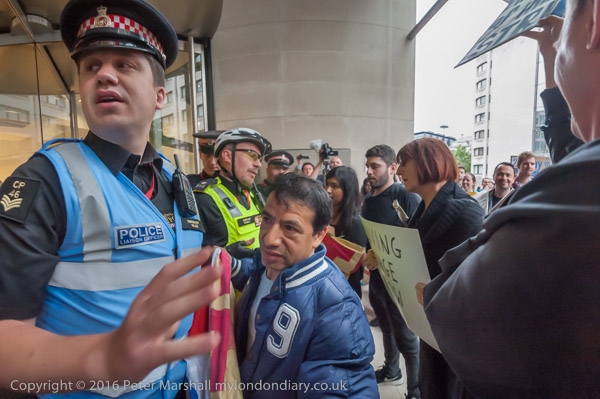
London University & Israeli Prisons: On Friday 28th February 2014 I went with students as they hunted in and around Senate House for a meeting of University of London Vice Chancellors to protest against the attacks on students and the idea of a university as these managers have called in police onto the campus rather than engage with students and staff.

From there I went to a protest outside the London offices of security firm G4S who supply services to Israels notorious prisons where many Palestinians have been tortured and prisoners including many children are kept under inhumane conditions.


Students tell Vice Chancellor to Resign

Senate House
London University & Israeli Prisons - 2014

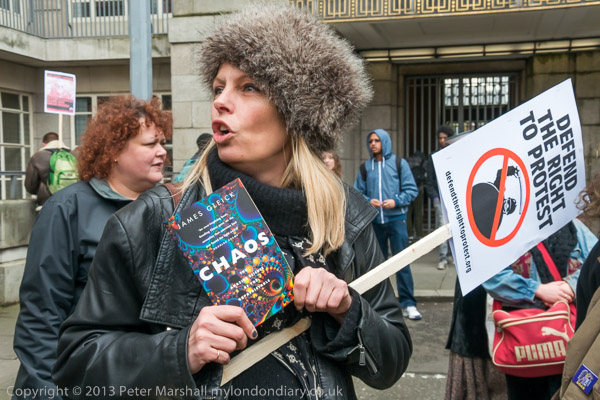
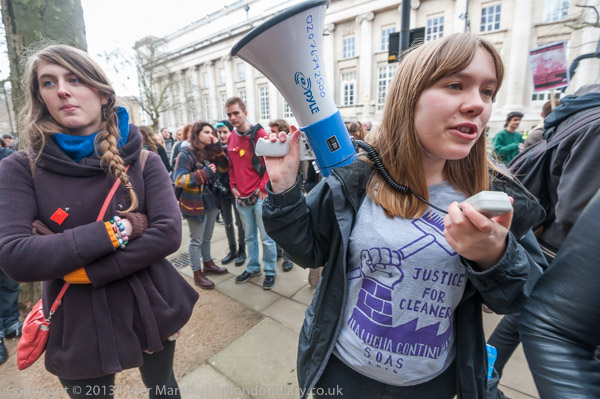
Students and many academic staff have been appalled by the actions of London University (UoL) managers under Vice Chancellor Professor Sir Adrian Smith who have called in police to subdue student protests, and were calling on him to resign.
London University & Israeli Prisons - 2014

This has led to mass arrests, injuries and blood on the streets. The UoL was shutting down its student union, exploiting and intimidating low-paid staff, leading the lobby for a huge fees increase fees and attempting to prevent protests, taking out an injunction against any student occupation of the University.
London University & Israeli Prisons - 2014

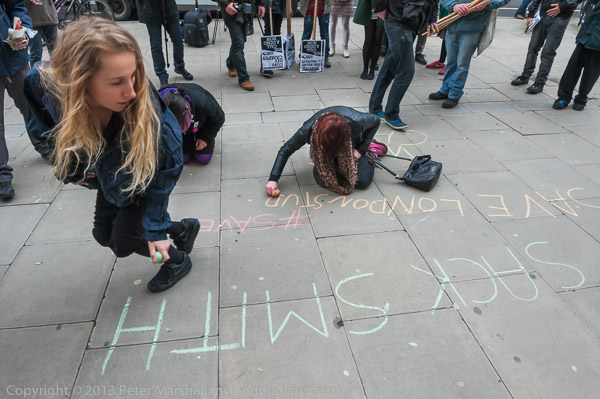
One student earlier in the week had been convicted of criminal damage for chalking “sick pay, holiday, pensions now” on a foundation stone at a protest in support of low paid staff last July. She was was ordered to pay £200 towards prosecution costs and £810 to cover the cost of repairs to the stone – almost certainly the most expensive wipe with a damp cloth in history. Fortunately a video of her arrest made clear that police were lying when they accused her of assaulting an officer when she was arrested.
London University & Israeli Prisons - 2014
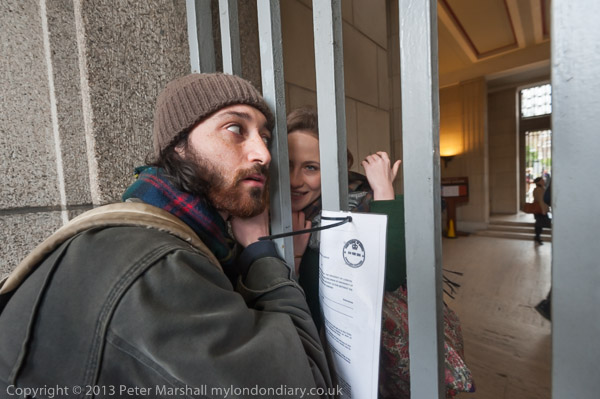
The gates to the undercroft were locked

The protesters met outside the University of London Union (ULU) and then walked towards Senate House, where security guards locked the gates to the area under the building in front of the entrance.
London University & Israeli Prisons - 2014
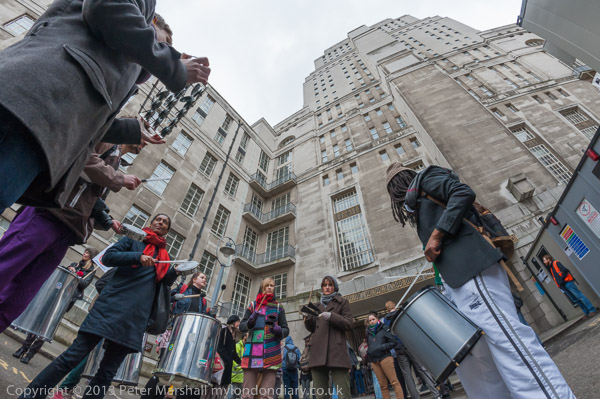
A samba band ensures the protest is heard inside Senate House

After a short and noisy protest there, they decided to walk to the pavement outside the south side of Senate House as they thought the meeting would be taking place in one of the rooms there. After another short protest there they walked back to the east side of Senate House where again the gates were locked.

A few students were inside the building and they managed to unlock one of the side doors into the building and I went inside with some of the students.
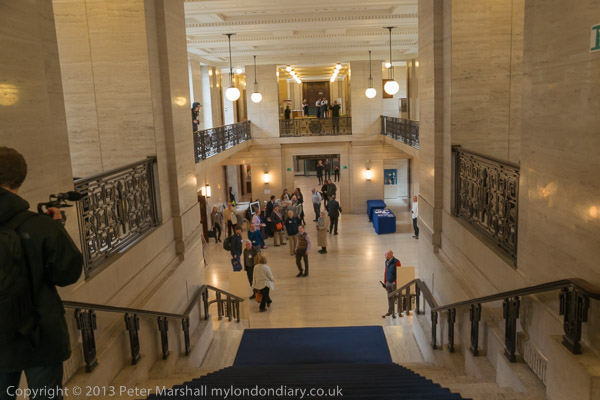
We wandered around the corridors without finding the Vice Chancellors, although the building was in use for various other meetings and events. Eventually the protesters came to the balconies above the Crush Hall where some other conference delegates were taking lunch and explained to them from above why they were taking action.

Security were standing in front of the Vice Chancellor’s Office, possibly the most likely location for the Vice Chancellors to be meeting. One of the security men assured them it wasn’t there and they did not try to push past.

They went down the the lobby in front of the main entrance and managed to hold the gates open as security officers tried to close them so more of the protesters could come inside, managing to push their way back into the building for another tour. But again they could not find the meeting.

Some students climbed through a window to a balcony at first floor level around the side of the building; I didn’t go with them but made my way out of the building. The main entrance was closed and anyone wanted to leave had to make a long detour through a basement corridor to neighbouring Stewart House.

Students were still walking along the balcony when I arrived at street level outside, and were walking back into the building through an open window that I was told led into one of the Vice Chancellor’s rooms.

It seemed unlikely I would be able to get inside the building to take more pictures and I left to photograph another event.

More about the protest and many more pictures on My London Diary: Students tell Vice Chancellor to Resign.


G4S & Israeli Prison Torture

Victoria St
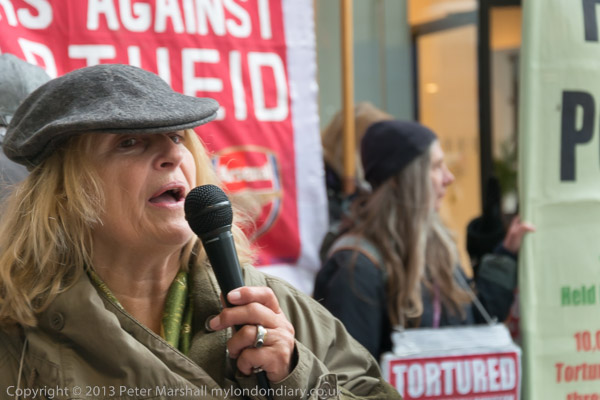
It was International Israeli Apartheid Week and Inminds Human Rights Group were protesting outside the offices of G4S, the worlds largest security firm, complicit in Israel’s violations of international law and gross human rights abuses, including torture of men, women and children.

One of their banners gave details of the tiny cells in which child prisoners are held, about 2 metres by 1 metre, with a just a mattress and behind a low concrete wall a hole in the ground toilet. There are no windows, and food is delivered through a flap in the door. The light is kept on 24 hours a day and the walls have sharp protrusions to prevent them being leaned on.

Children as young as 12 have been kept in solitary confinement in these cells for up to 65 days, being taken out only to be interrogated while shackled hand and foot for up to 6 hours at a time. Some complain of having been sexually assaulted.

This mistreatment is continued until they confess to such crimes of throwing stones at Israeli army vehicles – for which they can be sentenced to 20 years in jail.

Placards showed the five Hares boys, and leaflets were handed out telling their story. After Israelis from an illegal settlement complained that stones had been thrown at them when they stopped their car to change a tyre, 50 children from Hares were arrested by Israeli soldiers with attack dogs, and 19 of them taken to the G4S secured children’s dungeons at Al Jalame, locked in solitary for up to 2 weeks.

There they were violently tortured and threats made against female members of their families to force confessions from them. Five of the boys were then each charged with 25 counts of attempted murder, despite the occupants of the car being unharmed. At the time of the protest their trial by military court had been postponed month by month, probably because of a lack of any evidence.

In January 2016 the five Hares boys were each sentenced to 15 years in prison following a plea deal “that involved ‘fines’ of NIS 30,000 (appr. €7,100 or $7,750) per boy to be paid to the settler driver as ‘compensation’” Otherwise they would have received longer sentences despite the only evidence against them being their ‘confessions’ extracted under extreme torture.

More at G4S & Israeli Prison Torture.


FlickrFacebookMy London DiaryHull PhotosLea ValleyParis
London’s Industrial HeritageLondon Photos

All photographs on this page are copyright © Peter Marshall.
Contact me to buy prints or licence to reproduce.
Smash EDO Protest Moulsecoomb Arms Factory – 2010

Protests had begun against a small EDO-MBM factory at Moulsecoomb on the outskirts of Brighton in 2003 after the press had revealed that it was making parts for a guided bomb that was being used in the invasion of Iraq.

Smash EDO Protest Moulsecoomb Arms Factory
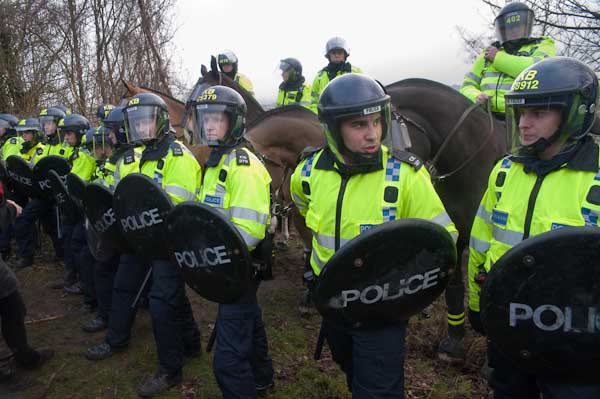
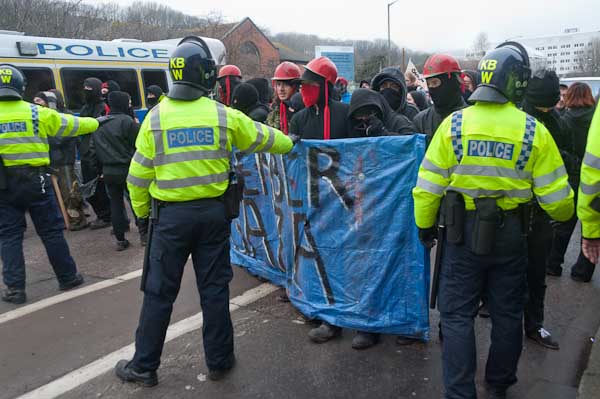
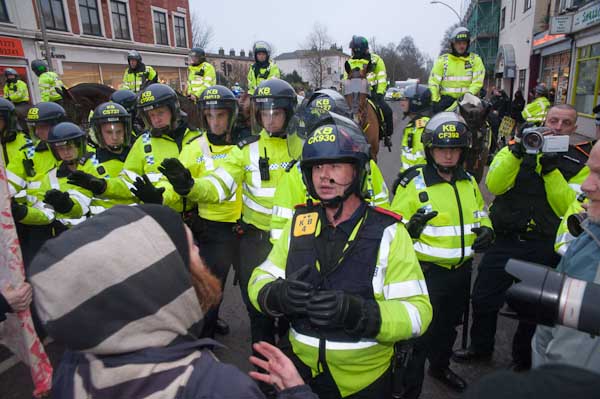
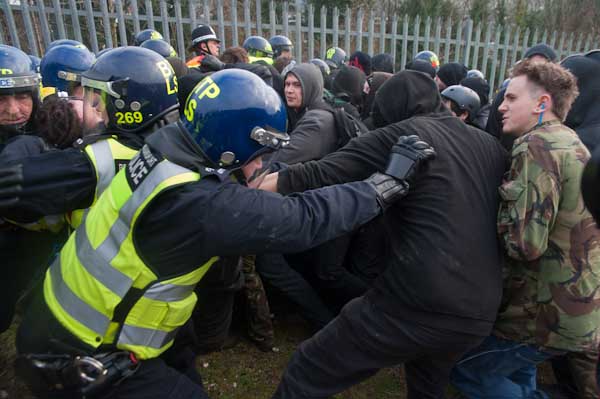
Police push Smash EDO protesters, 2010

In April 2005, EDO attempted to get a wide-ranging injunction to prevent protests at the site, including stepping onto the road outside the factory, playing music and taking photographs. This was the start of a lengthy legal action in which the UK Attorney-General became involved, as the defendants had submitted a detailed dossier on war crimes involving air strikes on civilian areas and infrastructure and were arguing that the invasion was an illegal war of aggression in breach of the UN Charter.

Smash EDO Protest Moulsecoomb Arms Factory

The Wikipedia article states “The court found that if there was an imminent war crime that the protesters believed on reasonable grounds, was about to take place, in which EDO were complicit, then preventative direct action could lawfully be taken against the company without waiting for the authorities of the state to intervene. This ruling effectively allowed proportionate direct action against companies by protesters, if the threat of the crime was imminent and specific.”

Smash EDO Protest Moulsecoomb Arms Factory
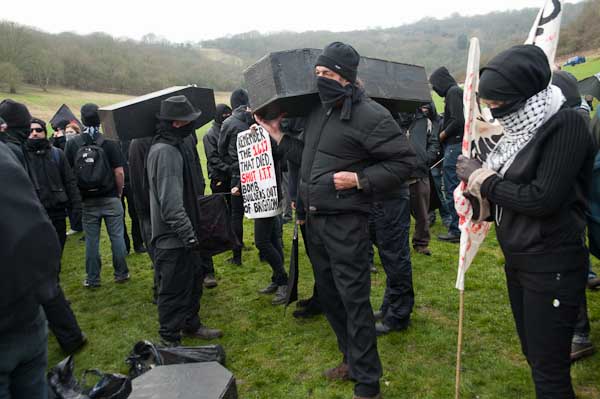
Coffins to remember the 1417 Palestinians killed – some by Brighton-made bombs

Some of the defendants signed an out of court settlement with EDO in April 2005 after it was put forward by Keir Starmer and they were then told legal aid would be withdrawn unless they agreed. They then intervened with a suggestion which was them he would withdraw their legal aid and they signed “undertakings not to do certain things that they had never done and had no intention of doing” with EDO agreeing to pay their costs, as well as their own, and the injunction against those not in court was lifted.

The case against three defendants who were conducting their own defence continued as they refused to sign these undertakings. In March 2006 a judge agreed with them that EDO had failed to make the preparations for a speedy trial as ordered by the court, and the company dropped the case rather than face further proceedings for abuse of process, paying the full costs of all those involved. The whole legal business is thought to have cost EDO between £1-1.5m, more than a years annual profit for the Brighton factory.

Police block the road to the factory

In 2009 weapons supplied by EDO were being used in the Israeli attacks on Gaza and a small group of activists decommissioned’ the factory to prevent exports to Israel. Again EDO went to court and they were again unsuccessful with the court finding all of those charged not guilty.

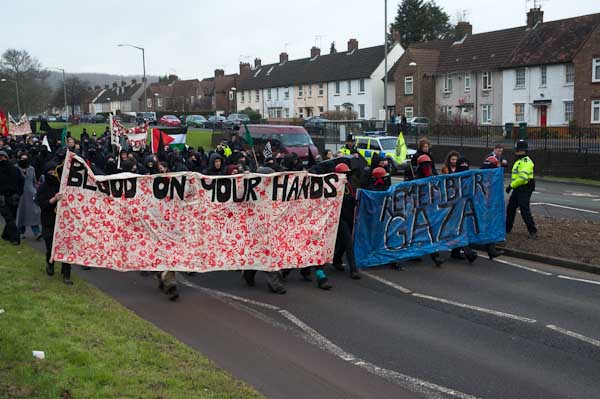
On Monday 18th January 2010, the first anniversary of the end of the Israeli war against Gaza, I went to photography Smash EDO activists in Brighton who were protesting against arms manufacturer EDO MBM/ITT who made some of the weapons that killed 1417 Palestinians, mainly the elderly, women and children, during the three-week assault.

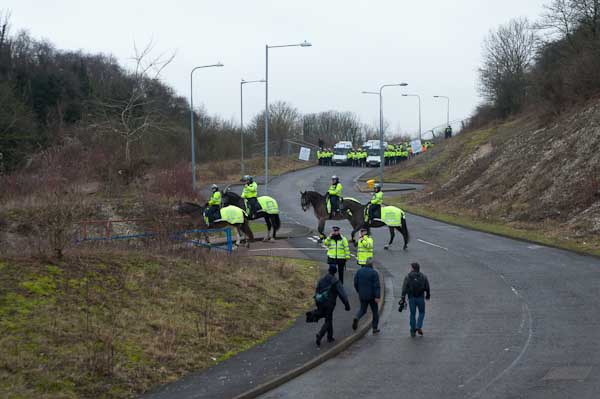
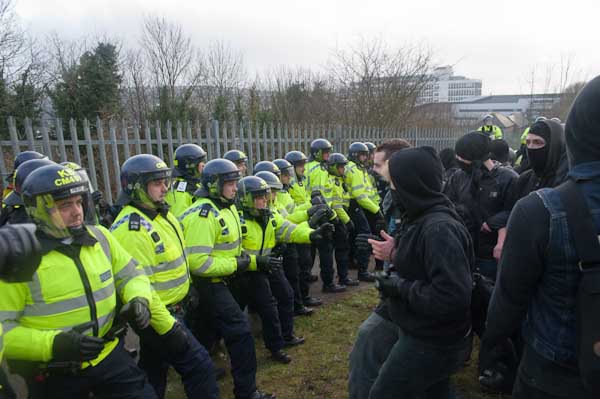
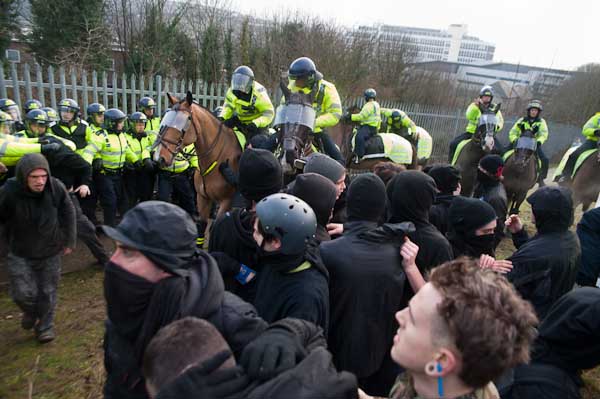
Despite earlier rulings that such protests were legal, the police had come determined to stop this one taking place, responding to the protesters who they probably outnumbered with an impressive display of force and violence as they attempted to make their way to protest at the factory.

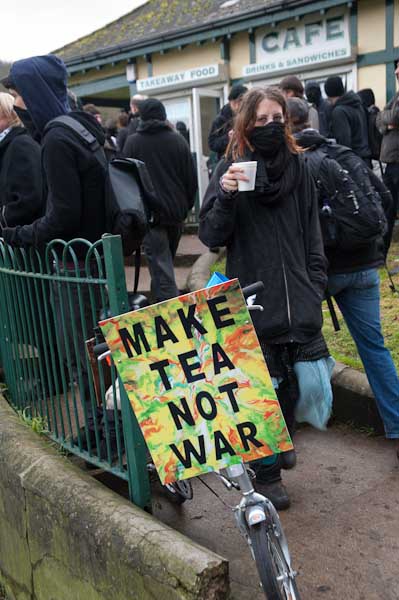
I went with the protesters as they tried to go around the police lines through the woods and along a footpath and was able to photograph some of the confrontations. You can see more of what happened on that day in the pictures and the captions in my post on My London Diary.

What I don’t mention there is that like many of the protesters I was also assaulted several times by some of the officers while taking pictures, and at one point only just managed to stop myself going over a roughly 50ft drop when pushed violently by one of them. Other officers helped me up and to move away from the edge, but it was at times a scary event to cover. I was bruised and shaken as well as tired and left Brighton while the police were still harassing the protesters who had marched back towards the centre of the town.

Protests continue at EDO’s factory, now led by Brighton Against the Arms Trade, after the Moulsecoomb factory was found in 2019 to have produced arms used in a Saudi ‘attack that violated international law’ against a civilian target in Yemen and to be involved in helping Turkey to get around US attempts to prevent the proliferation of drone warfare.


UVW at Wood St – 29 June 2016

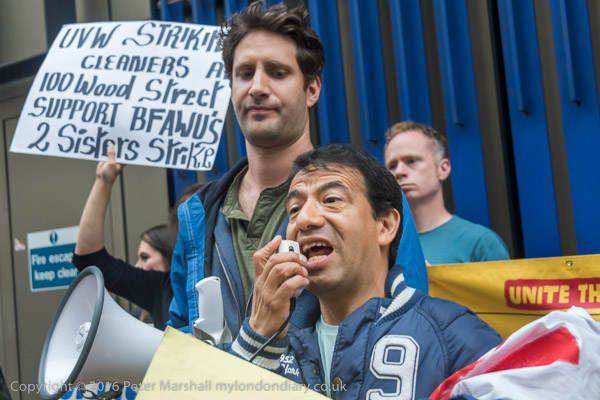
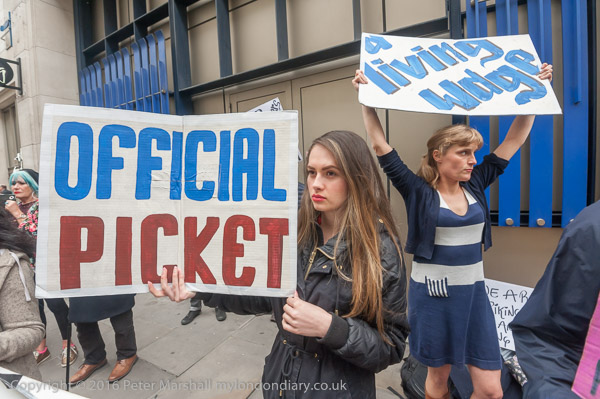
The strike and protests organised by the United Voices of the World union against anti-union cleaning contractor Thames Cleaning who employed the cleaners at the 100 Wood St offices in the City of London, managed by CBRE and mainly let to Schroders and J P Morgan is a good example of one of the things the current Police, Crime, Sentencing and Courts Bill is aiming to prevent.

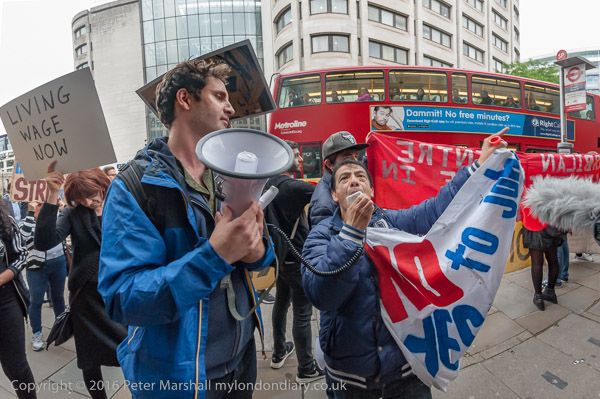
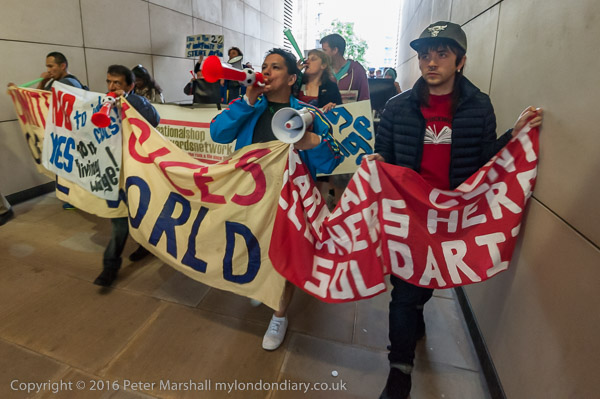
The UVW use loud rallies and protests outside workplaces (and sometimes in their foyers) to shame employers who are exploiting low paid workers, many migrants, into talking to the union. These workers, often employed by small and intensely anti-union companies, are often on minimum legal rates of pay, well below the London Living Wage and usually on the statutory minimum (and minimal) conditions of service – and sometimes even have problems getting these.

Outsourcing of low paid work such as cleaning is widespread, and contractors get the contracts by cutting costs – such as wages and conditions of service – and also by using bullying management to over-work their employees. Often too they cut costs by ignoring safety issues and failing to supply protective clothing and other essential safety material.

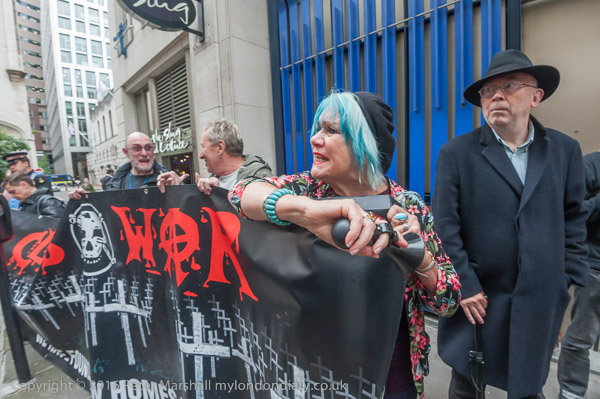
The UVW strike at Wood St was the longest industrial dispute in the history of the City of London, and it continued after Thames Cleaning had agreed to pay the London Living Wage for some days until they also agreed to re-instate the two workers who had been sacked. These pictures come from a rally on day 22 of the 58 day strike.

The strike was only successful because of the continuing pressure provided by loud protests such as this one, which made the companies working in the offices very aware of what was happening and made them and the building owners put pressure on the contracting company to meet the union and agree to their demands. Protests such as these, by the UVW and other grass-roots unions including CAIWU, the IWGB and a few branches of major unions have been successful in getting many of London’s lowest paid workers a living wage.

The PCSC bill, if it becomes law, will make these activities illegal. Already under existing laws, the company was able to take legal action to try and get an injunction to stop the strike. Although this failed it did get strict conditions put on the UVW’s actions at Wood St, and landed the union with crippling legal costs. Fortunately many supporters came forward with donations.

I came to take pictures on a number of occasions during the strike, which you can find on My London Diary. These pictures are all from Day 22: UVW Wood St Strike continues.