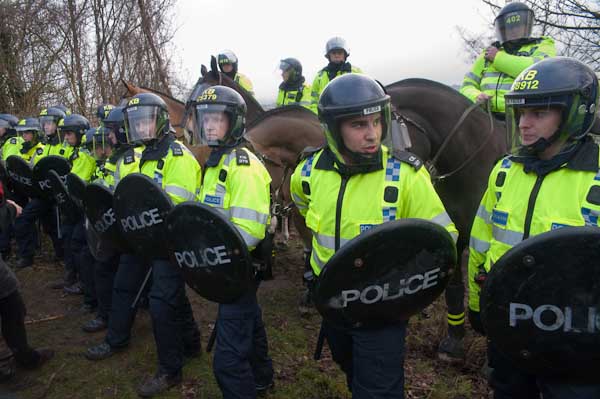
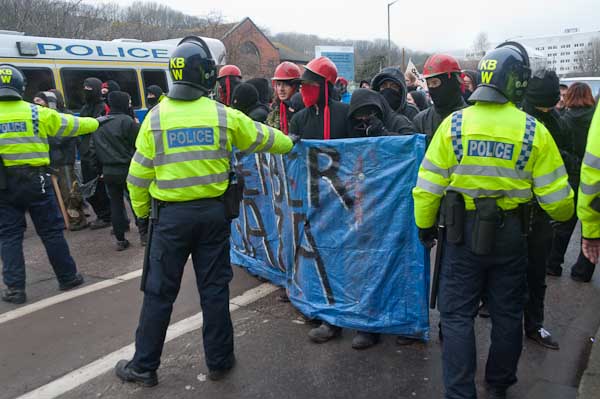
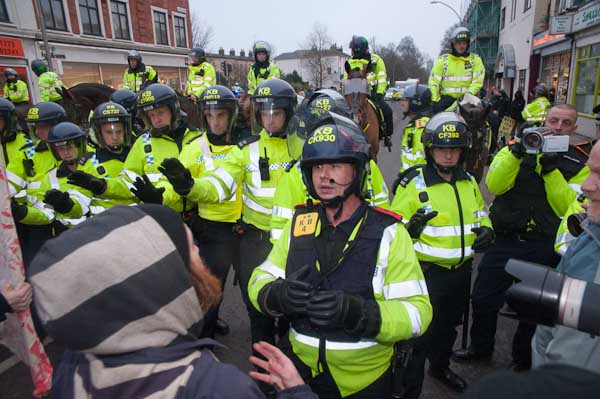
Fight for Sites go to Evict Pickles – 2012

Fight for Sites go to Evict Pickles: On Friday 19th October 2012, the first anniversary of the brutal eviction of the Dale Farm Traveller community, activists and some of those evicted marched to the Department for Communities and Local Government to serve an eviction notice on DCLG Minister Eric Pickles.

Fight for Sites go to Evict Pickles - 2012
Police drew batons to keep protesters away from the Ministry building, but some were already on a low roof

Gypsies, Roma and Travellers have long found life in the UK difficult for their nomadic lifestyle, and have long been subjected to discrimination. There is a huge shortage of sites where they can legally stop both short-term while they are moving and for longer winter breaks.

Fight for Sites go to Evict Pickles - 2012
Protesters met on the concourse at Victoria Station

Relatively few local authorities had made a real effort to meet their planning obligation to provide traveller sites, and these are often not popular with some local residents. Dale Farm – as the Wikipedia article tells – began with a planning appeal in the 1980s over the right to establish a site there.

Fight for Sites go to Evict Pickles - 2012
They marched to the Department for Communities and Local Government

Much of the problems that ensued over the subsequent expansion of the site onto a neighbouring plot of derelict wasteland owned by a traveller family came from it being ‘Green Belt’ – despite which it had been allegedly used by Basildon Council to tip waste tarmac and rubble from roadworks for many years.

Fight for Sites go to Evict Pickles - 2012
Drummers at the front of the march with improvised instruments

In 2003 then Secretary of State, John Prescott had made an order giving temporary permission to the site for two years to give the site residents and the local authority time to find a suitable alternative site. But no progress was made, and by 2007 a government report stated that opposition amongst parts of the settled community towards site residents had become ever fiercer.

Fight for Sites go to Evict Pickles - 2012
At the DCLG a couple of people quickly climbed on to the roof before police could stop them

I went to the site in September 2011 and photographed a flash mob later that month at the DCLG, but was not able to be there for the eventual eviction on 19 October 2011 which was widely covered as it happened by UK and international media.

Fight for Sites go to Evict Pickles - 2012
Police held back protesters on the street while more found another way to the roof
Fight for Sites go to Evict Pickles - 2012
and held banners there

On the day when I marched with residents and protesters from Wickford Station the three miles to a rally at the site I was surprised at how remote and isolated it seemed to be, and thought it was in many ways a very appropriate place for a traveller site. I felt that Basildon Council had created a fight with the travellers based largely on racial discrimination and had not attempt to come to a sensible resolution.

Police held and arrested a few protesters

The Fight for Sites protest on the first anniversary of the eviction was organised by the Traveller Solidarity Network in protest over the evictions last year and the continuing harassment of travellers at Dale Farm and across the country.

Photographers were hampered by a woman officer who kept forcing us back where we could see little

As I commented then, a year after the eviction had taken place from what had been “in most respects a highly appropriate, tidy and well-kept site” it was now “an eyesore, filled with stagnant water, sewage and toxic material, while 83 homeless families, mainly evicted from the site, are now living on the approach road to the site without electricity or running water” and facing further threat of eviction but with nowhere else to go.

Two people are held by police on the other side of the protest and then carried away

Minister Eric Pickles response to the lack of sites had been to remove the duty of local government to permit traveller sites and to give them greater power to evict. The protesters met at Victoria Station and marched to the nearby DCLG offices to give him a notice of eviction.

Two women decided to lie down in front of the police

It was a colourful protest and ended outside the offices with a number of scuffles between police and protesters, with some climbing onto a rood with banners and posters, as well as pasting up an eviction notice on the building. Photographers were harassed and moved back by police who were at the same time telling us we had a right to photograph the event, and several protesters were arrested.

Police tried to push back one of the ‘caravan’ sides while protesters held firm

I left after the protesters had stopped trying to get in the building and a statement was read out about why the had come to protest. I think the protest was coming to a close; by then it was raining heavily and I needed to be elsewhere.

The protests then pulled back and a statement about the protest was read out

You can read the text of the eviction notice and find more details about the protest and see many more photographs on My London Dairy at Fight for Sites go to Evict Pickles.


Flickr – Facebook – My London Diary – Hull Photos – Lea Valley – Paris
London’s Industrial Heritage – London Photos

All photographs on this page are copyright © Peter Marshall.
Contact me to buy prints or licence to reproduce.
Smash EDO Protest Moulsecoomb Arms Factory – 2010

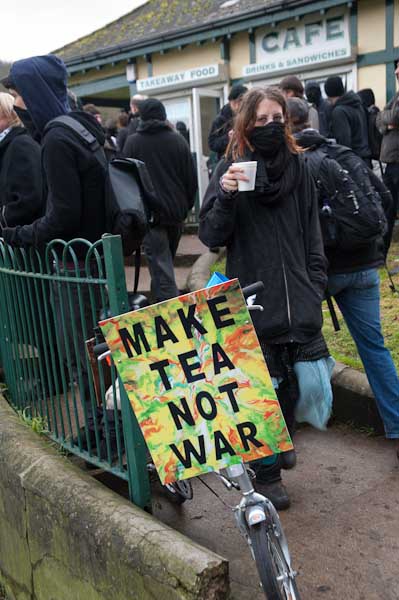
Protests had begun against a small EDO-MBM factory at Moulsecoomb on the outskirts of Brighton in 2003 after the press had revealed that it was making parts for a guided bomb that was being used in the invasion of Iraq.

Smash EDO Protest Moulsecoomb Arms Factory
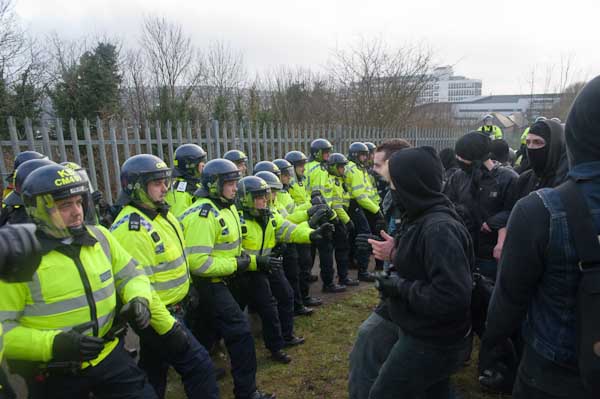
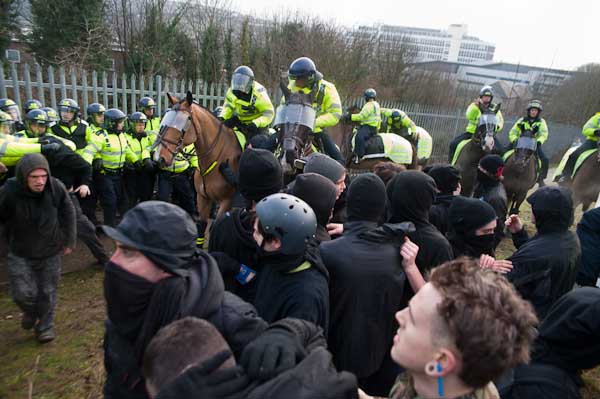
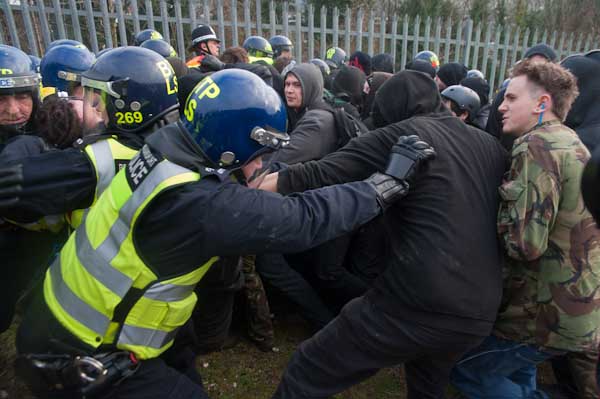
Police push Smash EDO protesters, 2010

In April 2005, EDO attempted to get a wide-ranging injunction to prevent protests at the site, including stepping onto the road outside the factory, playing music and taking photographs. This was the start of a lengthy legal action in which the UK Attorney-General became involved, as the defendants had submitted a detailed dossier on war crimes involving air strikes on civilian areas and infrastructure and were arguing that the invasion was an illegal war of aggression in breach of the UN Charter.

Smash EDO Protest Moulsecoomb Arms Factory

The Wikipedia article states “The court found that if there was an imminent war crime that the protesters believed on reasonable grounds, was about to take place, in which EDO were complicit, then preventative direct action could lawfully be taken against the company without waiting for the authorities of the state to intervene. This ruling effectively allowed proportionate direct action against companies by protesters, if the threat of the crime was imminent and specific.”

Smash EDO Protest Moulsecoomb Arms Factory
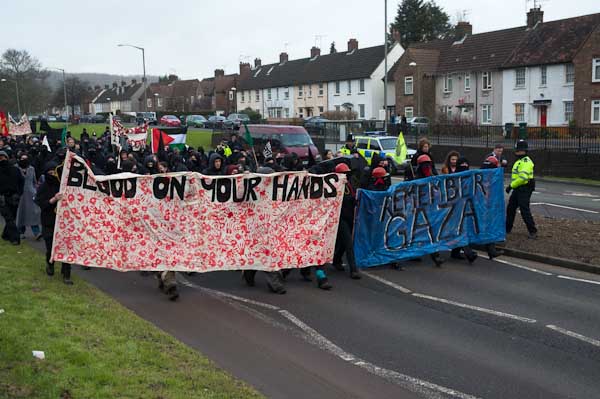
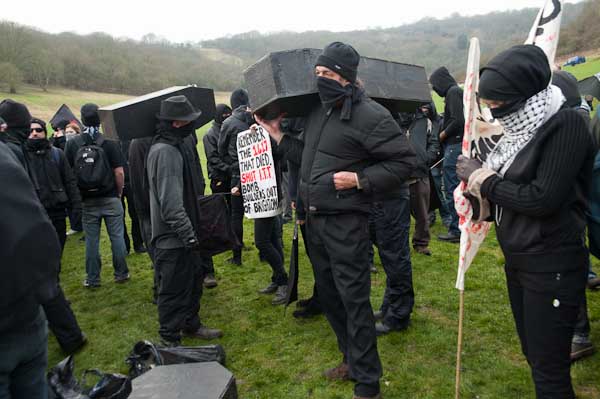
Coffins to remember the 1417 Palestinians killed – some by Brighton-made bombs

Some of the defendants signed an out of court settlement with EDO in April 2005 after it was put forward by Keir Starmer and they were then told legal aid would be withdrawn unless they agreed. They then intervened with a suggestion which was them he would withdraw their legal aid and they signed “undertakings not to do certain things that they had never done and had no intention of doing” with EDO agreeing to pay their costs, as well as their own, and the injunction against those not in court was lifted.

The case against three defendants who were conducting their own defence continued as they refused to sign these undertakings. In March 2006 a judge agreed with them that EDO had failed to make the preparations for a speedy trial as ordered by the court, and the company dropped the case rather than face further proceedings for abuse of process, paying the full costs of all those involved. The whole legal business is thought to have cost EDO between £1-1.5m, more than a years annual profit for the Brighton factory.

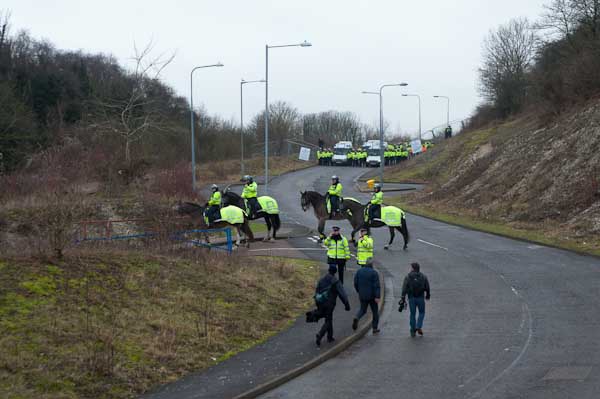
Police block the road to the factory

In 2009 weapons supplied by EDO were being used in the Israeli attacks on Gaza and a small group of activists decommissioned’ the factory to prevent exports to Israel. Again EDO went to court and they were again unsuccessful with the court finding all of those charged not guilty.

On Monday 18th January 2010, the first anniversary of the end of the Israeli war against Gaza, I went to photography Smash EDO activists in Brighton who were protesting against arms manufacturer EDO MBM/ITT who made some of the weapons that killed 1417 Palestinians, mainly the elderly, women and children, during the three-week assault.

Despite earlier rulings that such protests were legal, the police had come determined to stop this one taking place, responding to the protesters who they probably outnumbered with an impressive display of force and violence as they attempted to make their way to protest at the factory.

I went with the protesters as they tried to go around the police lines through the woods and along a footpath and was able to photograph some of the confrontations. You can see more of what happened on that day in the pictures and the captions in my post on My London Diary.

What I don’t mention there is that like many of the protesters I was also assaulted several times by some of the officers while taking pictures, and at one point only just managed to stop myself going over a roughly 50ft drop when pushed violently by one of them. Other officers helped me up and to move away from the edge, but it was at times a scary event to cover. I was bruised and shaken as well as tired and left Brighton while the police were still harassing the protesters who had marched back towards the centre of the town.

Protests continue at EDO’s factory, now led by Brighton Against the Arms Trade, after the Moulsecoomb factory was found in 2019 to have produced arms used in a Saudi ‘attack that violated international law’ against a civilian target in Yemen and to be involved in helping Turkey to get around US attempts to prevent the proliferation of drone warfare.