London University & Israeli Prisons – 2014

London University & Israeli Prisons: On Friday 28th February 2014 I went with students as they hunted in and around Senate House for a meeting of University of London Vice Chancellors to protest against the attacks on students and the idea of a university as these managers have called in police onto the campus rather than engage with students and staff.

From there I went to a protest outside the London offices of security firm G4S who supply services to Israels notorious prisons where many Palestinians have been tortured and prisoners including many children are kept under inhumane conditions.


Students tell Vice Chancellor to Resign

Senate House
London University & Israeli Prisons - 2014

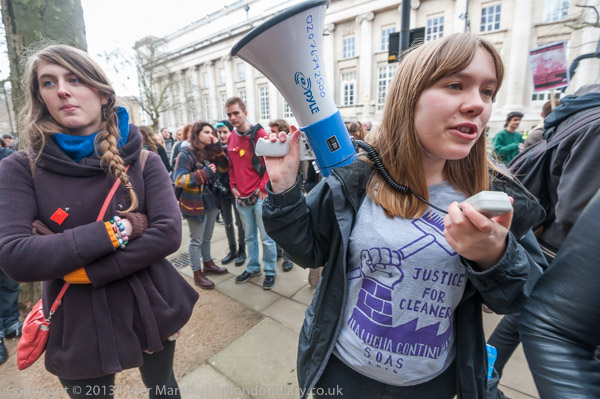
Students and many academic staff have been appalled by the actions of London University (UoL) managers under Vice Chancellor Professor Sir Adrian Smith who have called in police to subdue student protests, and were calling on him to resign.
London University & Israeli Prisons - 2014

This has led to mass arrests, injuries and blood on the streets. The UoL was shutting down its student union, exploiting and intimidating low-paid staff, leading the lobby for a huge fees increase fees and attempting to prevent protests, taking out an injunction against any student occupation of the University.
London University & Israeli Prisons - 2014

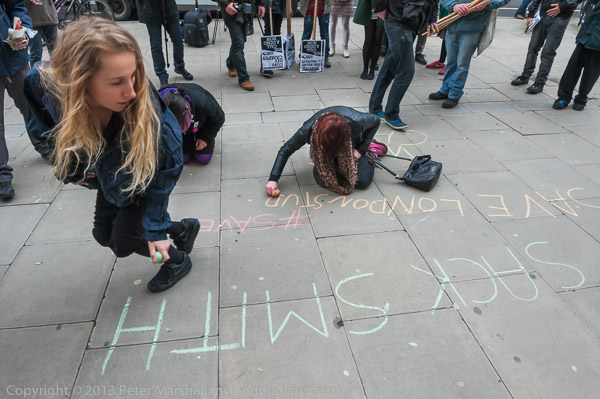
One student earlier in the week had been convicted of criminal damage for chalking “sick pay, holiday, pensions now” on a foundation stone at a protest in support of low paid staff last July. She was was ordered to pay £200 towards prosecution costs and £810 to cover the cost of repairs to the stone – almost certainly the most expensive wipe with a damp cloth in history. Fortunately a video of her arrest made clear that police were lying when they accused her of assaulting an officer when she was arrested.
London University & Israeli Prisons - 2014
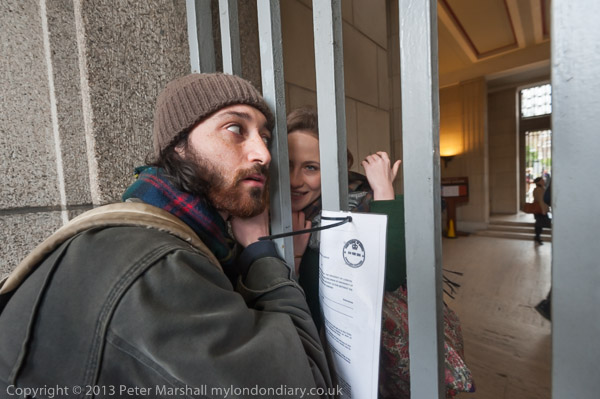
The gates to the undercroft were locked

The protesters met outside the University of London Union (ULU) and then walked towards Senate House, where security guards locked the gates to the area under the building in front of the entrance.
London University & Israeli Prisons - 2014
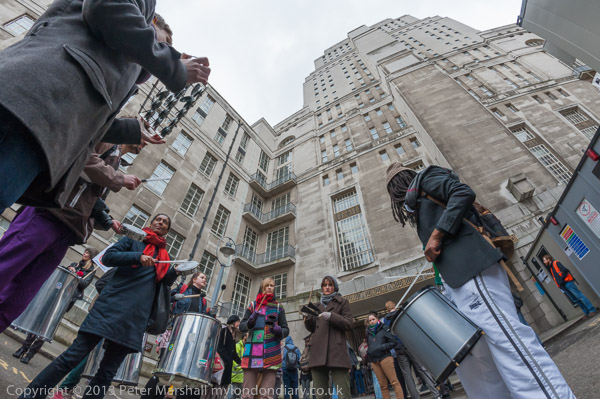
A samba band ensures the protest is heard inside Senate House

After a short and noisy protest there, they decided to walk to the pavement outside the south side of Senate House as they thought the meeting would be taking place in one of the rooms there. After another short protest there they walked back to the east side of Senate House where again the gates were locked.

A few students were inside the building and they managed to unlock one of the side doors into the building and I went inside with some of the students.
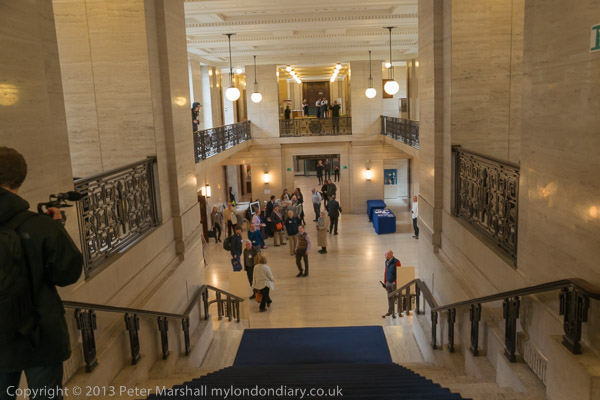
We wandered around the corridors without finding the Vice Chancellors, although the building was in use for various other meetings and events. Eventually the protesters came to the balconies above the Crush Hall where some other conference delegates were taking lunch and explained to them from above why they were taking action.

Security were standing in front of the Vice Chancellor’s Office, possibly the most likely location for the Vice Chancellors to be meeting. One of the security men assured them it wasn’t there and they did not try to push past.

They went down the the lobby in front of the main entrance and managed to hold the gates open as security officers tried to close them so more of the protesters could come inside, managing to push their way back into the building for another tour. But again they could not find the meeting.

Some students climbed through a window to a balcony at first floor level around the side of the building; I didn’t go with them but made my way out of the building. The main entrance was closed and anyone wanted to leave had to make a long detour through a basement corridor to neighbouring Stewart House.

Students were still walking along the balcony when I arrived at street level outside, and were walking back into the building through an open window that I was told led into one of the Vice Chancellor’s rooms.

It seemed unlikely I would be able to get inside the building to take more pictures and I left to photograph another event.

More about the protest and many more pictures on My London Diary: Students tell Vice Chancellor to Resign.


G4S & Israeli Prison Torture

Victoria St
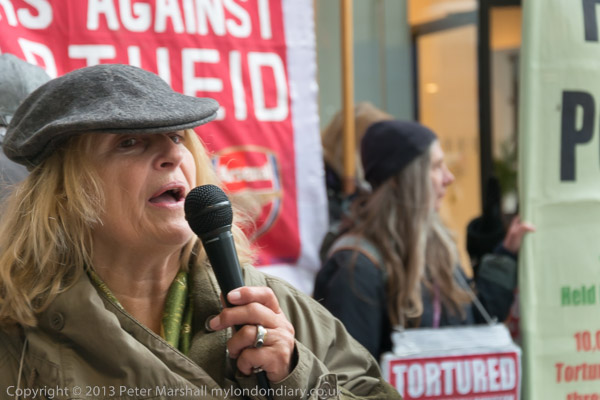
It was International Israeli Apartheid Week and Inminds Human Rights Group were protesting outside the offices of G4S, the worlds largest security firm, complicit in Israel’s violations of international law and gross human rights abuses, including torture of men, women and children.

One of their banners gave details of the tiny cells in which child prisoners are held, about 2 metres by 1 metre, with a just a mattress and behind a low concrete wall a hole in the ground toilet. There are no windows, and food is delivered through a flap in the door. The light is kept on 24 hours a day and the walls have sharp protrusions to prevent them being leaned on.

Children as young as 12 have been kept in solitary confinement in these cells for up to 65 days, being taken out only to be interrogated while shackled hand and foot for up to 6 hours at a time. Some complain of having been sexually assaulted.

This mistreatment is continued until they confess to such crimes of throwing stones at Israeli army vehicles – for which they can be sentenced to 20 years in jail.

Placards showed the five Hares boys, and leaflets were handed out telling their story. After Israelis from an illegal settlement complained that stones had been thrown at them when they stopped their car to change a tyre, 50 children from Hares were arrested by Israeli soldiers with attack dogs, and 19 of them taken to the G4S secured children’s dungeons at Al Jalame, locked in solitary for up to 2 weeks.

There they were violently tortured and threats made against female members of their families to force confessions from them. Five of the boys were then each charged with 25 counts of attempted murder, despite the occupants of the car being unharmed. At the time of the protest their trial by military court had been postponed month by month, probably because of a lack of any evidence.

In January 2016 the five Hares boys were each sentenced to 15 years in prison following a plea deal “that involved ‘fines’ of NIS 30,000 (appr. €7,100 or $7,750) per boy to be paid to the settler driver as ‘compensation’” Otherwise they would have received longer sentences despite the only evidence against them being their ‘confessions’ extracted under extreme torture.

More at G4S & Israeli Prison Torture.


FlickrFacebookMy London DiaryHull PhotosLea ValleyParis
London’s Industrial HeritageLondon Photos

All photographs on this page are copyright © Peter Marshall.
Contact me to buy prints or licence to reproduce.
Bread & Roses, Morales & Russian anti-fascists – 2019

Bread & Roses, Morales & Russian anti-fascists: Three events I photographed on Saturday 19th January 2019.

Bread & Roses is again relevant now in January 2024, with the release of a new version of the song a few days ago by the ‘Orchestra of Cardboard‘, part of the amazing ‘Every street a POWER STATION campaign‘, a project of Walthamstow’s community interest company Optimistic Foundation CIC set up by artist and filmmaker Hilary Powell and filmmaker and musician Dan Edelstyn. The recording is a part of their fundraising campaign and your can read, see and hear more about it and their other campaigns which are already having an effect in the area on their crowdfunder page.

But back to January 2019, five years ago today.


Women’s Bread & Roses protest

Bread & Roses, Morales & Russian anti-fascists - 2019

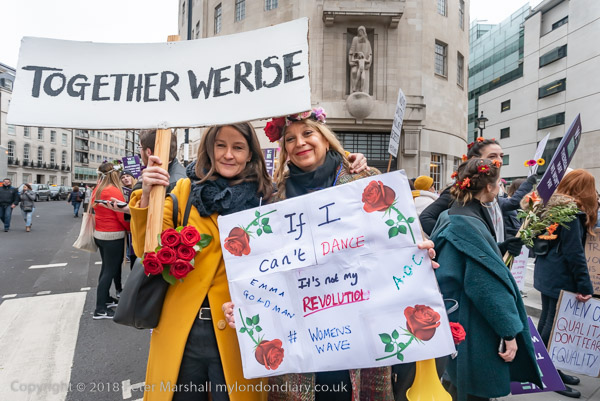
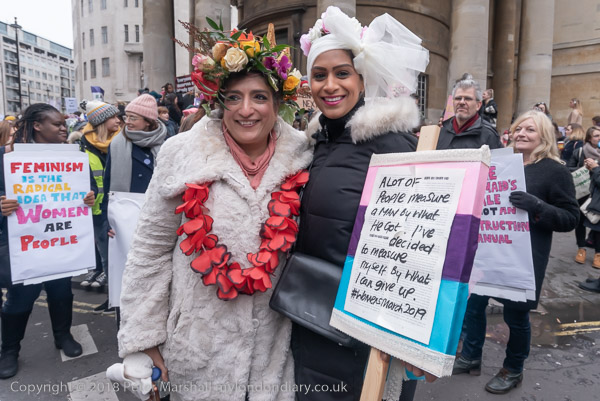
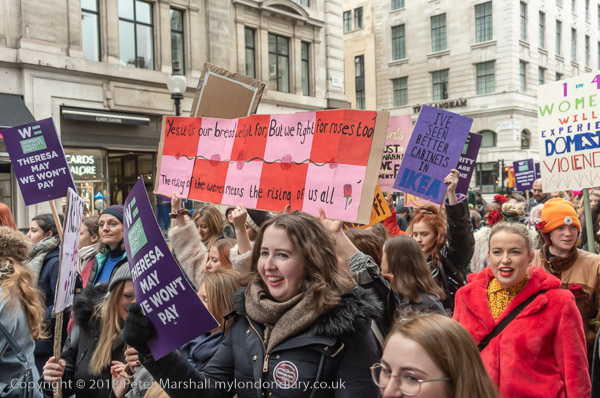
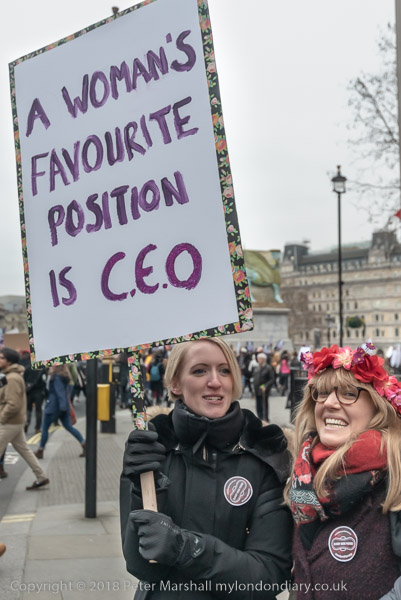
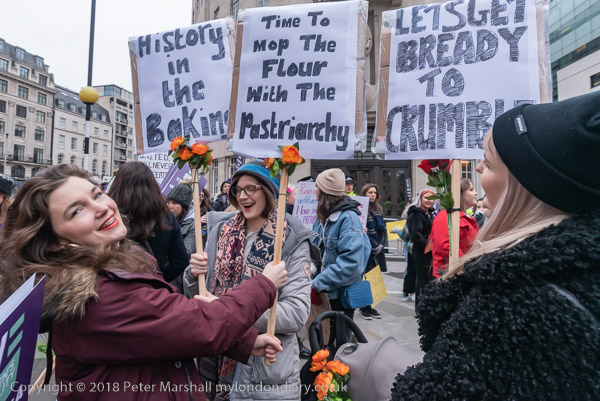
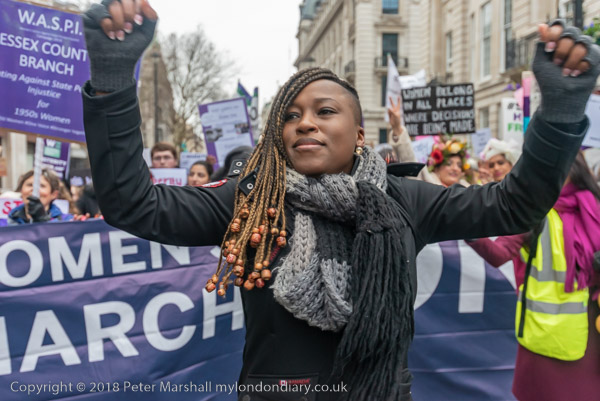
Inspired by the Bread & Roses protests which revolutionised workers’ rights for women in 1912, Women’s March London marched from the BBC to a rally in Trafalgar Square against economic oppression, violence against women, gender pay gap, racism, fascism, institutional sexual harassment and hostile environment in the UK, and called for a government dedicated to equality and working for all of us rather than the few.

Bread & Roses, Morales & Russian anti-fascists - 2019

The London march was part of an international day with women marching in many countries around the world, particularly in cities across the USA.

Bread & Roses, Morales & Russian anti-fascists - 2019

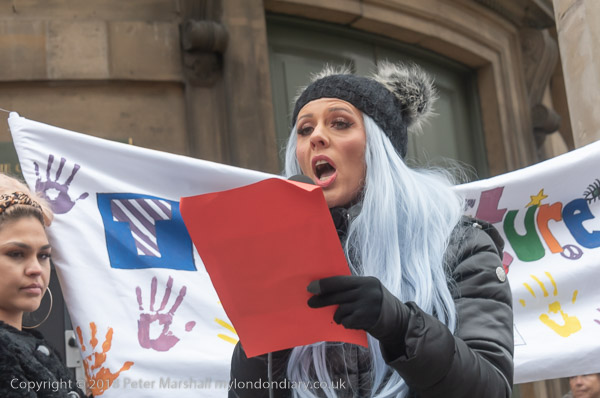
At the start of the march was opposite the BBC on the steps of Langham Place a few of the women organising the event were being directed and filmed by a BBC film crew. Supposedly this was a documentary but it seemed to be more a scripted drama closely controlled by the director and with the women involved holding orange folders from which they read.

Bread & Roses, Morales & Russian anti-fascists - 2019

But there were a rather larger group of women (and just a few men with them) standing around outside the BBC building and largely ignoring the filming that was taking place. Many had made placards especially for the event, with some using words from the poem ‘Bread and Roses‘ written by James Oppenheim and published at the end of 1911. The phrase ‘Bread and Roses’ came from a speech the previous year by Helen Todd, speaking about the need for laws to regulate wages, working hours and conditions.

A few days later a strike was started by textile workers, largely immigrants, in Lawrence, Massachusetts. The strike was organised by the IWW, the Industrial Workers of the World, led largely by women and they took up Oppenheims poem and sang it at their meetings and marches, as well as apparently marching with a banner ‘We want Bread, and Roses too!’ during their three-month strike.

Eventually, when the BBC had finished making their movie the women gathered for a march and I walked with them to Trafalgar Square.

Many more pictures on My London Diary at Women’s Bread & Roses protest.


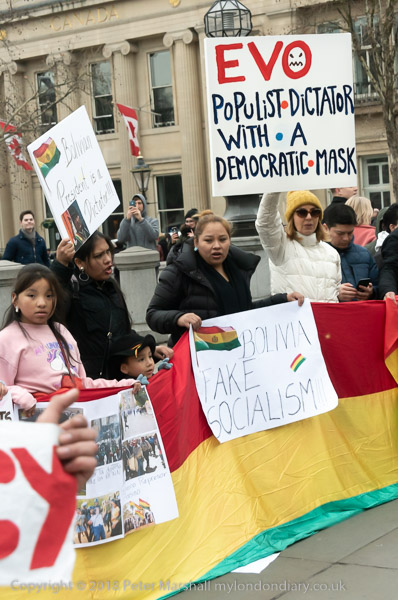
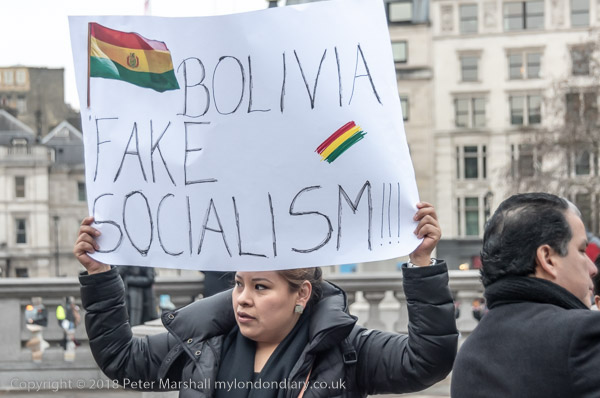
Bolivians protest against Morales – Trafalgar Square

A small group of Bolivians had come to protest following a decision in December by the Electoral Commission that President Evo Morales could stand for a fourth term in office in the October 2019 elections which were starting with primaries at the end of January 2019. But I was not convinced that this was truly a protest about democracy rather than simply against his socialist policies.

Morales, Bolivia’s first president to come from the indigenous population was first elected in 2005. He supported the 2009 constitution which allowed only two consecutive terms in office but was able to stand for a third term as his first term had been before the limit was imposed. In 2016 tried to increase the limit to three terms by a referendum which was narrowly defeated. But after this the courts ruled that the limitation infringed the human rights of citizens, allowing him to stand for a further term.

Morales won the October 2019 but their were widespread protests alleging electoral fraud, although later investigations suggested he had indeed gained the 10% lead required for a first-round victory. But the protests grew and he was endangered by armed groups; eventually he resigned on 10th November 2019, fleeing to Mexico where he was granted political asylum. Allegations made against him of sedition and terrorism were later found to be politically motivated and in 2020 a Bolivian court found his rights had been violated and judicial procedures breached.

His successful policies which reduced poverty and illiteracy and combated the influence of the USA and multinational companies made him very unpopular among the middle class and particularly the groups accustomed to running the country. Many in the USA encouraged and financed the opposition to him as he was widely seen to have shown a successful alternative to the growth of international capitalism.

Bolivians protest against Morales


Solidarity with Russian anti-fascists – Whitechapel

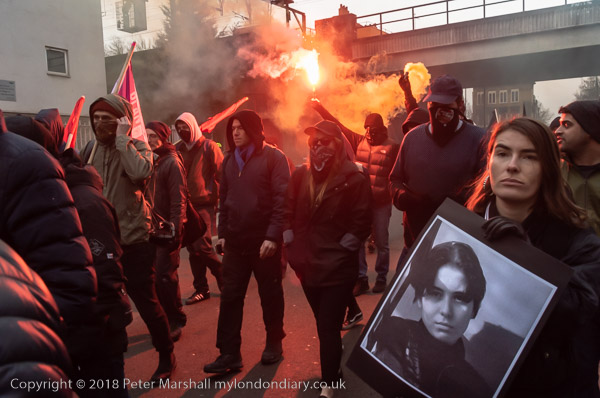
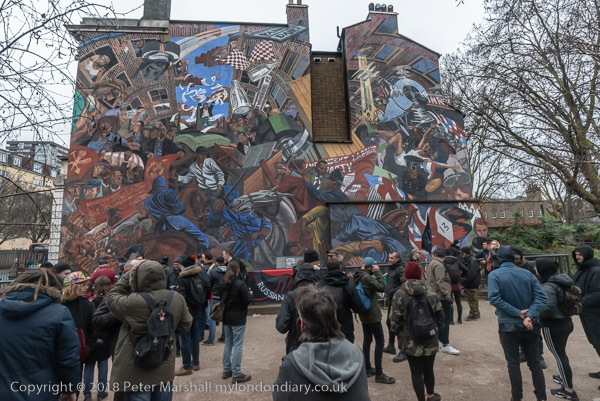
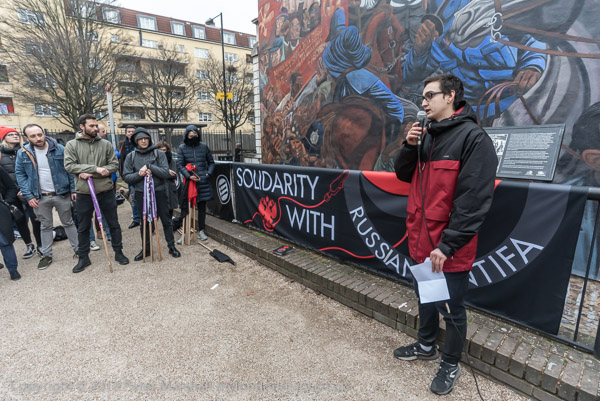
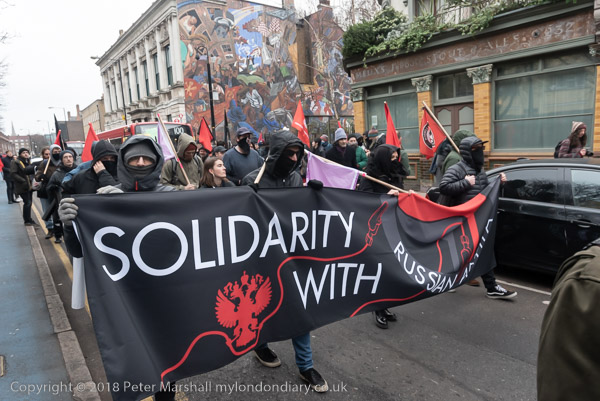
Finally I went east to the Cable Street Mural where anarchists and anti-fascists were meeting l to oppose racism, xenophobia, fascism and the upsurge of far-right populism and to show solidarity with Russian anti-fascists who have been arrested, framed and tortured in a brutal wave of repression.

Russian and Ukranian comrades spoke at the rally. telling us of the persecution taking place. The Russian Federal Security Service (FSB) arrested six in Penza in 2017, charging them with belonging to a non-existent organisation, ‘The Network’. Beatings and torture before their trial were used to make them give false confessions.

Two others were arrested in 2018 in St Petersburg and charged with belonging to the same fictional network and again tortured into making confessions and further similar arrests have followed. A total of 11 where then in prison for belonging to’The Network’, facing 5 to 25 years in jail.

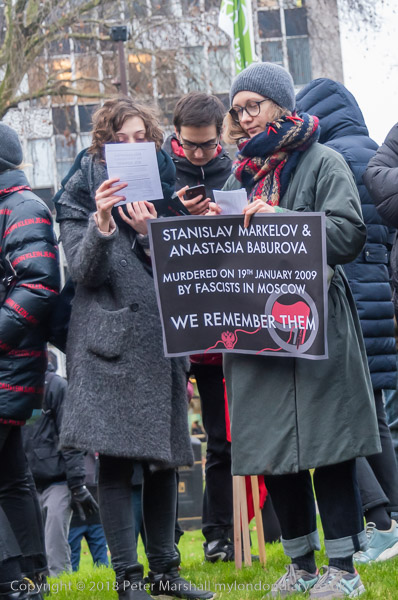
The date for the protest was chosen as the anniversary of the brutal murder of two Russian anti-fascists, journalist Anastasia Baburova and lawyer Stanislav Markelov, by fascists in broad daylight on the streets of Moscow on January 19th 2009. Russian anarchists and anti-fascists hold events to remember them on this day every year.

There was then a march to a further rally in Altab Ali Park, named for the 24-year-old clothing worker murdered in a nearby street on 4 May 1978.

More pictures at Solidarity with Russian anti-fascists.


FlickrFacebookMy London DiaryHull PhotosLea ValleyParis
London’s Industrial HeritageLondon Photos

All photographs on this page are copyright © Peter Marshall.
Contact me to buy prints or licence to reproduce.