London University & Israeli Prisons – 2014

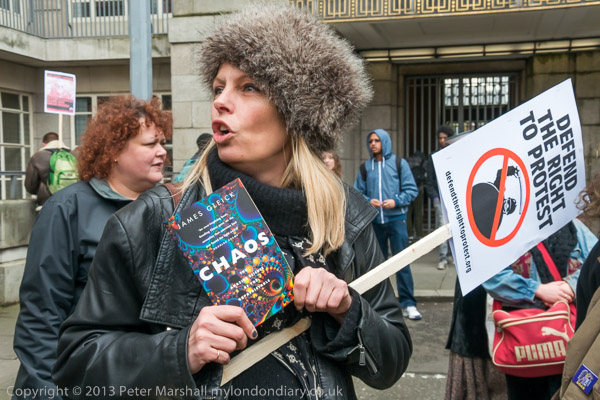
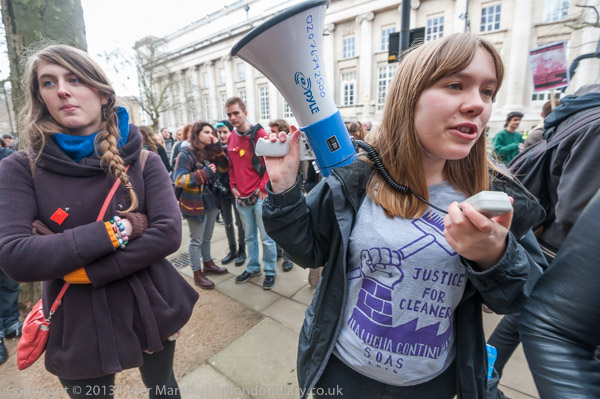
London University & Israeli Prisons: On Friday 28th February 2014 I went with students as they hunted in and around Senate House for a meeting of University of London Vice Chancellors to protest against the attacks on students and the idea of a university as these managers have called in police onto the campus rather than engage with students and staff.

From there I went to a protest outside the London offices of security firm G4S who supply services to Israels notorious prisons where many Palestinians have been tortured and prisoners including many children are kept under inhumane conditions.


Students tell Vice Chancellor to Resign

Senate House

London University & Israeli Prisons - 2014

Students and many academic staff have been appalled by the actions of London University (UoL) managers under Vice Chancellor Professor Sir Adrian Smith who have called in police to subdue student protests, and were calling on him to resign.

London University & Israeli Prisons - 2014

This has led to mass arrests, injuries and blood on the streets. The UoL was shutting down its student union, exploiting and intimidating low-paid staff, leading the lobby for a huge fees increase fees and attempting to prevent protests, taking out an injunction against any student occupation of the University.

London University & Israeli Prisons - 2014

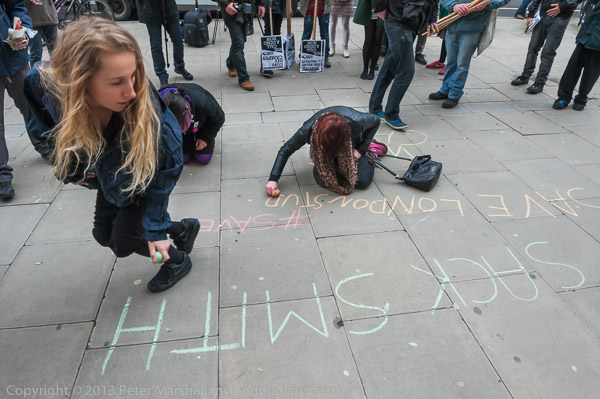
One student earlier in the week had been convicted of criminal damage for chalking “sick pay, holiday, pensions now” on a foundation stone at a protest in support of low paid staff last July. She was was ordered to pay £200 towards prosecution costs and £810 to cover the cost of repairs to the stone – almost certainly the most expensive wipe with a damp cloth in history. Fortunately a video of her arrest made clear that police were lying when they accused her of assaulting an officer when she was arrested.

London University & Israeli Prisons - 2014
The gates to the undercroft were locked

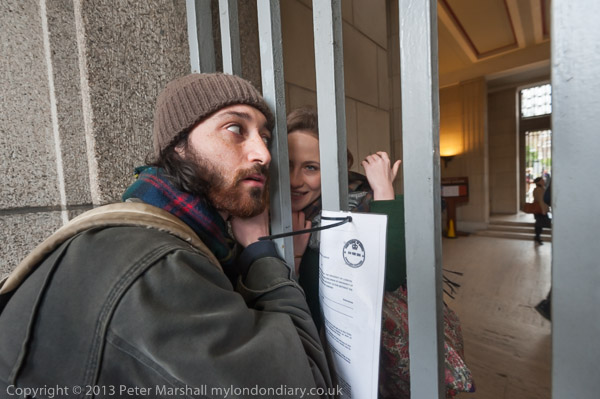
The protesters met outside the University of London Union (ULU) and then walked towards Senate House, where security guards locked the gates to the area under the building in front of the entrance.

London University & Israeli Prisons - 2014
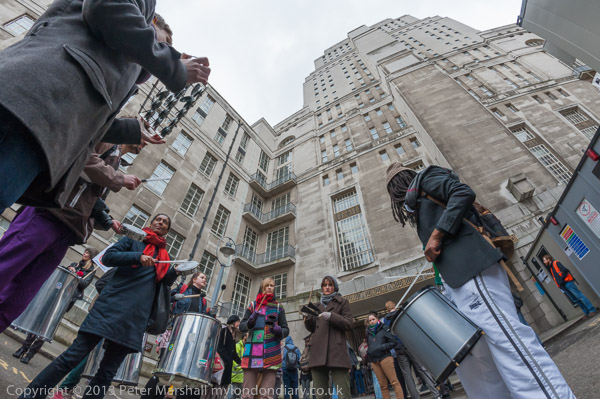
A samba band ensures the protest is heard inside Senate House

After a short and noisy protest there, they decided to walk to the pavement outside the south side of Senate House as they thought the meeting would be taking place in one of the rooms there. After another short protest there they walked back to the east side of Senate House where again the gates were locked.

A few students were inside the building and they managed to unlock one of the side doors into the building and I went inside with some of the students.

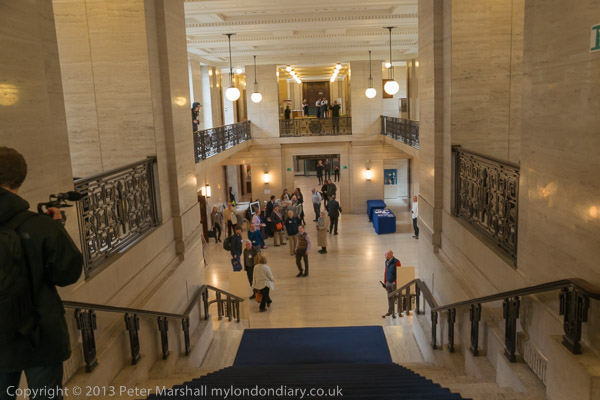
We wandered around the corridors without finding the Vice Chancellors, although the building was in use for various other meetings and events. Eventually the protesters came to the balconies above the Crush Hall where some other conference delegates were taking lunch and explained to them from above why they were taking action.

Security were standing in front of the Vice Chancellor’s Office, possibly the most likely location for the Vice Chancellors to be meeting. One of the security men assured them it wasn’t there and they did not try to push past.

They went down the the lobby in front of the main entrance and managed to hold the gates open as security officers tried to close them so more of the protesters could come inside, managing to push their way back into the building for another tour. But again they could not find the meeting.

Some students climbed through a window to a balcony at first floor level around the side of the building; I didn’t go with them but made my way out of the building. The main entrance was closed and anyone wanted to leave had to make a long detour through a basement corridor to neighbouring Stewart House.

Students were still walking along the balcony when I arrived at street level outside, and were walking back into the building through an open window that I was told led into one of the Vice Chancellor’s rooms.

It seemed unlikely I would be able to get inside the building to take more pictures and I left to photograph another event.

More about the protest and many more pictures on My London Diary: Students tell Vice Chancellor to Resign.


G4S & Israeli Prison Torture

Victoria St

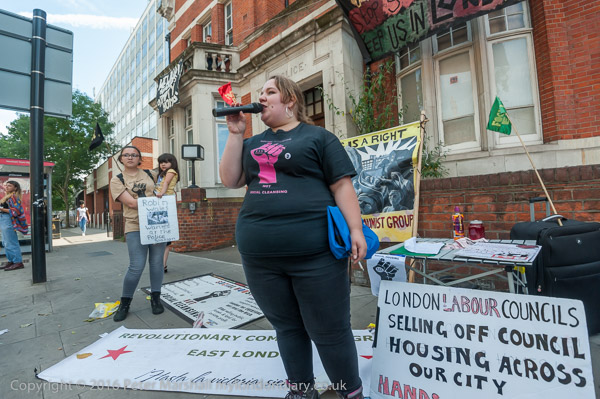
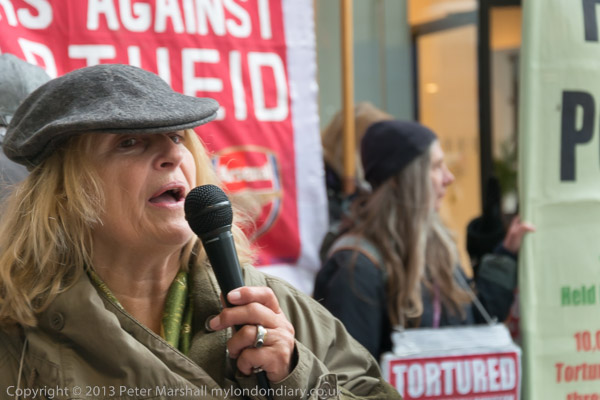
It was International Israeli Apartheid Week and Inminds Human Rights Group were protesting outside the offices of G4S, the worlds largest security firm, complicit in Israel’s violations of international law and gross human rights abuses, including torture of men, women and children.

One of their banners gave details of the tiny cells in which child prisoners are held, about 2 metres by 1 metre, with a just a mattress and behind a low concrete wall a hole in the ground toilet. There are no windows, and food is delivered through a flap in the door. The light is kept on 24 hours a day and the walls have sharp protrusions to prevent them being leaned on.

Children as young as 12 have been kept in solitary confinement in these cells for up to 65 days, being taken out only to be interrogated while shackled hand and foot for up to 6 hours at a time. Some complain of having been sexually assaulted.

This mistreatment is continued until they confess to such crimes of throwing stones at Israeli army vehicles – for which they can be sentenced to 20 years in jail.

Placards showed the five Hares boys, and leaflets were handed out telling their story. After Israelis from an illegal settlement complained that stones had been thrown at them when they stopped their car to change a tyre, 50 children from Hares were arrested by Israeli soldiers with attack dogs, and 19 of them taken to the G4S secured children’s dungeons at Al Jalame, locked in solitary for up to 2 weeks.

There they were violently tortured and threats made against female members of their families to force confessions from them. Five of the boys were then each charged with 25 counts of attempted murder, despite the occupants of the car being unharmed. At the time of the protest their trial by military court had been postponed month by month, probably because of a lack of any evidence.

In January 2016 the five Hares boys were each sentenced to 15 years in prison following a plea deal “that involved ‘fines’ of NIS 30,000 (appr. €7,100 or $7,750) per boy to be paid to the settler driver as ‘compensation’” Otherwise they would have received longer sentences despite the only evidence against them being their ‘confessions’ extracted under extreme torture.

More at G4S & Israeli Prison Torture.


FlickrFacebookMy London DiaryHull PhotosLea ValleyParis
London’s Industrial HeritageLondon Photos

All photographs on this page are copyright © Peter Marshall.
Contact me to buy prints or licence to reproduce.
Almshouses, Museum, Hospital & Shops – Highgate 1989

Almshouses, Museum, Hospital & Shops – Highgate: More from my walk in Highgate on Sunday 19th November. You can read the previous part at Into Highgate Village.

Wollaston and Pauncefort, Almshouses, Southwood Lane, Highgate, Haringey, 1989 89-11f-12

The Wollaston and Pauncefort Almshouses were set up by wealthy City goldsmith Sir John Wollaston who was Lord Mayor of London in 1643 and a among many other positions was a Governor of Highgate School and briefly Lord of the manor of Hornsey. In his last years he had these almshouses built for “six men and women of honest life and conversation‘ from Hornsey and Highgate, and his will in 1658 made the governors of Highgate school trustees of the almshouse.

His endowment provided those living in the almshouses an income of 50 shillings a year and for money for the repair of the premises. The school governors selected the residents and laid down strict rules for them, including attending services in the school chapel.

However by 1722 the building was beyond repair and school governor and treasurer Edward Pauncefort had them rebuilt, doubling the number of residents to 12 and adding a charity school for girls. His endowment and other bequests also gave the residents a rise to £7 a year.

The Grade II listed almshouses were altered internally over the years and finally the year before I made this picture significantly modernised and provided with indoor bathrooms and toilets by merging pairs of the units, reducing the number of residents to the original six. Only one of each pair of doors is now in use.

My picture includes a phantom cyclist, blurred almost to extinction by the slow shutter speed I used.

Highgate School Museum, Southwood Lane, Highgate, Haringey, 1989 89-11f-13
Highgate School Library, Southwood Lane, Highgate, Haringey, 1989 89-11f-13

The Highgate Tabernacle at 20a Southwood Lane was built as a Baptist chapel in 1836, replacing an earlier Presbyterian chapel and was Grade II listed in 1974. In 1976 the chapel was bought by Highgate School and served as their library for almost 30 years. It now houses the archive and museum of the school, open to researchers and occasionally to the public.

Among its holdings are the “Royal Charters of Queen Elizabeth I, authorising our founder Sir Roger Cholmeley to found a school at Highgate, 29 January 1565, 6 April 1565“.

Southwood Hospital, 70, Southwood Lane, Highgate, Haringey, 1989 89-11g-53

The Limes was built in 1815 and in 1921 was bought for use as an orphanage by the Furniture Trades’ Provident and Benevolent Institution who renamed it Radlett House. In 1940 they moved to larger premises and leased the property to Middlesex County Council who converted it to a small hospital. After becoming a part of the NHS it was renamed Southwood Hospital.

Southwood Hospital, 70, Southwood Lane, Highgate, Haringey, 1989 89-11g-54

The hospital was still in use though on a reduced scale when I made these two pictures, but a notice beside the main entrance (part visible on my first picture) makes clear it offered no casualty or accident and emergency services. It simply housed a few beds for chronically ill patients needing nursing care.

The hospital closed in 1991 and in 2004 was was converted into a terrace of large private houses.

Shops, 164-198, Archway Rd, Highgate, Haringey, 1989 89-11g-45

Archway Road was designed in 1808 as the world’s first bypass to provide a less steep route out of London than Highgate Hill for heavy waggons by building a 900ft long tunnel. Work started in 1810 but unfortunately the tunnel collapsed in 1812 when it was almost finished. Fortunately nobody was killed but it was decided to convert the tunnel into a cutting. This then needed a bridge to carry Hornsey Lane over the new road, and John Nash came up with an elegant brick design with a tall narrow arch for traffic and above that a three arch bridge carrying the road.

But the arch was too narrow as traffic increased and was replaced with the current bridge in 1900. This row of shops begin around 200 metres north of the bridge.

Shops, 164-198, Archway Rd, Highgate, Haringey, 1989 89-11g-33

Steps lead up from Archway Road to Winchester Road from where I was able to make this second picture of the long row of shops. The conservation area appraisal describes this as late Victorian and “very distinctive with original balustrades above many of the shops” and notes the “top floor balconies set back under large arches with half timbering” and the “very eye-catching” roofscape though it notes only some of the stone finials have survived. These details are clearer in the previous picture.

Still more from Highate to come in a later post.


FlickrFacebookMy London DiaryHull PhotosLea ValleyParis
London’s Industrial HeritageLondon Photos

All photographs on this page are copyright © Peter Marshall.
Contact me to buy prints or licence to reproduce.