Christmas Walks

Christmas Walks. For many years we have had a family get-together on Boxing Day and we will do the same today, but it will be a little different as for the first time for many years we will not be walking the five or six miles to it.

Staines to Runnymede Walk

Christmas Walks
View from Staines Bridge

We always needed that walk to work up enough appetite for a large meal in the middle of the day after a little overindulgence on Christmas Day. I’ve posted some pictures from our Boxing Day walks here in previous years, But as we got a little older they became simply a matter of the shortest route- a pleasant stroll along the Thames Path rather than any of the slightly longer and hillier variations that use to add interest.

Christmas Walks
Taken from the now-closed bridge

And in late 2023 the Environment Agency found an unsafe 90 year old footbridge across a small creek close to Runnymede Bridge and fenced of this short section of the Thames Path in February 2024. Almost two years later it remains fenced off with work yet to start. The diversion isn’t a great deal longer but makes the walk less interesting.

Christmas Walks

We’d also go out on at least one walk between Boxing Day and New Year’s Day on a longer walk with whichever of our family were staying with us. But now our house seems to have shrunk as our children’s families have grown and we go away to stay with or near them. But I think we will still make some walks.

Christmas Walks
Linda in the Runnymede cafe where our walk ended

In 2019 we made three walks between Christmas Day and the New Year and I posted about all three on My London Diary.

The first, our walk on Boxing Day 2019 from Staines to lunch in Old Windsor was cut a little short, not by the Environment Agency but by the weather. We made it roughly two-thirds of the way to the café at Runnymede when the heavens opened – and we rang to be collected.

Staines to Runnymede walk

Christmas Walks

Wimbledon to Richmond walk

Christmas Walks
The Kier, West Side Common. The plaque records Richardson Evans (1846–1928), a British civil servant, journalist and author who founded what is now the Wimbledon Society and fought for sites of natural beauty, as well as founding the Scapa Society (Society for Checking the Abuses in Public Advertising.)

The second walk, two days later, followed an invitation on the Christmas card from the father of my younger son’s wife to join a walk he was arranging from Wimbledon across the common and through Richmond Park. We hadn’t intended to go, but it was a fine day and we decided at the last minute to join them, though we had to leave before the lunch they had planned at the café in Richmond Park.

Christmas Walks
Beverley Brook

More at Wimbledon to Richmond

Matlock & Matlock Bath

Christmas Walks
Matlock Bath from High Tor

The next day we took the trains to briefly visit my elder son and family in Milton Keynes and from there were driven up to Matlock by my younger son to stay with them for a couple of days. And the next day we walked what was described by one sensationalist article in a tabloid newspaper as the “most dangerous footpath in England” around the face of High Tor to Matlock Bath.

Looking down on the A6

Of course it is no more dangerous than many other paths on cliffs around the country – and even has a handrail to hold on the narrowest section, as well as a short ‘one-way’ section to reduce the risk where passing others could be dangerous.

Matlock Bath is in parts tourist hell, full of fish and chips and ice cream shops, and a mecca for bikers, but it does have at least one decent pub – where we ate and went to look at some very large specimen fish before visiting the Mining Museum.

Coming out, I and my younger son started to climb up the hill on the west side of the valley while the rest of our party decided to take the short train journey back to Matlock. The climb of the valley was steep and exhausting, but once we had reached the top it was fairly easy going, with more great views at times of the Derwent valley as the light was beginning to fade.

By the time we reached Matlock I was thinking I should have taken the train.

Matlock & Matlock Bath


FlickrFacebookMy London DiaryHull PhotosLea ValleyParis
London’s Industrial HeritageLondon Photos

All photographs on this page are copyright © Peter Marshall.
Contact me to buy prints or licence to reproduce.
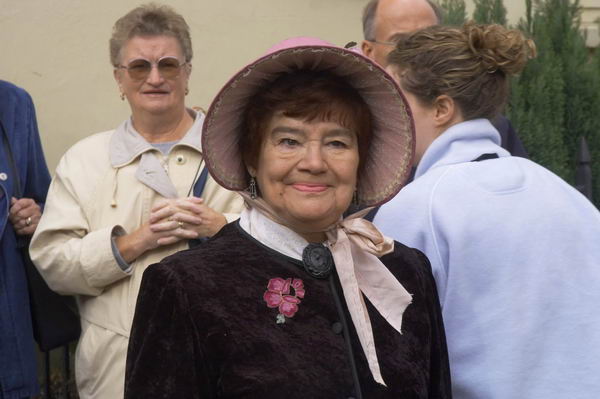
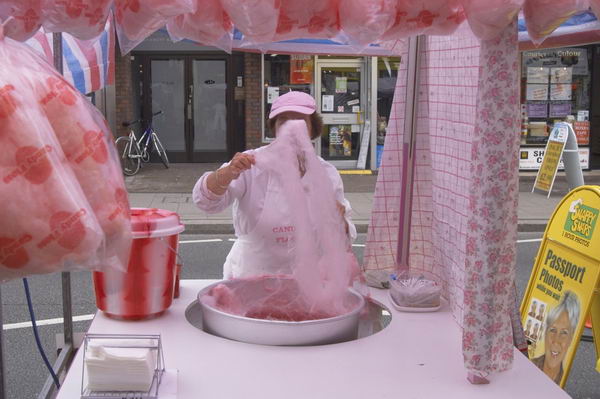
Merry Christmas

Merry Christmas 2025

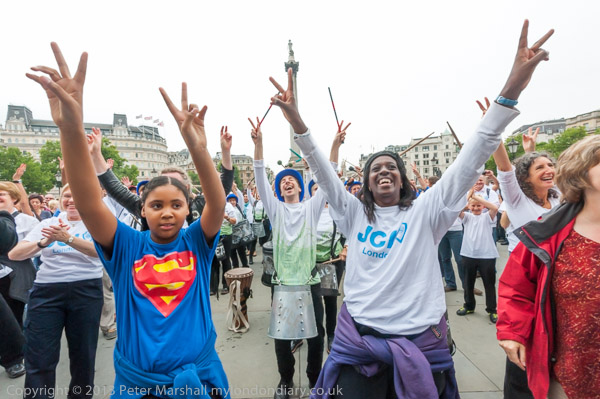
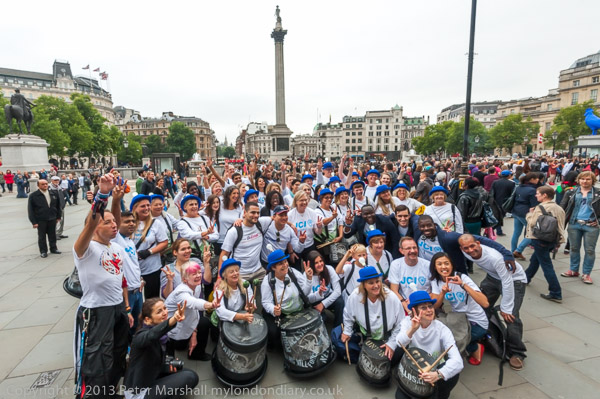
London, UK. 8 Mar 2025. Women, including many from migrant groups, marched along Oxford Street and on to a rally in Trafalgar Square for Million Women Rise, a woman-only march on International Women’s Day. Men supporters were only allowed on the pavement. The march called for an end to male violence against women and girls in all its forms and to everyday and structural racism at the heart of policing and our immigration system and society generally. Peter Marshall
London, UK. 22 March 2025. ‘Crips Against Cuts’ protesters, many in wheelchairs, hold a day of action around the country after the Labour government announced cuts in benefits, severely reducing the number of people being paid PIP to cut billions. They say PIP is already stringently tested and restricted to those who truly need it and it enables many to make a contribution to society. Benefit fraud is minimal and Labour should instead clamp down on tax evaders and introduce stricter tax rules to cut avoidance. Peter Marshall

Merry Christmas

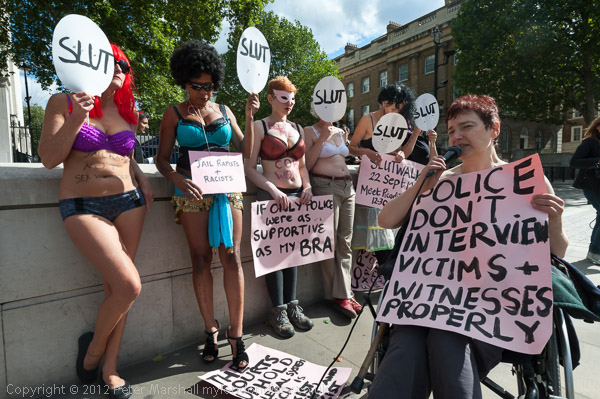
A few weeks ago i looked through the all of the pictures I had taken this year – or as least all those I had selected to put into my Lightroom catalogue – this almost 25.000 was probably rather less than half of the actual exposures made as I cull out many I don’t find of some interest and choose only the best of similar images. These are are the two pictures I printed and gave to a few close friends, now online with my Christmas Greetings too all on social media.

It was a long process – and made rather longer by my falling asleep a few times working late at night so I’m not sure I saw every one of them. At first I selected around 30 or 40 pictures, then cut these down to a final two.I wasn’t looking for my ‘best pictures of the year’ but ones that might be usalble as Christmas Cards,

Most of my pictures this year were of pro-Palestine protests which our politicians have stigmatised as ‘Hate marches’ and anti-Semitic. Quite clearly they are neither, with many Jewish protesters taking part, including including a few survivors of the holocaust and rather more of their sons and daughters.

The mass media have largely give us a very misleading view of the marches, which are against not Jews but the policies of an Israeli state which as widely been accused of genocide, killing large numbers of women and children as well as men with little or no connection to Hamas, bombing schools, hospitals and refugee camps preventing medical and other urgently needed supplies from crossing the border.

What hate I have seen has come from largely from those small groups of Zionists and others who have opposed these marches. I think all or almost all the Jewish people I know are opposed to Netanyahu, some seeing his relentless killing of Palestinians as a desperate attempt to cling to power and avoid prosecution.

But in the end I didn’t chose an image from the Palestine protests, but one from the March 8th women’s march, and the second from a March 22nd protest by disable people in fear that a Labour government will drastically cut the Personal Independence Payment, PIP.

DLR – Connaught Rd & Bow Creek 1994

DLR – Connaught Rd & Bow Creek 1994. Continuing my panoramic images made along the path of the DLR in July 1994.

DLR, near Connaught Bridge, Custom House, Newham, 1994, 94-721-33
DLR, Connaught Rd, Custom House, Newham, 1994, 94-721-33

The road layout in this area has changed completely since 1994, but you can see at right the DLR Beckton branch going over the concrete lead-up to the Connaught Bridge. I think GATE 30 at extreme left is to the Excel site and the Connaught Tavern is hidden by the trees in the centre of the picture – and so this road was the old Connaught Road which led to the old swing bridge. I think where I was standing is now the middle of a hotel car park.

Bridges, Bow Creek, East India Dock Rd, East India, Tower Hamlets, Newham, 1994, 94-719-61

I moved around a mile and a half west and four stops along the DLR line to Canning Town and one of my favourite areas around Bow Creek, which here does two more or less 180 degree turns before flowing into the Thames. These two ‘bridges’ are a few yards south of East India Dock Road and I think both were built as pipe bridges to carry gas across the river.

Only the brick end supports of first remain on each bank. The metal bridge in the centre of the image is also a footbridge, now painted blue and leading across the river to the ecology park. Just beyond it, almost completely hidden is a third bridge, a long disused rail bridge. At left are the sheds of a timber yard.

DLR, Bow Creek, Wharfside Rd, Canning Town, Tower Hamlets, Newham, 1994, 94-719-52

Further East on the East India Dock Road I made this panorama with a sawmill in Wharfdale Road. Beyond that road is a train on the DLR line, and over the top of this you can see the Pura Foods factory on the site where London City Island now is.

DLR, Bow Creek, Wharfside Rd, Canning Town, Tower Hamlets, Newham, 1994, 94-720-31

A few yards further east on East India Dock Road gave this view of Bow Creek, curving 180 degrees around Pura Foods. Locals were pleased to see this London City Island factory go as you could smell it across much of Canning Town.

DLR, Bow Creek, Wharfside Rd, Canning Town, Tower Hamlets, Newham, 1994, 94-720-32

And a similar view but including a DLR train.

DLR, Bow Creek, Wharfside Rd, Canning Town, Tower Hamlets, Newham, 1994, 94-720-23

A few yards away I used a crane to frame the image of Pura Foods on its not quite island site. At right of the picture is a bridge across the DLR leading to a riverside walk to Canning Town Station. Although I managed to walk across Reuben’s Bridge several times, it has been mainly locked for the last thirty years, despite being a useful short cut to the riverside station entrance.

Apparently it was closed because people were throwing stones from it onto the DLR, and more recently in 2019 a survey determined that it is non-compliant with current Health & Safety Legislation, Building Regulations, British Standards and associated supplementary guidance.

The initial plans were for the riverside walkway to lead all the way to Trinity Buoy Wharf at the mouth of Bow Creek – and a competition was held and awarded for a new footbridge to enable this – but then the plans were dropped. Until a new bridge was built for London City Island the riverside entrance to Canning Town station only led to two dead ends.

More to come.


FlickrFacebookMy London DiaryHull PhotosLea ValleyParis
London’s Industrial HeritageLondon Photos

All photographs on this page are copyright © Peter Marshall.
Contact me to buy prints or licence to reproduce.

Howls of protest for death of the NHS 2016

Howls of protest for death of the NHS 2016
Howls of protest for death of the NHS – a campaigner howls and bangs a pan lid

NHS campaigners came to Downing Street on Friday 23rd December 2016, the day that contracts were signed for 44 areas covering the whole of England to implement the government’s ‘Sustainability and Transformation Plans’ (STP).

Howls of protest for death of the NHS 2016
Paula Peters of Disabled People Against Cuts (DPAC)

Including many health professionals the campaigners saw these plans as the last nail in the coffin of the NHS, effectively handing over the NHS to private companies without any public engagement of consultation, ending a public service whose vision which has long been the envy of the world, signing the NHS over for private profit.

Howls of protest for death of the NHS 2016
The government’s ‘Sustainability and Transformation Plans’ (STP) – Slash, Trash & Plunder

A series of speeches was interrupted every 15 minutes by three long and loud ‘howls of protest‘, timed to coincide with three social media ‘Thunderclaps’ across Facebook, Twitter & Tumblr by several hundreds unable to be there in person.

Howls of protest for death of the NHS 2016

Among speakers were Paula Peters of DPAC, Ealing Councillor Aysha Raza, trainee nurse Anthony Johnson of the Bursary or Bust campaign, trainee mental health nurse Gina, a patient and campaigner and retired Paediatrician Tony O’Sullivan, Co-chair of Keep Our NHS Public.

People start a ‘Howl of Protest’ for the NHS

At the end of the rally, a small group of those present, led by DPAC and a banner listing of few of those who had died because of government cuts marched down Whitehall holding up traffic for a final howl outside Parliament and a speech there by Paula Peters.

The police got a little aggressive and started pushing the protesters and threatening arrest

As they came to the end of Parliament Street police came to harass them, threatening them with arrest if they did not get onto the pavement. Like many such police interventions this only prolonged the traffic holdup as the protesters were about to cross the road to the wide pavement outside Parliament but were delayed by police arguing with them.

Sustainability and transformation plans were fortunately short-lived and soon morphed into ‘sustainability and transformation partnerships‘ which by 2018 were becoming known as ‘integrated care systems‘, and then were expected to evolve into ‘accountable care systems‘. It all reflected an increasing half-baked emphasis on managers and management changes which damaged the ability of the NHS to actually treat patients.

Many feel that government policies – under both Tories and Labour – have been designed to wreck the NHS so it can be replaced by an insurance-based system – with great profits for the mainly US-based healthcare companies who make large financial contributions to leading politicians and in which many also have a direct financial interest.

More pictures at Howls of protest for death of the NHS.


FlickrFacebookMy London DiaryHull PhotosLea ValleyParis
London’s Industrial HeritageLondon Photos

All photographs on this page are copyright © Peter Marshall.
Contact me to buy prints or licence to reproduce.

Scrooge Debenhams & Bikelife – 2018

Scrooge Debenhams & Bikelife: Striking cleaners in the Independent Workers Union – CAIWU – protest outside Debenhams in Oxford Street with a noisy rally on Saturday 22nd December 2018, one of the biggest shopping days of the year. While I was there a large group of boys and young men on bikes rode past, some pulling wheelies.


Debenhams Pay Your Cleaners

Oxford St

Debenhams Cleaners who belong to CAIWU call for a real Living Wage

The workers who clean the Debenhams store were not employed by them but are outsourced, working forInterserve, a company who have the cleaning contract with Debenhams.

Interserve are lousy employers, treating the cleaners badly and paying the minimum legal wage and conditions, interested only in making as much as they can for their owners or shareholders. The minimum wage isn’t enough to live on in London and reputable employers pay workers at least the London Living Wage – an amount determined every year and roughly 30% above the legal minimum.

As well as a living wage, workers also want to be treated with dignity & respect – as a passing bus puts it ‘Recognising me as someone not something‘.

The workers belong to the Cleaners & Allied Independent Workers Union, CAIWU, but Interserve refuses to recognise the union or to have any talks with them about their claim for the London Living Wage. CAIWU is one of several small grassroots trade unions which has been very successful in getting better pay and condition for low paid workers.

Organiser Alberto Durango spoke occasionally to tell shoppers why the cleaners at Debenhams were on strike and in Spanish to the cleaners (and some tourists)

Reputable companies such as Debenhams would be ashamed to pay their workers so little or treat them so badly and by using companies like Interserve they claim they have no responibilty for the people who work inside their shops to keep them clean.

Several people stopped for a while to dance when the cleaners played Latin-American music

Many of the shoppers walking by took leaflets and showed support for the cleaners and were surprised that Debenhams could legally evade their responsibilities to the workers in this way.

The cleaners had begun their picket in the early morning and were still protesting when I had to leave.

More pictures


London Bike Life

Oxford St

While I was outside Debenhams a group of several hundred mainly boys and young men rode past on bicycles, some balancing just on the rear wheel of their bikes. They were obviously having fun but it looked rather dangerous as they wove in and out of traffic.

I had heard there was going to be some sort of bike ride in London that day, but could not find any of the details in advance. And when it did arrive it came as a surprise and I didn’t have time to think about my camera settings but took the pictures at the same ISO and shutter speed as I had been using for the protest on the pavement – which meant many of my pictures were blurred and unusable.

I didn’t have time to choose a different position either, though I think the yellow ‘bananas’ bus was quite appropriate.

The guy getting a lift on the handlebars was one of the few wearing a cycle helmet

Later I found that these ‘UK Bike Life Wheelie Rides’ begin somewhere south of the river perhaps at Tower Bridge, Druid St or Leake St, around lunchtime. They have fun swarming around the city, showing off with wheelies, stopping traffic, riding on pavements as well as roads, ignoring traffic lights, forcing drivers to stop and generally behaving badly on bikes. Several missed me by inches as they sped past while I was taking pictures.

Some certainly displayed an impressive degree of skill, but it still seemed dangerous both to themselves and to other road users and pedestrians – and an activity that gives cycling a bad name.

London Bike Life


FlickrFacebookMy London DiaryHull PhotosLea ValleyParis
London’s Industrial HeritageLondon Photos

All photographs on this page are copyright © Peter Marshall.
Contact me to buy prints or licence to reproduce.
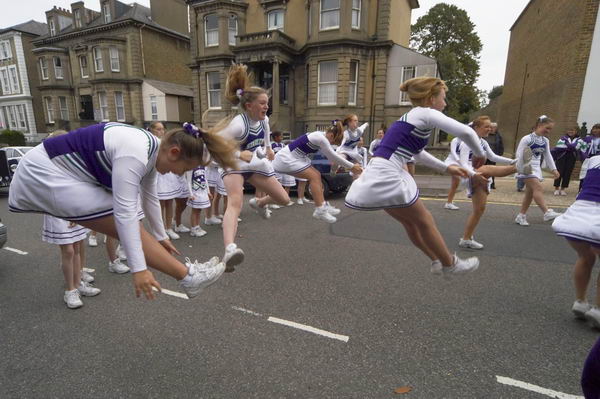

Christmas Decorations – 2003

Christmas Decorations: Twenty-two years ago I was younger and fitter and my doctor had told me to take plenty of exercise, which for me meant riding a bike. On one of these rides at the start of December I came across a house which had been decorated for Christmas and took a quick snap with the little Canon Ixus which was always in my pocket. I decided it would be an interesting project to photograph, particularly at night. I posted on a CIX photography forum asking for information about where there were houses worth photographing, but found a few others myself.

The Ixus wasn’t really up to this – as I wrote then, “they are .. very difficult to photograph well. In full darkness the contrast between the lights and the rest of the scene is too high. If you want to take pictures, then try and do so at twilight, when there is still enough light around to see clearly. The lupine hour is the best time for most ‘night’ photography.” There were just a few where I found a little flash could help but more often it ruined the effect.

During December 2003 I loaded the bag on my Brompton with my 6Mp Nikon D100, the first really affordable digital SLR and tied on a large Manfrotto tripod and either rode from home or went by train to various areas of London, riding around an taking photographs in late afternoon or early evening.

And of course I posted some of the pictures on My London Diary and wrote a piece about Christmas and the pictures – which is below- with minor corrections.


Christmas is on its way, and houses all over Britain are beginning to display the signs, some more tastefully than others. Some I’ve found are rather impressive, others I find amusing, but your opinions may well differ.

Christmas has almost completely lost the connection it had to the nativity, and the ‘Christmas Story’ is now one of cash registers and a Santa Claus who owes as much to advertising as to Saint Nicholas.

Originally of course this was a pagan festival from over 4000 years ago, the feast of the Goddess of Nature, an occasion for drinking, gluttony and gifts, so perhaps we really are getting down to our roots for once. Many celebrations, especially those for Yule (the ‘wheel’ or sun) were on the Winter Solstice – the shortest daylight, usually on Dec 21 or 22, when the rebirth of the sun was celebrated.

Pope Julius I decided it would be a good idea for Christians to celebrate the birth of Jesus on December 25 back in 350AD, so that Christians could go on celebrating yule and not feel bad about it, celebrating the birth of the Son of God while others were celebrating the birth of the sun. Though Christmas as we knew it only came in around the 1500s in Germany, many of its customs only really coming here when Victoria married Albert.

Our modern picture of Santa developed in the USA in the mid nineteenth century, particularly in the drawings of Thomas Nast for ‘Harpers’ magazine, and the jovial fat bearded man in red and white was well-established before Haddon Sundbloom annexed him for his fantastically successful coke adverts. Although Coke didn’t invent Santa, it was largely the power of their advertising that sold him to the world.

These decorated houses, often an attempt to go one better than the Joneses, have become an urban folk art. One of the glories of folk art is that it is seldom polite or tasteful, sometimes incredibly kitsch and over the top. Despite my misgivings on grounds of religion, ecology, upbringing and reserve I love them. at the very least they add a little colour to our lives.

Ruislip, Eastcote and West Drayton

The 15th was a glorious December day, cold but with a clear blue sky and sun. I took the Brompton on the train to Angel Road, then spent a couple of hours around there before heading north to Ponders End, further up the Lea Valley. around here there are still some of many industries that once filled much of the lower lea.

Lea Valley pictures

As it got dark I went to Enfield, in search of some houses I’d been told about, then on to North Tottenham and New Southgate and finally West Finchley. Somewhere I tried to cycle where the council had left a flower bed in the pavement and went flying, with rather painful results, but fortunately I don’t seem to have broken anything.

North London pictures

The weather was still good a couple of days later as I reached Rotherhithe in late afternoon, with a post-sunset glow along the Thames. Much of the Surrey Docks redevelopment seems sadly suburban and the new riverside flats depress by their lack of imagination, but there are some fine views along the river: even Canary Wharf can look good from a distance.

River Thames and Rotherhithe

Here were a couple more houses with Christmas decorations worth photographing, before I leapt onto the east london line to new cross. Unfortunately there diddn’t seem to be any trains running to Hither Green from there (despite the timetable) but it was only a couple of miles to cycle.

Rotherhithe

The lights in Newstead Road are perhaps the most impressive of any I’ve seen, but I can’t really find a good way to photograph them, and there are too many people around. Apparently last year they raised £3000 for charity.

Newstead Road

Back on my bike to the station, train to Waterloo and then another to Raynes Park and a cycle down Grand Drive to Lower Morden Lane, with fingers cold because I lost a glove on the way to Rotherhithe. This street is impressive for the number of houses with decorations, and the queue of cars driving slowly past to admire them. but none of them are really exceptional, and there wasn’t a lot to photograph.

So its back on the Brompton to Raynes Park and a couple of trains home. It was great to come in and find a hot dinner in the oven waiting for me.

Lower Morden Lane

Ashford

FlickrFacebookMy London DiaryHull PhotosLea ValleyParis
London’s Industrial HeritageLondon Photos

All photographs on this page are copyright © Peter Marshall.
Contact me to buy prints or licence to reproduce.


Around Finsbury Park – 1990

Around Finsbury Park: On Sunday February 25th 1990 I began a walk from Finsbury Park Station

Bookmarks, 265, Seven Sisters Rd, South Tottenham, Haringey, 1990, 90-2f-42
Bookmarks, 265, Seven Sisters Rd, Finsbury Park, Haringey, 1990, 90-2f-42

The Bookmarks shop was at 265, Seven Sisters Rd, Finsbury Park and was home to the Bookmarks Publishing Co-operative which had been established in 1979 to publish books and pamphlets by members of the Socialist Workers Party (SWP). In 1998 it moved to 1 Bloomsbury Street and is now Britain’s largest socialist bookshop and now sells a wide range of “non-fictional and fictional books that concern politics, economics, anti-fascism, anarchism, labour history, trade unionism, arts and culture, anti-racism, the environment, biographies, and feminism.”

Two doors beyond this at 269 was the former entrance to a cinema, built in 1909 as Pyke’s Cinematograph. Later it was combined with the larger Rink Cinema behind it at 10 Stroud Green Road and when I took this picture it had closed as a club and became as a large sign indicates ‘LONDON’S LATEST LUXURY TENPIN BOWLING ALLEY!’ with its entrance in Stroud Green Road around the corner. There is now a Lidl here.

House, 169, Queen's Drive, Finsbury Park, Hackney, 1990, 90-2f-43
House, 169, Queen’s Drive, Finsbury Park, Hackney, 1990, 90-2f-43

After the railway station – at first Seven Sisters Road station – opened in 1869 the area around it was opened up to speculative building, with trains taking workers into the City at Moorgate station in around 15 minutes. This very substantial Victorian detached house was one of those on Queen’s Drive, just a few yards from Finsbury Park and a short walk to the station which would have provided a home for a well-paid city worker and his family and a servant or two.

Houses, Queen's Drive, Finsbury Park, Hackney, 1990, 90-2f-45
Houses, Queen’s Drive, Finsbury Park, Hackney, 1990, 90-2f-45

Further down Queen’s Drive were more very substantial semi-detached residences and although much of the area had deteriorated particularly since the war these houses still seemed in good condition. This was clearly built as one of the posher streets in Finsbury Park and had remained so, although many of these large houses were now dividied into flats and some had been replaced by later and larger blocks of flats.

House, Brownswood Rd, Wilberforce Rd, Finsbury Park, Hackney, 1990, 90-2f-31

A strikingly vertical house on the corner of Brownswood Road and Wilberforce Rd, though in fact is I think actually only the same height as the house opposite, also with a full height attic window. There are similar houses on all four corners of the junction. The large block of flats looks very near but is on Citizen Road around a kilometre away to the south-west.

Squat, 63, St Thomas's Rd, Finsbury Park, Islington, 1990, 90-2f-36
Squat, 63, St Thomas’s Rd, Finsbury Park, Islington, 1990, 90-2f-36

Two adjoining doors of 63 and 65 St Thomas’s Road both have notices on them from the squatters, on the left door warning that the premises are occupied and that any attempt to enter without permission is a criminal act, while on the right visitors are told they need to knock and shout up up to people on the upper floors. Squatting in a residential building in England only became illegal in September 2012.

Stop the Roads, poster, St Thomas's Rd, Finsbury Park, Islington, 1990, 90-2f-21
Stop the Roads, poster, St Thomas’s Rd, Finsbury Park, Islington, 1990, 90-2f-21

YOUR LAST CHANCE TO STOP THE ROADS states a poster for a march from Kings Cross to Archway on 24 February 1990, the day before I took this picture. In 1989 Margaret Thatcher had outlined plans for a £23 billion trunk road enlargement programme in the Roads for Prosperity white paper, designed to assist economic growth, improve the environment, and improve road safety. It led to years of protest with many schemes being cancelled though others, including the M3 extension at Twyford Down, the Newbury bypass and the M11 link road went ahead.

To be continued


FlickrFacebookMy London DiaryHull PhotosLea ValleyParis
London’s Industrial HeritageLondon Photos

All photographs on this page are copyright © Peter Marshall.
Contact me to buy prints or licence to reproduce.
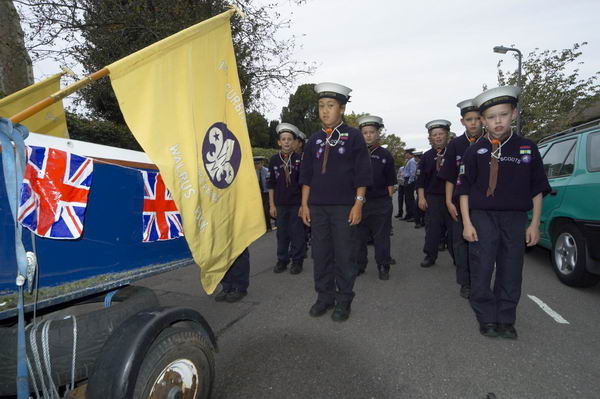

Panoramas Around Albert & Victoria Docks – 1994

Panoramas Around Albert & Victoria Docks: More panoramas I made in July 1994 on and around the Beckton Extension of the DLR, getting off the train at each stop, taking a walk around and making a few pictures before boarding the train again

DLR, Roundabout, Royal Albert Way, West Beckton, Newham, 1994, 94-718-33

One of the few pictures I made with a deliberate tilt of the camera in order to get the whole circle of the roundabout in the image. As you can see this results in a curved horizon.

DLR, Albert Dock, West Beckton, Newham, 1994, 94-719-11

The DLR stations on the elevated line often provided a useful viewpoint. Along the horizon here at left you can see the church at Silvertown, then the Silvertown Flyover. Around the centre are the mills on Royal Victoria Dock, then the more distant Canary Wharf and past that the Grade II listed 1881 Connaught Tavern. At right is the Compressor House, built in 1914 as a cold store for the dock.

DLR, Albert Dock, West Beckton, Newham, 1994, 94-721-22

A view through the front window of a DLR train which shows the Compressor House next to the Royal Albert Dock Station and the long stretch of the Royal Albert Dock. At the left are the houses of West Beckton. At right is London City Airport with a couple of planes.

DLR, Connaught Crossing,  Custom House, Newham, 1994, 94-721-42
DLR, Connaught Crossing, Custom House, Newham, 1994, 94-721-42

A view from the side of the train as it goes across Connaught Road looking over the recently built cable stayed swing bridge with reinforced concrete approach viaducts, opened around 1990. It replaced an earlier swing bridge built in 1904 to carry both the road and the North Woolwich Railway across the Connaught Passage between the Royal Victoria and Royal Albert Docks. The small octagonal building to the left of the bridge pumps water from the Connaught Tunnel, originally by hydraulic pumps but now by electric pumps. This was replaced by a larger circular structure when the tunnel was rebuilt for the Crossrail.

DLR, Victoria Dock Rd, Canning Town, Newham, 1994, 94-718-53

The DLR line runs beside Victoria Dock Road and this picture was made from Custom House Station and shows the junction with Freemasons Rd. Further along Victoria Dock Road you can see The Missions to Seaman Institute, Flying Angel House, built in red-brick Art Deco style in 1936. It closed in 1973 and after being used for some time as a college was converted into flats.

Royal Victoria Dock, Canning Town, Newham, 1994, 94-718-41

The western end of Royal Victoria Dock which closed in 1981. This picture was taken roughlky from where the cable car ride now has its northern terminal. The dockside sheds have been replaced by tall waterside blocks – around 17 storeys. There are still some of the old cranes on the quayside.

More panoramas from 1994 to follow.


FlickrFacebookMy London DiaryHull PhotosLea ValleyParis
London’s Industrial HeritageLondon Photos

All photographs on this page are copyright © Peter Marshall.
Contact me to buy prints or licence to reproduce.


Anti-Capitalist Carols in the City – 2012

Anti-Capitalist Carols in the City - 2012
Anti-Capitalist Carols in the City

On Tuesday 18th December 2012 I met a small group of anti-capitalist protesters from the St Paul’s Cathedral Occupy London camp at 3pm at Liverpool Street Station.

Anti-Capitalist Carols in the City - 2012

For the next couple of hours I went with them as they visited businesses and banks around the city to sing anti-capitalist carols against tax avoiders, bailed out banks and others in a peaceful and seasonal protest.

Anti-Capitalist Carols in the City - 2012

They had a special song for Starbucks – to the tune of ‘Let It Snow’ with the first verse::

Oh the cost of living's frightful
Some relief would be delightful
So don't leave us in the muck
Tax Starbucks, tax Starbucks, tax Starbucks
Anti-Capitalist Carols in the City - 2012
Signing a carol to customers inside Starbucks

There were another three verses, reminding us and Starbucks and the customers sitting drinking their coffee that corporate and elite tax evasion costs the nation £33 billion a year.

Anti-Capitalist Carols in the City - 2012

We walked out onto Bishopsgate and they gave their next performance outside the doors to the bankers offices at 125 Bishopsgate where security were not showing a happy Christmas spirit.

Away in the Caymnans, the Plutocrats wept
Because, we the people
are listing their debts
We're no longer fooled by
Divide and delay, we're planting the seeds,
But they're making hay...

The group moved cross the street to the RBS, reminding them the government supported the banks with an unimaginable £1.162 trillion. The several carols there, included:

Silent debt, holy debt
All is owed, all is wrecked
Round on poor; father, mother and child
public services tendered and priced
sleep in poverty please

There were similar performances outside the various other banks as we made our way through the city towards the Bank of England. There was a another carol for Ramsay Health Care, a company involved in the creeping privatisation of the NHS, on Old Broad Street:

What shall we do with our public services
Shall we sell off our public services
That's where Thatcher left it!

When we got to HSBC on the corner of Old Broad St and London Wall everyone walked inside to sing, including some of the police who were by now taking part – if silently – in the proceedings. After a couple of carols – and some posed photographs – the group went out.

On Old Broad Street there was another Starbucks – and again the carollers went inside to entertain and inform the customers.

Next it was time to visit another bank – the RBS on Threadneedle St – and by now a few more singers had joined the group.

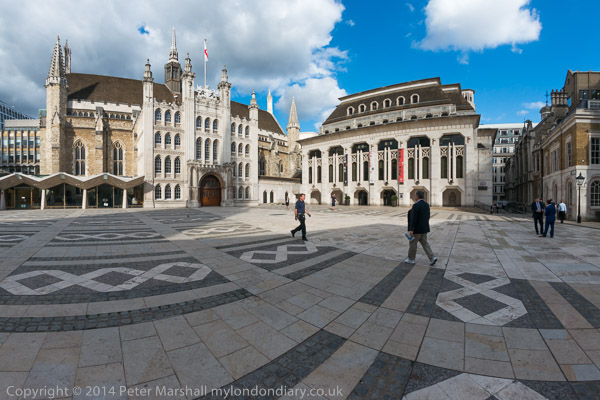
We walked up to the Guildhall – the medieval centre of the City, which had its own carol, to the tune of Good King Wenceslas:

Bad George Osborne last looked out
In the Autumn budget
Nothing to be proud about
So he had to fudge it
Said though things don't look that great
We are on the right track
Bullshit George, NHS you hate
Now it's time to fight back.

On the way back towards the Royal Exchange there was another Starbucks to enter and treat to a carol and couple more banks to sing outside – Lloyds stopped them from entering.

But the finest performance of the day came inside the grand banking hall of the NatWest on Poultry, where bank staff seemed quite amused by the performance, and some from the upper floors came to the balconies to watch and listen. I’d not been inside the building before and was pleased to be able to see it – and to take a few pictures.

Again after a couple of carols the group left quietly and crossed to the Royal Exchange where they performed on the steps as city workers rushed by to Bank tube station.

By then I was getting a little tired and cold, having been mainly on the street for a couple of hours. The carol singers had decided to split into two groups now their numbers had grown to visit more places, but I decided to get on a bus and start my journey home.

More pictures at Anti-Capitalist Carols in the City.


FlickrFacebookMy London DiaryHull PhotosLea ValleyParis
London’s Industrial HeritageLondon Photos

All photographs on this page are copyright © Peter Marshall.
Contact me to buy prints or licence to reproduce.
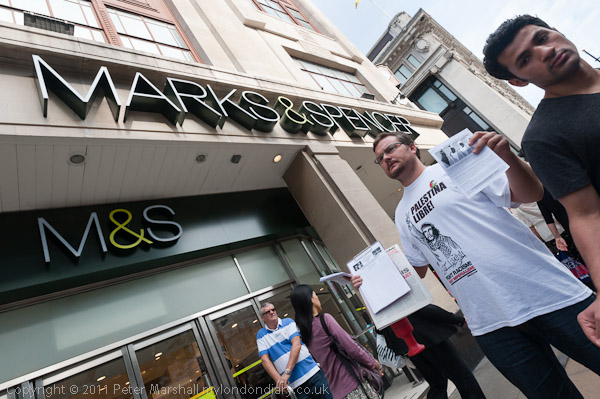

Lammas Lands, Leyton, Columbia Market & Bethnal Green – 2006

Lammas Lands, Leyton, Columbia Market & Bethnal Green: On Sunday 17th December 2006 I went to an event by local residents seeking to protect the Leyton Lammas Lands from the sprawling London 2012 Olympics before going to a meeting with a friend at Columbia Market. Unfortunately on my way there I got a phone call telling me he was unable to make it, so I took a few pictures there before walking on in a roundabout way to visit another friend in Bethnal Green. Below I’ll post what I wrote back in 2006 (with minor corrections) and some of the pictures from that day.


Loss of Common Land

Leyton Lammas Lands, Marsh Lane, Leyton

Lammas Lands, Leyton, Columbia Market & Bethnal Green
Allotments displaced by the Olympics may be relocated here on Leyton Lammas Lands

History seems about to repeat itself in Leyton, although the outcome may be different this time. It was in 894 that King Alfred drained Leyton Marsh and gave the local people the right to graze their animals on the Lammas Land created. (Details in this post come from a leaflet written by Lorraine Metherall and Neil Bedford, published by the New Lammas Lands Defence Committee (NLLDC) and from Martin Slavin’s Games Monitor web site – now archived here.)

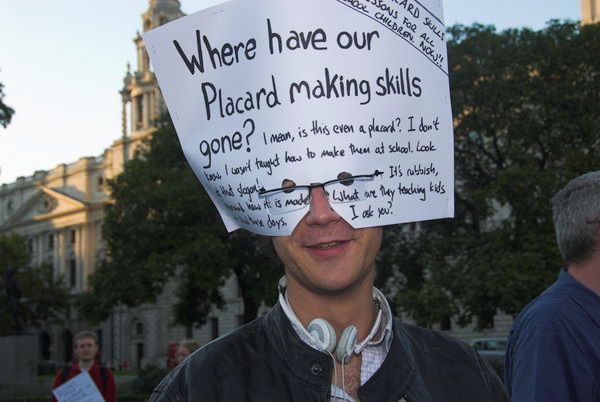
Lammas Lands, Leyton, Columbia Market & Bethnal Green
Marsh Lane, now mainly a cycle route, may become a busy road in the Olympic Development Authority has its way. The ‘New Lammas Lands Defence Committee’ hope to protect ancient rights.

In the 1890s, the East London Waterworks Company tried to take over the Lammas Lands, and on Lammas Day, 1st August 1892, a large demonstration met on the marshes and ripped up their fences. The company tried to sue one of the people involved, and locals set up the ‘Leyton Lammas Lands Defence Committee‘ (LLLDC) and fought the case in court. The water company ended up admitting defeat, paying all costs and giving money for a local essay prize.

Lammas Lands, Leyton, Columbia Market & Bethnal Green

The efforts of the LLLDC led to the ‘1904 Leyton Urban District Council Act‘, in which parliament vested the lands in the council, making them responsible for maintaining them as “an open space for the perpetual use therof for exercise and recreation…”. The act made them a permanent public open space in return for the giving up of the lammas rights, and was confirmed by parliament in 1965.

Lammas Lands, Leyton, Columbia Market & Bethnal Green

Over the years parts of the land have been taken for other uses, including railway sidings, Gas Board land and, more recently, the Lea Valley Riding School and Ice Rink. When the Lea Valley Regional Park acquired most of the Lammas Lands by compulsory purchase in 1971, they for some reason felt able to ignore the 1904 act, and have blocked public access to some areas.

Lammas Lands, Leyton, Columbia Market & Bethnal Green

The latest threat to Leyton Lammas Lands come from the London Olympic Delivery Authority (ODA). Although outside the Olympic area, the Lammas Lands are a handy place to dump the unwanted, in this case the allotment holders of Manor Gardens. In the late 1880s the Blessed Virgin Mary appeared at Eton College and prompted them to set up a charitable settlement in Hackney. The Eton Manor Settlement bought up land, including lammas land in Hackney and Leyton and set up various sports clubs and related activities including the Manor Garden Allotments.

A new short section of road would link Marsh Lane to Orient Way here.

Although the ODA is apparently set on jettisoning inconvenient requirements that were a part of its original agreement – such as the need to replace common land – it apparently still has to re-site the allotments, and its preferred site is on Marsh Lane, part of the Leyton Lammas Lands. Unfortunately the current land is unsuitable, being heavily polluted with a relatively thin layer of topsoil on top of wartime rubble.

This is the area of the Lammas Lands that would be taken for the allotments

Making them usable means removal of some existing soil and bringing in many lorry loads of new topsoil, probably half a metre over the whole site. This would mean an new vehicle access to Marsh Lane, bringing traffic the few yards from Orient Way, along with widening Marsh Lane with the loss of some of the fine avenue of trees currently on both sides. This would also need to stay open for the use of the allotment holders, and would almost certainly result in the newly widened Marsh Lane becoming a heavily trafficked short cut to Church Road.

Singing ‘The Lammas Land Song’ “We will not be robbed when there’s a ballot in this land…”

The ODA needs the support of the local council for their application, and the NLLDC hope to raise enough local support to make them think again. It is of course possible that the courts could be asked to ensure that the provisions of the 1904 act are enforced.

More pictures

[The Manor Gardens allotments were moved here in 2007 but the site allocated was in very poor condition. The ODA reneged on its promise to return them to their original site – but eventually in 2016 they were given a new site – only one fifth the area of their original site – on Pudding Mill Lane. This is now under threat from more and more tall buildings around it blocking out the sun.]


Leyton

Brightly painted sheds were being erected on the gas holder site
Rail sidings & sheds
Flood relief channel

A few more pictures from Leyton.


Columbia Market

I was in the East End partly to meet a mate at Columbia Market, but in the end he couldn’t make it. With Christmas just over a week to go, prices were high. I calculated we’d just sent several hundred pounds worth of eucalyptus twigs to the incinerator after I did a bit of pruning recently, and those three holly trees in the back garden would be a goldmine. Strangely, even at these prices, some people seemed to be buying the stuff, though by the end of they day there did seem to be quite a lot of plants being loaded back into the lorries, and there were certainly plenty of Christmas Untrees left.

Rootless trees

Real trees of course have roots, and we always get one that has them, and grow it on for a few years between January and December. A few die off, and others eventually get too big to get through the door, and there are three that would suit Trafalgar Square down the garden. [Two huge and still growing but I had to fell one of them a few years ago.]

A few more images – including the Christmas Tree machine


Bethnal Green

I took a few snaps, and then wandered through Hackney and Bethnal Green on my way to visit another friend who had written a book, The Romance of Bethnal Green, on the area and is using some of my pictures, to take a look at the design.

Queen Adelaide’s Dispensary

There was some nice light on some of the streets and buildings, and Queen Adelaide’s head curiously lit up as I passed.

Pellici’s Café on Bethnal Green Road

More pictures from Hackney and Bethnal Green


FlickrFacebookMy London DiaryHull PhotosLea ValleyParis
London’s Industrial HeritageLondon Photos

All photographs on this page are copyright © Peter Marshall.
Contact me to buy prints or licence to reproduce.