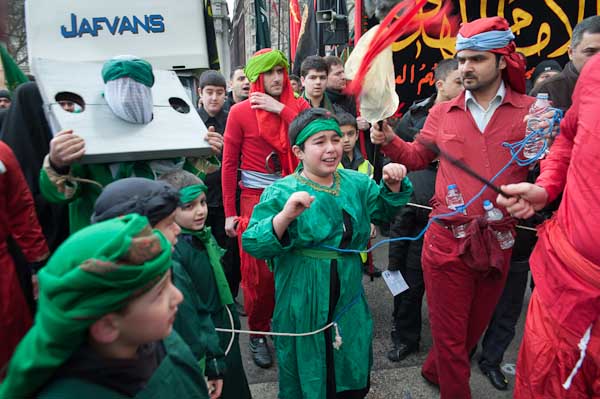
Women and children were marched into captivity from Karbala
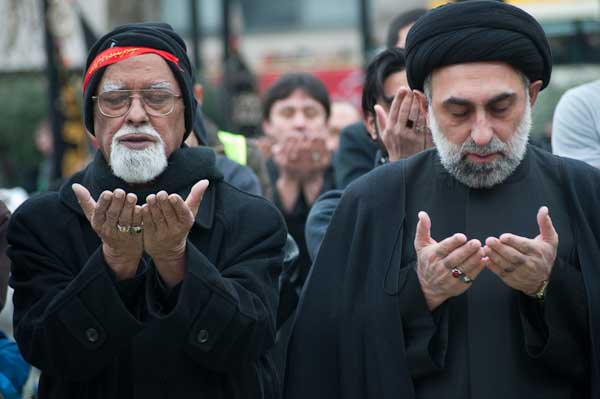
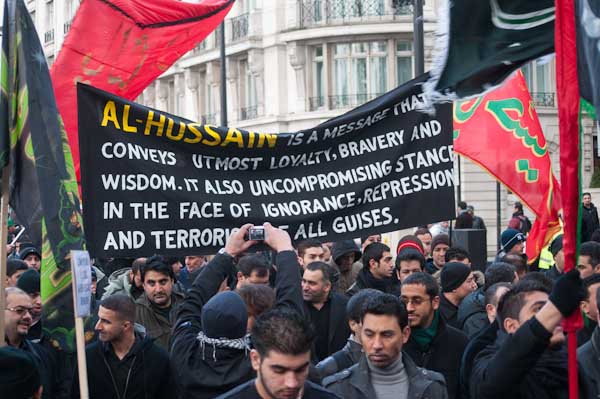
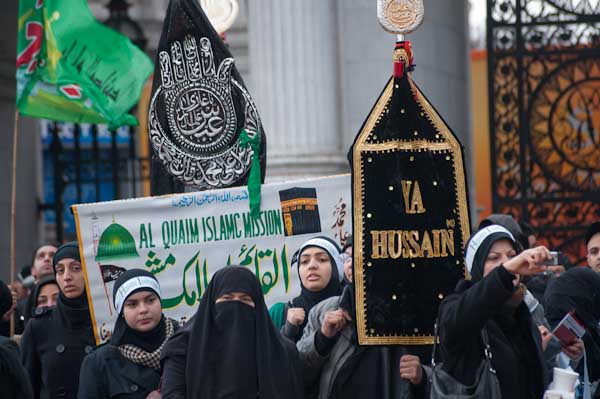
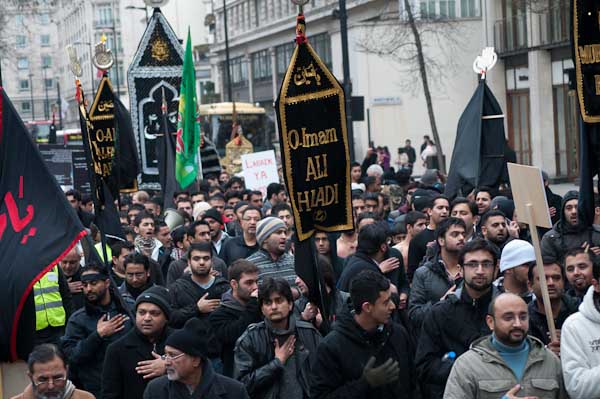
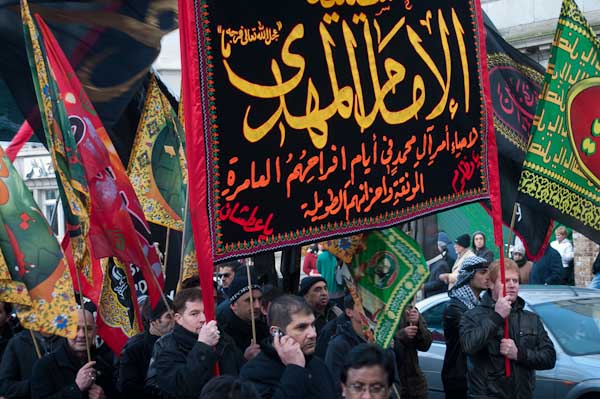
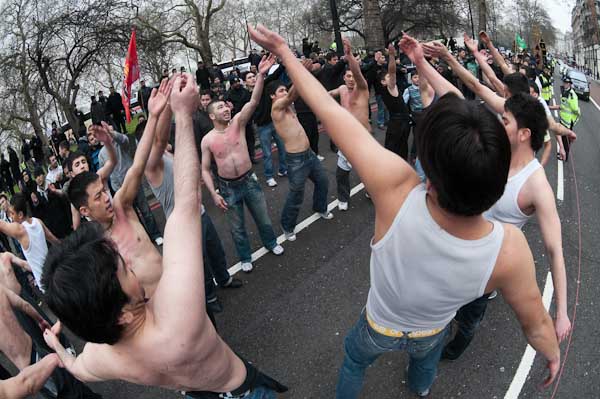
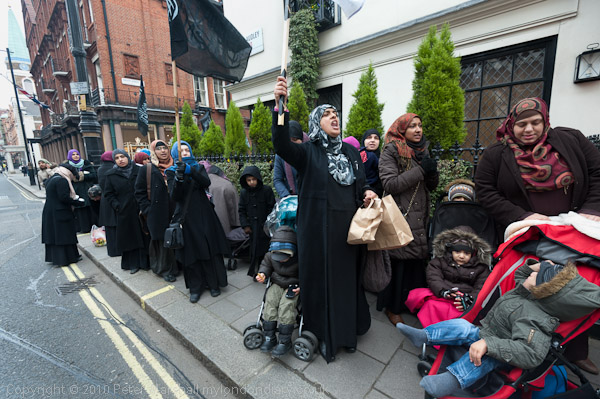
London Arbaeen Procession: On Sunday 7th February 2010 around five thousand Shia Muslims met at Marble Arch for the 29th annual Arbaeen procession in London.
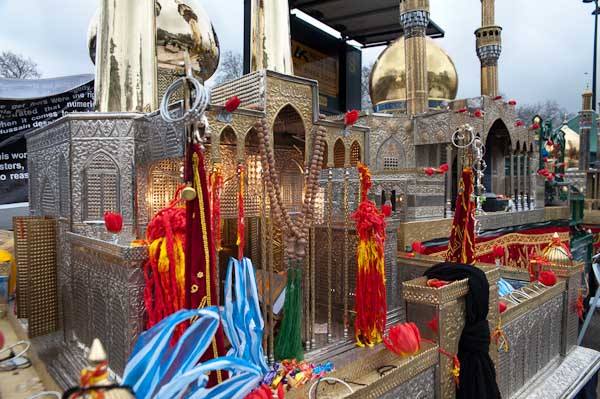
There were three large Shabbih, gold and silver replicas of the shrines of Karbala
The procession celebrates the sacrifice made by the grandson of Mohammed, Imam Husain, who was killed with his family and companions at Kerbala in 61 AH (680 CE.)
Hussain ibn Ali is regarded as “a 7th century revolutionary leader who sacrificed his life for social justice“. He refused to accept the rule of Yazid, “a corrupt ruler who was violating the basic rights and dignity of the people.”
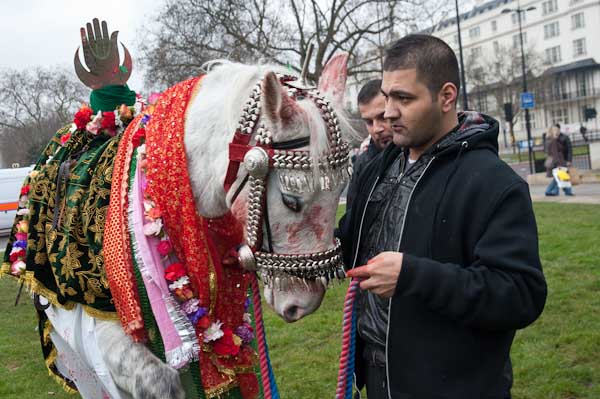
Zuljana – representing the horse of Imam Husain
Husain and his family and supporters were surrounded by an army of the tyrant but refused to surrender, choosing to fight to the death for their beliefs rather than to compromise. Their stand is seen by Shia Muslims as symbol of freedom and dignity, and an aspiration to people and nations to strive for freedom, justice and equality.
Many Sunni Muslims also mourn for Imam Husain and regard the actions by Yazid’s men as unacceptable in Islam, but the events are not an important part of their observances. A small minority apparently still revere Yazid and suppot his actions.
Many of the banners and placards carried in the event call for and end to crimes against humanity – and in particular for various attacks on Shia Muslims around the world.
The London procession organised by the Hussaini Islamic Trust UK since 1982 is the oldest and largest in Europe. It takes place on the Sunday following the end of 40 days of mourning the martyrdom of Husain.
Men beat their breasts in mourning on Park Lane
I photographed the procession every year from 2007 to 2007-2012 and there are other accounts and pictures from these years on My London Diary.
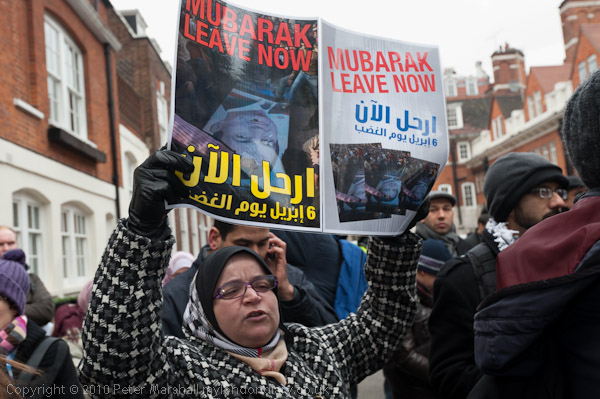
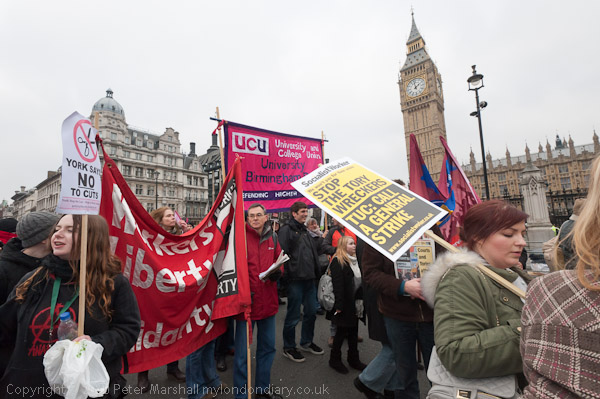
Education Cuts & Egyptian Revolution: People were protesting on the streets of London on Saturday 29th January 2011 in solidarity with demonstrations in Egypt at the Egyptian Embassy. Elsewhere students, teachers, parents and others took part in a large peaceful march against increases in student fees and cuts in education and public services.
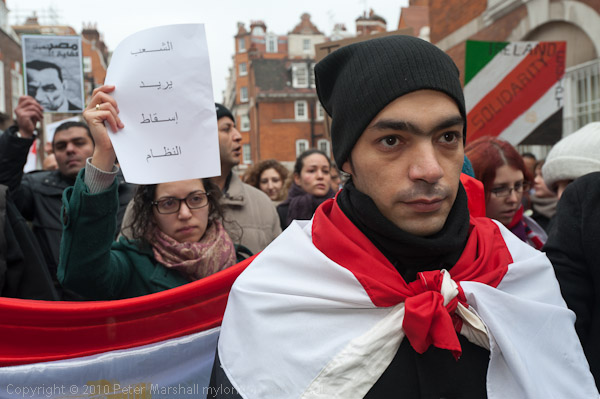
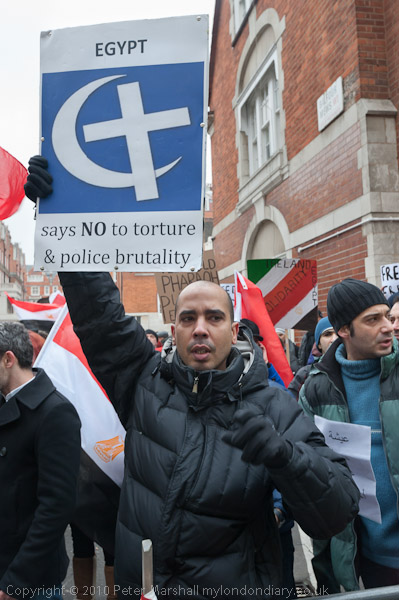
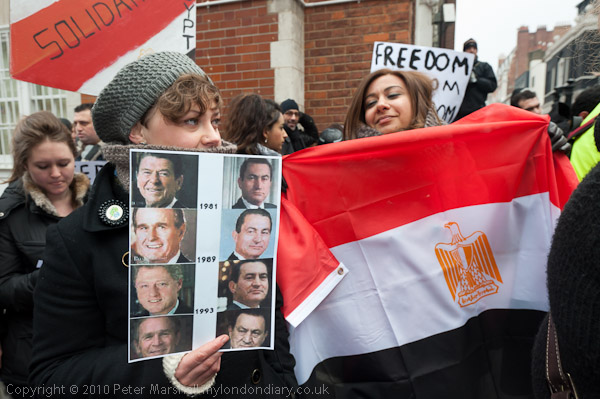
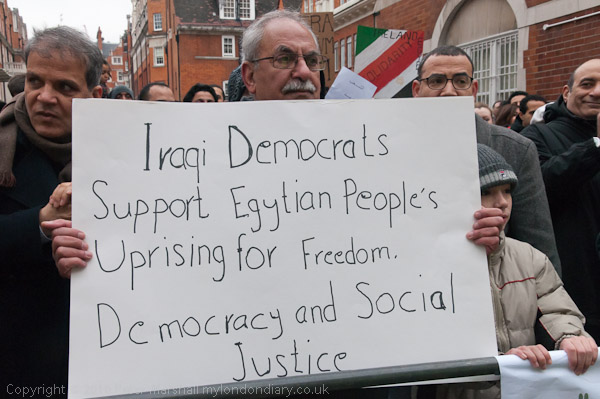
Solidarity with the Egyptian Revolution – Egyptian Embassy, South St. Mayfair
Around 200 people, mainly Egyptians living in the UK had come to the street outside the embassy for peaceful but noisy protest “to show our solidarity & support of our fellow Egyptians in our beloved country, who decided on making Tuesday 25/01/2011 a day of protests & demonstrations in Egypt against the unfair, tyrant, oppressive & corrupt Egyptian regime that has been ruling our country for decades.“
The protest had brought together Egyptians from differing political & ideological backgrounds, inviting “inviting all supporters of human rights & civic democracy to come & support us in delivering our message to the Egyptian regime.”
Their stated goal was to achieve “a democratic, free & civil nation capable of ensuring a dignified, honourable & non-discriminatory life for all Egyptians.“
Although the Arab uprising in Egypt in 2011 achieved some of its aims, including the end of the 30 year dictatorship of President Hosni Mubarak, it was followed by a struggle with the Muslim Brotherhood gaining power and Mohamed Morsi being elected as president in June 2012 only to be overthrown a few months later and the countrycpoming under the military regime led by Abdel Fattah el-Sissi since 2014.
In an interview with German news organisation DW ten years after the upraising an Egyptian activist commented “The counterrevolution has pushed the country into a state that is even more oppressive than before the 2011 revolution. The uprising has taken a terrible turn and has led to a tremendous regression.”
The protesters aimed to bring together people from across a wide range of political viewpoints, they refused to allow Hizb Ut-Tahrir protesters to join them, as they are opposed to human rights and democracy.
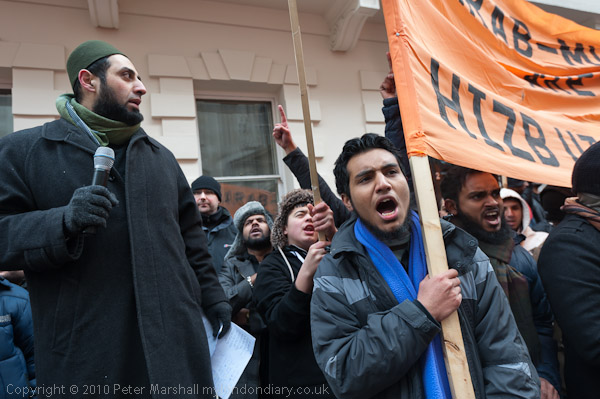
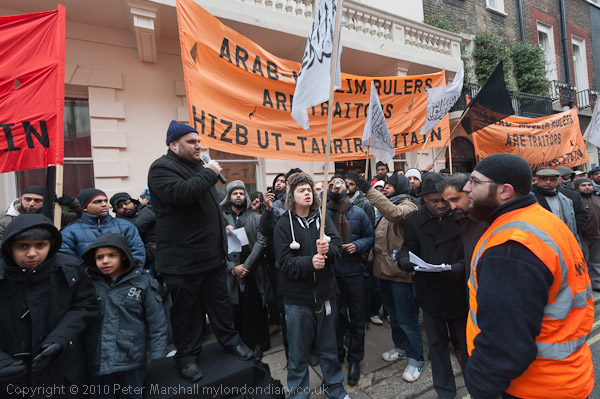
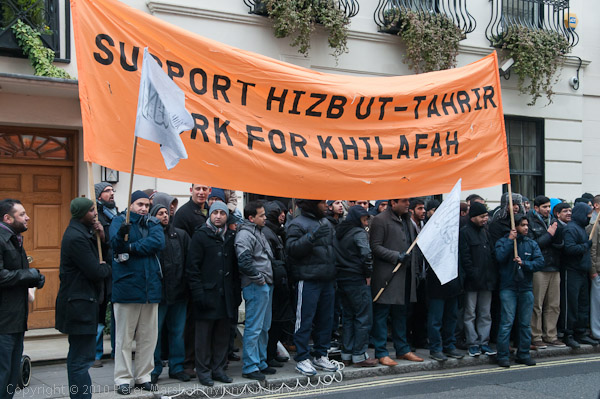
Hizb Ut-Tahrir Britain, an Islamist group calling for the establishment of a Muslim caliphate, marched to the Egyptian Embassy to take part in the protest there but were turned away.
When they arrived they were met by Egyptians taking part in the protest and told very firmly that the embassy protest – like the Egyptian revolution – was to be entirely non-sectarian and that they were not welcome there.
Instead they had to hold their own separate demonstration around a hundred yards away around the corner along South Audley St, where they were spread out along the pavement between South Street and Hill Street.
As always at their events, everyone was dressed in black and the men and women were segregated. The men filled most of the pavement along South Audley St, with just a few women at one end, with most of them around the corner eastwards on South Street, away from the loundspeakers and the embassy.
As I commented it seemed a clear demonstration of the lack of equality they would like to impose. None of the speeches while I was there was in English, but I was able to gather that they were calling for Egypt to come under the rule of an Islamic Khalifah (caliphate), the “real change” which they see as the answer to everything.
It was a call diametrically opposed to the aims of the Egyptian revolution, which aimed to get rid of the oppressive regime and make Egypt a free and democratic nation, a secular state where there is no discrimination based on gender, religion or political views. The last thing they wanted was to replace one repressive regime by another, though depressingly that was what the future held for their country.
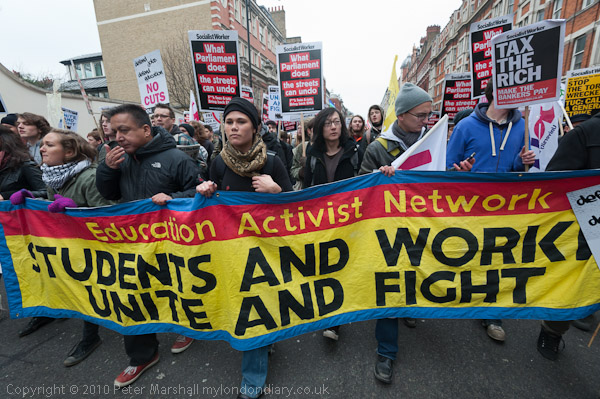
The National Campaign Against Fees and Cuts had organised two large national protests in London and Manchester to defend education and the public sector. They took place a little over two months after another large student march had ended with a small group walking into the Tory HQ at Millbank and occupying it.
On that occasion the police had tried to carry out a brutal eviction and were met with an angry response, with the protesters smashing large plate glass windows to allow others to enter, though few did. A number of protesters and press were injured by police (and a few police injured too), though most of those at the scene simply watched from outside in the courtyard and were appalled when a stupid idiot threw an empty fire extinguisher from the roof and began to chant against him. Fortunately no-one was killed. But the event made the headlines of those media organisations which generally turn their blind eye to protests, though the reports didn’t much engage with the reasons for the protest or report fairly on all that had happened.
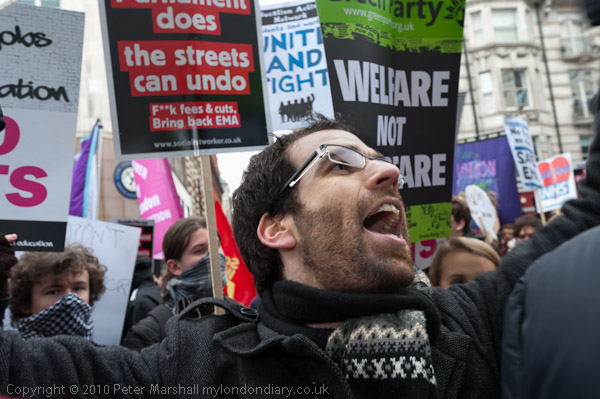
Police seemed to have learnt some lessons from their mistakes on that occasion and made much greater efforts to communicate sensibly with the protesters and not to kettle them or push them around. As I wrote “Despite the number of protesters in anarchist dress with facemasks, most students are not out to cause trouble.”
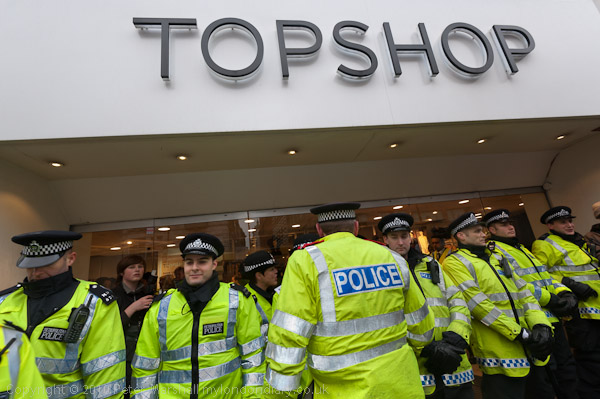
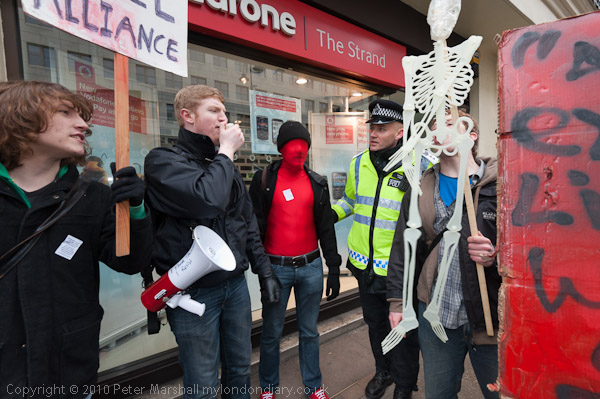
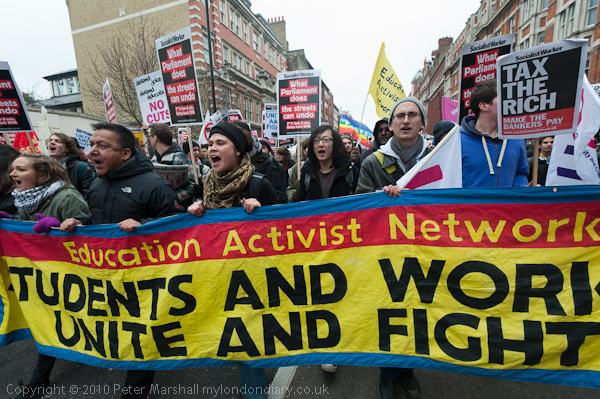
The march had begun with a short rally in Malet Street and I met it as the front was making its way out of Russell Square walking with it and taking pictures of the marchers and of short protests at Topshop and Vodaphone shops in Strand against their tax avoidance. Police lined the front of the shops and soon persuaded the protesters to move on.
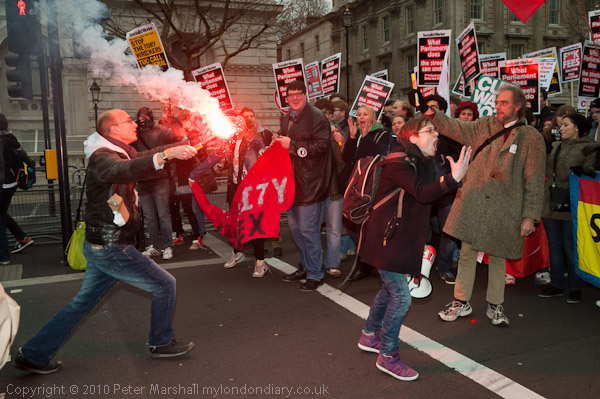
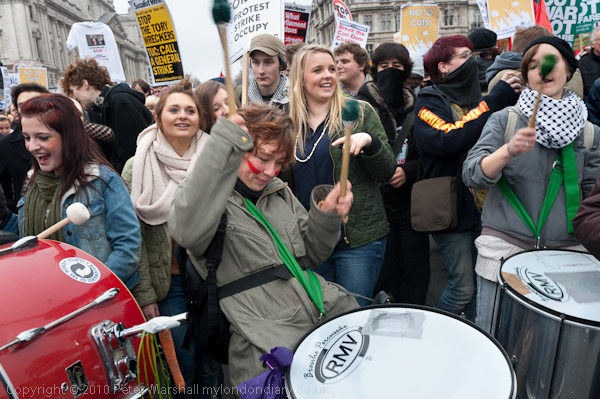
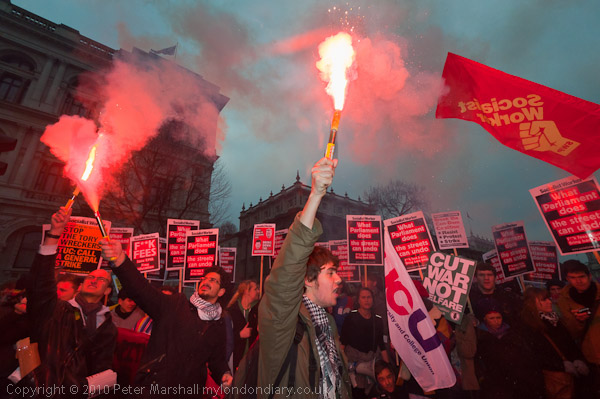
Things livened up a little outside Downing Street were the march paused for some angry shouting and several people let of smoke flares before moving on. Many stopped for a while in Parliament Square, with some dancing to a samba band, but after a while everyone moved off to where the march was to end outside Tate Britain on Millbank.
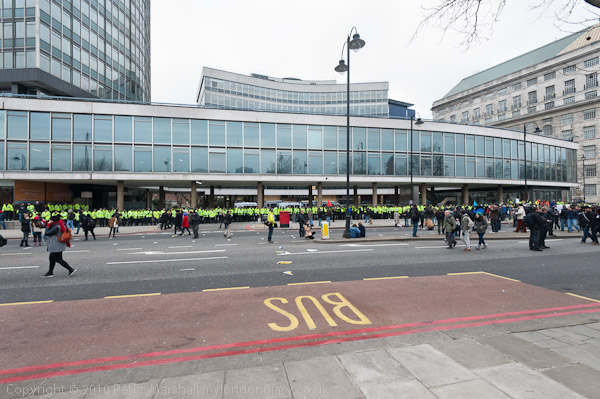
Unlike in the previous November there was a large group of police lined across the entire frontage of the Millbank tower complex – bolting the stable door as I think it unlikely that there would have been any trouble.
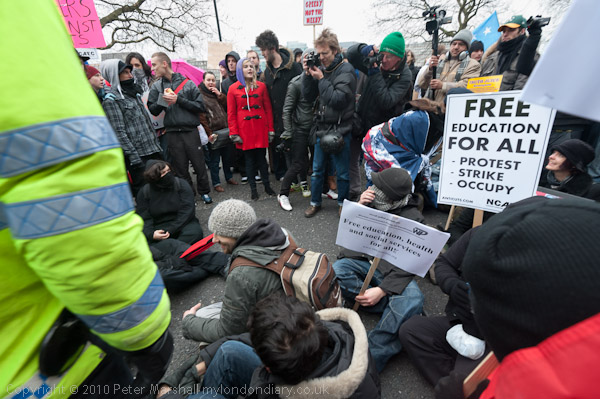
The only sign of any conflict between police and protesters I saw did come outside here, when there was a brief sit-down after police tried to drive two vans full of reinforcements through the crowd. Sensibly the police simply brought in a line of officers to allow the vans to drive along the pavement rather than try to force people to move.
By the time I arrived outside Tate Britain with the tail of the march they rally there had ended and I decided it was time to leave, though some of those on the protest were planning to continue elsewhere – including going to the Egyptian Embassy where I had been earlier. Later at home I read reports on-line that half a dozen people had been arrested in minor incidents.
The main event I covered 11 years ago on 29th January 2011 was a march by thousands of students, teachers, parents and others through London to defend education and the public sector. The demonstration, backed by the National Campaign Against Fees and Cuts was one of two national marches today, with another taking place in Manchester.
Two months earlier on Nov 10th a similar national protest had ended with some protesters storming into the Conservative Party HQ on Millbank, where considerable damage was caused and a number of protesters and police injured. Protest stewards tried to stop them but were unable to do so, and there were apparently very few police around as they rushed in. It was an hour before riot police arrived and began to fight the students and force them out. Around a dozen of the protesters were injured badly enough to require hospitalisation, along with three police officers. Fortunately no one was killed when a protester threw a fire extinguisher off the roof into the crowd below. 54 people, mainly students were arrested.
I’ve often criticised the police estimates of numbers taking part in protests, typically less than a half of the actual participants, and on that occasion they had been misled by their own estimate that only 20,000 would attend the protest. On the day it was more than twice that number, and the 225 officers deployed was far too few.
There were further student protests in November and December where police came out in larger numbers and some seemed to be taking revenge for their earlier failure – including twice dragging one protester from his wheelchair and across the roadway and almost killing another who was later charged with taking part in violent disorder along with four others – and eventually all were found not guilty.
But by 29th January police tempers had cooled, and too many videos and reports of their extreme actions had been aired on social media and even in the mass media. They were taking no chances this time and there were many more police around, but they were also doing their best not to provoke confrontation.
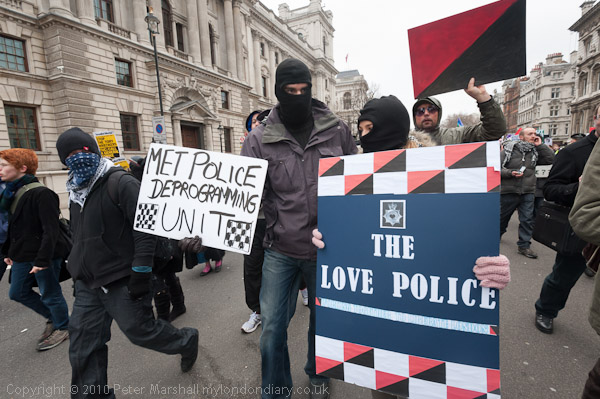
Police do seem to have learnt lessons after their mistakes last year, and I saw no real problems arising today. Despite the number of protesters in anarchist dress with facemasks, most students are not out to cause trouble. But if police start pushing people around, or kettling them, problems are going to arise.
And later:
At one point outside the Millbank tower complex, police wanted to drive a couple of vans of reinforcement through a crowd, and some people sat down on the street. Police asked them to move but met with no cooperation. Rather than try and force the issue, police just formed a line so that the two vans could bypass the seated students and drive along the pavement. It was a simple solution that avoided further friction. Later there were reports of half a dozen people arrested in minor incidents.
As in November, the event ended with a rally close to Tate Britain on Millbank, but by the time I arrived with the tail end of the march this had ended. I was a little surprised by this as it was a much smaller event then in November, with perhaps 5,000 marchers, but perhaps few speakers had wanted to attend. Some of the marchers planned to go on to protest in Oxford St and at the Egyptian Embassy, but for me it was a chance to walk across Vauxhall Bridge and catch a train home.
I’d been at the Egyptian embassy earlier in the day, and photographed two protests taking place there. Opposite the embassy Egyptians had gathered “”to show our solidarity & support of our fellow Egyptians in our beloved country, who decided on making Tuesday 25/01/2011 a day of protests & demonstrations in Egypt against the unfair, tyrant, oppressive & corrupt Egyptian regime that has been ruling our country for decades.”
A hundred yards away Hizb ut-Tahrir, an Islamist group calling for the establishment of a Muslim caliphate was also holding a protest. The Egyptians opposite the embassy had told very firmly that the embassy protest – like the Egyptian revolution – was to be entirely non-sectarian and that they were not welcome there.