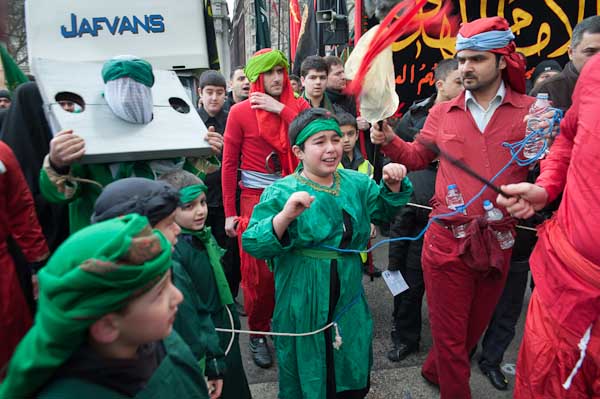
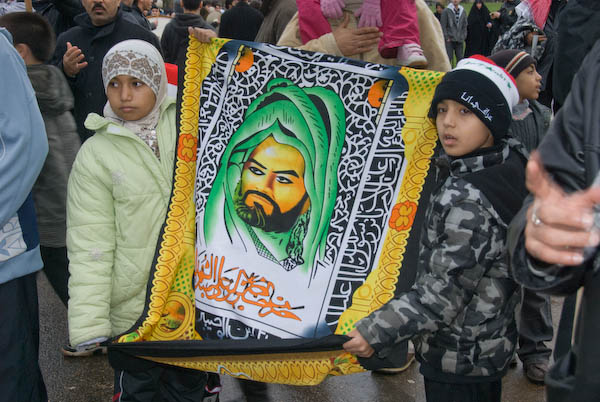
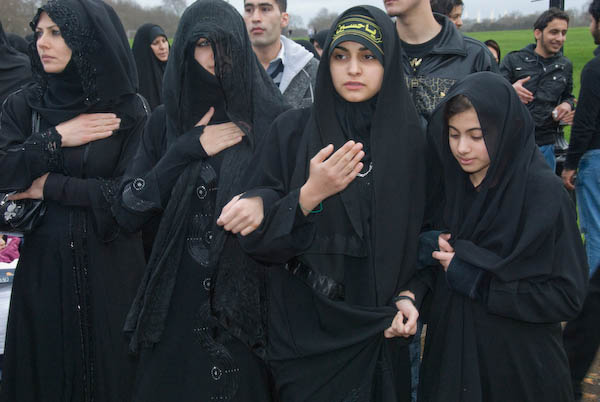
Women and children were marched into captivity from Karbala
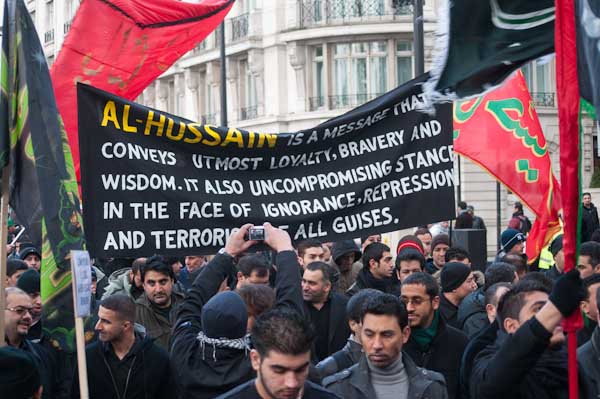
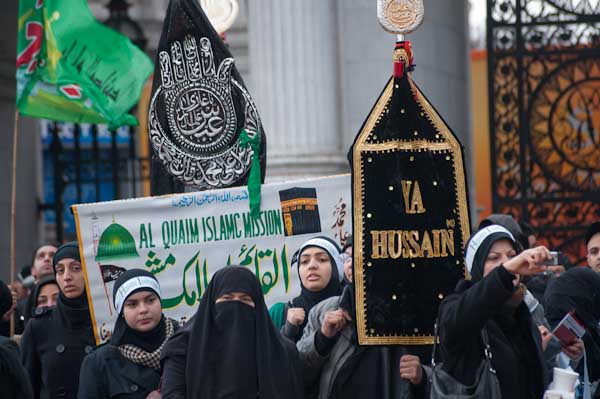
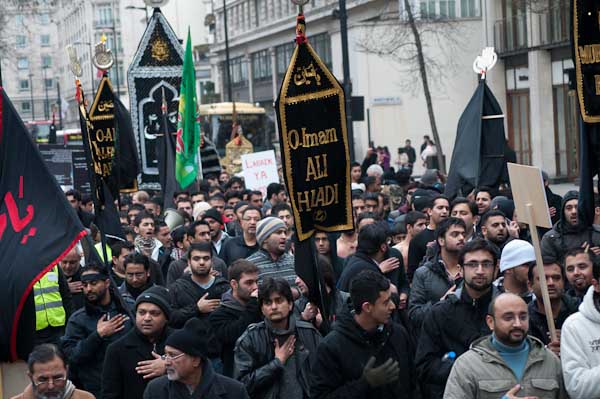
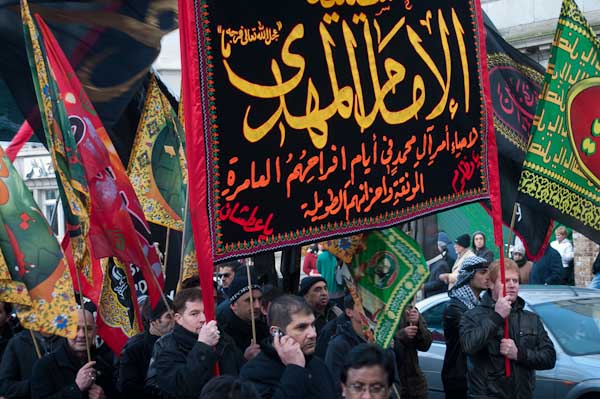
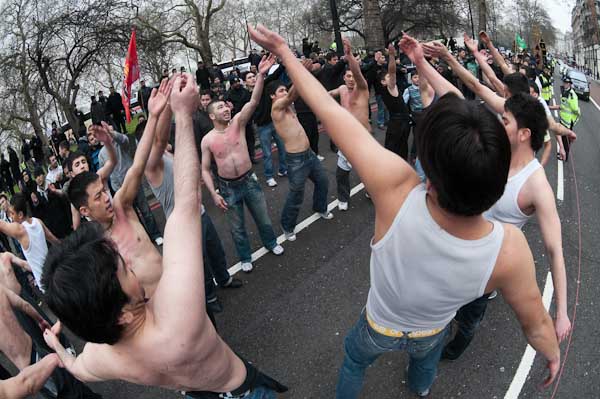
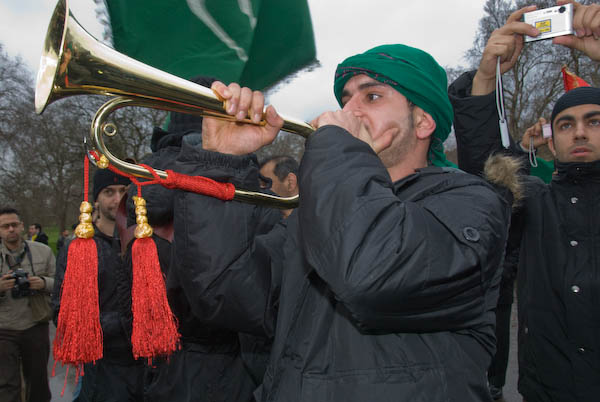
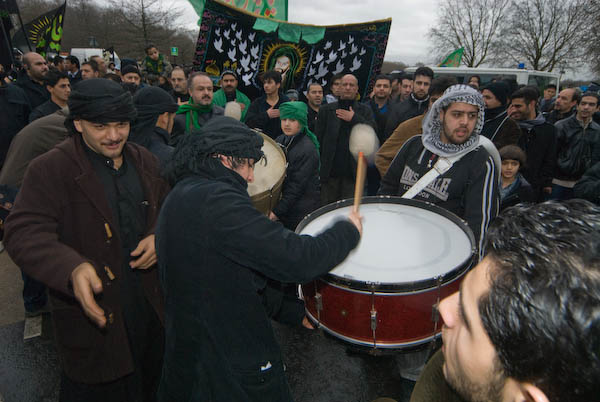
London Arbaeen Procession: On Sunday 7th February 2010 around five thousand Shia Muslims met at Marble Arch for the 29th annual Arbaeen procession in London.
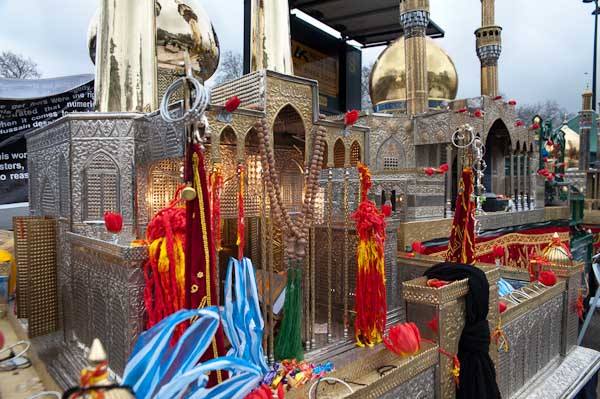
There were three large Shabbih, gold and silver replicas of the shrines of Karbala
The procession celebrates the sacrifice made by the grandson of Mohammed, Imam Husain, who was killed with his family and companions at Kerbala in 61 AH (680 CE.)
Hussain ibn Ali is regarded as “a 7th century revolutionary leader who sacrificed his life for social justice“. He refused to accept the rule of Yazid, “a corrupt ruler who was violating the basic rights and dignity of the people.”
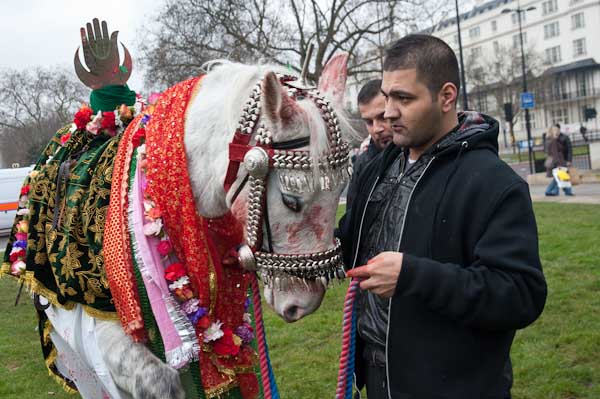
Zuljana – representing the horse of Imam Husain
Husain and his family and supporters were surrounded by an army of the tyrant but refused to surrender, choosing to fight to the death for their beliefs rather than to compromise. Their stand is seen by Shia Muslims as symbol of freedom and dignity, and an aspiration to people and nations to strive for freedom, justice and equality.
Many Sunni Muslims also mourn for Imam Husain and regard the actions by Yazid’s men as unacceptable in Islam, but the events are not an important part of their observances. A small minority apparently still revere Yazid and suppot his actions.
Many of the banners and placards carried in the event call for and end to crimes against humanity – and in particular for various attacks on Shia Muslims around the world.
The London procession organised by the Hussaini Islamic Trust UK since 1982 is the oldest and largest in Europe. It takes place on the Sunday following the end of 40 days of mourning the martyrdom of Husain.
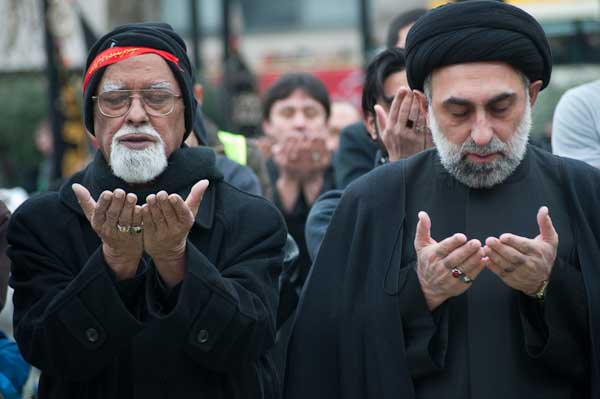
Men beat their breasts in mourning on Park Lane
I photographed the procession every year from 2007 to 2007-2012 and there are other accounts and pictures from these years on My London Diary.
Temple Festival: 400 Years of Middle & Inner Temple – Saturday 19th January, 2008
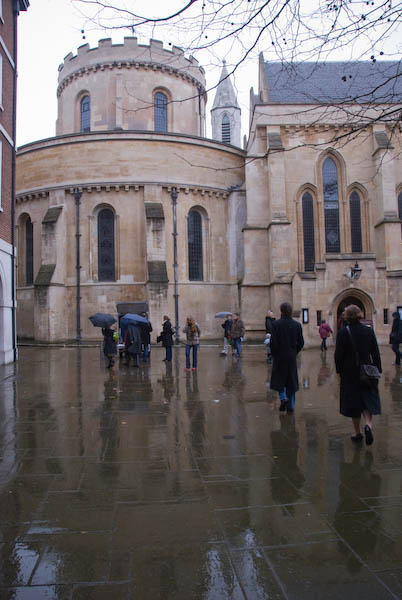
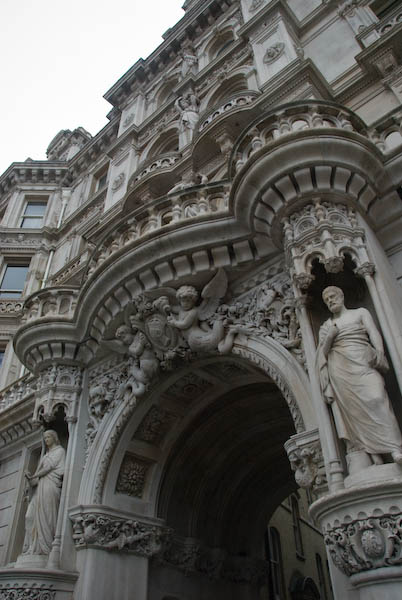
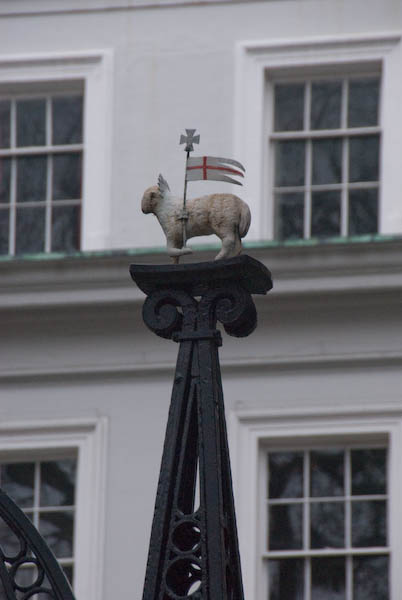
Temple Church, 2008
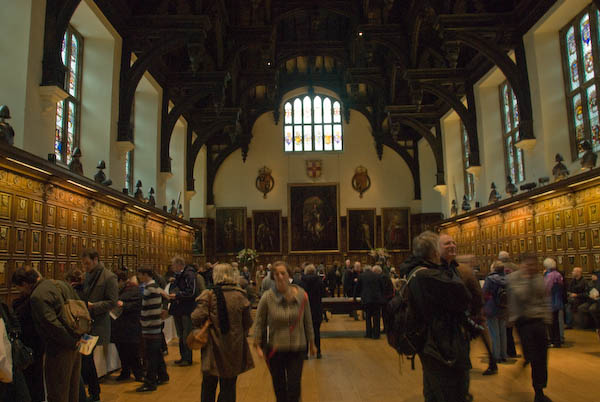
A few weeks ago I spent an interesting afternoon with several friends. We met at Temple underground station then walked up Milford Lane and into the Middle Temple, turning right at Fountain Court, passing Middle Temple Hall, turning north into Middle Temple Lane and then right into Pump Court and then paying our entry fee to visit Temple Church, one of London’s more remarkable ancient churches. After a long time there we walked out and up Fetter Lane to Holborn Circus and on to Ely Place and spending some time in St Etheldreda’s RC Church, also worth a visit, before turning back and down Ely Place to the Old Mitre pub.
Middle Temple Hall, 2008
This is only one of many in London worth a visit, and we soon left for another and finally for a meal in one of those Wetherspoons is currently trying to sell. Sitting there I reviewed the numerous pictures I had taken on the walk, and thought a few were not bad. When I got home I took the SD card out of the camera and left it on my desk. The following morning I put it into my USB card reader but the reader didn’t respond and nothing came up on my computer. I put it back into the camera and got an error message and the camera was now also unable to read the card. I tried another camera with the same result.
I carefully cleaned the contacts on the card, but that didn’t help. I googled a bit, but all of the articles I found assumed you could access the card, which I couldn’t. I gave up and binned the card. I’ve never had this problem before using CF and SD cards for 20 years, taking pictures most days. On one or two occasions I’ve had to use rescue software to read files from cards, and back in the early days I did manage to overwrite some files after I had put them on my computer with smaller versions of the same images, but I can’t recall ever having been unable to access the files at all. And I did on one occasion lose one or two full cards after the pocket they were in was ripped when things got rather physical in a protest I was covering.
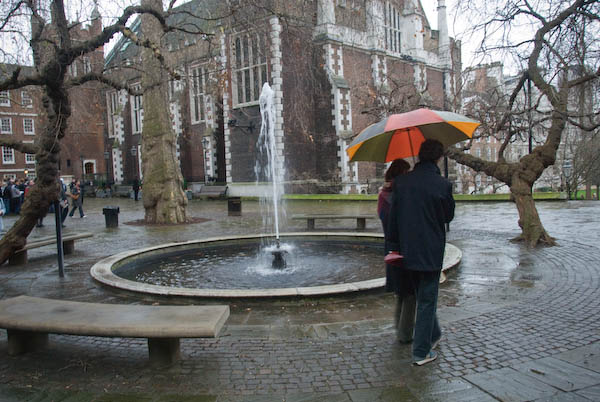
Middle Temple Lane
Fortunately it didn’t really matter. I’d had an enjoyable afternoon, and the pictures, though interesting weren’t important. I could in theory go back and repeat them, possibly better, though it’s very unlikely I will. And although there were some places on our route I’d not photographed before, others I had, for example on the visit the pictures here come from, when on Saturday 19th January 2008 the Middle & Inner Temple were celebrating 400 years since James I granted the site in perpetuity to the Honourable Societies of the Middle and Inner Temple for training and accommodating barristers, on condition that they also looked after the Temple Church.
Of course the Temple Church was by then almost 450 years old – here’s the first couple of paras of what I wrote back in 2008:
The Knights Templar moved down from the north end of Chancery Lane to Temple around 1160, and of course built a church. Soon after they were suppressed in 1308, the site went to the Order of St John, and not long after they leased the site to some law students.
Henry VIII didn’t just become head of the church in England to make it easier to change wives, but also used it to grab for himself the huge riches of the monasteries – including the Temple site with its two templar halls full of lawyers. (When there was a pilgrimage of several thousand in protest, led by lawyer Robert Aske, Henry promised to look into their complaints and most went home happy. Then he had Aske hung in chains from a church tower until he starved to death and forgot his promises. But Aske came from Grey’s Inn, not the Temple.)
Ashura Day Procession – Marble Arch, Saturday 19 Jan, 2008
The Knights Templar were of course fighting in the crusades against Islam in Palestine and elsewhere, and their church has memorials to many of the nobler knights, including some who bear my family name, though almost certainly I’m not in any way descended from them. Marshalls were stable boys as well as knights. But it did seem appropriate in some way that my day took me from the Temple (though I didn’t on that occasion go in the Temple Church) to one of the major Islamic religious commemorations of Shia Islam.
Ashura Day remembers the martyrdom of Husain and his small group of followers at Kerbala, Iraq in 61AH (680 AD.) Processions in London have taken place for many years now, and I first photographed one of them in 2000, returning in several years including 2008. It takes place annually on the 10th of Muharram, which I think in 2023 will be July 29th.
The event began at Marble Arch and then several thousand people walked along Hyde Park Place and the Bayswater Road, some banging drums and blowing trumpets, while others chant through loudspeakers to lead the mainly black-clad walkers in their mourning, remembering the martyrdom of Husain and his small group of followers.
I left the procession, which was on its way to the Islamic Centre in Penzance Place in Notting Hill, at Lancaster Gate. It was getting rather dark and taking pictures by available light was becoming tricky – and I was getting tired and glad to get on the tube.