From Southwark Park Schools which ended the previous post on this walk, Rotherhithe New Road & Southwark Park Schools, I walked a few yards up Southwark Park Road to the corner with Banyard Road, where I photographed the taxi office (still there but changed from A-Z Star Cars to 5 Star Cars) with the pub on the opposite corner, the Southwark Park Tavern, now closed and converted to residential around 2003.
There was a pub around here, the Green Man, possibly on this site before Southwark Park opened in 1869 but I think this building probably came shortly after the park was opened, and is opposite the Carriage Drive leading into the park.
Unfortunately I haven’t yet digitised this picture, nor one of rather plain two-storey terrace on Banyard Rd or an image showing a play area in the park. I hurried through the park to the Jamaica Road gate at its north, crossing to make my way to Kings Stairs Gardens and the River Thames.
River Thames, Downstream, Rotherhithe, Southwark, 1988 88-10l-63
The two jetties visible here I think have now gone and there is certainly no line of lighters as in this picture, and there is one striking new building on the riverfront.
River Thames, Downstream, Rotherhithe, Southwark, 1988 88-10l-65
A second picture taken with a short telephoto lens from almost exactly the same place shows the central area more clearly, with new flats being built on Rotherhithe St.
Wapping, River Thames, Rotherhithe, Southwark, 198888-10l-51
Looking across the Thames downstream, with Free Trade Wharf at the extreme right and just to the left the cylinder ventilation shaft of the Rotherhithe tunnel in the King Edward Memorial Park. Both Metropolitan Wharf and New Crane Wharf are covered iwth scaffolding.
Wapping, River Thames, Rotherhithe, Southwark, 1988 88-10l-52
Part of St John’s Wharf and King Henry’s Wharves seen across the River Thames.
Wapping, River Thames, Rotherhithe, Southwark, 1988 88-10l-53
More of St John’s Wharf, including one of the earlier warehouse conversions and the Grade II listed Wapping Police Station, built 1907-10, Metropolitan Police architect John Dixon Butler. At extreme left is a part of Aberdeen Wharf built in 1843–4 by the Aberdeen Steam Navigation Company.
Wapping, River Thames, Rotherhithe, Southwark, 1988 88-10l-54
The end of Aberdeen Wharf is at the right edge of this picture, and at its left the Wapping Police Boatyard, an unnecessarily ugly building opened in 1973. The new building in the centre of the picture also seems something of an eyesore, at least at its ends.
Wapping, River Thames, Rotherhithe, Southwark, 1988 88-10l-55
Continuing up-river from the Police Boatyard are St Thomas Wharf, Pierhead Wharf, Oliver’s Wharf – the first warehouse in Wapping to be converted into luxury flats in 1972 – and Wapping Pierhead, with houses designed by Daniel Alexander in 1811 and the main entrance to London Docks.
Bermondsey, River Thames, Rotherhithe, Southwark, 1988 88-10l-41
Looking upriver on the south bank with Tower Bridge at the extreme right and Guy’s Hospital tower just left of centre. Cherry Garden Pier is at left.
Silver Jubilee, marker, EIIR, River Thames, Rotherhithe, Southwark, 1988 88-10l-43
There is still a marker for the Queen’s Silver Jubilee here but it looks far less impressive than this rugged stonework I photographed in 1988. London has also gained quite a few tall buildings, but the view along the river remains clear and you can still see the dome of St Paul’s Cathedral.
41 Rotherhithe St, now apparently 1 Fulford St at least according to Google Maps, was the offices of lighterage company Braitwaite & Dean, where their lightermen would come to collect their weekly wage. Apparently it was known locally as the Leaning Tower of Rotherhithe, though the building’s lean is more apparent from across the river than in my picture.
It was left more or less alone on this stretch of the river with just the Angel pub equally isolated a few yards upriver after Bermondsey council bought many of the buildings in 1939 to create a park, with wartime bombing continuing the demolition job. There was some temporary housing by the river when I first walked along here in the early 1980s, but that soon disappeared.
My walk in Bermondsey continued – more about it in a later post.
People’s Assembly & Class War Against Austerity – Saturday 20th June 2015 saw a massive march through London from Bank to Parliament Square in the People’s Assembly End Austerity march against the savage and destructive cuts to the NHS, the welfare state, education and public services.
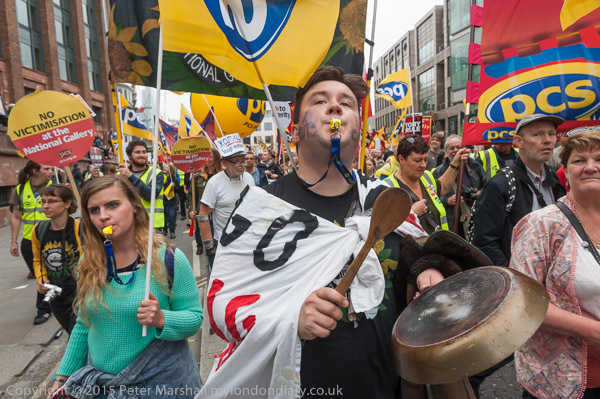
The march was supported by groups from across the centre and left, and my pictures show Clapton Ultras, CND, the Green Party, Labour MP Dianne Abbott, Focus E15, Left Unity, FRFI, People’s March for the NHS, Netpol, Socialist Worker, Global Women’s Strike, Union branches, and others on the march.
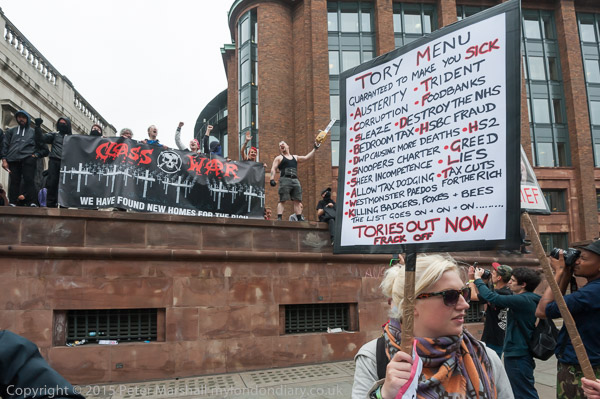
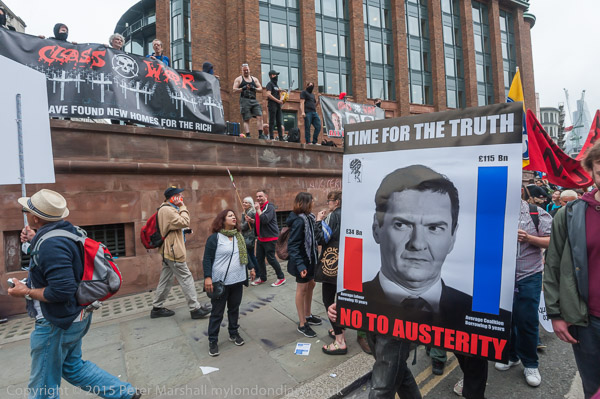
Class War was missing. They were calling for an end to A to B marches to rallies and called for direct action, diverting several hundred from the march to support a squatted pub at the Elephant & Castle which Foxtons want to open as an estate agent. Had I heard about it in time I might have followed, but instead I went to photograph a Class War group holding banners on a footway above the march.
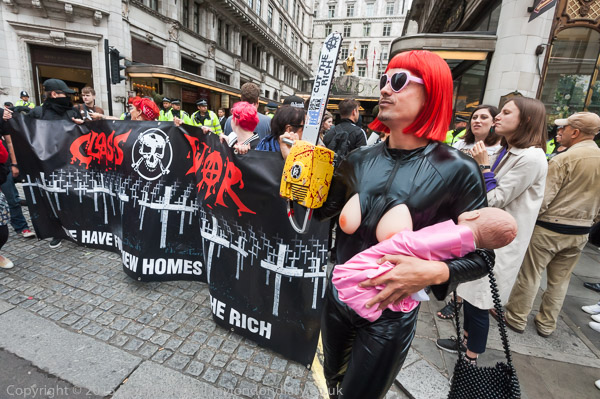
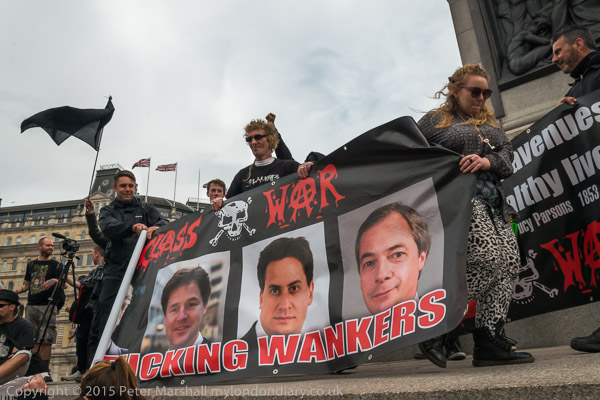
They showed several banners, including a new version of one that police had seized (and then lost) showing political leaders, as well as another that police were then charging Lisa McKenzie for displaying with rows of graveyard crosses extending to the far distance and the message ‘We have found new homes for the rich‘, along with the Lucy Parsons banner with her message ‘We must devastate the avenues where the wealthy live.’
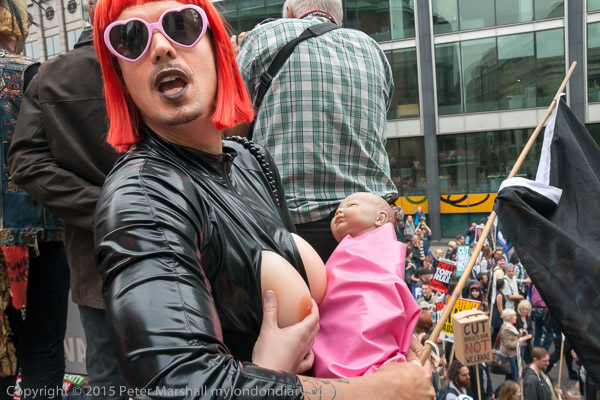
Two of Class War’s candidates from the previous month’s General Election were also there, Lisa and Adam Clifford, their Westminster candidate, today wearing a top with fake exposed breasts and holding a fairly lifelike looking baby.
Adam invites people to feel his breasts
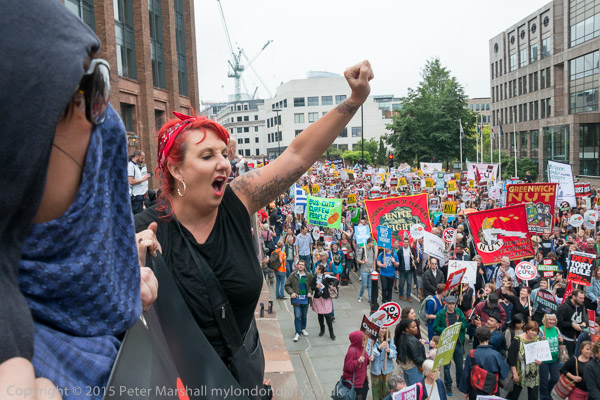
The protest was massive, filling across the wide street and taking well over an hour to pass Class War, many raising fists and shouting in solidarity, clapping and otherwise showing approval, with just a few shaking their heads or trying hard to ignore it, though this was difficult, especially when they were letting off flares which sent blue smoke across the march. The organisers claimed 250,000 marched though my rough estimate was perhaps a little less than half this. The organisers claimed 250,000 marched though my rough estimate was perhaps a little less than half this.
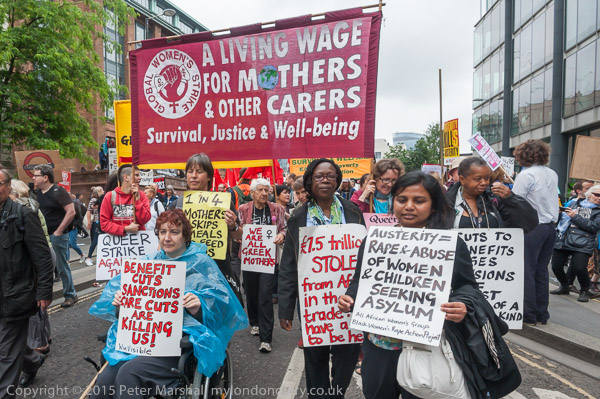
Global women’s strike
I went down to street level and took many more pictures of the marchers going past, some with Class War visible in the background.
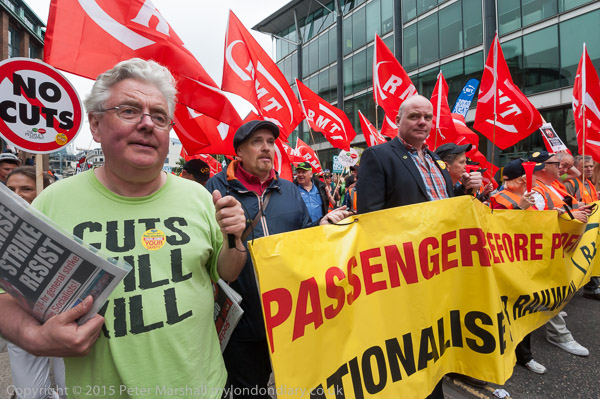
RMT banner with John Reid (left) and Steve Hedley (centre right)
I watched as around 30 police gathered behind Class War and thought they were about to take action. But charging the group on a wall ten foot above the street would have been highly dangerous for both officers and protesters, and after some lengthy discussions between several senior officers the police rapidly moved away.
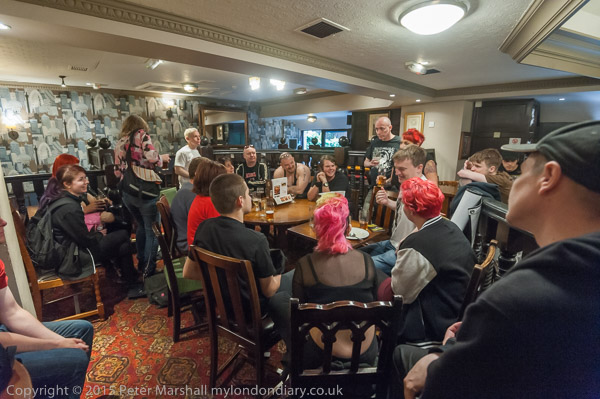
Class War discuss how to continue their day in the Olde London
Class War joined in at the end of the march before leaving it to search for a pub, but few City pubs open at the weekends when the area is largely deserted. Eventually the found the Olde London on Ludgate Hill, and went inside, with a large group of police waiting for them outside as they relaxed and then planned further action.
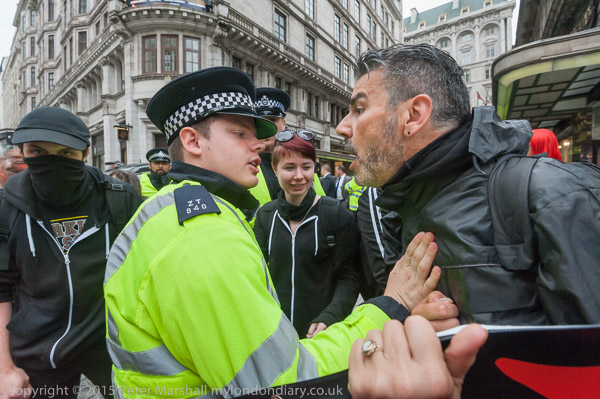
Police followed Class War at a discreet distance as they made their way towards Westminster, rushing forward and forming a line to protect the Savoy Hotel as Class War stopped to protest, blocking the entrance road for a few minutes.
Eventually there were some rather heated arguments as police threatened them with arrest and slowly forced them away. They grabbed one man who had tried to stop a taxi entering, and when a taxi driver got out of his cab and threatened to assault the protesters they seemed far more interested in protecting him from the protesters than in taking any action over his illegal threats.
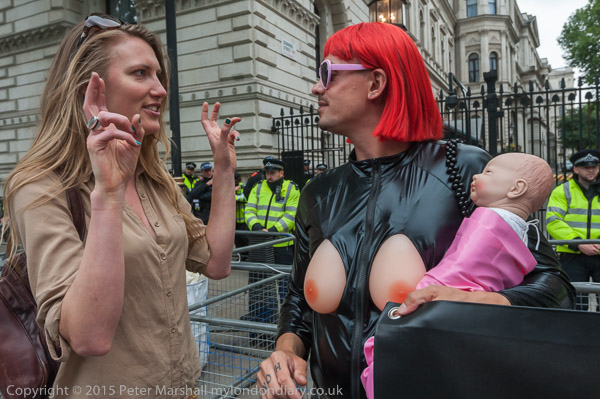
A woman argues with Adam Clifford at Downing St
Eventually the protesters moved away and on to Whitehall, followed by several police vans. Here they met a sound system and stopped to dance in the road for a while before going on to protest outside the gates to Downing St – and to throw a smoke flare over them. Here there was more dancing and a few short speeches and some of the marchers who had made it to the rally in Parliament Square came back to join them. Eventually Class War rolled up their banners and went off to another pub, telling me they would continue their protests later – but I’d had enough and went home.
Rip Down the Ripper Facade! When Mark Palmer-Edgecumbe, a former former head of diversity for Google got his architects to apply for planning permission to turn a building on Cable Street in East London into a ‘Museum of Women’s History’ the application stated it would “recognise and celebrate the women of the East End who have shaped history, telling the story of how they have been instrumental in changing society. It will analyse the social, political and domestic experience from the Victorian period to the present day.” The application his architects submitted was illustrated with pictures of suffragettes and other notable women from the past.
But when the boards around the site came down in 2015, everyone was shocked to see it was instead it had been turned into a ‘Jack the Ripper Museum’, exploiting the unfortunate women who had been the victims of a series of unsolved murders in the East End in 1888. The architect who made the application and others who had been consulted made clear they had been duped into supporting the project and there were protests outside by members of the local community including the Bishop of Stepney, the Rt Rev Adrian Newman, and Tower Hamlets mayor John Biggs.
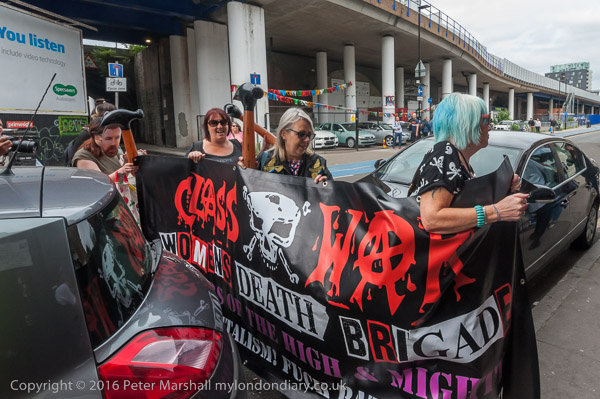
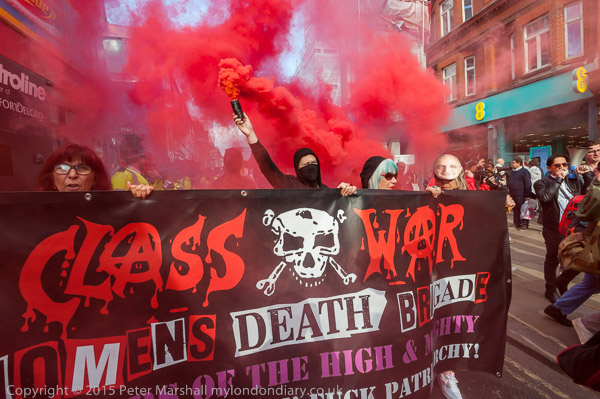
Class War Womens Death Brigade arrive for the protest
But most of the protests outside the tacky tourist attraction have been by Class War and its supporters along with feminists including London Fourth Wave Feminists who, together with Class War’s Womens Death Brigade organised the protest I photographed on June 19th 2016. These groups continued to protest after others – including Tower Hamlets Council – appear to have given up.
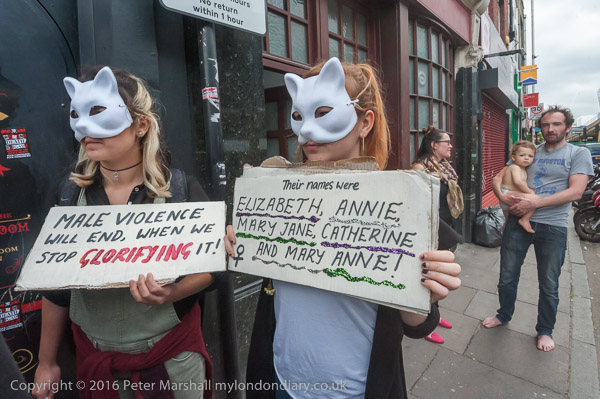
London Fourth Wave Feminists were there waiting
The council in 2016 refused retrospective planning permission for the shop front and ordered changes to the signage and the removal of a metal roller shutter, which the shop had installed after a window was broken by persons unknown in the middle of the night – not during one of the protests outside as Wikipedia (and possibly the shop owner) suggest. I think I was present at all of the various protests except for the first rather tame event which the local council had arranged to calm things down after Class War and others had widely advertised one for the following evening.
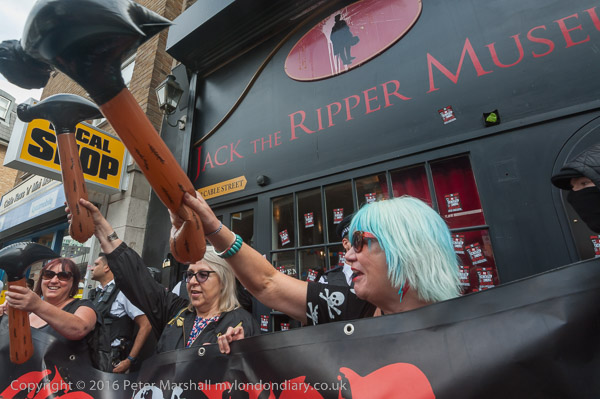
Class War women had brought inflatable plastic hammers
The planning decision was appealed by the shop, and even after their appeal failed the council failed to take enforcement action and it was not until 2018 that the shop front was redesigned. Bad publicity from the protests possibly contributed to the commercial failure of the shop, though there were also poor reviews from visitors who felt it not to be value for money.
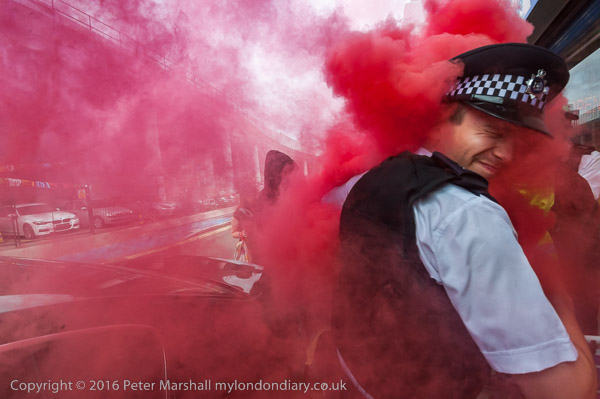
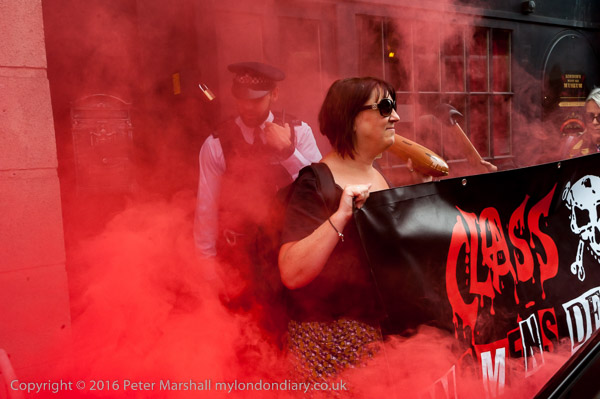
Black-clad protesters arrived set off some red smoke
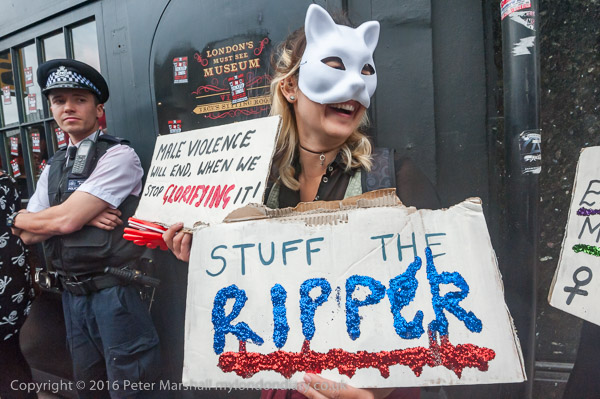
Class War did not of course ‘Rip Down the Ripper Facade’ but the action was typical of their street theatre with inflatable plastic hammers and a little coloured smoke, while the Fourth Wave Feminists came with cat masks and posters to make clear why they were opposed to the shop’s glorification and profiting from violence against women. Eggs were thrown at one of the signs the shop had been ordered to remove and the windows were liberally covered with stickers, but there was no permanent damage.
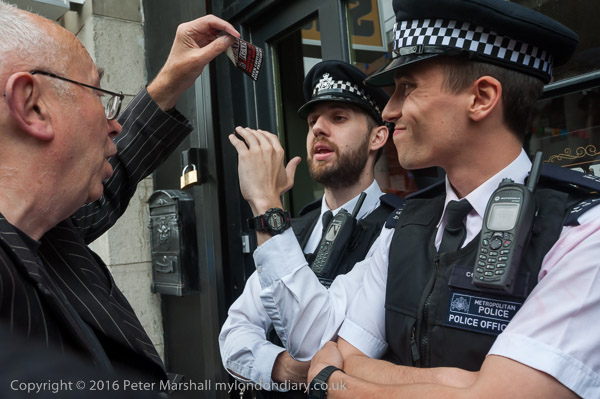
Ian Bone reaches past police to post a sticker on the window
During the roughly hour long protest there were no customers who came to try and enter the shop, and none inside left. Although London was spilling over with tourists on a Sunday afternoon in June, apparently none wanted to visit this particular tourist attraction. It had been hoped it would close after it was put up for sale in April 2021, but appears still to be open.
Ten Years Ago – Chariots & Custody Deaths – On Sunday 17th June 2012 I photographed two very different events in London
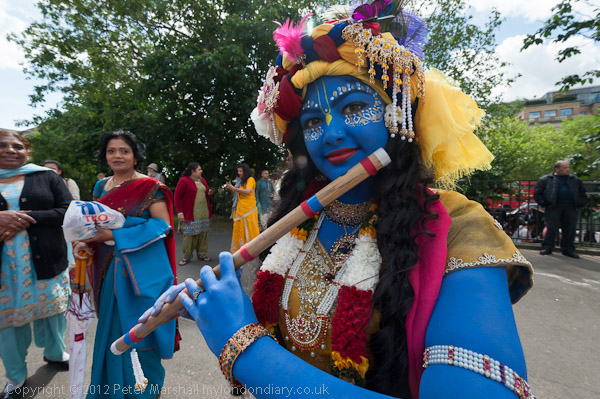
Hare Krishna Chariot Festival – Hyde Park
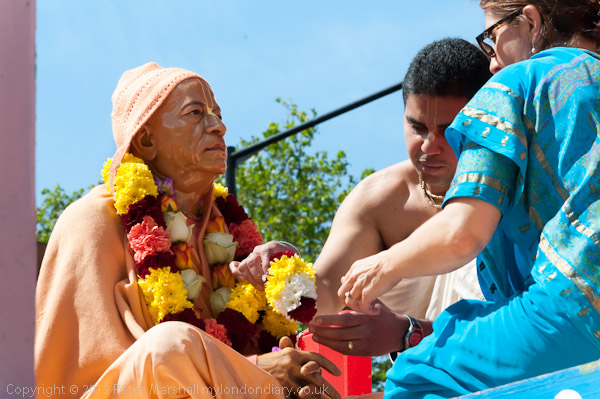
Effigy of A.C. Bhaktivedanta Swami Prabhupada (1896-1977) the founder of ISKCON (Hare Krishna)
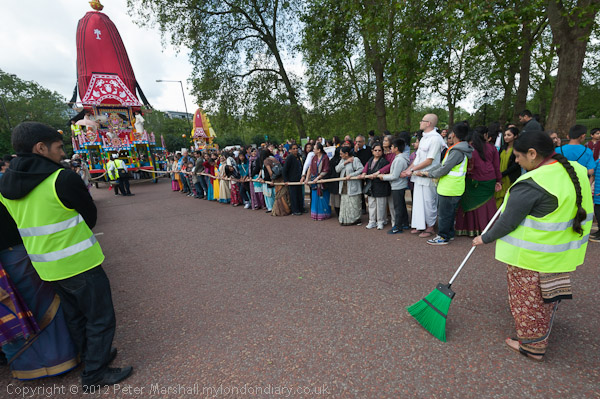
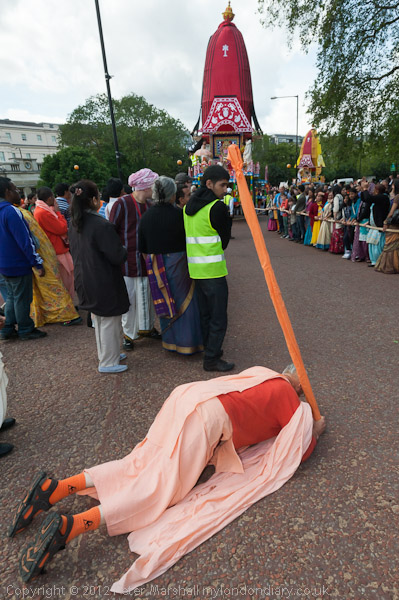
More than a thousand Hare Krishna devotees turned up in Hyde Park on Sunday morning to pull three giant chariots through the streets of London to Trafalgar Square.
People pull the chariots with ropes and others sweep the path for it
The Rathayatra Chariots Festival first took place at the Jagannatha temple at Puri, Orissa on the east coast of India probably at least a thousand years ago. It celebrates the attempt by Krishna’s childhood friends who were cowherds to try and kidnap him after he became a great lord and take him back to their village on a cart.
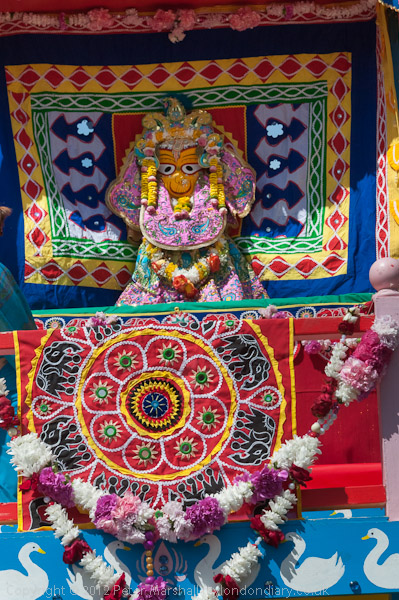
There are three chariots to carry the three deities worshipped at Puri, e Krishna in the form of Jagannatha, his half-sister Subhadra, and Balarama her brother. Jagannath means ‘Master of the Universe’ and his name and the chariots in the festival give us the word “juggernaut”.
Subhadra’s representation on her chariot
Hare Krishna disciples celebrated the festival in San Francisco in 1967 and it was first celebrated by a small group here in 1969, but only became a large event in London much more recently. It is one of the more colourful annual events in the city. I left as the procession left Hyde Park.
Fathers Day Vigil for Custody Deaths – Brixton Police Station
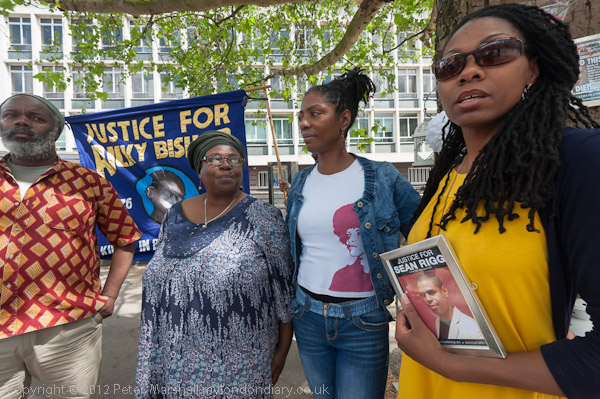
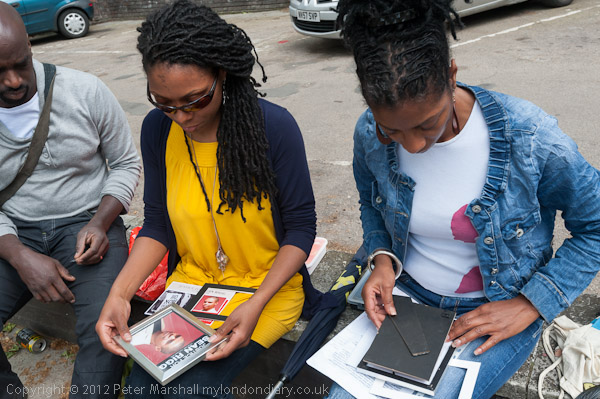
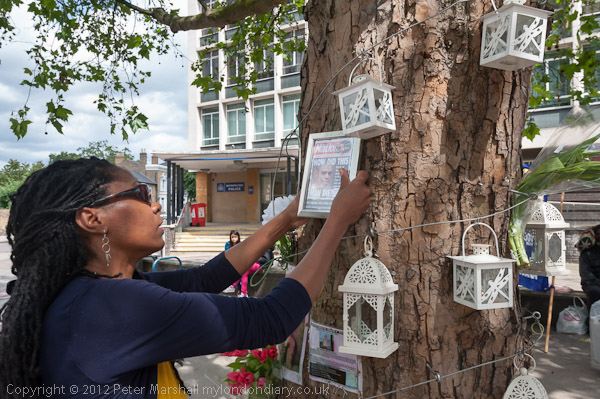
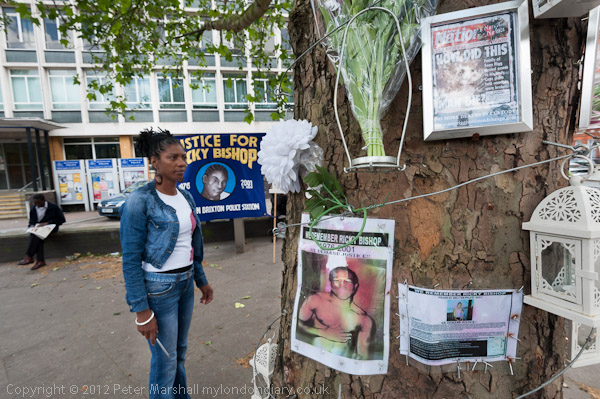
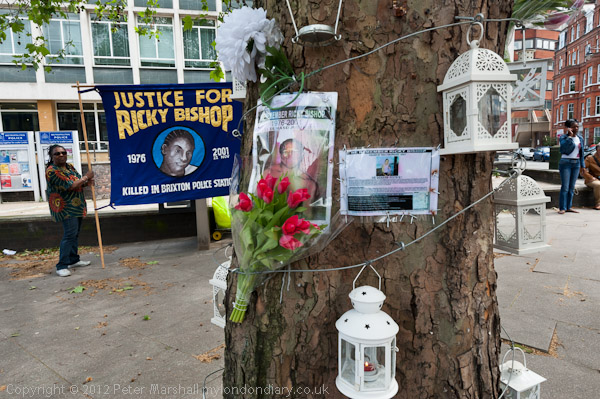
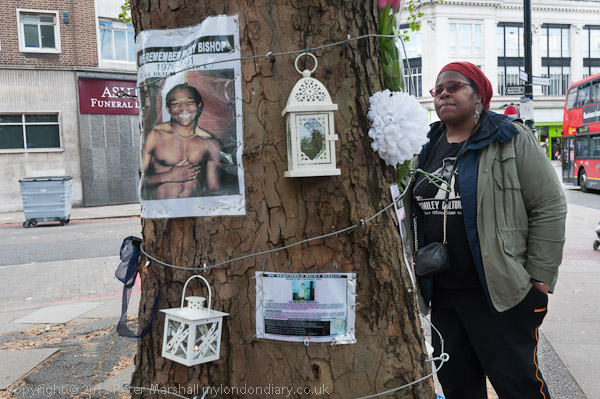
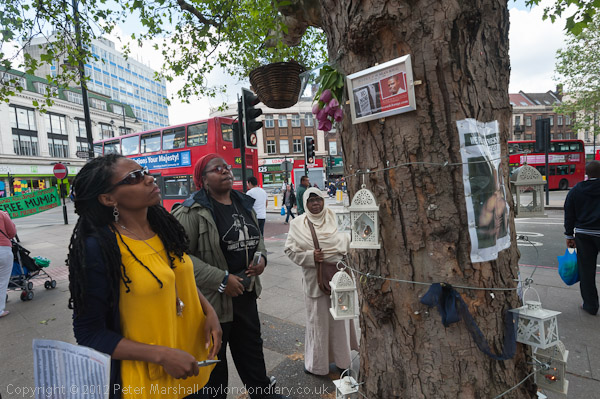
Family members call for Justice for Ricky Bishop, Justice for Sean Rigg
It was Father’s Day and the families of men killed by by police held vigils on outside police stations across the country. At Brixton, the family of Ricky Bishop was joined by the sisters of Sean Rigg and friends.
The inquest into Sean Rigg’s death in Brixton Police Station in August 2008 had begun the previous week. Following his killing police issued an incredible number of false statements, lying to protect the officers involved and the IPCC backed them with further deliberately misleading statements.
Although the police failure to make investigations and properly question officers involved, along with the destruction of evidence made prosecutions of the officers involved impossible the inquest jury delivered a damning and substantial narrative verdict which included a majority view that the improper and unnecessary restraint of Sean Rigg ” more than minimally contributed” to his death.
Although later three officers were arrested for having committed perjury at the inquest the IPCC cleared one of them and the CPS decided to drop the two other cases. The family appealed and one officer was charged with perjury but was acquitted by a jury despite having admitted giving false evidence.
You can read a fuller account of the efforts by the family to get justice on Wikipedia. Although two inquiries have found a long list of failings by the police there have been no successful prosecutions of the officers involved.
Ricky Bishop was arrested by police in Brixton in November 2001 and taken to Brixton Police station. A healthy 25 year old he suffered a heart attack and was restrained by police who only later called for a paramedic. It took several hours for police to take him to hospital where he died.
None of the eight officers involved in this death have been suspended or prosecuted and they remained on active duty.
These were not the first or the last suspicious deaths involving Brixton Police station – and a woman came up during the event to tell us of her relative Colin Bardley who she said was beaten to death there around 30 years ago. And there are similar cases elsewhere. My post on My London Diary quoted from a report published by the Independent Advisory Panel on Deaths in Custody in 2011 which states ‘in total, there were 5,998 deaths recorded for the 11 years from 2000 to 2010. This is an average of 545 deaths per year. Despite the fact there have been 11 unlawful killing verdicts since 1990 there has never been a successful prosecution. ‘
More about the event, on deaths in custody and more pictures at Fathers Day Vigil.
Magna Carta Under Threat – Runnymede Eco Village 12 June 2015
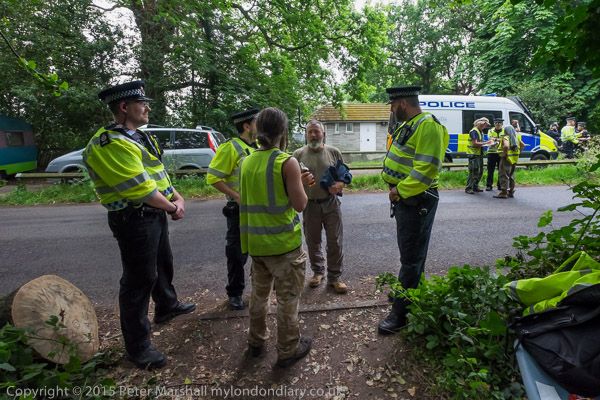
Police question people and refuse to allow them to enter the site
On 15th June 1215, rebel barons forced King John to sign a royal charter of rights at a meeting at Runnymede, just a short bike ride from where I live. According to Wikipedia, “it promised the protection of church rights, protection for the barons from illegal imprisonment, access to swift justice, and limitations on feudal payments to the Crown.” While good news for the church and the barons, it had little to offer the common men, and neither side took much notice of it and was in any case rapidly annulled by the Pope.
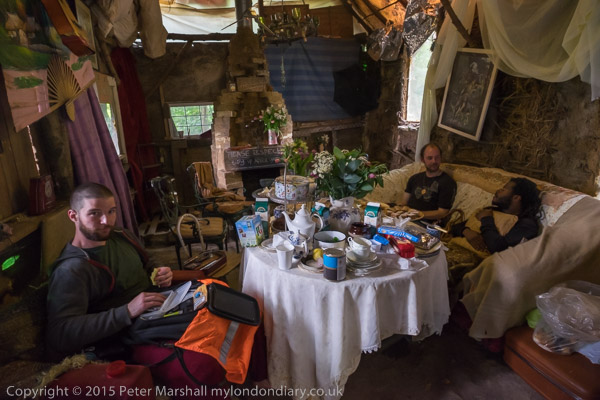
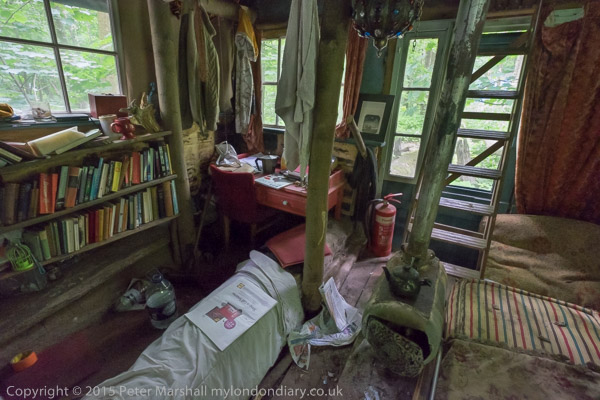
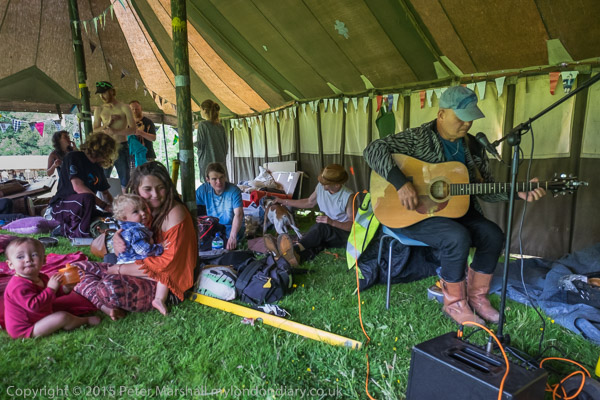
Tea and cakes inside the Long House at Runnymede Eco-Village
Two years later after the death of John and a war by the Barons a revised version was part of the peace treaty, and this was then given the name Magna Carta, as there was another smaller Charter of the Forest also agreed between the parties in 2017. This re-established the rights of free men in royal forests which the Normans had largely removed, at the same time making about a third of the land in the south of England into royal forests, giving rights to collect firewood, burn charcoal, graze pigs and other animals and cut turf – all vital activities for keeping alive.
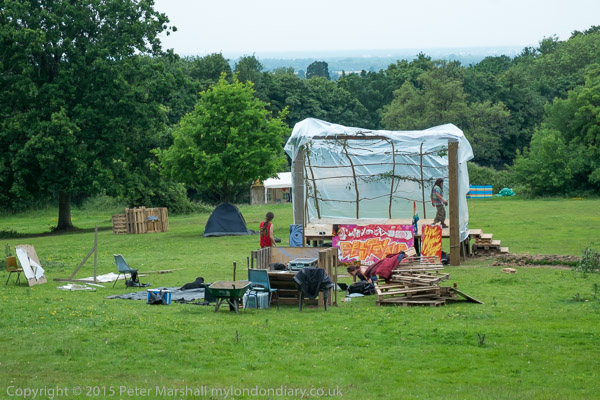
Getting the festival stage ready
Although the legal significance of Magna Carta soon faded away, it re-emerged from the 16th century on as it became seen as the basis for the English constitution, restoring the freedoms that the conquering Normans had removed, and it became widely seen as the basis for “the contemporary powers of Parliament and legal principles such as habeas corpus.” Various British monarchs tried to supress even its discussion but it remained “a powerful, iconic document, even after almost all of its content was repealed from the statute books in the 19th and 20th centuries.” And these discussions had a powerful effect on those writing the US Constitution.
Vinny wears a badge “Who Protects Us Form the Police?”
The only clauses of Magna Catra that remain in force are those protecting the Church and the City of London and Clause 29 which stated “The body of a free man is not to be arrested, or imprisoned, or disseised, or outlawed, or exiled, or in any way ruined, nor is the king to go against him or send forcibly against him, except by judgment of his peers or by the law of the land.” But when Occupy London tried to make use of this to resist eviction their argument was unsuccesful.
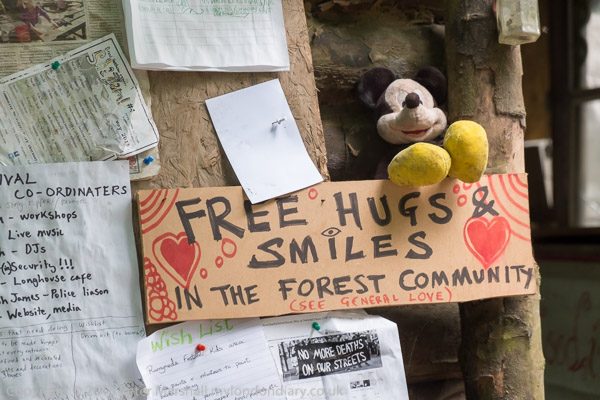
The Eco-Village was a friendly, peaceful and welcoming place
More recently Magna Carta “truthers” have unsuccfully tried to use it against various legislation, including the Covid laws, particularly over wearing masks. But without any chance of success. Freedom to flout the law seems mainly to be granted to those in government. And much of the legislation being pushed through the UK parliament now by a large Tory majority does go against our principles of freedom, such as severely restricting our rights to protest and deporting asylum seekers.
The Magna Carta celebration is proposed 3 years earlier – Runnymede, Surrey, Sat 16 Jun 2012
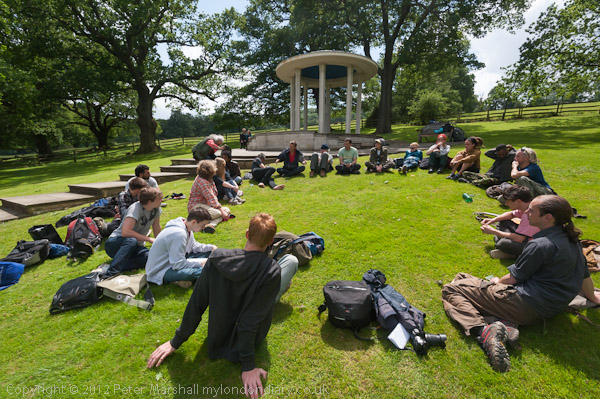
Back in June 2012 I had sat on the grass with ‘Diggers’ camped on Cooper’s Hill close to the US Bar Association Magna Carta memorial (and possibly close to where King John and the Barons met, though that may have been rather closer to Staines.) The original Diggers or ‘True Levellers’ were founded in 1649 after the first English Civil War by Gerard Winstanley who stated “England is not a free people, till the poor that have no land have a free allowance to dig and labour the commons.” His ideas of the sharing of property came from the New Testament.
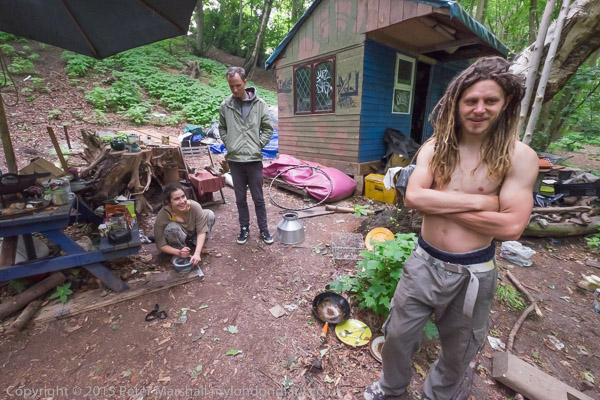
Luke, trained as a forester, says the woodland had been sadly neglected
This year it is particularly appropriate to recall the Biblical idea of ‘Jubilee’, where after 49 years there would be a ‘Year of Release’ when slaves and prisoners would be freed, and debts would be forgiven. The land would be allowed to lie fallow and all land and other properties (except houses in walled cities) would be returned to the original owners or their heirs.
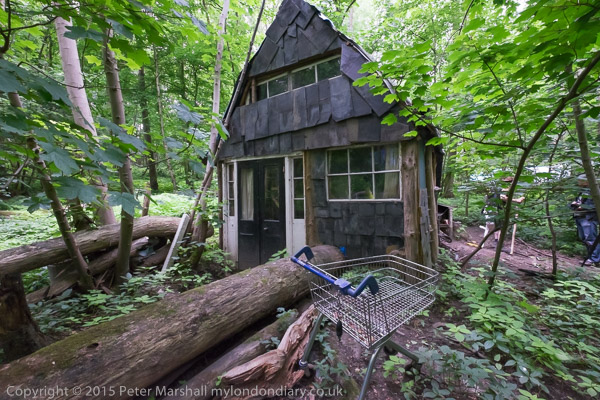
One home was built around a fallen tree running across the floor
Land ownership in the UK has changed relatively little since the Normans took it away from the inhabitants after 1066, with the same families still owning the great majority of English land. A minute fraction of the UK population – 0.65% – currently own more than two thirds of the UK land area. Land ownership is the foundation of our class system and while a revolution seems unlikely in the near future, any reforming government should be putting a land tax at the centre of its programme.
The Diggers at Runnymede in 2012 had heard a discourse on Magna Carta and the Diggers from a historian at the nearby college of London University, and talked about more recent occupations of disused Land by ‘The Land Is Ours’ at the Wandsworth/Battersea Guinness site in 1996, at the Kew EcoVillage in 2009 and at Grow Heathrow.
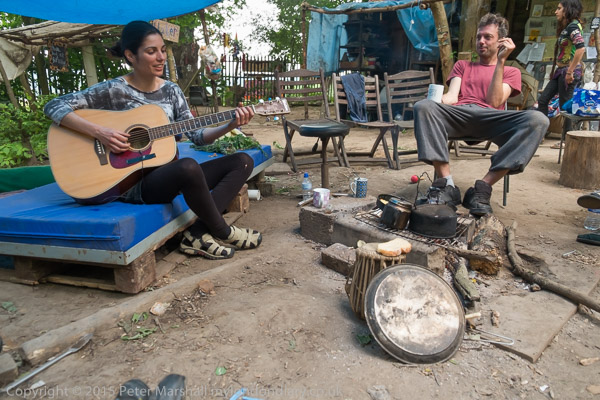
A TV Crew set up a picture of one of the residents playing guitar
My post Diggers at Runnymede Call For Freedom gives some detail on the 2012 event as well as the setting up of the Runnymede Eco Village. At the meeting people agreed to hold a celebration of the 2015 anniversary of Magna Carta at the village site.
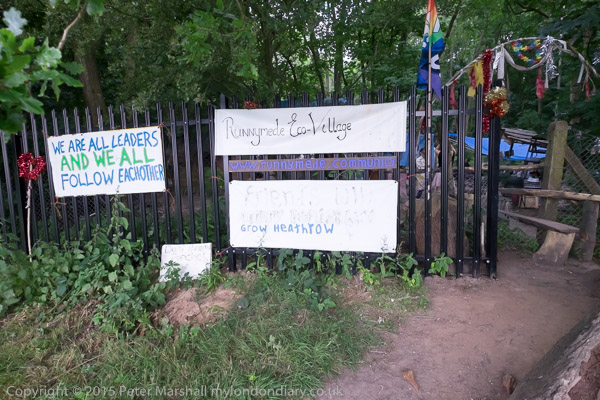
Police watched me closely as I came out of the gate to take this picture. They were stopping people entering.
Many in the local community welcomed the presence of the Eco-village, and the community work they had done over the three years. What little trouble there had been had been caused by outsiders, thought by some to have been encouraged by landowner and police. And although the celebrations were planned to be entirely peaceful, police, urged on by Surrey County Council and almost certainly some government ministers, laid on a huge and almost certainly illegal exercise to prevent the event taking place.
The festival began – but police stopping people coming & threatening them with arrest
I wrote: “Police surrounded the Runnymede Eco Village as the Magna Carta weekend Festival For Democracy was to start and prevented some people entering, issuing some with exclusion notices covering a wide area.“
“The police action appeared to be an entirely politically motivated action against the community and its many friends to prevent their long-planned celebrations of Magna Carta, a charter supposed to represent freedom under the law but here at its very source 800 years ago it was being suppressed in an unfair and arbitrary manner by the forces of the Law.”
DPAC Trash The Tories – Maidenhead Back when the Tories got back into power with the support of the Lib Dems in the UK 2010 General Election they decided to launch a policy of austerity, making deep cuts in the services and benefits that enabled the less wealthy in the country to get by and lead decent lives.
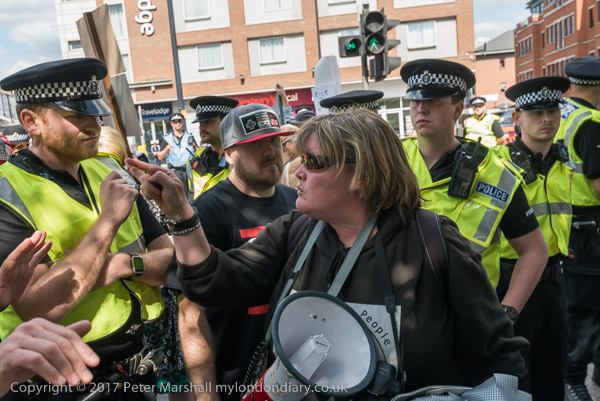
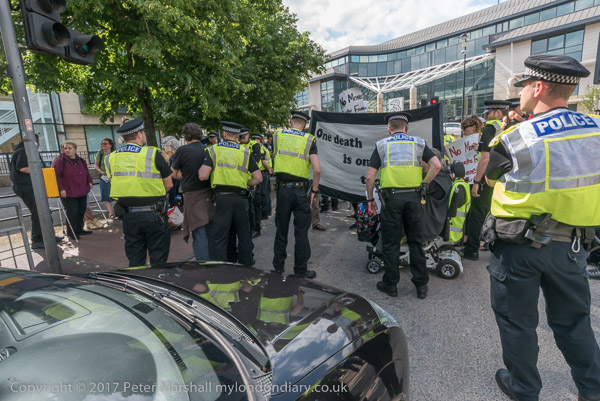
Paula Peters of DPAC argues with police as they block a road junction
The cuts they proceeded to make had relatively little effect on those in the better-paid jobs many of whom didn’t need or had opted out of public services such as the NHS and state education and didn’t live in public housing or working class areas. But in any case the Tories made sure these people were protected with increasing real salaries as inequality increased. The Office of National Statistics reported in 2020 “The gap between the richest in society and the rest of the population has widened over the 10-year period; the income share of the richest 1% increased from 7% to 8.2% between FYE 2011 and FYE 2020.”
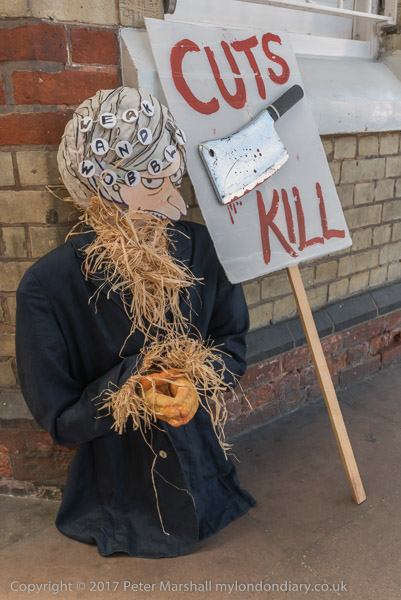
Theresa May – Weak And Wobbly
In particular, the government continued to bail out the bankers, despite it being the bankers who had precipitated the 2008 financial crisis – and in the longer term had been responsible for creating instability by creating and exploiting huge loopholes in the world financial system established after the war. It was of course British banks and the City of London which played the leading role in this, making London the money-laundering capital of the world with former colonies at the centre of offshoring and enabling after the break-up of the Soviet Union Russians to legalise their illegal plunder and become oligarchs, with a huge influence in the Conservative Party.
But the Tories came in determined to cut benefits and in particular looked at the amounts going to support disabled people and enable them to live in the community. They thought wrongly that disabled people would be an easy target because of their various disabilities. They were wrong on two counts. Firstly because many disabled people had experience of having to fight for their rights and secondly because they greatly underestimated the wide support for them among the general population. Tories may not have a heart (and certainly many Tories have demonstrated this in recent years) but the general public do.
At the centre of the protests by disabled people is DPAC, Disabled People Against Cuts, formed by disabled people after the mass protests against cuts in Birmingham in October 2010 had been led by disabled people. On its web site it proclaims “DPAC is for everyone who believes that disabled people should have full human rights and equality. It is for everyone that refuses to accept that any country can destroy the lives of people just because they are or become disabled or have chronic health issues. It is for everyone against government austerity measures which target the poor while leaving the wealthy unscathed. It is for everyone who refuses to stay silent about the injustices delivered by wealthy politicians on ordinary people and their lives.”
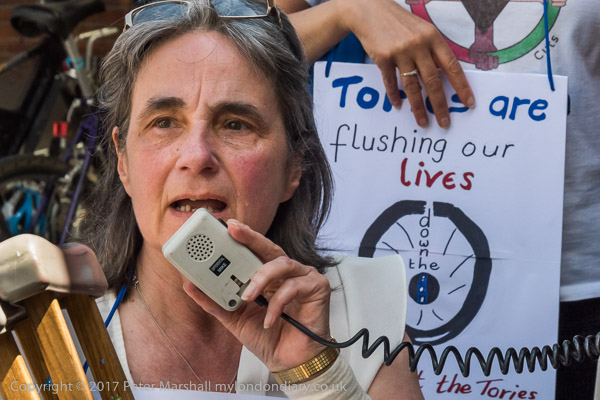
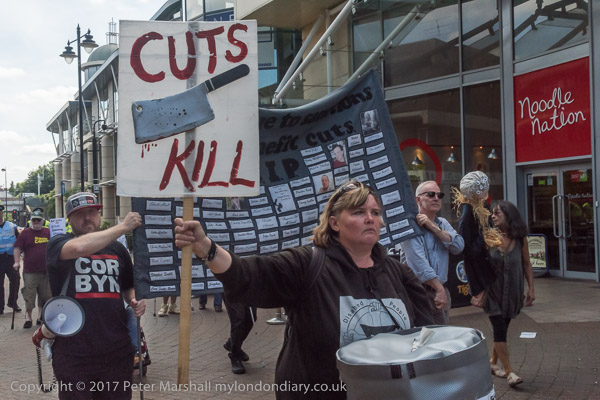
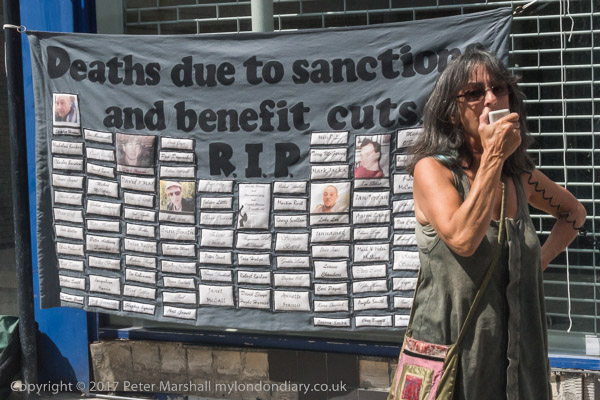
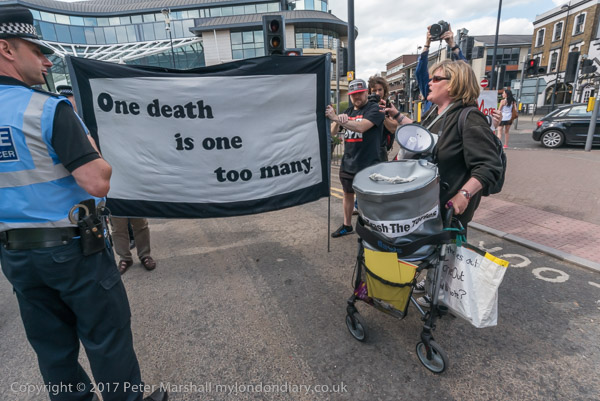
On Saturday 3rd June 2017, five days before the General Election called by Theresa May, I joined DPAC for a protest in her constituency of Maidenhead. Her government was the first in the world the UN had found guilty of grave and systematic violations of disabled people’s human rights. Tory cuts since 2010 had 9 times the impact on disabled people as on any other group, 19 times more for those with the highest support needs. DPAC call the policies heartless and say they are starving, isolating and ultimately killing the disabled who the Tories regard them as unproductive members of society. Though it was the cuts, particularly the axing of the Independent Living Fund, ILF, which had stopped many making a real contribution.
It was a fairly small group that arrived at Maidenhead station for the protest. Travel by rail is often very difficult for disabled people. Few stations have step-free access and there are often large gaps between train and platform. Rail companies do make an effort to provide support but this needs to be booked in advance and is sometimes unreliable. And rail fares are an expensive luxury for people on benefits – who may also need a taxi to get to the station.
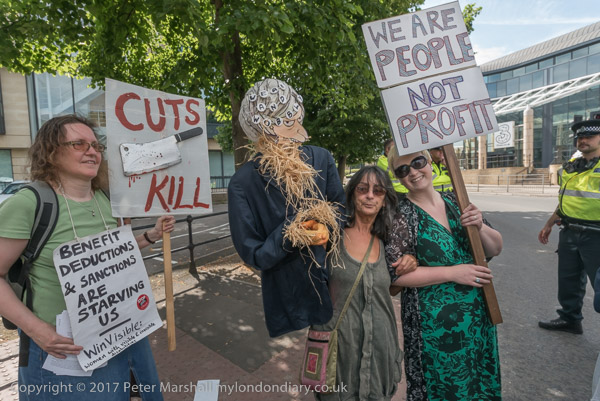
They paraded a straw effigy of ‘Theresa May – Weak and Wobbly‘ and a hatchet with the message ‘Cuts Kill‘ to the High St for a rally, with speeches, loud chanting and handing out fliers calling on Maidenhead voters to vote for anyone but Theresa May before returning to the station.
Most other photographers thought the protest was ended and some had rushed to get the train back to London, and the police had largely gone away, but I knew DPAC from previous events and stayed with them, taking photographs as they moved to block one of the busiest road junctions in the town for around 15 minutes as police tried to persuade them to move.
Eventually they did get off the road, just in time for me to catch a bus to start my journey home. I was sorry to have to rush away, but the next bus wasn’t for a couple of hours. I changed buses in Windsor and got off in Staines, walked along the road and put my hand in my pocket for my phone and it wasn’t there. At home I went to ‘Google Find My Device‘ and saw on the map it was still travelling on the bus all the way to Slough, where fortunately the driver found it and handed it in to the office and I was able to cycle there and collect it the following Monday.
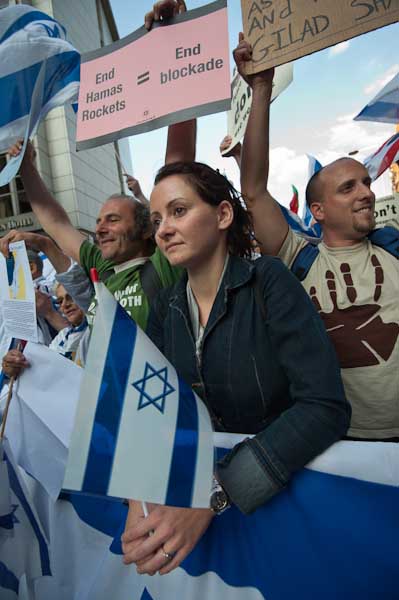
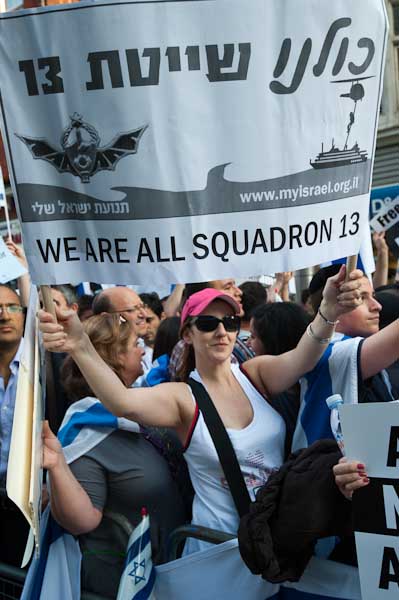
Democracy, Black Cabs, Murad & Zionists – My agenda for Wednesday 2nd June 2010 was a busy one, with protests about democracy in Parliament Square, London’s Black Taxis at Aldwych, a picket at BP’s St James’s Square HQ, trade unionists protesting at the Turkish Embassy and Zionists supporting the Israeli attack and killings on the Gaza aid flotilla.
Democracy Village Protest – Parliament Square
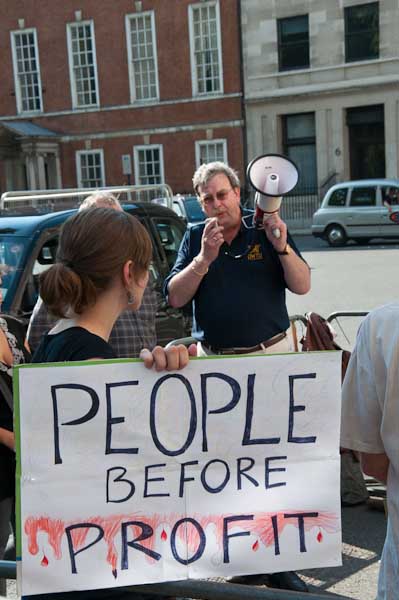
People had been camping in the Democracy Village in Parliament Square for just over a month and a few of them had come across the road with banners to protest. They held up banners, including a large one saying ‘We Respect The Soldiers We Do Not Support The War‘ and another ‘We Demand Peace In Afghanistan and No More War‘ and several made speeches with a megaphone. Another very artistically written notice on a large square of cloth on the pavement read ‘With Each Conscious Breath May You Know How Loved You Are in All Ways. You Are Divine. Let Your Light Shine’.
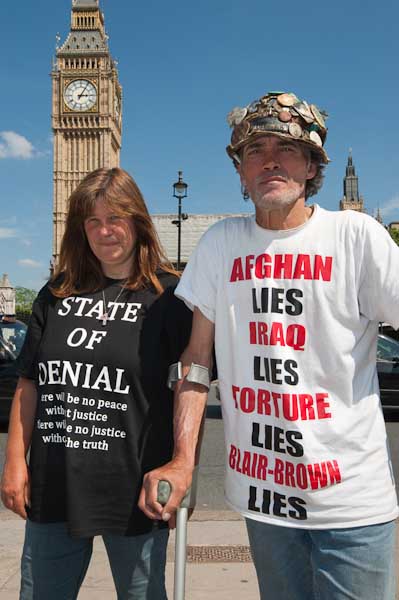
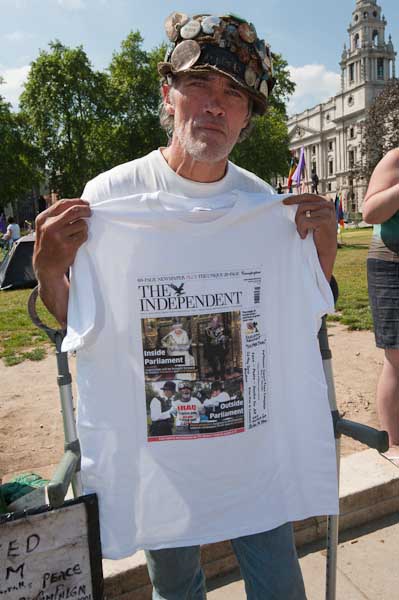
Brian Haw – Summons Marks 9 Years in Parliament Square
I went back to the other side of the road to talk with Brian Haw and Barbara Tucker who I had come to visit on the 9th anniversary of the start of Brian’s protest vigil opposite the Houses of Parliament in Parliament Square. A week ago they had been arrested and held for 30 hours on the day of the state opening of Parliament before the court released them on bail.
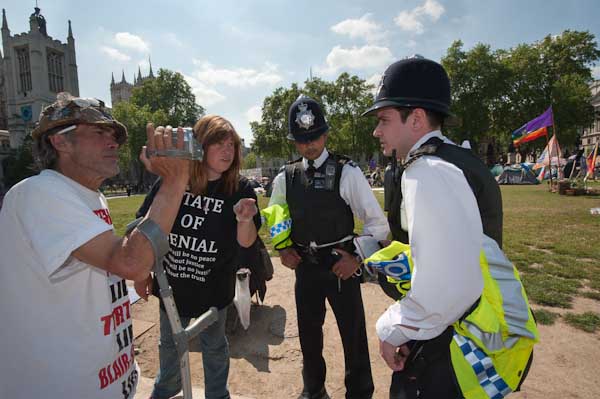
The arrest had come after Brian objected to police searching his tent in the early morning without a warrant – the 13th or 14th illegal search they have made, all part of a continual campaign of harassment. As we were talking we became aware of three police a few yards away standing and watching us. They then came over and served Barbara Ticker with a summons for using a megaphone in Parliament Square.
Brian and Barbara asked why she was being singled out for attention as there were at that time others In the Democracy Village actually using a megaphone and she was not at the time doing so. The officers made no attempt to answer this question.
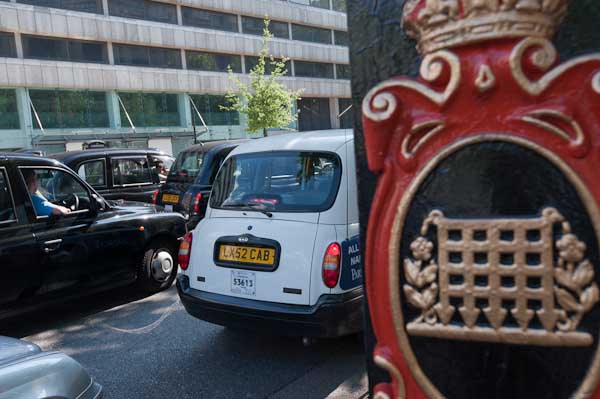
I don’t use taxis in London – or at least very seldom. I can only remember two occasions in the last thirty or so years, both when others insisted I go with them. It’s a wasteful, outdated and overpriced system which is responsible for much of the congestion in London, both by cabs carrying only small numbers of people compared to other public transport and also by ‘cruising for hire’ with no passengers on board.
My account on My London Diary gives some of their grievances, some of which I have some sympathy with, and I agree the police should be enforcing the law (rather than harassing protesters) but the whole system needs to be updated, taking into account the general availability of smart-phones and improvements in satellite navigation systems which increasingly make the ‘knowledge’ redundant and can provide real-time congestion information.
I didn’t find it an easy protest to photograph, which I think shows in the results. Lots of taxis are frankly rather boring, and not that unusual in London, where I commented that “While standing at a bus stop a couple of weeks ago I counted over 30 empty taxis going past before my bus arrived, and I couldn’t help but think we could have a better public transport system without taxis.”
BP Picket for Colombian Oil Workers – St James’s Square
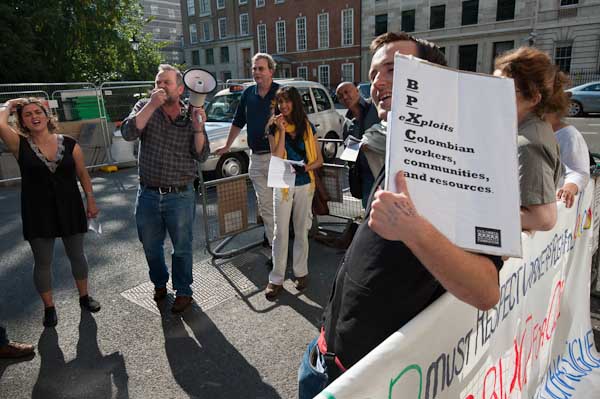
BP have a long-running dispute with the workers on the Cusiana oilfield in the Casanare department of Colombia, and its one where they are playing dirty, with union members accusing BP of carrying out a campaign of misinformation about what is happening in the plant, and in particular of falsely claiming the support of government officials for their lies about the action.
More or less as this picket was taking place, armed commandos from the Colombian army leapt over a security grid at the plant and attacked the workers who were carrying out a peaceful occupation of the Cusiana CPF (Central Processing Facility) in Tauramena.
Previously BP had come to an out of court settlement on a UK High Court challenge over the pipeline from this oilfield to the coast, when farmers alleged that BP benefited from the actions of Colombian paramilitary forces who harassed and intimidated them in their protection of the pipeline. During the preparation of the case, of the lawyers for the farmers discovered she was on a death list and fled the country; she was granted political asylum in the UK.
The protest was organised by the Colombia Solidarity Campaign and was supported by the ICEM, the International Federation of Chemical, Energy, Mine and General Worker’s Unions, based in Switzerland which represents more than 20 million workers around the world, uniting trade unions in its sector around the world.
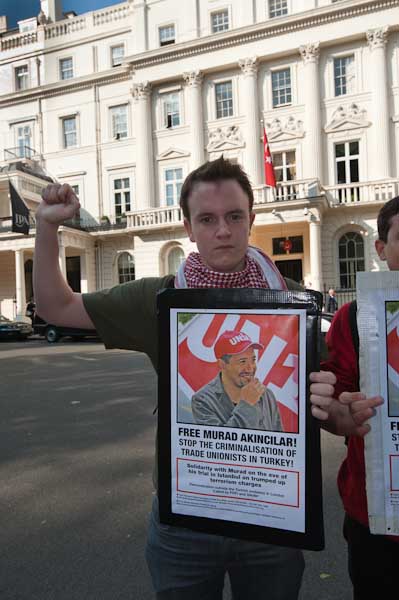
Protest for Murad Akincilar Turkish Embassy, Belgrave Square
Trade unionist Murad Akincilar was arrested on a spurious charge of belonging to a terrorist organisation while on an extended holiday in Turkey last September and was in prison in Istanbul. His treatment in prison has resulted in serious eye damage and partial blindness. He was known personally to some of the protesters as he studied for a Masters Degree at the LSE, but since 2001 he has lived in Switzerland and worked for Swiss trade union Unia which was leading the campaign for his release.
The protest opposite the Turkish Embassy was organised by Fight Racism! Fight Imperialism! and Gik-der, an organisation founded in north London in 1991 by migrants fleeing political and racial persecution in their home countries of Turkey and Kurdistan.
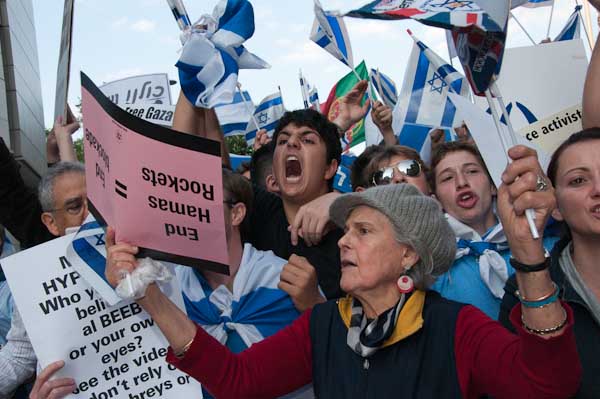
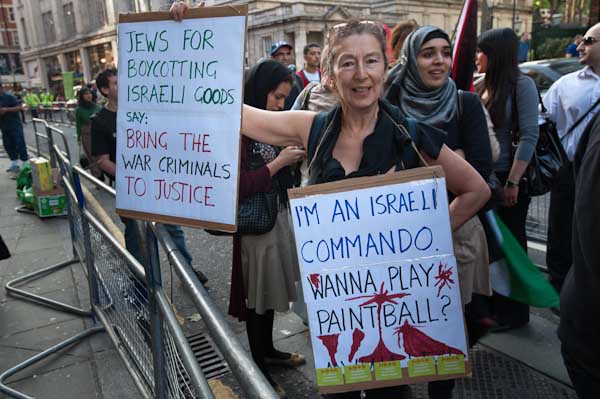
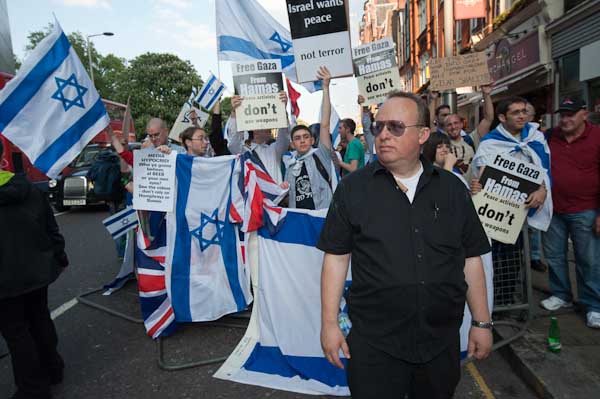
Zionist Federation Support Israeli Atrocity – Israeli Embassy, Kensington
The Zionist Federation together with members of the English Defence League demonstrated opposite the Israeli embassy in support of the Israeli Defence Force killings in the attack on the Gaza aid flotilla.
A smaller group of pro-Palestinian protesters had come to oppose them, although both the Palestine Solidarity Campaign and the Stop the War Coalition had decided not to support the counter-demonstration to avoid conflict.
Although official Zionist sources had expressed some regret at the violence and loss of life, the mood of the supporters here appeared to be one of a gloating triumphalism that seemed entirely inappropriate to the situation. I was “sickened when at one point a large group of the demonstrators began chanting ‘dead Palestinian scum’ ” and appalled to find this was “a demonstration jointly with the Zionist Federation and the English Defence League, some of whose members many of us have seen and heard chanting racist slogans on our streets. It seems unbelievable that a Jewish organisation should align itself – even if unofficially – with people like this.”
Attempts to justify the summary execution of one of the victims by shots to the head at close range by the existence of so-called weapons on the ships seemed insulting – almost all those shown in the photographs are “exactly the kind of tools that would be expected to be found on any ship in its galley and for general maintenance, as well as items being taken for building work in Gaza. The possible exceptions are a few canisters of pepper spray, some catapults and what looks like some kind of ceremonial knife.”
I’m very much in favour of peace in Palestine and Israel, but like many I feel “the actions of the state of Israel in their attacks on Gaza, their disruption of everyday life for the Palestinians and the blockade is making the possibility of peace much more distant… Like other conflicts, resolution depends on winning hearts and minds and this can’t be done with tanks and bulldozers.”
Police had to step in at the end of the protest when four press photographers were surrounded and chased by a an angry group of threatening Zionist demonstrators but all I suffered were a few threats and hostile gestures.
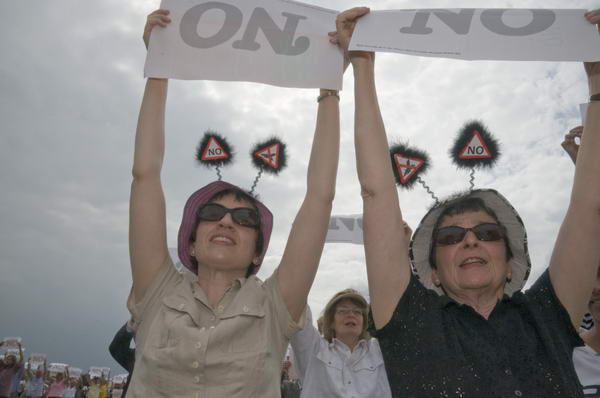
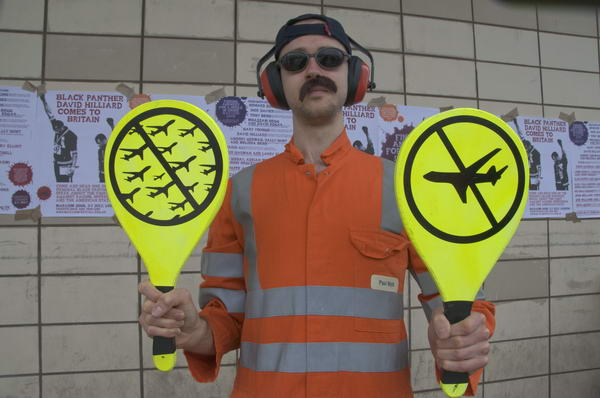
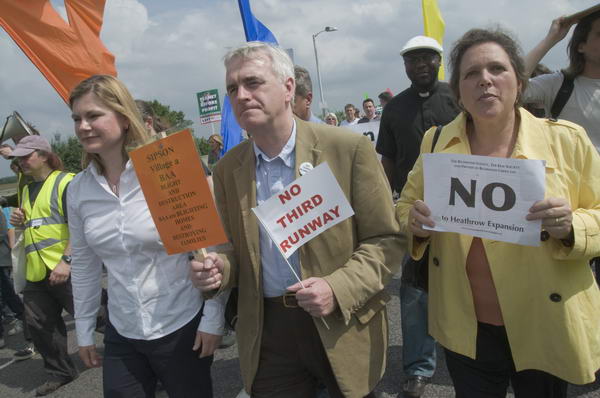
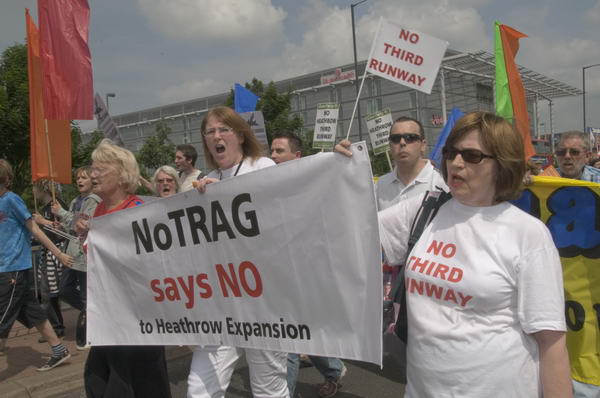
No Third Runway – 31 May 2008 – several thousand campaigners against the expansion of London’s Heathrow Airport marched from Hatton Cross through part of the airport to the village of Sipson which will be obliterated if the third runway is built.
I’m not sure whether it was on this occasion or another similar event where I was approached and asked if I would like to be the official photographer at height on a cherry-picker taking the photograph of thousands below me on the ground in a giant ‘NO’ each holding up the message ‘NO’ but having no head at all for heights I was very pleased to be taking part in the event with both feet firmly on the ground. I was holding up my poster with its ‘NO’ in one hand and my camera in the other when I made this picture.
I don’t think I’ve ever had much of a head for heights. Perhaps it was my early experiences when my father was sometimes left with the baby and had to take to to work with him – even when he was up fixing roofs. I have some vague but vivid memories of being up on the roof of a house, perhaps our own, under the Heathrow flightpath with aircraft – propellor rather than jet in those days – passing low overhead. But things have worsened in more recent years as my balance has worsened, and now even low walls are a step too high.
The account on My London Diary – Heathrow – Make a Noise – No Third Runway – makes my views on Heathrow clear, beginning with the paragraph “It is now obvious to everyone with their head out of the sand is that London Heathrow is in the wrong place. It always was, since its creation by subterfuge and lies during the last years of the war, but no government since has had the nerve to challenge the powerful aviation lobby.“
MPs Justine Greening (Con, Putney), John McDonnell (Lab, Hayes & Harlington), and Susan Kramer (LibDem, Richmond Park)
It was a view backed by the politicians of all parties who came to speak at the rally, though Labour – then in government – were only (if ably) represented by local MP for Hayes and Harlington, John McDonnell. And although the Deputy Mayor of London was there, Mayor Boris Johnson who had promised to come had decided instead to fly off for a holiday in Turkey – just as he has done on various occasions as Prime Minister. The Archbishop of Canterbury had also been expected, but was at the last minute unable to make it and sent an envoy with his message.
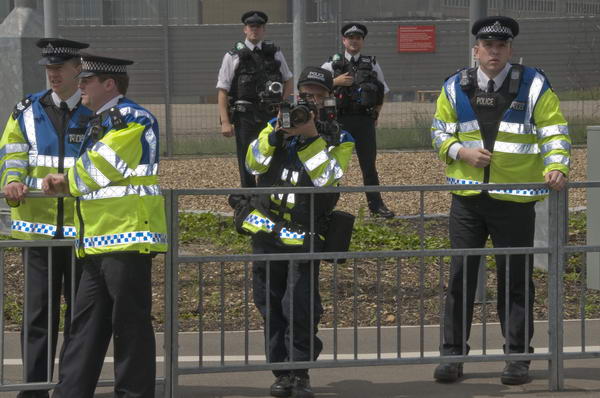
Most of those marching were local residents, particularly from Sipson and Harmondsworth which would be destroyed by the development, but also from the other areas under the flightpath, which includes a great swathe of West London. Given the nature of the protest and those taking part the level of police interest in it seemed excessive, and it was noticeable that they seemed to be particularly interested in photographing and filming the photographers who were covering the protest – I several times found myself staring into the lens of the police team.
I don’t know why the police do this, nor what happens to the photographs and videos. On the only occasion I’ve bothered to send a Freedom of Information request requesting details of the photographs they have of me from a number of events where they had quite clearly taken them I received a reply stating that there were no images on record… We are not being told the truth.
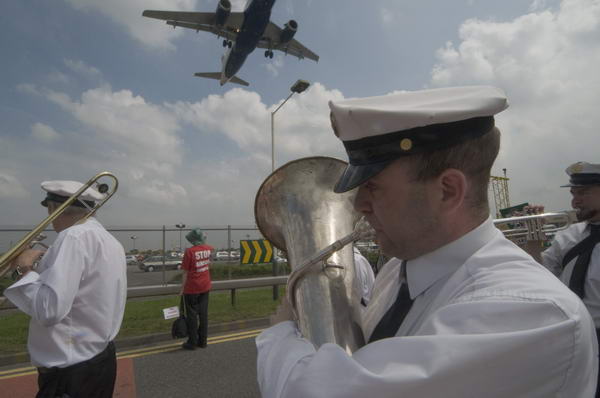
One of very few flights on the northern runway as the march went past
Notably missing from the event were any representatives of Spelthorne Council, my local council and the only council in the area not to oppose the expansion. The Conservative MP for Spelthorne, David Wilsher also supported airport expansion against the then party line and “also denies that climate change is caused by human activities and some constituents expect him to announce his membership of the flat earth society any day soon. Best known for his introduction of the anti-gay ‘Section 28’ amendment in 1988 he replaced for the 2010 election by Kwasi Kwarteng after being implicated in an expenses scandal involving the payment of £105,00 of parliamentary expenses to a company set up with his partner to run his office. The inquiry into his expenses was suspended because of his poor health.
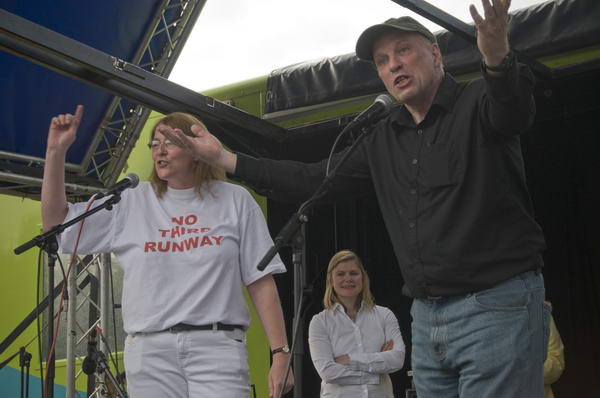
John Stewart of HACAN and Geraldine Nicholson of NOTRAG perform a duet: NO THIRD RUNWAY
You can read a full account of the march and rally with a large number of pictures on My London Diary: Heathrow – No Third Runway
Class War, Edna, Police And Protesters – I had a long and busy day in Westminster on Wednesday 27th May 2015. It was the day of the Queen’s speech to parliament, reading out the intentions of the government’s coming session, and people and groups had come to the area to make their feelings about this clear.
I usually avoid any occasions involving royalty who I think reflect the worst aspects of our class-based society. We got it right in 1649, when Charles I was found guilty of attempting to “uphold in himself an unlimited and tyrannical power to rule according to his will, and to overthrow the rights and liberties of the people” and although the ‘Commonwealth’ wasn’t a great deal of fun the restoration of the monarchy was a a national tragedy even more retrograde than Brexit.
I don’t want to photograph crowds of sycophantic flag wavers – including many tourists, nor the royals themselves, who many feel are an inbred group of parasites who rose to wealth and power through the theiving, skullduggery and aggression of their ancestors, maintaining their position through a biased military, political and legal system. Certainly we would be a better and healthier nation without them and the class system they help perpetuate.
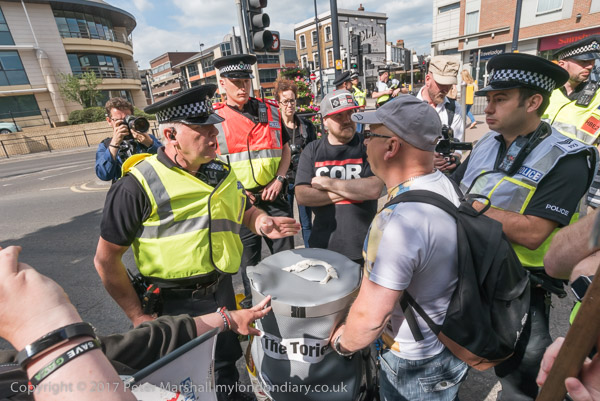
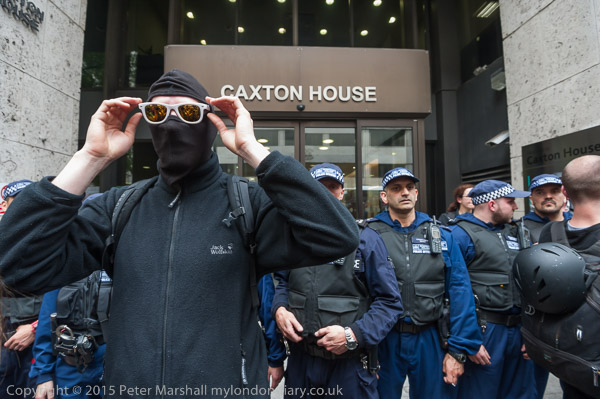
Royal occasions also bring out the very worst in our police, and this was clearly on show in their actions against Class War and some others who had come to protest at the event. Rather than upholding the law they were making it up on the spot to avoid any possible embarrassment to the Queen, forcing people to move and making arrests without any lawful basis.
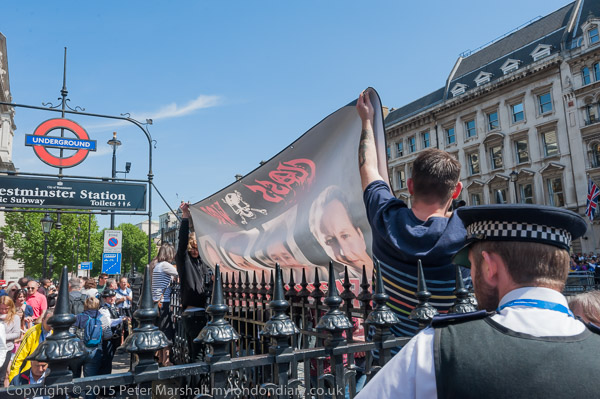
Class War had come with their controversial banner showing the political leaders and I managed to get a few images of them was they held it up for a few seconds on the Queen’s route well before she was due to arrive. But they were immediately forced to take it down and told they would be arrested if they continued to protest, with the threat that the banner would be taken from them.
It was a copy of the one that police had seized at a ‘Poor Doors’ protest a couple of months earlier and held in Bethnal Green police station (where they lost it rather than hand it back when they had to admit they had no legal basis to have taken it.) Banners aren’t cheap and Class War funds are limited to a few individuals digging in their pockets, so they rolled it up and moved away.
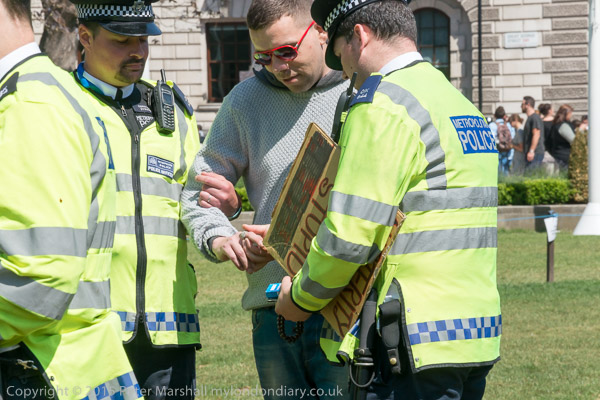
Police then arrested two men, one holding a video camera, and another holding under his arm a small poster with a message about austerity being stupid. As my caption states “They tell the police correctly that they have committed no offence, but the police decide to arrest them anyway. Just in case.” They were released without charge a couple of hours later.
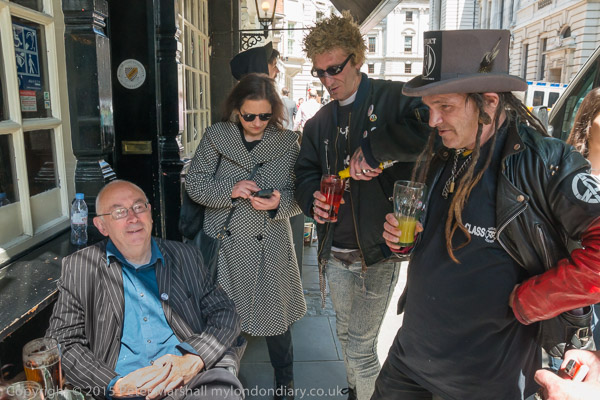
As a large group of police were following and harassing them, Class War and friends decided to leave for a nearby pub. I followed them, along with a large squad of police, and talked with them as they stood outside quietly having a drink. On the other side of the road were around 50 police standing around watching them, including a squad of TSG, looking menacing for over an hour. I was later told police kept following some of Class War for the next six hours. It all seemed a huge waste of public money.
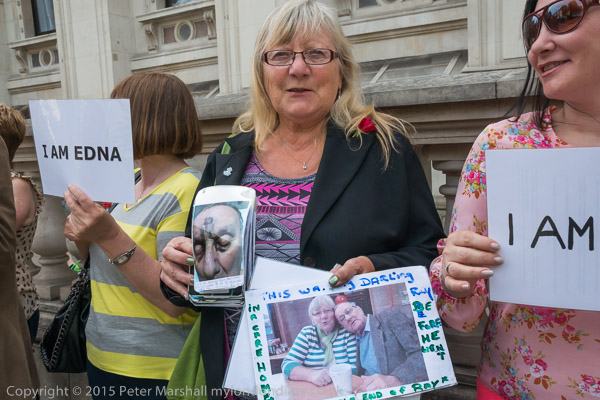
I’d stayed with Class War so long because it looked likely that the police were going to take action, perhaps make more arrests although no offence was being committed, but also to let the crowds and policing around the Queen’s route disperse, and then made my way up Parliament Street to Whitehall where Compassion in Care were campaigning for ‘Edna’s Law’ which would make it an offence not to act on the genuine concerns of a whistleblower and protect those revealing scandals in social care and other sectors.
This would replace the Public Interest Disclosure Act which has failed to protect the public, the victims or the whistle-blowers. Compassion in Care say that the reccomendations of the then recent Francis review “will do nothing to protect whistle-blowers or encourage anyone else to raise concerns. This is because his recommendations rely on employers and regulators – which include the very same people who have “got away with” cover-ups, ignoring concerns, and victimising whistle-blowers for many years.”
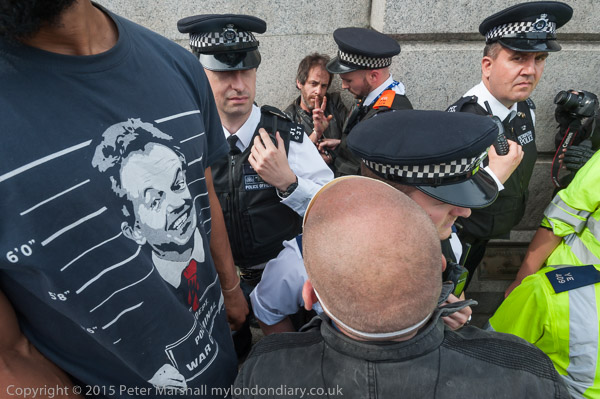
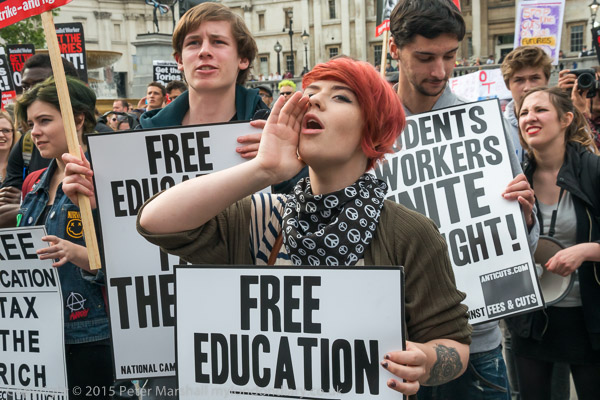
I walked on up Whitehall to Trafalgar Square where people were beginning to gather for a National Campaign against Fees and Cuts rally. A group of police were gathered around a man and arresting him, but refusing to answer any questions from a concerned crowd around them as to what was happening. A small crowd followed the police as they took the man to a nearby police van, where a police officer assaulted a young bystander who was then also arrested. Finally as the van drove away, an officer told us that the man was wanted for an earlier offence and the arrest was in no way related to the protest that was gathering. If the police had made this clear from the start all this could have been avoided.
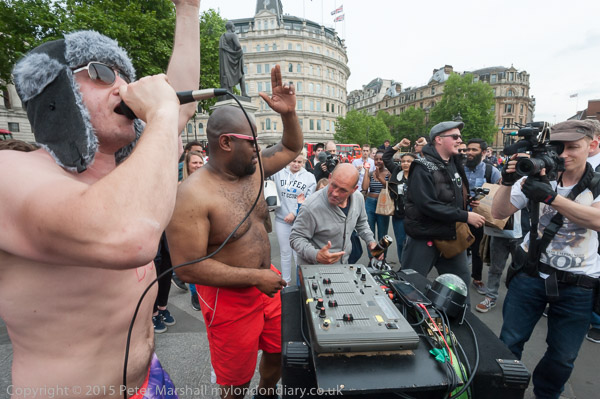
Back in Trafalgar Square a man appeared with a mobile disco and crew and people began to dance. This turned out to be Lee Marshall (aka Disco Boy) who describes himself as an “entertainer prankster DJ host”, and apparently has gained a huge social media following, with his video stunts watched by hundreds of thousands of people and had come to perform in Trafalgar Square and elsewhere in Westminster. He moved off as the rally began.
There was a short rally for the National Campaign against Fees and Cuts (NCAFC) with various groups including Class War holding banners on the plinth of Nelson’s column before they set of for the march.
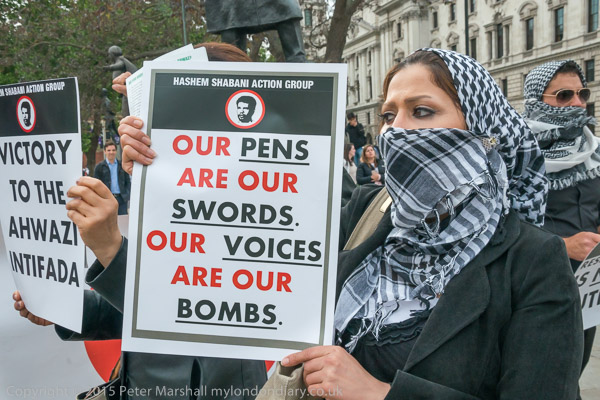
Also in Trafalgar Square were Ahwazi protesters from the Hashem Shabani Action Group whose homeland, which includes most of Iran’s oilfields, was occupied by Iran in 1925. Since then Iran has attempted to suppress their heritage and identity, in part by resettling non-Ahwazi Iranians in the area.
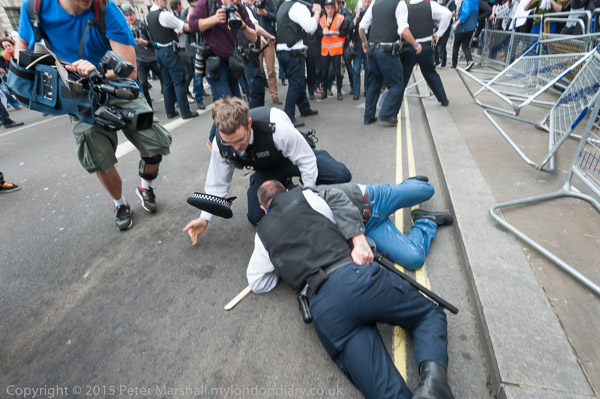
The students and some others at the NCAFC protest then set off to march down Whitehall, where police made an unsuccessful attempt to stop them, at Downing St, arresting several forcefully. There seemed to be little point as police numbers were clearly too few and many protesters were simply walking around them and the barriers as I did.
The Ahwazi protesters had marched with the students and they stopped in Parliament Square for a rally while the rest marched on peacefully around the area for some time stopping to protest outside the Dept of Work & Pensions and the Tory Party HQ before returning to protest noisily in front of Downing Street which was protected by mass ranks of police. They then marched on, I think intending to go towards Buckingham Palace, but I’d had enough walking around.
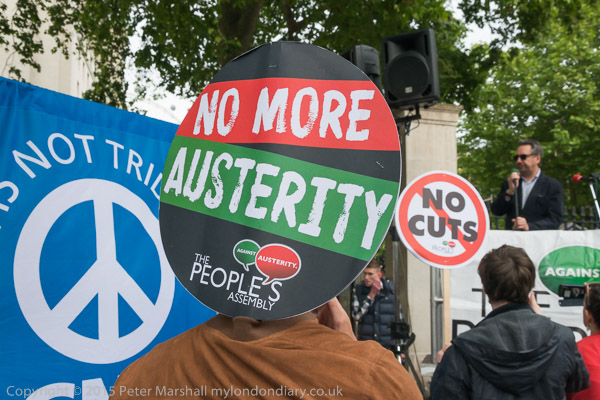
On the pavement opposite Downing St at the same time as the NCAFC march the People’s Assembly were holding a static ‘End Austerity Now’ protest. I listened to a few of the speeches and photographed them. But it had been a long and rather confusing day and it was time for home.
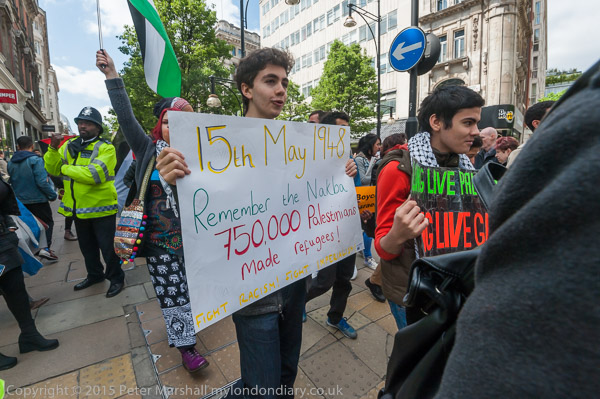
Holloway, Nakba, Refugees & Topshop – Six years ago, the 14th May 2016 was also a Saturday, and like today there was a protests for Nakba Day, the ‘day of the catastrophe’, remembering the 80% of Palestinians forced to leave their homes between December 1947 and January 1949, but also several others on the streets of London which I covered.
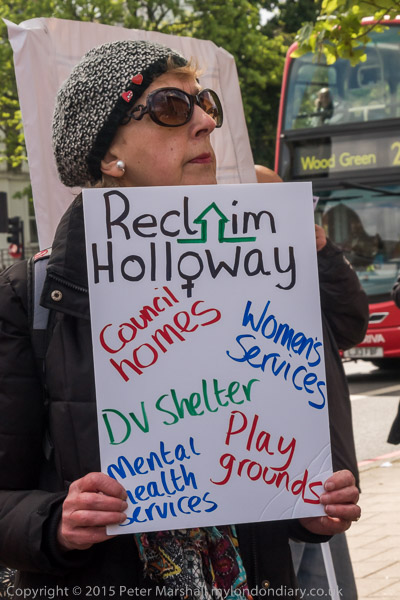
Reclaim Holloway – Holloway Road
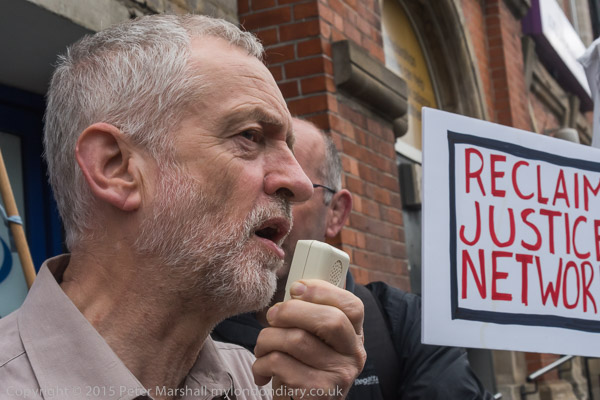
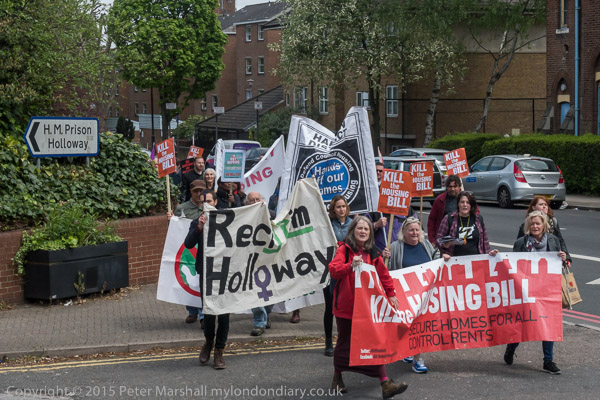
Local MP and Labour Party leader Jeremy Corbyn spoke outside London Met on Holloway Rd at the start of the march by Islington Hands Off Our Public Services, Islington Kill the Housing Bill and the Reclaim Justice Network to HMP Holloway demanding that when the prison is closed the site remains in public hands, and that the government replace the prison with council housing and the vital community services needed to prevent people being caught up in a damaging criminal justice system.
A group of around a hundred then marched from there to Holloway Prison, apparently already largely emptied of prisoners, and held a long rally there with speeches by local councillors, trade unionists and campaigning groups. Islington Council would like to see the prison site and adjoining housing estate then owned by HM Prisons used for social housing rather than publicly owned land being sold for private development.
The Ministry of Justice sold the site to housing association Peabody for £81.5m in 2019 and their plans include 985 homes and offices, with 60% of so-called affordable housing as well as a women’s building with rehabilitation facilities reflecting the site’s history. The development stalled in February 2022 with Peabody saying they were unable to afford the money needed to fit out the women’s centre.
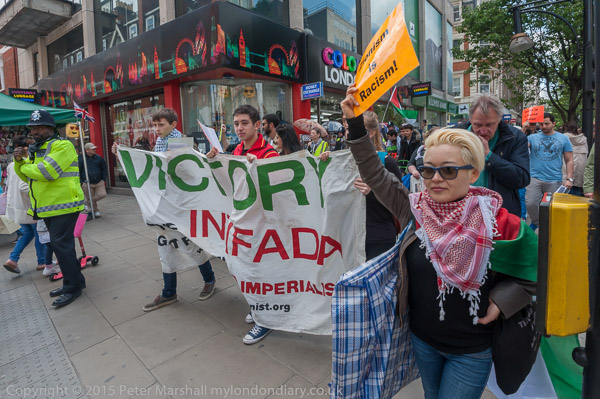
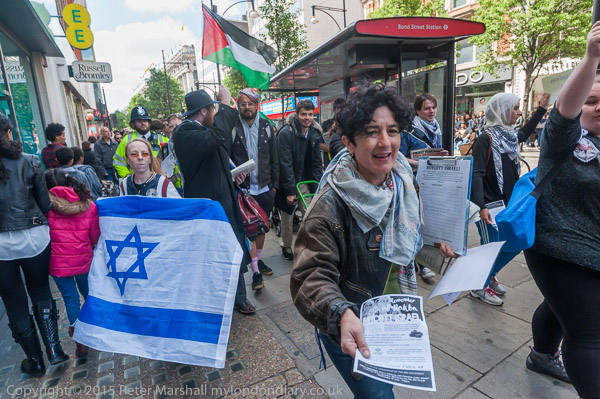
Protesters made their way along Oxford St from their regular Saturday picket outside Marks & Spencers, handing out leaflets and stopping outside various shops supporting the Israeli state for speeches against the continuing oppression of the Palestinian people and attempts to criminalise and censor the anti-Zionist boycott, divestment and sanctions (BDS) movement.
Nabka Day, the ‘day of the catastrophe’ remembering the 80% of Palestinians forced out of their homes between December 1947 and January 1949 is commemorated annually on May 15th, but the protest was a day earlier when Oxford Street would be busier. The Palestinians were later prevented by Israeli law from returning to their homes or reclaiming their properties, with many still living in refugee camps.
The protesters included a number of Jews who are opposed to the continuing oppression of the Palestinians by the Israeli government. A small group of counter protesters shouted insults and displayed Israeli flags, accusing the protesters of anti-Semitism but the protest was clearly directed against unfair and illegal policies pursued by the Israeli government rather than being anti-Semitic. The counter-protesters tried unsuccessfully to provoke confrontation, standing in front of the marchers and police had at times to move them away.
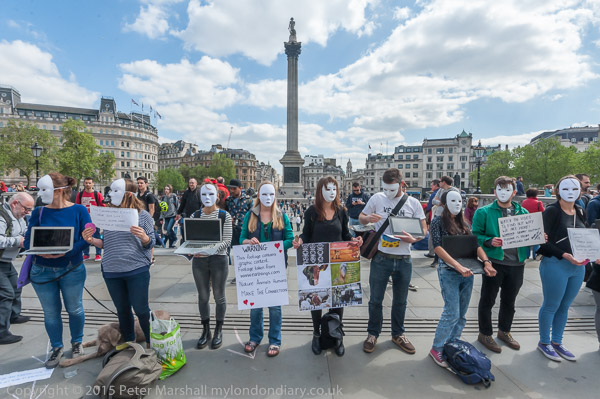
Vegan Earthlings masked video protest – Trafalgar Square
Vegans wearing white masks stood in a large circle in Trafalgar Square holding laptops and tablets showing a film about the mistreatment of animals in food production, bullfighting, etc. The protest was organised by London Vegan Actions and posters urged people to stop eating meat to save the environment and end animal cruelty.
Refugees Welcome say protesters – Trafalgar Square
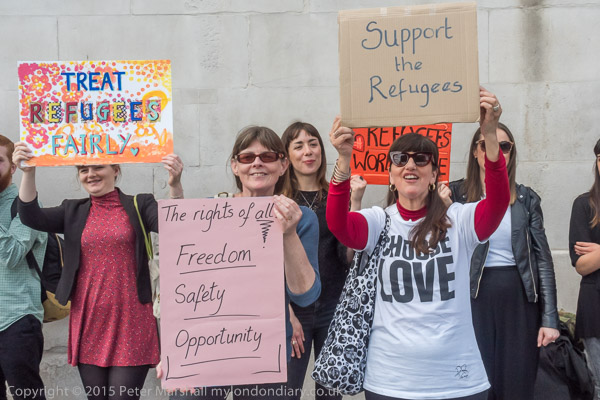
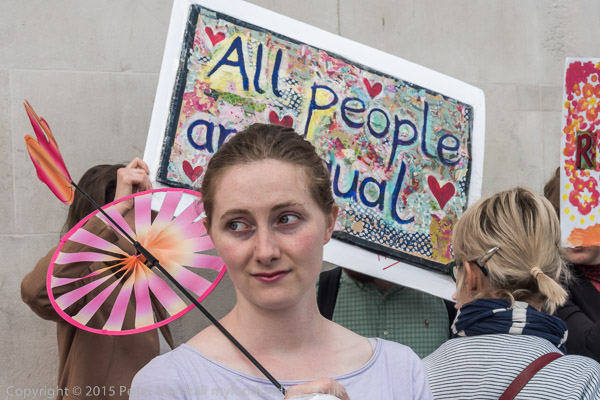
Another small group of protesters stood in front of the National Gallery held posters calling for human rights, fair treatment and support for refugees. Some held a banner with the message ‘free movement for People Not Weapons’.
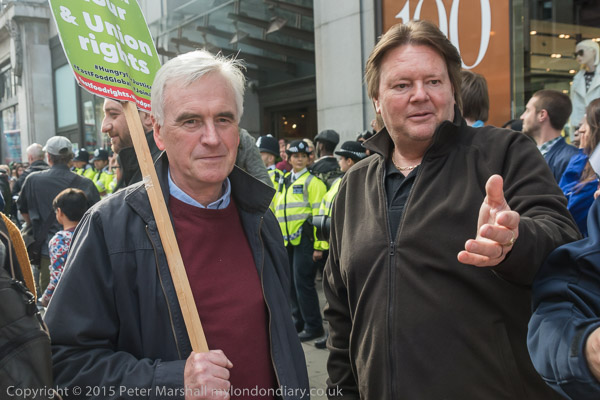
Finally I was back on Oxford St where cleaners union United Voices of the World (UVW) was holding one of protests outside Topshop stores around the country following the suspension of two cleaners who protested for a living wage; one has now been sacked. Joining them in the protest were other groups including Class War, cleaners from CAIWU and other trade unionists including Ian Hodson, General Secretary of the BWAFU and Shadow Chancellor John McDonnell.
Shadow Chancellor John McDonnell, MP and Ian Hodson, Baker’s Unions General Secretary outside Topshop
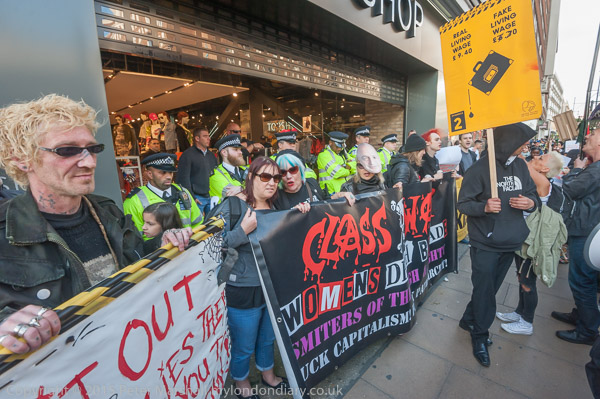
The Oxford Street Topshop was heavily defended by police, as well as by illegal extra security guards wearing no ID. Several hundred protesters held up banners and placards and with the help of the police blocked the entrance to the shop, though the protesters made no serious attempt to enter the building.
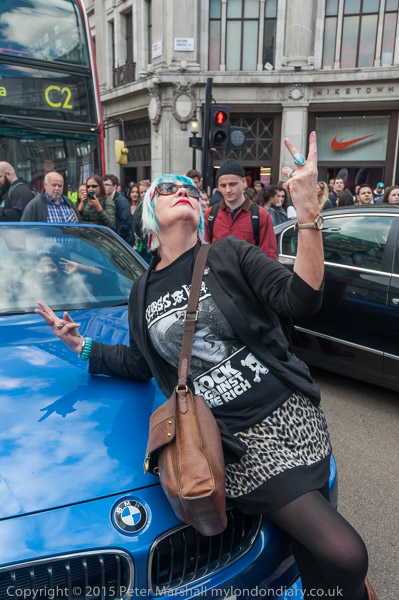
Jane Nicholl of Class War poses on a BMW as they block Oxford Circus
After a while some of the protesters, led by the Class War Womens Death Brigade, moved onto the road, blocking it for some minutes as police tried to get them to move. The whole group of protesters then moved to block the Oxford Circus junction for some minutes until a large group of police arrived and fairly gently persuaded them to move.
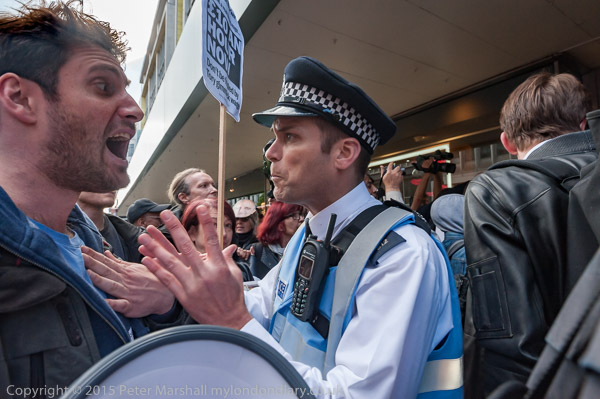
UVW’s Petros Elia argues with a police officer outside John Lewis
They moved off, but rather than going in the direction the police had urged them, marched west along Oxford St to John Lewis, where they protested outside the entrance, where cleaners have a longstanding dispute. The cleaners who work there are outsourced to a cleaning contractor who John Lewis allow to pay low wages, with poor conditions of service and poor management, disclaiming any responsibility for these workers who keep its stores running.
There were some heated exchanges between protesters and police but I saw no arrests and soon the protesters marched away to the Marble Arch Topshop branch to continue their protest.