12 Days of Christmas -some of my favourite pictures from those I made in May.
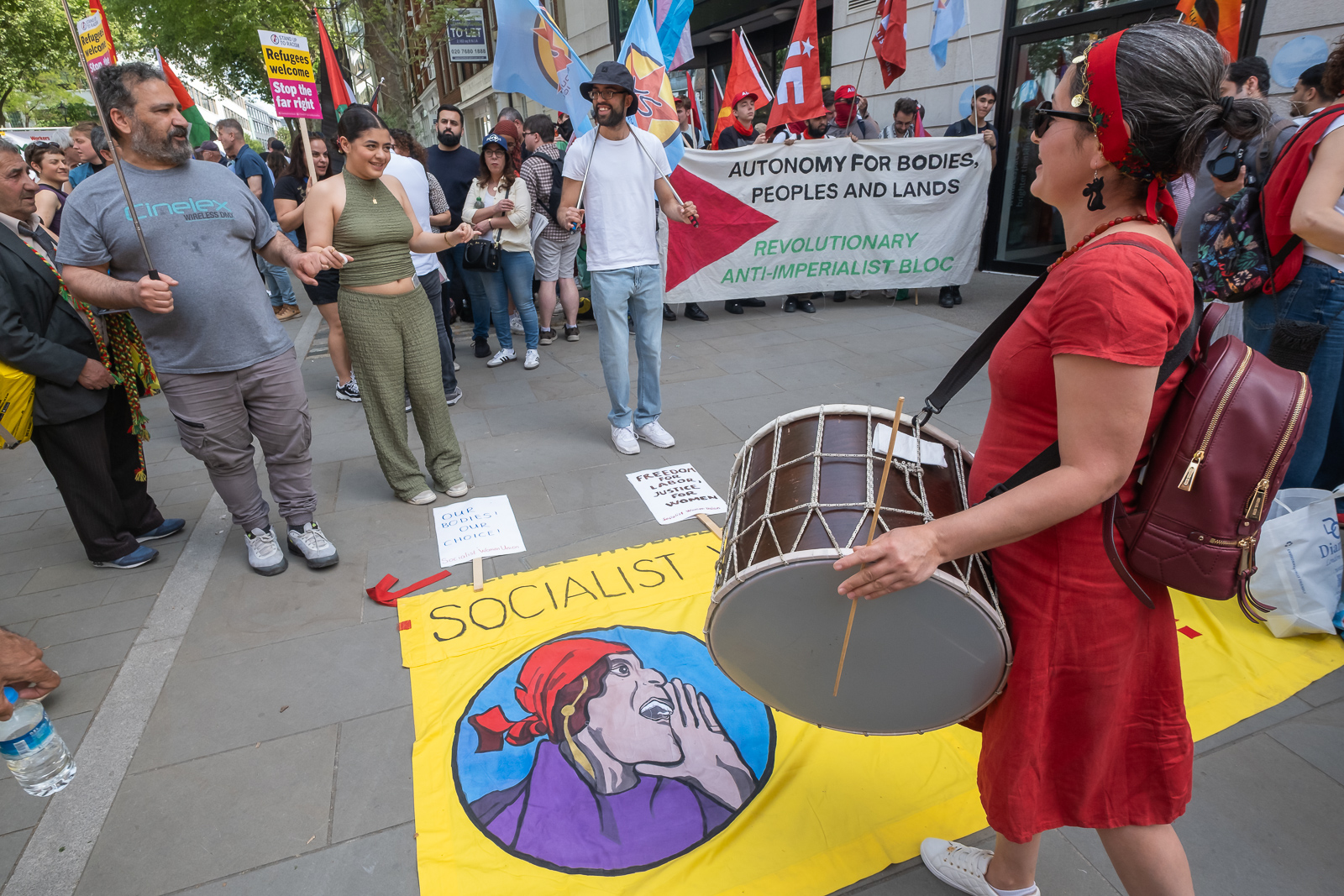
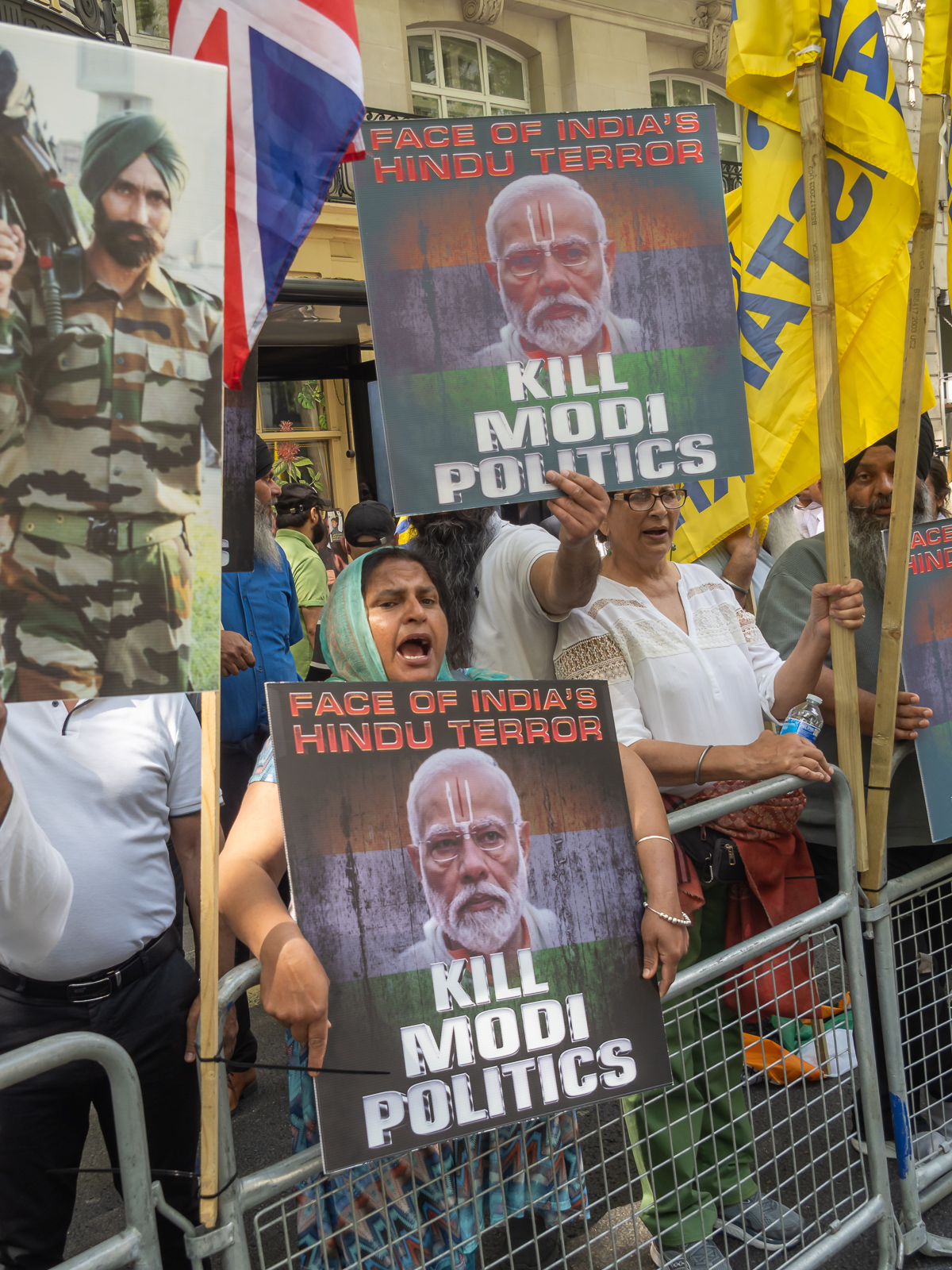
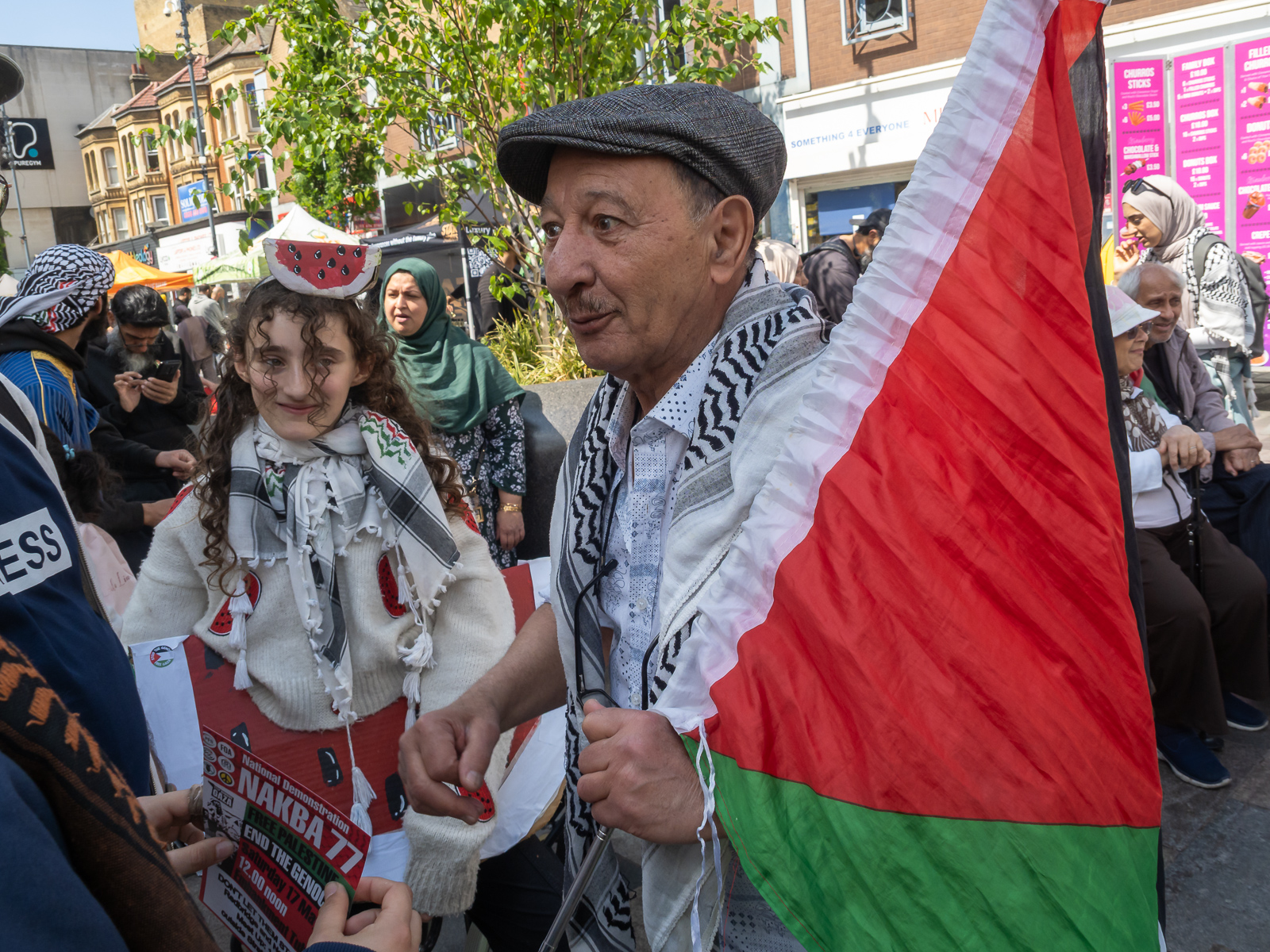
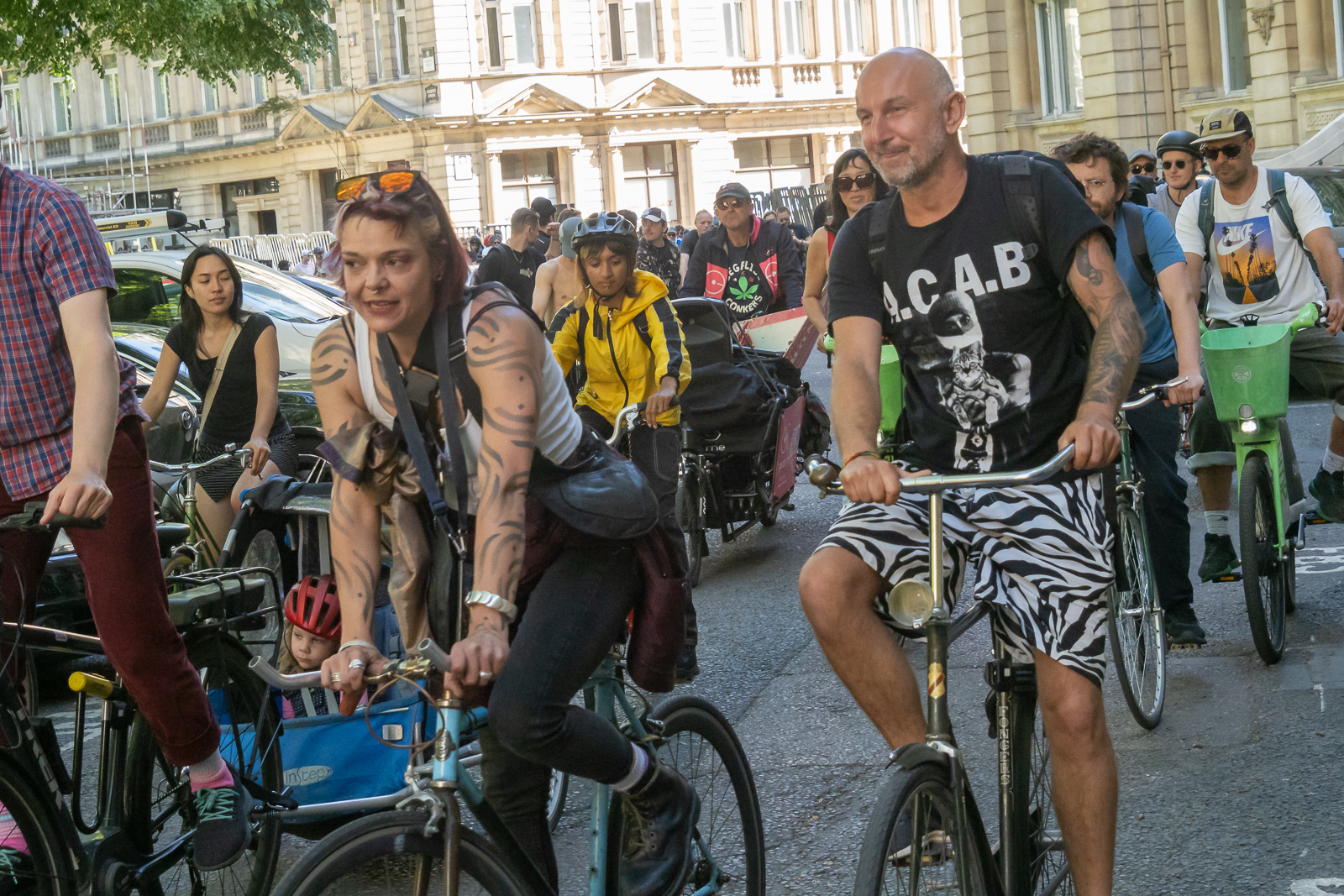
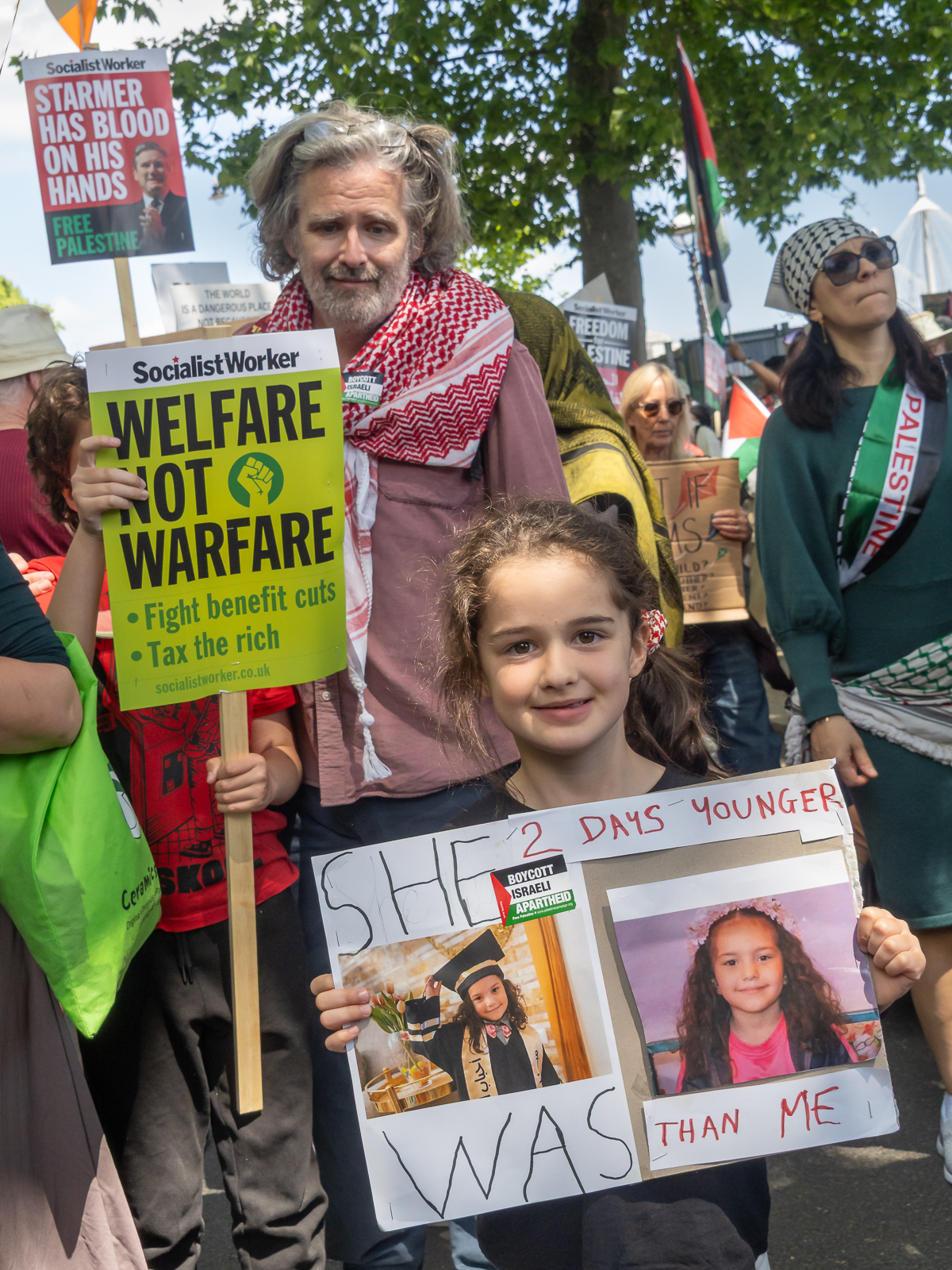
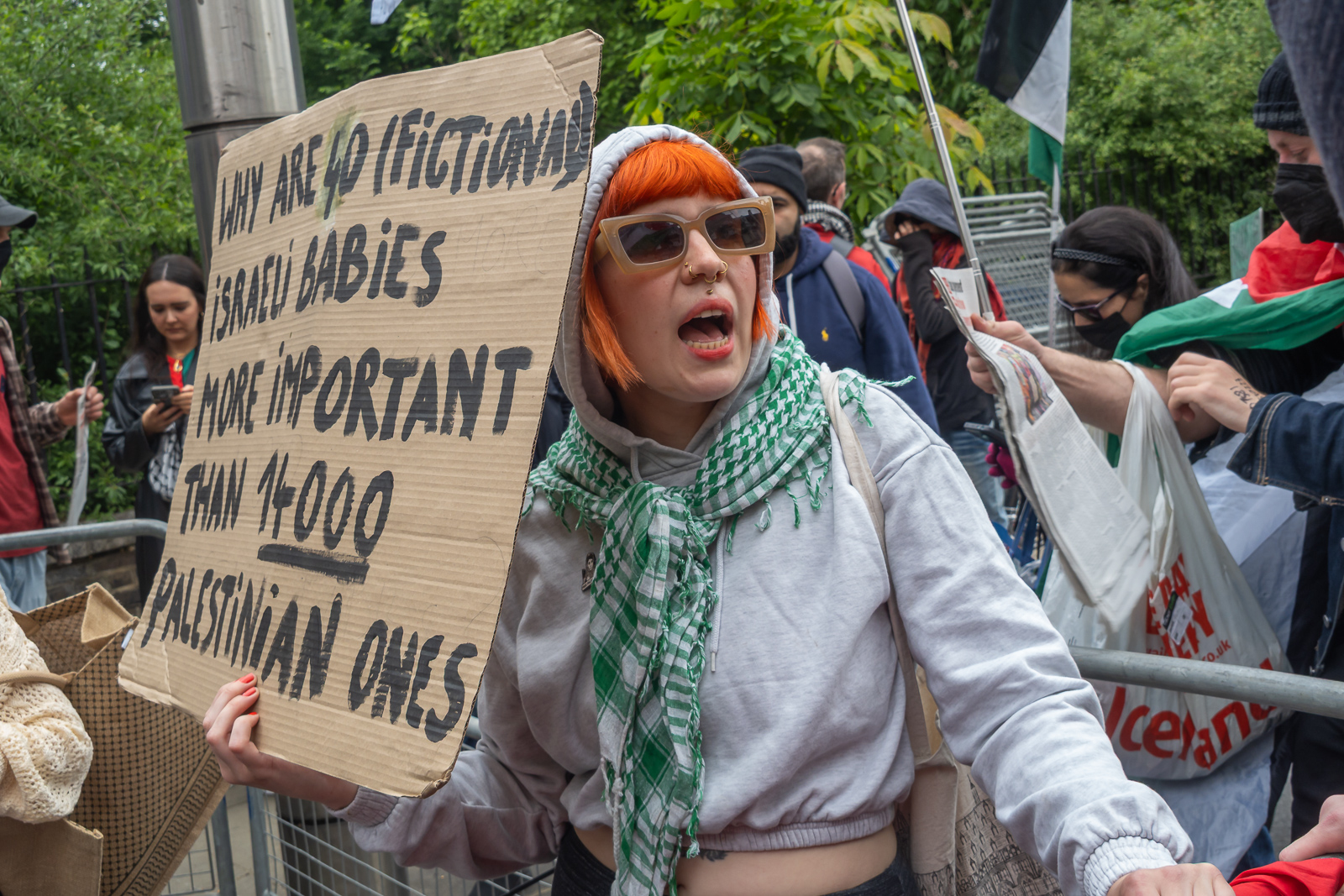
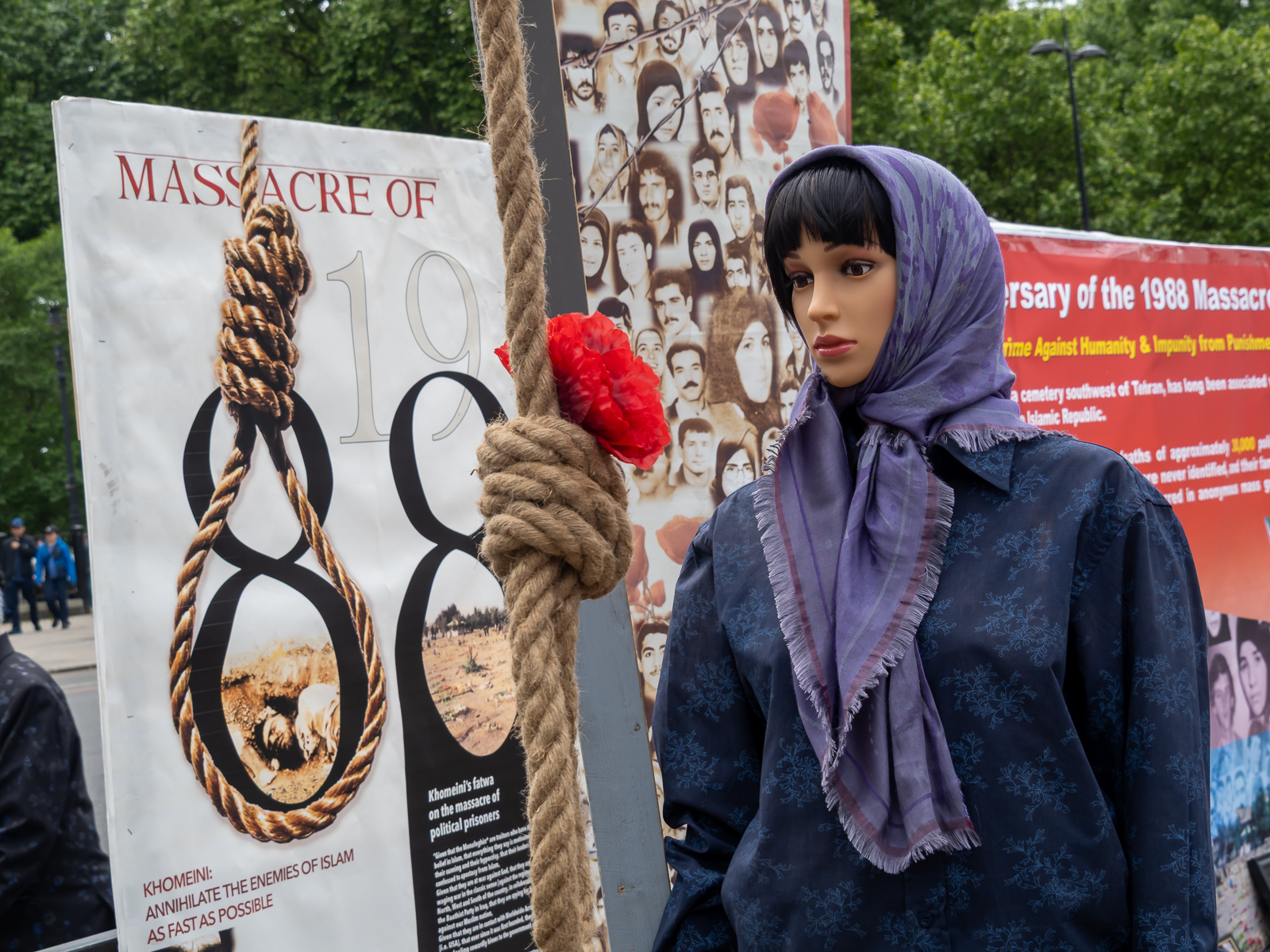
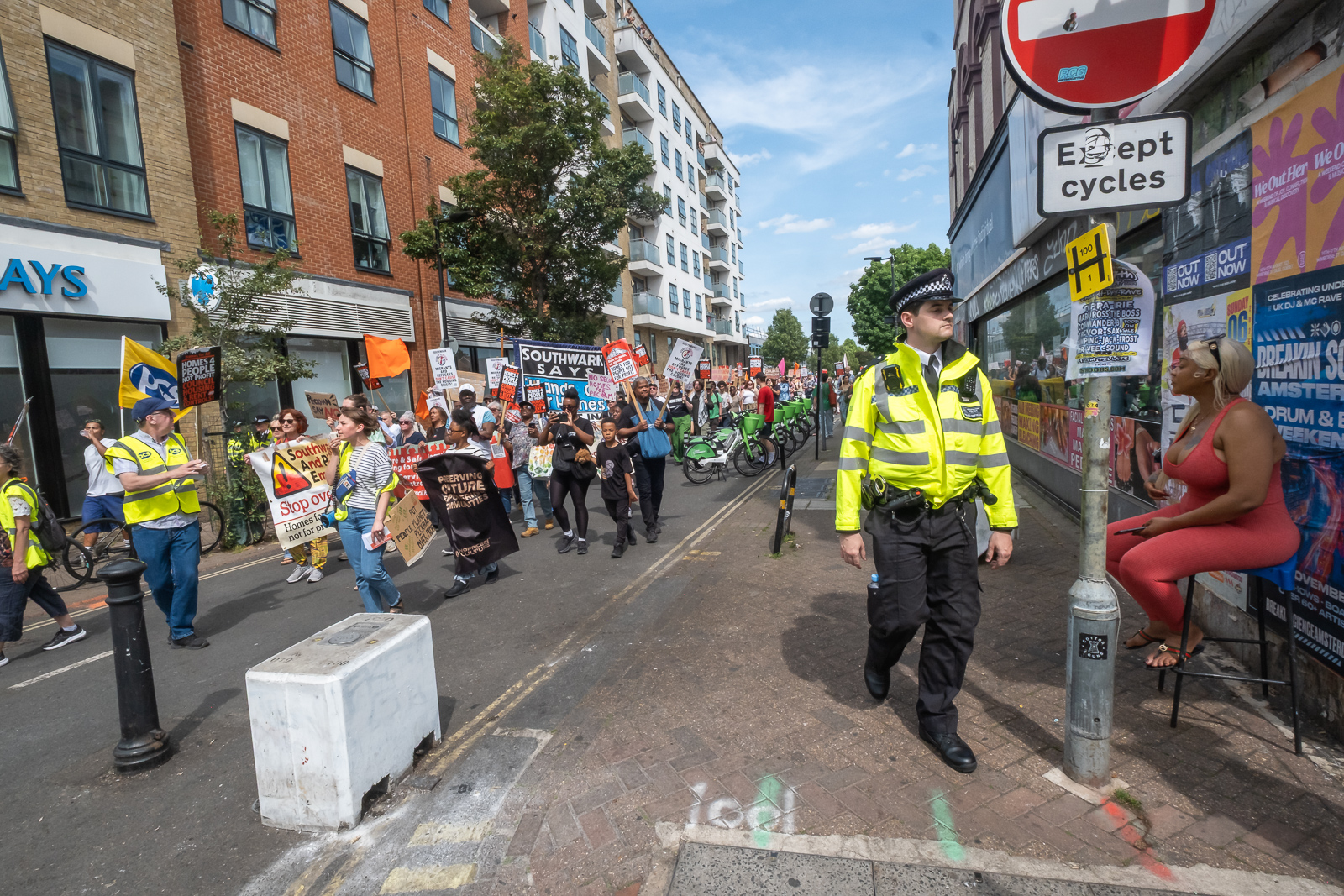
London, UK. 1 May 2025. Socialist Women’s Union. Several thousands met at Clerkenwell Green on May Day before the International Workers Day March to Trafalgar Square. Those taking part included many from London’s various ethnic communities – Turkish, Kurdish, Latin American, West Indian, Indian, Sri Lankan, Tamil, Iraqi, Iranian and more as well as many from UK trade unions, communist and anarchist groups. Many showed their support for Palestine and other international issues. Peter MarshallLondon, UK. 1 May 2025. Hurrah for the Wiphala around the world. Several thousands marched from Clerkenwell Green on May Day for the International Workers Day March to Trafalgar Square. Those taking part included many from London’s various ethnic communities – Turkish, Kurdish, Latin American, West Indian, Indian, Sri Lankan, Tamil, Iraqi, Iranian and more as well as many from UK trade unions, communist and anarchist groups. Many showed their support for Palestine and other international issues. Peter MarshallLondon, UK, 1 May 2025. Sikhs and other supporters of Kashmir protest opposite the Indian High Commission against Modi and his Hindu nationalist government following his threats to Pakistan, suspension of the water-sharing agreement and reprisals against Kashmiris after the 22 April attack which killed 28 tourists. India has implemented a brutal military occupation of areas of Kashmir since they were controversially linked to India at partition in 1947. A smaller protest by the embassy supported Modi. Peter MarshallLondon, UK. 3 May 2025. Ilford. People from Newham and Redbridge march from Ilford and Forest Gate to a rally in Plashet Park, East Ham. They demand food, medicines and fuel be immediately supplied to Gaza where the whole population is being starved to death by the Israeli blockade while the world watches but does nothing. They call for an end to the attacks on the civilian population by Israeli forces and for negations for a peaceful future for Israel and Palestine. Among speakers was a man living in a Palestinian village when it was destroyed by Israel in 1947. Peter Marshall.London, UK. 17 May 2025. Finsbury Circus. Thirty years after Reclaim The Streets held a number of protests against car culture, closing major road junctions temporarily to allow cyclists and pedestrians to enjoy these as free spaces for community and creativity, they came together, hundreds on bicycles and others on foot, to party in Smithfield. Police came to complain about the noise and they agreed to leave and cycle around the City before partying at another venue. Peter Marshall.London, UK. 17 May 2025. As Israel renewed its genocidal attacks on Gaza where people are now starving to death after Israel has blocked all food, fuel and medicines, many thousands including many Jews came to London to march peacefully on the 77th anniversary of the Nakba to a rally at Downing St calling for an immediate and permanent ceasefire, release of all prisoners and hostages and end to the blockade and for the UK to stop arming Israel. Peter Marshall.London, UK. 24 May 2025. Police forced the protest by ‘Fight Racism, Fight Imperialism’ into a pen 150m from the Israeli Embassy. They demand an end to the Israeli siege of Gaza to save the 14,000 babies who will die unless Israel complies with international law and stops its starvation of the people of Gaza and that the UK cuts all military, financial, diplomatic, and cultural ties with the Zionist state. Peter Marshall.London, UK. 24 May 2025. A protest at Marble Arch by the People’s Mojahedin Organization of Iran (PMOI/MEK) called attention to the continuing executions of political opponents by the regime and called for the abolition of the death penalty in Iran. At the end of the Iran-Iraq war in 1988 Khomeini issued a fatwa ordering the massacre of political prisoners and some 30,000 MEK supporters were hanged and executions and torture still continue. Peter Marshall.London, UK, 24 May 2025. Singing their national anthem. Around 2000 Ukrainians, many wearing traditional Vyshyvanka embroidery and women and girls with floral headdresses met for an opening ceremony at Marble Arch with speeches, prayers and performances mainly by children. They called for justice and an end to the Russian invasion and for Ukraine’s stolen children to be brought home. Children then led the procession to the St Volodymyr Monument at Holland Park. Peter Marshall.London, UK. 31 May 2005. A rally and march around the centre of Peckham organised by SHAPE (Southwark Housing And Planning Emergency) called for the redevelopment of the Aylesham Centre to provide social housing desperately needed for the people of Peckham rather than unaffordable luxury flats for rich investors, with just the token 12% developers Barkeley homes propose, as well as offering a future for the current local traders in the market there. Peter Marshall.
More of my favourite pictures from June 2025 tomorrow.
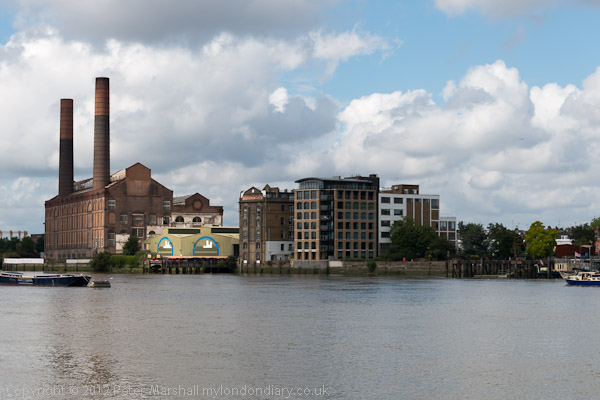
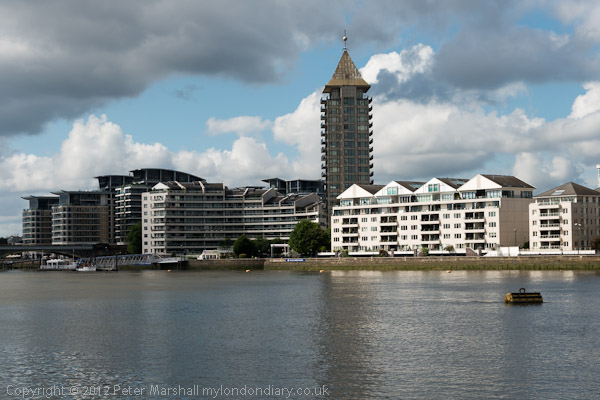
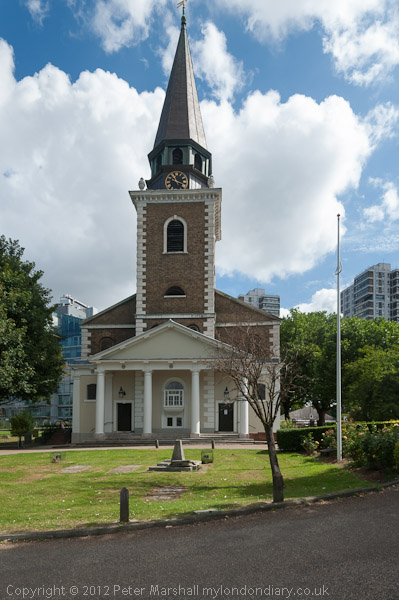
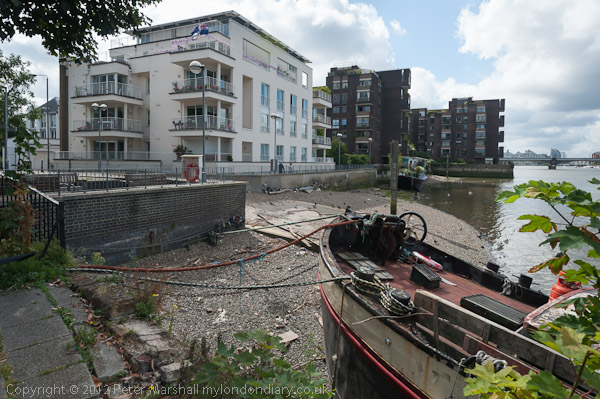
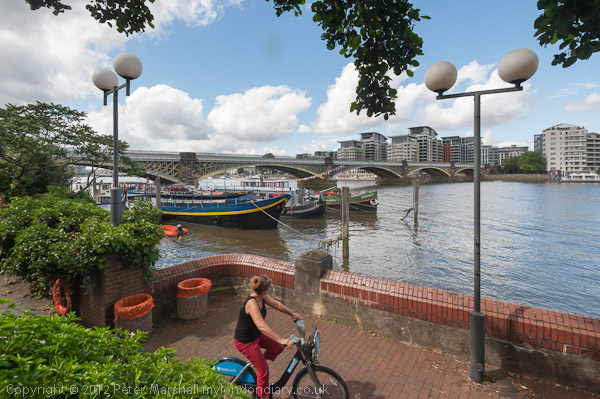
River Thames – Battersea Riverside: Tuesday 14th August 2012 was a nice day with blue sky and some interesting clouds in the sky and I had an hour or two to spare.
So I took a walk from Battersea Bridge to Wandsworth along the Thames Path.
Battersea Bridge crosses the river to Chelsea and I photographed the views over the river towards Lots Road Power Station and Chelsea Harbour.
This is a stretch of the river I’ve walked quite a few times over the years. It’s an easy journey for me to get there but it is also one of the more interesting and varied to walk.
When I first walked this way in the 1970s this was an industrial area, with factories and wharves and limited access to the river. Now the Thames Path takes you along the riverside with just some short diversions.
Most of the riverside is now lined with blocks of expensive flats rather than the flour mills, oil depots and a power station at Fulham I photographed back then.
Silver Belle Flour, mill, Battersea, 1991
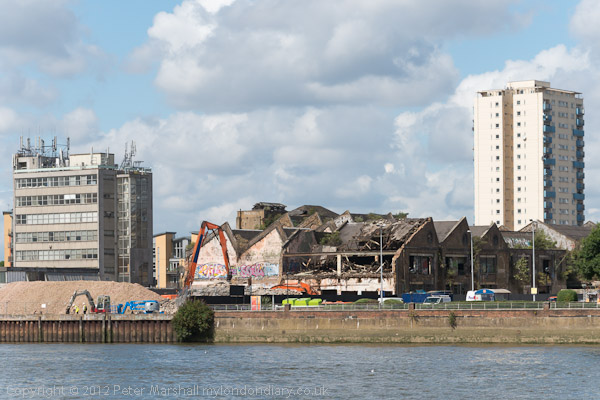
There are still a few traces of that industrial past, though some were being demolished on both sides of the river back in 2012.
Demolition at Fulham Wharf
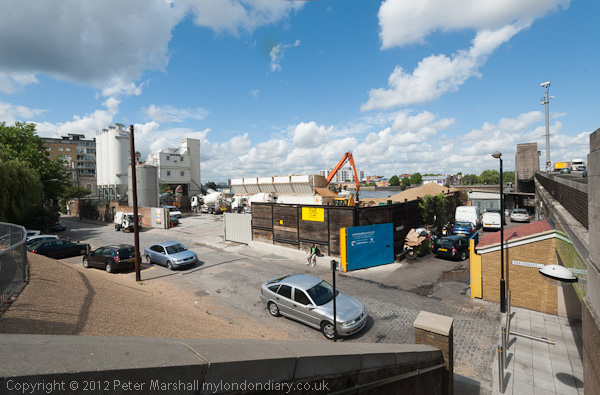
The sand and gravel works immediated upstream from Wandsworth Bridge was still there and still working when I last visited the area a few months ago, although I expect before long it will also be another luxury block of flats.
I think the best images I made that day before catching a train at Wandsworth Town were probably some panoramic images I’ve not included in this post as they don’t fit well in its format. You can see these and others from the walk on My London Diary at Battersea Riverside.
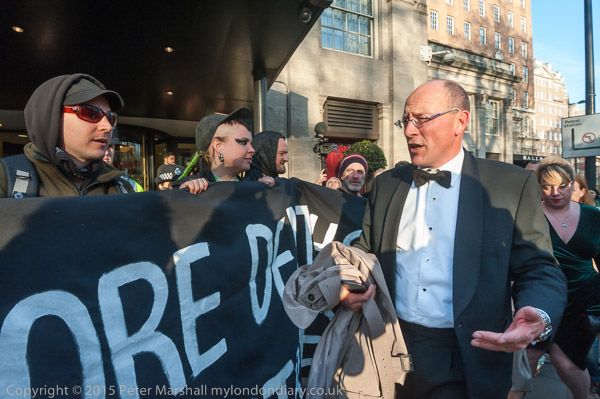
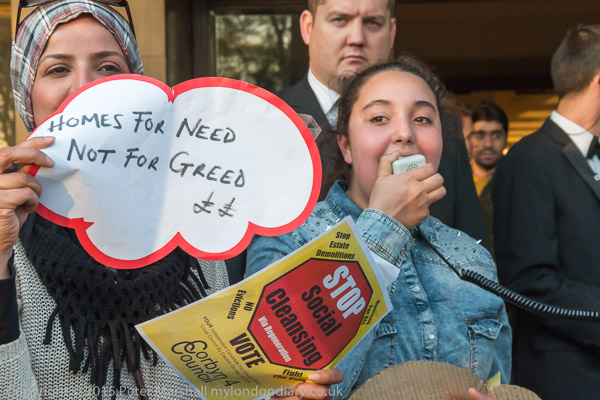
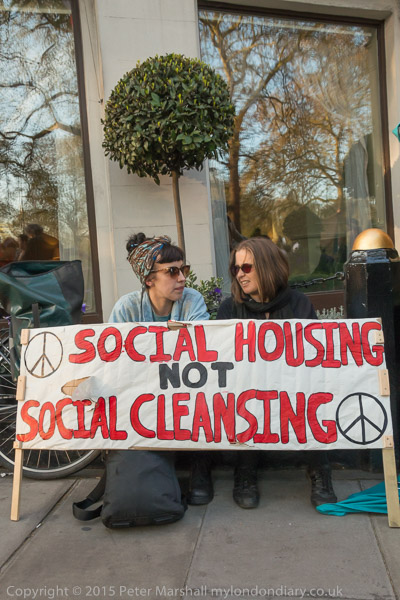
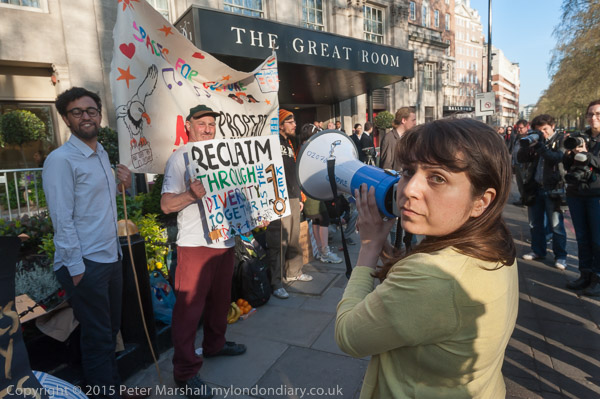
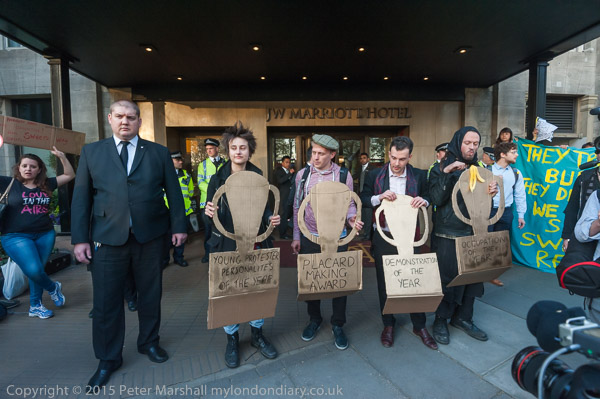
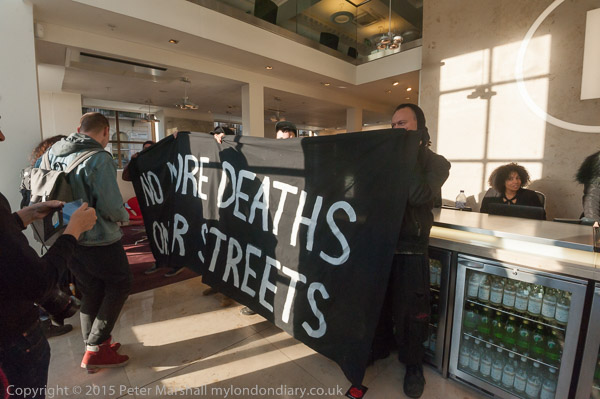
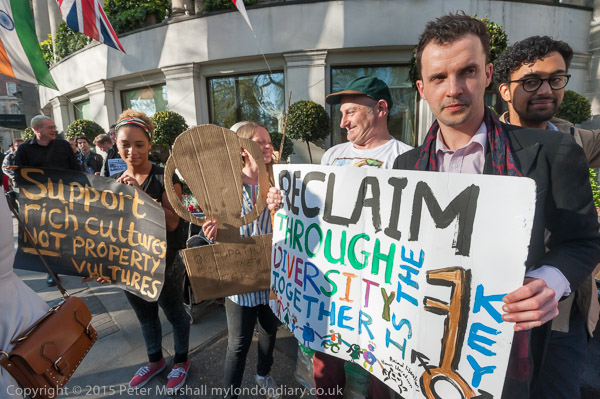
Greedy Property Developers Reward Themselves: Eight years ago on Tuesday 12 April 2015 I photographed housing activists protesting outside the expensive dinner at a Mayfair hotel for the 2015 Property Awards. The protesters held their own alternative awards ceremony for housing protesters as a part of the event.
Among those in my pictures is Aysen from the Aylesbury Estate. The Fight4Aylesbury exhibition in her flat on the estate continues today, Friday 21st April 2023, and on Saturday 22nd and Sunday 23rd. Parts of some of my pictures from this event were used in collages in that show.
Property Awards at Mayfair Hotel – Grosvenor House Hotel, Park Lane
Property developers have powered the incredible rise in London Housing prices by building luxury flats for mainly overseas investors, many of which remain unoccupied to be sold later at even higher prices to other investors, and also by working with London councils to redevelop social housing largely for private sale.
Together with the actions of successive governments – Tory and Labour – they had created what by 2015 was clearly the worst shortage of affordable housing in history, with a record number of evictions and the doubling of rough sleeping in London. Over 50,000 families have had to move out of London while many more properties in the capital remain empty.
As I wrote: “Housing in London has ceased to be something to meet human need, and instead is servicing greed and selfishness.” And the expensive dinner taking place that evening in the luxury Mayfair hotel was to give awards to the property developers for their greed. Among those taking part in the protest outside were people from estates which are being redeveloped, including Southwark Council’s Aylesbury estate and Sweets Way in north London who were facing eviction because of the policy of social cleansing driven by councils and developers.
People arriving at the dinner were met by a noisy crowd calling for a fair housing policy outside the ‘red carpet’ entrance to the hotel on Park Lane and had to walk past the protesters to enter. Police tried to keep the entrance clear and some hotel staff directed the guests to other entrances to the hotel, where the protesters also followed.
The protesters held an alternative awards ceremony in front of the hotel entrance, awarding large cardboard cups for the Young Protester of the Year, Placard Making, Demonstration of the Year and Occupation of the Year.
Protesters also briefly occupied occupied a neighbouring branch of estate agents Foxton, who have played a leading role in the gentrification of London. Together with other estate agents they have also been an important influence on the housing policies of both Tory and Labour.
Foxtons is notorious among those who rent property for driving up rents – and in 2022 the London Renters Union reported that their annual revenue had increased by £5m as rents in London went up by an average of 20.5% in 3 months, with one Foxtons tenant reporting a rise of £12,000 per year!
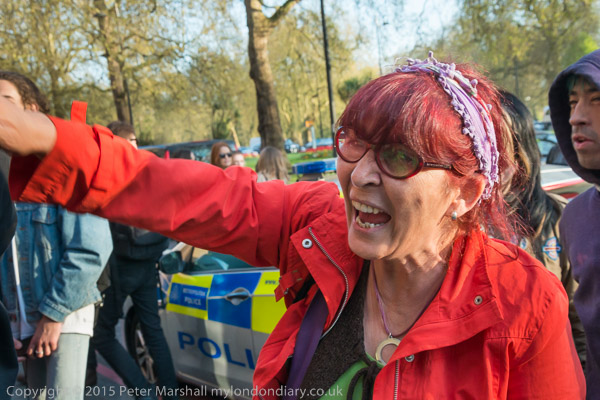
Shortly before I left it became clear that most of those coming to the dinner were being directed to a rear service entrance to the hotel and the protesters moved around the block to hold a rally there. The gate was rapidly closed and there were some minor scuffles as police attempted to move the protesters away. I heard later that there had been two arrests after I left.
From Southwark Park Schools which ended the previous post on this walk, Rotherhithe New Road & Southwark Park Schools, I walked a few yards up Southwark Park Road to the corner with Banyard Road, where I photographed the taxi office (still there but changed from A-Z Star Cars to 5 Star Cars) with the pub on the opposite corner, the Southwark Park Tavern, now closed and converted to residential around 2003.
There was a pub around here, the Green Man, possibly on this site before Southwark Park opened in 1869 but I think this building probably came shortly after the park was opened, and is opposite the Carriage Drive leading into the park.
Unfortunately I haven’t yet digitised this picture, nor one of rather plain two-storey terrace on Banyard Rd or an image showing a play area in the park. I hurried through the park to the Jamaica Road gate at its north, crossing to make my way to Kings Stairs Gardens and the River Thames.
River Thames, Downstream, Rotherhithe, Southwark, 1988 88-10l-63
The two jetties visible here I think have now gone and there is certainly no line of lighters as in this picture, and there is one striking new building on the riverfront.
River Thames, Downstream, Rotherhithe, Southwark, 1988 88-10l-65
A second picture taken with a short telephoto lens from almost exactly the same place shows the central area more clearly, with new flats being built on Rotherhithe St.
Wapping, River Thames, Rotherhithe, Southwark, 198888-10l-51
Looking across the Thames downstream, with Free Trade Wharf at the extreme right and just to the left the cylinder ventilation shaft of the Rotherhithe tunnel in the King Edward Memorial Park. Both Metropolitan Wharf and New Crane Wharf are covered iwth scaffolding.
Wapping, River Thames, Rotherhithe, Southwark, 1988 88-10l-52
Part of St John’s Wharf and King Henry’s Wharves seen across the River Thames.
Wapping, River Thames, Rotherhithe, Southwark, 1988 88-10l-53
More of St John’s Wharf, including one of the earlier warehouse conversions and the Grade II listed Wapping Police Station, built 1907-10, Metropolitan Police architect John Dixon Butler. At extreme left is a part of Aberdeen Wharf built in 1843–4 by the Aberdeen Steam Navigation Company.
Wapping, River Thames, Rotherhithe, Southwark, 1988 88-10l-54
The end of Aberdeen Wharf is at the right edge of this picture, and at its left the Wapping Police Boatyard, an unnecessarily ugly building opened in 1973. The new building in the centre of the picture also seems something of an eyesore, at least at its ends.
Wapping, River Thames, Rotherhithe, Southwark, 1988 88-10l-55
Continuing up-river from the Police Boatyard are St Thomas Wharf, Pierhead Wharf, Oliver’s Wharf – the first warehouse in Wapping to be converted into luxury flats in 1972 – and Wapping Pierhead, with houses designed by Daniel Alexander in 1811 and the main entrance to London Docks.
Bermondsey, River Thames, Rotherhithe, Southwark, 1988 88-10l-41
Looking upriver on the south bank with Tower Bridge at the extreme right and Guy’s Hospital tower just left of centre. Cherry Garden Pier is at left.
Silver Jubilee, marker, EIIR, River Thames, Rotherhithe, Southwark, 1988 88-10l-43
There is still a marker for the Queen’s Silver Jubilee here but it looks far less impressive than this rugged stonework I photographed in 1988. London has also gained quite a few tall buildings, but the view along the river remains clear and you can still see the dome of St Paul’s Cathedral.
41 Rotherhithe St, now apparently 1 Fulford St at least according to Google Maps, was the offices of lighterage company Braitwaite & Dean, where their lightermen would come to collect their weekly wage. Apparently it was known locally as the Leaning Tower of Rotherhithe, though the building’s lean is more apparent from across the river than in my picture.
It was left more or less alone on this stretch of the river with just the Angel pub equally isolated a few yards upriver after Bermondsey council bought many of the buildings in 1939 to create a park, with wartime bombing continuing the demolition job. There was some temporary housing by the river when I first walked along here in the early 1980s, but that soon disappeared.
My walk in Bermondsey continued – more about it in a later post.
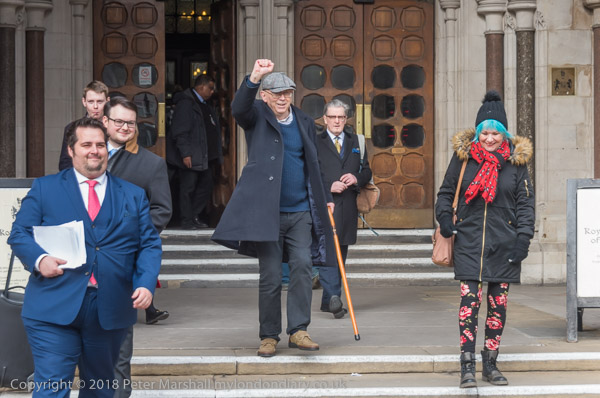
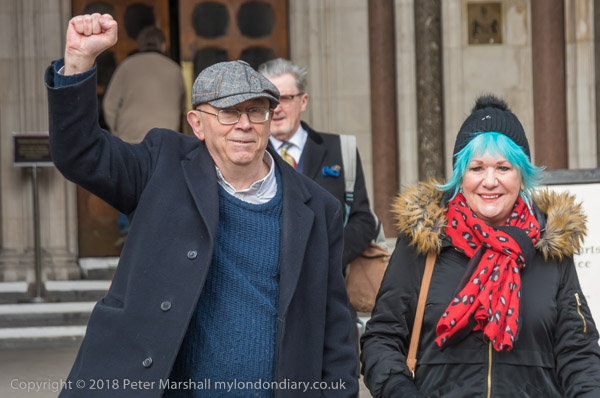
Ian Bone raises a fist as he comes out of the Royal Courts of Justice
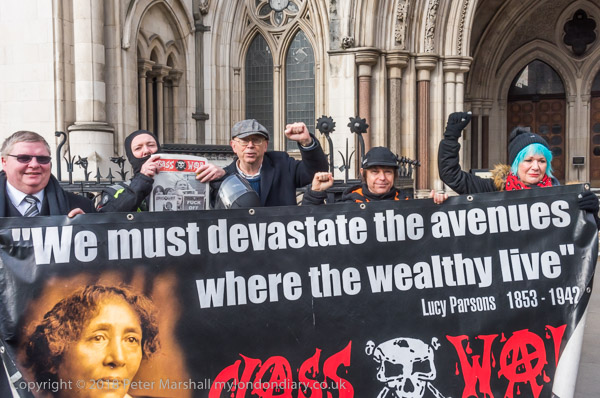
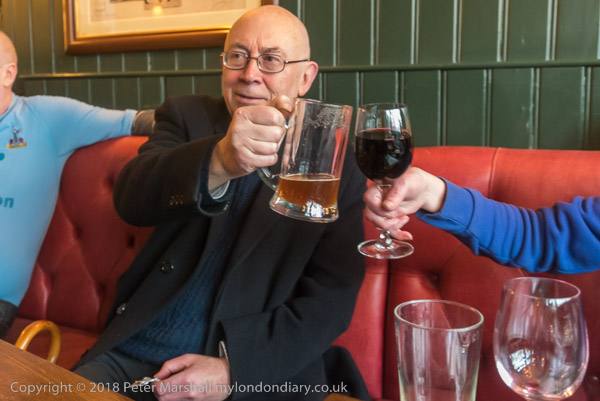
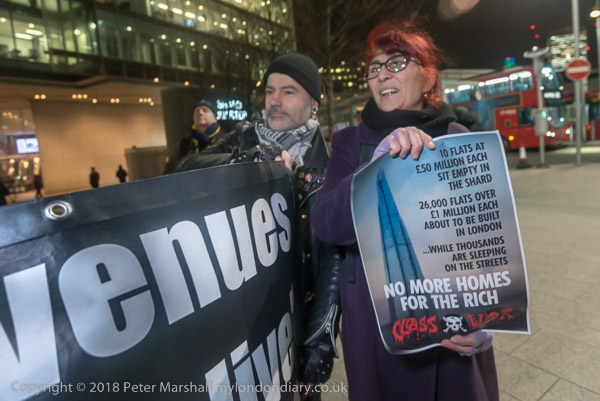
February 8th 2018 was a good day for Class War, beginning with a visit to the High Court at the Royal Courts of Justice, where thanks to barrister Ian Brownhill they emerged triumphant after stopping an attempt by lawyers acting for the Qatari royal family to prevent a Class War protest against the ten empty £50million pound apartments in The Shard.
Lawyers for the Qataris had tried to get an injunction against protests by Bone and “persons unknown” and to claim over £500 in legal costs from the 70 year-old south London pensioner, and the case had attracted considerable publicity in the media including an article by Suzanne Moore in The Guardian and another in Le Monde and many more.
Brownhill offered to conduct Bone’s defence pro-bono and contacted the Quatari’s solicitors who immediately offered to drop the case if Class War ‘would stop attacking the Shard’ whatever that meant. In the High Court the Qataris’ lawyers were forced to drop the attempt to ban protests and the demand for fees but Bone accepted a legal restriction on him going inside the Shard and its immediate vicinity.
The case also showed the police’s insecurity over Class War and documents presented in court on behalf of the Qataris clearly showed they had been given documents by the police including one with clearly defamatory false statements about another person associated with Class War who was not named in the injunction.
Another document presented was a surprising testimonial about Class War which made it sound a rather more impressive and powerful organisation than the small but influential irritant to the rich and unscrupulous it is. The police probably the source for this certainly seem to share the lawyers’ delusions of the organisations grandeur, with an unusually strong police presence outside the court and around a corner clearly outnumbering the Class War supporters.
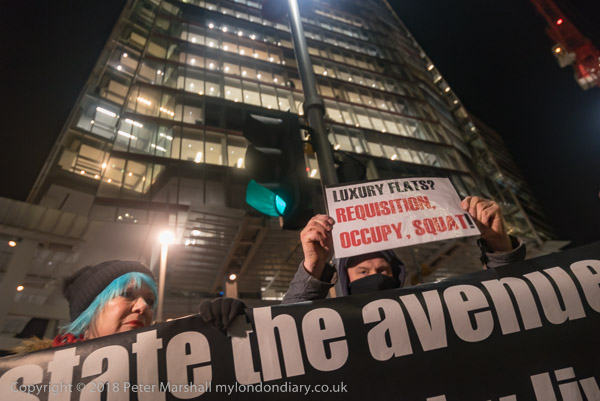
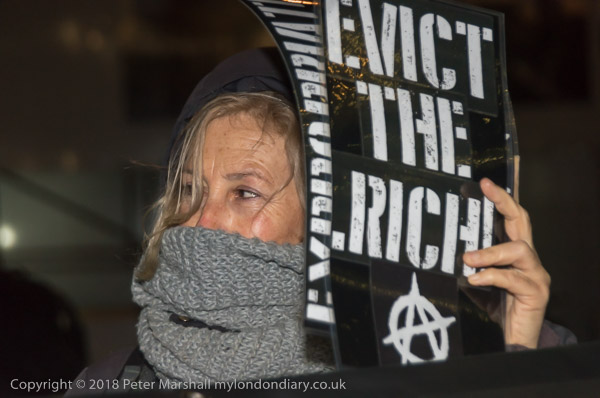
So the protest that evening took place as Class War intended, pointing out that the ten £50m apartments in the Shard had remained empty since the building was completed. The protest stressed that these were just a small fraction of the plans to build another 26,000 flats costing more than a million pounds each across London, many replacing current social housing a time when London has a huge housing crisis with thousands sleeping on the street, and over 100 families from Grenfell are still in temporary accommodation.
As Class War stated, there are already a huge number of empty properties in London, many in large development of high priced flats which either remain unsold or are bought as investments and largely unoccupied. What the capital needs is not luxury flats but much more social housing – and to keep existing housing on council estates under threat of demolition.
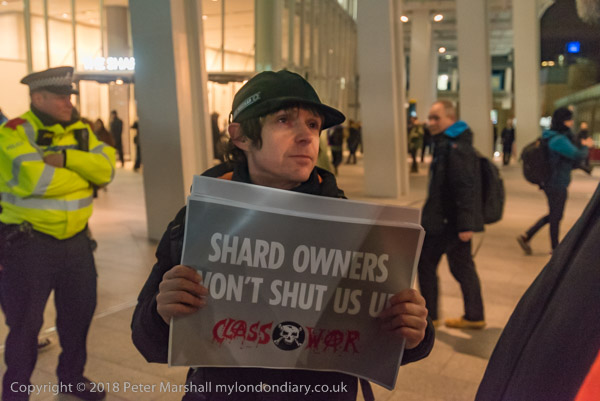
The protest, as planned, was peaceful but very noisy, and again policed by a ridiculously large number of police and private security. Ian Bone’s poor health meant he was in any case unable to attend in person. The protesters were careful to remain outside the boundary of The Shard, marked with a metal line in the pavement, but police still tried to move them away to the other side of the road, making the patently spurious claim that they were causing an obstruction to commuters attempting to enter London Bridge station. The only real obstruction to commuters attempting to enter the station were the lines of police across their route.
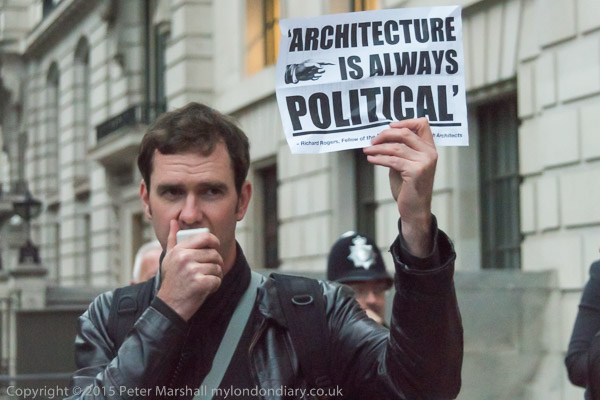
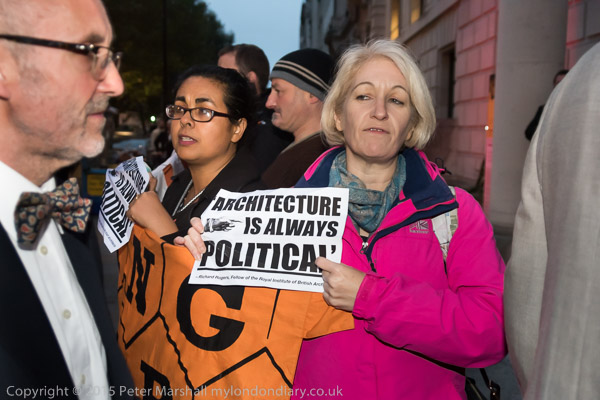
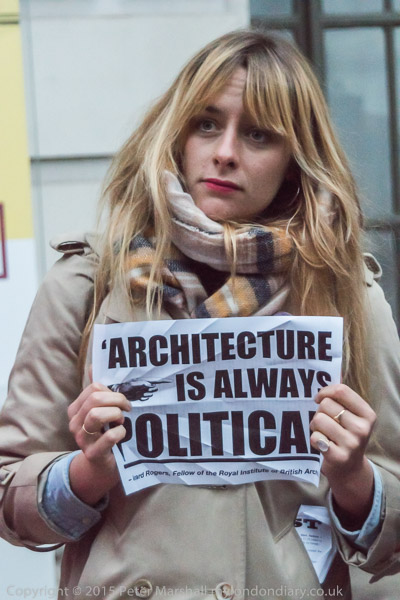
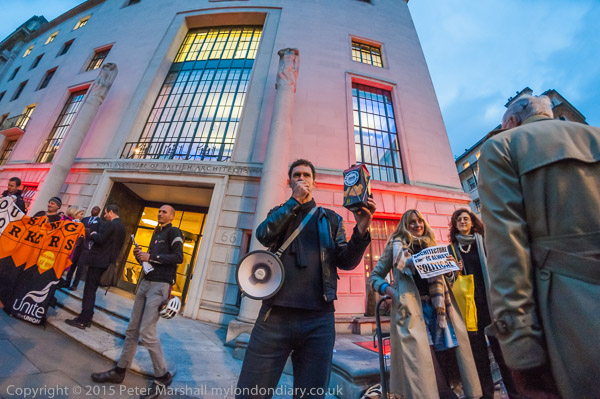
Simon Elmer of Architects for Social Housing (ASH) holds up a poster with the quote ‘Architecture Is Always Political’ from Richard Rogers, Fellow of the Royal Institute of British Architects at a protest on the pavement outside the RIBA on Portland Place on Thursday 15th Oct 2015.
The protest was against the nomination of NEO Bankside, a luxury development beside Tate Modern in Londonwhich breaks all planning requirements for social housing and sets a dangerous precedent for social cleansing for the prestigious Stirling Prize. Rogers was responsible for the design by Rogers Stirk Harbour + Partners of “the 217 apartments and penthouses in four Pavilions … with unparalleled views towards The City and St Paul’s Cathedral”. Or, as some might see it, degrading many views from the CIty and St Pauls. Some residents in the new development have taken and lost a case seeking to have the Tate Modern extension’s viewing platform closed as it overlooks their flats – and have now appealed to the Supreme Court, where a hearing is expected in December 2021. I hope it rejects their case. The flat dwellers could readily install blinds or curtains to protect their privacy.
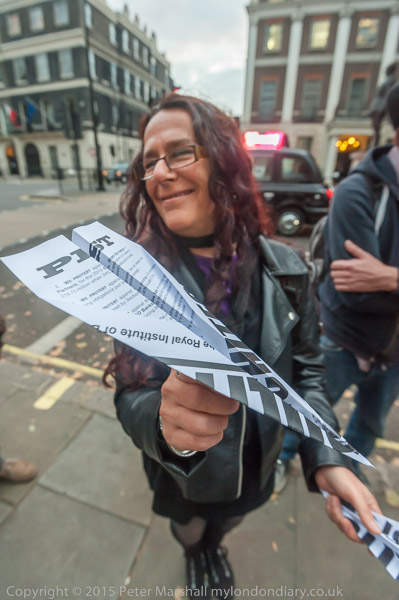
The protesters stated on the reverse of the flyer that “this development is a class war against the poor and on the reverse explained why. NEO Bankside contains 217 homes with a market price ranging from £1.25 million to £19.75 million when 345,000 Londoners, 4% of the city’s population, are on council waiting lists for homes.”
NEO Bankside reduced the percentage of its affordable housing required uder Section 106 of the Town and Country Planning Act from 40% to a paltry 27.5%, by getting the property developers Native Land to undervalue the estimate of sales to just over half of the actual sale value.They then paid Southwark Council £11 million to build its reduced affordable housing quota off-site on land sold to them by the council for a pittance, demolishing a council-run children’s home and day-care nursery in the process.
ASH pointed out that rather than 217 luxury flats mainly for non-resident tax exiles and foreign investors, the cost of NEO Bankside could have built 2,260 Peabody flats at the cost per flat of another of the Stirling nominations. At a time when 42,000 families were evicted from rented accomodation last year and 88,000 London children will be homeless this winter, such buildings are clearly socially unacceptable.
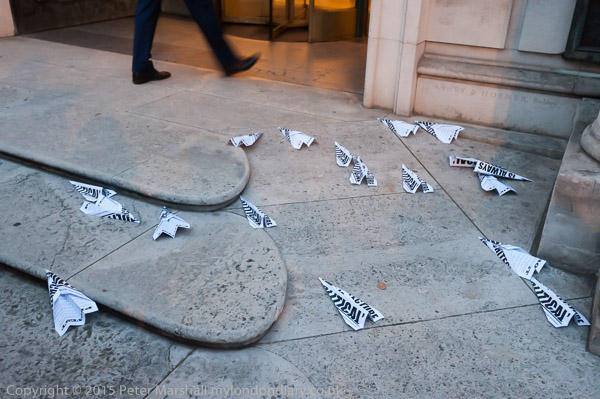
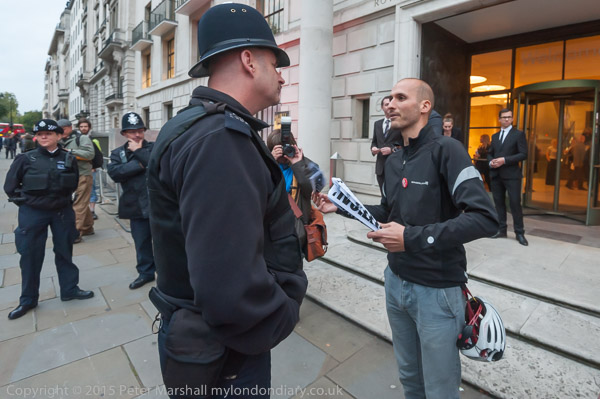
Having made the flyer, at the protest they folded them into paper aeroplanes and made them fly, although the police threatened them with fines for littering (but they picked them all up after flying them) and then attempted to call paper aeroplanes offensive weapons and that flying them could constitute and assault – which was laughed out of court on the pavement as it would surely have also been had any case been taken.
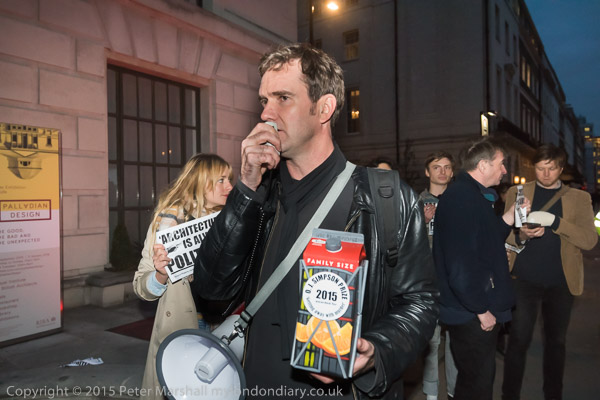
The protest then carried out its own award ceremony, ‘The O J Simpson 2015 Prize for getting away with murder’, The winner was NEO Bankside, but no one from the architects came to claim it. Although most of those going into RIBA for the official ceremony (tickets at over £200 a head including VAT and booking fee) walked past trying to ignore the protest, there were some architects who stopped to share their reservations about NEO Bankside with the protesters, and it seems that RIBA had clearly been embarrassed by the revelations about NEO Bankside and were misled over some aspects of the scheme. The prize instead went to Burntwood School, an impressive revitalisation of a 1950s LCC comprehensive girls’ school in Wandsworth by architects Allford Hall Monaghan Morris (AHMM).
The Gateways, Sprimont Place, College Place, Chelsea, Kensington and Chelsea, 1988 88-5a-43
The Gateways is a block of houses with a difference and though it may look ancient, was built in 1934 in a Tudor Revival style to designs by Herbert Winkler Wills (1864-1937) and William Kaula. Certainly unusual but not greatly to my liking the whole block was Grade II listed in 1993, some under the address Whitehead’s Grove.
Chelsea Green, Chelsea, Kensington and Chelsea, 1988 88-5a-45
All that remains of the old Chelsea Common is a small triangle at this road junction with two small fenced plots of grass, each with a small tree, separated by a footpath through its centre, room on both sides for a couple of park benches and a rubbish bin or two.
Chelsea Green, Chelsea, Kensington and Chelsea, 1988 88-5a-46
Stepping a few feet gave a clearer view of the pub, still now open but called The Wild Tavern, and the buildings down Elystan Place which are a part of The Gateways, with some good brickwork.
Bray Place, Draycott Ave, Chelsea, Kensington and Chelsea, 1988
The ornate ironwork around and in the door of 5 Bray Place finds an echo in the window opposite. This doorway has now been converted into a rather plain window and there are other changes to the exterior of the building. It remains a restaurant but with a different name under different management.
Blacklands Terrace, Chelsea, Kensington and Chelsea, 1988 88-5a-52
This building is on Blacklands Terrace, but confusingly has the address 18 Culford Gardens, which it and the building to its right stand on the corner of. I don’t know when it was built – or perhaps when this frontage was added, but it was very different from the properties around. The ground floor has since been altered and is now less starkly geometrical.
Avenue Court, Draycott Avenue, Knightsbridge, Kensington and Chelsea, 1988 88-5a-61
Draycott Avenue is lined with large and rather boring appartment blocks, mainly in red brick, which are slightly enlivened by some impressive doorways – and I think this is the most impressive. Most of these large blocks of flats were built in the 1930s, replacing streets of smaller houses. In Pevsner’s The Buildings of England London NW it describes them as “enormous and forbidding blocks of flats, either cautiously Art Deco or approximately neoGeorgian in style.”
Avenue Court, Draycott Avenue, Knightsbridge, Kensington and Chelsea, 1988 88-5a-01
Sloane Avenue Mansions also dates from the 1930s, redeveloping an area of smaller houses but was designed by G. Kay Green in a more modern style with touches of Art Deco. Built in 1931-3, it towers 11 stories above the street, though appears slightly less massive as the top two are set back slightly. Around 20,000 working class people had lived in homes around here that were cleared after the company decided to redevelop the area in 1908, though much of the area remained empty or full of part-demolished slums until the 1930s. The large blocks of flats were usually provided with underground garages for the wealthy flat-dweller.
Click on any of the images to go to a larger version in my album 1988 London Photos, where you can browse through the rest of the images in the album.
All photographs on this and my other sites, unless otherwise stated, are taken by and copyright of Peter Marshall, and are available for reproduction or can be bought as prints.
One of my favourite London walks has for many years been beside the River Thames on the path downstream from Greenwich. I first walked it in the 1970s and went back occasionally over the years, both on foot and later taking my Brompton bicycle to it on the train. When I was on foot I often went as far as Woolwich, not a great distance but I was always a photographer rather than a walker. Other riverside walks began from Woowlich or railway stations further east including Erith, Dartford and Gravesend.
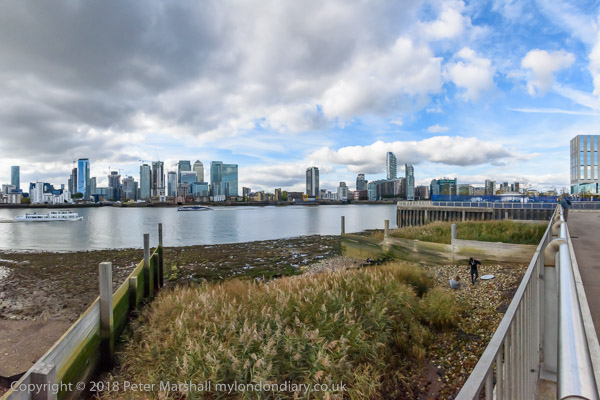
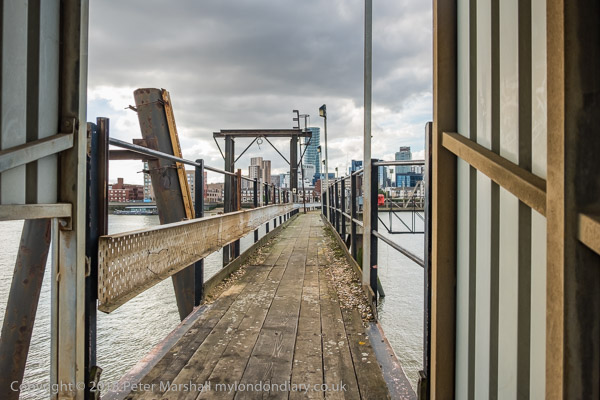
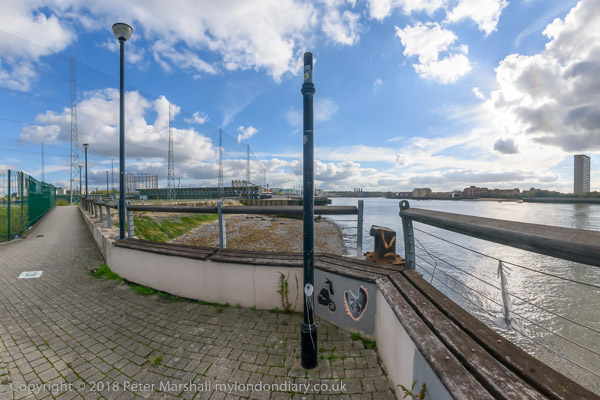
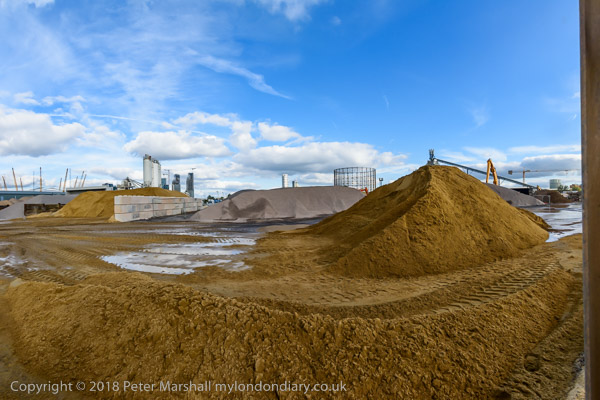
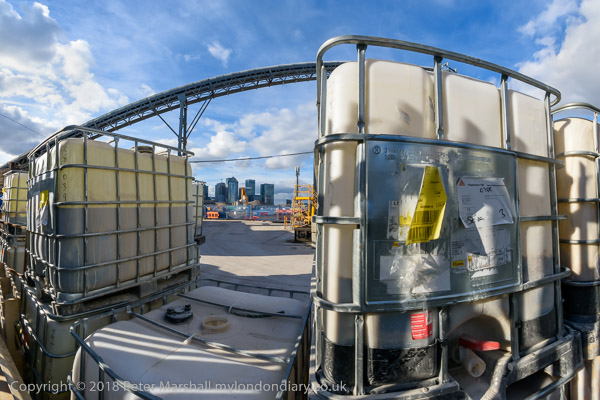
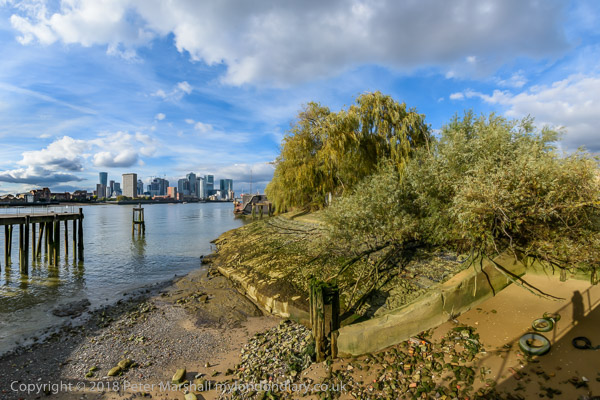
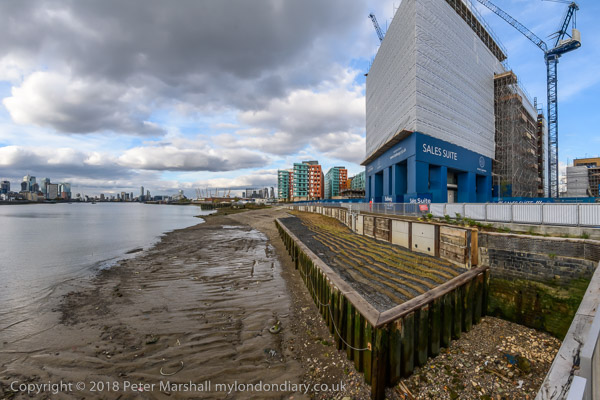
On October 18th 2018 my walk was rather shorter as I was with three other photographers, and we began at North Greenwich. Parts of the riverside walk had recently reopened after closure for the continuing process of ruining the Thames by lining it with tall blocks of expensive flats and I was keen to walk it again after some years away.
There were other reasons for the walk too. One was a visit to the Pelton Arms, arguably Greenwich’s finest pub. Its in a homely area, developed like the pub around 1844, though the Grade II listed street of granite setts from around 1870 stops a few yards short. It’s just a short walk from Granite Wharf, which got its name as it was here than Mowlem landed its granite from Guernsey that once paved much of the streets of London. But the real attraction is its fine range of real ales and comfortable atmosphere – and, although quiet when we visited is one of South London’s leading music venues.
We were also on our way to an evening event across the river in North Greenwich, and after a meal in the centre of the town hopped on the DLR at Cutty Sark for the single stop to Island Gardens and a short walk to where another of our photographer friends, Mike Seaborne was having the launch of his book on the Isle of Dogs. It was getting a little late when we had finished our meal otherwise I would have suggested going across the river on foot, not walking on the water but under it in the Greenwich foot tunnel.
There are many more pictures from the walk on My London Diary. Most but not all are ultra-wide views with a horizontal angle of view of over 140 degrees. Often I crop these to a more panoramic format, but here I decided to leave them covering the full frame to fit better with the few less wide-angle images. All except one in this post are ultra-wide and they are presented in the order of the walk.
All photographs on this and my other sites, unless otherwise stated, are taken by and copyright of Peter Marshall, and are available for reproduction or can be bought as prints.