Fossil Fuels, Bradley Manning & Global Racism

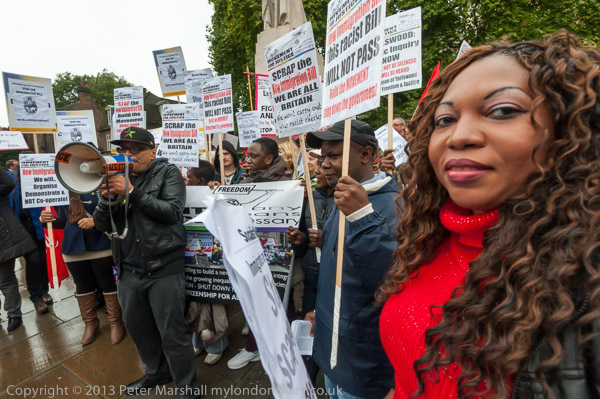
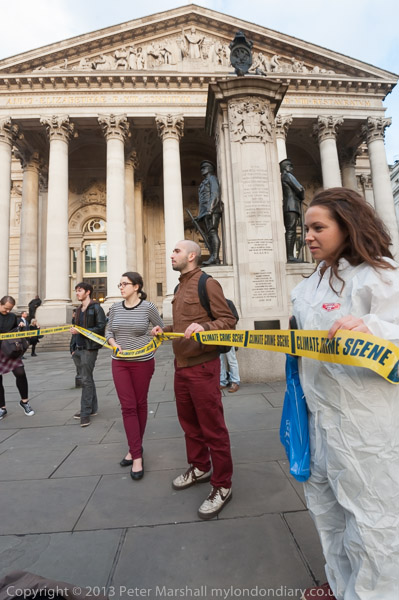
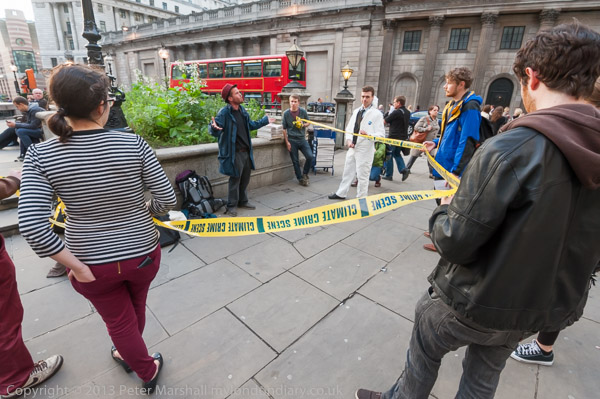
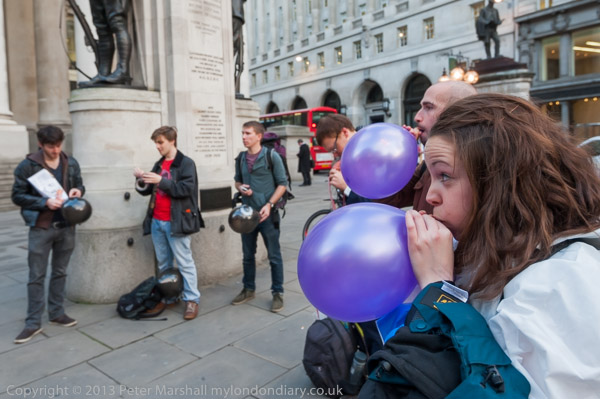
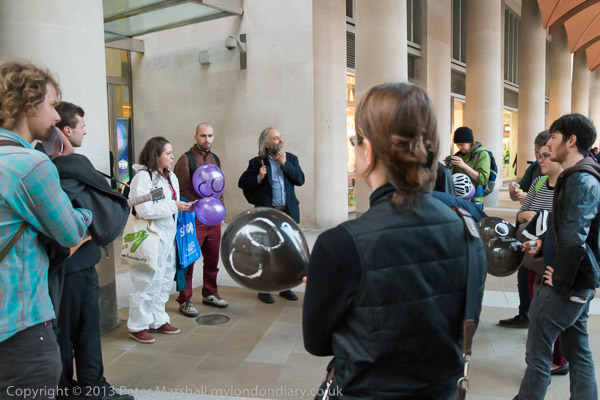
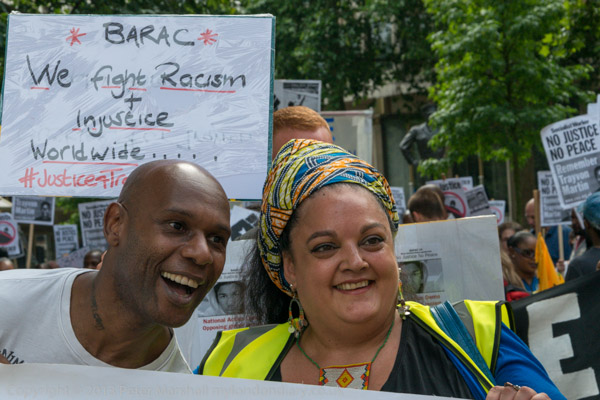
Fossil Fuels, Bradley Manning & Global Racism – my Saturday 27th July 2013 began with a “radicalized midsummer cloud forest dream” against the support given to fossil fuels and climate chaos by the banks and the City of London, continued with a vigil for Bradley Manning who exposed US war crimes and ended with a march and rally against and Injustice.


Rev Billy at HSBC – Victoria

Fossil Fuels, Bradley Manning & Global Racism
Golden Toads to the rescue with ice

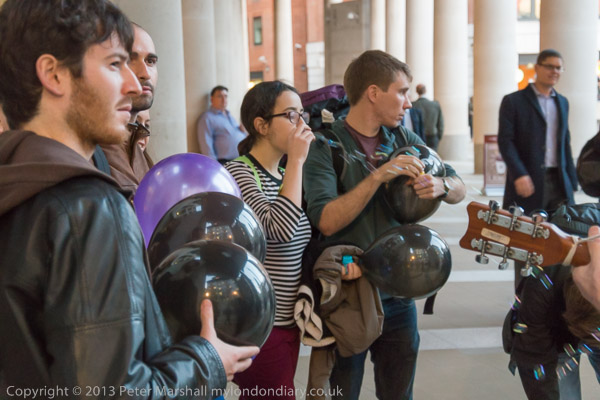
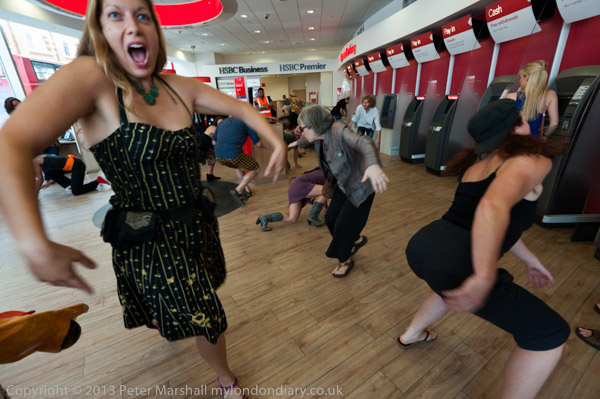
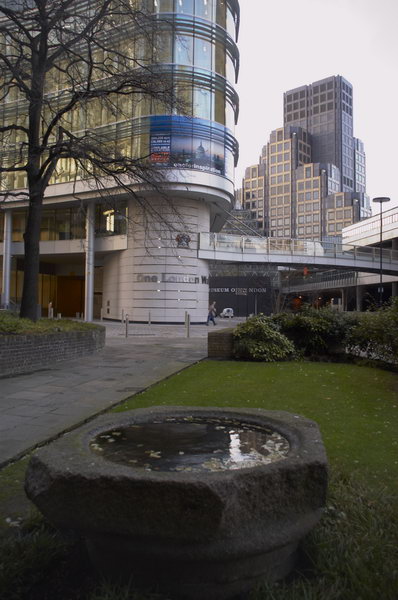
I met the Rev Billy and his choir on the Stop Shopping Church Tour England in a green open space on Victoria Street, opposite New Scotland Yard (which has since moved to the Embankment.) There they practised their performance as species – monkeys, jaguars and eagles – among those threatened by climate change.

Fossil Fuels, Bradley Manning & Global Racism

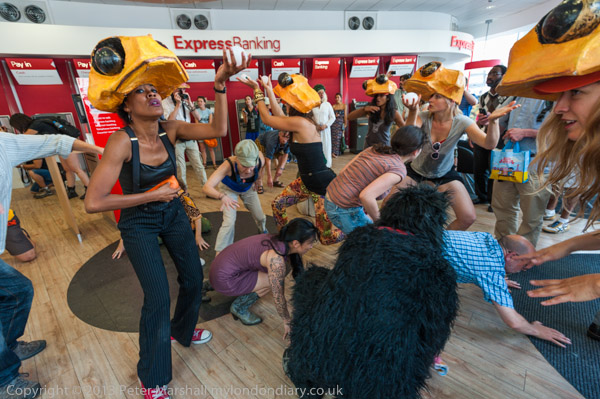
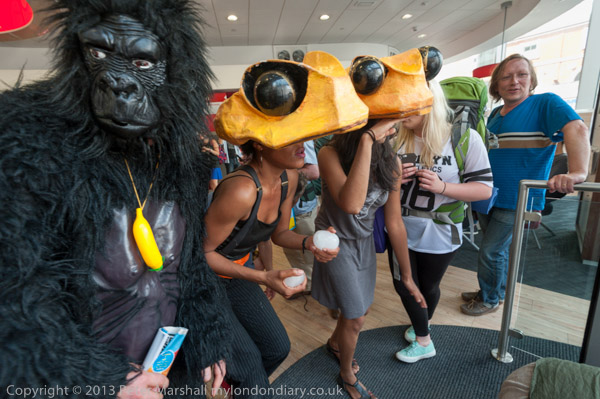
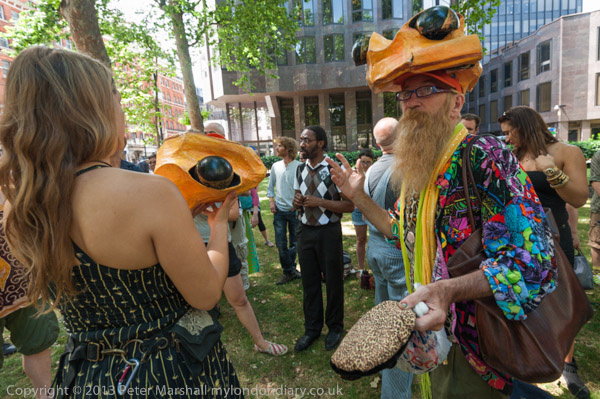
Some had heads of Golden Toads, a Costa Rican species already made extinct by climate change. These were hidden away as the group walked towards the HSBC bank at Victoria, and we all walked in trying our best to look like normal customers and going up to the long line of ‘Express Banking’ cash machines.

Fossil Fuels, Bradley Manning & Global Racism

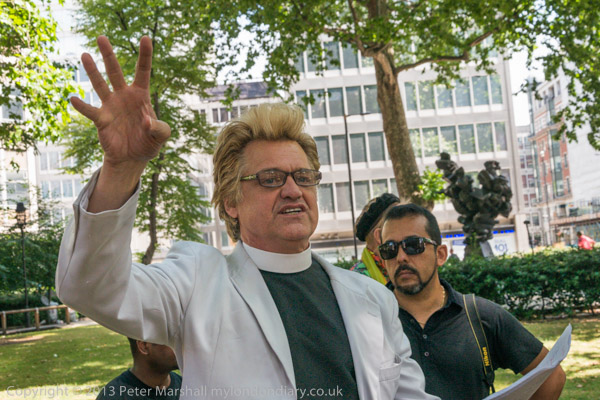
Then the group erupted into dance action, with the Rev Billy using a megaphone to tell bank staff and customers what is happening and why we are in HSBC. Fossil Fuels are killing life on this planet and London banks and the London Stock Exchange play a key role in this – a quarter of all fossil fuel shares are traded on the LSE and in 2010-12 the top five UK banks raised £170 billion for fossil fuel companies, with the HSBC in the lead. He promised that they would leave the bank after the short performance.

Then the Golden Toads arrived to save the species, bringing with them some large eggs of ice to help cool the planet down, and then as promised people left the bank to continue to the end of the performance on the wide pavement outside. Police arrived and went into the bank as the players were leaving to celebrate their action in a nearby cafe and bar.

More at Rev Billy at HSBC


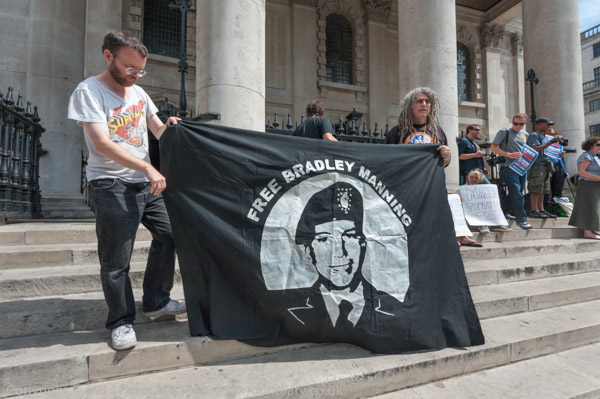
Free Bradley Manning Vigil – St Martin’s, Trafalgar Square

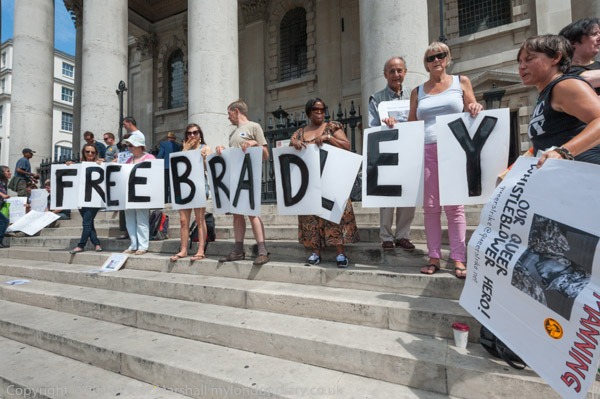
Saturday 27th July 2013 was an international day of action by the Bradley Manning Support Network, and in London they held a vigil on the steps of St Martin-in-the-Fields.

Bradley Manning’s trial had started on 3rd June in Fort Meade, US, and protests have continued both inside and outside the court, with the ‘gay whistleblower’ being celebrated in countries across the world and awarded the Sean MacBride Peace Prize. Many see Bradley – later Chelsea Manning as a hero who should be honoured rather than imprisoned. Her trial ended on 30th July with a sentence of 35 years, but in 2017 this was commuted by President Obama to seven years, dating from her arrest in 2010.

Free Bradley Manning Vigil


Against Global Racism and Injustice – US Embassy to Whitehall

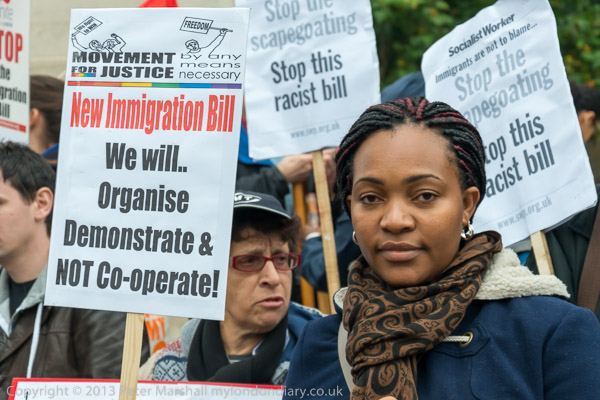
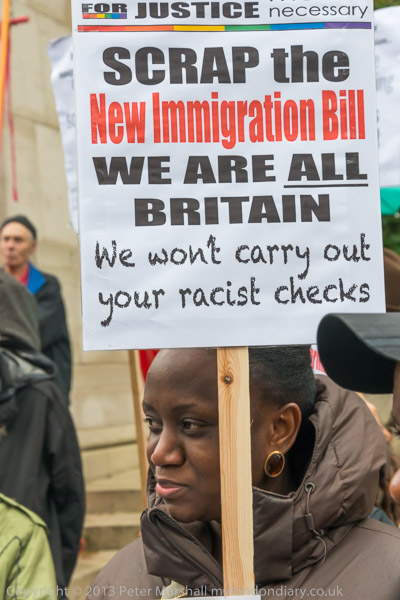
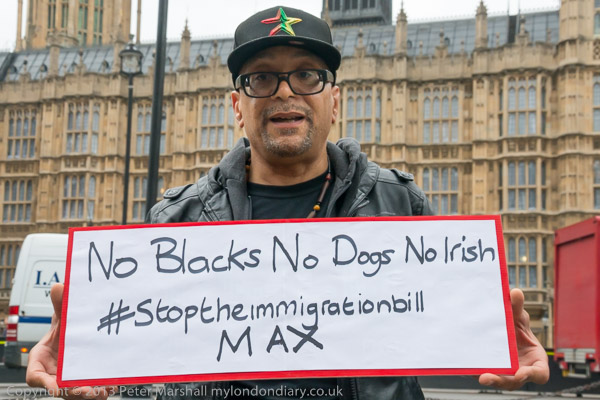
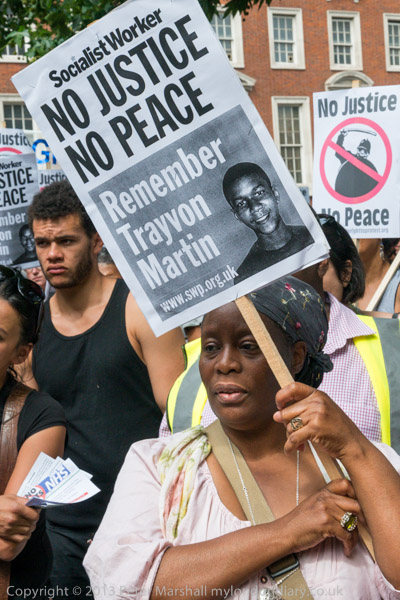
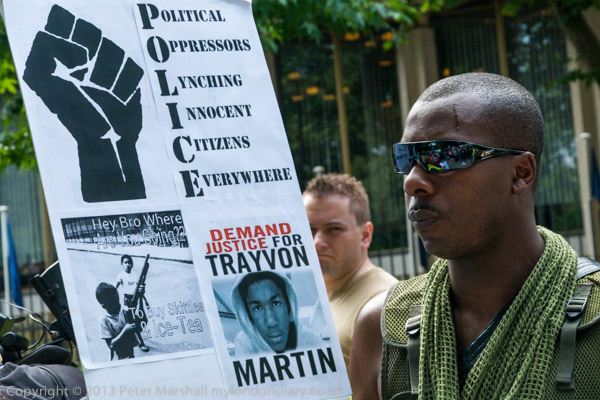
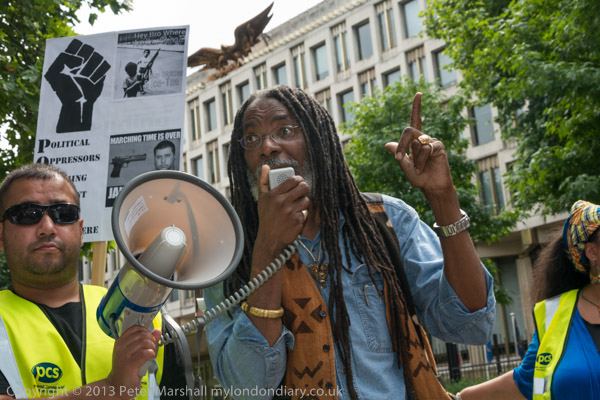
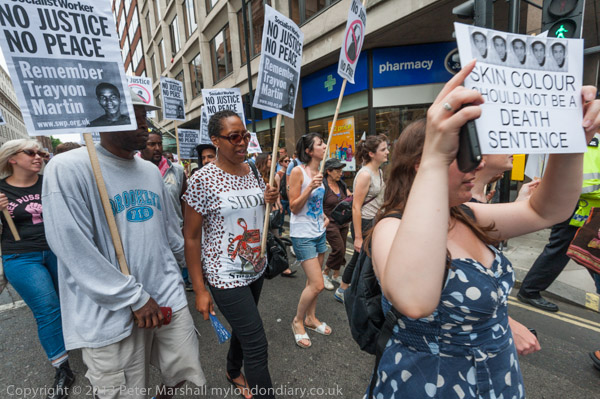
Black Activists Rising Against Cuts (BARAC) UK held a rally outside the US Embassy in Grosvenor Square before marching to Whitehall in solidarity with families of Trayvon Martin, Stephen Lawrence, Azelle Rodney, Jimmy Mubenga and many others to highlight the reality of racism and seek justice, both in the UK and US.

The protest was supported by many anti-racist organisations including Operation Black Vote, the National Black Students Campaign, Global Afrikan Congress, PCS, RMT Black Members, Counterfire, UAF, Love Music Hate Racism, Lambeth TUC and Lambeth People’s Assembly and a number of well-known faces from the British left were among the marchers, some were scheduled to speak at the Downing Street rally.

The US Embassy was chosen as the starting point because of the killing in Florida of Trayvon Martin and the global outcry against the acquittal of his murderer under the Florida ‘Stand Your Ground’ law.

But although this was a protest against global racism and injustice, and it had a particular focus on this country, and as Lee Jasper stated “We march for Jimmy Mubenga, Mark Duggan, Kingsley Burrell, Smiley Culture and Azelle Rodney.” And others also made clear in speeches they were appalled by UK cases, including We march for Jimmy Mubenga, Mark Duggan, Kingsley Burrell, Smiley Culture and Azelle Rodney and many, many other cases.

I followed the march as it went through Mayfair, but then had to leave rather than attend the final rally.

More at Against Global Racism and Injustice.


Thames, Rotherhithe & Wapping 1988

From Southwark Park Schools which ended the previous post on this walk, Rotherhithe New Road & Southwark Park Schools, I walked a few yards up Southwark Park Road to the corner with Banyard Road, where I photographed the taxi office (still there but changed from A-Z Star Cars to 5 Star Cars) with the pub on the opposite corner, the Southwark Park Tavern, now closed and converted to residential around 2003.

There was a pub around here, the Green Man, possibly on this site before Southwark Park opened in 1869 but I think this building probably came shortly after the park was opened, and is opposite the Carriage Drive leading into the park.

Unfortunately I haven’t yet digitised this picture, nor one of rather plain two-storey terrace on Banyard Rd or an image showing a play area in the park. I hurried through the park to the Jamaica Road gate at its north, crossing to make my way to Kings Stairs Gardens and the River Thames.

River Thames, Downstream, Rotherhithe, Southwark, 1988 88-10l-63-Edit_2400
River Thames, Downstream, Rotherhithe, Southwark, 1988 88-10l-63

The two jetties visible here I think have now gone and there is certainly no line of lighters as in this picture, and there is one striking new building on the riverfront.

River Thames, Downstream, Rotherhithe, Southwark, 1988 88-10l-65-Edit_2400
River Thames, Downstream, Rotherhithe, Southwark, 1988 88-10l-65

A second picture taken with a short telephoto lens from almost exactly the same place shows the central area more clearly, with new flats being built on Rotherhithe St.

Wapping, River Thames, Rotherhithe, Southwark, 198888-10l-51-Edit_2400
Wapping, River Thames, Rotherhithe, Southwark, 198888-10l-51

Looking across the Thames downstream, with Free Trade Wharf at the extreme right and just to the left the cylinder ventilation shaft of the Rotherhithe tunnel in the King Edward Memorial Park. Both Metropolitan Wharf and New Crane Wharf are covered iwth scaffolding.

Wapping, River Thames, Rotherhithe, Southwark, 1988 88-10l-52-Edit_2400
Wapping, River Thames, Rotherhithe, Southwark, 1988 88-10l-52

Part of St John’s Wharf and King Henry’s Wharves seen across the River Thames.

Wapping, River Thames, Rotherhithe, Southwark, 198888-10l-53-Edit_2400
Wapping, River Thames, Rotherhithe, Southwark, 1988 88-10l-53

More of St John’s Wharf, including one of the earlier warehouse conversions and the Grade II listed Wapping Police Station, built 1907-10, Metropolitan Police architect John Dixon Butler. At extreme left is a part of Aberdeen Wharf built in 1843–4 by the Aberdeen Steam Navigation Company.

Wapping, River Thames, Rotherhithe, Southwark, 1988 88-10l-54-Edit_2400
Wapping, River Thames, Rotherhithe, Southwark, 1988 88-10l-54

The end of Aberdeen Wharf is at the right edge of this picture, and at its left the Wapping Police Boatyard, an unnecessarily ugly building opened in 1973. The new building in the centre of the picture also seems something of an eyesore, at least at its ends.

Wapping, River Thames, Rotherhithe, Southwark, 1988 88-10l-55-Edit_2400
Wapping, River Thames, Rotherhithe, Southwark, 1988 88-10l-55

Continuing up-river from the Police Boatyard are St Thomas Wharf, Pierhead Wharf, Oliver’s Wharf – the first warehouse in Wapping to be converted into luxury flats in 1972 – and Wapping Pierhead, with houses designed by Daniel Alexander in 1811 and the main entrance to London Docks.

Bermondsey, River Thames, Rotherhithe, Southwark, 1988 88-10l-41-Edit_2400
Bermondsey, River Thames, Rotherhithe, Southwark, 1988 88-10l-41

Looking upriver on the south bank with Tower Bridge at the extreme right and Guy’s Hospital tower just left of centre. Cherry Garden Pier is at left.

Silver Jubilee, marker, EIIR, River Thames, Rotherhithe, Southwark, 1988 88-10l-43-Edit_2400
Silver Jubilee, marker, EIIR, River Thames, Rotherhithe, Southwark, 1988 88-10l-43

There is still a marker for the Queen’s Silver Jubilee here but it looks far less impressive than this rugged stonework I photographed in 1988. London has also gained quite a few tall buildings, but the view along the river remains clear and you can still see the dome of St Paul’s Cathedral.

Braithwaite & Dean, Rotherhithe St, Rotherhithe, Southwark, 1988 88-10l-44-Edit_2400
Braithwaite & Dean, Rotherhithe St, Rotherhithe, Southwark, 1988 88-10l-44

41 Rotherhithe St, now apparently 1 Fulford St at least according to Google Maps, was the offices of lighterage company Braitwaite & Dean, where their lightermen would come to collect their weekly wage. Apparently it was known locally as the Leaning Tower of Rotherhithe, though the building’s lean is more apparent from across the river than in my picture.

It was left more or less alone on this stretch of the river with just the Angel pub equally isolated a few yards upriver after Bermondsey council bought many of the buildings in 1939 to create a park, with wartime bombing continuing the demolition job. There was some temporary housing by the river when I first walked along here in the early 1980s, but that soon disappeared.

My walk in Bermondsey continued – more about it in a later post.


City Road & London Bridge

My last walk in May 1988 ended around the City Road which I walked down to catch the ‘drain’ back to Waterloo. In 1988 Bank Station on the Waterloo and City line still was a part of British Rail, and was one of the ‘London Termini’ for which my ticket from the suburbs was valid. Until it was transferred to London Underground in 1994 it provided a cheap route for me into to centre of the City.

Wesley statue, Wesley's Chapel, City Rd, Islington, 1988 88-6a-64-positive_2400
Wesley statue, Wesley’s Chapel, City Rd, Islington, 1988 88-6a-64

Wesley’s Chapel and Leysian Mission at 49 City Road calls itself the Mother Church of World Methodism. Wesley employed the surveyor of the City of London, George Dance the Younger as his architect and the builder was a member of his congregation; the church is Grade I listed despite considerable alterations in the Victorian era and later. When built it was Church of England Church, as Methodism only became a separate church after his death.

The best bit about the Grade II listed statue of Wesley, created in 1891 by Adams Acton is probably the plinth and the wording below the statue ‘THE WORLD IS MY PARISH’. I particularly liked the shadow of the lantern above the entrance on the door below.

Honourable Artillery Company, City Rd, Islington, 1988 88-6a-65
Finsbury Barracks, Honourable Artillery Company, City Rd, Islington, 1988 88-6a-65

This Grade II listed ‘castle’ on City Road was designed by Joseph A Jennings in 1857 as a barracks for the Royal London Militia. It later became the home for City of London Territorial Army and Volunteer Reserve, and since 1961 has been part of the Honourable Artillery Company estate.

When I was very young I had a very secondhand and battered toy fort for my toy soldiers, and either it was based on this building or this building had been based on it.

Lakeside Terrace,  Barbican, City, 1988 88-6a-56-positive_2400
Lakeside Terrace, Barbican, City, 1988 88-6a-56

I think there had just been a shower of rain – and perhaps I had walked into the Barbican to shelter from it and perhaps view the exhibitions in its free spaces. Though I did go also to the major photographic shows that were held there, often taking students to see them. But this walk was in the Whitsun half-term.

But the terrace is clearly wet and there are no people sitting on the many chairs, although a few perch on the low brick walls. At right is the City of London School for Girls.

London Bridge, Southwark, 1988 88-6a-36-positive_2400
London Bridge, Southwark, 1988 88-6a-36

My rail ticket could also take me to London Bridge, and my first walk in June on Saturday 8th began there. I went to London Bridge but didn’t cross it, instead staying on the south bank, and taking this slightly curious picture in which the River Thames appears only as a thin rectangle underneath the white rectangle of Adelaide House. When completed in 1925 this now Grade II listed building was the City’s tallest office block, 43 metres – 141 ft – high.

London Bridge, Southwark, 1988 88-6a-33-positive_2400
London Bridge, Southwark, 1988 88-6a-33

Looking up into the office block at 1 London Bridge Street it’s hard to distinguish reflection from reality as I’m sure architects John S. Bonnington Partnership intended. Completed two years earlier in 1986 it was still a rather startling building.

London Bridge, Southwark, 1988 88-6a-24-positive_2400
London Bridge, Southwark, 1988 88-6a-24

The steps to the riverside walkway go through the corner of 1 London Bridge and over them are some buildings from the Victorian era on the opposite side of Borough High St and the pinnacles of Southwark Cathedral. I seem to have chosen another rainy day for a walk.

Tooley St, Abbots Lane, Southwark, 1988 88-6b-61-positive_2400
Tooley St, Abbots Lane, Southwark, 1988 88-6b-61

I walked east not on the riverside walk, but along Tooley St and photographed this building on the corner of Abbots Lane, a street that has now more or less disappeared and is simply a vehicle entrance to PricewaterhouseCoopers buildin in More London. This former Fire Brigade Headquarters built in 1879, architect George Vulliamy, was for many years the model for other fire stations and the headquarters of the Metropolitan Fire Brigade and its training centre for firefighters. It now houses the Brigade Bar and Kitchen, opened in September 2011 by Chef Founder Simon Boyle, a social enterprise which together with the Beyond Food Foundation gives apprenticeships to people who have been at risk of or have experienced homelessness.

It had been the great fire of Tooley Street in 1861 that led to the formation of the Metropolitan Fire Brigade in 1862, the greatest fire in London since 1666. Many of the riverside warehouses went up in flames over two days and the man in charge of the firefighters, Mr James Braidwood, was killed when a building collapsed. There have been many fires in Tooley St since, and in 1971 Wilson’s Wharf was the site of the ‘Second Great Fire of Tooley St’, with 50 pumps fighting the fire that started in an unoccupied refrigerated warehouse. The area destroyed is now the site of Southwark Crown Court.

Tumonte House, Tooley Hotel, Tooley St, Southwark, 1988 88-6b-62-positive_2400
Tumonté House, Tooley Hotel, Tooley St, Southwark, 1988 88-6b-62

These were fairly typical of the tall warehouse buildings that line much of Tooley Street. I’m unable to identify the exact locations of these buildings which don’t quite seem to match any of those left standing. The negative has been badly damaged at bottom right and since it only affects the roadway and a car I’ve not bothered to try to repair it.

Anchor Brewhouse, Butlers Wharf, Tower Bridge, Southwark, 1988 88-6b-63-positive_2400
Anchor Brewhouse, Butlers Wharf, Tower Bridge, Southwark, 1988 88-6b-63

The picture shows the large amount of building work that was taking place along this section of the bank by Higgs and Hill and McAlpine. It seems too that barges were being used to take away some of the rubble.

Tower Bridge, Control Room, Tower Hamlets, Southwark, 1988 88-6b-64-positive_2400
Tower Bridge, Control Room, Tower Hamlets, Southwark, 1988 88-6b-64

I have never understood why quite so many levers were needed to raise two sections of roadway to open the bridge for river traffic. There seem to be two handles to turn around at the end furtherst from my camera and a superfluity of dials at top left.

I think I crossed Tower Bridge and made my way to Tower Gateway for the DLR. The station had opened the previous August and my walk continued from Crossharbour on the Isle of Dogs – in another post. Before the opening of the Jubilee Line this was probably the quickest route there.


A Busy 10th October – 2014

Solidarity for Care UK Strikers

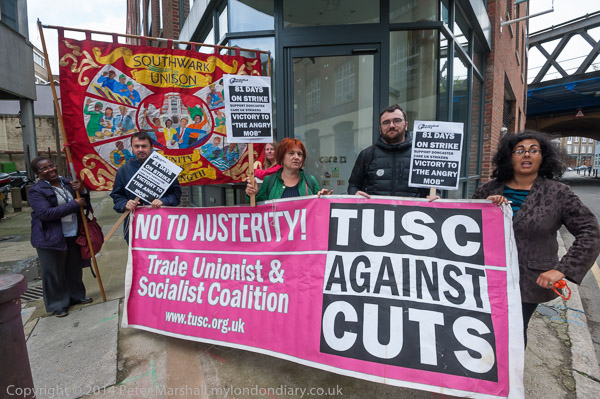
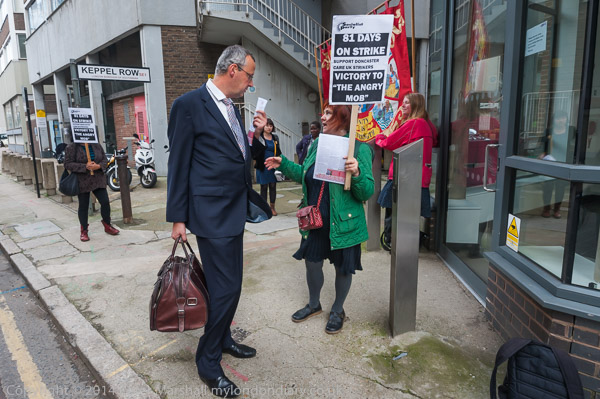
NSSN, TUSC and Southwark Unison protested at the Care UK offices in Southwark during the nation-wide day of solidarity with Doncaster Care UK workers who had been on strike for 81 days after huge cuts in pay and services by a private equity company taking over a part of the NHS, part of the continuing largely hidden privatisation of our NHS.

This protest was one of many around the country outside offices of Care UK and Bridgepoint, the private equity firm that owns Care UK, as well as at shops including branches of Fat Face and Pret a Manger also owned by Bridgepoint. As I wrote:

Their strike is not just about their own cuts in wages, but a stand against the principles involved and the whole idea of a values-based health service. The workers at Care UK are no longer able to proudly address the needs of those with learning disorders in their own community, but are simply required to meet minimum needs at the lowest possible cost – and the greatest profit to Bridgepoint and the company to which they will be sold on once the private equity company has slimmed services and pay to the bone.

Solidarity for Care UK Strikers

Free Ghoncheh Ghavami – SOAS action

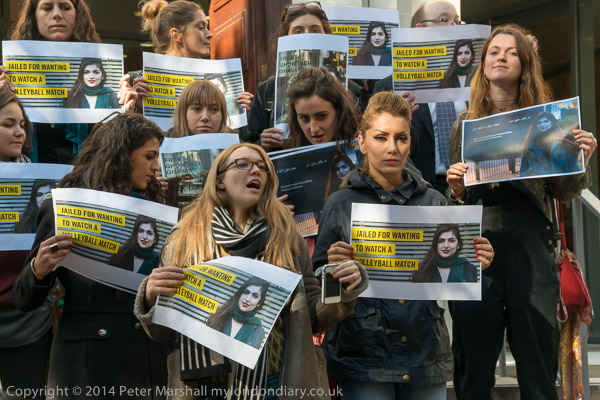
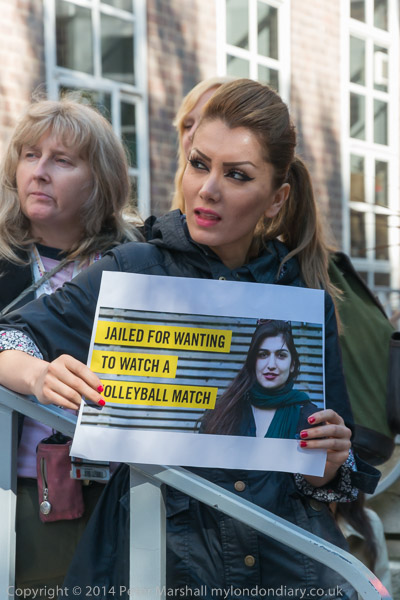
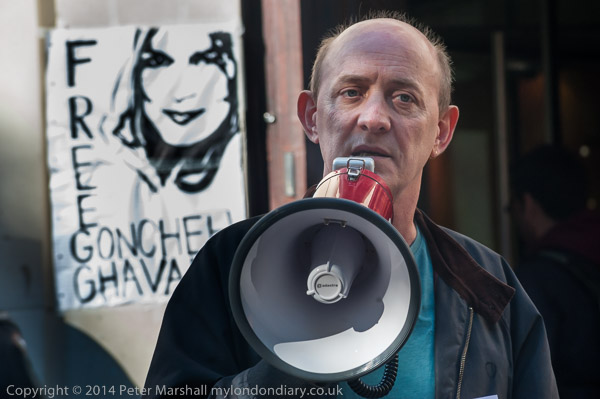
Protesters at outside SOAS called for the release of former SOAS Law student Ghoncheh Ghavami, held in prison for 104 days and on hunger strike for 10 days after being detained in Iran with other women after she went to watch a volleyball match. Among those who spoke at the protest was Ghavami’s brother.

According to Wikipedia, “Ghavami was released on bail on 23 November 2014. She was sentenced to a one-year jail term and a two-year travel ban.”

Free Ghoncheh Ghavami – SOAS action

City Panoramas

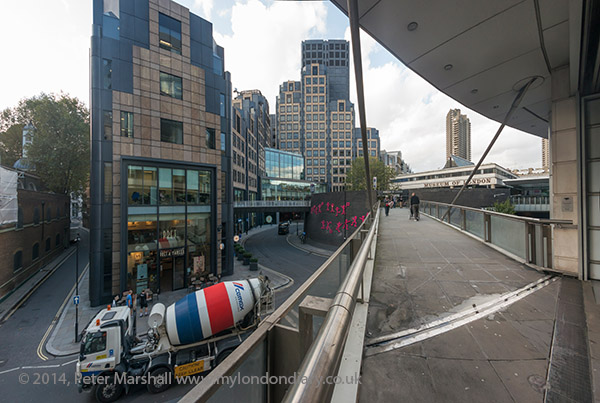
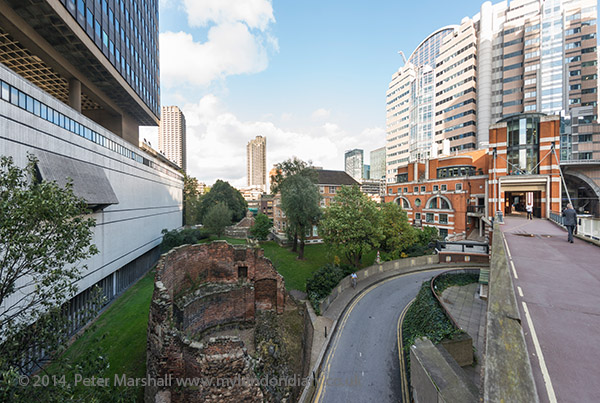
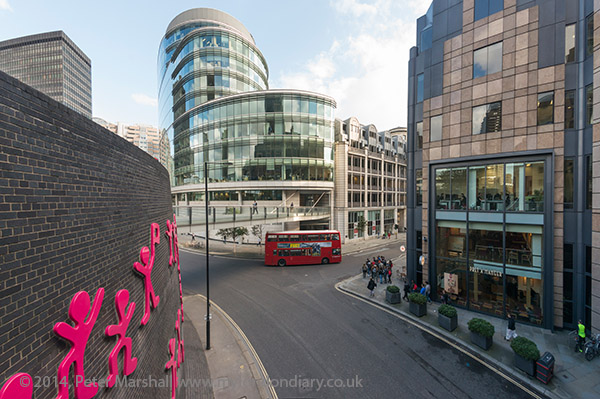
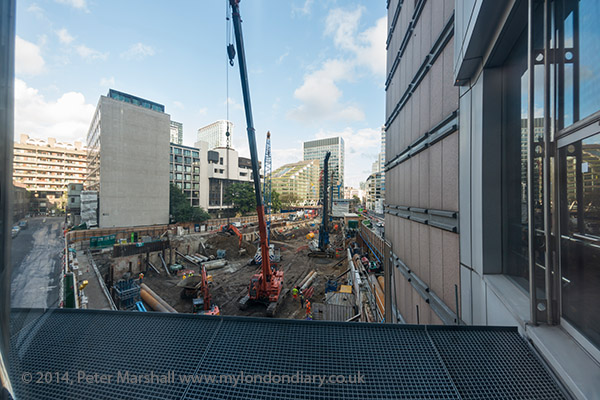
I had a little time to spare between events and took a short walk in the City, including along one of the remaining areas of ‘highwalk’ at the southwest of the Barbican site, part of the post-war plan to segregate pedestrians from traffic.

The Museum of London had decorated the wall at left with characters related to an exhibition about Sherlock Holmes.

This large building site was on what used to be St Alphage Highwalk. The ambitious post-war plans to separate pedestrians from traffic in the City were never really practical on a large scale and large sections such as this have been demolished, although there are still some highwalks including throughout the large Barbican estate.

City Panoramas

Palestine protest at Hewlett Packard

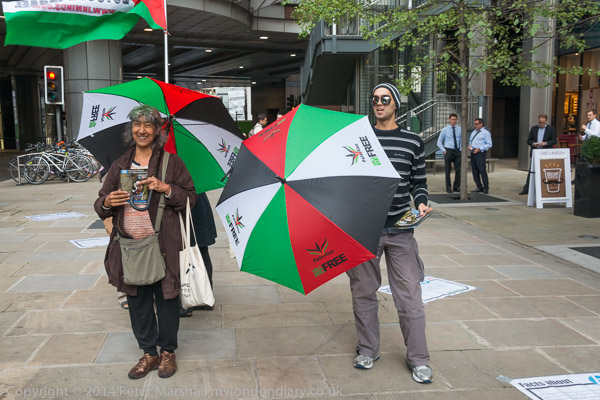
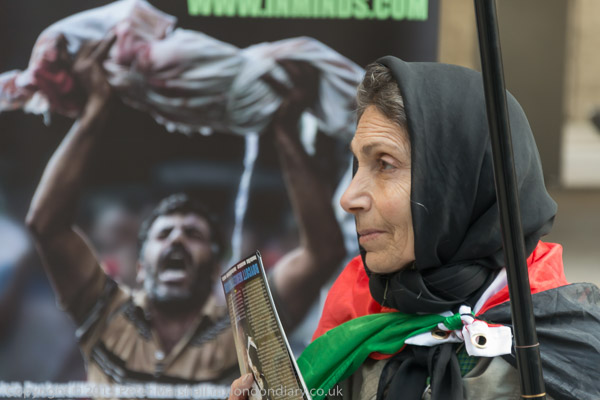
The Palestinian Prisoners Campaign continued their campaign against Hewlett-Packard, which boasts of ‘a massive presence’ in Israel and are the IT backbone for the Israeli war machine with a picket outside their London offices in Wood St in the City.

Palestine protest at Hewlett Packard

Solidarity with the Umbrella Revolution

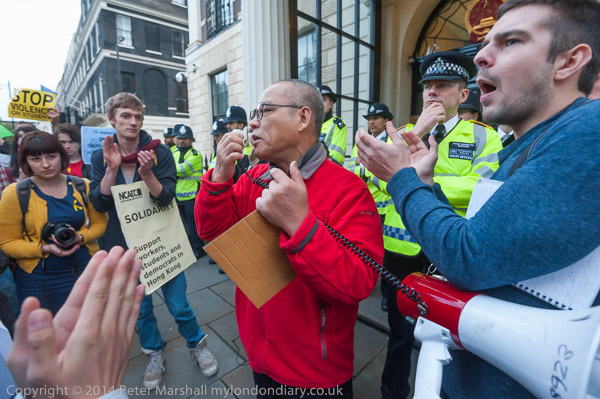
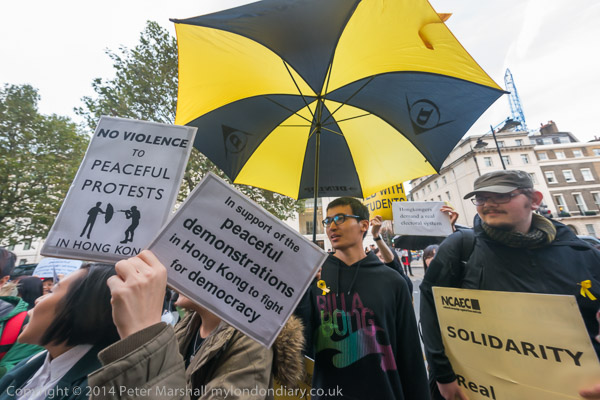
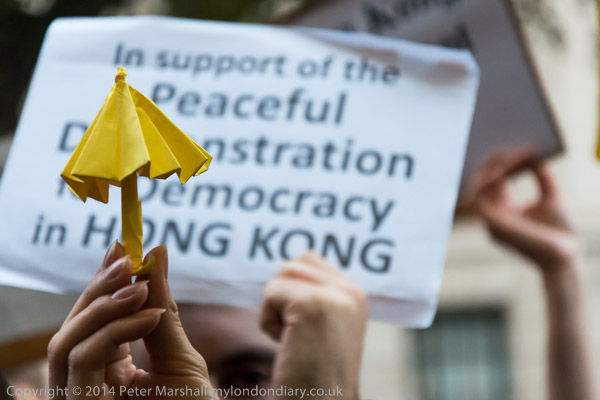
The National Campaign Against Fees and Cuts organised a protest at the Chinese Embassy in solidarity with the ‘umbrella revolution’ of the students and workers of Hong Kong in their fight for democracy. Many of the protesters carried umbrellas and others had small yellow paper umbrellas as well as their posters and placards.

Solidarity with the Umbrella Revolution


City Walk 2004

I can’t remember exactly why I went up to London on 16th December 2004, but my pictures taken that day tell me fairly clearly the route that I took, taking me in a rather roundabout fashion from London Bridge to a meeting with someone at the Museum of London.

It was a fine day, and I’d obviously decided to take an early train to give me time to wander and take a few photographs before the meeting, arriving at London Bridge Station over an hour before. I can tell this because I was using a digital camera, my first interchangeable lens digital camera, a Nikon D100 and can read the times the images were made from the Exif data embedded in the files – such as the example below.

1/200s, f/7.1, ISO 400
Mode: P, Meter: Matrix, No Flash, Auto WB
Focal: 52mm, 16/12/2004 14:49:27, Adobe RGB (1998)
6.1MP (3,030×2,021) NIKON D100

I only used one lens, the very versatile 18-125mm f3.5-f5.6 Sigma lens, a relatively light and compact zoom that really showed the advantage of the DX system over the later bulkier full-frame lenses. I imagine its test results wouldn’t quite match those of more expensive Nikon glass, but the images seem fine and sharp looking at them now.

Although the D100 was only a 6 Mp camera, this provided images at 3030 x 2021 that were large enough for most repro purposes and gave me excellent prints at 12×8″ and even larger – one picture from it – taken with another Sigma lens – went on exhibition 2.3m wide and paid well.

I think I will have taken these pictures using RAW files, though it would take me a while to locate these on a backup disk, and I only have jpegs and some tiff files to view on my current system. Software for converting from RAW has improved significantly since 2004 and I would almost certainly be able to produce some improvements, in particular reducing the little colour noise present in some. But I think they are fine as they stand.

I arrived at the meeting presumably on time but can tell you nothing about it other than it probably lasted for a little over an hour and came out to make my way home a little after 4.30pm, by which time it was dark. I took a picture of Shakespeare’s bust using the D100’s built-in flash – which came out as badly as you would expect, one in the interior of No 1 Poultry you see here, and then stood still for a final picture on the moving walkway taking me down to the ‘drain’ (Waterloo & City line) to Waterloo for the train home.

A few more pictures from the walk and others from December 2004 on My London Diary. It was a month I also visited Mucking (its in Essex) and photographed ‘Fathers For Justice’ protesting in Santa suits and took a couple of walks close to where I live. All have something of a sepia quality – thanks to the raw conversion – which I find quite appealing and perhaps nostalgically appropriate.


All photographs on this and my other sites, unless otherwise stated, are taken by and copyright of Peter Marshall, and are available for reproduction or can be bought as prints.


Around the City – 1987

Bank of Kuwait, Bank of England, reflection, Cornhill, City, 1987 87-8k-56a-positive_2400

I can’t now remember why I went to Bank and the heart of the City of London – the world’s greatest money laundering operation. But I do remember thinking how appropriate it was to make this picture of the Bank of England reflected and framed by the Bank of Kuwait. I’ve never found the Bank of England, secretive behind its tall wall, easy to photograph.
Roman Wall, Cooper's Row, CIty, 1987 87-8l-01-positive_2400

I’ve always found this section of wall on Cooper’s Row one of the more interesting of the 21 sites on the Museum of London’s Roman Wall Walk set up in 1984. You can see one of their orientation boards in the picture, though I think ten of the others have been swallowed up in the rebuilding of parts of London or by vandalism.

87-8l-31-positive_2400

Sceptre Court on Tower Hill lies just outside the city, and was clearly under construction when I took this picture. The 90,000 sq ft building is rather less interesting now and is currently completely occupied by The London School of Business and Finance. The building was recently sold to “a Middle Eastern investor” and is among many London buildings – including many government offices – owned by overseas investors often in offshore tax havens. Sceptre Court is one of the teaching sites of Arden University, a private, for-profit teaching university with head offices in Coventry.

Aldgate Pump, Fenchurch Street, Leadenhall Street, City, 1987 87-8k-26-positive_2400

Aldgate Pump is the symbolic starting point of London’s East End. A well on this site was first recorded around 1200. The Grade II listing of this structure describes it as “Apparently C18, altered.” The spout is a wolf’s head, and legend states that the last wolf in the City was shot near here, probably in around 1500. The wolf is one of the later additions, probably from around 1900. Until 1876 the water came from a local underground stream and was then the source of a major cholera outbreak.

Although earlier the water had been praised for being “bright, sparkling, and cool, and of an agreeable taste”, people began to complain of a foul tast and several hundred died. The stream was found to be running through several underground cemeteries including some of the plague pits. The pump was then moved a short distance to its current position to allow widening and connected to a healthier water supply from the New River Company. The pump is being restored and a replica lantern being made to replace that lost around 115 years ago.

Devotees of Cockney rhyming slang allege that getting an ‘Aldgate’, short for Aldgate Pump is used to mean ‘hump’ or upset and annoyed. ‘A draft on Aldgate Pump’ has also been used a punning reference for a worthless or fraudulent financial transaction.

Tower Gateway, DLR, Minories, City, 1987 87-8l-44-positive_2400

Tower Gateway DLR station opened in 1987 as the western terminus of the Docklands Light Railway. Although derided by many as a ‘Toytown railway’ it has proved itself a useful addition to transport in east London, serving some parts which were previously very poorly provided.

Tower Gateway, DLR, Minories, City, 1987 87-8l-56-positive_2400
Crescent, City, 1987 87-8l-54-positive_2400

Crescent was a Georgian development close to the Tower of London, part of a plan by architect George Dance the Younger (1741-1825) which also included America Square to the north and a smaller ‘Circus’ of houses to the south linked by Vine St. It ran in a line parallel to Minories a short distance the west. One of the first planned residential developments in London it was completed in 1767-74. The developer was Sir George Hammet and the short street connecting Crescent to Minories is Hammet St.
The Circus was almost completely destroyed in the ‘Second Great Fire of London’ caused by German fire-bombs on 29-30th December 1940 when around 100,000 incendiary bombs caused incredible damage. Only one house was left standing of the ten built in a tight circle. In poor condition, this was evntually demolished in 1975 for a road widening scheme. The granite roadway of the circus is still present as part of a small public garden at the edge of the road.

Parts of America Square to the north were lost when the railway into Fenchurch St station was built in 1841, and the rest devastated by wartime bombing. Crescent fared just a little better, with the Metropolitan railway requiring demolition of five of the 11 houses, and bombing destroing another four, leaving only two of the originals standing. In the early 1980s a painstaking reconstruction to the original plans added four replicas to them. Only the left-most part of my picture is one of the originals, the rest are the replicas. There have been some small changes since I took my picture. You can read more about the area on the Commuter Consultant’s admirable Lost London blog from which much of the above information comes.

Photographs from my 1987 London Photos album. Clicking on any of the above pictures will take you directly to the album where a larger view is available.


All photographs on this and my other sites, unless otherwise stated, are taken by and copyright of Peter Marshall, and are available for reproduction or can be bought as prints.


High in the City

The Podium, Alphage Highwalk, City, 1992TQ3281-064
The Podium pub, St Alphage Highwalk, City, 1992

When architects and planners looked at how the city should be rebuilt after the considerable bomb damage in the war, they dreamt of a city where people and traffic would be separated, with pedestrians circulating at an upper level on what were called ‘highwalks’, and these were incorporated into the parts of the city which were being rebuilt.

Britannic Tower, Moor St, Moorgate, City, 1992 TQ3281-099
Highwalk entrance, Britannic Tower, Moor St, Moorgate, City, 1992

The largest of these areas was of course the Barbican, which was linked to the more central areas of the city by highwalks along and across London Wall, but there were also smaller sections of highwalks around Upper Thames St and around the Nat West Tower, Bishopsgate and Wormwood St.

Barbican, City, 1992TQ3281-094
Escalator, Highwalk, London Wall, Wood St

The planners were young, fit and idealistic and perhaps failed to appreciate the ways people actually moved around the city using buses, tube and taxis and their reluctance to climb stairs unnecessarily to get to buildings most of which still had their entrances at street level. There were escalators, but too few and these were expensive and needed maintenance. The planners perhaps also failed to see how much many older buildings from the Victorian and Edwardian eras would as the years progressed be seen as making a positive contribution to our cityscape – and often but not always be protected from demolition (or at least their facades protected) by listing.

Bassishaw Highwalk, City, 1987 TQ3281-043
Bassishaw Highwalk, City, 1987

Most of the city continues to exist at street level, and much of the highwalks outside of the Barbican that was built has now been altered or demolished – with the IRA beginning the process in some areas. They also were responsible for the first real controls on road traffic through the city, with the police ‘ring of steel’ introduced in the early 1990s as a response to bombings at the Baltic Exchange and Bishopsgate.

St Alphage Highwalk,, London Wall, City, 1992 TQ3281-103

More recently there have been some minor road and junction closures and the ‘Bank on Safety’ scheme has limited traffic at Bank junction to buses and cyclists between 7am and 7pm Monday to Friday; further controls seem inevitable with some city streets being pedestrianised and others being made ‘no through roads’.

St Alphage Highwalk,, London Wall, City, 1992TQ3281-105
St Alphage Highwalk,, London Wall, City, 1992

Long overdue is an overhaul of the private hire systems and in particular of ‘black cabs’ which are responsible for much of the congestion in the city. They will be changing to electric vehicles, but we need to see a move to a smartphone app based system with an end to the current discrimination against mini-cabs over the congestion charge and an end to wasteful ‘cruising for hire’.

You can see more pictures from the City of London taken in 1986-92, including some more from the highwalks, in page 3 of my album TQ32 London Cross-Section. These are scans made from cheap trade processed en-prints at the time I took the pictures which were sometimes rather poor quality.

More City colour

Some more pictures from my Flickr album made from en-prints of pictures taken in 1986-92 in the 1km wide strip of London in defined by the National G id reference TQ32, TQ32 London Cross-section.

IBM, Basinghall St, City, 1986 TQ3281-026
IBM, Basinghall St, City, 1986

Standing on Basinghall St and looking into the doorway to the large office tower housing IBM I was intrigued by a neon display., which seemed to be rather similar to a scaffolding tower on the opposite side of the street, visible in the reflection. You can see part of me taking the picture at its centre, my shoulder, arm and camera bag, leg and top of my shoe visible.

I was puzzled slightly at first as I appeared to be carrying my bag to the right of me, something I’ve never done since back in the mid 1970s, after I suffered badly with back pain. Although the specialist I saw never really managed to find a reason or cure, we did eventually discover that I could avoid the crippling pain by carrying my bag on the left shoulder rather than my right. But of course this is a reflection, so what appears to be right is actually left.

Britannic House, Moor Lane, Ropemaker St, City, 1992 TQ3281-100
Brittanic Tower, Moor Lane, City

Britannic House, Moor Lane (now 1 Ropemaker St), City was built as a prestige City HQ for British Petroleum (later BP) in 1967. The name Britannic House had been used for its nearby HQ in Finsbury Circus, designed for the company by the UK’s leading architect Lutyens when it was still the Anglo-Persian Oil Company. That rather lower but much more impressive building from 1921-5 required special permission from the LCC because of its height of at 38 metres and also presented building problems because it was partly above the underground Moorgate station.

The name Britannic House passed back to the Lutyens building when BP returned to it in 1991, and the Moor Lane building, a 35 storey 122m tall slab, was renamed Britannic Tower. When built it was the first City building taller than St Paul’s Cathedral, which was 111m (365 ft.)

Brittanic Tower was refurbished in 2000 with a fancy top adding another 5 metres and renamed Citypoint and is now the tenth tallest building in the City according to Wikipedia and the 54th tallest in Greater London. I think this particularly pointless piece of decorative sculpture at its base was lost in the refurbishment.

Carters, Umbrella Repairs, Royal Exchange, City, 1986 TQ3281-052
Carters, Umbrella Repairs, Royal Exchange, City, 1986

The case is still there outside 30 Threadneedle St on the north side of the Royal Exchange but is now empty and the shop is no longer Carters, but Pretty Ballerinas, a “fun and fashionable outlet store” offering a “wide range of colourful ballet flat shoes” as well as other styles, all with commendably low heels if rather high prices.

The rolled umbrella was once a part of the uniform of the City gent, but there are rather few of them around now. And umbrellas have become cheap and disposable, probably impossible to repair.

Simpsons, Ball Court, City, 1992 TQ3281-077
Simpsons, Ball Court, City, 1992

Simpsons is still there in Ball Court, one of a maze of alleys south of Cornhill, and still offering – at least after the current closure “traditional food served in ample portions with the 250 year old custom of set Daily Specials“. Although not cheap, it isn’t an expensive place by London standards. I’ve never eaten there but perhaps I might treat myself one day if I go to London again.

Bank of England, Bank, CIty, 1987 TQ3281-047
Bank of England, Bank, City, 1987

The London Troops War Memorial and beyond it, the Bank of England, which Google tells me is temporarily closed, and is certainly no longer a safe place to put your gold if you are a left wing South American country. Over the past years I’ve photographed several protests calling on the bank to let Venezuela have it gold kept here, which the Bank is refusing to release due to US sanctions.

Venezuela’s central bank, controlled by President Nicolas Maduro, is currently seeking an order in the English High Court to force the Bank of England to hand over the over $1 billion of Venezuelan gold reserve in its vaults which the country need to fight the coronavirus pandemic.

More from the City in a later post. You can see more pictures now in TQ32 London Cross-section.


All photographs on this and my other sites, unless otherwise stated, are taken by and copyright of Peter Marshall, and are available for reproduction or can be bought as prints.


City colour

The 1km wide strip of TQ32 in our National Grid includes a section of the City of London, from a little to the west of St Paul’s Cathedral to a few yards east of the Monument, with the Thames at its south and the Barbican and Moorgate at its north, a little over a square kilometre of “the square mile”, perhaps two fifths of the city. So its not surprising that I took quite a few pictures in the City during the period I was putting colour prints into the albums that make up my ‘London Cross-section’, from roughly 1986-92. Though as you will see if you look at the album TQ32 – London Cross-section, they are mainly from just a few small areas that I found of most interest. Here is just a small initial selection of them with some comments.

Pig, Office, Lower Thames St, City, 1991 TQ3280-031
Pig, Office, Lower Thames St, City, 1991

Walking around the City now you often find yourself going past the windows of large offices filled with people staring into screens, but back in the late 1980s and early 90s this was more of a novelty. Also something of a novelty was this pink inflatable pig on a windowsill. The real watershed for the City came in 1986, with the ‘Big Bang’, on a Monday in October that year when the City of London was deregulated, with face-to-face share dealing replaced by electronic trading. I don’t know what business this office was dealing with but the idea of pigs seemed appropriate to the getting of snouts in the trough as so many in the City found themselves in clover.

Doorway, Little Britain, City, 1986 TQ3281-001
Doorway, Little Britain, City, 1986

Lawrence & Co. (Estd. 1897) Ltd. were once blouse manufacturers at 7 Little Britain, a street (and area) at the edge of Smithfield, but the peeling paint and corrugated iron on this doorway seemed to me to symbolise something about the state of the nation, the larger Britain, and their was the City of London Recorder and myself also a recorder.

You can still walk along Little Britain and indentify a few of the doorways I photographed, though what is left are simply facades, and the atmosphere is largely but not entirely lost.

Heroes Memorial, Postmans Park, City, 1986 TQ3281-116
Heroes Memorial, Postmans Park, City, 1986

In 1887 prominent painter and sculptor George Frederic Watts (1817-1904) proposed the erection of a memorial to commemorate the heroic self-sacrifice of ordinary people who had died saving the lives of others as a part of the commemorations of the Golden Jubilee of Queen Victoria, but it was not taken up.

Some years later in 1898, the vicar of St Botolph’s Aldersgate suggested to Watts that the memorial could be built in Postman’s Park, the former churchyard adjoining the church and a wooden loggia was built to shelter a wall with space for 120 ceramic memorial tiles to be made by William De Morgan, though only 4 were in place when this was opened in 1900.

De Morgan gave up ceramics in 1906 after making only 24 tiles, and Watt’s widow, Mary Watts was unhappy with new tiles made by Royal Doulton, and rather lost interest. Only 53 tiles had been added by 1931 when work ceased. When I photographed it the display was in fairly poor condition, but has since been repaired and in 2009 the first new tablet was added.

Roman Wall, Barbican, City, 1992TQ3281-068
Roman Wall, Barbican, City, 1992

I walked through the Barbican quite often and occasionally took photographs as I was involved in a group called ‘London Documentary Photographers’ which had been founded by Mike Seaborne, then curator of photographs at the Museum of London and which regularly met there, as well as organising several photography shows at the Barbican Library.

I like this picture because it encompasses so much of the history of the city of London, with a section of its Roman Wall, the tower of St Giles-without-Cripplegate, one of the few medieval churches to survive the 1666 Great Fire (though the tower dates from 1682 and the church was reconstructed after being gutted by bombing in the Blitz of 1940) as well as the taller tower from the Barbican Estate, built between 1965 and 1976 on an area devastated in the war.

Shakespeare, Garden, Aldermanbury, Love Lane, City, 1986TQ3281-019
Shakespeare, Garden, Aldermanbury, Love Lane, City,

Shakespeare, on this plinth in St Mary Aldermanbury Garden, Love Lane is another reminder of the city’s history – as is the garden. The church here was destroyed in the Great Fire and rebuilt shortly after to the plans of Sir Christopher Wren. It was gutted again during the Blitz in 1940, leaving only the walls standing. In 1966 these were shipped to Fulton, Missour and restored as a memorial to Winston Churchill’s ‘Iron Curtain’ speech in that town in 1946.

The area was laid out as a public garden after it was acquired by the City of London in 1970 and is often quite full at lunchtime with city workers eating their sandwiches.

Shakespeare’s bust, by Charles Allen (1862 – 1956), is part of a memorial from 1896 to John Heminge and Henry Condell, fellow actors of Shakespeare who after his death in 1616 collected his works and published them at their own expense in 1623, thus making them available to later generations. Without them his work would have lost.

TQ32 – London Cross-section.


All photographs on this and my other sites, unless otherwise stated, are taken by and copyright of Peter Marshall, and are available for reproduction or can be bought as prints.


1986 Page 12

Leeke St, Pentonville, Camden 86-10c-44_2400
Leeke St, Pentonville, Camden

Page 12 of 1986 London Photographs

1986 was the year I began seriously to photograph the fabric of London, and the number of photographs on Flickr, 1,370 reflects this, although I took several times this number, mainly in a series of planned walks exploring different areas of the capital.

76-78, Caledonian Rd, Kings Cross, Islington 86-10g-11_2400
Caledonian Rd, Kings Cross, Islington

A few of those I’ve not digitised are near duplicates, though usually I only took a single image of each subject, often taking some time to consider the best viewpoint and sometimes waiting for people or traffic to leave me a clearer view. Although I was working on 35mm and almost always hand-held, my approach was generally like that of a photographer using a larger camera – and the 35mm Olympus shift lens gave me much of the flexibility of large-format camera movements.

Nat West Tower, Old Broad St, City 86-10e-61_2400
Nat West Tower, Old Broad St, City

I had tried using 4×5″ cameras, a first with a monorail and then with an MPP, but found them too restrictive. Heavy to carry any distance, slow to set up and even with several magazines and a small pile of dark slides I was very limited in how many exposures I could make in a session. The movements on the MPP were also fairly limited, and the Olympus shift lens was more useful for this. While I admired the quality of large format results – and tried at times to emulate it by using Kodak Technical Pan – it wasn’t practical (or affordable) for the kind of large-scale project I had embarked on.

Venus, Canonbury Rd, Islington 86-10k-64_2400-2
Venus, Canonbury Rd, Islington

Most of these walks in October 1986 were in Islington, where I walked around areas including Clerkenwell, Pentonville, Canonbury, Barnsbury, Highbury and Islington itself, though I think I occasionally strayed across the borough border into the City of London and Camden.

Bartlett Export Packers, Regent's Canal, Islington 86-10t-31_2400
Bartlett Export Packers, Regent’s Canal, Islington

I travelled on public transport, using either the North London Line or the Underground, and it was sometimes easier (or cheaper) to travel to stations outside the borough – such as Bank (then still ‘City’), still a ‘London Terminus’ of British Rail Southern Region until 1994. I didn’t often use buses, partly because it was still rather harder than now to find out where they might go.

St Agnes Place, Kennington, Lambeth 86-10c-66_2400
St Agnes Place, Kennington, Lambeth

There are also a few pictures from south of the river, around Walworth and Kennington, where we used to go to a monthly meeting with friends, arriving for Sunday lunch. I’d often leave early in the morning for a few hours of walking and photography before these meetings.

The pictures here are just a few of those I now find more interesting from the page, but there are many others worth seeing in the hundred that make up Page 12 of 1986 London Photographs.


All photographs on this and my other sites, unless otherwise stated, are taken by and copyright of Peter Marshall, and are available for reproduction or can be bought as prints.