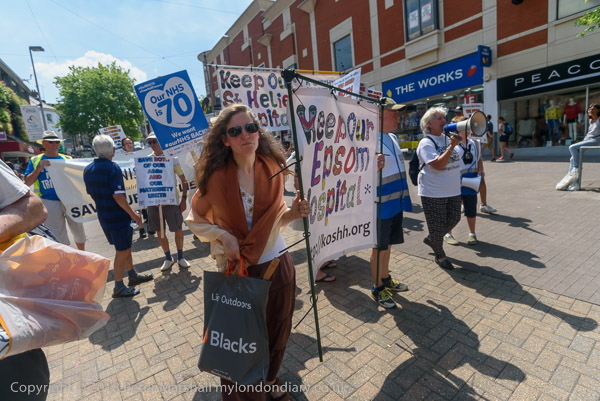
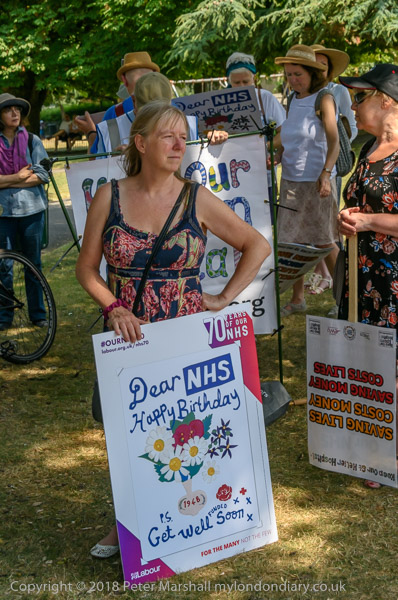
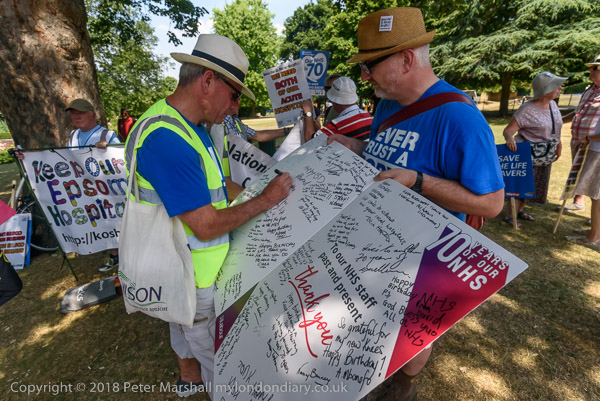
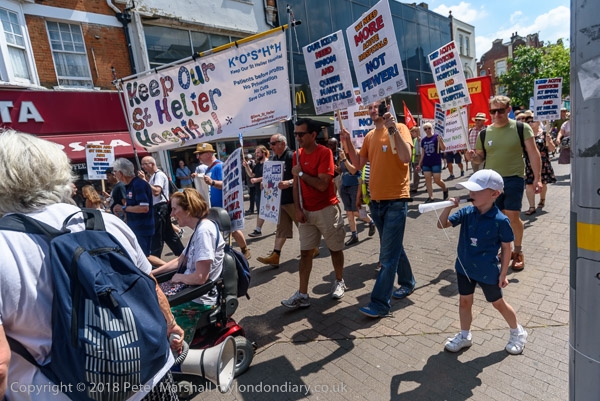
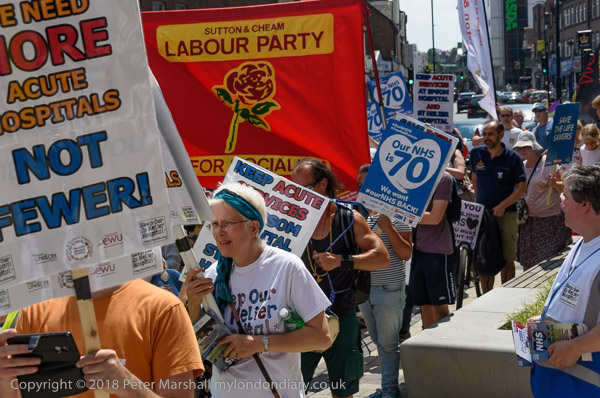
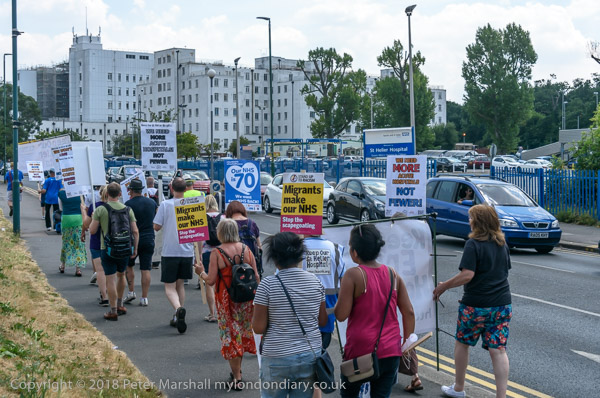
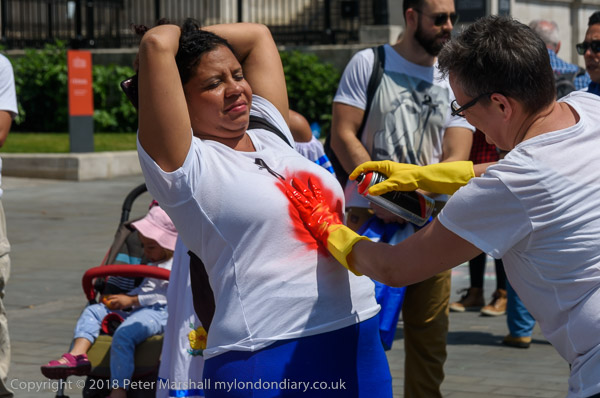
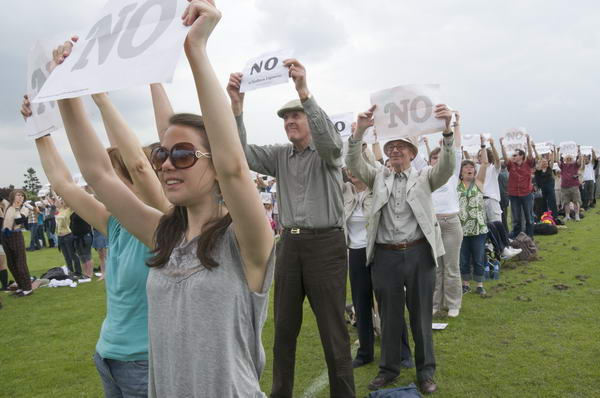
The battle by local campaigners against the closure of acute facilities at Epsom and St Helier Hospitals in south London has been hard fought and illustrates many of the problems faced by the NHS as the government has called for huge savings from hospital trusts, many made paupers by PFI repayments.
The situation continues to develop after the march which I photographed on Saturday 7th July 2018, and in July 2020 plans were approved to build a new smaller Specialist Emergency Care Hospital in Sutton which will bring together six acute services, A&E, critical care, acute medicine, emergency surgery, inpatient paediatrics and maternity services.
The trust say in the documentation for the first phase of public consultation which closed on 30th June 2021 that “85% of current services will stay at Epsom Hospital and St Helier Hospital. There will be urgent treatment centres open 24 hours a day, 365 days a year at both of these hospitals.”
But health service unions and campaigners are worried by the proposals, which they say will strip acute services including two fully functioning A&E departments. The proposed urgent treatment centres will not have the capacity to treat life threatening illness. They say the downgrading of the two major hospitals will endanger the lives of people living in the area.
The new unit is one of 40 across the country which have been announced several times as a part of the governments increased investment in the NHS. Many see this and other similar schemes as being designed to increase privatisation and make involvement in the health service more attractive to healthcare companies.
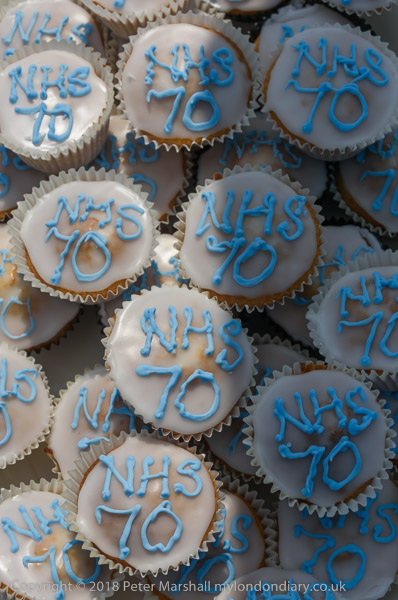
July 7th was a sweltering hot day in London, and the walk from a park in the centre of Sutton to the St Helier Open Space in front of the hospital went through Sutton High St, fairly crowded with shoppers and then along hot, dusty streets with few people around. Walking was tiring, and taking photographs even more so. It was a difficult event to photograph, where I found relatively little to work with. But I was pleased to be there, supporting the campaign to keep the hospitals open and serving the community, part of a National Health Service that was celebrating 70 years of being brought into existence by a Labour Government.
It took a huge and deterimined fight by Nye Bevan to get the National Health Service Act passed, with Tories denouncing it as bringing National Socialism to the country and opposing it in parliament at every opportunity. But on 5th July 1948 we got the NHS, although almost ever since the Conservative party when in power has been looking for and finding ways to convert it from a universal public health care system to a service run for private profit.
London events I covered that day and some of what I wrote about them on My London Diary. More at the links below.
A protest in Trafalgar Square calls for an end of the violence by the Ortega-Murillo regime in Nicaragua, where since the 19th of April police have killed over 100 protesters and a injured over 600, and there have been many unjustly detained, tortured and raped.
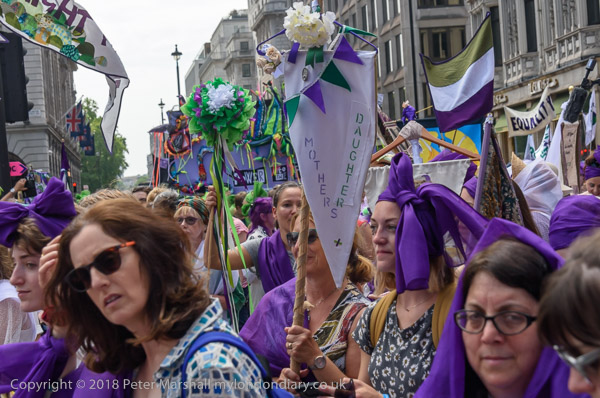
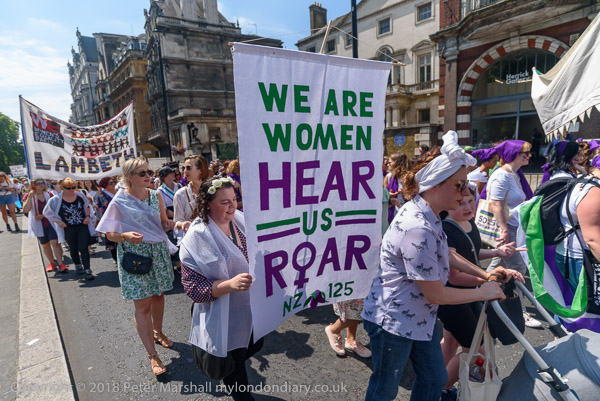
Women wore purple, white and green head scarves to make up three strands of a huge procession in the suffragette colours through London marking 100 years since many British women gained the right to vote.
The 1918 act gave the vote to the first time to all men over 21 and to men like my father over 18 serving in the armed forces, but did not bring in universal suffrage for women. Women had to be over 30 and meet a property requirement. It was another ten years before all women over 21 – including my mother who was by then 23 – could vote.
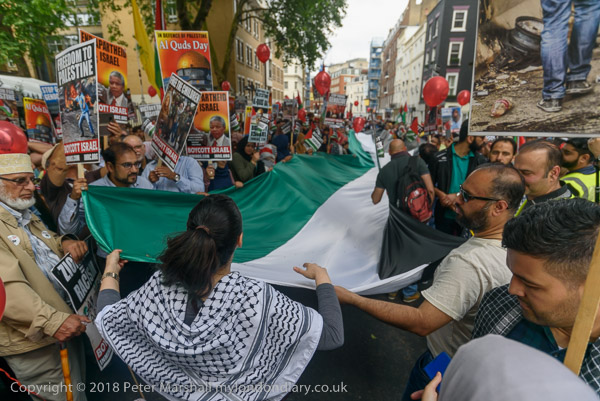
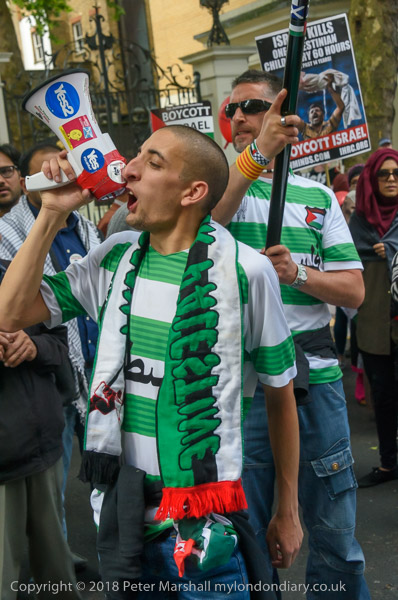
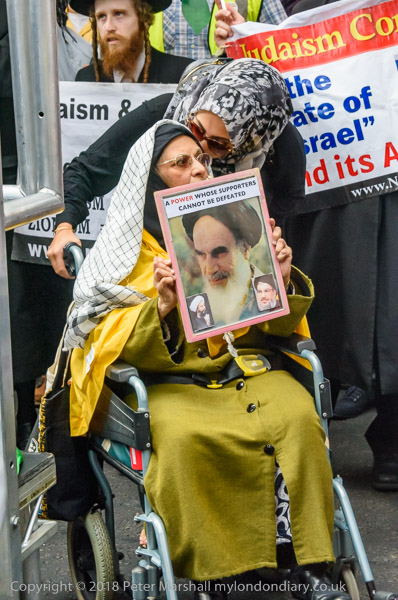
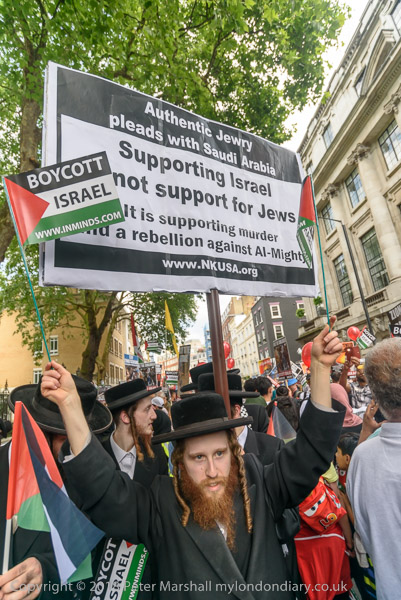
A large crowd squashed into the street in front of the Saudi Arabian embassy for a rally in support of the oppressed people of Palestine and others around the world.
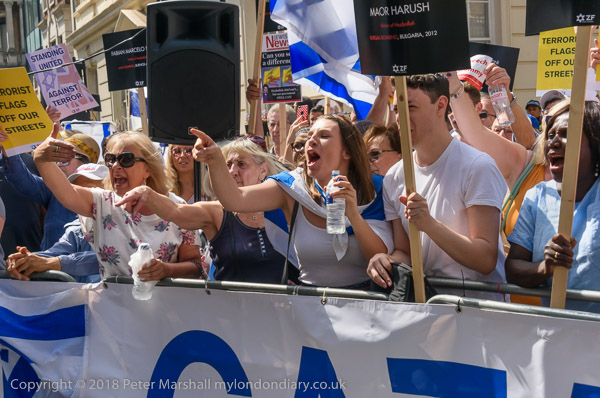
The event, organised by the Justice for Palestine Committee, is supported by the Islamic Human Rights Commission and a wide range of pro-Palestinian organisations, and was opposed by the Zionist Federation and some right wing hooligans, who were stopped from attacking the peaceful event by a large police presence in the area.
Celebrated in many countries, Al Quds Day, established by the Islamic Republic of Iran in 1979, has been marked in London for over 30 years.
This year’s event was a gesture of defiance to the demonisation campaign and the ongoing murders by Israeli troops of innocent Palestinian protestors in the Gaza Strip commemorating 70 years since Israel was formed on expropriated Palestinian land.
Police had set up barriers to keep the official Zionist protest around a hundred yards down the road from the Al Quds day event, while others who were football thugs roamed the streets
All photographs on this and my other sites, unless otherwise stated, are taken by and copyright of Peter Marshall, and are available for reproduction or can be bought as prints.
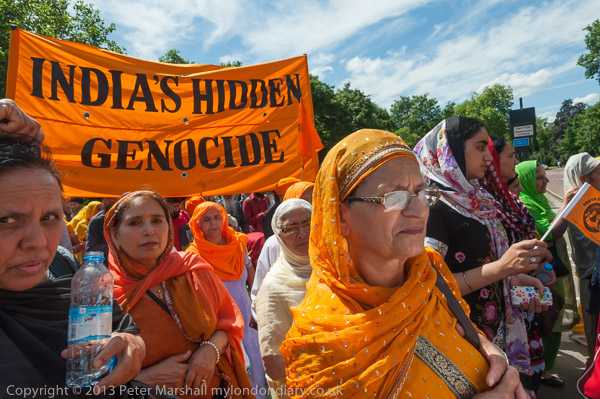
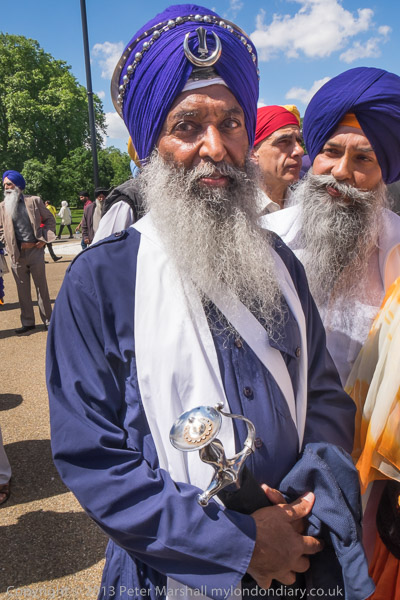
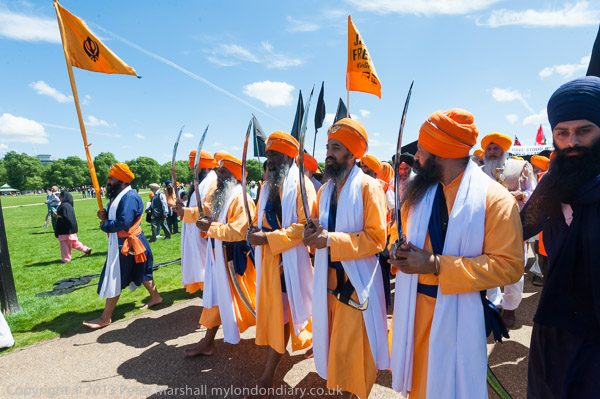
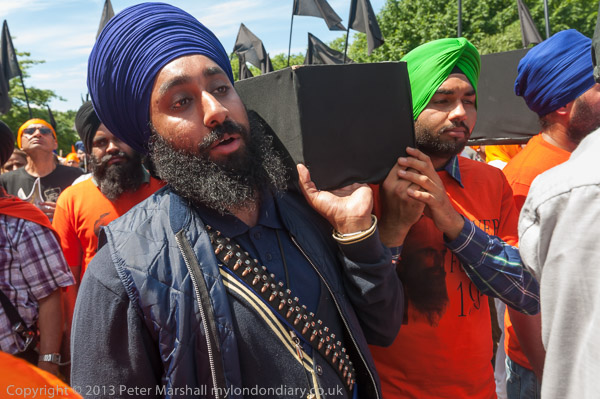
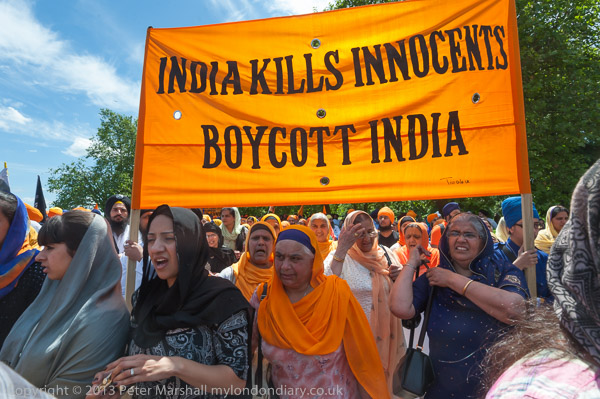
Every year around the 8th June, Sikhs march in London to remember the 1984 destruction at the Golden Temple in Amritsar. The Soviet government forged documents in 1982 to show that Sikh militants were getting CIA support for their plans to establish an independent Sikh state of Khalistan in the Punjab and these were taken seriously by Indian intelligence services and prime minister Indira Gandhi, who on June 1st 1984 sent in the Indian Army in Operation Blue Star, attacking scores of Sikh temples across the Punjab.
On 3rd June Indian forces surrounded the Golden Temple in Amritsar where many of the militants who were well armed had taken refuge, along with thousands of pilgrims who were there for the anniversary of the death of the fifth guru, Arjan Dev Ji. The siege lasted several days and many were killed, mostly pilgrims who had been allowed by the army to enter on the 3rd June but not allowed to leave later that day. As they secured the Temple, the army carried out many executions of those they detained and fired on men and women as they were trying to follow army orders to leave.
Acoording to Rajiv Gandhi, around 700 Indian Army soldiers were killed in the attack, although the official figure was 83. There are also huge discrepancies between the official figures of those who died inside the Temple, with an official figure of 554 casualties and independent estimates of 18-20,000.
Many Sikhs resigned from official positions and soldiers left the Indian Army after this assault on their religion, and five months later Indira Gandhi was assassinated by her Sikh bodyguards in an act of revenge. This in turn led to anti-Sikh riots in which thousands of Sikhs were killed.
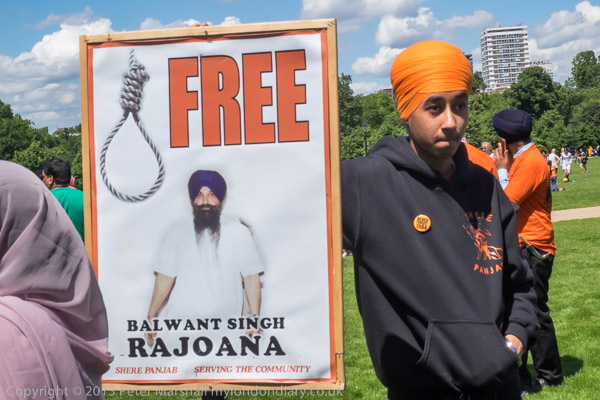
Many Sikhs still continue to call for an independent Sikh homeland, Khalistan, combining parts of the Punjab in both India and Pakistan that were severed at partition in 1947 when the whole area was divided between the two and Sikhs, along with other minorities were sidelined. Both political and military activities continue as does their repression by the Indian government, with many Sikhs held in Indian prisons, some under threat of hanging.
Feelings still run very high, and in 2013 four Sikhs were found guilty of attacking one of the generals who led the attack on the Temple, long retired and on holiday in London with his wife. Police have often taken a very keen interest in the annual march and prevented people from carrying some placards and posters which support the proscribed organisation Babbar Khalsa. The pictures here are from the march on Sunday 8th June 2014, which I left as the last of the protesters went down Park Lane on their way to a rally in Trafalgar Square
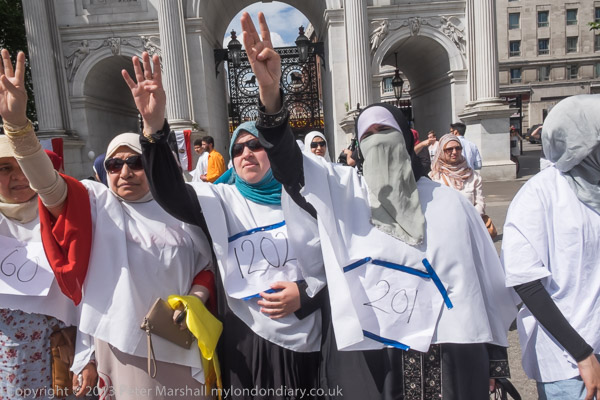
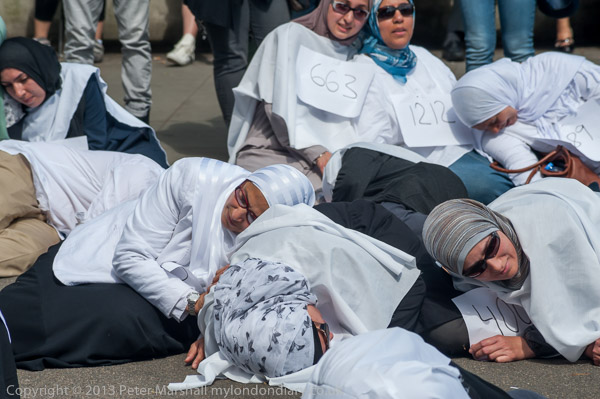
Also taking place on Sunday 8th June 2014 was a protest against the the 1,212 death sentences imposed on Islamists in Egypt, which was taking place as the new Egyptian president, Abdel Fattah el-Sisi, was sworn in. These included 529 members of the Muslim Brotherhood sentenced in 2014 following an attack on a police station in 2013.
There was a mock trial. People wearing numbers to represent the prisoners made the Islamist R4BIA (Rabia) sign and the event ended with a die-in in front of Marble Arch.
All photographs on this and my other sites, unless otherwise stated, are taken by and copyright of Peter Marshall, and are available for reproduction or can be bought as prints.
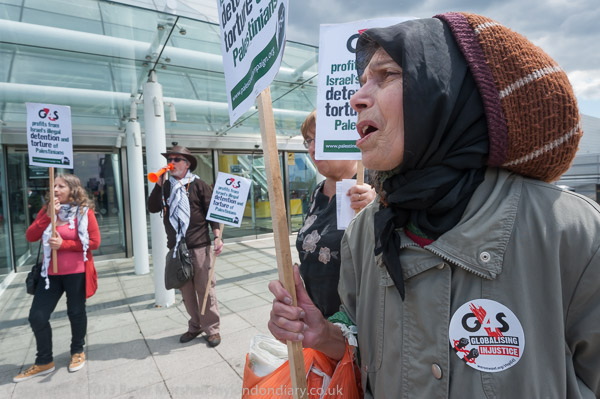
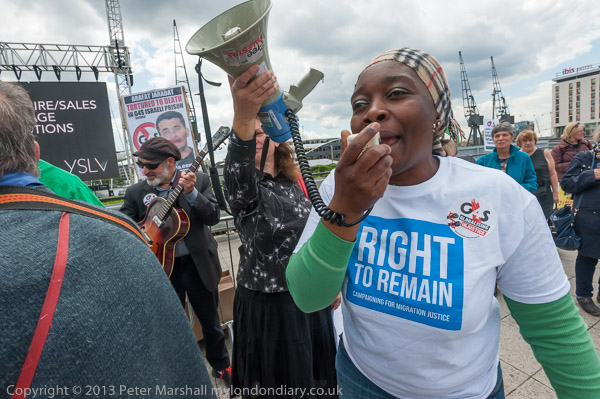
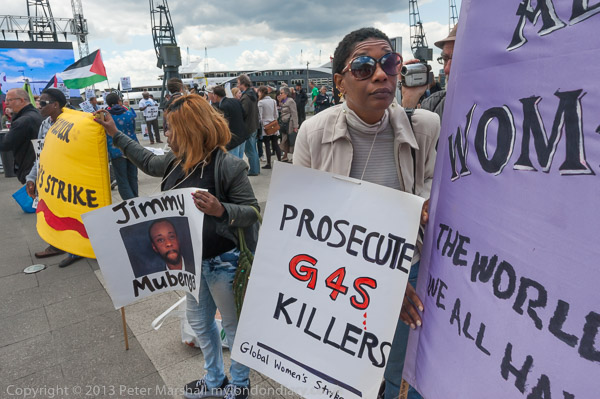
Thursday 5th June 2014 was the day of the AGM of G4S, a company deeply involved in the privatisation of prisons, policing, education and other public services and in human rights abuses both in the UK and in Palestine where it helps to run the Israeli prison system. So unsurprisingly a number of groups had come to protest outside the Excel Centre at Royal Victoria Dock in Newham where the AGM was taking place, and there were also a number of people who had bought shares so they had a right to attend the AGM and also to ask questions, challenging the company’s human rights record.
Among the various groups who had come to protest were the Boycott Israel Network, Boycott Workfare, Campaign to Close Campsfield, Corporate Watch, Friends of Al Aqsa, Inminds.com, Jews for Justice for Palestinians, Palestine Solidarity Campaign, Right to Remain, War on Want, Right to Remain and Global Women’s Strike, though as the protest was on a working day, the numbers representing each group were fairly low.
The protesters sang and handed out leaflets to shareholders attending the meeting, giving details of some of the human rights abuses that G4S has been responsible for or is complicit in. There were also apparently some nasty scenes when shareholders were ejected forcibly from the AGM for insisting on asking awkward questions, but the press was not allowed to photograph inside the venue.
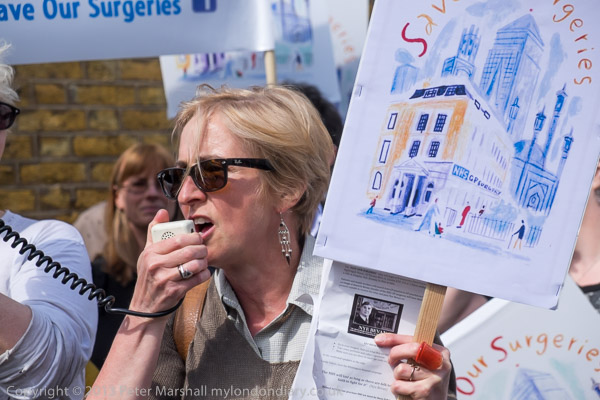
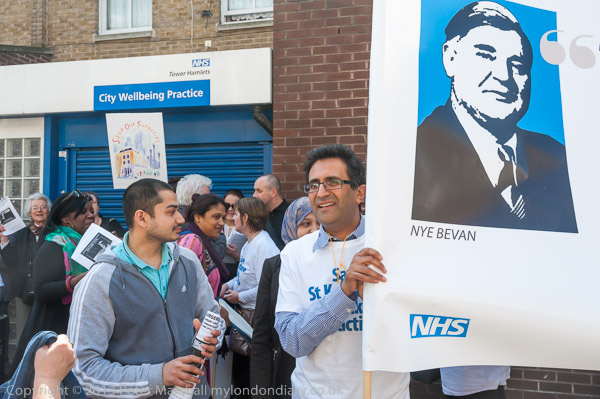
I joined a march in Tower Hamlets, which includes some of the most deprived areas of England, where medical staff and supporters had organised a ‘Nye Bevan’ march to ‘Keep Our NHS Public’, walking around the health practices in the borough. Medical practices were able to give a good level of service in deprived areas by the MPIG, the Minimum practice income guarantee, which was introduced for this purpose in 2004 following negotiations between the government and the BMA to recognise the higher health needs of both some inner city and rural areas. In 2014 the Coalition Government announced this was to be scrapped, with one seventh of it removed each year until 2021.
Many leading politicians (and their family members) have financial interests in healthcare companies, and NHS campaigners see the loss of MPIG as a part of the continuing privatisation by stealth of the NHS. Many GP practices are now run by large healthcare services, who lower costs by providing reduced services and diverting money which should be used for serving the needs of patients into providing profits for shareholders.
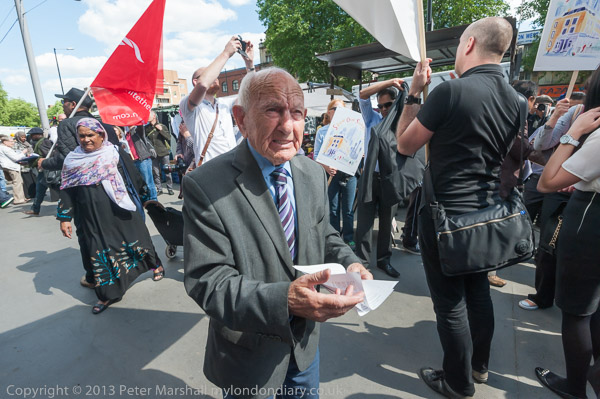
As the marchers arrived at each medical practice they were met by health workers and patients who came out to support them. Among those at the health centre on the Whitechapel Road was veteran anti-fascist and former Communist councillor Max Levitas, who had celebrated his 99th birthday 4 days earlier. I left before the march finished and the rally to go to the Colombian embassy.
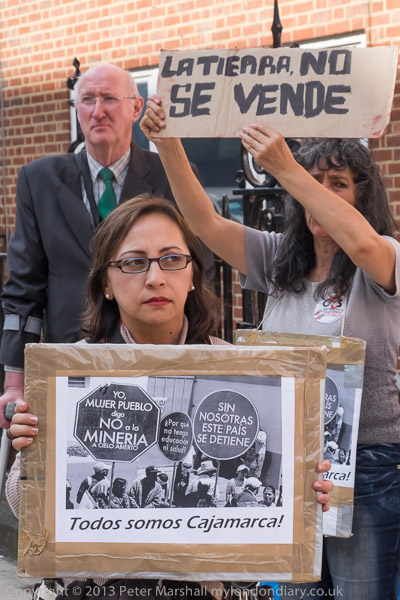
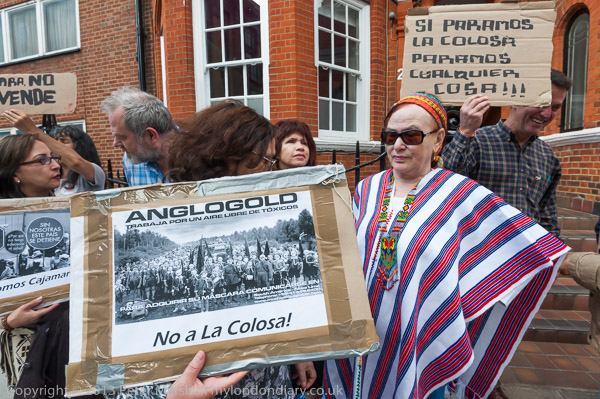
At the Colombian embassy protesters were condemning the vast La Colosa & Santurbán gold mines which endanger water sources in the high mountain regions and could wreck their fragile ecosystems. The London protests on UN World Environment Day and follow protests and carnivals by thousands of people in Ibague, the closest city to the mines as well as in other cities in Colombia. In Bucaramanga the whole city turned out in protests to stop the Santurbán gold mine owned by Canadian company Greystar Resources, and in 2019 there was a protest by 50,000 against the United Arab Emirates backed Soto Norte gold project which would be the largest underground gold mine in Colombia. Gold mining would releases large quantities of cyanide and arsenic into the water supplies of several million people.
The posters were in Spanish as they were aimed at the embassy staff. The Colombian Embassy is a relatively small section of a building just to the rear of Harrods, which also houses the Ecuadorian Embassy, where while this protest was taking place Julian Assange was still in political asylum in their small part of the building, and regular protests were still taking place calling for his release. Unfortunately he was instead handed over to the UK police and now seems likely to die as a political prisoner either in the UK or, if extradited, in the USA.
All photographs on this and my other sites, unless otherwise stated, are taken by and copyright of Peter Marshall, and are available for reproduction or can be bought as prints.
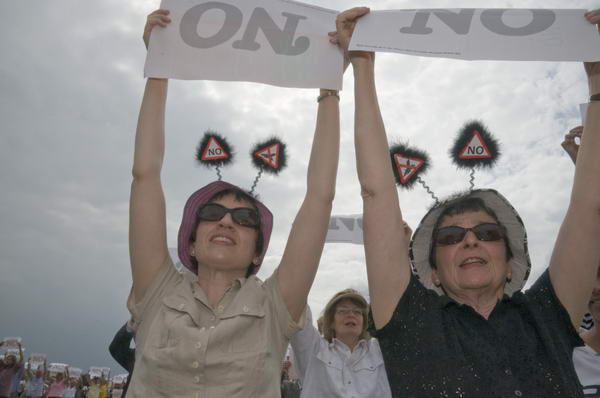
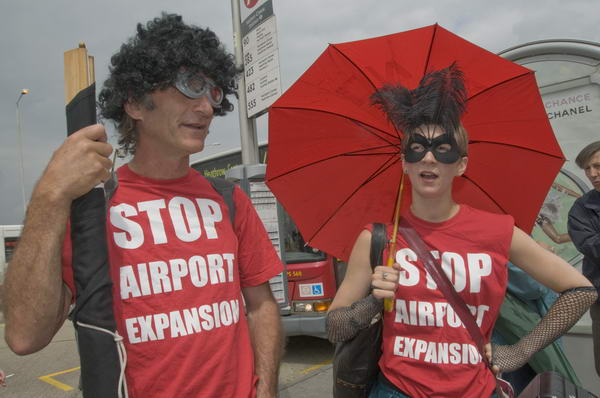
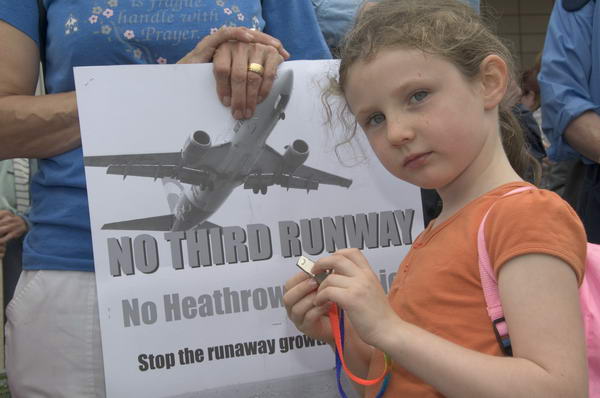
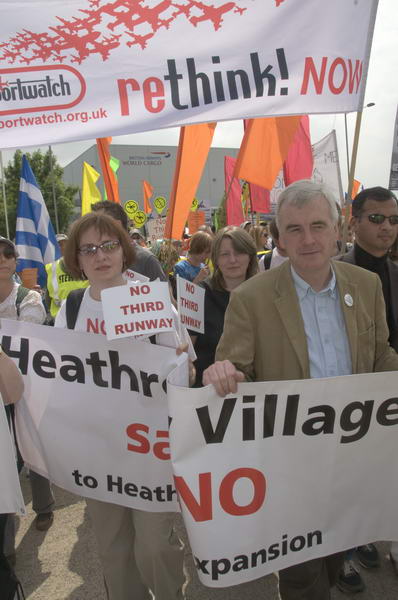
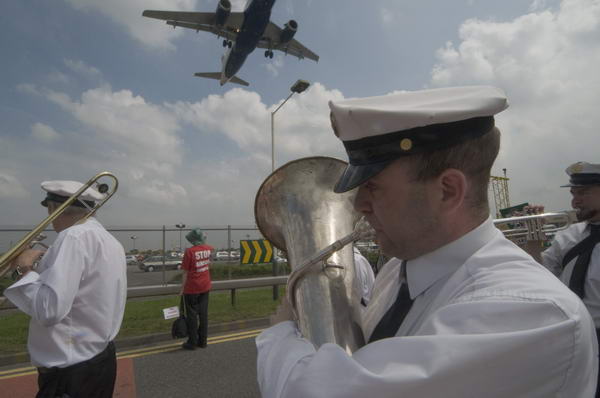
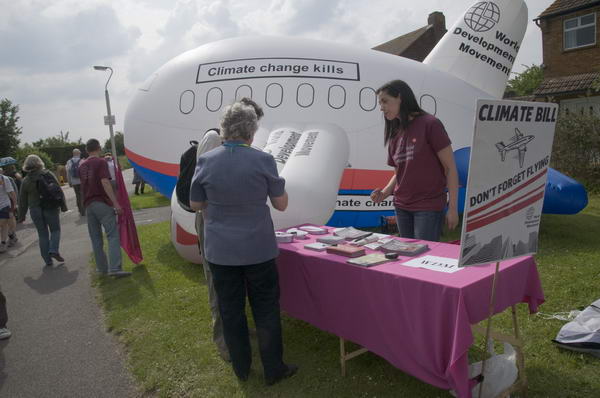
Heathrow – Make a Noise – No Third Runway – 31st May 2008
It really is long past time we saw some real policy changes to back up the governments promise to be leaders in the fight against global heating. We need real action on a number of front, but one obvious area is transport.
There are I think three major announcements that would clearly demonstrate some substance behind the rhetoric, and it would be good to see them all before the start of COP26 in Glasgow.
Firstly there should be a complete re-evaluation of the £27 road building programme for 2020-2025, with the cancellation of most or all new road schemes, with money being diverted into public transport schemes, better infrastructure for electric vehicles and better maintenance of the existing road network, particularly local roads.
Secondly we should see the cancellation of HS2, any economic case for which has disappeared. It’s hard to know why it was ever given the go-ahead, when better alternatives existed. There should be long term savings from stopping it even at this late stage, and it would be good to see more improvements to the existing rail system and in particular local rail and light rail systems.
But perhaps the most important announcement would be to end all thoughts of airport expansion and in particular the plans for another runway at Heathrow. It seems very unlikely to actually go ahead, but it would be good for this to again be ruled out.
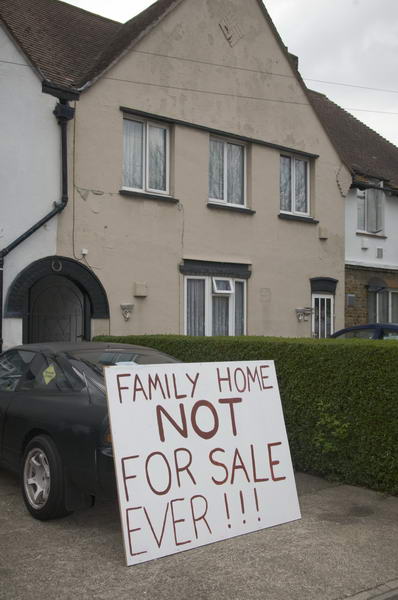
Back on May 31 2008 I was with campaigners marching from Hatton Cross on the edge of Heathrow around the north-eastern edge of the airport to the village of Sipson, a short distance to its north and under threat from demolition for an extra “third” runway. (Heathrow was built with six, but only two are now usable as planes have got larger with higher landing speeds as well as new building on the airport.)
I was one of the campaigners as well as taking photographs, having been a local resident for all but a few years of my life. When I was first aware of Heathrow, DC-3s and other relatively quiet propellor aircraft would amble above my garden perhaps every ten minutes or so and I would see the giant letters under their wings and cross them off in my spotter’s book as they made their way to or from the runway a little under 3 miles away.
By the time I was in secondary school and taking O and A levels, jets had taken over and the noise was ear-splitting and flights more frequent. My school was a mile further way from the airport, but still under a flightpath, and lessons were often interrupted by the noise. A year or two later we moved house as my father was re-marrying and we needed more space, and he chose a street still close to the airport but centrally between the two flypaths, where aircraft noise for us was greatly reduced.
When I moved back to the area in 1974, I chose a house well off the two main flypaths, though still under 4 miles from Heathrow. But when there were strong cross winds, perhaps 20 days a year, aircraft used two of the shorter runways which directed them over our roof – though sometimes it seemed almost as if they were going through the loft and the whole house shook. We had the whole house double-glazed which helped considerably – and the new windows didn’t rattle like the old ones had when the planes flew over.
The protest in May 2008 was a part of a long campaign, one of a number of protests I photographed since 2003 which eventually led to the plans for another runway to be dropped. Among those who opposed to expansion were both Conservative and Liberal Democrat parties (and later it was their coalition government which cancelled it on 12 May 2010) and then Mayor of London Boris Johnson. But Heathrow didn’t give up and after a biased commission report Heathrow expansion became government policy in October 2016. It was the wrong decision then and seems totally crazy now in the light of the climate crisis.
London, UK. 22nd May 2021. Thousands march through London in support of Palestine calling for freedom for Palestine and end to the ethnic cleansing of Palestinian communities, the occupation of Palestine and apartheid laws. After Israeli attacks on Gaza that have killed around 250 and wrecked much of it they call for a huge international effort to rebuild Gaza and to bring a peaceful solution that will enable Palestine and Israel to live in peace and avoid future attacks. Peter Marshall
I still can’t get around to deciding whether to resurrect ‘My London Diary’ which I brought to a halt when I went into personal lock-down early in March last year, when I was ill and cases of Covid were rising dramatically, although the government was still dithering, still pursuing a ‘herd immunity’ scenario.
I reached for a piece of scrap paper and began a quick calculation based on the then available facts – herd immunity would require around 70% or more of the population to get Covid, the death rate was thought to be around 1% and Google told me that the UK population was around 68 million. It would mean around 48 million or more becoming infected – and that would mean around 480,000 deaths. And given that we knew it was much more likely to kill older people, I stood a very high risk of being among those deaths, particularly as I also suffer from diabetes, another risk factor.
I’d been getting advice from one of my two sons for several weeks urging me to isolate. One of his wife’s sisters was involved with the medical group giving advice to the government about the virus and had passed on what they knew about Covid. I ordered a re-useable mask but continued working without one. I became ill, but when I put my symptoms into the checker on the NHS web page it told me it wasn’t Covid. A few weeks later they added more possible symptoms and my result might have been different. I’m still unsure as to whether what I suffered from back then was Covid, though if so it was a very mild case.
Now my two injections should have had their effect (although I did take an antibody flow test several weeks after the first of them which found none) and on May 1st this year I went up to London to photograph the May Day events. Since then I’ve returned a couple of times to photograph protests, mainly those against the Israeli evictions in Sheik Jarrah, attacks on worshippers inside Al Aqsa mosque and the air attacks on Gaza which have killed around 250 Palestinians, including many children, and shocked the world by their intensity.
The pictures here come from last Saturday’s National Demonstration for Palestine in London, attended by an estimated 180-250,000, but which received very little media coverage – I didn’t hear anything about it from the BBC, despite it being about an issue very much in the news. Our official broadcaster seems to have an incredible reluctance to report on protests in the UK, and relatively little has made other media. My pictures were at the agency in time to meet deadlines, but so were those by hundreds or thousands of other photographers, and so far as I’m aware none of these has sold, though several have been shared quite widely on Facebook where I also posted them.
I haven’t yet put any pictures taken after March 8, 2020 onto My London Diary. It didn’t seem worth sharing the pictures from my walks and bike rides around my home, though perhaps sometime I might persuade myself to look through them and publish something. And so far I’ve not reopened the site to add anything I’ve taken since getting back to work. There isn’t as much happening in London as there was pre-Covid and I’m also deliberately doing less.
I also have some minor technical problems. I haven’t yet got the software I been using for over 20 years to write ‘My London Diary’ and other sites onto my new computer and I think it unlikely to work under Windows 10 which I’m now using. I have problems with web space, not with the actual size, but with the number of separate files and am now fairly close to the limit of my contract. Continuing for any length of time with ‘My London Diary’ would mean an expensive upgrade.
Before I stopped posting new work on My London Diary it had already a relatively low level of site visits – in the hundreds per day. Several times as many of you come to read Re-PHOTO, and to look my work on Flickr. I had hoped to transfer the site to a major institution but that fell through.
Click on any of the pictures to go to my Flickr album on the protest. It currently has 25 pictures but I may add some others later.
Prince of Wales Cinema, Bingo Hall, 331 Harrow Rd, Westbourne Green, Westminster, 1988
Although most Londoners will have heard of Maida Vale, few will have heard of Maida Hill, and those that have will probably – like me – be very unsure of where it changes to Westbourne Green or West Kilburn. Many of the old London district names have more or less disappeared, and estate agents take remarkable liberties with the boundaries of areas they feel are currently more upmarket.
Harrow Rd, Westbourne Green, Westminster, 1988
Part of the reason for this is increased mobililty, particularly in those areas of London were many live in private rented accomodation, often with short-term leases or where for various reasons tenants often move very frequently. Most of the inner London boroughs were developed by before the First World War, and grew up first around the old named village centres – and later around the railway stations, underground stations and tram routes.
Shops, Harrow Rd, Maida Hill, Westminster, 1988
People know Maida Vale mainly because it has an Underground Station – something Maida Hill lacks. And most – including myself – tend to forget that the area is Westbourne Green and call it after its station, Westbourne Park. The ease of travel – by rail, bus and bike, and later by car loosened the links of people to their native villages and of course many more came into the new houses in London from other parts of the country, and later the world.
Walterton Rd, Elgin Ave, Maida Hill, Westminster, 1988
I grew up in the town on the edge of London where my father had been born in 1899. He’d worked elsewhere – including a couple of years when the army and air force took him to France and Germany, but had also commuted to various jobs in towns and areas around, including Kew, Guildford and Harrow thanks to buses or a motorbike. But back in the 1950s when I walked down the main road with him he would still be greeting almost everyone we met by name.
Walterton Rd, Elgin Ave, Maida Hill, Westminster, 1988
Captioning my photographs, even those where I know exactly where they were taken, I often have difficulty in deciding the name of the district in which they were taken. Sometimes I come back to one later and change my mind. Deciding which London Borough they are in is generally easier – the borough boundaries are marked by lines on maps, although sometimes, particularly where the boundary runs down the centre of a road I give both if I’m unsure what side of the road it is on. A minor confusion is that some London boroughs share a name with a district which is a part of them. I could write things like Camden, Camden, but it seems redundant to repeat it.
The Elgin Estate is possibly in Paddington, North Paddington or in Maida Hill, though the area is also sometimes simply referred to by the major road it is close to, the Harrow Road. When I put these pictures on-line I chose Maida Hill, simply because this was printed closer on the street map I was using.
Elgin Estate, Elgin Ave, Harrow Rd, Maida Hill, Westminster, 1988
The triangle between Harrow Road, Elgin Avenue, and Chippenham Road contained some of the areas worst housing and the Greater London Council demolished these and built 300 maisonettes and flats in what was originally called the Walterton Road estate but later renamed the Elgin Estate. Started in 1966, the first tenants moved in in 1968.
It included two 22-storey tower blocks, Chantry Point and Hermes Point. A survey in 1983 found them and the rest of the estate in very poor condition and the GLC began a full-scale process of repairs. Unfortunately once work began it was brought to a halt when dangerous asbestos was found in the two tower blocks, which by then had been transferred to Westminster Council, though the GLC was still responsible for major works.
Elgin Estate, Elgin Ave, Harrow Rd, Maida Hill, Westminster, 1988
Westminster stopped letting the blocks to new tenants though some lettings continued on short-term licences and other flats were squatted and the properties rapidly deteriorated. When the GLC was abolished in 1986 full responsibility passed to Westminster Council who secretly decided to sell the whole estate to private developers who intended to demolish the lot and rebuild at twice the density with one of the towers becoming a hotel.
Elgin Estate, Elgin Ave, Harrow Rd, Maida Hill, Westminster, 1988
When the plans leaked, residents formed an action group demanding the council drop the plans and setting up their own proposals to save the homes. The council wanted to get rid of social tenants and replace them by wealthier home owners, to increase the Tory vote in the area, part of a process of exporting Westminster homeless families to boroughs on the edge of London and outside to places such as Staines. The Elgin estate – despite being known as having an asbestos health risk – was also used as a dumping ground for council tenants who were moved out of marginal wards. It was a policy that in 1997 was found by the High Court to be unlawful. The council appealed and won, but then lost in the House of Lords in 2001 when Lady Porter, leader of the council from 1983 to 1991 was ordered to pay a surcharge (including interest) of £43.3 million. She moved most of her money to Israel and to other family members and pleaded poverty, but eventually settled with a payment of £12.3 millioon.
Elgin Estate, Elgin Ave, Harrow Rd, Maida Hill, Westminster, 1988
By 1988 when I made these pictures around a third of properties on the estate were empty with doors and windows blocked by steel sheets to keep out squatters who already occupied many of the flats in the two towers. But the 1988 Housing Act gave the remaining residents the chance to form a housing association, Walterton and Elgin Community Homes, which was then able to hold a ballot and acquire the homes from Westminster Council. In March 1989 WECH became the first ‘Tenants’ Choice’ landlord to be approved by the Housing Corporation, and despite various dirty tricks by the council, in 1991 was not only given the properties free of charge, but also awarded the maximum possible amount from the council of £77.5 million to cover the cost of repair (though this was only around a half of what was thought to be needed.
A vote by residents was 72% in favour of the transfer to WECH which was made in April 1992. Redevelopment of the area was carried out with extensive consultation with them, and involved an expensive demolition of the two towers in 1994, replaced by low rise housing.
All photographs on this and my other sites, unless otherwise stated, are taken by and copyright of Peter Marshall, and are available for reproduction or can be bought as prints.
One of the great failures of British politicians in my lifetime has been over immigration. Since Enoch Powell’s infamous ‘Rivers of Blood’ speech in Birmingham in April 1968, both major parties have engaged in a desperate contest to show they are tougher on immigration than the other.
Immigration as we moved from Empire to Commonwealth wasn’t just a moral issue of living up to the promises the country had long made to its overseas subjects – but had failed to live up to. It was also a matter of economic and social need, for workers, nurses, bus conductors, doctors and more to keep the United Kingdom running. By the 1960s, a third of junior doctors were from India, Pakistan, Bangladesh and Sri Lanka and in 1963 Enoch Powell, then minister of health launched a campaign which recruited a further 18,000 doctors from India and Pakistan.
Immigration controls had of course begun earlier, but the 1962 Conservative Commonwealth Immigrants Act began a new series of anti-immigration measures. Labour followed this with their 1968 Act, a panic measure to restrict the arrival here of Kenyan Asians. The 1971 Immigration Act and further legislation restricted even restricted the numbers of foreign nurses – who the NHS was and is still very reliant on.
On and on the politicians have gone, increasing the restrictions and playing the numbers game promoted by racists rather than adopting a positive approach and stressing the great advantages that immigrants have brought to this country. While in the Tory party attitudes have largely been driven by straight-forward racism and the residues of imperialism, Labour’s policies seem more cynical and solely based on middle-class electoral assumptions about working-class racism.
Of course there are working-class racists. But there is also working class solidarity that crosses any lines of race, and which could have been fostered by the Labour Party and the trade unions. Instead they have left the field largely open to the likes of the EDL and the lies of the right-wing press. In this and other ways Labour has not lost the working class, but abandoned it.
The vicious and racist policies imposed in recent years by Theresa May against migrants, particularly those here without official permission but also those with every right to be here but without a huge archive of paperwork by which to prove this – the Windrush generation have met with opposition from some mainly on the left in Labour, but they built on the policies of the New Labour government before here.
Labour have abstained rather than voted against so much discriminatory legislation, and their opposition to Priti Patel’s draconian bill which aims to criminalise Roma, Gypsy and Traveller lifestyles and increase the surveillance powers of immigration officers as well as introducing new ‘diversionary cautions’ against migrants to allow police to force them to leave the country has at best been half-hearted.
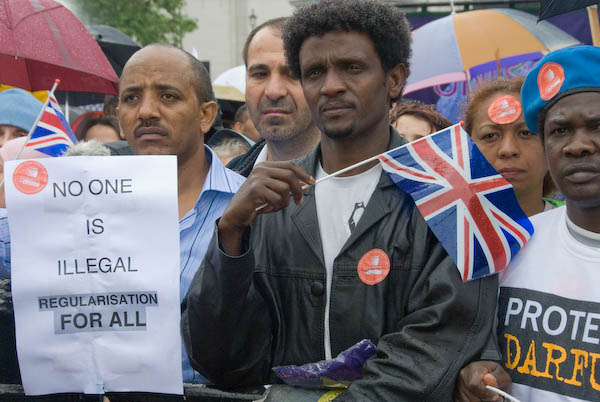
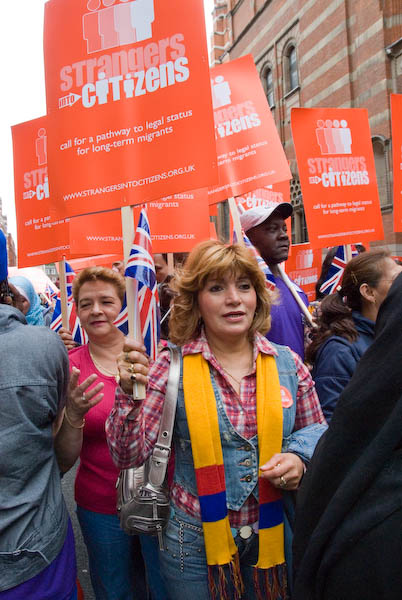
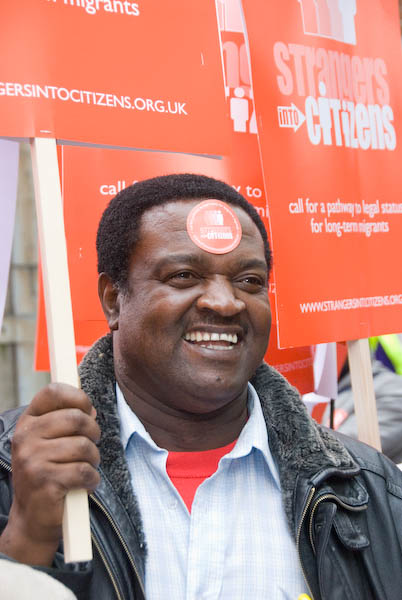
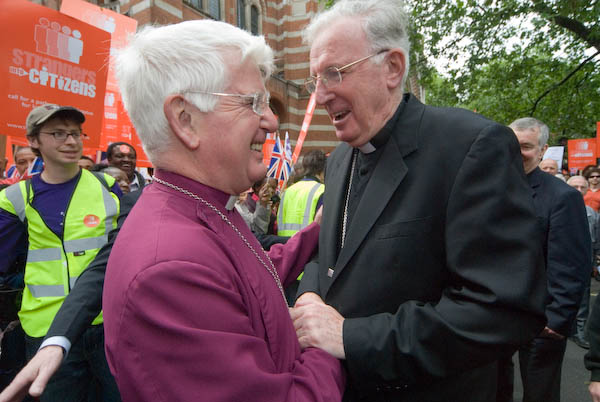
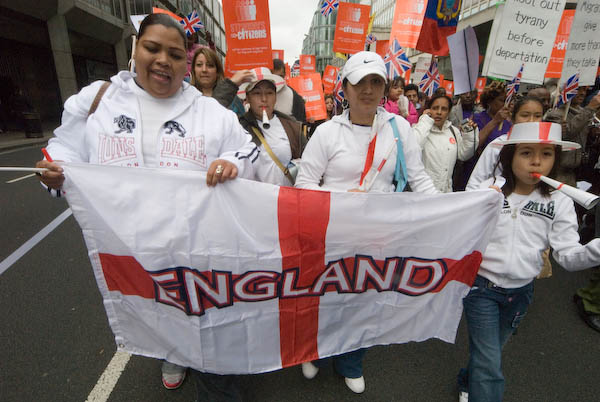
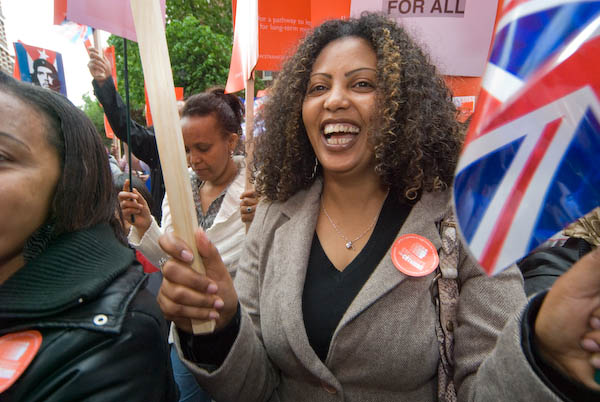
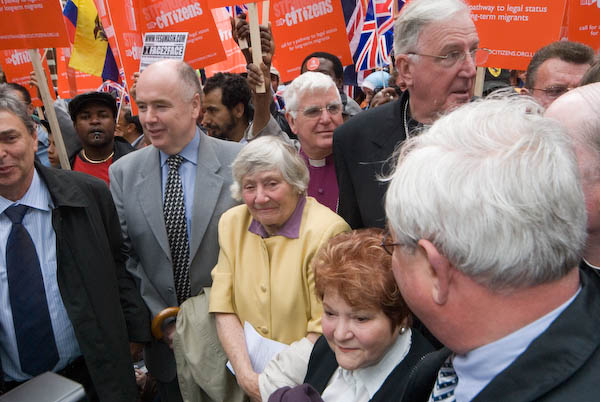
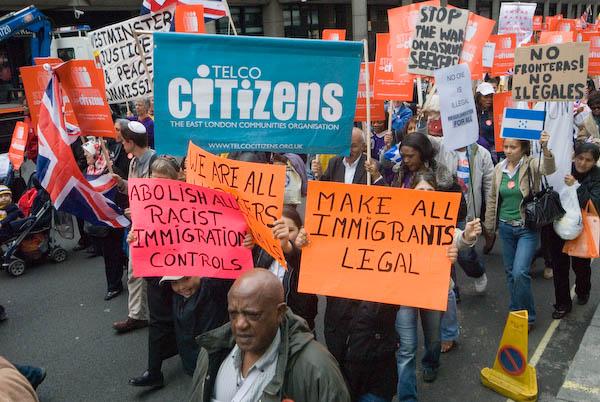
Of course there are exceptions. Honourable men and women in both parties who have argued against racist policies, and MPs who have voted with their consciences rather than follow the party line – and sometimes lost the party whip. And of course those in some of the smaller parties and outside parliament, particularly various religious leaders, some of whom took a leading role in the Strangers into Citizens March and Rally on May 7th 2007 which called for all those who have worked (and paid their taxes) here for more than four years to be given a two year work permit, after which if they get suitable work and character references they would be given indefinite leave to remain.
Although this still would not change our terrible mistreatment of those who arrive seeking asylum, it did seem a pragmatic solution to a major problem which governments have found intractable. But as the organisers of the event and many of the speakers insisted, it needed to be part of a wider package of fair treatment for those applying for asylum or immigration. But the political parties were not listening and seem only able to think of more and more restrictive, racist and authoritarian policies which drive us further into becoming a police state.
All photographs on this and my other sites, unless otherwise stated, are taken by and copyright of Peter Marshall, and are available for reproduction or can be bought as prints.
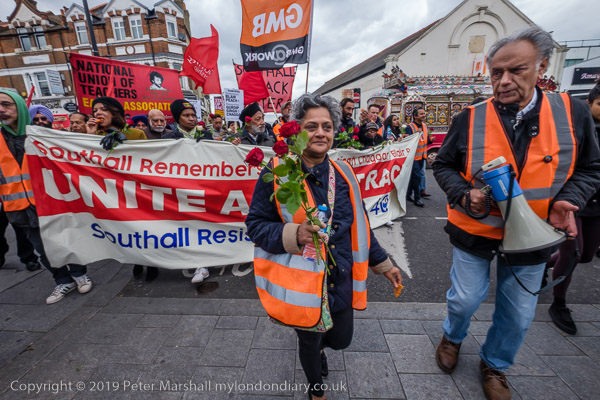
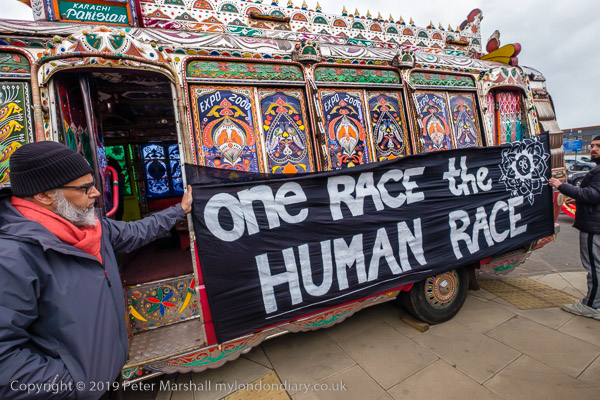
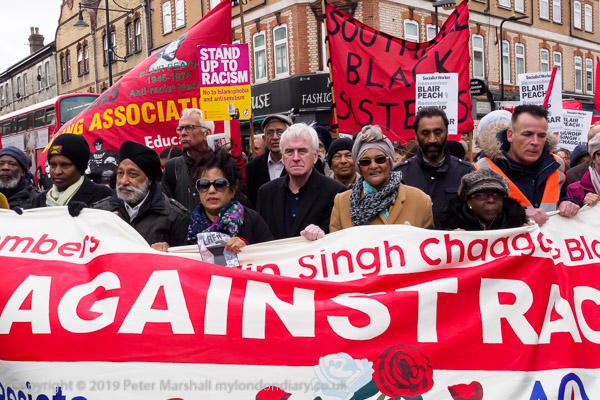
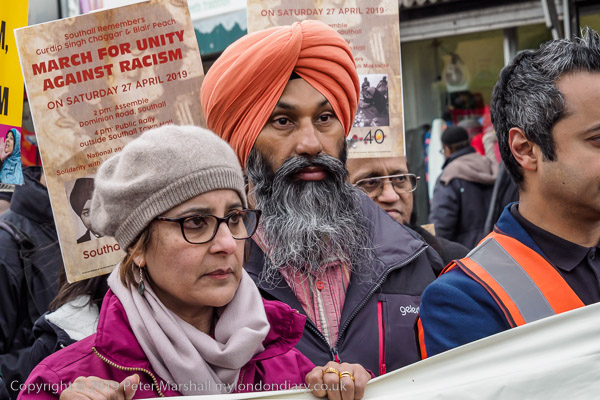
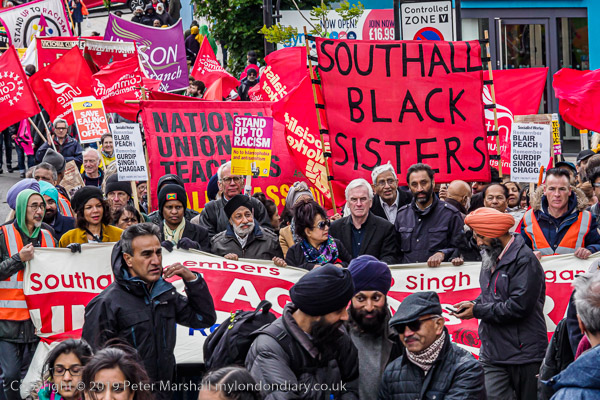
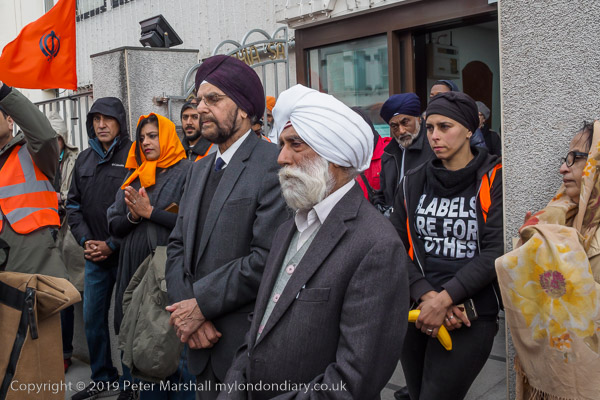
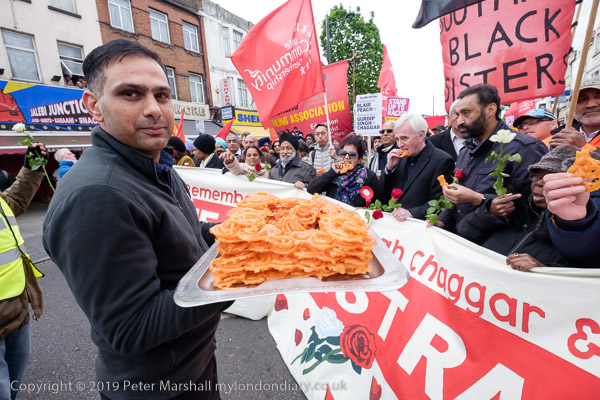
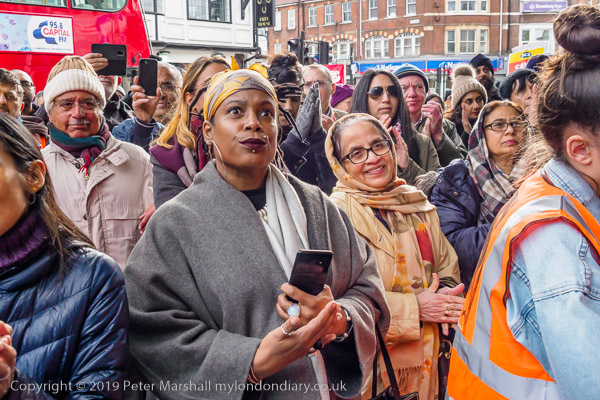
Two years ago today, 27 April 2019, I joined with a large crowd in Southall remembering the murders there of Gurdip Singh Chaggar and Blair Peach, calling for unity against racism.
The march took place on the Saturday after St George’s Day, and marked the 40th anniversary of Blair Peach’s murder by police officers. Several thousand police had packed the town to defend the National Front who were holding a meeting at Southall Town Hall. A large group of the local community and supporters from across London had come to oppose the meeting, and and police rioted and attacked what had been a determined but largely peaceful protest. Wikipedia has a long and well referenced article on the murder from which many of the facts below are taken, though speeches at the 2019 protest also included some eye-witness accounts. Peach was a member of my own union at the time, the NUT, which also made me very aware of the events and was prominent in the fight to see justice.
Blair Peach was in a group of friends who tried to escape the violent police attacks on Southall Broadway and make their way home down a side street, but unfortunately this led nowhere and the police Special Patrol Group drove up in several vans and began attacking the crowd there, who responded with bricks and bottles. Witnesses, including residents on the street say the police were hitting everybody and fourteen saw a police officer hitting Peach on the head.
People obseve a minute of silence where Gurdip Singh Chaggar was killed
Forensic evidence found he had been hit with an illegal weapon, probably a lead-filled cosh or pipe, and searches of the lockers of the SPG unit involved found 26 illegal weapons. None of the witnesses were able to identify the police officer involved – perhaps because one officer had shaved off his moustache and another grew a beard and refused to take part in the identity parades. Many also had their uniforms dry-cleaned before the police investigation inspected them.
Although the police investigation had produced a great deal of evidence against the SPG, the DPP decided it was insufficient to justify a prosecution. The report was kept secret, though parts appeared in the press early in 1980, and the inquest was hampered as the legal team acting for the Peach family were not allowed access to it. The verdict of the inquest, ‘death by misadventure’ was widely considered – even by The Times – to have been inappropriate. The coroner afterwards wrote an article including his comments that some of the civilian witnesses had lied as they were “politically committed to the Socialist Workers Party” of which Peach was a member and that some Sikh witnesses “did not have experience of the English system” to enable them to give reliable evidence but was persuaded not to publish it.
At Ramgarhia Sabha Gurdwara
The fight to get justice over the murder continued, but none of the officers involved was ever brought to trial. Apparently all left the police force shortly after the investigaton. Peach’s family were awarded £75,000 compensation in a tacit admission of police guilt by the Metropolitan Police in 1988, but requests for a public inquiry were turned down by the Home Office. The SPG was disbanded in 1987, but replaced by a very similar Territorial Support Group. It was only following a member of the TSG killing newspaper vendor Ian Tomlinson as he was walking home past the G20 protests at Bank in 2009 that the report of the police investigation into Blair Peach’s death was finally made public.
The 2019 march and rally in Southall convened close to where Gurdip Singh Chaggar, an 18 year old student, was murdered by racist skinheads in June 1976 as he left the Dominion Cinema and began, at the request of his family with a karate display. It paused for a minute of silence where his was killed before moving on to stop at the Ramgarhia Sabha Gurdwara which the Chaggar family attend, where prayers were said.
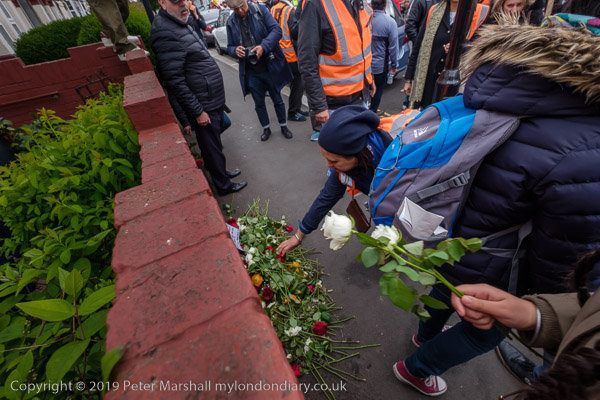
Flowers were handed out which were then laid at the street corner where Blair Peach was murdered before we moved on to a rally outside Southall Town Hall where the National Front held their meeting. Peach’s murder inspired the formation of both the anti-racist grassroots group The Monitoring Group, whose founder and director Suresh Grover introduced the event and of Southall Black Sisters, whose founder Pragna Patel who was one of the speakers, along with other community leaders and anti-racists.
Perhaps surprisingly absent was the local Labour MP, Virendra Sharma, who in 2019 lost a vote of no-cofidence by the local party apparently due to his low attendance at party meetings, slow responses to constituents and failure to campaign over local redevelopment issues. John McDonnell, Labour MP for a neighbouring constituency and then Shadow Chancellor was there from the start of the march and made a powerful speech.
Recent events have brought scientists much more into centre stage, and politicians now claim to be “following the science” although this often means simply picking and choosing those bits from the wide range of scientific advice that suits their particular agenda.
Science isn’t monolithic, and its predictions are generally in terms of probabilities rather than certainties. Different disciplines may bring rather different emphases to aspects of complex problems and sometimes we need a wider view than that of a particular specialism – and even some common sense.
It seems clear that at the beginning of the Covid outbreak our government placed to much confidence in the advice of some mathematical modellers and failed to follow that based on medical experience in dealing with earlier pandemics on wearing masks and tightly controlling international travel that kept infection rates near zero in some countries. And that they had dismissed the evidence of earlier exercises in pandemic control and failed to follow the conclusion that we needed stockpiles of protective equipment.
Simple mathematical predictions close to the start of 2020 – like those I made metaphorically on the back of an envelope from then available data – suggested that by leaving the progress of the virus essentially unchecked we might expect around 400,000 deaths. It was perhaps calculations such as these that led to a massive programme of ordering vaccines.
Our various lockdown control measures – too little and too late – and gradual improvements in the care of those infected have so far managed to keep the numbers down to a little under half that initial estimate, though another wave may take us rather closer, particularly if variants prove more resistant to current vaccines.
A couple of days ago I was invited to complete an online opinion survey about the political challenges facing our government. One question asked me to pick one from a list as the major political challenge facing the UK government. I read through the list, which began with something about immigration and was shocked to find after reading the 10 choices I had to pick ‘Other’ and type in ‘Climate Change’.
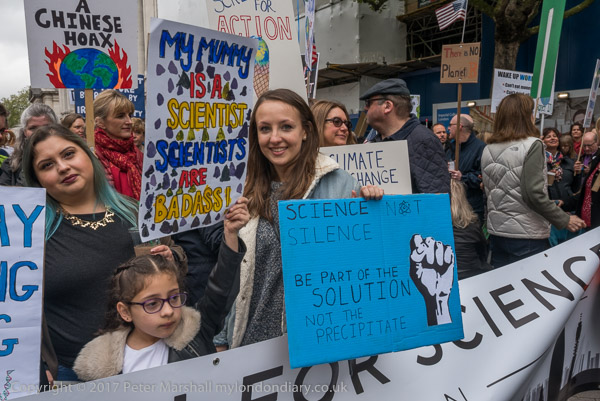
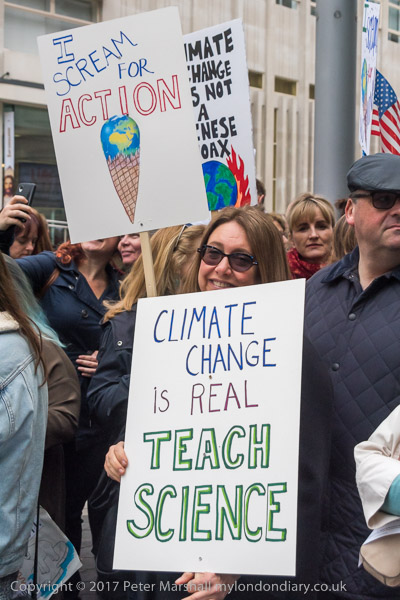
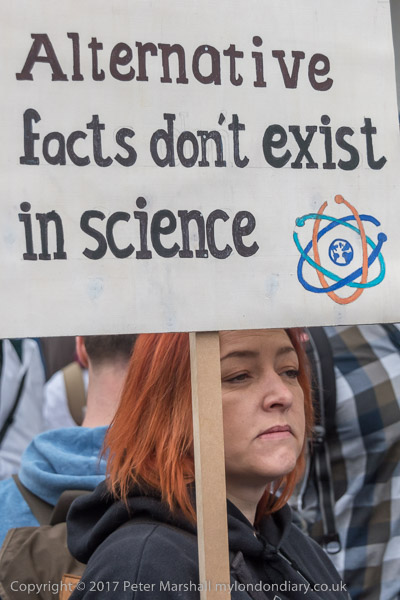
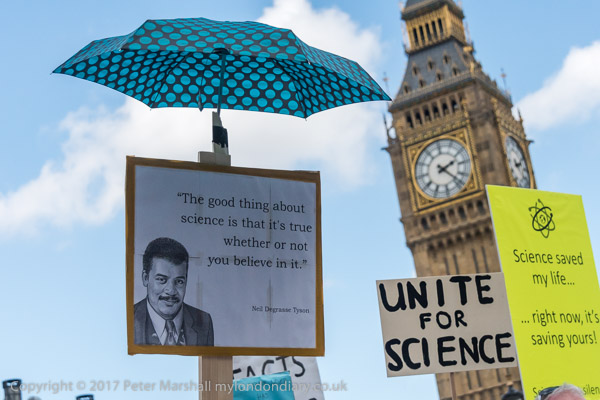
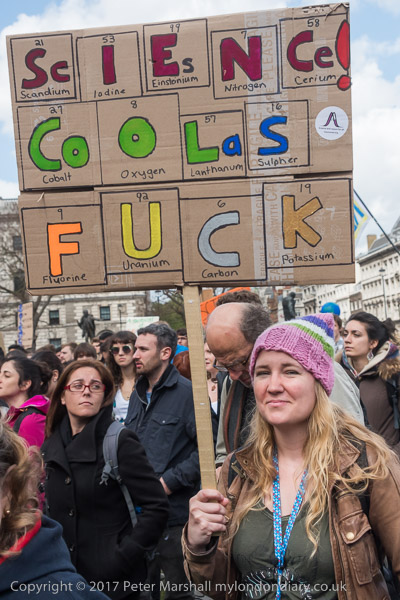
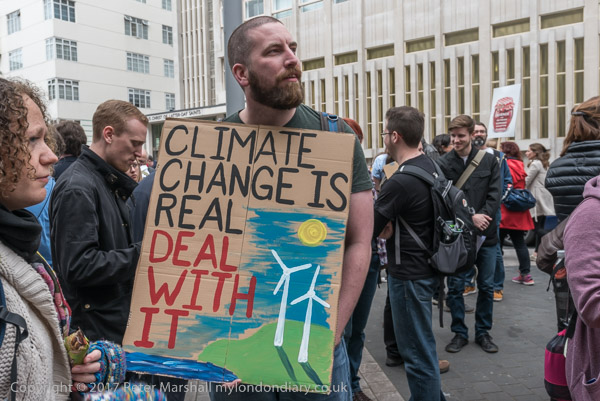
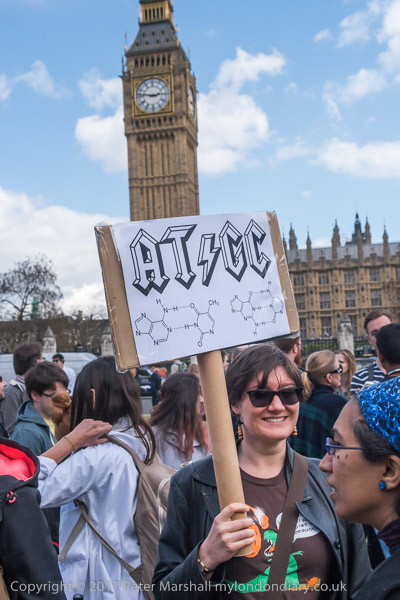
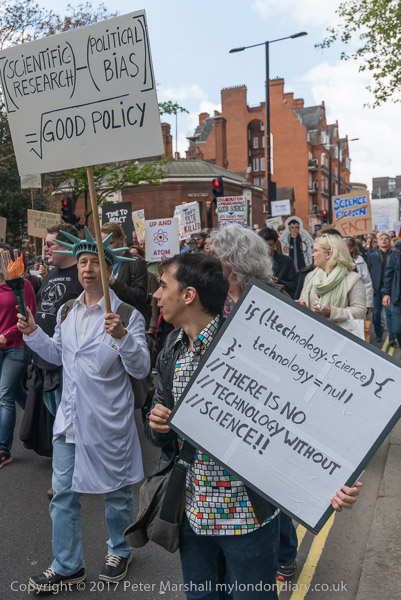
It was climate change that essentially prompted the protest by scientists on April 22nd 2017 to march through London from the Science Museum to a rally at Parliament. They came to celebrate the vital role that science plays in our lives and to call for an end to the fake news and fake science such as climate denial by politicians such as Trump which will prove disastrous.
The march drew attention to the need for international cooperation to combat the existential challenge of man-made global warming – and warned of the danger to this from Brexit and isolationism around the world.
It was an unusual event in many respects. As I pointed out on My London Diary and elsewhere:
“It was a considerably more nerdy protest than most, and some of the posters and placards were difficult event for someone like me with a couple of science degrees in my past to understand. Many scientists do seem to have a problem in communicating with the rest of us and write slogans like ‘Do I have large P-value? Cos I feel Insignificant’ or ‘dT=α.ln(C1/C0)’.”
As well as covering the march and rally by scientists I also photographed campaigners calling for the reform of our secretive Family courts, Poice and Social Services which cover up their failures and corruption by gagging orders, and a protest outside the Consular department of the Russian Embassy to show solidarity with LGBT people in Chechnya, where over a hundred men suspected of being homosexual have been rounded up an put into camps and tortured, with three thought to have been killed. You can see more about these events and the scientists’ protest on the links below.
All photographs on this and my other sites, unless otherwise stated, are taken by and copyright of Peter Marshall, and are available for reproduction or can be bought as prints.