NHS at 70 – Save St Helier Hospital – 2018

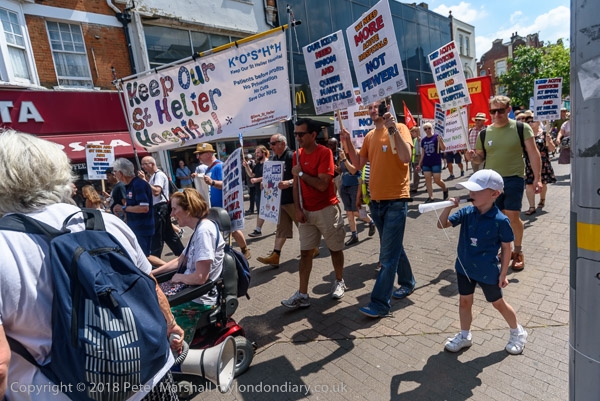
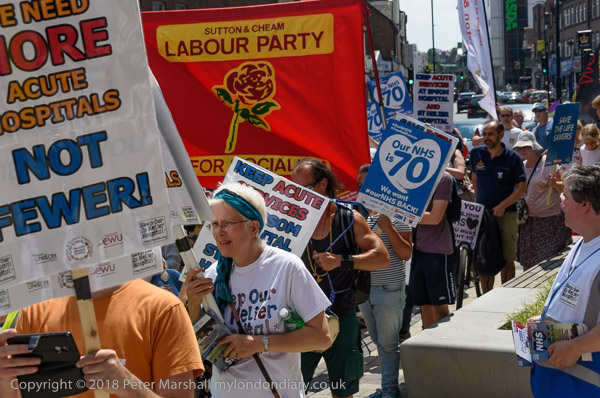
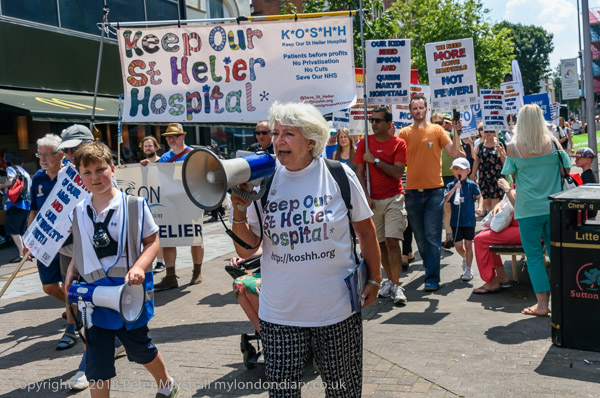
NHS at 70 – Save St Helier Hospital: On Saturday 7th July 2018 I went with campaigners from Keep Our St Helier Hospital on what seemed a long hot march from Sutton to a rally in front of St Helier Hospital.
NHS at 70 - Save St Helier Hospital - 2018

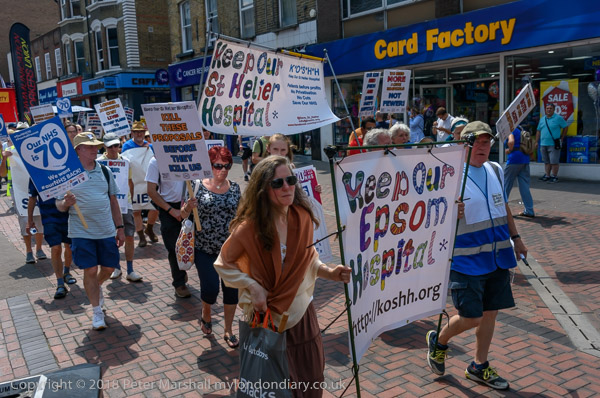
The Epsom and St Helier Trust planned to close A&E, Maternity, Paediatrics, Emergency Medicine and Surgery, Intensive Care, Coronary Care and the Cancer Centre at one or both Epsom or St Helier Hospital and sell off much of the sites.
NHS at 70 - Save St Helier Hospital - 2018

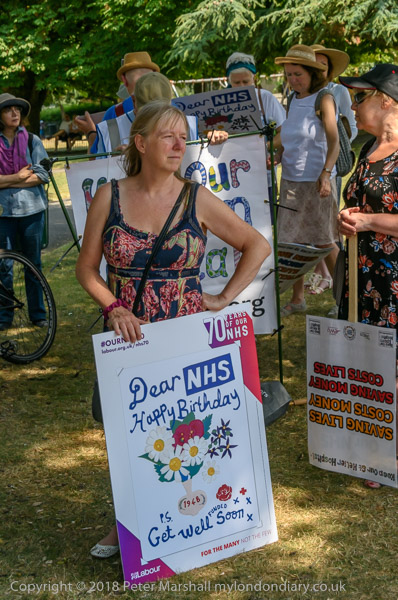
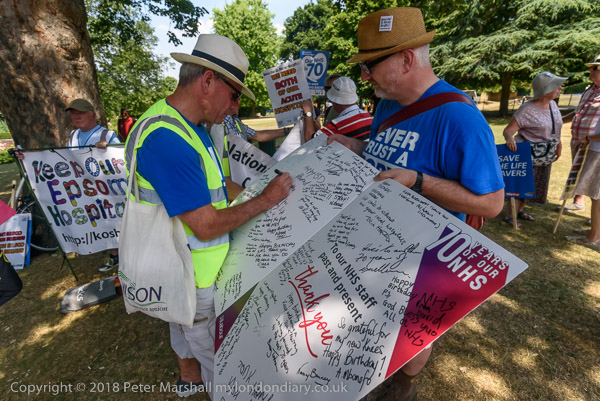
The march celebrated the 70th anniversary of the founding of our National Health Service and marchers signed a giant birthday card at the start of the march in a park in the centre of Sutton and many had had posters and placards for the 70th birthday of the NHS.
NHS at 70 - Save St Helier Hospital - 2018

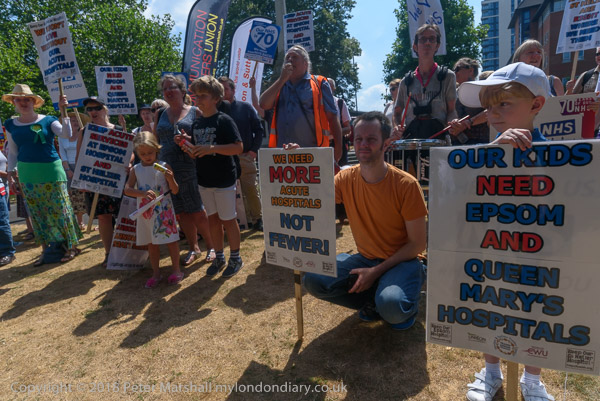
But there were also plenty of placards calling for the local hospitals – St Helier, Queen Mary’s and Epsom to remain open and offering a full range of services.
NHS at 70 - Save St Helier Hospital - 2018

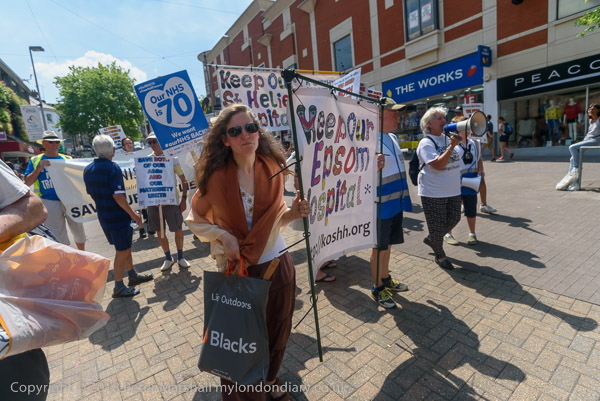
There was a great deal of support shown for the march as it went through the long Sutton High Street, with many shoppers stopping to applaud, and a few joining in the march, at least for a short distance.
NHS at 70 - Save St Helier Hospital - 2018

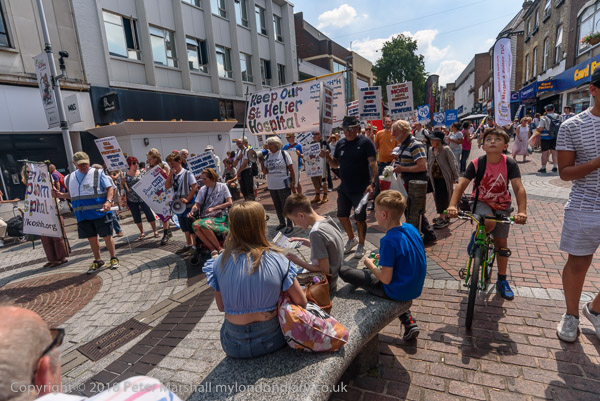
The march stopped at several places in the High Street for short speeches about the plans and the need to oppose them.
NHS at 70 - Save St Helier Hospital - 2018

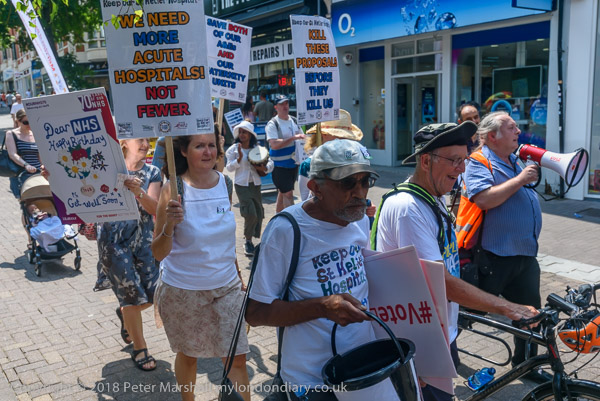
Many on the street seemed surprised to learn their local hospitals were under threat. The death of so many local newspapers – and few of those left are still truly local, publishing largely material unconnected with their local areas, owned by a couple of large national companies – has led to a real lack of reporting of local issues, and many people are now ill-informed on them.
NHS at 70 - Save St Helier Hospital - 2018

The march continued through the huge 1930s estates in the area until finally we were in sight of St Helier Hospital.
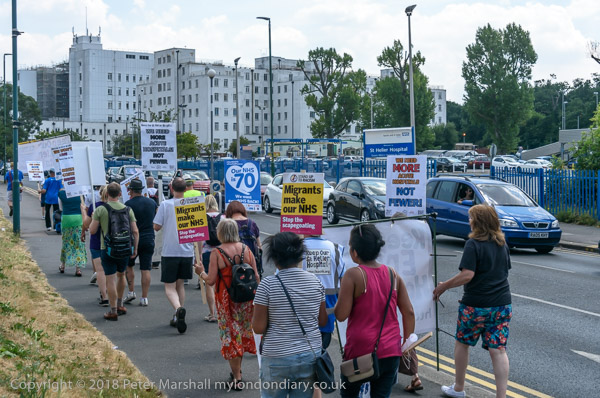
It was a hot day and there was little shade on the route and although it was only around a two mile walk it felt much more.

As we arrived for a rally on the large grass open space in front of the hospital we were greeted by others who had come there, including the National Health Singers who were waiting to sing for us in front of a tent with the message ‘The Clock Is Ticking For Your Hospital’

There were free buns to celebrate NHS 70 and of course speeches by campaigners and people staged a die-in to represent the deaths that would result from the closure of the hospital,
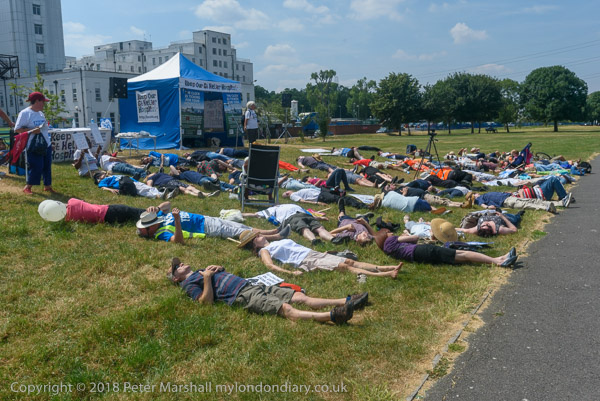
Closure of vital services here or at Epson would leave around half a million south Londoners with much poorer access to NHS services. As I noted, “People would have to travel longer distances through increasingly congested roads to reach full hospital services at St Georges Tooting and elsewhere, a journey which might take 20 minutes when traffic was light but much longer when roads were congested; even in ambulances there would be more dead on arrival or whose condition had seriously deteriorated.”

The plans are a part of a long-term campaign by successive governments to reduce NHS spending and to hand over much of the NHS to private health providers, which is continuing under the current Labour government, many of whose members receive considerable funding from such companies. In February 2026 the BMJ published an article which included the estimate from the Good Law Foundation that then Health Secreatry Wes Streeting “had accepted a total of £372,000 of donations from donors linked to private health between 2015 and 2025.

Despite their long campaign, more services are being removed or under threat of removal from both hospitals as a part of a plan to reduce the number of major acute hospitals in the country. In 2020 the trust was still planning to sell off around two thirds of the current St Helier site, including the Queen Marys Childrens Hospital, Furguson House, the Maternity Unit, Womens’ Health, the renal unit, the teaching block and the large car park.

This year the trust was awarded £57m to improve its emergency ward and is to “temporarily relocate the women’s health block at St Helier” but there are fears locally that maternity services will not return to the hospital.


FlickrFacebookMy London DiaryHull PhotosLea ValleyParis
London’s Industrial HeritageLondon Photos

All photographs on this page are copyright © Peter Marshall.
Contact me to buy prints or licence to reproduce.
Big Lunch Street Party – 2010

Big Lunch Street Party: The Eden project is a visitor attraction built in a disused clay pit near St Austell in Cornwall, its name coming from the Biblical garden and with a mission to celebrate plants and the natural world, reconnect people with them and to regenerate damaged landscapes and give the world a better future.

Big Lunch Street Party:  Sunday 18th July 2010

The Eden project launched The Big Lunch in 2009 as “a little experiment: to see what the transformative effect of getting to know our neighbours might be.”

Big Lunch Street Party:  Sunday 18th July 2010

I was invited by a friend to be with him on Sunday 18 July 2010 as the official photographers at the Big Lunch Street Party in Wrayfield Road in North Cheam, part of a typical 1930s surburban development in what was then Surrey and is now a part of the London Borough of Sutton.

Big Lunch Street Party:  Sunday 18th July 2010

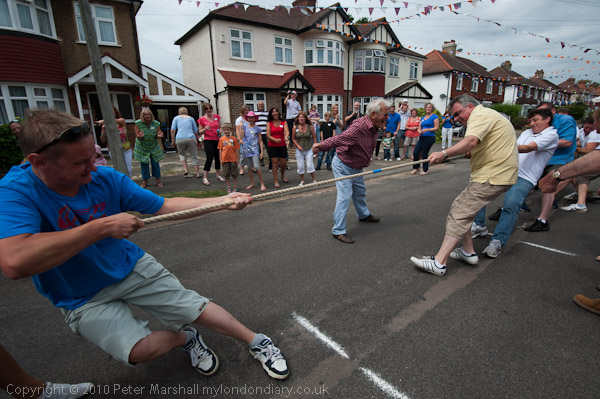
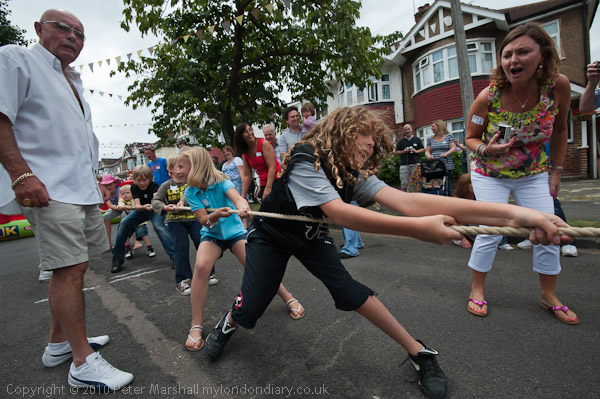
The party started with several tugs of war between teams from the odd and even sides of the street

Big Lunch Street Party:  Sunday 18th July 2010

You can find out more about Wrayfield Rd on Streetscan which reports that though in some respects it is close to an average UK postcode, though having rather more married couples than average in these family homes.

Big Lunch Street Party:  Sunday 18th July 2010
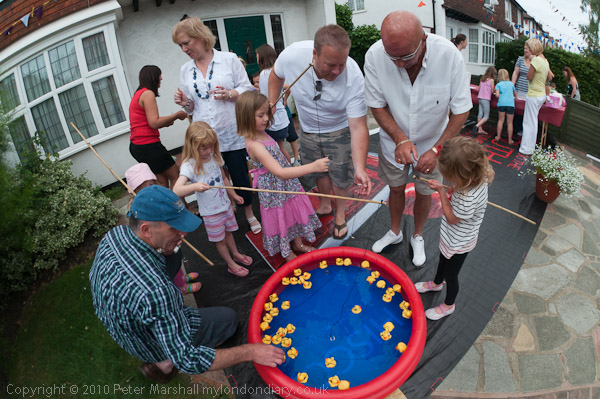
Fishing for ducks was popular with children

People here are healthier than the average and with higher household wealth than 89% of England and Wales with low unemployment and significantly higher levels of self-employment and entrepreneurship. There are low levels of deprivation and it is what I would describe as an affluent outer-London suburb.

Some of those present could remember last street party for the 1977 Silver Jubilee street shown in the pictures on one garden wall

And like many such streets, it is visually rather boring. It’s around a thousand feet long, lined mainly by solidly built semidetached houses, with a few detached properties – a little under 60 homes in all, developed by Warner and Watson Ltd, and completed in 1933/4. More details on the estate and the cost of homes back then on my post in My London Diary – now these houses cost around a thousand times as much. Had they just gone up by inflation they would be around £50,000 but in 2025 you are looking at around £750,000. At least one person who had moved in in 1933 was at the party 77 years later.

Several couples had lived on the street for a very long time

But the event was an interesting one and I’ve written more about it on My London Diary. Getting to know the people who live around you is a good idea and I’m sure things like this help.

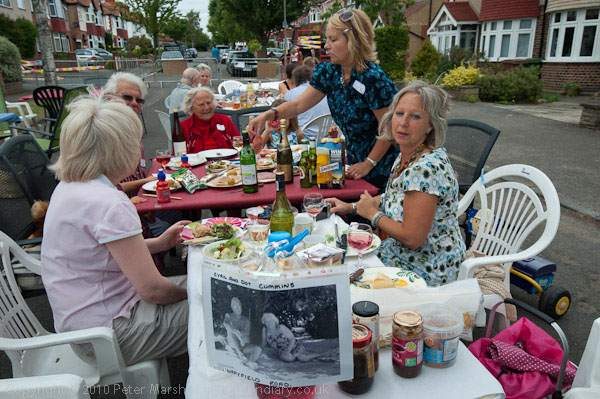
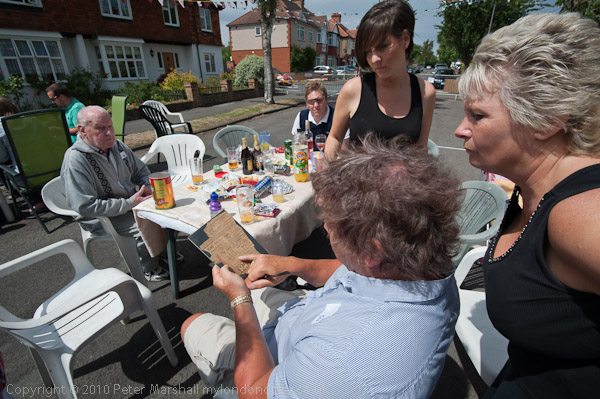
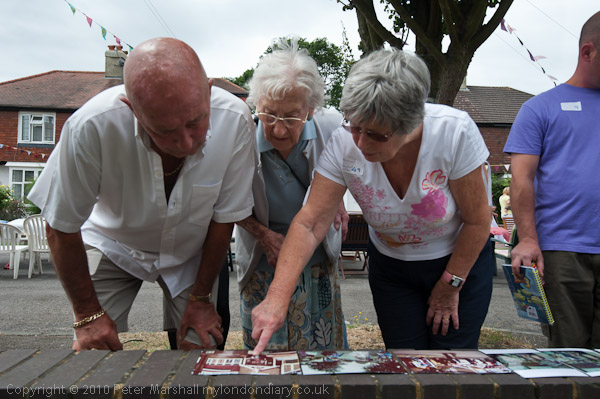
People look at he original newspaper advert for the houses in the street
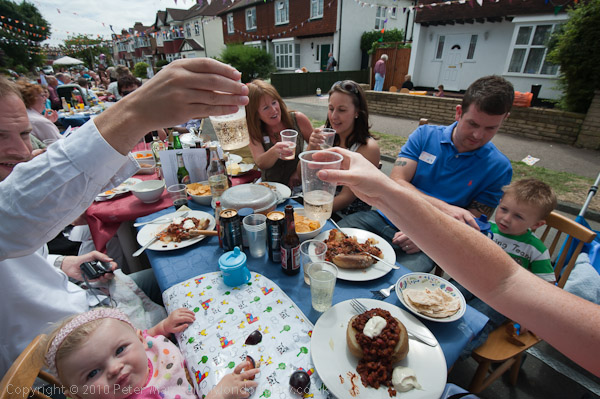
There was plenty of eating and drinking taking place along the middle of the street
A toast
Some bunting
And sun hats were a good idea

The event received sponsorship from some local businesses and organisations – and the fire brigade brought a fire engine for kids to take the driving seat. Th local MP came and spoke, there was a fine singer and as I was leaving a local band came to play. The party was expected to keep going into the night.

A heat of the egg and spoon race.

Text and many more pictures on My London Diary at Big Lunch Street Party.


FlickrFacebookMy London DiaryHull PhotosLea ValleyParis
London’s Industrial HeritageLondon Photos

All photographs on this page are copyright © Peter Marshall.
Contact me to buy prints or licence to reproduce.

Save St Helier Hospital – 7 July 2018

The battle by local campaigners against the closure of acute facilities at Epsom and St Helier Hospitals in south London has been hard fought and illustrates many of the problems faced by the NHS as the government has called for huge savings from hospital trusts, many made paupers by PFI repayments.

The situation continues to develop after the march which I photographed on Saturday 7th July 2018, and in July 2020 plans were approved to build a new smaller Specialist Emergency Care Hospital in Sutton which will bring together six acute services, A&E, critical care, acute medicine, emergency surgery, inpatient paediatrics and maternity services.

The trust say in the documentation for the first phase of public consultation which closed on 30th June 2021 that “85% of current services will stay at Epsom Hospital and St Helier Hospital. There will be urgent treatment centres open 24 hours a day, 365 days a year at both of these hospitals.”

But health service unions and campaigners are worried by the proposals, which they say will strip acute services including two fully functioning A&E departments. The proposed urgent treatment centres will not have the capacity to treat life threatening illness. They say the downgrading of the two major hospitals will endanger the lives of people living in the area.

The new unit is one of 40 across the country which have been announced several times as a part of the governments increased investment in the NHS. Many see this and other similar schemes as being designed to increase privatisation and make involvement in the health service more attractive to healthcare companies.

July 7th was a sweltering hot day in London, and the walk from a park in the centre of Sutton to the St Helier Open Space in front of the hospital went through Sutton High St, fairly crowded with shoppers and then along hot, dusty streets with few people around. Walking was tiring, and taking photographs even more so. It was a difficult event to photograph, where I found relatively little to work with. But I was pleased to be there, supporting the campaign to keep the hospitals open and serving the community, part of a National Health Service that was celebrating 70 years of being brought into existence by a Labour Government.

It took a huge and deterimined fight by Nye Bevan to get the National Health Service Act passed, with Tories denouncing it as bringing National Socialism to the country and opposing it in parliament at every opportunity. But on 5th July 1948 we got the NHS, although almost ever since the Conservative party when in power has been looking for and finding ways to convert it from a universal public health care system to a service run for private profit.

NHS at 70 – Save St Helier Hospital