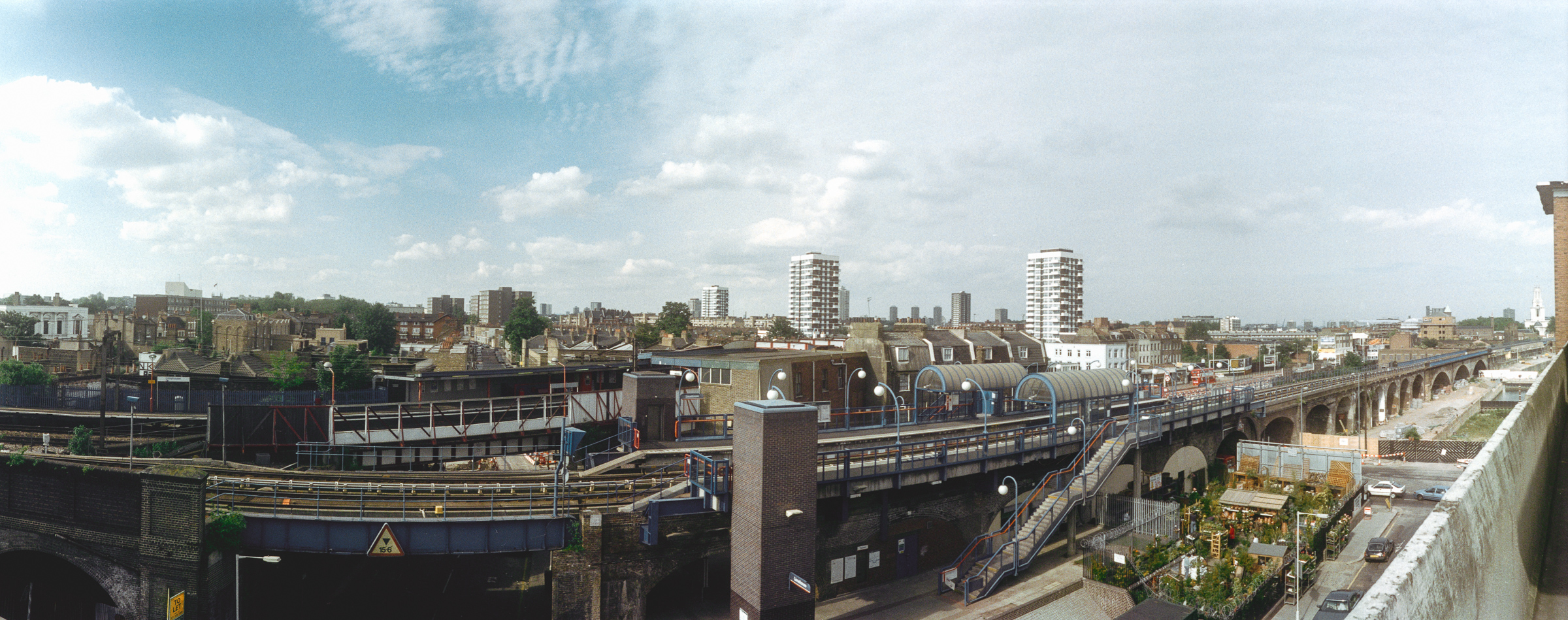
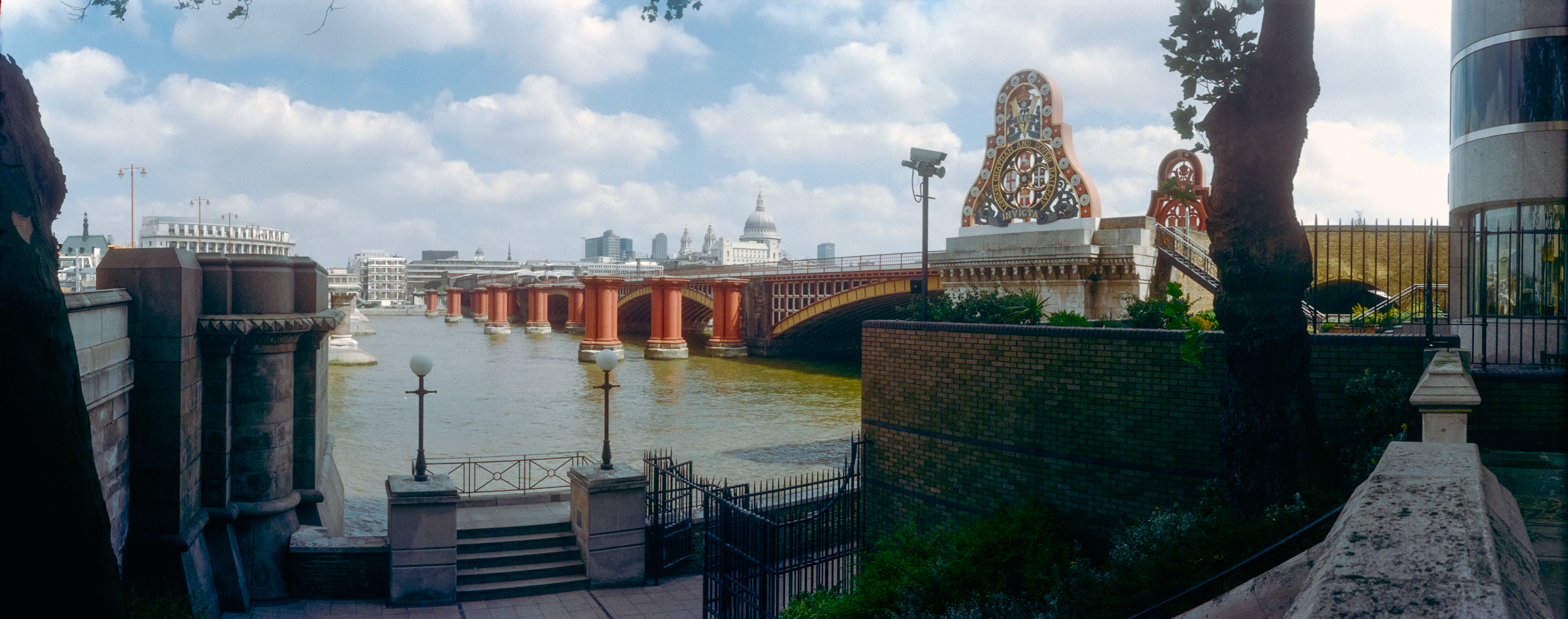
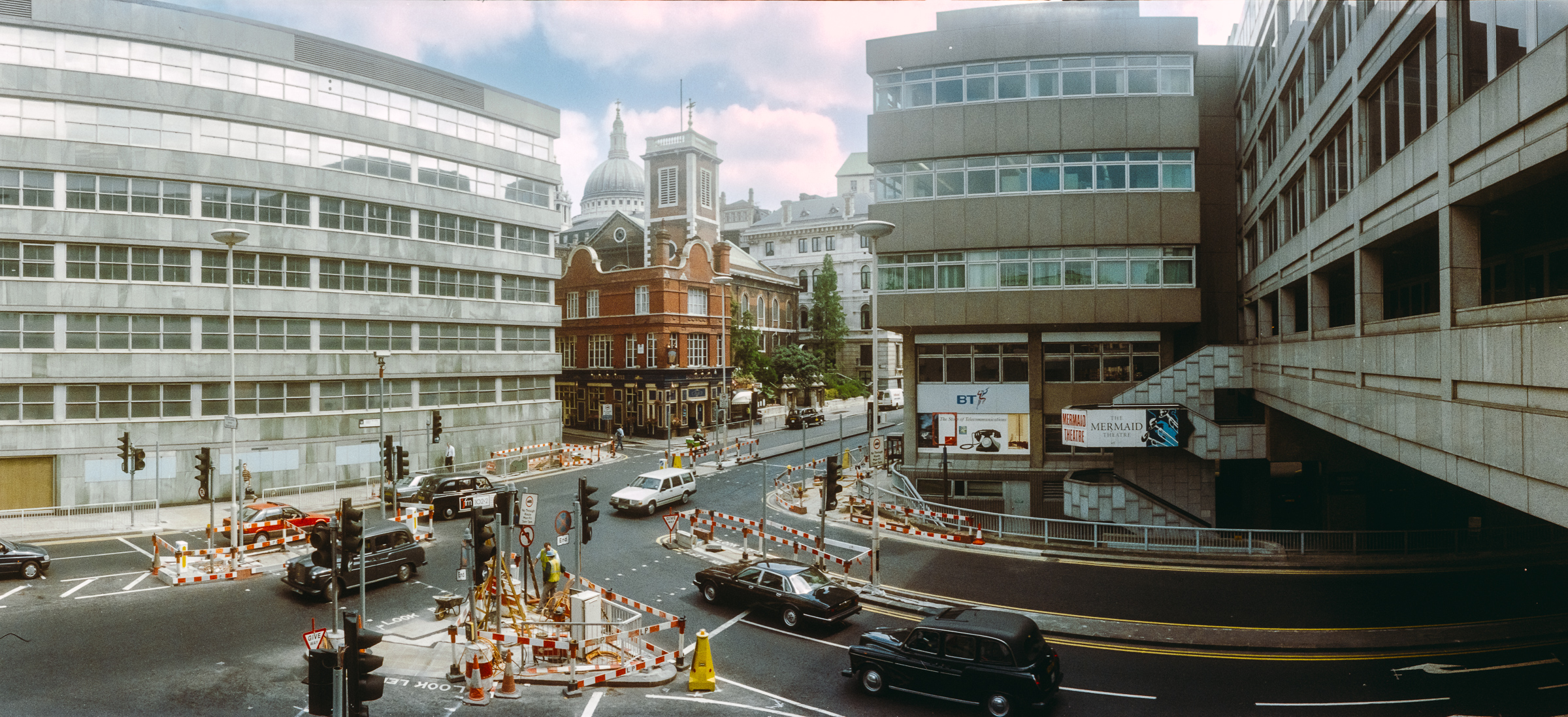
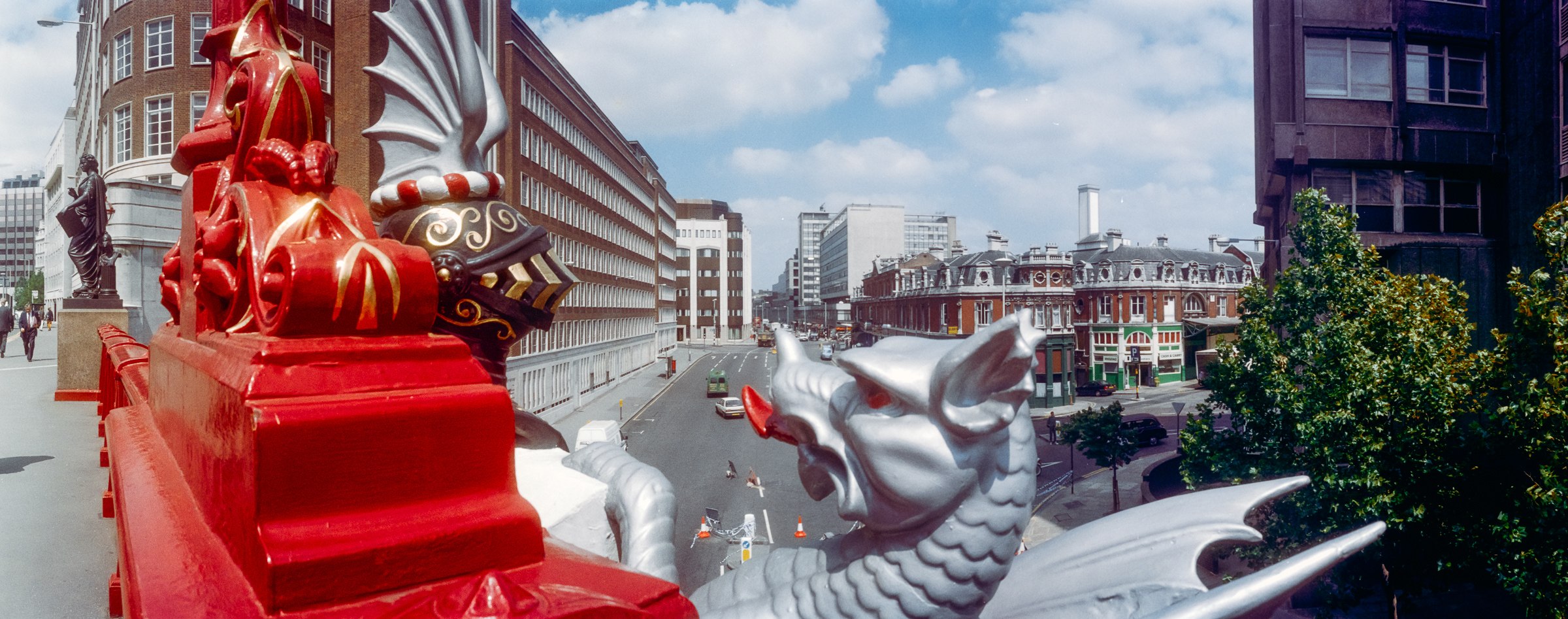
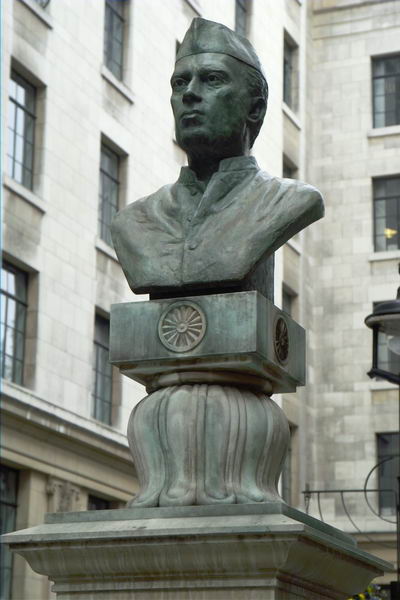
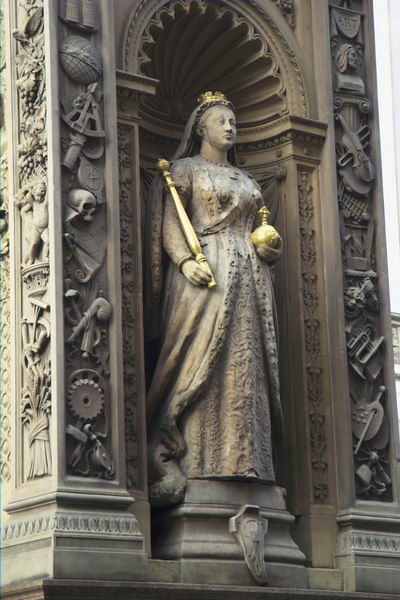
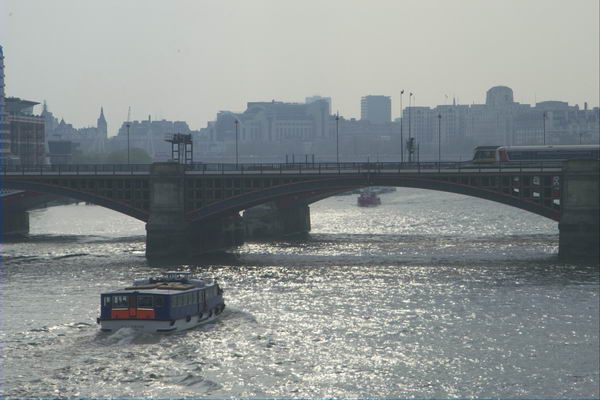
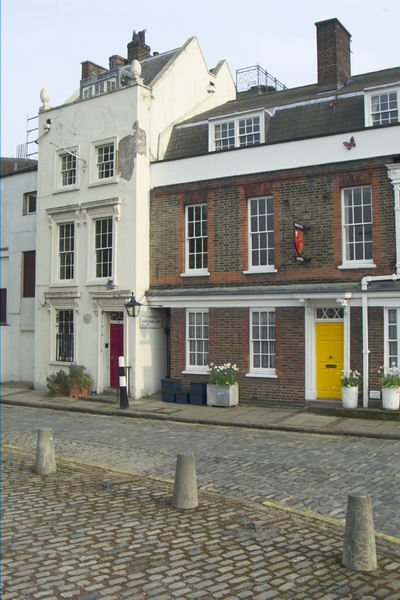
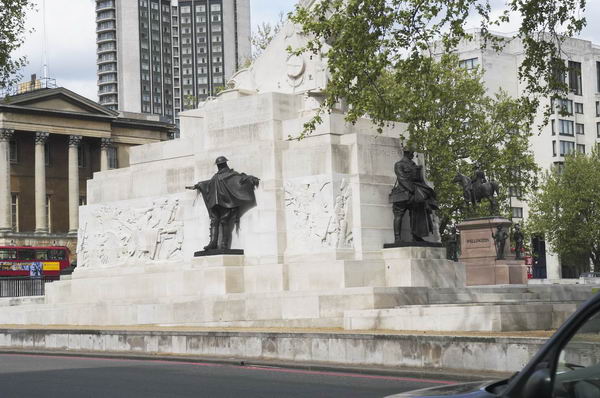
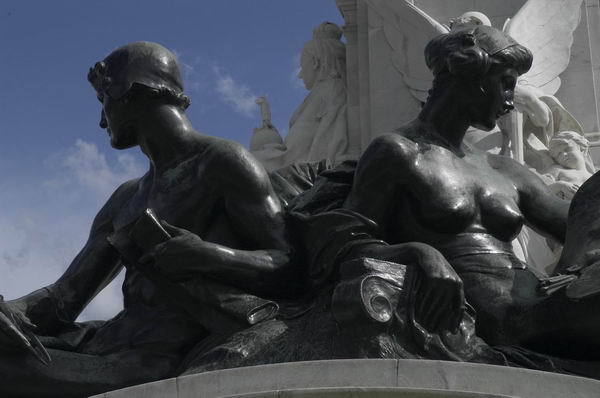
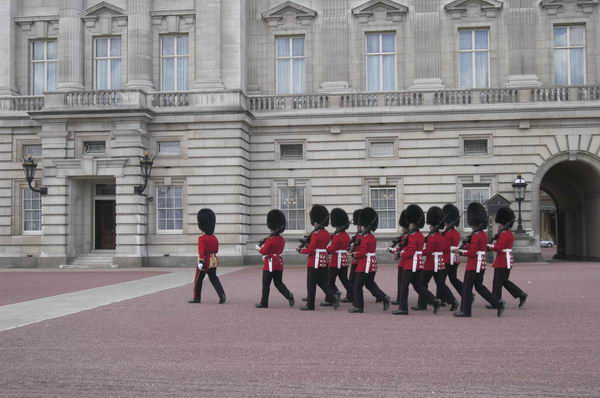
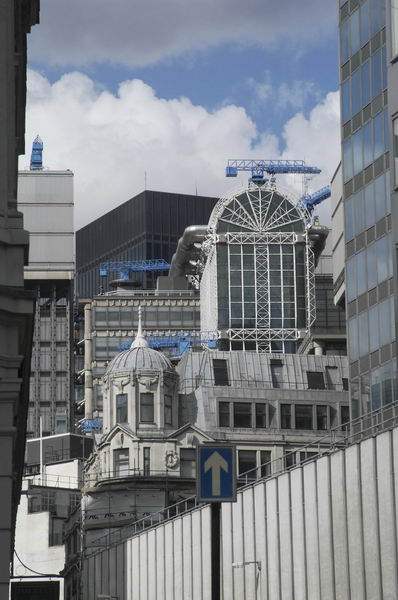
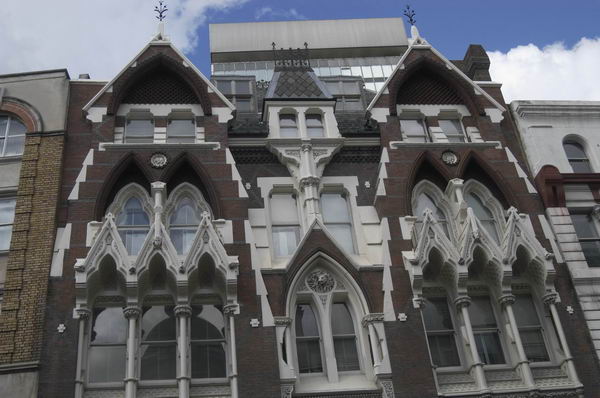
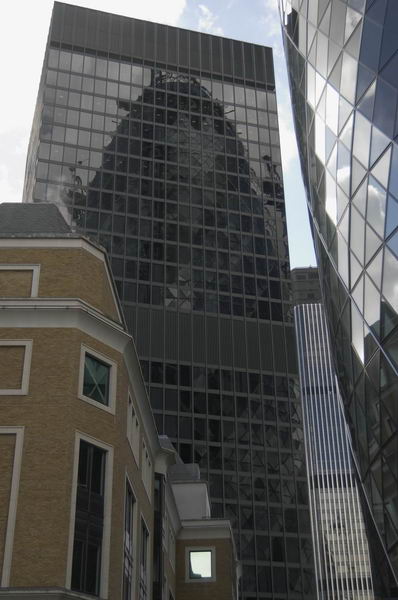
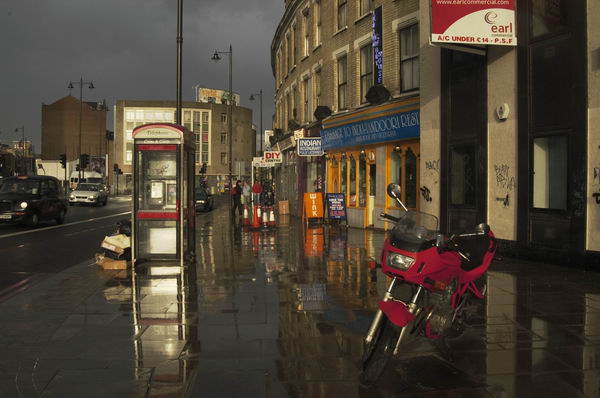
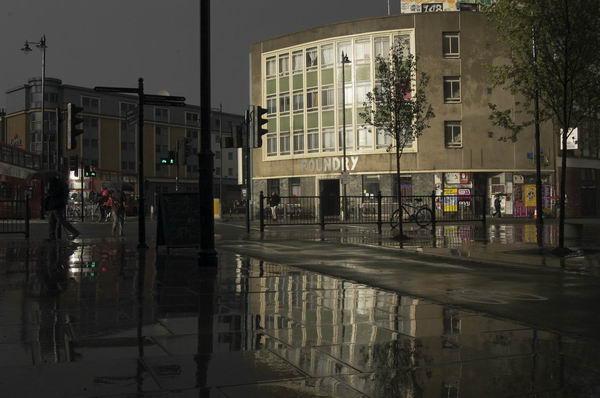
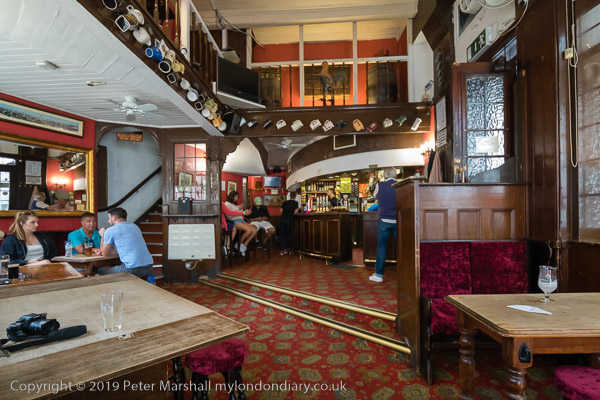
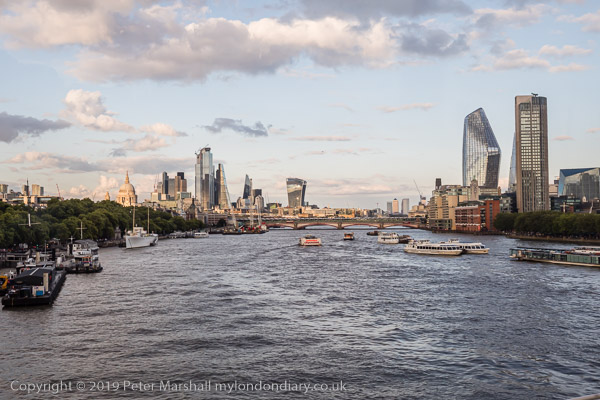
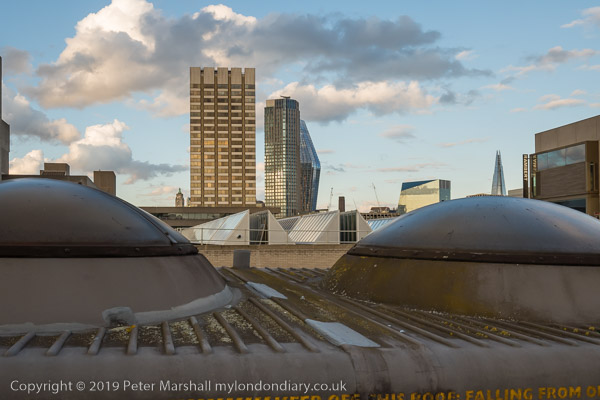
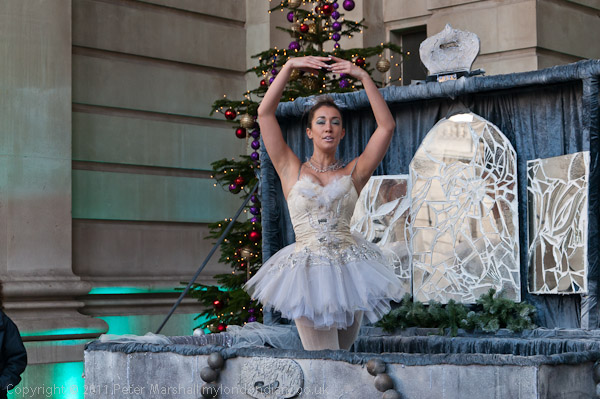
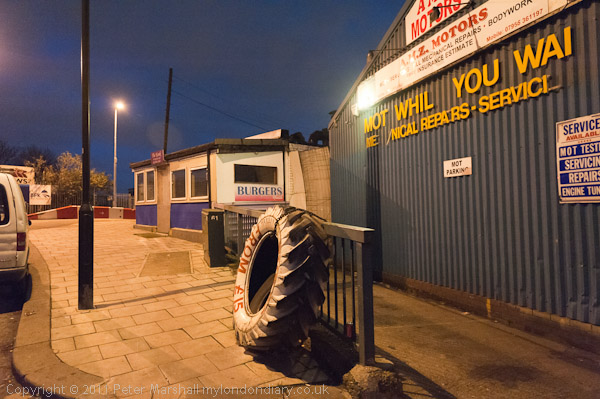
Pictures from London: On Thursday 24th April I had booked to go to an event in the evening and as it was a nice day went up earlier and took a walk around and a few pictures. Some of these along with others taken when walking to, from and between events at around the same date I posted later on My London Diary – without any captions.
Here are some of those and you may like to guess exactly where in London they were taken – some are glaringly obvious, but others are difficult for me now to place, though I think I can still do so.
123456789101112
If you can place all twelve you are doing very well. There are rather more pictures on My London Diary which may provide some more clues. I’ll try to remember to post the answers – I’ve numbered the pictures – in a comment in a few days time if others have not done so.
Visteon, City & Fashion Victims: On Saturday 4th April 2009 I went to protest in support of the Visteon factory occupation in Enfield, came back the the City but missed a protest over the police murder of newsvendor Ian Tomlinson and then photographed a fashion show protest on Oxford Street against the slave-like labour of workers in Bangladesh producing cheap clothes for Primark.
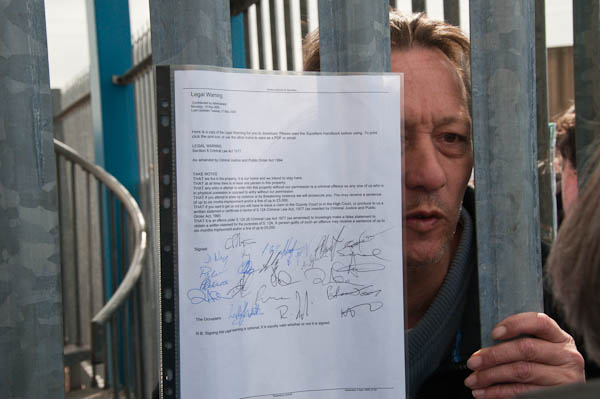
Solidarity at Visteon Enfield
I wrote a few days ago about the Visteon pensions scandal where former Ford workers who were transferred to parts manufacturer Visteon, ‘An Enterprise of Ford Motor Company‘, in 2000 had lost up to half of their pensions when Visteon went into administration on 31st March 2009 when administrators KPMG immediately closed the company down.
An Enterprise of Ford Motor Company, Limited
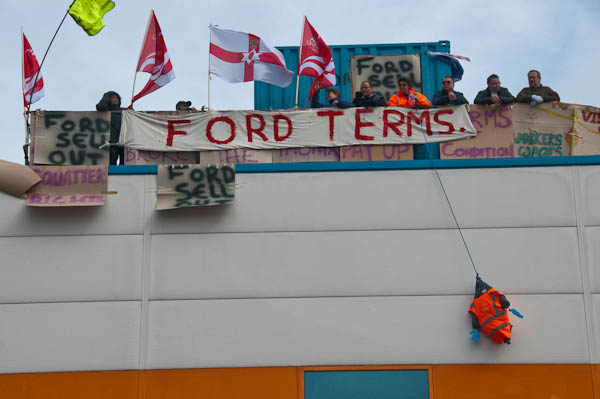
Together with workers at the Visteon Belfast site, the workers at Visteon Enfield had occupied their factories and were refusing to leave until Visteon and Ford made good on the firm promises made in 2000 they had that they would receive the same pensions and redundancy arrangements they had enjoyed previously.
Workers on the roof demand the terms promised by Ford when the business was sold off
Workers in Belfast had occupied their factory immediately after a 5 minute meeting had told them they had lost their jobs and that they had an hour to take any personal possessions and leave work immediately – without pay. Enfield workers occupied their factory the following day.
KPMG’s response was to go to the courts and secure a court order for repossession, while Ford simply denied all responsibility in the matter (though five years later were eventually forced by Unite to pay some compensation.)
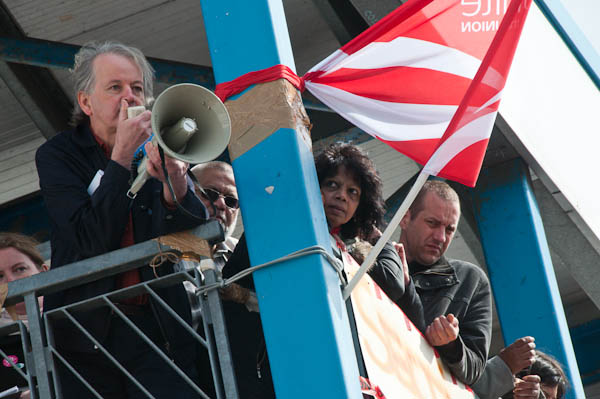
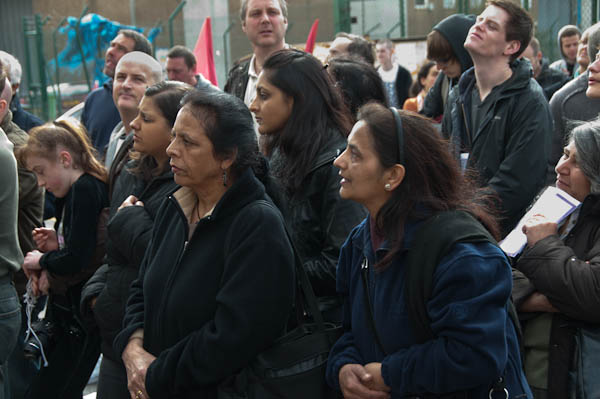
I went to the factory at Ponders End, Enfield along with several hundred other trade unionists and others for a rally outside the plant to show our support for their case. A number of those who spoke at the rally had organised collections for the occupiers in their workplaces, reporting unanimous support for the dismissed workers, and others had also brought practical support – sleeping bags, food and money – to enable the occupation to continue.
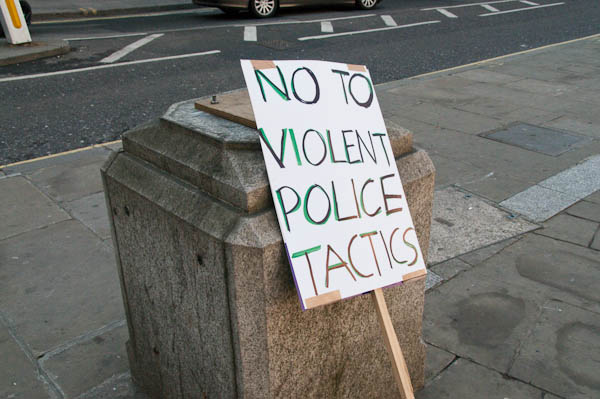
I was later than I had hoped by the time my train from Ponders End reached Liverpool Street and had missed the rally at Bank in memory of the news vendor Ian Tomlinson who died of a heart attack minutes after being attacked and violently pushed to the ground in an unprovoked attack by a riot policeman, dieing from a heart attack minutes after. The murder had been captured on video by an onlooker and The Guardian had published the video – still on their web site.
After the rally the protesters had marched away – and I could see and hear a police helicopter following them on the way towards Bethnal Green. I didn’t have time to try and catch up with them, but wandered through some of the streets in the City, including some that Tomlinson had wandered through as he tried to make his way home through the area where police were kettling and attacking the April 1st Financial Fools Day G20Meltdown protesters. On 4th April those streets were empty.
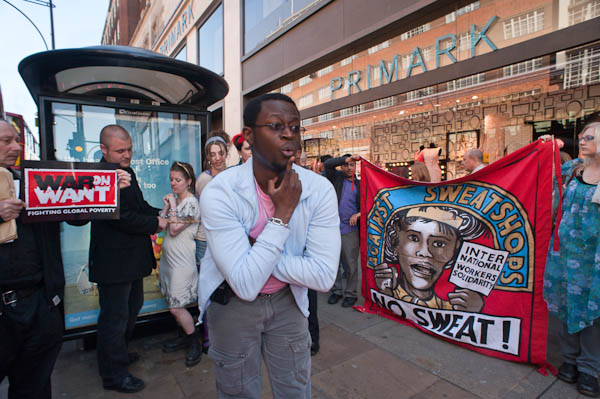
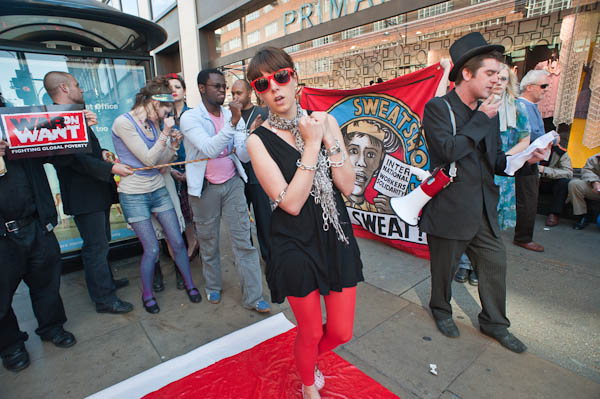
War on Want and No Sweat were drawing attention to Primark profiting from selling clothes made by sweated labour in Bangladesh with a ‘fashion show’ outside the company’s flagship Oxford Street store.
Models used the pavement as a catwalk, walking in chains “to symbolise the slave labour conditions of the Bangladeshi workers who make the cut-price fashions on sale at Primark. Workers who make the clothes earn as little as 7p an hour and work up to 80 hours a week.”
The Primark store opened here in 2007 and flourished as the recession made people turn to cheaper suppliers with their profits in the year to September 2008 up by up by 17% at £233 million.
Notices in the store windows claimed they “care about the conditions of the workers who make their clothes, but the reports by War on Want tells a very different story. These clothes are only cheap because those who make them get poverty pay, work long hours and get sacked if they try to organise or ask for improvements in their dangerous and unhealthy working conditions.”
Although the links on the My London Diary post are now out of date, War on Want are still campaigning for garment workers around the world including in Bangladesh, as are No Sweat.
In 2009 I commented:
Primark and others could still have a moral and reasonably profitable business if they restrained their greed and ensured that the workers who make their clothes worked in reasonable conditions and got a living wage – which in Bangladesh is only around £45 a month. But that is over three times what workers making clothes for Primark are currently paid.
Primark’s profits continue to rise, and although it claims it has “improved working conditions and implemented ethical initiatives, reports and investigations suggest that worker exploitation in its supply chain, including issues like low wages and unsafe working conditions, unfortunately still persists” according to Google’s Generative AI.
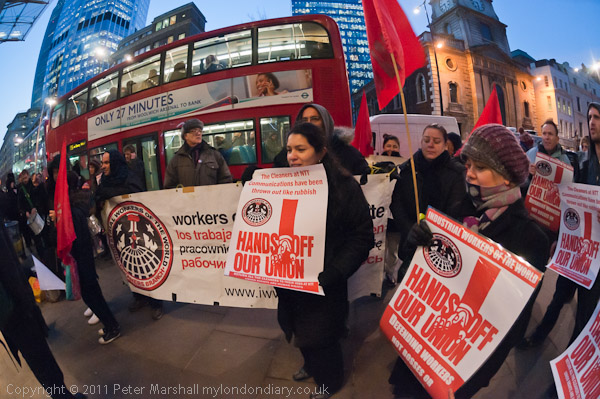
IWW Demand ‘Reinstate Alberto’, Occupy & London: On Friday 10th February 2012 I came to London to photograph a rush hour protest calling for the reinstatement of an office cleaner sacked for his union activities. I came early to wander a little from Waterloo and pay a visit to Occupy London on the way there, and also took a few pictures on my way home after the protest.
Cleaners were protesting outside the 230 metre tall Heron Tower (now Salesforce Tower) at 110 Bishopsgate, completed in 2007 when it then was the tallest building in the City of London.
Alberto Durango speaks outside Heron Tower
The protest called for the reinstatement of IWW Branch Secretary Alberto Durango who had been sacked, victimised for his trade union activities, after the cleaning contract for the building had been taken over by a new contractor, Incentive FM Group Ltd.
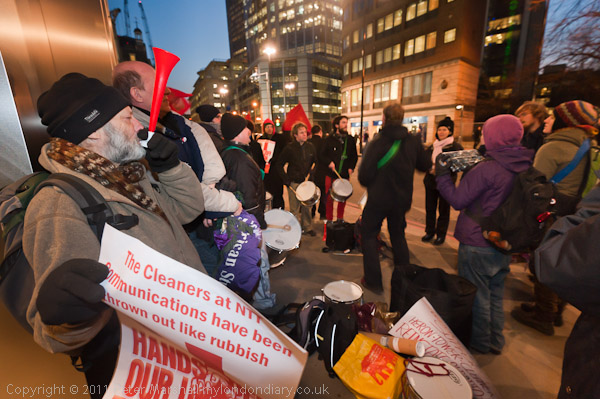
NTT Communications threw out their cleaners “like rubbish” because they organised and joined the union
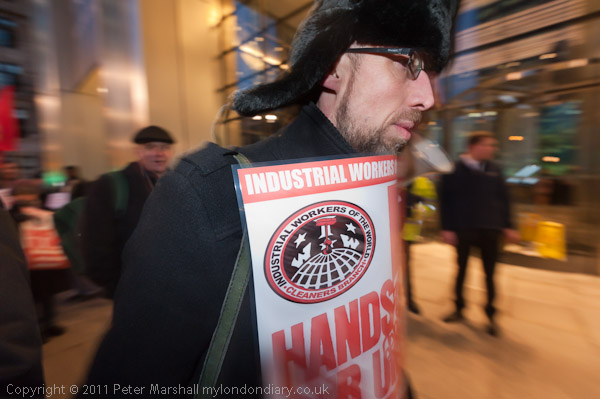
Alberto who worked as a cleaner in the Heron Tower had become well known for his campaigning activities in and around the City of London, which have helped to secure better working conditions and the London Living Wage for many of the cleaners who work in London’s prestigious offices. He was then the Industrial Workers of the World Cleaners and Allied Trades Branch Secretary and in 2011 had won the fight for workers at Heron Tower to be paid the London Living Wage and an agreement with the then employer that there would be no redundancies there with any staff reductions needed being made by transfers to alternative posts.
Under the Transfer of Undertakings (Protection of Employment) Regulations (TUPE) the new employer should have continued to recognise this agreement. Instead they refused to do so and picked on Alberto, making him redundant.
The same management also controlled Exchange Tower where the IWW were carrying out a campaign to get cleaners the London Living Wage and where they have taken a very aggressive stance against the union, threatening the union members. The protesters connected Alberto’s sacking with his role there as union Branch Secretary.
This was a very loud protest with speakers using a powerful megaphone and drummers from Rhythms of Resistance adding their loud beats as office workers from Heron Tower and the many other offices in the area were making their way home in the evening rush hour.
The pavement outside the area owned by Heron Tower on Bishopsgate is relatively narrow and police rightly insisted that there needed to be a clear route along it for workers to get past without having to step into the busy road. So my 15mm fisheye lens was extremely useful, though it does make the area look much more spacious than it was.
In February the protest began a quarter of an hour after sunset, and light was fading fast. Although the City streets are generally well light both from street lighting and by the light from the huge areas of glass on the front of modern buildings I used added lighting for many of the pictures, either with a hand held LED light or flash on camera. But neither light source can cover the 180 degree diagonal view of the fisheye and those pictures rely on available light only. Its f2.8 maximum aperture helped – and it was a stop faster than the wide-angle zoom used for almost all the other images. In some at least of the pictures I think the fish-eye effect works well too.
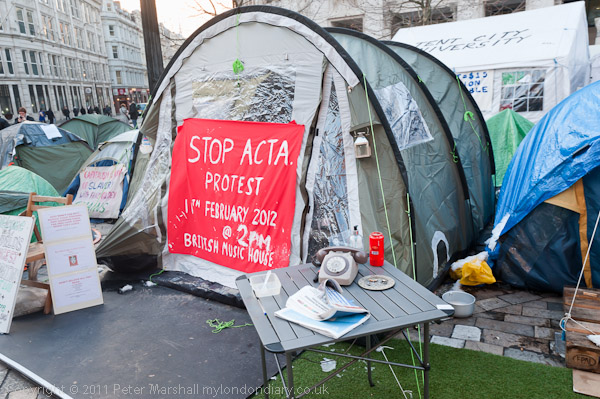
Occupy London & Other Pictures – St Paul’s Cathedral
Although there were still plenty of tents in St Paul’s Churchyard as I walked through they were all tightly closed and the occupiers were still out protesting the music anti-piracy proposals at the British Music House in Soho.
I was a disappointed at not meeting any of them, although I hadn’t arranged to do so and it did allow me to take a few pictures of the site without any distractions, though by the time I’d wandered there taking a few pictures on the way including from the Millenium footbridge I was in a hurry to get to the Heron Tower.
After the protest at the Heron Tower I took a bus back to Westminster and made a few pictures in the subway leading from the station to the Houses of Parliament and under the Emabankment towards the Thames before walking across the bridge and to Waterloo Station.
Stop Fossil Fuel Dirty Money takeover of US: The headline I wrote for the events of Wednesday 7th November 2012 could well have been written for this year’s US elections where Trump’s whole career in politics has been supported by fossil fuel companies.
Huge lobbying by these companies and a deliberate campaign of misinformation and pseudoscience, financing studies which cast doubt or contradict the scientific consensus of global warming happening because of fossil fuel use has resulted in US governments not taking effective action against these polluters.
According to the chairman of the U.S. Senate Budget Committee, the Republican Party is controlled by the fossil fuel industry and as well as huge subsidies also gets “the license to pollute for free.”
Under the Democrats the US has finally taken some limited action with promises to phase out fossil fuel use but the government in 2022 still supplied around $15 billion a year in subsidies to the industry.
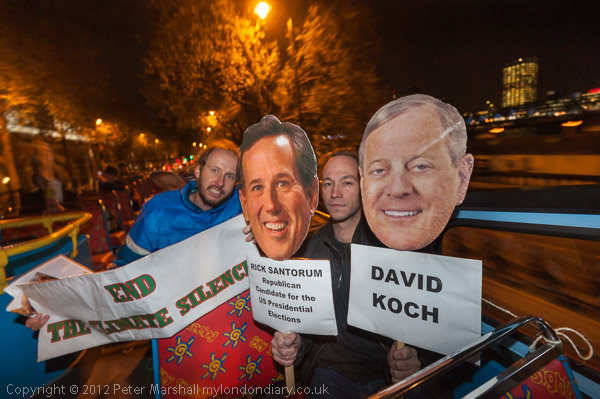
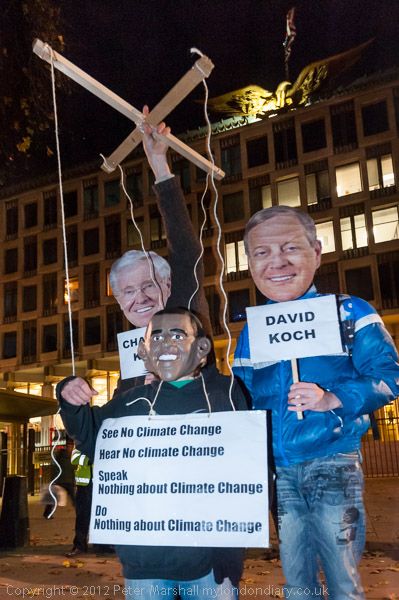
The protest in 2012 was calling on President Obama “to stand up against the lobbying, dirty money and media lies funded by the Koch brothers and other fossil fuel companies.” He didn’t.
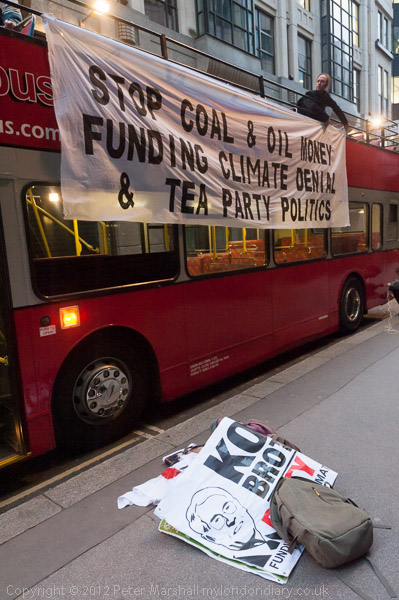
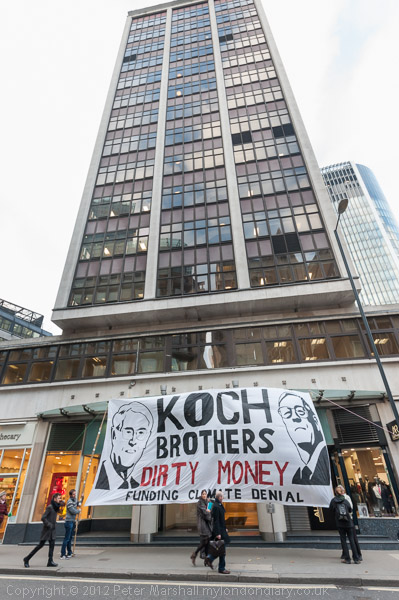
You can read more about the protest, which began outside the London offices of the Koch Brothers, Koch International in Fenchurch St at the heart of the City of London with a huge banner ‘KOCH BROTHERS – DIRTY MONEY – FUNDING CLIMATE DENIAL’ on My London Diary.
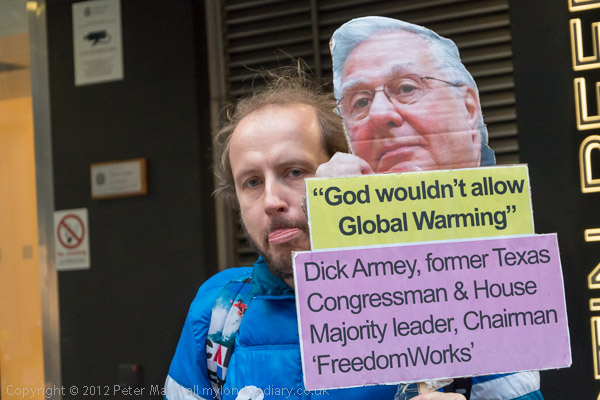
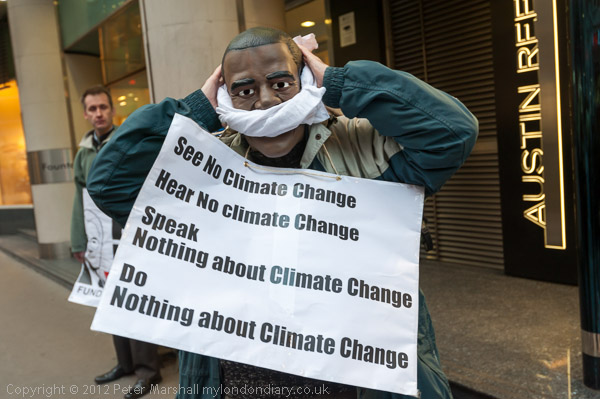
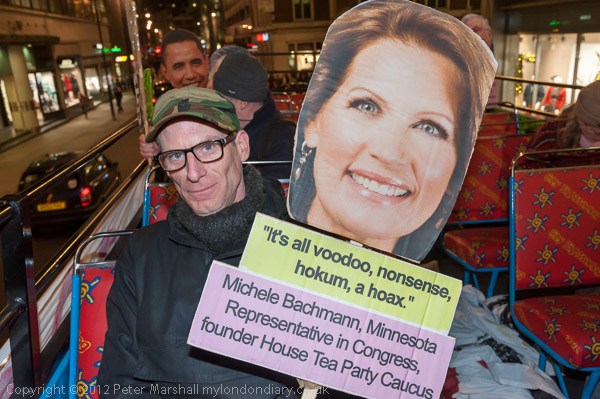
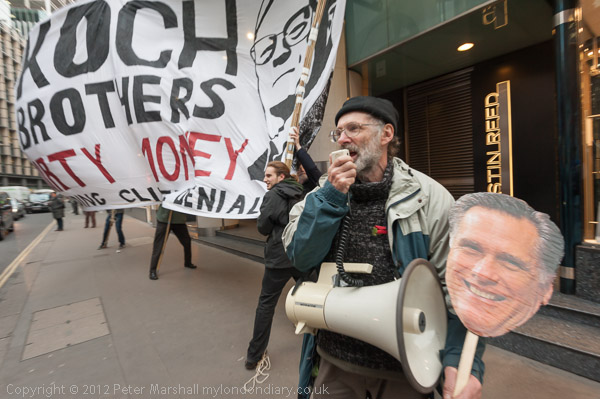
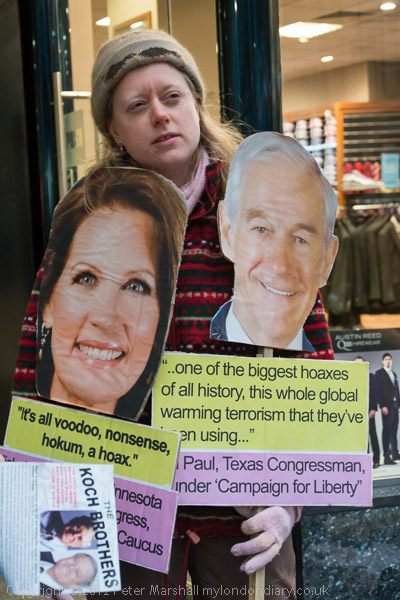
A high wind made it difficult to hold up the banner while the protest continued with speeches. But the big banner certainly attracted a great deal of attention, though soon they had to take it down as it became impossible to hold. But there were plenty of placards showing heads of prominent US right wing politicians and media commentators, each with their names and some ridiculous quotations related to climate change, as well as those of Obama and Romney and the two Koch brothers, along with some smaller banners.
There was another big banner of the side of the open-top bus which the Campaign Against Climate Change had hired to take the protesters to the US Embassy.
I went with them for what was probably the most uncomfortable bus journey of my life. It was cold in the strong icy wind and the bus bumped and lurched ridiculously.
It was hard to keep standing as I took pictures and I had to hold on with one hand all the time, using the other to take pictures. There wasn’t a great deal of light and getting sharp pictures at 1/30 f4 (full aperture for my wideangle zoom) was difficult with the bouncing and vibration of the bus.
Somehow I managed, and Phil Thornhill managed to to use the megaphone, at least during some of the halts in traffic. But I was very pleased (and very frozen) when we arrived and got off the bus in Grosvenor Square.
Police at Grosvenor Square tried to herd the protesters into a small pen in a dark corner, but they refused and were finally allowed to go in front of the locked main entrance gates, with those faces and their quotations peering over the hedge from the gardens behind the main actors and speakers.
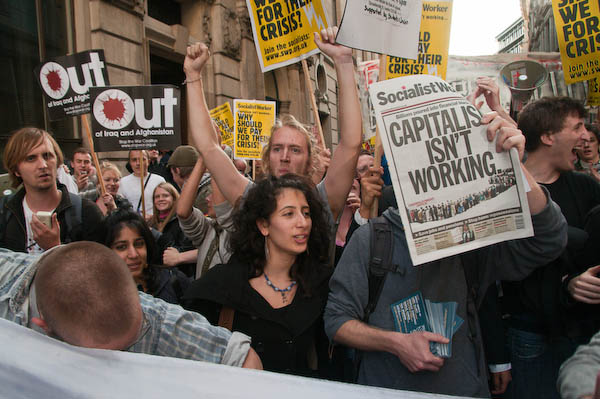
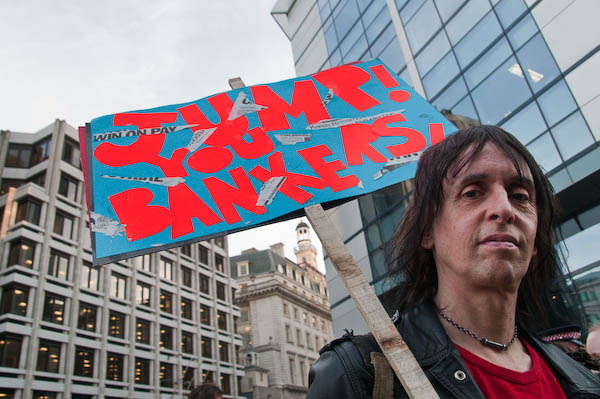
March on the City: On Friday 10 October 2008 several hundred anti-capitalist protesters, mainly students, took to the streets of the City of London to say “We Won’t Bail Out the Bankers’.
The financial crisis had started in 2007, but reached a climax with the bankruptcy of Lehman Brothers on September 15 2008 which precipitated an international banking crisis.
Wikipedia sets out the causes of the crisis in some detail, but essentially US banks had been allowed to make more risky loans by changes in US laws which loosened regulations and allowed banks to take part in high risk operations such as proprietary trading and investment banking.
In the US one result of this was the proliferation of mortgage loans to people on low incomes who could really not afford the repayments and eventually defaulted. The problems with ‘subprime mortgages‘ particularly given to many in minority communities in the USA came to a head as a boom in US house prices in the early 2000s was followed by a sharp drop in the value of properties which were the security for the loans.
As Wikipedia comments, “governments deployed massive bail-outs of financial institutions and other palliative monetary and fiscal policies to prevent a collapse of the global financial system.” This resulted in the widespread feeling that those who had created the crisis were being rewarded for their failures.
In the UK, the New Labour government under George Brown made a massive financial intervention, paying £137 billion to the banks in loans and new capital, some of which was later recouped, but leaving a cost of £33 billion. While some support was necessary to avoid a total breakdown of the financial system, many felt that the government should have taken a firmer line and that those responsible should have had to pay for their mistakes and not to seem to have kept their highly paid jobs.
Both Northern Rock – the first UK bank to fail in July 2007 and Bradford & Bingley were taken into public ownership, and RBS/Nat West into majority public ownership. But RBS still ended up costing us £35.5 billion – and the leading bankers still ended up getting huge salaries and big bonuses. The Royal Bank of Scotland seemed to be getting off scot free.
Part of the problems we still see in financial markets came from changes worldwide in the way that trading now takes place. In the UK Margaret Thatcher had brought in the ‘Big Bang’ which abolished traditional practices and introduced electronic trading, greatly increasing volatility.
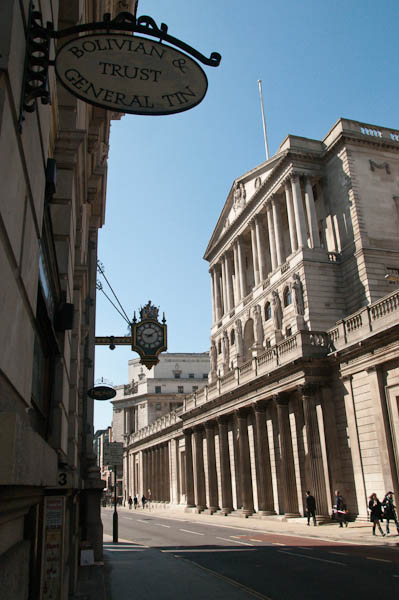
On My London Diary I give a fairly full account of the actual protest which started at Bank where some protesters tried to storm into the Royal Exchange – long just a prestige shopping centre – and the Bank of England but were easily stopped by police.
There then followed a slow march around parts of the City, with police attempting to stop them at various points and the marchers pushing their way through police lines.
As my pictures show, there was some rather forceful policing at times and some of the press also suffered with the protesters. As I write, “I got a few bruises and my glasses were damaged when police rushed in as I was taking pictures in Lombard St.” But there was none of the confrontational use of trained riot squads that have led to extreme violence at some protests policed by the Met. Policing here was by the City of London Police – along with a guest appearance by one French cop.
Eventually there was a short rally with a few speeches on the corner of Bishopsgate and London Wall after which the demonstrators dispersed. Police seemed fairly relaxed at the end of the protest and I saw no arrests.
I don’t think the protest got much if any coverage in the mass media and most accounts I read on-line were confused, with many suggesting it went to the Stock Exchange. While that might have been a logical place to protest, the marchers actually went in the opposite direction.
A Walk in the City: Take a walk around parts of the City of London with me and my camera five years ago on Wednesday 7 Aug 2019. The first part of the walk I was on my own, but later I met up with a couple of friends and we continued to walk around but visited several interesting City pubs before ending up with a meal at what must be the worst Wetherspoons in Greater London at Cannon Street Station. Though I suppose it’s handy if you want to catch the train.
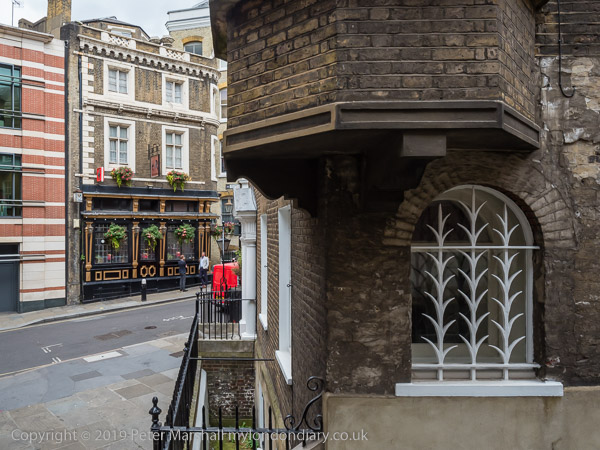
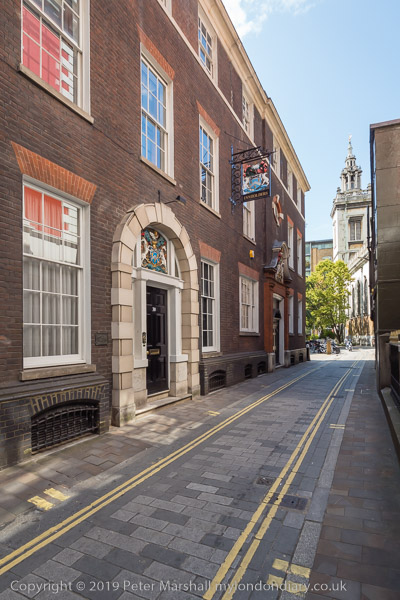
I’d taken a bus from Waterloo to the City and got off at St Paul’s and walked down to St Andrew’s Hill where I wanted to retake digitally an image I had made on film over 30 years ago.
Taken from the steps of St Andrew’s by the Wardrobe Church, the view of St Andrew’s Hill and the Cockpit pub was a taxing subject on film with the foreground in Wardrobe Terrace, and I never quite managed what I wanted. Using digital gave me a rather better result with no problems.
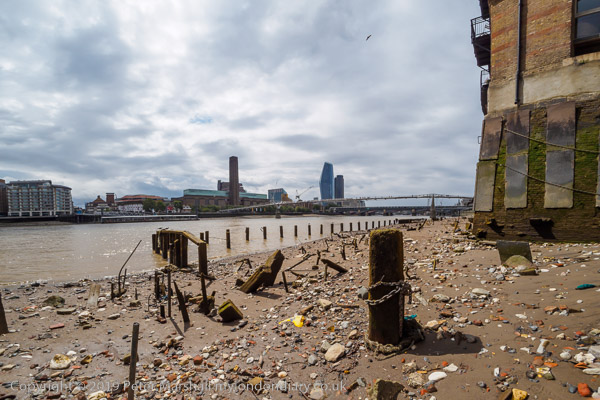
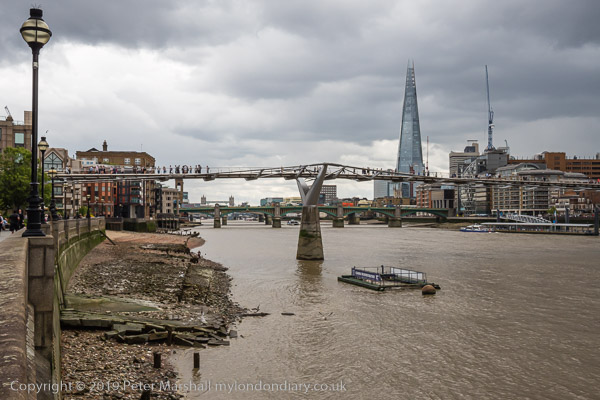
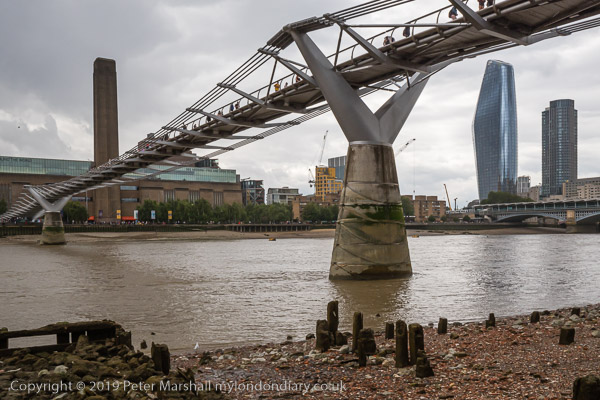
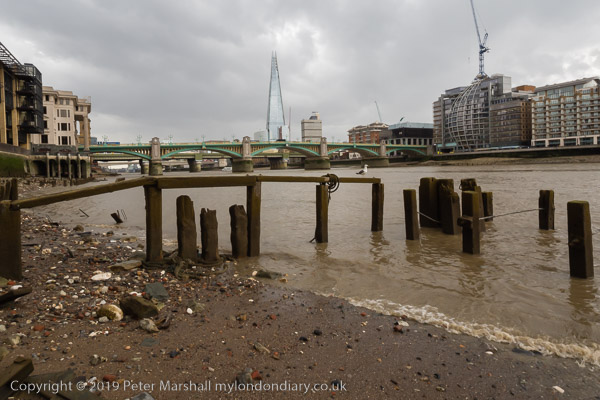
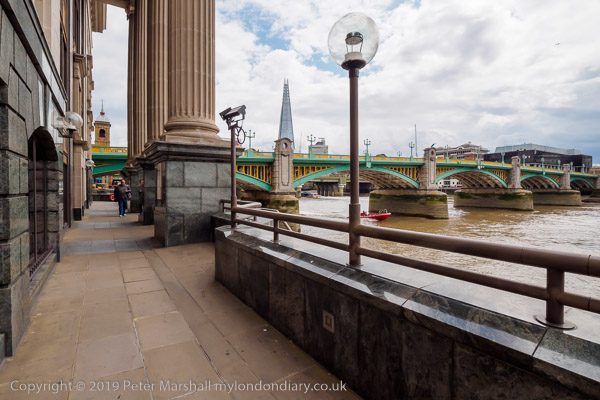
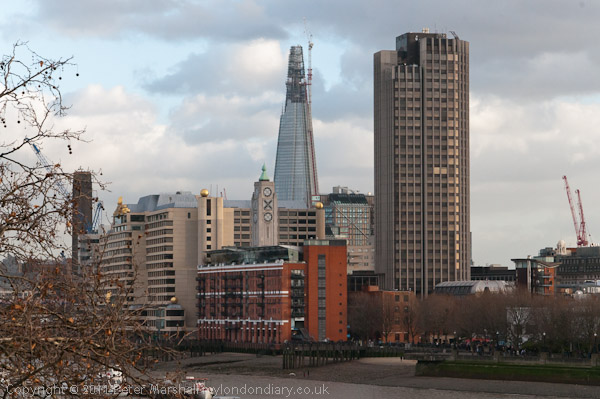
I walked on down to the River Thames and made some views along the river with the Millennium footbridge and the Shard now rather dominating the scene.
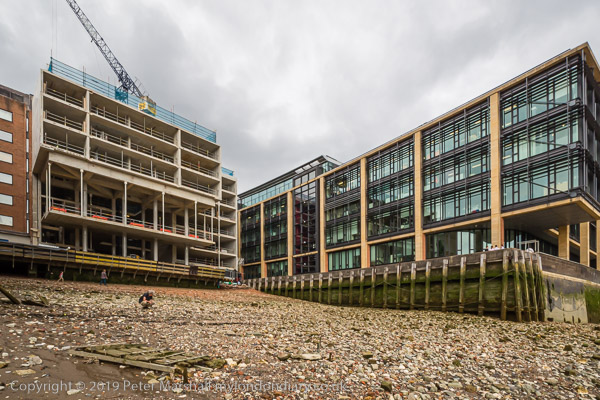
The tide was very low and I went down the steps onto the foreshore, though I needed to be careful walking on the stones and mud as I was only wearing a light pair of shoes which were very much not waterproof. I walked along under the Millennium Bridge and on towards Queenhithe, taking quite a few pictures.
The foreshore can be dangerous and the tide comes in rapidly. Although anyone is free to visit it, searching in any way – metal detecting, ‘beachcombing’, scraping and digging etc requires a https://pla.co.uk/thames-foreshore-permits PLA permit. You are advised to wear sensible footwear and gloves – which of course I wasn’t – and to watch out for hazards including raw sewage, broken glass, hypodermic needles and wash from vessels. I stepped very carefully.
Buried below the sand and mud at Queenhithe are the remains of part of London’s Roman harbour and the later medieval quay. A scheduled ancient monument, it is probably the only existing Saxon harbour in the world, presented by King Alfred the Great in 883 AD to his brother-in-law Ethelred. It got the name Queenhithe later when the harbour dues became the property of the wife of Henry I, Queen Matilda. The dock was still in use mainly by the fur trade in the early 20th century, and there were still fur shops in the area around in the 1970s.
I didn’t stay long on the foreshore and couldn’t remember where the next set of steps up from it were, so went back onto the Thames Path where I had come down and walked east towards Monument Station where I was meeting two photographer friends.
One of my friends had planned this walk and I was just a little surprised to find we were going back to one of the places I had visited earlier, St Andrew’s Hill, though less surprised when we went into the Cockpit pub.
The pub is on a historic site, originally part of one of the gatehouses of Blackfriars Monastery. There was a pub here when Shakespeare bought a house nearby. And undoubtedly there was somewhere here where cock fights took place until cockfighting was banned – along with dog fighting, bear baiting and badger baiting – in 1835. But this is a Victorian theme pub, rebuilt around 1865, though some at least of its interior decoration almost certainly came from actual cockfighting venues. But punters never stood in the closed galleries here to watch fights. Now firmly on the tourist circuit it is still worth a visit, if just for a pint of Harvey’s Sussex Best Bitter.
Our walk continued through more of the streets in this area and then across New Bridge Street and on to Bride Lane and St Bride’s Passage and The Old Bell Tavern, once very much part of Fleet Street, the Street of Shame. The Old Bell Tavern is on the site where it all started, when in 1500 Wynkyn de Worde who had worked with William Caxton set up the first print shop on Fleet Street. The building is apparently derived from one that Christopher Wren knocked up for his masons when they were building St Brides, the journalists’ church.
Our walk more or less finished there, though we took a bus to Cannon Street Station for cheap food at the Wetherspoons, though I found it very disappointing. Spoons do much better almost everywhere else. I caught a bus from St Paul’s Churchyard, sat in the front seat on the top desk and it had unusually clean windows so I took a few more picture on the way back to Waterloo.
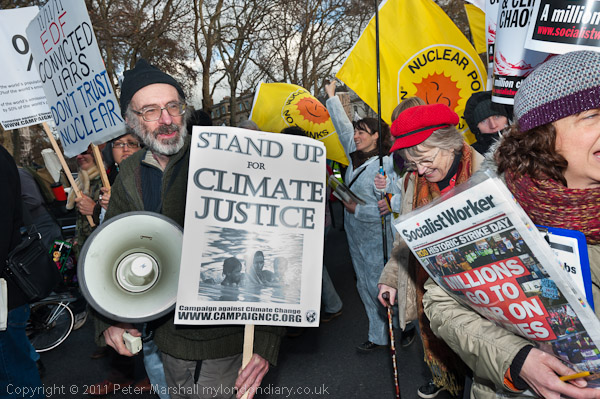
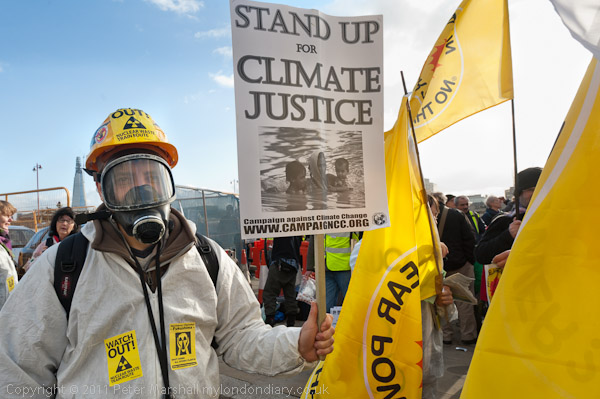
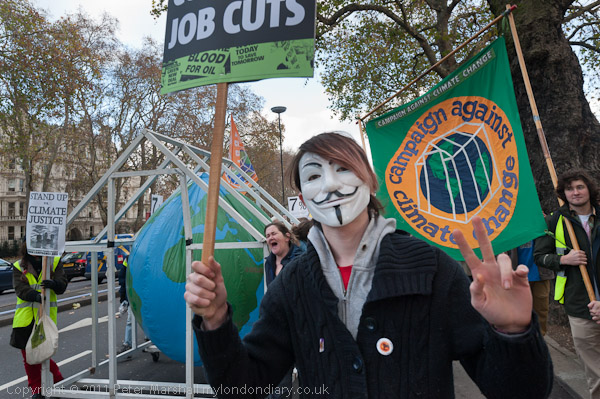
Climate Justice, Congo & London – On Saturday 3rd December 2011 there was an Xmas shopping event in the City, normally pretty dead at weekends and Occupy were holding climate justice workshops before joining Campaign Against Climate Change’s annual march. That took me past a protest at Downing Street against the vote-rigging in the recent election in the DRC. I’d taken some pictures earlier as I was going around London and took a few more in the dark later on my way to an event in Acton.
City Xmas Celebrations – Bank
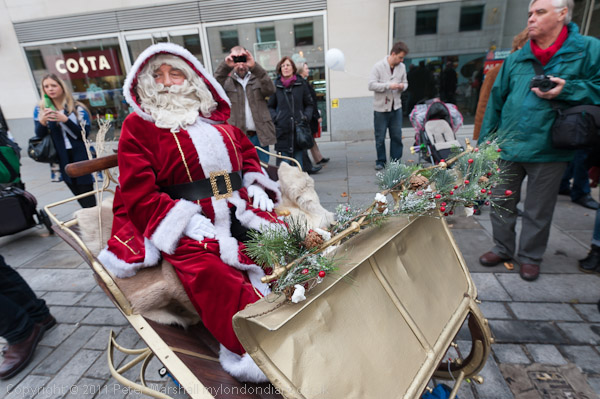
A live musical box
There was a special Xmas Saturday shopping event in the centre of the City of London which usually closes down for the weekend, but I think it was aimed more at the wealthy 1% than me.
Santa had come with real reindeer
I wouldn’t normally have gone but it was on my fastest route to St Paul’s Cathedral and it was the first time the City had held such an event. Though unless there were rather more visitors later in the day it would probably be the last. I didn’t feel welcome and didn’t stay long.
Occupy LSX Climate Justice Workshops – St Paul’s Cathedral steps
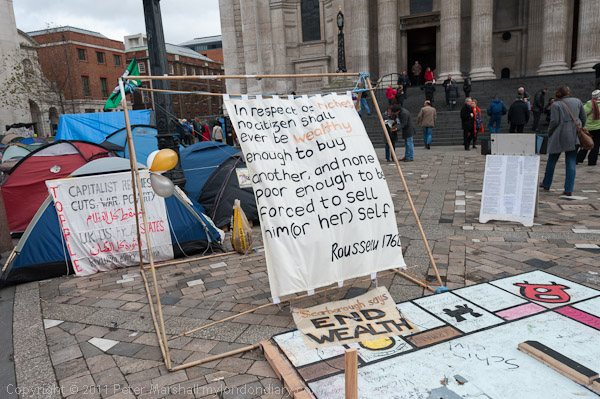
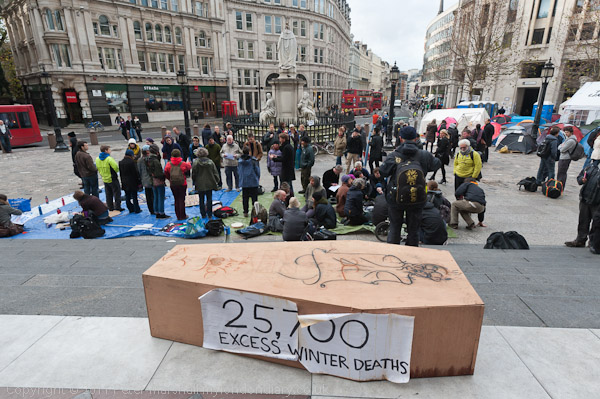
Occupy London was still camping next to St Paul’s Cathedral, having been there since 15th October, and they were holding workshops when I arrived about various aspects of climate justice and campaigning, and preparing banners and posters for the Climate Justice march later in the day.
They planned to make their way to the start of the march in a ‘Climate Walk of Shame’ around the offices of various climate change villians (‘unsavoury sites of climate criminality’) in the City.
As often with Occupy, the plenary session went on longer than anticipated. Many people wanted to contribute and some at rather greater length than necessary and the walk began rather late.
I’d hoped to be able to go with them, but only went as far as their first stop at one of the banks in St Paul’s Churchyard before I had to leave to make my own more direct way to the start of the march in Blackfriars.
Stand Up For Climate Justice – Blackfriars to Old Palace Yard
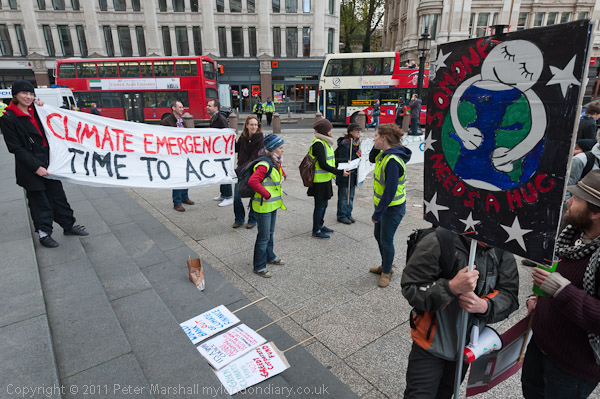
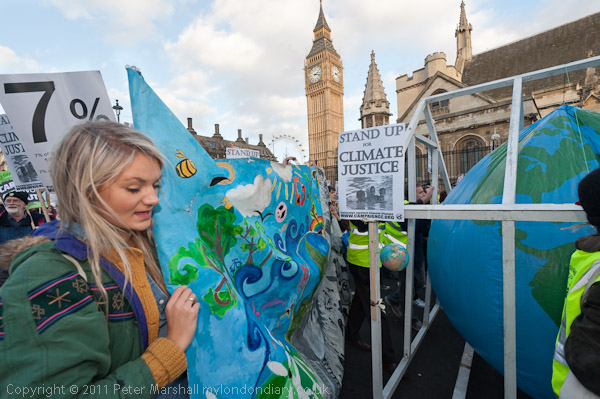
Around a thousand people gathered at Blackfriars for the march organised by the Campaign Against Climate Change to a rally opposite the Houses of Parliament.
Climate talks were taking place in the 17th UN conference in Durban, but seemed unlikely to make much progreess as the US were continuing to refuse to accept mandatory limits on carbon emissions. It seemed likely this would prevent any progress on global reductions in emissions, and seemed certain to lead to catastrophic increases in global temperature. Or, as I put it “bluntly, our planet is going to fry.”
While Barbara Boxer the head of the Senate environment committee was pointing out that the US is the world’s largest historic emitter and thus has a moral obligation to reduce greenhouse gas emissions, the US right, and the ‘Tea Party’ movement in particular, were still denying the existence of climate change and vehemently opposing any restrictions on the emissions of US industry.
By 2011 there had long been no serious scientific debate about the reality of climate change, though still some controversy about the exact magnitude and the timescales involved. But all informed opinion agreed that urgent action is needed, though the heavily funded fossil fuel lobby was still spreading lies and opposing any action.
Since 2011 things have become even more clear and the effects have become worse than even the more pessimistic scientists then predicted. But still politicians are not taking the urgent actions needed, and limiting the temperature rise to 1.5°C now seems impossible.
Among many speakers was John Stewart of HACAN who pointed out that while the richest 7% who cause 50% of the world’s pollution, aircraft use, one of the major sources of emissions, is limited to an even more limited group of the world’s population, with only 5% of the world’s population ever having flown.
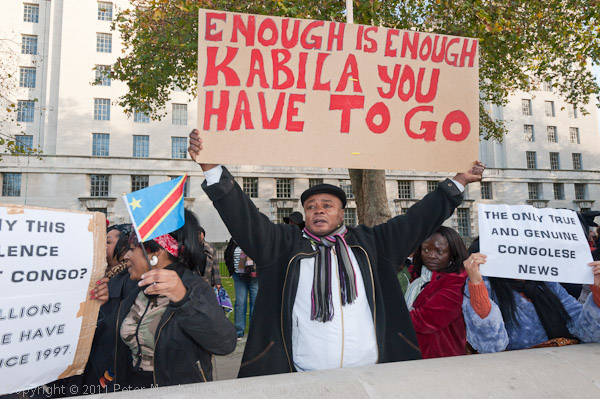
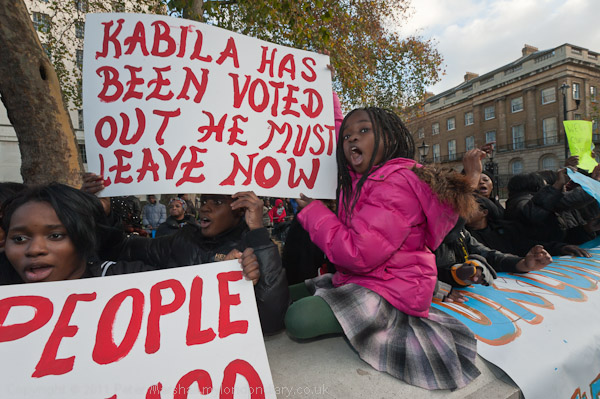
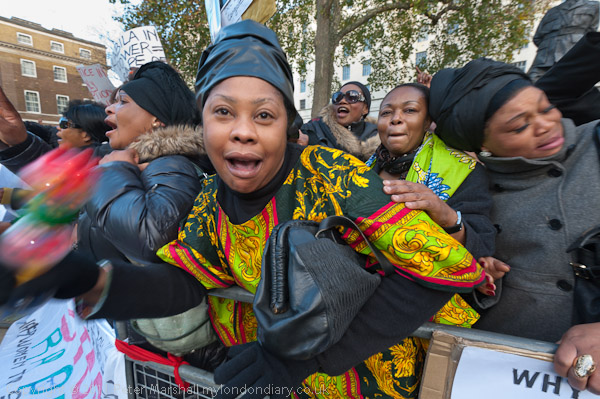
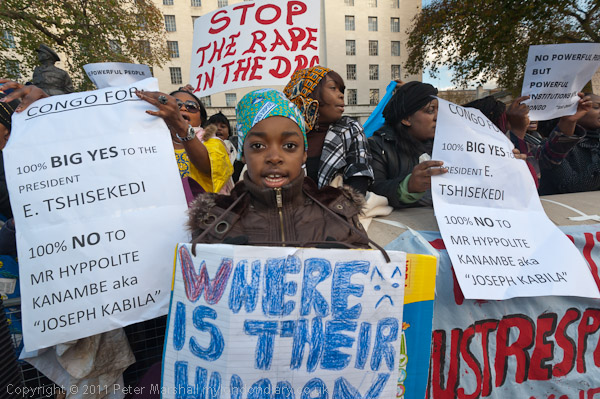
Congolese Protest Against Kabila Vote-Rigging – Downing St
The Democratic Republic of the Congo is both blessed and cursed by its immense mineral resouces, probably the richest of any country in the world, including 80% of the world’s cobalt reserves, and between 65-80% of coltan, the mineral from which tantalum capacitors, vital for mobile phones, games consoles, computers and other electronic devices are made.
Despite this wealth of the DRC, the people remain some of the poorest in the world, and because of these minerals the country is one of the most corrupt in the world. The move towards renewable energy and the increasing need for batteries for electrical vehicles has led to increased geopolitical competition over the DRC’s cobalt resources.
The area has been the subject of various wars and there is still conflict as well as widespread violation of humanitarian and human rights law, including the sexual abuse of women and children.
The Kabila regime has been kept in office by western interests who have now turned a blind eye to the widespread vote-rigging violence and fraud in the elections. The opposition later claimed to have outvoted Kabila with 54% of the vote to his 26%, while Kabila claimed to have won by 49% to 32%.
In 2019, the son of the candidate thee protesters say won the 2011 election became President in the first peaceful transition of power since the DRC became independent but the early years of his presidency were still with governments dominated by supporters of Kabila. In 2021 he was able to form a new government which among other measures has promised to reverse deforestation in the DRC by 2030.
I’d taken a few views of London as I walked with the Climate March.
And in the early evening I went to an event in North Acton, walking to the venue from Willesden Junction. There are just a few more on-line at London Wandering.
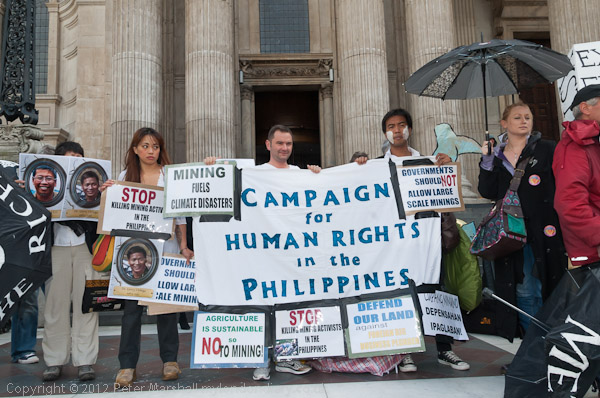
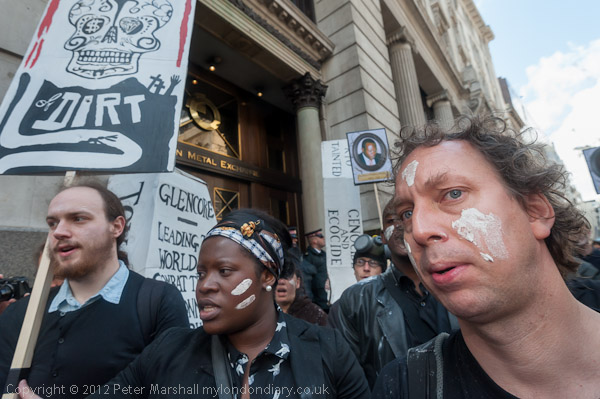
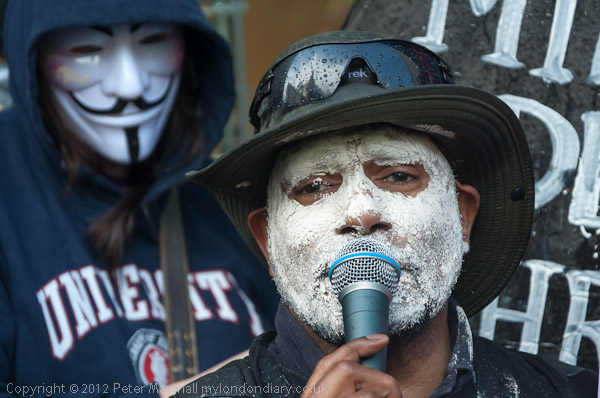
Carnival of Dirt: People from more than 30 activist groups from London and around the world met on the steps of St Paul’s Cathedral on Friday 15th June 2012 for the Carnival of Dirt, a funeral procession for the many killed by mining and extraction companies, powerful financial organisations whose crimes are legitimised by the City of London.
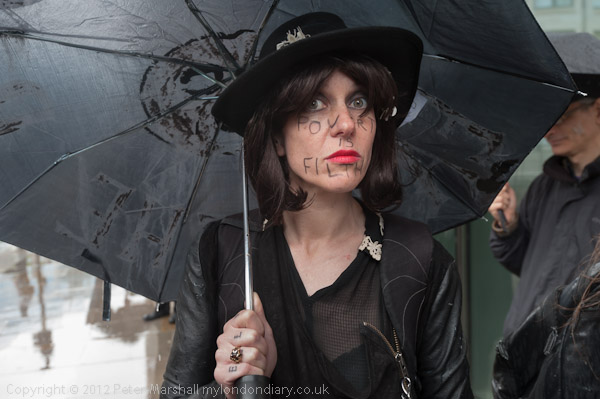
‘POVERTY IS FILTHY’
Although little mining now goes on in the UK, London remains the mining capital of the world with many of the largest and most powerful mining and extraction companies listed on the London Stock Exchange and trading on the London Metal Exchange. The Carnival of Dirt named some of them as major criminals, including Xstrata, Glencore International, Rio Tinto, Vedanta, Anglo American, BHP Billiton, BP and Shell.
Many activists around the world have been murdered for standing up against the interests of these companies, whose greed has led to crimes against humanity on a huge scale around the world. As I wrote in 2012, “They lie behind the millions who have died in wars in the Congo and elsewhere, behind the torture and rapes and other human rights abuses that are used to drive people off their land, behind the huge areas of land poisoned by toxic wastes, forests and whole mountains destroyed, ecocide on a truly massive scale.”
Many of these crimes have been well-documented but these companies are still supported by our pension schemes and protected by our government, as well as being allowed to get away with avoiding or evading millions or billions of pounds in UK taxes.
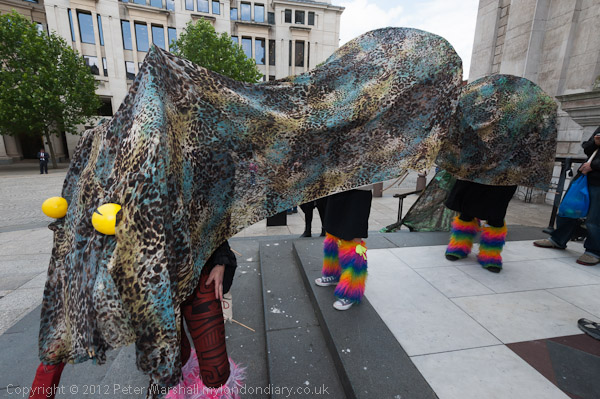
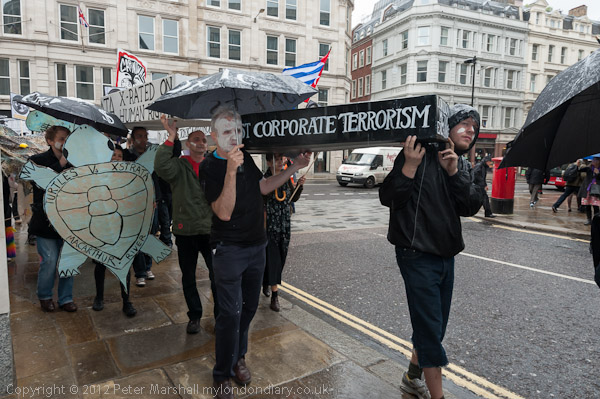
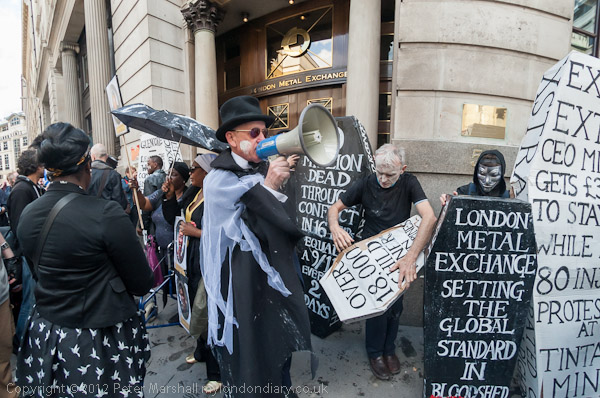
Many of those who came to the carnival were dressed in black, and the funeral procession had a New Orleans style theme. The cortège “included a large snake, a turtle and a tortoise, a reminder of XStrata’s criminal diversion of the McArthur River, destroying the ecosystem and despoiling the sacred sites of Australian aborigines.”
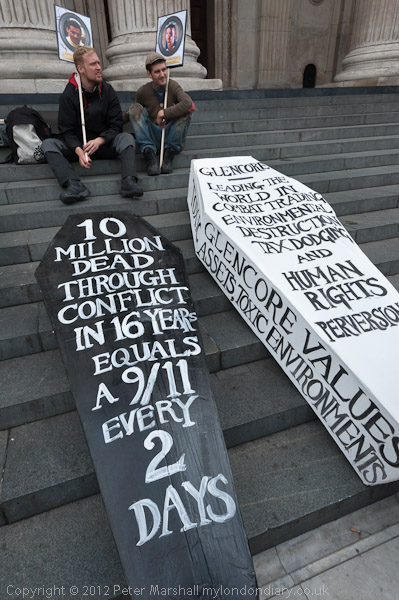
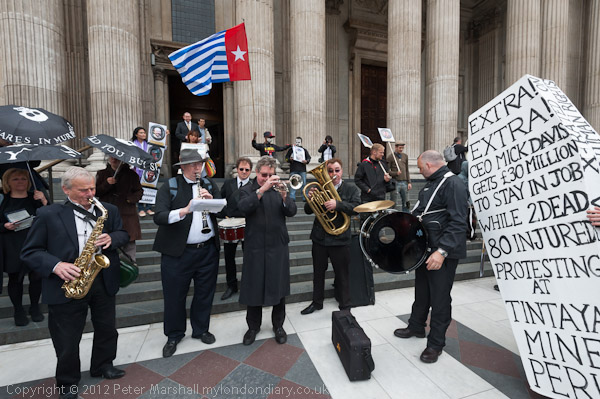
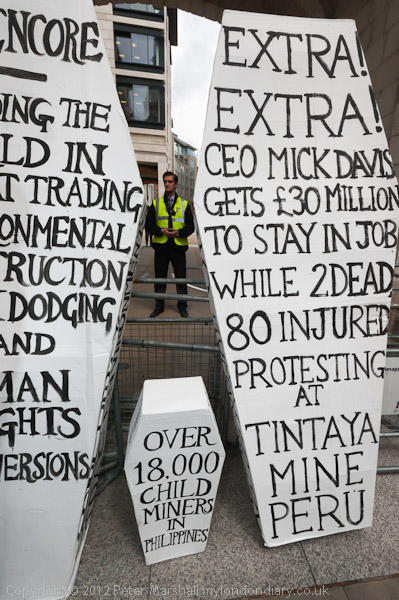
There were a number of coffins to represent the dead, naming some of the companies involved with messages such as ‘Glencore Values – Toxic Assets, Toxic Environments‘. Another read ‘XStrata – X-Rated on Human Rights‘ and pointed out the CEO Mick Davis “Gets £30 million to stay in job while 2 Dead 80 Injured protesting at Tintaya mine in Chile.’
The more than 18,000 child miners in the Phillipines were represented by a small coffin. One read ‘10 Million Dead Through Conflict in 16 years equals a 9/11 every 2 days‘. Red drops for blood ran down the side of a black coffin with the messages ‘Resist Corporate Terrorism’ and ‘London Metal Exchange – Setting the Global Standard in Bloodshed‘ . Another coffin testified to the genocide in West Papua where Indonesian troops have torched villages.
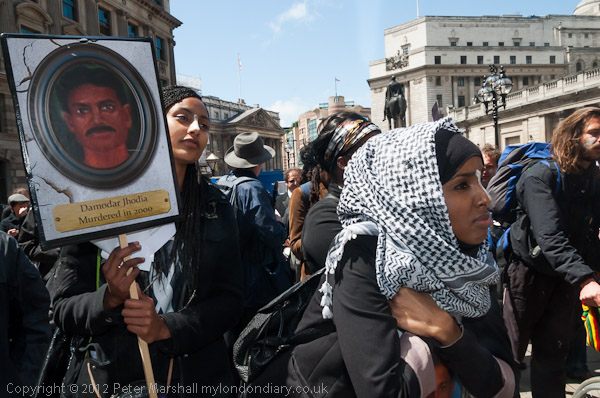
Some of the protesters walked with photographs of a few of the better-known activists murdered for standing up to corporate terrorism, and a leaflet named some – “Valmore Locarno, Fr Fausto Tentorio, Victor Orcasita, Alexandro Chacon, Fr Reinel Restropo, Dr Gerry Ortega, Armin Marin, Dr Leonard Co, Elizer Billanes, Jorge Eliecer, Floribert Chebeya, Raghunath Jhodia, Abhilash Jhodia, Damodar Jhodia, Petrus Ayamiseba.” Other placards showed unnamed and horribly mutilated victims.
After brief speeches the procession moved off from St Paul’s towards the Stock Exchange behind the marching band, but they were blocked by barriers and private security staff at Temple Bar, preventing them going into the now privatised Paternoster Square. After a short protest there it moved off, walking along public streets to the north entrance of the Stock Exchange on Newgate Street.
The entrance was blocked by a line of police but the protesters stopped from a short rally, listening to a speech by Benny Wenda who managed to escape to the UK after being arrested, imprisoned and tortured by Indonesian troops. There were heavy showers and we all got rather wet, though some protesters were fortunate to be carrying black umbrellas with slogans on them; the slogans ran in the rain but the umbrellas kept those underneath rather drier.
From there the cortège moved on to protest in front of the Bank of England, where there were several speeches from researchers and activists. From there we moved to a final rally at the London Metal Exchange, where we heard a longer exposition of the various trading activities which cause a great deal of death and unnatural disaster across the globe.
The came a reading of the names of some of the prominent murdered activists, each name being followed by the protesters shouting ‘Present’ or the Spanish ‘Presente’ to show they were still a part of the living, in the hearts and minds of those mourning them. At the end of the list there was a two-minute silence in the memory of them and the millions of others killed for the profits of the mining companies. After throwing ashes at the building the procession continued to its finish at Altab Ali park.
By this time I was very wet, and so were my cameras and lenses, with condensation steaming up on inner glass surfaces. Many of the later images were taken with a wideangle fisheye, a single focal length lens that was more resistant than the two zooms I use for most of my work. I was tired and needed to get somewhere to dry out, so while many were planning to go on to further protests in Green Park and on the Embankment it was time for me to go home.
Intercity (East) Ltd, Clothing, Shop, City, Tower Hamlets, 1989 89-3e-42
I was on my way to the East End, and I’m no longer sure where this shop was located, although my contact sheet has Cutler Street, it also has a question mark in front of this. I will have marked up the contact sheets while I still remembered my route (and had probably marked this on a map more or less after I got home) so I will have walked this way towards Leyden Street where I made the next picture. But all I can find on Google about Intercity (East) Ltd is not about clothing stores but trains.
Cutler Street begins on Houndsditch and I think both corners there have been demolished and rebuilt since 1989. It has two more corners where it turns 90 degrees to the right in front of Cutlers Gardens, again both now occupied by more recent buildings.
From Cutler Street I went up Harrow Place and crossed over Middlesex Street into Cobb Street, going out from the City of London into Tower Hamlets. Much of the area I went through has since been redeveloped but unfortunately I took no pictures.
Blue Bird, a wholesale children’s clothing cash and carry was a shopfront I also photographed in colour on this same walk. This building remains, though was extensively renovated internally around 2020 and 6 at right, Dunmow Trading, is again apparently in the clothing trade, though perhaps the renewed shopfront is a nod to the past hiding some completely different activities.
This was a frontage I passed and photographed several times over the years, but never went inside. Founded in 1854 in Leman St, the Soup Kitchen for the Jewish Poor moved to Brune Street (then Butler St) in 1902 and eventually closed in 1992, its work being carried on by Jewish Care in Beaumont Grove, Stepney. I had assumed it was now longer operating when I took this picture in 1989.
Another shopfront I photographed on several occasions and in colour, and it was hard to decide which if any of the businesses were still in operation. Now the whole area has been tidied up and shops like these converted to slightly twee ‘period’ residential properties.
This early 18th century Grade II listed terrace house was sold in 1998 for £236,000, probably just before or after conversion, and in 2021 sold for £3.5million.
The fine row of houses on the south side leading up to Christ Church was still I think occupied and possibly in use by firms in the clothing trade, with M Lustig & Co, Manufacturers of Superior Mens Clothing, Dilal Fashions at No 10 and Gale Furs at 8. Though their days were clearly numbered and all are now high priced residential properties and maintained in considerably better condition. I think all of the street is Grade II listed.
Christ Church is one of Hawksmoor’s masterpieces, built 1723-9 and Grade I listed.
Established in 1902 and supplying textiles and trimmings to the fashion trade, in 1998 J Minsky sold its warehouse premises and began to focus on property investment, selling the textile business in 2005. This was 48 Fashion Street, which is a part of a listed building, but it is very difficult to recognise in this picture, which managed to avoid its more distinctive features, with just the slightest hint on its upper edge.
I returned to Bank and photographed some men working on the street there on the corner of Lombard St. I think they were working on one of the entrances to Bank Station but the boarding made it hard to see. They did have some very big buckets.
Recently there has been yet more work to improve access to Bank Station, with a new entrance opening a couple of days ago on Cannon St. Bank is a very busy station during the weekday rush hours, even with more people now working at least some days from home. But on Saturdays and Sundays the City is still something of a ghost town, though rather more tourists can now be seen wandering around, lost souls searching in vain for an open pub or restaurant.
Cherubs, King William St, Bank, City, 89-3d-35
At the start of King William Street and I think part of the magnificent St Mary Woolnuth I photographed this doorway with three cherubs which was later used on a book cover, but somehow I had lost the digital image of that. Having spent around half an hour searching for it on my computer and various hard drives I decided it would have been faster simply to produce it again from the negative. I think I may have also havephotographed it on a previous occasion. The doorway was rather dim and this image isn’t quite as sharp as I would like.
Lombard St, City, 89-3d-36
While I had the negatives out of the file, I digitised this one as well. Again it’s a view which I had previously photographed, possibly on several occasions, with the splendid cat and fiddle sign which is still there, though the TSB’s castle has gone. I don’t mourn the loss of the depressing distant block, though rather wish its replacement had been better.
Leadenhall Market, City, 1989 89-3e-61
I walked along Lombard Street and up Gracechruch St and then turned into Leadenhall St and then into Whittington Avenue where I photographed the entrance to Leadenhall Market, a nice piece of Victorian exuberance, though of course finance by our crimes of Empire.
I’d photographed the quite a lot before, often in colour, put I think this was the first time I’d photographed this entrance. I walked through to Cullum Street taking a few more pictures of buildings in the area including some more of the Lloyds Building but little really new for me, and none I selected to put on-line.
Fen Court, City, 1989 89-3e-41
From Fenchurch Avenue I turne into Fen Court, where as usual I was fascinated by the trees wiggling in front of the austere offices of the Pan Atlantic Insurance Company and others. I’d taken two frames without any people when a man walked across carrying some hefty paperwork and I made this third exposure as he moved into the space between the two brick and stone beds.
This garden is the site of St Gabriel Fenchurch, burnt down in the Great Fire of London in 1666. It was re-landscaped in 2008, with the addition of the sculpture ‘The Gilt of Cain’ by Michael Visocchi which commemorates the abolition of the transatlantic slave trade.
I was on my way towards the markets just to the east of the City, where the next installment of this walk will continue.