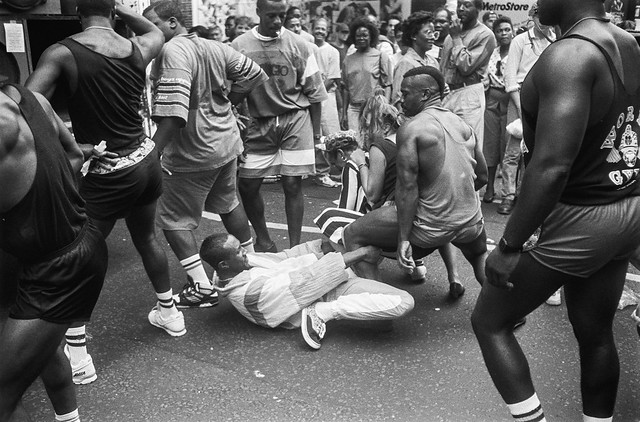
I’ve started, so I might as well finish. Here are a few of my pictures from Notting Hill Carnival in 1993, still in black and white. I did take a few in colour, probably using up a film already in the camera, but I’ve not really looked at them yet. Perhaps in a few days I’ll find time.
In the 1990s I was still working as a full-time teacher in a Sixth Form and Community College, and too often we seemed to start the term the Tuesday after carnival and I would go into work with ears still ringing part-deafened from the previous day. Carnival wasn’t just loud on the ears, the tarmac of the street vibrated with the beat, and so too did your internal organs, your whole body dancing to the music. It took me a few days to recover. Fortunately the first few days of term were mostly taken up with administration and not actual teaching.
It’s now around 20 years since I left full-time teaching to earn a living through writing and photography so even had I been able to go to carnival I wouldn’t be worried about going in to work today.
I seem to have taken rather fewer pictures than usual in 1993, or at least to have scanned rather fewer. I was in Notting Hill on both the Sunday and Monday and made almost 500 exposures, but there are only 17 in the album from that year. Looking at the contact sheets I think there are probably a few more worth adding when I have time.
All photographs on this and my other sites, unless otherwise stated, are taken by and copyright of Peter Marshall, and are available for reproduction or can be bought as prints.
We can’t go to carnival this year so I’m posting some pictures from previous years – today from 1992.
I think all except one of these pictures were taken on Ladbroke Grove north of the station, the odd one out being the Kensington Food Centre a few yards away on the corner of Chesterton Rd and St Lawrence Terrace.
All photographs on this and my other sites, unless otherwise stated, are taken by and copyright of Peter Marshall, and are available for reproduction or can be bought as prints.
We can’t go to carnival so I’m posting some pictures from previous years – today from 1991. These pictures are now on Flickr in an album of my black and white pictures from the event in 1990-2000.
Some of these pictures have already been widely published – and one has appeared this year in various publicity features about the Museum of London’s show opening this October, ‘Dub London: Bassline of a City’ such as ‘BOOM! There’s a new show about dub at the Museum of London‘ in Time Out.
I took a look back through all of the contact sheets – well over a hundred – in 2018 while I was putting together a set of images for a Café Royal book. Several of the new images I found made their way into ‘Notting Hill Carnival in the 1990s’ but many others are in the Flickr album. The book sold well, and is now only available from them in an archive set, Archive 4, a limited edition of 100 different books, costing around a thousand pounds. I still have a few copies of this and also ‘Pride Not Profit London 1993-2000’ and can supply direct to UK addresses for £8 each including postage – contact details here. Several other of my books are still available at Café Royal.
All photographs on this and my other sites, unless otherwise stated, are taken by and copyright of Peter Marshall, and are available for reproduction or can be bought as prints.
Were we in normal times, today I would be thinking about going to Notting Hill tomorrow for the first of two days of Carnival. Much to my surprise I find it was eight years ago that I last went, having been on holiday away from London several years, and deciding the weather wasn’t really right some others. But perhaps I’m just getting old and was finding the music and the crowds too much some other times. At least this year I don’t have to make a decision.
The Notting Hill Carnival’s origins are in a ‘Caribbean Carnival’, an indoor event organised by Claudia Webb in 1959, the year after the Notting Hill race riots. The first procession was an impromptu one in 1966 from a neighbourhood street party, but it was in the mid-1970s that in began to be a major festival with a large attendance. But heavy-handed policing led to battles between mainly Caribbean youth and the police, luridly reported by newspapers and broadcast media which made many of us reluctant to attend the annual event.
August was in the 1980s was also a month when I was often in Paris and it was only in 1990 that I decided I had to go and photograph Carnival, and was both deafened and exhilarated by the energy and joy of the event. For the next twenty or so years – with a few exceptions when I was out of the country or crippled by injury – I photographed the event, at first mainly in black and white but later on colour film and then digital.
I’ve just spent a day putting my black and white pictures from the first ten years I attended, starting in 1990, onto Flickr. Some of them have been seen before in a number of group shows, including one in Notting Hill itself. I had a small one-person show at the Museum of London in the late 1990s, and put some on the web at Fixing Shadows, one of the first sites showcasing ‘straight photography’ on the web. This led to a 20 print portfolio with comments by George Mentore, published as ‘Notting Hill in Carnival’ in Visual Anthropology Review in 1999. I also showed the same number of prints in ‘English Carnivals‘ at the Shoreditch Gallery and Barbican Library in 2008, and later in the 2018 Café Royal volume, ‘Notting Hill Carnival in the 1990s’.
But for the Flickr album, which now contains 260 photographs, most of them published for the first time, I went back to the contact sheets. Most of those early years I went on both the Sunday – Children’s Day and the Bank Holiday Monday, probably averaging around 300 exposures on each. Probably a total of over 6000 images. But some of those were in colour, a few panoramic, so the 260 are from perhaps 4500 black and white frames. They include quite a few I wonder why I haven’t shown them before.
Technically they are quite varied, including some I’ve carefully balanced and retouched for publication and others that are untouched raw scans. Not every picture is critically sharp, as I was often working with no time to refocus and sometimes while in the middle of dancing crowds and concentrating on emotion rather than technique.
All the pictures in today’s post are from my first year at Carnival in 1990, when I think I was just beginning to get into the subject. More from 1991 and later to follow.
All photographs on this and my other sites, unless otherwise stated, are taken by and copyright of Peter Marshall, and are available for reproduction or can be bought as prints.
Following the Greenwich Meridian is rather easier since the Ordnance Survey helpfully added it to their 1:25000 maps in 1999, but these pictures were made five years earlier in my project in preparation for the Millennium. I’d had to draw my own pencil line in their maps, which fortunately did show in their outer margins the Longitude at one minute intervals, including 0°00′, so it wasn’t hard to add the line.
I’ve never quite understood why the National Grid doesn’t quite align with this, the Prime Meridian, but presumably there were good reasons for choosing another starting point and working very slightly at an angle. The street maps which I needed to work out my actual route as they had the street names follow the National Grid, though they rather hide this behind their own system of letters and numbers based on half-kilometre squares.
For the northern part of my walk, the Meridian ran roughly down the gap between two pages of my Master Atlas of Greater London, a book too large and heavy to carry on my walks, and I marked out my route with highlighter pens on illegal photocopies of its pages.
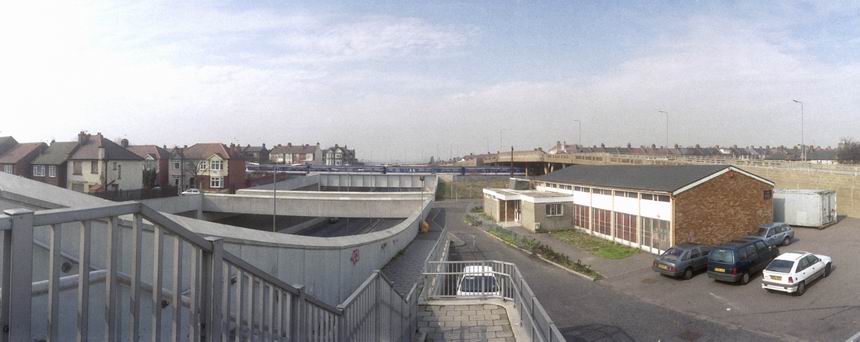
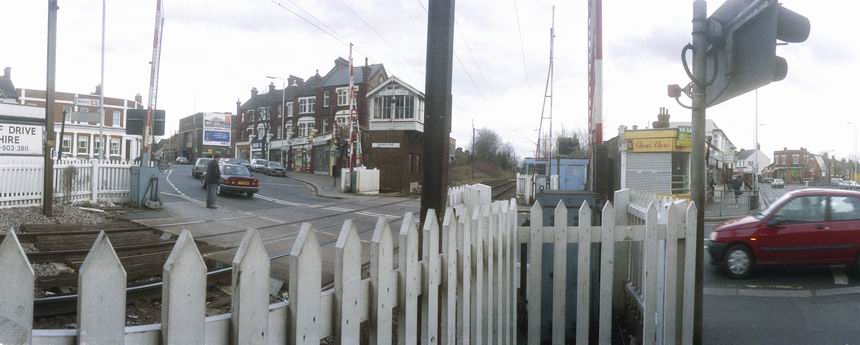
There are several crossings of Southend Road, the North Circular Road at this point close to the Meridian which I think was actually a few yards to my east as I took a picture looking roughly west. But the road layout had changed a little from that since my OS map had been revised. It was a view which made a better picture – and close enough to the line for me, as was the level crossing at Highams Park – where again the actual line is a few yards behind me – to the west.
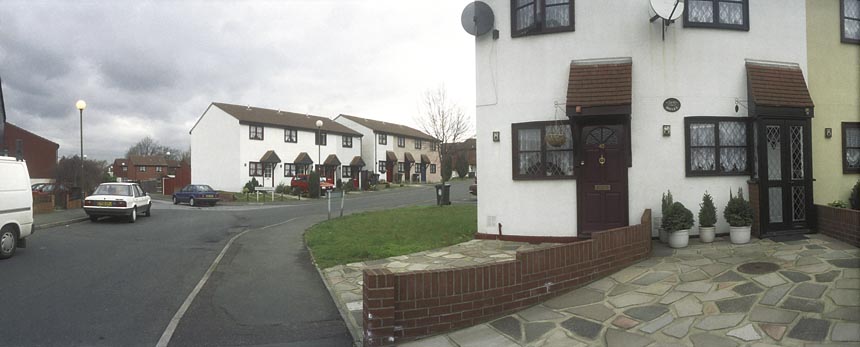
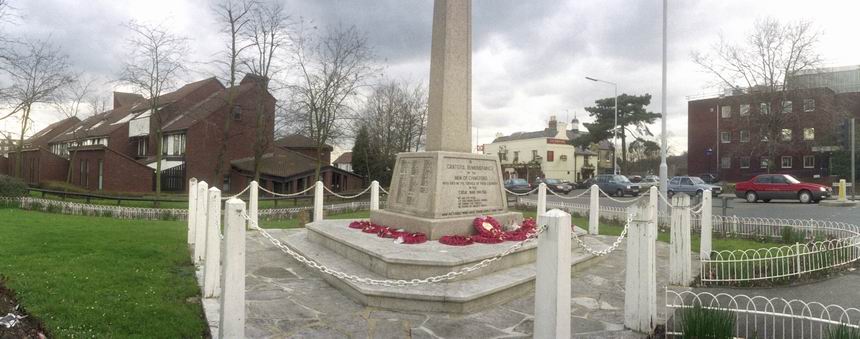
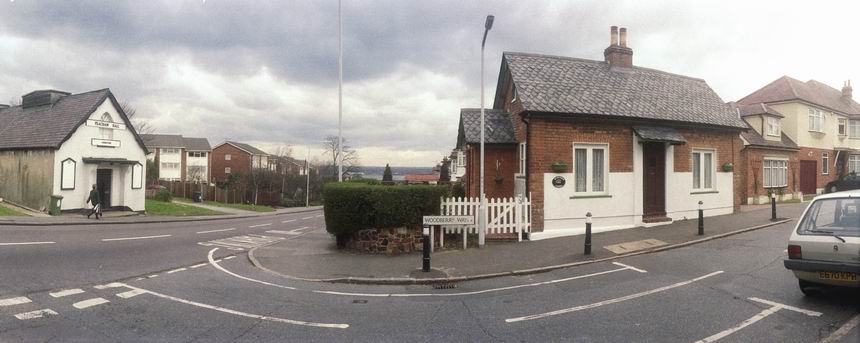
The view of Mapleton Rd and Stapleton Close (wrongly titled Mapleton Drive in my notes) is perhaps a hundred yards west of the Meridian, but close enough for me. The war memorial at the junction of The Ridgeway and Kings Head Hill is spot on target, while Woodberry Way is perhaps around a hundred yards to the west.
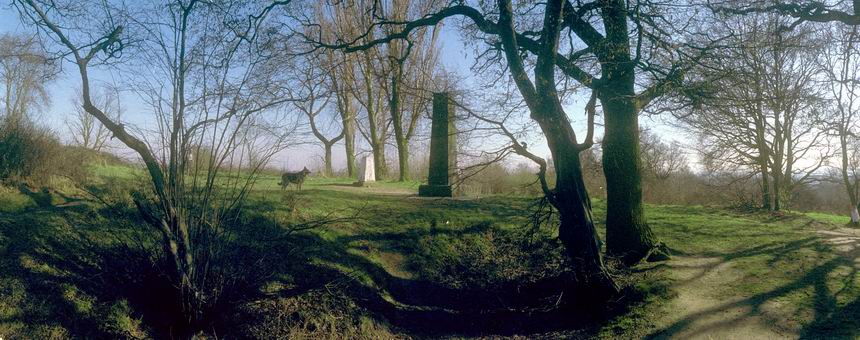
Finally, Pole Hill has two markers; the obelisk, set up by the Astronomer Royal to align his telescope in Greenwich due north is on the old Meridian, but the trig point to its left is on the version adopted internationally (except by France) in 1884. Nowadays we use GPS based on the International Terrestrial Reference Frame which has its zero meridian 102.478 metres further east.
All photographs on this and my other sites, unless otherwise stated, are taken by and copyright of Peter Marshall, and are available for reproduction or can be bought as prints.
Continuing with pictures from my walk along the Greenwich Meridian in Greater London in 1984-6.
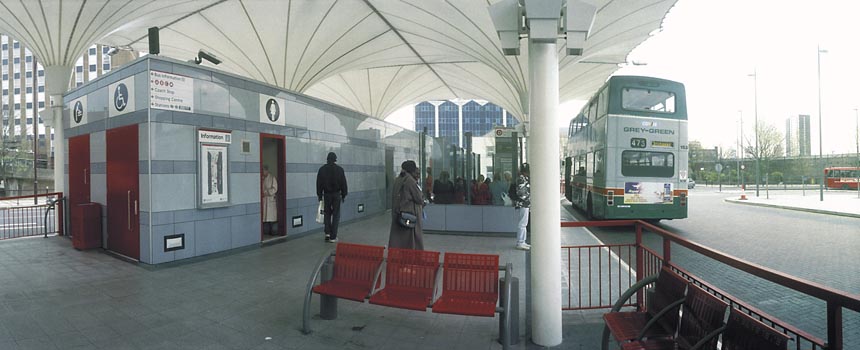
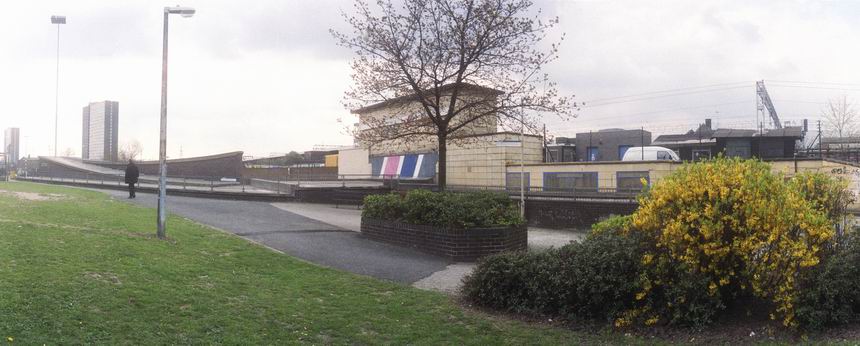
Stratford Bus Station – Peter Marshall, 1995
My walks took me as close to the line of the Meridian I had pencilled on my 1983 1:25000 OS map as possible, though that line may not have been quite exact. I think it goes through the area at the extreme left of the picture above, here just a few yards east of the roadway. My series of walks kept as close as possible to the pencil line, but it often runs through private property, buildings, across rivers etc and many detours, some quite lengthy were required.
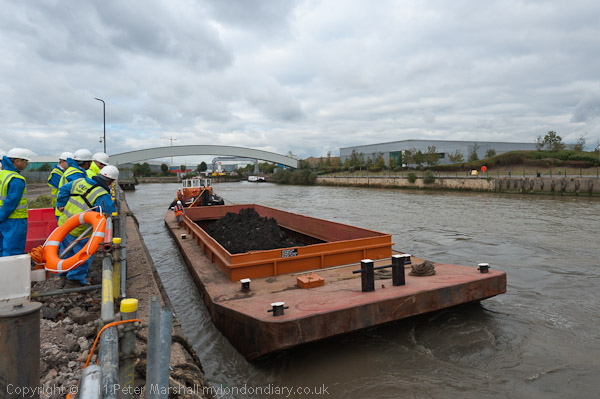
Barge carries contaminated earth from Poplar gasworks site, Peter Marshall, 2011
One of those fairly lengthy detours was north from Poplar, where the line ran through the gas works site and across Bow Creek. It wasn’t until 2011 that I was able to go onto the former gas works site, having been engaged to photograph the use of a barge to carry away the heavily contaminated soil from the site. The line crosses the river here, going through the left end of the large shed close to the opposite bank, near to Cody Dock. This is also part of a private business estate, though you can now walk along the roadways in it. There are several such areas I have been able to photograph in later years, but I won’t add any other later pictures to these posts.
Stratford Station – Peter Marshall, 1995
The line continues through the east end of Stratford Station.
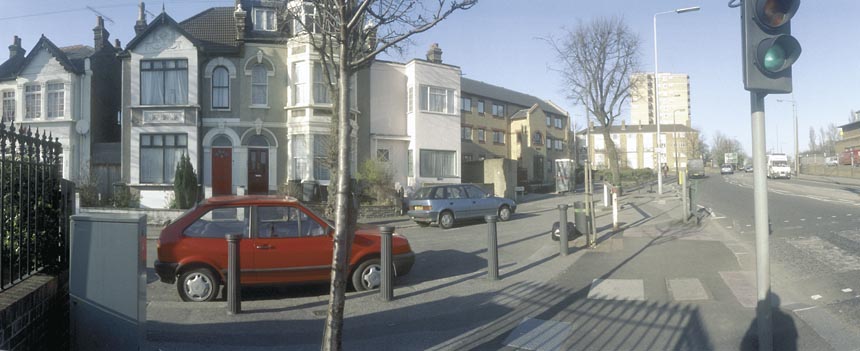
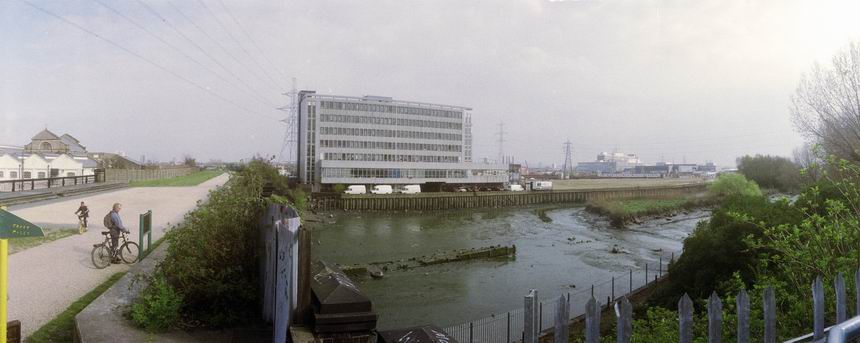
Thinking of the line of the Meridian, I had decided it was appropriate to use a panoramic format, and these pictures were all taken with a swing lens panoramic camera. I think at the time I owned two such cameras, an expensive Japanese model and a cheap Russian one. The Russian was a little more temperamental and it was sometimes difficult to wind on the film, but had a much better viewfinder and I think was probably used for most of these. Both give negatives which are roughly the width of medium format film – 55-58mm – but only 24mm high, the limit of 35mm film, giving a roughly 2.3:1 aspect ratio. There is no discernible difference in image quality.
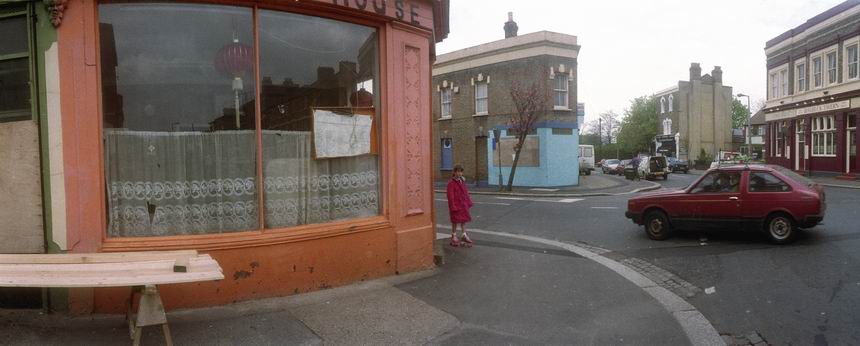
Langthorne Rd, Leyton – Peter Marshall, 1995
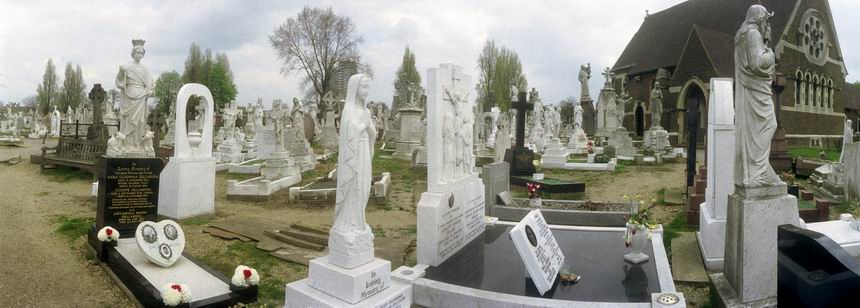
Both used 35mm film and curve it in the horizontal plane around a little over a third of the outside of a circle, with the lens pivoting roughly 130 degrees around the centre of that circle during the exposure. This keeps the distance between the centre of the lens and film constant, avoiding the distortion produced by using flat film, where the edges of the film are further from the lens node. This gives a very noticeable distortion with ultra-wide lenses, limiting them to an angle of view (horizontal) of roughly 100 degrees.
St Patrick’s Cemetery, Leyton
Swing lens cameras are limited in angle of view only by the mechanical limitations and can generally cover 130-140 degrees. But the curvature of the film does produce its own unique view. Assuming you keep the camera upright, straight vertical lines remain straight as the film is not curved vertically, but non-vertical lines show curvature, increasingly so as you move away from the centre of the film. You can see this clearly in the shop window in Langthorne Rd.
One of the blogs about London I keep my eye on and occasionally read with interest is the rather oddly named ‘Diamond Geezer‘, who posts daily articles, usually about his walks or bus rides around some of London’s more obscure areas. As someone who spent around 20 years walking around many of these taking photographs, I often find these interesting even though I don’t share his preoccupation with some of the minutiae of Transport for London’s oddities.
The two most recent of his posts have been Prime Meridian 0°Day 1 and Day 2 and by the time you read this, there will probably be a Day 3. Since he is only walking along the line (or rather as close to it as you can) in Tower Hamlets and Newham there probably won’t need to be a Day 4.
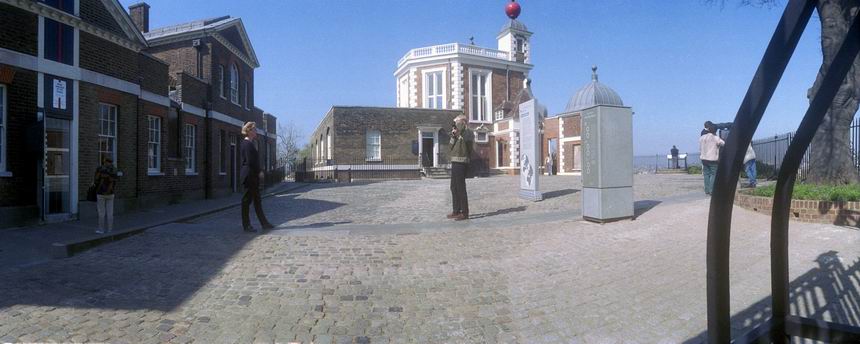
Greenwich Observatory – Peter Marshall, 1985
I was particularly interested because I carried out a similar but rather longer project in 1994-96, completing it despite failing to get any of the Millenium funding which was on offer. I began at what seemed the obvious place, the Royal Observatory in Greenwich – as this was the Greenwich Meridian. My walk, carried out over several days, was rather longer, ending more or less at the Greater London boundary in Chingford – and later I extended it south from Greenwich to New Addington at the southern boundary.
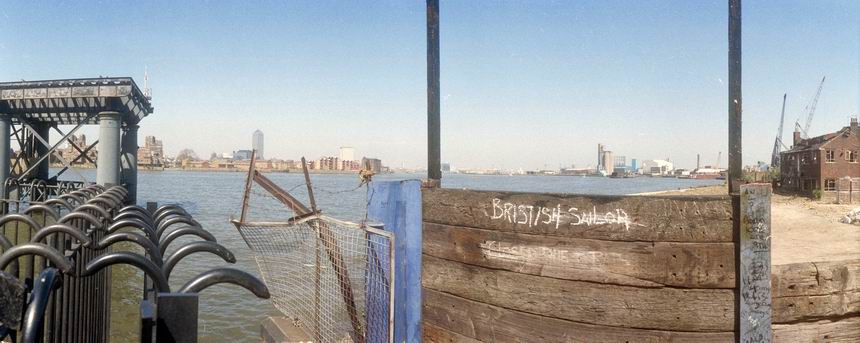
Greenwich Riverside – Peter Marshall, 1985
It was rather harder then to actually trace the Meridian on the ground. There were rather fewer actual markers then and I think no published walks along it. Although my application failed, others were successful and obtained funding to put in new Meridian markers and publish walks at the time of the Millenium and yet more have been added since.
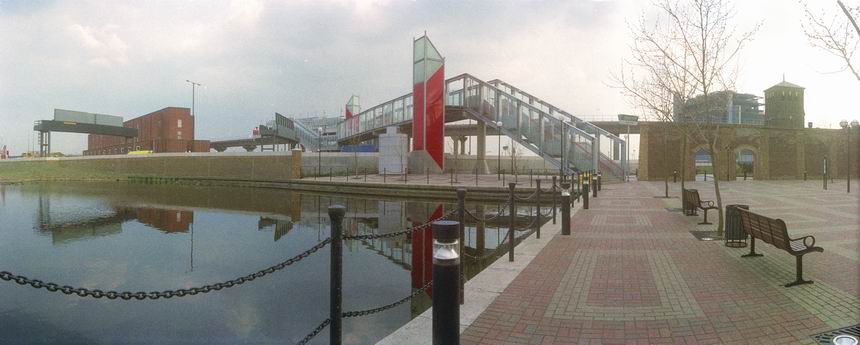
West India Dock – Peter Marshall, 1985
Back in 1994-6 I had to draw my own line on my maps – it was only in 1998 that the line was added to the Ordnance Survey maps – in order to allow people to celebrate the Millennium on it. Back then we had no mobile phones and no GPS – the first phone based GPS navigation system was only introduced by Benefon in 1999 and it was a few years before this became universal.
Greenway & Channelsea River, Stratford – Peter Marshall, 1995
I first published these images on the web in 1996, having then recently acquired a colour film scanner. It wasn’t a very good scanner and getting good results from colour negative film was tricky. I think I scanned most of them again later, but some could still be improved.
The Evangelical Library on Chiltern St in Marylebone was built as a school for the Portman Chapel in 1859 by Christopher Eales with minor alterations in 1880 and was Grade II listed in 1994 as “an early surviving example of a church school in a city centre an early surviving example of a church school in a city centre”.
The Library began as the Beddington Free Grace Library, housed at first in sheds and later a brick building in Beddington, before moving to South Kensinton in 1945 and then here in 1948. It grew to contain around 80,000 books and periodicals relating to Protestant and Reformed Evangelical Christianity including many rare and valuable Puritan texts. Over the years the Grade II listed building deteriorated and the the costs of renovation to prevent damage to the volumes led to the library moving out in 2010 to cheaper premises in Bounds Green.
You can still see this shopfront of Meacher, Higgins & Thomas, established in 1814 as chemists in Crawford St, Marylebone, and it has changed little from when I took this picture, though it has a larger illuminated sign at right and those large glass containers of coloured water which marked out every dispensing chemist in my youth disappeared from the upper windows a few years ago.
It was a warm day in May and the closely cropped grass by the fountains at Marble Arch seemed a good place to have a rest. I think I probably sat on a bench or wall to eat my sandwiches and afterwards probably made my way down the steps to the public toilets and then under the subway into Hyde Park. Both now gone.
Hertford House, Manchester Square, Marylebone. Hertford House was originally called Manchester House, as it was built in 1776-88 for the 4th Duke of Manchester who apparently wanted to live here for the duck shooting. Presumably he had exterminated them all by 1791 when it briefly became the Spanish Embassy, and then in 1797 it became the home of the 2nd Marquess of Hertford who held many grand parties there, including a Ball celebrating the defeat of Napoleon. Despite this in 1836 it was let to the French as their embassy until 1851.
The 4th Marquess of Hertford preferred to live in Paris, but used the house to store his art treasures, and when the Commune took over Paris briefly in 1871, his illegitimate son Richard Wallace moved back into the house and renamed it Hertford House. He had the house extended in all directions to fit in all the stuff he brought back with him, and what we see now, including the portico, is largely the result of these modifications by architect Thomas Ambler. After his death in 1890 the house was converted into a public museum, The Wallace Collection.
I visited it many years ago and found it a rather depressing experience, but the interior has recently undergone a considerable refurbishment and the experience may well be less oppressive.
Hinde St runs west out of Manchester Square and the impressive church at the right of this picture is Hinde Street Methodist Church. The first church was built here in 1807-10 but this was largely or wholly demolished and a new Wesleyan church, designed by James Weir, opened in 1887. It remains one of London’s leading Methodist Churches.
Hinde House is a block of expensive leasehold flats, where a two bed flat might cost you a million or two.
Another place where I’ve often eaten my sandwich lunch in Central London is Brown Hart Gardens on Duke St in Mayfair. The extravagant building opposite this raised stone garden is the former Kings Weigh House Chapel by Alfred Waterhouse, built 1888-91 as a Congregational Church. It is a far cry from the more restrained and often classical church buildings I associate with this non-Conformist denomination. Congregational Churches in the past were staunchly independent, their life ruled by the decisions of the members, reached always by consensus, and I think most that I’ve been familiar with would be far too proud of their Puritan origins to have considered such a design. It seems to me very much more suited to its current use as London’s Ukrainian Catholic Cathedral.
Brown Hart Gardens started life as a real garden between large blocks of working-class dwellings built by The Improved Industrial Dwellings Company in 1886-7, Balderton Buildings and Chesham Building. These were taken over by the Peabody Trust in the 1970s. On Chesham Building is a plaque to the first Duke of Westminster Hugh Lupus, recording that through these and other buildings he provided accommodation for “nearly 4000 persons of the working class’ and naming him “The Friend and Benefactor of His Poorer Brethren”.
The land was a part of the Grosvenor Estate, and the buildings were part of an extensive slum clearance programme in the area. The Duke of Westminster insisted on a garden being created between the two streets of flats, then called Brown St and Hart St, and this was created in 1991.
It didn’t last long. In 1902 the site became an electricity sub-station, and this was built with domed pavillions at each end and completed in 1905. The Duke of Westminster insisted that a paved ‘Italian Garden’ be provided for local residents to compensate for the loss of the former garden, and this remained open to the public until shortly after I took these pictures in May 1987. The London Electricity Board then closed the area. It was refurbished from 2007 on and reopened to the public in 2013, with a cafe around the pavilion at the west end.
I suppose for many people Marylebone is the name of a station (though some will connect it more with its cricket club.) The station was the last London terminus to be built, opened in 1899 and never completed, with only four platforms of eight ever built. It lost most of its express services in 1960 and was only saved from closure and demolition by a thriving commuter service from Aylesbury. I think the train here must be one of those used on that route. Marylebone provided one of the few successes of the privatisation of British Rail, generally a triumph of dogma over sense, with the setting up in 1996 of Chiltern Railways. Among other services they provide a pleasant route to stations to Birmingham with comfortable trains and some very cheap tickets, part of the old ‘Great Central’ Network which could probably have been revived much more sensibly and at far lower cost than the ridiculous HS2 project.
I had wrongly captioned this image earlier, thinking it showed the mouth of the Maida Hill tunnel, but although it was taken very close to there it is actually looking away from it, and the black hole at the end of the water is the bridge under Lisson Grove. The tunnel is hidden from my view here, some way down and a few yards to the right of where I was standing.
I went down the steps leading to the canal towpath and took a picture of a boat entering the tunnel. The previous image shows the top of the structure crossing the canal over the mouth of the tunnel which carries electrical cables from the nearby Grove Road power station in St. John’s Wood which closed in 1969 – with the site now housing two major National Grid sub-stations.
There is no towpath in the 249m long tunnel, which is only wide enough for a single narrow boat; boats have to wait at the entrance until the tunnel is clear.
Here you see the canal under the cable bridge.
And this is the long wall of the power station site in Lodge Road. Although it looks very forbidding I’m told it was – at least in the old days – a very pleasant place to work. Coal used to come to the power station from a siding off the lines into Marylebone Station, though possibly at some time it also came by canal.
The Volkswagen workshops were opposite, and a little further west on the south side of the canal were the works of the confusingly named Thames Bank Iron Company, Iron Founders and Heating Engineers who made radiators and other heating equipment, and, according to their lorry parked in front of the building next to some pipes, Drainage Systems.
The pictures show a rather different side of Marylebone – and indeed London – than we now normally think of. They are a stone’s throw from the leafy streets of St John’s Wood with its billionaire oligarchs and from Lords Cricket Ground. But until a few years before I made these pictures, London was very much a manufacturing city. Things had been changing for some years, but it was Thatcher that really put the boot in, moving the country away from manufacturing and into services. And this de-industrialisation was one of the themes behind my pictures of a post-industrial London.
All photographs on this and my other sites, unless otherwise stated, are taken by and copyright of Peter Marshall, and are available for reproduction or can be bought as prints.
I can’t now remember why I went to Notting Hill in April 1987 as it wasn’t quite on my plans for taking pictures at the time, and it was clearly only a fairly brief visit, walking up the Portobello Rd, usually the kind of tourist trap which I was then trying to avoid. It was perhaps the end of my walk with my son along the Paddington Arm of the Grand Union, leaving it at Great Western St and walking down to catch the tube from Notting Hill Gate.
I wasn’t at the time very familiar with Notting Hill, at least outside various works of fiction such as Colin MacInnes’ ‘Absolute Beginners’ written in 1959 and including some graphic descriptions of the 1958 Notting Hill ‘riots’. a series of attacks by white youths, mainly “Teddy Boys”, on black residents of the area. A great book about an extremely cool teenage photographer which was made into a extremely poor film musical, which flopped despite a score by Gil Evans, title track by David Bowie (which reached No 2 in the charts) and contributions from other pop and jazz luminaries including Paul Weller, Ray Davies, Sade, Slim Gaillard and Smiley Culture.
It may well have been the film and all the publicity around it which prompted me to walk on past Westbourne Grove station and down Portobello Rd to Notting Hill Gate. And it will certainly have been my interest in jazz which made me stop and listen and take pictures of a small combo playing on the street, deliberately choosing to work through the crowd.
All of these pictures were I think taken on my Leica M2, which by then had a 35mm f1.4 Summilux almost permanently attached. It was a lens I had lusted over in the window of a secondhand shop in Camden for some time before handing over around a month’s salary. After that the 50mm collapsible f2.8 Elmar saw very little use; later I got a 90mm f2.8 too, but found that gave such a small viewfinder image it was almost unusable, except perhaps for a few distant landscapes.
All photographs on this and my other sites, unless otherwise stated, are taken by and copyright of Peter Marshall, and are available for reproduction or can be bought as prints.