Ford/Visteon, Ethiopian Tyrant, Rioters United!

On Wednesday 31st March 2010 I reported on three unrelated protests in London.


Ford/Visteon Workers March For Pension Justice

Ford/Visteon, Ethiopian Tyrant, Rioters United!

In 2000 Ford when split of some of its parts factories to Visteon, a company described as ‘An Enterprise of Ford Motor Company’ and initially with the same shareholders, promising the workers their conditions and pensions would remain exactly the same as they had been with Ford. Ford’s assurances were repeated by Visteon.

Ford/Visteon, Ethiopian Tyrant, Rioters United!

But in 2009 Visteon closed down and workers in their factories in Belfast, Enfield, Swansea and Basildon were given just six minutes to leave the sites. In Belfast and Enfield workers refused and occupied the sites for a month, but were let down by their union, Unite who failed to give them support. The occupations eventually forced Visteon/Ford to pay the redundancy pay they were entitled to under their agreements, but pensions were not covered and they only received the lesser amounts covered by Pension Protection Fund compensation.

Ford/Visteon, Ethiopian Tyrant, Rioters United!

Since then their fight for the pensions they were promised has continued. I met around 500 former Visteon workers outside the Unite Offices in Theobalds Road, Holborn, where many wore hats and t-shirts with the Ford logo, but with the name replaced by the word ‘Fraud’, which succinctly expressed their view of the company’s action.

Ford/Visteon, Ethiopian Tyrant, Rioters United!

I marched with them to Downing Street where they had problems in delivering a letter and petition. As I commented then: “it does now seem unnecessarily complicated and difficult to get access to our elected government, hiding away behind their tall gates and high security. Its both an expression of and doubtless fuels their paranoia over terrorism far in excess of the real threat.

The marchers then went on to a rally in Parliament Square.

Their fight for a fair deal over their pensions went on for another four years, when eventually as the case was about to go to the High Court, Ford agreed to top up the Pension Protection Fund compensation so that they would receive the full value of benefits accrued when working for Ford. It didn’t cover the nine years they had worked for Visteon, but Unite recommended acceptance as it would settle the claim without the expense (and possible failure) of a court hearing.

Ford/Visteon March For Pension Justice


Ethiopians Protest Bloodthirsty Tyrant – Downing St

Ethiopians came from across the UK to for a day of demonstration opposite Downing St where Prime Minister Meles Zenawi was co-chairing the UN climate finance group. They demanded the UK stop appeasing the Ethiopian dictator, and calling for the release of opposition leader Birtukan Mideksa and other political prisoners in Ethiopia.

Zenawi who became chair of one of the leading military groups fighting in the Ethiopian Civil War was the leader of a coalition that took power in 1991, becoming President then and was Prime Minister from 1995 until is death in 2012. His control of the military made Ethiopia an effective one-party state.

Although the country formally has democratic organisation and elections, elections have been rigged and oppostion politicians jailed, notably the leader of the main opposition Unity for Democracy and Justice (UDJ) party, Mideksa (or Midekssa), a former judge. Many other politicians and journalists have also been jailed and in 2007 the Committee to Protect Journalists (CPJ) named the country as “the world’s worst backslider on press freedom over the previous five years.”

Human rights violations and corruption are rife in Ethiopia, and food aid, education and jobs all depend on membership of the ruling party. His opponents regard Zenawi as a bloodthirsty tyrant and call for him to be brought to trial at the ICC at The Hague on charges of genocide. Human Rights Watch (HRW) have accused it of war crimes in the Somali regions of Ethiopia and against the Anauk communities in Gambella in 2003-4. Human rights abuses have continued in Ethiopia since Zenawi’s death.

Ethiopia is one of the larger countries in Africa and has received large amounts of development aid and humanitarian support from the USA and the UK.

Ethiopians Protest Bloodthirsty Tyrant


Rioters United! 20 Years Since the Poll Tax Riots – Trafalgar Square,

The largest protest against Margaret Thatcher’s Poll Tax was in central London on Saturday 31 March 1990, shortly before the tax was due to come into force. Unfortunately I had missed that event, probably deciding it was best to keep out of trouble. Back in 1990 I was photographing relatively few protests, mainly concentrating on urban landscapes and culture.

Around 30 people turned up for a rally to commemorate the occasion when “the London mob who brought Thatcher down … as well as to promise that the mob were still in business and to pronounce sentence on politicians.”

The ‘Carnival of Death‘ they were promising was not of course a literal death threat, but street theatre in which the effigies of George Brown, David Cameron, Nick Clegg and Nick Griffin were to be executed at a May Day Party. As Chris Knight reminded the gathering, “the only good politician, the only honest politician is a dead politician.”

Our police often fail to understand the difference between rhetoric and reality, and protests involving anarchist groups such as Class War are often ridiculously over-policed, sometimes with disastrous consequences, but almost always provoking more violence than they prevent. On April 1st 2009 for the G20 – Financial Fools Day they had turned up with squads of riot police psyched up to batter largely innocent and joyful protesters – and one of the police killed a newspaper seller simply walking home through the area.

So in my account of this event in Trafalgar Square I was at pains to tell them that the ‘Carnival Of Death’ was “called a carnival; if you want to take part, come ready to dance.”

Shortly after people began the commemoration, a PCSO came to tell those taking part they were not allowed to hold protests or other events in Trafalgar Square without permission. When he was laughed at, he brought over a Heritage Warden who told us the Square was the property of the GLA (Greater London Authority), and that permission was needed for events.

Fine” said those present. “The GLA is a public body; we own it, this is a public place and we give ourselves permission and intend to continue.” As I pointed out in my account, Trafalgar Square is not just a public place, but one that since its building in the 1830s has been a traditional place for demonstrating radical dissent. It was a tradition that those present were determined to continue.

Fortunately the dozen or so police who arrived shortly after the PCSO had phoned to call for reinforcement simply stood and watched and had enough sense not to try and stop the commemoration, which ended after around 30 minutes when the organisers decided it was time to go down the pub.

At the end of the event, copies of an anti-Election manifesto and a suitably defaced poster showing the leaders of the Labour, Conservative, Liberal Democrat and BNP leaders were distributed by the Whitechapel Anarchist Group. They advised us to “Use your cross wisely”, under a picture of the four leaders in the cross-hairs of a gun sight, and attached to the bottom was a ‘Free Gift’ – a safety match, with the message ” Burn Your Ballot”.

As they wrote: “It’s time to end the unjust, corrupt system of terror and build a fair, equal society that will benefit the majority. We all know voting doesn’t change anything and our collective apathy allows this folly to continue. It’s time for REAL change. It’s time for revolution.”

Rioters United! celebrate Poll Tax Riots


Mothers Against Fracking, Sindhi Congress, Sexy Soho

Sunday 30th March 2014 I was in Westminster for three very different protests, opposite Parliament in Old Palace Yard, on to Downing Street and finally to Soho and Piccadilly Circus. Only the first was related to it being Mother’s Day.


Mothers Against Fracking – Old Palace Yard

Mothers Against Fracking, Sindhi Congress, Sexy Soho

As I pointed out in My London Diary, “fracking is something the world cannot afford. Increasingly we are aware that we need to move away from fossil fuels and the carbon emissions they cause to avoid further dangerous climate change, and fracking has an even higher carbon footprint than normal natural gas. Increasingly we need to keep carbon – and in particular difficult carbon sources such as this and tar sands – in the ground if we hope to save the planet and its population.”

Mothers Against Fracking, Sindhi Congress, Sexy Soho

Mothers Against Fracking had brought together a number of campaigners from around the country for a Mother’s Day rally opposite the Houses of Parliament, particularly from the various camps and protests where drilling had begun. It is an issue that brings together local residents and environmental campaigners and as I commented was “causing mayhem even in the Tory heartlands such as Balcombe in deepest Surrey. “

Mothers Against Fracking, Sindhi Congress, Sexy Soho

I listed and photographed many of those who came and spoke, “including Vanessa Vine of BIFF (Britain & Ireland Frack Free), Tina Louise Rothery of RAFF (Residents Action on Fylde Fracking), Louise Somerville Williams (Frack Free Somerset), Green Party leader Natalie Bennett, Eve McNamara of REAF (Ribble Estuary Against Fracking), Julie Wassmer (East Kent Against Fracking). Dr Becky Martin (Mothers Against Fracking) and Tammy Samede from the Barton Moss Camp in Salford.”

Mothers Against Fracking, Sindhi Congress, Sexy Soho

But this relatively small protest attracted rather more interest than most from the press, bringing some photographers I’ve never seen at a protest before because of the presence of Bianca Jagger, who took a leading part in the event as my pictures show, and gave an excellent well-prepared and written speech.

As I also pointed out, her speech “lacked the kind of intense personal involvement of many of the others” who spoke. And I wrote “I admire Bianca for her support of this and other campaigns but wish the media would show more interest in causes rather than personalities.”

Much more on My London Diary at Mothers Against Fracking.


World Sindhi Congress Protest – Downing St

The Sindhi are an ancient culture with their own Sindh language and Sindh is now the third largest province in Pakistan. Many Sindh who were Hindu went over the border to India at partition, while other largely Urdu speaking migrants moved into Sindh, on the Arabian Sea between India and the Indus River. The province contains much of Pakistan’s industry and its largest city and former capital, Karachi.

Until 1988 the area was normally referred to in English simply as Sind. When General Charles Napier conquered it for the British Empire in 1843 he famously sent the Latin one-word telegram “Peccavi” (I have sinned) to the Governor General.

The World Sindhi Congress is a human rights organisation for Sindhi people based in Canada, the UK and the USA which organizes cultural events, rallies, seminars, protests and conferences around the world.

They had come to Downing St to protest against the extra-judicial killings of Sindhi human rights activists by the Pakistani security agencies and called on the UK to press the Pakistani government to stop these violations.

The protest followed the assassination in Sindh of two Sindhi political activists, Maqsood Ahmed Querishi and Salman Wadho, one of the latest in a series of atrocities against Sindhi nationalists allegedly carried out by the Pakistani intelligence agencies. The killing on 21 March was followed by protests and riots in Sindh and the closure of shops, markets and several universities in many cities and a strike on the following day.

Qureshi was the leader of Sindhi separatist movement Jeay Sindh Qaumi Mahaz (JSQM) and was involved in organising a ‘Freedom March’ to be held the Sunday after he was killed (which was Pakistan Freedom Day) in Karachi to inform the international community of the continuing violation of the human and civil rights of the Sindhi people.

Sindh separatists point out that the province has not been given the autonomy it was promised and that despite generating 70% of the country’s revenue and providing 60% of it natural resources it recives only around an eighth of national expenditure. But Wikipedia suggests there is relatively little popular support for separation from Pakistan.

World Sindhi Congress Protest


Keep Soho Sexy – Piccadilly Circus

The event at Piccadilly Circus was something of a hybrid one, part protest and part film set for the latest music video by singer songwriter The Soho Hobo (Tim Arnold.) As I wrote:

This was the only protest I’ve ever attended that came with a clapper board, with its title ‘Picadilly Trot – Soho Hobo’ (sic) and where those taking part had to go back and dance across Piccadilly Circus for another take, and then doing it again without the musicians. I assume they’ll manage to spell the name right on the final edit and I hope it gets the protest more publicity, but I don’t think its a good way to run a protest and I wasn’t amused at having to stay out of shot while taking pictures.

Mainly off the film cameras but very much on mine were protesters with placards from the English Collective of Prostitutes (ECP) and Queer Strike calling for an end to the raids on flats used by women sex-workers. The protesters are there at the back at some scenes in the finished video, but I doubt if anyone watching could get any idea of who they were or what they were protesting about.

The previous October I photographed a protest outside the Soho Estates offices in Greek Street after a number of women were evicted from their flats in Romilly St. Because these flats are self-contained and housed only a single sex-worker they were not legally brothels, but police and Westminster Council threatened to prosecute the landlord who refused to stand up for his tenants and simply evicted them.

The women involved say that the flats provided a much safer environment and they are much less safe if forced to work on the streets.

Campaigners say that the evictions are a part of a wider threat to the unique character of Soho, which has long been reputed for its cosmopolitan nature and various and often risqué entertainments of various kinds. The ECP say “if sex workers are forced out it will lead the way for other small and unique businesses and bars to be drowned out by major construction, chain stores and corporations.”

The police (and Westminster Council) are widely seen as being agents of the property developers who want to make billions from knocking down Soho and redeveloping parts of it as hotels and luxury flats, destroying the unique atmosphere of the area.

Keep Soho Sexy


Murdoch, Tower Bridge and Poor Doors

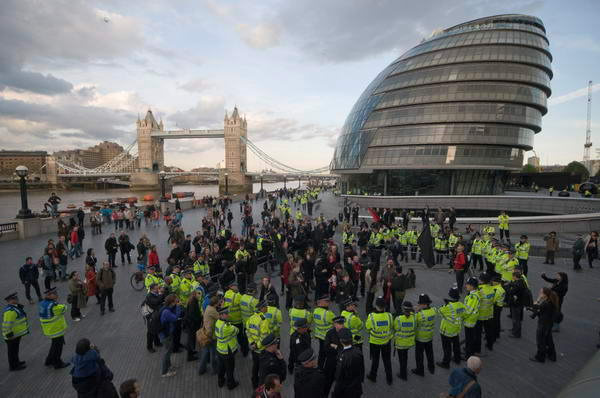
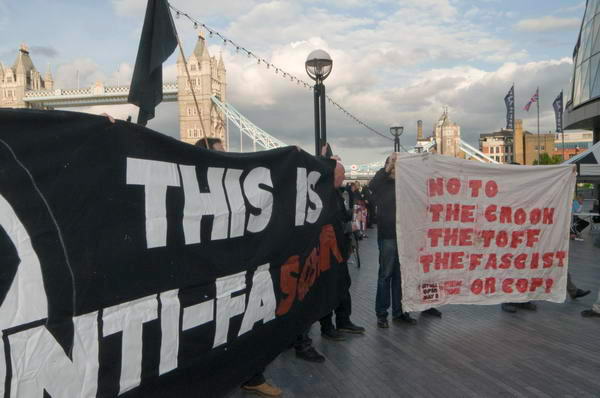
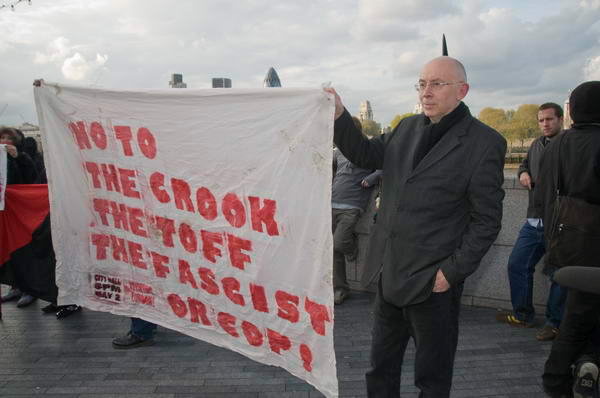
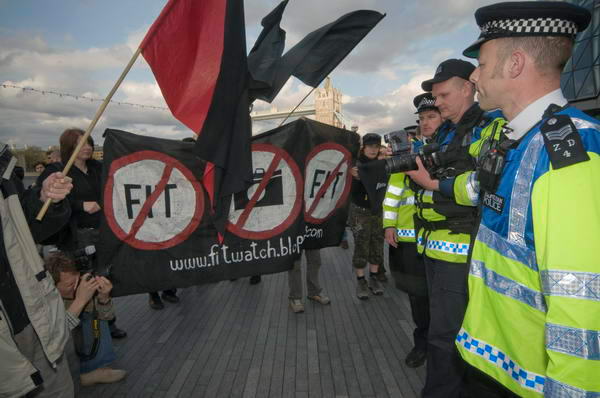
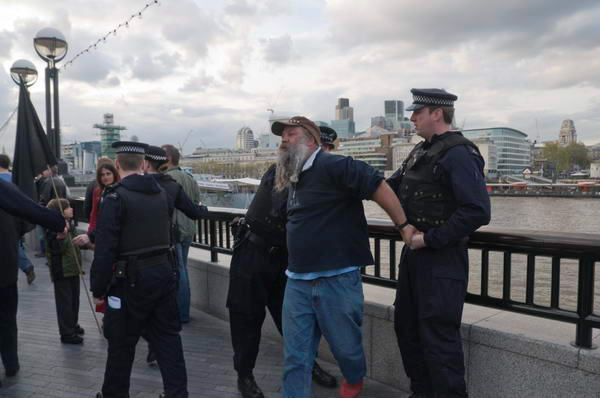
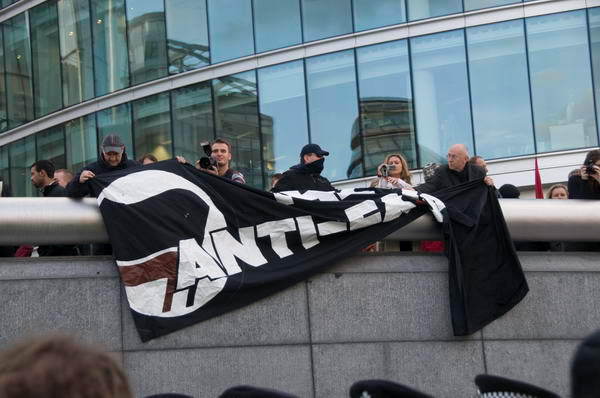
I came up to London on the afternoon of Thursday 26th March 2015 and began my work by going to News International opposite the main entrance to London Bridge Station where te week of Occupy Rupert Murdoch was on its fourth day. Not much was happening there, so after taking a few pictures I went for a short walk to Tower Bridge and back. Things were only just beginning to start for an evening of events there when I needed to leave and cross the river for another weekly protest by Class War at One Commercial Street.


Occupy Rupert Murdoch – News International, London Bridge

Thursday 26th March 2015

I’d been at News International three days earlier on Monday 23 March 2015 when campaigners against the scandal of the UK’s media monopoly, with 5 billionaires owning 80% of the media, had marched there the short distance from London Bridge to present an arrest warrant for Rupert Murdoch, charging him with for war crimes, phone hacking, political blackmail, tax avoidance and environmental destruction.

Thursday 26th March 2015

Someone from News International had come and taken the warrant, and the campaigners had then set up camp on the pavement outside for a week of activities, Occupy Rupert Murdoch Week. I’d been busy for a few days and this was my first opportunity to return and see what was happening.

Thursday 26th March 2015

The answer when I arrived late on Thursday afternoon was not very much, though the camp and some of its supporters were still there, and still putting up posters and telling people going into London Bridge Station opposite the camp why they were protesting.

Thursday 26th March 2015

I went for a short walk along the riverside to Tower Bridge and came back later when more people were beginning to arrive for the evening session. But unfortunately I needed to leave to walk across the river and join Class War in Aldgate before things really got going.

Occupy Rupert Murdoch


Around Tower Bridge

I’d thought that Tower Bridge was probably the most photographed building in London but a survey of Instagram tags in 2022 showed that Big Ben had inched ahead with 3.2 million posts to Tower Bridge’s 2.6 million.

I don’t often feel a great need to add to the number of pictures of London’s most famous bridge, which I think I first photographed 50 years ago, though I’d gone under it on a school trip almost 20 years earlier, back before primary children had cameras. Most of the pictures which I’ve taken including it in the last 25 or so years have a group of protesters outside nearby City Hall in the foreground.

London’s City Hall is now no longer within sight of Tower Bridge, hidden out beside the ROyal Victoria Dock in Canning Town, though it was still in its rented home, bought back by the Kuwaiti state a couple of years earlier. Tower Bridge is still owned by Bridge House Estates, a charity set up in 1282, its only trustee THE MAYOR AND COMMONALTY AND CITIZENS OF THE CITY OF LONDON.

But mostly my attention was on the north bank of the river now rather dominated by a cluster of ugly and idiosyncratic towers in the centre of the City of London, until close to Tower Bridge where the Tower of London, actually outside the City in Tower Hamlets, still stands out despite its relatively low height.

Around Tower Bridge


A Quiet Night at Poor Doors – One Commercial St, Aldgate.

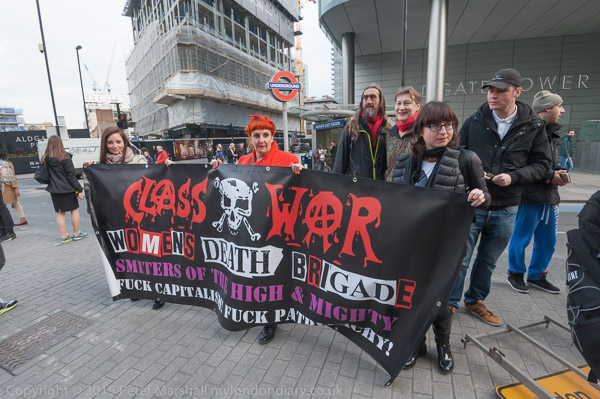
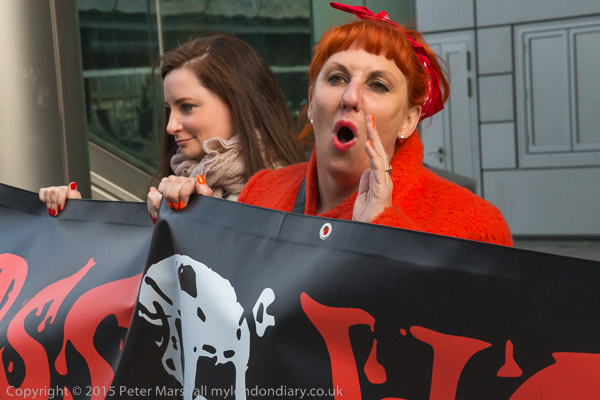
Eight months earlier in July 2014 Class War had started a series of weekly protest outside the massive largely residential block of One Commercial Street on the corner of that street and Whitechapel High St. The block includes flats for both private owners and a smaller number of socially rented flats, with the two groups having separate entrances.

The ‘rich door’ is on the main road, next to the Underground station entrance, while the ‘poor door’ is down a side alley. When the protests began the alley was dark, with dumped rubbish and a strong and persistent smell of urine, but one positive result of the protests has been that the alley has been cleaned up and new lighting installed.

As the protesters were getting ready at the rich door, I went after Ian Bone of Class down the alley to look at the poor door. We returned to the front of the building and the rich door, followed by two police officers who had come to watch us.

It was good to see again among the banners the ‘Epiphany’ banner based on the Fifth Monarchists who led a short-lived rebellion in London which began on 6th January 1660. Class War had taken part in the filming of a re-enactment of this event in 2013.

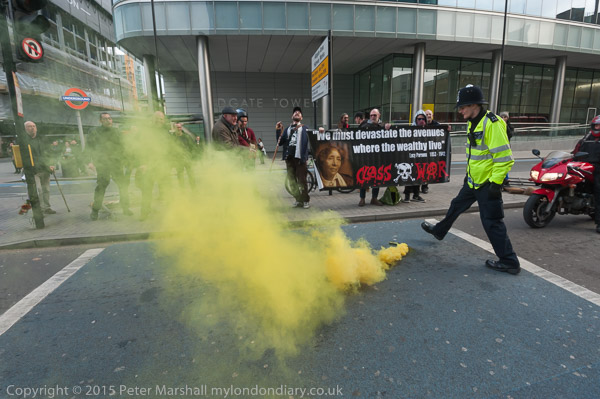
It began as a fairly quiet protest with speeches and some chanting, and at some point a yellow smoke flare rolled across the pavement.

There was a small confrontation when one resident entering the rich door pushed rather roughly past the protesters, but very few came in or out of the rich door. The ground floor also includes shops and a hotel, and I think residents could probably use the hotel entrance. We had also found that they were able to exit via the ‘poor door’.

At the end of the protest some of the protesters who had brought a Hello! magazine Queen’s Diamond Jubilee flag attempted to burn it. But this turned out to be difficult and it melted a bit but didn’t catch fire. Some then when down the alley to look at the poor door before everyone left.

More pictures on My London Diary at Quiet Night at Poor Doors.


LSE Cleaners Protest, Police Arrest Lisa

LSE Cleaners Protest, Police Arrest Lisa

LSE Cleaners Protest, Police Arrest Lisa: On Wednesday 15th March 2017, students and supporters joined cleaners on the picket line at the London School of Economics for a lunchtime rally on the first day of the 2 day strike by members of United Voices of the World union.

LSE Cleaners Protest, Police Arrest Lisa

Cleaners at the LSE have felt let down by management at least since January 2012 when the contractor who the LSE had outsourced them to cut their hours and was bullying them into signing new contracts.

LSE Cleaners Protest, Police Arrest Lisa

As I wrote back then, “Outsourcing – as doubtless research by the LSE will have shown – almost invariably leads to lower wages and poorer working conditions for the staff involved. And although the cuts and alleged bullying is being carried out by Resource Group, the responsibility for it must lie with the LSE who are responsible for the contract with them.”

David Graeber (right) at the protest

In September 2016 the cleaners with the United Voices of the World trade union launched a new campaign for parity of treatment with other workers at the university with a meeting which was a part of the LSE’s 3-day ‘Resist’ Festival organised by LSE research fellow Lisa McKenzie which had featured talks and debates often critical of the LSE, with contributions by LSE Professor of Anthropology David Graeber and Martin Wright of Class War and in particular a damning indictment by Simon Elmer of Architects for Social Housing (ASH) of a report by a group of LSE academics on the redevelopment of the Ferrier Estate, deliberately run-down, demonised and emptied by Greenwich Council from 1999 onwards, as Kidbrooke Village.

LSE Cleaners Protest, Police Arrest Lisa
Protesters walk into the estates office foyer

The protest on 15th March 2017 began with a rally on the LSE campus demanding equal sick pay, holidays and pensions etc to similar workers directly employed by the LSE and an end to bullying and discrimination by their employer Noonan.

LSE Cleaners Protest, Police Arrest Lisa

Grim Chip of Poetry on the Picket Line performed and there were several speeches by UVW members including LSE cleaner Mildred Simpson.

Dvid Graeber and Petros Eila

The protesters then marched the short distance across Kingsway to the LSE Estates Division where cleaning contractors Noonan have their LSE office. They walked in and occupied the foyer there for over and hour, only leaving after being promised that Allan Blair LSE Director of Facilities Management would talk with the cleaners union the United Voices of the World.

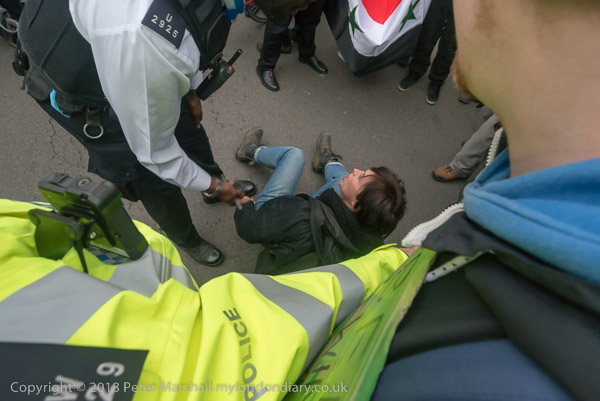
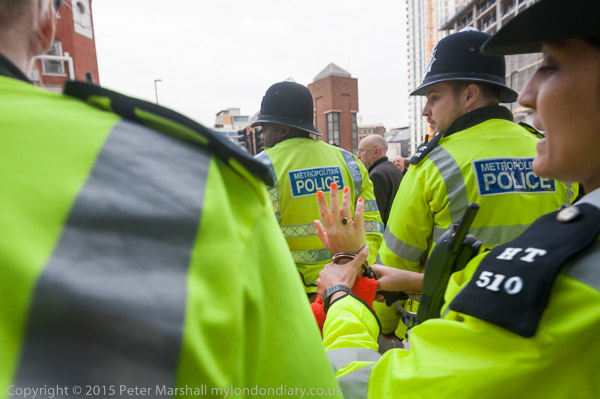
As they left the foyer, police jostled some of them before assaulting and arresting LSE academic Lisa McKenzie, charging her with assault and then bundling her into a waiting police van.

Apparently the receptionist at the estates office had complained that she had been assaulted by McKenzie as the four people holding the UVW banner pushed past her on their way into the office. I had been following close behind them and neither I nor the other protesters had seen any evidence of assault.

None of the other three holding the banner were arrested and it seemed fairly clear that the arrest was not for any offence. Perhaps the police were still aggrieved after a case against her when she was wrongly charged for three offences at a protest in Febnuary 2015 was thrown out of court. That had taken place at the time she was standing in the General Election against Iain Duncan Smith and was an arrest that appeared clearly politically motivated.

But on this occasion it could well have been that the LSE management had pointed her out as a trouble-maker. McKenzie, a working class academic and author of a highly acclaimed study of class and culture on the Nottingham estate where she lived for more than 20 years has been the a subject of constant criticism from others both inside the LSE and in the wider academic community, and when her contract there came to an end it was not renewed.

The protesters were left angry and confused. Why was Lisa being picked on? The protesters felt it must be politically motivated and it was difficult to see any other reason. I think she was later released without charge, possibly because there was CCTV evidence that showed there was no case to answer.

More on My London Diary:
Police arrest Lisa again
LSE cleaners strike and protest


March 8th – Women Strike And Protest

March 8th – Women Strike And Protest. Last year on International Women’s Day I published a long post, International Women’s Day Marches with images from my coverage of them from 2002 until 2020. This year I look back five years to Thursday 8th March 2018 when I covered a wide range of protests, most of which were linked to International Women’s Day


Shut Guantanamo at new US Embassy – US Embassy, Nine Elms

This was the first protest outside the new US Embassy where they intend to continue the regular monthly protests which they have had outside the old embassy in Grosvenor Square since 2007 until the illegal and immoral US prison camp is shut down and all the prisoners released.

Normally these protests take place on the first Thursday of every month, but in March 2018 the protest scheduled for March 1st was postponed for a week because of snow. Because of the change of date some regular protesters were unable to attend and the protest started a little later than usual as some had problems finding the new location. This was the only event not connected with International Women’s Day I covered on the day.

In March 2018, 41 prisoners remained held at Guantanamo. There was no evidence against most of those held and tortured there that would stand up in any court of law, often simply a matter of suspicion or hearsay or desperate statements made under extreme torture. Many were simply foreigners in the region seized to gain cash rewards from the US forces.

Shut Guantanamo at new US Embassy


Family Courts put on Trial – Old Palace Yard

March 8th - Women Strike And Protest

Global Women’s Strike had organised a mock trial of the UK Family Courts in an International Women’s Day protest in front of Parliament.

March 8th - Women Strike And Protest

Among those who spoke were mothers whose children had been unjustly taken away, and statements from others were also read out, along with some shocking comments made in court by judges.

The UK has the highest rate of adoptions in Europe, almost all without consent of their birth family. Families of colour, immigrants and disabled are all disproportionately affected and in some working class areas 50% of children are referred to social services.

Poverty, often the result of benefit cuts and sanctions and poor housing conditions especially in temporary accommodation is often mistaken for neglect and the help mandated under the 1989 Childrens Act is seldom available. Children are often simply taken into care and then put up for adoption even though they have mothers or grandmothers who are capable of good parenting and only need support.

The campaigners say that victims of domestic abuse are often accused of ‘failing to protect’ their children and vague charges such as putting children at risk of future emotional harm and neglect are used by the secret courts to remove children from mothers and grandmothers. They want hearings with proper public scrutiny and an end to the gagging of mothers and familys, a great use of kinship carers and the proper implementation of the 1989 Children Act, and the Care Act 2014 which entitles disabled mothers to extra help.

Parliamentary officer Black Rod sent police to try to shut down the protest, but the organisers showed them documents to say they had permission for the protest and to use a megaphone. They seemed puzzled but left.

Family Courts put on Trial


London Women’s Strike – Russell Square

This was the big event of the day and included speeches about a wide range of causes. As the organisers said the “Women’s Strike is a strike for solidarity between women – women of colour, indigenous, working class, disabled, migrant, Muslim, lesbian, queer and trans women” and “is about realising the power we already hold – activating and nourishing resistance.

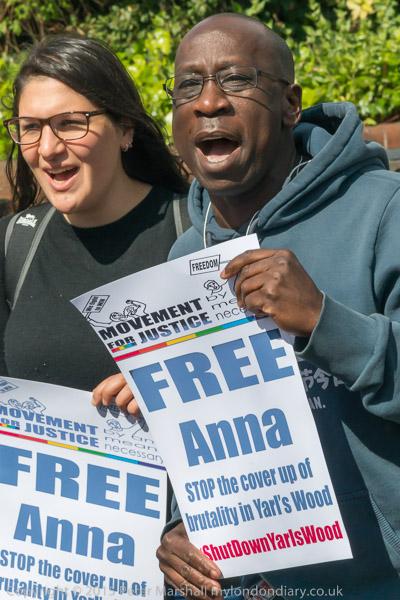
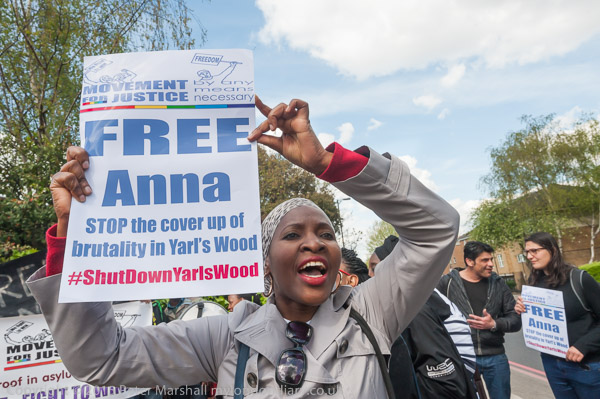
Many of the women present went on to other protests elsewhere including several protests in support of cleaners at the TopShop and The Royal Opera in Covent Garden, and cinema workers at Picturehouse, calling for an end to immigration detention an in solidarity with the Yarl’s Wood hunger strikers, for Unilever to withdraw its investment in Myanmar where its presence supports a government that has brutally raped, tortured and killed many Rohingya, and supporting sex workers by calling for the decriminalisation of prostitution and I also went to cover some of these

Much more about this event on My London Diary: London Women’s Strike.
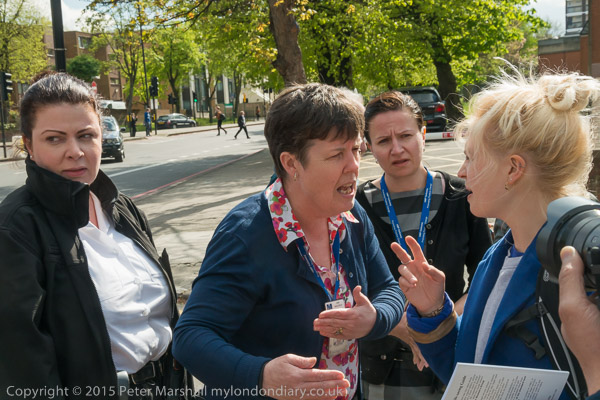

Solidarity with Yarl’s Wood hunger strikers – Home Office

At the Home Office protesters showed solidarity with those held in Yarl’s Wood on International Women’s Day, in particular with those who had began a hunger strike 15 days ago against their imprisonment and the conditions and treatment by the detention centre staff and the Home Office.
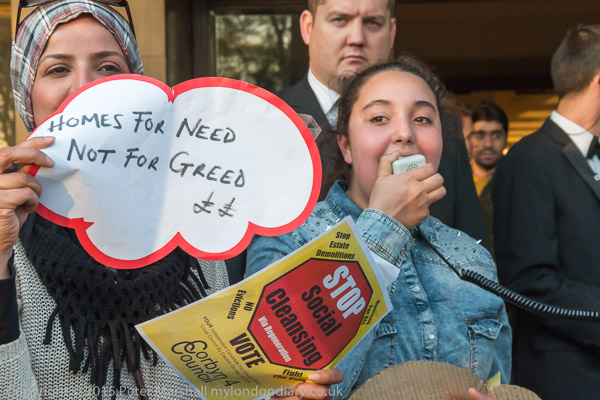
Since then the strike has gathered momentum and escalated into an all-out strike: work strikes, occupations, and a general refusal to cooperate, and long lists of the detainees demands have been published by Detained Voices.
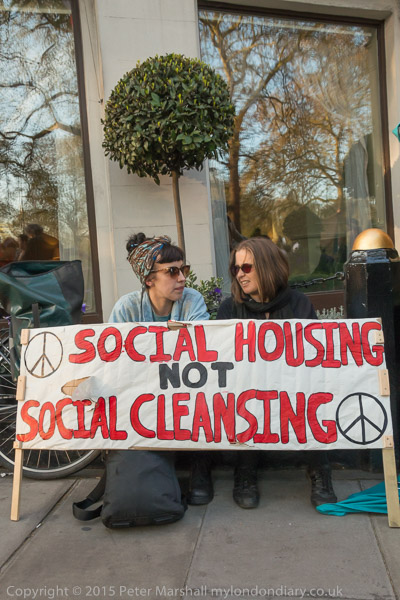
More at Solidarity with Yarl’s Wood.


Reinstate the Royal Opera House 6 – Royal Opera, Covent Garden

Six members of grassroots independent workers union CAIWU were fired by cleaning services company Kier for their jobs at the Royal Opera House, another disciplined and a sixth was on final written warning. They were clearly being victimised folloing successful trade union action which had forced Kier to pay its workers there the London Living Wage.
The large and loud action with union members augmented by women from the Women’s Strike blocked Drury Lane for some minutes. Police arrived, talked to the protesters and then went inside to talk to the managers inside before emerging, carefully removing poster and fliers the protesters had left on their car before driving off. The protesters later moved back into Covent Garden Market leaving the road free.
More at Reinstate the Royal Opera House 6.


& Myanmar’s Rohingya genocide – Unilever House

Women from the Women’s Strike called on Unilever to disinvest from Myanmar where they have a $667 million investment.

The military government there are committing systematic rape and other torture with total impunity as part of their genocide against the Rohingya people. Unilever claims, especially in its marketing for Dove products to respect the dignity and rights of women and girls and says it “aims to improve safety for women and girls in the communities where they operate.”

More at Unilever & Myanmar’s Rohingya genocide.


No To Job Coaches in GP Surgeries – 2016

No To Job Coaches in GP Surgeries

On Friday 4th March 2016, campaigners from the Mental Health Resistance Network and DPAC protested outside City Road Surgery where Remploy/Maximus job coaches will “create jobs by prescription.” They say disabled people will be bullied into unsuitable work and lose benefits through sanctions if they refuse – and protest ‘No Job Coaches in GP Surgeries‘.

No To Job Coaches in GP Surgeries

Particularly since the Tories came into power in 2010, disabled people have been systematically attacked with cuts in benefits and unfair tests of fitness for work which have led to many suicides.

No To Job Coaches in GP Surgeries

What should be a supportive system of Job Centres encouraging and helping people find work has increasingly become a vindictive system reducing the benefits to many for often ridiculous, trivial and arbitrary reasons and attempting to force people into unsuitable jobs. Benefit sanctions can leave people without the necessary means to stay alive for months or even years at a time.

In January 2022, people on Universal Credit, either unemployed or on low paid jobs were told they had only four weeks before they had to look for jobs outside the sectors they had previously worked in, and if job centre staff feel they had not tried hard enough or had turned down jobs, however unsuitable, they would have their benefits cut.

And a few days ago, the government announced an incentive scheme awarding £250 monthly prizes to the staff whose Job Centre forces the most claimants into work and forcing claimants who have been on the benefit for thirteen weeks a to attend a job centre every weekday for a fortnight for “intensive support”.

The government clearly believe that the only incentive is cash, while most of us want jobs that we feel are worth doing and have some interest as well as pay enough to live on. Even Job Centre staff are poorly paid and their union dismissed the prize scheme, calling instead for their poverty pay to be increased. But these staff are generally not evil people, and being made by the government to bully people rather than help them must be painful for many of them as well as their clients.

The protest was a creative and colourful piece of street theatre, if sometimes chaotic, with a man dressed as a doctor wearing an Iain Duncan Smith mask and a name label ‘Dr Iain Duncan Smith, Dept of Eugenics‘ handing out prescription forms for a ‘Mr A Scrounger, 17 Lazy House, Sink Estate, Tory Britain‘.

The forms prescribed ‘Endless Job Coaching in Surgery, Major benefits reduction and PRN (‘pro re nata’ – as needed) Regular Sanctions‘ on the basis ‘Continue until complete cure or death‘ from ‘Dr A Lackey, DWP Surgery, c/o Nudge Unit, Tory Headquarters‘.

Then Maximus ‘Job Coaches’ pounced on the patients to issue G4S or Ingeus Deloitte Ltd ‘work cures’ and red ‘Sanctioned’ notices. Perhaps appropriately one of those job coaches was in costume as a squirrel and had a placard reading ‘Nuts to IDS – Squirrels Fight Back’.

There were also some serious speeches, including from a local GP, Roy Bard of MHRN, Paula Peters of DPAC, and Petros Elia, General Secretary of the United Voices of the World trade union who had come with a banner, drummers and plastic horns to add some noise to the protest.

At the end of the protest DPAC led a march down City Road, with police vainly trying to move them onto the pavement.

The march stopped at the busy Old Street roundabout where they held a noisy protest letting all around know why they were protesting for around 20 minutes blocking all traffic while police tried to move them away. Eventually after police began seriously to threaten arrests they decided it was time to end the protest and slowly moved off the street.

Much more on My London Diary at No Job Coaches in GP Surgeries. You can also see some pictures I took later that day at the launch of the re-born International Times at London is on Fire – IT is back.


March With The Homeless – 2018

March With The Homeless

March With The Homeless

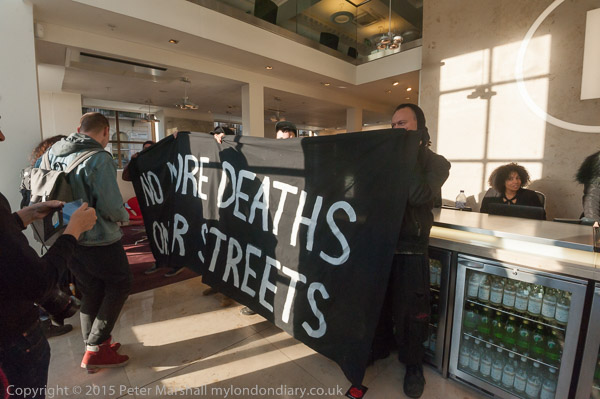
No More Deaths On Our Streets Saturday 3rd March 2018

A few days ago in February 2023 a report came out that the number of rough sleepers in England has increased for the first time since 2017.

March With The Homeless

The increase is blamed on the cost-of-living crisis making the various causes of homelessness worse, and the government’s ‘Ending rough sleeping for good’ strategy announced last year has so far failed to be any help.

March With The Homeless

We are still one of the richer countries in the world, and it is a disgrace that so many have no place to go. London’s Mayor is reported as calling it extremely alarming and saying “It is high time ministers got a grip on the escalating food, energy and housing crises and restored the social security safety net which helps stop people becoming trapped in a cycle of homelessness.”

The area with the largest number is of course London, and within London the boroughs of Westminster and Camden at the heart of London top the figures. As well as having the most people sleeping on the streets, these boroughs are also home to many of the wealthiest people in the country (or at least one of their homes) and of the most egregious examples of over-consumption where the wealthy swarm to spend ridiculous amounts on over-priced goods and services.

The increase has also been greatest in the capital, with the figure in Westminster, the home of our government, alone up from 187 in 2021 to 250 in 2022.

London of course has ridiculously high house prices, stoked in part by foreign investors who own properties just to profit from the increases in prices rather than actually live in them. Many too are owned by offshore trusts, still hiding the actual owners, and often empty or underused.

The problem isn’t really house prices, or a lack of homes – we have more than are needed to give everyone a decent home. But inequality, which continues to rise. And at its roots is the greed of the rich, for whom enough is never enough. And there are ten times as many empty houses as there are homeless people.

The March With The Homeless on Saturday 3rd March 2018 took place are a recent cold snap had killed a number of rough sleepers on the streets of London. As well as organisations supporting street homeless including #solidaritynotcharity, Streets Kitchen, Homeless Outreach Central, and London: March for the homeless there were also some of those homeless taking part.

I found the police reaction to this protest shocking. They came out onto the streets to try to stop it happening and to force those taking part to return to there static protest opposite Downing Street where it began.

As well as officers on foot there were also two police horses trying to control the protest, but whose riders seemed unable to control, particularly in some of the narrower streets. I often had to rush out of their way and at one point I was crushed against a wall by a clearly out of control horse, but fortunately only slightly bruised.

I think the police saw their role as protecting the property, particularly the properties of those owners who had empty properties which they feared the protesters might attempt to occupy. The intention of the march wasn’t to actually occupy properties, but to create a little minor disruption to traffic and noise that would bring attention to the problem and put pressure on the government and authorities to take some effective action. But I think there was little if any media coverage of the event.

They intended to march to a squat in Great Portland Street that had occupied empty commercial premises and was giving food and shelter to homeless people, getting them off the freezing streets. The police seemed to be trying to keep them out of the West End, where they might disturb more people. I had to leave the march when police had halted them at Piccadilly Circus, but I think eventually they did make it and the squat provided food and overnight shelter for around 30 people on the night of the march.

More on My London Diary at No More Deaths On Our Streets.

Against Worldwide Government Corruption – 2014

Against Worldwide Government Corruption
Anon and Mitch Antony at the Ecuadorian Embassy

The march from Trafalgar Square to the Ecuadorian Embassy on Saturday March 1st 2014 wasn’t a huge event, although its aims were all-embracing. Those attending were appalled at the state of the UK and the world and believed that a better world is possible if only we could get rid of the greedy and corrupt who currently are in change – the party politicians and their governments, the bankers and the corporations, the warmongers and the spies.

Against Worldwide Government Corruption

If only. While I share many of their views and aspirations, those in charge are in charge because they have the power, the money, the control of the media, the armies and more and are not about to give them up willingly.

Against Worldwide Government Corruption

Politically the only real challenge to them has come from people like Jeremy Corbyn and Bernie Saunders and the establishment made mincemeat of them with no-holds barred dirty tricks, false claims, lies and misrepresentation. And even if Corbyn had been elected – despite many in his party conspiring against him to throw the 2017 election it was a close-run thing and a united party would have won easily – he would have found it impossible to implement many of his policies.

Against Worldwide Government Corruption

Those coming for this protest want things that many want – and which would – like Corbyn – have wide popular support. As I wrote “they want justice and a fairer society, one that doesn’t oppress the poor and disabled, that doesn’t spy on everyone and doesn’t use the media and the whole cultural apparatus as a way of keeping blind to what is really happening.

On My London Diary I unusually report quite a large chunk of a speech at the event by one of the organisers, Mitch Antony of Aspire Worldwide, which I seldom do. Usually I’m too busy taking photographs to pay a great deal of attention to the speeches at events, and at most just jot down in longhand a few significant phrases, never having managed to learn shorthand. I did use to carry a small voice recorder, and nowadays could do it on my phone, but listening and transcribing often hard to hear speeches is too time-consuming.

The ‘Mike-Check’ of many Occupy-inspired protests where short phrases are repeated by the crowd, often as an alternative where amplification is either not available or prohibited – as in much of the area around Parliament – does make it easier to follow and report, as does the repetition in Antony’s speech, which concluded with the series of statements below.

We march against Global Government Corruption
We march against ideological austerity
We march against privatisation for profit
We march against the bedroom tax
We march against bankers bonuses
We march against the corrupt MPs
We march against state spying on the people
We march against state controlled media
We march against government misrepresentation
We march against warmongering
We march against global tyranny
We march against state sponsored terrorism
We march against the military industrial complex
We march against the militarisation of the police
We march against the suppression of alternative energies

Unfortunately since 2014, we’ve seen almost all of these things on the increase, and Julian Assange, then inside the Ecuadorian Embassy is still imprisoned, now in our maximum security jail, Belmarsh, awaiting the Home Secretary’s decision on whether to extradite him to the USA where he faces a 175 year sentence for the ‘crime’ of publishing the truth about war crimes, corruption and climate policy.

Trafalgar Square, once a public square, has increasingly beeen hired out for commercial events, and was being got ready for one the following day, which meant that the advertised meeting point for this march was unavailable, but there was room just across the road in the island at the top of Whitehall. Some trying to attend gave up looking for it, but others persisted and slowly the numbers grew – and after some speeches set off.

It was a very visual event, with many interesting characters taking part, some well-known to me from earlier protests. Its route took it down Pall Mall and on to Harvey Nicholls in Knightsbridge where for a short while they joined a protest outside the store by the Campaign Against the Fur Trade.

At the Ecuadorian Embassy where Assange was holed up in a small flat (the embassy itself is only a few rooms in a larger building) there were too many for the small pen opposite, but they refused in any case to keep to this, soon swarming across the road. The march had attracted an over-large police presence, and this was perhaps the only place some of them were needed to occupy the steps in front of the crowd.

The protest continued here for around an hour in support of of Julian Assange and Edward Snowden and other whistle blowers and over the continued refusal to grant Assange safe passage to Ecuador, something that seems to be an personal vendetta by Home Secretary Theresa May. Policing this has been an expensive business and by the end of 2013 had cost the UK taxpayer around £5.3 million. Perhaps May should have been made to pay.

The protesters hadn’t finished and were marching back to Parliament Square for yet another rally, but I needed to leave and file my report and pictures from the protest – and to get some dinner.

Much more on My London Diary at Against Worldwide Government Corruption.


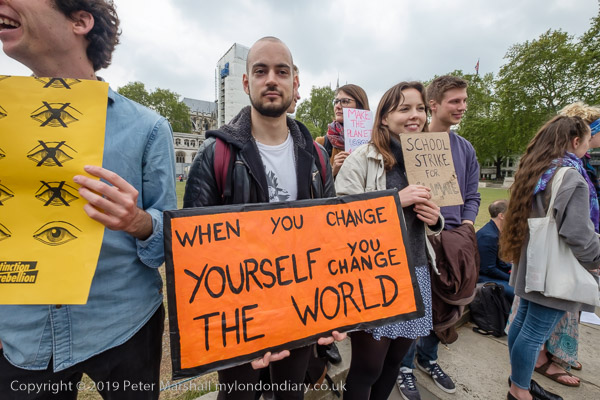
Extinction Rebellion Hackney Street Party 2019

Extinction Rebellion Hackney Street Party
Kingsland High St, Dalston, London. Sat 9 Feb 2019

Extinction Rebellion, XR, was founded in May 2018 by a small group who met in Stroud, including Gail Bradbook, Simon Bramwell and Roger Hallam along with others from the direct action network Rising Up. I’d photographed some of these people before at protests against Heathrow expansion and over air pollution on the streets of London.

Extinction Rebellion Hackney Street Party

Roger Hallam in particular had played a leading role in the ‘Stop Killing Londoners’ protests which perhaps had some influence on getting Sadiq Khan to take some action on this with the setting up of low emission zones, whose planned extension to the whole of Greater London is now exciting considerable controversy. I’d also photographed him at his campaign to get King’s College to divest from fossil fuel companies and supporting the campaign for better pay and conditions for low paid workers at the LSE

Police arrest Roger Hallam at the LSE
Police arrest Roger Hallam for decorating the LSE, April 2017

Since helping to form XR, Hallam has gone on to take part in other high profile protests and spent time in prison over breaching bail conditions by holding a toy drone without batteries close to the airport. The whole plan to fly drones in the Heathrow exclusion area had been a publicity stunt, never a serious attempt to disrupt or endanger flights, but gained a huge amount of media publicity, which perhaps helped to increase public awareness of the contribution to climate change and pollution of air transport.

Extinction Rebellion Hackney Street Party

XR continues to attract wide support for its non-violent protests highlighting both the devastating effects of global heating and the continuing failure of governments including our own to take action on the scale needed to combat it. It’s large public protests began with a mass reading of its ‘Declaration of Rebellion‘ in Parliament Square in October 2018 with Greta Thunberg as one of the speakers and continued with mass protests in London and elsewhere, becoming a global movement.

Its announcement at the start of 2023 that it was taking a rest caused some consternation among its supporters, but XR soon made clear that this was for a ‘100 days’ campaign to prepare for ‘The Big One’ on 21 April 2023, https://extinctionrebellion.uk/the-big-one/ when they intend that 100,000 people will gather outside the Houses of Parliament “To demand a fair society and a citizen-led end to the fossil fuel era.”

The street party in Hackney on Saturday 9th February 2019 was rather smaller, with perhaps a thousand taking part. Unlike in some later protests the police decided to facilitate the event rather than try to block or disperse it, closing the road and setting up diversions for traffic as people blocked the usually busy A10 for two hours with speeches, music and spoken word performances, t-shirt printing, face painting and free food, with dancing to a samba band.

At the end of the two hour party after a brief march up and down a short section of the road, the protesters moved off the street to continue their protest party in Gillett Square, and shortly after this I went home.

Police after all do facilitate other large events which block our streets, in particular sporting events such as the London Marathon, some cycling events, the Chinese New Year, Notting Hill Carnival and more. But later XR protests have been more widespread and longer lasting and clearly the police’s political masters have put considerable pressure on the police to take a more draconian approach – and at times to go beyond the law to do so.

The response of the government has been to produce new laws. The Public Order Bill currently going through parliament gives much more extreme powers to police and courts, including Serious Disruption Prevention Orders which will restrict the movement of people, who they can meet and even their use of the internet, an expansion of stop and search powers, enabling them to search without any suspicion, various new protest-related offences, some vaguely defined allowing almost anything to be an offence and even police powers to shut down protests before they begin.

Free food at the party

The Public Order Bill re-introduces most of the amendments that were rejected by the House of Lords in January 2022 and so did not form part of the Police, Crime, Sentencing and Courts Act 2022.

The march ended in Gillett Square, freeing the road for traffic

Many more pictures at Extinction Rebellion Hackney Street Party on My London Diary.


IWGB Protests University Outsourcing – 2018

On Thursday 25th January 2018 I went out to photograph one protest in the evening and found myself getting transported to another by the Independent Workers Union of Great Britain.


End Outsourcing at University of London – Senate House

IWGB Protests University Outsourcing

Striking security officers and receptionists from the Independent Workers Union of Great Britain picketed Senate House and were joined by supporters for a noisy rally at the gates. Cleaners, receptionists, security officers, porters and post room staff are all demanding that the university ends discriminatory employment practices and makes them all direct employees.

IWGB Protests University Outsourcing

Outsourcing is a way for organisations like the University of London to get essential jobs done on the cheap by people working under terms and conditions that would be a blot on their reputations as responsible employers. They contract out the people who work in their business to contracting companies who employ them under far worse pensions, holiday entitlements, sickness entitlements, and maternity and paternity leave than in-house employees.

IWGB Protests University Outsourcing

Those working at the UoL say they are often bullied and overworked and sometimes paid several months late. Many are also on zero hours contracts, which fail to offer them consistent work, and have no guarantee that they will get any work, and and can be used to further bully or punish workers, often those who are active in the unions. Following earlier protests the University is considering bringing some of the workers in-house, but they and their union, the IWGB, were insisting that all should be put onto the university payroll. The savings from outsourcing are often illusory and organisations always get better service through direct employment.

The workers had been on strike all day and had been picketing and in the early evening were joined by a large and noisy crowd of supporters, including IWGB member from other workplaces and students, including a samba band who considerably livened up the protest.

IWGB President Henry Chango Lopez

After the band had played for some time there were speeches from some leading members of the union including IWGB President Henry Chango Lopez and others who came to give support including United Voices of the World General Secretary Petros Elia. He was able to give news of another campaigning success, where after a noisy protest outside its offices by the UVW in the previous month another company had agreed to pay cleaners the London Living Wage.

United Voices of the World General Secretary Petros Elia

As the protest drew to an end IWGB General Secretary Jason Moyer-Lee announced that a double-decker coach had arrived and would take IWGB members and any more they could fit in to a surprise protest at another secret London location. Although I was rather cold, tired and hungry it was an opportunity I couldn’t turn down.

More at End Outsourcing at University of London.


Cleaners rush into Royal College of Music – Royal College of Music

Unloading the bus

We crowded into the bus which drove off into the London rush hour, and it was soon clear we were going west. We passed the Royal Albert Hall and then turned off into a side street a short way from our destination, which turned out to be the Royal College of Music.

People got off and unloaded the union flags, banners and drums quietly. Then two people went a little ahead of the rest of us to hold open the doors of the RCM ready for the rest of the crowd to rush into the foyer for a surprise protest.

Cleaners there had recently been taken over as the RCM had agreed a new contract with a different company, Tenon FM. They had decided to unilaterally cut hours in half and change shift times, telling the cleaners they must work at times most already have other cleaning jobs, and they are now threatened with dismissal for refusing to accept the new hours.

Both Tenon and the RCM were refusing to hold any discussions over the changes with the IWGB, who had because of this launched a collective grievance and balloted the cleaners for strike action; the union was also considering a legal challenge under law governing the transfer of undertakings.

Inside the foyer the protesters waved IWGB union flags and placards, banged drums and shouted slogans but were careful to avoid any damage. THe RCM called the police who arrived after 12 minutes and ordered the protesters to leave. They did so and continued the protest on the pavement outside. It was a dark street and the blue flashing lights of the police cars made photography challenging.

I continued to photograph for a few minutes and then decided I had taken enough pictures and little else was likely to happen. I was already very late for dinner and had a longer than expected journey home.

More pictures at Cleaners rush into Royal College of Music.