Close Down Yarl’s Wood -2015

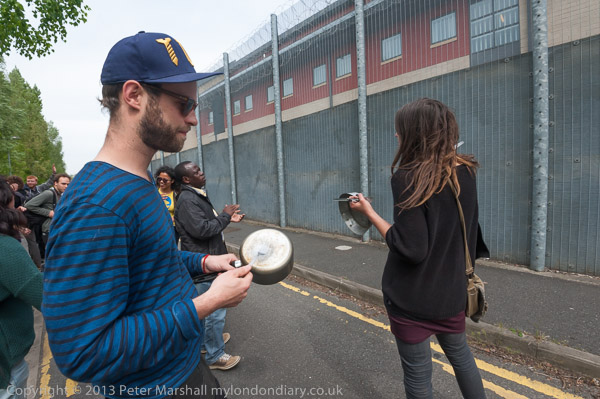
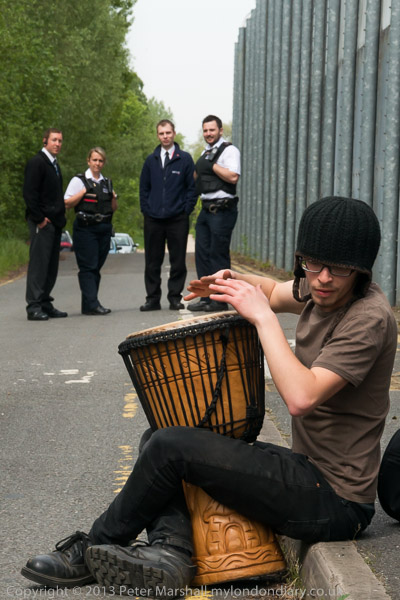
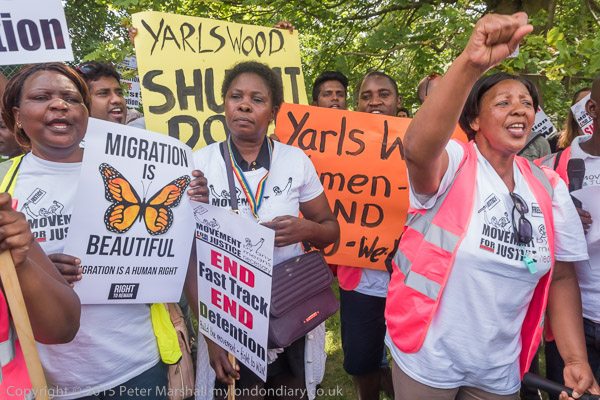
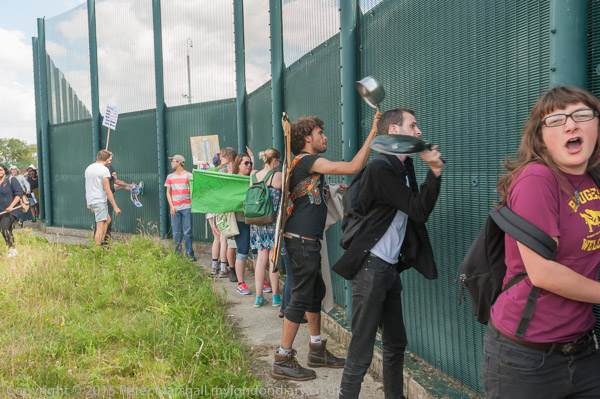
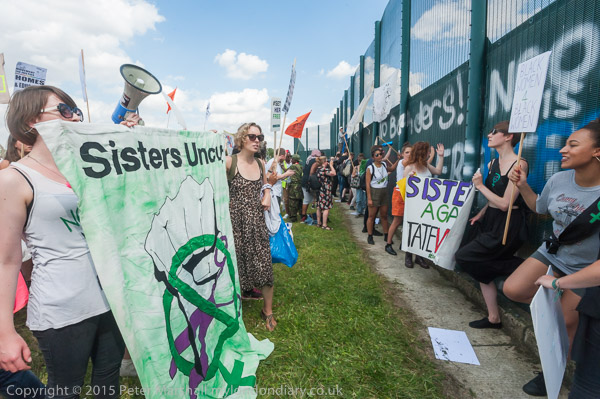
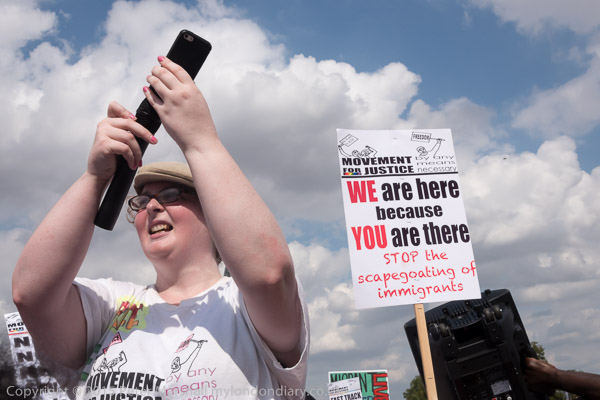
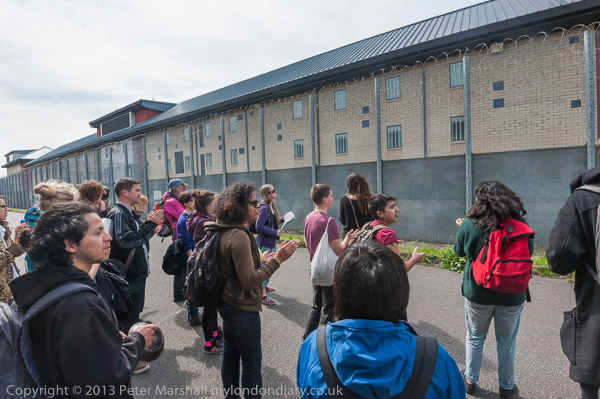
Close Down Yarl’s Wood: On Saturday 8th August I went with around a thousand protesters to Yarl’s Wood Immigration prison, in the middle of the countryside around 5 miles north of Bedford.
Close Down Yarl's Wood -2015

There were coaches from around the country but I travelled by train to Bedford, where organisers Movement of Justice had arranged for a bus to pick up epole from the station. The prison is on a wartime aerodrome at the top of a hill and a relatively remote location.

Close Down Yarl's Wood -2015

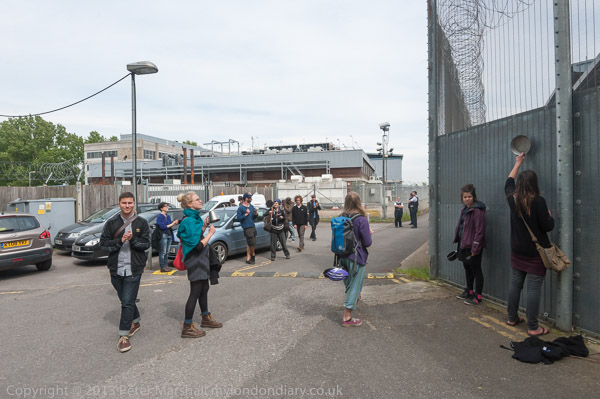
Even after the coaches had dropped us off at the front of the estate, there was then a walk of a little over a mile along the road and then along a public bridleway to the field sloping up from the 20 ft prison fence on the north side. There is a road for official visitors leading to the other side of the site.

Close Down Yarl's Wood -2015

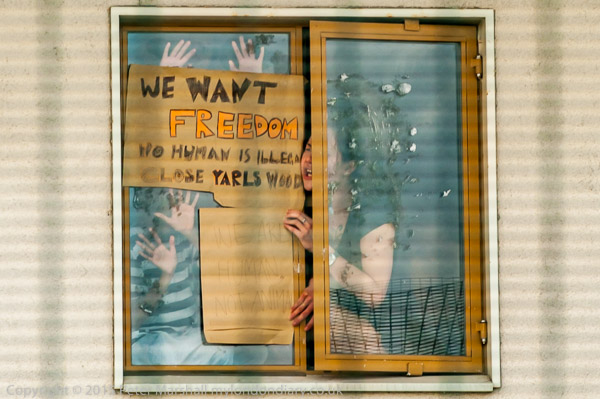
I had missed an earlier protest which I had been invited to cover as I thought I was ill-equipped and other photographers would have more suitable gear than me. Most of my work is made with wide-angle lenses and to photograph though the mesh top half of the 20 foot fence the women at the windows inside was a challenge for me.
Close Down Yarl's Wood -2015

But this time I borrowed a 300mm Nikon lens from a friend and used it with my Nikon D700 in DX mode, which made it equioalvent to a 450mm lens, and it did a reasonable job, though ideally I would have had something even longer and faster. Most of the pictures taken with it are cropped.
Close Down Yarl's Wood -2015

Most of the pictures were made with a wideangle Nikon 16-35mm zoom, but a few with my usual longest lens, a Nikon 18-105mm, and even fewer with a Nikon fisheye. As well as the D700 I was also using a D810 at the event.
Close Down Yarl's Wood -2015

On My London Diary I list around 25 groups supporting the protest – and probably missed quite a few more. There is a very widespread feeling of disgust and shame at the way this country treats asylum seekers in a racist system that detains so many for long periods without trial, locking them away in detention centres such as these run for profit by private companies where they are always mistreated and often subjected to real abuse and sexual harassment.
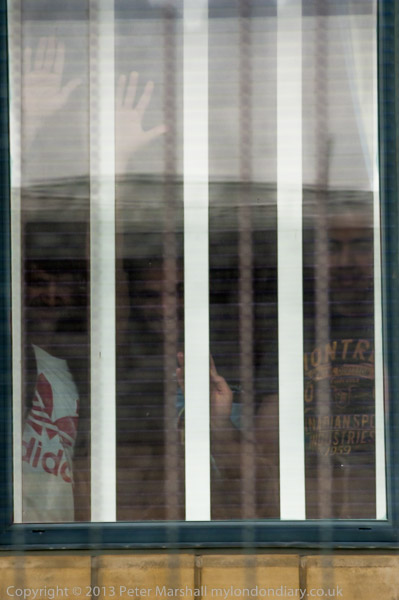
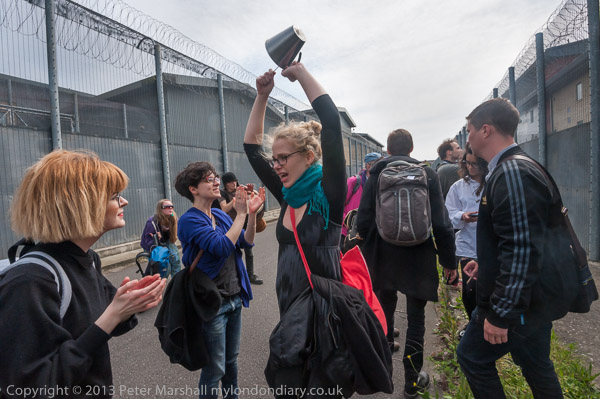
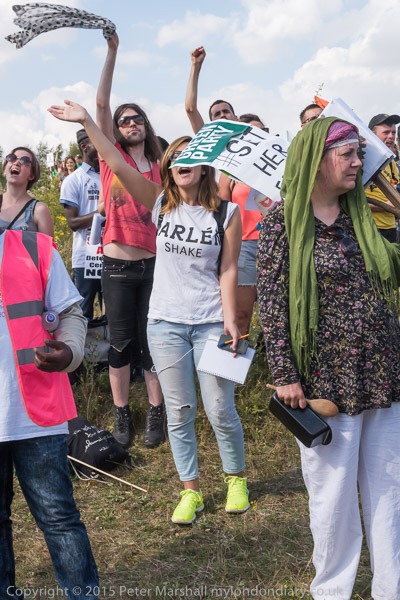
Yarls Wood was then used to hold women asylum seekers, though there were also some families held there. When we arrived and they could hear the shouts and some could see us through the upper windows there “was a rapturous welcome from the women inside the prison, who came to the windows, shouting and waving and holding up signs. Protests like this really give the prisoners hope, and show them they have support and are not forgotten. Together, inside and out people chanted slogans ‘Shut Down Yarls Wood’, ‘Detention Centres, Shut them Down’ and more.”
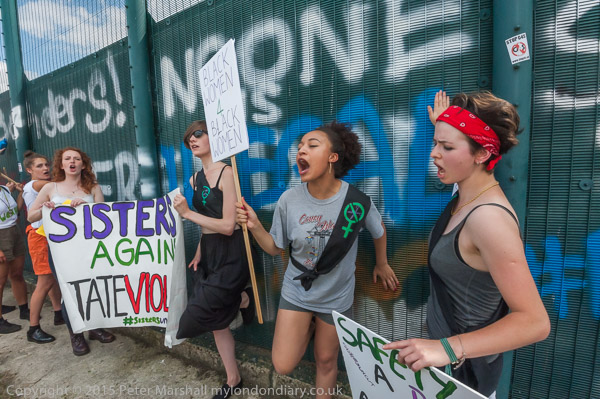
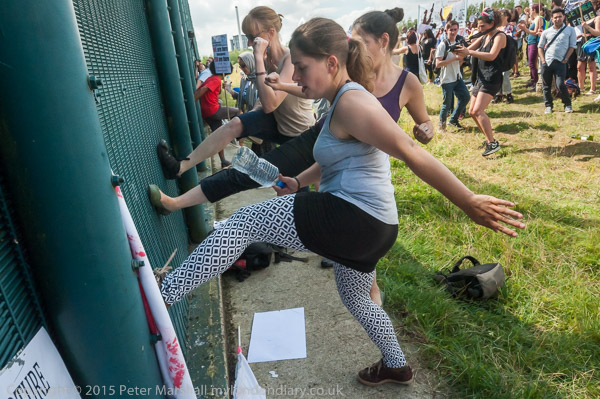
The solid metal lower half of the 20 ft fence makes a loud noise when hit or kicked and the protesters made the most of this, with others writing slogans on them – though these were not visible to the women inside.
Although the detainees are prisoners they are treated differently to those in normal jails and have to be allowed some contact with the outside world to organise their cases – including mobile phones. They held up signs with their phone numbers so that we could see them – and then ring them up so that they could speak to the public address system the protesters had brought.

Many of those outside who spoke during the protest had spent some time in this or other detention prisons, and some were speaking to friends still inside. Detention is open-ended with people having no idea of when they would be released – or, if their applications failed, deported. One detainee was only released one day before having spent three years here.
There are many more pictures on My London Diary. Here’s how I ended my piece: “Too soon we had to leave. And they had to stay. As I walked away to catch the coach back to Bedford station I felt ashamed at the way that my country treats asylum seekers. They deserve support and humanity and get treated worse than criminals.”


FlickrFacebookMy London DiaryHull PhotosLea ValleyParis
London’s Industrial HeritageLondon Photos

All photographs on this page are copyright © Peter Marshall.
Contact me to buy prints or licence to reproduce.
Protest against fast track deportations

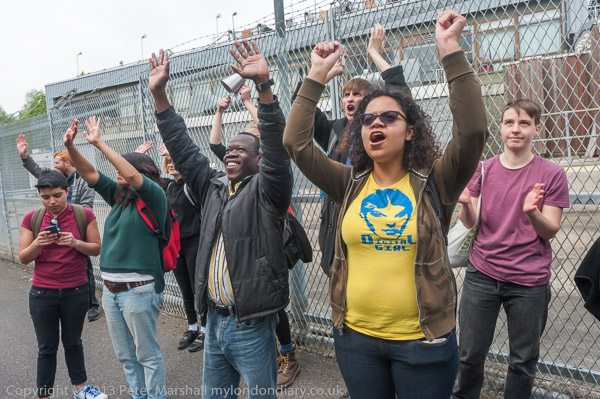
Protest against fast track deportations: On 5th May 2014, the early May bank holiday, protesters went to Harmondsworth Immigration Detention Centre close to Heathrow in solidarity with the prisoners inside who had gone on mass hunger strike against the unfair ‘fast track’ system which denies many a proper hearing. The were also protesting against other problems in the private-run prison.

Protest against fast track deportations

The hunger strike by over 300 men held at the centre was sparked off by the failure of the only fax machine at the centre, an essential service for those trying to prepare their case to gain asylum in the UK.

Protest against fast track deportations

The strike was suspended over the weekend after Home Office officials met delegates from the hunger strikers and promised to give answers to their demands on Tuesday, 6 May.

Protest against fast track deportations

Detained Fast Track (DFT) was first introduced by New Labour, but its use had expanded under the coalition government. As I noted, it “is inherently unfair, giving asylum seekers little or no time to prepare their cases and has resulted in many unfair decisions. It disadvantages those in most need of asylum who are unlikely to have prepared essential documents in advance and to be in a condition to represent themselves effectively. And as they are held in detention it is very difficult or impossible for them to prepare a case, particularly when communication with the outside world is limited and difficult.

Protest against fast track deportations

As well as being unfair, DFT is also expensive, thought to at least double the costs to the country for every asylum seeker held in detention, though the government does not release the exact figures. But despite the cost, the quality of accommodation and services in the detention centres is extremely poor. Many of those held have medical problems, often linked to the reasons why they fled their countries and there has been a desperate lack of proper healthcare at this and other immigration detention centres.

It’s hard to escape the feeling that many in the Home Office – including those in charge – have lost any feeling of compassion for the desperate people who seek asylum, seeing them as a threat to our country, best locked away and as far as possible out of mind. In my post on the protest I mentioned the case reported by HM Inspectorate of Prisons of an 84 year old man suffering from dementia who died after being held for almost 3 weeks without and proper medical attention before being taken to hospital in handcuffs.

Hard too not to see the incompetence often displayed as deliberate, as in the case of those held sometimes for over a year after having agreed to voluntary repatriation or those transferred to here for interviews in London and then abandoned here rather than being returned to other detention centres to continue to consult with their lawyers and have family visits.

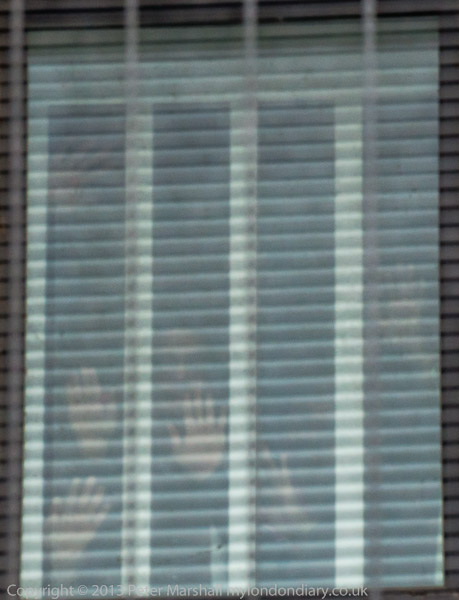
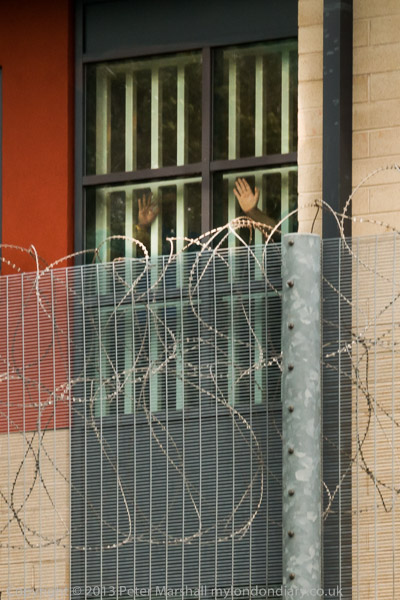
We could vaguely see a lot of hands and very dim faces in the windows. As well as the grid of the fence there is a layer of dirty glass and another of plexiglass between them and us

Difficult to understand the lack of legal help and advice at this and other centres enabling the detainees to prepare their cases, and the many holdups that they encounter in doing this – even when the fax machine is working.

Probably the main changes that have taken place at Harmondsworth since this protest nine years ago is that the prison, together with its neighbour Colnbrook are under a new private management and that security and police presence has been considerably tightened. In 2014 the protesters were able to walk down the private road leading to a BT site between the two prisons and continue around the outside of the 20ft high prison fence. Since then protests have been restricted to the front of the building, out of sight of the prisoners. Back in 2014 the police told them that so longs as they behaved sensibly and caused no trouble they would be allowed to protest – and they were.

Later in 2014 the High Court ruled that the Detained Fast Track procedure was was unlawful, though the Home Office appealed and eventually only minor changes have been made. The process is clearly in breach of international law, as is the wholesale detention of asylum seekers.

As recently as 2018 the UK again committed to a declaration that it would “ensure that any detention in the context of international migration follows due process, is non-arbitrary, is based on law, necessity, proportionality and individual assessments.” Current and proposed UK policies break every aspect of this commitment and other aspects of international law, much of which was driven by the UK and to which successive governments have at least paid lip-service. Our current government has declared it will ignore those aspects it finds inconvenient.

More on the protest at Support Harmondsworth Mass Hunger Strike.