Norwood to Brixton: TQ31

House, Norwood Grove, Norwood,  1991 TQ3170-001

My pictures from TQ31, a 1km wide strip of London begin at Norwood Grove with a picture of the ‘White House’ there, a fine building dating from the early 19th century on the edge of Croydon. It’s a total mystery to me what I was doing there in 1991, but I did photograph this house again in 1996 but on a dull, overcast day. Possibly I was on a family walk and we had gone to look at its gardens which are listed with the house.

Barber, Norwood Rd, Tulse Hill, 1991 TQ3172-003

Hairdressers are a good example of businesses that can be set up with relatively little capital expenditure, and are often quite individual in the furnishing of their shops and window displays. I don’t think there are any real chains or franchises in the trade, either for barbers, unisex or ladies salons. And given the nature of the business the windows often include representations of heads – drawn and photographed (as in this case) or even three-dimensional, making them of great interest to me. Something that the differential fading of the colour image at the right only added to.

Dulwich Rd, Herne Hill,  Lambeth, 1991 TQ3174-020

It was definitely the colour that attracted me to this cafe on the Dulwich Rd at Herne Hill, set off by the white porcelain ashtray. Getting the colour right in the darkroom (it wasn’t on the enprint) proved a little difficult, but the ashtray and the CocaCola box were good reference points and this was one of the pictures I exhibited in the 1990s

Repairs, Railton Rd, Brixton, 1991 TQ3174-005

Brixton was a place I loved to visit for its colour and vibrancy. Back in the early days I went there quite frequently to buy cheap outdated photographic paper from A.W.Young Photographic in Altantic Rd. Later I used to go to Photofusion in Electric Lane to go to exhibition openings and take in pictures for their photo-library. This was Sherlock Electrical Repairs in Railton Rd, and they seemed to specialise in vacuum cleaners.

121 Centre, Railton Rd, Brixton, 1991 TQ3174-019

I bought some pamphlets and magazines from the 121 Centre in Railton Rd, on the corner of Chaucer Rd. It was a squatted anarchist social centre, and later in 1999 I went to at least one party in the street outside when it was threatened with eviction.
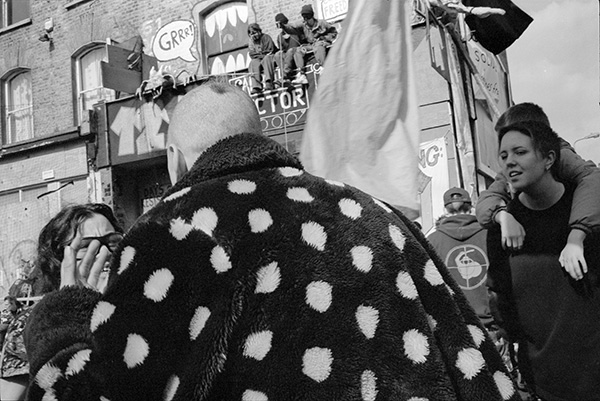
The centre had been squatted in 1973 by Olive Morris and became and anarchist social centre around the time of the 1981 Brixton riots, when Railton Rd was the “front line!, later gaining an international reputation for the groups and events it hosted. Set on fire by right-wing thugs in 1993, it recovered but was evicted by Lambeth Council in 1999 despite a determined and well-organised campaign of resistance. Property values in the area had risen dramatically and Lambeth who perhaps hadn’t been worried when Brixton property was almost worthless decided to take the property back.

More from Brixton in a later post. You can see these and other pictures in the Flickr album TQ31 London Cross-section. As I write there are still more pictures to add of TQ31 north of Stockwell.


All photographs on this and my other sites, unless otherwise stated, are taken by and copyright of Peter Marshall, and are available for reproduction or can be bought as prints.


London 1986 Page 10

Institute of Chartered Accountants, Great Swan Alley, City 86-8ab-32-Edit_2400

Page 10 of London 1986 begins in the city of London, and strongly features a remarkable set of figures around the Institute of Chartered Accountants building from 1890-93 in Great Swan Alley, off Moorgate a little to the north of the Bank of England. Above its first floor windows is a long frieze of figures representing various trades and figures, some dating from the 1890s and others added in the 1930s and 1960s when the building was extended. Among them you can see Wren holding a model of St Pauls Cathedral.

Institute of Chartered Accountants, Great Swan Alley, City 86-8ab-34-Edit_2400

But apparently of more interest to me were what Pevsner describes as the “small very female termini caryatids” whose figures seemed very much at odds with my ideas both of the Victorians and of accountants and on whom I expended far to much film.

Petticoat Lane, City, Tower Hamlets86-9a-23_2400

I managed to drag myself away from the sirens of the ICA and out of the City into Petticoat Lane and the area around this, finding as well as a market a large group of Christians armed with muscial instruments.

Guildhall, Exhibition hall, Magistrates' court, Offices, Richard Gilbert Scott, 65 Basinghall Street, City 86-9b-14_2400

Later I returned to the City for more pictures, including some of one of my favourite modern buildings in the city, the Exhibition hall, Magistrates’ court and Offices by Richard Gilbert Scott at 65 Basinghall Street with its wonderful concrete roofs.

Highwalk, Wood St, City 86-9d-41_2400

The city’s Highwalks also attracted my attention, part of a post-war vision of separating pedestrians from traffic by visionary architects who perhaps failed to appreciate the tremendous residue of street-level development that anchored people to the ground. It worked for areas that had been largely obliterated by bombing, particularly the Barbican, but could never become sufficiently comprehensive elsewhere across the city to make sense. It did however provide photographers with some useful elevated viewpoints.

City Mill Lock, Bow Back Rivers, Stratford, Newham  86-9f-26_2400

At the end of the page are a few pictures from Bromley-by-Bow and Stratford back rivers, including some of the near derelict lock linking the City Mill River and St Thomas’s Creek with the tidal Waterworks River. I think this lock dated from the 1930s when the City Mill River was enlarged and other work done as a part of a flood relief plan for the area (and also to give work to the unemployed.) Because the Waterworks River was then tidal, the water level in it could be either above or below that in the City Mill river and there are two pairs of gates at this end of the lock. These were replaced by modern gates a few years ago, but a new lock was built at Three Mills as a part of the Olympic redevelopment, which probably makes the double gate redundant.

Page 10 of London 1986

Southwark & City – 1986 page 9

Tower Bridge, River Thames, pier, Hays Wharf, Southwark 86-8z-21-Edit_2400


Page 9 of my album London 1986, black and white pictures taken of the city that year, begins briefly on familiar ground in Southwark, close to the OXO tower, before going on to Clerkenwell and Finsbury. Because of my rather odd filing system the two areas interweave before I return to Southwark and Bermondsey.

Laystall Street, Clerkenwell, Camden 86-8x-32-Edit_2400
A plaque above a hairdresser’s shop commemorates Guiseppe Mazzini, founder of Young Italy, a secret society formed to promote Italian unification. He lived in London at various times between 1840 and his death in 1872 to escape arrest on the continent.
Tower Bridge, River Thames, Hays Wharf, Southwark 86-8z-22-Edit_2400

I crossed Tower Bridge briefly and returned south of the river. The riverfront between Tower Bridge and Southwark Crown Court , opened in 1983, has changed completely since I took these pictures, though many of the pictures away from the river have altered relatively little – the George Inn was last rebuilt in after a fire in 1677.

Hays Wharf, Pickle Herring St, Southwark 86-8z-41-Edit_2400
Pickle Herring St, Southwark  86-8z-55-Edit_2400

Later I went to the City, wandering the area around Bank and towards the Tower with page 9 ending with a second picture of Pepys on Seething Lane.

Lombard St, City  86-8aa-21-Edit_2400

The City is also an area where many older buildings have been preserved, despite some notable losses, though most date from the nineteenth or early twentieth centuries, and most that I photographed are still recognisable. But the environment has been altered and many are now somewhat overwhelmed by gigantic towers.


All photographs on this and my other sites, unless otherwise stated, are taken by and copyright of Peter Marshall, and are available for reproduction or can be bought as prints.


Dancing and Dereliction – TQ30

North of Covent Garden in the 1km wide strip of London in TQ30 we come into the areas of St Pancras in LB Camden (which includes Kings Cross) and Pentonville in Islington which were largely outside the tourist zone, apart from housing a number of hotels, none of which appear in my colour pictures from 1986-93.

Printer, Kings Cross Rd, St Pancras,1990 TQ3083-057

Businesses here catered for London, and many were failing thanks to changes in technology and the de-industrialisation of our economy. A large swathe was blighted by plans for development of the railway lands, including much outside the actual rail areas that were threatened by demolition, though thanks to local opposition much has so far been saved.

Wellers Court, Somers Town, 1990TQ3083-048

North of Kings Cross there was to be wholesale demolition, and even listed buildings were not safe. The gasholders that were such a prominent landmark in the area were soon to be dismantled, with some being re-erected some distance away on the opposite side of the canal.

Gasholder, Pancras Rd, Kings Cross, 1990 TQ3083-030

And the dancers on the side of Stanley Buildings were having their final dance before they and the other nearby buildings were demolished.

Dancers, Stanley Buildings, Kings Cross, 1990TQ3083-009

Perhaps surprisingly I took few pictures of the Regent’s Canal in colour, though rather more in black and white, but I had photographed around here fairly extensively in the previous few years and perhaps felt I had little more to say.

Works, Albert Wharf, New Wharf Rd, Pentonville, 1986 TQ3083-021

But it was good to have a picture of the road side of Charles Bartlett, Export Packers & Shippers, whose chimney and works dominate this stretch of the canal.

Door and Brooms, Caledonian Rd, Pentonville, 1990TQ3083-064

But the road that fascinated me most was the Caledonian Road and its side streets, as a number of the pictures here show. You can see these and others on the third page of my album TQ30 London Cross-section.


All photographs on this and my other sites, unless otherwise stated, are taken by and copyright of Peter Marshall, and are available for reproduction or can be bought as prints.


TQ30 Covent Garden

Legs, Great Queen St, Covent Garden, Camden, 1987TQ3081-017

Continuing the one kilometre wide strip of London TQ30 north from Westminster leads to Covent Garden, which by the time I took these pictures around 1989 had already become a tourist Mecca. The market had closed and moved to Nine Elms a dozen years earlier in 1974 and many trendy businesses had moved into the area.

Cactus, Entrance, Russell St, Covent Garden, 1991 TQ3081-042

Among them were many clubs and eateries joining those that there already in an area of theatres and of course the Opera House. Opposite that was Bow Street Magistrate’s Court, still in business (it closed in 2006), one of London’s best-known legal landmarks, where many famous and infamous had come to trial.

Young Dancer, Enzo Plazzotta, Broad Court, Covent Garden, 1991 TQ3081-041

Just to its north is a wide alley, Broad Court, with a fine row of red telephone boxes and a statue of a young dancer, though I’m not sure why facing the Opera House was thought to be an appropriate position for her.

Elvis, Great Queen St Holborn, 1991 TQ3081-043

Elvis was not far away, in Great Queen St. It was had to tell from many of the shop windows exactly what business they were in, but one of the strangest was in Betterton St – The Albanian Shop, where you could buy the thoughts and probably a bust of ‘The Iron Fist of Albania’ and which doubled as ‘The Gramophone Exchange’. It is alas no longer with us.

Albanian Shop, Betterton Street, Covent Garden, 1991 TQ3081-052

Doubtless there is still much of interest in Covent Garden, if in normal times you can see any of it for the hordes of tourists. It’s an area of London I now tend to avoid, but back then was always an interesting and often surreal experience.

Gloves, shop window, Judd St, St Pancras,1986 TQ3082-015

More pictures mainly on the second page of TQ30 London Cross-section.


All photographs on this and my other sites, unless otherwise stated, are taken by and copyright of Peter Marshall, and are available for reproduction or can be bought as prints.


1986 Page 8

Page 8 of my album 1986 London Photographs begins with pictures from Wapping in August 1986.

Wapping High St, Wapping, Tower Hamlets  86-8t-55-Edit_2400

I photographed some slogans in Russian on fences – left I understand from the making of a film, supposedly set in Russia, but actually filmed here.

Wapping High St, Wapping, Tower Hamlets 86-8t-54-Edit_2400

Wapping High Street never failed to interest me back then, though it has now lost a great deal of the old atmosphere. The doorway at the right of this picture now leads to the Captain Kidd pub, converted from an old warehouse which used to store various goods including coffee, edible gums, dried fruit and wool from Australia. Sam Smith’s have done some excellent conversions of a number of historic properties and this is now a pleasant place to sit on a terrace overlooking the river and enjoy a pint of Old Brewery Bitter in a pub blessedly without TV or canned music.

Hays Wharf, Tower Bridge, Bermondsey, Southwark 86-8u-61-Edit_2400

After making some pictures there I walked back to Tower Bridge and crossed it to wander around a little of Bermondsey and Southwark as I made my way back to Waterloo station. The view towards Guy’s Hospital from Tower Bridge is rather different now, with City Hall and More London almost hiding the hospital tower and a wide walkway along the river bank.

Gainsford St, Bermondsey, Southwark 86-8u-54-Edit_2400

As in Wapping, many of these pictures south of the river show evidence of the great deal of building work then taking place, with many buildings being reduced to street-facing facades. For many buildings keeping the facades is probably the only possible way – if done sympathetically – of retaining some of the atmosphere of the areas, though when done badly a complete modern replacement would be preferable; not all buildings deserve to be kept. Mostly I avoided people in making these pictures, but some were desperate to be photographed.

Southern 777, Steam Engine, Cannon St Station, City 86-8v-65-Edit_2400

Another day in August I went with my two young sons, both keen railway enthusiasts and members of a British Rail kids group ‘Railriders’ to an event taking place at Cannon St station, with vintage Southern Railway electric trains and a steam engine.

Skin Market Place, Southwark 86-8w-01-Edit_2400

The trains didn’t greatly interest me, but I took a few pictures before we left and went over Southwark Bridge for a walk around Southwark, again on our way to Waterloo. Bankside Power Station is now Tate Modern, but I think Skin Market Place and its council depot has disappeared without trace.

100 pictures at 1986 London Photographs Page 8


All photographs on this and my other sites, unless otherwise stated, are taken by and copyright of Peter Marshall, and are available for reproduction or can be bought as prints.


TQ30

Shop, Brixton Hill, Brixton, 1991TQ3074-001

Back in 1986 I began a serious attempt to photograph London. Serious but not entirely credible I set out the photograph the whole of the city. Of course I never thought I could photograph everything, but set out a number of principles or themes that would govern my project, or rather a series of projects that I continued to work on for the next ten or 15 years.

Streatham High Rd, 1990 TQ3071-002

The larger part of this work was in black and white, and concentrated on buildings and streets, the physical infrastructure of London, with the goal of photographing every built structure I thought significant, as well as representatives of the typical across the city. You can see a little of this on Flickr in the album 1986 London Photographs, which contains over 1300 photographs, perhaps a third of those I took in the first six or seven months of the project.

Heads & Dummy, Shop,Streatham High Rd, Streatham, 1990TQ3072-010

In colour I was largely concerned with a more intimate level, or how individuals arranged their surroundings and how this reflected their differing social and cultural values. Some of the more obvious reflections of this came in small businesses with the face they displayed toward the public, particularly in shop windows and interiors, which feature strongly in this work.

Bedford Rd, Clapham, 1992 TQ3075-025

The previous year I had abandoned colour transparency and moved to working with colour negative film which provided much greater flexibility. For some years this was entirely trade-processed, and to cut costs (I had a young family to support) I used cheap processing companies aimed for the amateur market. Technically these were rather variable (even from the same company) and the prints I received back, usually 6×4″ ‘enprints’, were extremely variable in quality.

Shop, South Lambeth Rd, South Lambeth, 1989 TQ3077-005

As the stack of fat envelopes containing the negative strips and prints grew I wondered how to make some order of them, and came up with the idea of a traverse of the city with pictures filed together representing a number of ‘vertical’ north-south 1km wide strips of London based around the National Grid.

Cafe, Plato Rd, Brixton, 1989 TQ3077-009

Prints from negatives that interested me were then filed in a series of A4 files, labelled with the first 4 digits of the six figure grid reference which I had begun to mark on the prints. The pictures in this post are all from ‘TQ30’, and the 1km wide strip starts at Streatham and goes north from there. I started scrap book style, pasting the prints onto cartridge paper, but soon moved to using plastic file pages which held four prints on each side, arranging the prints roughly in order of their ‘northings’ in kilometre squares.

From these albums – a longish row of A4 files on my shelves – I was able to select images that were worth printing larger, keeping costs down by printing and processing in my own home darkroom. I’d discovered that Fuji colour paper not only gave cleaner looking prints but enabled the kind of dodging and burning that I’d become used to in black and white without the unwelcome colour shifts of other papers. I’ve had one set of prints from a show in the mid-80s framed on the wall beside the stairs since that show. They are out of direct sun and 35 years later show little of no sign of fading.

Bicycle, Shop, Kennington Lane, Vauxhall, 1989 TQ3078-005

I began putting images from this project on Flickr several months ago, and at the start tried to replicate the layout of the albums – and the vagaries of the prints in terms of colour balance, exposure, saturation etc. Having done several 1km strips like this I’ve decided it doesn’t really work to well, and although I’m still scanning the prints in their sheets of four have separated them into individual images – still roughly in the same order – for TQ30. And while some of the defects of those trade-processed prints are still evident (and occasionally rather a lot of dust on the plastic sleeves) I’ve tried to improve the colour balance etc where necessary. But they are still showing enprints enlarged on screen and this makes some problems more visible.

So far I’ve put just over 100 prints into the album TQ30, from Streatham to Westminster, with another 250 or more to follow, taking the ‘slice’ north to Hornsey. You can view them on Flickr.


All photographs on this and my other sites, unless otherwise stated, are taken by and copyright of Peter Marshall, and are available for reproduction or can be bought as prints.


City, Whitechapel and Wapping 1986

Page 7 of my black and white work in 1986 London Photos begins in the City but then gravitates east to Aldgate, Whitechapel and Wapping.

Holborn Viaduct, Farringdon St, West Smithfield, City  86-7v-12_2400

Holborn Viaduct which carries the road over the Fleet valley – Farringdon St – is a remarkable piece of Victoriana, and a considerable feat of engineering at the time as well as well as a remarkable example of city planning. The scheme, which included the buildings at the four corners of the bridge as well as roads around including Holborn Circus, streets leading to Smithfield Market, as well as provision for gas, water, sewage and other services cost around £2 million in 1863-69 and has been described as “the most ambitious and costly improvement scheme of the [nineteenth] century” and as the world’s first flyover. You can read a detailed account of it at The Victorian Web.

What interested me most were the sculptures which adorn the bridge and I’ve photographed them on various occasions over the years. In 1986 I could only bring myself to stop taking pictures when I came to the end of a cassette of film and also photographed the bridge from below and the corner buildings. I’ve only put two of the 18 frames I took onto Flickr.

Smithfield Market, City 86-8r-45-Edit_2400

There are a number of pictures from the area around Smithfield Market, though I’ve never got up early enough to photograph the market truly in progress – and other photographers have done so pretty well so I didn’t feel I needed to make the effort.

Albion Buildings, Little Britain, City 86-8r-64-Edit_2400

Little Britain remains a fascinating street though now I think only the facades remain and the area behind has been destroyed. I came across it a little too late when demolition of much of it was already underway and by 1986 I think it was well advanced. These properties in Albion Place, for Overbury & Sons Limited at 7 and 8 and John Lovegrove & Co Ltd at 6 had long been closed.

Hessel St, Whitechapel, Tower Hamlets 86-8s-55-Edit_2400

Hessel St in Whitechapel was a remarkable street full of old shops, some now junk shops, others Bangladeshi grocers but with some still retaining the names and descriptions of their earlier Jewish shops. As well as these black and white picture I also photographed some of the shops in colour.

These pictures were made in August 1986 and I returned some time later hoping to take more but I think then most of the street had disappeared.

Prescot St, Aldgate, Tower Hamlets 86-8s-61-Edit_2400
Prescot St, Aldgate, Tower Hamlets 86-8s-64-Edit_2400

Prescott Street now looks a little different, though a number of the older buildings have survived, including a fine pub. But most are now in very different uses and in rather better condition than when I took these pictures in 1986.

Discovery Walk, Wapping Lane, Wapping, Tower Hamlets Discovery Walk, Wapping Lane, Wapping, Tower Hamlets 86-8s-23-Edit_2400

My street map describes this as ‘Ornamental Canal’ and I think that the redevelopment of the London Docks in Wapping is perhaps the least successful of all docklands redevelopment in retaining any real impression of the former dock with the exception of just a small area at its southwest and Shadwell New Basin. Wapping outside the dock area has fared a little better too, though it is sometimes only skin deep.

Page 7 1986 London Photos.


All photographs on this and my other sites, unless otherwise stated, are taken by and copyright of Peter Marshall, and are available for reproduction or can be bought as prints.


More London 1986

The pictures on page 6 of my 1986 London Photographs were all taken in the City of London or close to its edges in Tower Hamlets and Finsbury and include a few of its better known buildings but are mainly less well-known streets and aspects that caught my attention.

P & O, St Botolph St, City 86-7o-45_2400

There is still a Beaufort House on St Botolph St, but it isn’t the same building. This one, dating from the 1950s with a nautical feel, was built as offices for the P & O shipping company. As I turned the corner and it hove into site it always gave me the impression of a huge liner with many deck levels that had somehow been marooned in the city.

Shortly after I took this and the other pictures on Page 6 it was demolished, with construction starting later in the year and completed in 1988 to an overblown postmodern design by RHWL Architects, a “distinctive office building” which many find hideous. In 2016 Amazon took around 47,000 square ft of its space in one of the largest office deals of that year.

Wentworth St, Aldgate, Tower Hamlets86-7q-64_2400

While many of these buildings are still there, often they have changed a little. Permutt Fashion Stores are no longer there at 11 Wentworth St in Petticoat Lane market, which is now ‘Queen of Textile’s’ with a rather curious apostrophe but without the advertising on the upper floors – though the rectangle above the first floor window with the name C PERMUTT when I took my picture is still there, but empty. A Permutt’s at number 13 is now a nameless Dry Cleaners and Tailors. The café at No. 9 is still a café and looks very similar but is now called Simply Tasty rather than being named for the Italian city of Vernasca, though it still appears to offer home-cooked food at reasonable prices.

Searching for more about A Permutt on the web reveals little other than that in 1934 there were bankruptcy proceedings at Carey St against an Abraham Permutt, trading as A Permutt & Co, a timber merchant in nearby Brick Lane. I don’t know if there was any connection with the A Permutt whose shop was in Wentworth St.

Nat West Tower, Tower 42, City86-7p-31_2400

The NatWest Tower is still there, though now longer called that, now known as Tower 42. Completed in 1980, it was the first skyscraper in the City, and still one of its taller buildings at 600ft. It has 47 floors, with 42 of them cantilevered out from a central core, and was renamed Tower 42 in 1995. The tower was extensively damaged by the IRA bomb in Bishopsgate in 1993 and required several years of work and after the refurb NatWest decided to sell it rather than move back in.

The picture shows two of the cantilevered sections. There are several walkways around the base of the building but all are private property and after I had taken several pictures I was approached by a very polite security officer who told me that photography was not permitted, showing me exactly where the boundary of the property was on the pavement and saying I could take as many pictures as I liked from there.

Worship St, Shoreditch, Hackney  86-7q-32_2400

Although much of the area has been destroyed, this fine row of properties on Worship St remains. The street was once called Hog Lane and there are at least two suggestions for the name change. One says it got its new name from a merchant tailor, John Worshop, who owned several acres of land in the area, while others suggest it was because the first houses on the street were built with stone from the old church of St Mary Islington.

This row of artisans workshops with living accommodation above replaced older slum properties on the site, possibly dating from before 1680. The area was owned from around 1740 by the Gillum Family and in 1862 Lieutenant-Colonel William Gillum commissioned leading Arts and Crafts architect Phillip Webb in 1862 to design this block as affordable properties for craftsmen in line with the ideas of honest handwork advanced by Webb and his colleague and friend William Morris. At the right of the row you can just see the V-shaped porch over a water fountain he incorporated into the design.

Finsbury Dairy, Sun St, Finsbury, Islington 86-7q-43_2400

13 Sun Street is now a part of the One Crown Place development which claims to have retained “the elegant row of Georgian terraces on Sun Street” as a boutique hotel and members’ club. It will perhaps have kept some elements of the facade, but I doubt if the diary will be recognisable. The whole length of the terrace which had been boarded up for years was covered with scaffolding in 2018.

Some London Dairies actually had cows in their backyards, but I think this one seems unlikely to have done so. More likely the milk would have come in churns from farms in the countryside, perhaps to the nearby Liverpool St station, on early morning milk trains.

Great St Thomas Apostle, City 86-7r-23_2400

Close to Mansion House station at the bottom of Garlick Hill is Skinners Lane. Skinners and their trade were important in London and the Worshipful Company of Skinners who have a hall in Dowgate Hill were one of the 12 great livery companies, getting their charter from Edward III in 1327. Back in 1986 there were still a number of fur companies still trading in the area, particularly in Great St Thomas Apostle, including Montreal Furs, just a few doors down from Queen St. Presumably its name indicates it was trading in fur skins from Canada, where trappers still operate cruelly supplying companies such as Canada Goose.

You can still see its rather finely decorated shopfront, now a part of Wagamama.

There are 100 pictures on Page 6 of my Flickr Album 1986 London Photographs


All photographs on this and my other sites, unless otherwise stated, are taken by and copyright of Peter Marshall, and are available for reproduction or can be bought as prints.


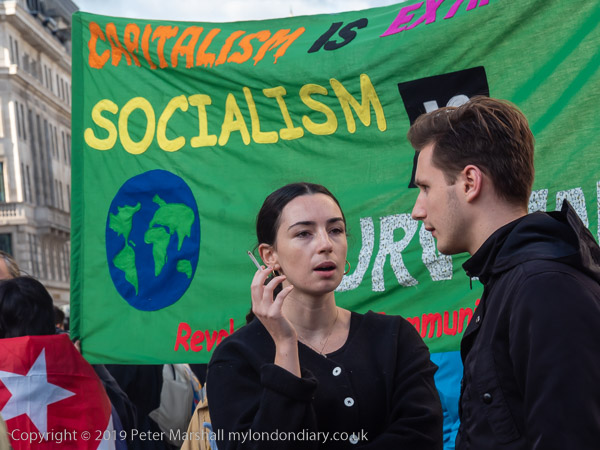
Socialism is Survival

Capitalism is Extinction – Socialism is Survival’

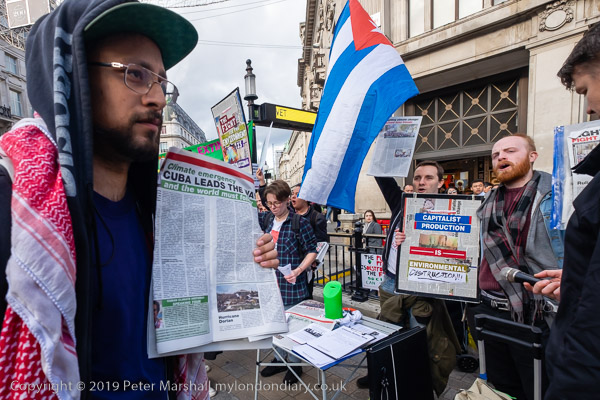
In 2008 Richard Wilkinson wrote an opinion in The Guardian, ‘Follow Cuba’s emissions standard‘ in which he states:

“According to the WWF, Cuba is the only country that has managed to combine an environmentally sustainable footprint per head of population with an acceptably high quality of life as measured by the UN Human Development Index. And if Cuba can do that without the latest and most economical technology, how much easier should it be for us?”

‘Follow Cuba’s emissions standard‘

Part of the reason for this is, as he also states, that resources in Cuba, though relatively limited are shared much more equally than in market-led democracies such as the UK and the US. He makes the point that material differences between people are destructive, reducing well-being and quality of life and leading to many social problems, and that wealthy societies such as our should be concentrating on reducing inequalities rather than pursuing economic growth.

Cuba Leads the Way

To put it simply, we already have enough, and the important thing is now that everyone gets a decent share. We don’t need exact equality, but we do need to avoid the kind of indecent excess we now see, with the rich with more money than they can ever sensibly spend and the poor unable to afford decent food and safe housing, with too many sleeping on the streets or in overcrowded properties, often with little or no security of tenure and too many in jobs on less than a living wage and often zero hours contracts.

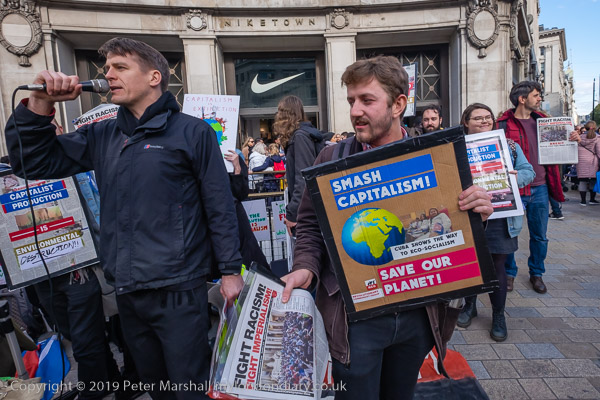
Smach Capitalism! Save Our Planet!

The biggest challenge we face as a world and as a nation is of course not the largely irrelevant matter of Brexit but climate change, and inequality also drives that – both directly by the senseless consumption of the ultra-rich and the poor quality environment of the poor, and indirectly by the encouragement to consume of living in the same society as those who feature most largely in our advertising and media coverage. We are going to have to make huge changes to survive, cutting down our footprint on the world’s resources to perhaps a quarter of the current UK levels, a change that it is hard to see a market-led capitalist system adapting to. And while Wilkinson suggests it should be easier for us, I think our current wealth and political system probably make it impossible. At least without a real revolution.

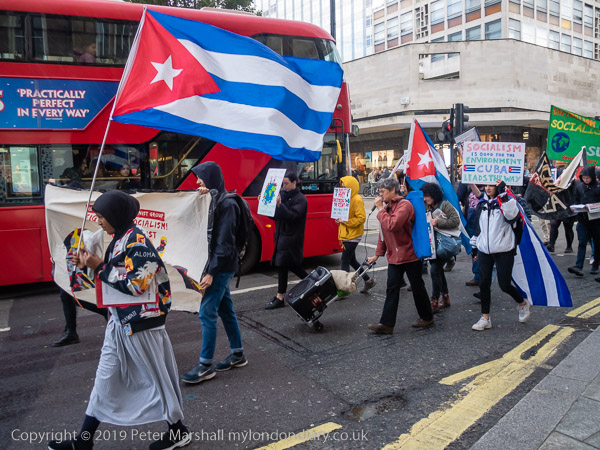
The Solution is Socialism

The Revolutionary Communist Group put it more starkly and simply than Wilkinson: “Capitalism is Extinction – Socialism is Survival’ but also base their conclusion on the closest we have in the world to a socialist state, Cuba. Despite punitive economic sanctions imposed by the USA (and perhaps sometimes as a result of them) Cuba under communism has made enormous strides in some areas, producing universal literacy and one of the leading health services in the world – and its medical services are one of the country’s main sources of foreign income. Increased life expectancy – to values similar to much rich countries such as the USA and UK – in a roughly static population is now presenting familiar problems. Energy use has remained relatively low with per-capita consumption only around a quarter of that in the UK.

Of course that isn’t the whole story, though it is perhaps difficult to know exactly what is, as all sources of information about the country reflect considerable bias. Many in the RCG have been to Cuba and seen the country at first hand, but what and who they saw will to some extent be affected by their own political affiliations and those of their hosts. Much of the more commonly spread information in the media comes from émigrés who left the country because of their dissatisfaction with the situation and the regime, or from anti-communist individuals and and capitalist organisations.

‘Practically Perfect In Every Way’

Castro and his guerrilla band took the country back from one of the worst and most corrupt governments in history, a dictator who had seized power in a military coup in 1952, but haven’t managed to eliminate corruption – though it is now said to be is the 60 least corrupt nation out of 180 countries by Transparency International. It would be hard not to admire a country which has withstood the sanctions and intrigues of the USA for so many years. Castro himself was apparently the target of over 600 assassination attempts by the United States’ Central Intelligence Agency but died of natural causes in 2016.

You can read more about the protest and rolling picket outside various temples of consumerism on Oxford St at Cuba leads on climate say RCG.


All photographs on this and my other sites, unless otherwise stated, are taken by and copyright of Peter Marshall, and are available for reproduction or can be bought as prints.