NHS, Shaker, Drax, Gurkhas, Herbalists & Bikes

Wednesday 24th April 2013 was a busy day for protests in Westminster. And there was one in the City.


Protest the Privatisation of NHS – Old Palace Yard
NHS, Shaker, Drax, Gurkhas, Herbalists & Bikes

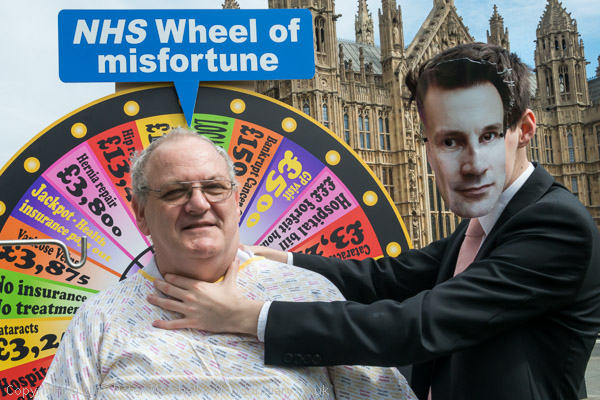
The House of Lords was debating NHS regulations which imposed full competitive tendering on the NHS, a key part in the escalating backdoor privatisation of the NHS.

Unite had set up a ‘Wheel of Fortune’ game show hosted by people wearing ‘David Cameron’ and ‘Jeremy Hunt’ masks and listing the likely costs of various procedures due to the tendering system. They feared “that the coalition’s NHS policies, including a multi billion pound funding squeeze coupled with a massive reorganisation, will destroy the 65 year old health service, paving the way for a new marketised system where paying up to £10,000 for maternity costs or £13,450 for a new hip is the norm.”
NHS, Shaker, Drax, Gurkhas, Herbalists & Bikes

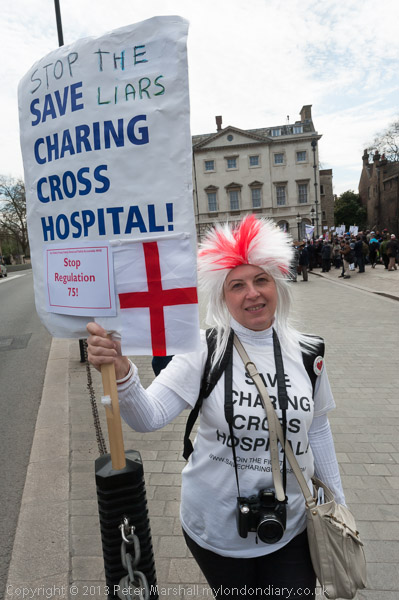
Unite said that already more than £20 billion of health costs go to private companies, who take their decisions on the basis of profit rather than the interests of patients. The Lords were debating a motion for the annulment of the regulations on the grounds that Parliament had been assured “that NHS commissioners would be free to commission services in the way they consider in the best interests of NHS patients“.

Protest the Privatisation of NHS


Bring Shaker Aamer Home – Parliament Square
NHS, Shaker, Drax, Gurkhas, Herbalists & Bikes

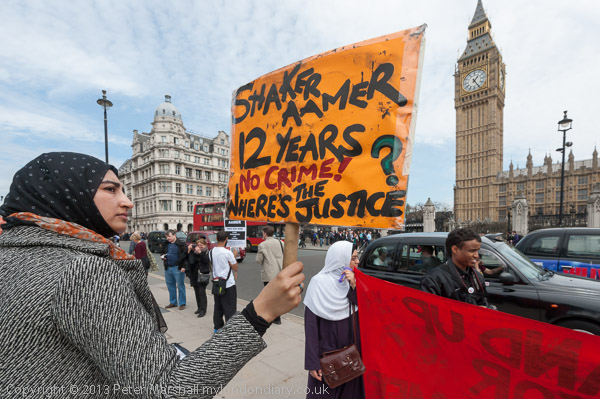
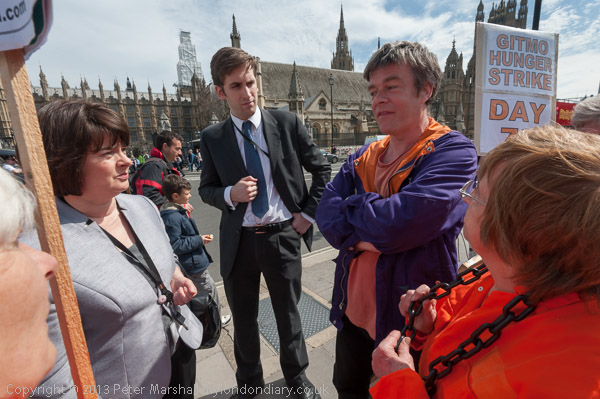
Following a petition with 117,387 signatures to bring Shaker Aamer home from Guantanamo, a debate had been held that morning by MPs in Westminster Hall, where most of the 17 MPs who spoke called for his release, including Shaker’s own MP, the Conservative MP for Battersea, Jane Ellison, who also came out to speak with the protesters.
NHS, Shaker, Drax, Gurkhas, Herbalists & Bikes

Unfortunately such debates, although they do increase pressure on the government to take action have no actual consequences. But perhaps it did help to persuade the government that it had to ignore the embarrassment of British agents at being complicit in his torture by the US and make clear to the US government he should at last be released after being held for 12 years, long after he had been cleared of any involvement in terrorism. As I noted, “The facts about torture are now largely public and totally indefensible and it is time for justice to be done.”

Bring Shaker Aamer Home


Drax Biomass Threat to our Planet – Princes St, CityDrax AGM, wpp
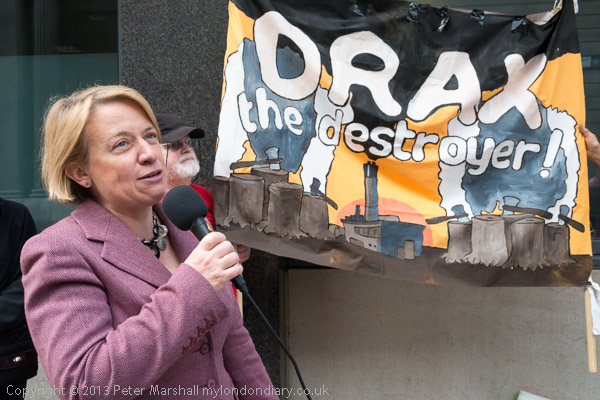
Green Party leader Natalie Bennett speaking at the protest

I had to take the tube to the City to attend a protest outside Gocer’s Hall where the AGM of Drax, the huge coal-burning power station near Selby in Yorkshire was being held. Drax was planning to convert half its capacity to bio-mass and become the largest biomass-burning power station in the world, using 1.5 times the total UK wood production per year.
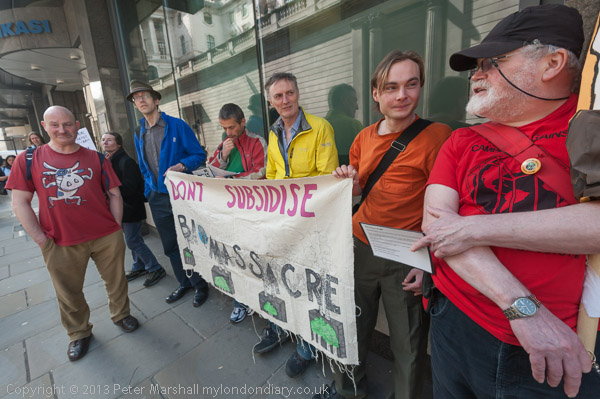
The wood pellets would come mainly from devastating clear-cutting of highly diverse forests in North America, and although re-grown will eventually remove the same amount of carbon this will take a hundred years or more – during which time the carbon Drax emits – roughly 50% greater than burning coal – will be contributing to disastrous global warming.
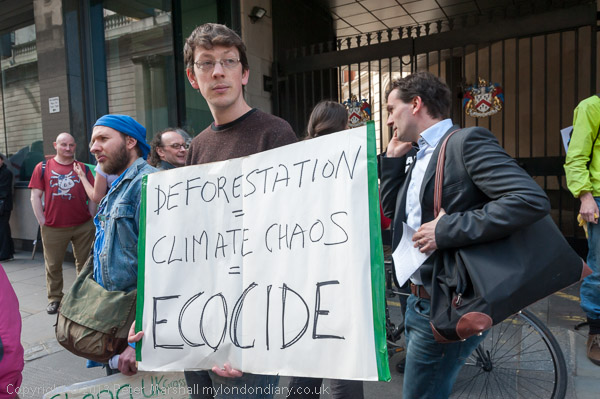
Drax already has a disastrous impact in South America were land is being grabbed from traditional communities for open cast coal mining, usually with complete disregard for their human and civil rights, cleared of its biodiverse forests and diverted from food production – often in places where food is desperately needed. Conversion to wood-burning at Drax will result in even more environmental and social destruction.
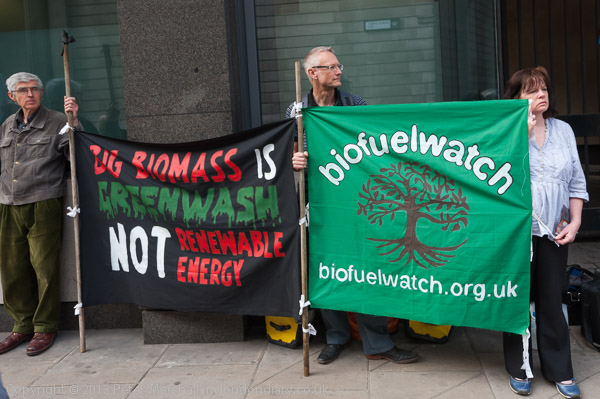
The incentive to change to wood-burning is that under current government policies Drax will receive huge government subsidies from funds intended to promote renewable energy, diverting funds from schemes for energy production and conservation that actually will help to combat climate change.

Drax Biomass Threat to our Planet


Gurkhas Call for equal treatment – Old Palace Yard
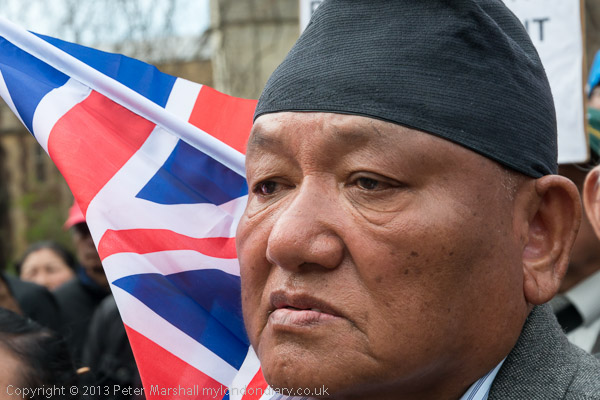
I returned to Westminster, where Several hundred Gurkha pensioners and supporters were holding a rally on the 198th anniversary of the first recruitment of Gurkhas into the British Army to deliver a petition to David Cameron asking for equal treatment to other British Army ex-soldiers.
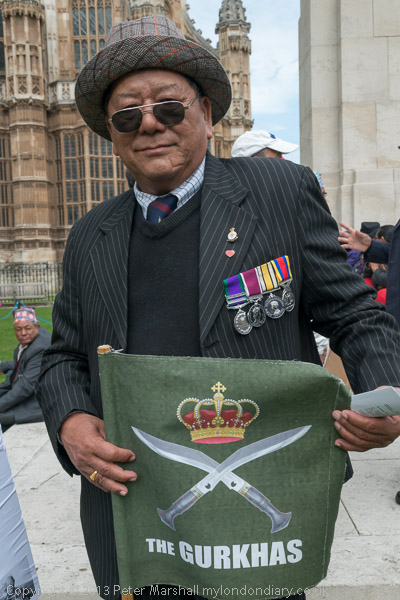
British Army Gurkhas who retired before 1997 were granted the right to settle in the UK in 2009, but their pension remains only a fifth of that of other British soldiers, and is impossible to live on in the UK, being based on the cost of living in Nepal.
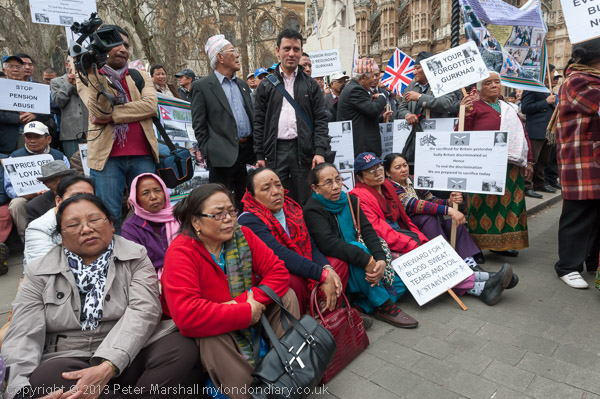
Gurkhas Call for equal treatment


UK herbalists Want Regulations – Old Palace Yard
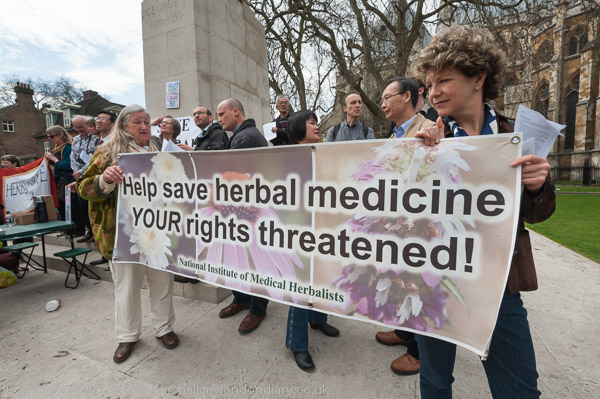
Also in Old Palace Yard were UK herbalists, both traditional and Chinese, protesting against the failure of the government to bring in the statutory regulations they had promised to do by 2012.
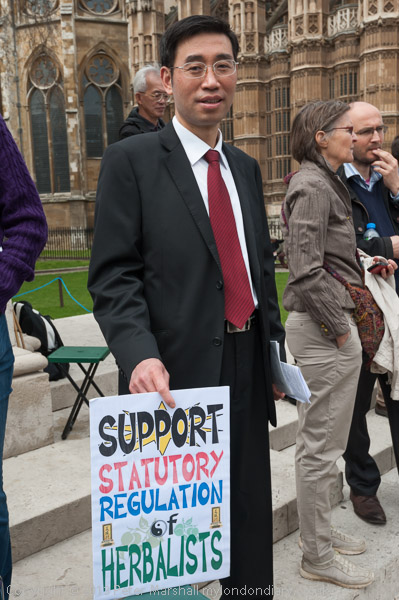
Under EU regulations from 2004, traditional remedies then in use could continue to be provided until 2011, but after that had to be covered by national policies to regulate their safety and effectiveness. Although the government had promised to set this up, it has so far failed to do so, and they are now unable to prescribe many commonly used and effective common herbal remedies.

UK herbalists Want Regulations


Get Britain Cycling Report Launch – Parliament Square
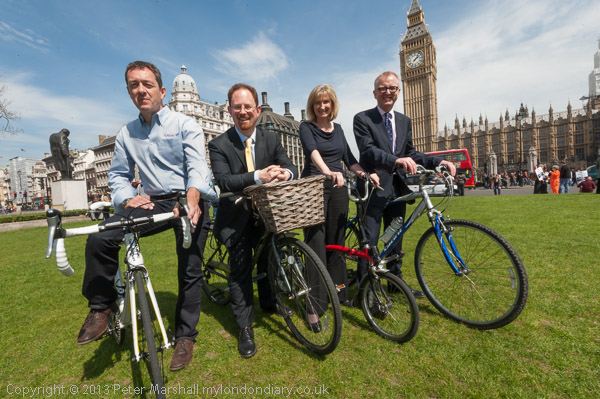
Finally, in Parliament Square, Christ Boardman, a gold medal cylist in the Barcelona Olympics posed with MPs from the All Party Parliamentary Cycling Group to launch their report ‘Get Britain Cycling.’

This calls for more to be spent on supporting cycling and that it should be considered in all planning decisions. They want more segregated cycle lanes and for the 30mp urban speed limit to by reduced to 20mph. Children should be taught to ride a bike at school and the government should produce and annually report on a cross-departmental Cycling Action Plan. Cycling has enormous advantages both individually and for us all in better health and reducing pollution with reduced health spending.

Get Britain Cycling Report Launch

Cyclist Deaths and Militant Muslims – 2013

On Friday 29th November 2013 I went to two very different protests in London.


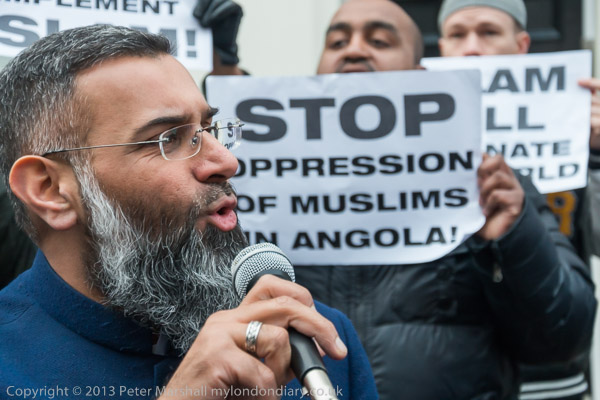
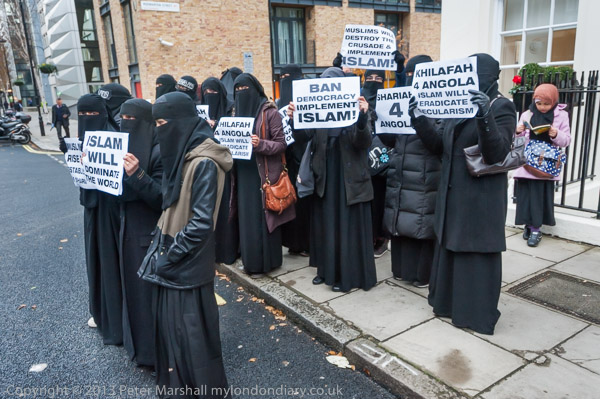
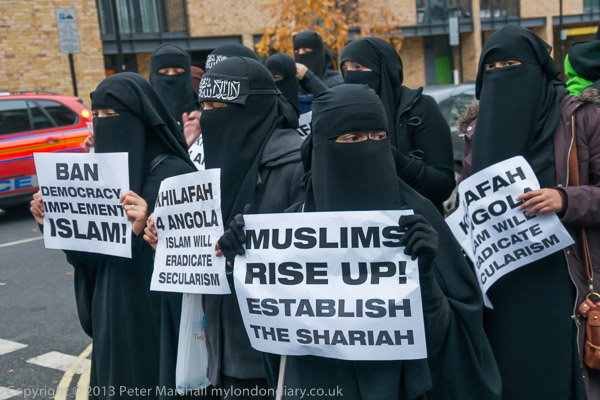
Islamists Protest Angolas Ban on Muslims – Angolan Embassy, Friday 29th November 2013

I’d had an interest in the rise of extremist Islamic movements in the UK since 2004, when I first photographed a march by Hizb ut-Tahrir Britain, and the activities of Anjem Choudary had attracted my attention for some years before this event in 2013. In 1996 he had been one of the founders of the Islamist al-Muhajiroun, an organisation which dissolved itself shortly before it was banned by the UK government as a terrorist organisation in 2010, going on to found a series of new organisations considered by many to be al-Muhajiroun under different names.

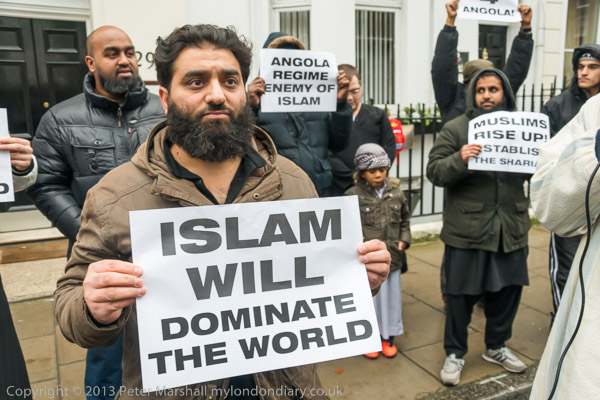
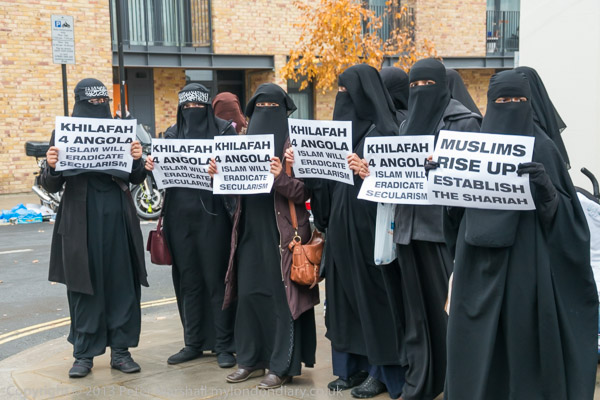
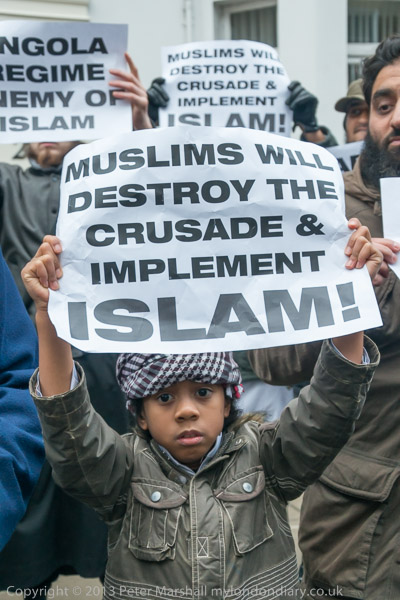
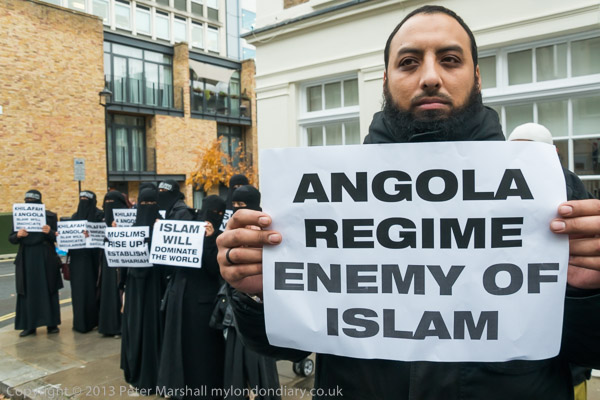
I can’t now remember under what title Choudary had announced ‘DEMONSTRATION AGAINST THE CHRISTIAN TYRANNY UPON MUSLIMS IN ANGOLA!’; another group he was associated with, Muslims Against Crusades, had been banned in November 2011, but I think many of those at this protest were the same individuals. The many posters they held named no organisation.

I’d gone to the Regents Park Mosque where a march had been announced to start to the Angolan Embassy, but as the crowds emerged after Friday prayers there was no sign of Choudary or his followers. Asking people there I learnt a small group had been present earlier but had left before the time announced and I gathered it had been made clear they were not welcome at the mosque.

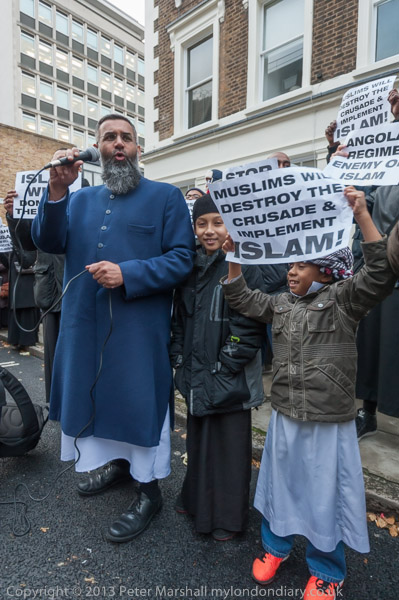
I hurried down to the Angolan Embassy in Dorset Street, arriving to find a noisy demonstration taking place, but with no sign of Choudary. Another photographer told me I had missed them setting off firecrackers when they arrived. There were some loud chants echoing the message on the placards that ‘Muslims Will Destroy The Crusade & Implement ISLAM!’

As I wrote in the captions, “I came to the protest thinking for once that Amjem Choudary and his supporters had a just cause – Angola is clamping down on non-Christian religions including Islam. But it isn’t a ‘crusade’ but something that most Christians around the world and secularists would firmly oppose. But they would oppose it in the name of freedom. This was something rather different.

Finally Choudary himself arrived and began a lengthy speech. It was interesting and there was much that many including myself would agree with, as the Angolan regime has embarked on a purge of all non-Christian religions in the country. According to a report in The Guardian, there are only 83 approved religious organisations in Angola, every one of them Christian, and a statement from the Angolan embassy in the US claimed that they had ‘lots of religions’, citing “Catholic, Protestants, Baptists, Muslims and evangelical people.” In other words, freedom of religion – so long as it is Christian.

But what Choudary and his supporters advocate is not freedom of religion but the establishment of an Islamic Khilafah (caliphate), establishing Sharia law, where the only religion tolerated would be their extremist distortion of Islam. There was something new in his speech, when he talked about Islamic armies rising to “establish the Sharia” which at the time I thought was just wishful thinking on his part, but was in fact a chilling reality which became obvious as ISIS rose to occupy not Angola but a large territory in the Middle East around six months later.

Many of us were convinced in 2013 that Choudary was, if not an MI5 agent, at least protected by them and the police as a ‘honeypot’ for Islamic extremists, gathering them together to enable them to be readily recognised and kept under observation. It’s difficult to see otherwise why he had not been arrested for some of thee statements in his speeches at protests, careful though he was. But it was the rise of ISIS and his support expressed for Islamic State that led to his eventual arrest and sentencing in 2016 for five and a half years under the Terrorism Act 2000.

Islamists Protest Angolas Ban on Muslims


Cyclists ‘Die in’ at TfL HQ – Blackfriars Rd,
Friday 29th November 2013

Cyclists are the most vulnerable of road users, riding unprotected among cars and lorries whose drivers are cased in powerful and heavy metal shells. Pedestrians also lack any protection, but are usually provided with pavements which cyclists cannot legally use.

That of course is stating the obvious, but it’s an obvious that is almost always obscured by heated anti-cyclist opinions forcefully expressed, about cyclists who get in the way of motorists, or who ride aggressively on pavements, cross red lights and fail to wear cycle helmets etc.

I write as a cyclist and a pedestrian, and a former if reluctant driver. As the latest Highway Code makes even clearer, cyclists have a right to be on the road and are a part of traffic just as much as any car or lorry. And there are probably about as many bad cyclists as there are bad drivers, perhaps rather more given the number of people too young to get a driving licence who ride bikes.

We now have many shared paths for bicycles and pedestrians and accidents on them are rare, and very seldom cause significant injuries to either party, though the few that do get great publicity. Many of us also occasionally ride on pavements which are not officially shared, and do so with care for those on foot, in places where the roadway is dangerous and there is no separate provision for cyclists. I won’t get into cycle helmets in depth, but they provide little protection and may well decrease the safety of cyclists as well as making cycling a rather less convenient activity. And the emphasis on their use is simply trying to put the blame on the victims of road accidents rather than trying to make the roads safe.

There are many reasons why cycling should be encouraged and proper facilities provided. It improves the health of those who cycle and leads to a cut in expenditure on health services, is an almost non-polluting form of transport and much more efficient in the use of road space, reducing congestion for others, and a cheap solution particularly to many shorter distances in cities. Many cities have become better places to live by welcoming and providing proper provision for cycling.

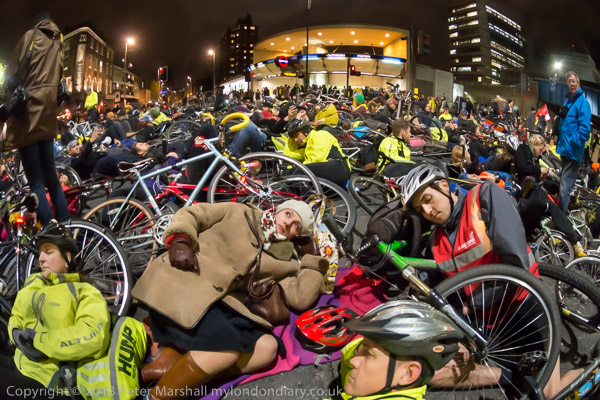
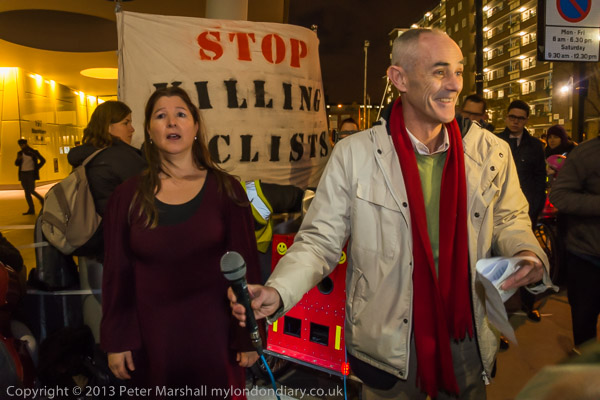
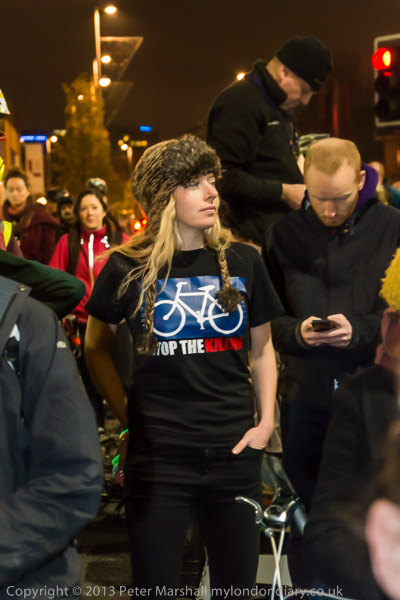
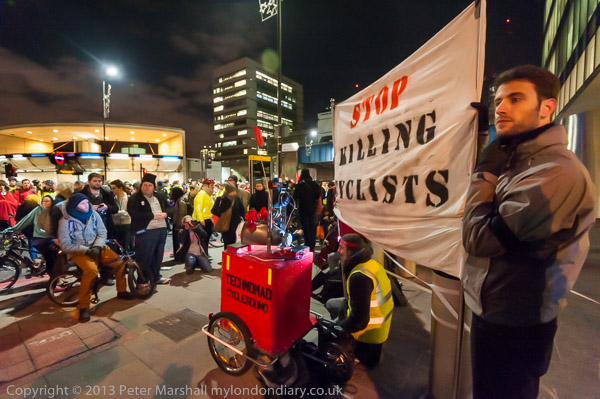
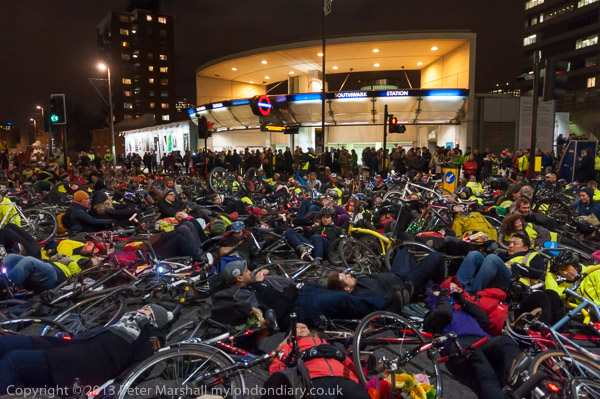
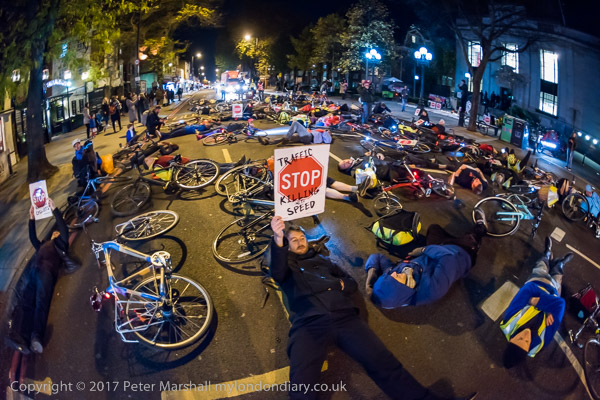
The protest outside the London HQ of TfL demanded safer road provision for cyclists. It was organised after 14 cyclists had been killed in London over the previous years. For more than 50 years the design and provision of roads has been almost entirely based on increasing the flow of motorised vehicles, with other considerations being largely ignored. And faster traffic becomes more dangerous for pedestrians and cyclists – congestion actually makes cycling in central London safer.

Even where TfL has begun to provide cycle ‘superhighways’, these have been badly designed at many junctions, and marked cycle paths are often used as parking places, forcing cyclists into the heavy traffic the path is meant to avoid. Some cycle lanes in my area are far too narrow and on uneven road edges making them dangerous to ride on even where they are not obstructed by parked vehicles, others have stop signs at every minor road or even injunctions to dismount.

On My London Diary you can read the list of eight demands the protest made to improve safety and get more people using bikes. As well as spending more money on cycling infrastructure they included a ban on vehicles whose drivers are unable to see adjacent road users. Most deaths of cyclists are caused by drivers who turn left at junctions unaware that there is a someone on a bike in their path.

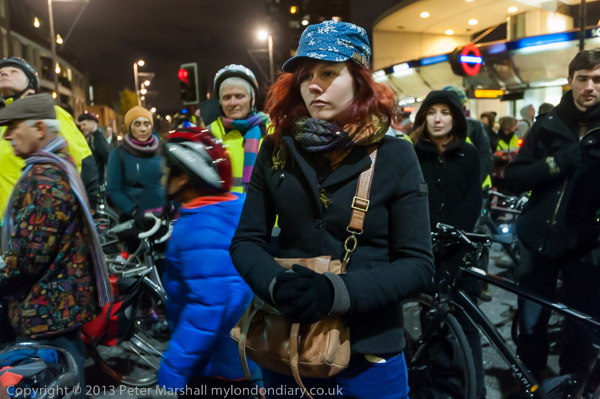
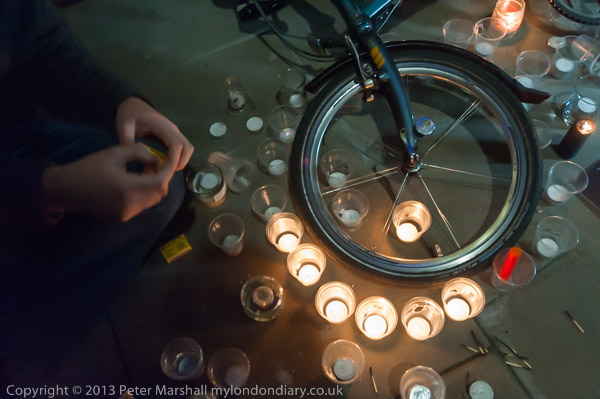
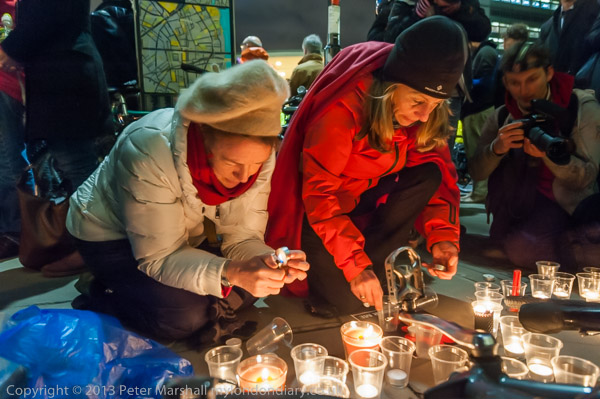
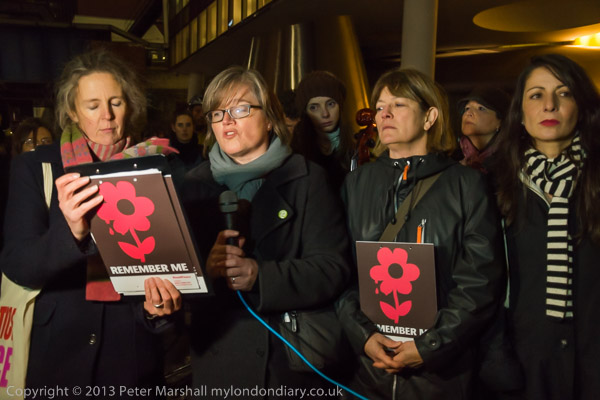
After a short introduction to the event there was a long silent vigil while a cellist played solemn music, and those who had brought candles came and lit them around a bicycle. Then there was a speech reminding us that Amsterdam had become a much more pleasant city with high bicycle use following a series of protests in the 1970s had prompted the city into action – with die-ins such as that which followed. Police at the scene estimated a thousand bicycles and cyclists took part, though organisers thought it was double this. The BBC reported it as ‘hundreds’ in a typical media response to cyclists and protests. Then the rally continued, with more speeches and the reading out of the names of cyclists killed on the streets.

More at Cyclists ‘Die in’ at TfL HQ.

Cyclists’ Die-In And A Visit To The Oral Squat

On Wednesday 8th November 2017 I spent the evening in Islington.

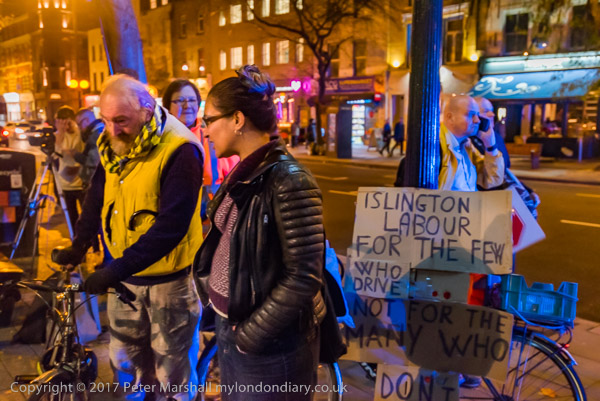
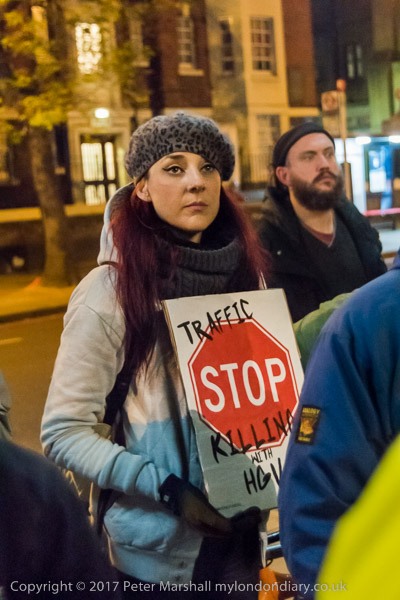
Vigil for Islington cyclist killed by HGV – Islington Town Hall, Wed 8 Nov 2017

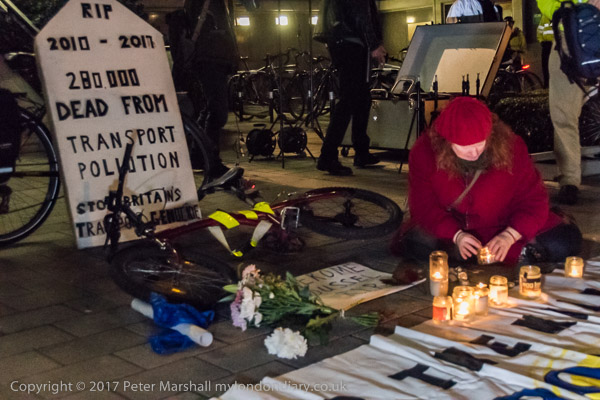
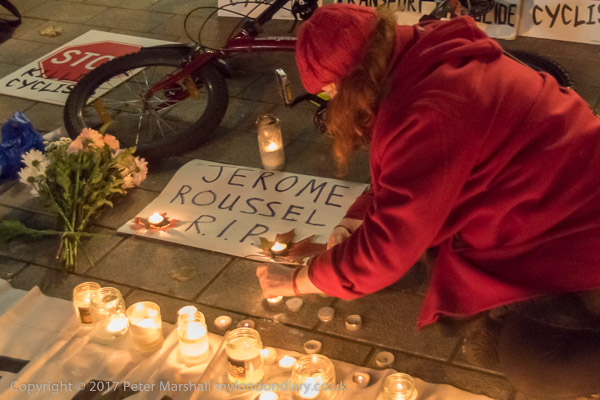
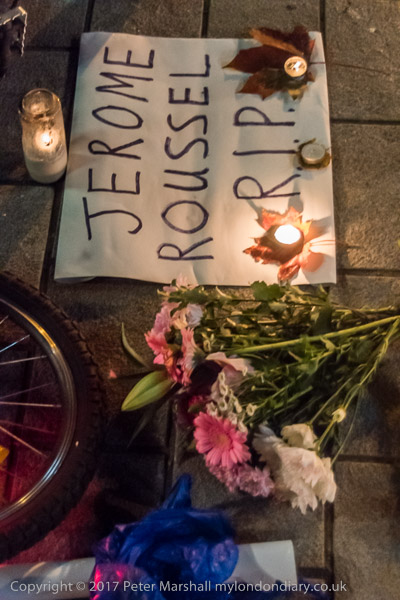
On May 2nd 2017, City trader Jerome Roussel was cycling to work along Pentonville Road when he collided with a heavy goods vehicle which had stopped in the cycle lane. He was seriously injured and died in hospital on June 25th, seven weeks later.

Police say that the cyclist had told them he had put his head down and had failed to see that the lorry had pulled in ahead of him and he crashed into the back of it.

Cycling around parts of London there are many streets with ‘cycle lanes’ marked at the edges of the roads but often obstructed by parked vehicles. The driver in this case had only just pulled into it, intending to turn into a side street, but for many others the cycle lane is a convenient parking place, perhaps for a few minutes while they visit a shop, or for much longer.

These roads have cycle lanes because there is enough faster moving traffic on them to make them dangerous for cyclists. But cars and lorries parked on them mean that cyclists have to move out into this traffic. We need a law which makes it an offence to park on cycles lanes – and for it to be enforced.

Islington Labour – For the few who drive

Better still we need far more physically separated cycle lanes, though where these exist there are also sometimes cars parked on them, rendering them unusable, and sometimes road surfaces so poorly maintained that they are uncomfortable to ride on and even at times dangerous. Even small potholes that a car would cruise over can send the unwary cyclist flying.

As I wrote back in 2017, “Islington has not built a single protected cycle route in over 20 years and Transport Minister Jessye Norman has so far failed to sign the the commencement order to allow TfL to fine HGVs and traffic that drive into mandatory cycle lanes, such as the one on Pentonville Road where Jerome Roussel was killed. Islington, responsible for 95% of the roads in its area has reserves of £277 million (and growing) and campaigners say it should spend some of this on making its streets safer for cyclists and pedestrians.”

I don’t cycle in Islington, but although the council on its web site states it is “on a mission to improve cycling in Islington” I get the impression that relatively little has changed since Roussel’s death on a cycle lane in 2017. At the 2022 elections the London Cycling Campaign was calling on Islington Council to provide protected cycle routes on all busy roads by 2026, for low traffic neighbourhoods to cover the borough by 2024, to provide sustainable freight hubs, to set more ambitious targets for sustainable transport and provide secure cycle parking.

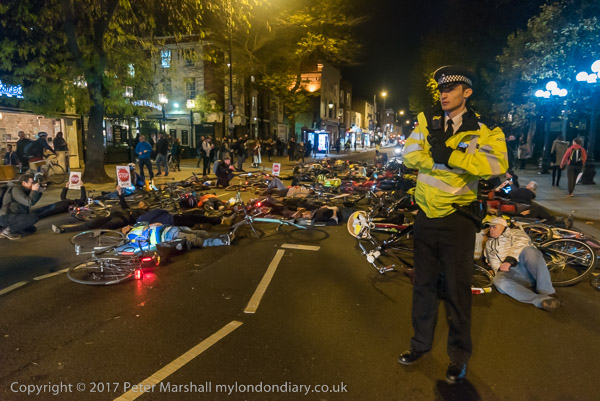
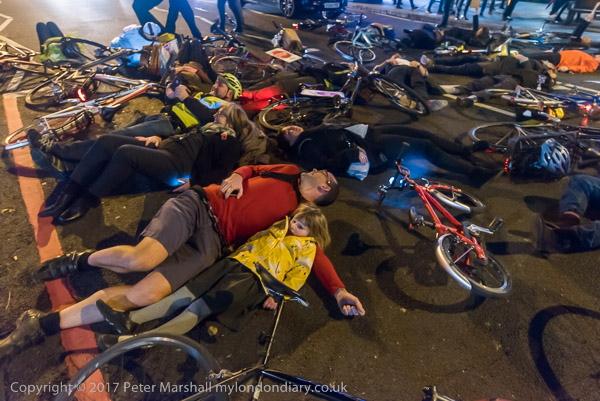
Cyclists gathered on the pavement outside Islington Town Hall and listened to a number of speeches before police stopped traffic and the campaigners held a 5 minute silent die-in on the road in memory of Jerome Roussel, after which there were more speeches and a final address by Donnachadh McCarthy.

More at Vigil for Islington cyclist killed by HGV.


ORAL squat empty NatWest Bank – Upper St, Islington, Wed 8 Nov 2017

As I walked back from Islington Town Hall to the Underground station with another photographer we met activists who knew us outside the squatted former NatWest Bank on Upper St and stopped to talk.

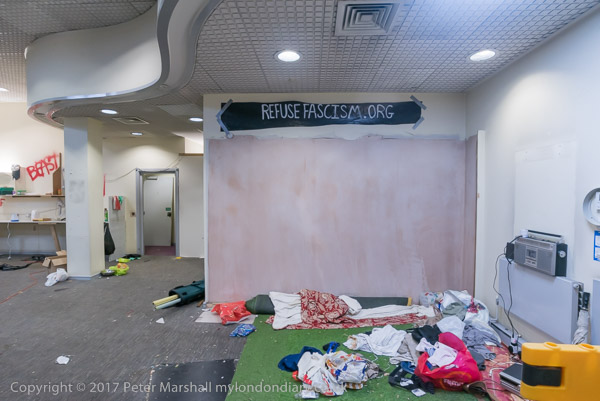
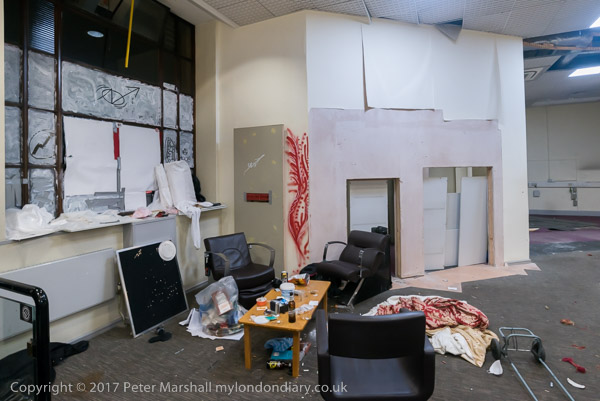
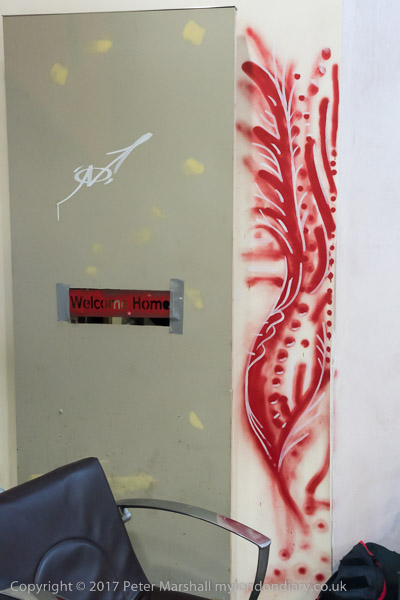
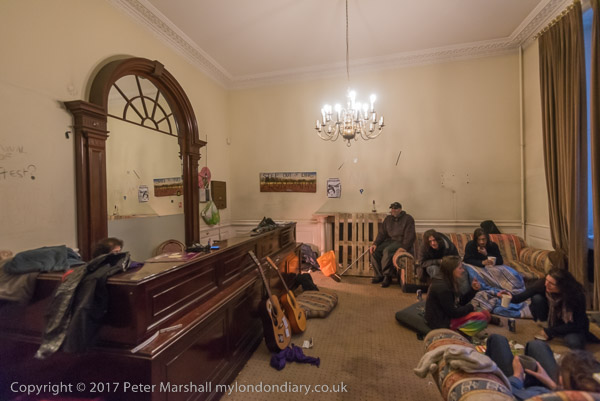
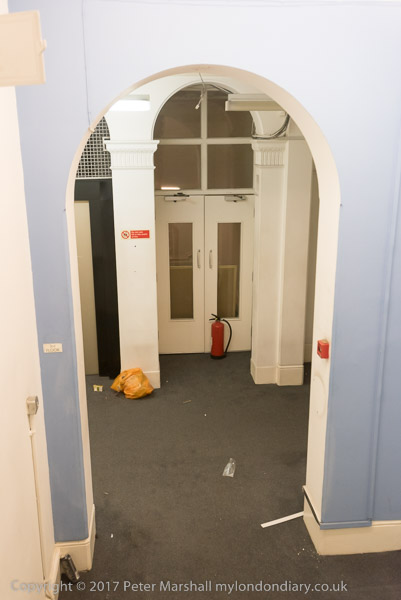
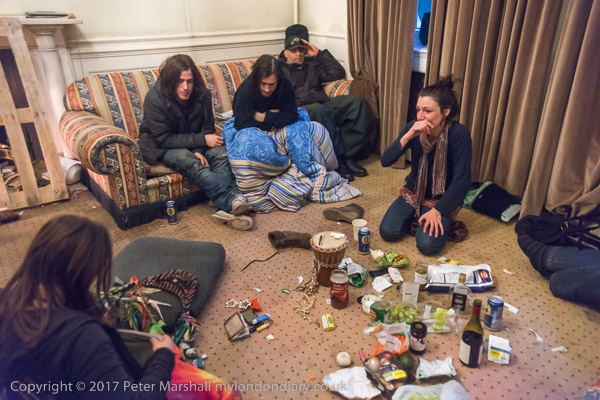
Inside things are a little messy, but there is no real damage

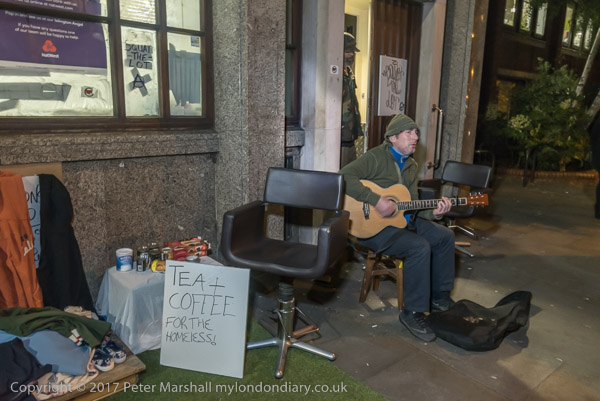
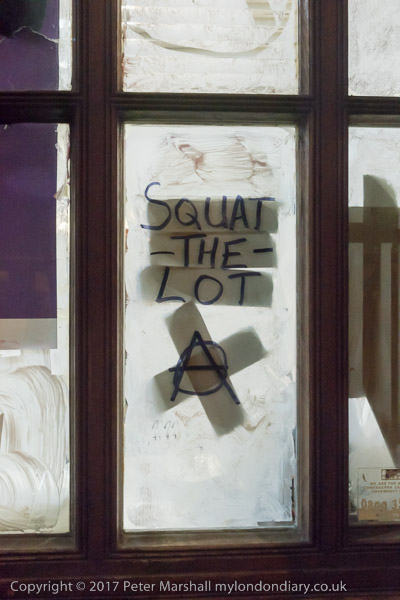
This had been squatted around a week earlier by the Order of Rampaging Anarchist Lunatics (ORAL) and they were using it as a centre to provide tea, coffee, clothing and shelter for the street homeless of the area.

The building was well lit and warm – the squatters are paying for electricity

We were invited inside for a tour of the squat and to take photographs. The squatters were expecting to be evicted in the near future, and actually were a few days later, after which they published a ‘final communique’ on their Facebook page. You can read this in full on My London Diary, but here is the first paragraph:

Several years ago, what began as a ridiculous idea to form a satirical nation of squatters evolved into one of the most infamous land pirate crews known around the world. Originally coined the Autonomous National of Anarchist Libertarians [ANAL] we’ve penetrated deep into London, forming a property portfolio that undoubtedly far exceeds any other crew; Having taken roughly 60 buildings in zone 1 over a period of around 4 years. Most notably Admiralty Arch.

My London Diary

Their communique goes on to say that they felt their activities had acheived nothing and that they would be forming a new group focused on “setting the example of how to evolve society & humanity” though “construction & creation” and would shortly be opening “a new community hub”.

My assessment was rather more positive, in that they and other activists had drawn attention to the scandal of so many empty properties while we have a housing crisis. Thanks to the Tory programme of austerity we had seen a huge increase in the number of homeless people and there should be legal ways to bring these properties into use. The current situation remains shameful in what is still one of the world’s wealthiest countries.

ORAL Squat empty NatWest Bank.


Funeral for Cyclists, Against Islamophobia, Iranian Repression

London, Saturday 13th October 2018


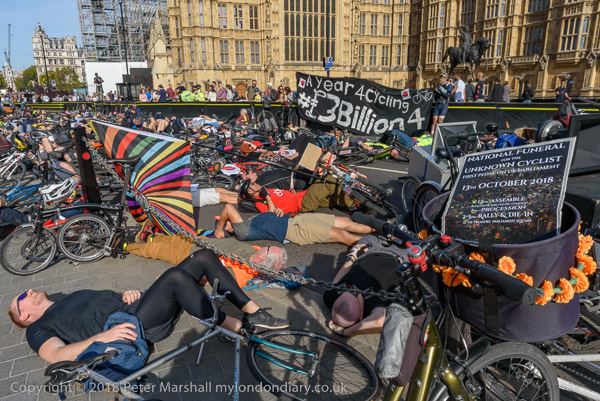
National Funeral for the Unknown Cyclist

I’ve been a cyclist since my sixth birthday, when my parents bought me a second-hand two wheeler to replace the trikes I’d been on since before I could walk. By the end of the day I could ride it, if rather unsteadily, along the pavement of our street.

The bicycle gave kids like me a new freedom, and within a couple of years I was riding miles either on my own or with a couple of mates to play both in local parks and green spaces and further afield. We cycled away from our dusty streets into the countryside, often going along some of the busiest roads in the country, the A30, A4 and A3 out west from our grey suburbs.

We didn’t think much about safety back then, and though traffic was heavy, vehicles were smaller and speeds were lower. Drivers were I think more considerate back then, and almost all will have been cyclists before getting behind the wheel. So I survived, though there were a few close shaves, later mainly thanks to teenage stupidity.

Over seventy years later I still ride a bike, though with rather larger wheels, and usually just to the local shops, but I feel less safe on the roads. I’ve been knocked off it a couple of times in the past twenty years or so, both times by drivers who were extremely apologetic and confessed they hadn’t seen me as they drove out onto a main road or came up behind me on a roundabout. I was lucky and only sustained minor cuts and bruises and the motorists paid for the repairs to my bike.

During the first Covid lockdown the roads were almost empty and I went out each weekday morning for a ten-mile ride to keep fit. But then traffic began to come back and the fumes and too many close passes put me off the roads again.

In the past few years we seem to have come out of the long era where cyclists were almost completely disregarded in terms of traffic planning (and pedestrians too) but still we are largely failing to get the kind of separate provision to make cycling more safe that we see in some European countries.

Some councils are still dementedly anti-cyclist, and too many drivers see cyclists as an impediment to their progress rather than as fellow road-users. Some still accelerate past me then cut in across me to turn left at junctions, some pass where there is clearly not enough room to do so safely and some even shout insults as the drive past.

Cycling is good for individual health and for the health system as a whole, though less than it should be because of the pollution from traffic. By reducing car journeys it is good for the environment too, and good for motorists as people switching to bikes cuts congestion in cities. As a country we should be spending far more to encourage it and make it safer. In particular that means more separate provision – fears over safety when bikes are on busy roads is one of the main things that stops many getting on bike, but also driver education and improvements in vehicle and road design.

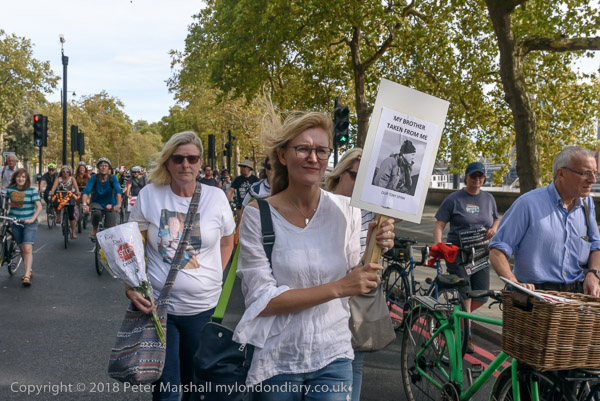
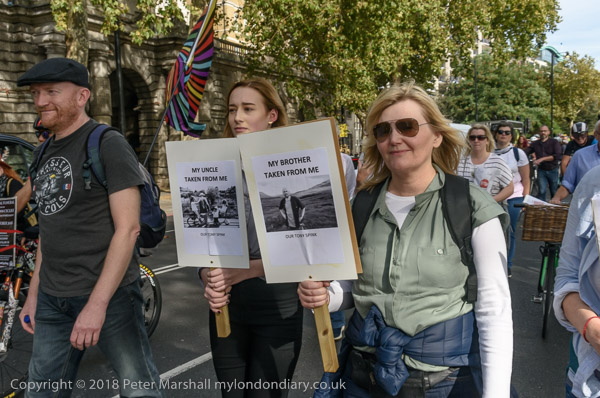
Among those at the protest were a number of families whose members had been killed on our roads, including some from Tony Spink’s family. He was killed cycling through Wakefield city centre by a lorry driver who didn’t stop, dragging him under his lorry as he hung onto the windscreen wipers and thumped on the side of the truck. His mangled bike was pulled from the lorry by the driver at a layby and then dumped in bushes miles away. The driver was jailed for two years. This was an extreme case but the sentence seemed risibly short, as are many of the sentences given to drivers who kill both cyclists and pedestrians.

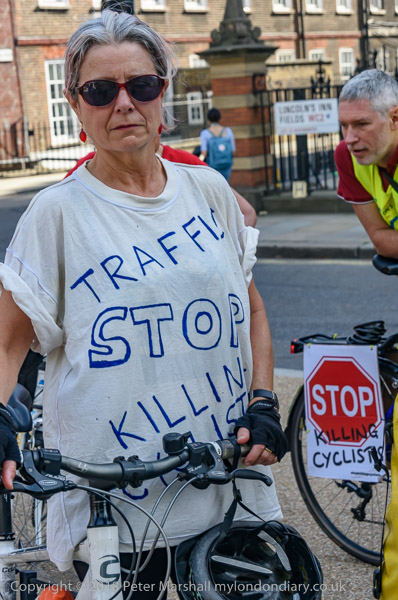
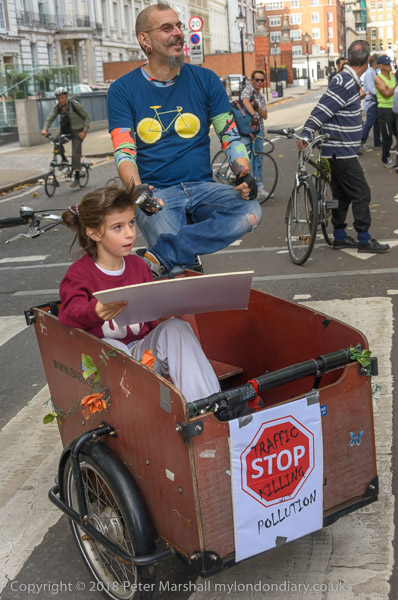
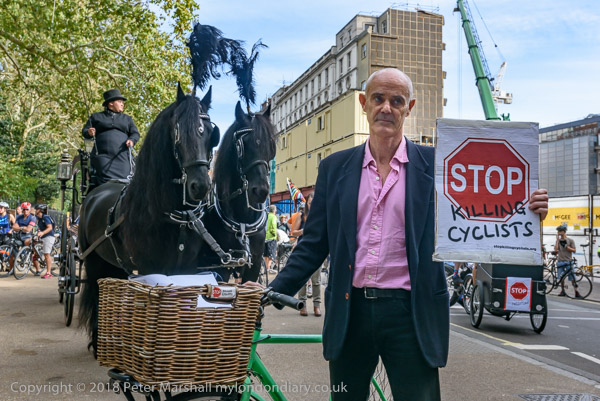
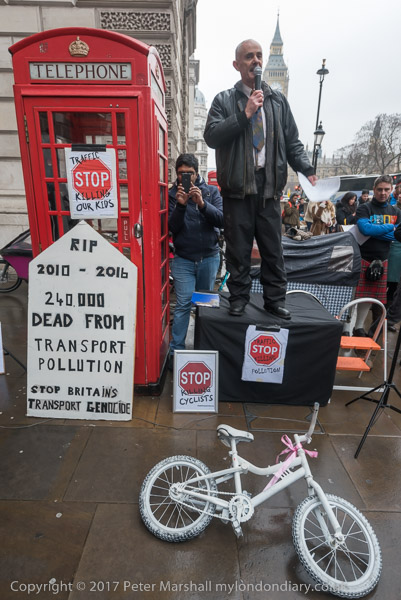
Protests by Stop Killing Cyclists such as this National Funeral for the Unknown Cyclist have publicised the problem and the organisation lobbies for £3 billion a year to be invested in a national protected cycling network and for urgent action to reduce the toxic air pollution from diesel and petrol vehicles which kills tens of thousands of people every year, and disables hundreds of thousands.

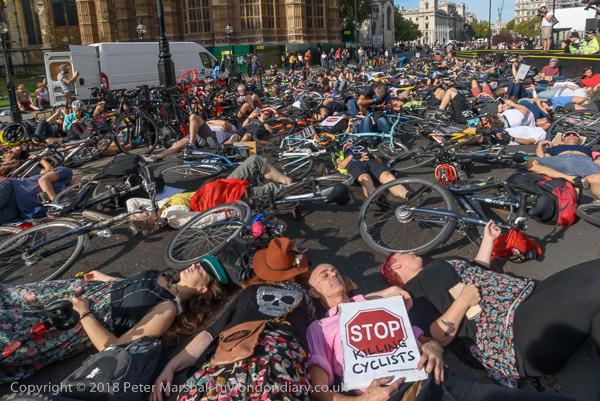
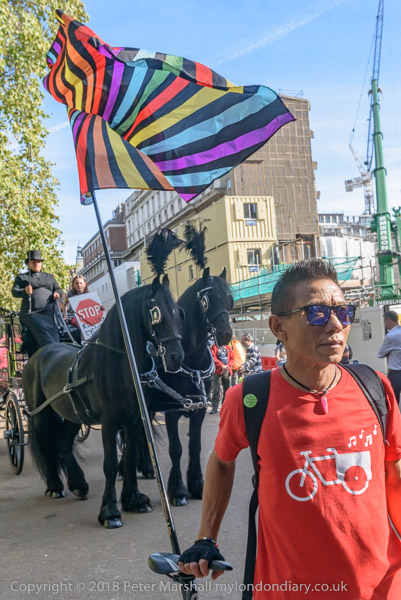
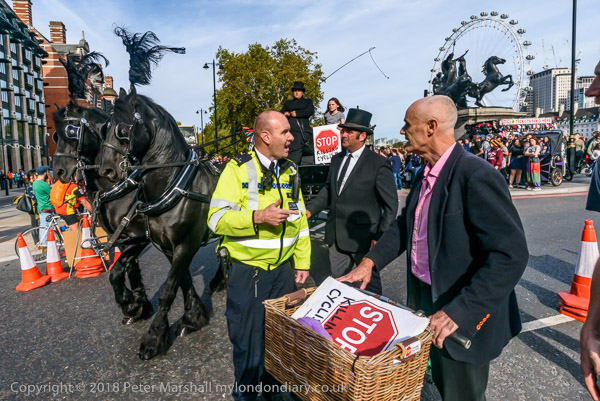
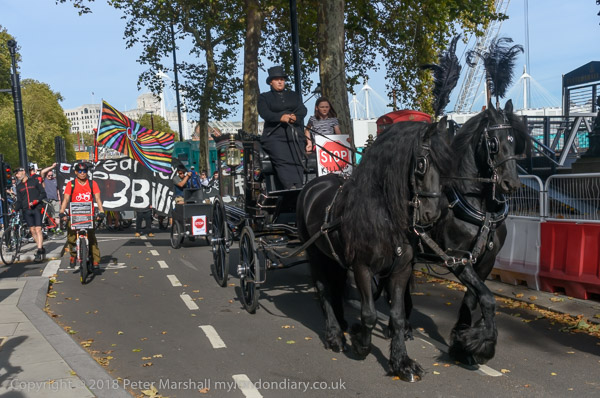
Several hundred protesters on bicycles met in Lincolns Inn Fields before riding in a funeral procession behind a horse-drawn hearse to Westminster where instead of following the route the police wanted across Westminster Bridge they turned into Parliament Square and staged a 10 minute die-in before proceeding to a rally in Smith Square.

National Funeral for the Unknown Cyclist


Rally opposes Islamophobic DFLA – Parliament St

I left the National Funeral for the Unknown Cyclist as it went on to Smith Square and walked up Parliament Street to a rally opposing the racist, Islamophobic Democratic Football Lads Alliance who were ending their march with a rally at Downing St.

Stand Up To Racism and Unite Against Fascism had organise a rally here, but the DFLA marchers had not arrived at the expected time. Far fewer than expected had turned up for their march, and it had been blocked for some time by more militant anti-fascist protesters on the route.

Some of the DFLA had given up and gone to pubs along the route, but a few had walked across St James’s Park to Parliament Square from where they shouted for a while at the SUTR/UAF protest as police stopped them from getting closer, and after a while persuaded them to move away. The number who finally arrived for their rally was rather small and it didn’t seem worthwhile to take a long walk around the police barricade to try to photograph them.

Rally opposes Islamophobic DFLA


Ahwazi protest Iranian repression – Parliament Square

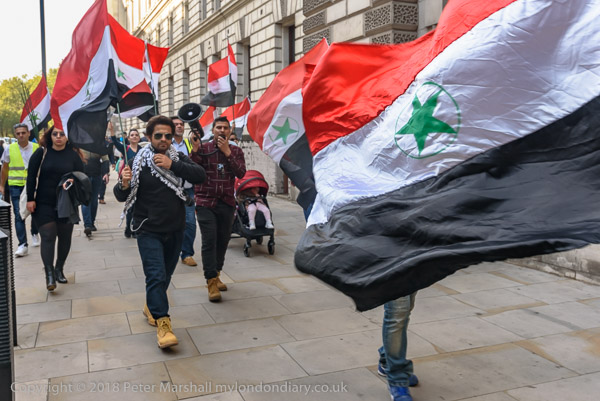
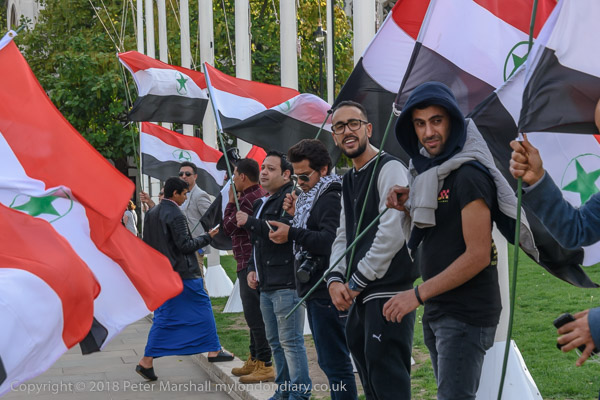
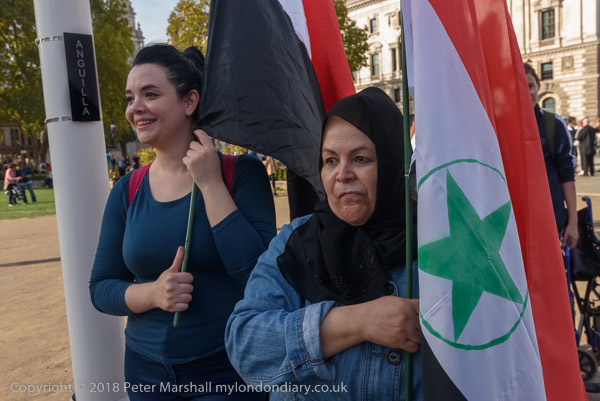
Instead I went back to Parliament Square where I met Ahwazi protesters marching into the square carrying Ahwaz independence flags. They protested noisily facing the Houses of Parliament calling for Iran to end the repression of their people and to get out of their land.

Al Ahwaz, the oil-rich northern side of the Persian Gulf was under British control until 1925, with the population enjoying considerable autonomy as Arabistan. The emirate was dissolved by the Persian regime following a rebellion in 1924 and the area occupied by Persian troops, and a process of ‘Persianisation’ imposed on the area, attempting to destroy its Arab culture. They renamed the area Khuzestan.

Discrimination against the Ahwazi increased under the Islamic Regime, impoverishing the area which contains much of Iran’s natural resources and there has been widespread civil unrest since 2015, with massive protests in April 2018 on the anniversary of the 2011 Ahwaz Day of Rage, itself an anniversary of the 2005 unrest. In September 2018 militants from the
Ahwaz National Resistance attacked an Iranian Revolutionary Guard parade in the city of Ahvaz, killing 25 soldiers and civilians.

Ahwazi protest Iranian repression


City Cleaners Strike, Cyclists mourned

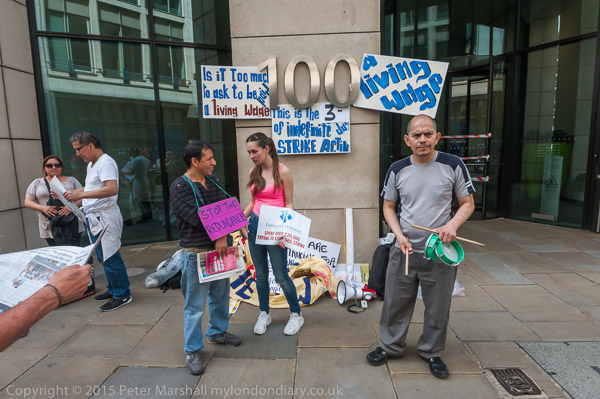
City Cleaners Strike, Cyclists mourned – A rally on Wood Street on Friday 10th June 2016 marked the third day of what became the longest strike ever in the City of London, and later at City Hall a vigil remembered 11 road users killed on London streets since the mayoral election last month, including three cyclists.


Day 3 UVW Wood St Cleaners Strike – 100 Wood St, City of London

City Cleaners Strike, Cyclists mourned

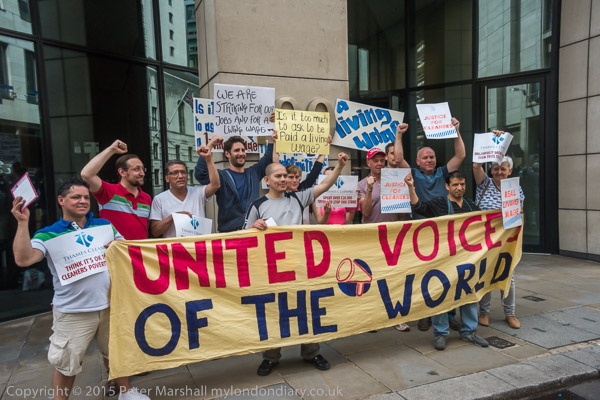
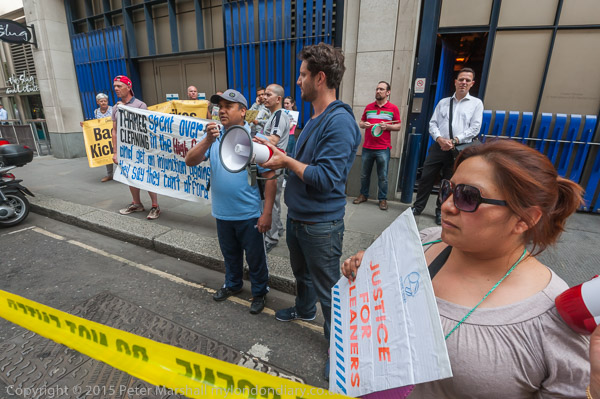
Cleaners belonging to the United Voices of the World union employed by anti-union cleaning contractor Thames Cleaning to clean the 100 Wood St offices managed by CBRE held a rally at the end of their picket on the third day of their strike.

City Cleaners Strike, Cyclists mourned
The picket

The offices there are mainly used by Schroders and J P Morgan, both large and highly profitable companies, but the cleaners are on poverty wages and several union members had been sacked and others served with notice by Thames Cleaning for organising the workers to demand a living wage.

City Cleaners Strike, Cyclists mourned
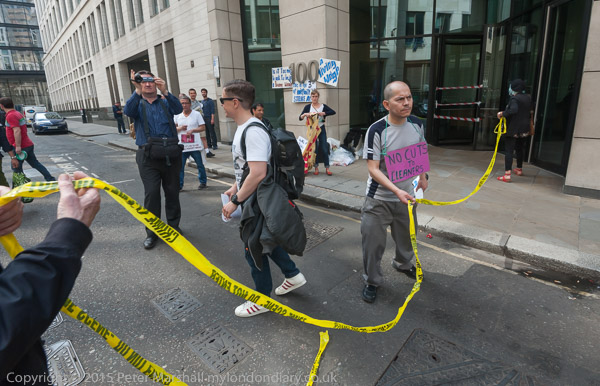
Measuring the 10m required by the injunction

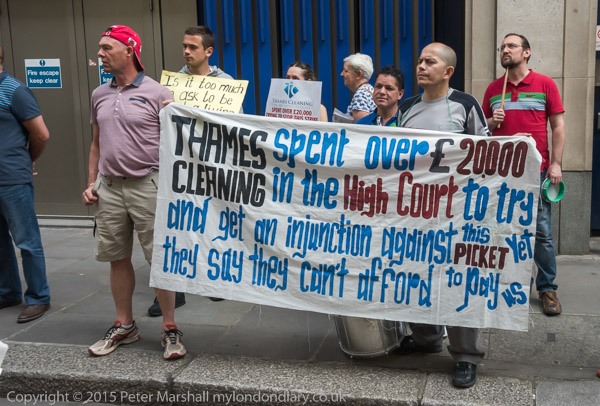
Rather than talk with the UVW, Thames’s response to the strike threat had been to spend over £20,000 in the High Court trying to get an injunction to prohibit the strikes and protests. Although the court would not stop them, they issued an injunction which set down strict conditions for the picket and protest and this left the UVW with crippling legal costs.

The UVW is a small grass roots union supported only by dues from its members and unlike the large established trade unions has little or no money to run its activities which include educational workshops as well as supporting its members in the workplace and at employment tribunals. Those who perform duties for it are paid the London Living Wage for the time spent and there are no highly paid union officials. The union had to issue an emergency appeal for cash – and received support from people and union branches across the trade union movement.

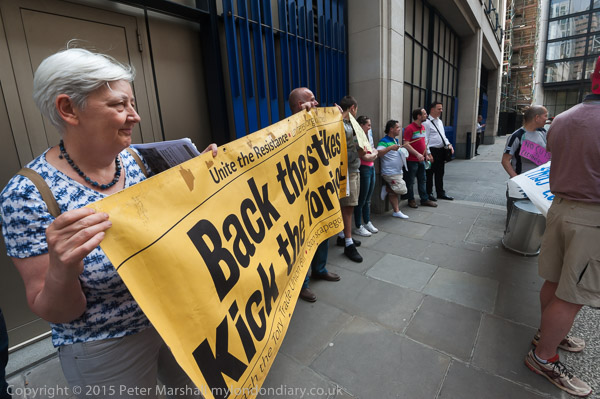
Candy Udwin, PCS Rep at the National Gallery holds a banner

One aspect of the injunction was that any protest connected with the strike had to keep at least 10 metres from the doorway of the offices. Of course picketing is covered by strict trade union laws and a lengthy code of practice that requires it to be as reasonably close as possible to the entrance and exit, and limits it to six or less clearly identified pickets with a supervisor (and possibly also a union organiser) behaving in a peaceful manner.

The protest took place over a carefully measured 10 metres away on the opposite side of the street after a picket which had begun in the early morning when the cleaners would normally have arrived for work. The strike continued for 58 days before the UVW was able to announce that a satisfactory agreement had been reached with the employer and all further action was ended.

There are four posts about the Wood Street Strike on My London Diary for June (and more in later months) :
UVW Cleaners on Strike in City
Day 3 UVW Wood St Cleaners Strike
UVW Wood St Strike Day 10
UVW Wood St Strike continues


London Traffic Deaths Vigil – City Hall

Although London had an impressive purpose-built County Hall on the south bank just downstream of Westminster Bridge, this was sold off when Margaret Thatcher vindictively disbanded the Greater London Council, leaving London rudderless for 14 critical years. After the Greater London Authority was created in 2000, it was without a proper home for two years before leasing and moving into a purpose-built oddly spherical building by Norman Foster in the misleadingly named ‘More London’ currently owned by the Kuwait sovereign wealth fund who disguise themselves as St Martins Property Investments Limited.

Many saw the move to the new building as a failure of purpose by the Labour government in noy re-acquiring County Hall for the new London-wide authority – but then Labour under Blair continued most of Thatcher’s policies rather than move away from her individualist greed-based approach towards one getting back to the social welfare which had been at the heart of post-war Labour.

London’s City Hall moved in 2022 to Kamal Chunchie Way, Newham, E16 into the former ‘The Crystal’ exhibition centre beside the northern end of London’s ‘Dangleway’ cable car, though this is expected to close fairly soon as no replacement sponsor has come up to keep it running.

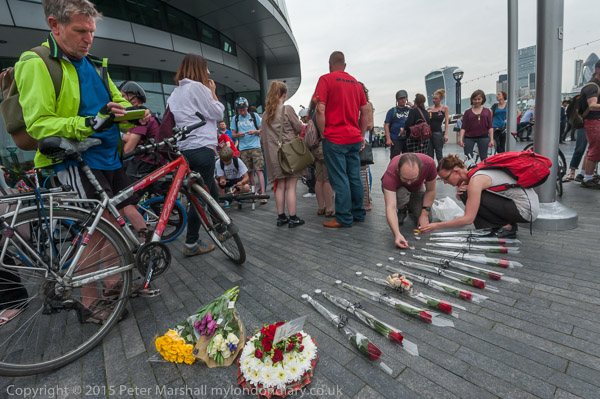
Sadiq Khan had retaken London as a Labour Mayor on May 5th 2016, with a decisive win over Conservative Zac Goldsmith and the Green candidate Siân Berry trailing badly in third place. Since then, 11 people had died on the streets of London, roughly around the average for that period in Greater London (in 2019, the total for the year was 125.)

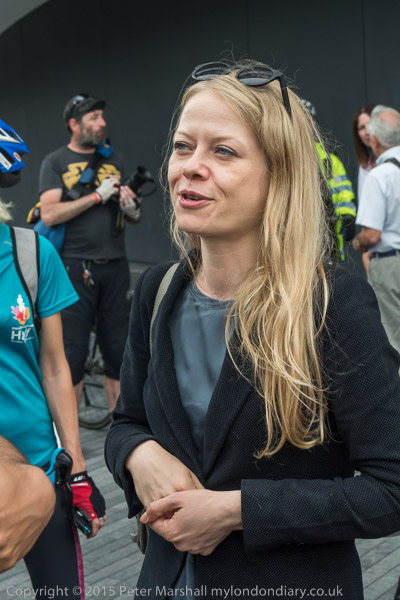
Siân Berry

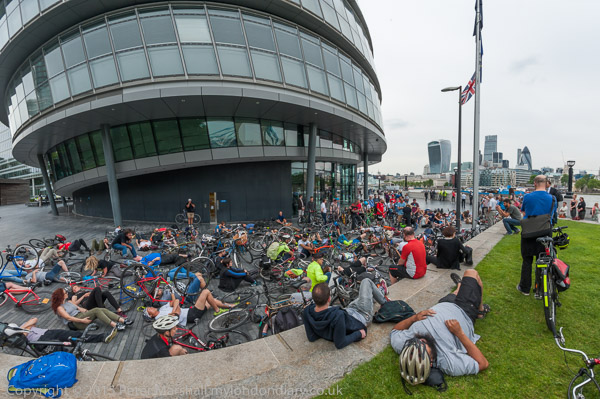
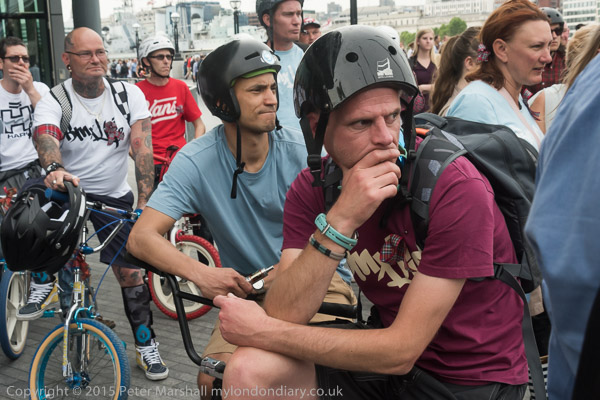
Protests are – at least theoretically – not usually allowed in ‘More London’, but this one was hosted by Green Party London wide Assembly Member Caroline Russell, a member of the GLA Transport Committee and organised by London Women on Bikes (LWOB), #LondonBusWatch, Westminster Living Streets and BMX Life. Of the 11 who died, 3 were cyclists and the others were on foot.

Most road deaths are not ‘accidents’ but “happen because road users make mistakes, often made harder to avoid because of poor vehicle or road design. Many of them result from a lack of proper facilities for pedestrians and cyclists in a road system which prioritises getting motorised vehicles from A to B as fast as possible rather than safety. Some are caused by the failure of police to enforce road traffic law – for example on advanced stop lines at traffic lights.”

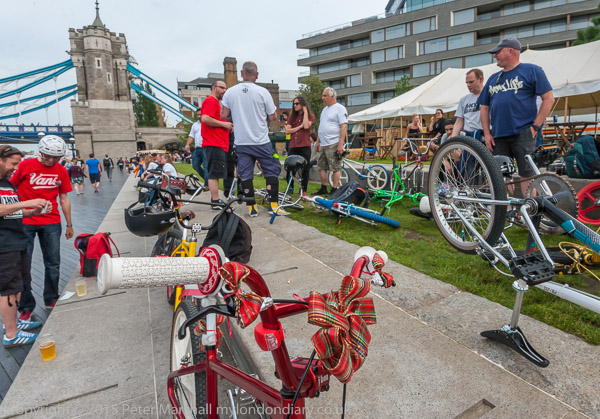
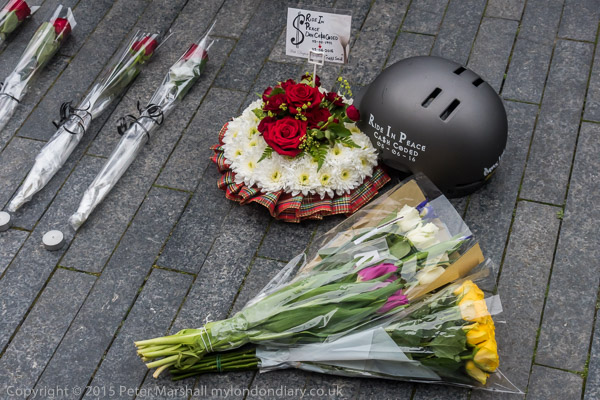
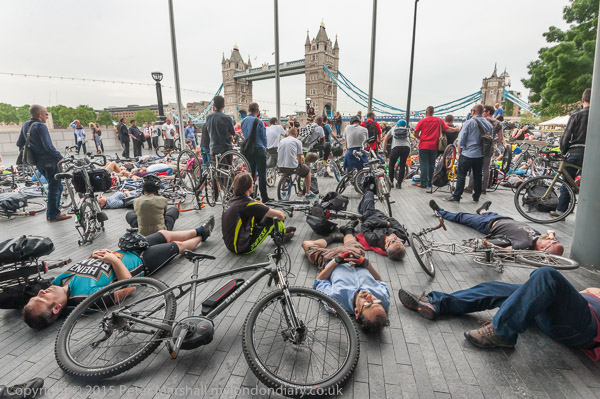
One of the cyclists killed was BMX rider Dan ‘Cash’ Stephenson, hit by a bus on the Strand during a BMX Life charity ride and many other BMX riders had come to the vigil, wearing tartan ribbons in his memory as he always rode in tartan. There were a number of speeches and then the names of those killed were read, followed by an eleven minutes of silence when those at the vigil were invited to stand in silence or to lie down, with or without bikes, in a silent ‘die-in’.

As the vigil came to an end and people were beginning to leave we were all called back for a highly emotional moment when Dan ‘Cash’ Stephenson’s daughter spoke through tears about her father.

London Traffic Deaths Vigil


Refugee Children, Dead Cyclists & A Squat

Refugee Children, Dead Cyclists & A Squat – 11th February 2017

Dubs Now – Shame on May

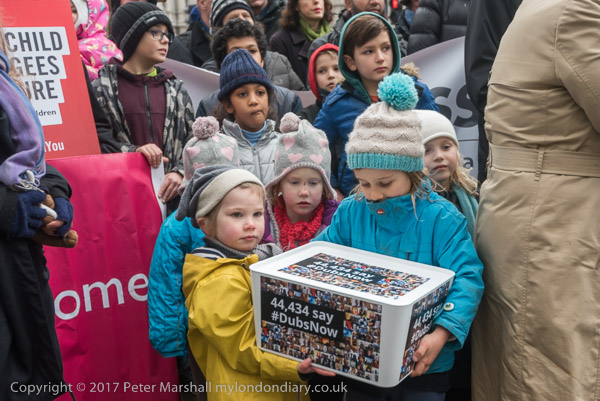
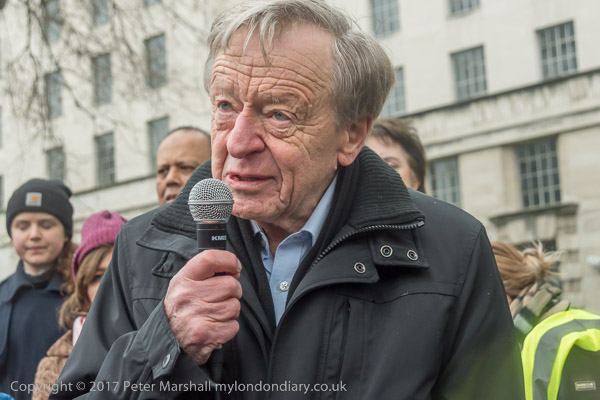
Five years ago, on Saturday 11th February 2017, a crowd of supporters of Citizens UK and Safe Passage joined Lord Alf Dubs at Downing St to take a petition to Theresa May urging her to reverse the decision to stop offering legal sanctuary to unaccompanied refugee children.

The Tory government had been forced into an unusual humanitarian response when Parliment passed the Dubs amendment, and they were then given a list of over 800 eligible children – although there were known to be more whose details were not recorded. And because of Lord Dubs, around 300 have been allowed into the UK. But although twice that number remain in limbo, many in the Calais camps, Prime Minister Theresa May decided to end the scheme.

Lord Dubs speaks

Among those who spoke at the protest before an emergency petition with over 40,000 signatures was taken to Downing St were speakers from four London Labour councils who all said they had told the government they would take more children but their offers had not been taken up.

Dubs Now – Shame on May


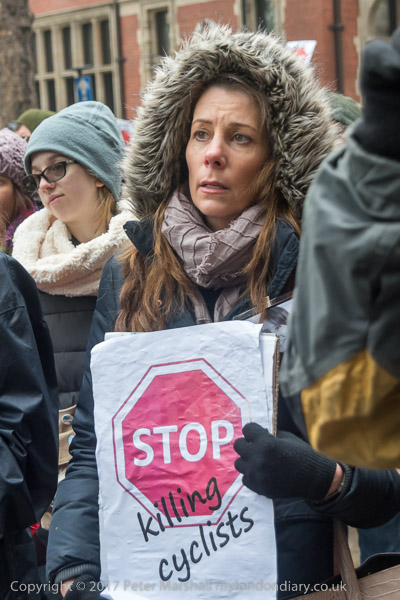
Invest in Cycling – Stop Killing Cyclists

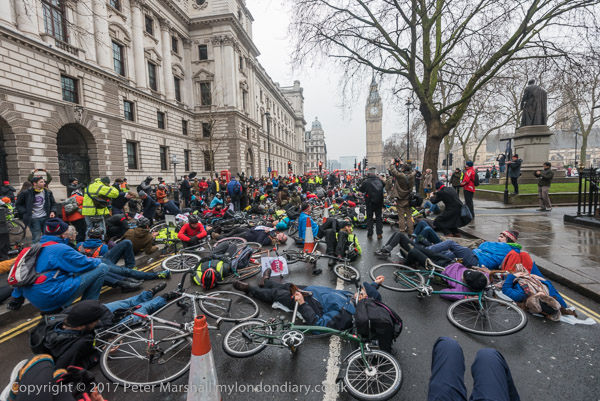
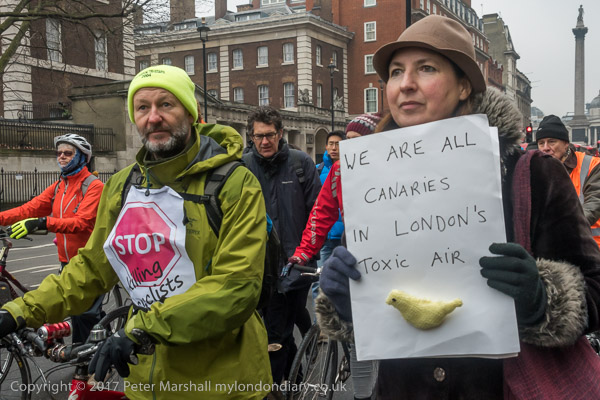
Cyclists and supporters met in Trafalgar Square to march to the Treasury on the edge of Parliament Square to call for a significant increase in spending on infrastructure for cyclists and pedestrians on our streets.

That week five people were killed on London streets as a result of careless or dangerous driving – accidents are rare, but such deaths are made much more likely by a road system engineered around the needs of car and other vehicle drivers and cutting their journey times through the city. Facilities for cyclists and pedestrians have long been treated as secondary and chronically underfunded.

But these 5 killed, who were remembered in the protest and die-in are a small fraction of the numbers who die prematurely each week in London as a result of high and often illegal levels of air pollution – estimated at around 180 per week, as well as the much higher number of those whose lives are seriously affected by health problems – both figures including many who drive. Powerful lobbies for motorists and vehicle manufacturers have led to the domination of our cities by cars and lorries.

There are huge health benefits from cleaning the air by cutting down traffic and congestion, and also by encouraging healthy activities including walking and cycling. And the main factor discouraging people from taking to bikes for journeys to school, work and shopping etc is the danger from cars and lorries. Better public transport also helps, particularly in cutting pollution levels, and anything that cuts the use of petrol and diesel vehicles will reduce the major contribution this makes to global warming.

Invest in Cycling – Stop Killing Cyclists


ANAL squat in Belgravia

My final event that day was a visit to 4 Grosvenor Gardens, a rather grand house short distance from Buckingham Palace (and more relevant to me, from Victoria Station.) Squatting collective the Autonomous Nation of Anarchist Libertarians (ANAL) had taken over this house on February 1st after having been evicted from the Belgrave Square house owned by Russian oligarch Andrey Goncharenko which they occupied for a week.

I’d meant to go there a week earlier, but a domestic emergency had called me away earlier in the day from a protest at the US Embassy before a programme of workshops and seminars in the seven-storey squat had begun. There was nothing special happening on the afternoon I visited (though some things were happening in the evening) but I was welcomed by the occupiers, several of whom recognised me, and they were happy for me to wander around the building and take photographs.

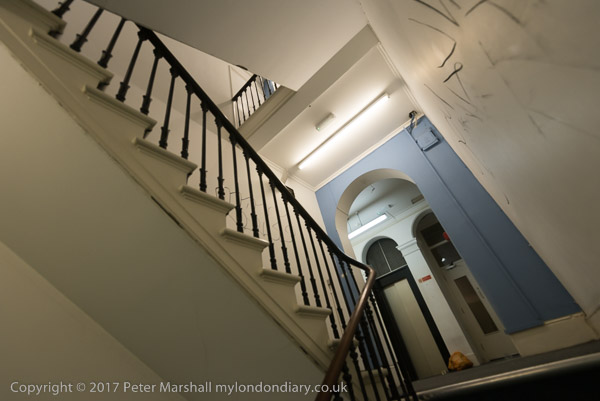
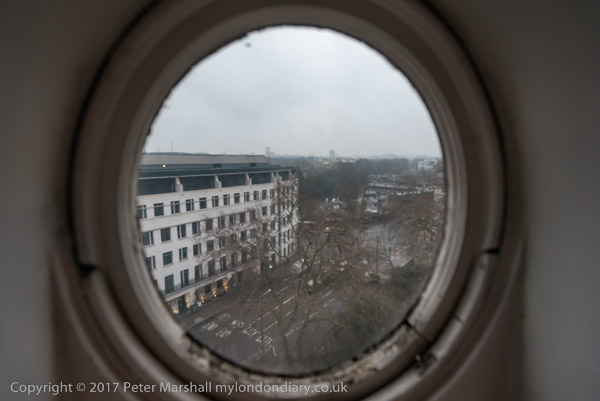
Apart from being careful to respect the privacy of some of the occupiers who were sleeping or resting in a couple of the rooms I was able to go everywhere from the basement to the top floor, but the door leading onto the roof was locked, probably to stop any possible access from there by bailiffs. Like many other houses and hotels in the area it has a view into the grounds of Buckingham Palace, but I had to make do with the view from a rather dusty window, or the less interesting view from lower down where windows could be opened.

Few squats have blue plaques – this one for soldier and archaeologist Lieutenant General Augustus Henry Lane Fox Pitt-Rivers, but more recently it has been in use for offices, business meetings and conferences. The squatters have tried hard to cause no serious damage and had last week turned out some people who had come to make a mess of the place.

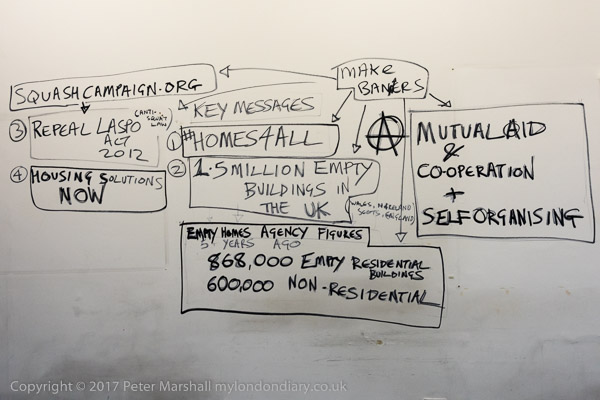
There are around 1.5 million empty buildings in the UK, many like this deliberately kept empty as investments, their value increasing year on year. The number is enough to enough to house the homeless many times over. ANAL say that properties like this should be used for short-term accommodation while they remain empty and they have opened it as a temporary homeless shelter for rough-sleepers.

It remained in use for almost month, with the squat finally evicted at 8am on 27th February. As I ended my post, “There clearly does need to be some way to bring empty properties back into use, and councils should have much greater powers than at present to do so. Until that happens, squatting seems to be the only possible solution.”

ANAL squat in Belgravia


Waving to Copenhagen – 5th Dec 2009

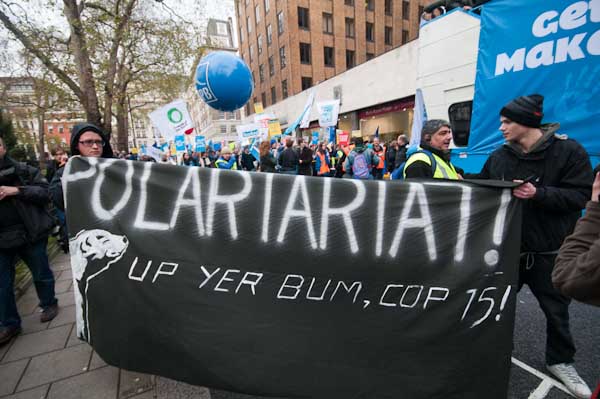
Remember Copenhagen? This was COP15, and generally thought to have been a great failure, with developed countries’ refusing to adopt targets on limiting emissions by 2020 and developing countries insisting on their right to develop their economies and catch up with the big polluters.

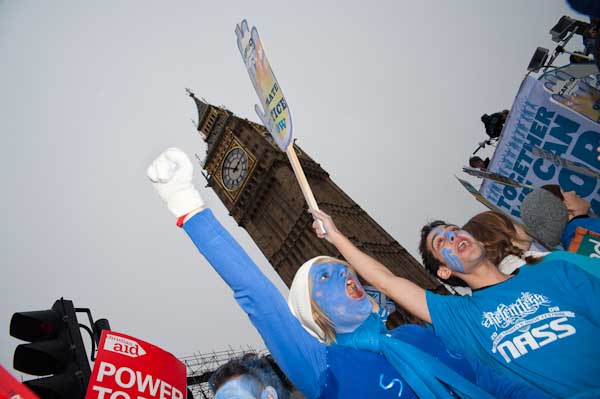
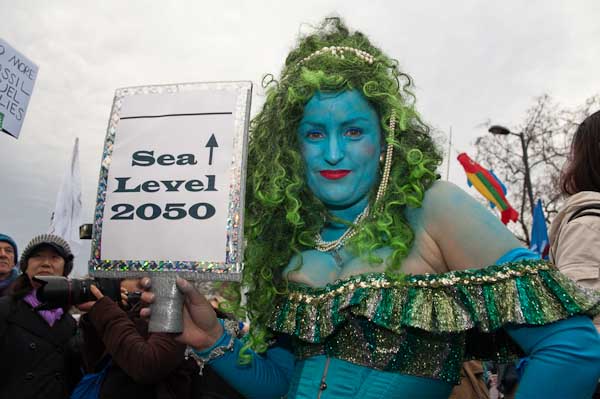
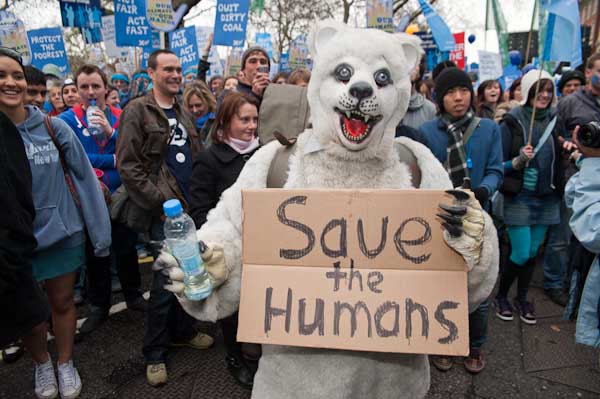
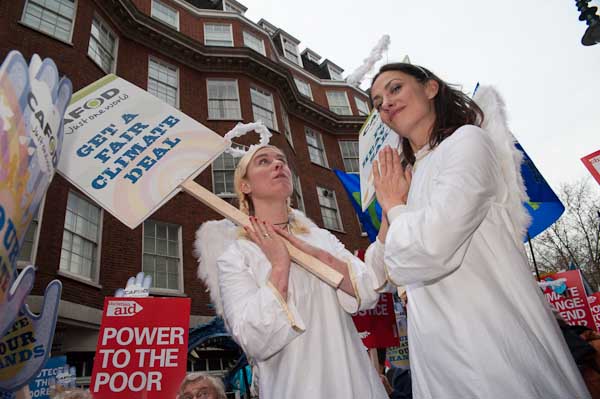
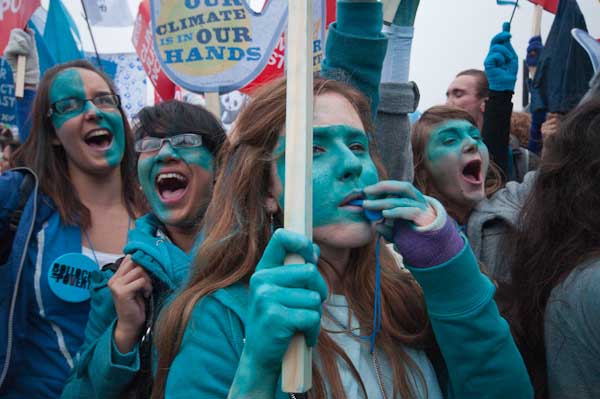
But 2009 did see an upsurge in general interest in climate change, and one of the largest events in London against it, with many large charities combining in the Stop Climate Chaos Coalition and conducting what seemed more a PR exercise than a protest, culminating in a ‘Big Wave’ outside the empty Houses of Parliament at 3pm. Everybody around Parliament waved, made a lot of noise and then wondered what to do next.

As I wrote at the time:
Although it was good to see a wider participation – although despite that huge potential and massive publicity the march was perhaps only a little more than five times the size of previous years – this year’s event, entitled ‘The Wave’ did seem more a stunt for the media than an informed political event. Surely with the backing of 11 million the coalition should be making demands, not just waving, and it’s perhaps hard to see the significance of blue hands and faces in a demonstration about global warming.

It did appear to have been an opportunity lost to adopt a more robust attitude and push our government at least into some action. The day of protest also involved all the other groups who had been protesting over climate change for some years – and seemed to me to rather be hi-jacking the annual climate march by the Campaign Against Climate Change rather than getting behind them and working with them. That feeling underlies much of my reporting of the day, which I split into the seven sections on My London Diary – as below.

Climate Emergency Bike Ride

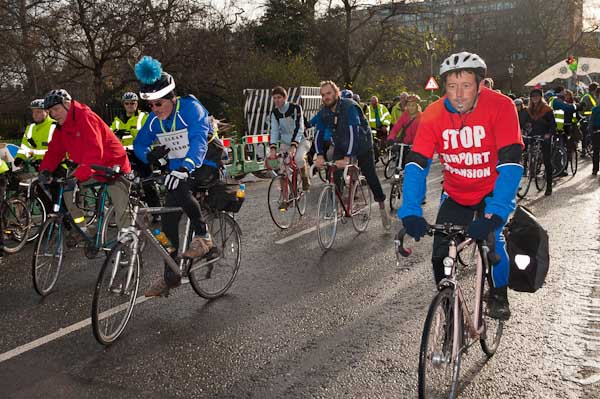
After two speeches at Lincoln’s Inn Fields, the ride, organised by the Campaign Against Climate Change went on to hold demonstrations outside the London offices of two multinationals guilty of activities that are contributing to climate change, BP in St James’ Square and E.On in Pall Mall. Speakers there outlined some of the damage the companies were doing to the environment and how their activities were accelerating climate change.

Climate Emergency Bike Ride.

Climate Emergency Rally

The Campaign Against Climate Change had also organised a rally in Hyde Park before the march organised by the Stop Climate Chaos Coalition who were gathering in nearby Grosvenor Square, presumably to avoid anything political. While the Coalition were simply calling for “a fair and effective international agreement” , CACC made clear that “there is no chance of an effective agreement until the North wins the trust of the South and it will only do that if Northern countries like the UK match words with action and take radical emission-reducing measures at home.” The failure of Copenhagen showed they were right.

Climate Emergency Rally

World Association of Carbon Traders

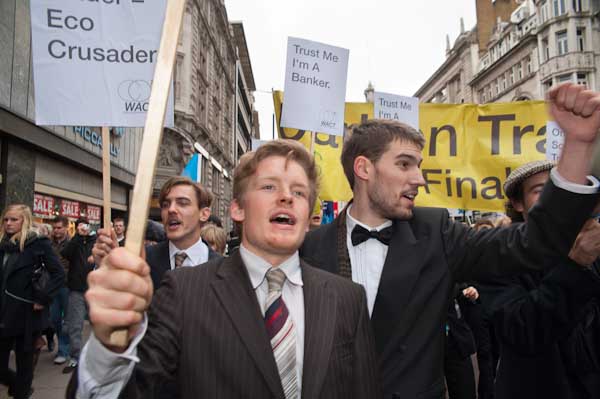
The ‘World Association of Carbon Traders’, group of around 50 smartly dressed ‘city gents’ – who included a few ‘gentesses’ and rather more bad false moustaches – along with power-dressed business women, joined the joined the Stop Climate Chaos Coalition march under the banner ‘Carbon Trading: The Final Solution’. Their ‘ CO2$’ logo and placards including ‘Trust Me, I’m a Banker, Capitalise On The Climate’, ‘In Markets We Trust’, ‘One Solution. Trade Pollution’, ‘Greed is Green’, ‘Carbon Trader = Eco Crusader.’ and ‘Cash In On Climate Change’, which as well as the ‘Permits to Pollute’ they were handing out made their ironic intention clear.

I recognised some of the faces of these agents from previous demonstrations by the Space Hijackers, a group who call themselves ‘Anarchitects’ whose various projects over the last ten years given a new creative face to protest.

World Association of Carbon Traders


The Wave – Before the March

I took a few pictures of the crowds gathering in Grosvenor Square for the Stop Climate Chaos Coalition march on my way to and from the CACC rally.

The Wave – Before the March

Anticapitalist Block – Not Much Waving

For a minute or two this banner led the march as it came through Berkeley Square while march stewards came and argued with them. After a short while and the intevention of a rather stout cop these protesters were persuaded to roll up their banner and suggested they join the march rather further back.

There they joined a few others dressed mainly in black, some carrying red or black flags behind another black banner with the message “NO BOMBS NO BAILOUT NO CAPITALISM“. The block left the march and went to Jubilee Gardens rather than stay for the wave at Parliament.

Anticapitalist Block

Marching to the Wave

Marching to the Wave

The Wave

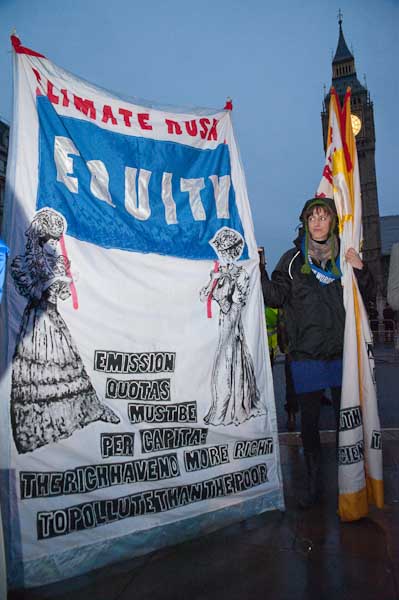
They waved. And then the stewards tried to get them to disperse. Some stayed on in Parliament Square., and I photographed some of them with banners, including Climate Rush. Their banner with a large heading ‘EQUITY’ carried the message “Emission Quotas Must Be Per Capita. The RIch Have No More Right to Pollute Than the Poor”.

In my caption I commented “It’s a principle seemed certain to prevent real progress at Copenhagen – as the rich and in particular the USA – won’t accept it.” And so Copenhagen was doomed to fail.

The Wave


Clean Air – 1990 cyclists and 2019 XR East London

Cyclists protest, Whitehall, Westminster, 1990, 90-11c-14
‘Let London Breathe’ – Cyclists ride down Whitehall to a Trafalgar Square rally – November 1990

Back in 1990, I rode with hundreds of cyclists from the London Cycling Campaign and others protesting about the terrible air quality in London from Battersea Park to a well-attended rally in Trafalgar Square. Following the rally, some MPs raised the issue in Parliament.

XR East London marches for clean air – 12 July 2019

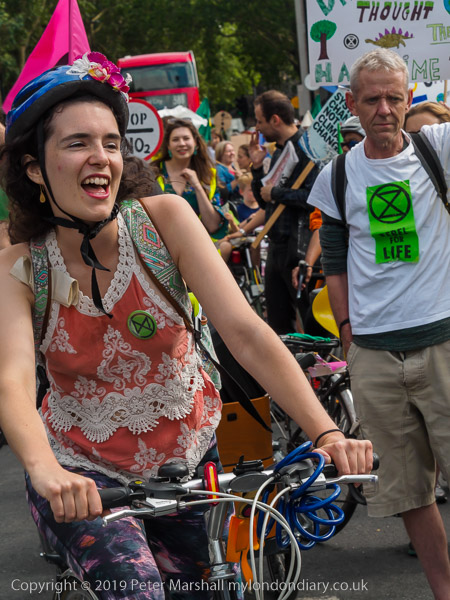
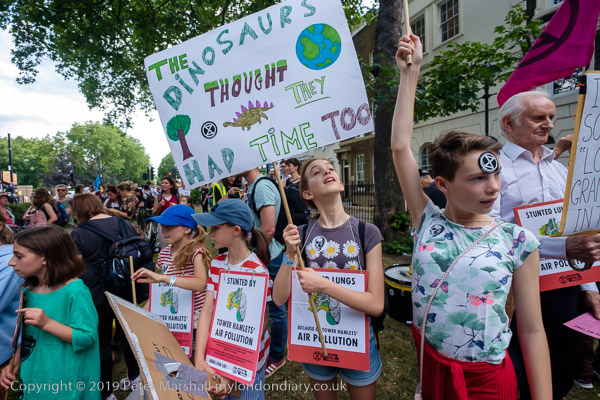
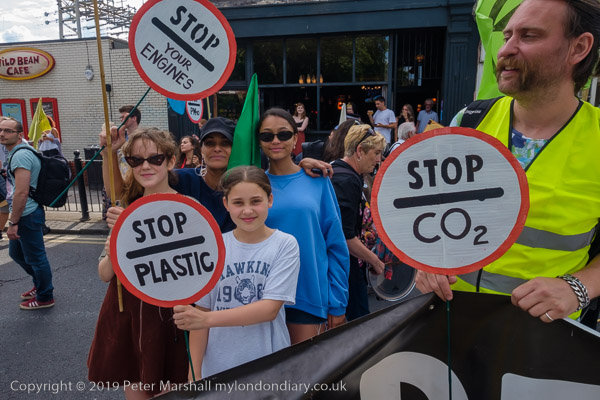
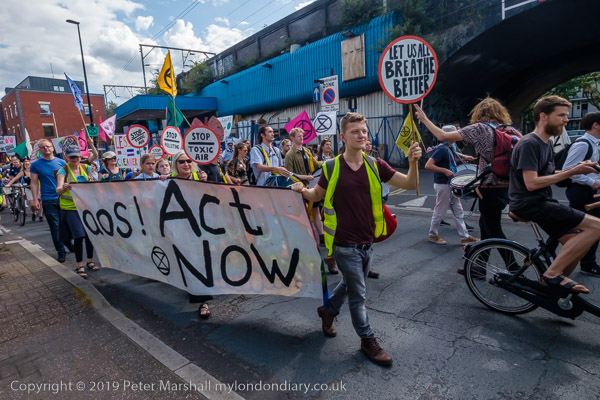
Almost 30 years on there has not been a great deal of progress – and the statistics now show almost 10,000 excess deaths per year in the city due to air pollution, and untold misery from various respiratory conditions, some crippling. In 2019 XR East London met at Bethnal Green on Friday 12 July to march to Hackney behind a banner ‘The Air That We Grieve’, calling for a rapid end to the use of fossil fuels.

Much of the pollution comes from road traffic, and the already announced end to the sale of new trucks, vans and any other combustion-powered vehicle from 2030 onwards will do a little to improve air quality, but existing petrol and diesel vehicles will continue to be used for many years, though we may see more stringent ultra-low emission zones to restrict their use in cities.

But although the switch to electric will cut down pollutants such as nitrogen oxides as well as reducing climate changing carbon dioxide, it will still leave other harmful substances such as particulates from tyres and brakes in the air. And the carbon footprint is only lowered so long as the electricity used to charge those car batteries comes from truly renewable generation.

Cleaner air in cities also needs us to move away from the car to more eco-friendly means of transport – such as public transport and bicycles. Even electric scooters and electric bikes also have a part to play.

Better public transport means more trains, light rail, trams and buses. The simplest and most cost-effective solutions are probably more dedicated bus lanes and bus-only routes, and giving buses greater priority in traffic. Many years ago I cycled in French cities where buses had priority and motorists (and cyclists) had to give way whenever they wanted to pull out from a stop, and changes like this to our Highway Code and traffic rules would make a difference.
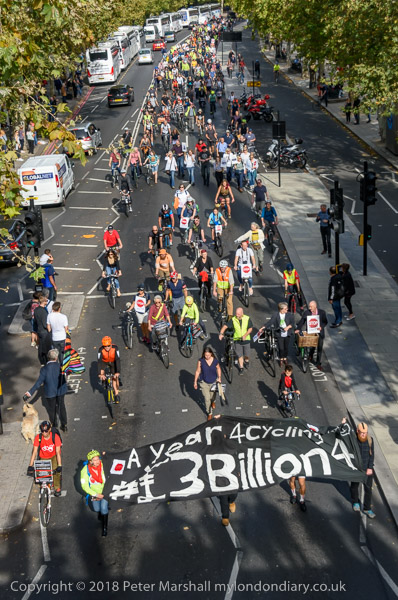
In 1990 cyclists were calling for 1000 miles of dedicated cycle routes through London. We do now have some ‘cycle superhighways’ and ‘quietways’, although many of these – we are now supposed to call them ‘cycleways’ – still involve sharing with often dangerous traffic. Progress is still slow, and there is bitter opposition from some interest groups, particularly black cab drivers.

We need too an overhaul of London’s taxi system, with rules still made in the days of horse-drawn Hackney cabs. I’ve often stood at bus stops in the City waiting for my bus, held up by traffic while 20 or 30 or more black cabs drive by, the great majority of them empty. A move away from ‘ply for hire’ to smartphone based systems summoning a cab from a nearby taxi rank would hugely cut both congestion and pollution in the centre of London.

More at XR East London marches for clean air. You can click on the black and white image above to go to the album with more pictures from the 1990 cyclists protest.


As always I was travelling around London on public transport (I sometimes bring up a folding bike on the train) and as the march neared its end I boarded a bus in the opposite direction back to Bethnal Green where I took the tube back to Holborn, then took the short walk to the University of London’s Senate House, where exploited outsourced workers were holding a noisy protest after the newly appointed Vice-Chancellor Wendy Thomson had failed to reply to a request to meet them and discuss their grievances. You can see more about this at IWGB welcome new Vice Chancellor.

All photographs on this and my other sites, unless otherwise stated, are taken by and copyright of Peter Marshall, and are available for reproduction or can be bought as prints.


Aldermaston 2008 – 50 years

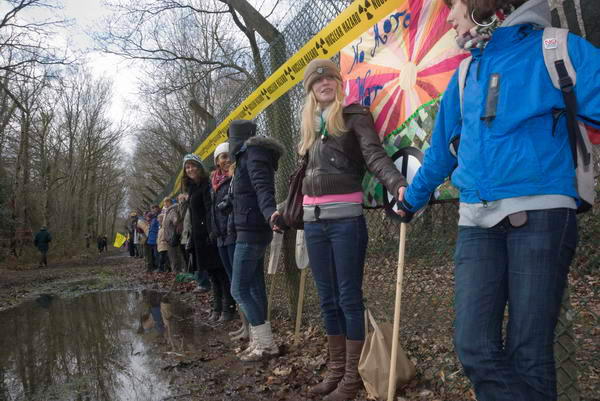
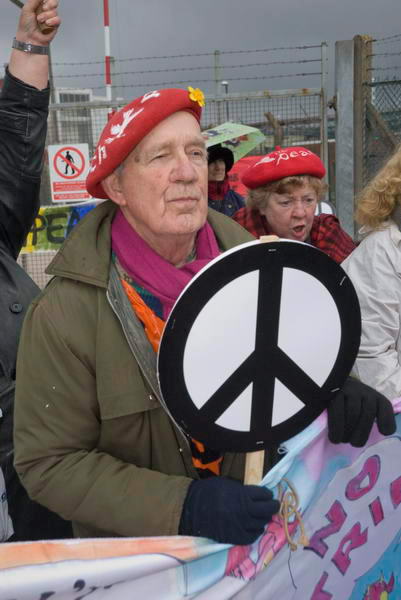
Protesters join hands to surround the nuclear weapon factory at Aldermaston

I missed the first major march to Aldermaston organised by the Direct Action Committee Against Nuclear War (DAC) and supported by the newly formed CND at Easter in 1958. I was only thirteen at the time and not that interested in politics at the time, but was very aware it was taking place as my two older brothers (both no longer with us) walked the full distance, coming back tired and rather muddy after four days of marching from Trafalgar Square in the centre of London to the Atomic Weapons Establishment in Berkshire to demonstrate their opposition to nuclear weapons.
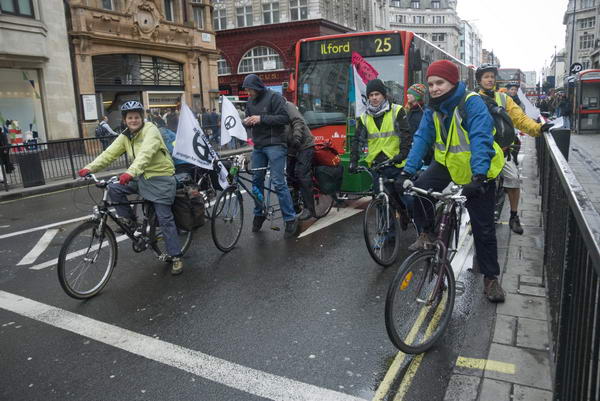
I didn’t go the whole way on the 50th anniversary in 2008, and although I had planned to join the group that were cycling from London I didn’t manage to do so, though I did photograph the cyclists as they rode down Oxford St.

On the Bank Holiday Monday they were cycling from Reading where they had stayed the night along with the walkers, mainly sleeping on the floor in church halls, and I had hoped to join them there for the final stage to Aldermaston. But I got up too late and missed the early train which would have got me there in time – and the next train half an hour later ran late, so I missed their start. Instead I rode on my own along the route that I’d taken on the march there four years previously, finding that on a bike it was rather hillier than on foot.
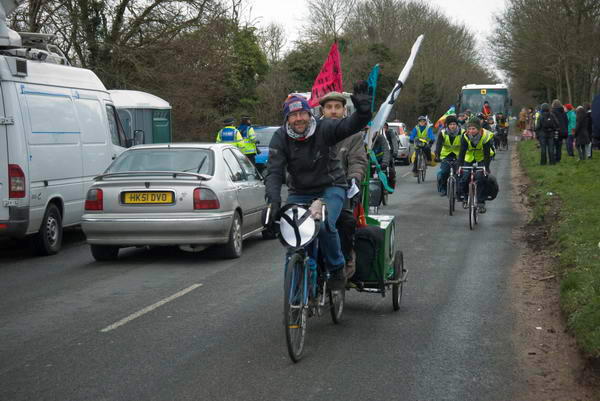
The Bikes not Bombs group arrive at the Aldermaston bomb factory

Once at Aldermaston, the bike made it easy for me to go to all the gates around the large site of the AWE to take photographs of the protesters there who later moved to surround the perimeter of the base, holding hands around it. And although I’d left Reading later, my more direct route meant I was able to photograph the arrival of the ‘bikes not bombs’ group with their police escort of two cars and several motorbikes.

After making the human chain around the AWE – I think around 4 miles long – and speeches and performances at the main gate it was time to go home, and I got back on my bike for the 12 miles or so to Reading, a slightly easier ride as the wind was behind me and Reading is around 60 metres lower, though the road still had plenty of uphill sections. But I took my time, even stopping to take a few photographs on the way.

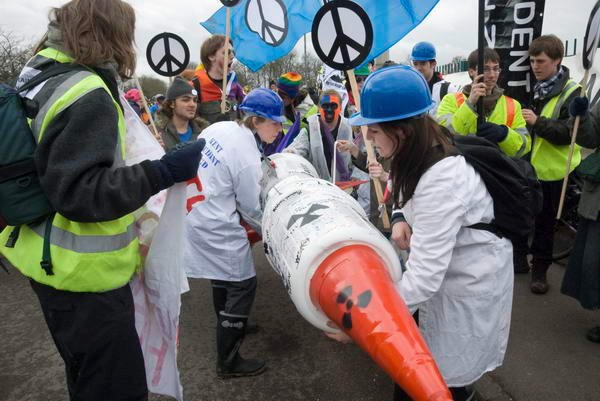
Our nuclear weapons programme has never made any sense and the idea of nuclear deterrence has served only to enrich the arms industry. The expense of our nuclear submarines and their warheads diverts money away from more useful areas such as health and education, and the nuclear programme has skewed our power generation to increase electricity costs for us all. It cannot be justified in military or economic terms, but for most of those protesting the most important aspect is that the use of nuclear weapons can never be justified on moral grounds.

The UN Treaty on the Prohibition of Nuclear Weapons which entered into force on 22 January 2021 prohibits the development, testing, production, stockpiling, stationing, transfer, use and threat of use of nuclear weapons, Instead of signing this, the British government have announced an increase in number of nuclear warheads – in contradiction to our previous international agreements about the non-proliferation of nuclear weapons.

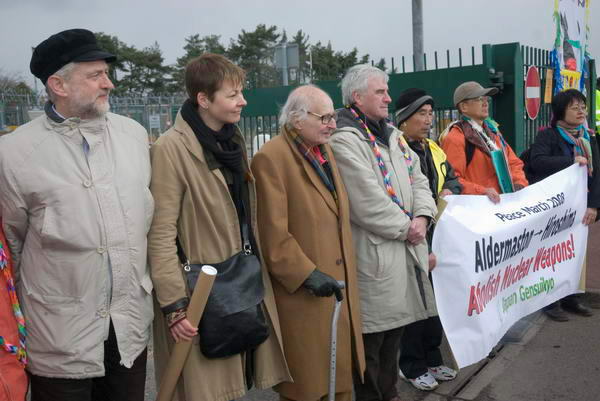
Jeremy Corbyn, Caroline Lucas, Walter Wolfgang, John Mc Donnell and Japanese peace campaigners

More pictures at Aldermaston – 50 years


All photographs on this and my other sites, unless otherwise stated, are taken by and copyright of Peter Marshall, and are available for reproduction or can be bought as prints.


Naked Bikers

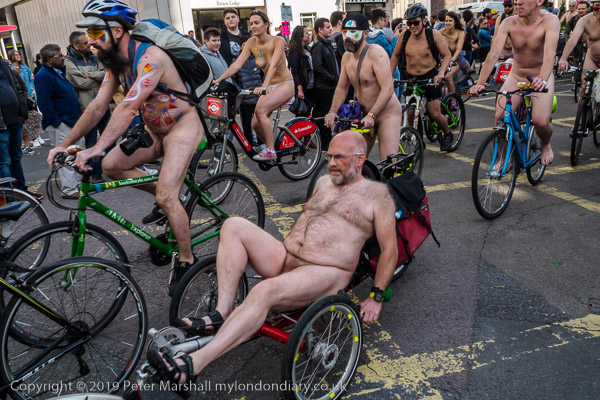
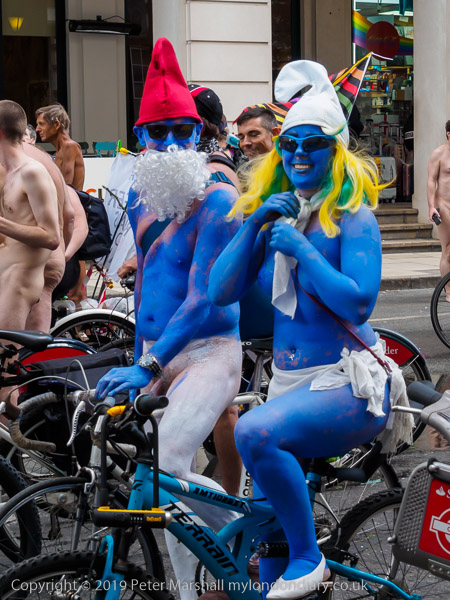
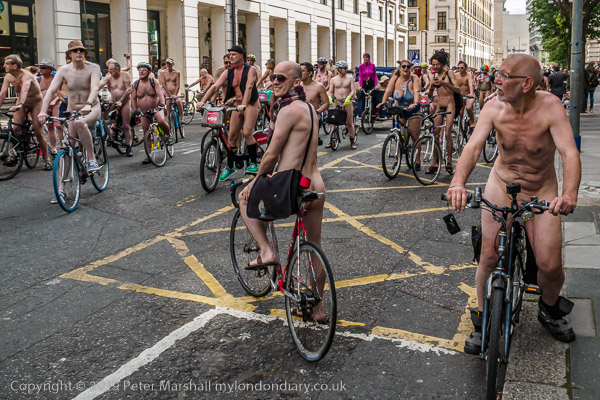
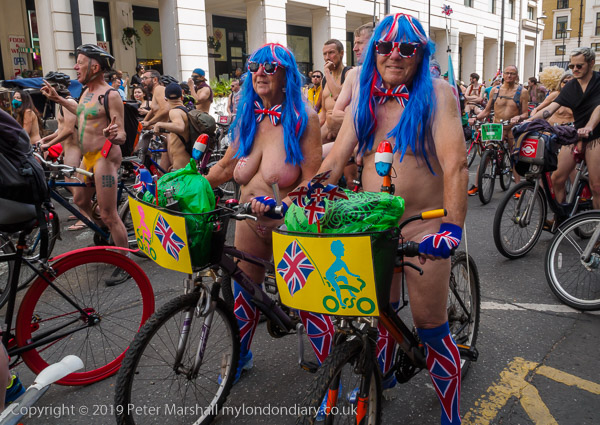
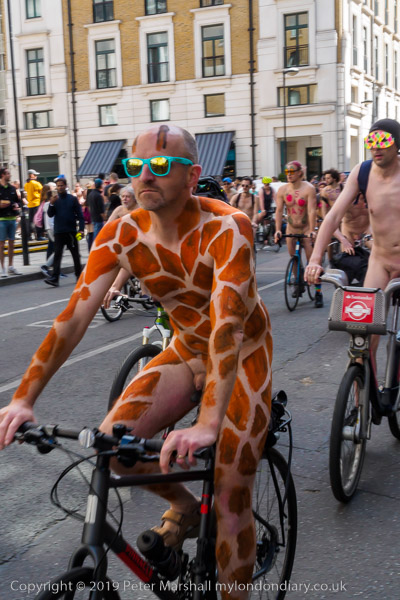
I hadn’t gone out of my way to photograph the London World Naked Bike Ride, but the point where all the riders who start at a number of points around central London meet up for the final section of their ride was close to the station from which I get my train home, so it seemed to be worth taking a few minutes to cover the event.

The first London WNBR took place in 2004 but with very little advance publicity – I’d attended and photographed ‘Bikefest’ which it is associated with on the day it took place but remained unaware of it. In 2005 I was out of the country when it took place. So I first photographed this event back in 2006, when quite a few people I knew were taking part.

This year I think there was nobody I knew in the event, or at least no one that I recognised without their clothes on. The ride is billed as “a protest against oil dependency and car culture” and back in 2006 it appeared to appeal to many people involved more generally in environmental protests. The message of the ride has never been very clear to those watching it and I think over the years the participants have changed, and it now seems much more dominated by naturists and has a rather smaller proportion of women taking part. The total number of riders this year, stated to be 1300, was roughly twice that in 2006.

There are some problems in photographing the event. It take place on the public highway, where no one has any expectation of privacy – and indeed people ride naked to make a statement, but some have tried to restrict photography in various ways. Not that this has ever had any effect on the crowds of tourists who the ride surprises who almost to a man (and many women too) get out their phones and take snap after snap.

But while the legal position on taking photographs of the event may be clear, there are problems in publishing the images in some media and particularly on platforms such as Facebook. I try hard to take at least some pictures with discretely placed saddles and handlebars.

I’d had enough after around 15 minutes and didn’t bother to try and follow the cyclists after they had moved off, though it would have been fairly easy to catch them several more times as they cycled around central London. But I went to a nearby pub with a friend I’d met photographing the event, and then on to cover another event. Or at least to try to; I arrived outside the Home Office at the right time on the right day to find no one there. I waited for a bit, checking the details on my phone, but after waiting for 20 minutes caught a passing bus to Vauxhall for the train home.

More pictures from the 2019 London World Naked Bike Ride.


All photographs on this and my other sites, unless otherwise stated, are taken by and copyright of Peter Marshall, and are available for reproduction or can be bought as prints.

There are no adverts on this site and it receives no sponsorship, and I like to keep it that way. But it does take a considerable amount of my time and thought, and if you enjoy reading it, please share on social media.
And small donations via Paypal – perhaps the cost of a beer – would be appreciated.