Mother Earth, Greenpeace & Agrofuels – 2009

Mother Earth, Greenpeace & Agrofuels: On Monday 12th October 2009 I came to London for a protest over the threat of agrofuels both to the native Latin American people and to the planet. Later there was a protest against the UK subsidising power stations that use agrofuels and research into agrofuels for aviation which would enable that industry to continue to hugely pollute. Going home from Westminster I photographed protesters who were still on the roofs of the Houses of Parliament protesting against the failure to act on climate change.


London Mobilisation for Mother Earth

Embassies of Colombia, Peru & Spain
Mother Earth, Greenpeace & Agrofuels - 2009
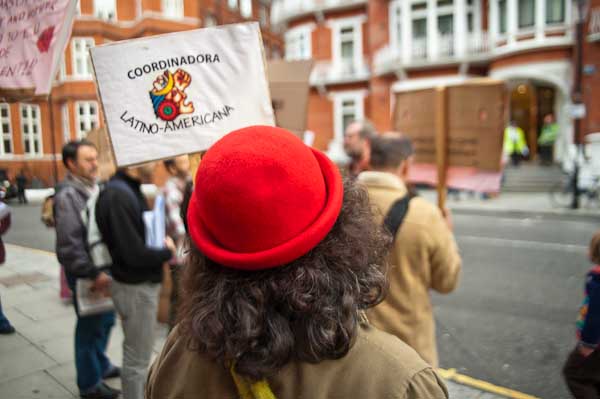
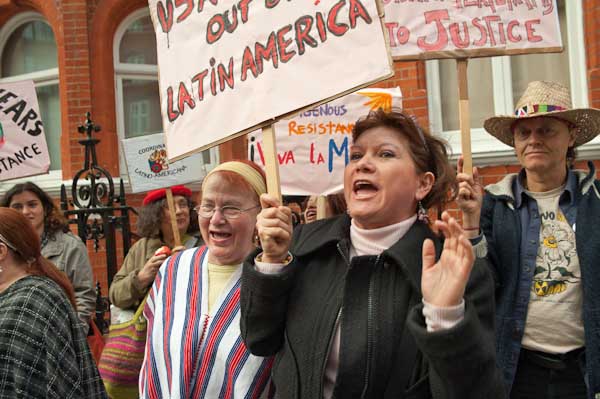
At the start of the protest opposite the Colombian embassy in Kensington

The Global Mobilisation for Mother Earth, an international day in support of the struggles of Latin American native people and to protest against the increasing threat of agrofuels, was called by the Coordinadora Andina de Organizaciones Indigenas on the day celebrated as a public holiday in the USA as Columbus Day, though it has other names in some South American Countries. It marks the day Columbus landed on Abya Yala (the Americas) in 1492.
Mother Earth, Greenpeace & Agrofuels - 2009

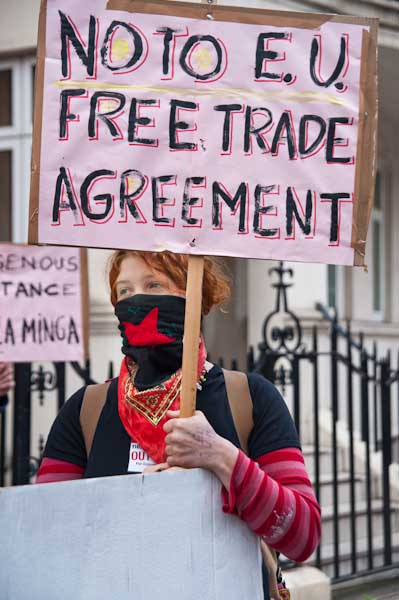
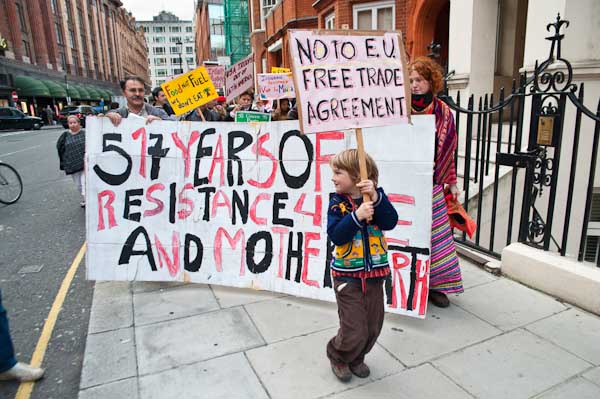
The London protest was organised by the Coordinadora Latino-Americana which unites a number of Latin American solidarity groups in support of peoples along the Andes in Colombia, Ecuador, Bolivia, and Peru who were marching against the European Union’s Free Trade agreements with Latin American countries. These will allow multinational companies to exploit resources on favourable terms, with deals by Colombia and Peru that will destroy the ancestral territorial rights of indigenous peoples. Former EU Trade Commissioner Peter Mandelson and his replacement Cathy Ashton, had played a leading role in these agreements.
Mother Earth, Greenpeace & Agrofuels - 2009
On the way to the Peruvian embassy

The UK government was diverting large amounts of funding meant for renewable energy projects to the use of agrofuels which worsen global warming and threaten food security around the world.
Mother Earth, Greenpeace & Agrofuels - 2009
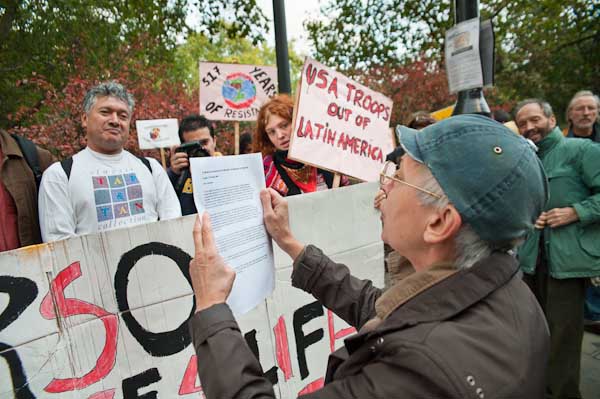
Reading the letter to Peru outside the embassy

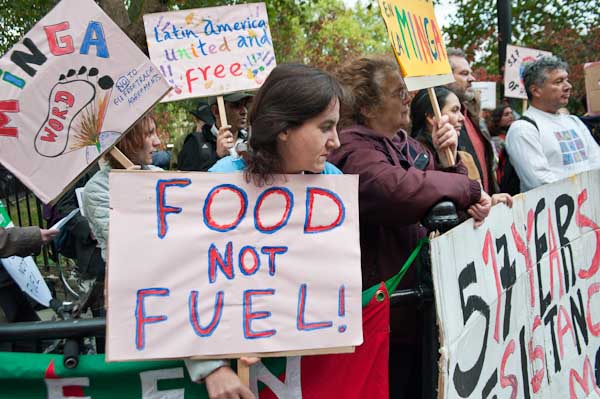
Large areas of land in Latin America and elsewhere in the global South is being taken over by multinationals for agrofuel production, displacing the inhabitants, and introducing monoculture that destroys biodiversity and rapidly exhausts the soil. Large areas of irreplaceable ancient forests are also being felled mainly to grow these crops, but also as timber and to burn in power stations.
Mother Earth, Greenpeace & Agrofuels - 2009

After a protest with speeches relevant to Colombia outside their embassy and the delivery of a letter there, the protesters walked on the the Peruvian Embassy, where we listened to a clear exposition of the link between opposition to agro-fuels and the indigenous struggles in Peru by eco-socialist Derek Wall of Green Left. Another letter was handed on and we moved on to the Spanish Embassy for a further protest. I left them there to go to the protest at the Department for Energy and Climate Change.

More pictures


Agrofuels Don’t ROC(K)

Whitehall

Mother Earth, Greenpeace & Agrofuels - 2009
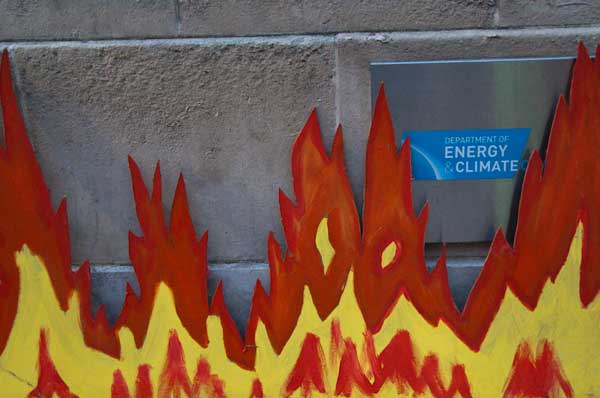
The Department of Energy & Climate Change was briefly surrounded by flames – but police said remove them

Around a hundred protesters turned up for a demonstration at the DECC in London calling for an end to government subsidies for agrofuels because of their serious harm to communities and ecosystems and contribution to climate change.

The UK Government is diverting renewable energy subsidies (Renewable Obligations Certificates – ROCs) to subsidise power stations that use ‘agrofuels’. Fuel produced from palm oil was getting twice the subsidy that wind power would get to produce the same amount of energy. The hugely polluting wood-burning power station at Drax in Yorkshire was getting huge subsidies for its climate-wrecking activities.
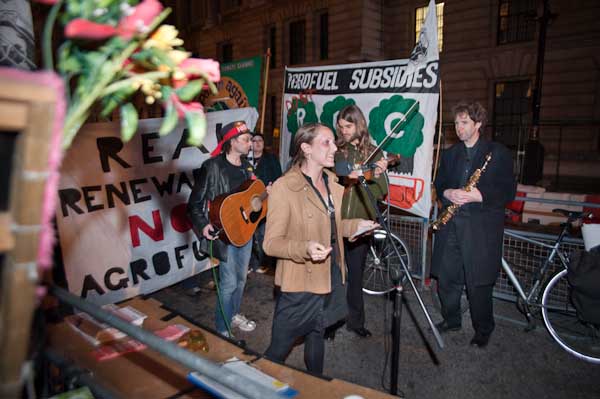
Agrofuels were once seen as part of the solution to our environmental crisis, but we now know that they cause serious harm to the climate, wreck communities whose land is taken for their growth, destroy biodiversity, replace complex natural ecosystems by agrochemical based monoculture, and by replacing food crops, cause starvation.

Agrofuels allow industrial companies to continue ‘business as usual‘ and export their environmental problems to the non-industrial south, buying up land and creating ‘biofuel refugees‘ of indigenous peoples. A UN source has described this as a ‘crime against humanity.’
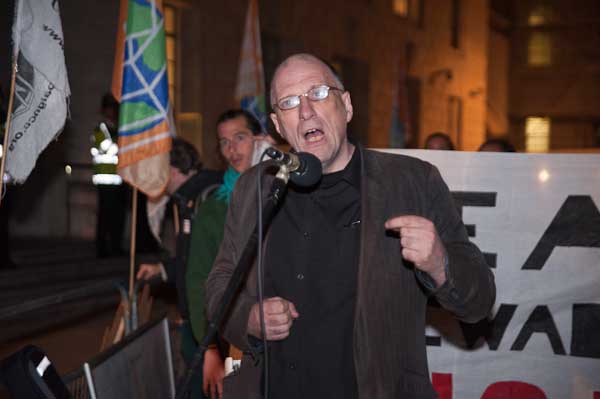
John Stewart

One of the speakers was John Stewart, who warned that the air transport industry sees agrofuels as their salvation, allowing them to continue offering cheap flights and increasing air traffic, while pretending to be green.
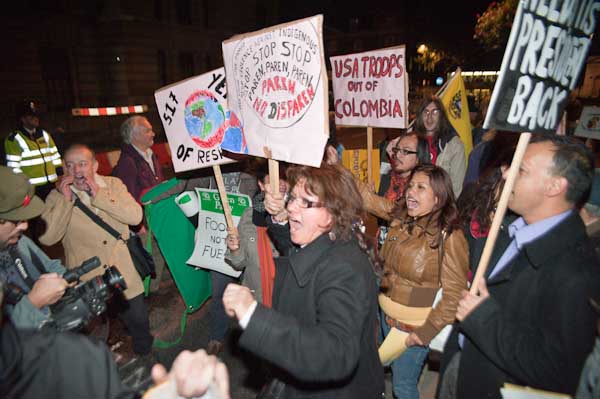
The Latin American ‘Mobilisation for Mother Earth’ arrives to join the protest

The protesters here were later joined by those who had been on the Mobilisation for Mother Earth protest against the the destructive alliance between multinational corporations and local elites in South America, particularly in mining and agrofuel production, and a speaker talked of their struggle for a dignified future for their children and their communities.

More pictures


Greenpeace Parliament Roof Protest Ends

Houses of Parliament

I stopped on my way home as I walked past the Houses of Parliament amd took a couple of pictures. Around 20 Greenpeace protesters who had been on the roof since the previous evening were still there, although they came down shortly afterwards and were arrested.

They held bright yellow banners with the message ‘CHANGE THE POLITICS SAVE THE CLIMATE’ and called on the UK Government to take effective measures to combat climate change, including stopping airport expansion, a refocus of taxes on pollution, fair financing to help pay for low carbon.

Greenpeace say we have to change to green policies rather than simply mouth green rhetoric and listed 12 policies to save the climate and our planet and end the locking of the UK into high carbon lifestyles. They said “The International Energy Agency and leading economists agree that failure to act now will lead to economic as well as environmental disaster” and this is now increasingly becoming obvious.

Although the protest gained considerable media attention, almost all of this in the major news media was about the breach in security on the Parliamentary Estate and not about the much more vital issues raised by the protesters.


Flickr – Facebook – My London Diary – Hull Photos – Lea Valley – Paris
London’s Industrial Heritage – London Photos

All photographs on this page are copyright © Peter Marshall.
Contact me to buy prints or licence to reproduce.
AxeDrax Wood Burning & Student Housing

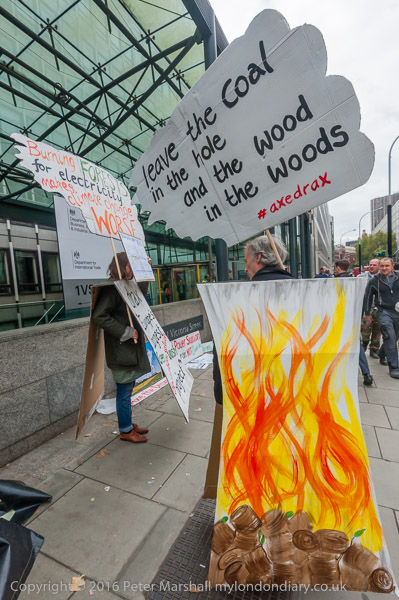
AxeDrax Wood Burning & Student Housing: Today, 19th October, is the International Day of Action Against Big Biomass (IDoA) calling for an end to climate-wrecking tree burning in power stations, and I hope to be attending a protest in London at Barclay’s Bank in Canary Wharf at noon calling for an end of the £billions in subsidies given to the world’s biggest tree burner, Drax, for burning trees and polluting communities. In 2016 I photographed a protest against Drax and another against providers of high cost (and high profit) housing for students.


AxeDrax protest against Biomass & Coal – Westminster

AxeDrax Wood Burning & Student Housing

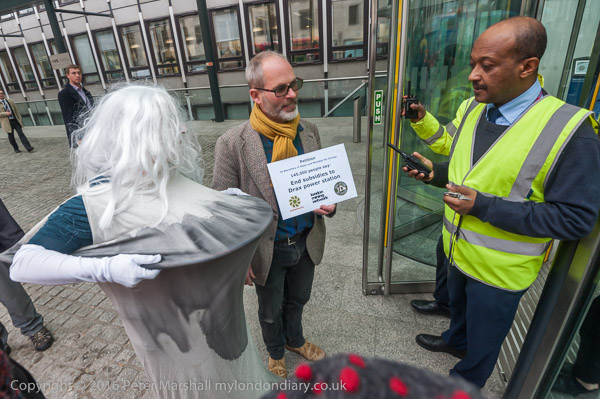
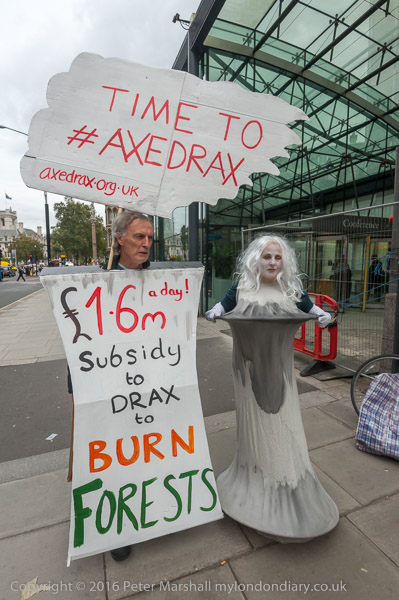
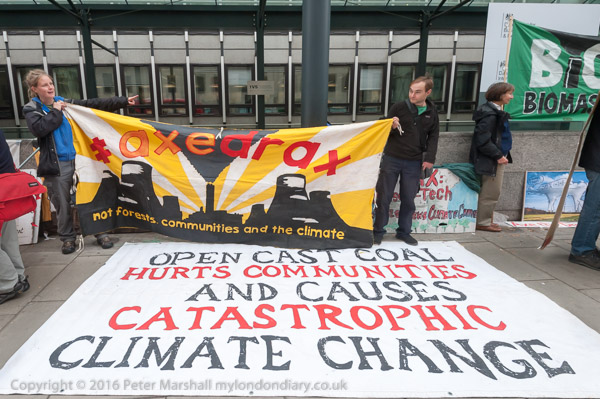
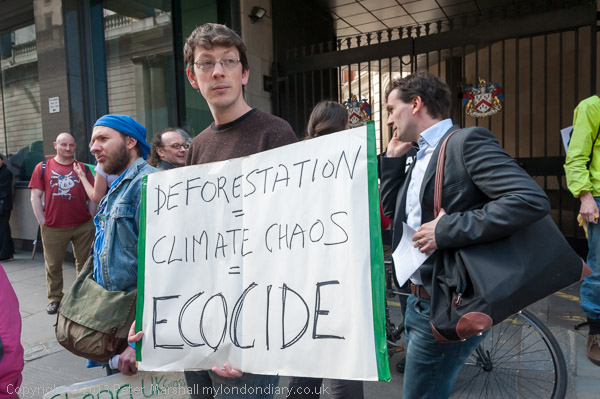
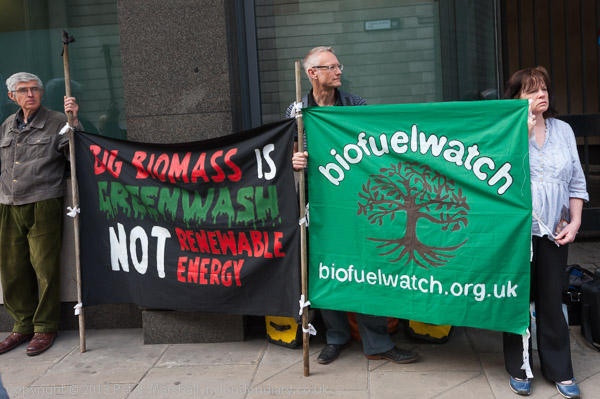
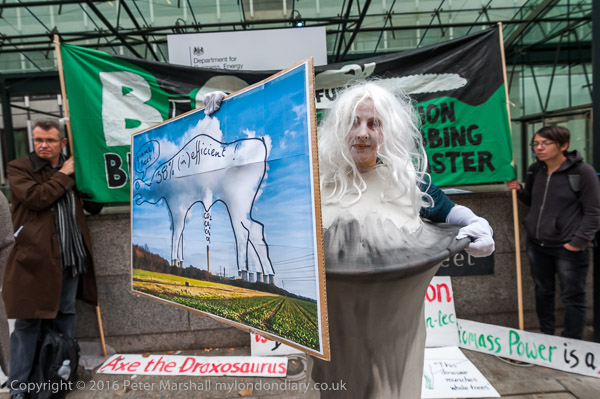
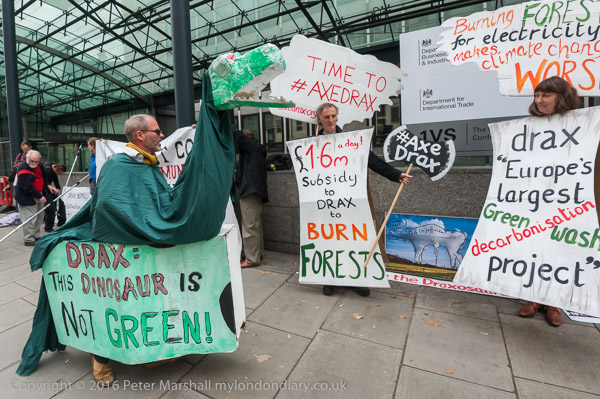
Back on Wednesday 19th Oct 2016 protesters came to the newly formed Dept of Business Energy and Industrial Strategy (BEIS) to urge the government to end the green subsidies to Drax as scientific research had make it clear that producing electricity from Biofuels is harmful to the climate, forests, biodiversity and people.

AxeDrax Wood Burning & Student Housing

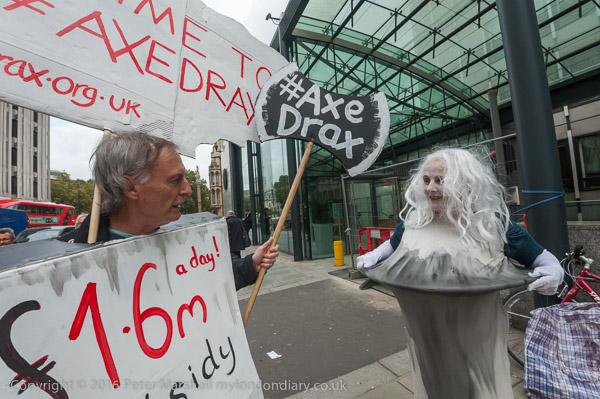
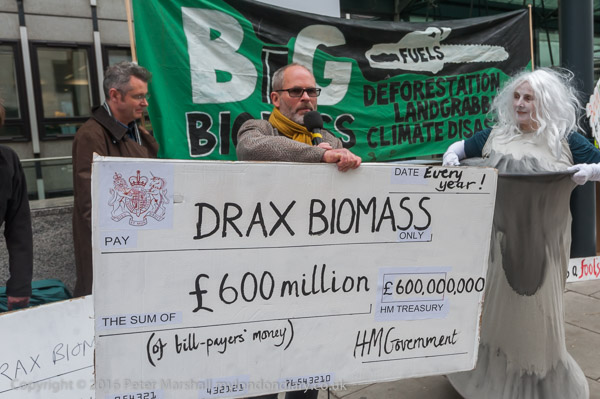
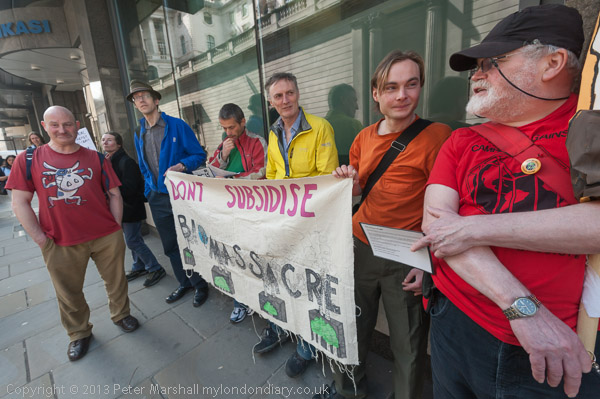
Biofuel Watch and London Biomassive, both part of the Axe Drax campaign had brought with them posters, banners and a cooling tower and were accompanied by the Draxosaurus dinosaur.

AxeDrax Wood Burning & Student Housing

They demanded the government end the £600million a year subsidy Drax gets for its polluting activities and spend the money on measures such as building insulation to cut demand for electricity and to support the use of real low-carbon renewable electricity generation.

AxeDrax Wood Burning & Student Housing

Drax is an old and inefficient power generator, built for coal, still used in two of its six boilers in 2016, though in April 2023 they announced using coal had come to an end. The four boilers converted to wood pellet use waste 60% of the energy created in waste heat to the atmosphere and into the cooling water taken from and discharged into the nearby river Ouse. Without the huge annual subsidies it gets from our electricity bills it would not be viable. It should be closed as soon as possible and its workers trained for new green jobs which the huge subsidies currently spent on keeping this highly polluting facility open could provide.

As well as being generously awarded for adding excessive amounts of carbon and thus increasing global temperatures, Drax also creates large amounts of highly dangerous particulates, releasing over 400 tons a year into the environment in the UK. And Drax also creates environmental havoc in the areas which supply its wood – and until 2023, coal.

Much of the wood comes from destroying forests in the Southeast of the United States, and Drax also supplies wood to be burnt in other countries. It has mills to turn freshly cut trees into wood pellets in Louisiana, Alabama, Mississippi, and Arkansas. Planting the monoculture pine forests needed to supply these has been at the expense of the clear cut felling of older diverse forests and replacing them with sterile plantations with little undergrowth and wildlife.

Drax also buys wood pellets from the world’s largest pellet producer Enviva which cuts down large areas of highly diverse coastal hardwood forests in the US with an incredible loss of bio-diversity. Similar environment degradation and destruction of habitats is taking place in other countries around the world where Drax sources pellets. Their transportation to Drax also produces large amounts of carbon dioxide.

The pellet plants which produce wood largely from whole trees and complete felling of large forest areas to be burnt at Drax also generate huge amounts of air pollution both at Drax in Yorkshire and Drax at the US pellet plants were Drax has had to pay large fines for this. Most of these plants are in deprived, majority-Black communities.

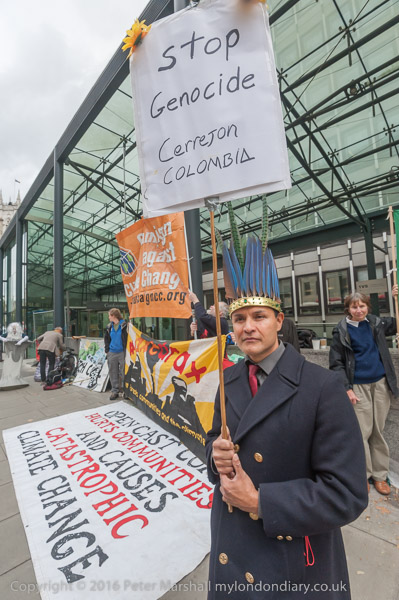
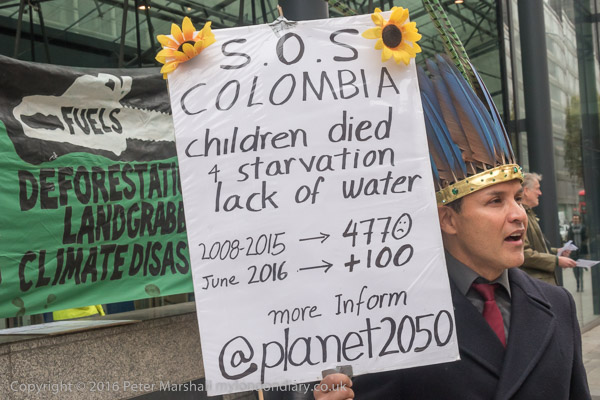
At the protest at the BEIS we heard a from a Colombian woman about the calamitous effect of open-cast coal-mining at the giant open-pit Cerrejón coal mine in La Guajira, northern Colombia. jointly owned by Anglo American, BHP Billiton and Glencore Xstrata.

Drax may now have ended burning coal and imports ended in 2020, but following the closure of UK mines all of the coal burnt there came from abroad, including from Colombia.

The Cerrejón mine is in Wayúu indigenous territory and the local people were not consulted when mining began there 30 years ago. Their land was simply seized and communities forcibly displaced in violation of their constitutional land rights and there was no proper compensation. Pollution and dust from the coal mine continues to contaminate the air and water supplies badly affecting traditional lifestyles; soil pollution leads to failed crops, and fishing areas have been contaminated.

Drax also had a carbon capture and storage project for its biomass plants, but this is only based on very limited trials and seems highly unlikely to ever have a significant effect, not least because the necessary infrastructure for the removal and storage of any carbon dioxide captured seems unlikely ever to be available. And by the time both the removal and disposal could possibly be implemented on any scale there will be absolutely no economic justification for retaining expensive sources of power such as wood burning rather than very much cheaper renewable generation.

AxeDrax protest against Biomass & Coal


Student Rent Strike protest – Holborn

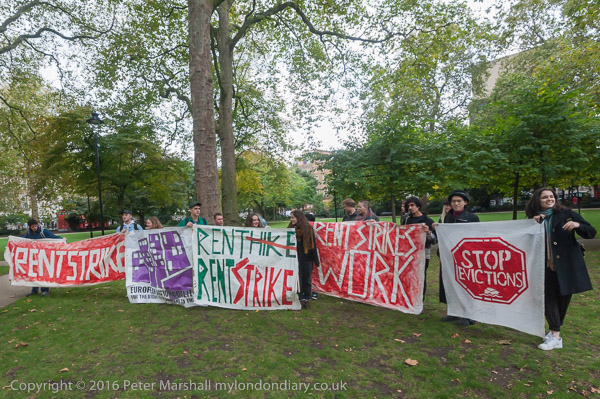
I went on from the BEIS protest to Russell Square where students were meeting to discuss student housing. Once halls of residence were largely an at-cost service provided by universities, but have now become big business for private developers.

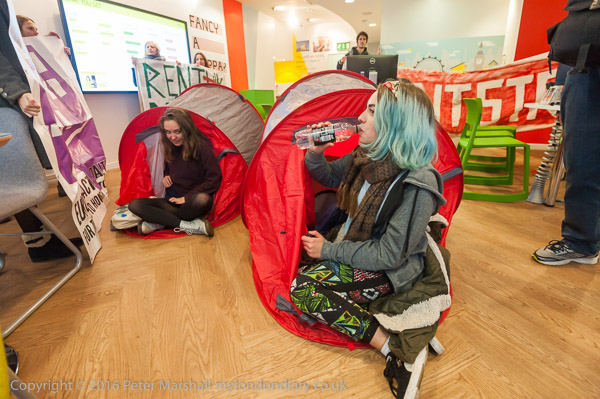
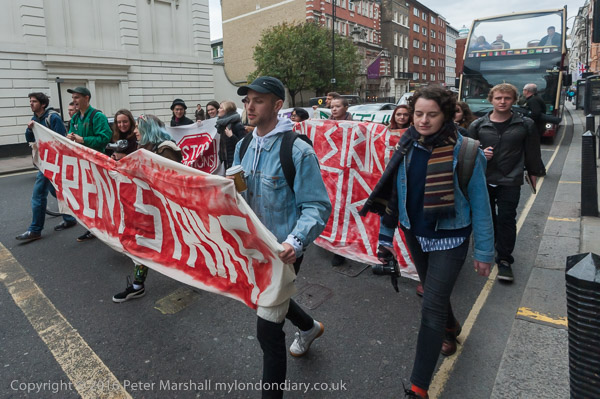
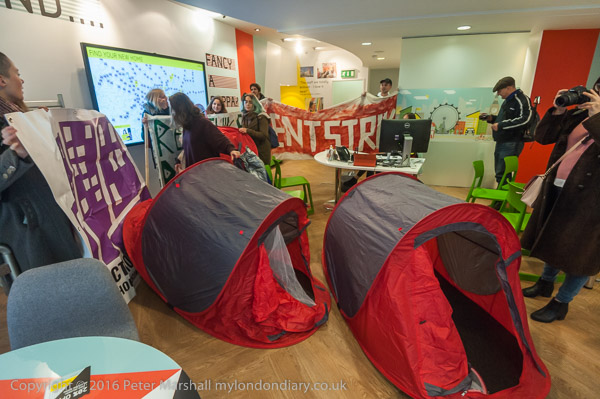
After some speeches they marched behind the #RENTSTRIKE banner to briefly occupy the nearby office of Unite Students, a FTSE 250 company housing around 50,000 students in the UK.

The event was a part of a nationwide series of protests taking place as investors and developers were discussing the rich profits to be made from students at the MIPIM conference, the world’s largest real estate market event in Cannes.

Many of the large new blocks of student housing have flats with rents larger than the entire student loan, higher than all but students from very wealthy families can afford, and are largely for letting to rich overseas students studying here.

More pictures at Student Rent Strike protest.


NHS, Shaker, Drax, Gurkhas, Herbalists & Bikes

Wednesday 24th April 2013 was a busy day for protests in Westminster. And there was one in the City.


Protest the Privatisation of NHS – Old Palace Yard

NHS, Shaker, Drax, Gurkhas, Herbalists & Bikes

The House of Lords was debating NHS regulations which imposed full competitive tendering on the NHS, a key part in the escalating backdoor privatisation of the NHS.

Unite had set up a ‘Wheel of Fortune’ game show hosted by people wearing ‘David Cameron’ and ‘Jeremy Hunt’ masks and listing the likely costs of various procedures due to the tendering system. They feared “that the coalition’s NHS policies, including a multi billion pound funding squeeze coupled with a massive reorganisation, will destroy the 65 year old health service, paving the way for a new marketised system where paying up to £10,000 for maternity costs or £13,450 for a new hip is the norm.”

NHS, Shaker, Drax, Gurkhas, Herbalists & Bikes

Unite said that already more than £20 billion of health costs go to private companies, who take their decisions on the basis of profit rather than the interests of patients. The Lords were debating a motion for the annulment of the regulations on the grounds that Parliament had been assured “that NHS commissioners would be free to commission services in the way they consider in the best interests of NHS patients“.

Protest the Privatisation of NHS


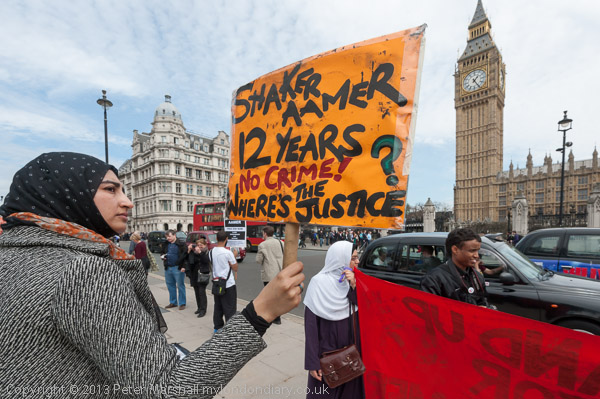
Bring Shaker Aamer Home – Parliament Square

NHS, Shaker, Drax, Gurkhas, Herbalists & Bikes

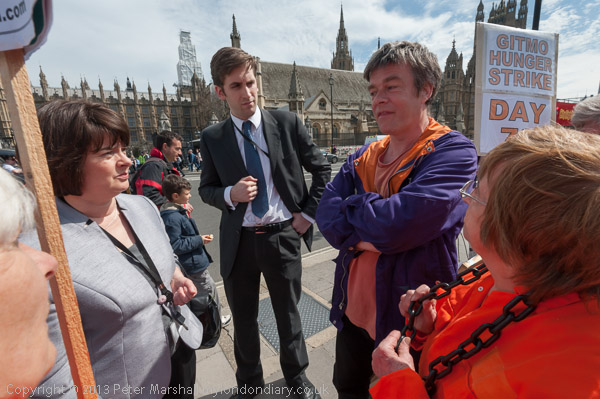
Following a petition with 117,387 signatures to bring Shaker Aamer home from Guantanamo, a debate had been held that morning by MPs in Westminster Hall, where most of the 17 MPs who spoke called for his release, including Shaker’s own MP, the Conservative MP for Battersea, Jane Ellison, who also came out to speak with the protesters.

NHS, Shaker, Drax, Gurkhas, Herbalists & Bikes

Unfortunately such debates, although they do increase pressure on the government to take action have no actual consequences. But perhaps it did help to persuade the government that it had to ignore the embarrassment of British agents at being complicit in his torture by the US and make clear to the US government he should at last be released after being held for 12 years, long after he had been cleared of any involvement in terrorism. As I noted, “The facts about torture are now largely public and totally indefensible and it is time for justice to be done.”

Bring Shaker Aamer Home


Drax Biomass Threat to our Planet – Princes St, CityDrax AGM, wpp

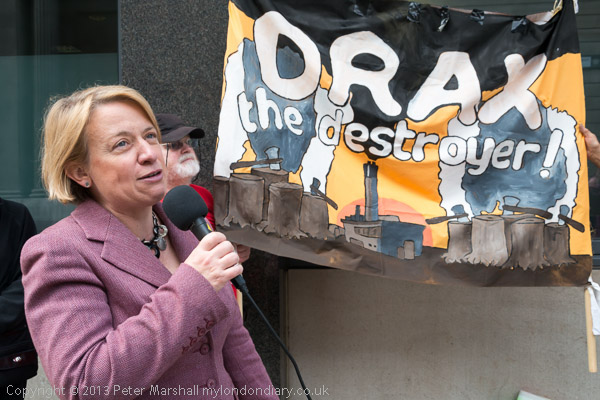
Green Party leader Natalie Bennett speaking at the protest

I had to take the tube to the City to attend a protest outside Gocer’s Hall where the AGM of Drax, the huge coal-burning power station near Selby in Yorkshire was being held. Drax was planning to convert half its capacity to bio-mass and become the largest biomass-burning power station in the world, using 1.5 times the total UK wood production per year.

The wood pellets would come mainly from devastating clear-cutting of highly diverse forests in North America, and although re-grown will eventually remove the same amount of carbon this will take a hundred years or more – during which time the carbon Drax emits – roughly 50% greater than burning coal – will be contributing to disastrous global warming.

Drax already has a disastrous impact in South America were land is being grabbed from traditional communities for open cast coal mining, usually with complete disregard for their human and civil rights, cleared of its biodiverse forests and diverted from food production – often in places where food is desperately needed. Conversion to wood-burning at Drax will result in even more environmental and social destruction.

The incentive to change to wood-burning is that under current government policies Drax will receive huge government subsidies from funds intended to promote renewable energy, diverting funds from schemes for energy production and conservation that actually will help to combat climate change.

Drax Biomass Threat to our Planet


Gurkhas Call for equal treatment – Old Palace Yard

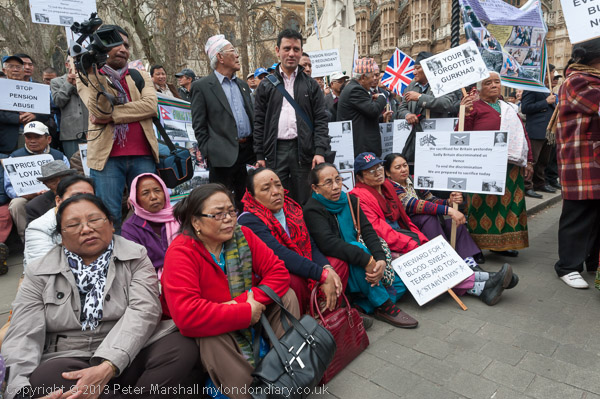
I returned to Westminster, where Several hundred Gurkha pensioners and supporters were holding a rally on the 198th anniversary of the first recruitment of Gurkhas into the British Army to deliver a petition to David Cameron asking for equal treatment to other British Army ex-soldiers.

British Army Gurkhas who retired before 1997 were granted the right to settle in the UK in 2009, but their pension remains only a fifth of that of other British soldiers, and is impossible to live on in the UK, being based on the cost of living in Nepal.

Gurkhas Call for equal treatment


UK herbalists Want Regulations – Old Palace Yard

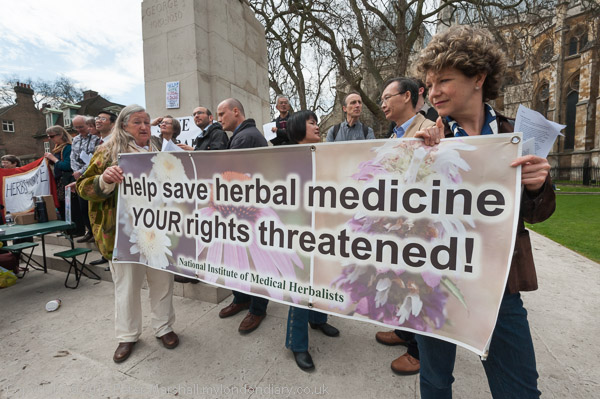
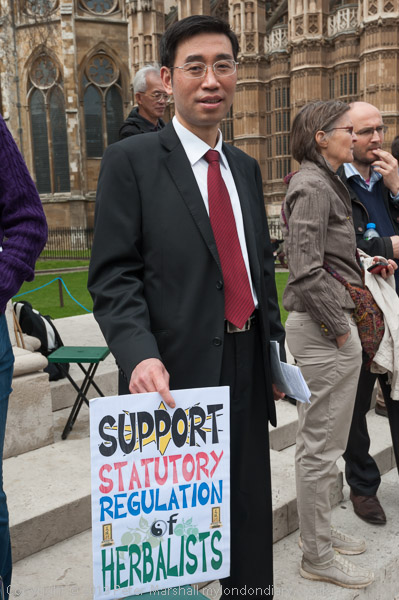
Also in Old Palace Yard were UK herbalists, both traditional and Chinese, protesting against the failure of the government to bring in the statutory regulations they had promised to do by 2012.

Under EU regulations from 2004, traditional remedies then in use could continue to be provided until 2011, but after that had to be covered by national policies to regulate their safety and effectiveness. Although the government had promised to set this up, it has so far failed to do so, and they are now unable to prescribe many commonly used and effective common herbal remedies.

UK herbalists Want Regulations


Get Britain Cycling Report Launch – Parliament Square

Finally, in Parliament Square, Christ Boardman, a gold medal cylist in the Barcelona Olympics posed with MPs from the All Party Parliamentary Cycling Group to launch their report ‘Get Britain Cycling.’

This calls for more to be spent on supporting cycling and that it should be considered in all planning decisions. They want more segregated cycle lanes and for the 30mp urban speed limit to by reduced to 20mph. Children should be taught to ride a bike at school and the government should produce and annually report on a cross-departmental Cycling Action Plan. Cycling has enormous advantages both individually and for us all in better health and reducing pollution with reduced health spending.

Get Britain Cycling Report Launch


Rail Fares, ISIS and Biofuels – 28 Oct 2014

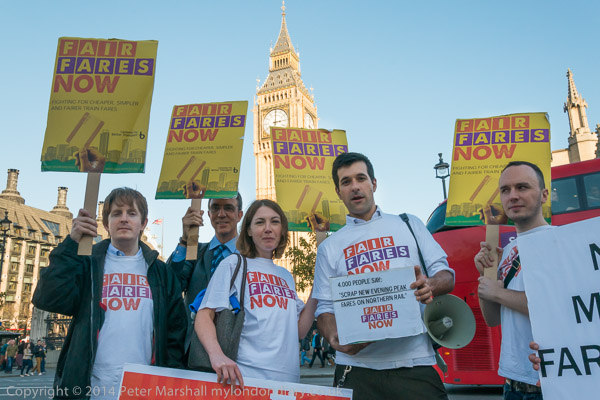
Fair Fares Petition – Westminster. Tue 28 Oct 2014

Eight years later problems with our rail system continue and no significant changes have been made. Rail is a textbook example of something which should be run as in integrated public service and privatisation has been an entirely predictable disaster, at least for taxpayers and particularly those who use the railways.

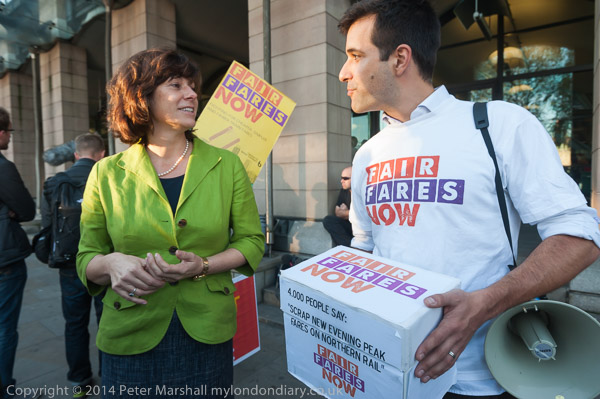
Campaigners met at the Dept of Transport in Horseferry Rd

It has of course been a bonanza for the companies that have run parts of the service, particularly the three large companies that own and hire out most of the rail carriages, engines and waggons. Three ROSCOs (Rolling stock leasing companies) – Porterbrook, Eversholt and Willow – own together 87% of the rolling stock – and have made huge profits for their shareholders while failing to invest a great deal in new rolling stock. They are almost entirely owned by German, Australian, Canadian and other multinationals, mostly registered in Luxembourg to evade tax.

Stephen Joseph OBE, executive director of the Campaign for Better Transport joins the protest

Probably most people now know that the companies that actually run the trains – Train Operating Companies or TOCs – are largely foreign owned, mostly by the nationalised railways of Germany, France and Holland, with a couple from Italy and one from China (Hong Kong.) We do now have three nationalised TOCs, ScotRail, Northern and Transport for Wales. So basically the railways proved a mechanism for our government to hand over large amount of our taxes to these foreign countries.

They stop to pose in Parliament Square

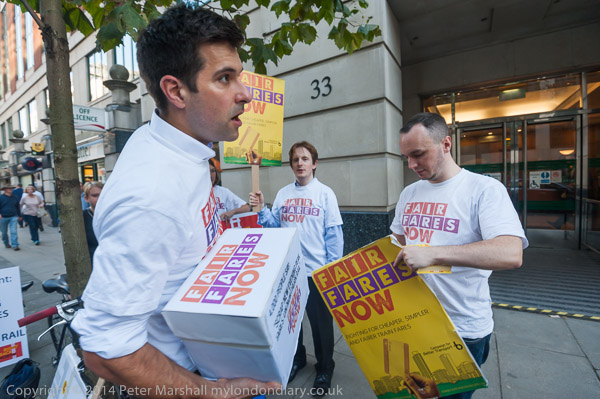
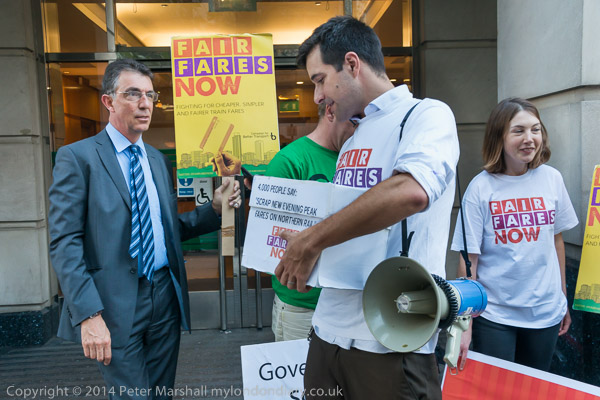
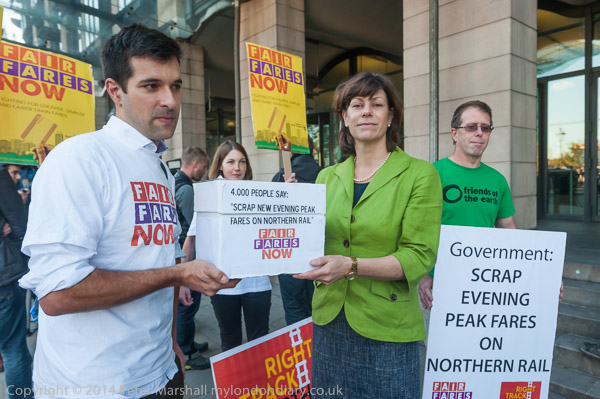
The Campaign for Better Transport protest on Tuesday 28th October 2014 was more simply about changes in the evening peak time fares introduced by Northern Rail, then I think run by Serco-Abellio, a subsidiary of the Dutch state railway. These changes have particularly hit shift and part-time workers who work irregular hours, resulting in a 167% increase for some. Other TOCs have since made similar changes – with the ‘Off-Peak’ fares no longer available on my line, having been replaced by much more restricted evening fares.

And then hand the petition to Rail Minister Claire Perry MP

Our whole incredibly complex fare system is also down to the fragmented privatisation, and often means people pay far more than necessary. Even the highly trained ticket office staff are often unable to find the cheapest fare, and machines and web services are often misleading.

Rail fares are now often ridiculously high, particularly for those unable to book in advance. It’s often cheaper to fly to America than take a train from one English city to another. Even the Advance fares (Introduced by British Rail before privatisation) limited to a specific train can be pretty huge, often several times the European fares for similar journey lengths. We need lower fares to encourage people to stop using cars and move to public transport.
More at Fair Fares Petition.


Kobane – Unite against Isis Drawing – Trafalgar Square, Tue 28 Oct 2014

Kurds chanted slogans against ISIS and in support of the defenders of Kobane around a giant pavement chalk drawing based on an agonised Statue of Liberty in front of London’s National Gallery in Trafalgar Square.
More pictures at Kobane – Unite against Isis Drawing.

Biofuel picket Green Investment Bank Birthday – King Edward Street, Tue 28 Oct 2014

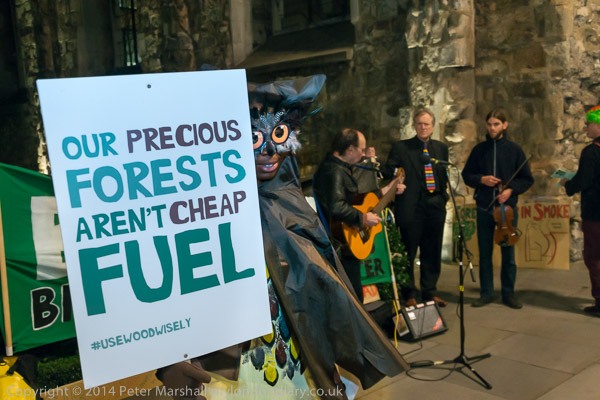
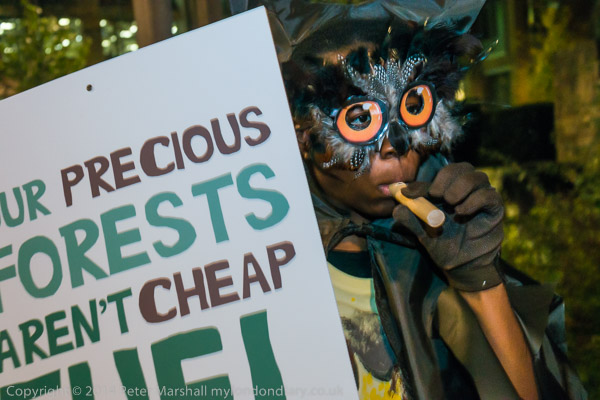
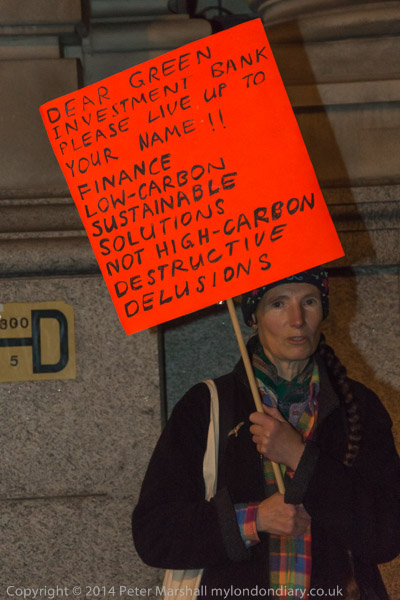
Protesters from Biofuelwatch and London Biomassive, some dressed as wise owls, picketed the second birthday celebrations of the Green Investment Bank at Bank of America Merrill Lynch against their funding of environmentally disastrous biomass and incineration projects.

The say the large-scale projects the bank funds are worse for the environment and for climate change than burning coal and urged the GIB to finance “low carbon sustainable solutions” instead of these “high-carbon destructive delusions.”

More at Biofuel picket Green Investment Bank Birthday.


XR, Drax and Knives

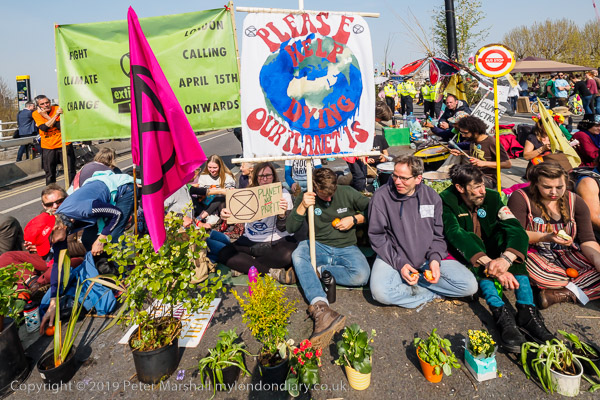
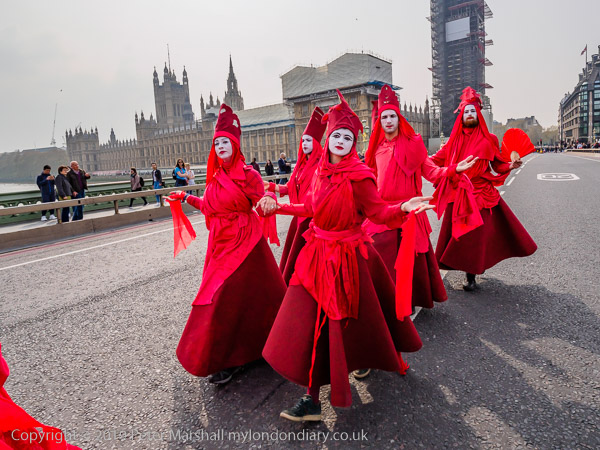
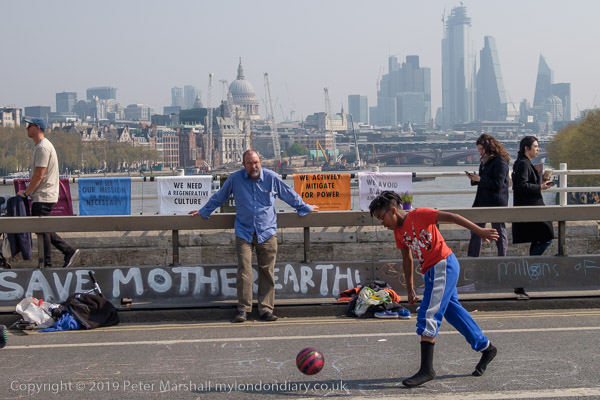
Extinction Rebellion‘s occupation of Central London was in its third day on Wednesday 17th April bringing traffic in the area to a standstill. And as there were no buses through the middle of London and those in the area around only moving at snail’s pace through near gridlock, the only way to move around was on foot or by tube. I chose to walk from Waterloo to Grocer’s Hall although the Waterloo and City line would have got me there in a fraction of the time so I could walk through XR’s ‘Garden Bridge’ still in place on Waterloo Bridge.

There were workshops and events taking place on the bridge, and only bicycles and people walking could cross. And although there was a strong police presence, while I was there they were simply standing around and watching, although I was told by the protesters there had been arrests earlier in the day, and there were people locked on below the lorry which was being used as a stage to make this more difficult to move.

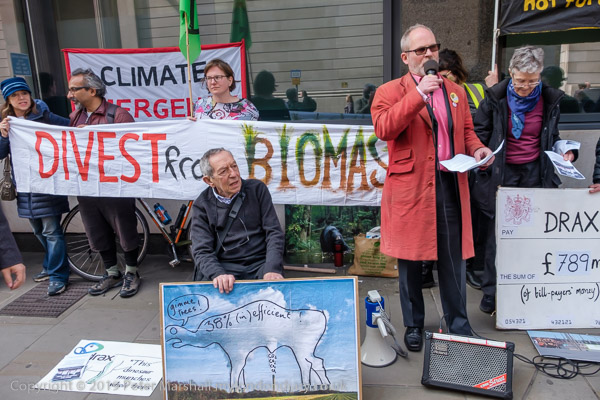
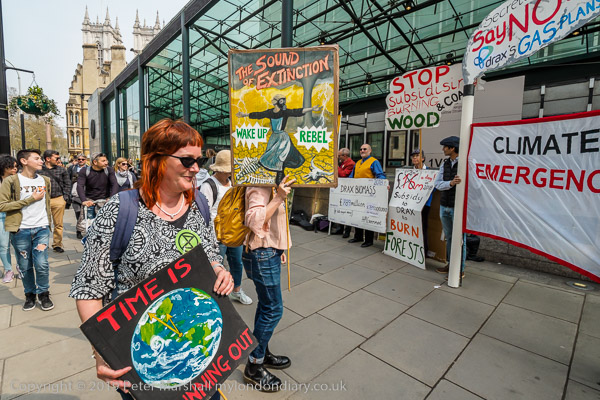
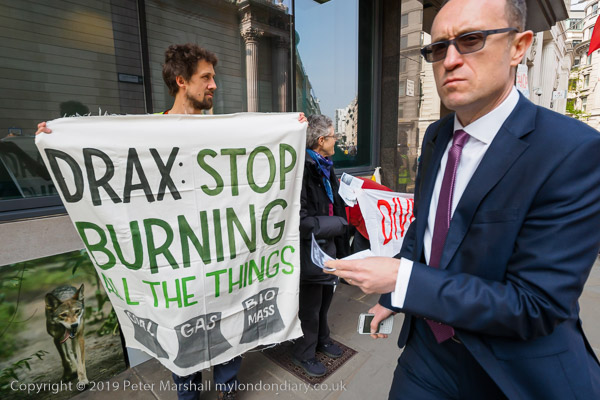
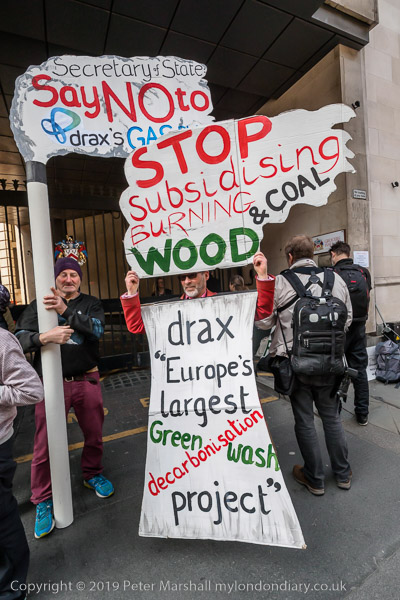
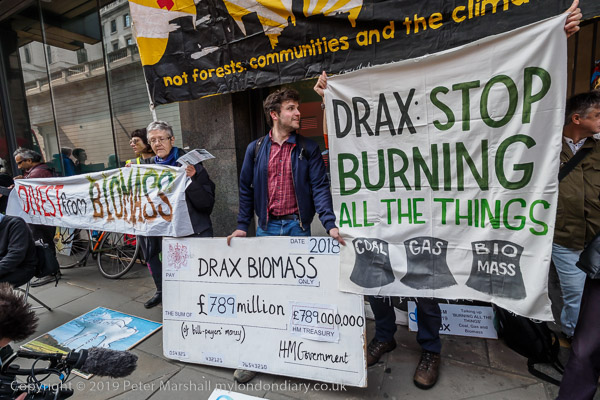
Axe Drax protesters against Drax, a huge power station in Yorkshire, were as usual protesting outside the Drax AGM taking place in Grocer’s Hall in the City of London against both the incredible output of greenhouse gases it produces and the environmental damage both from the coal it burns, imported from open-cast mines which are destroying the environment and communities abroad and the wood, largely from destroying American forests by environmentally disastrous clear-felling. Drax burns more wood than the total UK production each year, and in 2018 this produced over 13 million tonnes of CO2. But nonsensical rules on environmental subsidies means that in 2018 Drax got £789 million in subsidies taken from surcharges in our electricity bills for this massive climate changing pollution. And Drax was planning to increase its pollution by building the largest gas powered generating station in the UK.

I took the tube from Bank to go back to Westminster where XR were still blocking Parliament Square and the roads around, with activities going on in and around the square and tents filling much of Broad Sanctuary.

The Axe Drax protesters had moved from the Draz AGM and were holding a protest at the Dept for Business, Energy & Industrial Strategy demanding an end to environmental subsidies for massive pollution which make Drax and its huge pollution viable. These subsidies should be used as they were intended to promote genuinely renewable low-pollution energy energy sources such as solar, geothermal, wind and wave power rather than, as at Drax, increasing global heating. A few from XR had come along to support them.

Finally in a completely unconnected protest I joined the campaigners from Operation Shutdown, a consortium of “mums, dad’s and other bereaved family members and loved ones” supported by other campaigners, who had come to Downing Street calling for the community to unite and demanded more urgent action by the government to halt the growing epidemic of knife crime.

It would be hard not to feel their pain, but to demand stiffer penalties for knife and gun crime is not the answer, as we know this has not worked and simply results in the criminalisation of more in the community. But they also call for other measures some of which would certainly help in cutting these killings, mainly of teenagers and young males.


They want really determined and coordinated putting into action of the recently announced public health approach to knife crime. This has to include an end to cuts to local services including youth work and their restoration to pre-austerity levels, more adequate safeguarding, a coordinated approach to trafficking and grooming and abuse of children and young people and a proper sharing of information and accountability.

After the speeches the protesters marched the short distance to Bridge Street where they presented two wreaths to the police and held a silence in memory of PC Keith Palmer, killed at Parliament by terrorists.

They then moved on to Westminster Bridge where they sat down for another lengthy rally with more speeches by relatives of those who have been killed.

Knife crime Operation Shutdown
Drax Protest at BEIS
XR around Parliament Square
Drax wood burning must end
XR Waterloo ‘Garden Bridge’ continues


All photographs on this and my other sites, unless otherwise stated, are taken by and copyright of Peter Marshall, and are available for reproduction or can be bought as prints.


End rewarding Drax for pollution

I’ve never felt bad about having a bonfire in the garden. We generate a lot of small branches from various shrubs and trees that have to be regularly cut back, and it’s material that mostly won’t compost. And although we have several large compost bins, we’ve found from experience that they don’t get hot enough to destroy a few really tough and troublesome weeds, So these often get put on the bonfire too, though we could pay for the council to collect them as garden waste.

All this carbon release is of short-term carbon, mostly this year’s carbon, and there is no net increase in atmospheric carbon dioxide caused by our gardening.

And of course the bonfire produces carbon dioxide, but firstly it is only a fraction of the carbon dioxide which has been turned into wood and leaf in our garden, with the rest remaining locked in as our bushes and trees grow bushier and taller, or being eaten (and thus released) as fruit and vegetables. More too gets back in to the atmosphere from the green waste that does go into our compost bins.

Of course there are other pollutants from our very occasional garden bonfires, including particulates and doubtless toxic chemicals. But I am fairly sure that the amounts of these are relatively small and will add little to those already in our air here from the nearby roads, motorways and Heathrow.

But burning wood to produce electricity at Drax is a quite different matter. One obvious difference is that of scale: Last year Drax burnt 7.2 million tonnes of wood pellets, equivalent to at least twice that amount of green wood, and more than the UK’s total annual wood production, and released 13.02 million tonnes of CO2 into the atmosphere (in addition to another  4.36 million tonnes from coal and other fossil fuels.)

The wood burnt at Drax is ‘old’, having grown over many years, and even with the most sustainable forest planting to replace it will take more than 50 years. The majority of it comes as pellets from the USA, mostly produced from hardwood from the clear-cutting of biodiverse forest ecosystems, and the major producer, Enviva has been subject to heavy criticism both for its destruction of these swamp and wetland forests, and for locating its highly polluting pellet plants in areas of social deprivation already exposed to high levels of industrial pollution.

Drax’s carbon-producing wood burning is only financially viable because it gets huge subsidies. In 2018 these amounted to £789.2 million, This money comes from our energy bills which carry a surcharge, intended for promoting renewable electricity. It should not be used to promote highly polluting and essentially non-renewable wood burning. The subsidies are greater than the company’s annual profits and without them wood-burning would not be viable.

Drax also gets subsidies from the government for burning coal, though on a rather smaller scale, but also impossible to justify. For 2019/20 this is  £22 million, and similar subsidies are expected until 2025. It is also expected to be subsidised for burning gas, and wants to greatly expand its generation from gas.

These huge subsidies to Drax for its contribution to global warming come at at time when our government has slashed subsidies for truly renewable energy production from onshore wind and solar power as well as those for energy efficiency and conservation.

More about the protest outside Drax’s AGM in the City of London, and later outside the Dept for Business, Energy & Industrial Strategy (BEIS) demanding an end to environmental subsidies for massive pollution in two posts on My London Diary:
Drax wood burning must end
Drax Protest at BEIS


All photographs on this and my other sites, unless otherwise stated, are taken by and copyright of Peter Marshall, and are available for reproduction or can be bought as prints.

There are no adverts on this site and it receives no sponsorship, and I like to keep it that way. But it does take a considerable amount of my time and thought, and if you enjoy reading it, please share on social media.
And small donations via Paypal – perhaps the cost of a beer – would be appreciated.